




Introduction
In what ways do the structural and material interactions between sound, image, bodies and space condition the emergence of transmodal perception? More specifically, how do haptic granularity and spatial presence operate as constitutive vectors of immersion in an audiovisual work? This article proposes texture as a foundational compositional principle to interrogate these dynamics. By leveraging concepts of embodiment and immersion to analyse transmodal perception and scenophony, it examines the mechanisms through which texture organises sensory experience in audiovisual work. These reflections emerge from a practice-led research methodology where sound, image, technologies and environments are understood as continuously co-constitutive systems. This intermedial perspective demonstrates how audiovisual practice directly reconceptualises relationships between media.
This research is situated in the broader field of videomusic, specifically in the work of Jean Piché (Reference Piché2003). Piché describes videomusic as a hybrid form where sound and moving image emerge in a shared compositional process. Perception arises from the interaction of sonic, visual and temporal materials, creating continuity in movement, rhythm, texture and behaviour. This practice reflects the deep link between electroacoustic composition and digital imaging; both rely on editing, transformation, layering and temporal organisation. Meaning emerges from the relations between sound and image, blurring the line between hearing images and seeing music. This interplay extends tactile perception, offering a visual experience rooted in touch and proximity, where images seem to vibrate with sound, effectively dissolving the divisions between seeing, hearing and physical sensation.
These relations rely on an embodied and immersive understanding of perception. Following Maurice Merleau-Ponty (Reference Merleau-Ponty and Landes2012 [Reference Merleau-Ponty and Landes1945]), embodiment treats the body as the primary, active site of experience. In audiovisual art, for example, the perceiver feels the grain of a sound or the flicker of light as a physical sensation. This process crosses the senses, merging media into a single entity. Such physical engagement can foster immersion, a state where sensory and attentional boundaries between the work and the perceiver dissolve. As a situated phenomenon, immersion is a physical response to the sonic and visual environment that anchors the perceiver in the present moment.
To examine these dynamics, it is necessary to clarify the conceptual distinctions between space, place and environment that ground this study. Following humanistic geography and phenomenological perspectives, space is understood as an abstract, physical or geometric extension – the technical and architectural layout of the dispositif. Space becomes a place when it is invested with human experience, presence and affective meaning; it is a locus of situated encounters where the subject’s history and senses come together. As Yi-Fu Tuan (Reference Tuan1977) suggests, this transformation turns an unfamiliar, open space into a security-clad, lived place through the process of habitation. Moving beyond a simple container-content dichotomy, the term environment is considered as a dynamic, relational totality, aligning with the concept of milieu explored later in this text (Solomos Reference Solomos2016). Far from being a passive backdrop surrounding an isolated object, the environment is thus a network of continuously interacting forces where vibrations, media and bodies intertwine. In the audiovisual context, this definition extends to the physical site of dissemination where works take shape and are shared, operating as the precise point where these creations encounter architectural spaces and broader environmental realities.
My creative practice operates within this framework, transforming technological spaces and places through the generation of fluid, transmodal environments. This article presents a series of reflections that demonstrate this approach, focusing on texture as the primary means to achieve this transformation. The videomusic Nuées (2016, translated as Flocks) serves as a case study to explore this dynamic, alongside a broader body of audiovisual works and live performances developed in the context of improvisation and environmental listening.
Methodological framework: Embodied practice and non-representational inquiry
This article adopts a practice-based and autoethnographic methodology grounded in phenomenological reflection, audiovisual analysis and site-specific practice. Here, site-specific refers to creative processes developed in direct relation to particular places, predominantly outdoors. The phenomenological dimension draws on Merleau-Ponty’s (Reference Merleau-Ponty and Landes2012 [Reference Merleau-Ponty and Landes1945]) understanding of lived experience as grounded in bodily perception and situated interaction with the world. Perception is an active, participatory mode of engagement where meaning develops relationally. This orientation resonates with heuristic and non-representational perspectives (Vannini Reference Vannini2015) and Dewey’s (Reference Dewey1934) pragmatism, which treats art as experiential inquiry where knowledge arises from situated action. These methods remain attentive to processes in motion, making them vital for audiovisual creation where sensory elements continuously shift according to bodies, technologies and environments.
Artistic practice constitutes a site of embodied inquiry and heuristic exploration. Knowledge emerges from the creative experience, encompassing rehearsal, spatial adaptation, observations, listening sessions, field recordings and video footage. Interactions with places further inform this process. Responses arising during concerts and other public presentations contribute to the research, with particular attention given to moments of instability and intuitive decision-making.
These explorations place texture at the centre of the creative process, defining relations between sonic and visual materials to structure modes of attention. What is seen and heard generates atmospheres that shape the aesthetic experience. These atmospheres rely on Gernot Böhme’s (Reference Böhme1993) perspective, which prioritises felt, sensuous experience over the analysis of what an artwork signifies or how it communicates. Taking the specific example of a painting, Böhme argues that focusing strictly on textual interpretation risks ‘denying the experience of the presence of the represented, namely the atmosphere of the painting’ (Böhme Reference Böhme1993: 115). In my practice, this presence operates through affective tonalities that circulate continuously in the interstitial space between the subject’s body and physical things. This sensory engagement unfolds in media environments shaped by architectural and atmospheric conditions, where the boundaries between the physical and the digital, the material and the representation or the real and the mediated, are increasingly porous.
Listening as a relational, multisensory and creative practice
Inhabiting these porous media environments requires listening as a form of focus and openness, which constitutes a relational, multisensory way of inhabiting space. This ecological attentiveness involves the self, others and surroundings simultaneously, drawing on Félix Guattari’s (Reference Guattari1989) ‘three ecologies’ and Makis Solomos’s (Reference Solomos2016) reflections on the ecology of sound. For Solomos, this means ‘taking care of sounds, because it is through them that listening is activated and it is through them that we also become aware of the world around us’ (Solomos Reference Solomos2016: 6, my trans.), adding that even when sounds are reproduced, ‘their diffusion makes the space in which we exist resonate, in the same way that our footsteps, when we walk, make us aware of where we are, as much as, if not more than, our gaze’ (Solomos Reference Solomos2016: 6, my trans.). This reflection is anchored in the idea that ‘there would not be sounds, but sound milieus’ (Solomos Reference Solomos2016: 6, my trans.), a concept that takes shape when sound is understood as ‘a network of relations: to other sounds, to the surrounding space, to the listening subject’ (Solomos Reference Solomos2017: 3, my trans.). Environmental, social and mental dimensions thus shape lived experience, positioning sound as a milieu connecting bodies, technologies and affects rather than an isolated object.
This rejection of the sonic object aligns with the broader shift towards an ontological co-existence between sound and listener as defined by Roberto Barbanti (Reference Barbanti2011):
‘The notion of ontological “co-existence” refers to a form of immanence and belonging to the world, to a common vibration that resonates my being with the moving energies of other beings, objects or natural elements vibrating here and now. […] If sight is the only sense that requires a distance from the object to function and thus deploy itself as it is, hearing immediately raises the question of “non-separation”’ (Barbanti Reference Barbanti2011: 13, cited in Solomos Reference Solomos2017: 7, my trans.).
Drawing on this notion and Tim Ingold (Reference Ingold2000), Solomos argues that ‘[we] inhabit sound, just as we inhabit the world’ (Solomos Reference Solomos2017: 7, my trans.). This perspective dismantles the computational model of perception in favour of an ecological approach. Following James J. Gibson’s (Reference Gibson1979) theory of visual perception, this stance asserts that the brain is not an information processing system and that stimuli, whether sonic, visual or otherwise, are not objects to be processed. This understanding connects with research in multisensory perception and crossmodal correspondences, which suggests that sensory modalities interact dynamically in lived experience instead of functioning as isolated channels (Marks Reference Marks1978; Spence Reference Spence2011). Building upon Solomos’s (Reference Solomos2017) framework while extending it to the multisensory realm, this necessitates a continuous conceptual effort to grasp the absolute indissociability between the vibrating or emitting object, the milieu in which the energy propagates and the perceiving subject.
In this sense, I approach my works as dynamic environments where the emergence of relational dynamics and the plasticity of sensory materials shape artistic experience directly. I do not treat sound and image as isolated materials awaiting formal organisation, nor do I impose fixed conceptual systems in advance. Instead, composition develops from situated encounters. Materials, places and people interact with my presence, memory, feelings and emotions. Compositional thought and sensory experience shape one another. This posture persists even when a work appears finished, as each presentation transforms the piece in relation to new spaces and audiences.
Such an understanding finds inspiration in Pauline Oliveros’s (Reference Oliveros2005) deep listening, which foregrounds expanded sensory awareness and remains notably central to my VJ practice. In this improvisational context, I avoid synchronising visuals to fixed timelines or predetermined correspondences, instead responding to evolving musical and affective conditions. Images are dynamic materials that intensify, dissolve, destabilise or recede based on rhythmic tension, timbral density and changes in collective atmosphere. Decisions are made through real-time performance, shaped by the acoustic properties of the space, architectural lighting, audience movement and the energy of collaborating musicians.
Improvisation strongly informs my videomusic and audiovisual performances, positioning the notion of play as the foundation of my entire approach. I compose in the studio first by playing and improvising on the synthesiser, which has remained my primary instrument. I replay recorded tracks and improvise further upon these layers to develop a musical form and discourse. During this process, I also generate visuals in real time via VJing software, allowing for the simultaneous composition of sound and image or a continuous back-and-forth exchange. This process integrates the sounds, images, impressions and sensations of places in Quebec, Canada, that I have inhabited or frequented over many years. It is grounded in soundwalks, photography and note-taking, even allowing for wandering and reverie. Consequently, artistic ideas emerge only after prolonged periods, often years before their realisation. For instance, Tuning of the Field (2022) draws on childhood memories of agricultural fields in the Montérégie region and the sounds of summer insects, while Marées (2025) developed from three consecutive stays in June over a three-year period in Charlevoix, where I focused on the wind in the leaves and the tidal cycles of the St Lawrence River. Similarly, I developed an obsession with the sound of wingbeats and dense masses of birds after spending hours with the pigeons at Gare Jean-Talon in Montreal, a site I frequented regularly having lived in the neighbourhood for years. This fascination resulted in Nuées (2016), which I discuss in greater detail later in this article.
Embodiment and immersion
While listening practices establish an ecological foundation, they also facilitate a deeper entry into the processes of embodiment and immersion. Building upon previous phenomenological definitions, these dynamics operate as complementary forces rooted in Hartmut Rosa’s concept of resonance (Rosa Reference Rosa2018). Resonance describes a responsive and reciprocal relation in which subjects are simultaneously affected by and responsive to the surrounding world. In this context, immersion depends upon embodiment as the primary locus of sensory reception, while the physical self requires an enveloping sensory field to activate its relational potential.
In concert halls or theatres, technological devices and intensity can strengthen immersion without defining it. Indeed, immersion remains primarily a posture of receptivity towards a specific mediated context, arising from the pre-existing affective state and somatic conditions of the perceiver. Moving beyond simple external stimuli, this state reflects the totality of a subject’s disposition, encompassing both the residual impact of prior activities and the anticipation of future concerns. Immediate bodily sensations, such as heat, fatigue or pain, further shape this internal terrain, determining the capacity for engagement at any given moment. Crucially, this disposition relies on a willingness to inhabit the proposed artistic world, reflecting a voluntary desire to believe in the virtual environment. This inclination aligns with Michel Chion’s audiovisual contract (Reference Chion and Gorbman1994 [Reference Chion and Gorbman1990]), a concept describing a symbolic agreement where the perceiver consents to apprehend sound and image as a singular, unified reality, even where this does not correspond to the real world. By accepting this pact, the subject agrees to overlook the technical separation of media, allowing for a coherent and immersive experience of the work. Consequently, immersion implies an internal opening. It is a physical and mental readiness that anchors the individual in the present moment even before any technological interaction begins.
Building upon this readiness, the audiovisual experience functions as a relational encounter between the subject and the mediated environment. Creative immersive practice invites a necessary letting go, where the artist cultivates conditions that encourage a departure from expectations to welcome the sensory flow. In this complex relation between the subject, the technological dispositif and the shared presence of others and things, the boundaries of perception destabilise. Dancefloor culture offers a particularly revealing example. Sound diffusion, rhythmic synchronisation, projected visuals and collective energy create a shared space where the boundaries between the real and the virtual grow unstable. Music turns into colour, unfolds in light and image, and resonates across the body. Visual textures, colours and luminous patterns shape the atmosphere while influencing the subject’s sense of presence and orientation. Bernard Andrieu (Reference Andrieu2016) describes these immersive states as forms of trance marked by osmosis, ecstasy, symbiosis and vertigo. Perception loses its stable limits as participants merge with the encompassing whole.
Texture as a transmodal property: Sound, image and touch
Beyond the specific energy of the dancefloor, embodied conditions manifest across a broad spectrum of bass-oriented and rhythm-driven musical landscapes. Bass and rhythm transcend a simple metric pulse to encompass the oscillations, cyclical patterns and repetitions characteristic of drone, ambient and electroacoustic compositions. Within such works, sonic texture functions as a temporal organiser, transforming repetitive structures into a lived experience of time. Experimental studies demonstrate that low frequencies influence temporal perception and neural synchronisation behaviour (Hove et al. Reference Hove, Marie, Bruce and Trainor2014; Lenc et al. Reference Lenc, Keller, Varlet and Nozaradan2018). They reverberate across vestibular and somatosensory pathways, generating physical sensations that intensify auditory experience (Todd et al. Reference Todd and Lee2015). They resonate in the chest, stomach and skin, creating what Luis Manuel Garcia-Mispireta describes as a haptic experience of listening (Reference Garcia-Mispireta2023: 71–72).
Haptic channels communicate rhythmic and timbral information with remarkable precision, at times approaching auditory performance. This suggests the potential for multimodal compositional strategies where perceptual experience is organised through various physical inputs (Holland et al. Reference Holland, Bouwer, Hödl, Papetti and Saitis2018). Rhythm and timbre function as a multisensory organiser of time and movement. While regular pulses often elicit whole-body responses, timbral variation generates more localised motor and attentional reactions (Huang et al. Reference Huang, Gamble, Sarnlertsophon, Wang and Hsiao2012; Burger et al. Reference Burger, Thompson, Luck, Saarikallio and Toiviainen2013). Timbre is a structural tool, shaping specific tactile and affective qualities through saturation, filtering and spectral transformation (Garcia-Mispireta Reference Garcia-Mispireta2023: 75). This materiality contributes to auditory differentiation and grouping, determining how sonic layers are distinguished and how contrasts manifest even in moments of total sensory saturation (Hallam et al. Reference Hallam, Cross and Thaut2016). Such saturation, pressure and micro-variations engage the body with particular intensity, producing physical impacts that perceivers feel as much as the sound itself. Consequently, these sonic textures dissolve the divisions between physical and auditory sensation, anchoring the subject in a state of immersion.
Etymologically, the term texture derives from the Latin textura, meaning weaving or interlacing, and from the verb texere, signifying the act to weave, construct or interconnect (Lewis and Short Reference Lewis and Short1879: 1865). This origin remains significant because texture concerns the organisation of multiple elements into a coherent organisation. Texture may therefore be understood as a transmodal property linking sonic, visual, spatial and tactile experience. Sonic grain may correspond to visual granularity, dense spectral saturation may evoke visual opacity, while smooth drones may relate to monochromatic visual fields or slow continuous movement.
The body acts as a vessel where sonic textures propagate across biological tissues and sensory structures, generating vibrations felt directly. When listening to them, one may experience tingling or other physical sensations utilised in practices such as sound baths or Autonomous Sensory Meridian Response (ASMR). Despite the absence of direct vibration, visual stimuli still trigger tactile imagination and proprioceptive memory via visual textures, allowing the eye to feel surfaces via sensory association. The roughness of bark, the softness of fabric or the fluid movement of water may evoke physical sensation even in the absence of direct contact. Touch therefore acts as the fundamental anchor of this transmodal experience, where the haptic sense validates the information gathered by the ears and eyes. This integration of the senses aligns with Eve Kosofsky Sedgwick’s assertion that a profound intimacy exists between texture and feeling (Sedgwick Reference Sedgwick2003: 88). For Sedgwick, texture functions as an active point of contact, inviting a physical and affective ‘reaching out’ that moves beyond the concept of a neutral surface. When audiovisual compositions engage the body multisensorially, this intimacy is a catalyst for immersion. The grain of a sound or the density of an image moves beyond the representation of sensation to activate a pre-reflective state, transforming the subject’s body from a distant receiver into an inhabitant of the mediated space. By operating at this intersection of the tactile and the emotional, transmodal textures bypass purely cognitive interpretation, anchoring the perceiver in a situation of immediate, lived presence.
I constantly seek to explore material intimacy through texture, rooting my practice in outdoor environments. Touching surfaces, sensing atmospheres, being absorbed in light conditions, heat or cold, or exposed to rain, wind, mud and snow all contribute to the development of compositional ideas. This interaction creates a transduction between these experiences and audiovisual composition, representing a circulation of sensations, activities or forms from one context into another where one mode of engagement gradually reshapes another. This process transforms compositional thinking, encouraging a necessary openness to instability, adaptation and unpredictability. I remain drawn to the sounds and images of water, clouds, vegetation or birds. While keeping the origins of these recorded materials recognisable, I focus on textures that touch me through their physical qualities and the material imagination they generate (Boucher Reference Boucher and Knight-Hill2020). This dynamic flow strengthens the intimate bond between the work and the body, expanding the notion of being touched to encompass physical sensation and emotion. This dual resonance is reflected in the verb to touch, defined as ‘to make contact with, and related senses in which physical contact is the dominant idea’ as well as the capacity ‘to affect [a person or their mind and heart] with a feeling [or] emotion’ (Oxford English Dictionary 2026).
My practice therefore seeks to capture the haptic and affective essence essential to musical transformation. I embrace memory as a creative source because it provides a living representation inextricably linked to felt experience. Memory functions as an interpretation that brings me closer to being touched. As Henri Bergson demonstrates in Matter and Memory (Reference Bergson, Paul and Palmer1911 [Reference Bergson, Paul and Palmer1896]), a ‘pure’ present is an abstraction. Every perception functions as a contraction of spirit and matter, where the present is inherently saturated with memory. These recollections function as active forces that interpret the material world. Consequently, I reconstruct most sounds via synthesisers and noise generators, subsequently incorporating recordings of objects, instruments and collaborations with musicians chosen for their specific sensitivity. When field recordings are integrated, they are merged into these hybrid textural masses so that the distinction between the artificial and the real is no longer clear. This process applies equally to images, which are reprocessed or held in constant morphing with synthetic forms, digital effects and occasionally found footage. Beyond serving as a metaphor for memory, this textural fluidity, where porous boundaries allow for a continuous overlap between the recognised and the synthetic, mirrors a natural state of existence. We constantly journey between tangible reality and the virtuality of our thoughts, memories, imagination and reveries. Far from being an artificial construct, this fluidity is a fundamental human need that allows us to navigate the world and engage in the profound transmodal experiences discussed in this text.
Expanding this transmodal connection to the visual dimension reveals how perception operates through a distinction between material and represented textures. While maintaining an overall audiovisual focus, examining visual texture independently clarifies how its haptic properties differ from those of sound. This distinction defines material texture as the physical properties of the recording and display medium, while represented texture involves the images recorded and presented. These categories coexist or transition into one another, either enhancing or diminishing the haptic quality of the image.
In analogue cinema, material texture involves grain, scratches, splicing and further traces of manual intervention on a 16 mm film. As Basak Kaptan Siray argues, such interventions transform the cinematic surface into a haptic space where the viewer experiences the image as a direct tactile encounter, moving beyond distant representation (Kaptan Siray Reference Kaptan Siray2021). This transmission allows the physical energy of the filmmaker’s gestures to translate into a felt sensation for the viewer. This tactile presence extends to the conditions of projection, where flickering light and the mechanical rhythm of the equipment emphasise the physicality of the support. Represented textures recorded on the celluloid interact with the film’s material qualities to create a layered surface, bridging the gap between the eye and the hand.
Similar dynamics persist in digital environments, although material texture is less prominent because of the medium’s intangible nature. Through the transmodality discussed earlier, viewers perceive tactile qualities that remain physically untouchable, aligning with Laura U. Marks’s concept of haptic visuality, where the eye functions as an organ of touch (Marks Reference Marks2000, Reference Marks2002). Techniques such as glitch, pixel displacement, distortion and noise operate as digital equivalents to the scratches of analogue film. These intentional errors break the screen’s transparency to invite the viewer into the granular density of the data, acting as a form of material texture. Just as analogue filmmakers like Stan Brakhage used burning to foreground the celluloid, digital distortion reveals the underlying architecture of the image, transforming data into a tangible surface. Projection mapping further extends this sensation by casting digital images onto architectural structures, fabrics or reliefs. Other techniques facilitate this sensation of haptic materiality, as demonstrated by artists such as Refik Anadol, who creates digital collections where algorithmic flows and data accumulations acquire material density via saturated colour and spatial renderingFootnote 1 . As seen in Anadol’s work, this effect is reinforced by ultra-high-definition video content and the quality of the display system.
Indeed, once integrated into audiovisual environments, visual texture becomes inseparable from its conditions of diffusion. Contemporary technologies, including 4K, 8K and large MicroLED displays, produce highly defined luminous surfaces with intensified brightness, contrast and colour saturation. By generating such extreme visual density, these interfaces fundamentally shape tactile and haptic perception. While excessive smoothness may flatten the image, ultra-high definition frequently functions as a catalyst for a different haptic experience. When resolution reaches a certain threshold, the medium becomes transparent. The screen vanishes, allowing the visual texture to manifest as a tangible 3D object. Within this extreme definition, the image appears to detach from the screen, acquiring volume and physical presence that transcends mere representation.
Technology, scenophony and perceptual deviations
Tools of creation and technological diffusion remain essential parameters for our analysis, as they constitute the physical foundation for audiovisual experiences. Technological mediation and external stimuli shape perception as much as embodied interaction with environments. Immersive dispositifs reorganise associations, spatial orientation and bodily awareness, often destabilising habitual frameworks. Approaching immersive systems less as visual or sonic containers than as experiences shaped by spatialisation and the deliberate organisation of architectural volume therefore appears essential. Such environments materialise via configurations like speaker domes, multi-channel arrays or fulldome video projections, requiring a rigorous economy of means as theorised by Agostino Di Scipio (Reference Di Scipio2015). This principle prioritises the qualitative relationship between technical resources and aesthetic experience, acting as a critical resistance to technological abundance and the mere accumulation of tools. Aesthetic choices thus become essential to prevent sensory overload, as high densities of stimuli otherwise risk overwhelming the perceiver and disrupting focus. What matters most is the capacity of an environment to sustain affective resonance, sensory ambiguity and what I describe here as perceptual deviations, referring to instances where the boundaries between the mediated work and the physical environment grow porous or ambiguous.
The neologism scenophony provides the framework needed to activate these deviations. Coined by Gilles Malatray (Reference Malatray2011) from the term scenography, it addresses the acoustic and embodied dimensions of spatial experience. This concept was developed further by David Ledoux et al. (Reference Ledoux, Meneses and Baltazar2025) within spatial audio research at the Society for Arts and Technology (Montreal, CA), where it refers to the design and realisation of sound space as a whole. It focuses on the acoustic situation perceived by listeners within a given environment. By linking fields such as sound design and musical composition with psychoacoustics, architecture and immersive storytelling, scenophony operates as an ‘undisciplinary’ practice, as Ledoux et al. describe it. This perspective is relevant to audiovisual creation as it frames spatial audio as a relational ecology involving bodies, movement, materials, acoustics and specific listening behaviours. It specifically critiques conventional ‘sweet spot’ models that assume an idealised listener fixed at the centre of a space or a frontal orientation. Scenophony prioritises audience mobility and collective forms of listening over static arrangements.
A significant element of scenophony is the distinction between actual and virtual spaces. This duality serves as the primary engine for perceptual deviation, fostering the conditions for immersion. Actual space refers to the physical environment inhabited by the audience, while virtual space designates the mediated sonic and visual environments produced within the artistic work. Immersion arises through the interaction between these dimensions or, to borrow Bruno Trentini’s phrasing, from unstable relations between the actual and the mediated (Trentini Reference Trentini2014). It takes shape in this zone where sensations from the surrounding world and the artwork carry equal perceptual weight.
Sound provides a clear example of this process, where questions arise around the localisation and identification of sources. Listeners may wonder if sounds come from people within the performance space, exterior activity, resonant architectural surfaces or hidden loudspeakers. Sonic textures can absorb ambient sounds or merge with environmental noise such as ventilation systems and exterior wind. Sounds beyond the music also possess the potential to form synchretic relationshipsFootnote 2 with projected images, where textures provide the most effective elements for establishing connections through behavioural synchresis Footnote 3 . Sound and image relationships consequently rely on physical and affective schemata to generate audiovisual metaphors rooted in bodily experience, memory and history before conscious interpretation takes place. Within this relational and affective framework, the body functions as the primary site where audiovisual experience is continuously negotiated. Texture is therefore more than an attribute of artworks. It is an event that binds audiovisual experience to embodied life, ensuring that perceptual deviation is felt as a physical reality.
Navigating the interaction between actual and virtual spaces requires remaining open to unplanned events and environmental contingencies. As our perceptual systems continuously attempt to orient themselves among ambiguous conditions, perceptual deviations manifest most intensely. To cultivate this in audiovisual experiences, I bring the work into direct interaction with the presentation environment through specific spatial and material adaptations. In terms of sound, this includes the integration of ambient noise, additional loudspeakers, acoustic instruments and spatialisation strategies. Visually, my VJing practice involves placing images in direct relation to the architectural space, often incorporating semi-transparent fabrics, reflective materials and fog to introduce volume and shifting light into otherwise frontal projectionsFootnote 4 . When working with musicians, I account for every visual element of their presence, often collaborating with scenographers and choreographers to ensure that their playing, gestures and bodies integrate seamlessly with the broader environment. This multisensory orchestration transforms the performance space into a shared site of transduction where the tangible and the intangible converge. This porosity between the physical and the virtual reflects the fluidity established throughout this text, linking the interplay of material and represented textures with the dual nature of physical and affective touch.
Analytical case study: Perceptual deviation and texture in Nuées
One experience profoundly shaped my understanding of immersion, particularly in relation to perceptual deviation. It took place in 2017 at the Centro Mexicano para la Música y las Artes Sonoras (CMMAS) during a concert presentation of Nuées Footnote 5 (2016). This videomusic piece features bird flights and wingbeat sounds. It was staged in a hall with eight loudspeakers surrounding the audience, where one side of the venue had large windows overlooking the landscape at sunset. I chose to leave the windows uncovered, even though the remaining daylight slightly altered the visibility of the projections. Birds could be seen flying outside against the orange evening sky, creating a colour atmosphere aligned with the visual palette of the work. This acted as a visual extension of the screen, as if the outside world echoed the piece. Unlike the acoustic experience, this was not a literal blend because the distinction between the screen and the exterior remained perceptually clear. Leaving the windows open also allowed exterior wingbeat sounds, bird calls and ambient noise to mix with the sound diffusion. This merging provided an incredible depth of field where sounds were perceived as near, far or even distant, appearing to belong to the composition. By blurring the limits between the work and the world, this spatial openness instantiates Barbanti’s (Reference Barbanti2011) notion of non-separation discussed earlier.
This experience illustrates how immersion may be cultivated through relatively simple conditions. For the artist, it often involves remaining attentive to what is already present, letting go of rigid control and adapting to the particularities of a place. By allowing the outside world to penetrate the concert hall, the technical apparatus ceases to function as a closed system. It is a matter of following the flow of an environment, recognising that the perceiver and the work resonate within a common vibration. Even a fixed videomusic piece remains in continuous transformation each time it is shared, as it integrates the moving energies of its immediate environment.
Beyond these environmental dynamics, perceptual deviation also shapes the composition of sonic and visual textures. The piece oscillates between textured masses and changing spatial planes, tracing an energetic trajectory in which it becomes difficult to determine exactly what is being seen or heard. This lies at the centre of the transmodal dimension of texture. I describe this process as transmodal textures in motion, a concept that foregrounds the instability of sensory categorisation in audiovisual perception. By subjecting recorded and found footage to continuous transformation, a constant movement between the real and the abstract is generated. Elements initially recognised for their representational qualities shift. This fluidity challenges fixed cognitive categories, allowing literal recognition to dissolve into affective and material sensation. Sonic and visual information thus interact at a pre-reflective level where distinctions between modalities remain partially unresolved.
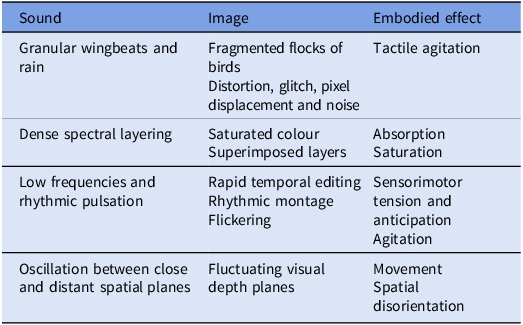
The Table 1 summarises the transmodal correspondences and embodied intention effects in Nuées.
Transmodal relations in Nuées

The piece is broadly structured around two dominant textured layers. The granular wingbeat textures are created from recordings of gloves rubbing against a spinning bicycle wheel, while the rain textures are derived from field recordings captured on grass, forest ground, rooftops and exterior metal roofing. These layers morph into one another, moving from sparse wingbeats towards dense accumulations that gradually transform into rain. Behavioural synchresis structures the work from beginning to end as the image shifts from isolated birds to dense masses. Low frequencies reinforce this gradual intensification, generating sensations of unstable bodily anticipation. Variations between proximity and distance are amplified by baritone saxophone recordings made with Ida Toninato in a large reverberant space, using microphones placed directly on the instrument alongside others positioned far away in the place.
Sonic energy and visual motion interact closely and form multiple synchretic relationships, producing the impression that images vibrate or physically react to sound and vice versa. Repetition, fragmentation, sudden contrast and scene transitions reinforce these correspondences. The composition is divided into two recurring main scenes: one depicts a swan attempting to take flight without success and the other an accumulation of birds in flight that appear to be fleeing. Although the work remains open to interpretation, it suggests themes of freedom, desire, fear and resistance. I deliberately foregrounded this narrative through the videomusical discourse to engage the affects and imagination inherent in the work. The objective prioritises the cultivation of ambiguity across sensory modalities over illustrative synchronisation, where auditory, visual and tactile perception, affect, imagination and subjectivity continuously overlap.
Conclusion
This article has proposed texture as a transmodal structure linking sound, image, space and haptic experience in audiovisual composition. Drawing from videomusic analysis, practice-based research and scenophony, I have argued that embodiment and immersion cannot be reduced to fixed compositional methods or technological formulas. Immersion may instead be understood as a mental, social and environmental disposition grounded in attentiveness and openness to the world. It involves intensified forms of sensory engagement in which the body is attuned to environments, atmospheres, intersubjective relations, media relationships and mediated spaces. In this sense, immersive audiovisual work involves an ecological mode of perception connected to ethical perspectives of care and situated ways of inhabiting space. Our access to embodiment and immersion begins with multisensory listening and lived experience, which audiovisual creation transposes into shared public situations, inviting others to become present and engaged.
The analysis of Nuées demonstrates how these dynamics operate in practice, utilising perceptual deviation and transmodal textures in motion. Far from being a static outcome, the artwork is a mode of knowledge production, offering a vital form of inquiry that generates theoretical insight into sensory experience. The phenomenological, heuristic and autoethnographic dimensions of this research provide grounded methods for examining how audiovisual experience works in relation to bodies, environments and modes of attention. In doing so, this framework directly reconceptualises media relationships. It demonstrates how intermediality functions in practice, uniting sound, image and physical space into a single, porous sensory environment.
Future research could develop these reflections by incorporating audience-based perceptual studies, spatial audio environments, virtual and mixed reality systems, and further forms of scenophonic composition. Investigating how transmodal textures and perceptual deviation behave in these technological contexts would provide deeper insights into the reception of audiovisual works. It also remains essential for musicologists, videomusic scholars and experimental film theorists to apply similar analytical frameworks to contemporary productions. These perspectives will continue to refine our understanding of embodiment and immersion, positioning audiovisual art as an active laboratory for human experience instead of a mere object of aesthetic appreciation.
Acknowledgements
The ideas for this article have developed over several years, notably through discussions with students in collaborative research-creation seminars that I developed at the Faculty of Music of the Université de Montréal in Canada. These include Immersive Visual Music, created in 2024 and 2026 with David Ledoux and the Society for Arts and Technology, and Sound, Ecology, and Environment, with doctoral candidate and composer Simon Chioini. AI tools were used exclusively for translation assistance from the original French. All conceptual development, analysis and argumentation remain the sole work of the author.

 Open access

