




Introduction
As part of a recent project on the foodways of medieval and early modern Estonia (PRG29, Estonian Research Council), stable carbon (δ13C) and nitrogen (δ15N) isotopic analyses were undertaken on a large collection of human and faunal skeletal material from ca. AD 1100‒1800 to reconstruct patterns and changes in dietary practices (Aguraiuja-Lätti and Lõugas Reference Aguraiuja-Lätti and Lõugas2019; Aguraiuja-Lätti and Malve Reference Aguraiuja-Lätti and Malve2023; Aguraiuja-Lätti et al. Reference Aguraiuja-Lätti, Tõrv, Sayle, Lõugas, Rannamäe, Ehrlich, Nuut, Peeters, Oras and Kriiska2022). These papers complement the increasing number of isotopic paleodietary studies of historic period populations in the eastern Baltic region conducted in the last few years (e.g., Etu-Sihvola et al. Reference Etu-Sihvola, Salo, Naito, Kytökari, Ohkouchi, Oinonen, Heyd and Arppe2022; Lightfoot et al. Reference Lightfoot, Naum, Kadakas and Russow2016; Malve et al. Reference Malve, Aguraiuja-Lätti, Müldner and Pluskowski2023; Petersone-Gordina et al. Reference Petersone-Gordina, Roberts, Millard, Montgomery and Gerhards2018; Skipitytė et al. Reference Skipitytė, Lidén, Eriksson, Kozakaitė, Lauzikas, Piličiauskienė and Jankauskas2020), but are also comparable with previous investigations of medieval populations from northwestern Europe (Kjellström et al. Reference Kjellström, Storå, Possnert and Linderholm2009; Müldner and Richards Reference Müldner and Richards2005, Reference Müldner and Richards2007). A similar trend in these studies is the apparent lack of a marine isotopic signal and the predominantly terrestrial origin of human diets. This has created discrepancies between quantitative data acquired through biochemical methods and qualitative data from the wealth of historical accounts and ecofacts which demonstrate the widespread availability and affordability of fish (especially cod and herring), consumption of which was sanctioned by the Catholic church itself (Adamson Reference Adamson2004; Põltsam-Jürjo Reference Põltsam-Jürjo2013, Reference Põltsam-Jürjo2018).
The lack of a marine carbon isotopic signal in the human collagen record can be explained by several ways:
-
A. Previously sampled human remains do not reflect the full spectrum of variation in marine resource consumption that existed in the society;
-
B. Consumption of marine resources has been overestimated as based on written accounts, being too minor to significantly affect human collagen isotopic ratios;
-
C. Marine resources were an important part of diet, but their consumption is not visible in human collagen composition due to the complex ecology/food web.
Hypothesis A seems unlikely considering approximately 300 human bone collagen samples from Estonia have been analyzed as part of previous research and have very similar isotopic ratios to contemporaneous populations in the Baltic Sea region (see references above). However, both explanations B and C are plausible. Historical evidence generally offers only indirect and partial knowledge concerning dietary habits and is often concerned with the habits of dominant social groups (e.g., urban, adult male, elite). On the other hand, the unique ecological setting of the brackish-water Baltic Sea has resulted in highly variable and generally lower (i.e., similar to the terrestrial range) carbon and nitrogen stable isotope ratios compared to the Atlantic Ocean (Barrett et al. Reference Barrett, Orton, Johnstone, Harland, Van Neer, Ervynck, Roberts, Locker, Amundsen, Enghoff, Hamilton-Dyer, Heinrich, Hufthammer, Jones, Jonsson, Makowiecki, Pope, O’Connell, de Roo and Richards2011; Craig et al. Reference Craig, Ross, Andersen, Milner and Bailey2006; Eriksson et al. Reference Eriksson, Linderholm, Fornander, Kanstrup, Schoultz, Olofsson and Lidén2008; Orton et al. Reference Orton, Makowiecki, de Roo, Johnstone, Harland, Jonsson, Heinrich, Enghoff, Lõugas, van Neer, Ervynck, Hufthammer, Amundsen, Jones, Locker, Hamilton-Dyer, Pope, MacKenzie, Richards, O’Connell and Barrett2011), which can obscure the presence of typical marine carbon isotopic signals in consumer bone collagen.
In this paper we have employed the use of stable sulfur isotope (δ34S) analyses on human bone collagen (n=126) to evaluate the potential of using δ34S as an alternate proxy to detect aquatic resource consumption in the Baltic Sea region, and to investigate the extent of sulfur isotopic variation among different populations in historic period Estonia (ca. AD 1100‒1800, corresponding to the end of the Iron Age up until the Early Modern Period as based on local periodization). Precise quantification of the contribution of aquatic resources to diet becomes highly relevant when we are dealing with radiocarbon measurements of individuals from this specific temporo-spatial context. Aquatic reservoir effects can produce misleading 14C dates, sometimes hundreds of years too old, which can significantly affect data interpretation in the case of historic periods. Thus, we also present 29 new radiocarbon dates from a sub-selection of the dataset and evaluate the need for dietary reservoir effect (DRE) correction through the use of Bayesian modeling software.
Stable sulfur isotope analysis
Stable isotope analysis is a quantitative method for reconstructing palaeodiet, where the chemical composition of body tissues reflects the average isotopic signature of consumed food (DeNiro and Epstein Reference DeNiro and Epstein1978). While the basic principles of using carbon and nitrogen stable isotope ratios in archaeological research are well established (see Schoeninger and Moore Reference Schoeninger and Moore1992; Sealy Reference Sealy, Brothwell and Pollard2001), sulfur isotope ratios (δ34S) are a more recent addition, providing an independent line of evidence for investigating the origin of dietary protein, especially in regards to identifying freshwater and marine resource consumption (e.g., Nehlich et al. Reference Nehlich, Borić, Stefanović and Richards2010; Sayle et al. Reference Sayle, Cook, Ascough, Hastie, Einarsson, McGovern, Hicks, Edwald and Friðriksson2013), on the condition that there exist meaningful differences between source δ34S values. δ34S values of soils and plants are primarily determined by bedrock geology but are also influenced by precipitation, groundwater, and biological processes (Krouse et al. Reference Krouse, Legge and Brown1984; Nehlich et al. Reference Nehlich, Fuller, Jay, Mora, Nicholson, Smith and Richards2011; Richards et al. Reference Richards, Fuller, Sponheimer, Robinson and Ayliffe2003). In animals (and humans), sulfur is obtained through the consumption of plant or animal protein (in the form of the essential amino acid methionine) and reflects the δ34S value of the food source (and thus the local biologically available sulfur isotopic signature) with only a minor trophic level change (ca. ‒0.5‰) (Barnes and Jennings Reference Barnes and Jennings2007; McCutchan et al. Reference McCutchan, Lewis, Kendall and McGrath2003; Nehlich Reference Nehlich2015; Peterson and Howarth Reference Peterson and Howarth1987; Richards et al. Reference Richards, Fuller, Sponheimer, Robinson and Ayliffe2003; Webb et al. Reference Webb, Newton, Lewis, Stewart, Miller, Tarlton and Evershed2017).
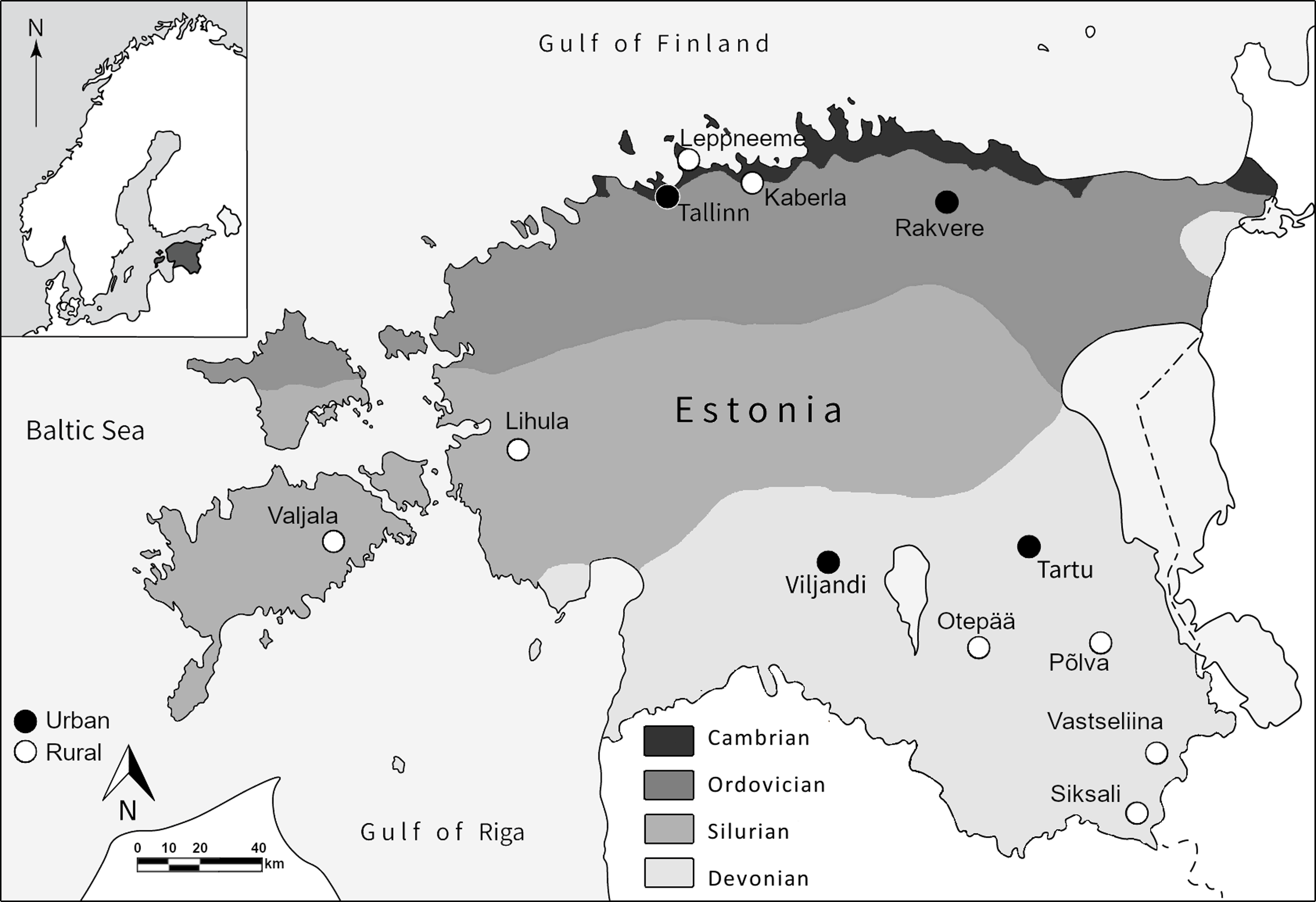
As we currently lack plant and soil sulfur isotope ratios from Estonia, zooarchaeological material has been used to establish local δ34S baselines. Terrestrial herbivores sampled from historic period sites in Estonia display δ34S values that increase from the northwest to the southeast, ranging from ‒6.3‰ to +11.5‰ (Aguraiuja-Lätti et al. Reference Aguraiuja-Lätti, Tõrv, Sayle, Lõugas, Rannamäe, Ehrlich, Nuut, Peeters, Oras and Kriiska2022). This gradient seems to be affected by the underlying geology (Figure 1) and allows distinguishing between coastal (average terrestrial herbivore value of +2.3±3.6‰) and inland (average value of +7.5±1.7‰) dietary sources. Although the presence of airborne marine sulfates with highly positive δ34S values (the “sea-spray effect”) can enrich coastal soils and plants (Richards et al. Reference Richards, Fuller, Sponheimer, Robinson and Ayliffe2003; Wadleigh et al. Reference Wadleigh, Schwarcz and Kramer1994), in our study region coastal δ34S values are (on average) unexpectedly low and steadily increase further inland/southeast, suggesting that the sea-spray effect may be muted and/or that the coastal terrestrial baseline is very low to begin with.
Map of Estonia with bedrock data (after Suuroja Reference Suuroja1997) and locations (urban and rural sites) mentioned in the study.

Marine fauna (cod, turbot, seal) sampled from Estonian sites have very diverse δ34S values: ca. +12.2‒17.6‰, ave. +15.9±1.5‰ (Aguraiuja-Lätti et al. Reference Aguraiuja-Lätti, Tõrv, Sayle, Lõugas, Rannamäe, Ehrlich, Nuut, Peeters, Oras and Kriiska2022). This range is both larger and lower than the +18‒20‰ usually associated with pure marine ecosystems (e.g., Peterson and Fry Reference Peterson and Fry1987; Rees et al. Reference Rees, Jenkins and Monster1978), but consistent with freshwater-affected (marine) organisms from coastal and estuarine regions, which have been shown to have δ34S values between +10‒15‰ (Leakey et al. Reference Leakey, Attrill, Jennings and Fitzsimons2008; Nehlich et al. Reference Nehlich, Barrett and Richards2013). Freshwater fish (pike, perch, bream, ide) from Estonia show a similarly wide range of δ34S values (+7.8‒15.4‰, ave. +12.4±2.0‰), reflecting the diverse habitats of the sampled fish, which originate both from coastal and inland locations (Aguraiuja-Lätti et al. Reference Aguraiuja-Lätti, Tõrv, Sayle, Lõugas, Rannamäe, Ehrlich, Nuut, Peeters, Oras and Kriiska2022). Although the carbon isotope ratios of these freshwater species clearly distinguish between pure freshwater (i.e., low δ13C values) and brackish water (i.e., δ13C values similar to Baltic Sea marine fish) specimens, their δ34S values overlap.
Material and methods
Here we present new sulfur stable isotope measurements from 126 human individuals which will be analyzed together with 59 δ34S values from similar contexts previously published in Aguraiuja-Lätti and Lõugas (Reference Aguraiuja-Lätti and Lõugas2019). Additionally, 29 new radiocarbon ages were produced from a sub-selection of the sites analyzed for stable isotopes to accurately define the context of some of the burial locations.
An overview of the historical background is given in Supplementary Information S1. The material investigated in this study originates from 17 different sites in Estonia (Figure 1; see also Supplementary Information S2 for details on sample context), representing a wide range of populations, both geographically, temporally, and by type. Sites are grouped based on their chronology: Late Iron Age (ca. 11‒12th century), Medieval (ca. 13‒16th century) and Early Modern (ca. 17‒18th century), although some sites were in use over several centuries so that two individuals from the same site may be temporally quite distant. Samples are further categorized as either “coastal” (originating from northern and western Estonia) or “inland” (from southern Estonia).
Human bone samples for stable isotopic analysis were preferentially taken from ribs, but other skeletal elements were used when ribs were not available. Ribs were preferred both because of their ready availability and minimal diagnostic value, and because their fast turnover reflects diet in the years leading up to death (Manolagos Reference Manolagos2000). Bone collagen extraction took place in Tallinn University (Estonia) following a modified Longin method (Brown et al. Reference Brown, Nelson, Vogel and Southon1988) and collagen samples were analyzed for sulfur, carbon, and nitrogen stable isotope ratios at the SUERC Radiocarbon Laboratory in East Kilbride (United Kingdom) as per the protocol outlined in Aguraiuja-Lätti et al. (Reference Aguraiuja-Lätti, Tõrv, Sayle, Lõugas, Rannamäe, Ehrlich, Nuut, Peeters, Oras and Kriiska2022). Based on duplicate measurements of ∼20% of samples, the analytical precision was ±0.18‰ for δ34S.
Carbon and nitrogen stable isotope ratios of these samples are published in Aguraiuja-Lätti and Lõugas (Reference Aguraiuja-Lätti and Lõugas2019) and Aguraiuja-Lätti and Malve (Reference Aguraiuja-Lätti and Malve2023). Aliquots from the same bone collagen sample were used for both carbon, nitrogen and sulfur isotope analysis and radiocarbon measurements of the selected individuals to eliminate potential variation caused by intraskeletal collagen turnover rates. Radiocarbon measurements were obtained at the Poznań Radiocarbon Laboratory (Poland) and the results were calibrated with OxCal v 4.4 (Bronk Ramsey Reference Bronk Ramsey2009) using the IntCal20 curve (Reimer et al. Reference Reimer, Austin, Bard, Bayliss, Blackwell, Bronk Ramsey, Butzin, Cheng, Edwards, Friedrich, Grootes, Guilderson, Hajdas, Heaton, Hogg, Hughen, Kromer, Manning, Muscheler, Palmer, Pearson, van der Plicht, Reimer, Richards, Scott, Southon, Turney, Wacker, Adolphi, Büntgen, Capano, Fahrni, Fogtmann-Schulz, Friedrich, Köhler, Kudsk, Miyake, Olsen, Reinig, Sakamoto, Sookdeo and Talamo2020).
Results and discussion
Results of sulfur isotope analysis
Human sulfur isotope results are presented in Figure 2 alongside their respective δ13C and δ15N values, and the 1 s.d. range of the average δ34S for terrestrial (coastal and inland herbivores) and aquatic (marine and freshwater) organisms sampled from similar contexts. Full results along with quality indicators can be found in Supplementary Information S2. Majority of samples complied with quality criteria established by Nehlich and Richards (Reference Nehlich and Richards2009), with C:S ratios of 600±300, N:S ratios of 200±100 and %S between 0.15% and 0.35%. Eight samples have %S≤0.14% (minimum of 0.10%) but these were included in the analysis as the other collagen quality indicators were acceptable.
Sulfur stable isotope ratios compared with their respective nitrogen and carbon isotopic ratios by site. St Barbara and Kaberla data are from Aguraiuja-Lätti and Lõugas (Reference Aguraiuja-Lätti and Lõugas2019), carbon and nitrogen isotope ratios of the remaining samples are from Aguraiuja-Lätti and Malve (Reference Aguraiuja-Lätti and Malve2023). Blue samples are from coastal sites, red samples from inland sites. Full symbols are Late Iron Age sites, open symbols Medieval sites and patterned symbols Early Modern sites. Color-shaded areas represent the 1 s.d. range of the group average for coastal and inland herbivores, freshwater fish, and marine organisms (from Aguraiuja-Lätti et al. Reference Aguraiuja-Lätti, Tõrv, Sayle, Lõugas, Rannamäe, Ehrlich, Nuut, Peeters, Oras and Kriiska2022).
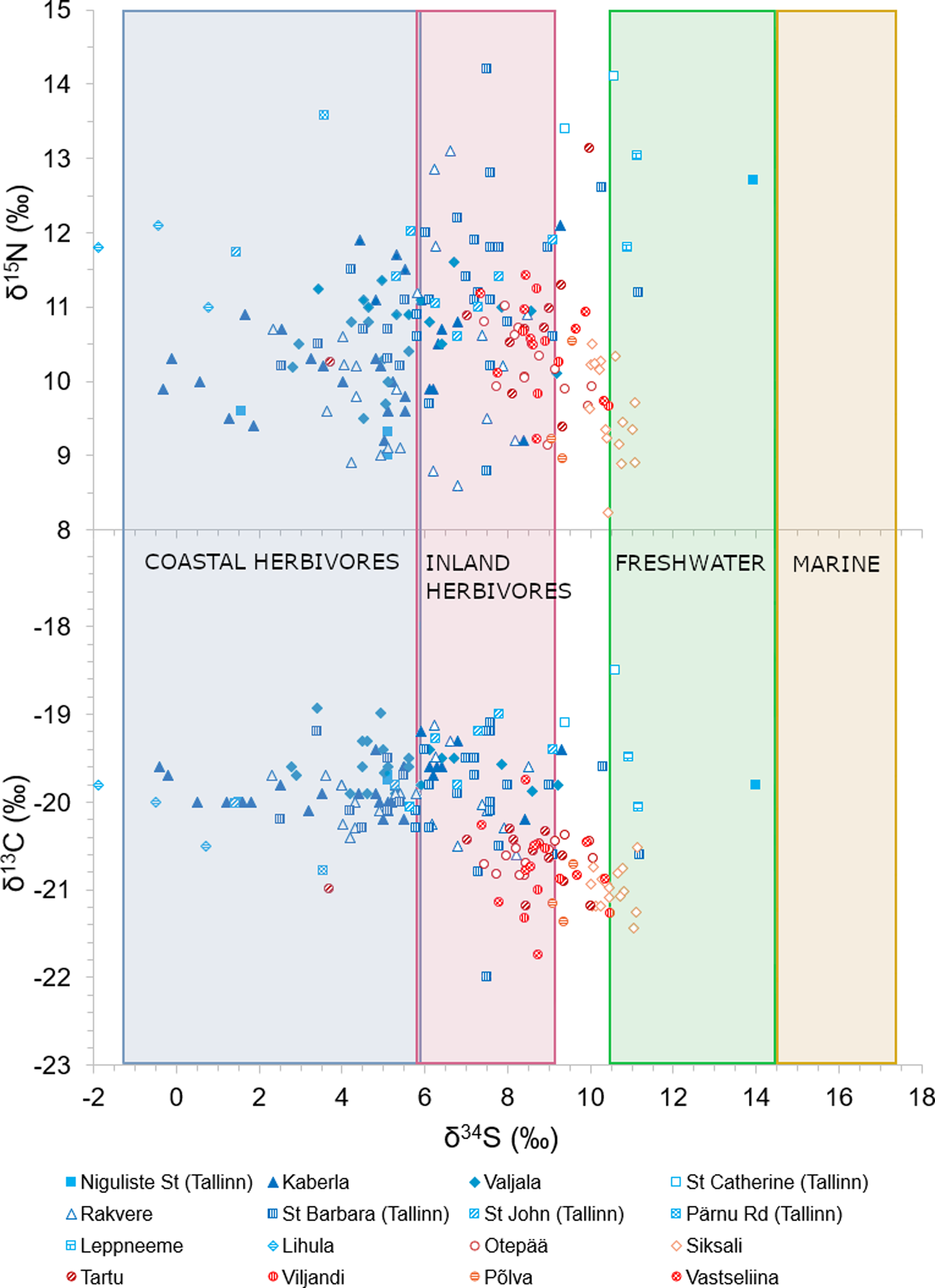
Temporal variations in human δ34S values are very moderate, thus we will not discuss differences between periods further but rather focus on spatial variations, i.e., between coastal and inland sites. The results demonstrate that similarly to terrestrial faunal reference values, coastal humans display the lowest δ34S values (ca. +5.6±2.6‰ 1 s.d.) but also the largest range (‒1.9‒14.0‰). Humans from inland sites have average values of 9.2±1.3‰, ranging from +3.7‒11.1‰. There is a statistically significant difference between the two groups (Mann‒Whitney U test, U=6412, p≤0.0001). Figure 2 shows that inland populations are also visually well distinguished from coastal communities, characterized by a combination of low(er) carbon isotopic values and high sulfur isotopic values. This is also indicated by the small yet statistically significant negative correlation between δ13C and δ34S values (Pearson’s r = ‒0.428, p<0.001) of all sampled humans, i.e., as δ13C decreases, δ34S increases, following a coastal‒inland trajectory.
Terrestrial baselines are generally in agreement with human δ34S values for both regions, although many individuals have values that are considerably higher than the 1 s.d. range of their local terrestrial average (Figure 2). For inland humans, consumption of aquatic resources with higher δ34S values could be considered as a possible explanation, although it is admittedly difficult to differentiate between marine and freshwater fish due to their overlapping δ34S ranges. While inland humans tend to have lower δ13C and higher δ34S values—similar to some freshwater fish—their relatively low δ15N values suggest that their diet was instead predominantly terrestrial.
For coastal populations, high human δ34S values (and the observed much larger range) may be influenced by several factors. For example, the sea-spray effect has likely affected local terrestrial baselines to a certain degree as evidenced by some coastal herbivores from Estonia having δ34S values of up to +10‰ (Aguraiuja-Lätti et al. Reference Aguraiuja-Lätti, Tõrv, Sayle, Lõugas, Rannamäe, Ehrlich, Nuut, Peeters, Oras and Kriiska2022). Humans consuming various terrestrial animals, some affected by the sea-spray and others not, could thus display a range of δ34S values somewhere between the two.
Additionally, consumption of omnivorous animals (e.g., pigs) who feed on aquatic resources could also result in high human δ34S values, although coastal omnivores have only somewhat higher average values (+3.4‰) compared to herbivores from similar contexts (+2.3‰) (Aguraiuja-Lätti et al. Reference Aguraiuja-Lätti, Tõrv, Sayle, Lõugas, Rannamäe, Ehrlich, Nuut, Peeters, Oras and Kriiska2022), indicating that both groups had a predominantly terrestrial diet. Considering there exists a statistically significant positive correlation between nitrogen and sulfur isotopic ratios of coastal humans (r=0.316, p<0.001), elevated δ34S values are more likely caused by consumption of aquatic resources, which have both high δ15N and δ34S values. The slightly elevated δ13C values of coastal populations compared to inlanders suggests their sulfur isotope ratios have been influenced by marine and not freshwater resources. No similar (statistically significant) distinction in coastal vs. inland δ13C (or δ15N) values is evident in terrestrial animal (including omnivore) values from coeval sites (Aguraiuja-Lätti et al. Reference Aguraiuja-Lätti, Tõrv, Sayle, Lõugas, Rannamäe, Ehrlich, Nuut, Peeters, Oras and Kriiska2022), implying that diet (most likely marine resource consumption), rather than the isotopic baseline, is the primary factor behind the observed differences between coastal and inland human populations.
These results demonstrate that at least in coastal regions, a combination of high δ34S and high δ15N can be used (with some reservation) to detect aquatic resource consumption. This creates the assumption that there could be notable reliance on aquatic resources for some coastal individuals, and consequently this needs to be taken into account when dealing with radiocarbon dates of individuals from this temporo-spatial context.
Quantitative dietary reconstruction
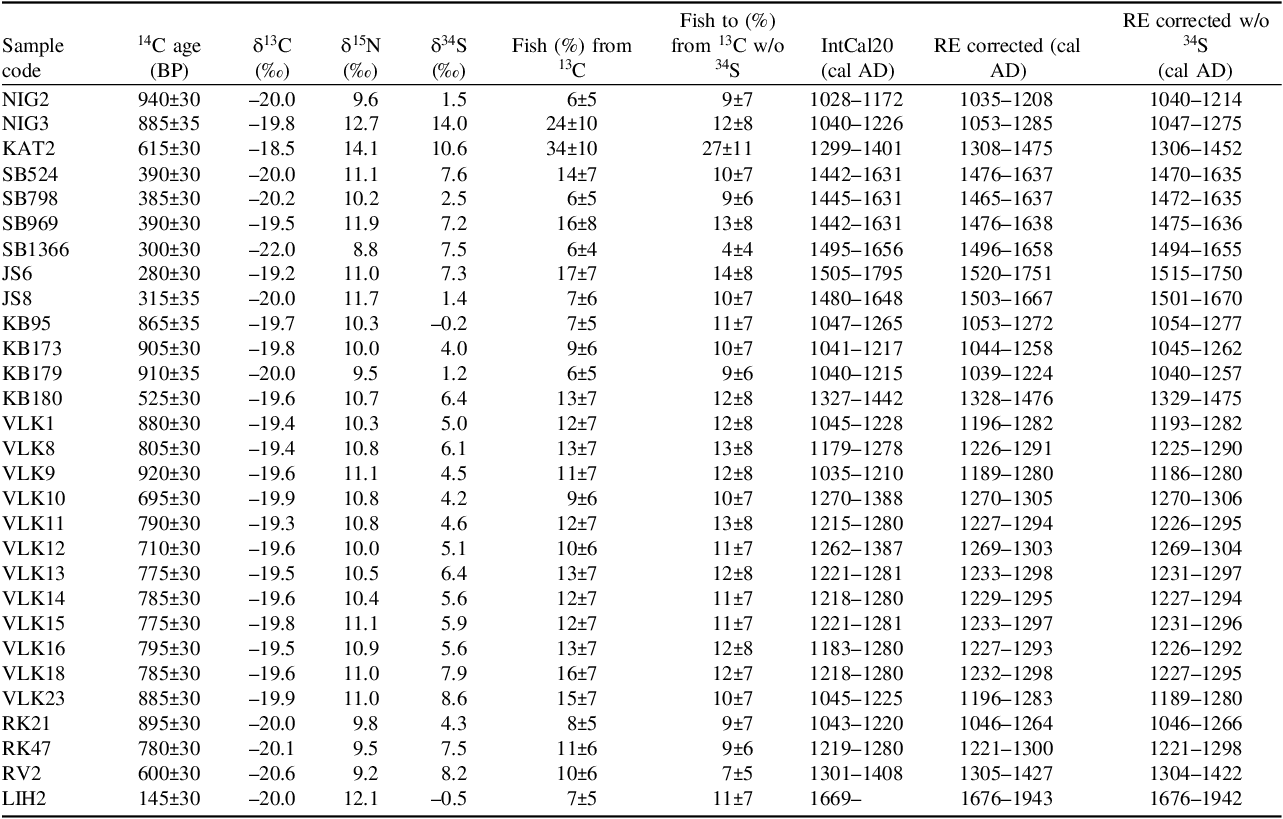
The Bayesian statistical program FRUITS (Food Reconstruction Using Transferred Isotopic Signals, beta 3.0; Fernandes et al. Reference Fernandes, Millard, Brabec, Nadeau and Grootes2014) was employed to provide quantitative dietary reconstruction for a sub-sample of 29 individuals (all from coastal sites) that were radiocarbon dated (Table 1). FRUITS calculates probability estimates of the relative contribution of multiple food sources both to diet as a whole and to individual dietary proxies of δ13C, δ15N, and δ34S, considering consumer’s isotope values and those of the different food groups, in addition to factors such as differences in protein content between dietary resources and uncertainties in trophic level offsets and food-source isotope values (see Supplementary Information S3 for further details).
List of individuals radiocarbon dated as part of this study alongside their 14C ages, dietary isotope ratios, FRUITS estimates, and calibrated age ranges. Stable isotope ratios of St Barbara (SB) and Kaberla (KB) individuals are previously published in Aguraiuja-Lätti and Lõugas (Reference Aguraiuja-Lätti and Lõugas2019), δ13C and δ15N values of the rest of the individuals published in Aguraiuja-Lätti and Malve (Reference Aguraiuja-Lätti and Malve2023). “Fish (%) from 13C” shows the average estimated contribution (with ±1 s.d.) of fish to the 13C content of the sample as modeled by FRUITS; the second scenario was run excluding δ34S as a dietary proxy (“w/o 34S”). Three calibrated age ranges are compared: uncorrected dates using only IntCal20, RE corrected dates using FRUITS estimates from the first scenario, and RE corrected dates using FRUITS estimates from the second scenario without δ34S. Calibrated age ranges are shown at 95.4% probability. See Supplementary File S3 for more details on RE correction.

Three isotopically distinct food groups are employed in the model (plants, animals, fish) to reflect the main staples of the medieval diet (i.e., bread, meat, fish) (Põltsam-Jürjo Reference Põltsam-Jürjo2013). Reference values for Animals include the main species consumed, e.g., cattle, goat, sheep, pig and chicken. Although herbivores and omnivores differ in their δ15N values, we have included them as one group to simplify the model (see also S3). For Fish, reference values for marine and brackish water (i.e., freshwater species living in the brackish coastal waters of the Baltic Sea) fish are used from Aguraiuja-Lätti et al. (Reference Aguraiuja-Lätti, Tõrv, Sayle, Lõugas, Rannamäe, Ehrlich, Nuut, Peeters, Oras and Kriiska2022). Although freshwater species are numerous in zooarchaeological deposits of this period (outnumbering those of marine species in inland sites, c.f., Lõugas and Aguraiuja-Lätti Reference Lõugas and Aguraiuja-Lätti2023), they are not included as a separate food source (i.e., with very low δ13C values indicative of origin in “inland” rivers and lakes). This is in line with criticism brought up by Schulting et al. (Reference Schulting, MacDonald and Richards2023), who assert that if a food group is included in FRUITS, the model will never estimate its importance as zero, even if the consumption is highly improbable, for example, in the case of “inland” fish being consumed at rural coastal villages.
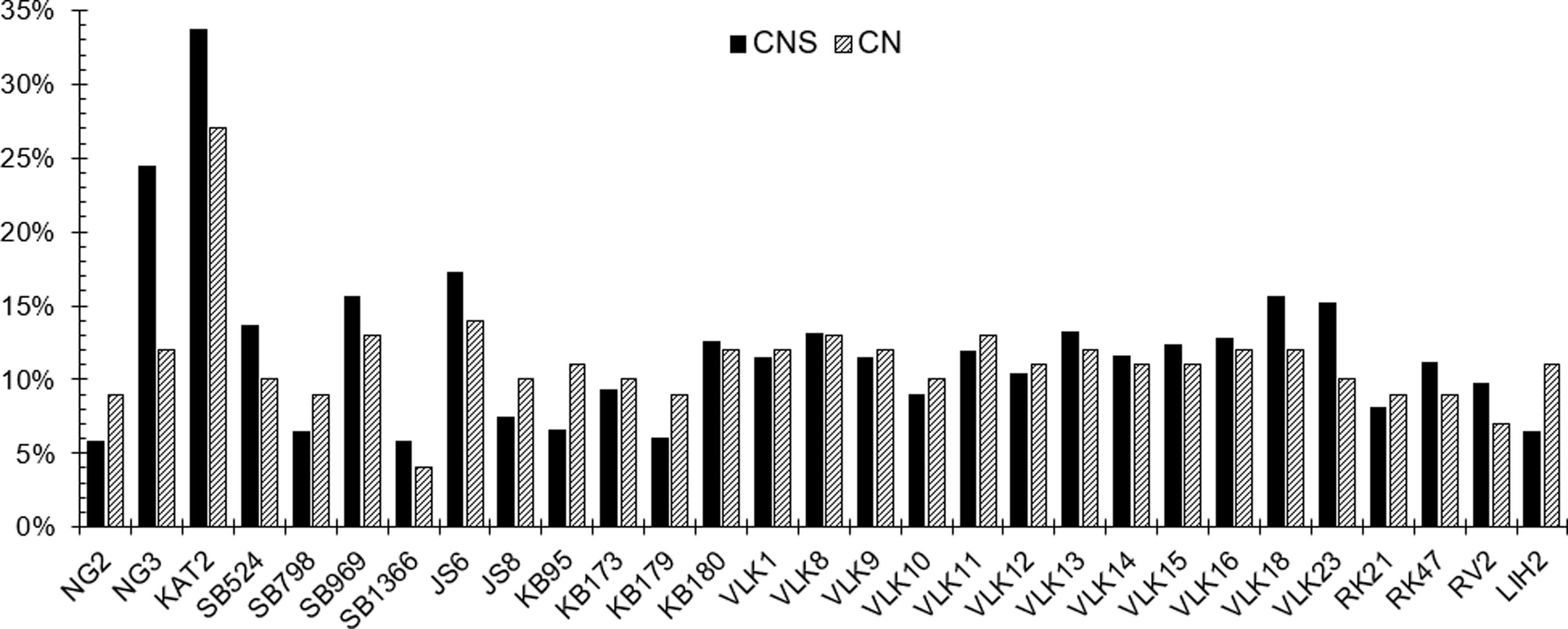
Figure 3 reflects the average estimates produced by FRUITS on the contribution of the Fish food group to the 13C composition of the sample. FRUITS generally provides estimates on the caloric contribution of a food group to diet as a whole, but to assess radiocarbon reservoir effects we are specifically interested in where the dietary carbon (13C) is coming from. To evaluate the advantage of using δ34S as a proxy for aquatic resource consumption, the model was run twice, the second time omitting δ34S from analysis (i.e., using only δ13C and δ15N). In most cases, the average estimated fish contribution between the two scenarios only differs by a few percentages (on average 2.8%), implying some redundancy of information, especially considering the correlation between δ34S and δ15N. The estimates differ the most for those individuals whose δ34S values stray from the average regional terrestrial baseline (e.g., δ34S of <1‰ and >7‰). Unfortunately, we cannot typically rule out whether these “outliers” were locals eating different diets or recent migrants originating from areas with divergent baseline values (but see discussion further below).
Estimated average contributions of fish to the 13C composition of each radiocarbon dated individual modeled by FRUITS. A comparison between the two scenarios is shown: utilizing all three dietary proxies (δ13C, δ15N, δ34S; black columns) vs. only two (δ13C, δ15N; diagonally striped columns). Sample numbers correspond to those shown in Table 1.

Radiocarbon measurements and chronological modeling
Radiocarbon measurements have been calibrated with OxCal using the “Mix_Curves” function with a defined mix of terrestrial and aquatic components corresponding to the range of estimated Fish contribution to 13C and a reservoir equivalent to the estimated local DRE for the aquatic component. The appropriate DRE in aquatic resources cannot be directly estimated from available data. According to Lougheed et al. (Reference Lougheed, Filipsson and Snowball2013, their Fig 6), the waters of the Baltic Sea around Estonia have an estimated reservoir age of about 225±75 14C years. But Lougheed and colleagues also documented that some coastal regions are influenced by hard-water from land areas dominated by limestone bedrock or aquifers (which is the case for most of the northern and western coastal regions in Estonia), which can contribute much older carbon, with a reservoir age of up to 1000 14C years. Large reservoir ages have also been estimated for some Estonian inland bodies of water (see Tõrv Reference Tõrv2018). As such, we may need to consider a much greater reservoir age (about 500±100 14C years) for local Baltic Sea fish that takes into account possible hard-water effects in coastal areas. While we tested both the lower and the upper range of the estimated local DRE (Supplementary File S3), in the final analysis only an average of 300±100 is used for chronological modeling (Table 1). This estimate is also similar to that proposed by Pesonen et al. (Reference Pesonen, Oinonen, Carpelan and Onkamo2012) as the average Baltic Sea RE. Since testing and refining the DRE is not the topic of this paper, the presented results should be taken as approximations.
Niguliste Street, Tallinn
At the end of the Iron Age (12‒13th century AD), Tallinn was a proto-settlement centered around a hill-fort, until 1219 the Danish led a crusade against northern Estonia, conquering the site and rebuilding it as a freshly converted Christian settlement. The church of St Nicholas (Niguliste in Estonian) was one of the two earliest and most important churches in the Old Town of Tallinn. During earthwork, a triple grave was found underneath the street next to the church, with burial inventory characteristic of native (i.e., pre-conquest) Late Iron Age inhumations (Talvar Reference Talvar2000). The grave consisted of a non-adult, an adult female (NIG2) and an adult male (NIG3).
While the woman and the child have very similar isotope values (ave. ‒19.8‰, +9.3‰ and +3.9‰ for δ13C, δ15N and δ34S) consistent with a local, terrestrial-based diet, the man showed very different results for δ15N and δ34S (+12.7‰ and +14.0‰), but not for δ13C (‒19.8‰). Individual estimates provided by FRUITS suggest the woman’s diet was 90% terrestrial, whereas the man had a diet very high in animal protein, including an average estimated contribution of about a quarter from fish. Considering the isotope data of the male, it was assumed that he may also display a significant reservoir effect, thus both the male (NIG3) and female (NIG2) from the same grave were radiocarbon dated (Table 1). However, their uncalibrated 14C ages are statistically the same, as tested by the “R_Combine” function in OxCal (1039‒1206 cal AD; χ2-test: df=1, T=1.4[5% 3.8]).
The woman’s stable isotope ratios do not allow us to assume any significant reservoir effect, thus we can consider her radiocarbon age to be an accurate estimation of the true age of the triple grave. Since the male essentially had the same age, his stable isotope ratios (which were measured from the same collagen extract as was used for 14C dating) are also unlikely to have been influenced by consumption of resources with a notable reservoir effect. Although there is some evidence concerning freshwater fish with no measurable reservoir effects, e.g., from fishponds or other stagnant water bodies (Dury et al. Reference Dury, Eriksson, Fjellström, Wallerström and Lidén2018; van der Plicht et al. Reference van der Plicht, Kaupová, Velemínský, Smolík, Kučera, Kameník, Havránek, Brůžek, Vellev and Rasmussen2020), we are not aware of any such features to be present around Tallinn at this time. Neither can the male’s very high δ34S value (which is the highest measured δ34S of any human in this whole dataset by a margin of +3.4‰ over the second-highest measurement) be reasonably explained by the sea-spray effect since coastal terrestrial animals sampled from Estonia have not shown δ34S values above +10‰ (Aguraiuja-Lätti et al. Reference Aguraiuja-Lätti, Tõrv, Sayle, Lõugas, Rannamäe, Ehrlich, Nuut, Peeters, Oras and Kriiska2022).
As such, the high δ15N and δ34S values of the male can be alternatively interpreted as being caused by feeding on omnivore protein and originating from a region with much higher terrestrial sulfur isotope ratios. Since the bone sample was taken from the rib, which has an estimated collagen turnover period of ∼5 years (Manolagos Reference Manolagos2000; Ubelaker et al. Reference Ubelaker, Buchholz and Stewart2006), it can be inferred that the man could have moved to Tallinn shortly before his death—i.e., before his rib collagen had adjusted to the local, much lower δ34S terrestrial baseline. In this instance, it seems that δ34S as a dietary proxy is misleading, although including it in the model has not resulted in conflicting RE corrected calibrated dates (Table 1). Excluding δ34S from the FRUITS model and using a more similar average estimated fish contribution to 13C for both NIG2 and NIG3 (9% and 12%, respectively) results in very good agreement among the DRE corrected calibrated dates (1040‒1214 for NIG2 and 1047‒1275 for NIG3). While this range is quite large, it overlaps nicely with the one estimated based on burial inventory (ca. 1150‒1250 AD).
St Catherine’s Church, Tallinn
The St Catherine’s church of the Dominican Friary was situated inside the medieval town walls of Tallinn Old Town. Burials recovered from the ruins of the church nave have been previously the subject of a multi-proxy analysis which demonstrated that they belonged to either monks or foreign merchants, most likely of high social status and having spent their childhood outside Estonia (Lightfoot et al. Reference Lightfoot, Naum, Kadakas and Russow2016). One of the burials (KAT2) was suggested by FRUITS as having consumed a diet typical of the medieval elite, with a strong focus on animal protein, including an average contribution of 34% from fish. This elite burial had the highest δ13C and δ15N values of the whole dataset (‒18.5‰ and +14.1‰, respectively), and a δ34S value which would be consistent with consumption of aquatic resources (+10.6‰), thus it is not surprising that it produced the highest estimated contribution of fish to dietary carbon. While excluding δ34S from FRUITS analysis resulted in a reduction in the average fish contribution, it was still quite high at 27%. The uncorrected age of 1299‒1401 cal AD has thus likely been affected by reservoir effects, but death is unlikely to have occurred later than AD 1531 when the church was burnt down and never rebuilt (Lightfoot et al. Reference Lightfoot, Naum, Kadakas and Russow2016). Using the estimated average fish contribution and a terminus ante quem of 1531, the calibrated RE corrected date for KAT2 is 1308‒1475 AD. Excluding δ34S and using a lower estimate for fish contribution results in a more or less similar corrected age range (1306‒1452 AD).
St Barbara cemetery, Tallinn
The suburban cemetery of St Barbara was situated right outside the Medieval town walls of Tallinn and was used to bury low social status and ethnic Estonians throughout the later Medieval and Early Modern Period, up until 1772 when burying inside towns was officially forbidden and the urban cemeteries closed. The site likely included individuals with diverse backgrounds, and the wide variation in protein consumption of St Barbara burials has been already discussed elsewhere (Aguraiuja-Lätti and Lõugas Reference Aguraiuja-Lätti and Lõugas2019). Four individuals were radiocarbon dated from St Barbara, with varying levels of estimated fish consumption (SB524, SB798, SB969, SB1366). A terminus ante quem of 1772 was set in the OxCal model as the known end date of the cemetery, and the calibrated RE corrected dates fall mostly between 1460 and 1660 AD. Although previously it has been thought that this part of the cemetery may have been used already from the second half of the 14th century (Sokolovski Reference Sokolovski1996), these data indicate a later usage of the cemetery. The inclusion of δ34S as a dietary proxy did not change the outcome of the chronological modeling since the average FRUITS estimates usually differed only by a few percent between the two scenarios.
St John’s Hospital, Tallinn
The St John’s Hospital was a leprosarium in the outskirts of medieval Tallinn, which later became an almshouse for the poor in the Early Modern Period. The associated cemetery was used to bury both the hospital patients and later also the local suburban population up until 1772 (Sokolovski Reference Sokolovski2002). Two individuals with notable pathological conditions were radiocarbon dated: one with venereal syphilis (JS6) and the other with advanced leprosy (JS8); both were likely residents of the hospital. JS6 was calibrated to 1520‒1751 AD and JS8 to 1503‒1667 AD. These ranges are very similar to the ones produced by the scenarios without δ34S. The results for JS6 in particular are compatible with syphilis starting to spread in Estonia at the end of the 15th century (Malve Reference Malve2023).
Kaberla village cemetery
A rural cemetery situated ∼30 km east of Tallinn was in use from the end of the Iron Age up until the 17th century (Aguraiuja-Lätti and Lõugas Reference Aguraiuja-Lätti and Lõugas2019). The site is thought to have been originally a burial place of a local 12th century wealthy family, which later grew into a Christian village cemetery (Selirand Reference Selirand1962). Four burials were selected for radiocarbon dating: KB173 was buried in a wooden coffin but with a rich burial inventory including copper alloy and silver jewelry; KB179 was buried with multiple dress ornaments and decorations typical of the 12‒13th century; KB95 had no grave goods but was buried under limestone slabs; KB180 also had no grave goods. All four had similar carbon and nitrogen stable isotope ratios, with FRUITS estimating on average around 10% contribution of fish to their dietary carbon. The inclusion of δ34S produced more variable estimates for fish contribution, but the differences in the RE corrected date ranges between the two scenarios were negligible for all four.
KB173 and KB179, both with rich burial inventories, and KB95, buried under limestone slabs, all date to between 1040‒1277 cal AD, reflecting the earliest phase of the cemetery. The fourth burial (KB180) is clearly younger, with a RE corrected date between 1330 and 1475 AD, consistent with the Medieval Period.
Valjala churchyard
The burials from Valjala churchyard are associated with one of the oldest stone churches in Estonia, on the largest island of Saaremaa. Based on archaeological context, the burials represent some of the earliest graves at this site, originating from the 12‒13th century (1300±20 AD was set as the terminus ante quem in the OxCal model). Twelve individuals were dated, all producing RE corrected calibrated ages between ca. 1190‒1305 AD, consistent with the erection of the stone church in the 13th century (Mägi et al. Reference Mägi, Malve and Toome2019). FRUITS estimated on average a 12% contribution of fish to dietary carbon; the inclusion of δ34S as a proxy has not significantly affected the results of dietary, nor chronological modeling.
St Michael’s churchyard and probable Gallows’ site, Rakvere
Rakvere is a small town in northern Estonia, situated ca. 20 km from the modern coastline. Once the location of an Iron Age hill-fort, it became an urban settlement following the Livonian Crusades in the 13th century. St Michael’s Church was erected next to the town’s main road in the 15th century, but arguably as early as the 13th century (Malve et al. Reference Malve, Viljat, Rannamäe, Vilumets and Ehrlich2020). Two individuals buried at the churchyard have been radiocarbon dated: a male with signs of healed trauma (RK21) produced a RE calibrated date of 1046‒1264 AD, and another male who likely died in a violent battle (RK47) was dated to 1221‒1300 AD. Both have estimated average fish contribution of around 10% and are otherwise isotopically similar to other Late Iron Age coastal populations such as those from Kaberla. The inclusion of δ34S has not greatly affected the results of dietary or chronological modeling. The RE corrected dates for St Michael’s churchyard seem to confirm that the church was already present in the 13th century.
Nearby St Michael’s Church, outside the borders of the medieval town, a group of burials was also discovered, thought to belong to victims of execution (Malve and Vilumets Reference Malve and Vilumets2020). No grave goods were found with the burials, which were unearthed right underneath the modern road, so dating them through archaeological context was impossible. RV2 was an adult male, who had died through complete decapitation. The RE corrected date is 1305‒1427 AD (or 1304‒1422 AD if δ34S is excluded as a dietary proxy), suggesting that an execution site may have been present here in the Medieval Period.
Lihula burial site
The burial from Lihula (LIH2) in coastal western Estonia is somewhat of an outlier. LIH2 along with a few others from Lihula was included in the original analysis due to the underrepresentation of samples from this region of Estonia. The burials were recovered without any grave goods and from a location not previously associated with a known burial site, so contextual evidence about their chronological age is unavailable. The radiocarbon date for LIH2 is calibrated to the end of the 17th century up until the end of the calibration curve in 1943. It is the youngest of the dated individuals in our dataset, and all three Lihula individuals have some of the lowest reported human δ34S values (ca. ‒0.6‰), whereas terrestrial fauna from western Estonia has thus far shown more elevated values (Aguraiuja-Lätti et al. Reference Aguraiuja-Lätti, Tõrv, Sayle, Lõugas, Rannamäe, Ehrlich, Nuut, Peeters, Oras and Kriiska2022). However, excluding δ34S from FRUITS analysis did not significantly alter the calibrated date. They may have been non-locals, their diet could have been exclusively terrestrial, or this region could have been unaffected by the sea-spray effect in the same way that other coastal sites were. Further work on samples from mainland western Estonia are necessary to provide more context for interpreting the Lihula samples.
Conclusions
This study has demonstrated the potential of using stable sulfur isotope analysis as both a dietary and a movement proxy in this region of the Baltic, as evidenced in the statistically significantly different mean δ34S values of coastal and inland humans. However, because of the overlap in freshwater and marine fish δ34S values—and the partial overlap between aquatic and inland terrestrial δ34S—using sulfur specifically as an indicator for aquatic resource consumption is complicated. The comparison of the two FRUITS scenarios—one including δ13C, δ15N, and δ34S, and the other only δ13C and δ15N—revealed that in most cases the model produced very similar estimates, reinforcing the strong correlation between nitrogen and sulfur isotope ratios in coastal Estonia. The estimates varied the most for individuals whose δ34S values strayed from the local terrestrial baseline, but it is not always possible to distinguish whether this was due to dietary factors or because of a non-local origin. As such, δ34S analysis is not required for accurately reconstructing aquatic resource consumption in this temporo-spatial context and consequently, is not specifically relevant for DRE correction. Nevertheless, a multi-proxy approach can still be useful (especially when paired with strontium isotope analysis) for specific case studies or when reconstructing individual life histories.
Our results also suggest that the importance of fish in the diets of Medieval and Early Modern Period commoners in coastal Estonia may be overestimated based on written accounts, with dietary modeling indicating that aquatic resources contributed on average only about 10% to diet. Such low levels of fish consumption (and the resulting RE) do not significantly alter the calibration of radiocarbon dates, suggesting that precise quantification of aquatic resource consumption may not be essential for common burials from this temporo-spatial context. However, once an individual is acquiring more than 25% of dietary carbon from fish (which was the case for the elite burial from St Catherine’s), the effects will be more pronounced. As the elite burial was well distinguished from other (common) individuals by their δ13C and δ15N, identifying the cases that specifically need RE correction is relatively straightforward.
Supplementary material
To view supplementary material for this article, please visit https://doi.org/10.1017/rdc.2025.10104
Acknowledgments
This study was supported by the Estonian Research Council (project nos. PRG29, PRG1027, PRG1931 & PRG2026), Tallinn University (project no. TF/1222) and Foundation Osiliana. Research was conducted using NATARC core infrastructure funded by the Estonian Research Council (TT14). We are thankful to the two anonymous reviewers whose comments improved the manuscript.
Competing interests
The authors declare that they have no competing interests.


 Open access

