




INTRODUCTION
The Ural Mountains are the informal boundary between Europe and Asia. The southern part of the Urals has a very diverse landscape (steppe, forest-steppe, mountain forest zone) and geological structure. It is saturated with numerous minerals, including polymetallic ores, the most important resource in the Bronze Age. The relative rarity of deposits and the livestock farming life-support system gave rise to extended connections, regional and local mobility, and migrations of various scales. The open nature of the landscape and the mastery of wheeled transport (Chechushkov and Epimakhov Reference Chechushkov and Epimakhov2018) facilitated the movement of individuals and groups of different sizes. As a result, the Bronze Age (3rd–early 1st millennia cal BC) in the Southern Urals can be considered as an alternation of migratory activity phases with stabilization phases (based on a relatively settled way of life) and evolutionary development (Koryakova and Epimakhov Reference Koryakova and Epimakhov2007).
Archaeological sites dating from many archaeological cultures have been studied on the territory of the Southern Urals. Some cultures are of migratory origin. The Yamnaya, Sintashta cultures, and the Andronovo cultural community are perhaps the best known today. Their origin and development are linked to migrations, as confirmed during paleogenetic studies (Allentoft et al. Reference Allentoft, Sikora, Sjogren, Rasmussen, Rasmussen and Stenderup2015; Narasimhan et al. Reference Narasimhan, Patterson, Moorjani, Rohland, Bernardos and Mallick2019, etc.). Unfortunately, the Yamnaya culture (Early Bronze Age) is not covered by dating in the Trans-Urals.
The important features of the local archaeological sites of the Bronze Age are the limited thickness of the cultural layer, infrequent reliable stratigraphic observations, and the almost total lack of caches and burials containing large series of different-type metal artifacts. This significantly complicates the creation of periodization systems based on the fractional typology of metal artifacts, similar to European typologies. The chronology of cultures can be determined only within the framework of radiocarbon (14C) dating, since the region is distant from the centers of early civilizations and writing.
Previous works proposed a rather simple periodization system generally consistent with the East European and West Siberian systems of periodization (Hanks et al. Reference Hanks, Epimakhov and Renfrew2007; Epimakhov Reference Epimakhov, Hanks and Linduff2009). However, this scheme relied on small samples often obtained during the formation period of the radiocarbon dating technique (the 1970s–1980s). Some cultures did not have any reliable dates. The methods previously used for the statistical generalization of dating series (“Sum of Probabilities”) are also far from perfect. Finally, Bayesian modeling is only possible if there are large series of samples with a reliable context. Thus, there are still some problems to be solved.
Key problems:
-
Critical shortage of high-quality dates from a reliable context for several cultures;
-
Lack of large series of dates for sites studied over large areas;
-
Unreliability and/or impossibility to verify certain values (in cases of single dating); and
-
The bulk of radiometric dates for some cultures cannot be currently verified (loss of context, lack of data on C/N isotopes, etc.)
In order to solve these and other problems, a new dating program was implemented. The objects of research were recently excavated archaeological sites. This provided sampling and storage control. Furthermore, several single samples from old excavations were analyzed for the cultural and chronological identification of the complexes without grave goods suitable for diagnosing archaeological culture.
This paper addresses the following objectives:
-
Obtaining a series of dates with reliable cultural attribution;
-
Statistical verification of the reliability of the obtained results;
-
Bayesian modeling in all possible cases; and
-
Comparison of new data with previous periodization schemes and their adjustment.
METHODS AND MATERIALS
Sampling Technique
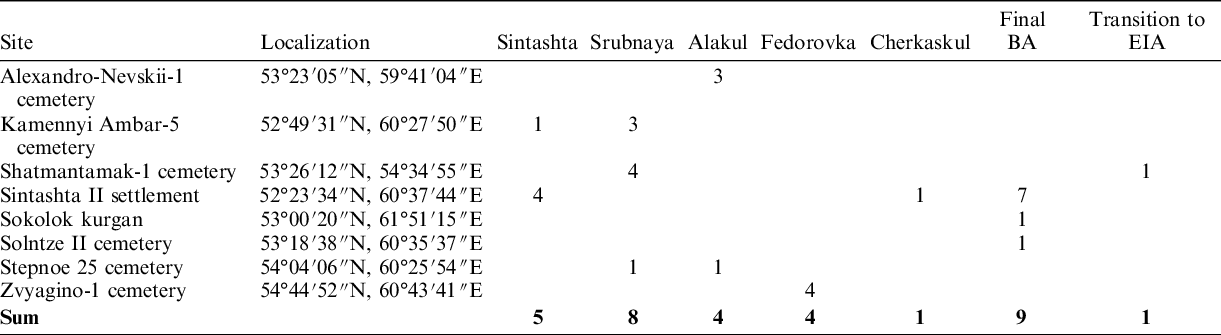
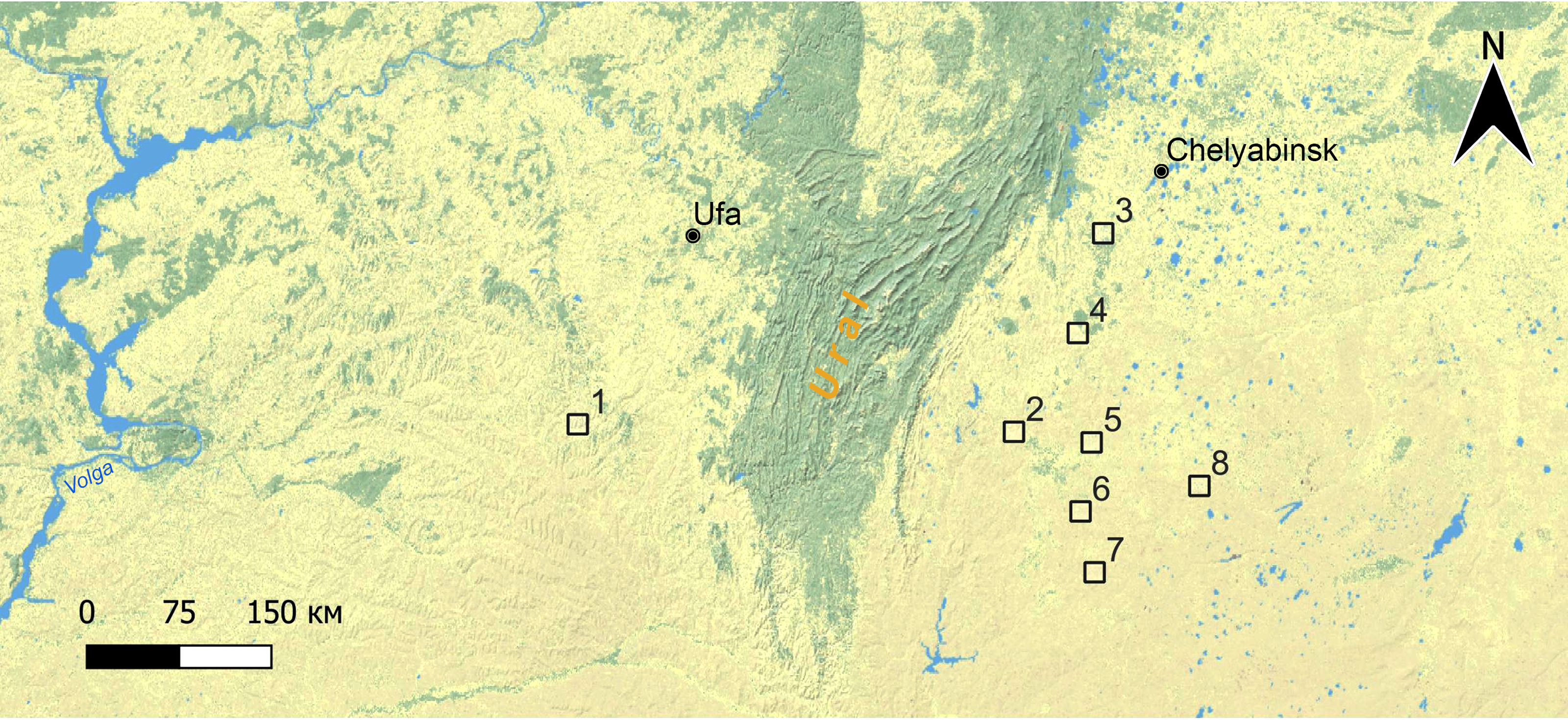
We obtained the 14C dates for one settlement and seven burial sites, most of which are located east of the Ural Mountains (Table 1; Figure 1). Some samples were collected directly during the excavations, others where collections are stored. The quantitative priority of burial sites is explained by the greater reliability of determining the sample context and its cultural identification. The choice of dating objects is preconditioned by several factors. We focused on minimizing the risk of distortions during the storage of collections (new field materials). This approach encompassed the following: burials or the floor of a building when it was abandoned by the population; expanding the range of archaeological cultures; and creating a series of reference sites with reliable stratigraphy, etc. Additional arguments when choosing an object were the need to verify earlier chronological conclusions and the replenishment of series for statistical modeling. The 32 dates obtained reflect seven cultural traditions (Sintashta, Srubnaya, Alakul, Fedorovka, Cherkaskul, Final Bronze Age, Transition to Early Iron Age). They belong to different stages of the Late Bronze Age within the Eastern European periodization system (Bochkarev Reference Bochkarev2017).
Archaeological sites covered by dating. Location, cultural affiliation and number of samples.
Map of the dated sites: 1 – Shatmantamak-1 cemetery; 2 – Alexandro-Nevskii-1 cemetery; 3 – Zvyagino-1 cemetery; 4 – Stepnoe 25 cemetery; 5 – Solntze II cemetery; 6 – Kamennyi Ambar-5 cemetery; 7 – Sokolok kurgan; 8 – Sintashta II (Levoberezhnoe) settlement.
Dating materials consisted of collagen extracted from human bones (n=15) and domestic animals (n=10), as well as coal (n=5) and wood (n=2). The predominance of human bones is explained by the absence of other organic materials in burials. We tried to reduce the risks of reservoir effects for this category of samples by dating animal bones whenever possible for the same context and by measuring nitrogen and carbon isotopes. Long-growing trees in the study area are extremely rare, so coal and wood should not significantly age our results (old-wood effects).
Sample Pretreatment
Bone samples were pretreated following the ultrafiltration protocol (Brown et al. Reference Brown, Nelson, Vogel and Southon1988; Bronk Ramsey et al. Reference Bronk Ramsey, Higham, Bowles and Hedges2004), in order to extract clean non-degraded collagen for 14C dating. Collagen extraction included treatment with hydrochloric acid and alkali, gelatinization at pH about 3 at 80ºC. The obtained gelatin was centrifuged at 2500–3000 rpm in tubes with an ultrafilter (Vivaspin™ 15 30kD MWCO). This collagen was freeze-dried. C/N ratios of collagen range between 2.9 and 3.5 and are usually based on numerous studies (primarily DeNiro [Reference DeNiro1985]) that have investigated the use of C/N ratios as a tool to detect the contamination of collagen.
We used the standard acid-base-acid (ABA) procedure for charcoal pretreatment. This processing consists of the following consecutive steps: acid 4% HCl at 80°C, followed by a weak base of 4% NaOH at 0°C The final step is again a hot acid wash of 0.5M HCl at 60°C. Following each step, the sample is rinsed with Milli-Q® water until a neutral pH is obtained (Hajdas et al. Reference Hajdas, Hendriks, Fontana and Monegato2017). Cellulose extraction from wood samples was performed using the BABAB method (Nemec et al. Reference Němec, Wacker, Hajdas and Gäggeler2010; Hajdas et al. Reference Hajdas, Hendriks, Fontana and Monegato2017). An alkali pretreatment was added to the ABA treatment described above. The ABA treatment was followed by a bleaching step, the samples were stirred for 2 hr at 80°C after the addition of 5% NaClO2 and five drops of 4% HCl. The resulting suspension was washed with Milli-Q water until neutral pH was reached. The finished product was dried in oven at 60°C.
Collagen extraction, wood and charcoal samples pretreatments, graphitization, and pressing graphite of the target for 14C accelerator mass spectrometry (AMS), stable isotope measurement were performed in the Laboratory of radiocarbon dating and electron microscopy of the Institute of Geography RAS (lab index IGAN). Graphitization and stable isotope measurement was conducted using the automated graphitization system AGE 3 in conjunction with the Elementar precision IRMS (Wacker et al. Reference Wacker, Němec and Bourquina2010). 14C AMS measurement was performed at the Center for Applied Isotope Studies, University of Georgia (Athens, USA) using the CAIS 0.5 MeV accelerator mass spectrometer. The sample ratios were normalized on the Oxalic Acid II (NBS SRM 4990C) standard measured together with unknowns. Blanks (14C-free samples) were processed together with unknowns, and all measurements were corrected to that.
Statistical Analysis
Analysis of the results obtained included the following procedures: calibration of individual dates; diagnostics of outliers (boxplot [box-and-whisker diagram]); summation of probabilities to check the homogeneity of the series of individual cultural traditions; determination of chronological boundaries for some of them. Calibration and other statistical procedures were carried out in OxCal 4.4.4 (Bronk Ramsey Reference Bronk Ramsey2017) with the internationally accepted IntCal20 standard curve for the northern hemisphere (Reimer et al. Reference Reimer, Austin, Bard, Bayliss, Blackwell, Ramsey, Butzin, Cheng, Edwards and Friedrich2020).
We used two grouping methods; a combination of values based on archaeological culture; and modeling within a stratified site. When summarizing the results, we considered only the AMS dates. Our experience working with liquid scintillation counting (LSC) dates, especially those obtained before the 2000s, has shown that the results are contradictory and only produce information noise. Some colleagues came to similar conclusions while working with the Bronze Age sites of Northern Eurasia (Polyakov Reference Polyakov2022).
The Alakul and Fedorovka AMS-dates list has been replenished only in recent years (Panyushkina et al. Reference Panyushkina, Mills, Usmanova and Cheng2008; Krause et al. Reference Krause, Epimakhov, Kupriyanova, Novikov and Stolarczyk2019; Schreiber Reference Schreiber2021). Certain new data was obtained as part of our statistics too. The total number of AMS dates for these two traditions is 51 samples (Alakul – 33; Fedorovka – 11, and Alakul-Fedorovka – 7). They were generalized by series to determine chronological boundaries; the date distribution was analyzed for the medians of the calibrated values.
RESULTS AND DISCUSSION
Validation of Dating Results
Results of isotope determination are presented in Table 2. All the data indicates that the dates are realistic. Regardless of the sample type (humans or animals), the amount of collagen ranged from 2.42‰ to 23.43‰. The lowest indicator is connected with the analysis of a human tooth (IGANAMS-9095), but this result is strictly in line with our expectations and does not fall out of the date series of the Final Bronze Age. The C/N ratio is 3.1–3.23, corresponding to the standard (DeNiro Reference DeNiro1985, Ambrose Reference Ambrose1990). Twenty-five samples contain data on the composition of δ15N and δ13C. They are verifiably divided into two groups. Humans are characterized by values of δ15N (8.7 to 11.19‰) and δ13C (–17.69‰ to –19.4‰), while animals are characterized by lower indicators of δ15N (2.29 to 7.81‰) and δ13C (–19.35 to –20.88‰). Thus, the figures obtained do not indicate possible distortions due to the freshwater reservoir effect.
The results of 14C dating of the Bronze Age sites in the Southern Urals.
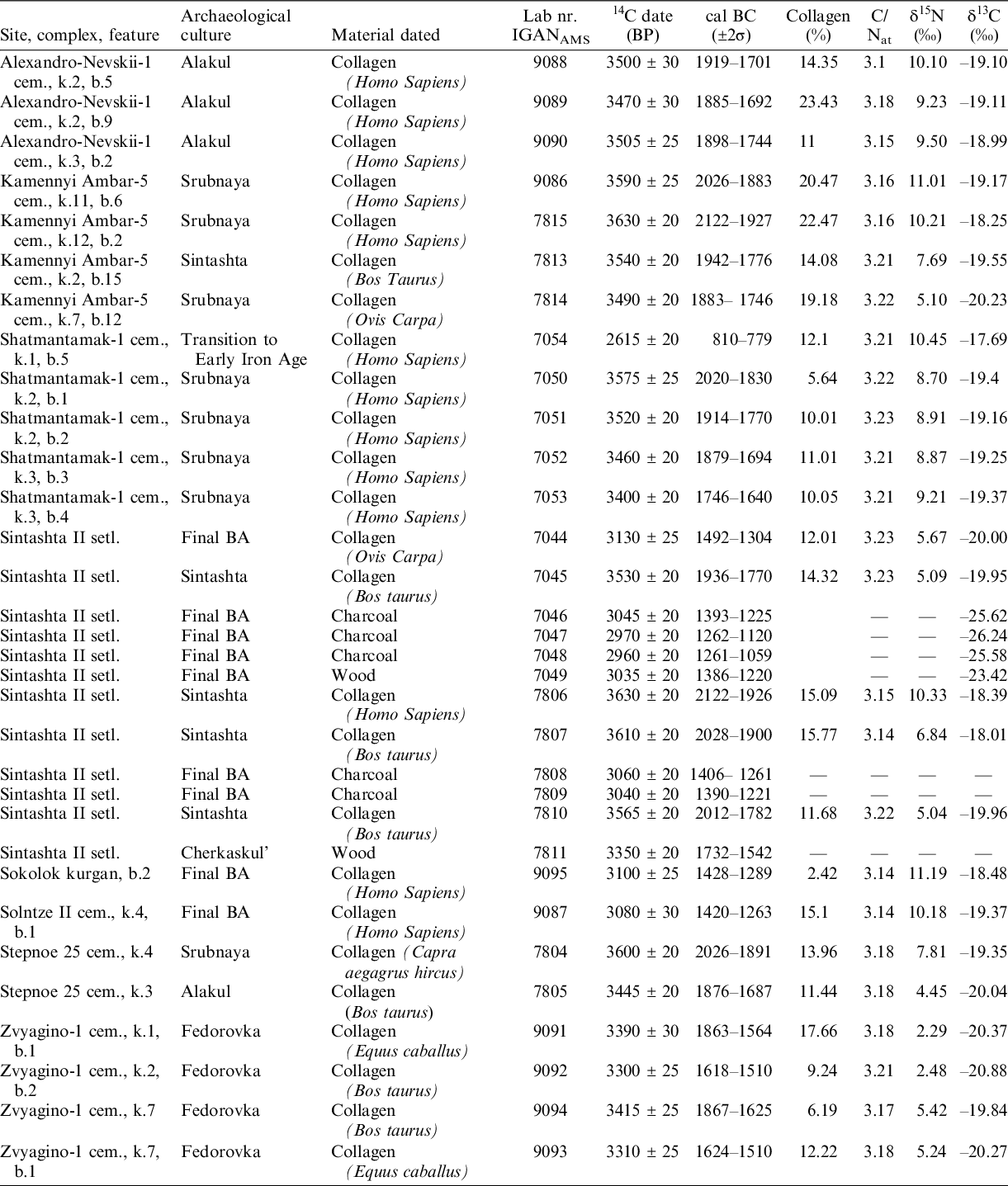
Another argumentation for this statement is related to the dating of paired different-type samples. We do not have many of them, but there are some. During the excavations of the Sintashta II (Levoberezhnoe) settlement, a child’s burial was investigated. Two dates were obtained. One sample was a child bone (IGANAMS-7806: 3630 ± 20 BP), and the other sample was a cattle rib from a vessel (IGANAMS-7807: 3610±20). The calibration results are indistinguishable. The second example is related to Kamenny Ambar-5 burial ground, where Grave 15 of Kurgan 2 was dated three times. We replicated the previously obtained dates for human (OxA-12533: 3555 ± 31 BP) and horse (UCIAMS-199278: 3590 ± 15 BP) bones with one additional date for a cattle bone (IGANAMS-7813: 3540±20 BP). The data presented indicates that there is no freshwater reservoir effect, which is in line with the opinion of our colleagues studying other Sintashta materials (Svyatko et al. Reference Svyatko, Reimer, Schulting, Shevnina, Logvin, Voyakin, Stobbe, Merts, Varfolomeev, Soenov and Tsydenova2022). Notably, this conclusion cannot be automatically extrapolated to other local cultures without direct evidence. Fish bones were found in the cultural layers of settlements, but the contribution of aquatic products to the human diet is not entirely clear (Stobbe et al. Reference Stobbe, Rühl, Nekrasov, Kosintsev, Krause and Koryakova2013).
The old-tree effect could theoretically distort the analysis results for the multi-layered settlement of Sintashta II (Levoberezhnoe). However, the values obtained from the analysis of these materials do not differ from previously obtained dates of the Final Bronze Age, including dates of the published series for other sites, i.e., Solntse II burial ground and Sokolok mound (IGANAMS-9095: 3100 ± 25 BP; IGANAMS-9087: 3080 ± 30 BP). This circumstance, together with an indirect argument that long-growing trees are rare within the site’s location, may indicate the viability of the new results.
Grouping by Archaeological Cultures and Sites
The earliest values in the series refer to the Sintashta culture (Sintashta II [the early phase], Kamenny Ambar-5 [Kurgan 2])—2200–2000 calBC. However, some dates of the Srubnaya culture (Kamenny Ambar-5 [Kurgans 11 and 12], Shatmantamak-1 [Kurgan 2], Stepnoe 25 [Kurgan 1]) fell into the same interval. The Seima-Turbnino antiquities in the adjacent territory also belong to this period (Chernykh et al. Reference Chernykh, Korochkova and Orlovskaya2017). The number of reliable dates for the Srubnaya culture is still insufficient for statistical analysis. Besides, the local plateau of the calibration curve is precisely in the area around 3500 BP. For this reason, we will refrain from any judgment about the complete or partial synchronization of different cultural traditions of this period.
The latest date comes from a child’s burial (IGANAMS-7054: 2615 ± 20 BP) of the transition period to the Early Iron Age (9–8 centuries calBC). This period is poorly represented by materials and dates. This concerns the Urals, the Volga region, and Kazakhstan. This is due to difficulties in recognizing such complexes, on the one hand, and a fundamental change in the lifestyle of the population (transition to nomadism), on the other hand.
The Sintashta culture has a large series of dates (more than a hundred) accumulated through many projects. There are examples of the serial dating of one site and Bayesian modeling, which allowed the duration of the functioning of individual settlements and burial grounds (less than a hundred years) to be estimated. However, problems concerning the evolution of traditions and the allocation of stages of this evolution remain unresolved. The correlation of this migratory culture with other cultures has single stratigraphic evidence only.
One of the unsolved problems is the relationship between the Alakul and Fedorovka cultures within the Andronovo cultural community, covering a vast territory of the arid part of Northern Eurasia (Kuzmina Reference Kuzmina2007). Reference eponymous sites of these cultures were studied in the southern Trans-Urals. The sacral features and appearance of the material culture of these two traditions differ greatly: inhumation and cremation, the use or lack of stone structures, etc. (Figure 2). However, a large series of sites combine Alakul and Fedorovka features in the frames of one kurgan, grave-pit or even a ceramic vessel.
Difference between the Alakul and Fedorovka burial traditions: I – Alakul culture (1-3 - Alexandro-Nevskii-1 cemetery, mound 2, burial 9); II – Fedorovka culture (1-2 - Zvyagino-1 cemetery, mound 1, burial 1; 3 – mound 2, burial 2). I-3, II-2, II-3 – ceramic pottery; I-2 – fang pendants.
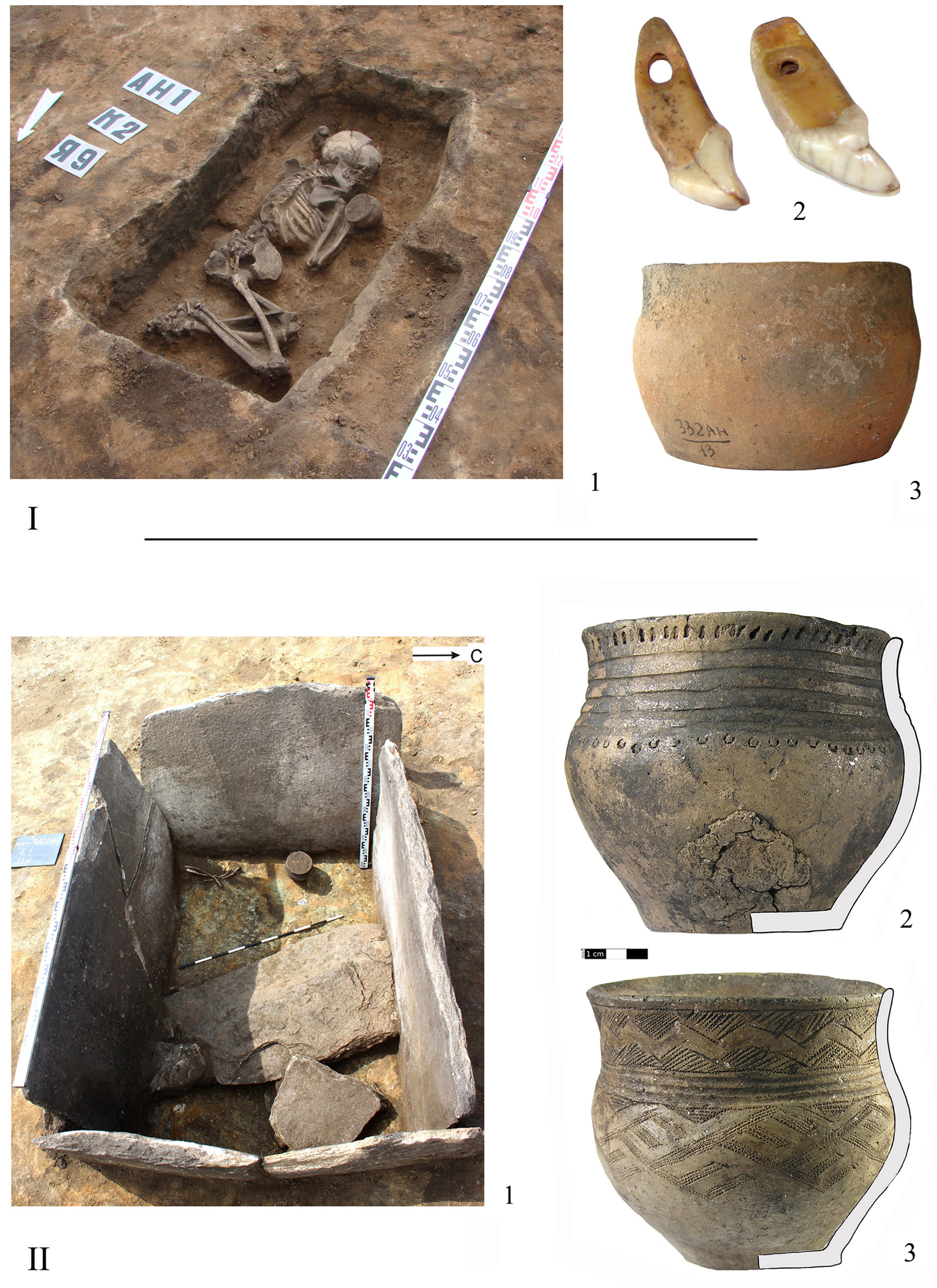
Historiography has alternative opinions about the successive or parallel functioning of cultures. This can be explained by the small number of site excavations in recent decades and the meager number of reliable datings. New publications (Panyushkina et al. Reference Panyushkina, Mills, Usmanova and Cheng2008; Krause et al. Reference Krause, Epimakhov, Kupriyanova, Novikov and Stolarczyk2019; Schreiber Reference Schreiber2021) have expanded this list a little, but further efforts are clearly required. Taking into account published and new dates, we have collected 33 Alakul AMS dates, 11 Fedorovka AMS dates, and seven syncretic Alakul-Fedorovka AMS dates.
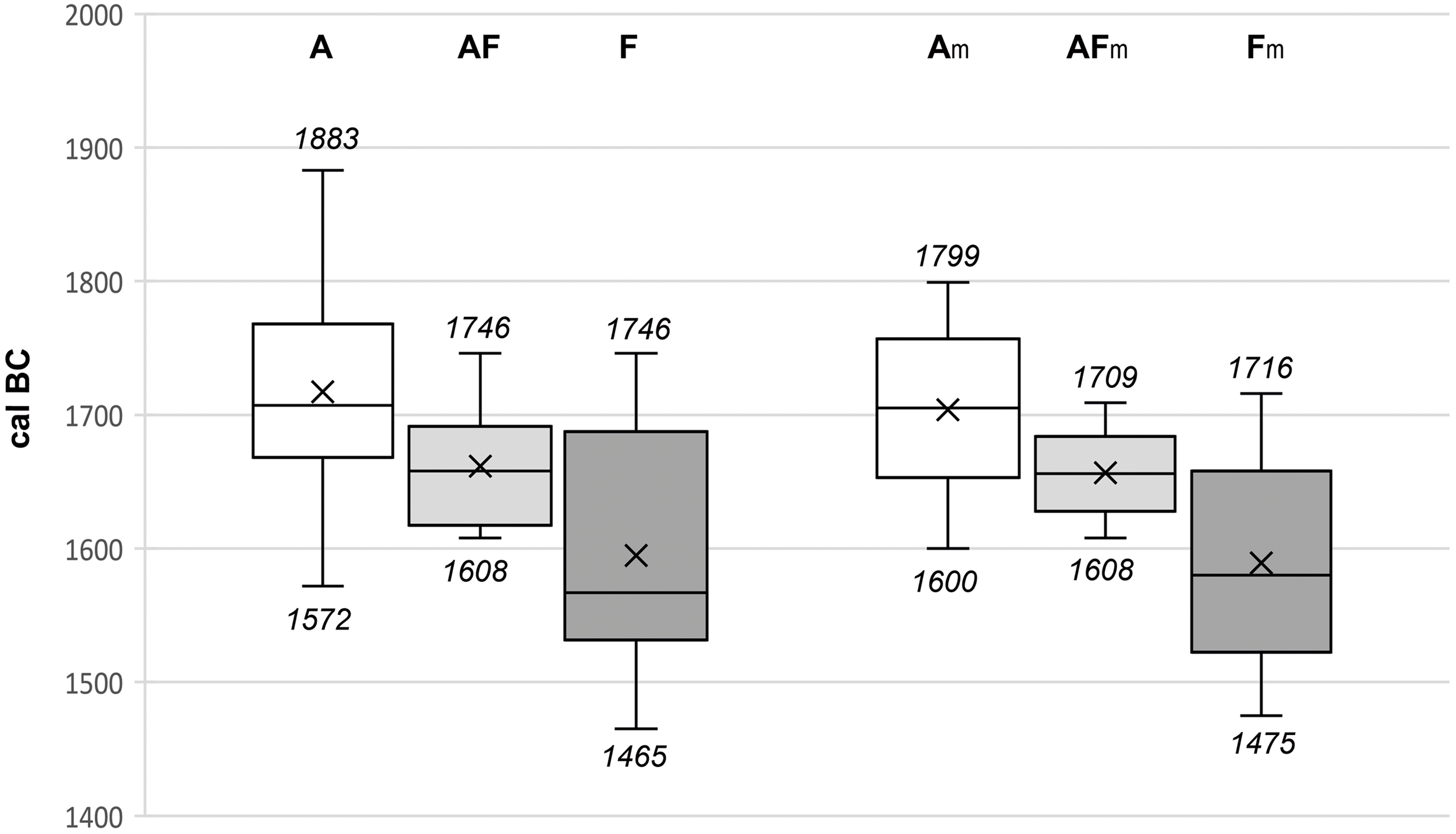
We built a boxplot in two versions: for simulated and non-simulated values (medians of calibrated intervals) (Figure 3). The boxplot showed no outliers in any of the cases. This indirectly indicates the relative homogeneity of the series, which is partly confirmed by the sum of probabilities procedure forming symmetrical figures. Their profiles are complex because of the nature of the calibration curve and the small number of measurements. All AMC dates of the Alakul and Fedorovka cultures were combined and considered in the simulation as a single series. The boundary intervals for them were calculated with the definition of median values. The medians clearly indicate the chronological priority of the Alakul culture (1802–1595 cal BC). The Fedorovka culture is significantly later (1742–1451 calBC). However, we established a long period of coexistence and interaction. The latter was embodied in the syncretic (Alakul-Fedorovka) sites. A similar boundary definition procedure is used for this series too. The median boundaries are 1728–1588 calBC. The Alakul culture ceases to exist earlier than the Fedorovka culture. We should emphasize that this conclusion is fair for the Southern Urals. Its possible extrapolation to other territories (from Kazakhstan to Southern Siberia) should be studied additionally.
Andronovo cultural community in Trans-Urals. Chronological correlation of traditions, boxplot: Medians of un-modeled dates: A – Alakul; AF – Alakul-Fedorovka (sincretic); F – Fedorovka. Medians of modeled dates: Am – Alakul; AFm – Alakul-Fedorovka (sincretic); Fm – Fedorovka.
The series of AMS dates for the Final Bronze Age was expanded significantly (by 37%) under our project. Unfortunately, almost all the results are concentrated in the Trans-Urals. The sum of probabilities shows two peaks and a clear right skew of the graph. Most of the values are concentrated in the early part. We actually have only two dates (OxA-14202: 2702 ± 32 BP; IGANAMS-7054–7054: 2615 ± 20 BP) for sites to be considered as transitional to the Early Iron Age. The medians of the calibrated values of these dates fall into the outliers when building the boxplot.
The new sample values (human bones and coal) were among the earliest, although they were not critically different from the remaining values. The influence of the factors aging the result is not excluded, although it is rather insignificant. The total duration of the Final Bronze Age was over six centuries (according to the medians of the boundaries). It seems reasonable to divide this period into sub-periods: 15–11 and 10–8 centuries calBC. This conclusion is generally in line with the conclusions of our colleagues for the Irmen culture of Western Siberia and the Karasuk culture of Minusinsk depressions (Molodin et al. Reference Molodin, Epimakhov and Marchenko2014; Polyakov Reference Polyakov2022). As yet the Volga region has no materials for correct comparison.
Sintashta II (Levoberezhnoe) Settlement Case-Study
Our work included modeling for Sintashta II (Levoberezhnoe) settlement, where we found materials from four cultures, three of which were dated (Sintashta, Cherkaskul, Final Bronze Age). The early stratigraphic horizon is represented by a settlement with a closed layout and blocks of dwellings located along the main thoroughfare. The dwellings (up to 150 m2 each) had shallow foundation pits and pillar configurations. The perimeter of the housing development is surrounded by a collapsed earth wall and a moat. The intramural child burial also belongs to the early period. The Sintashta cultural attribution of this period was reliably established. The population of the following periods rejected the traditions of dense housing and erected their dwellings chaotically. The building structures of the Final Bronze Age are most reliably documented. Their deep foundation pits cut through the early layers. As a result, we have a rare example of reliable stratigraphy. The cultural affiliation of these materials is debatable, though the epochal affiliation is unquestioned. The materials of other cultures in the excavated part of the site are presented in fragments. For example, Alakul antiquities are found only in a disturbed form, while Cherkaskul ones are found in a very small area of the cultural layer. The stratigraphic position of the latter was determined as post-Sintashta. These facts formed the basis of the chronological model.
The stratigraphy of the Sintashta II settlement allows for the identification of the three consistent phases in the development of the settlement site (Figure 4). The earliest cultural horizon corresponds to the Sintashta culture, which is followed by the Cherkaskul culture. The Final Bronze Age cultural horizon wraps up the stratigraphic sequence. We apply the Bayesian modeling approach and to assess the chronological span of each stratigraphic layer. The “Sequence” model is used as an order of events is known from the stratigraphic observation on the site. Within the “Sequence” model, we define two phases with the “Phase” command as within each stratigraphic horizon, events are related one to another, and events need to be treated as a whole (Bronk Ramsey Reference Bronk Ramsey2009). The early “Sintashta” phase incorporates four radiocarbon measurements, and the latest “Final Bronze Age” phase consists of seven measurements. The “Boundary” command limits each phase at each end to evaluate their chronological boundaries. The intermediate Cherkaskul horizon is presented by a single radiocarbon date located between the boundary commands of the two phases to constrain them further. The resulting Bayesian model has an overall high degree of inner agreement: the A coefficient varies from 85% to 107%. The Model agreement index is Amodel=83.7, and the individual agreement index is Aoverall=81.1; both are above 60% as required. The convergence integral is above 95% in all cases, as required.
Sintashta II (Levoberezhnoe) settlement. Bayesian chronological model.
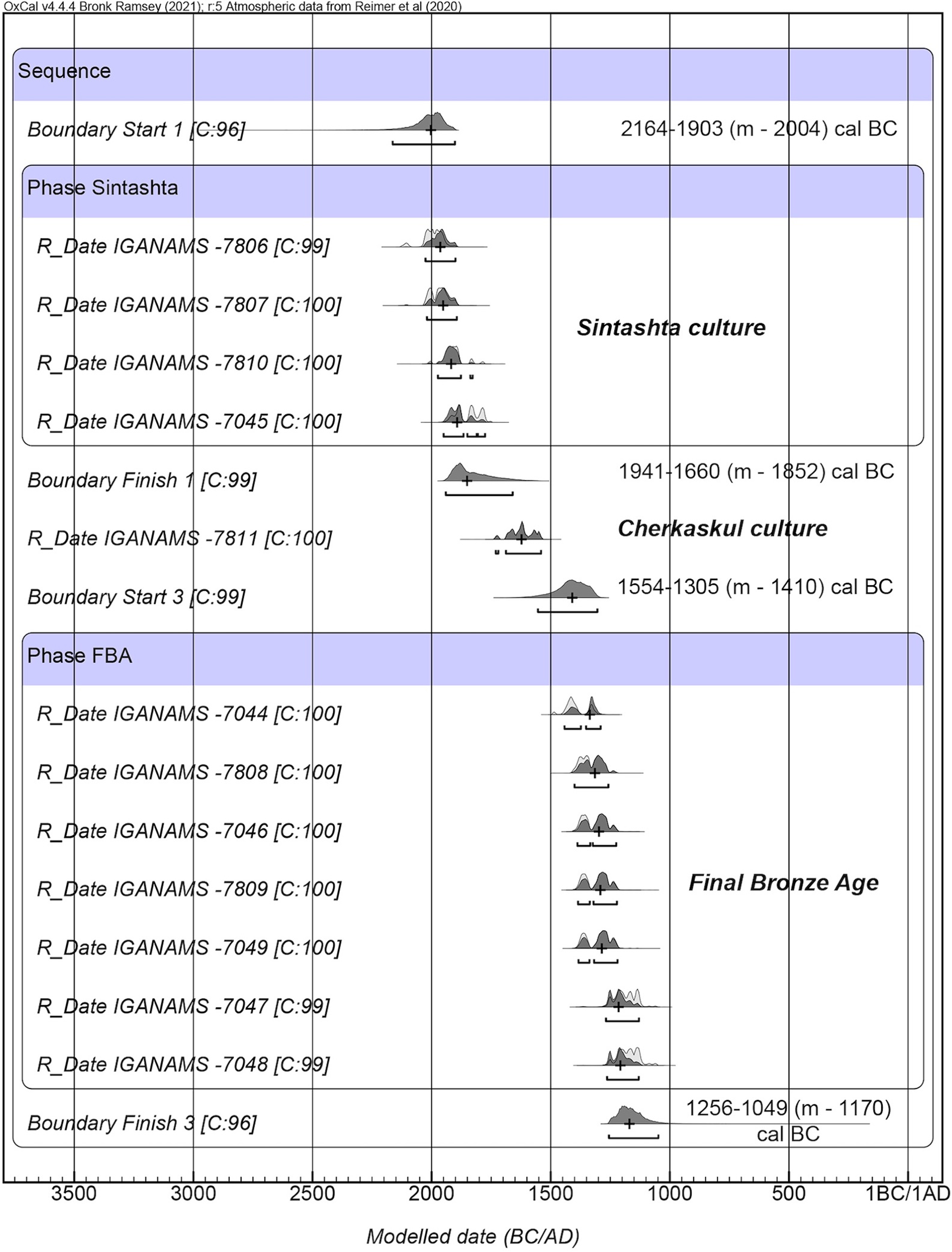
We employ the medians of boundary intervals at each phase’s end to assess the chronology of each stratigraphic phase. Accordingly, the early “Sintashta” phase is dated to 2004–1852 calBC. Its boundary events cover the intervals between 2170–1900 calBC at 95.4% at the beginning of the sequence and 1940–1660 calBC at 95.4% at the end. The latest “Final Bronze Age” phase is dated to 1410–1170 calBC according to the boundary medians, or to 1554–1305 calBC (95.4%) and 1256–1049 calBC (95.4%) according to their spans. The intermediate Cherkaskul phase is represented by a single date, corresponding to a calibrated interval of 1731–1541 calBC at 95.4%. We should emphasize that this is the first and, so far, the single AMS date representing the Cherkaskul culture.
CONCLUSIONS
We have obtained new data on the regional chronology of the Bronze Age of the Southern Urals. The chronological positions and cultural attribution of 8 sites were verified by obtaining first dates and/or increasing series for some of them. The earliest dates of the series belong to the Sintashta culture, the migratory genesis of which is generally recognized (Narasimhan et al. Reference Narasimhan, Patterson, Moorjani, Rohland, Bernardos and Mallick2019). However, in order to clarify its relationship with other cultures (Petrovka, Srubnaya, and Alakul), we should significantly expand the number of dates for these cultures and verify the available results. Many dates of these cultures date back to the first quarter of the 2nd millennium calBC. This pattern is partly explained by the local plateau of the calibration curve around 3500 yrs BP. Thus, we obtained several early dates for the Srubnaya culture to be cross-checked by different methods. By now, they conflict with the ideas about the periodization system of the Bronze Age of the Southern Urals.
Thirty-two new dates were obtained, including the most problematic (in terms of chronology) archaeological cultures. The first AMS date was obtained for Cherskul culture, and the Fedorovka series of dates almost doubled, as did the Srubnaya series in the Trans-Urals. The dozens of dates achieved allowed us to model the chronological boundaries for the Alakul and Fedorovka cultures in the Trans-Urals. The conclusions are based on using medians of the calibrated values intervals. We proved the chronological priority of the first culture and the existence of a long period of interaction between the two traditions. The archaeological manifestation of this interaction can be seen in the sites combining the features of the two cultures. This conclusion cannot be extrapolated to the Andronovo cultural community, since the genesis of the Fedorovka culture remains unclear. Its migratory origin is very likely, but the original zone has not been determined yet. As opposed to the Fedorovka culture, the Alakul culture apparently resulted from the evolution of the Sintashta traditions.
The Final Bronze Age was divided into two sub-periods based on the sum of probabilities. The first sub-period (the end of the 14th–11th centuries calBC) is well provided with dates. The sub-period transitional to the Early Iron Age (10th–9th centuries calBC) still has single datings. Their increase is limited by the small number of sites and complicate diagnostics. The division into sub-periods is generally consistent with other territories for which there are available date series.
Despite a noticeable improvement in the situation, the series of qualitative dates for the Bronze Age of the Southern Urals could still be expanded.
ACKNOWLEDGMENTS
The authors express deep gratitude to Igor Chechushkov for his help in describing the statistical model and editing the text. This study was funded by a grant from the RSF, Project No. 20-18-00402P.


 Open access

