




Introduction
Advances in diagnostics, neonatal care, and surgical management have improved the prognosis for patients with CHD including increased survival rates. Thus, the focus on clinical outcomes has shifted from early mortality toward long-term morbidity. Reference Gilboa, Salemi, Nembhard, Fixler and Correa1 Neurodevelopmental dysfunction is among the most common extracardiac complications in children with complex CHD. Reference Massaro, El-Dib, Glass and Aly2 Nevertheless, our understanding of the association between patients with minor, acyanotic CHD, including patients with septal defects, and neurodevelopmental outcomes is limited. Reference Dittrich, Bührer, Grimmer, Dittrich, Abdul-Khaliq and Lange3–Reference Licht, Shera and Clancy8 Previous population-based studies have shown that adult patients with an atrial septal defect have a higher incidence of psychiatric issues, Reference Nyboe, Udholm, Larsen, Rask, Redington and Hjortdal9,Reference Udholm, Nyboe, Dantoft, Jørgensen, Rask and Hjortdal10 lower workforce attachment, Reference Nyboe, Fonager, Larsen, Andreasen, Lundbye-Christensen and Hjortdal11 and cohort studies have shown decreased IQ. Reference Nyboe, Fonager, Larsen, Andreasen, Lundbye-Christensen and Hjortdal11–Reference Asschenfeldt, Evald and Heiberg13 Neurodevelopmental problems are also seen in patients with ventricular septal defects. Reference Asschenfeldt, Evald and Heiberg13 Young patients with atrial or ventricular septal defects have also been shown to have a higher burden of hyperactivity and inattention. Reference Lau-Jensen, Asschenfeldt, Evald and Hjortdal14
The association between small head circumference and impaired neurodevelopment is well-established. The American Heart Association recommends measurements of head circumference to be part of the developmental evaluation in infants with CHD. Reference Marino, Lipkin and Newburger15 Head circumference at birth is the most widely available proxy measure of prenatal brain growth Reference Bartholomeusz, Courchesne and Karns16 and has been associated with neurodevelopmental outcomes from the neonatal period through school age. Reference Limperopoulos and Majnemer17
Many previous studies on head circumference and neurodevelopmental outcomes focus on complex CHDs, with one study looking at head circumference in different types of CHD in a retrospective, registerbased study. Reference Stoll, Alembik, Roth, Dott and De Geeter32 No large, prospective study has investigated isolated cerebral growth specifically in simple cardiac defect. Therefore, we conducted a prospective, population-based cohort study on neonates and focused on those born with common types of simple CHD, i.e. atrial and ventricular septal defects. We aimed to assess the head circumference at birth as a proxy measure of isolated prenatal cerebral growth in neonates with septal defects, by matching a population cohort on birth weight as a marker of overall fetal growth.
Material and methods
Study design and data collection
This study is part of the Copenhagen Baby Heart Study; a prospective, population-based cohort study including neonates (n = 27,595) born at the three largest maternity wards in Copenhagen, Denmark in the period 1 April 2016 to 31 October 2018. All expectant parents were offered inclusion prenatally. The Copenhagen Baby Heart Study was established to study neonatal cardiovascular structure and function, investigate the impact of prenatal exposures on the infant’s heart, and determine how congenital cardiac structural and functional abnormalities affect later cardiovascular health. Included neonates underwent neonatal cardiac examination including echocardiography, electrocardiography, and pulse oximetry testing, as well as cord blood samples at birth. Maternal-, pregnancy-, and infant characteristics were collected and stored in the Copenhagen Baby Heart Study database. A detailed description of the study design, the inclusion, and the study cohort has previously been published.18,Reference Sillesen, Raja and Pihl19
Study population
In this specific study, term neonates from the Copenhagen Baby Heart Study diagnosed with atrial or ventricular septal defects based on echocardiographic findings were included. Neonates with gestational age less than 37 weeks (259 days), neonates with concomitant major cardiac malformations, Reference Vøgg, Basit and Raja20 and neonates with known chromosomal anomalies were excluded. Neonates with septal defects were matched to controls without septal defects from the Copenhagen Baby Heart Study. Matching was performed based on the neonates’ sex, birthweight, and birth length with a matching ratio of 1:5.
Echocardiography and assessment for septal defects
Neonates included in the Copenhagen Baby Heart Study were examined with a transthoracic echocardiography within the first 30 days after birth by a health professional with sonographic experience. Echocardiographies were analysed for interatrial and interventricular defects using the following two different classification systems.
Echocardiographies were analysed using a newly published algorithm to classify interatrial communications in the oval fossa into three main categories; patency of the foramen ovale, atrial septal defect, and no interatrial communication. Reference Hoffman and Kaplan21 The algorithm included six echocardiographic criteria, defined to systematically categorise the findings (see supplementary material for definition of the criteria and algorithm).
Ventricular septal defects were classified according to Soto et al,, as present or not. Reference Dannesbo, Blixenkrone-Moeller and Pihl22
Head circumference at birth
Since 1997 it has been mandatory in Denmark to measure the occipitofrontal head circumference for all live births, as a part of the clinical routine examination performed within four hours after birth by a midwife or paediatrician. The information is stored in the Danish Medical Birth Registry, Reference Soto, Becker and Moulaert23 from where these data were extracted. The examination also includes parameters such as APGAR score, birth weight, and birth length.
Statistical analysis
Categorial variables are presented as absolute numbers (percentages) and continuous variables are presented as median values (interquartile ranges) or as means (standard deviations). Comparison between neonates with septal defects and matched controls were performed using Student’s t-test. Z-scores regarding head circumference raw values were calculated for the study population. Furthermore, z-scores of head circumference were analysed for patients and controls according to their gestational age, allocating into groups of gestational ages of week 37 (259 – 265 days), week 38 (266 – 272 days), week 39 (273 – 279 days), week 40 (280 – 286 days), week 41 (287 – 291 days), and week 42 (292 – 298 days), respectively. In a sub-analysis, we investigated differences according to subtype of septal defect, i.e. we compared head circumference in neonates with atrial septal defects, ventricular septal defects, and neonates without septal defects, respectively, using analysis of Variance. p values < 0.05 were considered statistically significant. All analyses were performed using R Studio v4.2.0 and StataIC 11.2 (StataCorp LP, College Station, TX).
Results
Study population and descriptive characteristics
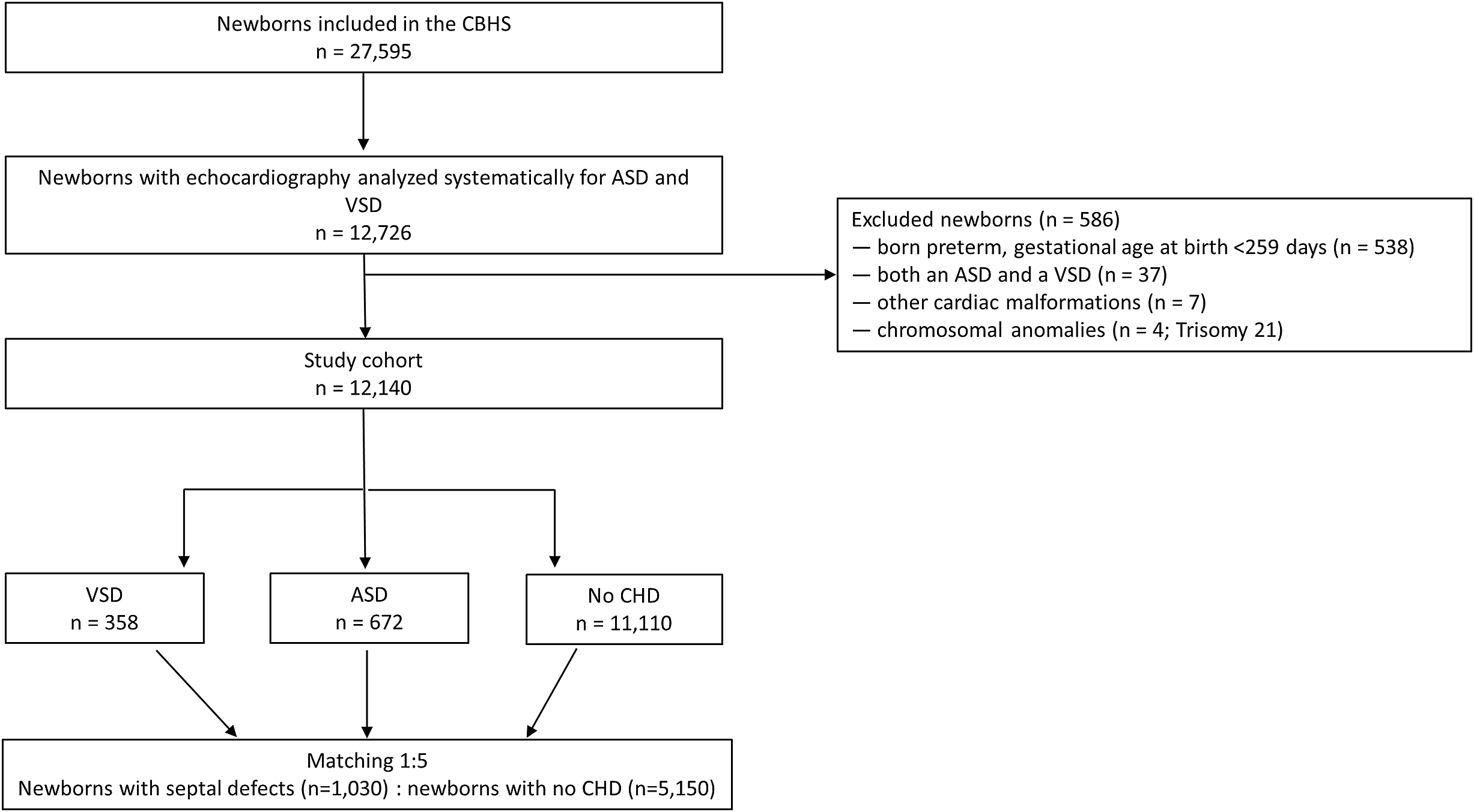
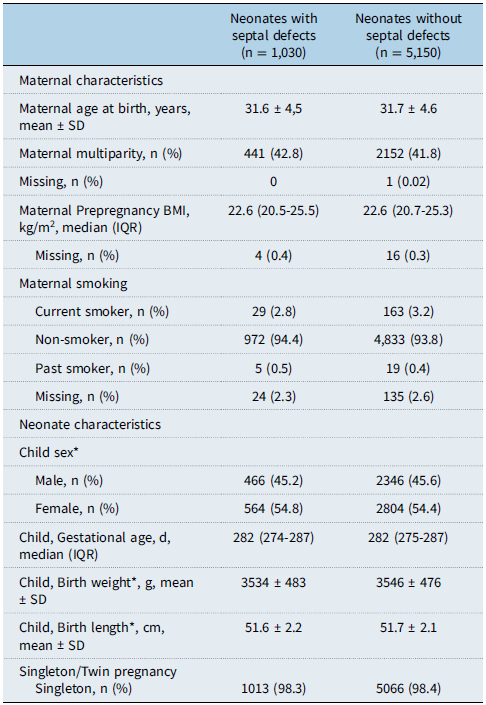
The Copenhagen Baby Heart Study included 27,595 infants in total. Details on the Copenhagen Baby Heart Study Cohort and collected data have been published previously. Reference Sillesen, Raja and Pihl19 For the present study, we included 1030 neonates with septal defects (672 neonates with an atrial septal defect and 358 neonates with a ventricular septal defect) along with 5150 matched controls. The inclusion process is illustrated in Figure 1. Descriptive characteristics for cases (neonates with septal defects) and controls (neonates without septal defects) are shown in Table 1.
Flowchart over the inclusion process. Abbreviations: ASD = atrial septal defect; CBHS = copenhagen baby heart study; VSD = ventricular septal defect.
Descriptive maternal and infant characteristics for neonates with and without septal defects
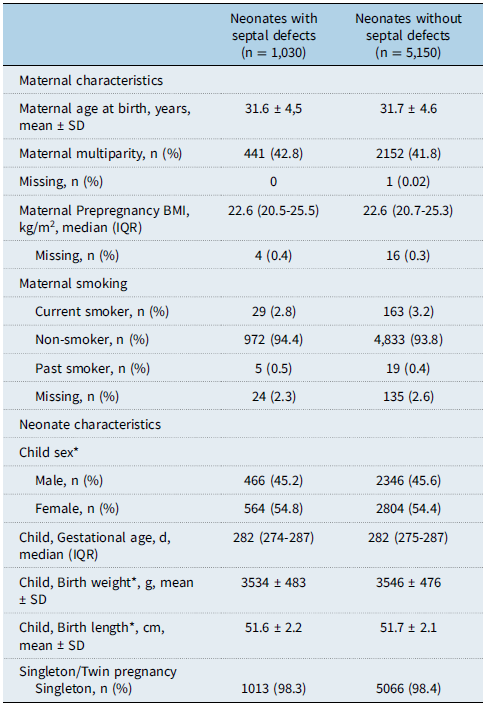
* = matching criteria.
Categorial variables are presented as absolute numbers (percentages) and continuous variables as median values (interquartile ranges) or as means ± standard deviations (SD). Abbreviations; ASD: Atrial septal defect; VSD: Ventricular septal defect; CBHS; Copenhagen Baby Heart Study; BMI, body mass index; IQR, interquartile range.
There were no differences between cases and controls regarding maternal age, maternal pre-pregnancy BMI, smoking status, parity, gestational age at birth, or whether the pregnancy was a singleton or twin pregnancy.
Head circumference
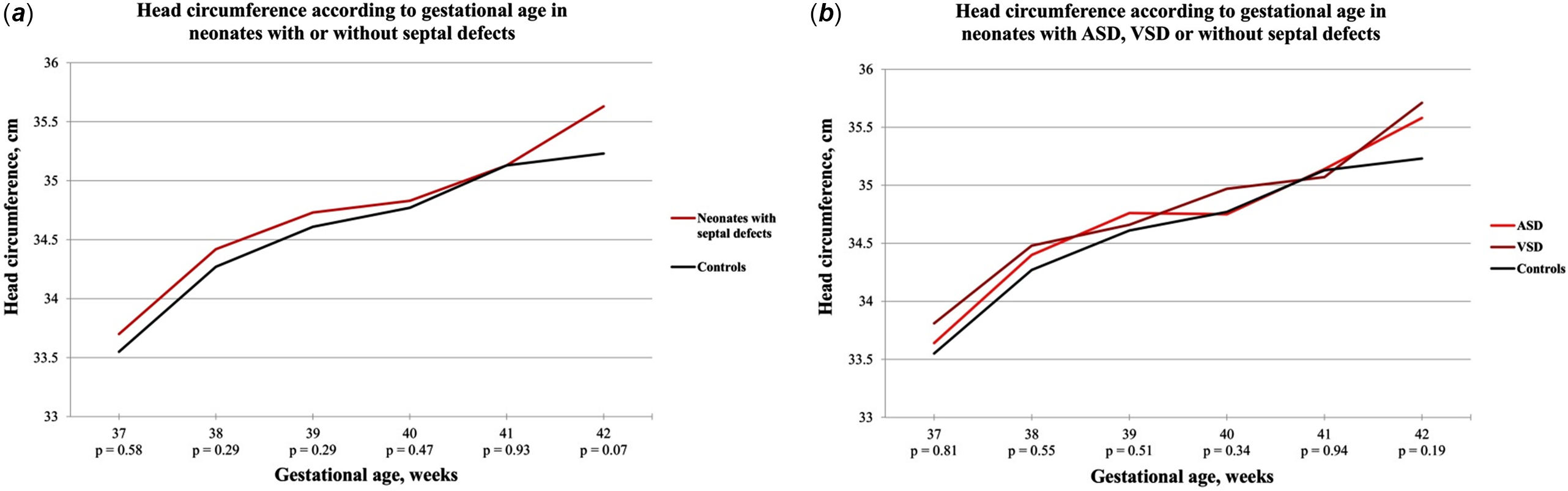
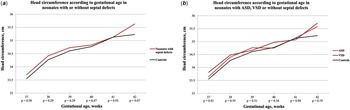
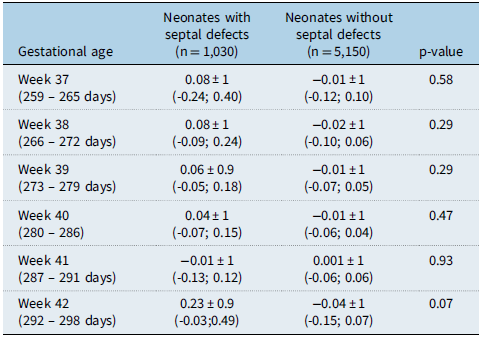
Neonates with septal defects had a mean head circumference of 34.8 cm (95% confidence interval 34.7–34.9 cm), compared to neonates without septal defects of 34.7 cm (95% confidence interval 34.7–34.8 cm); p-value 0.07. Regarding mean head circumference z-scores, there were no significant differences between neonates with septal defects and neonates without septal defects (0.05 (95% confidence interval -0.01–0.11) vs. -0.01 (95% confidence interval -0.04–0.02), p = 0.07, respectively). In Figure 2A, raw values of head circumference are depicted for neonates with and without septal defects as according to their gestational age. In Table 2, values for head circumference z-scores are listed for neonates with and without septal defects according to their gestational age.
Head circumference raw values. ( a ) Raw values of head circumference for neonates with and without septal defects according to their gestational age. ( b ) Raw values of head circumference according to gestational age for neonates with atrial septal defect, ventricular septal defect, or without septal defect. Abbreviations; ASD = atrial septal defect; VSD = ventricular septal defect.
Z-scores for head circumference in neonates with and without septal defects, divided in to groups according to gestational age
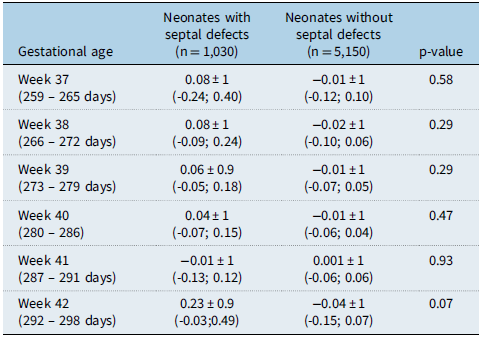
Data shown as mean ± SD with (95% confidence intervals).
Sub-analyses according to type of septal defect
Dividing cases into neonates with atrial septal defects and ventricular septal defects and comparing to neonates without septal defects did not reveal differences between groups (atrial septal defects 34.8 ± 2, ventricular septal defects 34.9 ± 2, neonates without septal defects 34.7 ± 2, p = 0.14). Figure 2B portrays raw values of head circumference according to gestational ages for the three groups.
Discussion
In a large population-based study, 1030 neonates diagnosed with atrial- or ventricular septal defects by transthoracic echocardiography within the first 30 days of birth did not differ from the matched control group in head circumference.
Numerous studies have investigated potential correlations between CHD and measures of prenatal cerebral growth, given the recognised psychosocial adversities manifested by individuals in their adulthood. These inquiries encompassed evaluations of brain volume, Reference Bliddal, Broe, Pottegård, Olsen and Langhoff-Roos24,Reference Limperopoulos, Tworetzky and McElhinney25 prenatal ultrasound metrics, Reference Owen, Shevell and Donofrio26,Reference Zeng, Zhou, Zhou, Li, Long and Peng27 fetal MRI studies, Reference Miller, McQuillen and Hamrick7,Reference Bliddal, Broe, Pottegård, Olsen and Langhoff-Roos24,Reference Donofrio, Bremer and Schieken28 and head circumference at birth. Reference Licht, Shera and Clancy8,Reference Stoll, Alembik, Roth, Dott and De Geeter32,Reference Skotting, Eskildsen and Ovesen29,Reference Lauridsen, Uldbjerg and Petersen30,Reference Rosenthal31 The majority of these studies have found an association between CHD and reduced prenatal cerebral growth. Lauridsen et al Reference Skotting, Eskildsen and Ovesen29 found brain size and head circumference to be smaller in neonates with CHD compared to neonates without CHD. The differences in head circumference were most pronounced for major CHD, namely univentricular physiology and tetralogy of Fallot, while, in accordance with our study, differences in minor CHD, like septal defects, did not differ significantly. Matthiesen et al, Reference Stoll, Alembik, Roth, Dott and De Geeter32 a Danish population-based study, demonstrated that CHD was associated with smaller head circumference, and this was also the case in individuals born with a large ventricular septal defect (requiring surgical closure). In addition, this study identified a larger head circumference relative to their birth weight, indicating asymmetrical prenatal growth.
Most of these earlier studies are either registry-based, with subsequent selection and detection bias, or based on small sample sizes and often highly selected populations, resulting in a limited ability to address the association between specific subgroups of CHD, such as patients with atrial or ventricular septal defects, and measures of prenatal brain growth. Reference Nyboe, Udholm, Larsen, Rask, Redington and Hjortdal9,Reference Zeng, Zhou, Zhou, Li, Long and Peng27,Reference Lauridsen, Uldbjerg and Petersen30,Reference Matthiesen, Henriksen and Gaynor33 In young adults (mean age 25.6 years) with isolated, simple CHD (atrial and ventricular septal defects), there is no change in overall brain size. Reference Asschenfeldt, Evald and Heiberg13 Our study corroborates those data demonstrating no differences in head circumference at birth.
Studies on the proportionality of prenatal cerebral growth relative to overall growth have been sparse, and the results have been inconsistent. Reference Zeng, Zhou, Zhou, Li, Long and Peng27,Reference Lauridsen, Uldbjerg and Petersen30 Infants with a small head circumference also exhibited low birth weight, indicating that they were symmetrically small.
MRI of the fetal brain (n = 105, Reference Bliddal, Broe, Pottegård, Olsen and Langhoff-Roos24 n = 35, Reference Limperopoulos, Tworetzky and McElhinney25 n = 241 Reference Owen, Shevell and Donofrio26 ) has shown smaller cerebral volumes, decreased cerebral oxygen supply, and delayed cerebral maturation in fetuses with more complex heart defects, which indicates that haemodynamic factors may play an important role in this abnormal development. Reference Bliddal, Broe, Pottegård, Olsen and Langhoff-Roos24–Reference Owen, Shevell and Donofrio26 Despite that the brain is of normal size in most patients with septal defects, structural brain changes have been shown in individuals with atrial and ventricular septal defects. Reference Masoller, Martínez and Gómez34,Reference Asschenfeldt, Evald and Yun35 The cause of impaired neurodevelopment in patients with CHD is largely unknown. In general, studies illuminate the question through different pathophysiological ways; 1) isolated specific cerebral hypo-oxygenation, 2) cerebral hypo-oxygenation combined with additional mechanisms, or 3) shared genetic, environmental, or placental causes of CHD and impaired overall growth. Lauridsen et al Reference Skotting, Eskildsen and Ovesen29 demonstrated through measurements of first-trimester bi-parietal diameter and second-trimester head circumference that impaired neurodevelopment in infants with complex CHD begins during second to third trimester in pregnancy.
This study has some limitations, such as sub-optimal echocardiographic images from agitated neonates and sub-optimal visualisation and angulation during echocardiography. To minimise the impact of these difficulties, examinations were primarily performed on calm or sleeping neonates. If this was not possible, parents were advised to reschedule the examination.
All written information was available in several languages and the inability to speak English or Danish was not an exclusion criterion. Nevertheless, language and cultural barriers may still have affected participation rates, as is reflected by the underrepresentation of children born to women with non-Danish backgrounds in the Copenhagen Baby Heart Study cohort. Finally, higher-income households and children with well-educated mothers were over-represented in the Copenhagen Baby Heart Study cohort. Reference Sillesen, Raja and Pihl19
In earlier studies on head circumference and CHD, Reference Licht, Shera and Clancy8,Reference Stoll, Alembik, Roth, Dott and De Geeter32,Reference Lauridsen, Uldbjerg and Petersen30 the diagnoses of CHD are based on invalidated data from the mandatory national registries. Registries will only include patients where the septal defects have led to symptoms and referral to an echocardiographic examination where the diagnosis has been made. Patients with small defects might not be diagnosed and hence not included in registries. In contrast, a strength of the present study is the fact that the diagnoses of atrial and ventricular septal defects were made by echocardiographic screening in the neonatal period. Due to prenatal inclusion and transthoracic echocardiographic examination of all included neonates after birth, detection bias is limited. The Copenhagen Baby Heart Study data provide the unique possibility to study this cohort of neonates, knowing the unselected prevalence of atrial and ventricular septal defects and investigate the association with head circumference at birth.
Conclusion
In a population-based screening study, the head circumference in term neonates with atrial or ventricular septal defects did not differ from neonates without septal defects.
Acknowledgements
We thank all study participants of the Copenhagen Baby Heart Study.
Financial support
This work was supported by The Novo Nordisk Foundation, Denmark (grant number NNFSA170030576). The Copenhagen Baby Heart Study receives financial support from the Danish Heart Association, the Danish Children’s Heart Foundation, Candy’s Foundation, the Toyota Foundation, the Herlev-Gentofte Hospital Research Foundation, and the Gangsted Foundation.
Competing interests
The authors have no conflicts of interest relevant to this article to disclose.
Ethical standards
The study complies with the Declaration of Helsinki and was approved by the Regional Ethics Committee (H-16001518), Capital Region of Denmark. Written informed consent was obtained from all parents prior to inclusion.

 Open access

