1 Introduction
This Element is designed for language teachers, future teachers, and teacher trainers. It explores how generative artificial intelligence (GenAI) and microlearning can be integrated into language teaching, offering research-backed recommendations and practical, pedagogy-focused strategies. Although the text references research findings, its primary aim is to provide actionable guidance for using GenAI and microlearning in teaching. Not all tools discussed in this Element incorporate GenAI technologies – some rely on general artificial intelligence or have minimal GenAI capabilities – but they are included to showcase diverse possibilities for enhancing language learning.
1.1 What Are GenAI and Microlearning
GenAI refers to AI models that can create new content based on prompts, including text, images, audio, and code. In language education, GenAI tools such as ChatGPT, Claude, and other large language models (LLMs) can support learners and teachers by generating personalised feedback, simulating conversations, adapting texts, and creating custom learning materials (Moorhouse & Wong, Reference Moorhouse and Wong2025). These tools will be examined in greater detail in Section 2.
Microlearning involves delivering content in short, focused bursts that target specific learning outcomes (Hug, Reference Hug2005). It is designed to reduce cognitive load and increase retention by offering flexible, just-in-time, and often mobile-accessible learning opportunities. In language education, microlearning is typically used to support vocabulary acquisition, grammar practice, and the development of listening or pronunciation skills through brief, repeatable activities. A more detailed discussion of microlearning appears in Section 3.
1.2 Why This Element?
Despite the growing body of knowledge on GenAI and microlearning, no published resources combine these two innovative approaches in the context of language education. I have several reasons for addressing this gap. First, I teach courses on emerging technologies, including GenAI, to pre-and in-service teachers at a university in Hong Kong – courses like Sustainable Development of e-Learning in Schools, Digital Literacy and English Language Teaching, and Effective Use of e-Resources in Primary/Secondary English Classrooms. I also deliver workshops and seminars worldwide on these topics. It is difficult to find literature that combines these approaches accessibly and practically. My workshop and seminar participants and students have repeatedly asked for such a resource.
Second, I have a track record of publications on GenAI and microlearning in language teaching and learning and the professional development of language teachers. I have researched how we can use technology to design English as a Second Language and English as a Foreign Language microlearning activities and optimise language teachers’ digital professional competence through microlearning. My publications explore aspects of teacher education such as lesson planning, self-regulated learning, multimodality, and technology-assisted language learning. This Element provides an opportunity to share these findings with a broader audience, empowering readers to explore emerging approaches to language teaching and learning.
Third, this Element is grounded in key theoretical perspectives that support the integration of GenAI and microlearning. Microlearning is informed by cognitive load theory (Sweller, Reference Sweller2020), which advocates for breaking complex information into manageable chunks, and self-determination theory (Ryan & Deci, Reference Ryan and Deci2017), which emphasises learner autonomy and motivation. It also draws on principles of self-regulated learning (Zimmerman, Reference Zimmerman2002) by enabling learners to take control of when, where, and how they engage with content. These learning theories align with the affordances of GenAI, which supports adaptive, personalised, and feedback-rich environments that respond to learner needs in real time.
Fourth, recent studies highlight the growing importance of personalised, just-in-time, and flexible learning opportunities in both teacher education and language learning (Kohnke et al., Reference Kohnke, Zou and Su2025a; Monib et al., Reference Monib, Qazi and Apong2025). Microlearning formats such as short videos and interactive tutorials have been shown to enhance vocabulary acquisition, grammar skills, and learner autonomy (Arakawa et al., Reference Arakawa, Yakura and Kobayashi2022; Gao et al., Reference Gao, Tsai, Huang, Ma and Wu2023; Rad, Reference Rad2023). At the same time, GenAI tools GenAI tools such as ChatGPT and Claude offer new ways for learners to co-create content, receive immediate feedback, and engage in realistic interaction.
Finally, there is a growing body of publications on GenAI and microlearning (e.g. Kohnke et al., Reference Kohnke, Zou and Xie2025b), but the combination of the two remains underexplored and underutilised. This oversight is significant, given their potential benefits to language learners and teachers. By adopting an explorative mindset as teachers, we can address this gap, embracing teaching practices that help learners become self-directed, adaptable, and effective learners. Together, we can ensure that GenAI and microlearning receive the attention they deserve in language education.
1.3 How to Use This Element
Each section describes tools that can be used in practice. However, these examples are illustrative rather than definitive as the field of GenAI is evolving rapidly. Some content appears across multiple sections, reinforcing key ideas and allowing individual sections to serve as stand-alone pathways. Readers are encouraged to reflect on which tools and strategies might work best in their specific teaching contexts. Together with the example activities and strategies, the reflective tasks make it easy to use this Element as a foundational training module or a resource for experienced teachers seeking to upskill independently.
This Element is designed to be flexible. Not all tasks, examples, or strategies will suit every teacher or context, and readers can skip to relevant activities without losing the thread of the text. For those who appreciate a practice-oriented, active learning approach, the Element encourages revisiting activities, experimenting with tools, and reflecting on teacher practices over time. Whether you are a novice teacher, trainer, or experienced educator, this Element invites you to adapt its content to your context and explore the exciting potential of AI, GenAI, and microlearning in language teaching.
1.4 Overview of Sections
This Element offers multiple ways to engage with its content. Readers can use the material to gain a thorough grounding in the foundations of GenAI and microlearning or treat it as a practical guide to specific applications.
For those seeking a foundational understanding, Sections 1–3 introduce GenAI and its historical context and offer examples of its affordances for language teaching and learning. Section 2 explores GenAI’s relevance and use in second-language education, including its pedagogical promise and limitations. Additionally, Section 3 introduces key second-language acquisition principles and theories, aligning them with the concept of microlearning. It also offers structured examples of GenAI-powered microlearning for language acquisition to help readers understand how pedagogy and technology interact.
Building on the theoretical and empirical foundations outlined in earlier sections, the remainder of the Element, particularly Sections 4 and 5, offers practical strategies and design frameworks that translate these insights into GenAI-powered microlearning experiences.
For practitioners focusing on designing microlearning experiences, Section 4 presents a practical framework for GenAI-assisted microlearning design, offering actionable tips for creating activities. Section 5 builds on this by exploring practical strategies for GenAI-powered microlearning, including tool selection, active design, assessment, feedback, and the support of diverse learner groups.
Teacher educators interested in harnessing GenAI and microlearning for teacher professional development (TPD) will find valuable insights in Section 6. This section outlines a structured framework for GenAI-powered TPD, providing strategies to ensure that professional development is focused, time-efficient, and directly applicable to classroom practices.
The Element concludes with Section 7, which discusses the future of GenAI and microlearning in second-language education. This section highlights pedagogical, ethical, and technological gaps in our understanding of these approaches and speculates on emerging trends.
This Element is ideal for language teacher training courses as it bridges theory and practice through accessible language and examples. The main text of each section can serve as preparatory reading, while the sample activities can be used to guide readers in creating unique projects. These tasks form the basis for classroom presentations and discussions, fostering collaboration and deeper engagement with the material.
The practical guidance provided throughout the Element is grounded in emerging empirical research on GenAI in language education. Studies have explored its use in formative feedback, learner autonomy, and interactive planning tasks. Their findings support the integration of GenAI as a pedagogically meaningful resource for language teachers.
2 GenAI in Second-Language Education
This section introduces generative artificial intelligence (GenAI) and explores its applications, historical contexts, and evolution in second-language education. It highlights key milestones in language education and discusses GenAI tools available for language learning. The benefits of GenAI in second-language education are examined, followed by a discussion of the technology’s challenges and limitations, as well as strategies to ensure its responsible and effective use.
2.1 What Is GenAI?
GenAI is a form of artificial intelligence (AI) that uses algorithms to generate new data or content. As defined by Google, GenAI is ‘the use of AI to create new content, like text, images, music, audio, and videos’, utilising a machine learning (ML) model ‘to learn the patterns and relationships in a dataset of human-created content’. GenAI then ‘uses the learned patterns to generate new content’. As a subset of AI, GenAI distinguishes itself from past forms of AI technology that employ ML algorithms and prediction from data based on past behaviour. Such traditional AI algorithms rely on pre-defined rules to process data and generate outputs. GenAI and traditional AI each have their strengths and weaknesses, making them suitable for specific problems. Traditional AI algorithms excel in tasks requiring rule-based processing and predictable content, such as automatic grading of multiple-choice and true/false questions. In contrast, GenAI focuses on creating new textual and multimodal content using large language models (LLMs), art-based models, and video-based models. Consequently, GenAI is particularly effective for tasks involving natural-language processing and creating new content, such as writing essays and personalising learning content for teaching and learning (Kuhail et al., Reference Kuhail, Alturki, Alramlawi and Alhejori2023).
GenAI’s primary strength lies in its ability to generate new and adaptive content tailored to learners’ needs. For instance, it can automatically generate learning materials tailored to each student’s proficiency level, facilitating a personalised experience (Kohnke et al., Reference Kohnke, Moorhouse and Zou2023a). Additionally, GenAI can provide students with meaningful feedback on pronunciation, grammar, and usage (Guan et al., Reference Guan, Zhang and Gu2025). Tools like ChatGPT can create dialogues for interactive role-play scenarios, enabling learners to practice language skills in context-rich environments. Furthermore, these tools can moderate virtual discussions in which learners engage in debates and storytelling sessions, enhancing their language fluency and cultural competency (Zhai & Wibowo, Reference Zhai and Wibowo2023).
LLMs leveraging GenAI can detect underlying patterns to generate ‘statistically likely’ content. However, this technology also raises concerns about bias and accuracy (Ferrara, Reference Ferrara2023). Despite these limitations, LLMs can perform tasks that historically required human intelligence (e.g. recognising patterns and making decisions; Ali et al., Reference Ali, Murray, Momin, Dwivedi and Malik2024). By analysing vast datasets, GenAI identifies patterns and uses them to autonomously produce novel output, including text, images, audio, and video.
Unlike other forms of AI, which are limited to reproducing, categorising, processing, and analysing input, GenAI excels at creating original content. LLMs are making GenAI use possible for chatbots, virtual assistants, content creation, research support, and language translation. They are revolutionising information access and interaction with digital tools, making them a crucial component of the contemporary digital ecosystem. Examples of well-known GenAI tools include OpenAI’s ChatGPT, GPT-4o, DALL-E, Whisper, Sora, Anthropic’s Claude, Google Gemini, and Stability AI’s Stable Diffusion.
2.2 GenAI’s Historical Context and Evolution
The roots of GenAI can be traced back to the early days of computer science and machine learning. In the late 1950s, researchers introduced machine learning (ML) to explore the use of algorithms to create new data. ML experienced significant growth in the 1990s and 2000s, driven by advances in computational power and increasing data availability. Before the emergence of GenAI, most ML models relied on datasets to classify and predict outcomes.
The development of neural networks, a type of ML designed to recognise patterns and relationships in large datasets, marked the beginning of Gen AI. Neural networks enabled machines to make decisions or predictions without explicit programming, paving the way for GenAI. Over time, more sophisticated generative architecture and deep learning algorithms emerged, forming the foundation of modern GenAI. Among these, variational autoencoders (VAEs; Kingma & Welling, Reference Kingma and Welling2013), generative adversarial networks (GANs; Goodfellow et al., Reference Goodfellow, Pouget-Abadie and Mirza2014), and transformer-based models such as generative pre-trained transformer (GPT) have been particularly influential.
Each of these algorithms has unique characteristics and applications:
VAE are generative models that learn to compress input data (e.g. images or text) into a latent representation and then reconstruct it. This process enables VAEs to generate new data that resembles the original dataset, such as creating variations of an image or reconstructing incomplete data.
GANs employ two neural networks working in opposition – a generator that creates data and a discriminator that evaluates it. The adversarial framework enables GANs to produce highly realistic outputs, such as photorealistic images or synthetic videos. Unlike VAEs, GANs are specifically designed to generate outputs that are indistinguishable from real data.
GPTs rely on attention mechanism to process and generate substantial data efficiently. GPT models, for example, are pre-trained on massive datasets and fine-tuned for specific tasks, making them highly effective for applications like language modelling, translation, and text generation. Unlike VAEs and GANs, transformers excel in handling the contextual and sequential information, particularly in natural language processing.
These algorithms collectively underpin the capabilities of modern GenAI. VAEs focus on data reconstruction, GANs generate realistic outputs, and transformers handle complex sequential data. Together, they represent a diverse toolkit that enables GenAI to produce text, images, audio, and video with remarkable precision and creativity.
Key milestones in GenAI’s evolution include:
WaveNet (2016): DeepMind’s groundbreaking generative model for audio, which produces natural-sounding human speech and has advanced text-to-speech synthesis.
Progressive GAN (2017): NVIDIA’s model for generating high-resolution, photo-realistic images, which has transformed fields like computer graphics.
GPT-2 and GPT-3 (2019, 2020): OpenAI’s language models, which have exceptional natural-language generation capacity, powering tools like ChatGPT.
DALL-E (2021): OpenAI’s model for creating digital images from text descriptions by merging computer vision and natural-language processing.
ChatGPT (2022): OpenAI’s conversational chatbot, which made GenAI accessible to the public.
LLaMA (2023): Meta’s open-source language model, which has provided researchers with access to advanced AI tools for natural-language processing.
Claude (2023): Anthropic’s conversational assistant Claude, which prioritises ethical considerations in AI use while generating coherent, human-like responses.
GPT-4o (2024): A milestone GenAI product from OpenAI that has enhanced reasoning capabilities and sophisticated textual understanding.
2.3 Key GenAI Tools for Language Education
GenAI can create a broad range of content, including realistic images, synthetic speech, new designs or prototypes, music, and art (McKinsey, 2024). Teachers, curriculum developers, and teacher educators must understand GenAI’s capabilities and applications to integrate AI tools into their practices effectively (Yang & Li, Reference Yang and Li2024). The following overview highlights key GenAI applications in education and showcases some of the most popular tools available to meet these needs.
2.3.1 Image Synthesis
GenAI algorithms can generate unique works of art, such as digital paintings, sculptures, and graphic designs. These tools are handy for creating visuals to enhance lesson plans, projects, and presentations. Examples include
DALL-E: Generates unique images based on text prompts, helping educators create visuals tailored to specific lesson themes. Midjourney: Produces high-quality, customisable images ideal for creative projects and thematic lessons.
Adobe Firefly: Allows teachers to generate creative, culturally responsive images using prompts in multiple languages.
2.3.2 Video Generation
GenAI can produce short, animated films or realistic videos, enabling teachers to create dynamic content that engages students and explains complex concepts. Examples include:
Sora: Converts text into realistic or imaginative videos useful for storytelling and concept visualisation.
Runway ML: Provides video editing and creation tools, including AI-powered background removal and video synthesis.
Synthesia: Creates studio-quality videos with AI avatars and voiceovers.
2.3.3 Music and Audio Creation
GenAI can unleash musical creativity by composing music, remixing existing songs, or creating custom sound effects. These capabilities enable students to enrich their projects, multimedia presentations, and language learning activities with personalised audio elements. Examples include:
Amper Music: Enables educators and students to compose original music for projects or presentations.
MuseNet: Generates music in various styles and mimics the sounds of various instruments.
Jukebox: Provides a wide range of music, lyrics, and singing styles as input and produces new music from scratch.
2.3.4 Text-to-Speech and Speech-to-Text
Text-to-speech and speech-to-text tools can provide valuable support to teachers by reading texts aloud or transcribing speech into writing. These capabilities enhance the accessibility of lessons, catering to students with diverse learning needs. Examples include:
Google Assistant: Offers robust text-to-speech and speech-to-text capabilities that are useful for accessibility and language practice.
Amazon Polly: Converts text into lifelike speech, supporting audio-based learning.
2.3.5 Text Generation and Conversation
Powerful LLMs can generate human-like text, craft engaging stories, and provide personalised student feedback. Additionally, these tools power chatbots that provide instant assistance for teachers and learners. Examples include:
ChatGPT: Generates text for lesson materials, writing prompts, and translating.
Claude: Focuses on ethical and safe AI use, providing detailed, context-aware responses.
Google’s Gemini: Excels at multimodal content creation, combining text, images, and audio for rich learning experiences.
2.3.6 Code Generation
GenAI can facilitate the development, writing, and debugging of programming code, making it a valuable resource for cross-disciplinary teaching. Leveraging GenAI tools can help students develop technical literacy, learn coding-related terminology in English, and practice language skills in authentic, real-world contexts.
OpenAI Codex: Allows students to practise writing instructions or commands in English while observing how those instructions translate into code.
GitHub Copilot: Encourages students to engage with English in specialised fields, helping them build confidence in communicating complex technical ideas.
Amazon Code Whisperer: Provides intelligent coding suggestions for cloud-based applications, offering opportunities to practice reading and writing in a structured, goal-oriented environment.
2.3.7 Productivity and Lesson Planning
GenAI can streamline teachers’ workflows by assisting with lesson preparation, material creation, and administrative tasks. Examples of GenAI’s potential to automate and support tasks include
Microsoft Copilot: Helps teachers create lesson plans, summarise data, and manage educational content efficiently.
Magicschool.ai: Provides tools to generate rubrics, feedback, and newsletters tailored to classroom needs (explicitly designed for education).
Diffit.me: Enables teachers to adapt content to suit various reading levels. Creates custom texts, quizzes, and activities by selecting the desired reading level and language.
Perplexity: Answers questions, provides citations from web sources, and generates images and videos, making it ideal for enhancing classroom multimedia presentations.
When utilised effectively, these tools cater to second-language learners’ diverse needs while supporting teachers in delivering multimodal and personalised instruction.
Most of these tools have a specific ‘context window’ that limits the number of ‘tokens’ they can process simultaneously. Tokens represent the smallest building blocks of a prompt (e.g. part of a word, image, or video). If the input exceeds the tool’s capacity or the user interacts with it for an extended period, it may ‘forget’ some information needed to complete the task. Some tools also allow the user to set a ‘temperature’ value, which determines the randomness or creativity of the responses.
2.4 Benefits of GenAI in Second-Language Education
Many GenAI applications have multimodal capabilities, generating text, audio, video, and images to create immersive and personalised learning experiences. These tools enhance language acquisition, address diverse learner needs, and make learning more effective and engaging. The primary ways GenAI can support second-language learners are by
Customising Learning Materials: GenAI can generate tailored materials that cater to individual learners’ proficiency levels, interests, and progress (Kohnke & Zou, Reference Kohnke and Zou2025). For example, tools such Diffit.me and Google’s Gemini can create simple texts or scaffolded exercises for beginner learners while providing advanced reading comprehension tasks for more proficient students. This feature ensures each student receives personalised learning materials that meet their unique needs.
Enhancing Pronunciation and Speaking Skills: GenAI tools such as Whisper, Amazon Polly, and Synthesia can simulate conversational practice and provide real-time feedback on pronunciation, fluency, and intonation (Edmett et al., Reference Edmett, Ichaporia, Crompton and Crichton2023). For instance, learners can practice speaking with AI chatbots that model natural language use to refine their spoken English in a supportive, low-pressure environment (Kim et al., Reference Kim, Yu, Detrick and Li2025).
Producing Multimodal Video Lessons: AI-generated video lessons produced by Sora or Runaway ML can combine narrated texts with visual aids, animations, and images to enhance comprehension and engagement (Netland et al., Reference Netland, Dzengeleski, Tesch and Kwasnitschka2025). For example, a language lesson could include interactive visuals explaining grammar rules paired with narrated examples and culturally relevant scenarios (e.g. Byram, Reference Byram1997). This multimodal learning functionality enhances retention and understanding (Rahmanu & Molnár, Reference Rahmanu and Molnár2024).
Supporting Vocabulary Acquisition: GenAI tools (e.g. ChatGPT, DALL-E, MuseNet) can generate vocabulary lists, flashcards, and context-based exercises, helping learners master new words through repeated exposure in meaningful contexts (Kohnke, Reference Kohnke2024a). For example, learners could use AI to generate word definitions, synonyms, and example sentences after reading a passage.
Generating Writing Prompts and Feedback: GenAI tools (e.g. Claude, Magicschool.ai) can produce creative writing prompts, encouraging learners to practice different writing styles (Kim et al., Reference Kim, Yu, Detrick and Li2025). Additionally, it can provide feedback on grammar, organisation, and coherence, empowering learners to improve their writing skills through guided exercises (Kohnke, Reference Kohnke2024a).
Reducing Language Anxiety: By providing a judgement-free environment (e.g. Krashen, Reference Krashen1982), GenAI tools (e.g. ChatGPT, Google Assistant) enable learners to practice speaking or writing without fearing that they will be criticised for making mistakes. This capability reduces anxiety and builds confidence, particularly for shy or apprehensive learners (Fryer & Carpenter, Reference Fryer and Carpenter2006).
Facilitating Peer Collaboration: GenAI can facilitate group activities, such as role-plays or discussions, by generating dynamic prompts or scenarios through tools such as ChatGPT, Runway ML, and MuseNet (Chen et al., Reference Chen, Zhu and del Castillo2023). For example, learners can practice conversational English through role-playing exercises, such as interacting as customer and salesperson in a simulated marketplace.
Tracking Progress and Adapting Goals: GenAI tools can monitor learner’s progress over time, providing valuable insights into areas in need of improvement and adjusting lesson content accordingly (Popenici & Kerr, Reference Popenici and Kerr2017). This feature ensures that learners remain challenged while receiving targeted support in weaker areas (Gruenhagen et al., Reference Gruenhagen, Sinclair and Carroll2024).
The eight benefits outlined earlier demonstrate the significant potential of GenAI to support second-language learners by addressing their individual needs, enhancing engagement, and mitigating learning barriers. However, careful implementation is essential to address the challenges and limitations associated with GenAI use (Kohnke et al., Reference Kohnke, Moorhouse and Zou2023a, b). Ensuring that educators and learners use these tools responsibly and effectively is essential, as discussed in subsequent sections.
2.5 GenAI’s Challenges and Limitations
Although GenAI has transformative potential for second-language education, it also presents significant challenges and limitations related to ethics, factual inaccuracies, bias, academic integrity, and accessibility for teachers and learners. Addressing these challenges is crucial to ensure learners and teachers can harness the potential of GenAI tools responsibly and effectively.
2.5.1 Ethical Concerns and Bias in GenAI
One of the most pressing challenges associated with GenAI is the potential for biased outputs, stemming from its training on large datasets that are often sourced from the internet. These datasets may perpetuate societal biases related to gender, race, culture, and socioeconomic status (Kumar, Reference Kumar2023; Maerten & Soydaner, Reference Maerten and Soydaner2023). For example, using ChatGPT to generate dialogues or instructional content such as worksheets may reinforce stereotypes or result in the creation of culturally insensitive materials. Learning materials that lack inclusivity or cultural relevance may alienate second-language learners or reinforce harmful stereotypes.
Second-language learners who expect GenAI tools to provide accurate and neutral information may encounter biased outputs that hinder their understanding of cultural norms, idiomatic expressions, or appropriate language use in real-world contexts (Godwin-Jones, Reference Godwin-Jones2024). This risk GenAI poses a significant threat to their ability to communicate effectively and confidently in intercultural situations.
2.5.2 Factual Inaccuracies and ‘Hallucinations’
GenAI tools are susceptible to ‘hallucinations’ – that is, generating plausible, yet entirely fabricated, content (Rudolph et al., Reference Rudolph, Tan and Tan2023). Faced with such inaccuracies, second-language learners might unwittingly internalise and utilise incorrect information.
GenAI tools can generate inaccurate explanations of grammar rules or word use (e.g. a GenAI tool might provide an incorrect example of the conditional tense). If the learner adopts and reinforces these errors in their writing or speaking, it can hinder their language development. Furthermore, fabricated citations or references could jeopardise the credibility of the learner’s academic work. These inaccuracies underscore the importance of human oversight in using GenAI for language learning. Teachers and learners must critically evaluate AI-generated content, treating it as a supplemental resource rather than a definitive source of truth.
2.5.3 Academic Integrity and Plagiarism
The increasing availability of GenAI tools raises significant concerns about academic integrity. ChatGPT can generate essays, translations, and assignments almost instantaneously, and it can be difficult to distinguish between human and AI-generated work (Marzuki et al., 2023). This creates the temptation for second-language users to over-rely on AI to complete tasks, potentially undermining their language development and discouraging the practising of essential skills such as organising ideas, constructing sentences, and using appropriate vocabulary.
The increasing difficulty of detecting AI-generated content poses a significant challenge to enforcing academic integrity. Learners may submit work produced by GenAI tools without proper attribution, violating academic honesty policies (Yeo, Reference Yeo2023). To address this issue, educators must emphasise the responsible use of GenAI tools and teach learners to integrate AI assistance into their work ethically while avoiding plagiarism.
2.5.4 Copyright and Intellectual Property Issues
Another critical challenge associated with GenAI involves the reproduction of copyrighted material (Chan & Hu, Reference Chan and Hu2023). Although GenAI tools generate new content, they are trained on datasets that may include copyrighted works, raising concerns about intellectual property violations. For second-language learners, legal and ethical issues may arise when they use AI-generated visuals, texts, or other materials for projects and assignments.
In language education, where creativity and originality are highly valued, unintentionally reproducing copyrighted material can undermine the authenticity of learners’ work. To mitigate this risk, teachers should guide learners in evaluating the originality of AI-generated materials and ensure compliance with copyright laws (Moorhouse et al., Reference Moorhouse, Yeo and Wan2023). Additionally, developers of GenAI tools must prioritise transparency regarding their training data sources to alleviate these concerns.
2.5.5 Accessibility and Digital Literacy
Despite the increasing availability of GenAI tools, a significant digital divide persists, resulting in unequal learning opportunities. Second-language learners from underprivileged backgrounds often have limited access to devices and reliable internet connectivity or insufficient digital literacy skills to utilise GenAI tools effectively. These factors put them at a disadvantage compared to their peers (Kamalov et al., Reference Kamalov, Calonge and Gurrib2023).
Even when learners have access to GenAI tools, they may struggle to use them effectively. They may not know how to frame effective prompts, have difficulty interpreting AI-generated feedback, or be unable to verify content accuracy. This lack of digital literacy can lead to frustration, misuse of tools, or a failure to fully benefit from their capabilities. To address this challenge, educators must integrate digital literacy training into language instruction and ensure that learners develop the skills and confidence to engage with GenAI responsibly (Moorhouse & Kohnke, Reference Moorhouse and Kohnke2024).
2.5.6 Mitigation Strategies
Using GenAI responsibly and equitably in second-language education requires careful oversight. Educators can design activities that encourage learners to critically evaluate AI-generated content and teach them to cross-check information and reflect on their learning process. Institutions must also implement AI-detection tools to prevent plagiarism and enforce academic integrity while fostering a culture of responsible AI use.
Beyond the risk of factual inaccuracies or plagiarism, over-reliance on GenAI tools may lead to the dehumanisation of the learning process and a diminished sense of learner agency. Algorithmic personalisation –the tailoring of content by AI tools based on user prompts or usage patterns –can unintentionally narrow learners’ exposure to diverse perspectives, reinforce confirmation bias, and limit opportunities for critical engagement (Selwyn, Reference Selwyn2023). As learners become passive consumers of AI-generated outputs, they may disengage from the cognitive and affective effort required in second-language acquisition: the need to grapple with ambiguity, negotiate meaning, and reflect on errors. Teachers, too, may lean on GenAI for content creation or feedback, which could reduce opportunities for meaningful interaction and empathy in language classrooms. To address these risks, language educators should foreground human-centred pedagogy, emphasise learner autonomy, and design tasks that require human interpretation, reflection, and judgment in tandem with AI use.
GenAI tool developers must strive to reduce bias, improve accuracy, and ensure compliance with copyright regulations. Collaborative efforts between educators, researchers, and policymakers are essential to establish guidelines for GenAI’s ethical use in education. These strategies will equip educators and learners to harness GenAI’s potential while minimising its risks and ensuring its effective integration into second-language education.
2.6 Discussion and Reflective Questions
1. How can you incorporate GenAI tools into your language-teaching practices to create personalised and engaging learning experiences for your students?
2. What strategies can you employ to identify and address potential biases and ethical concerns associated with using GenAI in your language classroom?
3. How can you guide your students to use GenAI tools responsibly, ensuring academic integrity and avoiding plagiarism?
4. What steps can you take to bridge the digital divide, ensuring equitable to GenAI tools and supporting all students in developing the necessary skills to effectively utilise these tools for language learning?
5. How can you collaborate with colleagues, researchers, and policymakers to establish guidelines and best practices for the ethical and effective integration of GenAI into second-language education?
2.7 Conclusion
GenAI is transforming the landscape of second-language education by providing personalised, engaging, and immersive learning experiences. GenAI tools can cater to language learners’ diverse needs, supporting the development of essential skills such as speaking, writing, and vocabulary acquisition. However, integrating GenAI into language education also presents ethical concerns, given the risk of bias, factual inaccuracies, challenges to academic integrity, violation of copyright, and unequal accessibility. To harness the benefits of GenAI while mitigating its risk, teachers must promote conscientious use and human oversight and should implement AI-detection methods. Collaborative efforts between teachers, researchers, and policymakers are necessary to establish guidelines for using GenAI in education ethically. By addressing these challenges and leveraging GenAI’s strengths, language teachers can create innovative, inclusive, and effective learning environments that empower student success.
The effectiveness of GenAI can be further enhanced by combining it with innovative pedagogical approaches. The next section explores the concept of microlearning, its benefits, challenges, and how integrating it with GenAI can create comprehensive and adaptive language learning experiences.
3 Microlearning and GenAI
Building upon the discussion of generative artificial intelligence (GenAI) in second language education in Section 2, this section explores the concept of microlearning in language acquisition and its potential synergy with GenAI tools. Microlearning – a teaching and learning methodology that delivers content in concise, focused segments – has gained significant traction due to its ability to engage learners and accommodate short attention spans. By combining the concise nature of microlearning with the adaptive and personalised capabilities of GenAI, language educators can create a powerful synergy that optimises students’ learning experiences and outcomes. This section examines GenAI’s potential to enhance and personalise microlearning experiences while addressing ethical concerns and the need for a balanced pedagogical approach. It provides a comprehensive overview of the benefits and limitations of microlearning and GenAI in modern language education.
3.1 What Is Microlearning?
Microlearning – a term formed by adding the prefix ‘micro’ to ‘learning’ – is a pedagogical learning method that leverages technologies such as infographics, video, and audio to deliver learning content in small, manageable segments (Yen-Mei et al., Reference Yen-Mei, Jahnke and Austin2021). Microlearning has existed for decades (Hug et al., Reference Hug, Lindner and Bruck2005), with a long tradition in adult education in the Anglo-American region (Gessler & Ahrens, Reference Gessler, Ahrens, Heider-Lang and Merkert2019). While scholars have proposed various descriptions of microlearning, a consensus on its precise definition is elusive. Maddox (Reference Maddox2018) described microlearning as an approach to delivering information about a single, specific idea in a concise and targeted manner. Most scholars agree that microlearning activities should be brief, but the ideal duration and most effective delivery methods are subject to debate. Hug et al. (Reference Hug, Lindner and Bruck2005) suggested that a microlearning activity could range from less than a second to over an hour, whereas Torgeson (2016) proposed that microlearning content should be consumable within 5 minutes. Shank (Reference Shank2018) emphasised that microlearning prioritises learning over technology. Hug (Reference Hug2005) suggested that educators could facilitate microlearning through face-to-face instruction or technological tools. In this Element, microlearning lesson is defined as a 2- to 8-minute activity that provides focused, personalised content using technology, as proposed by Kohnke (Reference Kohnke and Jarvis2023). Furthermore, microlearning activities should be easily digestible or ‘snackable’ – a concise ‘nugget’ optimised for digital delivery.
3.1.1 Microlearning’s Role in Second Language Acquisition
Research in second language acquisition (SLA) has provided robust evidence supporting microlearning’s effectiveness in language learning contexts. Studies have shown that microlearning enhances vocabulary retention, grammar acquisition, and listening comprehension (Kohnke, Reference Kohnke2023a; Luo & Li, Reference Luo and Li2025; Monib et al., Reference Monib, Qazi and Apong2025). For example, Rad (Reference Rad2023) discovered that microlearning helped second-language learners achieve significantly higher grammar skills than control groups using traditional methods. Opas (Reference Opas2023) incorporated TikTok as a supplementary listening tool and found it positively impacting students’ language proficiency. These findings suggest that microlearning’s concise format facilitates frequent, focused exposure to language input – a key condition for SLA (Khong & Kabilan, Reference Khong and Kabilan2022).
In addition, microlearning has proven effective in teaching speaking and pronunciation skills. Boonyabenjarit (Reference Boonyabenjarit2020) found that a microlearning approach effectively developed Thai students’ phonetics and overall pronunciation. Other studies have found video tutorials, particularly those incorporating interactive elements, allow learners to pause, rewatch, and practice at their own pace, fostering self-regulation and confidence in their language use (Dang et al., Reference Dang, Nguyen and Nga2022; Gao et al., Reference Gao, Tsai, Huang, Ma and Wu2023; Hamad et al., Reference Hamad, Metwally and Alfaruque2019). Gorham et al. Reference Gorham, Majumdar and Ogata2023 found that microlearning improved students’ peer feedback on spoken content. These studies highlight how microlearning’s learner-centred approach aligns with adult learning principles, offering autonomy, flexibility, and targeted instruction.
3.1.2 Meeting the Needs of Today’s Learners with Microlearning
Traditional educational approaches do not always meet the needs of today’s learners. The widespread use of smartphones, social media, and AI chatbots has contributed to shorter student attention spans and increased multitasking (Ng, Reference Ng2012). Modern learners often prefer fast, flexible, and personalised learning experiences over extended, lecture-based instruction. Typically digital natives, they engage with content in short bursts, expect on-demand access, and thrive in interactive, visual environments. Their learning is often informal, self-directed, and shaped by user experiences of platforms like YouTube, TikTok, and Duolingo (Kukulska-Hulme & Viberg, Reference Kukulska-Hulme and Viberg2018). They require instructional approaches that match their digital habits and cognitive preferences. Scholars have suggested that conventional teaching methods may not fully develop essential skills such as problem-solving and critical thinking (Darwin et al., Reference Darwin, Mukminatien, Suryati, Laksmi and Marzuki2024) and lack sufficient human interaction (Crompton et al., Reference Crompton, Edmett, Ichaporia and Burke2024).
Microlearning addresses these challenges by combining the most effective elements of various teaching strategies. This learner-centric method engages multiple senses and modalities, leveraging technology to enhance student participation and improve outcomes (Dolasinski & Reynolds, Reference Dolasinski and Reynolds2019). Studies suggest that microlearning’s concise and targeted format supports both knowledge retention and learner engagement. For instance, Erradei et al. (Reference Erradi, Almerekhi and Nahia2013) found that learners who engaged in gamified microlearning vocabulary lessons acquired more vocabulary than their peers who received conventional classroom lessons. The microlearning approach was particularly effective in both motivating learners and improving their performance.
By connecting with individual learners on a personal level, microlearning improves knowledge retention and increases student satisfaction. Furthermore, research on mobile microlearning indicates that learners benefit from the flexibility of accessing content on demand. Kohnke (Reference Kohnke, Corbeil, Corbeil and Khan2021a) discovered that second-language learners who could engage with microlearning lessons during commutes or idle moments strengthened their self-regulation skills. The accessibility of the lessons fostered frequent, meaningful language exposure, critical for second-language development.
3.1.3 Microlearning in Post-COVID-19 Education
The evolving educational landscape in the post-COVID-19 era has significantly altered curriculum design, pedagogical practices, and industry expectations. Academic institutions now offer classes in various modalities, including in-person, online (asynchronous and synchronous), hybrid (combining in-person and online learning), and trimodal (in-person, asynchronous online, and synchronous online). Consequently, educators across all levels and disciplines must explore innovative strategies to enhance their teaching practices and adapt them to the shifting learning environment. Microlearning’s concise and targeted nature makes it particularly well suited to ESL learning. Traditional ESL methods, often time-consuming and tedious, have become less appealing to modern learners. Today’s learners are not interested in sitting at desks, listening to lectures, taking notes, or completing long worksheets. Instead, they prefer using technologies like video, podcasts, interactive worksheets, and AI tools to learn English (Guan et al., Reference Guan, Zhang and Gu2025). Microlearning enables learners to quickly access essential language components, stimulating learning (Sankaranarayanan et al., Reference Sankaranarayanan, Leung, Abramenka-Lachheb, Seo and Lachheb2023). The convergence of shifting learner preferences and technology’s growing role has reinforced microlearning’s relevance as a teaching strategy (Rof et al., Reference Rof, Bikfalvi and Marques2024).
These studies collectively demonstrate that microlearning is not merely a theoretical concept, but a proven methodology that addresses the unique needs of language learners in diverse educational contexts. Whether through mobile apps, gamified platforms, or video-based tutorials, microlearning offers a versatile and effective approach to SLA. Educators can foster deeper engagement, improve retention, and ultimately enhance learning outcomes by focusing on targeted, digestible content.
Two recent events have underscored the need for innovative teaching practices. First, the COVID-19 pandemic, which began in December 2019, prompted many schools to shift their programmes entirely online; since then, HyFlex, blended, and online learning modalities have become the new norm (Moorhouse & Kohnke, Reference Moorhouse and Kohnke2021). Second, the advent of publicly available GenAI with ChatGPT’s release in November 2022 is likely to revolutionise education (Kohnke et al., Reference Kohnke, Moorhouse and Zou2023a). Amidst these changes, researchers and educators have begun focusing on developing students’ digital and AI literacy and investigating relevant pedagogies (Walter, Reference Walter2024). As GenAI tools have continued to evolve, AI-assisted microlearning has emerged as a significant learning modality (Kohnke, Reference Kohnke2024b).
3.2 Microlearning as a Teaching and Learning Approach
3.2.1 Blending Multiple Delivery Methods
Microlearning is a versatile and effective approach to teaching and learning. It combines various delivery methods (in-person, hybrid, online, etc.) to maximise the impact of each component (Kohnke, Reference Kohnke2023a). Microlearning helps learners focus on crucial information by leveraging engaging formats like interactive quizzes, short video tutorials, and podcasts, combatting short attention spans and maintaining interest. This targeted and efficient learning approach addresses specific learning objectives in concise, manageable segments (Corbeil et al., Reference Corbeil, Khan and Corbeil2021; Kohnke & Moorhouse, Reference Moorhouse2024).
Microlearning’s learner-centric approach integrates different modalities (audio, video, images, etc.) with hands-on learning, both inside and outside the classroom (Kohnke, Reference Kohnke2023a). Its multisensory and multimodality design increases the likelihood that it will resonate with a broad range of students in today’s fast-paced, technology-driven world, making it a valuable tool in their language-learning arsenal. This method is particularly well-suited for today’s learners for several reasons:
Speed and Efficiency: Microlearning enables English language learners to rapidly acquire and integrate new vocabulary, grammar structures, and language skills into their communication practice. This accelerated learning process enhances fluency and confidence in language use.
Engagement and Retention: By offering engaging, multimedia-rich content, microlearning helps English language learners maintain interest and retain information more effectively. Examples of interactive microlearning resources include animated explanations of idioms, interactive pronunciation exercises, and short videos demonstrating real-life conversations. These resources make complex language concepts more accessible and memorable.
Personalisation and Flexibility: Educators can customise microlearning to suit individual learning needs and preferences, enabling English language learners to select modules relevant to their immediate language-learning goals. For instance, learners preparing for a job interview might focus on modules related to professional vocabulary and interview questions.
Microlearning prioritises English language learners’ self-improvement. It encourages meaningful engagement with content by highlighting key information and mitigating the impact of diminishing attention spans.
3.2.2 Rethinking Course Content Delivery
Language teachers adopting microlearning must reconsider traditional content delivery methods. Rather than limiting the number of delivery methods, microlearning encourages the integration of multiple delivery methods within a single module. This multimodal approach leverages learning formats such as PDFs, podcasts, infographics, videos, augmented reality, virtual reality, and AI to convey essential messages or bursts of information (Kohnke, Reference Kohnke, Corbeil, Corbeil and Khan2021a). Each ‘snackable nugget’ focuses on a single idea (e.g. a specific grammar point) to minimise the risk of cognitive overload (Nikou, Reference Nikou and Graziano2019) and enhance retention (Jomah et al., Reference Jomah, Masoud, Kishore and Aurelia2016).
Examples of effective formats include:
Infographics and Animated GIFs: These tools provide a concise visual summary of complex language concepts, such as verb tenses or sentence structure, making them ideal for quick reference and review. They break down information into easily understandable pieces, facilitating quick reference, review, and retention of key details.
Podcasts and Audio Clips: Audio-based microlearning enables English language learners to multitask and learn while commuting or during other activities. It increases the frequency of learning opportunities throughout the day, making language acquisition more convenient and efficient.
Videos and Screencasts: These visual tools provide step-by-step demonstrations of language skills such as techniques for carrying on conversations, which are particularly effective for demonstrating how to apply skills in practical contexts. English language learners can pause and rewatch videos, allowing them to progress at their own pace and review materials as needed.
Interactive Tools and Chatbots: These technologies provide hands-on experience and immediate feedback, enhancing interactive learning and engagement among English language learners. They simulate real-life scenarios and conversations, offering a dynamic learning environment that adapts to the user’s responses and helps them practice language skills in context.
By incorporating these diverse formats and a multisensory, multimodal approach, microlearning engages English language learners to enhance motivation and performance (Corbeil et al., Reference Corbeil, Khan and Corbeil2021). This variety of formats caters to individual learning preferences, increasing the likelihood of appealing to diverse learners.
The choice of delivery method depends on the content. A short video lecture followed by an activity can mitigate the problem of reduced attention spans (Dolasinski & Reynold, Reference Dolasinski and Reynolds2019). Seidel (Reference Seidel2024) discovered that segmented videos of suitable length resulted in higher learning gains. Research has identified a positive correlation between video views and student satisfaction (Beatty et al., Reference Beatty, Merchant and Albert2019; Tiernan & O’Kelly, Reference Tiernan and O’Kelly2019). To reinforce content and promote short- and long-term retention, follow-up activities can incorporate visuals and infographics (VanderMolen & Spivey, Reference VanderMolen and Spivey2017), writing tasks (e.g. Google Docs) or speaking tasks (e.g. Elsa Speak, TalkPal) that require students to organise and demonstrate their learning.
3.2.3 Leveraging Social Media and AI Tools
Integrating social media platforms, apps, and basic AI tools into microlearning has created new opportunities to enhance learning experiences. Social media platforms, in particular, have proven effective in delivering microlearning content in concise, engaging formats that align with modern learners’ preferences for quick information. Platforms like Instagram, YouTube, and WhatsApp enable educators to share bite-sized videos, infographics, and interactive quizzes that learners can engage with. This flexibility allows learners to integrate learning into their daily routines – for example, commutes or breaks – without feeling overwhelmed by lengthy, traditional lessons.
The dynamic presentations by social media apps can shift learning from memorisation to comprehension and application (Keer & Frese, Reference Keer and Frese2017). For example, short videos demonstrating real-world language or infographics summarising grammar rules can make complex concepts easier to understand and retain. Social media platforms facilitate interaction and collaboration through polls, discussion threads, and live Q&As, fostering a sense of community among learners and enhancing motivation and engagement (Barrot, Reference Barrot2022).
The incorporation of streaming videos and gamified activities on devices can foster self-regulation, lifelong learning (Reinhard & Elwood, Reference Reinhardt, Elwood and Keengwe2019). Microlearning enables learners to stream concise, visually engaging videos, pause, rewatch, and review content. For instance, educators curate videos on platforms like Instagram or TikTok to demonstrate conversational scenarios, pronunciation tips, or cultural nuances in language use. These approaches make complex language concepts accessible and memorable. Small, achievable gamified milestones motivate learners to complete microlearning activities (Shamir-Inbal & Blau, Reference Shamir-Inbal and Blau2022). These milestones inspire students and nurture a sense of accomplishment, making them effective for younger learners accustomed to gaming mechanics in their digital interactions (Schöbel et al., Reference Schöbel, Saqr and Janson2021).
Learners can interact with microlearning tools regardless of time and location (Torgerson & Lannone, Reference Torgerson and Lannone2019). For example, an ESL learner can utilise a gamified app to complete vocabulary challenges, earn rewards, and track progress. Adapting lesson content based on learners’ preferences and incorporating multiple modalities facilitates self-regulated learning (Monid et al., Reference Monib, Qazi and Apong2025), increases knowledge retention (Kabudi et al., Reference Kabudi, Pappas and Olsen2021), and caters to digitally connected learners. This approach is optimal for learners accustomed to mobile devices, social media, and AI chatbots.
Basic AI tools like chatbots and adaptive algorithms enhance microlearning. Chatbots simulate practice, allowing learners to engage in dialogue and receive instant feedback (Kuhail et al., Reference Kuhail, Alturki, Alramlawi and Alhejori2023). Adaptive algorithms track learners’ progress and suggest personalised activities based on strengths and weaknesses (Kabudi et al., Reference Kabudi, Pappas and Olsen2021). For instance, if a learner struggles with verb conjugation, the system recommends targeted practice exercises or video tutorials.
Leveraging these technologies makes microlearning more engaging, interactive, and tailored to learners’ needs. Social media platforms provide familiar and flexible environments for informal learning, while AI tools personalise the learning experience without requiring technological infrastructure. These possibilities create a foundation for effective microlearning that appeals to diverse learners and supports their goals.
3.3 Using GenAI and Microlearning in Language Learning
GenAI has revolutionised microlearning and English language acquisition by providing advanced personalisation, adaptability, and immersion capabilities. Unlike traditional microlearning platforms (e.g. Quizlet, Khan Academy), GenAI can dynamically generate content and adjust difficulty levels in real-time based on learners’ progress and needs (Kohnke et al., Reference Kohnke, Moorhouse and Zou2023a). As discussed in Section 2, leveraging GenAI tools such as ChatGPT and Claude enables educators to create interactive and personalised microlearning content. For example, ChatGPT and Claude can generate bite-sized lessons, quizzes, or conversation prompts, while GPT-4o can be used to create engaging visual aids or interactive scenarios for language practice.
A key application of GenAI in microlearning is intelligent language tutors. These AI-powered tutors facilitate natural conversations, providing targeted feedback tailored to learners’ responses (Lin et al., Reference Lin, Huang and Lu2023). For example, if a learner struggles with a grammar rule, the GenAI tutor offers customised examples and practice exercises designed to address that weakness. These personalised interactions surpass traditional rule-based chatbots, offering a more engaging, interactive, and effective learning experience.
GenAI enhances microlearning by generating realistic, contextually relevant language-learning content. By leveraging GenAI algorithms, educators can create immersive scenarios and conversations that mimic real-life situations, exposing learners to diverse language uses (Moorhouse, Reference Moorhouse2024). One example is a GenAI-powered microlearning app simulating virtual role-playing like job interviews in English (Kohnke, Reference Kohnke2023a; Moorhouse & Wong, Reference Moorhouse and Wong2025). The AI adapts the conversation based on the learner’s responses, providing a dynamic, engaging experience that fosters practical skills.
GenAI also enables adaptive language assessments that measure proficiency and identify areas for improvement (Ng et al., Reference Ng, Chan and Lo2025). These assessments integrate seamlessly into microlearning, offering instant feedback and personalised recommendations. Moreover, GenAI adjusts learning paths, ensuring learners engage with the most relevant and challenging content to optimise their language acquisition process (Galaczi & Luckin, Reference Galaczi and Luckin2024).
As GenAI technologies advance, their integration with microlearning promises even more sophisticated and effective language-learning solutions. Combining GenAI’s adaptability and personalisation with microlearning’s focused format holds great potential for English language education. Harnessing these technologies, educators can create authentic, individualised, immersive experiences tailored to each learner’s unique needs and goals.
3.4 Limitations and Critical Perspectives
While microlearning offers numerous benefits for language learners, it has some limitations. Recognising these challenges is crucial to maximising its potential in diverse educational contexts.
Scalability: A significant obstacle in implementing microlearning is scaling it effectively (Kohnke et al., Reference Kohnke, Zou and Su2025a). Expanding its scope to encompass all receptive and productive language skills or cater to learners in diverse regions requires substantial investment in content development and platform upkeep. Maintaining high-quality and consistent content delivery is particularly challenging in the rapidly evolving landscape of emerging educational technologies. To address the scalability challenges, institutions can leverage AI to automate content generation and ensure cost-effective platform maintenance while collaborating with global partners to localise content for diverse audiences. Yet, scaling microlearning risks prioritising efficiency over pedagogy, where the drive to ‘scale up’ may inadvertently lead to generic, depersonalised learning experiences that overlook the local learner needs.
Technological dependence: Microlearning relies heavily on technology, necessitating access to digital devices and stable internet connections (Sankaranarayanan et al., Reference Sankaranarayanan, Leung, Abramenka-Lachheb, Seo and Lachheb2023). This dependency can exclude learners in areas with poor connectivity or limited technological access, potentially exacerbating the digital divide and marginalising underserved populations. Addressing this issue involves investing in offline-compatible microlearning solutions, distributing low-cost devices, and supporting community-led initiatives to improve infrastructure in underserved areas. This raised a broader ethical concern: whether educational innovation, unintentionally reinforces systematic inequality by privileging learners who already have access to robust digital infrastructure.
Distraction: Mobile devices, central to microlearning, can easily divert learners from educational activities. Notifications, social media, and other apps compete for attention, hindering learners’ ability to fully engage with the material. To address this issue, strategies such as minimising external interruptions, establishing app usage guidelines, and incorporating features that help learners stay on task can be employed. However, a more critical approach involves developing attentional literacy, the ability to consciously manage focus in digital environments (Pegrum & Palalas, Reference Pegrum and Palalas2024). By helping learners recognise and reflect on their attention habits, educators can support the development of self-regulation and sustained engagement, which are essential for effective microlearning.
Ethical and practical concerns with GenAI: While GenAI offers unparalleled personalisation and adaptability for microlearning, its use also raises ethical and practical concerns (Law, Reference Law2024). Over-reliance on GenAI could diminish the role of human instructors, potentially reducing human connection and emotional engagement in language-learning contexts. Data privacy is another key concern, as GenAI systems require access to significant amounts of user data to function effectively. Questions arise about how learner data is stored, used, and protected is often unclear. Additionally, AI-generated content can be biased, perpetuating stereotypes and inaccuracies, which affects the quality of learning experiences (see Section 2). Educators and developers must proactively ensure that GenAI systems are transparent, unbiased, and compliant with stringent data protection regulations. Critically, the integration of GenAI into microlearning forced educators to confront what constitute ‘authentic’ learning and whether AI-driven experiences risk displacing meaningful human interaction in language education.
Depth of Learning: While microlearning excels in delivering quick, focused lessons, their brevity may oversimplify complex subjects (Denojean-Mairet et al., Reference Denojean-Mairet, López-Pernas, Agbo and Tedre2024). This approach may not foster deep, reflective, and comprehensive understanding, which could be problematic in addressing topics that require critical thinking or in-depth exploration. A blended learning model that integrates microlearning with more extensive instructional methods could overcome this limitation and provide more balanced educational experiences. Moreover, the microlearning format may subtly promote a fragmented view of knowledge, favouring consumption over construction and limiting opportunities for learners to engage in sustained inquiry or meaning-making.
By acknowledging and addressing these challenges associated with microlearning, educators can ensure that this student-centred approach continues to evolve and remains an effective complement to other pedagogical approaches.
3.5 Discussion and Reflection Questions
1. How can microlearning techniques be incorporated into language teaching practices to enhance learner engagement and retention?
2. What challenges might arise when implementing microlearning in a specific educational context, and how can they be overcome?
3. How can microlearning and GenAI be integrated into a language-learning curriculum to personalise and optimise student learning experiences?
4. How would you address ethical concerns, such as data privacy and biases, when using microlearning and GenAI in language teaching?
5. Given microlearning’s limitations in addressing complex topics, how could a blended learning approach be designed to balance concise, targeted content with more comprehensive instructional methods to ensure a well-rounded language education?
3.6 Conclusion
Microlearning engages learners through concise, targeted content; however, researchers and educators must address scalability issues, technological dependence, and potential distractions. Similarly, GenAI’s advanced personalisation capabilities are promising, but ethical concerns regarding data privacy and bias require careful consideration. Furthermore, microlearning’s brevity may oversimplify complex topics, necessitating a blended approach that incorporates more comprehensive instructional methods. Educators who acknowledge and proactively address these challenges can harness the potential of microlearning and GenAI to create student-centred learning experiences that complement traditional pedagogical approaches in language education. The synergy between GenAI and microlearning has the power to transform language education, providing personalised, engaging, and efficient learning opportunities tailored to the needs of modern learners.
4 Designing Microlearning Activities: Pedagogy and Principles
Sections 2 and 3 explored the application of generative artificial intelligence (GenAI) in second-language learning and the potential of microlearning. This section builds on the theoretical foundations established in the previous sections, including second-language acquisition (SLA) fundamentals, cognitive load theory, and multimodal learning, to provide actionable guidance on designing microlearning tasks. It discusses how educators can use sound pedagogy and GenAI technology to create interactive, scaffolded, and ethically informed microlearning experiences.
4.1 Sound Pedagogy and Principles in Microlearning
Microlearning has emerged as a prominent approach to language learning, offering learners concise, ‘digestible’, and focused lessons accessible anytime, anywhere (Kohnke, Reference Kohnke, Corbeil, Corbeil and Khan2021a). Effective microlearning requires a foundation in sound pedagogy: a set of evidence-based teaching practices aligned with how learners acquire, process, and retain knowledge (Kohnke & Moorhouse, Reference Moorhouse2024; Shail, Reference Shail2019). In language learning, sound pedagogy emphasises principles derived from research in SLA and educational psychology, such as comprehensible input, meaningful interaction, and prompt feedback (Krashen, Reference Krashen1985; Long, Reference Long, Ritchie and Bhatia1996).
Sound pedagogy encompasses research-informed, learner-centred, and goal-oriented teaching practices designed to enhance language proficiency effectively and efficiently. It prioritises active engagement and meaningful communication and integrates input, output, and feedback to foster language acquisition (Richards & Rodgers, Reference Richards and Rodgers2014). In microlearning, this approach requires designing bite-sized lessons that focus on specific language skills or components, such as vocabulary, grammar, or pronunciation (Kohnke, Reference Kohnke2023a). These lessons also provide opportunities for practice and interaction. Thus, microlearning can promote deep learning and long-term retention by breaking language learning into manageable chunks and providing frequent opportunities for practice and feedback (Alias & Abdul Razak, Reference Alias and Abdul Razak2023; Khong & Kabilan, Reference Khong and Kabilan2022; Rof et al., Reference Rof, Bikfalvi and Marques2024). For example, an 8-minute microlearning activity focused on vocabulary might present 3–5 new words with definitions, example sentences, and a short quiz to reinforce understanding.
4.1.1 Key SLA Principles and Theories in Microlearning
Microlearning comprises several core SLA principles, making it a useful tool for language learning. For instance, retrieval practice – a process of actively recalling information – has been demonstrated to enhance retention and memory consolidation significantly (Roediger & Butler, Reference Roediger and Butler2011). Retrieval practices in microlearning reinforce memory retention by integrating techniques, such as quizzes, flashcards, and sentence reconstruction that actively involve learners with the materials. This process aligns with the testing effect, which shows that retrieving information from memory strengthens learning (Roediger & Butler, Reference Roediger and Butler2011). These design practices also resonate with cognitive load theory (Sweller, Reference Sweller2020) and the use of ‘snackable’ and ‘digestible’ content. Such approaches allow learners to revisit content at intervals, reducing cognitive overload and enhancing processing efficiency (Kohnke, Reference Kohnke, Corbeil, Corbeil and Khan2021a).
Krashen’s (Reference Krashen1982) input hypothesis asserts that learners acquire language most effectively when exposed to comprehensible input – that is, language that can be understood with the help of context, visual cues, or prior knowledge. This input should be slightly more advanced than the learner’s current proficiency level (i+1), providing an optimal challenge while remaining accessible. Such input is an essential factor in SLA. Thus, microlearning provides comprehensible input with contextualised and relevant content via short dialogues, videos, or reading passages on topics that can be tailored to learners’ needs. In addition, embedding the target language in meaningful and relevant contexts that mirror real-world communication enables students to learn the language naturally. For example, a microlearning lesson on ordering food at a restaurant could present a short video showing a speaker ordering food, followed by a quiz on key phrases and vocabulary. Swain’s (Reference Swain, Gass and Madden1985) output hypothesis also treats language production as essential to the development of language proficiency. In microlearning, opportunities for output can be offered through speaking prompts, short writing tasks, and pronunciation exercises. For instance, ELSASpeak encourages learners to practice and refine their language skills, fostering active production.
Feedback, another essential SLA component, enables learners to identify and correct errors (Long, Reference Long, Ritchie and Bhatia1996). Microlearning activities often incorporate immediate, corrective feedback during exercises, ensuring that learners can adjust their understanding and improve accuracy. This built-in feedback aligns with Schmidt’s (Reference Schmidt1990) noticing hypothesis, which asserts that learners must recognise the gap between their current output and the target language. Integrating feedback into each microlearning activity guides learners towards constant improvement of their skills. Additionally, motivation is a driving force in language learning (Dörnyei, Reference Dörnyei2001) and a cornerstone of microlearning. Features such as gamification, progress tracking, and rewards in the form of badges and leaderboards keep learners interested and motivated to learn. Furthermore, microlearning’s short, manageable lessons reduce cognitive overload and maintain learners’ motivation as they gradually build proficiency.
Microlearning’s design principles further enhance its effectiveness in language learning. Bite-sized content, lasting 2–8 minutes, reduces cognitive overload and narrows learners’ attention to specific, achievable objectives. Each microlearning unit has a clear learning goal, ensuring learners can focus on mastering one concept at a time. For example, a lesson might target using modal verbs in polite requests or pronouncing specific phonemes. Microlearning also supports just-in-time learning, allowing learners to access content when needed (Rof et al., Reference Rof, Bikfalvi and Marques2024). This immediacy fosters practical, real-world language-skill applications, such as preparing for a meeting or practising small talk before social interactions.
Most microlearning modules are designed for mobile phones or tablets. Consequently, lessons are optimised for small screens and incorporate multimedia elements, such as videos, animations, and interactive exercises. Mayer’s (Reference Mayer2021) cognitive theory of multimedia learning (CTML) suggests combining elements like text, visuals, and interactivity to enhance comprehension and retention by engaging multiple cognitive channels. The mobile-first design also accommodates learners’ preferences and habits, enabling study during commutes, breaks, or other spare moments. This accessibility further aligns with the self-determination theory, which emphasises autonomy and competence to foster intrinsic motivation (Ryan & Deci, Reference Ryan and Deci2017). Microlearning meets these needs by allowing learners to progress at their own pace, track their achievements, and engage with content that reflects their interests and goals.
Grounded in sound pedagogy and SLA theories, microlearning can be a highly effective approach to language learning. Microlearning boosts retention, engagement, and motivation by leveraging spaced retention, retrieval practice, and meaningful input. It also aligns with cognitive frameworks like CLT, CTML, and SDT. The design of microlearning (e.g. bite-sized content and mobile-first accessibility) makes it an innovative and practical solution for today’s language learners.
4.2 Principles for Effective Microlearning Using GenAI Tools
4.2.1 Pedagogical Alignment
The foundation of an effective microlearning activity lies in a clear and well-defined learning goal. Before designing content or selecting tools, educators should articulate what they want learners to achieve by the end of the activity. This focus ensures that all design decisions align with the intended learning outcomes to create a purposeful and impactful microlearning experience.
Well-structured pedagogical alignment requires constructive alignment (Biggs, Reference Biggs1996) of interrelated learning objectives, instructional activities, and assessments. When using GenAI tools in microlearning, educators must ensure that AI-generated content aligns with Bloom’s taxonomy (Rivers & Holland, Reference Rivers and Holland2023), guiding learners from lower-order thinking skills (recall, understanding) to higher-order cognitive processes (application, analysis, and evaluation). For example, an AI-powered microlearning module on critical thinking should progress from foundational knowledge (definitions and key concepts) to interactive problem-solving tasks that require learners to apply and evaluate information. The AI tool could initially present definitions of logical fallacies (recall) and then ask learners to identify fallacies in short arguments (application). Finally, the tool could challenge learners to analyse and evaluate the validity of complex arguments (analysis and evaluation).
Scaffolding theory (Vygotsky, Reference Vygotsky1978) suggests that learners benefit from structured guidance that gradually diminishes as they develop mastery. Microlearning activities designed with GenAI tools should incorporate adaptive scaffolding, with AI personalising content based on learners’ progress and needs (Holmes & Tuomi, Reference Holmes and Tuomi2022). This approach ensures that learning remains engaging and appropriately challenging for diverse learners. As cognitive load theory (Sweller, Reference Sweller1988) highlights the need to minimise extraneous cognitive load in microlearning environments, GenAI tools should be used to enhance clarity, summarise complex information, and generate concise, structured content that aligns with learners’ cognitive capabilities (Mayer, Reference Mayer2024). Overloading microlearning activities with excessive AI-generated content may compromise retention and engagement.
Pedagogical alignment in GenAI-driven microlearning requires a learner-centred approach to ensure relevant, structured, and cognitively appropriate content. Proper alignment fosters deeper learning, engagement, and knowledge transfer, thereby maximising the effectiveness of microlearning experiences.
4.2.2 Ethical and Responsible Use of AI in Microlearning
Integrating GenAI tools in microlearning environments requires addressing unique challenges to ensure responsible use. Although AI-driven microlearning offers personalised learning experiences, real-time feedback, and adaptive content, its output can be biased or inaccurate, and unregulated use may lead to academic dishonesty and privacy concerns (Floridi & Cowls, Reference Floridi and Cowls2019). As AI becomes an increasingly integral to microlearning, educators must adopt ethical design principles and critical oversight to ensure that AI-generated content remains accurate, fair, and pedagogically sound; AI tools must uphold academic integrity and earn learner trust.
A primary ethical concern in AI-powered microlearning is the potential for biased or misleading instructional materials. Since GenAI tools are trained on large datasets, they may inadvertently reinforce stereotypes or exclude diverse perspectives (Moorhouse, Reference Moorhouse2024). This is particularly problematic in language learning and culturally nuanced subjects; inaccuracies in AI-generated examples can hinder learner comprehension and engagement. To mitigate risks, educators must rigorously review AI-generated content before integrating, ensuring it reflects diverse perspectives and avoids stereotypes. Embedding AI-auditing practices design, including the systematic review of AI-generated materials before use, can help mitigate bias and improve content reliability (Holmes et al., Reference Holmes, Bialik and Fadel2019). For instance, educators should verify that AI-generated dialogue reflects cultural norms accurately before use in lessons on cultural etiquette.
Another concern is the risk of hallucinated or factually inaccurate content. AI models sometimes generate plausible, yet incorrect, information (Rudolph et al., Reference Rudolph, Tan and Tan2023). These inaccuracies can be detrimental to language acquisition because learners rely on precise terminology, grammar rules, and pronunciation guidance. To address this challenge, educators should cross-check AI-generated content against verified sources before integrating it into microlearning modules. Encouraging learners to critically evaluate AI outputs, rather than passively accepting them, fosters AI literacy and responsible engagement with GenAI tools.
Additionally, preventing AI over-reliance is crucial to promoting active learning. Learners may be tempted to consume AI-generated content passively. Microlearning should require learners to analyse, critique, or expand upon AI-generated responses to foster critical thinking and deep engagement. Ideally, AI should function as a support mechanism, rather than a shortcut, ensuring that microlearning remains an active and reflective process.
Many AI-powered microlearning platforms collect user data to personalise content and track progress. However, this raises concerns about data security, informed consent, and compliance with privacy regulations (e.g. GDPR, FERPA; Floridi & Cowls, Reference Floridi and Cowls2019). Educators and institutions must ensure that AI integration does not compromise learner privacy or autonomy. AI tools used in microlearning should have transparent data policies, enabling learners to understand how their data is collected and used.
4.2.3 Personalisation and Adaptive Learning
Perhaps most significantly, GenAI enhances microlearning by tailoring learning experiences to individual learners’ needs. AI-based microlearning systems can modify content in real-time to foster more efficient and engaging learning (Popenici & Kerr, Reference Popenici and Kerr2017). Adaptive learning frameworks leverage AI algorithms to assess learner interactions and modify content accordingly (Siemens & Long, Reference Siemens and Long2011). For instance, if a learner struggles with a topic, the AI tool (e.g. ChatGPT) can provide additional examples, break down explanations, or offer supplementary resources to facilitate understanding (Holmes et al., Reference Holmes, Bialik and Fadel2019). Conversely, AI can accelerate the learning trajectory for learners demonstrating competency by introducing more significant challenges or higher-order thinking tasks (Walter, Reference Walter2024). For example, an AI-driven platform in language learning can adjust vocabulary exercises based on a learner’s proficiency level, providing simpler sentences for beginners and complex, idiomatic expressions for advanced learners. This approach ensures that learners receive challenging, yet appropriate, instruction tailored to their skill levels. Furthermore, if a learner consistently struggles with a specific grammatical structure, the AI tool could provide targeted exercises and explanations focused explicitly on that structure. This approach aligns with the principle of individualised instruction, which acknowledges that learners have distinct needs.
The integration of gamification (e.g. points, challenges, instant feedback) and microlearning can optimise personalisation by providing adaptive quizzes, instant feedback, and AI-generated practice exercises (Hamari et al., Reference Hamari, Shernoff and Rowe2016). For example, a language-learning chatbot (e.g. Mizou) can simulate real-life conversations, adjusting responses based on learner proficiency and providing targeted feedback on pronunciation, grammar, and fluency.
4.2.3.1 AI and Self-Regulated Learning
Self-Regulated Learning (SRL) refers to students’ ability to set goals and monitor and regulate their learning processes (Zimmerman, Reference Zimmerman2002). Microlearning environments should empower students by offering tools that facilitate autonomy, self-monitoring, and motivation. AI tools increasingly support SRL by providing personalised guidance, adaptive feedback, and real-time data analytics. This gives learners more control over their learning trajectories (Chang & Sun, Reference Chang and Sun2024). AI-supported microlearning facilitates SRL in the following ways:
Goal-setting: AI tools such as Duolingo and LingQ allow students to set personalised goals (e.g. ‘Learn 10 new words every day’), triggering goal-oriented behaviour (Panadero, Reference Panadero2017).
Progress monitoring: Adaptive AI systems track students’ progress and provide immediate feedback, enabling learners to reflect on their strengths and weaknesses (Roll & Winne, Reference Roll and Winne2015).
Self-paced learning: AI platforms dynamically adapt to difficulty levels, allowing each learner to progress at their own pace without feeling overwhelmed (Kabudi et al., Reference Kabudi, Pappas and Olsen2021).
Aside from these fundamental functions, AI has the potential to enhance metacognitive awareness by making learners aware of their learning patterns (Fan et al., Reference Fan, Tang and Le2025). AI-driven insights can highlight prevalent errors, suggest suitable study times, and present the learning approaches that were most effective in the past. In addition, AI chatbots and virtual tutors can offer structured guidance, encouraging learners to reflect on their learning and refine their learning approaches (Kohnke, Reference Kohnke2023b) to convert them from passive receivers to active constructors of knowledge (Crompton, Reference Crompton2017).
Although AI tools can recognise patterns and personalise content, they lack the intuition necessary for profound pedagogical insights. Consequently, AI-based microlearning should complement – rather than substitute for – human teachers to ensure that personalised learning is contextually pertinent (Kohnke & Moorhouse, Reference Moorhouse2024). AI is suited to repetitive, information-heavy tasks, such as creating practice exercises. Human teachers are essential for providing contextualised feedback, emotional support, and guidance on critical thinking (Kohnke, Reference Kohnke2024a). For example, an AI-powered writing programme may offer grammar correction and stylistic suggestions, but a human teacher can better assist students in developing sophisticated arguments and advancing their writing proficiency. AI–human blended microlearning modules ensure that personalisation remains pedagogically meaningful rather than simply algorithmically ideal.
4.2.4 Structured Examples of AI-Powered Microlearning in Language Learning
The use of GenAI in microlearning for language acquisition has transformed skill development and knowledge retention (Kohnke, Reference Kohnke2023a). The following examples illustrate how AI-driven microlearning can support language acquisition through personalised, interactive, and contextually relevant learning experiences.
4.2.4.1 AI-generated summaries and microcontent
GenAI tools can automatically generate concise summaries of complex topics, making them ideal for microlearning. This capability is particularly valuable for grammar explanations, vocabulary acquisition, and cultural nuances in language learning.
Example:
A learner preparing for an IELTS exam may require a quick review of conditional sentences. To save the student from having to hunt through a textbook, AI-powered tools like ChatGPT, Claude AI, and Microsoft Copilot can
generate a 50-word summary of key grammar rules,
provide example sentences for different conditional forms, and
offer contextualised mini-quizzes to reinforce understanding.
This approach aligns with cognitive load theory (Sweller, Reference Sweller2020), which informs strategies to reduce the amount of information learners must process simultaneously. AI can summarise material such as news articles, academic papers, and literature excerpts, making them more accessible for learners who are still developing their reading comprehension skills. For instance, a student studying Shakespeare might receive an AI-generated summary of a sonnet, followed by a breakdown of key phrases and their modern equivalents. AI-generated microcontent also supports spaced repetition, reinforcing learning through repeated exposure. Learners can review summarised content multiple times, ensuring long-term retention.
4.2.4.2 AI-powered interactive quizzes and assessments
Adaptive AI can create customised quiz questions based on learner performance, enabling ongoing assessment and immediate feedback. These quizzes enhance engagement, motivation, and retention by providing
instant feedback on correct and incorrect responses,
progress tracking to highlight areas that require improvement, and
adaptive difficulty levels to ensure that learners receive challenges suited to their proficiencies.
Example:
A learner who is having difficulty learning past tense forms can utilise AI-driven programs such as Quizlet, Kahoot! or Memrise. These tools
identify weak areas based on previous mistakes,
automatically adjust quiz content to reinforce problem areas, and
provide AI-generated explanations for incorrect answers.
This use of AI aligns with the formative assessment principle, which emphasises the need for ongoing assessment to inform instruction and improve learning (e.g. Nicol & MacFarlane-Dick, Reference Nicol and Macfarlane-Dick2006). Microlearning optimises active recall and application of language concepts to ensure that learners engage with rather than passively consume content.
4.2.4.3 AI chatbots for just-in-time learning
AI chatbots offer real-time explanations, clarification, and one-on-one advice, acting as on-demand language instructors. These tools enable learners to
ask grammar or vocabulary-related questions and receive instant AI-generated explanations,
engage in conversational practice, obtaining AI-driven responses tailored to their skill levels, and
receive context-specific suggestions for improving fluency and accuracy.
Example:
A learner who is preparing for an English business meeting can utilise ChatGPT or Google Gemini to
rehearse professional conversations,
generate realistic emails,
learn proper phrases to use in negotiations, and
obtain etiquette advice for business communication.
This example aligns with the principle of situated learning, which emphasises learning in authentic contexts (e.g. Nachtigall et al., Reference Nachtigall, Shaffer and Rummel2022). Unlike traditional grammar checkers, AI chatbots can engage in back-and-forth dialogue, enabling students to understand why corrections are necessary.
4.2.4.4 AI-enhanced pronunciation and speaking practice
AI-driven pronunciation practice can also be a central microlearning element. AI-driven tools can provide real-time feedback on pronunciation accuracy, intonation, and fluency. AI-powered speech recognition technology allows learners to
record their speech and compare it to native-speaker models,
receive instant phonetic corrections and stress pattern adjustments, and
engage in interactive spoken conversations with AI-generated role-play scenarios.
Example:
A native Spanish speaker might struggle with pronouncing certain vowel sounds. Using Elsa Speak or Speechling, they can
record a sentence and receive AI-generated feedback on pronunciation accuracy,
view a visual representation of stress and intonation patterns, and
reattempt pronunciation until they achieve greater fluency and correctness.
This example aligns with the output hypothesis, which suggests that producing language is essential for developing language proficiency (e.g. Swain, Reference Swain and Hinkel2005). Such real-time, AI-driven feedback loops allow learners to improve their spoken accuracy independently, reinforcing pronunciation skills outside the classroom.
4.2.4.5 AI-supported grammar correction and sentence building
AI can support writing development by generating grammar correction exercises and sentence reconstruction tasks that enhance learners’ metalinguistic awareness.
Example:
A learner can be given an AI-generated sentence with a grammatical error to
identify and correct the error,
receive AI-generated feedback that explains the correction, and
apply the rule in response to a follow-up writing prompt.
This example aligns with the noticing hypothesis, which states that learners must notice the gap between their current output and the target language (e.g. Schmidt, Reference Schmidt, Chan, Chi, Cin, Istanto, Nagami, Sew, Suthiwan and Walker2010). AI-powered writing tools help learners understand grammatical structures in context, encouraging active learning rather than passive memorisation.
4.2.4.6 AI-powered conversation simulations and role-playing
AI-powered platforms can mimic real conversations, enabling learners to practice listening and speaking interactively. The simulations adapt in real-time to learner feedback, providing a personalised and interactive learning experience.
Example:
A learner preparing for a job interview in English can utilise AI-powered tools like Duolingo’s AI tutor, Elsa Speak, or Speechling to
conduct a mock interview with AI-generated questions,
receive context-specific feedback on fluency, pronunciation, and vocabulary, and
receive follow-up practice questions based on weak areas detected in previous responses.
This example aligns with the principle of authentic assessment, which emphasises assessing learners’ skills in real-world contexts (e.g. Vlachopoulus & Makri, Reference Vlachopoulos and Makri2024). Additionally, AI can facilitate cultural immersion through simulated real-life social interactions. For instance, a student travelling to France might use an AI-driven role-play app to
practice ordering a meal at a restaurant using AI-generated dialogue,
adjust tone and politeness levels according to cultural expectations, and
receive instant feedback on language appropriateness and pronunciation.
By engaging in AI-powered conversation simulations, learners develop confidence in real-world language use, bridging the gap between theoretical knowledge and practical application. Need-based feedback enables them to reach baseline proficiency, and the fact that they have practised and reinforced their skills makes classroom discussions more efficient and engaging. By strategically integrating GenAI-powered microlearning into lesson plans, instructors can provide focused, interactive, and adaptive learning experiences that cater to the diverse needs of learners.
4.3 Discussion and Reflection Questions
1. Which AI-powered tools have you used (or could you use) to support language learning? How can these tools be used to create microlearning activities that incorporate spaced repetition and retrieval practice?
2. How can AI-powered microlearning enhance learner engagement and motivation in your students’ language-learning journeys? What potential drawbacks or challenges are associated with using AI-powered microlearning, and how can you address them?
3. How could you design microlearning activities that balance AI-driven personalisation with human guidance to ensure meaningful learning experiences? What criteria should educators use to evaluate the quality and effectiveness of AI-generated content in microlearning?
4.4 Conclusion
AI-driven microlearning provides personalised, interactive, and effective language-learning experiences. By combining GenAI tool capabilities with sound pedagogical practices, educators can create adaptive, interactive, and experiential microlearning modules that support language learners. AI-driven microlearning is most effective when it complements rather than replaces human instruction. Ethical issues, including bias, data privacy risks, and invalid content, must also be considered. Educators should critically assess AI applications, leveraging their strengths while taking learner-centred and pedagogically appropriate language-learning approaches. Acknowledging AI’s limitations and ensuring responsible and ethical use of AI-powered microlearning is crucial. Future research should focus on developing best practices for integrating AI into microlearning and evaluating the long-term impacts of AI-powered microlearning on language acquisition. The next section will discuss best practices and design considerations for microlearning.
5 Designing Microlearning Experiences
Building on the pedagogical foundations established in Section 4, this section provides practical tips for designing AI-assisted microlearning activities. It highlights conciseness, interactivity, accessibility, and timely feedback as the cornerstones of successful microlearning. It explores how AI tools can enhance these elements, offering concrete examples of AI-generated content, adaptive assessments, and personalised learning paths. By focusing on user experience and learner-centric design, educators can harness the power of AI to create impactful, efficient, and tailored microlearning experiences that cater to individual needs. This section bridges the gap between theory and practice and prepares readers to explore the technical aspects of GenAI integration in the next section.
5.1 Conciseness and Focus
Simple, well-structured content that leverages high-impact, media-rich elements enables learners to grasp microlearning lessons efficiently. This is achieved by focusing on clearly defined learning objectives (Zhang & Ren, Reference Zhang and Ren2011). Microlearning experiences that target a single learning outcome allow learners to direct their attention and cognitive resources more effectively (Bratt, Reference Bratt and Bastiaens2020; Monib et al., Reference Monib, Qazi and Apong2025). This approach facilitates short bursts of learning, minimises cognitive overload, and fosters deeper, more meaningful engagement with the material. A well-defined objective serves as a roadmap for both learners and educators, and all content and activities should align with it. Without this focus, learners may be uncertain about what they should gain from a microlearning experience.
To understand the importance of a single learning objective, consider a microlearning unit focused on vocabulary. A poorly defined objective such as ‘To learn new vocabulary related to food’ is too broad and could lead to a scattered learning experience. A better and more concise learning objective would be ‘To learn and correctly use five common adjectives to describe the taste of food (e.g. sweet, sour, salty, bitter, spicy)’. This specific objective provides clear direction for the content and activities. Another objective might be ‘To learn and understand the meaning of three common phrasal verbs related to travel (e.g. check-in, check out, set off)’. This allows learners to focus their efforts, track their progress, and feel a sense of accomplishment upon completing the unit.
To achieve its learning outcome, a microlearning lesson should incorporate multimedia elements such as videos and animations, use minimal text, and feature responsive page design and recurrent elements (Kohnke, Reference Kohnke2023a). By remembering that less is more, we can facilitate the transmission and retention of knowledge.
Microlearning requires high-quality content to be as effective as traditional pedagogical approaches. It is essential to maintain ease of navigation and comprehension by including only the necessary components for the task. Educators should make the content visual, interactive, and straightforward. For example, a lesson could begin with a 1-minute animated overview situating the vocabulary or phrasal verbs in context, continue with a 3-minute flashcard activity to drill the new vocabulary, and conclude with an infographic summarising the key points (Kohnke & Jarvis, Reference Kohnke and Jarvis2023). When segmenting content for microlearning, educators should
Define a single learning objective per microlearning unit.
Utilise AI to generate targeted explanations and structured summaries.
Limit microlearning segments to 2 to 8 minutes to optimise retention.
Educators should also reflect on the following questions:
What is the learning aim of this activity?
How does the microlearning activity facilitate the achievement of this aim?
What media best support the objective and should be employed?
By addressing these questions, teachers can determine how to structure the learning content to maximise its impact.
5.2 Engagement and Interactivity
Active engagement is crucial in microlearning. Learners benefit from interacting with AI-driven microlearning activities, quizzes, and gamification. Engaged learners retain more information and are more likely to apply their knowledge in real-world contexts. AI-powered platforms facilitate interactive exercises that require learners to apply knowledge immediately, reinforcing learning through practice and retrieval-based activities. For example, AI can scramble sentences and ask learners to correct the word order to reinforce syntax understanding. AI can also generate gap-fill exercises, in which learners complete sentences by choosing the correct word or phrase and AI adjusts the difficulty level based on performance.
Engaging multiple modalities is also essential. Incorporating various types of media, such as text, visuals, audio, and video, enhances comprehension. AI tools can generate dynamic visual explanations, create interactive audio lessons, and compose and narrate summaries of texts, audio clips, or videos. Speech recognition tools (e.g. Google Speech-to-Text) provide real-time pronunciation feedback, and AI-generated videos with subtitles help learners link spoken and written forms of words. Employing AI tools such as ChatGPT to generate short, personalised stories enables learners to listen, read, and answer comprehension questions interactively.
Gamification also boosts motivation. AI-powered platforms (e.g. Duolingo) transform learning into an engaging game by through points, badges, leaderboards, and progress tracking. For example, learners might compete in daily vocabulary challenges with adaptive difficulty or engage in role-playing scenarios (e.g. job interviews, travel conversations) earning points for correct responses.
For microlearning to be effective, it must be applicable to the learner’s needs. AI can personalise learning paths based on the learner’s goals (e.g. business English, academic writing, travel communication). For instance, AI-generated workplace email writing exercises can cater to business English learners, and AI-powered pronunciation drills can be accent specific (e.g. British vs. American English). Conversational role-plays can support learners preparing for TOEFL/IELTS speaking tests.
5.3 Accessibility and Flexibility
Microlearning must be accessible and adaptable to diverse learning needs, preferences, and environments. Each microlearning activity should be device agnostic and support multimodal content, such as text, audio, video, and interactive elements. For example, a learner on-the-go might prefer an AI-generated audio lesson to visually rich infographics or interactive simulations. By leveraging AI, microlearning activities can be designed to adjust their formats based on user preferences, providing flexible and personalised learning experiences.
To enhance accessibility in microlearning activities
Ensure that microlearning content is mobile-friendly.
Offer a variety of formats (audio, visual, interactive) as part of each activity.
Utilise adaptive AI to personalise content based on individual user needs.
Ideally, AI-powered microlearning should allow downloads, ensuring that learners can continue learning offline. For example, downloadable AI-generated vocabulary flashcards can be reviewed offline, and preloaded AI-generated grammar exercises can sync when the learner reconnects.
5.4 Feedback and Assessment
Timely feedback is crucial for effective learning. When developing microlearning activities using AI platforms, integrating real-time feedback mechanisms into the activity enables learners to quickly identify errors and reinforce correct concepts. For example, students struggling with phrasal verbs might receive additional AI-generated exercises and personalisation tips before progressing to more complex sentence structures. Tools like ELSA Speak provide instant pronunciation feedback, helping learners refine their spoken language skills in real-life situations. To optimise feedback and assessment in microlearning activities
Leverage AI to provide immediate, personalised feedback within the activity.
Include adaptive assessments that respond to individual performance.
Encourage self-paced learning by integrating AI-driven progress tracking into each activity.
AI-based and human feedback plays essential roles in microlearning. Their distinct strengths and limitations are outlined in Table 1.
| Criteria | AI-Generated Feedback | Human Feedback |
|---|---|---|
| Speed | Instant feedback on grammar, pronunciation, and quizzes (e.g. ChatGPT, Grammarly) | Delayed feedback (depends on teacher availability) |
| Accuracy | High for structured rules (e.g. grammar correction) but may generate errors in nuanced contexts | More accurate in complex, subjective tasks (e.g. writing style, cultural appropriateness) |
| Personalisation | AI adapts based on performance, offering real-time modifications | Teachers provide context-aware feedback tailored to student needs |
| Engagement | Gamification elements (badges, streaks) enhance motivation | Human feedback fosters deeper engagement and discussion |
| Limitations | May not explain corrections pedagogically; risk of bias | Can be time-consuming and inconsistent |
Key takeaways:
The best use of AI feedback is for immediate corrections in grammar, pronunciation, and retrieval-based exercises.
Human feedback is best suited for complex writing tasks, critical thinking development, and cultural nuances.
A blended approach is recommended, where AI serves a support tool rather than replacing human feedback.
Teachers can strategically combine AI and human feedback to optimise microlearning effectiveness by understanding and considering these differences.
5.4.1 Blended Feedback Approaches in Microlearning
To leverage the strengths of both AI and human feedback, instructors can implement a blended model of feedback that combines the efficiency of AI with the insightfulness of human comprehension. A practical strategy is to create microlearning sequences in which AI manages low-stakes, formative activities (e.g. grammar drills, vocabulary drills), and human instructors engage in more complex learning activities (e.g. writing assignments, oral presentations). For instance, a microlearning module for formal email writing can start with AI grammar correction and vocabulary suggestions. After the learners have completed their drafts, a teacher can give feedback on tone, clarity, and suitability for the target audience. This split of tasks guarantees that AI is leveraged to give feedback on mundane tasks so that teacher time is allocated for more subtle, personalised feedback.
Another strategy is layered feedback, in which students receive AI feedback first and then work with a teacher or a peer to review it. This promotes metacognition and teaches students to critically consider the quality of the AI feedback they are receiving. Teachers can use AI-generated analytics (e.g. error patterns, time on task, quiz scores) and make their own feedback more learner-specific.
The user experience is important in blended feedback. Duolingo and ELSA Speak are examples of tools that encourage learners without frustrating them by offering easy-to-use interfaces and instant feedback.
In designing feedback, teachers must take into account learners’ needs and preferences. Some students will be engaged by instant AI feedback, and others will be helped by the relational and conversational quality of human feedback. Giving students time to reflect on both sources of feedback can enable them to become more strategic and self-directed learners. By coupling the scalability of AI with the pedagogical strengths of human teaching, educators can create more interactive and adaptive microlearning experiences.
5.5 User Experience
A seamless user experience is crucial for sustaining engagement in microlearning. The interface should be intuitive, the navigation straightforward, the content logically structured, and distractions minimised. Content should be presented in a way that allows learners to quickly understand the purpose of each activity and transition easily between segments. Integrating voice-guided prompts like ‘Next, let’s practice pronunciation’ can enhance usability, as can concise recaps and straightforward next-step suggestions. To further optimise the user experience, activities should feature a clean, intuitive interface and be fully optimised for mobile devices, enabling on-the-go learning. AI-driven recommendations can also personalise the learning path, ensuring activities align with individual learner needs. Additionally, incorporating aesthetically pleasing elements such as structured layouts, high-quality visuals, and colour-coded explanations (e.g. for grammar rules or verb tense charts) can significantly enhance comprehension.
Figure 1 shows an example of user experience design in an AI-powered microlearning application. The design features a progress bar, voice-led instructions, colour-coded grammar hints, and a minimalist mobile interface sufficient for bite-sized learning sessions.
User experience
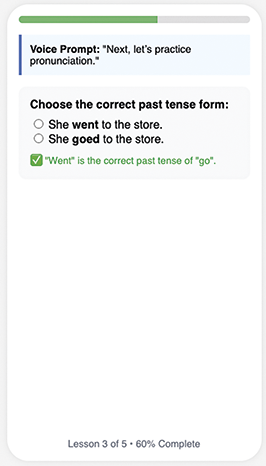
5.6 A Framework for Designing AI-Powered Microlearning
To ensure that AI-powered microlearning activities are pedagogically sound and effective, teachers can follow the structured framework outlined in Table 2.
| Step | Key considerations |
|---|---|
| 1. Define Learning Objectives | Outline what learners should achieve. Ensure that objectives align with SLA principles (e.g. vocabulary acquisition, grammar mastery). |
| 2. Select AI Tools | Choose AI platforms based on functionality (e.g. ChatGPT for language practice, Quizlet for retrieval practice, ELSA Speak for pronunciation feedback). |
| 3. Engagement and Task Design | Keep content concise (2−8 minutes), interactive, and multimodal (text, audio, video). Balance AI-generated content with human guidance. |
| 4. Design Interaction and Engagement | Include gamified elements (badges, leaderboard), AI-driven quizzes, and adaptive learning paths to maintain motivation. |
| 5. Integrate Feedback Mechanism | Ensure AI-generated feedback is accurate, immediate, and pedagogically meaningful. Complement with human feedback when necessary. |
| 6. Evaluate Effectiveness | Use learning analytics, student feedback, and performance tracking to assess microlearning success. Adjust AI parameters accordingly. |
Note: This framework focuses on AI-powered microlearning for language learners. A microlearning framework for AI-powered professional development for teachers is presented in Section 7.
5.7 Discussion and Reflection Questions
1. How can you ensure your microlearning activities align with specific learning objectives?
2. How can you incorporate interactivity and other means of engagement into your AI-driven microlearning activities?
3. What steps can you take to ensure that your microlearning activities are accessible and adaptable to different learning needs and environments?
4. How can you design a seamless microlearning user experience that sustains engagement and minimises distractions?
5. What are some potential challenges or limitations of designing microlearning activities that include AI, and how can you address these challenges?
5.8 Conclusion
Effective design for microlearning activities relies on clear, targeted objectives, engaging interactive content, accessible and flexible formats, timely feedback, and a seamless user experience. By thoughtfully integrating AI-driven tools into the development of microlearning activities and consistently maintaining a learner-centric approach, educators can create highly impactful and efficient learning experiences tailored to individual needs. Building on these practical design tips, Section 6 will provide an in-depth examination of the technical aspects, ethical considerations, and best practices for strategically integrating GenAI tools to enhance microlearning experiences and maximise learner outcomes.
6 Practical Strategies for GenAI-Powered Microlearning
Building on the pedagogical foundations and design principles discussed in Section 5, this section focuses on the practical use of generative artificial intelligence (GenAI) in microlearning. As AI evolves, educators must make strategic choices about which tools to use, how to integrate them, and how to measure their impact on learning outcomes. This section provides educators with a structured approach to selecting, integrating, and evaluating GenAI-powered microlearning options. It also explores best practices for maximising learner engagement, ensuring ethical use, and addressing potential challenges. By thoughtfully leveraging AI, educators can enhance the effectiveness, accessibility, and personalisation of microlearning activities to improve learner outcomes.
6.1 Selecting the Right GenAI Tools
GenAI tools provide flexible and interactive learning opportunities by allowing the incorporation of text, audio, video, and visual elements to explain, complement, and clarify learning concepts. Educators often struggle to decide which AI-driven tools to use when designing microlearning activities. GenAI tools should align with the learning objectives, content, and learner needs and be scalable and easy to use. The following questions help guide the selection of GenAI tools.
1. Functionality and Features
Does the tool generate adaptive content, such as personalised quizzes, AI-generated summaries, and dynamic feedback?
Does it support multimodal learning, including text, speech, images, and video, to cater to different learning preferences?
Does it enable interactivity, allowing learners to engage in, for example, chatbot conversations, AI-generated role-plays, and interactive simulations?
2. User Experience and Accessibility
Is the interface intuitive, mobile-optimised, and easy to navigate, ensuring a seamless learning experience across devices?
Does it provide real-time feedback to enhance engagement?
Does it correct misunderstandings immediately?
Does it have accessibility features like text-to-speech, speech-to-text, and language translation?
3. Integration with Existing Systems
Can it be integrated with learning management platforms like Blackboard, Canva, Moodle, and Google Classroom?
Does it allow content to be exported in various file types for flexibility?
4. Ethical Considerations
Does it respect privacy and data security protocols such as GDPR and FERPA to protect learners’ information?
How does it handle bias and misinformation in AI-generated content to ensure inclusivity and fairness?
Tools should be easy to access, set up, and use, and they should motivate learners to complete the activities (Nikou & Economides, Reference Nikou and Economides2018a, Reference Nikou and Economides2018b) (see Table 3).
| GenAI Tool | Use Case | Example Activity |
|---|---|---|
| ChatGPT, Gemini | AI-generated explanations and tutoring | AI-powered writing feedback |
| Grammarly, DeepL Write | Grammar correction and sentence rewriting | AI-assisted writing refinement |
| DALL-E, Canva AI | AI-generated visuals and infographics | AI-created learning posters |
| Synthesia, and Heygen | AI-powered video content creation | AI-generated instructional videos |
| Quizzes, Kahoot! | AI-driven adaptive quizzes and retrieval practice | Personalised AI-generated quizzes |
| EdAPP | AI-created lessons | AI mobile learning management system |
| iSpring Suite | AI-powered LMS features | AI learning management system |
6.2 Best Practices for GenAI Integration
The key principle to remember when designing microlearning activities is that each lesson/activity/event should centre on a single learning objective or topic. Breaking learning into manageable chunks to prevent cognitive overload aligns with cognitive load theory (Sweller, Reference Sweller1994). This approach also supports constructivist learning theory (Jonassen, Reference Jonassen and Reigeluth1999) as it allows learners to build new knowledge through structured, interactive activities.
Microlearning ensures that learners can engage deeply with the materials without cognitive overload, leading to better retention and application of knowledge (Kohnke, Reference Kohnke2023a; Kohnke et al., Reference Kohnke, Foung, Zou and Jiang2024b). To maximise its effectiveness, microlearning activities should drive active participation rather than passive consumption of AI-generated content, encouraging learners to click, interact, and progress through the material. Sometimes, learner may even create products as part of the learning process (Cerratto-Pragman & Jahnke, Reference Cerratto-Pragman and Jahnke2019). These activities should offer scaffolding, feedback, and adaptive learning experiences rather than static information. A well-structured AI-enhanced microlearning activity has a clear and logical flow to maximise engagement and learning outcomes. The following structure is recommended:
1. Introduction: Showcase the topic’s relevance, explain the learning objectives, and provide a brief overview.
2. Interactive content: Provide multimodal explanations (text, images, videos) or AI-driven chatbots for simulated conversations.
3. Short exercises: Incorporate quizzes, sentence reconstruction, or other interactive tasks to reinforce the learning objective.
4. Instant feedback: Give immediate feedback to help learners identify mistakes, receive explanations, and improve in real time.
Interactive and adaptive AI elements help learners construct knowledge without feeling overwhelmed. Immediate feedback from AI tools also facilitates self-regulated learning by enabling learners to monitor and adjust their learning strategies through immediate reflection on their performance (Chang & Sun, 126).
The following sample microlearning activities follow the structure suggested in the list earlier (see Tables 4 and 5). The recommended tools are only suggestions. Readers should choose tools accessible to them that are appropriate to their contexts.
| Component | Example | Recommended Tools | Time Allocation |
|---|---|---|---|
| Topic | Using Modal Verbs in Polite Requests | – | 8 min total |
| Objective | Learners will use ‘could’, ‘would’, and ‘may’ correctly in polite requests. | – | – |
| Introduction | An AI chatbot presents contrasting dialogues (polite vs. impolite requests). Learners identify the difference. | ChatGPT, Claude Gemini, Mizou | 1 min |
| Explanation and Examples | AI provides a short, interactive lesson explaining modal verbs and common mistakes. | ChatGPT, Claude Gemini, Mizou | 2 min |
| AI Chatbot Role-Playing | Learners interact with a chatbot by responding to three real-world request scenarios. AI provides instant corrections. | ChatGPT, Claude Gemini, Mizou | 3 min |
| Quick AI Feedback | AI highlights correct and incorrect responses and suggests improvements in phrasing | ChatGPT, Claude Gemini, Mizou | 1 min |
| Peer Review | Learners briefly discuss what they learned and share their best polite request | ChatGPT, Claude Gemini, Mizou | 1 min |
| Component | Example | Recommended Tools | Time Allocation |
|---|---|---|---|
| Topic | Identifying the Main Ideas in a Short Text | – | 8 min total |
| Objective | Learners will watch a short video. Then, they will identify and briefly summarise the main ideas in writing. | – | – |
| Introduction (Video) | Learners watch a 30- to 60-second video explaining how to find the main idea in a text. | YouTube, EdPuzzle, Synthesia, Heygen | 1 min |
| Activity: Identifying the Main Idea | Learners read a short paragraph and select the best main idea from three options. | Mizou, CommonLit. ReadTheory, ChatGPT | 2.5 min |
| AI Instant Feedback | AI provides immediate feedback on the learner’s choice, explaining why the answer is correct or incorrect. | Mizou, CommonLit. ReadTheory, ChatGPT | 1 min |
| Application: Summarising in One Sentence | Learners rewrite the main idea in their own words (one sentence). AI checks for clarity and concision. | Quillbot, Hemingway Editor, ChatGPT, Gemini | 2.5 min |
| Reflection (Optional) | AI prompts learners to share one tip they learned about identifying the main idea. | Peergrade | 1 min |
Outcomes. Learners have practiced polite requests interactively; AI‑driven feedback has improved grammar and phrasing; and a brief peer reflection has reinforced learning.
Outcomes. Learners understand how to identify main ideas; reading comprehension has improved through AI‑driven feedback; and a brief reflection has reinforced learning.
6.2.1 Leveraging AI for Enhanced Engagement
Traditional digital learning tools such as instructional videos typically enable passive content consumption. With GenAI tools, learners can interact with AI, generate responses, and receive real-time feedback. This shift supports active learning, in which learners participate, rather than being passive recipients of information (Jonassen, Reference Jonassen and Reigeluth1999; Law, Reference Law2024). For GenAI-powered microlearning to be effective and engaging, educators should
Use AI-generated scaffolding to break complex topics into digestible, structured chunks.
Incorporate adaptive AI-driven difficulty levels so learners receive content matched to their proficiency.
Leverage AI chatbots and simulations to allow learners to practice real-world scenarios interactively.
Microlearning must also be optimised for mobile learning environments (e. g. Kohnke, Reference Kohnke, Corbeil, Corbeil and Khan2021a) (see Tables 6 and 7). Since many learners access learning content on their mobile devices, educators should:
Ensure that the content is concise, structured, and easy to navigate.
Use responsive design to accommodate different screen sizes.
Minimise text-heavy formats, substituting AI-generated visuals, audio, and interactive elements.
| Microlearning Approach | How to Use EdApp |
|---|---|
| Video-Based Microlearning | Embed short explainer videos (30−60 sec) in lessons. |
| Scenario-Based Learning | Use branching scenarios in which learners make decisions and AI adjusts the content based on their choices. |
| AI-Powered Adaptive Learning | Use EdApp to automatically adjust content difficulty based on learner progress, ensuring personalised learning paths. |
| Social and Peer Learning | Enable AI-facilitated discussion forums and peer challenges to encourage collaboration and reflection. |
| Step | How EdApp Helps |
|---|---|
| 1. Watch a short video. | Allows the embedding of a 30- to 60-second narrated video explaining how to identify the main idea. |
| 2. Complete a quick quiz. | Generates multiple-choice or drag-and-drop exercises to reinforce learning. |
| 3. Get instant AI feedback. | Analyses learner responses in real-time, providing personalised explanations and adjusting difficulty based on accuracy. |
| 4. Apply learning. | Helps learners summarise a passage through its interactive text input feature. |
6.2.2 Ensuring Ethical, High-Quality AI-Generated Content
Educators who use GenAI tools to generate materials must ensure they are accurate, contextually relevant, and aligned with pedagogical best practices. Inaccurate or biased AI-generated content increases extraneous cognitive load (Sweller, Reference Sweller1994), forcing learners to process misleading information rather than focus on meaningful learning.
One of the main risks of AI-generated microlearning is the potential for hallucinated or misleading content: plausible, but incorrect, information generated by AI tools (Ferrara, Reference Ferrara2023). To mitigate this risk, educators should
Pre-screen AI-generated microlearning content before integrating it into lessons to ensure factual accuracy and alignment with learning objectives.
◦ Educators should cross-check AI-generated explanations against credible sources such as Cambridge Grammar for language learners or Khan Academy for technical concepts when using ChatGPT or Claude to generate materials.
◦ Educators using Quillbot or Grammarly should use established linguistic references like Merriam-Webster or Oxford Advanced Learner’s Dictionary to verify grammar explanations.
Use AI to supplement, not replace, expert-curated microlearning materials. AI-generated explanations should be verified and refined by educators.
◦ Platforms like Duolingo and LingQ use AI to generate adaptive language exercises. Human instructors should review AI-created sentence structures and contextual examples to ensure natural, culturally appropriate phrasing.
Leverage AI tools with built-in content verification features. Some AI platforms incorporate fact-checking and citation-based content generation.
◦ Perplexity and SciSpace are research assistants that can generate responses with citations, making them helpful for verifying information.
◦ Google’s Gemini integrates real-time search capabilities to fact-check its AI-generated responses, helping educators retrieve updated, verified content.
Another key concern is over-reliance on AI-generated feedback in microlearning. AI provides instant feedback on grammar, pronunciation, and quizzes but may be insufficient to teach critical thinking skills. Educators should
Combine AI-driven microlearning with human feedback. For example, AI can be used to assess basic writing mechanisms while teachers provide contextual feedback on structure and argumentation.
◦ Grammarly and DeepL Write provide instant grammar corrections and stylistic suggestions but do not assess persuasiveness or logical cohesion. Teachers should review AI-suggested edits to ensure that texts remain cohesive, well-structured, and aligned with academic integrity.
◦ For pronunciation practice, ELSA Speak and Speechling provide AI-driven real-time pronunciation coaching, but human instructors should still review intonation, fluency, and cultural appropriateness.
Encourage self-reflection and peer discussion. Learners should be prompted to critically evaluate AI-generated explanations rather than passively accepting them.
◦ AI-powered platforms like ChatGPT and Google Bard allow learners to ask complex questions and receive instant responses. However, educators should incorporate reflective activities in which learners analyse AI-generated content, identify inconsistencies, and discuss biases.
◦ Tools like Peergrade and Turnitin Draft Coach help learners critique AI-generated feedback collaboratively, allowing them to develop critical thinking skills while refining their work.
Bias in AI-generated microlearning activities can reinforce stereotypes or exclude diverse perspectives. To ensure inclusivity,
Review AI-generated examples, dialogues, and quizzes to identify and remove cultural biases and inappropriate phrasing.
◦ When using ChatGPT or Duolingo’s AI tutor to generate language-learning dialogues, educators should review sentence structures, names, and cultural contexts to avoid reinforcing stereotypes or using outdated expressions.
◦ Summaries by Perplexity AI and Microsoft Copilot generated for use in history and social studies lessons should be cross-checked against multiple sources to ensure balanced perspectives.
Use diverse AI training datasets when possible and supplement AI-generated content with human-curated materials that reflect global perspectives.
◦ AI-powered platforms like Canva AI and DALL-E 3 can generate educational visuals, but educators should curate imagery to ensure the representation of different cultures, ethnicities, and backgrounds.
◦ Reading comprehension exercises generated by tools like ReadTheory and CommonLit AI should be supplemented with human-selected texts from diverse authors to promote inclusivity in literature and storytelling.
By implementing these strategies for AI-powered microlearning, educators can ensure that lessons are engaging, accurate, and pedagogically sound while they benefit from AI’s ability to personalise and scale learning.
6.2.3 Supporting Diverse Learner Groups with GenAI-Powered Microlearning
GenAI technologies significantly enhance the inclusivity and accessibility of microlearning. Educators can leverage AI-powered personalisation and multimodal capabilities to address diverse learner groups’ needs (see Table 8). For example, special education learners can be provided with adaptive content personalised to their capabilities, interactive AI simulations to practice real-life scenarios safely, and accessibility features like text-to-speech or speech-to-text. Multilingual learners can leverage AI-powered real-time translations, adaptive vocabulary lessons, and AI-created culturally authentic situations to reduce cognitive load and enable deeper comprehension. Adult language learners, often motivated by practical concerns, can leverage scenario-based AI role-plays, workplace-contextualised AI-generated content, and adaptive quizzes at their proficiency levels.
| Learner Group | GenAI-supported Strategies | Example Tools |
|---|---|---|
| Special Education Learners | Personalised adaptive content, interactive AI simulations, text-to-speech accessibility | ChatGPT, Gemini, Synthesia, Speechling |
| Multilingual Learners | AI-powered translations, culturally relevant scenarios, adaptive vocabulary practice | DeepL, Grammarly, Duolingo, Canva, Mizou |
| Adult Learners | Scenario-based AI role-plays, workplace-contextualised AI content, adaptive proficiency quizzes | Claude, Heygen, Kahoot! iSpring Suite |
These tactics align closely with established theories. Personalisation and interactive simulations for special education learners, for example, reflect constructivist theories by supporting individualised knowledge construction and the principles of self-regulated learning via instantaneous AI feedback. The reduction of cognitive load on multilingual learners via culturally relevant and adaptive AI-generated content aligns with cognitive load theory (Sweller, Reference Sweller1994). The engagement of adult learners with authentic, contextually relevant tasks designed by AI aligns with constructivist learning principles and enhances intrinsic motivation, which is consistent with self-regulated learning theory (Zimmerman, Reference Zimmerman2000).
6.2.4 Limitations and Practical Challenges of GenAI-powered Microlearning
Educators implementing GenAI-powered microlearning should be aware of real-world challenges and consider practical mitigation strategies:
Teacher Workload: Screening and validating AI-generated content (e.g. practice questions, explanations) can increase teacher workload, given the need to check for age-appropriateness, language accuracy, and cultural sensitivity before assigning the content to students.
◦ Strategy: Form collaborative teacher teams to distribute the workload, co-develop prompt templates, and share vetted AI-generated resources through shared repositories or institutional platforms.
Technical Barriers: Limited technical proficiency among educators or students, along with insufficient infrastructure (e.g. outdated devices or lack of reliable internet), can slow the adoption of GenAI tools. For example, a teacher unfamiliar with prompt engineering may struggle to generate effective learning materials, or a student using a low-spec phone may experience lags in AI-enabled apps.
◦ Strategy: Offer ongoing professional development focused on GenAI literacy, provide step-by-step user guides, and select intuitive, low-barrier tools that work across devices and platforms.
Digital Divide and Equity: Unequal access to reliable internet, devices, or AI tools can create disparities in learning opportunities. Students in low-resource regions may be unable to access cloud-based platforms or streaming content. For example, a learner without stable internet cannot benefit from real-time AI feedback or voice-based interactions in mobile apps.
◦ Strategy: Ensure that microlearning experiences are accessible offline or on low-bandwidth devices and advocate for equitable access to technology and resources. Design offline-compatible activities as backup options.
Data Privacy and Ethical Concerns: AI platforms often collect and process learner data, raising concerns about privacy, consent, and data security. Some GenAI tools may store user inputs or usage patterns without transparent data-handling policies, which can create trust issues among parents or institutions.
◦ Strategy: Select GenAI tools that are compliant with privacy regulations (e.g. GDPR, FERPA) and communicate data-handling practices transparently, and include digital literacy components in the curriculum to educate learners about responsible AI use and online safety.
6.3 Designing Engaging GenAI-Powered Experiences
Motivation and engagement, which AI can foster, are essential for successful language learning (Wei, Reference Wei2023), so educators should ensure that microlearning activities are stimulating, dynamic, and relevant to real-world scenarios. One effective strategy is gamification. AI-based microlearning platforms can utilise game-like elements such as points, leaderboards, badges, and rewards to increase learner engagement (Kohnke, Reference Kohnke2023a). Gamification boosts learner motivation, engagement, and retention, especially in self-directed learning environments (Smiderle et al., Reference Smiderle, Rigo, Marques, Coelho and Jaques2020; Yang, Reference Yang2025).
Another useful approach to designing GenAI experiences is to incorporate adaptive learning. AI can analyse learners’ performance in real time and adjust content accordingly (Darvishi et al., Reference Darvishi, Khosravi, Sadiq, Gašević and Siemens2024). For example, if a learner struggles with a specific grammar rule, microlearning activities using AI-based apps can provide explanations, examples, and extra exercises. This personalised approach not only enhances language proficiency and prevents frustration by ensuring that content difficulty aligns with each learner’s needs. AI’s ability to generate adaptive learning paths fosters active learning and ensures learners remain engaged throughout the process (Wu & Chiu, Reference Wu and Chiu2025). The need for learners to critically evaluate AI feedback rather than passively accepting it aligns with self-regulated learning theory (Zimmerman, Reference Zimmerman2000). Encouraging learners to reflect on and assess AI-generated feedback helps them develop critical thinking skills and take ownership of their learning. Table 9 provides an example of how AI-powered gamification and adaptive learning can be applied in business English context.
| Component | Example |
|---|---|
| Topic | Expanding Business English Vocabulary |
| Objective | Learners will correctly use and recognise business-related terms in professional contexts. |
| Introduction | AI-generated business scenario: A simulated email exchange between managers and employees introduces key business terms (e.g. synergy, deliverables, stakeholders). |
| Interactive Content | AI-powered gamified flashcards using Quizlet or Anki: Learners match words to definitions and see AI-generated example sentences. |
| Short Exercise | AI-generated adaptive quiz: If a learner struggles with a term, the AI tool provides additional hints, synonyms, and contextual examples. |
| Instant Feedback | An AI chatbot (e.g. ChatGPT) explains correct or incorrect answers, offering alternative phrases for professional communication. |
| Gamification Element | Learners earn points and badges for correct answers and receive streak awards for consecutive correct responses. The AI tool adjusts difficulty levels based on performance. |
In addition to gamification and adaptive learning, AI-powered tools can be used to further enrich engagement by incorporating interactive simulations and multimedia elements. AI chatbots, for example, can provide learners with real-world conversational practice through scenario-based role-playing activities. AI can also generate engaging multimedia content, including videos, infographics, and animations, to make learning more visually and contextually stimulating. Furthermore, educators should ensure that all AI-generated content remains contextually relevant and aligned with learning objectives to maximise its effectiveness. Table 10 illustrates how similar strategies can be adapted for grammar and narrative tense practice.
| Component | Example |
|---|---|
| Topic | Mastering Past Tense Verbs in Storytelling |
| Objective | Learners will use regular and irregular past tense verbs correctly in narrative writing and spoken conversation. |
| Introduction | AI-generated short story: A chatbot (e.g. Mizou) presents a story with missing past tense verbs, prompting learners to fill in the blanks. |
| Interactive Content | AI-powered role-playing simulation: Learners engage in a chatbot conversation (‘What happened yesterday?’). The AI tool provides real-time feedback on verb tense usage. |
| Short Exercise | AI adaptive drag-and-drop activity: Learners categorise verbs into regular and irregular past tense (e.g. walked vs went). The AI tool adjusts difficulty based on performance. |
| Instant Feedback | AI-generated grammar explanations with examples: If a learner makes a mistake, the AI chatbot provides a rule-based explanation and suggests a corrected sentence. |
| Gamification Element | Learners earn points for correct answers and unlock bonus challenges. For example, after the class reads a short story, learners are prompted to practise the past tense in writing. |
6.4 Evaluating the Effectiveness of GenAI in Microlearning
Measuring the impact of AI-enhanced microlearning on learner engagement and understanding of the content is essential to making it effective. AI apps generate rich data on learner interactions, allowing teachers to track progress completion rates and learn about their students’ struggles. However, the use of AI apps in microlearning does not necessarily improve learning outcomes. According to self-regulated learning theory (Zimmerman, Reference Zimmerman2000), effective learning occurs when learners engage with feedback and reflect on their progress. Therefore, educators should integrate evaluation mechanisms that foster metacognition and critical thinking.
One of the most effective methods of measuring the effectiveness of microlearning is to incorporate pre- and post-test testing to evaluate learners’ knowledge retention and skill acquisition. By comparing performance before and after exposure to AI-generated microlearning content, educators can determine whether the content leads to meaningful learning gains. Additionally, qualitative feedback from learners can provide insights into how they perceive AI-generated content and its alignment with pedagogical goals.
To ensure long-term effectiveness, educators should
Conduct pre- and post-assessments to measure knowledge retention and skill acquisition.
Analyse AI-driven learning analytics to track learner progress, completion rates, and engagement levels.
Collect qualitative feedback through surveys and focus groups to assess learner perceptions of AI-generated content.
Regularly review AI-generated content to ensure accuracy, inclusivity, and alignment with pedagogical goals.
These strategies, when used in combination, provide a comprehensive evaluation framework for understanding the effectiveness of AI-powered microlearning and its impact on learners.
6.5 Discussion and Reflective Questions
1. What are the benefits of using chatbots for language learning?
2. What are the drawbacks of using chatbots for language learning?
3. What practical adaptations can educators make to ensure that GenAI tools meet diverse learner needs?
4. How can cognitive load theory inform your approach to designing GenAI microlearning activities?
5. How can the effectiveness of microlearning activities be evaluated?
6.6 Conclusion
This section explored strategies for selecting, using, and evaluating GenAI tools in microlearning. Educators can create engaging, personalised, and effective microlearning experiences by aligning AI-powered learning activities with specific learning objectives. They should experiment with different GenAI tools to find the best fit for their learners, continuously evaluate AI effectiveness using data-driven insights, and advocate for ethical AI use by ensuring transparency, fairness, and accuracy in AI-generated content. As AI advances, educators must adapt methodologies that will harness its full potential while preserving pedagogical integrity and learner-centred design.
7 Using GenAI in Teacher Professional Development
This section explores how generative artificial intelligence (GenAI) and microlearning can enhance teacher professional development (TPD) for language teachers. It begins by exploring cutting-edge AI technologies that can support tailored, on-demand learning experiences. Next, it highlights GenAI’s practical applications in TPD, from content creation and feedback to coaching and reflective practices. It then addresses the challenges and ethical concerns associated with integrating AI into educational settings and ensuring that these tools are used responsibly. Finally, real-world examples of AI-enhanced TPD programmes illustrate how teachers can benefit from these innovations daily. By mapping out these key areas, this section provides language teachers with a comprehensive guide to leveraging AI as a partner in continuous professional growth.
7.1 Using GenAI in Teacher Professional Development for Language Teachers
As AI technologies, particularly GenAI, continue to transform education, language teachers must receive ongoing, tailored, and rich TPD to adapt to new technologies and pedagogies (Kohnke & Zou, Reference Kohnke and Zou2025; Moorhouse & Kohnke, Reference Moorhouse and Kohnke2024) and to develop AI literacy (Sperling et al., Reference Sperling, Stenberg and McGarth2024). Such literacy goes beyond the ability to use AI tools. AI literacy includes a combination of technical, critical, ethical, and pedagogical competencies (Ng et al., Reference Ng, Leung, Chu and Qiao2021). For language teachers, it involves knowing how GenAI generate language, evaluating, recognising their inherent biases, and ensuring ethically responsible use of AI in the classroom, and guiding students to use AI ethically in learning task (Walter, Reference Walter2024). Language teachers need this critical competence to leverage AI tools effectively while maintaining pedagogical integrity (Moorhouse et al., Reference Moorhouse, Wan and Wu2024).
Unfortunately, traditional TPD programmes often offer generic, decontextualised training sessions that do not align with teachers’ professional needs, such as developing classroom management strategies, designing instructional materials, conducting assessments, or integrating AI tools into teaching (Kohnke, Reference Kohnke2021b; Zhang & Zhang, Reference Zhang and Zhang2024). These programmes have been referred to as ‘spray-and-pray’ models, which deliver broad content in the hope that some of it will be relevant and stick (Reimers & Chung, Reference Reimers and Chung2016). However, this model often leads to low engagement, limited retention, and minimal classroom application of what has been taught (Richards & Farrell, Reference Richards and Farrell2005) and fails to address the crucial need for teachers to upskill in emerging educational technologies (Ng et al., Reference Ng, Leung, Su, Ng and Chu2023). Incorporating AI-driven microlearning allows for flexible, personalised, and immediately applicable TPD (Kohnke, Reference Kohnke2024b; Moorhouse & Kohnke, Reference Moorhouse and Kohnke2024). Additionally, it aligns with contemporary pedagogical theories (Guskey, Reference Guskey2002; Timperley, Reference Timperley2011) by ensuring that learning is focused, learner-centred, and immediately relevant to classroom needs.
7.1.1 The Need for AI-Enhanced TPD
Despite the importance of lifelong learning for teachers, traditional TPD models often fail due to various limitations:
Lack of personalisation: Generic workshops do not address individual teachers’ pedagogical challenges, such as adapting AI tools for student-centred learning or incorporating AI-driven formative assessments in courses.
Limited practical applications: Many TPD programmes focus on theoretical discussions without offering hands-on experience with emerging AI tools.
Time constraints: Teachers have busy schedules and cannot always commit to lengthy training sessions.
Technology gaps: Many teachers feel unprepared to integrate AI into their classrooms.
AI can enhance TPD to help new and experienced teachers to adapt quickly to new technologies and pedagogies. It can provide (a) adaptive learning paths tailored to teachers’ subject expertise and skill levels, (b) on-demand AI-powered assistants (e.g. ChatGPT, Perplexity) that provide real-time support, and (c) microlearning modules that allow for self-paced, bite-sized learning experiences. For example, a teacher struggling with AI-assisted assessment can receive real-time guidance from an AI tutor (e.g. Coursera Coach) that curates personalised learning paths based on teachers’ needs.
7.1.2 Microlearning’s Role in AI-Driven TPD
Microlearning TPD comprises short, focused learning sessions that help teachers to acquire new knowledge in step-by-step sessions (Kohnke, Reference Kohnke2024b) that align with their busy schedules. Unlike traditional professional development, microlearning offers instant, interactive, and flexible learning for classroom use. Moreover, microlearning engages teachers in TPD through discussions, hands-on practice, and reflection to help them to understand and retain new concepts (Borko, Reference Borko2004; Garet et al., Reference Garet, Porter, Desimone, Birman and Yoon2001).
AI-powered microlearning must be interactive and modular. Each microlearning event should be stand-alone (2–8 minutes), interactive, directly applicable to teachers’ professional needs, and allow for progressive skill development. Modular, continuous TPD can help teachers to experiment with new strategies, receive feedback, and adjust their instructional practices. These sessions can include follow-ups, coaching, and peer collaboration to reinforce a commitment to lifelong learning (e.g. Darling-Hammond et al., Reference Darling-Hammond, Hyler and Gardner2017). Table 11 presents a structured framework for designing AI-driven microlearning sessions for TPD.
| Step | Objective | Example AI Tools and Tasks |
|---|---|---|
| Step 1: Quick introduction (30−60 seconds). | Briefly introduce the AI tool and its relevance to teaching. | Teachers explore Perplexity to summarise research articles for lesson planning. |
| Step 2: Interactive task (4−6 minutes). | Provide hands-on engagement with an AI tool(s). | Teachers generate a differentiated lesson plan with MagicSchool, record a 30-second speech with Vocaroo to evaluate clarity, and ask TeachFX to analyse teachers’ talking time in a short classroom audio clip. |
| Step 3: Reflection and application (1−2 minutes). | Encourage teachers to reflect on AI-generated content. | Discussion points: Does AI provide useful and accurate assistance? What are the AI tool’s limitations or biases? How can this tool be used in a specific teaching context? |
| Step 4 (optional): Application task (5−8 minutes for modular learning). | Extend learning by applying an AI tool in real-world teaching scenarios. | Teachers use Diffit to modify a reading passage into three proficiency levels and compare the results with a manually scaffolded text. |
Table 12 demonstrates the use of this framework to teach specific AI tools – Grammarly and Synthesia – in microlearning sessions.
| Step | Example Activity |
|---|---|
| Step 1: Quick introduction (30 seconds). | Teachers use Grammarly for AI-assisted writing feedback and Synthesia for AI-powered video presentations. |
| Step 2: Interactive task (5 minutes). | Teachers submit a short paragraph to Grammarly and compare AI-generated feedback with their revisions. Next, they use Synthesia to create a 1-minute AI-generated video explaining a key concept in language learning. |
| Step 3: Reflection and application (2.5 minutes). | Teachers discuss whether AI tools provide useful and accurate feedback. How could Grammarly help students to develop writing autonomy? How can Synthesia enhance flipped classroom activities? |
| Step 4 (optional): Application task (7 minutes). | Teachers use their expertise, along with AI-generated feedback, to revise their writing and create lesson plans integrating AI-powered writing and video tools. |
Microlearning’s structured approach ensures that AI-driven TPD is focused, time-efficient, and directly applicable to classroom practices. Teachers can enhance their professional growth without feeling overwhelmed as microlearning breaks down complex technological and pedagogical concepts into manageable learning units (Shamir-Inbal & Blau, Reference Shamir-Inbal and Blau2022). This structure allows teachers to build confidence and competence progressively (Kohnke & Foung, Reference Kohnke, Foung, Tafazoli and Picard2023) and gradually integrate new skills and knowledge into their teaching (Kohnke & Moorhouse, Reference Moorhouse2024).
AI-driven microlearning TPD offers flexibility (teachers can engage with modules during breaks or at home) and reduced cognitive load (content is delivered in small units). Additionally, microlearning can be applied immediately (e.g. teachers can use the AI tools in their classrooms as soon as they learn about them). For example, microlearning modules can support teachers in using tools such as Mizou, an AI chatbot for language learning, in the classroom, bridging the gap between theory and practice (Hubbard, Reference Hubbard, Ziegler and González-Lloret2022). A microlearning module designed to introduce Mizou could include (a) a short video overview of the website and chatbot interface and (b) an infographic-based walkthrough on building an AI-generated chatbot, including how to specify learning objectives, grade levels, and format variations (quiz-based, storytelling, etc.). Microlearning bridges the gap between theory and practice. It provides teachers with immediate hands-on practice, enabling them to grasp a tool’s potential for engaging students quickly. Microlearning promotes higher motivation and creates a sustainable and enjoyable learning experience (Emersen & Berge, Reference Emerson and Berge2018; Kohnke et al., Reference Kohnke, Foung, Zou and Jiang2024b).
7.2 GenAI in TPD for Language Teachers
This section explores the use of specific AI tools and technologies to enhance teacher professional learning, content creation, feedback, and coaching. Please note that this overview is not exhaustive: many tools may have overlapping functionalities, new tools may emerge over time, and educators can perform the suggested activities with alternative technologies. The examples provided are simply ideas for consideration that educators can adapt to their unique contexts. Each tool is presented with (a) a brief introduction, (b) a teacher example, and (c) a teacher educator example (TPD-focused).
7.2.1 AI for Personalised Professional Learning
One of the most powerful applications of GenAI in TPD is generating personalised learning experiences based on teachers’ subject-matter expertise, interests, and professional needs. AI-powered platforms can provide on-demand TPD, curated learning materials, and real-time pedagogical guidance, helping teachers to develop new skills and use AI tools (see Tables 13 and 14).
| AI Tools and Descriptions | Teacher Example | Teacher Educator Example |
|---|---|---|
| ChatGPT, Gemini, Claude (AI-powered teaching assistants): These AI chatbots function as on-demand TPD assistants. Teachers can ask pedagogical questions, request lesson ideas, or seek clarification on AI-assisted methods. | A teacher preparing a unit on academic writing asks ChatGPT, ‘How can I teach cohesion and coherence in eight minutes?’ AI provides an 8-minute structured response with step-by-step teaching techniques, example exercises, and customised lesson plans. | A teacher educator designs a microlearning module in which teachers use AI-powered chatbots to generate real-time grammar explanations for students. Participants experiment with AI-generated feedback, compare it with human feedback, and reflect on its pedagogical value. |
| Perplexity (AI research assistant): This tool helps teachers to summarise research papers quickly and to find academic studies of language-teaching methodologies. | A teacher researching task-based language teaching can use Perplexity to generate an easy-to-read summary of recent journal articles, saving time while staying current with research. | A teacher educator creates a short, self-paced activity in which trainees compare AI-generated research summaries with original journal articles to evaluate AI’s accuracy in synthesising research. |
| Elicit (AI for academic research): This tool helps teachers to review research efficiently by summarising and comparing research findings. | A teacher writing a reflection report on AI in education can use Elicit to analyse studies on AI-assisted language learning and extract key findings. | A TPD facilitator designs a microlearning session in which teachers use Elicit to summarise articles on AI in language learning and critically assess AI’s ability to identify research trends. |
| Khan Academy’s AI Tutor (adaptive learning coach): This tool provides personalised learning paths for teachers based on TPD goals. | A teacher aiming to improve technology-integration skills receives a curated set of microlearning modules on AI in language teaching. | A TPD coordinator integrates Khan Academy’s AI tutor into a self-paced teacher training course in which participants receive AI-guided lessons on classroom technology adoption and complete reflection tasks. |
| AI Tools and Descriptions | Teacher Example | Teacher Educator Example |
|---|---|---|
| Quora Poe AI and LinkedIn Learning’s AI coach: These tools use AI to curate professional discussions and insights. | A teacher seeking best practices in AI-assisted grammar instruction receives AI-summarised discussions from expert educators and researchers. | A teacher trainer assigns teachers the task of exploring professional discussions generated by LinkedIn Learning’s AI coach and creating a summary of key insights for peer discussion. |
| Coursera Coach. This platform provides personalised course recommendations for professional growth. | A teacher pursuing AI-assisted assessment receives a customised learning path featuring micro-courses on AI-driven grading, automated feedback, and adaptive assessment strategies. | A teacher educator designs a microlearning event during which teachers will generate a personalised professional development plan (i.e. obtain a list of courses that align with their teaching needs). |
| Microsoft Education AI Toolkit for teachers or Microsoft Copilot: This platform offers AI training courses to help teachers to integrate AI into classrooms. | A teacher wanting to incorporate AI chatbots into language practice completes a Microsoft AI course on natural language processing in education. | A TPD facilitator runs an 8-minute microlearning session during which teachers design AI chatbots that they can use in their language classrooms. |
| Google’s Generative AI for Educators: This tool provides microlearning courses on AI-assisted teaching, including AI-powered feedback systems, content creation, and classroom automation. | A teacher intending to use AI in writing instruction completes a Google microcourse on AI-feedback tools. | A teacher educator facilitates a microlearning task: teachers test Google’s AI-driven feedback tools on sample student essays and compare AI- and teacher-generated feedback. |
AI-powered assistants and research tools enable on-demand professional learning by allowing teachers to access and digest research, obtain content recommendations, and refine teaching methods. These tools help translate educational theory into practical classroom strategies by offering real-time pedagogical insights. However, to maximise their utility, teachers should critically evaluate AI-generated content before applying it, verifying that the findings align with credible sources to ensure evidence-based teaching. Teacher educators can further support this process by designing microlearning tasks that encourage teachers to support this process by designing microlearning tasks that encourage teachers to use their expertise to assess and adapt AI-generated insights. While AI can be a valuable supplement, it should not replace pedagogical expertise, and all AI-generated responses must be cross-checked for validity.
7.2.2 AI for Content Creation in TPD
AI can automate time-consuming tasks, allowing teachers to focus on innovative teaching strategies rather than creating content from scratch. AI-powered tools can generate lesson plans, quizzes, interactive activities, and training materials for TPD programmes (see Table 15).
| AI Tools and Descriptions | Teacher Example | Teacher Educator Example |
|---|---|---|
| Canva Magic Write and Adobe Firefly (AI for visual content creation): These AI tools help teacher trainers create infographics, slides, and posters for TPD workshops. | A teacher preparing a lesson on AI literacy uses Canva Magic Write to generate infographics explaining GenAI’s role in education. | A teacher educator guides teachers through a microlearning module during which they create AI-generated infographics summarising key teaching strategies (e.g. scaffolding). |
| Quillionz (AI-powered question generator): This tool automatically generates quiz questions based on professional learning materials. | A teacher attending a TPD workshop on AI-assisted assessment uses Quillionz to generate custom multiple-choice and open-ended quiz questions based on a professional learning article. | A TPD facilitator designs a microlearning activity in which teachers generate AI-powered questions for various student learning levels. |
| Edpuzzle: This tool converts educational videos into interactive learning resources by adding AI-generated questions and prompts. | A teacher watching a microlearning video on AI-assisted formative assessment interacts with AI-generated reflection prompts. | A teacher trainer designs microlearning tasks in which teachers annotate an AI-generated video lesson, adding interactive elements and quizzes using Edpuzzle. |
| MagicSchool (AI for lesson planning and resource creation): This AI suite generates lesson plans, discussion prompts, and classroom activities. | A teacher needing a differentiated reading comprehension task uses MagicSchool to generate exercises for beginner, intermediate, and advanced learners. | A teacher trainer designs a microlearning event during which teachers input a lesson topic into MagicSchool to generate AI-created lesson plans and discuss how they can adapt AI-generated content for students’ various needs. |
| Diffit (AI for differentiated learning materials): This tool creates versions of reading texts for learners at different levels. | A teacher preparing a workshop on scaffolding reading instruction chooses Diffit to generate simplified, standard, and advanced versions of a single text. | A teacher educator facilitates a microlearning session in which participants use Diffit to modify a reading text for diverse learners and compare the AI-modified text and worksheets to examples created using traditional scaffolding methods. |
AI-driven content-generation tools save time, enhance teaching materials, and provide pre-designed templates for TPD. Teachers and teacher educators who generate lessons and quizzes automatically can focus on adjusting the content to meet professional learning goals, while ensuring AI-generated content is accurate and relevant. Best practices for implementation include the following:
Teachers should use AI tools as brainstorming aids for their professional development, such as generating ideas for lesson plans or reflective practices.
Teachers and teacher educators should identify potential biases in AI-generated content and adjust materials to ensure inclusivity and accuracy.
Teacher educators should train teachers to critically evaluate AI tools and integrate them effectively into their professional learning routines.
7.2.3 AI for Augmented Feedback and Reflection
GenAI can support self-reflection and continuous improvement by providing automated feedback on teaching practices. AI-powered transcription and analytics tools can help teachers to review their lessons and identify areas for growth (see Tables 16 and 17).
| AI Tools and Descriptions | Teacher Example | Teacher Educator Example |
|---|---|---|
| Otter.ai and Fireflies.ai (AI-powered transcription tools): These tools transcribe and summarise workshop discussions, making them accessible for later reflection. | A teacher recording a classroom discussion with Otter.ai creates an AI-generated transcript to analyse student participation patterns. | A teacher educator facilitates a microlearning activity in which trainees record a short teaching segment, transcribe it with AI, and analyse teacher talking time vs. student talking time. |
| TeachFX (AI-powered classroom analytics): This tool calculates teacher-talking time to student-talking time ratios to improve student engagement. | A teacher seeking AI-generated insights on student participation uses TeachFX to determine whether participation has increased after introducing AI-assisted peer discussions. | A TPD trainer introduces TeachFX in a workshop, allowing teachers to analyse AI-generated classroom talk patterns and reflect on their instructional balance. |
| Grammarly and Write & Improve (AI for writing feedback): These tools provide AI-driven writing feedback that teachers can use for self-improvement. | A teacher preparing professional development reflections uses Grammarly to enhance the clarity and coherence of the document. | A teacher trainer leads a 5-minute microlearning task in which teachers submit a short paragraph on AI in education to Grammarly, analyse the AI feedback, and reflect on how AI-based writing tools could support students. |
| AI Tools and Descriptions | Teacher Example | Teacher Educator Example |
|---|---|---|
| Speeko (AI for pronunciation and public speaking training): This tool uses AI to analyse intonation, clarity, and pacing in spoken English. | A teacher delivering TPD workshops uses Speeko to enhance pronunciation and speech delivery. | A teacher educator facilitates a microlearning session in which teachers record a short explanation of a teaching concept, analyse their pronunciation and intelligibility using Speeko, and compare AI feedback with peer feedback. |
| Vocaroo (AI for voice recording and feedback): This tool allows teachers to record and analyse their lesson introduction and receive AI feedback. | Teachers recording lesson introductions receive AI feedback on clarity and engagement strategies. | A teacher trainer facilitates a microlearning activity in which participants record a 30-second teaching explanation, receive AI-generated feedback, and discuss how Vocaroo can refine their classroom delivery. |
AI tools that offer feedback can help teachers assess their teaching effectiveness and make data-driven improvements. They can provide feedback on teacher talking time, student engagement levels, and writing clarity. However, peer and self-reflection should accompany AI use for a holistic approach. Best practices for feedback implementation include the following:
Teachers should adopt AI feedback as a starting point for deeper reflection.
Teachers should combine AI-generated feedback with peer and mentor observations for a well-rounded professional development experience.
Teacher educators should ensure that teachers understand AI-generated analytics and avoid over-reliance on automated assessments.
7.2.4 AI-Powered Coaching and Simulation
AI-driven coaching and simulations provide interactive, immersive training experiences that allow teachers to practice new skills in low-risk environments (see Tables 18 and 19).
| AI Tools and Descriptions | Teacher Example | Teacher Educator Example |
|---|---|---|
| Mursion (AI-driven teacher training simulations): AI-powered avatars simulate real classroom scenarios, helping teachers develop classroom management skills. | A teacher struggling with student engagement in online learning practices virtual classroom interactions using AI-powered role-playing exercises. | A teacher educator designs a microlearning simulation in which teachers navigate AI-generated classroom management challenges and receive instant AI-driven feedback. |
| TALIS (AI for classroom management training): This tool provides AI-generated classroom situations for teachers to navigate. | A teacher preparing for a diverse classroom engages in AI-driven role-play exercises to develop culturally responsive teaching strategies. | A teacher educator designs a 7-minute microlearning simulation in which teachers respond to AI-generated classroom management challenges and reflect on strategies for engaging students and handling their behaviour. |
| ELSA Speak (AI for pronunciation coaching): This tool helps teachers to refine pronunciation and speech clarity. | A non-native teacher using ELSA Speak practises pronunciation before conducting a TPD session in English. | A teacher educator facilitates a microlearning activity in which teachers use ELSA Speak to analyse their pronunciation, compare AI feedback with self-perception, and discuss how it could benefit language learners. |
| AI Tools and Descriptions | Teacher Example | Teacher Educator Example |
|---|---|---|
| Synthesia (AI-powered video presentations): This tool generates AI-animated training videos for professional development. | A teacher educator leading a TPD session on AI in language teaching creates a video using Synthesia’s avatars. | A TPD facilitator guides teachers through a 6-minute task in which they use Synthesia to create a short AI-generated instructional video and reflect on how AI-generated videos could enhance teacher training. |
| ChatGPT role-playing mode: ChatGPT allows teachers to simulate classroom discussions with AI-generated students. | A teacher practising Socratic questioning techniques interacts with AI-generated student responses. | A TPD seminar includes an AI-driven breakout session in which teachers simulate a classroom debate with AI-generated student perspectives and analyse AI’s strengths and weaknesses in the role-playing activities. |
AI-based coaching and simulations offer realistic teaching scenarios. They allow teachers to rehearse classroom management skills, improve their articulation, and fine-tune lesson delivery safely. These tools work especially well for teacher educators who are creating scenario-based microlearning. However, AI simulations should be combined with human coaching and peer feedback for maximum effectiveness. Best practices for implementation include the following:
Teachers should complete structured reflection activities after AI-powered coaching sessions.
Teachers must experiment with AI simulations and compare strategies before applying them in classrooms.
Teacher educators should use AI-driven coaching tools alongside human mentorship to ensure a balanced approach to skill development.
7.3 AI-Enhanced TPD: Future Directions
As GenAI continues to evolve, its role in TPD will extend beyond individual tool usage to the development of institutional policies, collaborative learning networks, and enhanced reflective practices.
7.3.1 Institutional AI Policies for TPD
Institutions must provide explicit instructions for the ethical pedagogical and professional use of AI in teacher training (Moorhouse et al., Reference Moorhouse, Yeo and Wan2023). Policies on AI ethics should require that AI-produced content is pedagogically sound, transparent, and unbiased. Teachers could be required to note when they have used AI tools to generate materials for their professional learning or training exercises. Institutions should also incorporate privacy measures to protect teacher and student data when AI tools are used in professional development programmes. Additionally, institutional policies should include mandatory AI training for teachers and teacher educators, consisting of hands-on workshops on AI bias and responsible AI integration.
Although AI can enhance professional development activities such as lesson planning, assessment, and feedback training, institutional policies must also highlight teacher autonomy in decision making, ensuring that AI remains a pedagogical support tool rather than a substitute for professional judgment. For example, an institution could implement an AI ethics and pedagogy policy to ensure that AI recommendations for TPD are used to supplement, rather than replace, teachers’ critical thinking and expertise. By establishing institutional AI policies focused on professional development, schools and universities can create a structured, responsible approach to AI-enhanced TPD that balances innovation with ethical considerations.
7.3.2 AI-Powered Peer-Learning Networks
AI technologies have made peer learning and data-driven professional development more manageable. AI platforms can complement traditional peer-learning communities, including professional learning networks and communities, by offering real-time analytics, discussion analysis, and personalised recommendations. AI can support peer-learning networks by providing
curated discussions and insights. AI can search through professional discussions (e.g. Quora Poe AI and LinkedIn Learning’s AI Coach) to condense main ideas, find popular teaching topics, and recommend relevant research.
pairings. AI can pair teachers who have the same professional growth goals, enabling the formation of data-driven and adaptive peer groups.
feedback and coaching. AI suggestions can help teacher educators generate feedback for their peers. This allows teachers to receive individualised recommendations based on their teaching reflections and lesson recordings. In addition, AI can provide individualised feedback to teachers based on their teaching reflections and lesson recordings.
For example, a school district could employ an AI-enhanced peer-learning platform that allows (a) AI to review teacher discussions on professional forums, summarising key information; (b) AI to link teachers with peers facing similar difficulties to foster targeted peer mentoring (e.g. exchanging lesson reflections); and (c) AI-powered feedback systems to assist instructors in improving their instructional methods before sharing them with other teachers. Collaboration would become data-driven and personalised through AI-powered peer-learning networks.
7.3.3 AI-Assisted Reflective Teaching Portfolios
Reflective teaching is essential to professional development; it challenges teachers to think about how they teach. Teachers can use AI to facilitate the creation of reflective teaching portfolios by
automating lesson analysis from AI-generated classroom transcripts to reflect on their classroom instruction, student engagement, and instructional strategies.
using Grammarly to enhance reflection journals or TeachFX to monitor speaking time.
monitoring long-term professional development growth to check whether and how lessons have improved over time and identify areas needing additional development.
For example, a teacher could use an AI-supported reflective portfolio that transcribes lesson recordings. These transcriptions would allow the teacher to reflect on how the students engage with each other. Over time, AI will identify patterns within the teacher’s reflections and provide targeted teaching improvement suggestions. Teachers using AI in reflective teaching portfolios will be able to monitor their progress and receive constructive feedback to enhance their teaching techniques.
7.4 Discussion and Reflective Questions
1. How will GenAI in microlearning reshape your professional development as a language teacher?
2. What challenges do you encounter with TPD, and how might AI-driven tools address them?
3. How can you ensure consistent ethical, transparent, and student-centred AI use in your teaching practices?
4. How might AI-generated feedback complement your self-reflection and peer evaluations to enhance your teaching strategies?
5. How do you see AI’s role evolving in the TPD context, and what skills do you consider essential for future language teachers?
7.5 Conclusion
AI will transform TPD, but whether the transformation will be positive hinges on whether institutions, peer networks, and teachers embrace AI responsibly. Administrators should prioritise fair and transparent AI policies that protect privacy and guide its responsible use in TPD. AI-powered peer-learning groups should build adaptable and cooperative ways for teachers to learn together. AI-supported teaching portfolios should offer data-based information that encourages teachers to grow over time. Through such initiatives, teachers will be able to leverage AI as a strategic partner to assist in continuous professional development.
8 The Future of GenAI and Microlearning in Second Language Education
The integration of generative artificial intelligence (GenAI) into education since the release of ChatGPT in November 2022 has transformed learning experiences, instruction, and teaching methodologies (Kohnke et al., Reference Kohnke, Moorhouse and Zou2023a). GenAI’s ability to generate human-like responses, automate assessments, generate code, music, and websites, and facilitate language acquisition has revolutionised the educational landscape (Moorhouse, Reference Moorhouse2024). However, as with any emerging technology, significant critical gaps remain in our understanding of its long-term impact. Questions about pedagogical effectiveness, ethical considerations, and accessibility still need to be addressed. However, recent advancements in AI and microlearning provide glimpses of a future in which language learning is seamlessly woven into daily life, hyper-personalised, and engaging.
This section takes a forward-looking approach by exploring how GenAI and microlearning might affect second-language teaching over the next 10–20 years. It considers potential innovations, including AI-driven microlearning ecosystems and teacher professional development (TPD) driven by AI. Although some of these concepts are hypothetical, they draw attention to AI’s possibilities for transforming language education.
8.1 Gaps in Our Understanding
Despite the promising application of GenAI in language education, significant gaps in our understanding persist. These gaps can be classified into three broad categories: pedagogical, ethical, and technological. Addressing these gaps will ensure that AI-driven educational tools are effective, sustainable, and equitable.
8.1.1 Pedagogical Gaps: The Role of AI in Learning and Cognitive Development
Perhaps the most critical question in AI-assisted language learning is how GenAI will affect cognitive development, critical thinking, and knowledge retention. Although AI chatbots and AI-powered tutors are becoming increasingly popular and providing immediate feedback and personalised learning, empirical research addressing the long-term implications for academic performance, language acquisition, and intellectual growth is still in the early stages (e.g. Du & Daniel, Reference Du and Daniel2024; Kamalov et al., Reference Kamalov, Calonge and Gurrib2023).
Several pedagogical questions remain unanswered:
1. Learning Efficacy: To what extent is GenAI-enhanced learning more effective than traditional instruction at promoting depth of understanding rather than surface-level memorisation? Studies show that AI adaptive learning platforms such as Duolingo and Grammarly enhance engagement, but their capacity to generate higher-order thinking competencies is being debated (Guan et al., Reference Guan, Zhang and Gu2025; Xu & Liu, Reference Xu and Liu2025).
2. Teacher-AI Interaction: What is the right balance between instruction by AI and human-led teaching? Some teachers are concerned that depending too much on AI would undermine the value of teachers, while others believe that AI should be employed as an augmentation tool and not a substitute (Tan et al., Reference Tan, Cheng and Ling2025; Zhai et al., Reference Zhai, Wibowo and Li2024).
3. Personalisation vs. Standardisation: How do different learning preferences and educational backgrounds interact with AI-generated feedback? Studies show that AI can customise learning materials for teachers and differentiate them for students. However, teachers are still concerned that AI cannot meet students’ diverse educational needs, especially in multicultural classrooms (Kohnke et al., Reference Kohnke, Zou and Xie2025b; Walter, Reference Walter2024).
4. Fostering Creativity: Can GenAI stimulate original thinking and problem-solving skills, or does it primarily automate learning processes? AI models generate responses from existing knowledge and training data, but their ability to foster creativity remains uncertain (Ivcevic & Grandinetti, Reference Ivcevic and Grandinetti2024; Runco, Reference Runco2023). Further research is needed to explore how AI can enable creativity rather than merely automate learning processes.
8.1.2 Ethical and Bias-Related Gaps: Fairness, Transparency, and Plagiarism
The ethical implications of GenAI in language education present another important challenge (Giannakos et al., Reference Giannakos, Azevedo and Brusilosky2024; Hockly, Reference Hockly2023). AI models are trained on vast amounts of data that may be biased, which leads to questions of fairness, transparency, and equity.
Key ethical concerns include:
1. Bias in AI-Generated Content: Research indicates that AI models tend to reflect and amplify the biases present in their training data (Ferrara, Reference Ferrara2023). This can result in cultural, gender, and linguistic bias in learning content, adversely affecting specific student groups. For example, studies have indicated that large language models are sometimes biased towards Western-centric perspectives, which might make them unsuitable for multicultural environments.
2. Plagiarism and Academic Integrity: With AI-generated content becoming more sophisticated, it is becoming increasingly difficult to distinguish between human and AI-generated work (Kizilcec et al., Reference Kizilcec, Huber and Papanastasiou2024). This raises questions of academic integrity: Should students be allowed to use AI-generated content in their work? If so, how do teachers know they are learning and not simply having AI do the job?
3. Understanding AI Generated Content: Many students and teachers may lack the knowledge to evaluate critically how AI models generate responses (Kasneci et al., Reference Kasneci, Sessler and Küchemann2023). Without a clear understanding of AI’s limitations, there is a risk that they will accept and disseminate misinformation as factual knowledge. Establishing guidelines on evaluating and using AI-generated content is essential to maintaining trust within the learning ecosystem.
8.1.3 Technological and Accessibility Gaps: Bridging the Digital Divide
Making AI-driven education tools available remains a key challenge, particularly in underprivileged regions. Some students have limited access to computers and the internet, resulting in disparities in the use of AI tools in education.
Important questions include:
1. Digital Divide: How can the availability of GenAI learning tools be enhanced for students in low-income regions? Most AI systems need high-speed internet access and costly hardware, making them inaccessible to disadvantaged communities (Johnston & Davis, Reference Johnson and Davis2024).
2. Language Limitations: AI models have been predominantly trained in English and other widely spoken languages, resulting in lower accuracy for less popular languages. These limitations negatively impact the performance of AI-supported educational software for speakers of non-dominant languages (Du & Daniel, Reference Du and Daniel2024).
3. Sustainability and Energy Consumption: Large language models require enormous computational powers, making their environmental impact a cause for concern (Ren et al., Reference Ren, Tomlinson and Black2024). Future research should explore how to enable AI to operate efficiently with low energy consumption. Bridging these gaps requires collaboration among policymakers, educators, and AI developers to render AI tools effective but also ethical, inclusive, and sustainable.
8.2 Recommendations for Further Research and Practical Implementations
Further research and practical implementations are necessary to bridge the gaps identified in the previous section. The following recommendations outline key areas for study and action.
1. Establishing Evidence-Based Best Practices: Longitudinal studies should be carried out to evaluate GenAI’s long-term effects on student performance. The research should focus on
comparing AI-assisted learning with traditional teaching methods. Tracking students’ development across time can provide actionable insights to understand whether GenAI tools work and, if so, how well.
investigating how AI might influence second language learning. Although AI-driven language tutors can offer real-time feedback, the ability of AI-driven language tutors to foster conversational fluency requires more research.
investigating how AI shapes student motivation and engagement. While individualised learning might inspire students, overreliance on AI may reduce their ability to learn independently.
2. Developing Ethical Guidelines and Regulatory Frameworks: Policymakers have to create explicit ethical rules, including
standards for transparency in AI-generated content: When students use AI for assignments, institutions should mandate AI disclosures.
academic integrity policies. Institutions should clarify when and how AI tools can be used in coursework.
data privacy regulations. AI platforms should be required to protect student data from misuse.
3. Enhancing AI Training for Cultural and Linguistic Diversity: AI models should be trained on datasets reflecting diverse languages and cultural viewpoints to reduce bias and increase accuracy. This can be achieved through
developing AI-assisted tools for underrepresented languages. Ensuring that AI supports students with a variety of linguistic backgrounds will improve inclusiveness.
collaborating with teachers worldwide. AI developers should collaborate closely with educators to produce culturally relevant instructional resources.
4. Expanding Accessibility and Affordability: Governments and technology companies should fund the development of AI-powered educational tools and make them more accessible by
developing lightweight AI models that function on low-bandwidth networks. This would make AI tools practical in remote areas.
providing open-source AI educational tools. Institutions should have free, low-cost AI platforms at hand.
training teachers to integrate AI into the classroom. Teachers should have the knowledge and skills to apply AI in their professional practices.
8.3 Future Trends in GenAI and Microlearning for Second Language Education
GenAI and microlearning for second language learning are evolving rapidly and set to transform second language education, making learning more personalised, adaptive, and seamlessly integrated into daily life through real-time, immersive, and hyper-personalised learning experiences. The intersection of microlearning and GenAI will create a world in which acquiring a new language is no longer a structured, time-consuming process but an ongoing, adaptive, and seamlessly integrated experience. AI systems will likely reshape how learners interact with languages, embedding learning into daily life, immersive experiences, and even neural interfaces. Language acquisition will shift from a conscious effort to an AI-enhanced cognitive process, through which real-time assistance, multimodal learning, and ethical AI frameworks redefine multilingualism for future generations.
8.3.1 AI-Driven Microlearning Ecosystems: The End of Traditional Language Courses
The traditional model of second language learning, characterised by scheduled, time-consuming, and structured courses, may be increasingly replaced by AI-driven microlearning ecosystems that dynamically adapt to the requirements of each learner in real time. Instead of asking learners to set aside time for language learning, AI will naturally incorporate language learning into daily life, enabling passive and contextual learning throughout the day.
Next-generation AI-powered microlearning platforms will monitor learners’ digital behaviour, speech patterns, and biometric responses to identify the best moments for learning. AI tutors will integrate microlearning exercises imperceptibly into online activities, proposing alternative sentence formulations when users are composing emails, providing instant feedback on pronunciation during informal conversations, or embedding interactive language lessons into social media websites, news stories, and entertainment. AI assistants will also initiate spontaneous voice interactions, conversing briefly with students while they perform daily tasks such as cooking, travelling, or shopping. AI-driven microlearning events will be personalised and non-intrusive, making second language acquisition as natural as developing fluency in a native language.
Smart glasses, earbuds, and neuro-adaptive interfaces will simplify microlearning delivery as wearable AI develops. AIs will know when students are mentally fatigued or most receptive to absorbing new knowledge and adjust lesson formats accordingly. Instead of overloading students with predetermined coursework, AIs will personalise their exposure to language, spacing out new vocabulary, grammar, and pronunciation practice for maximum long-term retention. It is likely that in 10–20 years, second language education will no longer be confined to formal lessons. Instead, AIs will serve as an unobtrusive linguistic collaborator, assisting learners in achieving fluency while they remain unaware that they are studying.
8.3.2 Multimodal AI and the Rise of Immersive Microlearning
Historically, language education has focused on reading, writing, listening, and speaking as separate skills (Canale & Swain, Reference Canale and Swain1980; Hinkel, Reference Hinkel2006); however, emerging AI systems are set to facilitate multimodal learning experiences that simultaneously engage all sensory modalities. Rather than having learners passively consume language lessons, they will be actively involved in AI-generated contexts that enable them to experience language within relevant situations.
Augmented reality, virtual reality, and mixed reality will be at the heart of this transformation. Learners with AI-enabled augmented reality glasses will receive real-time translations, grammar prompts, and pronunciation guides superimposed on their surroundings. For example, when walking around a foreign city, augmented reality will provide learners with instant vocabulary suggestions. This will enable them to absorb new words contextually rather than through rote memorisation. AI-generated holographic tutors will engage in discussions with students in real time, adjusting speech patterns and difficulty levels based on students’ facial expressions, speech, and comprehension.
AI will introduce tactile and gestural language learning methods as well as visual and audio learning. Haptic feedback technology will allow learners to feel the shape of written characters using wearable technology, reinforcing the connection between motor memory and linguistic retention. Gesture recognition technologies based on AI will enable sign language students to rehearse and refine gestures with real-time feedback, making language learning more embodied and interactive. Second language acquisition in ten or twenty years will be an embodied, sensory-intensive process in which the language is not only listened to and read but also sensed through artificially created environments.
8.3.3 AI-Powered Conversational Agents and Adaptive Storytelling
The most significant challenge for second-language learners is achieving conversational fluency in real life, as students generally lack access to native speakers’ authentic social interactions. Future AI-powered conversational agents driven by AI will eliminate this barrier, offering students natural-sounding, emotionally attuned dialogue partners that dynamically adjust to each student’s progress.
In contrast to today’s chatbots, future AI conversation partners will be capable of unscripted, spontaneous interaction, and students will enjoy real-world conversations. AI will analyse intonation, speech rhythms, and emotional cues and adjust responses to create a natural and engaging conversational experience. As AI advances, it will be able to replicate regional accents, cultural nuances, and humour, allowing students to acquire linguistic skills and cultural sensitivity.
AI-driven storytelling will also take second-language immersion to the next level. Instead of passively reading textbooks, students will become part of AI-generated stories, in which they will need to use the target language to clear hurdles, solve mysteries, or untangle complex situations. Whether in a simulated historical environment, a business negotiation, or a sci-fi quest in some future world, students will be active participants in an AI-generated linguistic universe in which every dialogue and decision affects the unfolding narrative. Adaptive storytelling with AI may replace language drills in twenty years, and second language acquisition will become an interactive, immersive, and highly engaging experience.
8.3.4 Ethical AI, Global Language Preservation, and the Future of Multilingualism
As AI-driven language learning becomes more sophisticated, it will be essential to ensure ethical AI development and linguistic diversity. AI must reach beyond dominant global languages to preserve endangered languages and dialects so that all linguistic communities benefit equally from AI-powered learning.
Future AI models must be trained on diverse linguistic datasets to treat underrepresented languages and widely spoken languages equally. AI-powered language preservation initiatives will digitally archive and teach endangered languages, ensuring that linguistic diversity is not eliminated in the era of AI communication. In the future, AI is likely not only to teach languages but also to act as a global linguistic equaliser, making multilingualism a common human ability instead of a privilege of education or geography. Language learning will no longer be an educational pursuit; instead, it will be an effortless, AI-driven aspect of daily life that will transform how we engage with language and communication.
8.4 Future Trends and Innovations in GenAI and Microlearning for Teacher Professional Development
The future of professional development will likely be significantly influenced by integrating GenAI and microlearning to facilitate continuous, adaptive, and even more highly personalised teacher training sessions than those discussed in Section 7. As AI-based learning ecosystems transform students’ second-language learning experiences, teachers will need AI-powered TPD resources aligned to their changing roles. Traditional TPD workshops and certificate courses favoured by institutions will become obsolete, replaced by real-time AI coaching, simulation-based instruction, and global AI-driven teaching networks.
As AI tools become more sophisticated, they will function as personalised teaching mentors that can provide instant feedback on instructional strategies, classroom management, and student engagement. Teachers will no longer need to be bound by inflexible training timetables; instead, AI will deliver timely microlearning interventions according to their individual needs. AI-driven classroom assistants will review live teaching sessions, monitor student engagement in real time, and recommend different teaching methods based on tones of voice, facial expressions, and student reactions. They will recommend pedagogical interventions and provide real-time feedback on pronunciation, language modelling, and culturally responsive instructional strategies for second language instruction.
TPD opportunities in the future will also utilise augmented reality, virtual reality, and mixed reality simulations to enable teachers to create teaching strategies for AI-generated classrooms. Rather than learning pedagogical skills by reading or listening, teachers will take part in AI-driven interactive teaching simulations to test teaching strategies, react to classroom disruptions, and get feedback. These immersive simulations will allow teachers to hone their teaching skills in safe, non-judgemental environments before applying them in real classrooms.
AI will also facilitate global collaboration among educators via AI-supported professional learning networks. Teachers will be able to network with their peers worldwide, participate in mentorship programmes identified by AI, and exchange best practices across cultures and languages. AI-supported language translation will allow teachers to transcend language barriers, enabling them to participate in cross-border professional development programmes without limitations.
As AI advances, TPD will no longer be an isolated activity independent of regular teaching; instead, it will become a component of the teaching model. AI-powered microlearning will provide teachers with continuous, interactive, and tailored training and equip them to incorporate AI productively in second-language instruction. In this future landscape, AI will support, rather than replace, teachers, allowing them to focus on human instruction, creativity, and mentorship while it manages routine administrative tasks and content delivery.
8.5 Discussion and Reflective Questions
1. How will AI-driven microlearning reshape the role of human teachers in language education?
2. What new skills will teachers need to use AI in second-language instruction?
3. How can we balance personalised AI learning with the social and cultural aspects of language acquisition?
4. How can AI help to preserve endangered languages and promote linguistic diversity globally?
5. What are the most significant opportunities and challenges for AI in language education over the next 5–10 years?
8.6 Closing Reflection
The integration of GenAI and microlearning in second-language education will transform how students learn and how teachers teach. What began as an exploration of GenAI in second-language education and microlearning activities has expanded into a vision of how AI may reshape education over the next few decades. Moving forward, the task is not only to create increasingly sophisticated AI tools but also to make sure that these tools remain human-centred, ethical, and inclusive of all students and teachers.
Human-AI collaboration will be central to this transformation. Rather than replacing human agency, AI should be developed and used to support meaningful interaction between students and AI, between teachers and AI, and between humans. Teachers can co-create learning content with AI, use it as a reflective partner, and ensure that both they and students maintain active roles in directed learning.
To engage critically and creatively with these tools, learners and teachers alike will need to develop technical know-how, as well as the ability to evaluate, question, and make ethical decisions about AI-generated content. These literacies will be essential for navigating increasingly AI-mediated environments.
The future of language learning will involve a synergy between AI and human intelligence, with AI enhancing teaching rather than substituting for teachers and making multilingualism more common. This advancement will be accompanied by critical questions about equity, ethics, and the place of teachers in an AI-supported world. Along with policymakers and researchers, teachers will be tasked with guiding the implementation of AI in ways that augment, not diminish, the human experience of language learning.
This Element has laid a foundation for understanding how teachers can use GenAI and microlearning to enhance second-language education. The future of AI in education rests on how we engage with these technologies: not as passive users but as active co-developers of an ecosystem that remains deeply human at its core.
Glenn Stockwell
The Education University of Hong Kong
Glenn Stockwell has published several books exploring the use of technology in second language teaching and learning. He is Editor-in-Chief of Computer Assisted Language Learning and the Australian Journal of Applied Linguistics. He is interested in how technology shapes the learning environment from both teacher and learner perspectives.
Yijen Wang
Waseda University
Yijen Wang has published numerous research articles and book chapters in the field of technology and language education, specifically looking at learner and teacher motivation and the development of autonomy. She is currently Editor-in-Chief of Technology in Language Teaching & Learning and regularly reviews for multiple journals in the field.
Editorial Board
David Barr, Ulster University
Jules Buendgens-Kosten, Goethe-Universität Frankfurt
Mónica S. Cárdenas-Claros, Pontificia Universidad Católica de Valparaíso
Pornapit Darasawang, King Mongkut’s University of Technology Thonburi
Gilbert Dizon, Himeji Dokkyo University
Pham Ho, Van Lang University
Chun Lai, University of Hong Kong
Yu-Ju Lan, National Taiwan Normal University
Sangmin-Michelle Lee, Kyunghee University
Lara Lomicka, University of South Carolina
Qing (Angel) Ma, Education University of Hong Kong
Susan Marandi, Alzahra University
Mathias Schulze, San Diego State University
Bryan Smith, Arizona State University
Dara Tafazoli, University of Newcastle
Nobue Tanaka-Ellis, Tokai University
Jinlan Tang, Beijing Foreign Studies University
Lawrence Zhang, University of Auckland
About the Series
The evolution of technology has opened up new avenues for teaching and learning second languages, and technology has become a part of the vast majority of educational environments. This series aims to showcase and foster innovation in second language education to both reflect on their own practices and take advantage of ongoing technological and pedagogical developments.