

1. Introduction
A Steiner system with parameters (n, q, r) or an (n, q, r)-Steiner system is a set S of q-subsets of an n-set X such that every r-subset of X belongs to exactly one element of S. More generally, a design with parameters $(n,q,r,\lambda)$
or an
$(n,q,r,\lambda)$
or an $(n,q,r,\lambda)$
-design is a set S of q-subsets of an n-set X such that every r-subset of X belongs to exactly
$(n,q,r,\lambda)$
-design is a set S of q-subsets of an n-set X such that every r-subset of X belongs to exactly $\lambda$
elements of S. This type of structure is one of the most fundamental objects of Combinatorial Design Theory. For
$\lambda$
elements of S. This type of structure is one of the most fundamental objects of Combinatorial Design Theory. For $r = 2$
, a design with parameters
$r = 2$
, a design with parameters $(n,q,2,\lambda)$
is also called a balanced incomplete block design (BIBD) or a 2-design, and for
$(n,q,2,\lambda)$
is also called a balanced incomplete block design (BIBD) or a 2-design, and for $r = 2$
and
$r = 2$
and $q = 3$
, an (n, 3, 2)-Steiner system is a Steiner triple system of order n.
$q = 3$
, an (n, 3, 2)-Steiner system is a Steiner triple system of order n.
In order for an (n, q, r)-Steiner system to exist, n must satisfy some obvious divisibility conditions, namely that $\binom{q - i}{r - i} \mid \binom{n - i}{r - i}$
for all
$\binom{q - i}{r - i} \mid \binom{n - i}{r - i}$
for all $i \in \{0, \dots, r - 1\}$
. One of the oldest theorems in combinatorics, due to Kirkman [
Reference Kirkman25
] in 1847, is that the divisibility conditions are also sufficient for the existence of Steiner triple systems. The “Existence Conjecture”, dating back to the mid-1800s, asserts that for all q, r, and
$i \in \{0, \dots, r - 1\}$
. One of the oldest theorems in combinatorics, due to Kirkman [
Reference Kirkman25
] in 1847, is that the divisibility conditions are also sufficient for the existence of Steiner triple systems. The “Existence Conjecture”, dating back to the mid-1800s, asserts that for all q, r, and $\lambda$
and for sufficiently large n, the divisibility conditions are also sufficient for the existence of
$\lambda$
and for sufficiently large n, the divisibility conditions are also sufficient for the existence of $(n,q,r, \lambda)$
-designs. In a celebrated series of papers in the 1970s, Wilson [
Reference Wilson33–Reference Wilson35
] proved that 2-designs exist for all sufficiently large n satisfying the divisibility conditions. In 1985, introducing the “nibble method”, Rödl [
Reference Rödl28
] proved the Erdös–Hanani Conjecture [
Reference Erdös and Hanani9
] that “approximate” (n, q, r)-Steiner systems exist. In 2014, Keevash [
Reference Keevash23
] proved the Existence Conjecture using “randomised algebraic constructions”. Shortly thereafter, in 2016 Glock, Kühn, Lo and Osthus [
Reference Glock, Kühn, Lo and Osthus12
] gave a combinatorial proof of the Existence Conjecture via “iterative absorption”. All of these results have had a profound impact in combinatorics and beyond. Recently, the first and third authors [
Reference Delcourt and Postle6
] introduced a technique called “refined absorption” and provided a new proof of the Existence Conjecture. In this paper, we use this technique to show the existence of 2-designs in a probabilistic setting. We need the following definition.
$(n,q,r, \lambda)$
-designs. In a celebrated series of papers in the 1970s, Wilson [
Reference Wilson33–Reference Wilson35
] proved that 2-designs exist for all sufficiently large n satisfying the divisibility conditions. In 1985, introducing the “nibble method”, Rödl [
Reference Rödl28
] proved the Erdös–Hanani Conjecture [
Reference Erdös and Hanani9
] that “approximate” (n, q, r)-Steiner systems exist. In 2014, Keevash [
Reference Keevash23
] proved the Existence Conjecture using “randomised algebraic constructions”. Shortly thereafter, in 2016 Glock, Kühn, Lo and Osthus [
Reference Glock, Kühn, Lo and Osthus12
] gave a combinatorial proof of the Existence Conjecture via “iterative absorption”. All of these results have had a profound impact in combinatorics and beyond. Recently, the first and third authors [
Reference Delcourt and Postle6
] introduced a technique called “refined absorption” and provided a new proof of the Existence Conjecture. In this paper, we use this technique to show the existence of 2-designs in a probabilistic setting. We need the following definition.
Definition 1·1. Let $q \geq 1$
be an integer. For every integer
$q \geq 1$
be an integer. For every integer $n \geq q$
and real
$n \geq q$
and real $p \in [0,1]$
, let
$p \in [0,1]$
, let $\mathcal{G}^{(q)}(n,p)$
be the random n-vertex q-uniform hypergraph in which each q-set is included as an edge independently with probability p. For an increasing property
$\mathcal{G}^{(q)}(n,p)$
be the random n-vertex q-uniform hypergraph in which each q-set is included as an edge independently with probability p. For an increasing property $\mathcal{P}$
of q-uniform hypergraphs and an increasing sequence
$\mathcal{P}$
of q-uniform hypergraphs and an increasing sequence $(n_i \;:\; i \in \mathbb N)$
, a function
$(n_i \;:\; i \in \mathbb N)$
, a function $p^*=p^*(n)$
is a threshold if as
$p^*=p^*(n)$
is a threshold if as $i \rightarrow \infty$
,
$i \rightarrow \infty$
,
 \begin{equation*}{\mathbb P\left[ \mathcal{G}^{(q)}(n_i,p) \in \mathcal{P} \right]} \rightarrow \begin{cases} 0 & \text{ if } p=o(p^*) \text{ and }\\ 1 & \text { if } p=\omega(p^*). \end{cases} \end{equation*}
Although thresholds are not unique, every pair of thresholds is related by some multiplicative constant factor, so we will refer to the threshold for a property as is common in the literature.
For $r = 1$
, it is easy to see that (n, q, 1)-Steiner systems exist if and only if
$r = 1$
, it is easy to see that (n, q, 1)-Steiner systems exist if and only if $q \mid n$
. However, the “threshold” version of this problem – determining the threshold for
$q \mid n$
. However, the “threshold” version of this problem – determining the threshold for $\mathcal{G}^{(q)}(qn,p)$
to contain a (qn, q, 1)-Steiner system, or equivalently, for
$\mathcal{G}^{(q)}(qn,p)$
to contain a (qn, q, 1)-Steiner system, or equivalently, for $\mathcal{G}^{(q)}(qn,p)$
to contain a perfect matching – was considered to be one of the most important problems in probabilistic combinatorics until its resolution by Johansson, Kahn and Vu [
Reference Johansson, Kahn and Vu18
] in 2008. This problem, known as “Shamir’s Problem” (due to Erdös [
Reference Erdös8
]), was also a major motivation behind the Kahn–Kalai Conjecture [
Reference Kahn and Kalai21
], recently proved by Park and Pham [
Reference Park and Pham27
]. (The “fractional” version of this conjecture posed by Talagrand [
Reference Talagrand32
] was proved slightly earlier by Frankston, Kahn, Narayanan and Park [
Reference Frankston, Kahn, Narayanan and Park11
].) The
$\mathcal{G}^{(q)}(qn,p)$
to contain a perfect matching – was considered to be one of the most important problems in probabilistic combinatorics until its resolution by Johansson, Kahn and Vu [
Reference Johansson, Kahn and Vu18
] in 2008. This problem, known as “Shamir’s Problem” (due to Erdös [
Reference Erdös8
]), was also a major motivation behind the Kahn–Kalai Conjecture [
Reference Kahn and Kalai21
], recently proved by Park and Pham [
Reference Park and Pham27
]. (The “fractional” version of this conjecture posed by Talagrand [
Reference Talagrand32
] was proved slightly earlier by Frankston, Kahn, Narayanan and Park [
Reference Frankston, Kahn, Narayanan and Park11
].) The $q = 2$
case, concerning perfect matchings in random graphs, is a classic result of Erdös and Rényi [
Reference Erdös and Rényi7
]. Standard probabilistic arguments show that
$q = 2$
case, concerning perfect matchings in random graphs, is a classic result of Erdös and Rényi [
Reference Erdös and Rényi7
]. Standard probabilistic arguments show that $n^{-q+1}\log n$
is the threshold for the property that every vertex of
$n^{-q+1}\log n$
is the threshold for the property that every vertex of $\mathcal{G}^{(q)}(qn,p)$
is contained in at least one edge, which in turn implies that the (n, q, 1)-Steiner system threshold is at least
$\mathcal{G}^{(q)}(qn,p)$
is contained in at least one edge, which in turn implies that the (n, q, 1)-Steiner system threshold is at least $n^{-q + 1}\log n$
. Johansson, Kahn and Vu [
Reference Johansson, Kahn and Vu18
] proved a matching upper bound, and this fact also follows from the Park–Pham Theorem [
Reference Park and Pham27
]. In fact, much more is known. Kahn [
Reference Kahn19, Reference Kahn20
] recently determined the sharp threshold and even proved a hitting time result for this problem.
$n^{-q + 1}\log n$
. Johansson, Kahn and Vu [
Reference Johansson, Kahn and Vu18
] proved a matching upper bound, and this fact also follows from the Park–Pham Theorem [
Reference Park and Pham27
]. In fact, much more is known. Kahn [
Reference Kahn19, Reference Kahn20
] recently determined the sharp threshold and even proved a hitting time result for this problem.
For $q \gt r \gt 1$
, determining the threshold for
$q \gt r \gt 1$
, determining the threshold for $\mathcal{G}^{(q)}(n, p)$
to contain an (n, q, r)-Steiner system (for n satisfying the divisibility conditions) is more challenging, as any nontrivial upper bound on the threshold necessarily implies not only that these designs exist, but that they exist “robustly”. (Studying “robustness” of graph properties has been an important trend in extremal and probabilistic combinatorics – see for example the survey of Sudakov [
Reference Sudakov31
].) Hence, any result of this type seemed out of reach until Keevash’s [
Reference Keevash23
] breakthrough in 2014. Nevertheless, in 2006, Johansson [
Reference Johansson17
] posed a related conjecture on the threshold problem for Latin squares. In 2017, Simkin [
Reference Simkin30
] conjectured that
$\mathcal{G}^{(q)}(n, p)$
to contain an (n, q, r)-Steiner system (for n satisfying the divisibility conditions) is more challenging, as any nontrivial upper bound on the threshold necessarily implies not only that these designs exist, but that they exist “robustly”. (Studying “robustness” of graph properties has been an important trend in extremal and probabilistic combinatorics – see for example the survey of Sudakov [
Reference Sudakov31
].) Hence, any result of this type seemed out of reach until Keevash’s [
Reference Keevash23
] breakthrough in 2014. Nevertheless, in 2006, Johansson [
Reference Johansson17
] posed a related conjecture on the threshold problem for Latin squares. In 2017, Simkin [
Reference Simkin30
] conjectured that $n^{-1}\log n$
is the threshold for
$n^{-1}\log n$
is the threshold for $\mathcal{G}^{(q)}(n,p)$
to contain an
$\mathcal{G}^{(q)}(n,p)$
to contain an $(n,q,q-1)$
-Steiner system for every integer
$(n,q,q-1)$
-Steiner system for every integer $q \gt 1$
, and Keevash posed the same problem for
$q \gt 1$
, and Keevash posed the same problem for $q = 3$
(the case of Steiner triple systems) in his 2018 ICM talk. Similar to the
$q = 3$
(the case of Steiner triple systems) in his 2018 ICM talk. Similar to the $r = 1$
case, standard arguments show that
$r = 1$
case, standard arguments show that $n^{-1}\log n$
is a lower bound on this threshold. Utilising the work of Keevash [
Reference Keevash23
] on the Existence Conjecture, Simkin [
Reference Simkin30
] showed that the threshold for
$n^{-1}\log n$
is a lower bound on this threshold. Utilising the work of Keevash [
Reference Keevash23
] on the Existence Conjecture, Simkin [
Reference Simkin30
] showed that the threshold for $(n,q,q-1)$
-Steiner systems for any fixed integer
$(n,q,q-1)$
-Steiner systems for any fixed integer $q \gt 1$
is at most
$q \gt 1$
is at most $n^{-\varepsilon}$
for some
$n^{-\varepsilon}$
for some $\varepsilon \gt 0$
that depends on q. Following the breakthroughs of Frankston, Kahn, Narayanan and Park [
Reference Frankston, Kahn, Narayanan and Park11
] and Park and Pham [
Reference Park and Pham27
] on the Kahn–Kalai Conjecture [
Reference Kahn and Kalai21
], a series of results in 2022 culminated in the resolution of the threshold problem for Steiner triple systems. First, Sah, Sawhney and Simkin [
Reference Sah, Sawhney and Simkin29
] proved an upper bound on the threshold of
$\varepsilon \gt 0$
that depends on q. Following the breakthroughs of Frankston, Kahn, Narayanan and Park [
Reference Frankston, Kahn, Narayanan and Park11
] and Park and Pham [
Reference Park and Pham27
] on the Kahn–Kalai Conjecture [
Reference Kahn and Kalai21
], a series of results in 2022 culminated in the resolution of the threshold problem for Steiner triple systems. First, Sah, Sawhney and Simkin [
Reference Sah, Sawhney and Simkin29
] proved an upper bound on the threshold of $n^{-1+o(1)}$
; Kang, Kelly, Kühn, Methuku and Osthus [
Reference Kang, Kelly, Kühn, Methuku and Osthus22
] proved the better bound of
$n^{-1+o(1)}$
; Kang, Kelly, Kühn, Methuku and Osthus [
Reference Kang, Kelly, Kühn, Methuku and Osthus22
] proved the better bound of $n^{-1}\log^2 n$
. Subsequently Jain and Pham [
Reference Jain and Pham15
] and independently Keevash [
Reference Keevash24
] settled the problem, proving that
$n^{-1}\log^2 n$
. Subsequently Jain and Pham [
Reference Jain and Pham15
] and independently Keevash [
Reference Keevash24
] settled the problem, proving that $n^{-1}\log n$
upper bounds the threshold. In fact, Jain and Pham [
Reference Jain and Pham15
] and Keevash [
Reference Keevash24
] first proved that
$n^{-1}\log n$
upper bounds the threshold. In fact, Jain and Pham [
Reference Jain and Pham15
] and Keevash [
Reference Keevash24
] first proved that $n^{-1}\log n$
upper bounds the Latin square threshold and used a reduction of Kang, Kelly, Kühn, Methuku and Osthus [
Reference Kang, Kelly, Kühn, Methuku and Osthus22
] to then derive the Steiner triple system threshold.
$n^{-1}\log n$
upper bounds the Latin square threshold and used a reduction of Kang, Kelly, Kühn, Methuku and Osthus [
Reference Kang, Kelly, Kühn, Methuku and Osthus22
] to then derive the Steiner triple system threshold.
Besides the cases of $r = 1$
and of
$r = 1$
and of $r = 2$
and
$r = 2$
and $q = 3$
, the threshold problem for (n, q, r)-Steiner systems is wide open. Kang, Kelly, Kühn, Methuku and Osthus [
Reference Kang, Kelly, Kühn, Methuku and Osthus22
] conjectured that the threshold is
$q = 3$
, the threshold problem for (n, q, r)-Steiner systems is wide open. Kang, Kelly, Kühn, Methuku and Osthus [
Reference Kang, Kelly, Kühn, Methuku and Osthus22
] conjectured that the threshold is $n^{-q+r}\log n$
. For
$n^{-q+r}\log n$
. For $p = o(n^{-q+r}\log n)$
, asymptotically almost surely
$p = o(n^{-q+r}\log n)$
, asymptotically almost surely $\mathcal{G}^{(q)}(n,p)$
will contain an r-set of vertices that is not contained in any edge and thus does not contain an (n, q, r)-Steiner system. Hence, to prove this conjecture it suffices to show that
$\mathcal{G}^{(q)}(n,p)$
will contain an r-set of vertices that is not contained in any edge and thus does not contain an (n, q, r)-Steiner system. Hence, to prove this conjecture it suffices to show that $n^{-q+r}\log n$
upper bounds the threshold for
$n^{-q+r}\log n$
upper bounds the threshold for $\mathcal{G}^{(q)}(n,p)$
to contain an (n, q, r)-Steiner system, as follows.
$\mathcal{G}^{(q)}(n,p)$
to contain an (n, q, r)-Steiner system, as follows.
Conjecture 1·2 (Kang, Kelly, Kühn, Methuku and Osthus [
Reference Kang, Kelly, Kühn, Methuku and Osthus22
]). For every $q,r\in \mathbb{N}$
with
$q,r\in \mathbb{N}$
with $q\gt r$
, the following holds. If
$q\gt r$
, the following holds. If $\binom{q - i}{r - i} \mid \binom{n - i}{r - i}$
for all
$\binom{q - i}{r - i} \mid \binom{n - i}{r - i}$
for all $i \in \{0, \dots, r-1\}$
and
$i \in \{0, \dots, r-1\}$
and $p = \omega(n^{-q+r}\log n)$
, then asymptotically almost surely
$p = \omega(n^{-q+r}\log n)$
, then asymptotically almost surely $\mathcal{G}^{(q)}(n, p)$
contains an (n, q, r)-Steiner system.
$\mathcal{G}^{(q)}(n, p)$
contains an (n, q, r)-Steiner system.
The main result of this paper is progress on the $r=2$
case of Conjecture 1·2 as follows.
$r=2$
case of Conjecture 1·2 as follows.
Theorem 1·3. For every integer $q \gt 2$
, the following holds: If
$q \gt 2$
, the following holds: If $q - 1 \mid n - 1$
and
$q - 1 \mid n - 1$
and $\binom{q}{2}\mid \binom{n}{2}$
and
$\binom{q}{2}\mid \binom{n}{2}$
and $p\geq n^{-(q-6)/2}$
, then asymptotically almost surely
$p\geq n^{-(q-6)/2}$
, then asymptotically almost surely $\mathcal{G}^{(q)}(n,p)$
contains an (n, q, 2)-Steiner system.
$\mathcal{G}^{(q)}(n,p)$
contains an (n, q, 2)-Steiner system.
Besides the $q = 3$
case, no nontrivial upper bound on the threshold for (n, q, 2)-Steiner systems was known prior to our work. The exponent of n in the lower bound for p in Theorem 1·3 is essentially a factor of two away from the conjectured value. For
$q = 3$
case, no nontrivial upper bound on the threshold for (n, q, 2)-Steiner systems was known prior to our work. The exponent of n in the lower bound for p in Theorem 1·3 is essentially a factor of two away from the conjectured value. For $p = 1$
, Theorem 1·3 is equivalent to Wilson’s [
Reference Wilson33–Reference Wilson35
] result that the Existence Conjecture holds for
$p = 1$
, Theorem 1·3 is equivalent to Wilson’s [
Reference Wilson33–Reference Wilson35
] result that the Existence Conjecture holds for $r = 2$
.
$r = 2$
.
For the rest of the paper, we will view Steiner systems through the lens of graph decompositions. For graphs F and G, an F-packing of G is a collection $\mathcal{H}$
of pairwise edge-disjoint subgraphs of G, each isomorphic to F, and an F-decomposition of G is an F-packing
$\mathcal{H}$
of pairwise edge-disjoint subgraphs of G, each isomorphic to F, and an F-decomposition of G is an F-packing $\mathcal{H}$
of G in which every edge of G is in an element of
$\mathcal{H}$
of G in which every edge of G is in an element of $\mathcal{H}$
. An (n, q, 2)-Steiner system corresponds to a
$\mathcal{H}$
. An (n, q, 2)-Steiner system corresponds to a $K_q$
-decomposition of
$K_q$
-decomposition of $K_n$
, where
$K_n$
, where $K_n$
denotes the complete graph on n vertices. More generally, an (n, q, r)-Steiner system corresponds to a decomposition of the edges of the complete n-vertex r-uniform hypergraph
$K_n$
denotes the complete graph on n vertices. More generally, an (n, q, r)-Steiner system corresponds to a decomposition of the edges of the complete n-vertex r-uniform hypergraph $K^r_n$
into subhypergraphs isomorphic to
$K^r_n$
into subhypergraphs isomorphic to $K^r_q$
. We say a graph G is
$K^r_q$
. We say a graph G is $K_q$
-divisible if the degree d(v) of every vertex
$K_q$
-divisible if the degree d(v) of every vertex $v\in V(G)$
is divisible by
$v\in V(G)$
is divisible by $q - 1$
and e(G) is divisible by
$q - 1$
and e(G) is divisible by $\binom{q}{2}$
. Note that
$\binom{q}{2}$
. Note that $K_n$
is
$K_n$
is $K_q$
-divisible if and only if
$K_q$
-divisible if and only if $q - 1 \mid n - 1$
and
$q - 1 \mid n - 1$
and $\binom{q}{2} \mid \binom{n}{2}$
.
$\binom{q}{2} \mid \binom{n}{2}$
.
To prove Theorem 1·3, we employ the Park–Pham Theorem [
Reference Park and Pham27
]. In fact, the fractional version of Frankston, Kahn, Narayanan, and Park [
Reference Frankston, Kahn, Narayanan and Park11
] suffices. To use this theorem, our main objective is to show the existence of a sufficiently “spread” probability distribution on the $K_q$
-decompositions of
$K_q$
-decompositions of $K_n$
(provided
$K_n$
(provided $K_n$
is
$K_n$
is $K_q$
-divisible). In this context, the definition of spread is as follows.
$K_q$
-divisible). In this context, the definition of spread is as follows.
Definition 1·4. A probability distribution on $K_q$
-decompositions
$K_q$
-decompositions $\mathcal{H}$
of a graph G is
$\mathcal{H}$
of a graph G is $\sigma$
-spread if
$\sigma$
-spread if
 \begin{equation*} {\mathbb P\left[\mathcal{S} \subseteq \mathcal{H}\right]} \leq \sigma^{|\mathcal{S}|} \text{ for all $K_q$-packings $\mathcal{S}$ of}\;{G}. \end{equation*}
The Park–Pham Theorem implies that for some absolute constant $K \gt 0$
, if there exists a
$K \gt 0$
, if there exists a $\sigma_n$
-spread probability distribution on
$\sigma_n$
-spread probability distribution on $K_q$
-decompositions of
$K_q$
-decompositions of $K_n$
and
$K_n$
and $p \geq K\sigma_n\log n$
, then
$p \geq K\sigma_n\log n$
, then $\mathcal{G}^{(q)}(n, p)$
asymptotically almost surely contains an (n, q, 2)-Steiner system. Hence, Theorem 1·3 follows immediately from the following result.
$\mathcal{G}^{(q)}(n, p)$
asymptotically almost surely contains an (n, q, 2)-Steiner system. Hence, Theorem 1·3 follows immediately from the following result.
Theorem 1·5. For every integer $q \gt 2$
, there exists
$q \gt 2$
, there exists $\beta \gt 0$
such that the following holds for all sufficiently large n. If
$\beta \gt 0$
such that the following holds for all sufficiently large n. If $K_n$
is
$K_n$
is $K_q$
-divisible, then there exists an
$K_q$
-divisible, then there exists an $\left(n^{-(q - 6)/2 - \beta}\right)$
-spread probability distribution on
$\left(n^{-(q - 6)/2 - \beta}\right)$
-spread probability distribution on $K_q$
-decompositions of
$K_q$
-decompositions of $K_n$
.
$K_n$
.
In fact, Theorem 1·5 implies a slightly stronger form of Theorem 1·3 with the condition “ $p \geq n^{-(q-6)/2}$
” replaced with “
$p \geq n^{-(q-6)/2}$
” replaced with “ $p \geq n^{-(q - 6)/2 - \beta}$
” for some
$p \geq n^{-(q - 6)/2 - \beta}$
” for some $\beta \gt 0$
sufficiently small with respect to q; however, we chose not to state this in Theorem 1·3 for brevity, since this bound is likely not optimal. In fact, it seems likely that the “6” can be improved to “2” or even to “
$\beta \gt 0$
sufficiently small with respect to q; however, we chose not to state this in Theorem 1·3 for brevity, since this bound is likely not optimal. In fact, it seems likely that the “6” can be improved to “2” or even to “ $1 + o(1)$
”, but we did not pursue optimising this constant so as to present a shorter proof. The multiplicative
$1 + o(1)$
”, but we did not pursue optimising this constant so as to present a shorter proof. The multiplicative $1/2$
factor on the other hand seems to be a theoretical limit for our methods, which we discuss further in the next section.
$1/2$
factor on the other hand seems to be a theoretical limit for our methods, which we discuss further in the next section.
We conclude this section with some open questions. First, we note that our methods easily imply that for all integers $q \gt r\ge 1$
, there exists some
$q \gt r\ge 1$
, there exists some $\varepsilon \gt 0$
depending on q and r such that Conjecture 1·2 holds with
$\varepsilon \gt 0$
depending on q and r such that Conjecture 1·2 holds with $p=n^{-\varepsilon}$
(that is, this gives an independent proof of Simkin’s result and generalises it to all q). It would be interesting to prove explicit bounds with an eye towards proving Conjecture 1·2.
$p=n^{-\varepsilon}$
(that is, this gives an independent proof of Simkin’s result and generalises it to all q). It would be interesting to prove explicit bounds with an eye towards proving Conjecture 1·2.
Since the proof of the Park–Pham Theorem is nonconstructive, we do not have an efficient algorithm for finding the (n, q, 2)-Steiner system promised by Theorem 1·3. As we discuss in the next section, for $p \geq n^{-(q - 6)/4}$
, we believe our methods would yield a randomised polynomial-time algorithm for finding an (n, q, 2)-Steiner system asymptotically almost surely in
$p \geq n^{-(q - 6)/4}$
, we believe our methods would yield a randomised polynomial-time algorithm for finding an (n, q, 2)-Steiner system asymptotically almost surely in $\mathcal{G}^{(q)}(n,p)$
. It would be interesting to determine whether such an algorithm exists in the setting of Conjecture 1·2. Even the
$\mathcal{G}^{(q)}(n,p)$
. It would be interesting to determine whether such an algorithm exists in the setting of Conjecture 1·2. Even the $r = 1$
case of this problem is open.
$r = 1$
case of this problem is open.
Recently, the first and third authors [
Reference Delcourt and Postle5
] proved the existence of high-girth Steiner systems. It is plausible that Conjecture 1·2 and Theorem 1·3 hold for high girth Steiner systems as well. Similarly, the authors [
Reference Delcourt, Kelly and Postle3
] recently proved new results for $K_q$
-packings of random graphs, and it would be interesting to see whether the results of these two papers can be combined. For example, given
$K_q$
-packings of random graphs, and it would be interesting to see whether the results of these two papers can be combined. For example, given $p_1 = p_1(n)$
and
$p_1 = p_1(n)$
and $p_2 = p_2(n)$
, when is it possible to find a
$p_2 = p_2(n)$
, when is it possible to find a $K_q$
-packing of the binomial random graph
$K_q$
-packing of the binomial random graph $G\sim G(n,p_1)$
with small leave using cliques of G chosen independently at random with probability
$G\sim G(n,p_1)$
with small leave using cliques of G chosen independently at random with probability $p_2$
?
$p_2$
?
The Nash-Williams Conjecture [
Reference Nash-Williams, Erdös, Rényi and Sós26
] asserts that every $K_3$
-divisible n-vertex graph with minimum degree at least
$K_3$
-divisible n-vertex graph with minimum degree at least $3n/4$
admits a
$3n/4$
admits a $K_3$
-decomposition, and it has been conjectured [
Reference Barber, Kühn, Lo and Osthus2, Reference Gustavsson13
] that more generally a
$K_3$
-decomposition, and it has been conjectured [
Reference Barber, Kühn, Lo and Osthus2, Reference Gustavsson13
] that more generally a $K_q$
-divisible n-vertex graph with minimum degree at least
$K_q$
-divisible n-vertex graph with minimum degree at least $(1 - 1/(q + 1))n$
admits a
$(1 - 1/(q + 1))n$
admits a $K_q$
-decomposition. It would again be interesting to see whether this problem can be combined with those in this series. For example, do such graphs admit high-girth decompositions, and can we find these decompositions using only a binomial random selection of the cliques? We conjecture that in fact, for all g, if G is an n-vertex
$K_q$
-decomposition. It would again be interesting to see whether this problem can be combined with those in this series. For example, do such graphs admit high-girth decompositions, and can we find these decompositions using only a binomial random selection of the cliques? We conjecture that in fact, for all g, if G is an n-vertex $K_q$
-divisible graph with minimum degree at least
$K_q$
-divisible graph with minimum degree at least $(1 - 1/(q + 1))n$
and
$(1 - 1/(q + 1))n$
and $p = \omega(n^{2-q}\log n)$
, then asymptotically almost surely there exists a
$p = \omega(n^{2-q}\log n)$
, then asymptotically almost surely there exists a $K_q$
-decomposition of G of girth at least g using only a binomial p-random selection of the copies of
$K_q$
-decomposition of G of girth at least g using only a binomial p-random selection of the copies of $K_q$
of G.
$K_q$
of G.
In the next section, we provide an overview of the proof of Theorem 1·5 before outlining the rest of the paper.
2. Proof overview
Theorem 1·3 asserts the existence of (n, q, 2)-Steiner systems in $\mathcal{G}^{(q)}(n,p)$
for some small p, and similarly, Theorem 1·5 asserts the existence of a highly spread distribution on (n, q, 2)-Steiner systems. It is natural to inquire how the existential proofs for (n, q, 2)-Steiner systems fare in such settings. Wilson’s proof [
Reference Wilson33–Reference Wilson35
] uses a recursive algebraic construction and hence is not amenable due to its lack of randomness. Keevash’s proof [
Reference Keevash23
] utilises “random algebraic constructions”; indeed, in theory his work yields a spread of
$\mathcal{G}^{(q)}(n,p)$
for some small p, and similarly, Theorem 1·5 asserts the existence of a highly spread distribution on (n, q, 2)-Steiner systems. It is natural to inquire how the existential proofs for (n, q, 2)-Steiner systems fare in such settings. Wilson’s proof [
Reference Wilson33–Reference Wilson35
] uses a recursive algebraic construction and hence is not amenable due to its lack of randomness. Keevash’s proof [
Reference Keevash23
] utilises “random algebraic constructions”; indeed, in theory his work yields a spread of $n^{-\varepsilon}$
for some
$n^{-\varepsilon}$
for some $\varepsilon \gt 0$
(a la Simkin [
Reference Simkin30
] for the
$\varepsilon \gt 0$
(a la Simkin [
Reference Simkin30
] for the $q=r+1$
case), but the
$q=r+1$
case), but the $\varepsilon$
is likely to be far from optimal (namely
$\varepsilon$
is likely to be far from optimal (namely $\varepsilon$
is at most
$\varepsilon$
is at most $2^{-\Omega(q)}$
say). The iterative absorption proof of Glock, Kühn, Lo and Osthus [
Reference Glock, Kühn, Lo and Osthus12
] builds a
$2^{-\Omega(q)}$
say). The iterative absorption proof of Glock, Kühn, Lo and Osthus [
Reference Glock, Kühn, Lo and Osthus12
] builds a $K_q$
-decomposition by slowly restricting the ‘leftover’ (i.e. undecomposed) edges to smaller and smaller sets of vertices. This inherently is not highly spread since the cliques used to decompose the smallest set of vertices will not be highly spread. Meanwhile, the techniques that resolved the
$K_q$
-decomposition by slowly restricting the ‘leftover’ (i.e. undecomposed) edges to smaller and smaller sets of vertices. This inherently is not highly spread since the cliques used to decompose the smallest set of vertices will not be highly spread. Meanwhile, the techniques that resolved the $q=3$
case of Conjecture 1·2 do not seem to readily extend to the case of general q since they rely on the properties of Latin squares and their association with edge-colorings (and hence are specific to the
$q=3$
case of Conjecture 1·2 do not seem to readily extend to the case of general q since they rely on the properties of Latin squares and their association with edge-colorings (and hence are specific to the $q=3$
case).
$q=3$
case).
Thus, the key to our proof of Theorem 1·5 is to use the method of “refined absorption” developed by the first and third authors [ Reference Delcourt and Postle6 ] in their new proof of the Existence Conjecture. While that proof does not immediately carry over to our settings, we are fortunately able to use the key technical theorem from [ Reference Delcourt and Postle6 ] (see Theorem 2·3 below) as a black box. The novel (and certainly still non-trivial) work of this paper then is how to utilise the template provided by refined absorption and apply it to produce highly spread distributions of (n, q, 2)-Steiner systems.
2·1. Proof of existence via refined absorption
To that end, we first outline the proof of existence from [
Reference Delcourt and Postle6
] as well as the key technical definition and black box theorem before discussing the modifications that allow us to extract the true power of this new proof. The iterative absorption proof of existence uses absorbers. In this context, if L is a $K_q$
-divisible graph, we say a graph A is a
$K_q$
-divisible graph, we say a graph A is a $K_q$
-absorber for L if
$K_q$
-absorber for L if $V(L)\subseteq V(A)$
is independent in A and both A and
$V(L)\subseteq V(A)$
is independent in A and both A and $L\cup A$
admit
$L\cup A$
admit $K_q$
-decompositions. The first key concept from [
Reference Delcourt and Postle6
] is that of an ‘omni-absorber’, an object that absorbs all possible leftovers.
$K_q$
-decompositions. The first key concept from [
Reference Delcourt and Postle6
] is that of an ‘omni-absorber’, an object that absorbs all possible leftovers.
Definition 2·1 (Omni-Absorber). Let $q \geq 3$
be an integer. Let X be a graph. We say a graph A is a
$q \geq 3$
be an integer. Let X be a graph. We say a graph A is a $K_q$
-omni-absorber for X with decomposition family
$K_q$
-omni-absorber for X with decomposition family $\mathcal{H}$
and decomposition function
$\mathcal{H}$
and decomposition function $\mathcal{Q}_A$
if
$\mathcal{Q}_A$
if $V(X)=V(A)$
, X and A are edge-disjoint,
$V(X)=V(A)$
, X and A are edge-disjoint, $\mathcal{H}$
is a family of subgraphs of
$\mathcal{H}$
is a family of subgraphs of $X\cup A$
each isomorphic to
$X\cup A$
each isomorphic to $K_q$
such that
$K_q$
such that $|E(H)\cap E(X)|\le 1$
for all
$|E(H)\cap E(X)|\le 1$
for all $H\in\mathcal{H}$
, and for every
$H\in\mathcal{H}$
, and for every $K_q$
-divisible subgraph L of X, there exists
$K_q$
-divisible subgraph L of X, there exists $\mathcal{Q}_A(L)\subseteq \mathcal{H}$
that are pairwise edge-disjoint and such that
$\mathcal{Q}_A(L)\subseteq \mathcal{H}$
that are pairwise edge-disjoint and such that $\bigcup \mathcal{Q}_A(L)=L\cup A$
.
$\bigcup \mathcal{Q}_A(L)=L\cup A$
.
The next key concept is that of refinement of an omni-absorber, that is that every edge of $X\cup A$
is in only constantly many cliques of the decomposition family as follows.
$X\cup A$
is in only constantly many cliques of the decomposition family as follows.
Definition 2·2 (Refined Omni-Absorber). Let $C\ge 1$
be real. We say a
$C\ge 1$
be real. We say a $K_q$
-omni-absorber A for a graph X with decomposition family
$K_q$
-omni-absorber A for a graph X with decomposition family $\mathcal{H}$
is C-refined if
$\mathcal{H}$
is C-refined if $|\{H\in \mathcal{H} \;:\; e\in E(H) \}| \le C$
for every edge
$|\{H\in \mathcal{H} \;:\; e\in E(H) \}| \le C$
for every edge $e\in X\cup A$
.
$e\in X\cup A$
.
We may now state the key technical theorem from [ Reference Delcourt and Postle6 ] which asserts that linearly efficient refined omni-absorbers exist. Here we recall just the graph version of the main omni-absorber theorem from [ Reference Delcourt and Postle6 ] (which was more generally proved for hypergraphs).
Theorem 2·3. For every integer $q \ge 3$
, there exists a real
$q \ge 3$
, there exists a real $C\ge 1$
such that the following holds: If X is a spanning subgraph of
$C\ge 1$
such that the following holds: If X is a spanning subgraph of $K_n$
with
$K_n$
with $\Delta(X) \le {n}/{C}$
and we let
$\Delta(X) \le {n}/{C}$
and we let $\Delta:= \max\left\{\Delta(X),\sqrt{n}\cdot \log n\right\}$
, then there exists a C-refined
$\Delta:= \max\left\{\Delta(X),\sqrt{n}\cdot \log n\right\}$
, then there exists a C-refined $K_q$
-omni-absorber
$K_q$
-omni-absorber $A \subseteq K_n$
for X such that
$A \subseteq K_n$
for X such that $\Delta(A)\le C \cdot \Delta$
.
$\Delta(A)\le C \cdot \Delta$
.
These linearly efficient omni-absorbers permitted a more streamlined proof of the Existence Conjecture whose outline we now recall from [ Reference Delcourt and Postle6 ] but restricted to the graph case for simplicity:
-
(1) ‘reserve’ a random subset X of $E(K_n)$
;
$E(K_n)$
; -
(2) construct a
$K_q$
-omni-absorber A of X; -
(3) “regularity boost”
$K_n\setminus (A\cup X)$
; -
(4) apply “nibble with reserves” theorem to find a
$K_q$
-packing of
$K_n\setminus A$
covering
$K_n\setminus (A\cup X)$
and then extend this to a
$K_q$
-decomposition of
$K_n$
by definition of omni-absorber.


We now discuss the difficulties in adapting this proof to the threshold or spread settings. The main difficulty for the proofs of Theorem 1·3 and Theorem 1·5 lies in step (2), namely we need to embed an omni-absorber inside $\mathcal{G}^{(q)}(n,p)$
for Theorem 1·3 and in a spread way for Theorem 1·5. Similarly, we will also require a threshold/spread version of nibble with reserves for step (4). However, since we are not striving for the optimal value of p, this may be accomplished via a simple random sparsification argument which will only require a p that is
$\mathcal{G}^{(q)}(n,p)$
for Theorem 1·3 and in a spread way for Theorem 1·5. Similarly, we will also require a threshold/spread version of nibble with reserves for step (4). However, since we are not striving for the optimal value of p, this may be accomplished via a simple random sparsification argument which will only require a p that is ${\rm polylog}\;n$
times the conjectured value of p (and hence is not the bottleneck for our proof).
${\rm polylog}\;n$
times the conjectured value of p (and hence is not the bottleneck for our proof).
2·2. Building a spread omni-absorber
For step (2), we have to ensure that the $K_q$
’s used in the decomposition family of our omni-absorber can be embedded inside
$K_q$
’s used in the decomposition family of our omni-absorber can be embedded inside $\mathcal{G}^{(q)}(n,p)$
or in a spread way. With the ideas from this paper, it may be possible to amend every step of the proof of Theorem 2·3 to be done inside
$\mathcal{G}^{(q)}(n,p)$
or in a spread way. With the ideas from this paper, it may be possible to amend every step of the proof of Theorem 2·3 to be done inside $\mathcal{G}^{(q)}(n,p)$
or in a spread way; however, it is far easier to use Theorem 2·3 as a black box and then seek to increase the spread using structures we call spread boosters.
$\mathcal{G}^{(q)}(n,p)$
or in a spread way; however, it is far easier to use Theorem 2·3 as a black box and then seek to increase the spread using structures we call spread boosters.
To that end, we view the omni-absorber A from Theorem 2·3 as a template, and we randomly embed private spread boosters for each clique in the decomposition family $\mathcal{H}$
of A. Here, a
$\mathcal{H}$
of A. Here, a $K_q$
-booster is a graph with two disjoint
$K_q$
-booster is a graph with two disjoint $K_q$
-decompositions
$K_q$
-decompositions $\mathcal{B}^{\circ}$
and
$\mathcal{B}^{\circ}$
and $\mathcal{B}^{{\bullet}}$
(see Definition 4·2). If a clique
$\mathcal{B}^{{\bullet}}$
(see Definition 4·2). If a clique $Q\in \mathcal{H}$
is also in
$Q\in \mathcal{H}$
is also in $\mathcal{B}^{\circ}\cup \mathcal{B}^{{\bullet}}$
, say
$\mathcal{B}^{\circ}\cup \mathcal{B}^{{\bullet}}$
, say $\mathcal{B}^{\circ}$
without loss of generality, then we can replace Q in the decomposition family
$\mathcal{B}^{\circ}$
without loss of generality, then we can replace Q in the decomposition family $\mathcal{H}$
with
$\mathcal{H}$
with $(\mathcal{B}^{\circ}\setminus \{Q\}) \cup \mathcal{B}^{{\bullet}}$
(the other cliques of the booster). Then if Q would be used to decompose
$(\mathcal{B}^{\circ}\setminus \{Q\}) \cup \mathcal{B}^{{\bullet}}$
(the other cliques of the booster). Then if Q would be used to decompose $L\cup A$
, we instead use
$L\cup A$
, we instead use $\mathcal{B}^{{\bullet}}$
, while if Q is not used to decompose
$\mathcal{B}^{{\bullet}}$
, while if Q is not used to decompose $L\cup A$
, we use
$L\cup A$
, we use $\mathcal{B}^{\circ}\setminus \{Q\}$
. In this way, the booster may be viewed as a ‘non-trivial’ absorber for the clique Q. Since we are free to choose these boosters randomly, the new set of cliques will be more random than the original pre-determined clique (and hence we “boosted the spread”).
$\mathcal{B}^{\circ}\setminus \{Q\}$
. In this way, the booster may be viewed as a ‘non-trivial’ absorber for the clique Q. Since we are free to choose these boosters randomly, the new set of cliques will be more random than the original pre-determined clique (and hence we “boosted the spread”).
For the proof then, we argue that the boosters are spread if chosen independently. However, we must use the Lovász Local Lemma to ensure that the boosters are embedded disjointly. We argue via the Lovász Local Lemma distribution that the spreadness of a fixed set of cliques is not too much larger for the disjoint case than if the choices were truly independent.
The bottleneck for this argument turns out to be the rooted density of the boosters (see Definition 4·3). In this paper, we construct boosters of density $2/(q - 2)$
(see Lemma 4·4) and this yields a value of
$2/(q - 2)$
(see Lemma 4·4) and this yields a value of $1/n^{(q-6)/2}$
for spreadness. With more effort, we could probably improve the proof to yield the reciprocal of the density in the exponent. Similarly, the booster density could perhaps be improved to
$1/n^{(q-6)/2}$
for spreadness. With more effort, we could probably improve the proof to yield the reciprocal of the density in the exponent. Similarly, the booster density could perhaps be improved to $2/(q-1+\beta)$
for any small
$2/(q-1+\beta)$
for any small $\beta \gt 0$
. However, we have not pursued this in this paper for the sake of brevity. As shown in [
Reference Delcourt, Kelly and Postle3
, lemma 10·1], every non-isolated vertex of a
$\beta \gt 0$
. However, we have not pursued this in this paper for the sake of brevity. As shown in [
Reference Delcourt, Kelly and Postle3
, lemma 10·1], every non-isolated vertex of a $K_q$
-booster is in at least two cliques of each decomposition, and thus, a double counting argument shows that
$K_q$
-booster is in at least two cliques of each decomposition, and thus, a double counting argument shows that $K_q$
-boosters will always have rooted density at least
$K_q$
-boosters will always have rooted density at least $2/q$
. Hence, new techniques would be needed to prove Conjecture 1·2 for general q.
$2/q$
. Hence, new techniques would be needed to prove Conjecture 1·2 for general q.
Finally, we remark that the booster embedding could have been done inside $\mathcal{G}^{(q)}(n,p)$
directly using the techniques from [
Reference Delcourt, Kelly and Postle3
]; however, that would require the existence of both decompositions of the boosters inside, which yields an extra factor of 2 in the threshold exponent (
$\mathcal{G}^{(q)}(n,p)$
directly using the techniques from [
Reference Delcourt, Kelly and Postle3
]; however, that would require the existence of both decompositions of the boosters inside, which yields an extra factor of 2 in the threshold exponent ( $p \geq n^{-{(q - 6)}/{4}}$
vs
$p \geq n^{-{(q - 6)}/{4}}$
vs $n^{-{(q - 6)}/{2}}$
-spread) but with the benefit that it yields an algorithm for finding the (n, q, 2)-Steiner system. By using the Park–Pham Theorem and spreadness, this mitigates the extra factor of 2 at the cost of being non-constructive.
$n^{-{(q - 6)}/{2}}$
-spread) but with the benefit that it yields an algorithm for finding the (n, q, 2)-Steiner system. By using the Park–Pham Theorem and spreadness, this mitigates the extra factor of 2 at the cost of being non-constructive.
2·3. Outline of paper
In Section 3, we recall various necessary previous results for our main proofs. In Section 4, we prove a spread distribution on omni-absorbers modulo the construction of spread boosters which we do in Section 5. In Section 6, we prove a spread version of nibble with reserves. In Section 7, we then prove Theorem 1·5, from which Theorem 1·3 follows via the Park–Pham Theorem.
3. Preliminaries
In this section, we collect the other previous results we need.
3·1. Reservoir
For step (1), we require the following lemma from [ Reference Delcourt and Postle6 ].
Lemma 3·1. For every integer $q\geq 3$
, there exists
$q\geq 3$
, there exists $\varepsilon \gt 0$
such that the following holds for sufficiently large
$\varepsilon \gt 0$
such that the following holds for sufficiently large $n \in \mathbb N$
. If G is an n-vertex graph with
$n \in \mathbb N$
. If G is an n-vertex graph with $\delta(G)\ge (1-\varepsilon)n$
and
$\delta(G)\ge (1-\varepsilon)n$
and $1 / n^\varepsilon \leq p \leq 1$
, then there exists
$1 / n^\varepsilon \leq p \leq 1$
, then there exists $X\subseteq G$
such that
$X\subseteq G$
such that $\Delta(X)\le 2pn$
and for all
$\Delta(X)\le 2pn$
and for all $e\in E(G)\setminus E(X)$
, there exist at least
$e\in E(G)\setminus E(X)$
, there exist at least $\varepsilon p^{\binom{q}{2}-1}n^{q-2}$ $K_q$
’s in
$K_q$
’s in $X\cup \{e\}$
containing e.
$X\cup \{e\}$
containing e.
3·2. The design hypergraph
Rephrasing a decomposition problem in terms of a perfect matching of an auxiliary hypergraph is useful for step (4). To that end, we have the following definition.
Definition 3·2 (Design hypergraph). Let F be a hypergraph. If G is a hypergraph, then the F-design hypergraph of G, denoted ${\rm Design}(G,F)$
is the hypergraph
${\rm Design}(G,F)$
is the hypergraph $\Gamma$
with
$\Gamma$
with $V(\Gamma)=E(G)$
and
$V(\Gamma)=E(G)$
and $E(\Gamma) = \{S\subseteq E(G)\;:\; S \text{ is isomorphic to } F\}$
.
$E(\Gamma) = \{S\subseteq E(G)\;:\; S \text{ is isomorphic to } F\}$
.
Note that $\mathrm{Design}(K_n, K_q)$
is
$\mathrm{Design}(K_n, K_q)$
is $\binom{n - 2}{q - 2}$
-regular with codegrees at most
$\binom{n - 2}{q - 2}$
-regular with codegrees at most $\binom{n - 3}{q - 3}$
. For step (3), we recall the following corollary of the Boosting Lemma of Glock, Kühn, Lo and Osthus [
Reference Glock, Kühn, Lo and Osthus12
].
$\binom{n - 3}{q - 3}$
. For step (3), we recall the following corollary of the Boosting Lemma of Glock, Kühn, Lo and Osthus [
Reference Glock, Kühn, Lo and Osthus12
].
Lemma 3·3. For every integer $q \geq 3$
, there exists
$q \geq 3$
, there exists $\varepsilon \gt 0$
such that the following holds for sufficiently large n: if J is an n-vertex graph with
$\varepsilon \gt 0$
such that the following holds for sufficiently large n: if J is an n-vertex graph with $\delta(J) \ge (1-\varepsilon)n$
, then there exists a subhypergraph
$\delta(J) \ge (1-\varepsilon)n$
, then there exists a subhypergraph $\mathcal{D}$
of
$\mathcal{D}$
of ${\rm Design}(J,K_q)$
such that
${\rm Design}(J,K_q)$
such that $d_\mathcal{D}(v) = (1/2 \pm n^{-(q-2)/3})\left.\binom{n - 2}{q - 2}\middle.\right.$
for all
$d_\mathcal{D}(v) = (1/2 \pm n^{-(q-2)/3})\left.\binom{n - 2}{q - 2}\middle.\right.$
for all $v\in V(\mathcal{D})$
.
$v\in V(\mathcal{D})$
.
3·3. Nibble with reserves
For step (4), we require the “nibble with reserves” theorem, but first a definition.
Definition 3·4 (Bipartite hypergraph). We say a hypergraph $G=(A,B)$
is bipartite with parts A and B if
$G=(A,B)$
is bipartite with parts A and B if $V(G)=A\cup B$
and every edge of G contains exactly one vertex from A. We say a matching of G is A-perfect if every vertex of A is in an edge of the matching.
$V(G)=A\cup B$
and every edge of G contains exactly one vertex from A. We say a matching of G is A-perfect if every vertex of A is in an edge of the matching.
Here is “nibble with reserves” from [ Reference Delcourt and Postle4 ].
Theorem 3·5. For every integer $r \ge 2$
and real
$r \ge 2$
and real $\beta \in (0,1)$
, there exist an integer
$\beta \in (0,1)$
, there exist an integer $D_{\beta}\ge 0$
and real
$D_{\beta}\ge 0$
and real $\alpha \gt 0$
such that following holds for all
$\alpha \gt 0$
such that following holds for all $D\ge D_{\beta}$
:
$D\ge D_{\beta}$
:
Let G be an r-uniform (multi)-hypergraph with codegrees at most $D^{1-\beta}$
such that G is the edge-disjoint union of
$D^{1-\beta}$
such that G is the edge-disjoint union of $G_1$
and
$G_1$
and $G_2$
where
$G_2$
where $G_2=(A,B)$
is a bipartite hypergraph such that every vertex of B has degree at most D in
$G_2=(A,B)$
is a bipartite hypergraph such that every vertex of B has degree at most D in $G_2$
and every vertex of A has degree at least
$G_2$
and every vertex of A has degree at least $D^{1-\alpha}$
in
$D^{1-\alpha}$
in $G_2$
, and
$G_2$
, and $G_1$
is a hypergraph with
$G_1$
is a hypergraph with $V(G_1)\cap V(G_2) = A$
such that every vertex of
$V(G_1)\cap V(G_2) = A$
such that every vertex of $G_1$
has degree at most D in
$G_1$
has degree at most D in $G_1$
and every vertex of A has degree at least
$G_1$
and every vertex of A has degree at least $D\left(1- D^{-\beta}\right)$
in
$D\left(1- D^{-\beta}\right)$
in $G_1$
.
$G_1$
.
Then there exists an A-perfect matching of G.
3·4. The Lovász local lemma distribution
To prove that spread boosters may be embedded disjointly in a manner almost as spread as if they were embedded independently at random, we require the following variant of the Lovász Local Lemma [ Reference Erdös and Lovász10 ] for the conditional distribution (see Haeupler, Saha and Srinivasan [ Reference Haeupler, Saha and Srinivasan14 ] and Jain and Pham [ Reference Jain and Pham15 ]).
Lemma 3·6. Let $\{X_i\}_{i\in I}$
be independent random variables, and let
$\{X_i\}_{i\in I}$
be independent random variables, and let $\{\mathcal{E}_j\}_{j\in J}$
be events where each
$\{\mathcal{E}_j\}_{j\in J}$
be events where each $\mathcal{E}_j$
depends on a subset
$\mathcal{E}_j$
depends on a subset $S_j \subseteq I$
of the variables. Let
$S_j \subseteq I$
of the variables. Let $\Gamma$
be a graph with vertex set J where
$\Gamma$
be a graph with vertex set J where $S_j \cap S_{j'} = \emptyset$
for all distinct non-adjacent
$S_j \cap S_{j'} = \emptyset$
for all distinct non-adjacent $j,j'\in J$
. Let
$j,j'\in J$
. Let $\mathbb P$
be the product measure on the random variables
$\mathbb P$
be the product measure on the random variables $\{X_i\}_{i\in I}$
, and let
$\{X_i\}_{i\in I}$
, and let $\mathcal{E}$
be an event depending on a subset
$\mathcal{E}$
be an event depending on a subset $S \subseteq I$
. If
$S \subseteq I$
. If ${\mathbb P\left[\mathcal{E}_j\right]} \leq p$
for all
${\mathbb P\left[\mathcal{E}_j\right]} \leq p$
for all $j \in J$
and
$j \in J$
and $4p\Delta(\Gamma) \leq 1$
, then
$4p\Delta(\Gamma) \leq 1$
, then
 \begin{equation*} {\mathbb P\left[\mathcal{E}\:\middle|\:\bigcap_{j \in J}\overline{\mathcal{E}_j}\right]} \leq {\mathbb P[\mathcal{E}]}\exp(6pN), \end{equation*}
where N is the number of events $\mathcal{E}_j$
with
$\mathcal{E}_j$
with $S_j \cap S \neq \emptyset$
.
$S_j \cap S \neq \emptyset$
.
4. Spread omni-absorber theorem
The main ingredient in our proof of Theorem 1·5 is a “spread” version of Theorem 2·3 as follows.
Theorem 4·1 (Refined omni-absorber theorem for graphs - spread version). For every integer $q \ge 3$
, the following holds for sufficiently large
$q \ge 3$
, the following holds for sufficiently large $n,C\ge 1$
such that
$n,C\ge 1$
such that $C \leq \sqrt{n} / {\log n}$
. If X is a spanning subgraph of
$C \leq \sqrt{n} / {\log n}$
. If X is a spanning subgraph of $G \cong K_n$
with
$G \cong K_n$
with $\Delta(X) \le n / C$
, then there exists a probability distribution over
$\Delta(X) \le n / C$
, then there exists a probability distribution over $K_q$
-omni-absorbers
$K_q$
-omni-absorbers $A \subseteq G$
for X with decomposition family
$A \subseteq G$
for X with decomposition family $\mathcal{H}_A$
and decomposition function
$\mathcal{H}_A$
and decomposition function $\mathcal{Q}_A$
such that
$\mathcal{Q}_A$
such that $\Delta(A)\le C \cdot \max \left\{\Delta(X), \sqrt{n}\log n\right\}$
and
$\Delta(A)\le C \cdot \max \left\{\Delta(X), \sqrt{n}\log n\right\}$
and
 \begin{equation*} {\mathbb P\left[\bigcup_{L\subseteq X}\{\mathcal{S} \subseteq \mathcal{Q}_A(L)\}\right]} \le \left(\frac{1}{C^{1/4}n^{(q - 6)/2}}\right)^{|\mathcal{S}|} \text{ for all $K_q$-packings $\mathcal{S}$ of}\;{G}. \end{equation*}
Here, the event $\bigcup_{L\subseteq X}\{\mathcal{S} \subseteq \mathcal{Q}_A(L)\}$
is the event that there exists some
$\bigcup_{L\subseteq X}\{\mathcal{S} \subseteq \mathcal{Q}_A(L)\}$
is the event that there exists some $K_q$
-divisible
$K_q$
-divisible $L \subseteq X$
for which
$L \subseteq X$
for which $\mathcal{S}$
is contained in the
$\mathcal{S}$
is contained in the $K_q$
-decomposition
$K_q$
-decomposition $\mathcal{Q}_A(L)$
of
$\mathcal{Q}_A(L)$
of $A \cup L$
, where A is a random
$A \cup L$
, where A is a random $K_q$
-omni-absorber. Throughout this section, we use A
′ to refer to an omni-absorber for X with decomposition family
$K_q$
-omni-absorber. Throughout this section, we use A
′ to refer to an omni-absorber for X with decomposition family $\mathcal{H}_{A'}$
and decomposition function
$\mathcal{H}_{A'}$
and decomposition function $\mathcal{Q}_{A'}$
obtained by applying Theorem 2·3. To prove Theorem 4·1, we use the Lovász Local Lemma distribution (see Lemma 3·6) to find a distribution on a random omni-absorber A obtained by replacing each copy of
$\mathcal{Q}_{A'}$
obtained by applying Theorem 2·3. To prove Theorem 4·1, we use the Lovász Local Lemma distribution (see Lemma 3·6) to find a distribution on a random omni-absorber A obtained by replacing each copy of $K_q$
in
$K_q$
in $\mathcal{H}_{A'}$
with a spread booster and updating the decomposition function accordingly.
$\mathcal{H}_{A'}$
with a spread booster and updating the decomposition function accordingly.
4·1. Spread boosters
When we randomly replace a copy of $K_q$
in the decomposition family
$K_q$
in the decomposition family $\mathcal{H}_{A'}$
with a spread booster, it will be helpful to work with the following notion of a rooted booster.
$\mathcal{H}_{A'}$
with a spread booster, it will be helpful to work with the following notion of a rooted booster.
Definition 4·2. Let $q \gt 1$
be an integer.
$q \gt 1$
be an integer.
-
(i) A
$K_q$
-booster is a graph B along with two
$K_q$
-decompositions
$\mathcal{B}^{\circ}$
and
$\mathcal{B}^{{\bullet}}$
of B such that
$\mathcal{B}^{\circ} \cap \mathcal{B}^{{\bullet}} = \emptyset$
. -
(ii) A tuple
$(B, \mathcal{B}^{\circ}, \mathcal{B}^{{\bullet}}, R)$
is a rooted
$K_q$
-booster if-
(a) B is a graph,
-
(b)
$\mathcal{B}^{{\bullet}}$
is a
$K_q$
-decomposition of B, called the off-decomposition, -
(c)
$R \cong K_q$
,
$V(R) \subseteq V(B)$
, and R is edge-disjoint from B, and -
(d)
$\mathcal{B}^{\circ}$
is a
$K_q$
-decomposition of
$B \cup R$
with
$R \notin \mathcal{B}^{\circ}$
, called the on-decomposition.
-


Note that if $(B, \mathcal{B}^{\circ}, \mathcal{B}^{{\bullet}}, R)$
is a rooted
$(B, \mathcal{B}^{\circ}, \mathcal{B}^{{\bullet}}, R)$
is a rooted $K_q$
-booster, then
$K_q$
-booster, then $B \cup R$
is a
$B \cup R$
is a $K_q$
-booster with decompositions
$K_q$
-booster with decompositions $\mathcal{B}^{\circ}$
and
$\mathcal{B}^{\circ}$
and $\mathcal{B}^{{\bullet}}\cup\{R\}$
. Similarly, if B is a booster with
$\mathcal{B}^{{\bullet}}\cup\{R\}$
. Similarly, if B is a booster with $K_q$
-decompositions
$K_q$
-decompositions $\mathcal{B}^{\circ}$
and
$\mathcal{B}^{\circ}$
and $\mathcal{B}^{{\bullet}}$
, then for any
$\mathcal{B}^{{\bullet}}$
, then for any $R \in \mathcal{B}^{{\bullet}}$
, we have that
$R \in \mathcal{B}^{{\bullet}}$
, we have that $(B - E(R), \mathcal{B}^{\circ}, \mathcal{B}^{{\bullet}}\setminus\{R\}, R)$
is a rooted
$(B - E(R), \mathcal{B}^{\circ}, \mathcal{B}^{{\bullet}}\setminus\{R\}, R)$
is a rooted $K_q$
-booster. Moreover, if A is a
$K_q$
-booster. Moreover, if A is a $K_q$
-omni-absorber for X with decomposition family
$K_q$
-omni-absorber for X with decomposition family $\mathcal{H}$
and decomposition function
$\mathcal{H}$
and decomposition function $\mathcal{Q}$
and
$\mathcal{Q}$
and $(B, \mathcal{B}^{\circ}, \mathcal{B}^{{\bullet}}, H)$
is a rooted
$(B, \mathcal{B}^{\circ}, \mathcal{B}^{{\bullet}}, H)$
is a rooted $K_q$
-booster for
$K_q$
-booster for $H \in \mathcal{H}$
such that B is edge-disjoint from
$H \in \mathcal{H}$
such that B is edge-disjoint from $A \cup X$
, then
$A \cup X$
, then $A \cup B$
is also a
$A \cup B$
is also a $K_q$
-omni-absorber for X with decomposition family
$K_q$
-omni-absorber for X with decomposition family $\mathcal{H} \cup \mathcal{B}^{\circ} \cup \mathcal{B}^{{\bullet}} \setminus\{H\}$
and decomposition function
$\mathcal{H} \cup \mathcal{B}^{\circ} \cup \mathcal{B}^{{\bullet}} \setminus\{H\}$
and decomposition function
 \begin{equation*} L \mapsto \left\{\begin{array}{l l} \mathcal{Q}(L) \cup \mathcal{B}^{\circ} \setminus \{H\} & \text{if } H \in \mathcal{Q}(L)\\ \mathcal{Q}(L) \cup \mathcal{B}^{{\bullet}} & \text{otherwise.} \end{array}\right.\end{equation*}
In the proof of Theorem 4·1, we will find a random rooted booster $(B_H, \mathcal{B}^{\circ}_H, \mathcal{B}^{{\bullet}}_H, V(H))$
for every
$(B_H, \mathcal{B}^{\circ}_H, \mathcal{B}^{{\bullet}}_H, V(H))$
for every $H \in \mathcal{H}_{A'}$
and apply the above operation for each
$H \in \mathcal{H}_{A'}$
and apply the above operation for each $H \in \mathcal{H}_{A'}$
to get a new omni-absorber A satisfying the spread property. The exponent in the spreadness corresponds to the following parameter of the spread booster.
$H \in \mathcal{H}_{A'}$
to get a new omni-absorber A satisfying the spread property. The exponent in the spreadness corresponds to the following parameter of the spread booster.
Definition 4·3. Let $q \gt 1$
be an integer.
$q \gt 1$
be an integer.
-
(i) For a
$K_q$
-packing
$\mathcal{H}$
of a graph G and
$R \subseteq V(G)$
, the rooted density of
$\mathcal{H}$
and R is and the maximum rooted density of
\begin{equation*} d(\mathcal{H}, R) \;:\!=\; \left. |\mathcal{H}| \middle/ \left|\bigcup_{H\in \mathcal{H}}V(H)\setminus R\right|\!,\right. \end{equation*}
$\mathcal{H}$
and R is
\begin{equation*} m(\mathcal{H}, R) \;:\!=\; \max_{\mathcal{H}' \subseteq \mathcal{H}}d(\mathcal{H}', R). \end{equation*}
-
(ii) For a rooted
$K_q$
-booster
$(B, \mathcal{B}^{\circ}, \mathcal{B}^{{\bullet}}, R)$
, the rooted density is
$ \max_{\mathcal{H} \in \{\mathcal{B}^{\circ}, \mathcal{B}^{{\bullet}}\}}m(\mathcal{H}, R)$
.



Suppose vertices of a spread booster $(B, B^\circ, B^{{\bullet}}, H)$
were chosen independently with probability
$(B, B^\circ, B^{{\bullet}}, H)$
were chosen independently with probability $1 / n$
. Then the probability some
$1 / n$
. Then the probability some $K_q$
-packing
$K_q$
-packing $\mathcal{S}$
is contained in
$\mathcal{S}$
is contained in $\mathcal{B}^\circ$
or
$\mathcal{B}^\circ$
or $\mathcal{B}^{{\bullet}}$
is at most
$\mathcal{B}^{{\bullet}}$
is at most $1 / n^{|\bigcup_{S\in \mathcal{S}}V(S)\setminus V(H)|} = \left(1 / n^{1/d(\mathcal{S}, V(H))}\right)^{|\mathcal{S}|}$
, and
$1 / n^{|\bigcup_{S\in \mathcal{S}}V(S)\setminus V(H)|} = \left(1 / n^{1/d(\mathcal{S}, V(H))}\right)^{|\mathcal{S}|}$
, and $d(\mathcal{S}, V(H))$
is at most the rooted density of the booster if this probability is nonzero. Hence, it is key to construct spread boosters with small rooted density, as follows.
$d(\mathcal{S}, V(H))$
is at most the rooted density of the booster if this probability is nonzero. Hence, it is key to construct spread boosters with small rooted density, as follows.
Lemma 4·4. For every integer $q \gt 2$
, there exists a rooted
$q \gt 2$
, there exists a rooted $K_q$
-booster with rooted density at most
$K_q$
-booster with rooted density at most $2/(q-2)$
.
$2/(q-2)$
.
4·2. Vertex-spread clique embedding
A partial $K_k$
rooted at R is a graph T with
$K_k$
rooted at R is a graph T with $R \subseteq V(T)$
,
$R \subseteq V(T)$
, $|V(T)| = k$
, and
$|V(T)| = k$
, and $E(T) = \binom{V(T)}{2}\setminus \binom{R}{2}$
. We will need to embed spread boosters for each
$E(T) = \binom{V(T)}{2}\setminus \binom{R}{2}$
. We will need to embed spread boosters for each $H \in \mathcal{H}_{A'}$
so that they are pairwise edge-disjoint and collectively have small maximum degree. It will be convenient to first embed partial cliques with the same property and choose boosters inside the partial cliques. Using the conditional Lovász Local Lemma, we can find such an embedding in which vertices are chosen in partial cliques in a spread way, as follows. In this lemma,
$H \in \mathcal{H}_{A'}$
so that they are pairwise edge-disjoint and collectively have small maximum degree. It will be convenient to first embed partial cliques with the same property and choose boosters inside the partial cliques. Using the conditional Lovász Local Lemma, we can find such an embedding in which vertices are chosen in partial cliques in a spread way, as follows. In this lemma, $\Delta_1(\mathcal{H})$
is the maximum 1-degree of the hypergraph
$\Delta_1(\mathcal{H})$
is the maximum 1-degree of the hypergraph $\mathcal{H}$
; that is, the maximum number of edges containing a given vertex.
$\mathcal{H}$
; that is, the maximum number of edges containing a given vertex.
Lemma 4·5. For all integers $q \geq 3$
and
$q \geq 3$
and $b \geq 1$
, the following holds for sufficiently small
$b \geq 1$
, the following holds for sufficiently small $\varepsilon\gt 0$
and sufficiently large
$\varepsilon\gt 0$
and sufficiently large $C \gt 0$
. Let G be an n-vertex graph with
$C \gt 0$
. Let G be an n-vertex graph with $\delta(G) \geq (1-\varepsilon)n$
. If
$\delta(G) \geq (1-\varepsilon)n$
. If $\mathcal{H}$
is a q-uniform hypergraph with vertex set V(G) such that
$\mathcal{H}$
is a q-uniform hypergraph with vertex set V(G) such that $\Delta_1(\mathcal{H}) \leq n / C$
, then there exists a probability distribution on pairwise edge-disjoint subgraphs
$\Delta_1(\mathcal{H}) \leq n / C$
, then there exists a probability distribution on pairwise edge-disjoint subgraphs $(T_e \;:\; e \in E(\mathcal{H}))$
of G such that
$(T_e \;:\; e \in E(\mathcal{H}))$
of G such that $T_e$
is a partial
$T_e$
is a partial $K_{q+b}$
rooted at V(e) satisfying
$K_{q+b}$
rooted at V(e) satisfying $\Delta(T) \leq C\Delta_1(\mathcal{H})$
, where
$\Delta(T) \leq C\Delta_1(\mathcal{H})$
, where $T \;:\!=\; \bigcup_{e \in E(\mathcal{H})}T_e$
, such that
$T \;:\!=\; \bigcup_{e \in E(\mathcal{H})}T_e$
, such that
 \begin{equation*} {\mathbb P[S_e \subseteq V(T_e)\setminus V(e)\;\forall e \in E(\mathcal{H})]} \leq \left(\frac{(3b)^b}{n}\right)^{\sum_{e\in E(\mathcal{H})}|S_e|} \text{ for every } (S_e \subseteq V(G)\; :\; e \in E(\mathcal{H})). \end{equation*}
Proof. Let $\Delta \;:\!=\; \Delta_1(\mathcal{H})$
, let
$\Delta \;:\!=\; \Delta_1(\mathcal{H})$
, let $D \;:\!=\; \lfloor C\Delta / (2(q + b))\rfloor$
, and for each
$D \;:\!=\; \lfloor C\Delta / (2(q + b))\rfloor$
, and for each $e \in \mathcal{H}$
, let
$e \in \mathcal{H}$
, let $\mathcal{X}_e$
be the set of partial
$\mathcal{X}_e$
be the set of partial $K_{q + b}$
s rooted at V(e). Since
$K_{q + b}$
s rooted at V(e). Since $\delta(G) \geq (1 - \varepsilon)n$
, every set of at most
$\delta(G) \geq (1 - \varepsilon)n$
, every set of at most $q + b$
vertices of G have at least
$q + b$
vertices of G have at least $(1 - \varepsilon(q + b))n \geq n / 2$
common neighbours in G. Hence,
$(1 - \varepsilon(q + b))n \geq n / 2$
common neighbours in G. Hence,
-
(a)
$|\mathcal{X}_e| \geq (n/2)^{b}/b! \geq (n/ (2b))^b$
for every
$e \in E(\mathcal{H})$
, and -
(b)
$|\{T \in \mathcal{X}_e \;:\; V(T) \supseteq S\} \leq n^{b-|S|}$
for every
$e \in E(\mathcal{H})$
and
$S \subseteq V(G)\setminus V(e)$
.





First, for each $e \in E(\mathcal{H})$
, consider choosing
$e \in E(\mathcal{H})$
, consider choosing $T_e\in \mathcal{X}_e$
independently and uniformly at random, and choose
$T_e\in \mathcal{X}_e$
independently and uniformly at random, and choose $i_e \in [D]$
independently and uniformly at random. We will use the Lovász Local Lemma to construct the desired probability distribution; to that end, we define the following “bad events”.
$i_e \in [D]$
independently and uniformly at random. We will use the Lovász Local Lemma to construct the desired probability distribution; to that end, we define the following “bad events”.
Forbidding the first type of bad event will ensure $\Delta(T) \leq C\Delta_1(\mathcal{H})$
. Let
$\Delta(T) \leq C\Delta_1(\mathcal{H})$
. Let $J_1$
be the set of
$J_1$
be the set of $(T_1, T_2, v, i)$
, where
$(T_1, T_2, v, i)$
, where $T_1 \in \mathcal{X}_{e_1}$
and
$T_1 \in \mathcal{X}_{e_1}$
and $T_{2} \in \mathcal{X}_{e_2}$
for distinct
$T_{2} \in \mathcal{X}_{e_2}$
for distinct $e_1, e_2 \in E(\mathcal{H})$
, and
$e_1, e_2 \in E(\mathcal{H})$
, and $v \in (V(T_1) \setminus V(e_1)) \cap (V(T_{2}) \setminus V(e_2))$
and
$v \in (V(T_1) \setminus V(e_1)) \cap (V(T_{2}) \setminus V(e_2))$
and $i \in [D]$
. For every
$i \in [D]$
. For every $(T_1, T_{2}, v, i) \in J_1$
, let
$(T_1, T_{2}, v, i) \in J_1$
, let $\mathcal{E}_{(T_1, T_{2}, v, i)}$
be the event that
$\mathcal{E}_{(T_1, T_{2}, v, i)}$
be the event that $T_{e_1} = T_{1}$
and
$T_{e_1} = T_{1}$
and $T_{e_2} = T_2$
and
$T_{e_2} = T_2$
and $i_{e_1} = i_{e_2} = i$
.
$i_{e_1} = i_{e_2} = i$
.
Forbidding the second type of bad event will ensure the $T_e$
’s are edge disjoint. Let
$T_e$
’s are edge disjoint. Let $J_2$
be the set of
$J_2$
be the set of $(T_1, T_2, f, i_1, i_2)$
, where
$(T_1, T_2, f, i_1, i_2)$
, where $T_1 \in \mathcal{X}_{e_1}$
and
$T_1 \in \mathcal{X}_{e_1}$
and $T_2 \in \mathcal{X}_{e_2}$
for distinct
$T_2 \in \mathcal{X}_{e_2}$
for distinct $e_1, e_2 \in E(\mathcal{H})$
,
$e_1, e_2 \in E(\mathcal{H})$
, $f \in E(T_1) \cap E(T_2)$
, and
$f \in E(T_1) \cap E(T_2)$
, and $i_1,i_2\in [D]$
. For every
$i_1,i_2\in [D]$
. For every $(T_1, T_2, f, i_1,i_2) \in J_2$
, let
$(T_1, T_2, f, i_1,i_2) \in J_2$
, let $\mathcal{E}_{(T_1,T_2,f,i_1,i_2)}$
be the event that
$\mathcal{E}_{(T_1,T_2,f,i_1,i_2)}$
be the event that $T_{e_j} = T_j$
and
$T_{e_j} = T_j$
and $i_{e_j} = i_j$
for
$i_{e_j} = i_j$
for $j \in \{1,2\}$
. Since
$j \in \{1,2\}$
. Since $|\mathcal{X}_e| \geq (n/(2b))^{b}$
for every
$|\mathcal{X}_e| \geq (n/(2b))^{b}$
for every $e \in E(\mathcal{H})$
,
$e \in E(\mathcal{H})$
,
 \begin{equation*} {\mathbb P[\mathcal{E}_j]} \leq (2b / n)^{2b}D^{-2} \text{ for every } j \in J_1 \cup J_2. \end{equation*}
Next we construct the dependency graph for the Lovász Local Lemma. Let $\Gamma$
be the graph with vertex set
$\Gamma$
be the graph with vertex set $J_1 \cup J_2$
where
$J_1 \cup J_2$
where $(T_1, T_2, f,i_1,i_2) \in J_2$
is adjacent to
$(T_1, T_2, f,i_1,i_2) \in J_2$
is adjacent to $(T'_1, T'_2, f,i'_1,i'_2) \in J_2$
or
$(T'_1, T'_2, f,i'_1,i'_2) \in J_2$
or $(T'_1, T'_2, v, i) \in J_1$
if either
$(T'_1, T'_2, v, i) \in J_1$
if either $T_1, T'_1 \in \mathcal{X}_e$
or
$T_1, T'_1 \in \mathcal{X}_e$
or $T_2, T'_2 \in \mathcal{X}_e$
for some
$T_2, T'_2 \in \mathcal{X}_e$
for some $e \in E(\mathcal{H})$
, and
$e \in E(\mathcal{H})$
, and $(T_1, T_2, v, i) \in J_1$
is adjacent to
$(T_1, T_2, v, i) \in J_1$
is adjacent to $(T'_1, T'_2, v, i') \in J_1$
if either
$(T'_1, T'_2, v, i') \in J_1$
if either $T_1, T'_1 \in \mathcal{X}_e$
or
$T_1, T'_1 \in \mathcal{X}_e$
or $T_2, T'_2 \in \mathcal{X}_e$
for some
$T_2, T'_2 \in \mathcal{X}_e$
for some $e \in E(\mathcal{H})$
. By (b), every
$e \in E(\mathcal{H})$
. By (b), every $j \in J_1 \cup J_2$
has at most
$j \in J_1 \cup J_2$
has at most
 \begin{equation*} 2n^b\binom{q + b}{2}(|E(\mathcal{H})| \cdot n^{b - 2} + 2\Delta n^{b - 1})D^2 \leq 6D^2 (q + b)^2 n^{2b} / C \end{equation*}
neighbours in $J_2$
, where in the second inequality we used
$J_2$
, where in the second inequality we used $\Delta \leq n / C$
and
$\Delta \leq n / C$
and $|E(\mathcal{H})| \leq n\Delta$
. Similarly, by (b), every
$|E(\mathcal{H})| \leq n\Delta$
. Similarly, by (b), every $j \in J_1 \cup J_2$
has at most
$j \in J_1 \cup J_2$
has at most
 \begin{equation*} 2n^b(q + b)(|E(\mathcal{H})|\cdot n^{b - 1} + \Delta n^b)D \leq 12D^2 (q + b)^2n^{2b} / C \end{equation*}
neighbours in $J_1$
, where in the second inequality we used
$J_1$
, where in the second inequality we used $D \geq C\Delta / (3(q + b))$
. Hence,
$D \geq C\Delta / (3(q + b))$
. Hence, $\Delta(\Gamma) \leq 18D^2(q + b)^2n^{2b} / C$
.
$\Delta(\Gamma) \leq 18D^2(q + b)^2n^{2b} / C$
.
Finally, we claim that the conditional distribution on $\bigcap_{j \in J_1 \cup J_2}\overline{\mathcal{E}_j}$
is the desired distribution. Indeed, given
$\bigcap_{j \in J_1 \cup J_2}\overline{\mathcal{E}_j}$
is the desired distribution. Indeed, given $\bigcap_{j \in J_2}\overline{\mathcal{E}_j}$
, we have that
$\bigcap_{j \in J_2}\overline{\mathcal{E}_j}$
, we have that $T_{e}$
and
$T_{e}$
and $T_{e'}$
are edge-disjoint for distinct
$T_{e'}$
are edge-disjoint for distinct $e, e' \in E(\mathcal{H})$
, and given
$e, e' \in E(\mathcal{H})$
, and given $\bigcap_{j \in J_1}\overline{\mathcal{E}_j}$
, we have that
$\bigcap_{j \in J_1}\overline{\mathcal{E}_j}$
, we have that $\Delta(T) \leq (D + \Delta)(q + b) \leq C\Delta$
, as desired. Finally, given
$\Delta(T) \leq (D + \Delta)(q + b) \leq C\Delta$
, as desired. Finally, given $(S_e \subseteq V(G)\; :\; e \in E(\mathcal{H}))$
, let
$(S_e \subseteq V(G)\; :\; e \in E(\mathcal{H}))$
, let $\mathcal{E}$
be the event that
$\mathcal{E}$
be the event that $S_e \subseteq V(T_e) \setminus V(e)$
for all
$S_e \subseteq V(T_e) \setminus V(e)$
for all $e \in E(\mathcal{H})$
. We may assume
$e \in E(\mathcal{H})$
. We may assume $S_e \cap V(e) = \emptyset$
and
$S_e \cap V(e) = \emptyset$
and $|S_e| \leq b$
for all
$|S_e| \leq b$
for all $e \in E(\mathcal{H})$
, or else
$e \in E(\mathcal{H})$
, or else ${\mathbb P[\mathcal{E}]} = 0$
, as desired. Let
${\mathbb P[\mathcal{E}]} = 0$
, as desired. Let $X \;:\!=\; \{e \in E(\mathcal{H})\; :\; S_e \neq \emptyset\}$
. By (a) and (b),
$X \;:\!=\; \{e \in E(\mathcal{H})\; :\; S_e \neq \emptyset\}$
. By (a) and (b),
 \begin{equation*} {\mathbb P[\mathcal{E}]} \leq \prod_{e\in X}\frac{n^{b - |S_e|}}{(n/(2b))^b} \leq \left(\frac{(2b)^b}{n}\right)^{\sum_{e\in X}|S_e|}. \end{equation*}
Let $N_1$
be the number of
$N_1$
be the number of $(T_1, T_2, v, i) \in J_1$
such that for some
$(T_1, T_2, v, i) \in J_1$
such that for some $e \in X$
, either
$e \in X$
, either $T_1 \in \mathcal{X}_e$
or
$T_1 \in \mathcal{X}_e$
or $T_2 \in \mathcal{X}_e$
, let
$T_2 \in \mathcal{X}_e$
, let $N_2$
be the number of
$N_2$
be the number of $(T_1, T_2, f, i_1, i_2) \in J_2$
such that for some
$(T_1, T_2, f, i_1, i_2) \in J_2$
such that for some $e \in X$
, either
$e \in X$
, either $T_1 \in \mathcal{X}_e$
or
$T_1 \in \mathcal{X}_e$
or $T_2 \in \mathcal{X}_e$
, and let
$T_2 \in \mathcal{X}_e$
, and let $N \;:\!=\; N_1 + N_2$
. Using the same argument used to bound
$N \;:\!=\; N_1 + N_2$
. Using the same argument used to bound $\Delta(\Gamma)$
, we have
$\Delta(\Gamma)$
, we have
 \begin{equation*} N_1 \leq |X|6D^2 (q + b)^2 n^{2b}/C\qquad\text{and}\qquad N_2 \leq |X|12D^2 (q + b)^2n^{2b}/C, \end{equation*}
so $N \leq 18|X|D^2(q + b)^2n^{2b}/C$
. Applying Lemma 3·6 with
$N \leq 18|X|D^2(q + b)^2n^{2b}/C$
. Applying Lemma 3·6 with $(2b / n)^{2b}D^{-2}$
playing the role of p implies that
$(2b / n)^{2b}D^{-2}$
playing the role of p implies that
 \begin{equation*} {\mathbb P\left[\mathcal{E}\:\middle|\:\bigcap_{j \in J_1 \cup J_2}\overline{\mathcal{E}_j}\right]} \leq \left(\frac{(2b)^b}{n}\right)^{\sum_{e\in X}|S_e|}\exp\left(\frac{108|X|(q + b)^2(2b)^{2b}}{C}\right) \leq \left(\frac{(3b)^b}{n}\right)^{\sum_{e\in E(\mathcal{H})}|S_e|}, \end{equation*}
as desired.
4·3. Proof of the spread omni-absorber theorem
Now we can combine Lemmas 4·4 and 4·5 to prove Theorem 4·1.
Proof of Theorem
4·1. Let C
′ be as in Theorem 2·3, and let X be a spanning subgraph of G with $\Delta(X) \leq n / C$
. By Theorem 2·3, there exists a C
′-refined omni-absorber
$\Delta(X) \leq n / C$
. By Theorem 2·3, there exists a C
′-refined omni-absorber $A' \subseteq G$
for X with decomposition family
$A' \subseteq G$
for X with decomposition family $\mathcal{H}_{A'}$
and decomposition function
$\mathcal{H}_{A'}$
and decomposition function $\mathcal{Q}_{A'}$
such that
$\mathcal{Q}_{A'}$
such that $\Delta(A') \leq C'\Delta$
, where
$\Delta(A') \leq C'\Delta$
, where $\Delta \;:\!=\; \max\{\Delta(X), \sqrt{n}\log n\}$
. Note that
$\Delta \;:\!=\; \max\{\Delta(X), \sqrt{n}\log n\}$
. Note that $\Delta \leq n / C$
since
$\Delta \leq n / C$
since $C \leq \sqrt{n}/\log n$
. By Lemma 4·4, there exists a rooted
$C \leq \sqrt{n}/\log n$
. By Lemma 4·4, there exists a rooted $K_q$
-booster
$K_q$
-booster $(\tilde{B}, \mathcal{B}^{\circ}, \mathcal{B}^{{\bullet}}, R)$
with rooted density at most
$(\tilde{B}, \mathcal{B}^{\circ}, \mathcal{B}^{{\bullet}}, R)$
with rooted density at most $2/(q-2)$
. Let
$2/(q-2)$
. Let $b \;:\!=\; |V(\tilde B)\setminus V(R)|$
.
$b \;:\!=\; |V(\tilde B)\setminus V(R)|$
.
Since A
′ is C
′-refined and $\Delta(A') \leq C'\Delta \leq C' n / C$
, we have
$\Delta(A') \leq C'\Delta \leq C' n / C$
, we have $\delta(G - (X\cup A')) \geq (1 - (C'+1)/C)n$
and
$\delta(G - (X\cup A')) \geq (1 - (C'+1)/C)n$
and $|\{H \in \mathcal{H}_{A'} \;:\; V(H) \ni v\}| \leq C'd_{X\cup A'}(v) \leq C'(C' + 1)\Delta \leq C'(C' + 1)n / C$
for every
$|\{H \in \mathcal{H}_{A'} \;:\; V(H) \ni v\}| \leq C'd_{X\cup A'}(v) \leq C'(C' + 1)\Delta \leq C'(C' + 1)n / C$
for every $v \in V(G)$
, so
$v \in V(G)$
, so $\Delta_1(\mathcal{H}_{A'}) \leq C'(C' + 1)\Delta \leq C'(C' + 1)n/C$
. Hence, by Lemma 4·5 with
$\Delta_1(\mathcal{H}_{A'}) \leq C'(C' + 1)\Delta \leq C'(C' + 1)n/C$
. Hence, by Lemma 4·5 with $G - (X \cup A')$
,
$G - (X \cup A')$
, $(C' + 1) / C$
,
$(C' + 1) / C$
, $\mathcal{H}_{A'}$
,
$\mathcal{H}_{A'}$
, $C / (2C'(C' + 1))$
playing the roles of G,
$C / (2C'(C' + 1))$
playing the roles of G, $\varepsilon$
,
$\varepsilon$
, $\mathcal{H}$
, and C, respectively, for sufficiently large C, there exists a probability distribution on pairwise edge-disjoint subgraphs
$\mathcal{H}$
, and C, respectively, for sufficiently large C, there exists a probability distribution on pairwise edge-disjoint subgraphs $(T_H \;:\; H \in \mathcal{H}_{A'})$
of G such that
$(T_H \;:\; H \in \mathcal{H}_{A'})$
of G such that $T_H$
is a partial
$T_H$
is a partial $K_{q + b}$
rooted at V(H) satisfying
$K_{q + b}$
rooted at V(H) satisfying $\Delta(T) \leq C\Delta/2$
, where
$\Delta(T) \leq C\Delta/2$
, where $T \;:\!=\; \bigcup_{H\in\mathcal{H}_{A'}}T_H$
such that
$T \;:\!=\; \bigcup_{H\in\mathcal{H}_{A'}}T_H$
such that
 \begin{align} & {\mathbb P\left[S_H \subseteq V(T_H)\setminus V(H)\;\forall H \in \mathcal{H}_{A'}\right]}\nonumber \\&\quad \leq \left(\frac{C^{1/(q-2)}}{n}\right)^{\sum_{H\in \mathcal{H}_{A'}}|S_H|} \text{ for every } (S_H \subseteq V(G) \;:\; H \in \mathcal{H}_{A'}). \end{align}
For each $H \in \mathcal{H}_{A'}$
, choose a rooted booster
$H \in \mathcal{H}_{A'}$
, choose a rooted booster $(B_H, \mathcal{B}_H^{\circ}, \mathcal{B}_H^{{\bullet}}, H)$
such that
$(B_H, \mathcal{B}_H^{\circ}, \mathcal{B}_H^{{\bullet}}, H)$
such that $B_H \subseteq T_H$
and
$B_H \subseteq T_H$
and $B_H \cong \tilde{B}$
. Let
$B_H \cong \tilde{B}$
. Let $A \;:\!=\; A' \cup \bigcup_{H\in \mathcal{H}_{A'}}B_H$
, let
$A \;:\!=\; A' \cup \bigcup_{H\in \mathcal{H}_{A'}}B_H$
, let $\mathcal{H}_A \;:\!=\; \bigcup_{H \in \mathcal{H}_{A'}}(\mathcal{B}_H^{\circ} \cup \mathcal{B}_H^{{\bullet}})$
, and let
$\mathcal{H}_A \;:\!=\; \bigcup_{H \in \mathcal{H}_{A'}}(\mathcal{B}_H^{\circ} \cup \mathcal{B}_H^{{\bullet}})$
, and let $\mathcal{Q}_A(L) = \bigcup_{H\in\mathcal{Q}_{A'}(L)}\mathcal{B}^{\circ}_H \cup \bigcup_{H\in\mathcal{H}_{A'}\setminus\mathcal{Q}_{A'}(L)}\mathcal{B}^{{\bullet}}_H$
. Note that A is a
$\mathcal{Q}_A(L) = \bigcup_{H\in\mathcal{Q}_{A'}(L)}\mathcal{B}^{\circ}_H \cup \bigcup_{H\in\mathcal{H}_{A'}\setminus\mathcal{Q}_{A'}(L)}\mathcal{B}^{{\bullet}}_H$
. Note that A is a $K_q$
-omni-absorber with decomposition family
$K_q$
-omni-absorber with decomposition family $\mathcal{H}_A$
and decomposition function
$\mathcal{H}_A$
and decomposition function $\mathcal{Q}_A$
.
$\mathcal{Q}_A$
.
We claim that this probability distribution on A, $\mathcal{H}_A$
, and
$\mathcal{H}_A$
, and $\mathcal{Q}_A$
is the desired distribution. Since
$\mathcal{Q}_A$
is the desired distribution. Since $\Delta(T) \leq C\Delta/2$
and
$\Delta(T) \leq C\Delta/2$
and $\Delta(A') \leq C'\Delta$
, we have
$\Delta(A') \leq C'\Delta$
, we have $\Delta(A) \leq \Delta(T) + \Delta(A') + \Delta(X) \leq C\Delta$
, as required. Let
$\Delta(A) \leq \Delta(T) + \Delta(A') + \Delta(X) \leq C\Delta$
, as required. Let $\mathcal{S}$
be a
$\mathcal{S}$
be a $K_q$
-packing of G, and let
$K_q$
-packing of G, and let $\mathcal{P}$
be the set of
$\mathcal{P}$
be the set of $((\mathcal{S}_H, *_H) \;:\; H \in \mathcal{H}_{A'})$
where
$((\mathcal{S}_H, *_H) \;:\; H \in \mathcal{H}_{A'})$
where $(\mathcal{S}_H \;:\; H \in \mathcal{H}_{A'})$
is a partition of
$(\mathcal{S}_H \;:\; H \in \mathcal{H}_{A'})$
is a partition of $\mathcal{S}$
and
$\mathcal{S}$
and $*_H \in \{\circ, {{\bullet}}\}$
for every
$*_H \in \{\circ, {{\bullet}}\}$
for every $H \in \mathcal{H}_{A'}$
. Note that
$H \in \mathcal{H}_{A'}$
. Note that $|\mathcal{P}|$
is at most the number of injections from
$|\mathcal{P}|$
is at most the number of injections from $\mathcal{S}$
to
$\mathcal{S}$
to $\mathcal{H}_{A'}\times\{\circ,{{\bullet}}\}$
; since A
′ is C
′-refined and
$\mathcal{H}_{A'}\times\{\circ,{{\bullet}}\}$
; since A
′ is C
′-refined and $\Delta(A') \leq C'\Delta$
, we have
$\Delta(A') \leq C'\Delta$
, we have $2|\mathcal{H}_{A'}| \leq 2C'(C' + 1)\Delta n \leq n^2 / C^{3/4}$
, so
$2|\mathcal{H}_{A'}| \leq 2C'(C' + 1)\Delta n \leq n^2 / C^{3/4}$
, so
 \begin{equation*} |\mathcal{P}| \leq \left(\frac{n^2}{C^{3/4}}\right)^{|\mathcal{S}|}. \end{equation*}
If there exists $L \subseteq X$
such that
$L \subseteq X$
such that $\mathcal{S} \subseteq \mathcal{Q}_A(L)$
, then there exists a partition
$\mathcal{S} \subseteq \mathcal{Q}_A(L)$
, then there exists a partition $(\mathcal{S}_H \;:\; H \in \mathcal{H}_{A'})$
of
$(\mathcal{S}_H \;:\; H \in \mathcal{H}_{A'})$
of $\mathcal{S}$
such that
$\mathcal{S}$
such that $\mathcal{S}_H \subseteq \mathcal{B}^{\circ}_H$
for every
$\mathcal{S}_H \subseteq \mathcal{B}^{\circ}_H$
for every $H \in \mathcal{Q}_{A'}(L)$
and
$H \in \mathcal{Q}_{A'}(L)$
and $\mathcal{S}_H \subseteq \mathcal{B}^{{\bullet}}_H$
for every
$\mathcal{S}_H \subseteq \mathcal{B}^{{\bullet}}_H$
for every $H \in \mathcal{H}_{A'}\setminus\mathcal{Q}_{A'}(L)$
. In particular, letting
$H \in \mathcal{H}_{A'}\setminus\mathcal{Q}_{A'}(L)$
. In particular, letting $*_H \;:\!=\; \circ$
for
$*_H \;:\!=\; \circ$
for $H \in \mathcal{Q}_{A'}(L)$
and
$H \in \mathcal{Q}_{A'}(L)$
and $*_H\;:\!=\;{{\bullet}}$
for
$*_H\;:\!=\;{{\bullet}}$
for $H \in \mathcal{H}_{A'}\setminus\mathcal{Q}_{A'}(L)$
, we have
$H \in \mathcal{H}_{A'}\setminus\mathcal{Q}_{A'}(L)$
, we have $\mathcal{S}_H \subseteq \mathcal{B}^{*_H}_H$
for every
$\mathcal{S}_H \subseteq \mathcal{B}^{*_H}_H$
for every $H \in \mathcal{H}_{A'}$
. Therefore, by a union bound,
$H \in \mathcal{H}_{A'}$
. Therefore, by a union bound,
 \begin{equation*} {\mathbb P\left[\bigcup_{L\subseteq X}\{\mathcal{S} \subseteq \mathcal{Q}_A(L)\}\right]} \leq \sum_{((\mathcal{S}_H, *_H) \;:\; H \in \mathcal{H}_{A'})\in\mathcal{P}}{\mathbb P\left[\mathcal{S}_H \subseteq \mathcal{B}^{*_H}_H\;\forall H \in \mathcal{H}_{A'}\right]}. \end{equation*}
For every $*\in\{\circ,{{\bullet}}\}$
, and
$*\in\{\circ,{{\bullet}}\}$
, and $\mathcal{S}' \subseteq \mathcal{B}^{*}$
, since
$\mathcal{S}' \subseteq \mathcal{B}^{*}$
, since $(\tilde B, \mathcal{B}^{\circ}, \mathcal{B}^{{\bullet}}, R)$
has rooted density at most
$(\tilde B, \mathcal{B}^{\circ}, \mathcal{B}^{{\bullet}}, R)$
has rooted density at most $2 / (q - 2)$
, we have
$2 / (q - 2)$
, we have $|\bigcup_{S\in \mathcal{S}'}V(S)\setminus V(H)| \geq (q - 2)|\mathcal{S}'| / 2.$
Therefore, for every
$|\bigcup_{S\in \mathcal{S}'}V(S)\setminus V(H)| \geq (q - 2)|\mathcal{S}'| / 2.$
Therefore, for every $((\mathcal{S}_H, *_H) \;:\; H \in \mathcal{H}_{A'})\in\mathcal{P}$
, by (4·1), we have
$((\mathcal{S}_H, *_H) \;:\; H \in \mathcal{H}_{A'})\in\mathcal{P}$
, by (4·1), we have
 \begin{equation*} {\mathbb P\left[\mathcal{S}_H \subseteq \mathcal{B}^{*_H}_H\;\forall H \in \mathcal{H}_{A'}\right]} \leq \left(\frac{\sqrt C}{n^{{(q - 2})/{2}}}\right)^{|\mathcal{S}|}. \end{equation*}
Combining the inequalities above, we have
 \begin{equation*} {\mathbb P\left[\bigcup_{L\subseteq X}\{\mathcal{S} \subseteq \mathcal{Q}_A(L)\}\right]} \le \left(\frac{1}{C^{1/4}n^{(q - 6)/2}}\right)^{|\mathcal{S}|}, \end{equation*}
as desired.
5. Construction of spread boosters
In this section, we construct our spread boosters; namely, we prove Lemma 4·4 which says there exists a rooted $K_q$
-booster with rooted density at most
$K_q$
-booster with rooted density at most $2/(q-2)$
. First, we prove the following lemma which constructs such a booster except for one special clique which is not counted in the density calculation.
$2/(q-2)$
. First, we prove the following lemma which constructs such a booster except for one special clique which is not counted in the density calculation.
Lemma 5·1. For every integer $q \gt 2$
, there exists a
$q \gt 2$
, there exists a $K_q$
-booster B with disjoint decompositions
$K_q$
-booster B with disjoint decompositions $\mathcal{B}_1$
and
$\mathcal{B}_1$
and $\mathcal{B}_2$
,
$\mathcal{B}_2$
, $S_i \in \mathcal{B}_i$
for
$S_i \in \mathcal{B}_i$
for $i \in \{1,2\}$
with
$i \in \{1,2\}$
with $|V(S_1) \cap V(S_2)| = q - 1$
such that:
$|V(S_1) \cap V(S_2)| = q - 1$
such that:
-
(i)
$m(\mathcal{B}_1\setminus\{S_1\}, V(S_1)) \leq 2 / (q-2)$
and -
(ii)
$m(\mathcal{B}_2\setminus\{S_2\}, V(S_1) \cup V(S_2)) \leq 2/(q - 2)$
.


Proof. We define the graph B with $V(B) \;:\!=\; \{v_1, v_2\} \cup [q-1]\times[q-1]$
, where
$V(B) \;:\!=\; \{v_1, v_2\} \cup [q-1]\times[q-1]$
, where $v_1$
and
$v_1$
and $v_2$
are adjacent to every vertex in
$v_2$
are adjacent to every vertex in $[q - 1] \times [q - 1]$
and
$[q - 1] \times [q - 1]$
and $(i,j) \in [q - 1]\times[q - 1]$
is adjacent to
$(i,j) \in [q - 1]\times[q - 1]$
is adjacent to $(i',j') \in [q - 1]\times[q - 1]$
if either
$(i',j') \in [q - 1]\times[q - 1]$
if either $i = i'$
(and
$i = i'$
(and $j \neq j'$
) or
$j \neq j'$
) or $j = j'$
(and
$j = j'$
(and $i \neq i'$
). Note that B is the Cartesian product of
$i \neq i'$
). Note that B is the Cartesian product of $K_{q - 1}$
with
$K_{q - 1}$
with $K_{q - 1}$
(or equivalently, the line graph of
$K_{q - 1}$
(or equivalently, the line graph of $K_{q-1,q-1})$
with two dominating vertices added. The Cartesian product of
$K_{q-1,q-1})$
with two dominating vertices added. The Cartesian product of $K_{q-1}$
with
$K_{q-1}$
with $K_{q - 1}$
has a
$K_{q - 1}$
has a $K_{q - 1}$
-decomposition in which each vertex is contained in exactly two cliques (one “horizontal” and one “vertical”). We will extend this decomposition to a
$K_{q - 1}$
-decomposition in which each vertex is contained in exactly two cliques (one “horizontal” and one “vertical”). We will extend this decomposition to a $K_q$
-decomposition of B in two different ways, as follows. For each
$K_q$
-decomposition of B in two different ways, as follows. For each $i \in [q - 1]$
and
$i \in [q - 1]$
and $x \in \{1,2\}$
, let
$x \in \{1,2\}$
, let $Q^{{\text{h}}}_{i,x} \;:\!=\; \{v_x\} \cup \{(i, j)\; :\; j \in [q - 1]\}]$
, and for each
$Q^{{\text{h}}}_{i,x} \;:\!=\; \{v_x\} \cup \{(i, j)\; :\; j \in [q - 1]\}]$
, and for each $j \in [q - 1]$
and
$j \in [q - 1]$
and $x \in \{1,2\}$
, let
$x \in \{1,2\}$
, let $Q^{{{\text{v}}}}_{j,x} \;:\!=\; \{v_x\} \cup \{(i,j)\; :\; i \in [q-1]\}$
. Let
$Q^{{{\text{v}}}}_{j,x} \;:\!=\; \{v_x\} \cup \{(i,j)\; :\; i \in [q-1]\}$
. Let $\mathcal{B}_1 \;:\!=\; \{B[Q^{{\text{h}}}_{i,1}]\; :\; i \in [q - 1]\} \cup \{B[Q^{{{\text{v}}}}_{j,2}]\; :\; j \in [q - 1]\}$
, and let
$\mathcal{B}_1 \;:\!=\; \{B[Q^{{\text{h}}}_{i,1}]\; :\; i \in [q - 1]\} \cup \{B[Q^{{{\text{v}}}}_{j,2}]\; :\; j \in [q - 1]\}$
, and let $\mathcal{B}_2 \;:\!=\; \{B[Q^{{\text{h}}}_{i,2}]\; :\; i \in [q - 1]\} \cup \{B[Q^{{{\text{v}}}}_{j,1}]\; :\; j \in [q - 1]\}$
.
$\mathcal{B}_2 \;:\!=\; \{B[Q^{{\text{h}}}_{i,2}]\; :\; i \in [q - 1]\} \cup \{B[Q^{{{\text{v}}}}_{j,1}]\; :\; j \in [q - 1]\}$
.
Now we have two disjoint $K_q$
-decompositions
$K_q$
-decompositions $\mathcal{B}_1$
and
$\mathcal{B}_1$
and $\mathcal{B}_2$
of B, as desired. Let
$\mathcal{B}_2$
of B, as desired. Let $S_1 \;:\!=\; B[Q^{{\text{h}}}_{1,1}]$
, let
$S_1 \;:\!=\; B[Q^{{\text{h}}}_{1,1}]$
, let $S_2 \;:\!=\; B[Q^{{\text{h}}}_{1,2}]$
, and note that
$S_2 \;:\!=\; B[Q^{{\text{h}}}_{1,2}]$
, and note that $S_i \in \mathcal{B}_i$
for
$S_i \in \mathcal{B}_i$
for $i \in \{1,2\}$
with
$i \in \{1,2\}$
with $|V(S_1) \cap V(S_2)| = q - 1$
, as desired. It remains to check the rooted densities.
$|V(S_1) \cap V(S_2)| = q - 1$
, as desired. It remains to check the rooted densities.
To that end, let $\mathcal{H} \subseteq \mathcal{B}_1\setminus\{S_1\}$
. Let
$\mathcal{H} \subseteq \mathcal{B}_1\setminus\{S_1\}$
. Let $\mathcal{H}^{{\text{h}}} \;:\!=\; \mathcal{H} \cap \{B[Q^{{\text{h}}}_{i,1}]\; :\; i \in [q - 1]\}$
, and let
$\mathcal{H}^{{\text{h}}} \;:\!=\; \mathcal{H} \cap \{B[Q^{{\text{h}}}_{i,1}]\; :\; i \in [q - 1]\}$
, and let $\mathcal{H}^{{{\text{v}}}} \;:\!=\; \mathcal{H}\setminus \mathcal{H}^{{\text{h}}}$
. Note that
$\mathcal{H}^{{{\text{v}}}} \;:\!=\; \mathcal{H}\setminus \mathcal{H}^{{\text{h}}}$
. Note that
 \begin{equation*} \left|\bigcup_{H\in\mathcal{H}^{{\text{h}}}}V(H)\setminus (V(S_1) \cup V(S_2))\right| = (q - 1)|\mathcal{H}^{{\text{h}}}| \end{equation*}
and
 \begin{equation*} \left|\bigcup_{H\in\mathcal{H}^{{{\text{v}}}}}V(H)\setminus (V(S_1) \cup V(S_2))\right| = (q - 2)|\mathcal{H}^{{{\text{v}}}}|, \end{equation*}
so
 \begin{equation*} d(\mathcal{H}, V(S_1)) = \frac{|\mathcal{H}|}{\left|\bigcup_{H\in\mathcal{H}}V(H)\setminus V(S_1)\right|} \leq \frac{|\mathcal{H}|}{(q-2)\max\{|\mathcal{H}^{{\text{h}}}|, |\mathcal{H}^{{{\text{v}}}}|\}} \leq \frac{2}{q - 2}, \end{equation*}
as desired. By a nearly identical argument, we can show $m(\mathcal{B}_2 \setminus \{S_2\}, V(S_1) \cup V(S_2)) \leq 2 / (q - 2)$
, so we omit the details.
$m(\mathcal{B}_2 \setminus \{S_2\}, V(S_1) \cup V(S_2)) \leq 2 / (q - 2)$
, so we omit the details.
Now, we iteratively use the construction from Lemma 5·1 to prove Lemma 4·4. Namely, by iteratively layering that construction, we are able to make the special clique more and more disjoint from the rooted clique; once the two cliques are vertex-disjoint, we can then add the special clique back to the rooted density calculation.
Proof of Lemma
4·4. Let B be a $K_q$
-booster with disjoint
$K_q$
-booster with disjoint $K_q$
-decompositions
$K_q$
-decompositions $\mathcal{B}_1$
and
$\mathcal{B}_1$
and $\mathcal{B}_2$
,
$\mathcal{B}_2$
, $S_i \in \mathcal{B}_i$
for
$S_i \in \mathcal{B}_i$
for $i \in \{1,2\}$
with
$i \in \{1,2\}$
with
-
(4.4.1)
$m(\mathcal{B}_1\setminus\{S_1\}, V(S_1)) \leq 2 / (q-2)$
and -
(4.4.2)
$m(\mathcal{B}_2\setminus\{S_2\}, V(S_1) \cup V(S_2)) \leq 2/(q - 2)$


such that $|V(S_1) \cap V(S_2)|$
is minimised. Such a booster exists by Lemma 5·1.
$|V(S_1) \cap V(S_2)|$
is minimised. Such a booster exists by Lemma 5·1.
If $|V(S_1) \cap V(S_2)| = 0$
, then we claim that
$|V(S_1) \cap V(S_2)| = 0$
, then we claim that $(B - E(S_1), \mathcal{B}_2, \mathcal{B}_1\setminus\{S_1\}, S_1)$
is a rooted
$(B - E(S_1), \mathcal{B}_2, \mathcal{B}_1\setminus\{S_1\}, S_1)$
is a rooted $K_q$
-booster with rooted density at most
$K_q$
-booster with rooted density at most $2/(q - 2)$
. Indeed, by (4·4.1), it suffices to show that
$2/(q - 2)$
. Indeed, by (4·4.1), it suffices to show that $m(\mathcal{B}_2, V(S_1)) \leq 2 / (q - 2)$
. To that end, let
$m(\mathcal{B}_2, V(S_1)) \leq 2 / (q - 2)$
. To that end, let $\mathcal{H} \subseteq \mathcal{B}_2$
. If
$\mathcal{H} \subseteq \mathcal{B}_2$
. If $S_2 \notin \mathcal{H}$
, then by (4·4.2),
$S_2 \notin \mathcal{H}$
, then by (4·4.2), $d(\mathcal{H}, V(S_1)) \leq d(\mathcal{H}, V(S_1) \cup V(S_2)) \leq 2/(q - 2)$
, as required. Otherwise, if
$d(\mathcal{H}, V(S_1)) \leq d(\mathcal{H}, V(S_1) \cup V(S_2)) \leq 2/(q - 2)$
, as required. Otherwise, if $S_2 \in \mathcal{H}$
, then by (4·4.2),
$S_2 \in \mathcal{H}$
, then by (4·4.2),
 \begin{equation*} \frac{|\mathcal{H}| - 1}{|\bigcup_{H\in \mathcal{H}\setminus\{S_2\}}V(H)\setminus (V(S_1) \cup V(S_2))|} = d(\mathcal{H}\setminus\{S_2\}, V(S_1) \cup V(S_2)) \leq \frac{2}{q - 2}. \end{equation*}
Moreover,
 \begin{equation*} \left|\bigcup_{H\in \mathcal{H}\setminus\{S_2\}}V(H)\setminus (V(S_1) \cup V(S_2))\right| = \left|\bigcup_{H\in \mathcal{H}}V(H)\setminus V(S_1)\right| - q, \end{equation*}
and since $|\bigcup_{H\in \mathcal{H}}V(H)\setminus V(S_1)| \leq q|\mathcal{H}|$
, we have
$|\bigcup_{H\in \mathcal{H}}V(H)\setminus V(S_1)| \leq q|\mathcal{H}|$
, we have
 \begin{equation*} d(\mathcal{H}, V(S_1)) = \frac{|\mathcal{H}|}{|\bigcup_{H\in \mathcal{H}}V(H)\setminus V(S_1)|} \leq \frac{|\mathcal{H}| - 1}{|\bigcup_{H\in \mathcal{H}}V(H)\setminus V(S_1)| - q}. \end{equation*}
Combining the inequalities above, we have $d(\mathcal{H}, V(S_1)) \leq 2 / (q - 2)$
, so
$d(\mathcal{H}, V(S_1)) \leq 2 / (q - 2)$
, so $m(\mathcal{B}_2, V(S_1)) \leq 2/(q - 2)$
, as claimed.
$m(\mathcal{B}_2, V(S_1)) \leq 2/(q - 2)$
, as claimed.
Therefore, we may assume $V(S_1) \cap V(S_2) \neq \emptyset$
. By Lemma 5·1 again, there exists a
$V(S_1) \cap V(S_2) \neq \emptyset$
. By Lemma 5·1 again, there exists a $K_q$
-booster B
′ with disjoint decompositions
$K_q$
-booster B
′ with disjoint decompositions $\mathcal{B}'_1$
and
$\mathcal{B}'_1$
and $\mathcal{B}'_2$
,
$\mathcal{B}'_2$
, $S'_i \in \mathcal{B}'_i$
for
$S'_i \in \mathcal{B}'_i$
for $i \in \{1,2\}$
with
$i \in \{1,2\}$
with $|V(S'_1) \cap V(S'_2)| = q - 1$
such that
$|V(S'_1) \cap V(S'_2)| = q - 1$
such that
-
(4.4.1’)
$m(\mathcal{B}'_1\setminus\{S'_1\}, V(S'_1)) \leq 2 / (q-2)$
and -
(4.4.2’)
$m(\mathcal{B}'_2\setminus\{S'_2\}, V(S'_1) \cup V(S'_2)) \leq 2/(q - 2)$
.


By possibly relabelling the vertices of B
′, we may assume that $S'_1 = S_2$
,
$S'_1 = S_2$
, $V(B') \cap V(B) = V(S_2)$
, and
$V(B') \cap V(B) = V(S_2)$
, and $E(B) \cap E(B') = E(S_2)$
. Moreover, since
$E(B) \cap E(B') = E(S_2)$
. Moreover, since $|V(S'_1) \setminus V(S'_2)| = 1$
and
$|V(S'_1) \setminus V(S'_2)| = 1$
and $V(S_1) \cap V(S_2) \neq \emptyset$
, we may also assume that
$V(S_1) \cap V(S_2) \neq \emptyset$
, we may also assume that $V(S'_1) \setminus V(S'_2) \subseteq V(S_1) \cap V(S_2)$
. Let
$V(S'_1) \setminus V(S'_2) \subseteq V(S_1) \cap V(S_2)$
. Let $B'' \;:\!=\; B \cup B'$
,
$B'' \;:\!=\; B \cup B'$
, $\mathcal{B}''_1 \;:\!=\; \mathcal{B}_1 \cup (\mathcal{B}'_1\setminus\{S'_1\})$
, and
$\mathcal{B}''_1 \;:\!=\; \mathcal{B}_1 \cup (\mathcal{B}'_1\setminus\{S'_1\})$
, and $\mathcal{B}''_2 \;:\!=\; (\mathcal{B}_2\setminus \{S_2\}) \cup \mathcal{B}'_2$
, and note that
$\mathcal{B}''_2 \;:\!=\; (\mathcal{B}_2\setminus \{S_2\}) \cup \mathcal{B}'_2$
, and note that $\mathcal{B}''_1$
and
$\mathcal{B}''_1$
and $\mathcal{B}''_2$
are disjoint
$\mathcal{B}''_2$
are disjoint $K_q$
-decompositions of B
′′. Moreover,
$K_q$
-decompositions of B
′′. Moreover, $S_1 \in \mathcal{B}''_1$
and
$S_1 \in \mathcal{B}''_1$
and $S'_2 \in \mathcal{B}''_2$
, and since
$S'_2 \in \mathcal{B}''_2$
, and since $V(S'_1) \setminus V(S'_2) \subseteq V(S_1) \cap V(S_2)$
, we have
$V(S'_1) \setminus V(S'_2) \subseteq V(S_1) \cap V(S_2)$
, we have $|V(S_1) \cap V(S'_2)| \lt |V(S_1) \cap V(S_2)|$
. We claim that (4·4.1) and (4·4.2) hold with
$|V(S_1) \cap V(S'_2)| \lt |V(S_1) \cap V(S_2)|$
. We claim that (4·4.1) and (4·4.2) hold with $\mathcal{B}''_1$
,
$\mathcal{B}''_1$
, $\mathcal{B}''_2$
,
$\mathcal{B}''_2$
, $S_1$
, and
$S_1$
, and $S'_2$
playing the roles of
$S'_2$
playing the roles of $\mathcal{B}_1$
,
$\mathcal{B}_1$
, $\mathcal{B}_2$
,
$\mathcal{B}_2$
, $S_1$
, and
$S_1$
, and $S_2$
, contradicting the choice of B with
$S_2$
, contradicting the choice of B with $|V(S_1) \cap V(S_2)|$
minimum.
$|V(S_1) \cap V(S_2)|$
minimum.
To that end, let $\mathcal{H} \subseteq \mathcal{B}''_1\setminus\{S_1\}$
. Let
$\mathcal{H} \subseteq \mathcal{B}''_1\setminus\{S_1\}$
. Let $\mathcal{H}_1 \;:\!=\; \mathcal{H} \cap \mathcal{B}_1$
, and let
$\mathcal{H}_1 \;:\!=\; \mathcal{H} \cap \mathcal{B}_1$
, and let $\mathcal{H}_2 \;:\!=\; \mathcal{H}\setminus \mathcal{H}_1$
. By (4·4.1),
$\mathcal{H}_2 \;:\!=\; \mathcal{H}\setminus \mathcal{H}_1$
. By (4·4.1),
 \begin{equation*} \frac{|\mathcal{H}_1|}{|\bigcup_{H \in \mathcal{H}_1}V(H)\setminus V(S_1)|} = d(\mathcal{H}_1, V(S_1)) \leq \frac{2}{q-2}, \end{equation*}
and by (4·4.1’)
 \begin{equation*} \frac{|\mathcal{H}_2|}{|\bigcup_{H \in \mathcal{H}_2}V(H)\setminus V(S'_1)|} = d(\mathcal{H}_2, V(S'_1)) \leq \frac{2}{q-2}. \end{equation*}
Therefore
 \begin{equation*} |\mathcal{H}_1| + |\mathcal{H}_2| \leq \frac{2}{q - 2}\left(\left|\bigcup_{H \in \mathcal{H}_1}V(H)\setminus V(S_1)\right| + \left|\bigcup_{H \in \mathcal{H}_2}V(H)\setminus V(S'_1)\right|\right), \end{equation*}
and since $V(B) \cap V(B') = V(S_2) = V(S'_1)$
, we have
$V(B) \cap V(B') = V(S_2) = V(S'_1)$
, we have
 \begin{equation*} \left|\bigcup_{H \in \mathcal{H}}V(H)\setminus V(S_1)\right| = \left|\bigcup_{H \in \mathcal{H}_1}V(H)\setminus V(S_1)\right| + \left|\bigcup_{H \in \mathcal{H}_2}V(H)\setminus V(S'_1)\right|. \end{equation*}
Combining the inequalities above, we have
 \begin{equation*} d(\mathcal{H}, V(S_1)) = \frac{|\mathcal{H}_1| + |\mathcal{H}_2|}{|\bigcup_{H \in \mathcal{H}}V(H)\setminus V(S_1)|} \leq \frac{2}{q-2}, \end{equation*}
so $m(\mathcal{B}''_1, V(S_1)) \leq 2 / (q - 2)$
, as required. By a nearly identical argument, we can show
$m(\mathcal{B}''_1, V(S_1)) \leq 2 / (q - 2)$
, as required. By a nearly identical argument, we can show $m(\mathcal{B}''_2 \setminus \{S'_2\}, V(S_1) \cup V(S'_2)) \leq 2 / (q - 2)$
, so we omit the details.
$m(\mathcal{B}''_2 \setminus \{S'_2\}, V(S_1) \cup V(S'_2)) \leq 2 / (q - 2)$
, so we omit the details.
6. Spread nibble with reserves
The next key ingredient for our proof of Theorem 1·3 is a spread version of nibble with reserves. As this is not the bottleneck, we can get away with a simple random sparsification argument, using the conditional Lovász Local Lemma in a way similar to the proof of Lemma 4·5.
Theorem 6·1. For all $r, \gamma, \beta \gt 0$
, the following holds for sufficiently large D and sufficiently small
$r, \gamma, \beta \gt 0$
, the following holds for sufficiently large D and sufficiently small $\alpha \gt 0$
. Let G be an r-uniform (multi)-hypergraph such that G is the edge-disjoint union of
$\alpha \gt 0$
. Let G be an r-uniform (multi)-hypergraph such that G is the edge-disjoint union of $G_1$
and
$G_1$
and $G_2$
where
$G_2$
where $G_2=(A,B)$
is a bipartite hypergraph and
$G_2=(A,B)$
is a bipartite hypergraph and $G_1$
is a hypergraph with
$G_1$
is a hypergraph with $V(G_1)\cap V(G_2) = A$
. If G has codegrees at most
$V(G_1)\cap V(G_2) = A$
. If G has codegrees at most $D^{1-\beta}$
, every vertex of B has degree at most D in
$D^{1-\beta}$
, every vertex of B has degree at most D in $G_2$
, every vertex of A has degree at least
$G_2$
, every vertex of A has degree at least $D^{1-\alpha}$
in
$D^{1-\alpha}$
in $G_2$
, every vertex of
$G_2$
, every vertex of $G_1$
has degree at most D in
$G_1$
has degree at most D in $G_1$
, and every vertex of A has degree at least
$G_1$
, and every vertex of A has degree at least $D\left(1- D^{-\beta}\right)$
in
$D\left(1- D^{-\beta}\right)$
in $G_1$
, then there exists a probability distribution on A-perfect matchings M of G such that
$G_1$
, then there exists a probability distribution on A-perfect matchings M of G such that
 \begin{equation*} {\mathbb P\left[S \subseteq M\right]} \leq \left(\frac{1}{D^{1 - \gamma}}\right)^{|S|} \text{for every $S \subseteq E(G)$}. \end{equation*}
Proof. We may assume without loss of generality that $\gamma \lt \beta$
, or else we replace
$\gamma \lt \beta$
, or else we replace $\gamma$
with
$\gamma$
with $\beta$
. Moreover, we may assume
$\beta$
. Moreover, we may assume $\gamma$
is sufficiently small with respect to
$\gamma$
is sufficiently small with respect to $\beta$
,
$\beta$
, $\alpha$
is sufficiently small with respect to
$\alpha$
is sufficiently small with respect to $\gamma$
, and
$\gamma$
, and $1 / D$
is sufficiently small with respect to
$1 / D$
is sufficiently small with respect to $\alpha$
. We may also assume without loss of generality that every vertex of A has degree exactly
$\alpha$
. We may also assume without loss of generality that every vertex of A has degree exactly $\lceil D^{1 - \alpha}\rceil$
in
$\lceil D^{1 - \alpha}\rceil$
in $G_2$
, as otherwise we remove edges from
$G_2$
, as otherwise we remove edges from $G_2$
, and in particular, both
$G_2$
, and in particular, both $G_1$
and
$G_1$
and $G_2$
have maximum degree at most D.
$G_2$
have maximum degree at most D.
First, consider the random spanning hypergraphs $G'_1 \subseteq G_1$
, and
$G'_1 \subseteq G_1$
, and $G'_2 \subseteq G_2$
obtained by including each
$G'_2 \subseteq G_2$
obtained by including each $e \in E(G_i)$
in
$e \in E(G_i)$
in $G'_i$
independently with probability
$G'_i$
independently with probability $D^{\gamma/2 - 1}$
for each
$D^{\gamma/2 - 1}$
for each $i \in \{1,2\}$
, and let
$i \in \{1,2\}$
, and let $G' \subseteq G'_1 \cup G'_2$
. We define the following events.
$G' \subseteq G'_1 \cup G'_2$
. We define the following events.
-
(1) For every
$\{u,v\} \in \binom{V(G)}{2}$
, let
$\mathcal{E}_{\{u,v\}}$
be the event that
$d_{G'}(\{u,v\}) \gt \log^2 D$
. -
(2) For every
$b \in B$
, let
$\mathcal{E}_b$
be the event that
$d_{G'_2}(b) \gt D^{\gamma/2} + D^{\gamma/3}$
. -
(3) For every
$v \in V(G_1)$
, let
$\mathcal{E}_{(v, 0)}$
be the event that
$d_{G'_1}(v) \gt D^{\gamma/2} + D^{\gamma/3}$
. -
(4) For every
$a \in A$
, let
$\mathcal{E}_{(a,1)}$
be the event that
$d_{G'_1}(a) \lt D^{\gamma/2}(1 - D^{-\gamma / 6})$
. -
(5) For every
$a \in A$
, let
$\mathcal{E}_{(a,2)}$
be the event that
$d_{G'_2}(a) \lt D^{\gamma/2 - \alpha} - D^{\gamma/3}$
.















Let $\Gamma$
be the graph with vertex set
$\Gamma$
be the graph with vertex set $\binom{V(G)}{2} \cup B \cup (V(G_1)\times\{0\}) \cup (A\times[2])$
where
$\binom{V(G)}{2} \cup B \cup (V(G_1)\times\{0\}) \cup (A\times[2])$
where $\{u,v\} \in \binom{V(G)}{2}$
is adjacent to
$\{u,v\} \in \binom{V(G)}{2}$
is adjacent to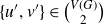 $\{u',v'\} \in \binom{V(G)}{2}$
if G contains an edge containing
$\{u',v'\} \in \binom{V(G)}{2}$
if G contains an edge containing $\{u,v, u', v'\}$
and adjacent to
$\{u,v, u', v'\}$
and adjacent to $b \in B$
if G contains an edge containing
$b \in B$
if G contains an edge containing $\{u,v, b\}$
. Other adjacencies in
$\{u,v, b\}$
. Other adjacencies in $\Gamma$
are defined similarly so that
$\Gamma$
are defined similarly so that $S_j \cap S_{j'} = \emptyset$
for distinct non-adjacent
$S_j \cap S_{j'} = \emptyset$
for distinct non-adjacent $j,j'\in V(\Gamma)$
, where
$j,j'\in V(\Gamma)$
, where $S_j$
and
$S_j$
and $S_{j'}$
are the sets of trials determining whether an edge is included in
$S_{j'}$
are the sets of trials determining whether an edge is included in $G'_1$
or
$G'_1$
or $G'_2$
upon which
$G'_2$
upon which $\mathcal{E}_j$
and
$\mathcal{E}_j$
and $\mathcal{E}_{j'}$
depend, respectively. Since every vertex has degree at most D in both
$\mathcal{E}_{j'}$
depend, respectively. Since every vertex has degree at most D in both $G_1$
and
$G_1$
and $G_2$
, we have
$G_2$
, we have $\Delta(\Gamma) \leq 5r^2D$
. By a standard application of the Chernoff Bounds (see e.g. [
Reference Alon and Spencer1
, theorem A·1·12] and [
Reference Janson, Luczak and Rucinski16
, corollary 2·3]),
$\Delta(\Gamma) \leq 5r^2D$
. By a standard application of the Chernoff Bounds (see e.g. [
Reference Alon and Spencer1
, theorem A·1·12] and [
Reference Janson, Luczak and Rucinski16
, corollary 2·3]), ${\mathbb P\left[\mathcal{E}_j\right]} \leq \exp(-\log^2(D))$
for every
${\mathbb P\left[\mathcal{E}_j\right]} \leq \exp(-\log^2(D))$
for every $j \in V(\Gamma)$
.
$j \in V(\Gamma)$
.
For every outcome G
′ for which $\bigcap_{j \in V(\Gamma)}\overline{\mathcal{E}_j}$
holds, by Theorem 3·5 applied with G
′,
$\bigcap_{j \in V(\Gamma)}\overline{\mathcal{E}_j}$
holds, by Theorem 3·5 applied with G
′, $G'_1$
,
$G'_1$
, $G'_2$
,
$G'_2$
, $D^{\gamma / 2} + D^{\gamma/3}$
,
$D^{\gamma / 2} + D^{\gamma/3}$
, $1/4$
, and
$1/4$
, and $3\alpha / \gamma$
playing the roles of G,
$3\alpha / \gamma$
playing the roles of G, $G_1$
,
$G_1$
, $G_2$
, D,
$G_2$
, D, $\beta$
, and
$\beta$
, and $\alpha$
, respectively, G
′ has an A-perfect matching M. We claim that the conditional distribution on
$\alpha$
, respectively, G
′ has an A-perfect matching M. We claim that the conditional distribution on $\bigcap_{j \in V(\Gamma)}\overline{\mathcal{E}_j}$
yields the desired distribution. To that end, let
$\bigcap_{j \in V(\Gamma)}\overline{\mathcal{E}_j}$
yields the desired distribution. To that end, let $S \subseteq E(G)$
, and let
$S \subseteq E(G)$
, and let $\mathcal{E}$
be the event that
$\mathcal{E}$
be the event that $S \subseteq E(G')$
. Note that there are at most
$S \subseteq E(G')$
. Note that there are at most $5r^2 D|S|$
choices of
$5r^2 D|S|$
choices of $j \in V(\Gamma)$
for which
$j \in V(\Gamma)$
for which $\mathcal{E}_j$
depends on whether
$\mathcal{E}_j$
depends on whether $S \subseteq E(G')$
. Hence, by Lemma 3·6,
$S \subseteq E(G')$
. Hence, by Lemma 3·6,
 \begin{equation*} {\mathbb P\left[\mathcal{E}\:\middle|\:\bigcap_{j \in V(G)}\overline{\mathcal{E}_j}\right]} \leq \left(D^{\gamma/2 - 1}\right)^{|S|}\exp(30r^2 D|S|\exp(-\log^2 D)) \leq \left(2D^{\gamma/2 - 1}\right)^{|S|}. \end{equation*}
Since $2D^{\gamma/2 - 1} \leq 1 / D^{1 - \gamma}$
and
$2D^{\gamma/2 - 1} \leq 1 / D^{1 - \gamma}$
and $S\subseteq M$
only if
$S\subseteq M$
only if $S \subseteq E(G')$
, the result follows.
$S \subseteq E(G')$
, the result follows.
7. Proof of Theorem 1·5
Now prove Theorem 1·5, which as mentioned, implies Theorem 1·3.
Proof of Theorem
1·5. Throughout the proof we assume n is sufficiently large and $\beta$
sufficiently small for various inequalities to hold. In addition, we assume n is sufficiently large with respect to
$\beta$
sufficiently small for various inequalities to hold. In addition, we assume n is sufficiently large with respect to $1 / \beta$
. Let
$1 / \beta$
. Let $G \cong K_n$
, let
$G \cong K_n$
, let $C \;:\!=\; n^{8\beta}$
, and let
$C \;:\!=\; n^{8\beta}$
, and let $p \;:\!=\; C^{-2}/2$
. By Lemma 3·1, there exists
$p \;:\!=\; C^{-2}/2$
. By Lemma 3·1, there exists $X \subseteq G$
such that
$X \subseteq G$
such that $\Delta(X) \leq \Delta \;:\!=\; 2pn = n/C^2$
and for all
$\Delta(X) \leq \Delta \;:\!=\; 2pn = n/C^2$
and for all $e \in E(G) \setminus E(X)$
, there exist at least
$e \in E(G) \setminus E(X)$
, there exist at least $p^{\binom{q}{2}}n^{q - 2}$ $K_q$
’s in
$K_q$
’s in $X \cup \{e\}$
containing e. By Theorem 4·1, there exists a probability distribution on
$X \cup \{e\}$
containing e. By Theorem 4·1, there exists a probability distribution on $K_q$
-omni-absorbers A for X with decomposition family
$K_q$
-omni-absorbers A for X with decomposition family $\mathcal{H}_A$
and decomposition function
$\mathcal{H}_A$
and decomposition function $\mathcal{Q}_A$
such that
$\mathcal{Q}_A$
such that $\Delta(A) \leq C\Delta$
and
$\Delta(A) \leq C\Delta$
and
 \begin{equation} {\mathbb P\left[\bigcup_{L\subseteq X}\{\mathcal{S} \subseteq \mathcal{Q}_A(L)\}\right]} \le \left(\frac{1}{n^{(q - 6)/2 + 2\beta}}\right)^{|\mathcal{S}|} \text{ for all $K_q$-packings $\mathcal{S}$ of}\;{G}. \end{equation}
Let $\mathcal{A}$
be the set of omni-absorbers supported by this distribution. For each omni-absorber
$\mathcal{A}$
be the set of omni-absorbers supported by this distribution. For each omni-absorber $A \in \mathcal{A}$
, let
$A \in \mathcal{A}$
, let $J_A \;:\!=\; G - (X \cup A)$
, and note that
$J_A \;:\!=\; G - (X \cup A)$
, and note that $\delta(G) \geq (1 - (C+1)/C^2)n$
. Hence, by Lemma 3·3 applied to
$\delta(G) \geq (1 - (C+1)/C^2)n$
. Hence, by Lemma 3·3 applied to $J_A$
, there exists a hypergraph
$J_A$
, there exists a hypergraph $\mathcal{D}^A_1 \subseteq \mathrm{Design}(J_A, K_q)$
that is
$\mathcal{D}^A_1 \subseteq \mathrm{Design}(J_A, K_q)$
that is $((1/2 \pm n^{-(q-2)/3})\left.\binom{n - 2}{q - 2}\middle.\right.)$
-regular. Let
$((1/2 \pm n^{-(q-2)/3})\left.\binom{n - 2}{q - 2}\middle.\right.)$
-regular. Let $\mathcal{D}^A_2$
be the
$\mathcal{D}^A_2$
be the $\binom{q}{2}$
-uniform hypergraph where
$\binom{q}{2}$
-uniform hypergraph where
 \begin{equation*} V\big(\mathcal{D}^A_2\big) \;:\!=\; E(J_A) \cup X \end{equation*}
and
 \begin{equation*} E\big(\mathcal{D}^A_2\big)\;:\!=\;\big\{S \subseteq V\big(\mathcal{D}^A_2\big)\; :\; |S \cap E(J_A)| = 1 \text{ and } G[S] \cong K_q\big\}. \end{equation*}
We will apply Theorem 6·1 with $\mathcal{D}^A_1$
and
$\mathcal{D}^A_1$
and $\mathcal{D}^A_2$
playing the roles of
$\mathcal{D}^A_2$
playing the roles of $G_1$
and
$G_1$
and $G_2$
, respectively. To that end, note that
$G_2$
, respectively. To that end, note that $\mathcal{D}^A_2$
is bipartite with bipartition
$\mathcal{D}^A_2$
is bipartite with bipartition $(E(J_A), X)$
, that
$(E(J_A), X)$
, that $V(\mathcal{D}^A_1) \cap V(\mathcal{D}^A_2) = E(J_A)$
, and that
$V(\mathcal{D}^A_1) \cap V(\mathcal{D}^A_2) = E(J_A)$
, and that $\mathcal{D}^A_1$
and
$\mathcal{D}^A_1$
and $\mathcal{D}^A_2$
are edge disjoint, and let
$\mathcal{D}^A_2$
are edge disjoint, and let $\mathcal{D}^A \;:\!=\; \mathcal{D}^A_1 \cup \mathcal{D}^A_2$
and
$\mathcal{D}^A \;:\!=\; \mathcal{D}^A_1 \cup \mathcal{D}^A_2$
and $D \;:\!=\; (1/2 + n^{-(q-2)/3})\binom{n-2}{q-2}$
. Note that
$D \;:\!=\; (1/2 + n^{-(q-2)/3})\binom{n-2}{q-2}$
. Note that $n^{q-2}/(3(q-2)!) \leq D \leq n^{q - 2}$
. The maximum codegree of
$n^{q-2}/(3(q-2)!) \leq D \leq n^{q - 2}$
. The maximum codegree of $\mathcal{D}^A$
is at most the maximum codegree of
$\mathcal{D}^A$
is at most the maximum codegree of $\mathrm{Design}(K_n, K_q)$
which is at most
$\mathrm{Design}(K_n, K_q)$
which is at most $\binom{n - 3}{q - 3} \leq D^{1 - 1/(2q-5)}$
since
$\binom{n - 3}{q - 3} \leq D^{1 - 1/(2q-5)}$
since $D \geq n^{q - 5/2}$
. Every
$D \geq n^{q - 5/2}$
. Every $e \in X$
is in at most
$e \in X$
is in at most $\Delta(X)n^{q-3} \leq n^{q-2}/C^2 \leq D$
hyperedges
$\Delta(X)n^{q-3} \leq n^{q-2}/C^2 \leq D$
hyperedges $S\subseteq E(\mathcal{D}^A_2)$
, so
$S\subseteq E(\mathcal{D}^A_2)$
, so $d_{\mathcal{D}^A_2}(e) \leq D$
for every
$d_{\mathcal{D}^A_2}(e) \leq D$
for every $e \in X$
. Every
$e \in X$
. Every $e \in E(J_A)$
is in at least
$e \in E(J_A)$
is in at least $p^{\binom{q}{2}}n^{q - 2} \geq n^{q - 2 - 8q^2\beta} \geq D^{1 - 8q^2\beta}$
hyperedges
$p^{\binom{q}{2}}n^{q - 2} \geq n^{q - 2 - 8q^2\beta} \geq D^{1 - 8q^2\beta}$
hyperedges $S \subseteq E(\mathcal{D}^A_2)$
by the choice of X, so
$S \subseteq E(\mathcal{D}^A_2)$
by the choice of X, so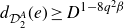 $d_{\mathcal{D}^A_2}(e) \geq D^{1 - 8q^2\beta}$
for every
$d_{\mathcal{D}^A_2}(e) \geq D^{1 - 8q^2\beta}$
for every $e \in E(J_A)$
. Every
$e \in E(J_A)$
. Every $e \in \mathcal{D}^A_1$
satisfies
$e \in \mathcal{D}^A_1$
satisfies $d_{\mathcal{D}^A_1}(e) \leq D$
and
$d_{\mathcal{D}^A_1}(e) \leq D$
and $d_{\mathcal{D}^A_1}(e) \geq (1/2 - n^{-(q-2)/3})\binom{n-2}{q-2} \geq (1 - 2n^{-(q-2)/3})D \geq (1 - D^{-1/4})D$
by the choice of D and
$d_{\mathcal{D}^A_1}(e) \geq (1/2 - n^{-(q-2)/3})\binom{n-2}{q-2} \geq (1 - 2n^{-(q-2)/3})D \geq (1 - D^{-1/4})D$
by the choice of D and $\mathcal{D}^A_1$
, where in the last inequality we used that
$\mathcal{D}^A_1$
, where in the last inequality we used that $D \geq n^{q-2} / (3(q-2)!)$
. Hence, we may apply Theorem 6·1 with
$D \geq n^{q-2} / (3(q-2)!)$
. Hence, we may apply Theorem 6·1 with $\binom{q}{2}$
,
$\binom{q}{2}$
, $1/q$
,
$1/q$
, $\min\{1/(2q-5), 1/4\}$
, D, and
$\min\{1/(2q-5), 1/4\}$
, D, and $8q^2\beta$
playing the roles of r,
$8q^2\beta$
playing the roles of r, $\gamma$
,
$\gamma$
, $\beta$
, D, and
$\beta$
, D, and $\alpha$
, respectively, to obtain a probability distribution on
$\alpha$
, respectively, to obtain a probability distribution on $E(J_A)$
-perfect matchings
$E(J_A)$
-perfect matchings $M_A$
of
$M_A$
of $\mathcal{D}^A$
, which correspond to
$\mathcal{D}^A$
, which correspond to $K_q$
-packings
$K_q$
-packings $\mathcal{M}_A$
of
$\mathcal{M}_A$
of $G - A$
covering every edge of
$G - A$
covering every edge of $J_A$
, such that
$J_A$
, such that
 \begin{equation} {\mathbb P\left[\mathcal{S} \subseteq \mathcal{M}_A\:\middle|\:A = A'\right]} \le \left(\frac{1}{n^{q-3}}\right)^{|\mathcal{S}|} \text{ for all $K_q$-packings $\mathcal{S}$ of}\;{G}\;\text{and $A' \in \mathcal{A}$}. \end{equation}
For every such matching, we let $L_{A, M_A} \;:\!=\; X \setminus \bigcup M_A$
, and we choose the
$L_{A, M_A} \;:\!=\; X \setminus \bigcup M_A$
, and we choose the $K_q$
-decomposition
$K_q$
-decomposition $\mathcal{M}_A \cup \mathcal{Q}_A(L_{A, M_A})$
.
$\mathcal{M}_A \cup \mathcal{Q}_A(L_{A, M_A})$
.
We claim that this probability distribution on $K_q$
-decompositions is
$K_q$
-decompositions is $(n^{-(q-6)/2 - \beta})$
-spread. To that end, let
$(n^{-(q-6)/2 - \beta})$
-spread. To that end, let $\mathcal{S}$
be a
$\mathcal{S}$
be a $K_q$
-packing of G, and note that
$K_q$
-packing of G, and note that
 \begin{multline*} {\mathbb P\left[\mathcal{S} \subseteq \mathcal{M}_A \cup \mathcal{Q}_A(L_{A, M_A})\right]} = \sum_{\mathcal{S}' \subseteq \mathcal{S}}{\mathbb P\left[\mathcal{S}' \subseteq \mathcal{M}_A \text{ and } \mathcal{S}\setminus \mathcal{S}'\subseteq \mathcal{Q}_A(L_{A, M_A})\right]}\\ \leq\sum_{\mathcal{S}'\subseteq \mathcal{S}}{\mathbb P\left[\mathcal{S}' \subseteq \mathcal{M}_A \text{ and } \bigcup_{L\subseteq X}\{\mathcal{S}\setminus \mathcal{S}' \subseteq \mathcal{Q}_A(L)\}\right]}\\ =\sum_{\mathcal{S}' \subseteq \mathcal{S}}{\mathbb P\left[\mathcal{S}' \subseteq \mathcal{M}_A\:\middle|\:\bigcup_{L\subseteq X}\{\mathcal{S}\setminus \mathcal{S}' \subseteq \mathcal{Q}_A(L)\}\right]} \cdot{\mathbb P\left[\bigcup_{L\subseteq X}\{\mathcal{S}\setminus \mathcal{S}' \subseteq \mathcal{Q}_A(L)\}\right]}. \end{multline*}
By the law of total probability and (7·2), for every $\mathcal{S}' \subseteq \mathcal{S}$
,
$\mathcal{S}' \subseteq \mathcal{S}$
,
 \begin{multline*} {\mathbb P\left[\mathcal{S}' \subseteq \mathcal{M}_A\:\middle|\:\bigcup_{L\subseteq X}\{\mathcal{S}\setminus \mathcal{S}' \subseteq \mathcal{Q}_A(L)\}\right]}\\ = \sum_{A'\in \mathcal{A}}{\mathbb P\left[\mathcal{S}' \subseteq \mathcal{M}_A\:\middle|\:A = A'\right]}{\mathbb P\left[A = A'\:\middle|\:\bigcup_{L\subseteq X}\{\mathcal{S}\setminus \mathcal{S}' \subseteq \mathcal{Q}_A(L)\}\right]}\\ \leq \left(\frac{1}{n^{q-3}}\right)^{|\mathcal{S}'|} \sum_{A' \in \mathcal{A}}{\mathbb P\left[A = A'\:\middle|\:\bigcup_{L\subseteq X}\{\mathcal{S}\setminus \mathcal{S}' \subseteq \mathcal{Q}_A(L)\}\right]} = \left(\frac{1}{n^{q-3}}\right)^{|\mathcal{S}'|}. \end{multline*}
For every $\mathcal{S}' \subseteq \mathcal{S}$
, by (7·1), we have
$\mathcal{S}' \subseteq \mathcal{S}$
, by (7·1), we have
 \begin{equation*} {\mathbb P\left[\bigcup_{L\subseteq X}\{\mathcal{S}\setminus \mathcal{S}' \subseteq \mathcal{Q}_A(L)\}\right]} \leq \left(\frac{1}{n^{(q - 6)/2 + 2\beta}}\right)^{|\mathcal{S}|-|\mathcal{S}'|}. \end{equation*}
Combining the inequalities above, since $q - 3 \geq (q - 6)/2 + 2\beta$
and
$q - 3 \geq (q - 6)/2 + 2\beta$
and $2/n^{(q-6)/2 + 2\beta} \leq 1/n^{(q-6)/2 + \beta}$
, we have
$2/n^{(q-6)/2 + 2\beta} \leq 1/n^{(q-6)/2 + \beta}$
, we have
 \begin{equation*} {\mathbb P\left[\mathcal{S} \subseteq \mathcal{M}_A \cup \mathcal{Q}_A(L_{A, M_A})\right]} \leq \sum_{\mathcal{S}' \subseteq \mathcal{S}}\left(\frac{1}{n^{q-3}}\right)^{|\mathcal{S}'|}\left(\frac{1}{n^{(q - 6)/2 + 2\beta}}\right)^{|\mathcal{S}|-|\mathcal{S}'|} \leq \left(\frac{1}{n^{(q - 6)/2 + \beta}}\right)^{|\mathcal{S}|}, \end{equation*}
as desired.
Acknowledgements
We would like to thank the referee for their very careful reading of the paper. The first author’s research was supported by NSERC under Discovery Grant No. 2019-04269 and a Sloan Research Fellowship. The second author’s research was supported by the National Science Foundation under Grant No. DMS-2247078. The third author’s research was partially supported by NSERC under Discovery Grant No. 2019-04304.

 Open access

