

Introduction
Traditional studies in international security and peace studies have paid almost no attention to governance dynamics involving the extent of social violence and the new forms of governance generated by agents labelled as violent nonstate actors (VNSAs). The explosion of violence, either through competition between VNSAs, clashes between them and the state, or through the spillover effect into neighboring societies, has generated different informal forms of governance. These are causally linked to problems of limited statehood or a state’s institutional weakness. A significant bibliography has explored various aspects of modes of governance generated by VNSAs (Reference WilliamsWilliams 2008; Reference Schneckener, Bryden and CapariniSchneckener 2006, Reference Schneckener2009; Reference Clunan, Trinkunas, Clunan and TrinkunasClunan and Trinkunas 2010; Reference MandelMandel 2013; Reference Arjona, Kasfir, Mampilly, Arjona, Kasfir and MampillyArjona, Kasfir, and Mampilly 2015; Reference ArjonaArjona 2016; Reference EzrowEzrow 2017; Reference Magaloni, Vivanco and MeloMagaloni, Franco Vivanco, and Melo 2018; Reference Lessing and WillisLessing and Denyer Willis 2019). Although scholars have contributed to the analysis of the forms of governance produced with the rise of VNSAs (e.g., Reference ArjonaArjona 2016; and Reference Villa and SouzaVilla and Souza 2019), we observe an empirical gap in the study of how VNSAs contribute to the formation of hybrid governance in some regions of the world, where state authority seems to govern but actually is sharing, ceding, or complementing the “governance” offered by VNSAs. It means that the relations between states and those VNSAs are not always zero-sum.
Certainly, South America is not a peculiar case. In various parts of the world, VNSAs represent a challenge to state governance and human security. In Mexico, drug-trafficking organizations are actively challenging the Mexican state’s governance control over the country. In Central America and the United States, youth gangs such as Mara Salvatrucha (MS-13) have a massive and highly disruptive presence. In parts of Central and Western Europe such as Albania, Italy, and many areas of the former Soviet Union, criminal organizations not only intimidate businesses and corrupt politicians but also engage in a variety of activities that undermine formalized forms of state governance (Reference WilliamsWilliams 2008; Reference PodderPodder 2017).
In these regions, it is possible to observe the overlap of diverse forms of governance—vertical (or by governments) and horizontal (or beyond governments)—which allow new sources of social control and legitimacy to emerge. These are sites of hybridity and social change, captured by the notion of hybrid governance. Nation-states’ institutional weaknesses, deepened by the decline of welfare states around the world, contribute to the formation of a hybrid governance system. How can the formation of hybrid governance be observed in South America, considering the coexistence of vertical and horizontal governance dynamics? To answer this question, two starting points were considered: first, the type of VNSA to be addressed; and, second, the VNSA’s capacity to act in more autonomous ways, providing alternative modes of governance. Following previous works, such as Villa, Chagas-Bastos, and Braga (Reference Villa, Chagas-Bastos and de Macedo Braga2019) and Domínguez (Reference Domínguez, Suarez, Villa and Weiffen2017), our argument explores the hypothesis that violent nonstate actors generate forms of governance in parts of Latin America that result in a hybrid governance system in which nonstate actors exercise state-like functions such as dispute resolution and resource allocation while overlapping or interacting with certain forms of state governance.
Mandel (Reference Mandel2013, 42) defines violent nonstate actors “as relatively autonomous organizations (not under complete and direct state control) with significant and sustained coercive capabilities for organized violence.” Part of the bibliography on VNSAs refers to rebel groups and the governance generated by them (Reference Arjona, Kasfir, Mampilly, Arjona, Kasfir and MampillyArjona, Kasfir, and Mampilly 2015; Reference DuyvesteynDuyvesteyn 2017; Reference HernándezHernández 2019). Frequently, VNSAs are simply defined as “armed groups” (Reference Schlichte and SchneckenerSchlichte and Schneckener 2015; Reference PodderPodder 2017). In this work, to overcome the ambiguity of the concept, we focus on a very specific kind of VNSA that uses violence as a tool to achieve its aims: organized crime.
We initially observed a universe of cases in South America (which include paramilitary groups, militias, rebels/insurgents, drug traffickers and cartels, and others). From the regional setting, we selected two case studies: the Brazilian transnational criminal organization Primeiro Comando da Capital (PCC) and the Colombian Bandas Criminales (BACRIM). The cases were selected because, to a significant extent, they synthesize the characteristics of other South American VNSAs in the production of governance, such as using armed violence and raising funds (rent-seeking). The research draws on qualitative data, including interviews conducted in Brazil, Colombia, and Venezuela. Reports released from Colombian nongovernmental and governmental institutions are also used. In both cases, the VNSAs do not seek to change or replace the legitimate political authority. The diverse relations they developed with local actors, among themselves, and with states’ agents make criminal actors and insurgent/rebel actors two distinct types of VNSA.
Organized crime is our starting point to analyze how VNSAs operationalize hybrid dynamics of governance in South America. Organized crime, as well as gangs, are commonly characterized by two elements: violent behavior patterns, considered illegal by dominant authorities and the society; and a measure of institutional continuity that is independent of its membership, constituted mainly by young males (Reference SchuberthSchuberth 2016, 2). These actors emerge, as Rosenau (Reference Rosenau1990) proposed, as sovereign-free agents, operating new forms of governance, although without the aim of changing the political structure of their original nation-state. However, as seen in other VNSAs, they effectively undermine the state’s traditional authority in governing over the national territory and its people (Reference Zizumbo-ColungaZizumbo-Colunga 2019). Following the extensive empirical work of Williams (Reference Williams2008), which analyzed the forms of violence provided by different VNSAs (insurgents, militias, organized crime, gangs, etc.), the present work considers three essential variables associated with VNSAs power dynamics: the groups’ access to resources, their scope of action, and the role of violence in promoting the groups’ aims. The three variables were chosen as essential channels in order to first map the capacity of VNSAs to operate in more autonomous forms, as we consider their nexus with states and their agents; and second, to map their capacity to provide alternative modes of governance (horizontal), as we consider their mechanisms of social control over local constituencies. Hybrid governance formations emerge in a context where the three variables are constitutive elements.
Hybrid Governance
Where the term governance is applied, it indicates a causal coordination strategy, involving formal and informal mechanisms, over a specific problem or issue. It may result in formal institutional practices and/or regular networks of routine interaction. Generally, both “governance” and “government” consist “of rule systems, of steering mechanisms through which authority is exercised in order to enable the governed to preserve their coherence and move towards desired goals” (Reference Rosenau, Bache and FlindersRosenau 2004, 31). For government, however, rule systems merge in formalized structures. Governance, in turn, involves “any collectivity—private or public—that employs informal as well as formal steering mechanisms to make demands, frame goals, issue directives, pursue policies, and generate compliance” (Reference Rosenau, Bache and FlindersRosenau 2004, 31). In any case, governing implies the exercise of authority. Conversely, authority emerges through the recognition of the right to govern (Reference Rosenau, Bache and FlindersRosenau 2004, 32).
The contemporary emergence of governance mechanisms in international politics, involving a multiplicity of state and nonstate actors, reflects an increasing fragmentation of the structures of authority. For example, the broadening notion of what constitutes a security issue takes security governance a step further, beyond governments’ exclusive space of action, to include other issues and actors that—although they may not contest the centrality of states in managing them—contribute to the growing relevance of other formal (vertical) and informal (horizontal) structures of authority at different levels.
In general, scholars have addressed hypotheses that are more concerned with problematizing the state-centric view of governance practices (Reference Clunan, Trinkunas, Clunan and TrinkunasClunan and Trinkunas 2010), paying little attention to the many sites of authority (or actors) which provide governance in a complex world of intersecting social, political, and economic arenas where state control is almost absent or contested. For Rosenau (Reference Rosenau, Bache and Flinders2004, 40), world politics could be conceptualized “as governed through a bifurcated system”: one a system of states and their governments, which dominates world affairs, and “the other a multi-centric system of diverse types of other collectivities that have lately emerged as rival sources of authority that sometimes cooperate with, often compete with, and endlessly interact with the state-centric system” (Reference RosenauRosenau 1990).
A governance perspective brings to attention the interplay between different actors—governments, civil society, businesses, and others—to collectively design and establish a given set of formal and informal rules that both shape and are shaped by power relations. Systems of governance have been identified along two axes, vertical and horizontal, indicating the orientation through which authority flows (Reference Bache and FlindersBache and Flinders 2004). On one hand, in horizontal governance (through informal rules, norms, and practices) attention is given to the relations established among a multiplicity of nonstate actors, such as international organizations, and private actors, ranging from nongovernmental organizations (NGOs), epistemic communities, multinational corporations (MNCs), organized crime, and armed groups. On the other hand, vertical governance (through formal rules, norms, and institutionalized practices) indicates the growing interaction of state and nonstate actors at various territorial levels: local, national, regional, and global (Reference Hänggi, Bryden and HänggiHänggi 2005; Reference Rosenau, Bache and FlindersRosenau 2004; Reference Boege, Brown, Clements and NolanBoege et al. 2008).
Traditionally, analysis has mainly focused on state-led governance or formal governance dynamics, considered as “governance by governments,” whereby authority flows vertically, merging public and private operational actors and strategies into hierarchical structures (Reference RosenauRosenau 1990, Reference Rosenau, Bache and Flinders2004; Reference Hänggi, Bryden and HänggiHänggi 2005). Conversely, attention was also given to the so-called governance without government (Reference RosenauRosenau 1990), which entails less formalized and networked dynamics. Governance without governments (or bottom-up governance) “refers to policies that may be ratified by governments but that are propelled and sustained mainly outside the halls of governments” (Reference Rosenau, Bache and FlindersRosenau 2004, 43).
In contrast, analysis of the role of nonstate actors has focused on the overlapping and intertwining forms of governance in “weak” or “fragile” states and on the emerging “hybrid political orders” (Reference LawrenceLawrence 2017) resulting from hybridization processes in which state and nonstate modes of governance coexist, overlap, and intertwine. Others argued that so-called ungoverned spaces are actually alternatively governed (Reference Clunan, Trinkunas, Clunan and TrinkunasClunan and Trinkunas 2010); and more recently, authors analyzing security sector reform have focused on the role of nonstate providers of justice and security in societies emerging from violent conflicts (Reference LawrenceLawrence 2017).
However, few analysts inquire about the empirical ways in which criminal VNSAs erode state authority—or vertical/formal governance—when they aggregate horizontal/informal forms of governance, thus contesting traditional structures of control and social order. In South America, for example, global interdependence has profoundly changed the nature of illicit activities in recent decades, effectively undermining state authority in particular areas controlled by criminal organizations or disputed among them.
Following previous efforts (Reference ArjonaArjona 2016; Reference Villa and SouzaVilla and Souza 2019; Reference Villa, Chagas-Bastos and de Macedo BragaVilla, Chagas-Bastos, and Braga 2019; Reference Ferreira, Spring and BrauchFerreira 2020), we suggest that a parallel dynamic may be at play, where by nonstate armed actors engage in horizontal modes of governance over spaces and populations to the extent that they provide alternative forms of welfare, employment, and meaning, by operating as the functional equivalents of states wherever formal state governance is perceived as weak or contested. We focus on governance beyond governments, considering the informal modes of governance that emerge in spaces of limited statehood and operate outside government’s control but may achieve a measure of legitimacy among local populations and (sometimes) the state.
By exploring the interaction between different forms of governance, a sited hybridity emerges. In hybrid governance, we address fluid modes of formal and informal interaction between state and nonstate actors in the intersection of both horizontal and vertical dimensions of governance. At the horizontal dimension, we observe how nonstate actors make instrumental use of violence and coercion practices to establish and maintain routine practices of social interaction in a given social space. In turn, at a vertical dimension, we observe the growing capability of these non-state actors in providing alternative forms of governance over spaces and populations, enacting diverse and competing claims of power and logics of order (Reference Boege, Brown, Clements and NolanBoege et al. 2008, 24). The overlapping dynamics give rise to hybrid governance formations, where state and nonstate actors will behave in accordance with the other, constraining or calculating their actions by considering the other’s responses.
In regions where the state does not occupy a central position in the “political framework that provides security, welfare and representation, it has to share authority, legitimacy and capacity with other actors” (Reference Boege, Brown, Clements and NolanBoege et al. 2008, 24). Hence, horizontal forms of governance emerge where state authority is undermined both in terms of coercion and consent, as VNSAs’ control over the means of violence interacts with a resistance subculture in the face of rising levels of repressive politics. Such dynamics mobilize and consolidate spaces of hybrid governance in which the state is not absent but a particular other, a stakeholder or interested party, fighting for control over a pluralistic social system. In these socially bounded spaces, hybrid governance materializes when states are unable to create or maintain the loyalty and allegiance of their populations, and where individuals and groups typically revert to, or develop, alternative patterns of affiliation (Reference WilliamsWilliams 2008). Consequently, hybrid governance entails an order-creating system that seeks to shape horizontal and vertical relations among the political and social units through which domestic, international, and transnational governance mechanisms are created and developed.
In this regard, one might question how hybrid governance affects the traditional/state-centric view of governance run by governments. A response would be that it is necessary to address the basic qualities of modern sovereign states: their constitution as legitimate political authorities (in centralized or decentralized political structures) and their monopoly over the legitimate means of violence. In hybrid governance formations, however, both forms of legitimacy are contested.
Researchers such as Schlichte and Schneckener (Reference Schlichte and Schneckener2015) and Podder (Reference Podder2017) have argued that armed groups are able to produce or attempt to produce minimal forms of legitimacy. Legitimacy is a concept meant to capture the beliefs that acts of authority must be accepted because there is some source, whether rational-legal, patriarchal, or charismatic in nature, that justifies those acts. On the basis of a conception of legitimacy aimed at political authority, Max Weber (Reference Weber1968, 212–216) argued that a legitimate ruler or government elicits willing deference and obedience by justifying its exercise of authority with arguments based on the three aforementioned sources of legitimacy. In contrast, Beetham (Reference Beetham1991, 15–16) proposes that legitimacy means an overlap between preexisting formal and informal rules in a society and revolves around the extent to which new rules can be justified by beliefs that are shared in a community, as well as the extent to which these are confirmed in practices demonstrating compliance. Nevertheless, few scholars have devoted attention to the legitimacy of political actors other than the state.
If VNSAs have been found to be capable and able governance providers, both as alternatives to an absent state and as stand-alone governors with neither claims nor ambitions to state power (Reference DuyvesteynDuyvesteyn 2017, 672), there are multiple examples in the literature that indicate a substantial variation in structure, resources, practices, and aims among the possible types of VNSAs (Reference Krause and MillikenKrause and Milliken 2009; Reference EzrowEzrow 2017; Reference SchneckenerSchneckener 2009). Some emerge in direct contestation to state authority—like insurgents, rebels, or guerrilla groups—while others will arise in response to systemic opportunities offered by the fragmentation of a state’s authority at different levels of governance, such as paramilitary groups, youth gangs, and organized crime. According to Williams (Reference Williams2008, 4), VNSAs are entities that challenge the state’s “monopoly on the use of violence within a specified geographical territory.” The concept of ungoverned spaces assumes that because of a perceived absence of the state, there is no governance. However, most so-called ungoverned spaces are, in reality, “alternatively governed spaces” where governance becomes “no longer the exclusive domain of states or governments” (William 2008, 6), but where they coexist with informal forms of governance derived from the VNSA. This is precisely the case for organized crime and the governance produced through their actions.
In a recent study, Chabat (Reference Chabat, Rosen, Bagley and Chabat2019, 17–18) identified four modes of connection between state and criminal VNSAs, varying from situations where the state has control and instrumentalizes the criminal groups to achieve its ends; and situations where corruption of officials is the prevailing nexus; toward undisclosed alliances between the state and powerful criminal groups; and, finally, situations where the de facto control is in the hands of armed groups, who will perform some basic state functions. Nonetheless, even if all modes of interaction are present at a certain time and space, the nexus between state and criminal organizations is difficult to map as corruption is widespread in modern states’ bureaucratic structures. For Podder (Reference Podder2017), to understand how criminal groups can generate alternative forms of governance considered legitimate by their stakeholders, the nexus between organized crime and the domestic society and that between organized crime and the international community must be considered. Legitimacy is relational and, on our understanding, produced within hybrid governance formations.
In turn, to analyze how VNSAs generate governance in plural contexts, Williams (Reference Williams2008) elaborated an analytical approach that identifies several variables. These include their motivation and purpose, strength and scope, how they obtain funding or access to resources, organizational structure, the role of violence, and the relationship between VNSAs and the state. The functions that VNSAs fulfill for members and supporting constituencies are also considered. Following this author’s argument, but instead focusing specifically on criminal VNSAs, we adapted three of these variables to show the development of causal factors in hybrid governance formations (system dynamics): access to resources, the extension of their activities, and the role of violence.
The three variables operate as significant empirical dimensions for analyzing the impact of VNSAs in diverse social and politically critical areas of the planet. Through their conceptual frame, they allow us to map the overlap between vertical and horizontal governance dynamics and, hence, to explore how the formation of hybrid governance might be observed in South America considering the coexistence of formal (vertical) and informal (horizontal) dynamics. In this research we address the empirical variations across these three categories.
Group resources (material capacities): The first variable is approached through a dual notion of how power manifests and creates new modes of domination and control. One dimension addresses the group’s material resources, including the criminal economy, access to arms, control of territory, and distribution of benefits/public goods. The second dimension is symbolic, on the level of recognition, sustainability and growth, forms of legitimization, and the socialization of informal rules and practices that create different modes of being (self-identities).
Extension of their criminal economies: The second variable includes consideration of VNSAs transnational reach (contact/relations with other VNSAs, criminal networks, and states). This will allow us to explore how intergroup governance may result in a change of strategic behavior prompted by common issues among diverse social groups, such as repressive policies that threaten their mutual survival.
Intensity of violence: The third and last variable considers the use of force by VNSAs in order to ensure compliance and will analyze its use in the groups’ relations with the state (compliant/noncompliant), in intergroup relations, and through competition over scarce resources (spaces, people, and assets) between similar actors.
Although the three above variables may never be present with the same intensity, they are an important mean through which we can evaluate a VNSA’s capacity for governance during a specific time and space. The article explores to what degree these new dynamics have considerably undermined the state’s authority and contributed to the emergence of hybrid governance systems in which modern sovereignty is essentially transformed and contested.
Primeiro Comando da Capital (PCC) as a Brazilian VNSA
The Brazilian PCC offers an important example of how a VNSA can provide governance beyond its core activities. The PCC was established on August 31, 1993, in Taubaté, São Paulo State, Brazil, by a small group of eight prisoners (Reference Dias and DarkeDias and Darke 2016, 217–218). The initial focus, to strengthen the criminal organization, was on fundraising through bank robbery and drug trafficking. During this period, the PCC had a pyramidal structure under the leadership of three criminals: Geleião (José Márcio Felício dos Santos), Cesinha (César Augusto Roriz), and Bandejão (José Eduardo Moura da Silva) (Reference MarquesMarques 2010). In 2002, after several clashes for control of the PCC, Marcos Herbas Camacho (aka Marcola) became the organization’s leader through a strategic collaboration with the police (Reference Christino and TognolliChristino and Tognolli 2017). Since then, this VNSA evolved from a prison gang into a strong criminal organization with governance capacities.
Group resources
Under Marcola’s command, PCC has become one of the main VNSAs in Brazil and neighboring countries. Since 2001, the group started a new phase, as shown by the mega-rebellion organized simultaneously in twenty-nine penitentiaries that involved twenty-eight thousand prisoners, showing the unique organization of a group neglected by the authorities (Reference Adorno and SallaAdorno and Salla 2007, 4; Brazil 2006, 193).
Five years later, PCC had exceeded the boundaries of the prison through coordinated attacks against authorities and the civilian population. The 2006 attacks paralyzed the São Paulo metropolitan area and its 18 million inhabitants: 51 prisons mutinied, and 251 terror attacks resulted in 90 buses set on fire and 42 police and prison officers killed. The strong crackdown of the police generated numerous criticisms in public opinion and human rights institutions. The violence statistics for these attacks and the aftermath of events are varied. However, until May 21, at least 493 deaths were registered—451 of them civilians—and four disappearances (Reference Adorno and SallaAdorno and Salla 2007, 7–8; Reference Biderman, de Lima, Mello and SchneiderBiderman et al. 2019).
An organizational change was seen in PCC between 2006 and 2012. According to Feltran et al. (Reference Feltran, Dias, Biondi and Marques2010), Marcola has promoted the insertion of equality into PCC’s practices. Since then, PCC operates under the leadership of eighteen members called sintonia final geral (central management of PCC). Even though PCC claims there is no central leadership, Marcola is the de facto top leader (Reference MarquesMarques 2010, 312). Below the sintonia final geral, there are two branches: the first being organized from different geographical divisions, and the second, based in issue areas. The geographic divisions are divided into two: São Paulo State sintonia and other states and countries sintonia. In São Paulo State, the cells are divided according to the phone areas. For example, in areas where the phone prefix is 013 (the coastal region of São Paulo State), at least two cells operate: one for the prisons and another for the poor neighborhoods (Lessing and Denyer Willis 2018, 22; Reference Manso and DiasManso and Dias 2018, 335). In the sintonia for other states and countries, each one has its cells for both the prisons and the quebradas (poor neighborhoods). All these cells have specific missions and responsibilities, such as managing its twenty to thirty thousand enrolled members spread around Brazil and abroad (Reference Lessing and WillisLessing and Denyer Willis 2019).
To reach this level of power and control, the PCC needed to organize its finances, administer its resources, and seek forms of protection in the judicial system. These responsibilities are under the control of the fourth branch of the PCC’s structure called “support.” It gathers specialized activities, which includes the financial sector—and several sub-branches linked to its illicit activities, including the gravitas (literally, “neckties”), covering the network of lawyers paid for by PCC to defend its members in the formal justice system (Reference Lessing and WillisLessing and Denyer Willis 2019, 22; see also Reference Manso and DiasManso and Dias 2018).
Most of PCC’s members contribute both as a workforce and financially to PCC. Estimates suggest that 80 percent of PCC profits come from the drug trafficking of approximately forty tons of cocaine/year, totaling US$200 million/year. The remaining 20 percent are the result of bank robberies, kidnappings, arms trafficking, raffles for detainees, and the monthly stipend paid by seven thousand prisoners and families in exchange for protection (Reference HisayasuHisayasu 2016).
Consequently, the organization is not only producing substantive profits. It also provides collective goods for enrolled members and invests in the organization’s development and expansion. As described by Lessing and Denyer Willis (Reference Lessing and Willis2019, 13), “this collectivist approach is echoed in another Central Management document proposing ‘aid banks’ for each Regional [“street” branch subdivisions in Interior] that provide loans of money and guns to members recently released from prison, to help them ‘get back on their feet.’ Each bank should have on hand BRL 500,000 (US$267,800) and a standing inventory of twenty automatic rifles, fifteen submachine guns, fifty pistols, thirty grenades, and twenty revolvers.” PCC’s financial power directly reflects its geographical extension and the intensity of its violence (Reference Ferreira, Spring and BrauchFerreira 2020).
Extension
The PCC branch for Sao Paulo State comprises eight geographic subdivisions: five for the capital and one for each of the São Paulo suburbs, the port city of Santos and coastal lowlands (Baixada Santista), and the remainder of the state (Interior) (Reference Lessing and WillisLessing and Denyer Willis 2019). This structure makes the PCC hegemonic in the state of São Paulo’s illicit activities and its prison system. This extension across the state is strategic, not only in terms of power but also economically. This is fundamental when considering that São Paulo is Brazil’s main economic center and the top consumer of drugs in the country.
The third branch of the PCC organization is dedicated to other states (estados) beyond São Paulo. This is divided into five regions: North, Northeast, West, South, and Center-West. It is organized similarly to the “street” branch but focuses on other territories under PCC control outside of São Paulo—mainly drug retail points—and cooperation with allied criminal gangs. Furthermore, recent clashes—mainly after October 2016—between the PCC and other criminal gangs, such as Comando Vermelho and Família do Norte, show that the former is seeking to expand its control over illicit activities in other Brazilian states (Reference FerreiraFerreira 2019).
Recent research has also shown that PCC operates not only in Brazil but has branches in several other Southern American countries (Reference FerreiraFerreira 2019; Reference Lessing and WillisLessing and Denyer Willis 2019). Moreover, this VNSA controls drug trafficking in the south and southeast of Brazil, a key route for the distribution of narcotics to Europe, Africa, and North America via the Atlantic Ocean. Thus, PCC can be regarded as a transnational VNSA (Reference FerreiraFerreira 2019).
Intensity of violence
Instrumental violence is also used by PCC to enforce the group’s norms in areas under its control. The debates (trials conducted according to PCC code) have the function of making corrective procedures against individuals that are an obstacle to the criminal organization. The debates often serve to eliminate enemies, such as prison agents who are no longer cooperating with the organization, members who betray it, and individuals involved in crimes that are not allowed by the PCC’s code of conduct, such as raping women, pedophilia, and corruption or misconduct in the organization’s financial management. However, the penalty can also be an advertência (warning), like physical punishment or public humiliation (Reference Ferreira, Spring and BrauchFerreira 2020).
An example of the PCC’s capacity of governance through control of violence was reported in one interview by a resident of a PCC-controlled area. In Capão Redondo (city of São Paulo), a criminal had stolen a television from a small house in 2016; however, to steal in PCC territories is not permitted. The thief was subjected to a debate, and after the “trial” received the penalty: to walk in the neighborhood with the TV on his shoulders and give it back to the citizen. Additionally, it was instructed that he should move to another neighborhood or he would be killed if new thefts were reported.Footnote 1 “Justice” was served, and all subjects complied.
The story shows a spillover on governance practices from a social space—the prisons—to another in which the PCC’s rule was accepted and normalized by residents. The PCC’s legitimacy is thus deeply woven into social relations. Those who live under this system engage in a form of self-governance. Even where the PCC is not explicitly present, its norms are. The PCC notion of right and wrong is transcendent and diffuse both for those understood to be within the “família” (family), meaning not necessarily the irmãos batizados (baptized brothers/enrolled members) but also all of those people living under the PCC’s code (Reference Denyer WillisDenyer Willis 2015, 58).
As the organization’s revenues grow, so do its territorial boundaries (Reference HisayasuHisayasu 2016). Consequently, violent clashes against competing groups also grow. One important episode of violence that marked the PCC’s expansion beyond Brazilian borders was the attempted murder in April 2010 of Roberto Acevedo, a Paraguayan senator with a devoted agenda against drug trafficking. On June 15, 2016, the Brazilian businessman Jorge Rafaat Toumani was also ambushed by approximately one hundred mercenaries linked to the PCC, using military-grade arms such as anti-missile .50 caliber and rifles, in the Paraguayan city of Pedro Juan Caballero (Reference BenitesBenites 2016). Moreover, as reported by an intelligence official in an interview in Foz do Iguaçu, nowadays the PCC also has control of some Paraguayan and Bolivian penitentiaries.Footnote 2
Governance and service delivery are viewed as a central part of the output or performance of legitimacy for the state. It is the tangible or visible part of seeing the state or perceiving its presence. In the case of armed groups, governance aspirations are often part of their project to fulfill the social contract toward the local population in areas where the state is not visible (Reference PodderPodder 2017, 687 and 692). Moreover, service provision is more likely when VNSAs require civilians support in their activities (Reference Sarkar and SarkarSarkar and Sarkar 2017); and as we observed in PCC governance structure, parts of the population collaborate with an armed group on the basis of a cost-benefit calculation about the utility of the service offered in the exchange for their support (Reference PodderPodder 2017, 691). Public goods like security and justice are an integral part of the criminal governance promoted by PCC. Nevertheless, while PCC tries to keep peaceful governance where it alone is hegemonic, its territorial expansion tends to disseminate high levels of armed violence, as seen in the clashes between this VNSA and the gang Família do Norte since 2017.
Colombian VNSA: The BACRIM
According to the Foundation for Peace (FIP), currently the insurgency of the National Liberation Army (ELN), FARC’s dissidents, and the BACRIM are the main security challenges for the government of Colombia. The BACRIM were successors of the paramilitaries that turned into armed mafia groups, whose objective is essentially the pursuit of criminal economic activities (FIP 2017). The BACRIM, however, do not follow a hierarchy or any centralized organizational model as did the guerrilla or the paramilitaries. They are instead committed to the model of a “franchise.” As Tickner, Garcia, and Arreaza (Reference Tickner, Garcia, Arreaza, Mejia and Gaviria2011, 424) show, “their criminal profile is wider and more flexible since they engage in multiple activities related to cocaine trafficking, agricultural production and fuel, kidnapping and extortion in rural areas; and micro trafficking and murder in urban areas.”
Group resources
At present, the Colombian state recognizes three BACRIM, or Grupos Armados Organizados (Organized Armed Groups) as they are called by the government: the Autodefensas Gaitanistas de Colombia (AGC) or Clan del Golfo, Los Puntilleros, and the Ejército Popular de Liberación (EPL), also called Los Pelusos (FIP 2017). In Colombia, organized crime increased its strength after the demobilization of the country’s main guerrilla force, the FARC, and is active in 132 municipalities. Considering that Colombia has 1,098 municipalities, this number is not high, but the relevant fact is that these 132 municipalities are distributed in 27 of the 32 departments (states) in the country (FIP 2017).Footnote 3 Table 1 shows the evolution of this VNSA from 2010 to 2017.
BACRIM’s structure (2010–2017).

Source: Based on data from the Policía Nacional y Fiscalía of Colombia (2006–2016) and International Crisis Group (2017).
The most striking observation is the reduction in the number of these VNSAs, even though this does not mean that they are less active or no longer have a significant territorial presence. Operationally, the older VNSAs do not have to act directly in a municipality or department but can outsource the criminal activity to local BACRIM.
Regarding the group’s financial capacity, in the specific case of the Clan del Golfo, the main source of income is drug trafficking, but also it also includes other criminal activities like illegal gold mining and extortion. Los Puntilleros, in turn, center their financial resources in drug trafficking, specializing in the transformation, internal commercialization, and control of coca (FIP 2017). The EPL is seen, at the national level, as a criminal group also dedicated to drug trafficking. This group also forces farmers to grow coca instead of participating in crop substitution programs (International Crisis Group 2017). In the case of the FARC’s dissidents, the prosperous illicit businesses—such as coca plantations, illegal gold mines, extortion, and contraband networks—are responsible for the survival and expansion of the group (International Crisis Group 2017).
Taking advantage of the low state presence in some territories, BACRIM can provide alternative sources of public goods such as security, food, or forms of employment. However, such groups can fund the extensive military capability needed to enforce territorial control and have a low reliance on civilian contributions in material terms. Methods of extraction for both rents and local resources, such as information, material support, and recruits, are enforced. These groups remain less responsive and more fluid in their interaction with civilians and likely to be more abusive toward civilian populations. As Mampilly (Reference Mampilly and Krieger2015, 48) argues, “civilians politically habituated by rentier fiscal state are unaware of their ability to influence the political authority. Under such conditions, armed groups can become de facto rulers more easily” without evoking significant resistance.Footnote 4
Extension
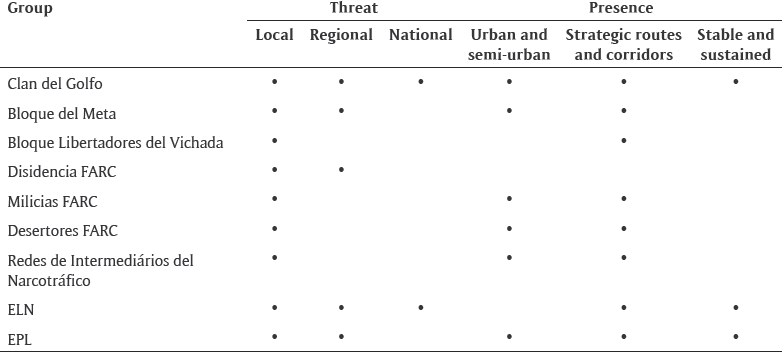
BACRIM affect public security in different intensities, as shown in Table 2, in which UGC or Clan del Golfo has the greatest capacity to affect public security in different social dimensions, from local to national. The group also presents greater complexity in territorial presence, which is stronger in urban and suburban areas, maintaining a stable (and nonvolatile) presence in those spaces. In turn, the ELP presents almost the same characteristics but to a lesser degree, as the group can establish alternative norms and institutions (Reference ArjonaArjona 2016, 109–110).Footnote 5
Scope of threat and occupation of space by Colombian VNSAs.
Source: Data from the Fundación Ideas para la Paz database (FIP 2017).
The nexus between criminal groups and states is also clear. In Venezuela and some regions of Colombia, agents of the state security forces, such as the National Guard or state police, administer drug trafficking. In Colombia’s case, it is led by local and regional political elites. In these areas, there are alliances between politicians, the police force, drug traffickers, and paramilitary groups or drug trafficking armies, and the population is condemned to subordinate itself to the social and political powers of the VNSA to access resources and goods, as well as social goods such as public safety.Footnote 6
Intensity of Violence
According to the Centro Nacional de Memoria Histórica de Colombia, from 1982 to 2014 the BACRIM and paramilitaries were responsible for the vast majority of deaths in Colombia, committing78 percent of the murders , followed by the guerrillas with 13.5 percent, unidentified armed groups with 6 percent, and the public security forces with 2.3 percent.Footnote 7
As Table 3 also shows, the neo-paramilitary forces have been responsible for 65 percent of the victims of political violence in Colombia, particularly in departments like Antioquia and Valle del Cauca. Since the peace talks began in 2012, there has been an increase in the number of victims recorded. In terms of political violence, BACRIM are responsible for 71 percent of the total of political victims, followed by public forces (20 percent of the total), and to a less degree, the actions of the guerrillas (14 percent of the total).Footnote 8
Political victims of armed groups in Western Colombia, 2009–2016.

Source: Banco de Datos de Derechos Humanos y Violencia Política, CINEP, Colombia.
For the violent nonstate actor, coercion can be an important source of authority (Reference DuyvesteynDuyvesteyn 2017; Reference PodderPodder 2017). An armed group perceived as legitimate is defined as “the rightful wielder of power, maker, and interpreter of rules or use of force and who thereby warrants support and compliance” (Reference SuchmanSuchman 1995, 575). However, when it comes to obedience or compliance by the population toward the forms of social control imposed by the BACRIM, it is entirely coerced and not based on a set of shared beliefs or perceptions. In general, coercive compliance is the characteristic of resource-rich groups like the BACRIM, which have access to considerable revenue-generating resources (Reference Schlichte and SchneckenerSchlichte and Schneckener 2015; Reference Sarkar and SarkarSarkar and Sarkar 2017).
Criminal Governance in South America
The VNSAs described have not achieved the cooperation of the civilian population only by mobilizing grievances or providing selective economic incentives. There is another relevant factor in their success: the capacity to generate governance and social legitimacy in the areas in which they operate. As suggested by the literature on rebel and criminal governance (Reference Arias and BarnesArias and Barnes 2016; Reference CockayneCockayne 2016; Reference ArjonaArjona 2016), VNSAs tend to exercise horizontal governance functions, such as the maintenance of public order, the creation of and compliance with rules of conduct, the resolution of disputes, the provision of public services, and the collection of taxes.
Moreover, as Podder (Reference Podder2017, 690–91) argues, “popular support for an armed group draws on different types of interactions”; these include utilitarian exchanges of core services such as security and justice. The provision of basic services by armed groups generate governance outputs, such as performance legitimacy, among the domestic constituencies (Reference PodderPodder 2017, 690). This is clear in the case of PCC. While the four branches of the Brazilian criminal VNSA are interchangeable and often overlap depending on the context, two of them directly provide governance control in different settings: the sistema (system) and “street” branches. In these two cases, they perform public services in substitution to the state, consequently strengthening the VNSA at the social level (Reference Ferreira, Spring and BrauchFerreira 2020). The PCC’s prison governance branch is responsible for the control of the entire penitentiary system. It involves the full control of penitentiaries, jails, penal colonies, and female prisons (Reference Manso and DiasManso and Dias 2018). The second branch that provides governance is the “street” (rua), responsible for organizing the criminal business and justice at the social level where the PCC has territorial control, which includes 7 percent of São Paulo State (Reference Biderman, de Lima, Mello and SchneiderBiderman et al. 2019).
The Colombian VNSAs, especially the contemporary BACRIM, have developed governance capacity in at least eight Colombian departments (Antioquia, Chocó, Córdoba, Sucre, Norte de Santander, Santander, Magdalena, and Bolívar) and more than 130 municipalities (El Tiempo 2016). In those urban and semi-urban regions, VNSAs such as the Clan del Golfo have territorial and population control and can exercise or impart justice. They established relations with local institutions and low ranks of the police forces, also exercising control over whole segments of criminal economies. Additionally, in some areas of illegal exploitation of gold, inhabitants go to these groups, and not to the formal authorities, to solve community conflicts. FARC dissidents exercise the same role of informal governance. These groups continue to function as it did before the Peace Agreement between the Colombian government and FARC-EP; they fight against coca eradication efforts, resolving disputes, controlling drug trafficking corridors, carrying out selective attacks against security forces and, in general, guaranteeing public order at the local level (International Crisis Group 2017). For example, the fighters of the dissident Frente Septimo de FARC act as political leaders, resolving disputes and defending illicit livelihoods against security forces. In the areas they control, these groups have established a rudimentary and authoritarian form of local political leadership (International Crisis Group 2017).
This shows that VNSAs are capable of generating shared norms and beliefs in a social space (Reference ArjonaArjona 2016). In rebel governance, it “is only by replacing the state in respect of key public service functions that an insurgency will be able to obtain political legitimacy” (Reference OlsonOlson 1993, 567). Likewise, criminal governance achieves social legitimacy by implanting horizontal forms of social control, based on the shared beliefs of local communities. Therefore, performed legitimacy is a key feature in hybrid governance, where sited hybridity is formed by the interactions of these three stakeholders in a given social space: the criminal groups, the state, and the local constituencies, shaping their practices and perceptions of each other.
In the exercise of governance by criminal VNSA, as observed in the Brazilian and Colombian cases, three aspects must be taken into account that determine how the governing practices of these groups are established. First, the idea of “outsourcing” becomes part of its operational methods: organized crime subcontracts to local VNSAs to perform operational functions at the most visible levels of illegal activities. Thus, large disputes between criminal organizations over the control of different urban areas and cities have given way to a rather complex system of contracting services, as also seen in the cooperation of PCC with minor criminal gangs in other Brazilian states. Second, there are also regions where they operationalize different forms of exercising authority, with the rise of political elites linked to crime, and with the presence of territorial disputes over drug trafficking routes associated with other armed groups (Reference Ávila and NiñoÁvila 2012; Reference Ferreira, Spring and BrauchFerreira 2020).
Third, there are places (for example, municipalities in the Pacific coast or eastern Colombia) in which the presence of VNSAs makes social governance dependent on the income generated by illicit economies, which implies alternative modes of subordination to illegal actors. If the population and the entrepreneurs depend on the illegal income to be able to have some level of consumption, then their subordination to illegal actors is complete. In such scenarios, repressive state governance policies to combat organized crime may not be feasible. For example, PCC’s control over marginalized or impoverished areas, in terms of governance, could not be explained only by the VNSAs’ control of violence in localized sites. This regulation takes place with the knowledge, and sometimes consent of the civil population (Reference PedrazaPedraza 2012). Or as Bolívar (Reference Bolívar2006) argues, such groups derive their [horizontal] legitimacy from several different forms of action.
Paradoxically, an increase in levels of state governance in a territory is not a sufficient condition to determine the failure of the governance offered by VNSAs. Even where the state has consolidated its power, there is a chance of being governed by a violent armed group in the future. VNSAs “who develop effective and legitimate [horizontal] governance systems can reaper afterwards, where [vertical governance] fails to weaken their capacity to achieve their larger strategic objectives” (Reference Arjona, Kasfir, Mampilly, Arjona, Kasfir and MampillyArjona, Kasfir, and Mampilly 2015, 3). Even when the state is perceived as legitimate and is forced to face the violence that comes from the VNSAs, the state’s response is not simple. Lessing’s (Reference Lessing2012) comparative study of Brazil, Mexico, and Colombia emphasizes that a state’s crackdowns on traffickers are more likely to succeed when the state follows a “conditional approach,” where repression is conditional on cartels’ use of violence, as in Rio de Janeiro’s recent pacification of some of the city’s favelas, and not when the state hits cartels “without distinction,” as in Mexico’s recent drug war.
Final Remarks
Our argument explored the hypothesis that violent nonstate actors (VNSAs) produced forms of actions in Latin America that contribute to the formation of hybrid governance, including vertical (by government) and horizontal (beyond government) dynamics. In theory, these hybrid governance formations, mobilized through the actions of South American VNSAs such as the PCC and BACRIM, could be generalized to contain the same pattern of governance production as other criminal VNSAs elsewhere in the world.
Nonetheless, in this work, we chose to focus on the agency of organized crime, a particular type of VNSA, as it compels states to shape their policies and transform the social space by offering alternative modes of governance in which new forms of affiliation emerge. To analyze VNSAs’ agency and impact, some common features were explored: the group’s resources, its extension of control over spaces and people, and the intensity of violence deployed to ensure obedience. These features help us to identify some general patterns in governance dynamics: first, the hybrid modes of governance that characterizes the dynamic spaces where both sets of actors operate; and second, how the PCC’s and BACRIMs’ operational structures made their continuous presence possible without relying, in any significant way, on state support or protection.
In both cases, hybridity presents a signal of change for modern political authority, as the traditional basis of legitimacy is contested and transformed. In these spaces of hybridity, the state is not absent, but VNSAs’ affiliated members and local societies arise as alternative stakeholders in systems of governance mobilized by the nexus between them and organized crime, state agents, and political and economic elites. The PCC stands out in its capacity to expand its business and to create parallel models of justice (the debates) in both poor neighborhoods and prisons, often more agile and efficient in the eyes of the population, than state justice institutions. In the same way, the BACRIM offer forms of security that end up privatizing the scarce functions of state public security. Both groups take advantage of the low state presence in some territories and assume some of the state’s basic functions, providing alternative sources of public goods such as security, justice, food, and forms of informal employment for their constituencies. In such contexts, VNSAs’ agency and the intermittent presence of the state combine to produce a variety of hybrid political orders, where authority flows vertically and horizontally, through formal and informal steering mechanisms. Hybrid governance therefore indicates the process through which hybrid political orders emerge and develop.
By exploring the question of how and why South American VNSAs generate forms of horizontal governance and social legitimacy mediated by violence, this article stresses the need for greater attention to systemic changes currently pressing societies everywhere. The main gap in this line of research, which still requires extensive empirical analysis, is to understand the effects of hybrid governance over modern forms of authority and social control; this indicates the next steps in this research.


 Open access

