


“Life consists in what a man is thinking of all day”
Ralph Waldo Emerson, journal entry (July–Aug., 1847)
Work has been and continues to be central to the human experience (Hulin, Reference Hulin, Brett and Drasgow2002). In addition to providing individuals with necessary financial resources, work is a source of identity, relationships, skill development, autonomy, self-esteem, and purpose. To this point, when Americans were asked what provides meaning in their lives, careers were mentioned more frequently than any source other than family (van Kessel et al., Reference van Kessel, Smith and Schiller2018). Furthermore, the obligation and structure of working hours enable leisure activities to feel relaxing, fulfilling, and rejuvenating. In these ways, Ralph Waldo Emerson (Reference Emerson1841) wisely remarked, “do your work, and I shall know you. Do your work, and you shall reinforce yourself.” Work bolsters an individual’s sense of self and can allow one to better understand the self of another. Artfully perfecting work, no matter the task, empowers the person.
As such, the centrality of work to human existence suggests that a psychology of work and working, properly constituted, should be of central interest to mainstream psychology. We believe that industrial-organizational (I-O) psychology should be that field. In many ways, one could argue that it already is. Indeed, I-O psychology provides/represents the foremost authorities on the tasks and activities that constitute jobs. We also are the experts on the attributes, contexts, and interventions that enable successful enactment of such task and activities. Beyond this, we have amassed vast knowledge on a range of other topics such as leadership, team effectiveness, employee well-being, training and development, work–family conflict, workplace diversity, and so on. Furthermore, perhaps no other area of psychology prioritizes clarity in delineating constructs and appropriately measuring those constructs as does I-O psychology. Our field established the foundation for (what is now termed) “people analytics,” and we continue to be at the forefront of psychology in developing sophisticated analytical techniques (e.g., Campion & Campion, Reference Campion and Campion2023)
Given all this expertise and accumulated knowledge, perhaps our field is doing exactly what we should be doing. After all, our top journals have exceptionally high rejection rates of over 90%. And despite being a small field, I-O psychology practitioners make critical contributions every day to the functioning and effectiveness of organizations, and as an extension, society in general. Virtually all the largest companies in the USA have I-O psychology practitioners helping with testing and assessment. Moreover, graduates of our programs traditionally have obtained lucrative positions with relative ease, and industrial psychologist was rated as the second-best science job by US News and World Report in 2024 (https://money.usnews.com/careers/best-jobs/industrial-psychologist). Maybe these accomplishments and statistics are satisfactory, or much more than satisfactory; perhaps this is what I-O psychology is, and what it should be “all about.”
We contend otherwise, asserting that I-O psychology can be more than this. That is, we argue that the field should be extended through systematic inquiry into the experience of working, and to do so requires new and more sophisticated approaches to theory building (Voss et al., Reference Voss, Stoffregen, Couture, DiGirolamo, Furman, Haidar and Spector2025). Too many so-called “theoretical models” within I-O psychology are basically collections of correlations—for example, that encountering job demands leads to job stress or that higher levels of cognitive ability enhance job performance. We recognize these are simplifications and that our theories are more sophisticated than these descriptions imply, but arguably not much more sophisticated. We include a moderator or mediator or perhaps multiple of them. Moreover, with some notable exceptions, we have been relying on and reframing the same theoretical frameworks established decades ago. Bold new ideas and insights about working seem rare.
Can we say that I-O psychology regularly provides important and theoretically rich insights into the nature of humanity and working? Can we say that we recently have derived either timeless, context-free theories about the nature and experience of working or, alternatively, context-specific and historically bound ones? Certainly, there are some exceptions, but for the most part, we would contend the answers to these questions are “probably not.” More fundamentally, can we really say that I-O psychology—or adjacent fields like management or organizational behavior—is of central interest to mainstream psychology? Again, we would suggest that, absent some exceptions, the answer appears to be no.
The purpose of this essay is to suggest one way in which we can strive to provide such insights and, in doing so, elevate the study of work. By extension, we hope to help I-O psychology establish its rightful central place within psychological science. One might presume that this essay and its purpose of engendering deeper thinking about work are only relevant to academic researchers. Quite the opposite is true. Practitioners are the individuals closest to the experience of workers and, as such, should be experts (if not the experts) on the experience of work. The job analyst who interviews job incumbents about their tasks and hears of their daily activities brings knowledge that academics cannot (Bartunek & Rynes, Reference Bartunek and Rynes2014). Ideally, practitioners should be the tentacles that detect and help interpret the experience of workers, which academics then can help further study. In this way, an essay on studying work as the experience of working is at least as relevant to those who interact with those experiencing work as it is to academics.
The present state of I-O psychology
We begin the substantive portion of this essay by putting forth a number of claims regarding how I-O psychology has approached the study of work(ing) and what the field knows about work(ing) owing to this approach. We hasten to note that any summative statements are at best approximations and that there always will be exceptions with an endeavor like this.
Claim 1: I-O psychology is construct centric
Since its inception in the early 20th century, academic I-O psychology has been rooted in a certain epistemological paradigm. We deal with variables and relationships among them, and we prioritize rigorous measurement of those variables. Often, we conceptualize these variables as latent psychological constructs. The proverbial bread-and-butter of I-O psychology has been the conceptualization and measurement of the job/work performance domain and the psychological attributes whose levels converge with, for better or worse, performance (Campbell & Wiernik, Reference Campbell and Wiernik2015; Sackett et al., Reference Sackett, Zhang, Berry and Lievens2022). Although there is certainly divergence in opinion regarding the “truth” or naturalness of the variables we study, our field generally avoids such debates. Instead, we carefully conceptualize and measure variables like job performance, intelligence, conscientiousness, engagement, and so forth. Doing so is sufficient—and indeed necessary—for our purposes as an applied discipline.
Claim 2: I-O psychology is measurement/analytics oriented
Within this paradigm, I-O psychology has embraced (and developed) increasingly sophisticated techniques to capture variables of interest. In recent years, advances in machine learning and big data techniques have allowed for gaining greater understanding and measurement regarding the particulars of jobs, those of psychological constructs, and the linking of the two (Campion & Campion, Reference Campion and Campion2023; Speer et al., Reference Speer, Oswald and Putka2025).
Claim 3: This applies to all areas of I-O psychology
The above two claims extend beyond the job performance or personnel psychology domain. This paradigm underlies the study of virtually every major topic in I-O psychology. Whether we are interested in workplace diversity, work–family/life issues, leadership, workplace safety and health, or the many other topics that our field explores, we primarily focus on constructs and prioritize the measurement of those variables and statistical modeling among those variables.
Claim 4: The traditional I-O approach has led to the accumulation of extensive knowledge about work
Owing to this epistemological approach and to our methodological rigor and sophistication, we have gathered a tremendous amount of information about work. I-O psychology is the foremost generator of knowledge on the tasks that constitute jobs and the requirements and competencies in the form of Knowledge, Skills, Abilities, and Other Characteristics (i.e., KSAOs) needed to perform those tasks effectively (Campbell & Wiernik, Reference Campbell and Wiernik2015). We also are the foremost experts on the systematic methods (i.e., job analysis) to ascertain that information (Morgeson et al., Reference Morgeson, Brannick, Levine and Sage.Munsterberg2020). In addition, we have amassed a tremendous wealth of knowledge on the types of reactions (e.g., job attitudes, stress) associated with the appraisal of job and organizational features (Schaufeli, Reference Schaufeli2017; Sonnentag et al., Reference Sonnentag, Tay and Nesher Shoshan2023). Relatedly, we know a great deal about the factors that contribute to varying levels of these reactions and about how such levels relate to other outcomes (e.g., job performance, turnover, and so on (e.g., Judge et al., Reference Judge, Thoresen, Bono and Patton2001). We know much about workplace health and safety. We know how to create safer and healthier workplaces, and the implications of having a safer and healthier workplace for workers and organizations (Kaplan & Tetrick, Reference Kaplan, Tetrick and Zedeck2011). We know a tremendous amount more about many topics such as work–family issues (Allen & French, Reference Allen and French2023), workplace diversity (Roberson, Reference Roberson2019), leadership (Lord et al., Reference Lord, Day, Zaccaro, Avolio and Eagly2017), group processes (Kozlowski & Bell, Reference Kozlowski, Bell, Borman, Ilgen and Klimoski2003), training (Bell et al., Reference Bell, Tannenbaum, Ford, Noe and Kraiger2017), and many other areas.
Claim 5: There has been little debate on whether this is the best approach for studying work
Perhaps owing to our success in generating such knowledge, I-O psychology seems to believe that the approach described above is “the” way to study work. This paradigm does not represent one among a mosaic of diverse perspectives or approaches to understanding work. Although exceptions exist here and there, the paradigm described above is clearly the dominant approach. This framework of carefully conceptualizing and measuring variables and then statistically modeling relationships among them permeates our major journals and is pervasive in applied work too. We quantify “things.” Sometimes the data are from observational survey studies. Sometimes they are from interviews with Subject Matter Experts (i.e., SMEs). Occasionally, they are from experiments. Increasingly, they are from online platforms or panels (e.g., Prolific, etc.), organizational databases, or text sources (e.g., Reddit, LinkedIn, ChatGPT, etc.). The end goal is generally the same. Measure one or more variables and use judgments or statistical analyses to make inferences about relationships among them. This approach underlies our theory development, theory testing, and practical recommendations.
Claim 6: Given our reliance on the single paradigm described above, there are additional, important things we do not know
We propose that what we do not know, and what we must know to significantly enhance the contribution of I-O psychology, is about the experience of working. This is the proverbial dark side of the moon for our field and, for the most part, for adjacent fields like organizational behavior and (human resources) management as well. We almost never investigate the conscious momentary experiences of working or how those moments form a stream of working moments. Put simply, we do not understand the phenomenology of working.
This argument was originally made in 2011 by Weiss and Rupp, who suggested that a first-person or “person-centric” paradigm should complement the prevailing “variable-centric” paradigm. That paper generated much interest, as evidenced by its 374 citations (Google Scholar as of March 2026). Despite this interest, Weiss and Rupp’s conclusions about the lack of person-centric research and their corresponding guidance to conduct such work have gone mostly unheeded. Indeed, only about 10% of the papers citing Weiss and Rupp were studies at least somewhat within the person-centric, “lived-through” experience approach that Weiss and Rupp described.Footnote 1 Certainly, there are other studies beyond these that fit within this person-centric paradigm, both within and outside of the psychology and business scholarship on work. Yet, as we discuss below, this body of work remains relatively small and is fragmented across disciplines and topics. A perusal of the abstracts of top mainstream journals in I-O psychology and related fields clearly shows that the variable-centered paradigm Weiss and Rupp (Reference Weiss and Rupp2011) highlight is still the dominant one. Any significant expansion of scholarship and/or practice adopting the person-centric view has not come to fruition.
The current paper is, in many ways, a further attempt to explicate and extend the points Weiss and Rupp (Reference Weiss and Rupp2011) made. Beyond further emphasizing their core arguments, though, we attempt to provide a much more thorough examination of work and the study of it. We begin with an historical perspective, describing the roots of I-O psychology and how those roots have both helped our discipline blossom while also crowding out other potential roots that could provide greater diversity in perspectives about work.
The journey to the present: the Munsterberg project
In some ways, our field is so accustomed to the current paradigm that we seem not to recognize that I-O psychology could look like a very different (and much broader) field than it currently does. To this point, we find it useful to return to the origins of I-O psychology, as its legacy has remained largely intact.
Among those who can claim parenthood for I-O psychology is Hugo Munsterberg, psychologist and member of the famous philosophy department at Harvard during the early part of the last century. In 1913, Munsterberg wrote a book titled Psychology and Industrial Efficiency. Here is the first paragraph:
Our aim is to sketch the outlines of a new science which is to intermediate between the modern laboratory psychology and the problems of economics: the psychological experiment is systematically to be placed at the service of commerce and industry. (Münsterberg, Reference Münsterberg1913, p. 1)
For the purpose of this essay, this is referred to as the Munsterberg Project, that is, psychology at the service of industry. Largely contemporaneous with Munsterberg’s work, Frederick Winslow Taylor (Reference Taylor1911) produced the Principles of Scientific Management, providing a blueprint about the objectives of management and how to achieve them by maximizing worker productivity. The Munsterberg Project’s agenda has guided the marriage of psychology and work ever since. It is easy to imagine how exciting the Munsterberg Project was at the time—an exploding economy married to an exciting new area of psychology, with direct implications for industry.Footnote 2
Many readers of this paper who know this history also know that a critique of “psychology at the service of commerce and industry” has endured over time. After all, Baritz wrote The Servants of Power in Reference Baritz1960, which describes the emergent and then powerful influence of social science in business organizations over the preceding 50 years. But the arguments herein are different from this. They are not moral or ethical in nature. To the contrary, they acknowledge that I-O psychology methods can have tremendous benefit for organizational stakeholders, including not only employers and employees but also various higher level constituents such as historically marginalized demographic subgroups.
The enthusiasm for the Munsterberg Project naturally guided the development of problems, issues, and concepts of use for a psychology “in service of commerce and industry”—problems of training, of selection, of appraisal, of motivation. Those particular concepts and problems, as useful as they might be for the Munsterberg agenda, are less useful for the agenda of a true work psychology. Indeed, even seemingly non-Munsterberg I-O psychology research that is more humanitarian in natureFootnote 3 has significant Munsterberg elements. How does work–life balance relate to turnover? Does quality of work–life predict job performance? Indeed, papers submitted to the major I-O journals still often are required to include a discussion of the applied relevance of the research.
As interesting as this latter research is, and as person-centric as it sometimes is, it fails to move work and working to a central place within psychology. This is because (a) it has grown as an addendum to the Munsterberg Project rather than as a product of more fundamental conceptual thinking about the nature of work; (b) it has tried to force a marriage of concepts from different agendas; (c) it is still driven by a contextualized definition of work that confuses work with jobs and employment; and (d) it has not made a commitment to a true first-person, experiential analysis of working.
For certain, the Munsterberg project has contributed a tremendous amount of practical knowledge that has benefited individual employees, organizational teams, management, and both whole organizations and their external stakeholders. It has inspired significant contributions not only to business but also to society (for examples, see Opoku-Dakwa et al., Reference Opoku-Dakwa, Chen and Rupp2018; Rotolo et al., Reference Rotolo, Church, Adler, Smither, Colquitt, Shull, Paul and Foster2018),
Nonetheless, it provides a poor foundation to understand what it is like “to work.” It does not provide guidance to any real understanding of what it feels like to work, or the lived-through, first-person experience of working, in the moment, and over time (Weiss, Reference Weiss, Ford, Hollenbeck and Ryan2014). It does not represent knowledge of the personal meaning of work for the working person. Importantly, these goals cannot be adequately met using the traditional methods and perspectives inherent to the I-O psychology approach.Footnote 4
The intent of this essay is to catalyze a more focused psychological examination of work and working. It is argued that work is a particular form of engaging with the world and as such, a psychology of working must, at the very least, be about the personal, subjective experience of that engagement and the conditions of that experience. We advance a definition of work that focuses on the activity of working, and in a manner that avoids meanings too tied to particular moments in history, to particular cultures, to particular economic or production systems, or to modern understandings of work, as doing so would limit the scope of this exploration. This definition is contrasted with the traditional conceptualization of work as a role in a larger production system, and it is argued that this traditional definition is ultimately grounded in the alternative one offered.
It is paradoxical that despite the pervasiveness of work to the human experience, psychology’s focus on the experience of work has been so minimal. Many societal problems involve problems of work and working. What will technology do to work? How will people respond to the increasingly precarious nature of work arrangements? What does it feel like to work alongside (perhaps eventually for) an AI agent (Yam et al., Reference Yam, Tang, Jackson, Su and Gray2023)? Might humanity exist someday in a world without work as it is currently defined (Kaplan et al., Reference Kaplan, Aitken, Allan, Alliger, Ballard and Zacher2025), and if so, what will that mean for the human condition? Yet, in the public discourse on such issues, psychologists are rarely found. Economists, political scientists, sociologists, engineers, and even philosophers fill the space. It is revealing that among psychologists, there is very little discussion about the psychological implications of the changing nature of work (for notable recent exceptions, see Hoffman et al., Reference Hoffman, Shoss and Wegman2020; Wiese, Reference Wiese2025).
Fashioning a psychology of work
Psychology, as a science, is largely about the search for fundamental and enduring human experiences, capabilities, and processes. There are things that are true of people that are not dependent on time or place. When we think of the most important theoretical developments in general psychology (e.g., cognitive dissonance [Festinger, Reference Festinger1957]; self-efficacy [Bandura, Reference Bandura1977]; divided attention and mental resource allocation [Kahneman, Reference Kahneman1973]), they depict essential and seemingly timeless human phenomena (at least within certain reasonable bounds). This essay contends that there is a work psychology to be fashioned out of this point of view. For millions of years, humans, in some form, have been engaged in activities that could justifiably be called work. Imagine Homo egaster (“working man”), 1.5 million years ago, bending over a rock while fashioning a stone flake, or a Homo sapiens, 40,000 years ago, sitting on a riverbank making beads from shells, retaining some, throwing away others (see Suzman, Reference Suzman2020). Were these individuals not working? Were they not trying to create a material reality from some form of mental map, however primitive? Did they not have feelings of agency, of frustration, while they worked? If a work psychology is to be developed in the way we are proposing, working must be thought about in a deeper, more fundamental, less contextualized manner than it has been. The field must stop thinking about work as a place where psychological processes happen and start thinking about working as itself a fundamental, timeless, human activity.
The above implies that the issue of a proper definition of work is fundamental. As such, it will form a good part of the discussion to come. Here it will only be stated that even existing “person-first” research (occupational health, identity, etc.) is constrained by a definition of work bequeathed by Munsterberg and others (e.g., Jahoda, Reference Jahoda1981), which considers work to be a role in an organizational or broader economic system. It is a definition too contextualized to serve as a foundation for a psychology of work. Consequently, any attempts to answer questions about the human experience of working, about work and human nature, are too heavily reliant on a body of knowledge developed for a completely different purpose. So again, if a psychology of working is to be developed, working must be thought about in a deeper, more fundamental, less contextualized manner than it has been. This requires ceasing to think about work only as a place where psychological processes happen and starting to think about working as itself a fundamental, timeless, human activity.
What is work?
Assume for a moment, as an intellectual exercise (e.g., Aguinis et al., Reference Aguinis, Beltran, Archibold, Jean and Rice2023), that there is no existing field of I-O psychology nor any subfield of psychology devoted to the activity of work. That is, assume Munsterberg, Taylor, and the other individuals who laid the groundwork for our field had not done so. Imagine further that, in such a world, a large foundation notices the importance of work to overall human experience and the absence of the topic in mainstream psychology, and has an interest in funding research to stimulate the development of a new field. They ask you to write a white paper telling them what such a field should look like and on what it should focus. You are now the new Munsterberg, the potential parent of an I-O psychology that has as its main perspective, the psychology of working.
This is quite a daunting task, but you can make it manageable by starting with two fundamental questions: What is work, and what should be known about it? But remember, you need to answer these questions without the understandings that are the explicit or implicit foundations of the existing situation. This is the path sought in this essay, starting with the problem of definition.
The question “what is the experience of drinking a cup of coffee?” brings forth a consensus for what activity is being described. Nobody confuses drinking a cup of coffee with skiing or reading a book. Agreement can exist as to what drinking a cup of coffee is, and a description of the experience that is sensible to others presupposes that common understanding of the activity. Absent that consensual understanding of the activity, discussions of its experience become disordered; so too with work and working. Developing ideas about a psychology of work requires an agreed-upon description of what working is.
But unlike drinking a cup of coffee, consensus on what is meant by working is not easy to come by. It should be obvious that common language uses of the term do not serve this purpose. In everyday usage, the word work points to many different things: activities for income, jobs, effort expenditure or labor, obligatory activity, creation, a location where certain activities are performed, and so forth. I-O psychology research resides within a work context yet never defines it. Similarly, most I-O psychology textbooks fail to define work or working explicitly. They seem to let the readers’ intuitions carry the weight of definition. One might argue that I-O conceptualizes work mainly in terms of job (or work) performance. But treatments of job performance do not capture what we have in mind here. Work (i.e., job) performance is defined as organizationally relevant behavior, whose “latent structure” we have derived from factor analysis (see Borman & Motowidlo, Reference Borman, Motowidlo, Schmitt and Borman1993; Campbell et al., Reference Campbell, McCloy, Oppler, Sager, Schmitt and Borman1993). Illustrative of this paradigm, Campbell and Wiernek in their 2015 review piece conclude, “a consensus developed that individual job performance should be defined as things that people actually do, actions they take, that contribute to the organization’s goals” (p 48). This is a perfectly appropriate definition of work for many purposes but not one for understanding the experience of work in our view. It is ironic that I-O psychology, who (rightly) prides itself on doing good science and, as part of that, thoroughly defining the constructs it studies, leaves the notion of work up to the intuition of the individual reader. Imagine if physics ignored the question of what constitutes matter or the nature of energy. We certainly are not physicists, and the analogy is an imperfect one, but one gets the point.
Thus, discussing the psychology of work requires the provision of what is meant by work. This conceptualization need not be found in existing definitions or common sense uses of the term. But, deviating from such common usage does require justification. It will not do to simply say “work is this” and then move on to the remaining topics. The edifice rests on the definitional foundation, and work is a complex topic with many contested definitions. Scientific discourse requires unique terms for concepts (Weiss, Reference Weiss, Ford, Hollenbeck and Ryan2014).
Developing a broader definition of work
As a starting point for developing a definition of working (or an alternative definition), we turn to the work of social philosopher Andre Gorz. Gorz (Reference Gorz1999) argued that there are two ways to think about work. First, there is what he describes as the “anthropological/philosophical way,” which is “the autonomous activity of transforming matter.” Stated differently, he says that work is “the practico-sensory activity by which the subject exteriorizes himself/herself by producing an object which bears his or her imprint (p. 2).” There is also a “work” that is specific to industrial capitalism. For Gorz, this sense of work is an activity embedded in the social/economic/production system of society as a whole. It is a role, a job, a position in the economic system.
Building off the first of these conceptualizations, we argue that a broader definition, where work is cast as a core activity of human nature, has the potential to serve as foundation of a psychology of work. This is in contrast to the narrower definition, the time/context-bound industrial capitalism idea of work, which is the implicit foundation for current I-O psychology.
How work has been studied: the narrow definition of work
Munsterberg and Taylor’s focus on changing the system to maximize productivity (e.g., through work redesign and incentive structures, etc.) and find individuals who “fit” within the system (e.g., through personnel selection; Taylor, Reference Taylor1911) may seem archaic, but the paradigm it established remains the dominant one in I-O psychology. Present-day I-O psychology still primarily focuses on characteristics of the work environment and how individuals react to them.
Implicit in this still dominant conceptualization is the duality and juxtaposition of the system (i.e., the working environment) and the person. Work and the individual exist as two wholly separate domains. The duality is perhaps most apparent in personnel psychology, but it also pervades more humanistic work research domains. They too build from a narrow conceptualization of work that exhibits this dualism. Work–family conflict, for example, is about being embedded in two systems. The person straddles, manages, and integrates the work and home/family domain (see Allen & French, Reference Allen and French2023). Unemployment research mostly concerns the impact of losing a position (i.e., job) in the system, and how the person responds to having a job versus not having a job (Aitken et al., Reference Aitken, Cannon, Kaplan and Kim2023). Person–job fit research says work and people exist separately, indexed by current statistical methods to assess convergence on the relevant constructs (see Kristof-Brown et al., Reference Kristof-Brown, Zimmerman and Johnson2005).
This approach is system centric or rather, work or organization centric, and only slightly (in some cases) person-centric. Given its origins, it is rooted in a Cartesian system (i.e., work environment) by person duality, where the person is yet another object within a structural model (e.g., indexed by their moods, job attitudes, etc.). As such, this narrow conceptualization therefore falls short of delivering a complete psychology of work that prioritizes the person’s experiences.
A broader definition of work (as material creation)
We contend that a second, broader way of approaching the study of work is needed. There are two parts to this broader perspective. First, it places the person—from their perspective—at the forefront; one where they (not researchers) define their environment. Per Heiddeger (Reference Heidegger1962), the world becomes exposed and opens itself up moment by moment as the person engages in the world. The person’s perspective is paramount, for the world only reveals itself and takes on meaning to the person through that perspective. This perspective vastly differs from the current third-person paradigm where the researcher determines what problems to study, which variables to examine, how those variables are defined and measured, and how they should relate to each other. Such an approach not only subjugates the person’s perspective but also necessarily segments the whole of experience into parts, and abstract parts at that. As such, it cannot capture anything approaching the totality of one’s subjective engagement (see Weiss & Rupp, Reference Weiss and Rupp2011). In contrast, under the broader conceptualization of work, the person defines their context and experiences. We do not start with labels or constructs; the worker is the origin of understanding.
The second part of the broader definition of work is that it represents a particular form of engaging in the world. This form of work is through creating, modifying, and enhancing the world in some way (Arendt, Reference Arendt1958). This is the only parameter we put around the person’s subjective context and experience. We must have some bound, and we propose that defining work as engaging through creation, modification, or enhancement of the world is an appropriate one, at least to begin exploration.
Thus, we define work as the subjective experiences around creating, modifying, or enhancing the world. We define it as such because these activities are part of what necessarily and uniquely define humanity. Like memory or the function of neurons, this conceptualization of work predates modern society, even though its manifestations have morphed over time. The prehistoric human fashioning beads manifests this part of human nature. The sandal maker and the potter also represent it (see Suzman, Reference Suzman2020). The factory worker in their way represents it as well. The individual artifact, such as the bead or pot, is a product of this facet of humanity, as is the totality of the person-made world, what Arendt (Reference Arendt1958) calls the “human artifice.” Other animals destroy and create nature for their survival. Humans do too (e.g., for food or clothing). But, in these cases, nature provides sustenance; we are still servants to it. In contrast, when we create the physical artifice that defines our world, whether that be simple tools, highways, or spacecraft, we dominate nature. We fundamentally change and create the world (see Arendt, Reference Arendt1958; Ihde & Malafouris, Reference Ihde and Malafouris2019). Put simply, individuals create the world, and then the world creates and modifies each individual’s reality (Berger & Luckmann, Reference Berger and Luckmann1967).
Creation is so essential to human nature that humanity has become blind to it. Humans are creators, and this mode of “being-in-the-world” (i.e., through material creation) is a topic worthy of its own psychology. The psychology of material creation, or work, according to our broader definition, is the timeless topic of a psychology of work—a topic of study that is so fundamental to human existence, so culturally transcendent, that it can take its place among the fundamental aspects of human nature. This topic is so important to human nature that many traditional psychological processes can be seen as serving it. Table 1 summarizes and compares these two conceptualizations of work.
Descriptions and Comparisons of Broad and Narrow Definitions of Work

Table 1 Long description
A table with four rows and three columns comparing broad and narrow definitions of work. The columns are labeled Dimension, Broader definition of work, and Narrow definition of work. The rows are labeled Proposed definition/conceptualization, Philosophical treatment of person and environment, Universality, and Typical methodological approaches. Row 1: Proposed definition/conceptualization, The subjective experiences around creating, modifying, or enhancing the world, Paid employment undertaken as part of larger production system. Row 2: Philosophical treatment of person and environment, The person as engaged in the world; the world presents itself as the person engages in it, Emphasizes the Cartesian duality and juxtaposition of the system (i.e., the working environment) and the person. Row 3: Universality, Universal throughout human history and across human cultures as well as across various other types of animals, Emerged largely in the 18th century with the first Industrial Revolution. Although normative around the world, its manifestation still differs across cultures. Row 4: Typical methodological approaches, Phenomenological, inductive, first-person (worker) as informant, Quantitative, hypodeductive, third-person (researcher) as expert.
Precedent for the conceptualization and importance of work as material creation
There is a long tradition of thinking about work as modifying or improving one’s environment. Weiss (Reference Weiss, Ford, Hollenbeck and Ryan2014) gives examples from both Catholicism and Judaism. First, he reviews Pope John Paul II’s (Reference Paul1981) encyclical letter concerning work, Laborem Exercens. In this letter, Paul II discussed work in terms of its function for following divine instruction to tame the earth. Implicit in his discussion is creation. Also, in Jewish law, work (melacha) means any intentional activity that produces a change in the environment. It is forbidden to work on the Sabbath. One can read, but not write (as only the latter produces environmental change). As Seymour Adler noted in personal communication to Weiss (Reference Weiss, Ford, Hollenbeck and Ryan2014, p. 40) “Work is exactly agentic activity. Affecting change in the material environment, say by converting raw materials to a finished product—even food or something very small. Lighting a candle… is practically effortless but nonetheless prohibited because after the action the world, in some small way, is different.”
In 1958, philosopher Hannah Arendt published a book titled The Human Condition. In contrasting the “vita active,” the active life, with the “vita contemplative,” the contemplative life or life of the mind, she tells the reader how the philosophical interest in the life of the mind developed and discusses why there should be a return to an analysis of the “vita active.” In so doing, she describes three types of “vita active”: labor, work, and action. She defines work as activity that provides the artificial world of things; activities that “bestow a measure of permanence and durability upon the futility of mortal life and the fleeting character of human time” (p. 8). The Greeks had a word for this: poiesis.
Although Arendt’s position was that modern society has glorified work, her sentiments bear some resemblance to the ones Martin Luther expressed in the 16th century. Up to that point, many leaders in the Christian Church had regarded the “contemplative life” as superior to the “active life” . . . “the one life is loved, the other endured” according to Augustine in the 4th century CE. Luther rejected this view, proclaiming that all work is valuable (see Tilgher, Reference Tilgher1930). Calvin amplified this idea and emphasized the importance of work as transformation: “The purpose of work, for Calvin, was to actively reshape the world in the fashion of the divine kingdom and through one’s dedicated labors to prove oneself one of the Elect” (Dawson, Reference Dawson2005, p. 224). As the Zen Buddhist proverb states, before enlightenment, chop wood, carry water; after enlightenment, chop wood, carry water.
Similarly, Marx’s concept of alienation is grounded in this creative aspect of human nature. Through creation, the self is infused in the object. He states, “We are to find our fulfillment in contemplating ourselves in the works of our own hands” (as cited in Hardy, Reference Hardy1990, p. 30). But when workers do not own the objects they produce, they become estranged from that part of themselves. John Locke’s labor theory of private property (Reference Locke1988) describes that it is through an individual’s effort at material change and improvement that the land given by G-d to humans communally becomes something someone can own. In summary, work is material engagement; it involves changing the world and exists as agentic creation. It is the activity of bringing something into being that did not exist before. Poiesis.
The centrality of creation is evident in influential modern thinking too. Gorz (Reference Gorz2012) writes, “true work is a historical-fundamental need: the need the individual feels to appropriate the surrounding world, to impress his or her stamp upon it and, by the objective transformation he or she effects upon it, to acquire a sense of him- or herself as an autonomous subject possessing practical freedom” (p.55). Theoretically, our broadened conceptualization of work also aligns closely with material engagement theory and postphenomology (see Ihde & Malafouris, Reference Ihde and Malafouris2019). Collectively, these theories highlight humans’ unique predisposition to make and use tools to change their environments, rather than simply adapt to those environments. Borrowing from the thinking of Henri Bergson (Reference Bergson1998 [1911]), these theorists emphasize the notion that what distinguishes humans from other animals is how we use tools. Whereas other animals use tools to leverage their environments for survival (e.g., extracting food, protections), humans are “self-conscious fabricators that become through their engagement in the material world” (Ihde & Malafouris, Reference Ihde and Malafouris2019, p. 200). We change the world, and this process of changing as well as the resultant changes made, in turn, impact how we perceive and experience being (Ihde, Reference Ihde2009).
An essential point is that this broader definition of work is about the phenomenology of engaging in behaviors that change the world. It is not about where these behaviors take place (e.g., in a manufacturing plant or an office building or one’s home garage) or whether they occur as part of a formal production system. These behaviors and the phenomenology around them are the “starting point.” We are accustomed to thinking about “work” versus “leisure.” But, imagine a thought experiment where those demarcations do not exist, as least as we know them. Imagine we start with the phenomenology around building an engine or writing computer code. Yes, obviously, the phenomenology around these behaviors will differ depending on various contextual factors, and we might build those factors into thought experiments eventually. But, let us not start with them. What if we instead start by having people describe those experiences. We likely would learn about fundamental psychological experiences, about experiences of agency, of intentionality, of actions one does not realize making until expressing them. These could be the building blocks of understanding work as defined in this way.
Existing use of this definition of work
If we are to study work as described above, we should look for concrete examples of it, partly to help demarcate what it is and is not. Depictions of work defined in this way are rare in the I-O literature (see Blustein, Reference Blustein2019, for a notable exception). Take, for example, job analysis. Job analysis methods such as subject matter observation and participation, as well as the use of incumbent interviews, are approaches that can yield great insights into the activities carried out within a specific role. However, job analysis often falls short of unearthing the momentary and full experiences of working. Job analysis mainly focuses on how one executes tasks and the characteristics necessary for such successful execution. These goals align more with the narrower definition of work: jobs as entities in an economic system. Still, job analysis is about work, and job analysts are experts in the experience of work, with much knowledge to provide about work defined more broadly (Morgeson et al., Reference Morgeson, Brannick, Levine and Sage.Munsterberg2020). For example, Wonders et al. (Reference Wonders, Hoover, Rupp, Kaplan, Strah and Ratwani2025) discuss expanded job analysis methodologies such as those incorporating experience sampling methodology (Gabriel et al., Reference Gabriel, Podsakoff, Beal, Scott, Sonnentag, Trougakos and Butts2019) to capture the experience of work as it unfolds and as it is experienced by the worker.
Ethnographies about work include vivid descriptions of work as we define it. The most well-known of these is Studs Terkel’s Working (Reference Terkel1974), which is an extraordinary collection of people talking about their daily work and their relationship with it. Arlie Hochschild’s The Managed Heart (Reference Hochschild1983) contains vivid descriptions of the emotional labor experienced by those in the service industry (i.e., flight attendants and bill collectors). Interestingly, this research catalyzed emotional labor research within the I-O psychology and organizational behavior fields, though consistent with the general thesis of this essay, doing so involved moving away from capturing the universal aspects of in-the-moment experience of material creation and toward the operationalization, validation, and analysis of construct relationships within specific contexts. There are other more recent popular-press books that provide first-hand accounts of working such as Gig (Bowe et al., Reference Bowe, Bowe and Streeter2001), Kitchen Confidential (Bourdain, Reference Bourdain2008), Shop Class as Soul Craft (Crawford, Reference Crawford2009), and The Good Hand (Smith, Reference Smith2021). Many critical commentaries of working also detailed accounts of working including Nickel and Dimed Ehrenreich (Reference Ehrenreich2008), The Good Enough Jobs (Stolzoff, Reference Stolzoff2023), and Grace and Grit (Ledbetter & Isom, Reference Ledbetter and Isom2012). Aside from these, there are many academic texts, largely in the anthropology and sociology literatures that provide vivid depictions of working. Again, though with some exceptions, I-O psychology largely neglects studying work in this way. We return to this point below.
The relationship between the broader and narrower definitions of work
When are the two conceptualizations the same?
Today, I-O research focuses a great deal on the blurring of work- and nonwork domains in modern life (Allen & French, Reference Allen and French2023). This characterization implies that work seeps into the nonwork domain (and vice versa). This bifurcation of domains is obviously appropriate and beneficial for many purposes. However, we offer an alternative (additional) conceptualization. As described above, we could begin by studying the phenomenology around material creation. Adopting this approach, we would see that work (in terms of material creation) occurs throughout one’s days, after “work time,” on breaks from “work time,” and so on. In fact, it may be that we carry out more work outside the boundaries of our contracted work role.
One may counter that building, or coding, or sewing on “one’s own time” are qualitatively different experiences because one is choosing to engage in those activities and is not receiving compensation for such engagement. We would push back. Whereas a sense of choice and experiences around compensation certainly are part of the phenomenological activity, we should not, a priori, assign experience based on these demarcations. When we write, do we feel differently when we know we realize doing so may result in tangible rewards (e.g., promotions, etc.)? What about when we hammer a nail into a wall? The answer is likely yes in some cases and no in other cases (see Gorz, Reference Gorz1999). In any case, we suggest that our field’s walling off of work versus nonwork domains (e.g., family, leisure) based on researcher decisions sometimes can serve to obscure rather than facilitate the study of activity when defined as universally experienced material creation. Differences obviously do sometimes exist, but they probably are nuanced between and within people, and not always along the lines we researchers draw. Studying where those lines exist and where they do not from a phenomenological perspective would, in our view, be fruitful.
Moving from narrower to broader
We see a second useful way to consider the relationship between these two conceptualizations of work, that of how the broader view relates to the narrower view. In one sense, the broader view should be seen as more fundamental. A world without modern organizations can be imagined, granted it would be a very different world than the present one. Most of human history is without work organizations as currently understood. Consequently, a world without employment or jobs or wage labor or roles in production systems can be imagined. In contrast, we suggest imagining a world without material creation is impossible to fathom because such a world has never been the case in human history.
But the world is clearly a function of the narrower view of work too, of systems of formal employment arrangements, mass production, and so on. The narrower view cannot exist without the broader view. Put simply, people sometimes engage in work as we define it herein in formal systems with defined roles, incentive structures, and so forth.
From a historical perspective, this moving from broader to narrower conceptualizations of work resembles processes that long predated the emergence of modern industrial organizations in the last 250 years. For millennia, humans have pooled their activities in service of material creation. Organizations since the industrial revolution are just modern manifestations of collective efforts to coordinate work that surely have existed for tens of thousands of years (Suzman, Reference Suzman2020). Seen in this way, a psychology of work is not just about the potter at the wheel. It is about the totality of human creation. It is not just about the single artifact; it is about the human artifice, the created world in which all humanity lives.
And now, in modern times, economic/production systems have developed that aggregate the contributions of individuals for far larger economic and production purposes. The individual urge for creation has produced systems for creation both large and small, and people have roles in these systems. Both conceptualizations of work are complementary in what could broadly be called a “production psychology,” a psychology of individual and collective material creation. The subjective experience of creative engagement, as well as the holding of a role in the broader system, can both be usefully studied. However, they need not be studied using the same methods or constructs.
Positioning broad and narrow views of work in this way presents new and exciting questions. How historically has the human creative instinct come to manifest itself in collective activity? How does the creation of material, both individually and scaled up in a formal organization, foster and result from individual and collective efforts to make sense of the world (Jones et al., Reference Jones, Meyer, Jancsary, Höllerer, Greenwood, Oliver, Lawrence and Meyer2017)? How do individuals reconcile the instinct for fundamental material creation within a system run by financially motivated stakeholders (see Sitzmann et al., Reference Sitzmann, French and Fletcher2025)? What is the phenomenology of using AI and so forth as part of a formal role versus not? These are the types of questions that could be asked in linking multiple perspectives on work.
Developing a research agenda around the psychology of work
Now that work has been defined (as it would be properly studied as a true psychology of work), an agenda for research within this paradigm can be developed. Such a psychology of work would ask different questions than traditional I-O psychology research does. In traditional I-O psychology scholarship, we primarily ask questions such as how variable X relates to variable Y, perhaps moderated by Z and/or mediated by M (or with multiple Xs, Ys, Zs, and/or Ms).
A first-person psychology of working
In contrast, an expanded I-O psychology would seek to understand experiences of working. Doing so would not only provide rich nuanced accounts of “life as it is lived” but also could yield the fruits for exciting new conceptual developments and perhaps even universal truths of a psychology of working. A recent review piece on the lived experience of service work calls for the same shift in that topic area, and we borrow their language as we find it apt.
A first priority for HRM (Human Resources Management) practitioners is to move beyond conventional data-gathering tools such as surveys, questionnaires, and feedback forms, which often strip away the context that gives meaning to workers’ accounts. Instead, managers should adopt methods capable of capturing the depth, nuance, and complexity of service work as it is actually performed. (Bhatnagar et al., Reference Bhatnagar, Cayla and Suquet2025, p. 12)
As per Geertz (Reference Geertz1973)
thick insights refer to richly contextualized understandings of workers’ experiences—accounts that situate actions within the cultural, relational, and material environments in which they occur. Unlike numerical metrics, which can flatten or generalize complex realities, thick insights illuminate the layered nature of service work.
We agree completely. Consider how we might study some topics using this other paradigm. One topic we could study is how insight about object use emerges. Although we sometimes use qualitative methods to study creativity, phenomenological studies like those we have in mind here are rare. Per Heiddeger (Reference Heidegger1962), we cannot study insight about object use simply by correlating independent variables (e.g., facilitating conditions) with dependent variables (e.g., amount or novelty of object uses) because such an approach essentially disregards the person. As an illustration of this point, consider that the first drinking cup carved from a tree was once simply a part of the tree itself. From a phenomenological approach, we might begin by asking how this insight to carve a drinking vessel from a tree unfolded. Here, we cannot study the psychology of insight independent of the tree (and cup). Rather, the cup came into being as the person envisioned it (West, Reference West2017). Might we be able to derive generalizable principles around insight—or uncover variants of insight—through phenomenological accounts around events (see Danek et al., Reference Danek, Fraps, von Müller, Grothe and Öllinger2014, for an example)? We emphasize that these not need be new object discoveries; we can study how people’s perceptions of tools’ functions change as they become more accustomed with the tools (e.g., Martin, Reference Martin2021).
As another sample topic to study, we could seek to derive principles about the experiences of work as changing the world. Again, although we claim to focus on the experience of working, we generally do not study the stream of thoughts that constitute (or at least contribute to) subjective experience as people work. There is obviously some relevant research (e.g., on mind wandering and related topics; e.g., Dane, Reference Dane2018). But we could go beyond looking at when thoughts are on versus off task, examining how thoughts intersect, accumulate, and manifest in other thoughts as one works (Mischel & Shoda, Reference Mischel and Shoda1995). For instance, Gell (Reference Gell1998) discusses the process of artists attempting to recreate the image they envisioned. The feedback (i.e., agreement between their vision of the image and the image drawn, etc.) is continuous, resulting from muscular movements that cannot be undone. This interplay between envisioning an image and creating it, while constantly producing the feedback that will guide future muscular movements, exemplifies a level of cognition we almost never consider. Studying a topic like this may require going far beyond the bounds of our traditional literatures, drawing heavily on the cognition of consciousness, for instance.
These are just examples. More generally, we see great value in asking questions like:
[A]s I work on this task. . . “what thoughts occur to me and how does one thought lead to another?”; “do I feel agency and what does that feel like?”; “how am I trying to keep distracting thoughts at bay?”. . . and “am I monitoring the success of those efforts?”; “at what level of abstraction am I thinking about this task (e.g., writing this sentence)”. . . as a task to complete today, regarding the next word I will write, and/or about the sensation of my fingers making contact with each key? (Weiss, Reference Weiss, Ford, Hollenbeck and Ryan2014)
There are countless questions and phenomena one could study, and we offer more suggestions below. The above is to illustrate the difference between how we usually study work versus how we would in this paradigm.
Again, there are studies here and there in the I-O psychology literature that address these kinds of questions. But any reader of our top journals and books would acknowledge that these are not the types of questions we typically ask. As we stated at the outset of this essay, I-O psychology scholars generally do not conduct the kind of research that directly speaks to the experiences of people working. But, to answer the types of questions we pose here, careful foundational research on a first-person psychology of working needs to be carried out. Through these types of studies, we imagine universal truths about the psychology of work can arise, or at least different and new insights than the ones we have been studying for some time.
Person-centric versus first-person psychology
Distinguishing between two related concepts is important at this juncture. One term is “person-centric work psychology.” As Weiss and Rupp (Reference Weiss and Rupp2011) described, person-centric work psychology is understood as being in conceptual opposition to organization-centric work psychology. This distinction is really about the locus of problem concern, about what “system” one is interested in understanding. The organization-centric perspective takes the organizational system’s goals and problems as the problem of concern. The psychologist working from this perspective is taking the person as a component of the organizational system and using knowledge of the way that person/component operates to improve the system. This is the essence of the Munsterberg Project—humans as system components.
In contrast, the person-centric perspective takes the person as the locus of problem concern. It looks at the needs, functioning, and so forth of the person embedded in the organizational system. It addresses questions of worker well-being, work meaning, and the like. Occupational health, organizational stress, and work identity research are prime examples of person-centric research. But person-centric is not necessarily first-person. The latter is about the subjective perspective, the personal experience of acting on or engaging with the world, the world of working included. Only a minority of person-centric research in our field is also first-person research. This essay contends that psychology has yet to inquire systematically about how to capture the viewpoint of the person working.
Every sentient being has a subjective world. There is a “what it is like” to be a dog, or a cow or a bat, as Thomas Nagel (Reference Nagel1974) famously noted. Although humans cannot know what it is like to be a bat flying or eating an insect, they each have a real experiential world that they can share with each other, and their common biological makeup makes that sharing meaningful and understandable.
To appreciate this “what it is like,” first-person perspective, take, for example, how I-O psychology treats job tasks. Tasks might be defined as sets of behaviors to accomplish a job-related function. This is a job-centric definition. It implies a duality between some entity or abstraction—a job or task—and the person. It ignores that no job or task can exist without the person engaging in it. In the person-centric view, this Cartesian distinction between person and task is abolished. The behavior of doing this or that exists, or emerges, as the person engages in it to the person engaging in it. This is not meant to suggest that a first-person work psychology is all there should be, that questions of either perspective on work are limited to first-person questions of subjective experience. However, the subjective experience of working, the “what it feels like to be working,” must be part a core part of any psychology of work.
In the field’s current corpus of scholarship on work, the first-person viewpoint of “me” engaged with the world is de-emphasized. For example, today, within I-O research, there is an emphasis on interdependence, such as within distributed teams, networks, and other interconnected systems (Connaughton & Shuffler, Reference Connaughton and Shuffler2007). But when one works, as in all aspects of life, one is alone in one’s experience. There is no distributed experience. There is only that experience, and much of that experience consists of sensory perceptions, self-thoughts and verbalizations, and various emotions—all intersecting and all typically unexpressed.Footnote 5 One might be connected, directly or indirectly, to a team or even to everyone else in the world, but for this person, there remains only one personally experiencing self. One may be observing others, or others may be observing them. Individuals may converse with each other, text one another, and so on. They may have similar experiences. But ultimately, each individual is alone in their feelings, in their thinking, in their engagement. When one works, it is that personal, self-owned experience that is their experience and theirs alone. Nobel Laureate Svetlana Alexievich said in her 2015 Nobel acceptance speech, “I am drawn to that small space called a human being …. A single individual. In reality that is where everything happens.” Indeed!
A phenomenology of work experience
As the first part of our expanded definition of work emphasizes, we call for studying the phenomenology of work experience (Gill, Reference Gill2014; Susman & Evered, Reference Susman and Evered1978). Gallagher and Zahavi (Reference Gallagher and Zahavi2008) say that phenomenology is concerned with understanding the experiential structure of mental/embodied lives. Pollio et al. (Reference Pollio, Henley and Thompson1997, p. 5) say that phenomenology is after a “rigorous description of human life at it is lived and reflected on.” Heidegger notes that the meaning of the word “phenomenology” derives from a Greek word meaning “that which appears” (see Barrett, Reference Barrett1958, p. 214). Applied to the current discussion, the “task” or understanding of an interaction partner or emergent “stressor” “appears” as one engages; they do not exist prior to, outside of, or separate from, the person so engaged. The “situation” does not exist waiting to be described by us as researchers; it only exists as the person constructs and experiences it.
A first step for a phenomenology of work experience would be to define what is meant by experience. This is a great challenge partly because the nature of experience itself is so varied (Dewey, Reference Dewey1934; Kahneman & Riis, Reference Kahneman, Riis, Huppert, Baylis and Keverne2005). Experience here refers to subjective experience—attached to “this moment” or “this stream of moments,” or of “doing this” or “doing that” or what “it is like.” These experiences can include sensory-perceptive ones (e.g., temperatures, movement) and various types of actions, cognitions, and affects. Two important points about such experiences warrant emphasis to differentiate them from those that might be gathered in more traditional I-O research.
First, individuals’ phenomenological accounts represent the totality of what they are subjectively experiencing, or at least that of which they are consciously aware (Heidegger, Reference Heidegger1962). Accounts are an amalgamation of components, generally not reducible to any of those components (Gill, Reference Gill, Härtel, Zerbe and Ashkanasy2015). From a phenomenological perspective, studying how receiving negative feedback impacts one’s affective states—as is typically done (e.g., Weiss & Cropanzano, Reference Weiss and Cropanzano1996)—would miss the proverbial forest for the trees. This is because affective experiences are experientially linked to the other components (e.g., attempts to regulate those emotions; Gill, Reference Gill, Härtel, Zerbe and Ashkanasy2015). Phenomenology broadens the experiential space and, in doing so, destroys the boundaries among thoughts, action, affect, and so on that are more apparent to (or constructed by) the third-person researcher than to the person engaged in action (e.g., Pacherie, Reference Pacherie2008).
Second, phenomenological accounts are not meant to be veridical depictions of “ground truth,” beyond what is truth to the person experiencing and reporting the phenomenon in question. Individuals regularly are unaware of the many factors impacting their experiences, and they make “faulty” causal claims among components of their experience (Nisbett & Wilson, Reference Nisbett and Wilson1977; Polanyi, Reference Polanyi1964). In Heiddeger’s (Reference Heidegger1962) phenomenology at least, phenomenology is about understanding how individuals see and make sense of their worlds, not about understanding the “true” essence of that phenomenon per se.
Our intention is not to belabor the mechanics of conducting phenomenological research or to provide detailed practical guidance on doing so (see Gill, Reference Gill2014; Guo et al., Reference Guo, Rupp, Weiss, Trougakos, Gilliland, Steiner and Skarlicki2011; Neubauer et al., Reference Neubauer, Witkop and Varpio2019). Rather, the intent is to show how this approach can contribute to a more complete, significant, and impactful psychology of work. This can be done by returning to our distinction between a broad and narrow conceptualization of work. A first point is that the phenomenological approach is closely aligned with the broad definition of work. As phenomenology is about how one experiences and interprets the lived experience of working (van Manen, Reference van Manen1997), the variety of work experiences that can be studied is almost limitless. Thus, although phenomenology may be an especially good fit for the study of material creation, we see this application as subsequently providing the foundation against which other types of activity can be anchored and compared. It is an open question as to whether—or when—aspects of the phenomenologically of material creation are similar to aspects of other types of activity. Does the restaurant server taking a customer’s order feel the same as bricklaying? How so or not so? What about the investment banker discussing a transaction with their client or the therapist speaking with their client? We could foresee a potential mapping out of such experiences across activities. But the map would not need to focus on the jobs or even tasks constituting those jobs; the phenomenology of experience would be the focus, with tasks and jobs being secondary.
This alignment between phenomenology and the broad definition suggests a second, more significant parallel. Just as the narrow definition of work can be subsumed within the broader definition of work, in the sense that individual material creation results in collective production, the fruits of phenomenological research—in the form of workers’ experiential accounts—can scale up to an understanding of work more universally.
There are many possibilities of how understanding workers’ lived experiences can scale up to a greater understanding of work more generally. For one, a phenomenological approach can help provide a taxonomy or mapping of work experiences. Imagine thousands of individuals describing their work experiences, using whatever contours of those experiences they (not the researchers) deem psychologically relevant. These accounts could be gathered for a vast cross-section of experiences across tasks, occupations, contexts, organizations, cultures, and so on. With such a database, one could apply text analysis to determine the similarity of experiences based on the content of wording. One could do so in a more structured way (to create a taxonomy of tasks) or in a completely unstructured way (to create a map of experiences, letting the data determine the structure). This could produce a truly new understanding of work. Instead of jobs being classified by scores on job satisfaction surveys or prestige, for example, jobs could be classified by experience, using workers’ own words. This also could assist with comparing jobs for job classification and in establishing equal/equitable pay for equal/equivalent work (Strah et al., Reference Strah, Rupp and Morris2022).
Second, a phenomenological approach could reveal variants of existing constructs and unearth novel ones. Too often, I-O psychology research has borrowed foundational constructs from outside the organizational context (e.g., social psychological phenomena) and applied them to the workplace, assuming the meaning is isomorphic across contexts. This treatment is problematic, though, if the lived experience that the construct is meant to capture (insofar as constructs can capture lived experience) does not translate to work contexts. An example of this mistranslation involves the study of affect. The explosion of organizational research on affect over the past few decades (see Elfenbein, Reference Elfenbein2023) largely has used context-free affect concepts from the more general psychology literature and applied them to the organizational research questions. But can it be said with certainty that affect emerges, feels, and functions the same way across contexts? Is frustration resulting from a child not listening to directions the same as the frustration from one’s computer not working or being denied voice in an important meeting (see Barrett, Reference Barrett2006)? Perhaps so, but that is not known, and certainly should not be assumed. A phenomenological approach could help reveal the flavors of a given affect and so forth across contexts.
Regarding the potential for unearthing new constructs, it is useful to recall that Csikszentmihalyi developed the concept of flow based on interviews of people engaged in various forms of play, such as rock climbers, chess players, and musical composers (e.g., Csikszentmihalyi, & Bennett, Reference Csikszentmihalyi and Bennett1971). Since the time of his initial explication of flow, flow has become a widely studied topic within organizational and management science, with various scales developed to assess it (e.g., Bakker, Reference Bakker2008). The example of flow is instructive for two reasons. First, it illustrates how a phenomenological approach can lead to research in the narrower tradition. Second, it highlights the importance of attending to conscious experiences. Flow captures the intersection of action and consciousness. I-O psychology largely defines job behaviors and demarcates one job behavior from another based on correlational evidence (Campbell & Wiernik, Reference Campbell and Wiernik2015). Capturing the conscious experience associated with job-related behaviors potentially can reveal new constructs, thus contributing to traditional I-O psychology.
Another way to appreciate how a phenomenological approach can enhance work psychology is by considering the two forms of experience described by John Dewey (Reference Dewey1934). According to Dewey, one form refers to the nature of an ongoing experience, what might be called a “feeling;” it requires little-to-no regulation (Weiss & Rupp, Reference Weiss and Rupp2011). The second form refers to broader life experiences, organized in units or episodes. The self actively reflects and organizes them, and structures the experience, with specific episodes nested within broader ones and eventually into longer narratives. These narratives serve as personal and meaningful accounts of work and complement momentary work experiences. The authors call for research that seeks to understand both how work is momentarily experienced and how these momentary experiences are structured and organized into an individual’s work narrative.
Notably, Kahneman and colleagues drew a similar contrast, distinguishing between experiencing the moments of life versus thinking about life (e.g., Kahneman & Riis, Reference Kahneman, Riis, Huppert, Baylis and Keverne2005). It is common to study different components of subjective well-being, focusing on the different nature and correlates of affective experience versus deliberative judgments about work or life (i.e., job and life satisfaction; see Diener et al., Reference Diener, Lucas and Oishi2018; Weiss, Reference Weiss2002). This is a beginning. Yet attempts to capture momentary experiences (even through experience sampling designs) do not wholly approximate our expanded definition of work.
Existing examples touching on the psychology of work
As noted above, there are fascinating first-hand accounts of working along with theoretically rich accounts of the nature of working arising from various disciplines, mostly outside of psychology. We should be drawing on these works if we are serious about understanding work and about doing the kind of research advocated herein. In addition to these texts, there are exemplary journal articles from various fields that serve as exemplars of the type of research we envision a broadened I-O psychology doing. For example, there is a small set of studies on the phenomenology of tool use. In a study titled, “Getting ‘the feel’: Craft learning as perceptual transformation,” Martin (Reference Martin2021) worked alongside and interviewed boat builders for 6 months, journaling about his “perceptual experience.” One major theme Martin emphasized was how perceptions of tools and one’s relationship with them changes as one gains experience. Similarly, O’Connor (Reference O’Connor2007) provided a phenomenology of learning to blow glass, where she discusses bodily and sensory attachment to tools. Further, Saxena (Reference Saxena2021) interviewed potters and other artisans in rural India about their experiences as they crafted. These depictions of the experience of work can be compared with the typical ways of capturing it. However interesting this would be, individual studies such as these are not the same thing as a field united with a common objective, working from a shared perspective, starting with an analysis of the activity of working and an analysis of experience.
The implication here is not that a researcher must spend 6 months in a “second job” to do their research. Nonetheless, imagine if researchers spent a few hours a month doing the work they study. Imagine if institutions supported this endeavor or small grants facilitated it. Such hours could lead to new questions and far greater insights about work. Many if not most well-published scholars in medicine are still required to see patients. With the exception of job analysts, many academic I-O psychologists rarely do the types of work they study, or even spend time speaking with the people that do it. Perhaps that should change and could lead to a deeper understanding of the experience of working.
Other potential research avenues
One could spend decades studying the subjective experience of work as material creation, the experience in the moment, reflected on over a lifetime. This could involve studying what it feels like as you work, experiences of agency or fatigue, mental mapping, bodily and sensory experiences, and/or feelings of concentration or boredom (see Guo et al., Reference Guo, Rupp, Weiss, Trougakos, Gilliland, Steiner and Skarlicki2011). Whereas the intention of this essay is not to lay out a detailed research agenda, some topics are offered as ideas for future study (see also Weiss & Rupp, Reference Weiss and Rupp2011, for a description of a research agenda focused on the segmenting of work experience).
Agency
Agency is a particularly interesting concept related to the subjective experience of work. It involves who “owns” the behavior or the outcome of the behavior in question. Agency is a primary experience of momentary activity (Bayne, Reference Bayne2008). It is a prereflective property of behavior as it unfolds, and it is a reflective judgment of broader behaviors and their outcomes. Agency is a major issue for human–technology partnerships. There is a conceptual literature on the phenomenology of interacting with technology (see Ihde, Reference Ihde2009), but relatively little by I-O psychologists. As technology rapidly advances in the workplace, discussion has largely surrounded the legal, ethical, and human resource implications of technology and/or jobs being replaced by machines (e.g., Autor, Reference Autor2015; Tippins et al., Reference Tippins, Oswald and McPhail2021). I-O psychologists can do more to study what it feels like to partner with technology as a lived experience and how such arrangements impact a sense of agency (Weiss, Reference Weiss, Ford, Hollenbeck and Ryan2014).
Intentionality in action
A closely related topic to agency is that of intentionality in action. The philosopher John Searle makes a fundamental distinction between intention prior to action versus intention in action (Searle, Reference Searle1980). He describes how individuals do not give forethought to many—perhaps most—of their actions; most actions are simply performed, sometimes in the service of those that have received forethought (i.e., prior intention). For instance, a writer may intend to write a paragraph today. The intention preceded the actions. But, while writing, the writer might shift in their chair, get a beverage, perhaps pace around the room. These are all intentional acts, but they occur without having an intention to perform them prior to their execution.
The I-O literature largely has adopted a rather linear and logical path of intention to action (i.e., behavior). Motivational frameworks of self-efficacy, goal setting, and self-regulation emphasize the sociocognitive mechanisms that lead to behavior (Bandura & Locke, Reference Bandura and Locke2003). As Searle highlights though, much intention is of the “in-the-moment” type. Yes, this includes emotion-driven intention like yelling at a colleague who has treated them unjustly (Folger et al., Reference Folger, Cropanzano, Goldman, Greenberg and Colquitt2005). But these, in-the-moment intentions also more generally refer to adjusting task behavior as one senses and reacts to perceived situational obstacles and affordances.
One might consider the implications of this notion with respect to the concept of job crafting, or ‘‘the physical and cognitive changes individuals make in the task or relational boundaries of their work” (Wrzesniewski & Dutton, Reference Wrzesniewski and Dutton2001, p. 179). Often, the literature positions job crafting as intentional acts one performs to increase meaning, job satisfaction, and the like by fulfilling given needs, motivations, or tendencies (e.g., Slemp & Vella-Brodrick, Reference Slemp and Vella-Brodrick2014). Surely, this is the way the process unfolds sometimes. But there is a discrepancy between what one perceives and desires (e.g., in terms of an unmet need) and intent to change an aspect of one’s job to reduce that discrepancy and thus meet that need. It is also likely that many of the acts people report as job crafting only become intentional—or at least transformational—as one engages in them. One finds transformational value in the act as one is engaging in it, or after doing so, rather than intending to perform the act for the purpose of meeting an unmet need. Such phenomena will not be understood until people are studied as they job craft, versus only using retrospective accounts.
On narrower conceptualizations of work
Of course, the same experiential approach used to study work broadly defined can also be taken to study work traditional and narrowly defined. For instance, there is a good deal of research on ostracism at work (Howard et al., Reference Howard, Cogswell and Smith2020), but most of it is far from experiential. Rather, it describes the correlates of ostracism such as turnover or job satisfaction. In one exception, Zhong and Leonardelli (Reference Zhong and Leonardelli2008) showed that experiencing ostracism corresponds to feeling physically cold. This is not how even visceral topics like workplace emotion are typically studied. Workplace boredom or pride, these are not simply levels or entities a person possesses; they overcome the person, become the person, in ways that have not yet been explored.
There is no reason experiences germane to the most traditional I-O psychology topics cannot be studied more experientially: What does asking questions during an interview feel like? What about having to fire someone? What does a recruiter experience when making “cold calls”? How do parents’ thoughts shift back and forth between preparing their children’s breakfast in the morning and thinking about their upcoming workday? The list of experiences one could examine is endless.
Borrowing from and expanding existing theories
Although our arguments in this paper largely imply a bottom-up process toward understanding and theory development, existing theories should help guide this observational and participative research. In particular, we suggest that certain larger “metatheories” can provide the scaffolding to frame new knowledge. In turn, this knowledge can enhance those theories. One such metatheory is action regulation theory (Frese & Zapf, Reference Frese, Zapf, Triandis, Dunnette and Hough1994; Zacher & Frese, Reference Zacher, Frese, Ones, Anderson, Viswesvaran and Sinangil2018). Broadly, action regulation theory describes goal-oriented activity in terms of corresponding cognitive processes. Several aspects of the theory suggest its applicability and usefulness in helping to guide investigation into the ideas presented here. First, it highlights the interplay between the context (environment) and subjective experience (Frese & Zapf, Reference Frese, Zapf, Triandis, Dunnette and Hough1994). As such, it clearly maps onto the ideas above about the environment shaping individuals and individuals shaping the environment. Second, action regulation theory describes goal-oriented behavior as hierarchically structured, describing the interplay and feedback among these hierarchical levels (Hacker, Reference Hacker2003). Of particular relevance to the current paper, this hierarchy incorporates different levels or forms of conscious cognitive processing. As such, the theory would seem to provide a very useful framework to guide investigation of the experience of working. For instance, we could see researchers applying the theory to choose the level of work experience granularity appropriate for their research question. In turn, the findings of research applying action regulation could further inform, extend, and revise the theory.
Another set of theories that would seem especially relevant are appraisal theories of emotion (e.g., Lazarus, Reference Lazarus1991). These theories are a central component of affective events theory (Weiss & Cropanzano, Reference Weiss and Cropanzano1996), and much corresponding research has incorporated appraisals. Still, this research has largely taken a variable-centric perspective, separating workplace events from emotional reactions. The study of appraisals as a phenomenological unit, including their conscious constituents, seems like fertile ground to bring together the person and context. Similarly, components of the Cognitive Affective Personality System (Mischel & Shoda, Reference Mischel and Shoda1998) could inform the study of work as described here. This framework highlights the intersection of the many cognitive and affective inputs that reflect the person’s unique interpretation of contextual information. In this sense, it too prioritizes the person and their perspective and interpretation. Finally, we strongly advocate looking at frameworks outside of (I-O) psychology. To truly create the types of research we describe in this paper, we must go beyond studying the same constructs in the same ways. We highlighted material engagement theory and postphenomology (Ihde & Malafouris, Reference Ihde and Malafouris2019) as theories especially relevant to the current arguments. More generally, integrating ideas from philosophy, sociology, anthropology, history, and other fields can bring much-needed fresh ideas and perspectives to our field.
Diversifying the types of papers published in I-O journals
An implication of our arguments is that I-O psychology needs to substantially broaden and diversify the content and approaches of research that top journals publish. As we have argued, I-O psychology remains a variable-centric field, characterized by sophisticated analytical approaches and “boxes-and-arrows” models. To have the impact we believe I-O psychology can have, though, we suggest I-O needs to come up with “big new ideas.” For the most part, these are not to be found within the current paradigm. Rather, we call for more novel theoretical work and for more qualitative research in our top journals. Achieving this would take initiative and courage on the part of journal editors. Fortunately, there has been some broadening within the I-O journals surrounding both qualitative and inductive/abductive theory building (e.g., Inceoglu, Reference Inceoglu2022; Spector, Reference Spector2017). However, we put forth the perhaps controversial suggestion that journals should, at times, prioritize intriguing or counterintuitive ideas, beyond methodological rigor. A corollary of this notion is that graduate training should better incorporate qualitative, ethnographic, inductive/abductive, and phenomenological methodology to include readings from far outside our field.
Taking our “rightful central place” within the field of psychology
We began this paper by arguing that I-O psychology is of little interest to mainstream psychology and how that is paradoxical given how pervasive work is to the human experience (Hulin, Reference Hulin, Brett and Drasgow2002). It is our hope that, as work psychology and the psychology of working continue to evolve, I-O psychology will not be thought of by the other subfields of psychology as simply the application of, for example, social/personality or cognitive psychology to the workplace; but rather, that insights about the experience of work can inform more “basic” theories of things like attitudes, decision-making, motivation, and individual differences. Indeed, organizations consist of groups and systems of groups, hierarchically arranged (Zaccaro et al., Reference Zaccaro, Dubrow, Torres and Campbell2020). Often, they function as small societies where individuals must navigate, regulate, persuade, and compete. They are living laboratories for understanding basic human behavior.
This notion has not escaped some researchers within the other psychological subfields. We mentioned the motivational concept of flow earlier (Csikszentmihalyi & Bennett, Reference Csikszentmihalyi and Bennett1971). This did not originate within I-O psychology, yet it is largely a theory of how people reach their full motivational potential at “work” (especially if we accept the definition of work provided herein). Similarly, some of the most influential theories in social psychology (e.g., relative deprivation, Stouffer et al., Reference Stouffer, Suchman, DeVinney, Starr and Williams1949; procedural justice, Lind & Tyler, Reference Lind and Tyler1988) have at their roots studies of people at work. We feel strongly that, as we extend the variable-centric paradigm to one that is also person-centric and as we move away from “box-and-arrow” theorizing to deep dives into human working experience, we will gain the attention and respect of our colleagues in the other psychological subdisciplines and finally “find our rightful place” within the broad study of human behavior.
Conclusion
In summary, work is among the most central life domains. Yet the psychology of work and working remains limited in scope and magnitude. Other topics and subfields within psychology clearly are larger and more influential than the study of work. Similarly, fields outside psychology (e.g., economics, computer science) dominate policy discussions about work, including how work should be organized/compensated and what its role should be in society. A major reason a psychology of work remains underdeveloped and generally off the radar of psychology is the singular and largely outdated paradigm that has guided work-related research.
Work is not a mere context to which theories from other areas of psychology readily can be transported. Rather, it should be seen as an activity—a timeless form of human engagement that predates modern industrialism. Work is defined as material creation. It is about creating the world in which individuals live and that in turn creates individuals. Studying work in this way necessitates a first-person phenomenological approach. Doing so must embrace the lived world of the worker, as they engage in that world. These phenomenological accounts can then inform a psychology of work more generally. Just as individual acts scale up to collective ones, so too can insights about work experiences scale up to scaffold the study of work using psychological constructs and more traditional psychological methodologies.
This essay was meant to stimulate discussion and engender scholarship. The authors are not as certain that the new paradigm they describe is the correct one as they are that the current one is far too restrictive and needs significant rethinking. Above all, their hope is that this essay will foster such consideration. We should recall that theoretical insights derive largely from observing our world and from exploring new and different modes and sources of investigation (Cornelissen & Durand, Reference Cornelissen and Durand2014), not just from reading what already exists in journals. If the field is to be a science that provides new insights about work, we must directly explore the experience of working—not just the fruits or correlates of that working.
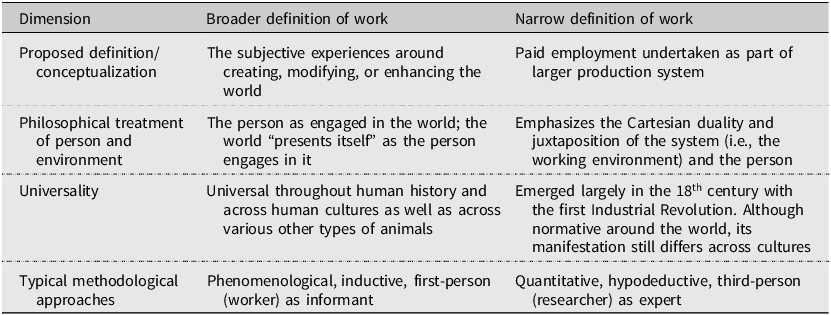

 Open access

