

Introduction
Judges in Vietnam have increasingly been called upon by state and societal actors to resolve new social and economic problems (Bui Reference Bui2019; Nicholson and Do Reference Nicholson, Do, Abel, Sommerlad, Hammerslev and Schultz2020). The expansion of judicial authority presents a problem for Vietnam’s authoritarian government, which wants courts that can resolve social problems without challenging state interests (Nicholson and Pham Lan Phuong Reference Nicholson and Phuong2018; Nguyen Reference Nguyen2019). Our study uses a novel theoretical framework based on systems theory (Luhmann Reference Luhmann2004; Nobles and Schiff Reference Nobles and Schiff2017) to explore how judges might use legal reasoning Footnote 1 to extend their authority over new social problems and overreaching officials. It draws on empirical research to understand how judges determine who is entitled to benefit from the law; which norms—legal and extralegalFootnote 2 —are appropriate to particular cases; and how such norms direct them to reach decisions. Our research suggests that Vietnamese judges are increasingly using legal reasoning to draw on extralegal norms to creatively interpret statutory law and construct new legal principles where there is no governing law. This exercise of discretionary power has the potential to expand judicial authority.
According to a scholarly consensus, judicial authority is not only conditioned by the structural interactions between courts and political/social actors (Ginsburg and Moustafa Reference Ginsburg and Moustafa2008) but also by the epistemological assumptions informing judicial decision making (Stone Sweet Reference Stone Sweet2000; Brinks and Blass Reference Brinks and Blass2017). Most analysis of judicial authority in Vietnam concentrates on structural interactions, such as communist party control over judicial appointments and political directives (Bui Reference Bui2019; Nguyen Reference Nguyen2019). These studies evaluate constraints on judicial power by exploring what the external legal and political regulatory environment expects from judges (Stone Sweet Reference Stone Sweet2000).
Our article shifts the analytical focus to a less well understood question—how do shared epistemological assumptions inform and guide judicial authority? We are influenced by socio-legal scholarship that treats judicial authority not as something that individual judges possess but, rather, as a capacity that emerges from the epistemic assumptions that shape how judges conceptualize the scope and nature of their discretionary power (Stone Sweet Reference Stone Sweet2000; Engel and McCann Reference Engel, McCann, David and McCann2009 ; Solomon Reference Solomon and James2015). More particularly, we explore whether judges have gained the discretionary capacity to use legal reasoning to reinterpret statutory law and create new legal principles where there is no governing law. The development of such a capacity, we argue, indicates discretionary power and judicial authority (Stone Sweet Reference Stone Sweet2000; Brinks and Blass Reference Brinks and Blass2017), we define judicial authority as the discretionary capacity to intervene efficiently and decisively in a broad range of politically, socially, and economically meaningful disputes.
Our study is timely because recent reforms in Vietnam have created conditions with the potential to encourage judicial authority (Bui Reference Bui2019; Nguyen Reference Nguyen2019). For example, courts are now required to publish reasons for their decisions, and, since 2017, the Supreme People’s Court has issued án lệ (case law), which is a type of precedent (Bui Reference Bui2019; Lê Văn Sua 2020). Judicial reforms have provoked an outpouring of commentaries by Vietnamese academics (Trương Thi Hòa 2019). Some commentors have focused on procedural reforms (Lê Mạnh Hùng 2017; Phạm Thị Như Quỳnh 2017), while others have examined how structural factors and resource constraints limit judicial authority (Bui Reference Bui2019; Nguyen Reference Nguyen2019). Despite their different analytical approaches, the studies agree that “[c]ourts are increasingly proactive in exercising their powers prescribed by law, especially since the 2013 Constitution took effect” (Phạm Thị Như Quỳnh 2017, 3).
By concentrating on structural factors, these commentaries miss a critical element of the reform—they overlook how shared epistemic assumptions might inform how judges conceptualize their potential sphere of action (Teubner Reference Teubner, Priban and Nelken2001; Nobles and Schiff Reference Nobles and Schiff2017). To correct this oversight, our study investigates whether Vietnamese judges have taken advantage of recent court reforms to develop a system of reasoning and epistemic knowledge that might extend their authority. We have not attempted to identify how particular judicial reforms did (or did not) advance epistemic change and legal reasoning as this inquiry is beyond the scope of this study.
Socio-legal theorists have long argued that judicial decision making is not quarantined from extralegal factors, such as customary normsFootnote 3 and political ideologies (Garth and Sterling Reference Garth and Sterling1998). Numerous studies have demonstrated that class, ethnicity, and personal backgrounds inform how judges discuss, experience, and ultimately frame legal decisions (Merry Reference Merry1990; Engel and McCann Reference Engel, McCann, David and McCann2009 ). More recently, studies have explored the expressive and performative dimension of court decisions (Savelsberg and King Reference Savelsberg and King2007; Li Reference Li2023) as well as the psychological and emotional states of mind of key courtroom actors, such as judges, juries, lawyers, and litigants (Sarat Reference Sarat2001; Maroney Reference Maroney2016).
Our study aims to take the socio-legal analysis of judicial decision making in a different direction. Rather than focusing primarily on how extralegal factors such as class, emotion, and ideology influence judicial decision making, we examine how (if at all) judges use legal reasoning to sift evidence and determine which legal (and extralegal) norms are appropriate to cases and how these norms should inform decisions. Our study does not assume that the “artificial reason” of law banishes extralegal norms from the courtroom (Garth and Sterling Reference Garth and Sterling1998). Instead, it examines how judges might use legal reasoning to mediate the interaction between legal and extralegal knowledge in the courtroom.
This article begins by making the case for using systems theory to evaluate judicial authority in Vietnam (Luhmann Reference Luhmann2004; Nobles and Schiff Reference Nobles and Schiff2017). After discussing the methodology and justifying the analytical approach, the article provides an overview of judicial reform in Vietnam from the high socialist period (1954–86) to more recent reforms beginning with the Politburo Resolution no. 08-NQ/TW on the Key Tasks of Judicial Work in the Forthcoming Period (Nicholson and Pham Lan Phuong Reference Nicholson and Phuong2018).Footnote 4 The next section first analyzes legal reasoning in 186 appellant level cases and then explores how courts might use the “artificial reason” of law to extend their authority. The analysis draws on interviews with judges to understand how (if at all) legal reasoning reinterpreted statutory law and/or interacts with extralegal knowledge in deciding cases. A key finding is that judges are increasingly using legal reasoning to address flaws in statutory rules, government policies, business practices, and moral narratives. The “artificial reason” of law is expanding judicial authority over significant social and economic fields.
This article aims to contribute new insights to debates about judicial authority in authoritarian regimes. Existing studies have examined the motivations (Kwai Hang Ng and He Xin Reference Ng and Xin2017), performative dimensions (Li Reference Li2023), and political influences (Ginsburg and Moustafa Reference Ginsburg and Moustafa2008) over judicial decisions. In this article, we explore the under-researched question of whether judges in authoritarian regimes can use legal reasoning to increase their authority over politically and economically significant disputes.
Theorizing the development of legal reasoning in an authoritarian polity
Systems theory offers a promising framework in which to analyze how judges might harness legal reasoning to expand their authority (Luhmann Reference Luhmann2004; Nobles and Schiff Reference Nobles and Schiff2017). It contributes the insight that legal reasoning can enhance judicial authority through its “conflict-alienating” effect—its capacity to reconfigure or displace extralegal thinking in the courtroom (Teubner Reference Teubner, Priban and Nelken2001). Gunther Teubner (Reference Teubner, Priban and Nelken2001, 22–23) explained this process:
The crucial transformation took place when in court litigation, legislation and contracting legal argumentation began to exclude arguments ad hoc and ad hominem and to refer to specialized legal materials (precedents, rules, principles) in a very specific way. It is the exclusion of arguments which makes it possible that the legal process begins to insulate itself (more or less successfully) against social influences, especially clientelism, kinship, social status, friendship politics.
Alec Stone Sweet (Reference Stone Sweet2000, 29–30) makes a similar point in which “legal discourse or legal consciousness has causal power: The central claim regarding legal discourse is that legal actors, judges, lawyers, and law professors think and talk differently than do actors outside of the legal world.” Within this imaginary legal space, political, social, and moral conflicts are scarcely recognizable because they have been transformed into technical legal questions framed by elaborate doctrinal rules and analytical techniques.
“Conflict alienation” occurs when legal discourse in courtrooms functions differently from extralegal discourses, such as political, moral, or economic communication (Teubner Reference Teubner, Priban and Nelken2001; Nobles and Schiff Reference Nobles and Schiff2017). For example, courts use internally generated epistemic assumptions to inform their responses toward external (to the system) norms (Luhmann Reference Luhmann and Teubner2011; King Reference King, Banakar and Travers2013). Contrary to an enduring misconception,Footnote 5 systems theorists have long recognized that concrete social organizations, such as courts, think and converse using more than one discursive system (Hiller Reference Hiller, de Graaf, von Maravić and Wagenaar2010; Nobles and Schiff Reference Nobles and Schiff2017). Although courts privilege legal discourse, this dominant mode of thought orients and reconfigures without entirely displacing extralegal norms (Nassehi Reference Nassehi2005; Nobles and Schiff Reference Nobles and Schiff2017). Courts are consequently not closed to the external world; rather, they process external knowledge through their own system of logic based primarily, although not exclusively, on legal discourse (Nassehi Reference Nassehi2005).
Systems theory explains how legal reasoning might transform extralegal norms in the courtroom (Nassehi Reference Nassehi2005; Nobles and Schiff Reference Nobles and Schiff2017). As members of a legal discursive system, judges must make decisions that are recognizable as legal decisions within their system (Teubner Reference Teubner, Priban and Nelken2001; Nobles and Schiff Reference Nobles and Schiff2017). For example, they must decide which legal norms are appropriate to particular cases and who is entitled to benefit from the law. If they want their judgments upheld on appeal, judges need to frame their decisions using the dominant epistemic assumptions that orientate communication within the court system (Nassehi Reference Nassehi2005; King Reference King, Banakar and Travers2013). They must disregard ideas that are considered irrelevant and convert others into a format that is compatible with legal processes, norms, and doctrines (Kahan et al. Reference Kahan, Hoffman, Evans, Devins, Lucci and Cheng2016; Strong Reference Strong2020).
A key question is whether judges can use legal reasoning to expand their authority over meaningful social, economic, and political arenas. Larry Alexander and Emily Sherwin (Reference Alexander and Sherwin2008, 25–26) framed this inquiry as: “[D]o courts reason deductively from rules posited by others; or posit law, relying on moral and empirical judgment, as any lawmaker must?” In addressing this question, systems theorists distinguish between deductive (syllogistic) legal reasoning, which mechanically applies law to facts and principles-based reasoning that actively engages with extralegal knowledge (Van Krieken Reference Van Krieken2006; Winczorek Reference Winczorek, Febbrajo and Harste2013). Deductive (syllogistic) legal reasoning reaches conclusions based on legal propositions that are derived from already acquired, or posited, information (Van Krieken Reference Van Krieken2006). It syllogistically applies predetermined legal rules and principles to sets of facts. Syllogistic reasoning requires little discretionary capacity because judges fit case facts into pre-existing legal frameworks and do not posit law (Alexander and Sherwin Reference Alexander and Sherwin2008). For this reason, syllogistic reasoning is unlikely to expand judicial authority (Samuel Reference Samuel2009; Strong Reference Strong2020).
Reasoning that converts extralegal knowledge into legal principles—what we term principles-based reasoning—offers more potential to expand judicial authority (Teubner Reference Teubner, Priban and Nelken2001; Nobles and Schiff Reference Nobles and Schiff2017). Judges applying principles-based reasoning are guided by an explicit or intuitive sense of extralegal norms, such as policy considerations and customary norms (Samuel Reference Samuel2009; Strong Reference Strong2020). They draw on this extralegal knowledge to hermeneutical search for the deeper normative principles that underpin and explain laws and legal principles. Judges can use principles-based reasoning to increase their authority in cases where there is guiding law and also in cases where there is no guiding law. For example, judges might employ contextual and functional analysis to creatively reinterpret existing statutory provisions to expand or contract rights and obligations (Samuel Reference Samuel2009). In other cases where there is no guiding law, judges might develop new legal principles that determine who caused social or economic harm and whether they are legally at fault (Engel and McCann Reference Engel, McCann, David and McCann2009; Samuel Reference Samuel2009). Judges may also creatively use intentionality analysis to reinterpret their statuary powers in criminal trials to determine whether defendants are psychologically, morally, and emotionally entitled to clemency (Samuel Reference Samuel2009; Strong Reference Strong2020). These examples show how principles-based reasoning might expand judicial authority over new social and economic fields (Brinks and Blass Reference Brinks and Blass2017).
Judges use principles-based legal reasoning to bring extralegal and legal knowledge into communication through a process that Niklas Luhmann (Reference Luhmann2004, 381–88) called “structural coupling.” This process allows judges to draw on external (to the legal system) policies and norms to reframe legal thinking. The interaction between legal reasoning and extralegal knowledge irritates and redirects the development of legal semantics, rules, concepts, principles, and doctrines (Winczorek Reference Winczorek, Febbrajo and Harste2013; Nobles and Schiff Reference Nobles and Schiff2017). It ensures that legal reasoning cannot always follow its own internal logic and, to some extent, is guided in directions that are compatible with extralegal systems of thought (Teubner Reference Teubner, Priban and Nelken2001). Conflict alienation occurs when judges use “structural coupling” to transform extralegal knowledge into a format that is compatible with legal norms and doctrines (Luhmann Reference Luhmann and Teubner2011; Nobles and Schiff Reference Nobles and Schiff2017).
We have drawn three core research questions from systems theory to guide our inquiry into judicial authority:
-
• Is there evidence for principles-based legal reasoning in Vietnamese judicial decision-making?
-
• Is legal reasoning hardening and/or transforming the distinctions within courts between legal and extralegal norms?
-
• Are judges using legal reasoning to extend their authority over significant political, social, and economic problems?
Methodology and data
Our study uses a mixed-methods research program to investigate legal reasoning in Vietnam (Timans, Wouters, and Heilbron Reference Timans, Wouters and Heilbron2019). Qualitative methods (that is, in-depth interviews) explore what judges think about legal reasoning, and quantitative methods analyze written judgments. A comparison of these analytical perspectives offers insights into the differences (if any) between what judges say about legal reasoning and what is officially recorded in written judgments. To examine legal reasoning in written judgments, we analyzed 186 appellant cases decided between 2018 and 2024 by city and high courts in Hà Nội and Hồ Chí Minh City. These appellate courts judge most of the controversial and difficult cases in Vietnam (Phạm Thị Như Quỳnh 2017; Trương Thi Hòa 2019). All the cases reviewed are available on the Supreme People’s Court website and were accessed in 2025.Footnote 6
We selected these cases for two main reasons. First, the Supreme People’s Court identified these cases as possible sources of case law because they provide clear examples of legal reasoning (Lê Mạnh Hùng 2017). Second, both Vietnamese (Lê Văn Sua 2020) and international scholars (Kwai Hang Ng and He Xin Reference Ng and Xin2017; Strong Reference Strong2020) argue that appellant level courts are more likely than inferior courts to use discretionary power to expand their authority. It is important to note that selection bias in Vietnam excludes from publication approximately 12 percent of sensitive criminal cases that concern state secrets and/or high-profile dissidents (Nguyen Reference Nguyen2019). We analyzed the judgments by searching for decisions that used syllogistic reasoning and principles-based reasoning (that is, causal, contextual, functional, and intentionality reasoning). Although often descriptive and formulaic, each judgment provided valuable information about whether judges mechanically applied law to facts and/or exercised discretionary power by transforming extralegal norms into new legal principles (Winczorek Reference Winczorek, Febbrajo and Harste2013; Nobles and Schiff Reference Nobles and Schiff2017). We focused primarily on legal reasoning concerning questions of law as this is where the literature suggests judges are most likely to exercise discretionary power and expand their authority (Solomon Reference Solomon and James2015; Brinks and Blass Reference Brinks and Blass2017). Although the courts deciding these cases were comprised of three judges, our interviews suggest that judgments are usually formulated and written by the presiding judge (Interviews J13, J16, and J17).
The qualitative research comprises five group interviews and twenty-eight in-depth interviews with twenty-nine judges (see the Appendix for details). The judges were identified using a combination of purposive, niche, and snowball sampling methods (Atkinson and Flint Reference Atkinson and Flint2001). They were selected to represent the judicial approaches across different jurisdictional levels (district and appellant courts), geographical areas (northern and southern cities as well as industrial and rural provinces), and genders (59 percent male and 41 percent female). To preserve the anonymity of the interviewees, we have not disclosed the precise location of the district-level courts.
The judges were encouraged to conceptually evaluate the objectives, reasoning processes, and epistemic assumptions informing their legal reasoning. They were invited to reflect on how they applied different modes of reasoning to achieve desired results (Edelman, Erlanger, and Lande Reference Edelman, Erlanger and Lande1993). The judges were also asked open-ended questions, such as “what are the main sources of authority used to decide particular cases,” “how are cases decided if there is no guiding law,” and “what techniques and processes guide decision making”? Narratives—the stories that judges told about court cases—were analyzed to identify how judges used syllogistic and principles-based reasoning to decide cases (Polkinghorne Reference Polkinghorne2005; Engel and McCann Reference Engel, McCann, David and McCann2009).
We next used three criteria to determine whether judges are expanding their authority over significant political, social, and economic cases (Solomon Reference Solomon and James2015; Brinks and Blass Reference Brinks and Blass2017). First, did judges use legal reasoning to displace and/or transform extralegal norms? Second, did new legal principles appear untroubled by contradictions and inconsistencies with external (to the legal system) patterns of behavior and moral norms? Third, did judges use legal reasoning to reach decisions in socially and politically “hard” cases? For example, we looked for evidence that judges are prepared to extend legal protection into new social and economic areas and/or to use legal reasoning to rule against state authorities in administrative and criminal law cases.
However, before turning to the qualitative and quantitative data, it is instructive to understand the institutional structure in which Vietnamese judges operate.
Đổi Mới reforms and the creation of a law-based state (1986–2016)
During the high socialist period (1954–86), Vietnamese courts were unpromising sites for legal reasoning (Nicholson Reference Nicholson2007; Pham Duy Nghia and Do Hai Ha Reference Pham Duy and Ha2018). In the 1960s, the Democratic Republic of Vietnam established a Soviet-influenced legal system that rejected the separation-of-power doctrines and placed the judiciary under the Communist party (Đinh Gia Trinh 1961). According to the doctrine of pháp chế xã hội chủ nghĩa (socialist legality), law functioned as a political instrument to promote party policies. It did not matter whether the party line was formally legislated or not because officials and the public were expected to follow party invocations as if they were law (Đinh Gia Trinh 1961; Phạm Điềm Reference Phạm2013).
Differing from the Soviet model, the Vietnamese legal system during this period emphasized leadership through đạo đức cách mạng (revolutionary morality) (Phạm Điềm Reference Phạm2013). President Hồ Chí Minh argued that law and morality were intertwined and revived the precolonial maxim that judicial decisions should be hợp tình hợp lý (“sentimentally appropriate and reasonably sound”) (Letsoni Reference Letsoni1963). Senior judges encouraged junior judges to move beyond legal texts and use revolutionary morality to craft socially appropriate outcomes (Nicholson Reference Nicholson2007; Phạm Điềm Reference Phạm2013). Judges were discouraged from developing legal reasoning that might interpret, and, by implication, question, party directives (Thành Duy 1995; Nicholson and Pham Lan Phuong Reference Nicholson and Phuong2018). In this decision-making environment, judges practised political prudence rather than jurisprudence.
Đổi Mới (renewal) reforms formalized in 1986 transformed the centrally planned economy and opened the country to global influences (Lê Mạnh Hùng 2017; Bui Reference Bui2019). Capturing the spirit of reform, the “socialist rule of the law state” doctrine retained the leadership of the Communist party, while placing more emphasis on governance through law and legal institutions, especially the courts (Phạm Thị Như Quỳnh 2017). Although legislation incrementally expanded to protect private economic and civil relationships, the party insisted on retaining tight control over the judiciary through the appointment and promotion of judges (Thành Duy 1995; Nicholson and Pham Lan Phuong Reference Nicholson and Phuong2018).
During the initial post-Đổi Mới period (1986–2016), courts were expected to passively and mechanically apply the law to resolve cases (Phạm Điềm Reference Phạm2013; Nicholson and Pham Lan Phuong Reference Nicholson and Phuong2018). The law was supposed to have already judged cases, and courts used deductive (syllogistic) reasoning to make the facts correspond to the law (Đinh Thế Hưng 2009; Lê Mạnh Hùng 2017). Judges were not permitted to review the constitutionality of legislation and were expected to reflexively apply top-down instructions. To promote uniformity in judicial decisions, higher courts sent chỉ đạo chuyên môn (professional guidance) to lower courts (Bùi Ngọc Sơn 2003; Tưởng Duy Lượng 2007). Top-down controls discouraged courts from developing an autonomous system of legal reasoning. Courts during this period consequently lacked a hermeneutic tradition capable of transposing political, moral, and economic precepts into judicable questions (Phạm Điềm Reference Phạm2013; Nicholson and Pham Lan Phuong Reference Nicholson and Phuong2018).
Three empirical studies from this period found little evidence that judges exercised discretionary power through legal reasoning. After reviewing 178 Supreme People’s Court cassation judgments issued between 2002 and 2006 and interviewing judges, Yuka Kaneko (Reference Kaneko2009–10, 340) concluded that “[t]hey [judges] usually articulate a lengthy reference to raw facts, without streamlining legal factors according to statutory provisions, before abruptly providing a conclusion without mention to the detailed reasoning of fact-finding and legal application. … Ultimately, these judgments amount to compromises that seek an emotional balance between the parties rather than implementing the law.” Kaneko described a paternalistic culture of dispute resolution in which judges preferred informal conciliation over decision making based upon legal reasoning and substantive law.
In another study from this period, John Gillespie (Reference Gillespie2011) reviewed forty-one provincial and Supreme People’s Court judgments and interviewed fifty judges and twenty-four lawyers involved in land disputes. He found that “[t]he Supreme Court confines itself to narrow procedural issues and avoids making doctrinal rulings on the substantive meanings of land laws” (Gillespie Reference Gillespie2011, 272). To overcome gaps, conflicts, and ambiguities in the statutory law, judges used syncretic reasoning to ground their decisions on extralegal notions of công bằng (fairness) and hợp lý (reasonableness). Adding to the literature, Bui Bich Lien (2016) reviewed 120 court cases concerning inheritance deputes and interviewed seventeen judges and twenty-three lawyers. She concluded that “legal education does not teach legal reasoning. Without this essential skill, judges were unable to construct and understand customary information in law’s own terms” (Bui Bich Lien 2016, 257–58).
A common theme in these studies is that judges during the initial post-Đổi Mới period did not use principles-based legal reasoning to creatively interpret law. Instead, judges deployed syllogistic reasoning to mechanically apply legal provisions to case facts. In the rare cases where judges exercised discretionary power, they used syncretic reasoning to select legal and extralegal norms according to the context of each case (Kaneko Reference Kaneko2009–10; Gillespie Reference Gillespie2011; Bui Bich Lien 2016). The studies show that judges rarely (if ever) used principles-based legal reasoning to alienate conflicts from external (to the courtroom) norms and precepts (Teubner Reference Teubner, Priban and Nelken2001; Nobles and Schiff Reference Nobles and Schiff2017). Judges during this period lacked a usable legal history, such as legal doctrines and reported cases, that might have informed the development of legal reasoning (Bùi Ngọc Sơn 2003; Lê Văn Sua 2020). This raises the question whether recent reforms have established conditions that might encourage judges to move beyond legal formalism and creatively use principles-based legal reasoning to extend their authority?
Judicial reforms and the emergence of legal reasoning
Political leaders in authoritarian regimes face a dilemma in reforming courts. The state wants to extract the benefit of a judiciary that can resolve social problems, while minimizing the risks, especially legal challenges to state interests (Ginsburg and Moustafa Reference Ginsburg and Moustafa2008; Kwai Hang Ng and He Xin Reference Ng and Xin2017). The difficulty for political leaders is that effective and legitimate courts require the appearance of judicial authority where judges have the discretionary power to treat disputants impartially according to legal norms (Ginsburg and Moustafa Reference Ginsburg and Moustafa2008).
The Vietnamese Politburo aimed to resolve this dilemma by introducing far-reaching reforms that promoted a competent and responsive judiciary, while retaining party control over the courts (Phạm Thị Như Quỳnh 2017; Hoàng Thi Bích Ngọc 2019). In 2005, the party issued Resolution no. 49 NQ/TW on the Strategy for Judicial Reform to 2020, which proposed adversarial court processes, the publication of court decisions, and the development of án lệ (case law) (Hoàng Thi Bích Ngọc 2019; Lê Văn Sua 2020).Footnote 7 After a slow start, reforms gained momentum following constitutional amendments in 2013 that recognized a quyền tư pháp (judicial right) to protect “justice, human rights and citizen rights” (Phạm Thị Như Quỳnh 2017; Hoàng Thi Bích Ngọc 2019).
In 2014, Law no. 62/2014/QH13 on the Organization of People’s Courts sought to professionalize the judiciary by securing tenure for judges and reducing the influence of local government officials.Footnote 8 It also limited the grounds for refusing cases—a reform designed to prevent judges from referring difficult cases to local government officials (Phạm Thị Như Quỳnh 2017; Lê Văn Sua 2020). In addition, the law established a mechanism for developing case law. Currently, the Supreme People’s Court has issued seventy-two case laws that cover a wide range of areas, especially in civil, commercial, and criminal jurisdictions (Nguyễn Anh Tuấn 2023). Deepening these reforms, most court decisions since 2017 have been published on the Supreme People’s Court website. In preparation for this reform, judges have been trained since 2012 to write judgments that explain the reasoning processes used to decide cases (Phạm Thị Như Quỳnh 2017; Lê Văn Sua 2020). In addition, starting in 2015, major law schools have incorporated legal reasoning into their general legal education—initially, as an elective and, later, as a compulsory subject (Interview J10; see also Nicholson and Do Reference Nicholson, Do, Abel, Sommerlad, Hammerslev and Schultz2020).
For the purposes of analysis, we have designated the initial post-Đổi Mới period from 1954 to 1986 as the pre-judicial reform period and the period from 2017 onward as the post-judicial reform period. To understand whether legal reasoning has changed from the pre-judicial reform period, we reviewed 186 cases decided by the high and city courts in Hà Nội and Hồ Chí Minh City between 2017 and 2024.
Analyzing legal reasoning in case decisions
Empirical studies from the pre-judicial reform period show that judges rarely (if ever) used principles-based legal reasoning to decide cases (Kaneko Reference Kaneko2009–10; Gillespie Reference Gillespie2011; Bui Bich Lien 2016). This suggests that a finding that judges during the post-judicial reform period routinely used principles-based legal reasoning indicates a significant change in judicial decision making. We analyzed 186 cases decided during the post-judicial reform period to determine how judges used legal reasoning to reach decisions (see Table 1). Table 1 differentiates syllogistic reasoning and principles-based reasoning, such as causal, contextual, functional, and intentionality reasoning. It also shows the different types of legal reasoning used in different jurisdictional areas.
Legal reasoning in appellant-level courts (2017–24)
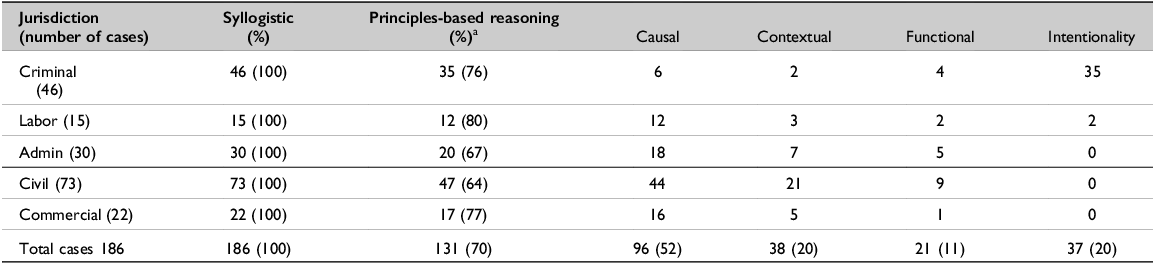
Table 1 Long description
The table presents data on legal reasoning types used in various jurisdictions during the post-judicial reform period. It includes columns for syllogistic reasoning, principles-based reasoning, causal, contextual, functional, and intentionality reasoning. The table has six rows representing different jurisdictions: Criminal, Labor, Admin, Civil, Commercial, and Total cases. Each row lists the number of cases and the percentage of each reasoning type used. For example, in the Criminal jurisdiction with 46 cases, 100 percentage used syllogistic reasoning, 76 percentage used principles-based reasoning, and specific counts for causal, contextual, functional, and intentionality reasoning are provided. The table highlights the prevalence of syllogistic reasoning across all jurisdictions and the varying use of principles-based reasoning.
Note: aSyllogistic and principles-based reasoning are the two key types of legal reasoning, whereas causal, contextual, functional, and intentionality are categories of principles-based reasoning.
Syllogistic reasoning
The appellate cases show that judges have continued to use syllogistic reasoning to frame their decisions (see Table 1), much as they did during the pre-judicial reform period. All the judgements reviewed in Table 1 began by outlining the facts before discussing the relevant laws. Implicit in this structure was the notion that judicial reasoning can be reduced to a syllogism. The relevant legal rules and doctrines furnished the major premise, the facts of the case constituted the minor premise, and the decisions flowed logically from the application of the law to the facts. Judges used legal frameworks, such as quan hệ pháp luật (legal relationships), cấu thành tội phạm (elements of a crime), and tình tiết tăng nặng (aggravating factors) to identify, classify, and analyze case facts (Interviews J7 and J8).
In a clear break from the pre-judicial reform period, 70 percent of the cases reviewed in Table 1 used principles-based legal reasoning. Rather than using legal reasoning to expand judicial authority, most cases treated law as essentially complete and gapless and, thus, capable of producing unequivocable and correct answers. However, judges deciding “hard” cases, which comprised approximately 15 percent of the judgments reviewed, used principles-based legal reasoning to expand their authority over novel social and economic problems (Interviews J8, J10, and J17). For example, judges used principles-based legal reasoning when they encountered difficult questions such as should liability for some kinds of harmful actions be extended into new fields; should institutions promoting the public good be held liable for personal injury; and what is the public interest in eminent domain cases? In contrast, judges during the pre-judicial reform period would have either pushed these hard cases back to state authorities or used syncretic reasoning to selectively draw from legal and extralegal norms (Kaneko Reference Kaneko2009–10; Gillespie Reference Gillespie2011; Bui Bich Lien 2016).
Civil law cases
Judges in hard civil law cases used principles-based reasoning to create legal principles to reinterpret statutory provisions or develop new doctrines where there was no governing law. For example, in cases involving claims for personal injury, judges examined the causal link between conduct and injury to establish how they wanted blame attributed. For example, in Judgment no. 432/2021/DS-PT on May 4, 2021, the Hồ Chí Minh City People’s Court determined whether a large public hospital had misdiagnosed a medical condition that had resulted in an emergency hysterectomy.Footnote 9 The court accepted the hospital’s argument that the plaintiff had partially contributed to her condition by taking an oral contraceptive. Rather than finding the hospital partially liable for the personal injury, in accordance with provisions in the 2015 Civil Code that govern contributory negligence, the court dismissed the plaintiff’s claim.Footnote 10 Throughout the judgment, the court emphasized that hospitals need protection from litigation because they contribute to the public good. The judgment transformed this public policy norm into a legal principle that limited civil liability for hospitals where claimants had contributed to their injuries.
In another “hard” civil law case, the Supreme People’s Court in Judgment no. 01/2021/HNGĐ-GDT decided a complex matrimonial property settlement on March 11, 2021.Footnote 11 The husband and wife in this case jointly developed Trung Nguyen Coffee, Vietnam’s largest coffee company. In 2015, they filed for divorce and disputed the distribution of matrimonial property. The court refused to follow Article 59 of Law no. 52/2014/QH13 on Marriage and Family in dividing the matrimonial property equally among husband and wife.Footnote 12 Instead, it decided that, “If Ms. Th [wife] continues as a shareholder and jointly manages and operates the TN Group companies, the Group will experience difficulties that will threaten its existence, stability and development. This will greatly affect the stability and employment for thousands of workers engaged in production in the TN Group.” The court concluded that “it is in the public interest to protect the national brand of TN coffee and to ensure the TN Group companies remain stable and continue to support the economy.”Footnote 13 No evidence was submitted suggesting that the wife would destabilize the Trung Nguyen Group or that a destabilized company would substantially disrupt the local economy.
The court argued that, although the Law on Marriage and Family aims to equitably distribute marital property, state policies promoting economic development should prevail over this statutory principle. They used contextual reasoning to transform an economic development policy into a legal principle that expanded the range of stakeholders with interests in matrimonial property beyond the family members contemplated by the law. These cases show how courts use principles-based legal reasoning to draw on extralegal norms to radically reinterpret statutory rules. This reasoning process extended the courts authority over personal injury claims and the distribution of matrimonial property.
Commercial law cases
Judges also used principles-based reasoning to resolve hard commercial law cases. For example, on March 24, 2020, the Hồ Chí Minh City People’s Court in Judgment no. 194/2020/DS-PT used functional analysis (what is the underling purpose of legislation) to establish whether the concept of bona fide purchasers defined in Article 147 of the 1995 Civil Code should extend to banks.Footnote 14 It decided that “[t]his regulation is intended to ensure fairness and reasonableness for people of goodwill and sincerity and to ensure stability in civil relations. Therefore, the phrase “transfer by another civil transaction” must be applied in a broad sense… to cover transactions aimed at transferring ownership rights to assets or rights to use land plots.”Footnote 15 The court first determined the underlying policy objective of statutory protection for bona fide purchasers and then considered whether this protection should extend to banks enforcing mortgages. It concluded that, since the objective of Article 147 was to “ensure fairness and reasonableness” and to stabilize commercial transactions, banks should enjoy statutory protection.
Having used legal reasoning to extend protection developed for private consumers to sophisticated financial enterprises, the court then decided whether the bank in this case was entitled to legal protection. It found that “[t]he bank had no basis of knowing that its transaction was with a person who did not have the right to dispose of the assets or that the assets had been invalidated. … Therefore, the bank acted with righteousness [ngay thẳng] and ‘good faith’ [thiện chí].”Footnote 16 The Court used principles-based reasoning to draw on community norms of righteousness and good faith to develop a test for bona fide purchasers. These norms reflect what the court thought a “reasonable” person should do in the circumstances. This new legal doctrine extended the meaning of bona fide purchasers found in the Civil Code because it expected a “reasonable” bank to make proper inquiries to detect fraud. This doctrine creatively reinterpreted the meaning of “good faith” in the 1995 Civil Code, which lacked a positive duty for bona fide purchasers to verify title.
In another commercial case decided on September 6, 2017, the Hồ Chí Minh City People’s Court in Judgment no. 1158/2017/DS-ST expanded copyright protection under Law no. 50/2005/QH11 on Intellectual Property.Footnote 17 A poet claimed that a publisher had infringed copyright that protected his epic poem that retold well-known Vietnamese folktales. The publisher argued that authors cannot claim protection for works based on existing storylines. Using functional analysis, the court determined that the underlying purpose of copyright protection was to foster creative artists and Vietnamese literature. With this public policy objective in mind, the court reinterpreted the Law on Intellectual Property to extend copyright protection to literary works that creatively reimagine existing literary works, such as folktales. The court was influenced by the neoliberal concept that individual creativity deserves the reward of exclusive property rights and rejected the publisher’s argument that copyright in folktales is collectively owned by the public.
In Judgment no. 142 /2019/DS-PT on June 7, 2019, the Hà Nội People’s Court used principles-based reasoning to create a new legal doctrine to fill a gap in the law.Footnote 18 The purchasers (plaintiffs) in a contractual dispute over an “off-the-plan” apartment wanted the seller (defendants) to transfer title. The seller argued that the purchasers were late in paying an installment, which justified postponing title transfer. The court used principles-based reasoning to balance these competing contractual interpretations. It argued that if the seller does not handover the apartment on schedule, the seller will be fined. Therefore, if the seller violates their obligation, they cannot claim a penalty from the purchaser for not satisfying the payment condition. If, on the other hand, the purchaser has not paid the purchase price for the apartment according to the agreed schedule, then the seller has a right to damages and is not obligated to complete the transfer. Faced with litigants who each had breached their contractual obligations, the court decided that it was inequitable for either party to enforce the contract. The court drew on extralegal notions of righteousness and good faith to develop a new legal principle—if both parties are in contractual default, neither should enlist the law to enforce their claim. This principle relates to community notions that commerce is based on reciprocity and that the transacting parties should not inflexibly insist on enforcing their contractual rights.Footnote 19
Labor law cases
Courts in the three hard labor cases reviewed in Table 1 used contextual and functional reasoning to transform extralegal norms into new legal principles. For example, the Hồ Chí Minh City Court, in Judgment 239/2019/LD-PT on March 29, 2019, applied contextual reasoning to determine the legality of conditions that limited access to performance-based pay.Footnote 20 The court first decided that the employer acted unreasonably in limiting access to the performance-based pay and then developed a legal principle to support this conclusion. To overcome the failure of Labor Code no. 10/2012/QH13 to regulate performance-based pay, the court repurposed a general principle from Article 284(1) of the 2015 Civil Code that governs the performance of contractual obligations into a new legal principle that prevents employers from limiting access to performance-based pay conditions.Footnote 21 The court transformed the extralegal norm that employers were unreasonable in not paying their employees into a binding legal principle. It used principles-based legal reasoning to fill a gap in the statutory law.
In the civil, commercial, and labor cases reviewed, judges routinely drew on extralegal policies and social norms to develop new principles. They used principles-based legal reasoning to either reinterpret and expand existing statutory provisions or create new doctrines where there was no governing law. In a sign of growing judicial authority, the new legal principles remained in place untroubled by contradictions and inconsistencies with external (to the judicial system) patterns of behavior and moral norms. Law in the courtroom was able to create its own boundaries under pressure from the social environment.
Administrative law cases
A core question in authoritarian polities, such as Vietnam, is whether judges can extend their authority over state agencies (Ginsburg and Moustafa Reference Ginsburg and Moustafa2008; Kwai Hang Ng and He Xin Reference Ng and Xin2017). Vietnamese judges readily acknowledged party leadership over the court system (Interviews J3, J6, J10, and J21). In an illustrative statement, a Hà Nội High Court judge observed that “[j]ustice under the law is equated to protecting the ruling class. In theory, judges are independent, but in practice they must follow the principle of party leadership” (Interviews J15). Although this general organizational principle is uncontested, what is changing is how in practice the party-state influences judicial authority. As a District Court judge explained, “[w]e still report to the Party Committee. But that does not mean that judges always have to report and ask for opinions. We only report cases that are politically sensitive” (Interview J10).
A consensus emerged during our interviews that party policies and directives were less relevant to civil, commercial, and labor cases than to administrative and, especially, criminal cases. When asked whether judges in civil, commercial, and labor cases subordinated private interests to state interests, a District Court judge replied: “I rarely have to do that. There are dozens of cases that clearly affect state interests, but if I feel they [state interests] are not as substantial as the private interests, then I put state interests in a secondary position to protect the interests of the litigants” (Interview J19). Although judges are sensitive to state interests in administrative law cases, our analysis shows that litigants were nevertheless successful in 25 percent of the administrative law cases reviewed in Table 1. This finding reveals a change from the pre-judicial reform period when administrative law actions were rarely successful (Lê Thị Hoàng Thành 2006; Kaneko Reference Kaneko2009–10).
Judges used principles-based reasoning to interpret administrative powers in 67 percent of the administrative law cases analyzed in Table 1. For instance, the Hồ Chí Minh City High Court in Judgment no. 427/2019/HC-PT, decided on July 9, 2019, transformed customary land rights into a legal principle that prevented a local government authority from enforcing eminent domain powers.Footnote 22 The plaintiff claimed that the local government should recognize possessory rights to land when paying compensation for land clearance. The court concluded that the authority “resolved the complaint about land clearance and compensation for Mr. T [plaintiff] in a way that avoided responsibility, caused irritation, and decreased the people’s trust in the local authorities, which led to lengthy complaints.”Footnote 23 In another eminent domain case decided on July 25, 2024, the Hồ Chí Minh City Court in Judgment no. 785/2024/HC-PT used contextual legal reasoning to direct a local government agency to compensate dispossessed landowners for the market value of their land.Footnote 24 This is an important decision that settled a public policy debate concerning just compensation for compulsorily land acquisition. Drawing on commercial real estate practices, the court concluded that just compensation should correspond to the market value of land.
Courts have also used principles-based reasoning to limit the reach of government taxation policy. For example, the Hồ Chí Minh City Court in Judgment no. 382/2019/HC-PT used contextual reasoning to expand the meaning of investment activities under Law no. 14-2008-QH12 on Corporate Incomes Tax.Footnote 25 Following government policies that encourage commercial investment, the court searched for ways to exempt the investment company from income tax. It borrowed a broad definition of investment activities from Law no. 68/2014/QH13 on Enterprises to expand the exemption given to investment companies under the 2008 Law no. 14/2008/QH12 on Corporate Income Tax.Footnote 26 This is an authoritative ruling because the court used principles-based reasoning to reinterpret government tax policy in favor of a private enterprise.
Courts in some administrative law cases used legal reasoning to extend state powers. For example, on September 23, 2019, land users in Judgment no. 246/2019/HC-PT challenged the powers of the Hải Phòng People’s Committee to compulsorily acquire land to construct a luxury hotel.Footnote 27 A high school for gifted students had used the land since 1954. The plaintiffs argued the state lacked “public purpose” powers under Article 62 of Law no. 45/2013/QH13 on Land to take land for a private hotel.Footnote 28 Their claim drew on government land policy that limited eminent domain powers for private developments (Gillespie Reference Gillespie2011; Pham Duy Nghia and Do Hai Ha 2018). Using contextual analysis, the Hà Nội High Court expanded the definition of the public purpose. It reasoned that “the project to build a 5-star hotel is an urban beautification development that will benefit the public.” It then went on to argue that, although private business entities controlled the hotel development, the “construction of a 5-star hotel is a project that will enhance the overall socio-economic development of Hai Phong City.” The court concluded that the public benefit derived from urban beautification and economic development outweighed the private rights of the landholders.Footnote 29 The factual scenario described in this judgment was an empirical fiction because the court did not employ social science research to determine what, in practice, transpired between the disputants. Instead, the court used a falsified factual scenario to recast a claim for land use rights into an administrative law dispute about the public purpose powers in eminent domain law. Judges then drew on government policies that encouraged economic and urban development to craft a new legal principle that extended statutory powers to compulsorily acquire land for private developments.
Interviews with judges revealed nascent judicial resistance to top-down political directives in administrative law cases. For example, a Hà Nội High Court judge discussed a politically sensitive eminent domain case:
There are many administrative cases that I handle that make me feel uncomfortable, because superiors give directives to stabilize the political system. … For example, there are cases where land has been allocated to people since the 1990s, and all of it was recovered without giving compensation to the people. But I had to “grit my teeth” to reject the people’s petition, because otherwise it would cause instability that spread bad elements [các yếu tố xấu]. So, I had to accept direction. (Interview J15)
Judges in another high-profile land-taking case were prepared to resist political pressure. A District Court judge discussed a legal challenge by landholders against a large-scale urban renewal project in Hồ Chí Minh City:
The local Party Committee has closely monitored and directed this [land-taking] case. But they are very smart, they only give verbal instructions. If judges follow instructions and lose the case, then there is a risk that they are not acting in accordance with the law. But if the people win, it is contrary to the direction of the Party Committee. So, we have to find reasons to delay the case. (Interview J21)
This outcome suggests the transitional nature of judicial authority. While judges in sensitive administrative cases lack the authority to overrule party officials, they are also reluctant to extinguish the legal rights of citizens.
Criminal law cases
Contrasting with the willingness of some judges to check overreaching beauracrats, judges in criminal cases rely on police prosecutors to determine liability, much as they did during the pre-judicial reform period (Interviews J4, J6, J11, J12, and J18). “Interagency coordination” (cơ chế phối hợp liên ngành) between the judiciary, police, and procuracy routinely predetermines liability in criminal cases before trials commence (Nicholson and Pham Lan Phuong Reference Nicholson and Phuong2018; Nguyen Reference Nguyen2019). Although most judges interviewed disliked this practice, they felt powerless to prevent the police from taking the leading role in criminal prosecutions. As a Hà Nội People’s Court judge explained, “[t]o put it bluntly, the court wants independence from administrative agencies. … However, the police and prosecutors vigorously oppose this reform. The old thinking is still very strong” (Interview J4). The “old thinking” refers to the enduring Soviet-influenced criminal justice system, in which courts were expected to cooperate with the police and procuracy to determine criminal liability (Nicholson and Pham Lan Phuong Reference Nicholson and Phuong2018).
Quantitative data confirms that judges rarely challenge police prosecutions. For example, the Judicial Council of the Supreme People’s Court returned a non-guilty verdict in only two of over two hundred appeals heard between 2012 and 2016 (Nguyen Reference Nguyen2019). In the forty-six criminal cases reviewed in Table 1, judges reversed the guilty verdict in only three instances. Our findings also reveal the influence of “interagency coordination” on legal reasoning in the courtroom. Judges only used principles-based legal reasoning, such as causal, contextual, and functional analysis, to assess guilt in 6 percent of the criminal cases reviewed. It is unlikely that the selection bias for cases discussed in the “Methods and data” section would significantly change these findings (Nguyen Reference Nguyen2019). The cases most likely to have been excluded from the published sample are politically sensitive in nature—the types of cases where judges are most likely to follow top-down instructions (Nicholson and Pham Lan Phuong Reference Nicholson and Phuong2018; Nguyen Reference Nguyen2019).
Some judges were willing to contest police evidence. For example, a District Court judge recalled that, “[i]n cases where defendants retract their confessions, saying they were forced to confess, and where investigation agencies did not do a strict job, the court will challenge the confession” (Interview J19). More typically, judges overlooked procedural violations. Take, for example, Supreme Court Judgment no. 05/2020/HS-GĐT 2020, wherein “[t]he Investigating authority made numerous procedural violations and omissions in examining the murder scene, seizing exhibits, forensic examination of blood patterns and stab wounds, and witness identification and statements.”Footnote 30 Despite these shortcomings, the court concluded that “the violations and omissions do not affect the determination of guilt, neither do they require reexamination.” A District Court judge encapsulated this thinking about criminal liability: “There are people who clearly commit crimes but still escape punishment. But in Vietnam, there is no such story. In Vietnam, there is only the story of innocent people being wronged. Why? Because there is an assumption that if you have been prosecuted, of course you must be guilty and people in the court system must find you guilty” (Interview J6).
In politically sensitive criminal trials involving corruption and sedition, higher-party authorities predetermine judicial outcomes (Nicholson and Pham Lan Phuong Reference Nicholson and Phuong2018). Although judges were unwilling to discuss the operational mechanics of such cases, they confirmed that party authorities sent detailed instructions to courts (Interviews J10 and J13). For example, in discussing criminal prosecutions against protesters who attacked Taiwanese and Chinese factories in Bình Dương Province, a District Court judge said: “In these cases, the courts conducted the trials strictly in accordance with political and social directives” (Interview J10). Courts use legal reasoning in sensitive cases to legitimize political directives with a veneer of legality. As another District Court judge observed, “[w]hen serving the political tasks of the local authorities [party-state], judges must in the first place ensure that written judgments conform to and reflect legal provisions” (Interview J6).
Contrasting with their passive role in determining guilt, judges during sentencing actively employ their discretionary powers under Criminal Code no. 100/2015/QH13 (Nguyen Reference Nguyen2019).Footnote 31 For example, courts used intentionality reasoning to identify tình tiết giảm nhẹ (mitigating factors) during sentencing in 81 percent of criminal cases in Table 1. As one District Court judge explained, “[w]hy is the defendant entitled to that [leniency]? Because his family has contributed to the revolution. Because he has received a medal, and because he has remedied the harm” (Interview J7). Judges drew on extralegal norms—frequently labeled tính nhân đạo xã hộichủ nghĩa (socialist humanism) to establish grounds for mitigation (Interview J6). What this suggests is that, although courts are prepared to use legal reasoning to determine sentences, they feel constrained in using the law to challenge police prosecutions.
In summary, the findings show that courts during the post-judicial reform period used principles-based reasoning significantly more than pre-reform courts. Courts in 70 percent of the cases reviewed in Table 1 used some form of principles-based reasoning to repurpose extralegal knowledge. For example, they drew on a wide range of social norms, such as compensation based on market valuations as well as standards that reflected “reasonable” people and social needs. In addition, they crafted new legal principles from notions of the public good derived from health services, employment, economic investment, and urban beautification. These findings contrast with the pre-reform courts that rarely (if ever) based decisions on principles-based reasoning (Kaneko Reference Kaneko2009–10; Gillespie Reference Gillespie2011; Bui Bich Lien 2016).
A closer inspection reveals that some types of principles-based reasoning were used more frequently than others to advance judicial authority. For example, judges in criminal cases applied intentionality to mitigate sentences but were reluctant to use causal and intentionality reasoning to check police powers. In contrast, judges in hard civil, commercial, labor, and administrative law cases (approximately 15 percent of the cases in Table 1) used causal, but, more importantly, functional and contextual analysis, to transform extralegal norms into legal principles. Courts in some cases used principles-based reasoning to reinterpret statutory provisions, while in cases where there was no governing law, they used legal reasoning to create new legal principles. Either way, judges used reasoning to expand the reach of the court into new economic and social fields. What this suggests is that judges have developed a common epistemic logic that uses legal reasoning to transform extralegal norms into legal principles. Although our case analysis suggests the triumph of the “artificial reason” of law over extralegal knowledge, judges during interviews described a more complex reform story.
Reconciling reason and sentiment in judicial decision making
Vietnamese judges were historically encouraged to avoid excessive legality and craft decisions that were hợp tình hợp lý (sentimentally appropriate and reasonably sound) (Nicholson Reference Nicholson2007; Gillespie Reference Gillespie2011). This syncretic approach to decision making enabled judges to select legal and extralegal norms that reflected the context of each dispute. Studies during the pre-judicial reform period found that judges routinely used syncretic decision making (Kaneko Reference Kaneko2009–10; Gillespie Reference Gillespie2011; Bui Bich Lien 2016). Although official pronouncements during the post-judicial reform period insist that courts have replaced extralegal norms with legal formalism (Phạm Thị Như Quỳnh 2017; Hoàng Thi Bích Ngọc 2019), judges insisted that courts continue to rely on reason and sentiment in deciding cases. Judges equated hợp lý (reason) to legal rules and hợp tình (sentiment) to social morality (đạo đức xã hội) (Interviews J1, J3, and J10). While hợp lý requires adherence to legal principles, hợp tình encourages a focus on situational factors such as personal backgrounds, motivations, and attitudes as well as social factors such as personal relationships and dư luận (public opinion).
Judges believe that hợp tình is necessary to remedy inflexible laws and to harmonize law with social morality (Interviews J4, J10, and J12). As a Hồ Chí Minh City High Court judge observed, “[r]eferring to hợp tình in decisions helps overcome the rigidity of the law and thus secures a more satisfactory outcome” (Interview J13). A District Court judge went on to explain that, in contrast to hợp lý, hợp tình is “flexible [mềm], uncertain [mơ hồ], and depends on the judge’s perception and ‘internal beliefs’ [niềm tin nội tâm]” (Interview J4). Illustrating this point, another District Court judge (Interview J12) discussed the social problems created by strictly applying land-zoning regulations: “If these regulations are applied, there will be many cases where land titles cannot be recognized and many people will have nowhere to live. … In short, the regulations provide clear outcomes, but we must resolve cases according to socially appropriate outcomes and not unbendingly apply the law.” Other judges emphasized the role hợp tình plays in fashioning socially acceptable decisions. For instance, a judge from the Đồng Nai Provincial Court said: “We all need to decide cases in a manner that combines both hợp tình and hợp lý. What this means is that we decide cases in ways that are persuasive and earn people’s respect” (Interview J17).
If law alone does not guide decision making, as our interviews suggest, then it is instructive to understand how judges select and construe extralegal norms. Judges said they used niềm tin nội tâm (inner beliefs) to construct socially appropriate outcomes. This all-encompassing notion was understood as an internalized moral framework that enabled judges to harmonize and balance conflicting interests. A Hà Nội High Court judge described the application of inner beliefs during an inheritance case (Interview J15). A dispute arose over an intestacy between two surviving daughters. The older daughter was married and financially secure, while the younger daughter lived with her parents until they passed away. Oral evidence stated that the parents intended for the younger daughter to inherit the entire estate. According to Article 651 of Civil Code no. 91/2015/QH13, the court was expected to ignore oral testamentary intentions and divide the estate equally among the surviving children.Footnote 32 The judge turned to inner beliefs for guidance in resolving the case:
I relied on fairness and inner beliefs [niềm tin nội tâm] to resolve the dispute. Since the older sister did not reside on the premises and the younger daughter built a house on the land and still worshiped at her parents’ altar, if the property was divided, it would cause chaos. … Although finding for the younger daughter is not in accordance with the “hierarchy of heirs” [hàng thừa kế] in the law, I find it perfectly acceptable and supported by the Judicial Council. When the judgment was issued, the husband [of the oldest daughter] turned purple, but there was no request to appeal the judgment.
Here, the judge followed inner beliefs to identify lòng hiếu thảo (filial piety) as the customary norm that produced the most appropriate outcomes. The younger daughter demonstrated filial piety by caring for her parents and tending the family alter. This inner belief guided the selection of an extralegal norm that produced socially appropriate outcomes. The judge then transformed this extralegal norm into a legal principle that rewarded beneficiaries who demonstrated filial piety. The new principle displaced the statutory presumption that surviving children should share intestate estates equally.
In another example, a District Court judge described a matrimonial dispute where the wife was not legally entitled to matrimonial property contributed by her husband’s family: “When the marriage dispute was brought to court, legally the property belonged to the husband’s family. But this outcome did not guarantee justice [lẽ công bằng] because the wife sacrificed her youth and was pushed out of the house with empty hands. As a judge, I must decide how to ensure justice based on inner beliefs and community expectations and norms” (Interview J15). The judge followed inner beliefs to identify a social norm that required the distribution of matrimonial property according to need. This norm was considered appropriate because it delivered an outcome that conformed to community expectations of justice. The judge then transformed this social norm into a legal principle that overrode the presumption in Law no. 52/2014/QH13 on Marriage and Family that spouses are entitled to matrimonial property contributed by their families.Footnote 33
Inner beliefs also inform commercial law decisions. A District Court judge argued that “[c]ourts not only have to firmly grasp the law, and the contents of cases, but also need to muster the courage to find and fight against legal loopholes. As I said, in the end the purpose of law is to protect the rights of the people” (Interview J22). Influenced by this notion of social equity, the judge developed a legal principle that lifted the corporate veil to prevent a company owner from hiding assets in a network of related corporations. As in the inheritance and family law cases, the judge justified selecting this norm because it produced outcomes that accorded with notions of social justice.
We have previously argued that judges developed a scheme of intelligibility (that is, principles-based legal reasoning) that transforms extralegal norms into legal principles. Our analysis of inner beliefs adds to this finding by showing how judges select extralegal norms. Although the judges interviewed came from different geographical locations and jurisdictional levels, they were remarkably consistent in describing both the function of inner beliefs and the types of social norms that promote social justice. Senior judges explained that courts have cultivated inner beliefs for decades as a means of guiding decisions that produce socially acceptable outcomes (Interviews J9, J10, and J15). The interviews imply that inner beliefs change to reflect prevailing social norms in Vietnam. For example, judges deciding cases involving ethnic minority litigants in highland areas enlisted different sets of social norms to judges working in lowland cities and provincial centers (Interviews J1, J2, and J3).
In a fundamental epistemic change from the pre-judicial reform period, our findings show that judges are increasingly reluctant to use syncretic reasoning to guide decision making. They now use legal reasoning to transform extralegal norms into new legal doctrines. This process of “structural coupling” brings extralegal knowledge into conversation with legal knowledge (Luhmann Reference Luhmann and Teubner2011; Nobles and Schiff Reference Nobles and Schiff2017). Structural coupling enables judges to develop legal fictions that overcome shortcomings in legal texts, government policies, and moral narratives. It offers law a feedback link with the external (to the court) environment, but it also alienates conflicts from social norms and practices. Structural coupling gives judges a scheme of intelligibility that filters sentiment through legal reasoning.
Ordering sentiment with legal reason
During the interviews, judges explained the turn away from syncretic decision making (Interviews J5 and J7). In a representative statement, a Supreme People’s Court judge observed that,
[s]ince there may be different opinions regarding the application of customs [extralegal norms], judges are sometimes afraid and do not dare to apply them in written judgments. Judges must give convincing legal arguments and without them it is not possible to say anything about customs. In short, the judge must analyze and present convincing legal arguments to justify the use of customs. (Interview J8)
Making a similar point, a District Court judge noted: “I always need a legal rule to defend my decisions that base law on fairness and social justice [that is, customary norms]. To avoid appeal, I must explain why the legal rule corresponds to and covers my argument about social justice, otherwise it is not possible to say anything new” (Interview J20). The judge went on to say: “Of course, reason and sentiment are implicitly [ngầm] embedded in written cases because decisions must follow the law and be rationally and legally presented.”
As members of a legal discursive system, judges are expected to make decisions that are recognizable as legal judgements within their system (Teubner Reference Teubner, Priban and Nelken2001; Nobles and Schiff Reference Nobles and Schiff2017). Judgments must communicate decisions using a language that is comprehensible to the scheme of legal intelligibility ordering the court system. This means that judges must use the same schemes of intelligibility to write judgments that other judges and lawyers use to decode their judgments. In writing decisions, judges need to transform extralegal norms into a legal language that prevents their decisions from being overturned on appeal as errors in law.
Niklas Luhmann (Reference Luhmann2004) observed that syncretic judgments based on legal and extralegal norms generated uncertainty and complexity. He argued that judges overtime attempt to reduce complexity by using legal reasoning to transform extralegal norms into legal doctrines and principles (Luhmann Reference Luhmann2004; Van Krieken Reference Van Krieken2006). To reduce complexity, European (and North American) court systems developed legal reasoning to maintain the fiction that law functions in a special decision-making arena that is isolated from social and political influence (Garth and Sterling Reference Garth and Sterling1998; Teubner Reference Teubner, Priban and Nelken2001). Luhmann’s theorizing explains the recent turn away from syncretic decision making by Vietnamese judges. Although our study shows that Vietnamese judges frequently base decisions on two schemes of intelligibility—a binary lawful/unlawful logic and extralegal norms—they used structural coupling to connect the schemes of intelligibility. This reasoning process enabled judges to minimize uncertainty and complexity by transforming extralegal norms and policies into a binary lawful/unlawful logic.
Legal reasoning and the rise of judicial authority
A central inquiry in our study is whether the recurrent use of principles-based legal reasoning during the post-judicial reform period constitutes a mere stylistic change or signals increasing judicial authority. To extend their authority, judges need discretionary power to intervene efficiently and decisively in a broad range of politically, socially, and economically meaningful disputes (Solomon Reference Solomon and James2015; Brinks and Blass Reference Brinks and Blass2017). Our findings show that judges routinely used principles-based legal reasoning to expand their authority over important civil, commercial, labor, and administrative issues. They demonstrated discretionary power by radically reinterpreting statutory provisions and creating new legal doctrines in areas where there is no governing law. For example, judges have limited civil rights to sue public institutions for personal injuries, while expanding the range of stakeholders who are entitled to benefit from matrimonial property. In commercial cases, judges have used legal reasoning to extend statutory protection against fraud and developed a legal principle that lifts the corporate veil to prevent fraud. These decisions demonstrate a willingness to use legal reasoning to project judicial power into important social and economic fields.
Courts also displayed judicial authority by creating equitable principles to redress social wrongs. Where laws produced harsh outcomes or failed to address social problems, courts were prepared to transform social norms relating to fairness and equity into legal principles. For example, courts created a legal principle based on filial piety to reward a daughter who cared for her parents and established a legal principle that distributed matrimonial property according to need. This use of extralegal norms resembles the way in which equity originally functioned in common law jurisdictions—to ameliorate harsh legal outcomes (Van Krieken Reference Van Krieken2006). Developing legally enforceable principles of equity is a significant expression of judicial authority in any legal system, more so one that has historically lacked a hermeneutic tradition that reconfigured political, economic, and moral norms into legal principles (Phạm Điềm Reference Phạm2013; Nicholson and Pham Lan Phuong Reference Nicholson and Phuong2018).
Although political leaders in authoritarian regimes want courts that can resolve social problems, they are uncomfortable with legal challenges to state interests (Ginsburg and Moustafa Reference Ginsburg and Moustafa2008; Solomon Reference Solomon and James2015). By using administrative law to check overreaching officials, Vietnamese courts are prepared to exercise judicial authority and challenge state interests. According to our case analysis, litigants in 25 percent of the administrative cases held officials accountable (Table 1). While still modest, the chance of success has significantly improved from the pre-judicial reform period (Lê Thị Hoàng Thành 2006; Kaneko Reference Kaneko2009–10). Although many successful actions challenged routine administrative powers, such as traffic regulation and business licensing, some cases opposed important administrative policies. Judges in these hard cases developed legal principles that overturned taxation policies and eminent domain powers. They also ruled against state authorities in commercial disputes with private enterprises. Even in politically sensitive cases, some judges were prepared to delay judicial decisions to prevent political authorities from violating legal rights. These are significant findings because courts in authoritarian polities are usually the last state institution to gain power over administrative agencies (Ginsburg and Moustafa Reference Ginsburg and Moustafa2008; Solomon Reference Solomon and James2015).
In contrast to administrative cases, courts have been reluctant to contest criminal prosecutions. Where they have demonstrated judicial authority is in developing political and social norms that justify mitigating criminal sentences.
Exploring the structural limits of judicial authority
So far, the discussion has examined how epistemic assumptions inform the way in which judges conceptualize and exercise judicial authority. To understand the limits to judicial authority, it is also instructive to consider structural constraints over judicial powers (Ginsburg and Moustafa Reference Ginsburg and Moustafa2008). Many of the top-down instrumental controls over the judiciary that developed during the pre-judicial reform period have endured into the post-judicial reform period (Phạm Điềm Reference Phạm2013). For example, judges are still prevented from reviewing the constitutionality of legislation and executive action (Pham Duy Nghia and Do Hai Ha Reference Pham Duy and Ha2018). In addition, party leaders continue to dictate outcomes in politically sensitive cases (Nicholson and Pham Lan Phuong Reference Nicholson and Phuong2018; Nguyen Reference Nguyen2019). In less sensitive cases, party leaders aim to control and standardize judicial outcomes through instructions issued by the Supreme People’s Court, such as decisions, official letters, annual reports, and monthly online meetings (Interviews J9 and J10; also see Lê Văn Sua 2020). Between 1986 and 2024, the Supreme People’s Court promulgated 255 decisions and 427 official letters.Footnote 34 Suggesting increasing attempts to impose top-down controls, more than half of these rulings were issued following the passage of Law No. 62/2014/QH13 on the Organization of People’s Courts.Footnote 35
Our findings show that judges actively critique and selectively apply top-down instructions (Interviews J4, J5, and J10). As a District Court judge observed, “[t]here are many professional guidance documents from the Supreme Court, however, most have a general content and therefore are not suitable for deciding particular cases” (Interview J19). The judge then went on to query the relevance of top-down controls: “Recently, Judge N has also written a lot and looked directly at the shortcomings of the Supreme Court. In the Supreme Court there are many people sitting in cold rooms who give very stupid instructions and Judge N pointed directly at the problems and ‘declared war’ [tuyên bố chiến tranh] on central instructions.”
Further suggesting resistance to top-down direction, judges rarely apply case law issued by the Supreme People’s Court. This initiative was introduced in 2017 to standardize and control judicial outcomes (Lê Văn Sua 2020; Nguyễn Anh Tuấn 2023). Only four of the 186 cases analyzed in Table 1 mentioned case law, and just one decision incorporated case law into the reasoning process. Reflecting a consensus among the judiciary, a District Court judge explained, “[m]y colleagues and I rarely apply case law. Case law is rarely used because it does not provide anything new. It just applies existing statutory provisions and is not really necessary. If case law did not exist, judges could still resolve cases based on statutory laws” (Interview J21).
Although judges did not question the principle of party leadership, they believed that courts should exclusively decide cases through laws and legal principles. They reconciled these competing regulatory principles by saying that, if courts apply the law, they are following party leadership (Interviews J10, J16, J20, and J21). This is more than a rhetorical assertion. Judges in the post-judicial reform period are actively developing a body of doctrinal rules and legal principles independently from higher party authorities (Lê Văn Sua 2020).
Following the systematic publication of court decisions in 2017, judges now routinely consult written judgments in deciding cases (Interviews J4 and J6). In a representative response, a District Court judge observed: “When I encounter difficult or complicated cases, I will go to it [the Supreme Court Judgment Portal] to consult. I will see how others decide and see whether I can follow them” (Interview J10). In addition, judges are increasingly developing legal doctrines through discourse with other judges. As one District Court judge noted: “I often discuss case reasoning with judges in higher courts, who work in related fields and are prestigious within the profession” (Interview J12). More particularly, judges consult critiques published by senior judges about landmark judgments and Supreme People’s Court rulings. For example, after discussing various influential judicial writers, a District Court judge observed: “Judge N often writes in a way that presents different legal arguments about the same incident and then gives his opinion as to which arguments he supports and why. For example, he explains why the legal principles underlying Supreme Court guidance are often incorrect” (Interview J19).
For decades, judges have consulted commentaries that explained the purpose and intention of statutory law (Interviews J10 and J21; see also Lưu Tiến Dũng 2021). In a recent development, judges now regularly use bình luận khoa học (case law commentaries) to understand the legal principles informing judgments. Judges, academic lawyers, and legal practitioners, such as Lưu Tiến Dũng (2021), Đỗ Văn Đại (2020), and Đinh Văn Quế (2018), have written influential case commentaries that cover key jurisdictional areas (Interviews J10 and J21). All this suggests that judges are expanding their structural and epistemic authority. Structurally, judges are developing influential legal principles and doctrines in relative autonomy from higher authorities and are unafraid to critique and reject top-down instrumental controls (Interviews J9 and J10; see also Lê Văn Sua 2020). By developing a body of self-directed legal thought, the judiciary is signaling an intention to increase their authority.
From an epistemic perspective, judges are using legal reasoning to reframe their scope of action. Principles-based reasoning enables judges to gain epistemic distance from legislators and senior judicial agencies. For example, judges are questioning long-standing socialist tropes that expect them to reflexively apply top-down rules and instructions. As their epistemic horizons expand, judges are developing a hermeneutic scheme of intelligibility that gives them the autonomy to transpose extralegal norms into legal principles. Courts now regularly use a complex body of judge-made principles and doctrines to expand their authority over new social and economic problems.
Finally, if judges are to gain authority, they need the public to believe in their capacity to deliver socially meaningful judgments (Solomon Reference Solomon and James2015; Brinks and Blass Reference Brinks and Blass2017). There is a well-researched connection between public trust and the conferral of authority upon state actors, such as courts (Verhoest et al. Reference Verhoest, Maggetti, Guaschino and Wynen2025). Judges were mindful that their authority depends on decisions that reflect community expectations of justice (Interviews J10 and J17). As one District Court judge explained, “[o]f course we have to think about how to balance (hòa hợp) our judgments between what is legal and what is reasonable. The judgement must accord with public opinion, especially the views of the parties affected by disputes” (Interview J5).
A growing body of evidence suggests that public support for the courts is increasing. Quantitative surveys show that, during the post-judicial reform period, public trust in courts to resolve civil and commercial disputes has risen (Centre for Community Support and Development Studies, Real-Time Analytics, and United Nations Development Programme 2024). Reflecting this trend, litigation rates are increasing, especially in civil and administrative jurisdictions.Footnote 36 Public trust in courts is partially attributable to streamlined litigation procedures (Hoàng Thi Bích Ngọc 2019) and more litigation lawyers (Nicholson and Hai Ha Do Reference Nicholson, Do, Abel, Sommerlad, Hammerslev and Schultz2020). But, importantly for our discussion, there is a growing public awareness that courts play a central role in resolving social and economic conflict (Centre for Community Support and Development Studies, Real-Time Analytics, and United Nations Development Programme 2024).
Conclusion
Systems theory has directed our attention to the epistemic assumptions that enable judicial authority (Luhmann Reference Luhmann2004; Nobles and Schiff Reference Nobles and Schiff2017). It invites us to analyze how judges acquire different schemes of intelligibility and how these schemes interact to shape judicial decision making. Following this theoretical framework, our findings show that Vietnamese courts routinely use principles-based legal reasoning to transform extralegal norms into legal principles. This repurposing creates legal fictions that overcome failings in statutory rules, government policies, business practices, and moral narratives. Judges are increasingly developing legal fictions in relative autonomy from higher authorities—a process that is empowering judges to project their authority into new social and economic arenas.
Systems theory also furnishes insights into how Vietnamese judges manage the interaction between legal and extralegal knowledge. In a break from the pre-judicial reform period, judges now consistently use legal reasoning to bring extralegal knowledge into conversation with legal principles. This interaction (or structural coupling) between legal reasoning and extralegal ideas irritates and redirects the development of legal principles and doctrines (Winczorek Reference Winczorek, Febbrajo and Harste2013; Nobles and Schiff Reference Nobles and Schiff2017). Legal reasoning does not develop in isolation from extralegal knowledge, and, accordingly, it cannot always follow its own internal logic and, to some extent, is guided by extralegal systems of thought (Teubner Reference Teubner, Priban and Nelken2001). At the same time, legal reasoning has transformed the meaning ascribed to extralegal norms, making them virtually unrecognizable from their original meaning in external (to the courtroom) discourses. This process of conflict “alienation” has enabled judges to partially insulate themselves against external social and political influences (Teubner Reference Teubner, Priban and Nelken2001).
Our findings reveal a court system in transition. Although Vietnamese judges are increasingly willing to extend their authority into civil, commercial, labor, and administrative law jurisdictions, they remain reluctant to review the legality of police prosecutions in criminal cases. Police, rather than the courts, have continued to determine what constitutes criminality in most cases. Political constraints over judicial authority are on full display in sensitive criminal cases where courts obediently follow directives from higher party officials. These findings suggest a trade-off: in return for the courts demonstrating loyalty in politically sensitive cases, the party allows them to extend their authority into important social and economic arenas.
To determine the trajectory of judicial authority, it is important to distinguish between structural and epistemic constraints. Structural constraints remain firmly in place, and judges are in no position to resist concerted political pressure. But this does not mean that judges are epistemologically predisposed to accepting political interference. Our findings suggest that, as legal reasoning develops judges are not becoming immune from political inference, but, rather, the form in which political ideas are entering the law is increasingly determined by the law’s sense of its own purpose and usefulness. This emerging jurisprudential epistemology is encouraging judges to decouple law from its social and political moorings.
It is interesting to speculate whether the development of a jurisprudential epistemology might overtime extend judicial authority into new fields. As juridical principles and doctrines accumulate, the complex web of epistemological assumptions might shape not only the goals of judicial decision making but also the perception of the very problems that courts are meant to be addressing. As Sally Engle Merry and Susan Coutin (Reference Merry and Coutin2014, 11) have argued, “[a]n archaeology of regulation produces change where new layers of subordinate rules and processes reshape the meaning of previous layers.” Overtime, aggregated layers of principles and doctrines could refine and entrench a scheme of legal intelligibility that judges feel compelled to follow. If judges want their decisions upheld on appeal, they must use the scheme of intelligibility that guides communication within the court system (Nassehi Reference Nassehi2005; King Reference King, Banakar and Travers2013).
Legal reasoning in Vietnam is not merely a pretext for political and social considerations. It influences how judges conceptualize their potential sphere of action (Teubner Reference Teubner, Priban and Nelken2001; Nobles and Schiff Reference Nobles and Schiff2017). This does not mean that legal reasoning is unconstrained by political and social imperatives as well as by party-dominated institutional settings. Rather, as layers of legal reasoning accumulate, judges might with increasing frequency conclude that compliance with a scheme of legal intelligibility is preferable to succumbing to pressure from those outside the court system.
Acknowledgments
The authors are grateful to the Institute of Legal Studies at the Ministry of Justice in Hanoi, Vietnam, for partially funding the fieldwork and to the judges who participated in the interviews.
Appendix: Judicial Interviews
J1: Two group interviews with three judges Lai Châu Provincial People’s Court, October 10 and 13, 2016, Lai Châu Province.
J2: Interviews with a judge in the Sơn La Provincial People’s Court, December 13 and 16, 2016, Sơn La Province.
J3: Three group interviews with six District Court Judges in Lào Cai Province, July 4 and 5, 2017, Lào Cai Province.
J4: Interviews with a judge in the Hà Nội People’s Court, December 11, 2022 and May 4, 2024, Hà Nội.
J5: Interview with a judge in the District Court in Hà Nội, December 14, 2022, Hà Nội.
J6: Interview with a chief judge District Court in Hà Nội, December 15, 2022, Hà Nội.
J7: Interview with a judge District Court in Hà Nội, December 15, 2022, Hà Nội.
J8: Interview with a judge in the Department of Cassation in the Supreme People’s Court, December 15, 2022, Hà Nội.
J9: Interview with a judge in the Hà Nội People’s Court, December 20, 2022, Hà Nội.
J10: Interview with a member of the Supreme People’s Court Case Law Selection Committee, January 7, 2023, Hà Nội.
J11: Interview with a judge Đồng Nai Provincial Court, February 13, 2023, Đồng Nai Province.
J12: Interviews with a judge District Court in Bình Dương Province, October 21, and November 12, 2023, Bình Dương Province.
J13: Interviews with a judge Hồ Chí Minh City High Court, May 7 and 26, 2023, Hồ Chí Minh City.
J14: Interview with a judge District Court in Hà Nội, May 10, 2023, Hà Nội.
J15: Interview with a judge Hà Nội High Court, May 13, 2023, Hà Nội.
J16 Interviews with a judge Hà Nội High Court, May 21, and October 28, 2023, Hà Nội.
J17: Interview with a judge Đồng Nai Provincial Court, May 30, 2023, Đồng Nai Province.
J18: Interview with a judge District Court in Hưng Yên Province, December 23, 2023, Hưng Yên Province.
J19: Interviews with a judge District Court in Thái Nguyên Province, January 15 and 22, 2024, Thái Nguyên Province.
J20: Interviews with a judge District Court in Hà Nội, March 2, 2024, Hà Nội.
J21: Interviews with a judge District Court, February 9, 2023 and November 12, 2023, Hồ Chí Minh City.
J22: Interview with a judge District Court in Hồ Chí Minh City, January 20, 2024, Hồ Chí Minh City.

 Open access

