

Introduction
The time-honored distinction between presidential, parliamentary and ‘hybrid’ or ‘mixed’ forms of government plays a fundamental role in political science and comparative constitutional law (Bagehot Reference Bagehot1867; Shugart and Carey Reference Shugart and Carey1992; Linz Reference Linz, Juan, Linz and Valenzuela1994; Ackerman Reference Ackerman2000; Cheibub, Elkins and Ginsburg Reference Cheibub José, Elkins and Ginsburg.2014; Gardbaum Reference Gardbaum, Ginsburg, Huq and Khaitan2024). One striking fact about it is that, although many authors apply it only to democracies (e.g., see Cheibub, Gandhi and Vreeland Reference Cheibub José, Gandhi and Vreeland.2010; Stykow Reference Stykow2019; Partlett Reference Partlett2022), it has never been systematically grounded in an explicit conception of what democracy requires. The dominant strategy in political science has been to combine general, ‘nondemocratic’ definitions of these forms with a positive theory of democracy based on the principal-agent model. The dominant pattern in the normative theory of democratic design has been to largely neglect the different constitutional forms of democratic government (e.g., see Wilson Reference Wilson, James2019; Kolodny Reference Kolodny2023).
This article aims to systematically link the classification of democratic forms of government to democratic and constitutional theory. It does so, first, by grounding a theory and typology of these forms in minimalist and, thus, relatively uncontroversial assumptions about the requirements of democracy. It then combines the resulting conception of what these forms are about – the electoral authorization of the political executive – with a positive focus on a fundamental democratic challenge: how to stabilize the electoral authorization of the political executive in the face of unstable electoral and legislative majorities. Finally, the article shows how this basic problem of stable electoral authorization speaks to important issues in normative democratic and constitutional theory.
The article makes three specific contributions. First, the theory and typology ground a coherent and comprehensive classification of all the world’s democratic constitutions. They provide a unified theoretical perspective on various disagreements and inconsistencies in the literature. For example, presidential democracy is usually defined as requiring that the president serve a fixed term, but this condition is rarely applied consistently. If it were, countries like Bolivia, Ecuador, Mexico or Zambia would not be presidential democracies because they allow the president to be recalled by referendum and/or require new presidential elections in the event of a dissolution of the assembly. The theory and typology proposed here avoid such inconsistencies.
Second, the example of fixed presidential terms also shows how definitions can obscure important questions of democratic and constitutional theory. For when we define the presidential system in terms of fixed presidential terms, we are relieved of the need to find a causal explanation for why presidential recall is so rare in presidential democracies. Constitutional theorists offer no explanation for this fact, but some nevertheless suggest that recall referenda may be a functional equivalent of a parliamentary vote of no confidence, with far-reaching implications for the design of presidential systems (Albert Reference Albert2009; Colón-Ríos Reference Colón-Ríos, Joel2022: 11). I argue that this suggestion neglects the problem of stable electoral authorization and, thus, underestimates a fundamental limitation of presidential democracy.
Finally, I show how the theory-based typology and the positive theoretical perspective on the problem of stable electoral authorization both highlight the distinctiveness and democratic potential of neglected or misclassified forms of government in cases such as Australia, Bhutan, Guyana, Japan, Kiribati, Micronesia, Suriname and Switzerland. These cases represent distinct forms of democracy whose rationale is, in part, to avoid the democratic downsides associated with stabilizing the political executive in presidential and parliamentary (as well as semi-presidential) systems. Presidential systems stabilize the political executive by personalizing its power, which can undermine social and political equality (cf. Ingham Reference Ingham2022). Parliamentary systems, on the other hand, tend to create a cartel of veto players (Tsebelis Reference Tsebelis2002) and, thus, constrain legislative majority rule (Ward and Weale Reference Ward and Weale.2010; Willumsen and Otjes Reference Willumsen, David and Otjes.2025). Well-designed hybrids of presidentialism and parliamentarism can be understood as constitutional strategies to ‘depersonalize’ the political executive, strengthen legislative majority rule or both. The democratic potential of some of these hybrids is obscured by standard classifications.
After situating my approach in the literature, I develop my theory and typology and apply the latter to all 111 electoral democracies in 2024. These countries are identified based on the Varieties of Democracy (V-Dem) and Freedom House projects, as well as the proposed theory itself. The resulting classification of democratic forms of government differs significantly from other recent studies (e.g., see Siaroff Reference Siaroff2022: 132–42; Metin and Ünal Reference Metin and Ünal.2023; Carey and Micozzi Reference Carey, Micozzi., Ménard and Shirley2025). I then show that a focus on the problem of stable electoral authorization of the political executive illuminates seemingly disparate issues in democratic and constitutional theory and highlights the distinctiveness of unusual hybrids of parliamentarism and presidentialism.
The gap between classification and democratic theory
The dominant political science approach to democratic forms of government has two main features. First, it avoids any explicit assumptions about democracy in defining and classifying different forms. For example, virtually no definition of parliamentary, presidential or semi-presidential government requires that the legislature be (popularly) elected (Shugart and Carey Reference Shugart and Carey1992; Strøm Reference Strøm2000; Cheibub, Elkins and Ginsburg Reference Cheibub José, Elkins and Ginsburg.2014; Elgie Reference Elgie2011; Cheibub, Gandhi and Vreeland Reference Cheibub José, Gandhi and Vreeland.2010). Second, when democratic theory enters the picture, explicitly or implicitly, it does so separately from questions of classification and very often based on the principal-agent model (e.g., see Shugart and Carey Reference Shugart and Carey1992; Strøm Reference Strøm2000).
Strøm’s (Reference Strøm2000) influential work on parliamentarism is probably the most explicit articulation of both of these features. He notes that ‘existing definitions do not tell us much about parliamentary democracy’ (emphasis in the original), which constitutes an ‘unfortunate diversion from central concerns in democratic theory’ (Strøm Reference Strøm2000: 265). However, his response is not to introduce assumptions about democracy into the operational definition of parliamentary government but to complement this definition with an ideal-typical conception of parliamentary democracy based on the principal-agent model. Presidential and parliamentary government are thus theorized as institutional strategies for dealing with ‘agency losses’, that is, agent behavior that is not in the interest of the principal. For example, the fact that the president and the legislature are elected separately in a presidential system is interpreted as the institutionalization of ‘competing’ and ‘checking’ agents of the voters. Another typical assumption in the literature is that these types of principal-agent considerations were actually behind the ‘conscious constitutional design’ of various countries (Cheibub, Martin and Rasch Reference Cheibub José, Martin and Rasch2015: 969).
However, Strøm’s (Reference Strøm2000: 268) work is also exemplary in its clarity about how demanding the assumptions of the principal-agent perspective really are. He notes that ‘it is not clear that collectives without a hierarchical or other institutional structure are capable of acting as principals or agents’. I think this problem is fundamental, especially with respect to voters as the supposed ultimate principal. For a collective to be considered a principal in any meaningful sense, it must have minimally stable preferences over time. In a democracy, this is typically not the case. It is electoral and/or legislative majorities that authorize the executive, and these majorities tend to be unstable. Today’s majority may be gone tomorrow, because of changing preferences or shifting linkages among separable issues. It is unlikely, therefore, that the principal-agent perspective will suffice to illuminate central concerns in the constitutional design of democracies.
The approach in the following is to ground the classification of different forms of government in a democratic conception of these forms and combine it with a positive theoretical focus on the challenge of stabilizing the political executive. This combination allows us to systematically link comparative classification to democratic and constitutional theory.
A theory and typology of democratic forms of government
For classification, I assume a minimalist, procedural understanding of democracy. Electoral or representative democracy is a system that uses elections to authorize those who govern (Przeworski Reference Przeworski2019: 159, 161; Landa and Pevnick Reference Landa and Pevnick.2025: 3). Those who govern include the legislature and the political executive, the latter being defined as the highest constitutional bodies with the formal political authority to direct the bureaucracy (cf. Andeweg Reference Andeweg, Rudy, Vatter and Freiburghaus2024: 215). Based on this conception of democracy, I define democratic forms of government as constitutional systems that specify how the political executive is electorally authorized. More specifically, they determine the extent to which this authorization is fused with or separated from the electoral authorization of the democratic legislature (cf. Shugart and Carey Reference Shugart and Carey1992).
It is noteworthy that this conceptual focus on the political executive marks a fundamental departure from much of the literature. Most authors are centrally concerned with how the head of state is selected, regardless of whether he or she is part of the political executive. Thus, they classify democracies as presidential or semi-presidential whenever the head of state is popularly elected (e.g., see Elgie Reference Elgie2011; Cheibub, Elkins and Ginsburg Reference Cheibub José, Elkins and Ginsburg.2014). I do not agree with this view, because if heads of state do not have significant political powers, if they are conceived as a merely symbolic or ‘dignified’ part of the executive, they do not necessarily need electoral authorization. This is, after all, why we can classify states with monarchical heads of state, such as the United Kingdom or Sweden, as electoral democracies. In my approach, the method of selecting the head of state only affects classification if the office has constitutional powers that make it part of the political executive.Footnote 1
Another thing to note is that, even from a minimalist perspective, the constitutional rules and conventions that shape the electoral authorization of the political executive can be more or less democratic. For example, if the authorization of those who govern is only partly based on elections, the system cannot be fully democratic. Here, I focus on what a fully democratic form of government requires. However, the following analysis is partial, focusing on what democracy requires of these constitutional forms; other constitutional and nonconstitutional requirements of democracy (e.g., suffrage requirements) are outside its scope.
To specify the concept of a fully democratic form of government, I add the requirement that the authorization of those who govern must be based on the majority principle (which is implicit in the idea of electoral authorization) and direct elections.Footnote 2 At least one chamber of the legislature must be wholly directly elected. Additionally, if the political executive is electorally authorized separately from the legislature, this election must also be direct. Deviations from direct election tend to violate the majority principle. For example, the electoral college system for presidential elections in the United States makes it possible to authorize a political executive against the popular majority expressed in the elections. Even proponents of minimalist conceptions of democracy consider this to be ‘not democratic by the standards of today’ (Cheibub, Limongi and Przeworski Reference Cheibub José, Limongi and Przeworski.2023: 492). Similarly, if a legislature also includes some appointed members, these members may become pivotal, so that those who govern are not actually electorally authorized.Footnote 3
The directly elected legislature is always part of those who govern and may also play a role in authorizing the political executive. If only one of two chambers is fully directly elected, full democracy requires that this chamber be the main decision-maker. For example, it must be able to override any veto of an unelected chamber by a simple or absolute majority (cf. Boix, Miller and Rosato Reference Boix, Miller and Rosato.2012: 1534).Footnote 4 As for electoral systems, plurality and majority rule are as democratically acceptable as proportional systems. There is reasonable disagreement about whether the former violate political equality (e.g., see Wilson Reference Wilson, James2019; Kolodny Reference Kolodny2023).
The electoral authorization of the political executive may be separated from and/or fused with that of the legislature. If separated, this authorization can, in principle, take the form of its direct election or removability. Actual democracies invariably prioritize the former, a plausible explanation being that direct recall threatens the stability of the political executive (see Section "Linking classification to democratic and constitutional theory" below). The possibility of removing the political executive through a recall referendum is rare and always supplements rather than replaces its direct election. This election can be conducted under various electoral rules.
When the electoral authorization of the political executive is fused with that of the legislature, full democracy has two requirements. First, this authorization must be provided by the directly elected legislature.Footnote 5 This requirement departs from the common practice of ignoring second chambers altogether (e.g., see Shugart and Carey Reference Shugart and Carey1992: 1, n.1; Strøm Reference Strøm2000: 287, n. 3). Since I have defined democratic forms of government in terms of whether and to what extent the electoral authorization of the political executive is fused with or separated from that of the democratic legislature, it matters when that authorization is fused with only one part of that democratic legislature and separated from another. Second chambers can thus be neglected only if they are not really part of the democratic legislature in the narrow sense. This is the case when they are not fully directly elected and/or when their veto can be overridden by a simple or absolute majority in the first chamber. The constitution then clearly establishes only one chamber as the main democratic legislature. We must not, however, neglect second chambers that are wholly directly elected and whose veto power makes them an integral part of the democratic legislature.
The second requirement is the democratic majority principle. To see its implications, we have to distinguish between the two ways in which the legislature can transfer electoral authorization to the political executive: by electing it or by being able to remove it. In both cases, a supermajority requirement is problematic, but to different degrees. If the political executive is authorized solely by its election, this requirement denies the absolute majority in the democratic legislature the ability to elect a political executive. However, if this requirement can be met, it is well-suited to transferring electoral authorization, and there is no consensus in normative theory as to whether supermajority rules undermine political equality (e.g., see Ganghof Reference Ganghof2013; Kolodny Reference Kolodny2023: 357–60). As we will see, no actual democracy relies solely on a supermajoritarian election of the political executive. Suriname does this in the first stage of the process, but eventually lowers the requirement to a simple majority.
Most democracies that fuse the electoral authorization of the political executive with that of the legislature focus on its removability. If this is the sole mechanism of electoral authorization, the decision rule must be a simple or absolute majority. For if only a supermajority can remove the political executive (or parts of it), this not only denies a simple or absolute majority the right to do so, but also implies that there is no majoritarian transfer of authority from the legislature to the political executive at all. A supermajoritarian removal procedure may thus render a constitution undemocratic. The important implication is that such a procedure should not be considered a vote of no confidence, regardless of what it is called in a constitutional text. It is not sufficient to transfer electoral authorization from the legislature to the political executive.Footnote 6
A typology of democratic forms of government
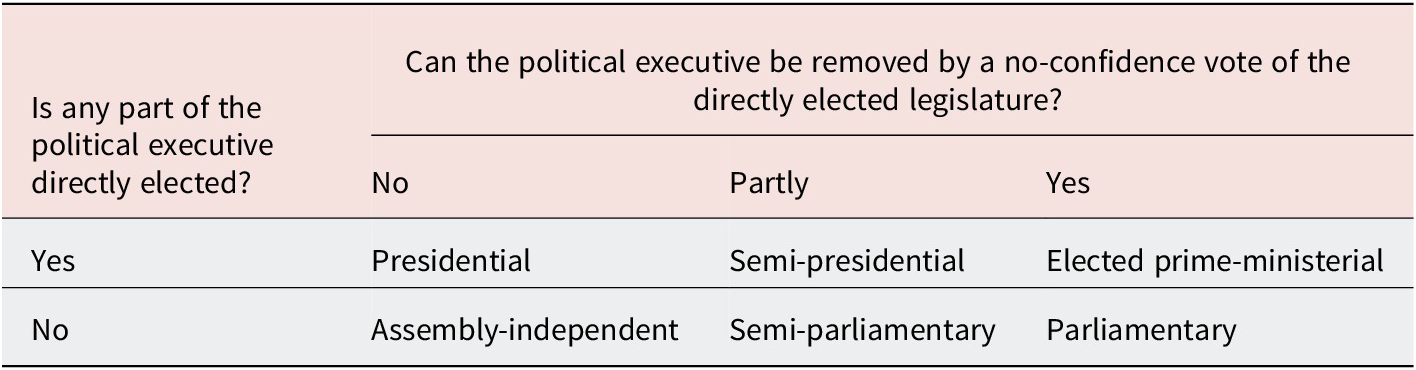
Based on this procedural conception of democratic forms of government, Table 1 presents a comprehensive typology of these forms. It is based on the two institutional dimensions commonly used to classify forms of government and builds on a proposal by Ganghof (Reference Ganghof2018). Here, I ground it in an explicit theory and modify it accordingly: by consistently focusing on the political executive and by basing the definition of no-confidence procedures on the democratic majority principle.
Six basic forms of democratic government

Table 1. Long description
The table is structured with two primary questions as axes. The vertical axis on the left asks, Is any part of the political executive directly elected? with row options Yes and No. The horizontal axis at the top asks, Can the political executive be removed by a no-confidence vote of the directly elected legislature? with column options No, Partly, and Yes.
In the Yes row for direct election:
- Under the No removal column is Presidential.
- Under the Partly removal column is Semi-presidential.
- Under the Yes removal column is Elected prime-ministerial.
In the No row for direct election:
- Under the No removal column is Assembly-independent.
- Under the Partly removal column is Semi-parliamentary.
- Under the Yes removal column is Parliamentary.
The rows distinguish democracies based on whether any part of the political executive is directly elected. The columns distinguish them based on whether and to what extent the political executive can be removed from office by a vote of no confidence in the democratic, directly elected legislature. The middle column accounts for the possibility that only part of the political executive can be removed by a vote of no confidence (semi-presidentialism), and that only part of the democratic legislature has the right to remove the political executive by such a vote (semi-parliamentarism).
While I will comment on the six types in more detail in the next section, one potential objection to the typology should be addressed up front. Assembly-independent government – a term coined by Shugart and Carey (Reference Shugart and Carey1992: 26) – is defined here in purely negative terms: Electoral authorization is achieved neither by the direct election nor by the majoritarian removability of the political executive. This might suggest that the explicit election of the political executive by a parliamentary majority should be added as a definitional criterion. However, the next section shows that this is not the case. If the electoral system is designed to guarantee a clear majority winner, the outcome of parliamentary elections can clearly authorize the political executive.
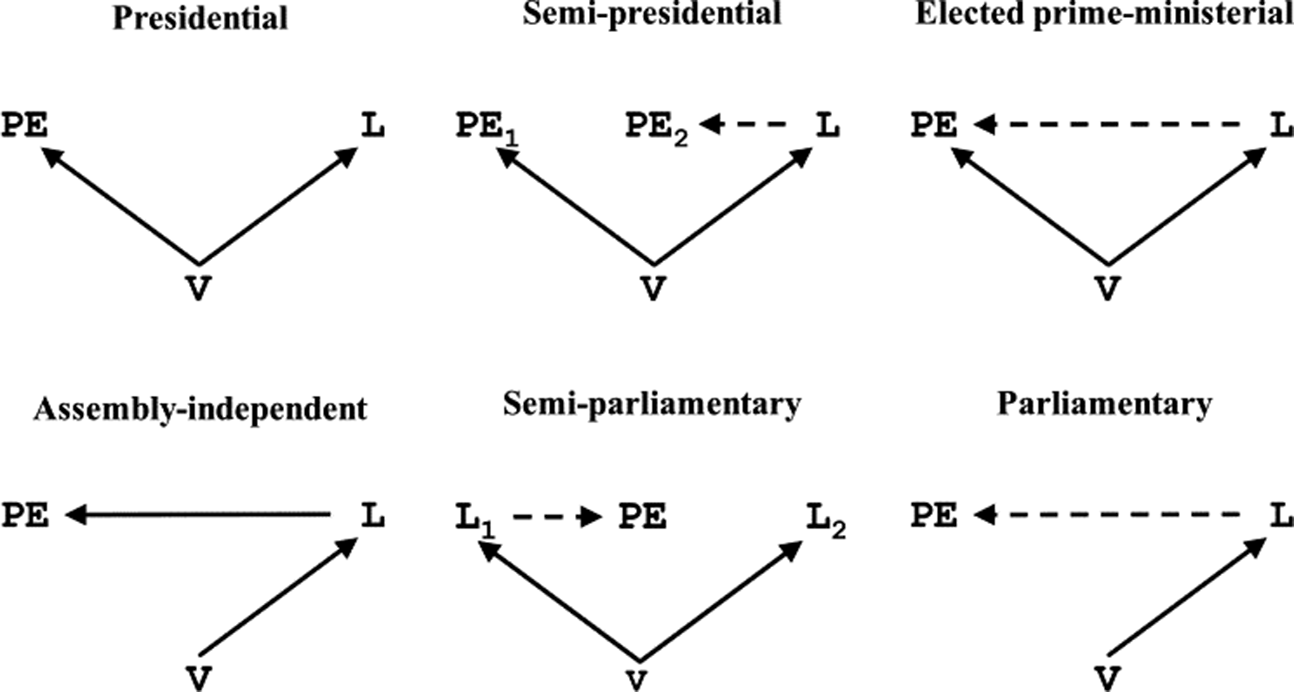
It is also important to note that the typology cannot possibly delineate every conceivable form of government, of which there are many. The goal is to distinguish six basic types of electoral authorization of the political executive and to show that the forms of government in today’s electoral democracies instantiate them. Figure 1 provides stylized representations of these types. While these kinds of depictions are often associated with the principal-agent model, they merely visualize different constitutional patterns of how the political executive is electorally authorized.
Six basic forms of democratic government.
Note: L, legislature; PE, political executive; V, voters; ➔, election (or implied by election result); - - >, hierarchical or majoritarian removal.
Source: Own composition.

Figure 1. Long description
The flowchart consists of six panels arranged in two rows of three.
Top-left panel, Presidential. V is at the bottom with two solid arrows pointing upward to P E on the left and L on the right.
Top-center panel, Semi-presidential. V is at the bottom with two solid arrows pointing upward to P E sub 1 on the left and L on the right. A dashed arrow points from L leftward to P E sub 2.
Top-right panel, Elected prime-ministerial. V is at the bottom with two solid arrows pointing upward to P E on the left and L on the right. A long dashed arrow points from L leftward to P E.
Bottom-left panel, Assembly-independent. V is at the bottom with a solid arrow pointing upward to L on the right. A solid arrow points from L leftward to P E.
Bottom-center panel, Semi-parliamentary. V is at the bottom with two solid arrows pointing upward to L sub 1 on the left and L sub 2 on the right. A dashed arrow points from L sub 1 rightward to P E.
Bottom-right panel, Parliamentary. V is at the bottom with a solid arrow pointing upward to L on the right. A long dashed arrow points from L leftward to P E.
A global classification of democracies
To apply the theory and typology to all electoral democracies, I first select the 114 countries that V-Dem and/or Freedom House classify as achieving some minimum level of electoral democracy in 2024 (Barak et al Reference Barak, Gorokhovskaia, Grothe, Hopkins, Larson, Meijer, O’Toole, Roylance, Shahbaz and Uhlig.2025; Nord et al Reference Nord, Altman, Angiolillo, Fernandes, Good God and Lindberg.2025). Many of these cases are not fully democratic forms of government according to the above theory. For example, the president of the United States is not directly elected; the president of Zambia can appoint up to eight members of the unicameral legislature; the president of Italy can appoint up to five members of a second chamber that has the right to dismiss the government in a vote of no confidence;Footnote 7 and Canada’s second chamber has absolute veto power over legislation, even though it consists entirely of appointed members. In all of these cases, the formal constitutional rules do not fully establish the electoral authorization of those who govern based on the democratic majority principle. For all of them, however, I assume that the experts at Freedom House and/or V-Dem have correctly determined how severe these deviations from full democracy are and to what extent they are compensated by informal practices. An example of such an informal practice would be the political self-restraint of a second chamber such as the Canadian Senate (cf. Boix, Miller and Rosato Reference Boix, Miller and Rosato.2012: 1534).
For three cases, however, I reject their classification (by Freedom House) as electoral democracies. In Liechtenstein, Monaco and Tonga, the constitutional powers of the monarchs – as well as the actual exercise of these powers – are so great that those who govern are clearly not fully electorally authorized (Corbett, Veenendaal and Ugyel Reference Corbett, Veenendaal and Ugyel.2017; Nieuwenburg and Veenendaal Reference Nieuwenburg and Veenendaal.2024).Footnote 8 Thus, I identify 111 countries as electoral democracies.
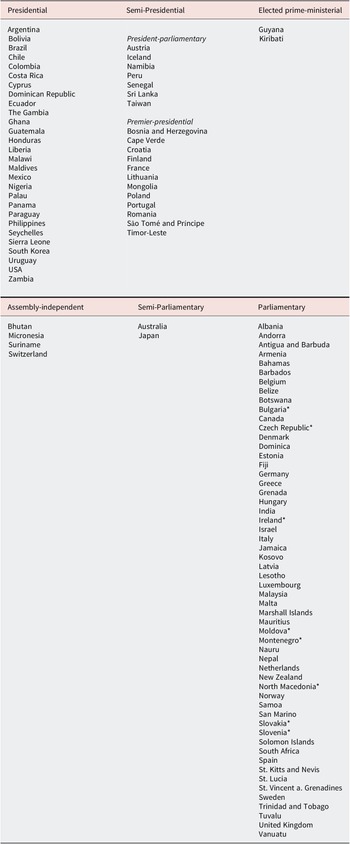
Table 2 uses the information on the constitutions of these countries provided by the Constitute Project (Elkins, Ginsburg and Melton Reference Elkins, Ginsburg and Melton.n.d.) and country-specific literature to classify them.Footnote 9 This classification is generally based on formal constitutional rules rather than behavioral patterns. As is common, however, I also consider practices that can be seen as having constitutional standing or being a constitutional convention. The Australian Constitution, for example, vests executive power in the Queen and her heirs and successors, exercisable by the Governor-General. The no-confidence procedure is a constitutional convention (Aroney et al Reference Aroney, Gerangelos, Murray and Stellios.2015: 409, 412).
Forms of government in 111 electoral democracies, 2024
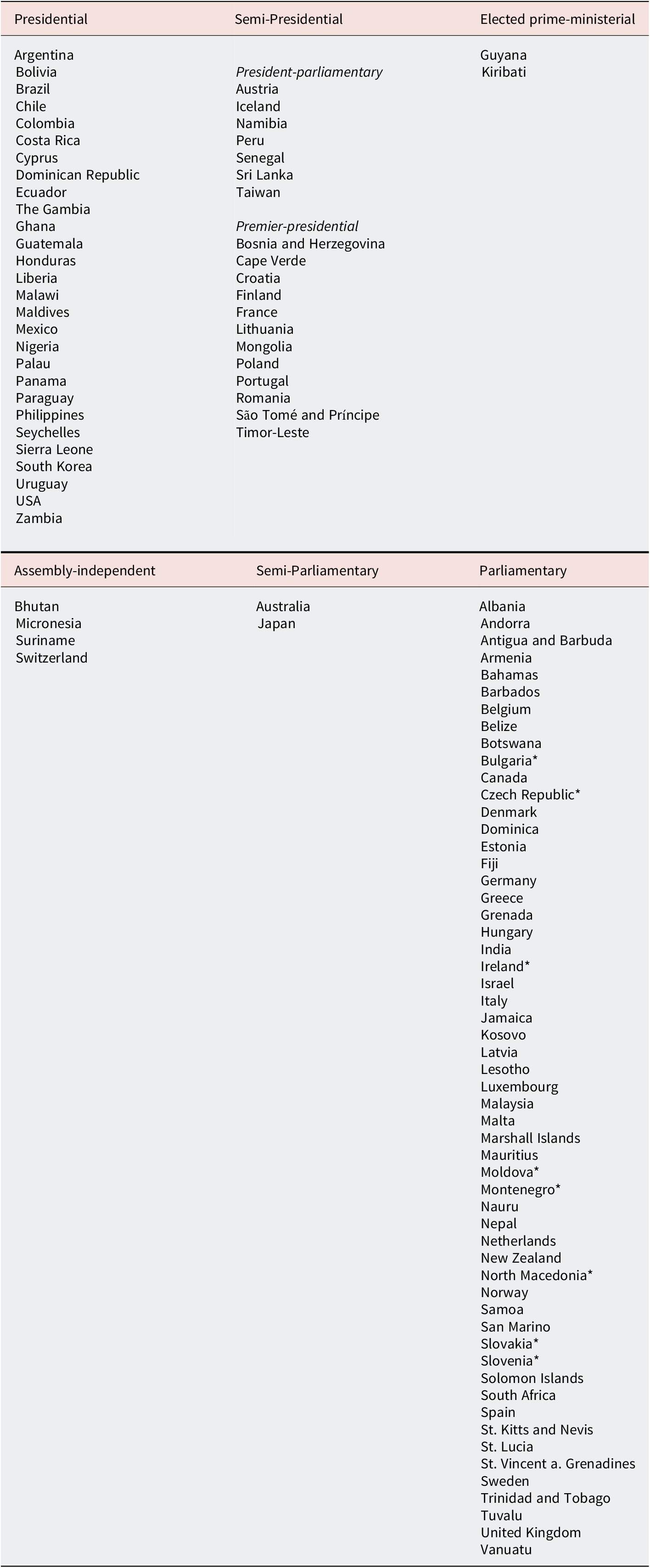
Table 2. Long description
The table is divided into two horizontal sections.
Top section columns:
1. Presidential: Includes 28 countries such as Argentina, Brazil, Mexico, Nigeria, South Korea, and the U S A.
2. Semi-Presidential: Subdivided into President-parliamentary (Austria, Iceland, Namibia, Peru, Senegal, Sri Lanka, Taiwan) and Premier-presidential (Bosnia and Herzegovina, Cape Verde, Croatia, Finland, France, Lithuania, Mongolia, Poland, Portugal, Romania, São Tomé and Príncipe, Timor-Leste).
3. Elected prime-ministerial: Guyana and Kiribati.
Bottom section columns:
1. Assembly-independent: Bhutan, Micronesia, Suriname, and Switzerland.
2. Semi-Parliamentary: Australia and Japan.
3. Parliamentary: A large group of 56 countries including Canada, Germany, India, Israel, Italy, South Africa, and the United Kingdom. Countries marked with an asterisk (Bulgaria, Czech Republic, Ireland, Moldova, Montenegro, North Macedonia, Slovakia, and Slovenia) are parliamentary with a directly elected president.
Sources: See text.
Note: * Parliamentary with directly elected president.
I classify 56 countries as parliamentary, 28 as presidential and 19 as semi-presidential, 4 as assembly-independent, 2 as elected prime-ministerial and 2 as semi-parliamentary. The following analysis elaborates on the classification for each form of government in turn and shows how the proposed theory and typology provide a coherent and unified perspective on a number of persistent disagreements in the literature.
Parliamentary democracy
Parliamentary democracy exists when (1) no part of the political executive is directly elected, and (2) it can be completely removed from office by a vote of no confidence in the entire directly elected legislature (see Table 1 and Figure 1).
This broad definition speaks to two important controversies. The first concerns the distinction between parliamentary and semi-presidential systems. Elgie (Reference Elgie and Elgie1999) argues that whenever the head of state is popularly elected in an otherwise parliamentary system, it becomes semi-presidential, regardless of the president’s constitutional powers. I reject this view because electoral authorization is required only for those who govern. Thus, a directly elected presidency changes the form of government only if that office is part of the political executive. I also think that Elgie’s view is not applied consistently in the literature. If the method of selecting the head of state were unconditionally important, we would also need a separate category for democracies with monarchical heads of state. However, democracies such as Sweden or the United Kingdom are generally classified as parliamentary rather than ‘semi-monarchical’. Arguably, the best explanation for this is that the constitutional powers of heads of state do matter in creating a need for electoral authorization. While I specify the relevant constitutional powers of presidents in the discussion of semi-presidentialism below, Table 2 classifies countries such as Bulgaria or Ireland, which have constitutionally weak presidents, as parliamentary systems.
A second controversy concerns countries that have a ‘unified’ executive in the sense that the head of government is also the head of state. Drawing on Verney (Reference Verney, Douglas1959), Siaroff (Reference Siaroff2003, Reference Siaroff2022: 139) argues that this unification, which characterizes presidential systems, is an apex classification criterion. Thus, he classifies otherwise parliamentary systems with this unification as ‘mixed’ forms of government (see also Metin and Ünal Reference Metin and Ünal.2023). Here, by contrast, the unification of the executive is considered irrelevant. What matters is how the political executive is electorally authorized. Therefore, Botswana, the Marshall Islands, Nauru and South Africa are classified as parliamentary democracies, even though their chief executives are also heads of state and called Presidents.Footnote 10
Presidential democracy
Presidential democracy exists when (1) the political executive, or part of it, is directly elected and (2) no part of the political executive can be removed from office by a vote of no confidence in the directly elected legislature (Table 1 and Figure 1).
This definition speaks to a number of important issues. Most importantly, it does not require that the president be elected for a fixed term. Several cases commonly classified as presidential do not have fixed-term presidents. One reason is the provisions for the direct recall of presidents in countries like Ecuador, Bolivia and Mexico (Alemán Reference Alemán2020: 135–6). To treat these systems as non-presidential would not only raise the question of what they are instead – a question that is never answered – but would also fail to take presidential democracy seriously. If the voters directly authorize the political executive, the democratic logic of this form of government implies that they would also be politically responsible for revoking that authorization. Recall elections do not undermine the logic of presidential democracy, but are an attempt to democratize presidential systems. That most of these systems resist this democratization should not be swept under the rug by our definition of presidentialism, but requires a causal explanation (see Section "Linking classification to democratic and constitutional theory" below).
A second type of constitutional provision that violates the fixed-term requirement is the possibility of a kind of ‘double dissolution’ of the presidency and the assembly. For example, the constitutions of Ecuador (Art. 148) and Zambia (Art. 81) allow the president to dissolve the assembly under certain conditions, which also leads to new presidential elections. Mainwaring and Shugart (Reference Mainwaring and Shugart.1997: 453) discuss these kinds of rules as a remedy for the ‘rigidity’ (Linz Reference Linz, Juan, Linz and Valenzuela1994) of presidential systems and as a ‘deviation from presidentialism, which is defined by its fixed terms’. Here, I see them as an attempt to make presidential democracy less rigid.
Instead of fixed terms, the above definition requires that the president cannot be removed by a vote of no confidence, which I have defined as requiring a simple or absolute majority. This means that even countries whose otherwise presidential constitutions call a supermajoritarian removal procedure a ‘vote of no confidence’ should be classified as presidential. A case in point is the constitution of The Gambia (Art. 63), which requires a two-thirds majority in the legislative assembly and subsequent confirmation by referendum to remove the president in a so-called motion of no confidence.
Distinguishing between forms of government based on the decision rule for removing the political executive is more reliable than determining whether removal can be based solely on political grounds. A number of presidential constitutions allow the president to be removed not only for criminal acts but also for political reasons. For example, the Constitution of Ecuador (Art. 130) allows a two-third majority of the assembly to remove the president in the event of a serious political crisis. Similarly, the Constitution of Ghana (Art. 69) allows for the supermajoritarian removal of the president for reasons that include “policy dissatisfaction” (Ginsburg, Huq and Landau Reference Ginsburg, Huq and Landau.2021: 128). Some constitutional theorists have also tentatively embraced a ‘political’ model of impeachment as a promising reform for presidential systems (ibid.: 144–153).
My definition of presidential democracy is inclusive in other ways, too. First, it does not exclude multi-person presidencies, such as existed in Uruguay and Cyprus (Shugart and Carey Reference Shugart and Carey1992: 94–105). Second, it allows for the existence of parts (i.e., members) of the political executive that are not directly elected, as long as these members cannot be removed by a vote of no confidence.Footnote 11 For example, South Korea has a prime minister who cannot be removed by a vote of no confidence in the legislature. Third, the definition includes countries in which individual cabinet ministers can be removed by censure votes in the legislative assembly, but only by a supermajority, for example, Bolivia, Costa Rica, Guatemala and Uruguay (Alemán Reference Alemán2020: 133–6).
There is one important case in which the proposed definition needs specification: when individual ministers can be censured by a simple or absolute majority. The constitution of Colombia (Art. 135) allows for the removal of any minister, while that of Argentina (Art. 101) allows only for the removal of the chief of the cabinet. How we classify such cases depends on whether we count the removal of individual ministers as the removal of one part of the political executive. Shugart and Carey argue in this direction and treat cases such as Argentina and Colombia unequivocally as ‘not presidential’ (1992: 112, emphasis in the original). Shugart (Reference Shugart, Matthew2005: 327), on the other hand, requires the collective responsibility of the cabinet and thus sees the two cases as ‘minimally attenuated forms of presidentialism’. Since the latter view is now dominant in the literature, I follow it here and explain its rationale in the next section.
Semi-presidential democracy
A semi-presidential democracy exists when (1) one part of the political executive is directly elected and cannot be removed from office by a vote of no confidence in the directly elected legislature, while (2) another part can be removed in this way (Table 1 and Figure 1).
This broad definition addresses a number of issues. As in the case of presidential systems, it allows for a multi-person presidency and does not require a fixed presidential term. The former is provided for in the Constitution of Bosnia and Herzegovina (Art. V); the latter is lacking in the Constitution of Namibia (Art. 29), since the term of office of the president ends in the event of the dissolution of the assembly.
The definition also specifies Duverger’s (Reference Duverger1980: 166) requirement of ‘quite considerable’ constitutional powers for the presidency. What matters here is whether these powers make the presidency part of the political executive. For example, the power of a president to ask a constitutional court to review the constitutionality of laws may be considered ‘considerable’, but it is arguably the power of a constitutional guardian rather than the political executive (cf. Partlett Reference Partlett2022). Several authors have made suggestions on how to operationalize the relevant political powers reliably (for an overview, see Åberg and Denk Reference Åberg and Thomas2024). Here, I consider it sufficient if the president has at least one of the following political powers: (1) the dismissal of the prime minister; (2) the power to (co-)direct foreign policy; (3) a legislative veto that can only be overridden by a legislative supermajority in the directly elected assembly; and (4) some discretion in dissolving the directly elected assembly. If all of these powers are absent, I classify the system as parliamentary (see Table 2). While there may well be reasonable disagreement about this list, my focus here is on providing a clear theoretical basis for its determination.
Before proceeding, it is useful to note an important development in the literature on semi-presidentialism. In their path-breaking work, Shugart and Carey (Reference Shugart and Carey1992) sought to replace the category of semi-presidentialism with two distinct forms of government. ‘Premier-presidentialism’ was essentially identical to Duverger’s (Reference Duverger1980) semi-presidentialism, while ‘president-parliamentarism’ differed in two important ways: (1) the president also has the right to dismiss the prime minister and cabinet, and (2) there is no requirement of collective cabinet responsibility; it is sufficient that ‘cabinet ministers are subject to parliamentary confidence’ (Shugart and Carey Reference Shugart and Carey1992: 112). According to this view, the upper-middle cell of Table 2 would contain two different forms of government, and the cases of Argentina or Colombia would move from the ‘presidential’ to the ‘president-parliamentary’ category. This alternative way of dividing the conceptual space would be consistent with my theory and typology, which allow for different forms of government in one cell of Table 1. Here, however, I have tried to stay as close as possible to how the literature has developed. Shugart and Carey’s two types have come to be understood as subtypes of the overarching concept of semi-presidentialism, and the definition of president-parliamentarism has changed accordingly. The authors have accepted this (Shugart Reference Shugart, Matthew2005: 327; Carey and Micozzi Reference Carey, Micozzi., Ménard and Shirley2025: 131). Still, the conceptual shift should not go unnoticed, as it is also relevant for causal analysis. An important but controversial causal argument derived from Shugart and Carey’s work is that only the president-parliamentary subtype of semi-presidentialism is perilous for democracy (Shugart and Carey Reference Shugart and Carey1992; Elgie Reference Elgie2011; Sedelius and Linde Reference Sedelius and Linde.2018; Stykow Reference Stykow2019; Åberg and Denk Reference Åberg and Thomas2025). It matters, therefore, whether we define this form of government in accordance with the authors’ original argument.
Assembly-independent government
Assembly-independent government exists when (1) no part of the political executive is directly elected and (2) no part of it can be removed by a vote of no confidence in the directly elected legislature (see Table 1 and Figure 1). Bhutan, Micronesia, Suriname and Switzerland fulfill these conditions. While the latter three cases are at least sometimes classified as assembly-independent, Bhutan is generally classified as parliamentary (Horgan Reference Horgan, Gerald2019; Siaroff Reference Siaroff2022: 140; Carey and Micozzi Reference Carey, Micozzi., Ménard and Shirley2025: 132). I reject this classification because the country’s constitution (Art. 17) requires a two-third majority (in the first chamber) to remove the prime minister. This is largely equivalent to a politicized impeachment process.
Bhutan also demonstrates why it is important that my definition of assembly-independent government does not require an explicit constitutional procedure for transferring electoral authorization from the legislature to the political executive. The minimum conditions for a democratic form of government can still be met if legislative elections are designed to be decisive. This is the case in Bhutan, where an extremely restrictive electoral system guarantees a two-party system in the lower house. If more than two parties are registered, a nationwide ‘primary’ determines the two parties with the greatest voter support, and only these two parties are then allowed to compete in single-member districts under plurality rule (Horgan Reference Horgan, Gerald2019: 85). Since this system creates a clear majority party, it is sufficient for the constitution (Art. 17) to state that the king shall choose the leader or nominee of that party as prime minister. The irony of the Bhutanese constitution, however, is that in order to be considered democratic at all, it requires a massive suppression of representational pluralism through the electoral system. For example, in the primary round of the 2023–2024 election, nearly 38% of voters chose parties that were not allowed to compete in the actual election (Election Commission of Bhutan 2023).
The other three cases of assembly-independent government do not need to impose such severe restrictions on their electoral systems because their political executives are elected by the legislature. Switzerland has had a collegial government since 1848, whose seven equal members are elected individually by an absolute majority in a joint session of the two directly elected chambers of the legislature (Linder and Mueller Reference Linder and Mueller.2021). The 14-member unicameral congress of Micronesia has since 1978 used absolute majority rule to elect two of its four senators as president and vice president (Johnson Reference Johnson2002). In Suriname, since 1987, the president and vice president are elected by a two-thirds majority of the national assembly (51 members). If such a majority cannot be reached, a United People’s Assembly is convened, consisting of the national assembly as well as district and local councils (818 members), which decides by simple majority (Inter-American Development Bank 2001).
Elected prime-ministerial government
The term ‘elected prime-ministerial government’ was proposed by Shugart (Reference Shugart, Matthew2005: 326). Based on Table 1, it exists when (1) the political executive, or part of it, is directly elected, but (2) it can be completely removed from office by a vote of no confidence in the directly elected legislature (see also Figure 1).
The literature on this form of government has largely focused on the failed experiment with it in Israel (e.g., see Samuels and Shugart Reference Samuels and Shugart.2010: 181–8) or on reform proposals in countries such as Italy (Improta and Marzi Reference Improta and Marzi.2024). The two existing cases, Guyana and Kiribati, are often neglected or misclassified. For example, Guyana has been classified as ‘semi-presidential’ (Elgie Reference Elgie2005: 102), ‘effectively presidential’ (Siaroff Reference Siaroff2022: 139), ‘assembly-dependent’ (Metin and Ünal Reference Metin and Ünal.2023: 497) and ‘parliamentary’ (Carey and Micozzi Reference Carey, Micozzi., Ménard and Shirley2025: 132).Footnote 12
The 1979 Constitution of Kiribati provides that the ‘President’ is directly elected (Art. 32) and can be removed from office by a vote of no confidence in him or the entire government by an absolute majority of the legislature (Art. 33). Legislative elections precede presidential elections, and the newly elected assembly uses the Borda count to elect three to four candidates from among its members (Van Trease Reference Van Trease1993; Reilly Reference Reilly2002). Thus, while voters directly provide the ultimate electoral authorization of the chief executive, the list of candidates from which they may choose can be severely restricted by a majority of the legislature.
Guyana’s constitution (as amended in 2000) requires that each list of candidates for the proportional election of parliament must nominate a candidate for the office of the ‘President’, who is elected by plurality (Art. 177). Presidential and parliamentary elections are thus fused, but different electoral rules imply that the election of the president is still direct in the relevant sense: his or her electoral authorization is separate from that of the legislature (see also Ghany Reference Ghany2020). The elected presidents are not members of parliament, but they must resign, along with the entire cabinet, if they are defeated in a vote of no confidence by an absolute majority in parliament (Art. 106).
In both Guyana and Kiribati, the chief executive is also the head of state and is called the President. In Guyana, there is also the additional office of Prime Minister, who is appointed by the president (Constitution of Guyana, Art. 101). Therefore, the term ‘elected prime-ministerial’ can be misleading.
Semi-parliamentary democracy
The label ‘semi-parliamentary government’ has been proposed by Ganghof (Reference Ganghof2018); see also Taflaga Reference Taflaga2024). This system exists when (1) no part of the political executive is directly elected, and (2) the entire political executive can be removed in a vote of no confidence by one part of the directly elected democratic legislature, but not the other (Table 1 and Figure 1).
Australia and Japan, which are typically treated as parliamentary, are classified here as semi-parliamentary because only one chamber of the directly elected democratic legislature can dismiss the government through a vote of no confidence. Other cases of directly elected second chambers either extend the right to dismiss the government to the second chamber (Italy) or allow an absolute majority of the first chamber to override a legislative veto of the second chamber (e.g., Czech Republic and Poland). In Australia and Japan, on the other hand, the second chambers are clearly part of the democratic legislature (Ganghof Reference Ganghof2021: 43–6), but they cannot dismiss the cabinet by a vote of no confidence. The electoral authorization of the political executive is thus fused with only part of the democratic legislature. The other part relates to the political executive as in a presidential system.
Summary
The classification in Table 2 differs significantly from other studies. For example, Carey and Micozzi (Reference Carey, Micozzi., Ménard and Shirley2025) identify 90 electoral democracies in 2022, of which 21% are classified differently. They classify 16 countries as parliamentary, which are here classified as semi-presidential (Austria, Bosnia and Herzegovina, Croatia, Finland, Iceland, Lithuania, Mongolia, Romania, Cape Verde and São Tomé and Príncipe), semi-parliamentary (Australia and Japan), assembly-independent (Bhutan, Suriname and Switzerland) or elected prime-ministerial (Guyana). In addition, they classify three countries as presidential that I classify as semi-presidential: Peru, Namibia and Sri Lanka. The difference between the two classifications would be even greater if Carey and Micozzi had consistently applied their own ‘fixed term’ criterion for presidents and, thus, not classified cases such as Ecuador, Bolivia or Zambia as presidential systems. Similar differences exist in comparison to other global classifications (e.g., see Siaroff Reference Siaroff2022: 132–42; Metin and Ünal Reference Metin and Ünal.2023).
Linking classification to democratic and constitutional theory
This section argues that the six forms of democratic government distinguished in the previous sections are also importantly different from the perspective of positive political theory, and that these theoretical concerns relate directly to important debates in normative democratic and constitutional theory. My positive theory focuses not on the problems of delegation, which assume the existence of a principal with stable preferences, but on a basic challenge that arises when elections and majority rule are used to authorize the political executive. The theoretical premise is that this authorization requires a degree of stability for democracy to be effective. Thus, the challenge is to achieve this stability in the face of electoral and/or legislative majorities that tend to be unstable. Any democratic form of government must respond to this fundamental challenge of stable electoral authorization. Consider three exemplary issues.
The (de)personalization of executive power
The (de)personalization of political power is crucial for representative democracy. As Ingham (Reference Ingham2022: 699) argues, the massive and unavoidable inequality in political power between citizens and elected officials is consistent with the ideal of social and political equality only if the power of officeholders is ‘depersonalized’ at the behavioral level. This is the case when officials make decisions according to certain criteria, such as the public good, independent of their personal feelings, preferences and interests (see also Lovett Reference Lovett2021; Kolodny Reference Kolodny2023: 329–36). Since complete depersonalization is impossible, Ingham suggests comparing the extent to which electoral democracy and alternative regimes such as political meritocracy depersonalize the power of public officials.
I suggest that the same comparison is needed for different constitutional forms of electoral democracy, and with a special focus on the political executive as a particularly powerful set of offices. The political executive is most personalized, at the constitutional level, in the standard presidential model, which achieves stable electoral authorization by deliberately vesting executive power in ‘a single official elected for a fixed and relatively long term’ (Ferejohn and Hills Reference Ferejohn, Hills., Rakove and Sheehan2020: 520). Because presidents are neither part of nor continuously accountable to any collective, they are relatively less constrained in the exercise of their power. Some normative theorists hope that they, like other officials, are still constrained by ‘duty’ (Kolodny Reference Kolodny2023: 335), so that their exercise of power is still relatively depersonalized in Ingham’s behavioral sense. Others find it ‘downright embarrassing for a constitution to ask free and equal citizens to place so much trust in the personal integrity and ideals of a single human being’ (Ackerman Reference Ackerman2000: 663). In the empirical literature, the negative consequences of the constitutional personalization of executive power under presidentialism have been an important theme (e.g., see Linz Reference Linz, Juan, Linz and Valenzuela1994; Samuels and Shugart Reference Samuels and Shugart.2010; Ganghof Reference Ganghof2021). James Madison, too, was quick to realize that the president’s powers allowed him ‘to build a political coalition from anyone benefiting from his exercise of political discretion’, which for Madison was ‘the very essence of corruption’ (Ferejohn and Hills Reference Ferejohn, Hills., Rakove and Sheehan2020: 520).
From this perspective, all other forms of government in Table 1 can be understood as constitutional efforts to (partially) depersonalize the political executive: by abandoning the direct election of a president, by making the political executive, or at least part of it, accountable to a legislative majority, or both. In some of the hybrid forms, this anti-personalist motivation was very explicit. For example, the drafters of Switzerland’s assembly-independent system considered an office like that of the president of the United States, but ‘could not think of proposing the creation of an office so contrary to the ideas and habits of the Swiss people who might see therein evidence of a monarchical or dictatorial tendency … Our democratic feeling revolts against personal pre-eminence’ (Constitutional Reform Committee Reference Lijphart1992[1848]: 173). Similarly, Guyana’s 1980 constitution had created a presidential system with an overly powerful presidency, and the switch to an elected prime-ministerial form of government, in which the ‘President’ is responsible to a majority of the assembly, was made as a remedy (Ramkarran Reference Ramkarran, Hari2004).
The limits of direct recall
One might object that in order to constitutionally constrain a directly elected president, it would be sufficient to democratize a presidential system. If presidents do not serve fixed term, but can be recalled by voters, this continuous accountability might constrain them to act in a more depersonalized manner. Partly in this spirit, constitutional theorists such as Albert (Reference Albert2009) and Colón-Ríos (Reference Colón-Ríos, Joel2022: 11) suggest that recall elections could play a role in a presidential system similar to that of a no-confidence vote in a parliamentary system. Albert (Reference Albert2009: 561) even believes that the analogy between a recall referendum and a no-confidence vote ‘undermine[s] the claim that votes of no confidence are incompatible with presidentialism’.
If this suggestion of functional equivalence were correct, it would have far-reaching implications for other issues of constitutional design in presidential systems. For example, an effective recall threat could greatly reduce the need for presidential term limits, which are themselves a problematic constraint on democratic elections (e.g., see Ginsburg and Elkins Reference Ginsburg, Elkins., Baturo and Elgie2019: 50).
However, the suggestion neglects the problem of stable electoral authorization. More specifically, it neglects that an electoral majority authorizing a president cannot be stabilized by collective action in the same way as a legislative majority authorizing a cabinet in a parliamentary system (more on the latter shortly). A no-confidence procedure can be used purely as an ‘anti-personalism device’ by the parliamentary majority (a single party or a coalition) authorized in the last election. By contrast, recall procedures inexorably intertwine any effort to constrain the personal power of the president with the struggle of the losers of the last election to become part of a new majority. Recall procedures, therefore, pose a greater threat to the stability of the political executive and cannot be the functional equivalent of no-confidence procedures (see also Ganghof Reference Ganghof2021: 155–7). This fact helps explain why recall procedures in presidential systems remain rare and tend to be designed restrictively (Welp and Whitehead Reference Welp, Whitehead, Llanos and Marsteintredet2023), and why no national president has ever been recalled by voters (Pérez-Liñán Reference Pérez-Liñán, Welp and Whitehead2020).
This discussion also illustrates the link between classification and democratic theory. Only when we remove the condition of fixed presidential terms from the definition of presidential government (as suggested above) can we clearly see the limits of presidentialism as a form of democracy. Although the direct election of the chief executive is often seen as inherently more ‘democratic’ – even by critics of presidentialism (Lijphart Reference Lijphart and Lijphart1992: 13; Arato Reference Arato2000: 321) – it implies the absence of effective and continuous accountability of the chief executive. It is thus likely to lead to a greater personalization of the political executive not only in formal constitutional terms but also in Ingham’s (Reference Ingham2022) behavioral sense. Therefore, rather than being more democratic, the direct election of the political executive can contribute to undermining social equality.Footnote 13
The democratic costs of the no-confidence procedure
However, the direct election of the political executive is only one of the two dimensions of my typology (Table 1). We must also consider the potential democratic downside of the other: the no-confidence procedure. This procedure is an effective constitutional mechanism for depersonalizing the power of the political executive (to the extent possible), but the very processes that reconcile this mechanism with executive stability also tend to constrain majority rule in the democratic legislature. In parliamentary systems, especially those with fragmented parliaments, the political executive is typically stabilized by majority coalitions in which each party is granted veto power over legislation in exchange for maintaining the government in office (Tsebelis Reference Tsebelis2002).Footnote 14 The resulting cartel of veto parties suspends majority rule in the legislature to some extent, because even if different issues are separable and parties would otherwise have an interest in separating them, they cannot usually be determined by an issue-specific majority. In terms of social choice theory, they cannot be determined by the issue-specific median (Ward and Weale Reference Ward and Weale.2010). On the one hand, a cabinet party can veto a policy change supported by a legislative majority; on the other hand, a policy change can be imposed against the will of an issue-specific majority as part of a larger ‘logroll’ or ‘package deal’. For example, Willumsen and Otjes (Reference Willumsen, David and Otjes.2025: 1) show for Dutch coalition governments from 2007 to 2022 that two-thirds of the policies included in coalition agreements are not supported by a floor majority (‘minority rule’), and that 30% of the policies supported by a floor majority are not included in a coalition agreement (‘frustrated majorities’).Footnote 15
This democratic downside of the no-confidence procedure helps us understand the potential rationale for hybrid forms of government that avoid it. First, consider the case of Switzerland’s version of assembly-independent government, which is almost unique in the democratic world in that it does not create veto players.Footnote 16 In contrast to most presidential systems, the political executive has no legislative veto because it has no direct electoral mandate to protect against legislative majorities. However, the cabinet parties are not veto players either, because the fixed-term cabinet does not need to be stabilized. Legislative coalitions can shift from issue to issue, giving great power to the issue-specific median party (e.g., see Traber Reference Traber2015; Linder and Mueller Reference Linder and Mueller.2021: 192). It is hard to overstate how important this is for Swiss democracy. If the most polarized parties in the cabinet, the right-wing populists and the left-wing social democrats, were veto players, Swiss democracy could not function effectively (for further discussion, see Ganghof Reference Ganghof2021: 23–6). Moreover, the median-oriented nature of the country’s representative institutions facilitates their integration with the equally median-oriented direct-democratic procedures (cf. Leemann, Emmenegger and Walter Reference Leemann, Emmenegger and Walter.2025).
Semi-parliamentary government in Australia can be understood in a similar manner. Here, the democratic legislature is divided into two directly elected chambers, one of which is denied the right of no confidence. Australia takes advantage of this constitutional structure by using a majoritarian electoral system to elect the confidence-supplying first chamber and proportional representation in the second chamber.Footnote 17 The typical electoral outcome is, thus, a single-party majority government in the first chamber that forms issue-specific majority coalitions in the second chamber. Since only the government party has veto power (due to its first chamber majority) and is also the median party on many issues, the overall legislative process tends to remain majoritarian, with legislative coalitions (in the second chamber) shifting from issue to issue (Ganghof Reference Ganghof2021: ch. 6; Tsebelis et al Reference Tsebelis, Thies, Cheibub, Dixon, Bogéa and Ganghof2024: 87–9). Australia differs from Switzerland in that voters in first-chamber elections can still give a clear mandate to a single actor as the political executive and legislative agenda setter; and it differs from presidential systems in that the single actor is a political party that can remove the chief executive at any time, thereby helping to depersonalize his or her power.
These features of Australian-style semi-parliamentarism have arguably helped Australian democracy to perform relatively well and to be relatively resilient to the forces of authoritarian populism (Dixon and Gauja Reference Dixon, Gauja., Graber, Levinson and Tushnet2018; Ganghof Reference Ganghof2021; Evans, Dunleavy and Philimore Reference Evans, Dunleavy and Philimore.2024). Accordingly, this form of government has recently received increased attention in democratic and constitutional theory, as well as in constitutional reform debates (e.g., see Khaitan Reference Khaitan2021; Landwehr and Schäfer Reference Landwehr and Schäfer.2025; Larraín and Voigt Reference Larraín and Voigt.2023; Birch Reference Birch2024; Gardbaum Reference Gardbaum, Ginsburg, Huq and Khaitan2024; Landwehr Reference Landwehr2024; Partlett Reference Partlett2024: 172–3; Tong Reference Tong2024). In 2025, a Constitutional Reform Commission tasked by the interim administration under the leadership of Muhammad Yunus proposed the introduction of a semi-parliamentary system in Bangladesh (Hosen Khan Reference Hosen Khan2025).
The cases of Australia and Switzerland illustrate the distinctiveness and democratic potential of the assembly-independent and semi-parliamentary forms of government. This potential is likely to be overlooked when we classify them as ‘parliamentary’ (e.g., Carey and Micozzi Reference Carey, Micozzi., Ménard and Shirley2025) or, in the case of Switzerland, ‘presidential’ (e.g., Cheibub, Gandhi and Vreeland Reference Cheibub José, Gandhi and Vreeland.2010).
Conclusion
I have analyzed different forms of government as different types of electoral democracy and as different responses to the problem of stable electoral authorization. These responses differ along two dimensions: (1) whether and to what extent the political executive is directly elected, and (2) whether and to what extent it can be removed in a political and majoritarian process by the democratic legislature. A typology based on these two dimensions can coherently classify all the world’s democratic forms of government and highlight their consequences for the democratic process. Direct election of a chief executive for a fixed term stabilizes the political executive, but it tends to personalize executive power. Making the political executive accountable to a legislative majority depersonalizes its power (to the extent possible), but also constrains legislative majority rule. Because both of these consequences can be seen as costly for democracy, the efforts of countries to contain them by creating ‘hybrid’ constitutions are important and should be recognized by our comparative classifications.
History is not efficient, and the globally dominant forms of government are not necessarily the best for improving and defending the democratic project. Instead of truncating our classifications based on what is most common, we should think from first principles. The principles of constitutional democracy might not be a bad place to start.
Acknowledgments
The author would like to thank JD Mussel, William Partlett, Ryan Pevnick, Tapio Raunio, Matthew Shugart, Alan Siaroff, Petra Stykow and GlobCon’s anonymous reviewers for their helpful comments and discussions, as well as Timo Rexin for excellent research assistance. The author made use of DeepL to assist with the editing of this article. The author remains entirely responsible for the scientific content of the article.
Competing interest
The author declares none.

 Open access

