

Introduction
The legal term “Copyright” denotes a bundle of exclusive rights in original expressive works fixed in a tangible medium. Since its origination as a system of control over literary works – intended to restrict publication of controversial or heretical religious writings – copyright law has developed into a legal institution that performs a set of social and economic functions related to the management of creative works.
The catalogue of exclusive rights granted to the author may differ from one jurisdiction to another, as well as from one type of work to another. Nevertheless, generally any entity interested in using a copyrighted work for any purpose or in any means (that fall within the scope of the authors’ exclusive rights) must obtain authorization from the author to do so. Thus, authors’ ability to transfer his or her rights is a cardinal aspect of the copyrights system.
Notwithstanding the abovementioned, legislatures sometimes choose to limit the author’s ability to transfer their rights, mainly, to “protect” the author who is presumably the weaker party (Nahmias Reference Nahmias2019a, Reference Nahmias2019b). Although rooted in the best intentions, rules which restrict the menu of options the parties can adopt contractually may be running counter to the author’s true preferences, decrease the number of transactions executed, or the remuneration offered to the author. Thus, naturally affecting the author’s incentive to create.
Despite the fact that one’s ability to pursue their own preferences might have an enormous impact on their incentive to create, empirical work in this area is generally scarce (Sprigman et al. Reference Sprigman, Buccafusco and Burns2013; Engel and Kurschilgen Reference Engel and Kurschilgen2011). This is even the more so with respect to people’s valuation of their own (copy)rights (with a notable exception of Bechtold and Engel Reference Bechtold and Engel2017), and the question of legitimacy of waiver or whether the right of attribution can be ‘traded’ in the sense of licensing.
In view of the foregoing, we conducted a conjoint experiment (choice experiment) designed to investigate authors’ preferences (Doherty et al. Reference Doherty, Dowling and Miller2019). In particular, we sought to answer the following questions: (1) What is the relative independent weight creators give to the different economic and moral rights in their copyright contractual choices and what are the trade-offs they are making? (2) To what extent do creators value the right of attribution and are they willing to transfer it for a price? (3) Do professionals have different preferences than lay respondents? As an exploratory exercise, we have also looked whether different sub-groups of creators have different preferences.
Given that copyright contracts provide a bundle of rights, the decision about them is multidimensional. Namely, there are different rights the authors weight against the price and against each other. Singling out only one component, might distort the decision (Hainmueller et al. Reference Hainmueller, Hopkins and Yamamoto2014). Having this in mind we employ a novel methodology to this topic – a conjoint experiment, which to the best of our knowledge, has never been applied before in research on copyrights, although it has found a wide range of applications in political science and public policy research. Such methodology has been employed to answer important, among others, questions such as the type of immigrants people “prefer” to accept (Hainmueller and Hopkins Reference Hainmueller and Hopkins2015); people’s acceptance of EU regulatory decisions (Zeitlin et al. Reference Zeitlin, van der Duin, Kuhn, Weimer and Jensen2022); the public’s acceptance of government’s paternalism (Treger Reference Treger2021) as well social (Gallego and Marx Reference Gallego and Marx2017) and climate change policies (Kantorowicz et al. Reference Kantorowicz, Collewet, DiGiuseppe and Vrijburg2024).
Conjoint experiments offer a cost-effective alternative to more traditional survey experiments (Hainmueller and Hopkins Reference Hainmueller and Hopkins2015). They allow for simultaneous testing of multiple hypotheses as conjoint experiments, in their fractional form, typically enable the manipulation of many attributes, minimizing the problem of confounding. In the context of copyrights, by employing a conjoint experiment, we are able to identify the independent and relative weight given to each component among multiple components of copyrights contracts and avoid confounding factors. In other words, we are able to test how each right (and the price) in the contract affects the participant’s choice of that contract.
In this paper we focus on the Anglo-American tradition. Our participants include UK professionals and USA professionals (people from the creative fields). However, with the changing nature of creative markets, where the boundaries between professional creators and ordinary people who choose to create are becoming less clear, it is reasonable to assume that copyrights law becomes more and more relevant for the public in general and not only to a small group of professionals. For example, with the technological developments and online platforms more people are engaging in activities where copyrights laws are relevant (e.g. Sundara Rajan Reference Sundara Rajan2002). Therefore, our sample also includes participants from the UK general population, Given the similarity in the legal framework of the two countries (at least as compared to the Continental-European tradition) we first look at all professionals together and compare them to the general population. Later we break it into two samples to investigate whether there are significant differences between the British and the American professionals.
Our results suggest that the right of attribution, which is a moral right, has a larger effect on the respondent’s probability to select a contract than any of the economic rights, in all samples (UK general population, all professionals, and UK and USA professionals separately). In addition, both types of respondents (general population and professionals) and from both countries were willing to trade off the moral right against compensation. The only statistically significant difference is that USA professionals attach a higher weight to the price than the UK professionals. With marginal statistical significance we even see that unlike the UK professionals (who are indifferent between those two options), the USA participants preferred a contract which offered them higher compensation, even if without the moral right, over a contract with a lower price but with the moral right. The difference we have found is to some extent reflected in the different legal frameworks in those countries. Seeing that, under UK legislation, author’s moral rights enjoy a stronger protection than in the USA, where they are only afforded to a narrow group of works.
The fact we do not find significant differences between the general and the professionals’ samples not only substantially interesting, indicating that experience does not impact preferences, but also potentially good news for researchers. This means that at least in this context, research on participants from the general population is useful also when wishing to derive conclusions about professionals. Methodologically, it is often easier and less costly to recruit participants from the general population as compared to the sub-group of professionals. Consequently, researchers often use non-professional samples, to investigate questions related to choices and behaviors of professionals (e.g. Sprigman et al. Reference Sprigman, Buccafusco and Burns2013; Kantorowicz-Reznichenko et al. Reference Kantorowicz-Reznichenko, Kantorowicz and Weinshall2022). Therefore, with our study, we are contributing to important literature (Runeson Reference Runeson2003; Bornstein et al. Reference Bornstein, Golding, Neuschatz, Kimbrough, Reed, Magyarics and Luecht2017; Spamann and Klöhn Reference Spamann and Klöhn2024) that examines whether results from target samples (e.g. judges) are truly comparable with proxy samples (e.g. law students).
It is interesting to note that generally the economic rights received lower weight than the moral right and the price, both among the general population and professionals. The only statistically significant difference which was observed within those rights is that the right to issue copies appears to be the least important right for participants. Nevertheless, all those rights matter to the authors’ choice which contract to select. This provides support for the existing legal framework which recognizes these rights and allows trading them.
Finally, in addition to comparing participants from the general population to professionals, and professionals from the USA to professionals from the UK, we also examined the weight given to each right among sub-groups based on gender and education. We did not find statistically significant differences between female and male participants. On the other hand, the level of education did matter for the weight assigned to the right to create derivative work. Participants with higher education, considered this right as more important to their choice than participants with lower level of education.
Important to note that our results are not meant to identify just one attribute or right that has a determinable effect on the authors’ choice, but to indicate what peoples’ preferences are, given the complexity of a copyright contract. Thus, overall, our results are not only interesting from a theoretical standpoint but could also have substantive policy implications, with regards to the question of legitimacy of waiver and/or whether the right of attribution can and should be “traded”.
The discussion proceeds as follow. First, we present the theoretical and legal framework of copyrights regimes. Subsequently we explain our research design and provide the background to it. Finally, we present our results and discuss potential policy implications.
Theoretical underpinnings of copyright law
This section delves into the foundational theories and legal structures that shape copyright law across different jurisdictions. Subsequently, the focus shifts to authors’ preferences, considering how legal frameworks influence their decisions and strategies regarding the management and exploitation of their rights.
Divergent copyright philosophies: the Anglo-American and continental traditions
Although recognized in numerous countries and harmonized to a certain extent at the international level (Berne Convention for the Protection of Literary and Artistic Works 1886), there is no international uniform application of copyright protection. In fact, legal protection of expressive works falls into two broad models or traditions: the “copyright,” or the Anglo-American tradition; and the “authors’ rights” (“droit d’auteur”), or the Continental-European tradition.
The authors’ rights tradition views copyright as a natural right (Patterson and Lindberg Reference Patterson and Lindberg1991; Ginsburg Reference Ginsburg1990; Netanel Reference Netanel1993; Woodmansee Reference Woodmansee1984). The underlying justification for the adherence to this belief lies in the premise that a deep and intimate connection between the author and their creative work justifies giving the author a degree of control over the work, and this takes the form of exclusive property rights (Netanel Reference Netanel1993; Goldstein and Hugenholtz Reference Goldstein and Hugenholtz2013; Yoo Reference Yoo2012; Zemer Reference Zemer2006).
Under this approach, two key interests of authors are entitled to protection: economic interests and moral interests (Ciolino Reference Ciolino1995; Damich Reference Damich1988). On the one hand, the authors’ rights tradition places a strong emphasis on those interests related to the authors’ personalities. On the other hand, it safeguards authors’ economic interests and their ability to commercialize and exploit their creative works to derive financial gain (Senftleben Reference Senftleben2014). Consequently, most jurisdictions that follow the authors’ rights tradition provide the author with a bundle of economic rights (e.g. the right of reproduction, distribution, and communication to the public), as well as with a set of moral rights (e.g. the right of attribution, the right to ensure the integrity of the work).
In contrast, it is generally accepted that Anglo-American copyright tradition, rests on a utilitarian foundation. In this understanding, creativity and innovation are vital to society’s well-being (Leval Reference Leval1990). A large body of literature argues that the dissemination of literary and artistic works is dependent on economic reward (Breyer Reference Breyer1970). Economic theory suggests that in the absence of legal protection, the supply of creative works will fall short of the social optimum (Barnes Reference Barnes2010; Landes and Posner Reference Landes and Posner1989; Conley and Yoo Reference Conley and Yoo2009; Croskery Reference Croskery1993; Parchomovsky and Goldman Reference Parchomovsky and Goldman2007). One of the assumptions underpinning this approach is that given the high initial costs of creating expressive works in the absence of protection, the author will not be able to recoup their investment and will therefore choose not to produce the work. As a result, there will be an under-supply of creative works and social welfare will be adversely affected. To remedy this, exclusive property rights are granted to the author. On this view, the exclusive property rights granted to the author are a way to incentivize creation, ensure optimal supply of expressive works, and promote the dissemination of artistic and literary works (Sony Corp. of America versus Universal City Studios 1984; Landes and Posner Reference Landes and Posner1989; Ng Reference Ng2009; Sterk Reference Sterk1996).
In sum, copyright theorists – whether adopting the natural rights approach or the utilitarian approach – assume that the state can advance certain goals by vesting the author with property rights, and that the author can use the bundle of exclusive rights to advance her economic ends.Footnote 1 This advancement of the author’s economic ends can be achieved via different modes of exploitation. However, generally, the reward or incentive to the author depends on there being an interested third party who wishes to transact with the author and to pay her for the right to exploit her rights. Thus, authors’ ability to transfer – some or all – of her rights is a cardinal aspect of the copyrights system.Footnote 2 Notwithstanding this essential role the ability to transfer one’s right plays in the copyrights system, legislatures often decide to limit the author’s ability to transfer their rights, mainly, to “protect” the author (Nahmias Reference Nahmias2019a, Reference Nahmias2019b). Such limitations although developed by legislatures presumably to protect the “weaker” author against her “stronger” counterparties, might in fact be running counter to the author own true preferences. Thus, eventually affecting the author’s incentive to create.
Legal protections and implications in the Anglo-American context
In the Anglo-American tradition, where legal protections heavily favor economic incentives, the UK and USA provide authors with extensive economic rights designed to encourage the creation and distribution of works. These rights, encompassing reproduction, distribution, and public performance, aim to optimize creative output and societal benefits through financial incentives. As we transition from discussing the theoretical foundations in the previous subsection, we now examine the specific legal mechanisms that operationalize these theories, highlighting the similarities and variances between the two jurisdictions and their impact on copyright enforcement.
Both jurisdictions vest the author with a bundle of transferable economic rights (e.g. Art. 201(d)(1), USA Copyright Act; art. 90(1) of the UK, Copyright, Designed and Patents Act 1998). In the UK for example the author of a copyrighted work has the exclusive right to authorize or refuse to authorize the following acts: reproduction, distribution, rental and lending, public performance, communication to the public and adaptation. Similarly, the USA Copyright Act recognizes that the owner of copyright has the exclusive right to do and to authorize others to do the following: reproduction, prepare derivative works, distribute copies to the public, publicly perform the work, publicly display the work, and digitally transmit sound recordings (e.g. 17 USA.C § 106). In both UK and USA, the violation of any or all of the aforementioned exclusive economic rights might be copyright infringement.
As the forgoing indicates, there is remarkable likeness between the economic rights vested with the author by the UK and USA copyright system. Nevertheless, there are some variations in how moral rights are recognized and protected in the USA and the UK.
The UK Copyright, Designs and Patents Act of 1988, specifically protects two moral rights: (1) the right of attribution; and (2) the right of integrity (section 77). These rights continue to subsist with the author as long as copyright subsists in the work (section 86). However, unlike the economic rights which are transmissible by assignment, testamentary disposition or operations of law, as personal or moveable property (section 90), moral rights are not assignable under UK legislation (section 94). In fact, under Section 87 of the UK Copyright, Designs and Patents Act, one may waive his or her moral right by a signed instrument in writing (section 87).
By contrast, copyright legislation in the USA does not generally protect the moral rights of authors.Footnote 3 This is due to concerns regarding moral right’s ability to weaken the First Amendment protection (Gordon Reference Gordon2017), their potential conflict with many fair use practices (Organization for Transformative Works (OTW) 2017), and the courts’ ability to make fair use determination (Association of American Publishers (AAP) 2017). The exception to this rule is the Visual Artists Rights Act of 1990, known as VARA, which provides authors of qualified works of visual art the right of attribution (17 USA.C. § 106A(a)(1)(A)–(B)) and a limited right to prevent distortion, mutilation, or modification of the work (17 USA.C. § 106A(a)(3)(A); 17 USA.C. § 106A(a)(3)(B)).Footnote 4 Under section 101 of the Copyright Act, a work of visual art is a (i) painting, drawing, print, or sculpture, (ii) existing in a single copy or in a limited edition of 200 copies or fewer that are signed and consecutively numbered by the author (17 USA.C. § 101). A still photographic image produced for exhibition purposes could also qualify as a “work of visual art” as long as there is only a single copy of the image signed by the author or a limited edition of 200 copies or fewer that are signed and numbered (17 USA.C. § 101). Additionally, courts in the USA have interpreted the statute to exclude the following types of visual art from the statutory definition of a work of visual art which is qualified for moral right protection under VARA: (a) works made for hire, (b) commercial art, (c) applied art, (d) non-copyrightable art, (e) preparatory works, and (f) site-specific works.Footnote 5
In parallel to the approach taken by the UK with regards to the concepts of waivability and alienability of moral rights, the limited moral rights recognized under VARA are non-transferable (17 USA.C. § 106A(e)(1); Lilley v. Stout 2005), but can be waived by the author via signed, written agreement that specifies the work and the particular uses of the work to which the waiver applies (17 USA.C. §106A(e)).
While moral rights are not likely to be the sole subject of a contract for the transfer of rights, a rule limiting the transferability of the authors’ moral rights could have a direct effect on the authors’ ability to derive monetary gains from their works. This is because the decision to take advantage of a certain moral right may restrict the transferee’s ability to exploit the work. For instance, a report of the USA register of copyrights indicates that today it is very easy to remove metadata containing attribution and other information for creative works. Then, the work can be disseminated online to the detriment of the author’s reputation and their ability to profit from her work.Footnote 6
Moreover, although the main justification for vesting authors with moral rights is rooted in natural rights theories, one can no doubt justify the protection of moral rights on the utilitarian grounds (Bechtold and Engel Reference Bechtold and Engel2017). For instance, the right of attribution or the recognition for author’s work could potentially lead to better reputation within the relevant market and consequently to more work and/or added value to existing works. In practice however, where the author is the weaker party – as it is often the case with young and unknown authors – the possibility of a waiver may in effect bar the author from retaining her moral rights (Brown-Pedersen Reference Brown-Pedersen2018).
Interesting to note that the USA. Copyright Office conducted a study on the waiver of rights provision following the enactment of VARA. However, in its final report submitted in 1996, the Copyright Office concluded that because artists and art consumers are generally unaware of the moral rights, it could not make an accurate prediction as to the impact of the waiver provisions at that time (U.S. Copyright Office 1996).
Evaluating authors’ preferences within legal frameworks
Shifting from the legal architecture to the individual creator, this subsection explores how authors navigate the legal landscape to align with their personal and professional aspirations. Within the frameworks established by UK and USA law, authors’ decisions reflect a complex interplay of economic and moral considerations influenced by various factors including market demands, personal values, and industry standards. This analysis builds on the prior discussion of legal protections to investigate how these laws shape authors’ preferences and strategies in managing their rights and maximizing their creative and financial potential.
One fundamental assumption underlining the law and economic literature in the realm of copyright law, is that authors seek to maximize the economic benefits derived from their works through strategic licensing. This strategic licensing often involves choosing between different types of payments model: lumpsum payments offer immediate financial security but are generally recouped against future royalties, while royalties provide a stream of income that reflects the work’s ongoing value. An author’s decision whether to pursue a lump sum or a royalty model largely depends on the author’s assessment of the work’s commercial viability, as a variable of his reputation, experience, and personal financial needs. Furthermore, the author must ensure that he does not undervalue his work while still making it attractive for publishers or producers to invest in. In that respect, new upcoming authors might prioritize immediate gains to support further creative projects, while established authors might prefer royalties to benefit from long-term success (Nahmias Reference Nahmias2019a).
To effectively manage financial exposure while exploiting diverse market opportunities, authors can strategically license their creative outputs in various formats across different platforms. For instance, a novelist could distribute print publishing rights independently from e-book rights, and establish separate agreements for audiobooks. This approach not only optimizes potential revenue by catering to varied consumer preferences but also distributes financial risk across several income streams. Nevertheless, significant challenges arise due to the prevalent power asymmetries between authors, publishers, and other intermediaries, compounded by the intricate nature of rights management and utilization. These factors can obscure an author’s ability to predict earnings accurately, thereby complicating their capacity to pursue their preferences in a fully informed manner. (Towse Reference Towse2018).
In a recent study conducted in Greece, Malliari et al. (Reference Malliari, Nitsos, Zapounidou and Doropoulos2022) explore the licensing predilections of Greek providers of audiovisual content. The findings reveal that a substantial majority – approximately two-thirds – of these providers elect to disseminate their content on platforms that support “Fair Use” policies. In contrast, 28% of the providers adopt “Creative Commons” licenses for their content distribution, while a smaller fraction, 5%, opt for proprietary terms of use that diverge from standard licensing frameworks. The researchers also note a consistent licensing strategy among providers, typically selecting the same licensing framework across all their content. Significantly, the study identifies a correlation between the provider’s nature and their licensing choices, as well as between the content’s genre and the selected licensing approach, suggesting that both the type of provider and the genre of the content systematically influence licensing decisions. This research offers critical insights into the copyright dynamics affecting the aggregation of audiovisual content in Greece as well as their preferences (Malliari et al. Reference Malliari, Nitsos, Zapounidou and Doropoulos2022).
A noteworthy aspect of authors’ strategic licensing decisions is the influence of the endowment effect, a psychological phenomenon where authors are likely to assign a higher value to their copyrighted works simply because they have created and own them. This tendency has been documented across various assets, from mundane items like mugs and lottery tickets to intellectual property rights (Korobkin Reference Korobkin2003; Buccafusco and Sprigman Reference Buccafusco and Sprigman2010). Buccafusco and Sprigman’s research highlights significant valuation disparities, particularly in the market for poems, where authors typically demand more than double the price that buyers are willing to pay. This suggests that the endowment effect plays a crucial role in shaping authors’ preferences and their readiness to negotiate and license their copyrights, potentially leading to substantial economic implications in transactions involving creative works Buccafusco and Sprigman Reference Buccafusco and Sprigman2010.
Notwithstanding the foregoing, in a recent analysis, a study centered on academic authors posits that the primary motivation for engaging in scholarly publishing is not pecuniary gain but, rather, the pursuit of academic recognition and professional development. Consequently, academics predominantly favor copyright licensing models that amplify their readership rather than those that enhance direct financial returns from their intellectual outputs (Shavell Reference Shavell2010). Other studies have emphasized academic authors desire to retain the ability to use the copyrighted work in future publication (Gadd et al. (Reference Gadd, Oppenheim and Probets2003)).
Furthermore, research by Kretschmer and Hardwick illustrates that earnings for literary authors in the UK and Germany are modest and show minimal responsiveness to copyright laws. Despite this, a significant number of these authors and performers continue to pursue their professions driven by non-economic motivations such as a passion for their work, a need for self-expression, and a desire for independence, provided they can secure a minimal livelihood (Kretschmer and Hardwick Reference Kretschmer and Hardwick2007). Consequently, it is understandable that the moral rights afforded by copyright often may serve as a more compelling incentive than economic rights. This preference underscores that authors might be primarily motivated by the pursuit of recognition and status, benefits that are facilitated through the protections of copyright. Despite the fact that one’s ability to pursue their own preferences might have an enormous impact on their incentive to create, empirical work in this area is generally scarce (Sprigman et al. Reference Sprigman, Buccafusco and Burns2013; Engel and Kurschilgen Reference Engel and Kurschilgen2011).
In a comprehensive study drawing on data from numerous interviews, the author provides a detailed account of the motivations behind individual creativity and innovation, as well as the operational dynamics of industries centered on creative and innovative products and services. The research reveals that many inventors are driven by factors other than financial gain, such as reputation and professional advancement, which can also arise from intellectual property rights. It was noted that inventors often do not feel motivated by the prospect of obtaining a patent; however, once granted, a patent is valued as a testament to the inventor’s contribution to their field. Similarly, discussions with artists – including painters, writers, sculptors, photographers, and filmmakers – indicate that their primary pursuit is the impact of their work on their respective fields and audiences, rather than merely financial rewards. A recurrent theme across the interviews concerns the importance of proper attribution, as misattribution can significantly affect an individual’s reputation. The interviewees expressed frustration with the inadequacy of intellectual property law in ensuring correct attribution, viewing it as a barrier to their professional growth and engagement with their work (Silbey Reference Silbey, David and Halbert2014)
In a previous study conducted by Bechtold and Engel (Reference Bechtold and Engel2017), the authors employed an incentive compatible field experiment eliciting preferences of authors for moral rights from various countries to assess the desirability of moral right protection. Their findings suggest that the majority of authors are not willing to trade their moral rights. However, when they are willing to trade, the authors demand substantial compensation for the rights. They further found that differences between USA authors and their European counterparts are small, thus concluded that the different legal traditions neither reflect systematic differences in preferences, nor that the revealed preference of European authors towards moral rights is a byproduct of the European legal protection of moral rights. In their study, Bechtold and Engel found that participants are more likely to trade the attribution rights compared to other moral rights tested.Footnote 7 Thus, using their results as our benchmark, we decided to test what is the relative independent weight authors assign to each economic and moral right, focusing on the right for attribution in their copyright contractual choices.
Additionally, it is noteworthy that there is a burgeoning advocacy for acknowledging the unique preferences of indigenous communities regarding their traditional knowledge. Unlike the conventional motivations underpinning copyright law, these communities prioritize cultural heritage over immediate economic benefits. This shift underscores a growing recognition of the need to adapt legal frameworks to preserve and respect indigenous intellectual property rights (Torsen and Anderson Reference Torsen and Anderson2015).
Several scholars have even suggested that some of the exclusive rights protected by copyright legislation are ill-fitting for this day and age. For instance, Jessica Litman argues that our current copyright laws are based on a model devised for print media. It has been constructed to address primarily commercial and institutional actors. It does not however fit the reality of non-commercial, non-institutional user interacting with copyrighted works in his or her private capacity. Therefore, she claims it is not surprising that members of the public believe that copyright law protection does not apply to laypeople making ordinary, non-commercial use of copyrighted works (Litman Reference Litman1996; Samuelson Reference Samuelson1993). Litman (Reference Litman1996) further argues that the reproduction right should be abandoned in favor of a right of commercial exploitation. Raymond Shih Ray Ku (Reference Ku2002) similarly argues against copyright protection for digital works. Questioning the conventional wisdom that the two interests served by copyright – creation and public dissemination – are aligned, Ray Ku argues that copyright is no longer needed to encourage distribution in a world where consumers themselves build and fund the distribution channels for digital content. Specifically, he maintains that a distinction should be made between the exclusive rights to reproduce and distribute and the derivative right. He argues that the exclusive rights to reproduce and distribute copies provide little if any incentive for creation, and that digital technology makes it possible to compensate artists without control. In his view, the right to make derivative works remains an important component of copyright law as it allows authors to earn significant income from the licensing and sales of tie-in products. This discussion has led us to focus on the rights of reproduction, distribution and making derivative works in our inquiry into the relative independent weight authors assign to each economic right.
Research design
Background
The catalogue of exclusive rights granted to the author may differ from one jurisdiction to another, as well as from one type of work to another. For example, Directive 2001/29/EC of the European Parliament and of the Council of 22 May 2001 on The Harmonization of Certain Aspects of Copyright and Related Rights in the Information Society, 2001 O.J. (L 167) recognizes the following economic rights: reproduction right, the right of communication to the public and the distribution right. In comparison, the USA Copyright Act defined this bundle as comprising of: the right to distribute, the right to reproduce, the right to create derivative works, the right to perform and publicly display (17 USA.C. §106 (2012)). Nevertheless, as stated, one can describe the rights conferred upon authors as property rights. Granting the author these exclusive property rights does not guarantee pecuniary rewards, but it does create a legal institution that performs a set of social and economic functions related to the management of creative works, which authors can use to elicit monetary or non-monetary compensation (Kretschmer Reference Kretschmer2010). Yet, for copyright law to fulfill its intended aims, property rights alone are insufficient. This results from the fact that the reward or incentive to the author depends on there being an interested third party who wishes to transact with the author and to pay them for the right to exploit their rights (Bell and Parchomovsky Reference Bell and Parchomovsky2016).
In essence, any entity interested in using a copyrighted work for any purpose or in any means (that fall within the scope of the authors’ exclusive rights) must obtain authorization from the author to do so (Towse Reference Towse1999). Authorization is, fundamentally, a contractual matter. A review of the academic literature reveals multiple papers and discussions of the issues arising out of the interplay between copyrights and contracts (Lemley Reference Lemley1999; Lemley Reference Lemley2006; Madison Reference Madison1998; Merges Reference Merges1995; O’Rourke Reference O’Rourke1995; Rice; Reference Rice1992). This paper aims to advance our understanding of people’s preferences with regards to the bundle of rights assigned to them by the state, and particularly their ability to assign those rights for some pecuniary compensation. Therefore, we have chosen to focus on the following rights: (1) right of attribution; (2) right to make copies; (3) right of reproduction; and (4) right to make a derivative work.
Building on the existing literature and given that we are interested in the preferences of people when facing different combinations of rights in their creation, we first focus on the independent weight they assign to each of the economic and moral rights tested in this research, as well as to the price. We strive to answer the following questions:
-
1. What is the relative independent weight authors assign to each economic and moral right (focusing on the right of attribution) in their copyright contractual choices? Which trade-offs are they willing to make between the rights and the price?
-
2. Do professionals have different preferences than laypeople?
Comparing professional respondents, who are themselves creators, to lay respondents, who are not engaged in creative activity more systematically is novel and important for two reasons. On the substantive side, it allows us to examine whether experience in this field affects preferences. It might be the case that people who create as part of their profession and who have experience in contracting copyrights in their work, attach different weights to such rights than people without experience. Yet, non-professional respondents are becoming increasingly relevant for research on copyrights laws, as technological developments and online platforms enable people to create works and share them (Sundara Rajan Reference Sundara Rajan2002; Li and Huang Reference Li and Huang2019).
On the methodological side, comparing those two groups can shed light on the external validity of experimental studies in this context. If there are no major differences between preferences of professionals and lay respondents, then researchers may potentially use the participants from the general population to examine their related questions. Recruiting participants from the general population is clearly easier and less costly than focusing on specific professional groups. This examination adds to a literature stream that compares results from laypeople’s samples to professional samples in different context in order to verify when “proxy” samples can indeed be meaningfully used in different contexts. The results are mixed. For example, in the context of judicial reasoning, a sample of students was found to be unreliable “proxy” group as the reasoning differs between those groups (Spamann and Klöhn Reference Spamann and Klöhn2024). On the other hand, in areas such as assessment of risks, lay respondents seem to perform similarly to experts (Wright et al. Reference Wright, Bolger and Rowe2002).
Next, as an explorative step, we examine the differences between the various sub-groups and answer the following question:
-
3. Do different sub-groups of creators have different preferences?
The experiment
To answer these questions, in December 2020 we have launched a survey containing the conjoint experiment module. Conjoint experiments allow to measure the independent value people attach to each element of a contract. This way we can assess the importance of specific author’s rights. Such methodology has also the advantage of reducing satisficing and social desirability bias, as compared to the traditional experiments (Bansak et al. Reference Bansak, Hainmueller, Hopkins, Yamamoto, Druckman, Green, Druckman and Green2021; Horiuchi et al. Reference Horiuchi, Markovich and Yamamoto2022). Two last powerful advantages of the conjoint experiment, especially in its tabular and paired profile format, is that it allows to alleviate the ordering effects and makes respondents to consider the trade-offs across attributes more carefully. More traditional vignette factorial design does not offer these advantages, and hence the conjoint approach was chosen for this study.
The survey respondents were recruited by the survey firm Dynata and included participants from the UK general population (N = 718); professionals from the UK (N = 268); and professionals from the USA (N = 278), defined as respondents working in “creative” sectors as identified by the surveying firm.Footnote 8 The sample size for professionals comports to ex-ante power calculations for detecting AMCE of .05.Footnote 9 Including those two types of participants (lay respondents and professionals), assures that we will be able to compare the answers of the general population with those who more frequently interact and affected by copyright legislation in their own professional interactions. Further, and given the significant differences in copyright law traditions around the globe, our pool of participants drew from the USA and the UK.
Both groups come from the Anglo-American copyrights tradition and comprise of English-speaking participants. Nevertheless, those two countries have also some differences in the treatment of moral rights. Therefore, besides comparing the general population to professionals, it is also interesting to break the professionals group based on their country of origin to see whether they differ in their preferences.
In the experiment, respondents were asked to imagine they were specialized in landscape photography and to think of a specific photo they have taken of a landscape with their mobile phone. They were then asked to describe the specific photo they have chosen. Asking the participants to refer to a specific photo they have previously taken was meant to elicit strong attachment feelings among the participants. This strategy has been chosen in light of the literature that recognizes that the attachment an author develops towards his or her work is stronger than the level of attachment one develops towards goods he/she owns (Tur-Sinai Reference Tur-Sinai2011). This could ultimately increase the value the author attached to the work and their willingness to trade their rights in it.
Then we asked the participants to imagine that they are asked by a guidebook publisher to purchase the rights in this specific photo. The participants were offered a choice between two contracts. Each of the contracts provided the participants with different conditions. Throughout the experiment the participants had to make the choice between Contract A and Contract B six times. We tease out the participants’ preferences by varying the options available to them. Each time the conditions in the contracts were randomly set. This means each participant evaluated 12 different contracts (six choices between two contracts). In total it resulted in 15,168 evaluated contracts throughout all three samples. Hence, each type of contract gets evaluated 474 times, given that there are 32 (25) different types of contact (each contract consists of five different attributes and each attribute has two levels).
For convenience of the participants, the order of the rights/conditions (attributes) was held constant for each participant, but randomly varied across participants. For example, one participant always saw the price first in the contracts. Another participant always saw the right for attribution first. This design enabled us to assess the independent importance participants attribute to each contractual right and the price. In other words, it allowed us to answer the question what contract conditions/rights (attributes) causally increase or decrease the attractiveness of a given contract, on average, when varied independently of the other conditions included in the contract.
Our design also allowed us to examine whether the effects of the contract conditions (attributes) vary depending on the characteristics of the respondent (Americans versus Britishers; professional versus laypeople; female versus male; highly educated versus lower educated).
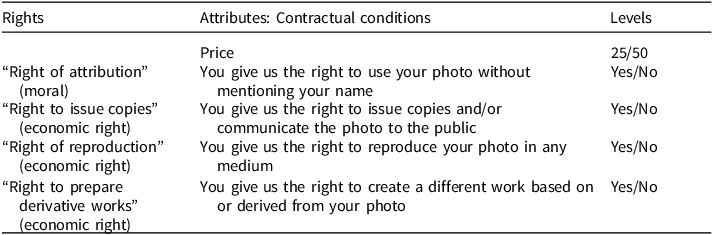
The list of rights with its respective contractual conditions (attributes of contracts) and levels, which were randomly assigned to respondents are presented in Table 1. For the full survey instructions, see Supplementary Material.
The rights and conditions which were varied in the presented contracts
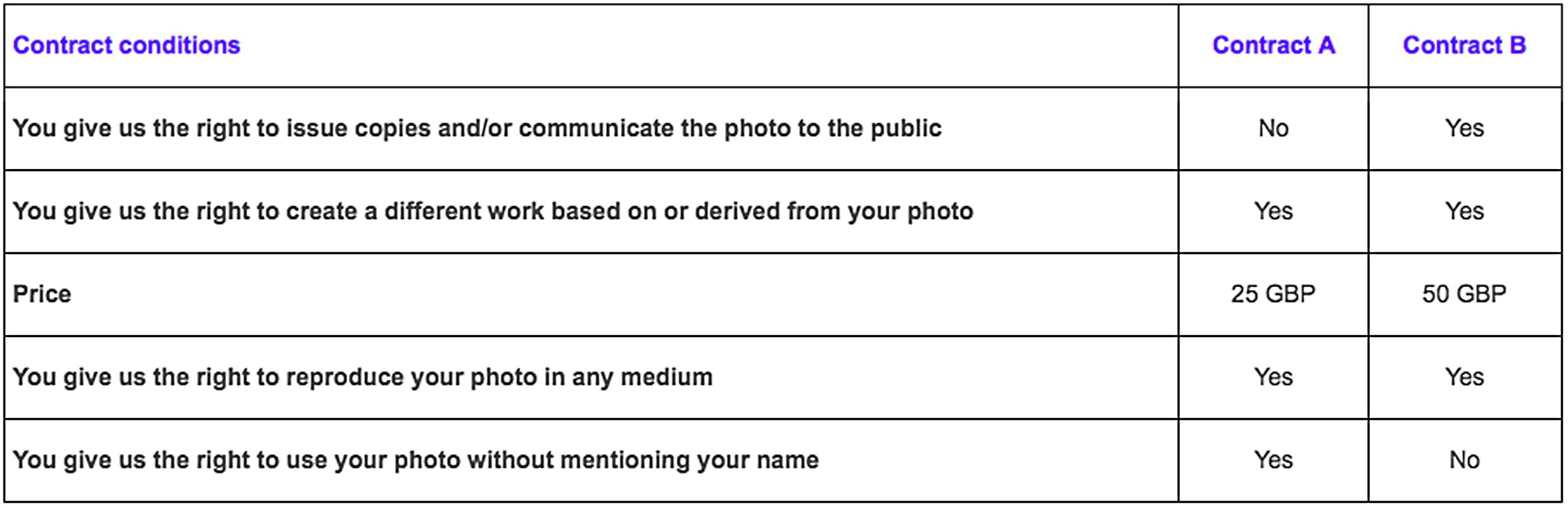
An example of the way the choice has been presented to the participants can be found in Figure 1. In each choice screen the participants needed to choose between contract A and contract B. The random variation of the conditions enabled us to assess how important each of the conditions is for the participants.
An example of a choice screen presented to the participants.
After making a choice between six different pairs of contracts, participants answered a number of demographic questions, as well as questions which were intended to measure their level of experience and knowledge of copyright law. Finally, we have included an attention check to ascertain participants paid attention to the instructions.
Results and discussion
Originally, we had 2,713 participants. It is of note, however, that for the analysis we have excluded those participants who did not pass the attention check, which was provided prior to the conjoint experiment; and/or did not provide the description of the photo; and/or did not complete the conjoint (providing all six choices). After excluding these participants, the study included 1,264 participants, leading to an incidence rate of nearly 47%.
Table 2 presents the main demographic characteristics of the samples. In the supplementary materials we also show the distribution of characteristics in the samples.
Participants’ characteristics per sample

Consistent with our expectations, we have found that the professionals’ samples have more experience with signing copyright contracts than the general population and are more knowledgeable about copyrights.
In the following sections, we present and discuss the results for each of the questions we have posed in this study. We look at each of the samples separately, as well as discussing the differences between the samples.
The importance of the different rights
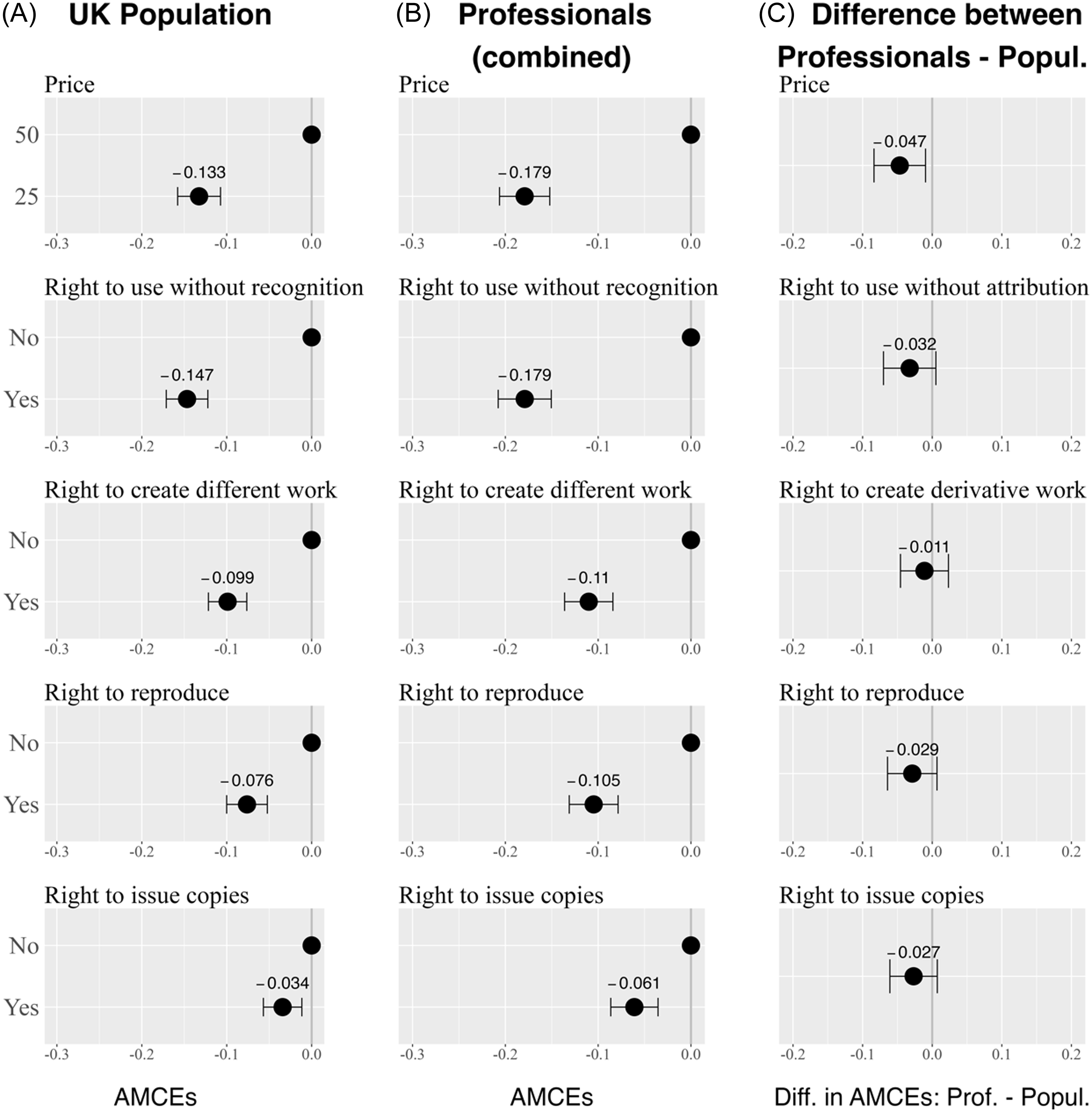
The first question we have posed was with respect to the relative independent weight creators assign to each economic and moral right in their copyright contractual choices. We first look on the (UK) general population (Figure 2).
AMCEs for UK Population and Professionals (UK and USA combined). Note: The figure presents point estimates of the Average Marginal Component Effects (AMCEs) and the differences in AMCEs, along with 95% confidence intervals. The AMCE represents the change in the probability of choosing a contract when a certain price or right is realized, as compared to its baseline level. Panel A presents the AMCEs for the UK lay population, Panel B displays the AMCEs for professionals (UK and USA), and Panel C shows the differences in AMCEs between these two groups.
General population
Figure 2 Panel A reports the Average Marginal Component Effects (AMCEs) for the general population sample. AMCEs capture the shifts in probability when contractual features change. With respect to the price attribute, reduction of a price from 50 to 25 GBP, reduced the probability of choosing the contract by roughly 13 percentage points. This change is derived from, the Marginal Means (MM), which we only report in Supplementary Material. They stand for the probability of choosing a contract given a certain characteristic (independent of all other choices). For the price attribute, for the UK general population, participants had around 43% probability of choosing contract with the price of 25 GBP and almost 57% of choosing a contract which offered a price of 50 GBP for the photo. This probability is averaged over the distribution of other rights in the contract.
Coming back to examining our question, among the general (UK) population participants, our results (Panel A of Figure 2) indicate that the weight assigned to the right of attribution is similar to the weight given to the (higher) price. In other words, the probability to choose a contract decreases to a similar extent when a lower price is offered as when the right of attribution is waived. To illustrate, we found that participants were indifferent between a contract for 25 GBP with the right of attribution and a contract for 50 GBP without the right of attribution. This in fact means, that despite the importance assigned to this moral right, participants are willing to trade it for a higher price.
When comparing all of the choices presented to the participants, we found that both price and the moral right were considered more important than other (economic) rights. In fact, the right which mattered the least to the participants was the “right to issue copies”; whereas the “right to create different work” has a bit higher weight than the “right to reproduce.”
Professionals combined
Next, we look at all the professional participants in our samples (UK and USA). The results in Panel B of Figure 2 demonstrate that also for this group the moral right and the price have the largest effect on the choice of a contract. Among the economic rights, which all receive a lower weight than the moral right and the price, the right to issue copies seems to be the least important.
Figure 2 Panel C brings the results together and illustrates better the similarities between the general population and the professionals. We see that there are no major differences between the general population participants and professional participants. The only small difference is that professionals are more responsive to changes in the price (by 5 percentage points) than participants from the general population. Thus, differences in experience and knowledge of copyrights, does not seem to play a major role in preferences with respect to copyrights. The similarities in preferences between the general population and professionals become even more evident when comparing data solely from the UK (both UK public and UK professionals), as shown in Figure A5 of the Supplementary Material.
UK professionals versus USA professionals
When looking at the results from the UK professionals (Panel A of Figure 3), we see that the moral right receives the highest weight. The estimated AMCE for the “right to use without recognition” is −.17. This is compared for example with AMCE of −.64 when choosing a contract that allows to retain the right to issue copies. The price (AMCE=−.13) seems to be of a similar importance as the moral right, but also not strongly different from the economic rights of derivative work and the right to reproduce.
AMCEs for UK and USA professionals. Note: The figure presents point estimates of the Average Marginal Component Effects (AMCEs) and the differences in AMCEs, along with 95% confidence intervals. The AMCE represents the change in the probability of choosing a contract when a certain price or right is realized, as compared to its baseline level. Panel A presents the AMCEs for the UK professionals, Panel B displays the AMCEs for USA professionals, and Panel C shows the differences in AMCEs between these two groups.
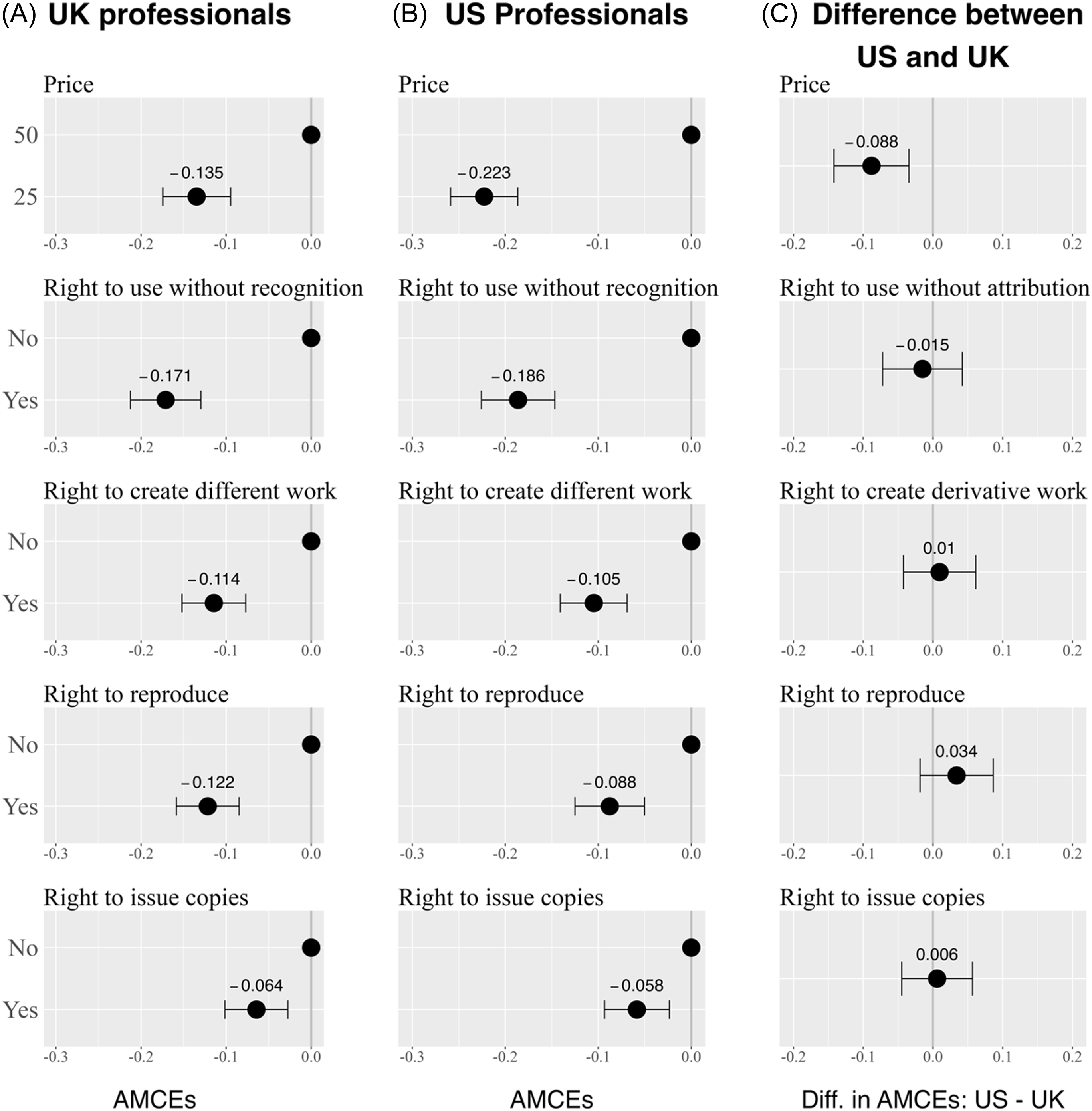
Now we turn to the results with respect to USA professionals (Panel B of Figure 3). Also, USA participants value the moral right higher than the economic rights. We can see it the magnitude of AMCEs. Namely, the presence or absence of the moral right in the contract has a larger effect on their choice of a contract than the economic rights. However, the price plays a larger role for the USA professionals than any of the economic rights. It is also marginally more important than the moral right. The economic rights seem to receive a similar weight to one another.
Panel C of Figure 3 better illustrates the differences and similarities between UK and USA professionals. When comparing those two groups, by computing the differences in AMCEs, we find that the price plays a larger role for the USA professional than for the UK professionals. Yet participants from both countries attach similar weight to the moral right. In other words, the moral right has a similar (independent) effect on their choice of a contract. Furthermore, there are no differences with respect to the weight given to other rights. Professionals in both countries seem to attach similar weights to the economic and the moral rights.
Differences between the sub-groups of respondents
Finally, as an explorative analysis we were interested in examining whether preferences with respect to the different copyrights differ between sub-groups of respondents. We have already reported the differences between professionals and laypeople. Here we focus on sub-groups divided by gender and level of education.
Panel A in Figure 4 presents the results for female and male participants. Given that we did not find major differences between the lay participants and professionals, we conducted the sub-group analysis for the entire UK sample. We find no differences between the weights assigned by female and male participants to the different rights. There are also no differences with respect to the weight assigned to the price.
Differences between sub-groups of respondents. Note: The figure presents point estimates of the differences in Average Marginal Component Effects (AMCEs), along with 95% confidence intervals. Panel A presents the differences AMCEs for female and male participants, and Panel B displays the differences in AMCEs for higher and lower educated respondents.
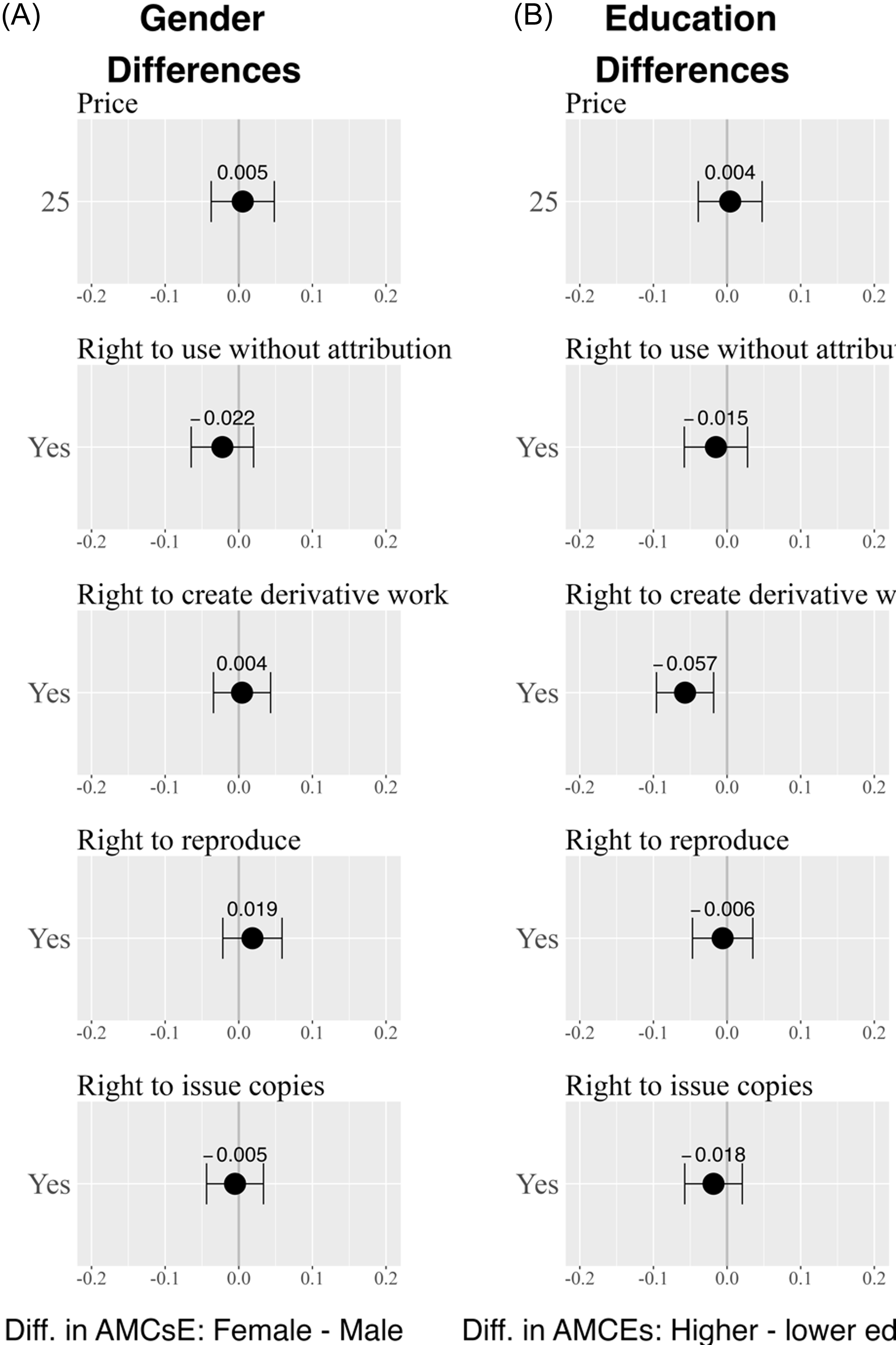
We have also conducted a sub-group analysis for participants based on their education level. We divided participants into two groups: “higher education,” namely those who indicated the education level to be bachelor, master or PhD, and “lower education,” defined as secondary education or other. Interestingly, as can be seen in Panel B of Figure 4, we found that the only right which had different impact on the choice of a specific contract was the “right to create different work.” People with higher education assigned higher weight to this right. All other rights, as well as the price, received similar weights by those two groups.
Policy implications and conclusions
In this paper, we aimed to investigate people’s preferences with respect to the rights traditionally provided by copyrights laws. In particular, we wanted to understand what the independent weight people assign to each right and the trade-off between those rights and the price are. Using a novel methodology for the research of copyrights – a conjoint experiment – we have reached several interesting findings with these regards.
First, our findings suggest that generally participants from all different sample groups (i.e. general population and professionals) value the moral right of attribution to a larger extent than the economic rights. Interestingly, these findings fit very well with the idea that underlines the creative commons movement and the huge impact it had over certain online industries.Footnote 10 Creative Commons is a nonprofit organization that aims to help authors, creators and users to overcome legal obstacles to the sharing of knowledge and creativity by means of providing Creative Commons licenses and public domain tools. These Creative Commons licenses are essentially free, simple, and standardized contracts which grant potential users the permission to use, to copy, distribute, and make use of those works while maintaining the right of attribution. Thus, further suggesting that people value this right to a large extent.
Second, we found that generally USA professionals attach higher importance for the price than other participants. Nevertheless, the economic rights were also important for the choice of the contract, with the right to issue copies being the least important.
Third, when comparing male and female participants, we did not find differences in preferences. We did however find that participants with higher education valued more the right to make derivative work than participants with lower education.
Our results do not only contribute to the scientific literature on copyrights and creators’ preferences, which is understudied empirically but could also have important policy implications.
One of the generally accepted goals of copyright legislation, at least according to the utilitarian approach, is to incentivize creativity. One way for copyright laws to do so, is by providing authors with rights that match their true preferences. This could also serve to increase market efficiency by allowing to make transactions where the rights are given to the one who values it the most.
One area in which scholars and legislators often diverse is with regards to the question of waivability and alienability of moral rights. It is clear from our results that despite the difference in weights assigned to each of the rights tested, people value all the copyrights they are entitled to, but also willing to trade them. Such valuation means that the ability to transfer both economic and moral rights and receive compensation for them, can play a significant role in the ex-ante incentives to invest in the creation. Therefore, recognizing the different rights might in fact fit better the preferences of those who create the relevant works. Implementing these insights in the “real world” might actually require policymakers to recognize moral rights and simultaneously allow creators to “trade” them. This way, creators could potentially demand a higher price for their creation. This in turn, can increase their bargaining power and the potential higher price can increase their incentives to create.
Intermediaries may also benefit from the protection of moral rights if they then have the right to sue third parties for its violation, and no longer depend on the wish of the author whether to sue or not. This is of course not to disregard the fact that creators might engage in strategic behavior with probable inefficient consequences. Nevertheless, all in all, even such strategic behavior would align with authors true preferences and therefore could potentially increase the overall well-being.
Thus far, our suggested policy implications have been stemming from the economic analysis of copyright law. It is however important to recognize that the strong preference towards the right of attribution could in fact also be used to support the more restrictive and paternalistic approach of the Continental-European tradition. If creators value the highest moral rights but are weaker on the bargaining power level, they might give up something they do not wish to. Therefore, recognizing those rights, and yet restricting the ability to transfer it (or even waive it) can be argued to be protecting the author’s interests from their own propensity to err and consequently assist them to attain a larger share of the contractual surplus relative to their counterpart. The assumption underlining this idea is that the authors are inherently weak. Indeed, the combination of the disparity in bargaining power and information asymmetries significantly undermines the author’s ability to capture a fair share of the wealth generated from their creative efforts and contributions. More than that considering that copyright is often perceived as a right designed to promote the economic well-being of authors, this is a fundamental weakness that may undermine the entire system.
In other words, although our findings are incapable to resolve the day-old argument between advocates of the Anglo-American approach and those of the Continental approach, with regards to the question of whether the right of attribution can and should be “traded”, they are able to offer policymakers with empirical findings that could help them reimagine copyright legislation.
Finally, our study demonstrates that there are no major differences between professional and lay participants. This might be good news for researchers. At least in the specific context of stated preferences with respect to copyrights, the external validity is not entirely absent when using participants from the general population. This is important particularly nowadays where many people, whether professional or layman participate in creation and trading of copyright works online. However, our results are derived from a comparison in one country. To increase the generalizability of findings, this question needs to be investigated in more countries.
This study contributes to the understanding of preferences with respect to copyrights. Despite the proliferation of legal rules around the world which regulate copyrights, evidence-based studies on people’s preferences are scarce. The efficiency and the effectiveness of legal rules are not independent from people’s preferences. Therefore, it is important to conduct empirical research into those questions.
Yet, this study has also its limitations, which open venues for future research. We have chosen to zoom in on the Anglo-American tradition, to understand better the preferences there. Those systems are generally similar but with some differences in the rules as well as cultural background which might have an effect on preferences. In our field work we have faced with a difficulty to recruit a large number of professionals for our study from one country. Even thought we were able to provide some tentative results for those sub-groups (UK versus USA professionals) increasing the samples may provide stronger findings.
Furthermore, future research should look at the Continental-European tradition, where different levels of protection are provided. The first step could be running such an experiment on the European civil law systems such as Germany where moral rights receive a stronger protection. Those systems also tend to be more paternalistic. While providing a stronger protection of some rights, they also limit creator’s ability to transfer them. Therefore, it is interesting to examine whether in such systems people assign different weight to the different (copy)rights.
Finally, in future research the examined bundle of rights may be expanded to include all possible rights. This would provide a more complete picture and may guide policy makers in their work.
Supplementary material
The supplementary material for this article can be found at https://doi.org/10.1017/S0143814X25000042
Data availability statement
Replication materials are available in the Journal of Public Policy Dataverse: https://doi.org/10.7910/DVN/BIBHUW (Kantorowicz et al. Reference Kantorowicz, Kantorowicz-Reznichenko and Nahmias2025).
Acknowledgements
We would like to thank the Leiden University Fund and the Gratama Foundation for generously supporting this research. In addition, we would like to thank participants of the 38th Annual European Law and Economics Association (EALE) Conference, and the Private Law Consortium Conference (2019) for useful comments.
Competing interests
There is no conflict of interests to report.
Ethics approval statement
This study is part of a larger study on incentives of copyrights and has been approved by the Ethics Committee of the Faculty of Governance and Global Affairs at Leiden University – no. 2020–014-ISGA-Kantorowicz.
Permission to reproduce material from other sources
All materials are original from the authors, thus there is no need to obtain any permissions.


 Open access

