

In June 1981, South Dakota Governor William “Wild Bill” Janklow and Citibank Chief Executive Officer (CEO) Walter Wriston joined with local dignitaries to celebrate “Citibank Day” in Sioux Falls, the site of Citi's newly opened subsidiary bank. Citi had good reason to come to South Dakota. Unlike other states, South Dakota did not restrict the amount of interest financial institutions could charge on consumer credit accounts, and through its nationwide credit card network, Citi planned to export those rates to its cardholders across the country. This was a radical change. In the United States, banks like Citi had long been confined to local markets by a mix of federal and state law, and this captivity diminished opportunities to reshape regulatory policies in their favor. The policy at the center of this essay, state interest rate restrictions—or usury limits, as they are known—had constrained banks' opportunities to compete for and profit from small consumer loans like those made through credit cards. Citi worked relentlessly to remake that system, and it capitalized on the mobility of credit cards, and then on its own mobility, to gain new power over the regulatory process. As other banks followed, state-level financial regulation and consumer protection became subject to the politics of local job creation and economic development. States, which had been a critical component of the postwar regulatory system, instead became “on-shore” financial havens where banks connected far-flung consumers directly with volatile capital markets. Credit card debt, once checked by usury limits, spiraled out of control.
Recently, scholars have examined the political foundations of the growth of the financial services industry—sometimes called financialization—in terms of market size and profits, emphasizing the consequences of federal regulation since the New Deal and federal deregulation beginning in the 1970s. This essay, however, is concerned with state-level regulatory and political strategies. A new, decentered picture of financialization emerges when we examine how American businessmen and politicians sought to reconcile, and later exploit, the contradictions of a regulatory system ordered by state boundaries and new mobile financial instruments that could move beyond them. By examining the causes and consequences of Citibank's relocation of its card business to South Dakota, this essay demonstrates that individual states were critical sites where banks worked strategically to remake the financial system in the late twentieth century.Footnote 1
To tell this story, this essay will begin by describing the postwar bank regulatory regime and Citibank's place within it. Here, banks were confined within states and their credit card plans were primarily local products—and remained so even as payment networks like BankAmericard (Visa) and Master Charge (MasterCard) linked bank card programs across the country. The pricing and profitability of these bank card plans were shaped by the laws of the states where they were located, but when cards crossed state lines beginning in the late 1960s, conflicting laws created problems for consumers, banks, and state officials. We will look first to the Midwest, where these conflicts culminated in a Supreme Court case, Marquette, that allowed banks to export the interest rates allowed in their home states into those with more restrictive laws. Marquette would be important for Citibank, but only after the bank built a nationwide credit card network to break out of the geographic limitations of the postwar banking regime. This effort foundered on New York's strict usury limit and Citibank's rising cost of funds, which finally pushed Citi to pursue regulatory innovation in South Dakota. There it created, with its South Dakota partners, a new regulatory system that supported state-based efforts to extract profits from a national consumer base.
Citibank's relocation—and the changes the move created in the national banking system—matter not only to historians of the postwar United States, but also to legal scholars and social scientists. The bank's manipulation of regulatory geography offers to legal scholars an example of federalism as a legal instrument in the hands of motivated actors, rather than merely a system of competing and overlapping sovereignties. For social scientists—especially economic sociologists, political scientists, and new institutional economists—this essay clarifies postwar consumer debt accumulation as not just a cultural phenomenon, but one driven by political and economic choices that in turn motivated the design of political and economic institutions. Indeed, one cannot understand the rise of a state-based, nationwide credit card system without paying close attention to the structure, design, and manipulation of such institutions.Footnote 2 This essay provides such an account.
Citibank and the Postwar Bank Regulatory System
Bank credit cards came of age within a regulatory system composed of federal and state law and committed to protecting banks from their own sometimes destructive tendencies. The federal story is well known: The Great Depression revealed the fundamental instability of the U.S. financial system and New Deal policymakers put bank stability at the top of their agenda, backstopping deposit institutions with federal insurance and limiting destructive competition between financial firms. The New Deal Banking Acts compartmentalized financial service providers into specific fields—investment banking, insurance, consumer finance, business lending—and further curtailed competition by fixing maximum deposit interest rates through Regulation Q. National policy, in the broadest strokes, ended there, but the postwar financial regulatory system was federalist, not merely federal. Where Regulation Q limited price competition for deposits, state usury limits, which applied to both state and national banks, curtailed price competition for loans. The federal ban on interstate branching was augmented by state intrastate branching restrictions that limited bank size and, as a byproduct, created a constituency of over 14,500 independent banks that fought for stability at the state level. When large banks sought to use holding companies to circumvent the federal ban on interstate branching, Congress gave states authority to control the conditions of this expansion within their boundaries through the Bank Holding Company Act (1956). Members of Congress knew, or thought they knew, that states would halt any expansion to protect their local banks.Footnote 3
This federalist system of bank regulation provided a golden age of financial stability, but by the mid-1960s, change was on the horizon. In many ways Citibank's experience was typical of how these changes affected large banks. Like its peer institutions, in the early postwar years Citi primarily relied on the non-interest-bearing deposits of businesses for the funds that the bank in turn lent back to other businesses. By the 1960s, the profits of Citi's largest corporate customers were declining, and many firms looked to earn more on their cash assets and pay less for their loans—goals they could increasingly accomplish through financial markets. For Citi to retain its deposits, it too needed to bid for funds in these markets, which increased the bank's costs and squeezed its profits. To counter this squeeze, Citibank and many of its peers pursued aggressive balance sheet expansion. One avenue was the burgeoning consumer loan market. Yet while Citi's corporate clients shopped for loans nationally, consumers borrowed where they lived, and Citibank was geographically confined by state and federal law to New York City and its surrounding counties.Footnote 4
Internationally, though, the regulatory situation was different, and Citibank's overseas division became a source of profits and ideas for the firm's executives. By 1970 the bank boasted over two hundred international branches, initially structured around serving multinational corporations, but through which Citi also pursued consumer-oriented financial services without the geographic and competitive restrictions it faced domestically. Through these businesses, the bank's overseas division became a profit center and a proving ground for young executives. Walter Wriston and John Reed, both strong advocates of the domestic consumer market who would successively head the company, came up through this division. Abroad, Citi also tapped vast reserves of virtually unregulated capital, whether the dollar holdings of European banks or the surplus wealth born of the 1970s oil crisis. Citibank famously “recycled” this capital into Third World development, but Citi executives also channeled it into the U.S. market. The lack of international regulation opened new domestic opportunities just as the profit squeeze forced Citi's executives to find new avenues for growth. Credit cards, these executives hoped, might provide a way to sell consumer credit beyond New York.Footnote 5
State Regulation and Bank Card Profitability
The credit card market to which Citi executives looked had emerged within the local financial economies created by federal and state branching restrictions. The card programs developed by bankers in the 1950s and 1960s were meant to serve existing markets, enabling bankers to sell their lending expertise to local retailers. These small firms could not afford the credit card technology then employed by major department stores, gasoline companies, and other large consumer-oriented firms. Bank cards were a business service first; only later did bankers come to see direct consumer lending as a critical component of bank card profits. Even then they tended to view cards primarily as a way to initiate relationships with consumers, to whom they could then sell additional banking services such as checking accounts or personal loans—services that relied on a bank's brick-and-mortar location and personal interactions between bank employees and customers.Footnote 6
The bank card market remained localized even as, after 1966, BankAmericard and Master Charge began licensing their card products to banks across the country. By working through local banks that would sign up merchants and issue cards to consumers in their region, these card payment systems combined the community relationships of their participant banks into national card networks. This arrangement was specific to the U.S. banking system; Barclays Bank in England, which also partnered with BankAmericard in 1966, marketed its Barclaycards through its nationwide branch network, covering all of England as U.S. banks could only do, at best, within their states. Still, despite geographic restrictions, card plans grew quickly. From September 1967 to December 1969, the number of banks issuing credit cards expanded from 197 to 1,207. During the early 1970s, outstanding credit card balances held by national banks grew 20 percent per year, and by 1976, BankAmericard and Master Charge together accounted for 69 million cardholders.Footnote 7
Even with these successes, profitability remained elusive for many bank card issuers. The card business “can be profitable if it's well run,” confided Bankers Trust Company executive A. Ray Einsel, “but that's not as easy as it appears.” Credit cards carried much higher administrative costs than did traditional installment lending. Processing card transactions involved complex paperwork and billing procedures, especially because banks needed to be in constant contact with participating merchants and other banks, either by telephone or by mail. Computers could speed these processes and drive down costs, but were themselves significant investments. Cards were also more susceptible to default and fraud. Most importantly, state usury ceilings often capped the rates bankers could assess their card-carrying customers, usually at 18 percent annually.Footnote 8
Through the 1970s state usury limits served as a structural check on consumer debt accumulation by making cards effective only as tools for short-term credit. Bank profits reside in the space between the rate banks charge borrowers and the rate they pay depositors and money markets, minus administrative costs and loan losses. Because credit card costs and losses were high, banks needed to assess high interest to make cards profitable. With a fixed usury ceiling in place, however, if a bank's costs rose too much, it would lose money on every credit card transaction its customers made. At the same time, card-issuing banks could not simply stop lending; by putting cards in the hands of consumers, banks created the expectation of perpetual credit availability, and constraining credit—by reducing credit limits or withdrawing cards altogether—was a guaranteed way to lose market share. To offset this interest rate risk, banks kept repayment periods short, structuring minimum monthly payments to ensure that consumers did not carry debts over extended periods of time. The usury laws that created this structure were not dusty holdovers from the nineteenth century; rather, throughout the postwar era, consumer and labor groups fought to keep usury restrictions in place as part of a high-wage, fair-price agenda that recognized the cost of credit—credit that Americans had long embraced—as a critical component of the cost of living.Footnote 9
Where permissible, banks also charged service fees, which provided additional income when interest alone could not cover the costs of extending card-based credit. For instance, Marquette National Bank in Minneapolis, Minnesota, began issuing cards in 1968, but bank executives quickly determined that the card program could not become profitable under the state's 12 percent interest-rate ceiling. Marquette began charging cardholders a ten-dollar annual fee. When the fee went into effect, the bank lost 40 percent of its cardholders, but its card program began to turn a profit.Footnote 10
While Minnesota allowed such practices, New York did not. Citibank had begun its card program in 1967, distributing cards in and around New York City, and had joined the Master Charge system in 1968. New York State allowed Citibank to charge its cardholders between 12 and 18 percent, depending on the cardholder's outstanding balance, but by the early 1970s, bank executives found that many of the bank's customers were paying off their balances each month and thus not incurring any interest charges. Because Citi paid its participating merchants before these convenience users paid the bank, Citi was incurring costs on these transactions without any offsetting income from card users. In early 1976 the bank decided to charge convenience users a fifty-cent monthly service fee. “We feel that this small fee is well within reason,” noted a Citibank spokesman, adding, “This revision is necessary to offset our rising costs and to improve our level of customer service.”Footnote 11
Although the fee seemed sensible to the bank, “well within reason” proved to be a matter of perspective. As one Citibank chronicler recalls, “Angry cardholders stormed into branches and threw their cards in the tellers' faces, forcing Citibank to take special security measures.” Such customer anger was understandable. These cardholders felt that by paying their bills every month they were being responsible credit card users—they were not succumbing to temptation; they were not going into debt; they were not spending extravagantly. It hardly occurred to them that the convenience of their cards came with a cost, that in fact they were committing the most intolerable act of all: they weren't making the bank any money. In any event, the fee did not last. As the result of a class action brought by three Citi cardholders, District Court Justice Andrew DiPaola ruled such service charges illegal and ordered Citibank to repay all collected fees. Though embarrassing for the bank, the real consequences of DiPaola's ruling would only be felt later on.Footnote 12
Fisher and Marquette: Usury Goes to Court
When cards stayed within states, state usury laws constrained credit card profitability but did not impact the landscape of bank competition, since banks within the same state were subject to the same interest rate rules. Bank cards, though, were mobile, and when they began crossing state lines they created new challenges for states and banks, especially when the laws of one state allowed significantly higher rates than did those of its neighbors. Banks began marketing cards across state borders in the late 1960s, and states initially sought to shield their consumers and local financial institutions from out-of-state card issuers. These efforts played out most vigorously in the Midwest and culminated in a 1978 Supreme Court ruling known as Marquette. Marquette would serve as an important legal precedent for Citibank, but the case and its antecedents also provide a useful window into the ways consumers, banks, and state actors strategically mobilized conflicting visions of local regulation in a new age of mobile financial instruments.
The trouble began in February 1969, when Iowa resident Fred Fisher received a BankAmericard from the First National Bank of Omaha (First of Omaha) that neither he nor his wife had requested. Unconcerned, the Fishers proceeded to use their new card, along with a similar one sent from the First National Bank of Chicago (First of Chicago), “from time to time to make credit purchases from member merchants.” Initially satisfied, the Fishers soon discovered that both banks were charging them higher interest rates than allowed under Iowa's usury laws. First of Omaha and First of Chicago were exporting the higher rates permitted in their home states into Iowa.Footnote 13
Fisher brought suit separately against both banks in federal court in Iowa, claiming violation of Iowa's usury laws. In both cases, the court dismissed Fisher's suit for improper venue, forcing Fisher to carry his grievance from his home in Iowa to the banks' home states. At these sites, too, Fisher claimed that First of Omaha and First of Chicago were shipping usurious rates into Iowa, and again he met with frustration. The U.S. District Court for the Northern District of Illinois, Eastern Division, ruled that Illinois law held sway over all loans made by First of Chicago, “whether such loans are made in Illinois or elsewhere.” Fisher, though, was persistent, and he traveled farther still, finally reaching the federal courts of appeals, the seventh and eighth circuits, respectively, which had jurisdiction over Illinois and Nebraska. Yet again, both courts ruled in favor of the defendant banks, and since the Supreme Court did not grant a writ of certiorari—denying Fisher the opportunity to carry his case to Washington—Fred Fisher was forced to go home.Footnote 14
Though Fisher's journey ended there, the interest rate exportation issue did not. With the Fisher cases still pending, First of Omaha looked to extend its BankAmericard territory into nearby Minnesota, creating a subsidiary, First of Omaha Service Corporation (Omaha Service), to enlist customers and merchants in the state. As in Iowa, Minnesota usury ceilings were lower than those in Nebraska, but in Minnesota, banks were allowed to assess card users an annual fee to help make their bank card plans profitable. The Marquette National Bank of Minneapolis (Marquette), which had lost 40 percent of its cardholders when it instituted its fee, was naturally concerned that Nebraska's more permissive usury laws gave First of Omaha an unfair pricing advantage over its own BankAmericard program. Marquette, in league with the state's AFL-CIO chapter, first sought a political solution, urging the legislature to pass interest rate restrictions specifically aimed at bank credit cards. When the legislation went into effect, Marquette filed suit, claiming that First of Omaha's card program did not comply with the new Minnesota law. The case was first filed in federal court, but when the Fisher rulings came down, Marquette's lawyers changed course. They dropped their suit against First of Omaha, choosing to sue only the subsidiary, Omaha Service, a procedural strategy that brought the issue instead into Minnesota state court, asking that the case be assessed as a state, not federal, issue.Footnote 15
Initially, this was a winning strategy, and a lower court permanently enjoined Omaha Service from issuing credit cards in Minnesota. In effect, this also barred First of Omaha, making the Nebraska bank a de facto defendant. On appeal, the majority of the Minnesota Supreme Court argued that a “bank engaged in the interstate business of credit card financing should not be able to avoid the provisions of Minnesota law.” But they could not countenance the procedural prestidigitation employed by Marquette's attorneys. While the majority reluctantly concurred with the Fisher rulings that First of Omaha was subject to Nebraska law, Justice George M. Scott issued a strong dissenting opinion. “Should a simple credit card transaction between a local citizen and a local merchant be construed as a bank loan by the Nebraska bank to a Minnesota citizen, as Fisher proclaims without question?” Scott demanded. He added firmly, “Minnesota should reject such an extension as a misinterpretation of the National Bank Act and exercise its own judgment.” It should, according to Scott, retain its public policy prerogative over in-state interest rates.Footnote 16
The tone of the Minnesota Supreme Court's ruling and the seeming willingness of a state court to challenge Fisher under the right procedural circumstances—First of Omaha would lose a similar case in Iowa's Supreme Court in August 1978—prompted the United States Supreme Court to hear Marquette in October 1978. By taking the case, the court chose to grapple with the challenges that mobile credit cards posed to a regulatory system built on immobile state boundaries. Fittingly, the key legal question in the case pertained to the meaning of the word “located” as written in section 85 of the National Bank Act of 1864, which mandated that a national bank assess interest based on the laws of the state in which it is “located.” Was, the court contemplated, First of Omaha's BankAmericard program “located” at a physical site in some state, and if so, where was it?Footnote 17
When the law was written, this would have been self-evident: in 1864, a bank had a concrete location. Credit cards complicated this question; the program could have been “located” in Minnesota, where a Minnesota citizen would employ a First of Omaha credit card to purchase goods from a Minnesota merchant, as Judge Scott's dissent in the antecedent case suggested, and therefore be subject to Minnesota's usury laws. Several justices appear to have initially agreed with this interpretation. In May 1978, Justice Harry Blackmun wrote that the Fisher ruling distorted the National Bank Act's “original purpose of preventing discrimination against national banks,” instead making the law “a sword for discrimination in favor of out-of-state national banks.” Former U.S. Solicitor General Robert Bork, arguing on behalf of First of Omaha, offered a different line of reasoning. All aspects of the credit transaction, its extension and repayment, happened by mail in Omaha, meaning the card program was legally “located” there. “Nebraska is not exporting interest rates,” Bork explained to the court. “It is more accurate to say that Minnesota is exporting its law to a Nebraska bank.” Thus Bork, retained by First of Omaha solely to deliver the oral argument, ingeniously reversed the rhetoric of exporting and extraterritoriality mobilized by Marquette's attorneys and swayed the Supreme Court in the process.Footnote 18
In delivering the opinion of the unanimous court, Justice William Brennan stated, “If the location of the bank were to depend on the whereabouts of each credit card transaction, the meaning of the term ‘located’ would be so stretched as to throw into confusion the complex system of modern interstate banking.” Yet for Fred Fisher and millions of other bank card users, the meaning of a bank's location was already in confusion. While the court fixed the “location” of a bank at the physical place stipulated by its charter, credit cards spread transactions further afield, erasing the boundary lines between states even as banks relied on these lines to predicate their pricing. In this way, the highest federal court tacitly sanctioned a geographic divergence. Local relationships—whether between a bank and its customers or between a state and its citizens—might no longer have any fixed relationship to consumer credit. Nebraska usury laws could be brought to bear on Minnesotans.Footnote 19
National Credit Cards, Local Usury Limits, and the Problem of Interest Rate Risk
Marquette, a regional dispute with regional consequences, was hardly noticed at the time and likely would have remained so without Citibank. As the Fisher and later Marquette cases moved through midwestern courts, however, Citi executives back east began to look to the credit card market as a way to grow the bank's consumer lending business beyond New York. Although the bank had tried other methods of geographic expansion, every attempt to move into new businesses and territories domestically brought conflict with the bank's federal regulators, especially the Federal Reserve, which was not yet ready to countenance nationwide banking in the United States. Credit cards, though, offered an innovative way to redraw the bank's regulatory geography. As Reed told the publication American Banker, “My own personal belief is that almost everything we have traditionally distributed through the branch system can be delivered on the card.” And cards could go anywhere, enabling Citi to traverse federal and state branching boundaries and build a truly nationwide card-user network.Footnote 20
Visa would open up the regulatory borders for Citibank's interstate expansion. In late 1976, National BankAmericard Inc. (NBI), the member-owned payment systems company that licensed the BankAmericard brand, announced its intention to drop the BankAmericard name in favor of consolidating the company's domestic and international card operations under a new name: Visa. This move was designed to distance NBI from Bank of America, the original issuer of the BankAmericard, providing a unified brand for the thousands of credit cards issued as part of NBI's payments network. The company chose “Visa” because, according to NBI's president Dee Hock, the “adoption of the single name ‘Visa,’ surmounts language and cultural barriers and is the final step in assuring instant recognition and acceptance around the world.” To inform BankAmericard holders and other consumers of the change, NBI planned a national advertising campaign, alerting customers to expect a new Visa card from their local bank—and presenting the artful executives at Citi with a unique opportunity.Footnote 21
Before 1976 the competing card payment systems did not allow their member banks to issue more than one brand of credit card; a Master Charge issuer such as Citibank, for example, could not also issue BankAmericards. When the payment systems removed the barrier, Citi immediately joined NBI. The bank, though, did not intend to confine its issuance to its New York market; instead, Citi began mailing preapproved Visa applications to former BankAmericard holders across the country. Capitalizing on the confusion caused by NBI's rebranding effort, Citi aggressively pushed into geographic markets previously controlled by other NBI banks. Many consumers, assuming that Citi's offer was part of the Visa name change, promptly mailed the bank their acceptances—four million of them. Other NBI issuers responded with outrage. Missouri bankers, for instance, were irate that Citi had dared encroach on “their market.” “The only thing bad about the credit-card business,” fumed St. Louis banker William Travis, “is that some banks are getting too greedy.”Footnote 22
Although local card-issuing banks saw cardholders as their customers, cardholders did not necessarily see themselves that way. The credit cards issued through BankAmericard and Master Charge carried these logos prominently, reorienting consumers' focus away from the issuing bank and toward the national payment system—the name on the card that gave the card its purchasing power. While these card systems initially relied on local banking relationships to build their merchant and customer bases, they also eroded these boundaries as BankAmericard and Master Charge became national, even international, institutions, synonymous with mobility and surmountable distance—exactly what the name Visa was meant to capture. BankAmericard customers, Citibankers believed, were unaware of the local bank connections that linked them to the payment networks. “The consumer,” Citibank executive David Phillips explained to a congressional hearing in September 1977, “has been telling us through his behavior that he does not view the card as a ‘local’ geographically constrained product.”Footnote 23
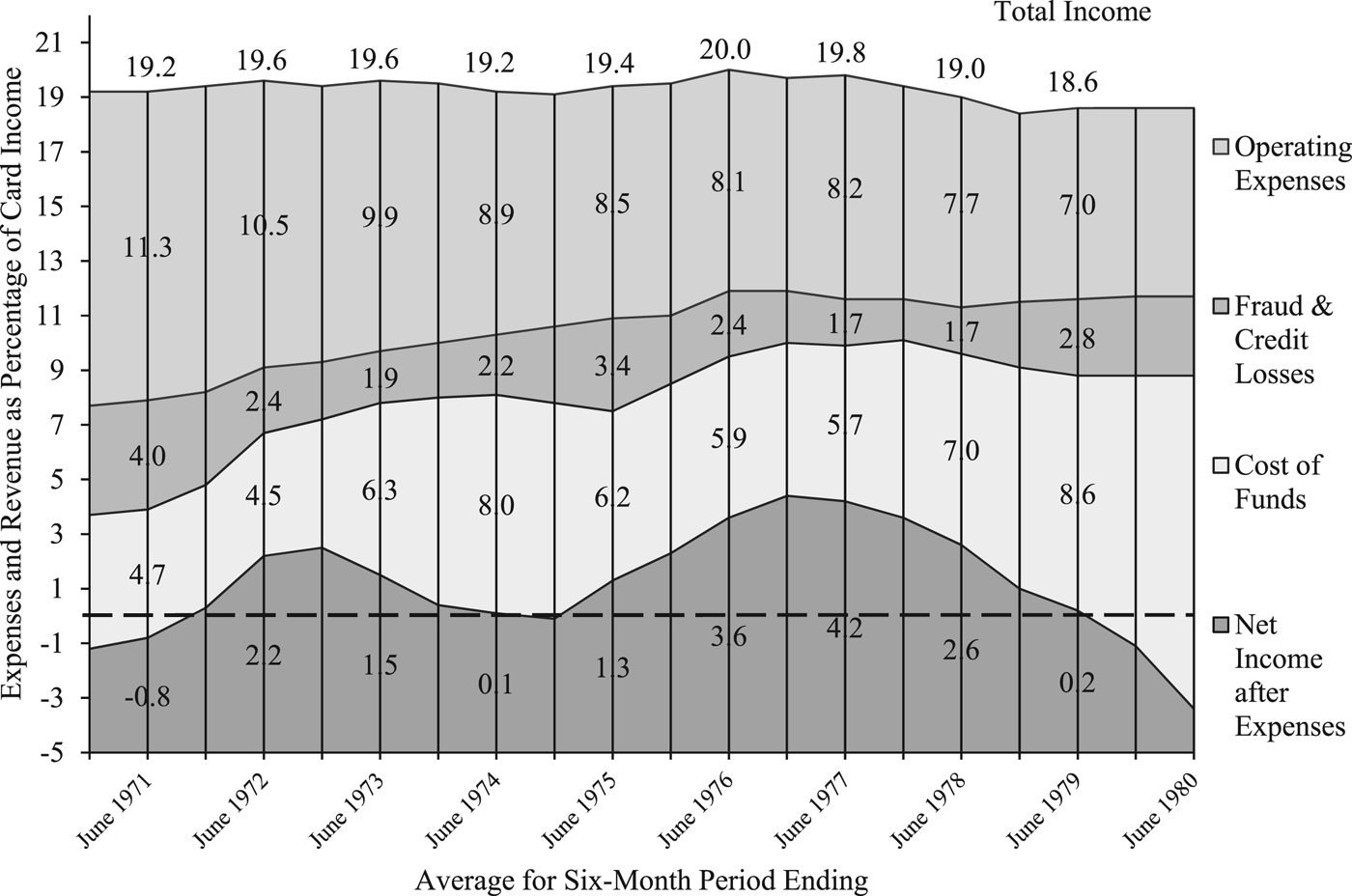
Citibank's competitors responded with solicitations of their own, and initially this escalation of bank card marketing seemed to proceed profitably. While state usury laws limited the amount of interest most banks could charge, the total income from credit purchases, which also included fees paid by merchants accepting the banks' cards, exceeded most banks' expenses and costs of capital. A report from Visa showed that the average total income for bank credit cards equaled 19 percent of the total outstanding balances in June 1978 (see Figure 1). Subtracted from this were credit card processing costs, at 7.7 percent, and fraud and credit losses, at 1.7 percent. With a cost of funds averaging 7 percent, banks were clearing a net income of 2.6 percent on their outstanding card balances. But those profits were being squeezed. Although fraud and credit losses would increase over the subsequent year because of the wide and sometimes unwise distribution of cards, the real worry for banks came from interest rate risk linked to their rising cost of funds.Footnote 24
Annualized return on outstanding bank credit card balances. The figures are based on Visa System quarterly member reports; the first six months of 1980 is Visa's forecast. (Source: Visa USA Inc., “Credit Controls and Bank Credit Cards: Analysis and Proposals,” 794.01 (L) Voluntary Credit Restraint, Mar. 1980, Federal Reserve Bank of New York Archives, New York.)

Interest rate risk posed tremendous danger for card plans. The breakneck inflation of the late 1970s accelerated rising interest rates as investors demanded higher premiums for funds that inflation would devalue in the future. This advancing tide of inflation-elevated interest quickly trapped card-issuing banks such as Citi against the unforgiving ceiling of state usury regulations. Citi had to pay depositors and money market investors for the money that it, in turn, lent borrowers, and New York's usury limit effectively created an income ceiling with no cost floor. In the third quarter of 1977, when Citi began its Visa campaign, its internal cost of funds stood at 6.21 percent, a rate that compares favorably with industry figures. A year later that number stood at 9 percent, and the bank's internal forecasts estimated that it would rise to over 10 percent by the third quarter of 1979. At this rate, taking into account the high cost of administering card accounts, the bank was losing money on every credit card transaction it financed. For a bank that now had 5.8 million cards outstanding, this posed an urgent problem that could not, thanks to Justice DiPaola's ruling, be offset by imposing annual fees.Footnote 25
By late 1979, Citi's attempt to institute nationwide card-based banking was suffering from a case of profoundly bad timing—a problem that would soon became a crisis. Newly appointed Federal Reserve Chairman Paul Volcker was determined to purge inflation from the economy and, in October 1979, took unprecedented steps to do so. Volcker's Fed announced that it would cease its traditional manipulation of market interest rates, intended to provide stability, and instead target the money supply, ceding control of interest rates to the whim of financial markets. Immediately following the Fed's shift in policy, interest rates rose dramatically. One indicator, the federal funds rate—the rate at which banks make short-term loans to each other—jumped from what had been a historically high 11.5 percent to an astronomical 15.5 percent; it had been 6 percent when Citi began its national campaign.Footnote 26
Simply put, the Fed's action crushed the bank credit card industry, especially as consumers continued to demand credit as a hedge against future inflation. As Citi CEO Walter Wriston wrote in a Washington Post op-ed in March 1980, “[Consumers] perceive that if they borrow at . . . 12 percent when inflation is 18 percent, they're beating the system.” For the banks this was disastrous: “If you are lending money at 12 percent and paying 20 percent,” Wriston later lamented, “you don't have to be Einstein to realize you're out of business.” Not wanting to sacrifice market share, many banks endured the losses, while others considered exiting the market altogether. “There is . . . a good deal of concern regarding losses on consumer credit cards,” the New York Fed's Thomas Timlen observed on a March conference call, adding “but that's news to no one.”Footnote 27
For Citibank, the problem was particularly acute, given its massive credit card portfolio and New York's strict interest rate limits, which Citi could not convince legislators to raise. Though bankers and their Republican allies were eager to associate usury ceilings with outmoded traditionalism, Democrats in the state assembly fought to keep caps in place or, at most, to raise them only temporarily. Through early 1980, legislation went nowhere. Thus, while Citibank had invested hundreds of millions of dollars creating a card-based national bank, it now faced the prospect of losing hundreds of millions more on the spread between its cost of money and the price at which it could lend. And though Citibank's national credit card gamble threatened to capsize the company, Citi could not, like other banks, abandon ship. Citibank's success, both domestically and abroad, had as much to do with the bank's reputational capital as its financial capital, and scuttling its credit card business would have humiliated the bank and likely crippled Citi's ability to undertake such expansionary projects in the future. With lending losses escalating, Citibank needed a dramatic solution to its interest rate problem—and it found the answer in Marquette.Footnote 28
Strategic Manipulation of Regulatory Space: Citibank Comes to South Dakota
Marquette turned on the meaning of the word “located.” That word meant one thing to First of Omaha and Marquette, which were located in fixed places, and another to Citibank executives, whose global experience taught them that the “location” of a bank's operations depended on the legal fictions of a bank charter, not the physical infrastructure of a bank building. With Marquette, Citi executives saw an opportunity to save their credit card business (and perhaps the bank itself) by relocating its consumer credit operation to a high-usury state. From there, Citi could project higher interest rates back into New York and to its credit card customers across the country. The bank would thereby substitute a spatial solution for a political one, escaping the challenges of local regulation by simply moving to a more favorable location.Footnote 29
Such a move was legally possible under conditions set out in the Bank Holding Company Act of 1956, but only if another state explicitly invited the bank in. In early 1980, Citibank's lawyers began narrowing a list, first to states with usury ceilings at 22 percent or higher, then to states with legislatures still in session, and finally to states other than California (it was inconceivable that Bank of America's home state would welcome Citi in). The final list was short: Citibank executives could choose between Missouri and South Dakota. With a large labor pool and an established communications infrastructure, Missouri seemed the obvious choice, and the two thousand jobs Citi promised guaranteed the bank a thoughtful hearing from state legislators. Missouri's banking community was not as welcoming; St. Louis bankers were still irate at Citi's earlier unsolicited incursions into “their market” and blocked the move—exactly what the framers of the act had expected would happen.Footnote 30
That left South Dakota, a state not generally known as a center of banking and finance. In fact, when Citi executives began deluging the governor's office with calls, the state was the center of a financial mess. South Dakota had long suffered from the decline of family farming in the face of globalized agribusiness. For seven years running, its nonagricultural workers were the lowest paid in the nation, contributing to a distressing out-migration of young South Dakotans looking for better opportunities elsewhere. The tight money policies of the Fed further wrought financial havoc for South Dakota's local banks. With their cost of money rising as Federal Reserve Chair Paul Volcker wrung inflation out of the economy, South Dakota bankers were bumping up against the state's already high usury limit in their efforts to make local loans, squeezing out small borrowers and virtually halting local economic activity. Looking back on the period, South Dakota Governor Bill Janklow recalled, “The economy was, at that time, dead.”Footnote 31
Before Citibank arrived, South Dakota bankers were working on their own solution to the problems imposed by interest rate limits. If the state lifted the regulatory constraints on lending, these men believed, they could resurrect the local economy. At their annual policy meeting in November 1979, the South Dakota Bankers Association (SDBA) considered recommending that the legislature raise the state's usury limit 2 percent to keep pace with the rising cost of money emanating from the Federal Reserve. To the surprise of those attending, Thomas Reardon of the Western Bank of Sioux Falls proposed a more dramatic solution: that the state instead exempt all regulated lenders from the state's usury limit, a proposal that would allow South Dakota banks to charge any interest the market would bear. Following a “short and compelling argument” from Reardon—and a quick second from his brother-in-law, the CEO of Pierre National Bank—the motion carried. Although some bankers were stunned, the SDBA was nevertheless able to rally support from the governor and the legislature, and South Dakota's anti-usury bill passed by a wide margin in January 1980.Footnote 32
This action, which occurred without Citibank's knowledge, clearly demonstrated the local power of South Dakota's banking community. Consequently, when Citibank approached Governor Janklow in February 1980 about its possible relocation to South Dakota, the first place to which Janklow turned was the SDBA. Naturally, these men were deeply concerned about the competitive presence of a bank with Citi's size and resources, but they were also encouraged by the possibility of jobs and the banking services Citi could provide them. Though Citibank initially promised only a few hundred local positions—holding out hope that New York would raise its rate caps to stave off the bank's threatened move—the potential economic impact of Citi's entire credit card division was estimated at between $63 million and $68 million. Furthermore, Janklow was convinced, economic growth need not come from Citibank alone; with Marquette and a new appreciation for federal banking law provided by Citi's executives, the governor saw the potential to bring an entirely new industry into his state.Footnote 33
Still, to approve the deal South Dakota's bankers wanted protection, and Janklow and the legislature gave it to them. First, credit card banks like Citi hoping to relocate to South Dakota would need to secure the approval of the state's banking commission (a board controlled by local bank executives) rather than from the director of banking and finance (a political appointee). Next, the so-called Citibank Bill limited out-of-state banks to one location; further, it read, “such single banking office shall be operated in a manner and at a location which is not likely to attract customers from the general public in the state to the substantial detriment of existing banks in the state.” In practice, this meant that Citi's “bank” was a nondescript office building in an industrial park by the airport, not a cheerful storefront downtown that took deposits and gave away toasters. In this way, South Dakota seemed to succeed where Minnesota had failed, protecting its local banks from out-of-state competition and bringing in new industry to boot. Meeting with wide approval, the Citibank Bill cleared both houses of the state's legislature on March 12, 1980, by a combined vote of 97–3.Footnote 34
South Dakota and Citibank thus laid the groundwork for a new era in American consumer finance. With no applicable usury ceiling, Citi could set its credit card rates at will and project the laws of one small state onto every Citi-card transaction across the country, circumventing local regulations by locating transactions in South Dakota. Further, because Citibank's South Dakota subsidiary could not compete for local deposits, “the bank's principal source of funds” would, Citi reported in its national bank application, “be obtained through money market instruments.” This meant that Citi would now intermediate directly between large-scale capital markets and consumer borrowers, transferring risk and volatility from one to the other. This was the essence of financialization.Footnote 35
Through its use of Marquette, the bank was bringing its mastery of regulatory arbitrage to bear on the domestic market, stretching the seams of federalism as it had the sovereignties of nation-states. With locations across the globe, the bank was adept at finessing differences in tax structure and regulatory requirements across geographies and had done so to great profitability throughout the 1970s. As the U.S. Securities and Exchange Commission would later find, Citibank subsidiaries in London and Frankfurt regularly booked transactions through subsidiaries in Nassau and the Channel Islands, skillfully avoiding British and German currency regulations, capital requirements, and taxes. Citi executives had, through these means, long stretched the meaning of the term “located.” As one commentator noted, “The real significance of Citibank's activities . . . relates not so much to the question of illegality or wrongdoing as to the ease with which deals can be booked to any part of the world that happens to be convenient and the possibilities presented thereby for regulatory circumvention.” And, one should add, profit.Footnote 36
Federalism Becomes a Powerful Tool: Local Bank Jobs and National Credit Policy
Citibank's move still required regulatory approval, and with protections against local competition in place, Citi's greatest support came from South Dakota's banking community. These bankers' prestige and profits—not to mention their political influence—were intertwined with the economic prosperity of their state, where Citi, they hoped, would help attract additional “desirable commerce and clean industry.” Consequently, they testified at public hearings held by the Office of the Comptroller of the Currency and wrote letters of support to the Fed. “Though it is not customary for a banking institution to write in support of a potential competitor,” wrote a Sioux Falls banker to the secretary of the Federal Reserve Board of Governors, “we . . . feel the proposal has great future potential for Sioux Falls and South Dakota and do support it wholeheartedly.” By publically supporting Citi's move and mediating between the bank, the federal government, and their communities, South Dakota bankers reaffirmed their status of local economic leadership, even as they helped Citibank relocate.Footnote 37
Federal regulators approved the move and with it a new regulatory geography, still reliant on states, even as individual state decisions could be projected nationally. Now, a New York citizen, shopping at a New York retailer, using a credit card from a nominally New York bank, could be subject to the lending laws not of the state of New York, but to those of South Dakota—where they could not vote, hold office, or stand to sue. Being able to “locate” in South Dakota, or any other nonusury state, enabled Citibank to orchestrate a deft regulatory arbitrage, projecting the local decisions of South Dakota legislators onto its cardholders across the country.
The example set by Citi's relocation placed new pressure on states that had tried to retain interest rate regulation in the face of mobile credit instruments; as many more banks moved or threatened to move, state law became an increasingly impotent tool for controlling consumer interest rates on the local level. Within a year of Citibank's relocation announcement, Delaware legislators—equally eager to lure jobs and investment to their state—passed legislation virtually identical to that of South Dakota. Forced to react to such moves, forty-four states had either loosened or lifted their usury laws by 1983. Even Iowa did an about-face, and by 1984 its governor was busy luring out-of-state banks. “Effective July 1, 1984, there will no longer be a finance charge limit on bank credit cards,” Governor Terry Branstad wrote to the president of Washington's Rainier Bancorp., adding, “This assures Rainier Bancorp. a competitive position in credit card operations regardless of fluctuating interest rates.”Footnote 38
As Branstad's memo made explicit, the elimination of state usury limits effectively removed the interest rate risk that had previously constrained card plans. Without these limits, unrestrained banks could begin pumping increasing volumes of capital into consumer credit and credit card debt. This undoubtedly opened credit markets and made credit available to underserved consumers, but it also gave primacy to bankers in a political debate where unrestrained markets and consumer protection were at odds, at a moment when increasing credit availability replaced rising wages as the foundation of economic citizenship and purchasing power.
The decisions of other states to lift their usury ceilings blunted the local impact of Marquette, but South Dakota policymakers were committed to making the state “the frontier of modern banking.” Through the 1980s the state continued to pursue local regulatory innovations that would bring jobs to South Dakota and regulatory change to other states. In 1983, with Citi's support, the state passed legislation allowing commercial banks to acquire insurance companies, so long as they sold insurance outside South Dakota. When Citibank moved to use this power, the Federal Reserve intervened, chastising South Dakota policymakers “for placing job expansion concerns above considerations for the soundness of the national banking system.”Footnote 39
By the early 1990s, however, the national regulatory picture had changed—deregulation had become mainstream—and as South Dakota's relationship with Citibank matured, the state's most pressing priority shifted from luring other banks in, to making sure Citibank, and its jobs, capital, and prestige, did not leave. Indeed, in 1991 some state legislators began to worry that other card-friendly states, notably Nevada and Delaware, might offer Citibank a more favorable tax climate than South Dakota. Though House Republican Leader Jerry Lammers was quick to assure citizens that Citi had made no threats to leave, “by a stroke of the pen,” he warned, “Citibank could, if it wished to do so.” To meet this implicit threat, the legislature instituted a new sliding tax scale, sharply discounting all bank income above $500 million. Citibank was the only South Dakota bank approaching this revenue figure, and the tax break came in a year when a budget shortfall forced the state to raise taxes elsewhere.Footnote 40
The bank has not left. Walking in Wriston's footsteps, CEO Charles Prince came to Sioux Falls in April 2006 to honor Citi's twenty-fifth anniversary in the state. At the celebration, Prince began by recalling the great leaders who, in Citibank's hour of darkest need, found a solution to the bank's credit card problem: “A solution that was good for South Dakota—and that's terrific!—but frankly can be seen to have saved Citibank. Think of that:” Prince continued, in reverent awe, “Saved Citibank.” Prince, though, was not only interested in the past; he was there to urge his employees to continue growing the bank's card business. “Cards [Divison],” Prince implored, “is the centerpiece of our North American Consumer business. There's no getting around it.” Gaining momentum, the CEO of the world's largest financial services company emphasized each of his next seven syllables, “We Need Growth from U.S. Cards—We need growth in what we sell to people. We need growth in numbers of accounts. We need growth.” He crescendoed, “We're going to grow this business. We're going to grow Citigroup.” And Prince did: Citi's net income from the U.S. cards division rose an impressive 41 percent in 2006, to $3.9 billion dollars.Footnote 41
Conclusion
Citi's remarkable statistics represent the outer limit of a credit card bubble, which, along with the mortgage bubble, was soon to burst. The following year, as the global financial crisis began to unfold, the bank's card income fell 26 percent. In 2008, with the collapse fully underway, the company lost a staggering $523 million on its North American credit card accounts, underscoring the immense growth in consumer indebtedness that Citibank's relocation to South Dakota had helped create. Outstanding revolving consumer debt had doubled from 1980 to 1985, again by 1990, again by 1995, and again by 2005, topping out in April 2008 at over $1 trillion. The removal of usury limits, and with them interest rate risk tied to credit card accounts, helped make consumer debt an outsized component of the newly financialized economy.Footnote 42
The central role of consumer debt after 1981 was possible only because banks strategically turned a regulatory system meant to stymie their growth to their advantage. Indeed, a financial regulatory system founded on a bank's location proved incompatible with a new era of mobile financial instruments, which extended state regulation—through the national banking system—onto the citizens of other states. “A law enacted by the Nebraska legislature will determine the interest rates charged to respondent's Minnesota customers,” Minnesota's AFL-CIO argued, as amicus curiae, in Marquette, yet “a consumer interest group in Minnesota has no voice in the legislatures of other states.” What was true for credit card accounts was also true for a variety of other financial products, including mortgages and money market checking accounts that also moved across state lines. Once banks, aided by their state allies, embraced the possibilities of relocating beyond regulatory frontiers, the politics of economic development mingled with those of financial regulation, threatening states that were reluctant to accede to bank interests. Freewheeling financial products reshaped a regulatory landscape that had limited the political power of financial institutions by limiting their mobility, and barriers to their mobility continued to fall.Footnote 43
For Citibank's CEO Walter Wriston, the bank regulatory system's pluralism was not a flaw, but a feature, one the bank's executives had long appreciated in their international operations. Writing to Senate Banking Committee member Charles Percy, Wriston stated his position clearly: “If a complicated structure is a concomitant of less regulation and more competition, then I am for it.” Wriston meant competition between financial institutions, but his bank's actions also led to competition between states for bank jobs and bank capital. Yet Citibank's use of regulatory barriers led other states to tear them down, to the detriment of Citi's partners in South Dakota who continued to push regulatory innovation—first to bring more banks in and then to ensure its banks didn't leave.Footnote 44
For Americans, this meant a diminished voice in the local political economy of consumer credit, even as regulatory geography continued to structure the bank card industry. In 1991, the Supreme Court extended its ruling in Marquette to include late-payment fees and other card account charges. By 2003 almost three-quarters of credit card loans in the United States originated from states (including South Dakota and Delaware) containing just 4 percent of the country's total population. Importantly, Citibank's relocation did not make state interest rate regulation irrelevant; rather, it made the interest rate regulation of a few states national policy. Opponents of interest rate limits might argue that they and other price caps impede market efficiency, and that through the removal of interest rate and other pricing restrictions, American consumers benefited from greater credit availability. Financialization, though, is about more than just credit access. Whether consumers should be able to shield themselves from high interest rates, annual fees, and overdraft charges is also always a political question. The extraterritoriality of bank credit cards reshaped this question in favor of the banking industry, ultimately leading to the instability of political and economic citizenship in America's age of finance.Footnote 45