




Introduction
During the Terminal Classic period (a.d. 830–900), economic and political interaction between the Maya region of Mesoamerica and areas to the west intensified, even as many Maya population centers declined and their ruling dynasties collapsed. In this context, water routes stretching from the Caribbean coast, around the Yucatan Peninsula, and westward along the Gulf Coast took on heightened importance, facilitating connections with the peoples of Veracruz and central Mexico and increasing the wealth and power of Gulf Coastal Maya groups (e.g., Andrews and Mock Reference Andrews, Mock, Masson and Freidel2002; Ardren et al. Reference Ardren, Hutson, Hixson, Lowry and Hutson2017). Works of art produced for sociopolitical elites in the Maya region may depict some of these interactions and reflect the emergence or introduction of new or newly emphasized themes and ideas. The militaristic sculptures and murals of Terminal Classic Chichen Itza, closely paralleling monumental programs at Tula, Hidalgo, have long been the subject of investigation and debate in this respect (Guenter Reference Guenter2019; Kristan-Graham and Kowalski Reference Kristan-Graham, Kowalski, Kowalski and Kristan-Graham2007; Ringle Reference Ringle2017; Thompson Reference Thompson1966, Reference Thompson1970; Tozzer Reference Tozzer1930, Reference Tozzer1957; Volta et al. Reference Volta, May, Braswell, Wren, Kristan-Graham, Nygard and Spencer2018). But other works produced during the same period—at Maya centers and at Tula—stress, not militarism or martial hierarchy, but social and economic interactions that include the presentation of gifts or tribute, or conferences between apparently equal parties (Kristan-Graham Reference Kristan-Graham1989:343–346). In the Maya region, themes of conference and cooperation migrated from polychrome ceramic vessels to other media, including monuments and personal ornaments.
One category of Terminal Classic ornaments which exhibit this thematic shift is a small corpus of shell gorgets, mostly semielliptical or “lunate” in shape and probably all carved from conch shell. These have not been intensively examined as a class, both because so few of them have been found and because several examples lack archaeological provenience. Of those semielliptical gorgets whose origins are known, one was found in the Valley of Mexico (Lumholtz Reference Lumholtz1902:454), while others were recovered from Terminal Classic contexts at Ceibal, El Peru-Waka’, and Uaxactun in the southern Maya lowlands (Kidder Reference Kidder1947:63; Lee Reference Lee2003:161–162; Willey Reference Willey and Willey1978). This geographic distribution, the style of their portraiture, and a single calendrical date in a non-Maya script inscribed on one of the unprovenienced gorgets all raise the question of the role of these objects in interactions between the Maya world and the societies of central Mexico. Herein, we describe the thematic and stylistic variation and commonalities of these objects, report on a previously unpublished gorget in the Haffenreffer Museum of Anthropology at Brown University, and attempt to situate these ornaments in the context of long-distance interaction.
Terminal Classic conch-shell gorgets
Ornaments fashioned from marine shell have a deep history in Mesoamerican art, dating back in the Maya region to at least the Early Middle Preclassic period (1000–700 b.c.; see Sharpe Reference Sharpe2019:497). Ancient Maya artisans crafted shell into ear ornaments, pectoral jewels, plaques to be sewn onto clothing and diadems, and noisemakers worn for ritual dances, among other artifacts (Zender Reference Zender, Finamore and Houston2010:84). Among the pendants and pectoral ornaments they produced, favored forms included limpet-shell oyohuallis, Spondylus and other bivalve shells with portraits or narrative scenes sometimes carved on their interior surfaces, and jewels in the form of the IK’ (“breath”) logogram (e.g., Matsumoto and Tremain Reference Matsumoto, Tremain, Carter, Houston and Rossi2020; Prager and Braswell Reference Prager and Braswell2016). Facial and pectoral ornaments were associated with breath and the soul (Houston et al. Reference Houston, Stuart and Taube2006:141–152), and some shell pendants—especially in the Early Classic period—were engraved with the portraits of royal ancestors looking down from the sky (Figure 1), or with other supernatural beings (Doyle Reference Doyle, Finamore and Houston2010:130; Houston Reference Houston, Finamore and Houston2010:78; Taube Reference Taube, Finamore and Houston2010:125).
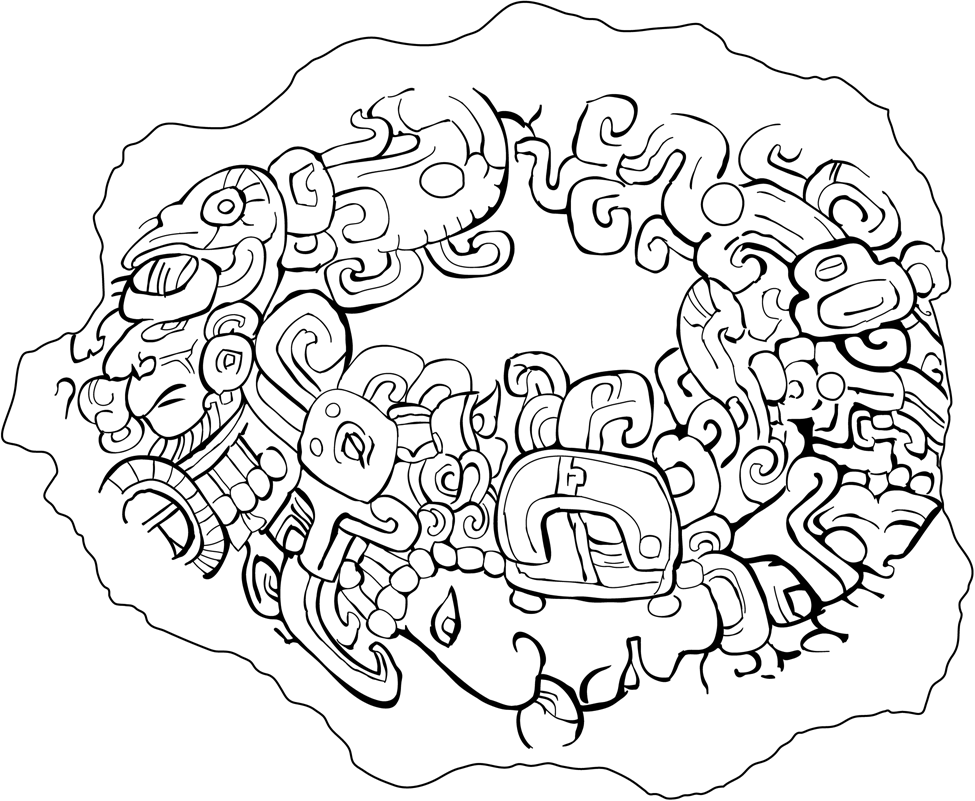
Shell plaque from Burial 162, Tikal, depicting a royal ancestor. Drawing by Carter after Finamore and Houston (Reference Finamore and Houston2010:Catalogue No. 45).
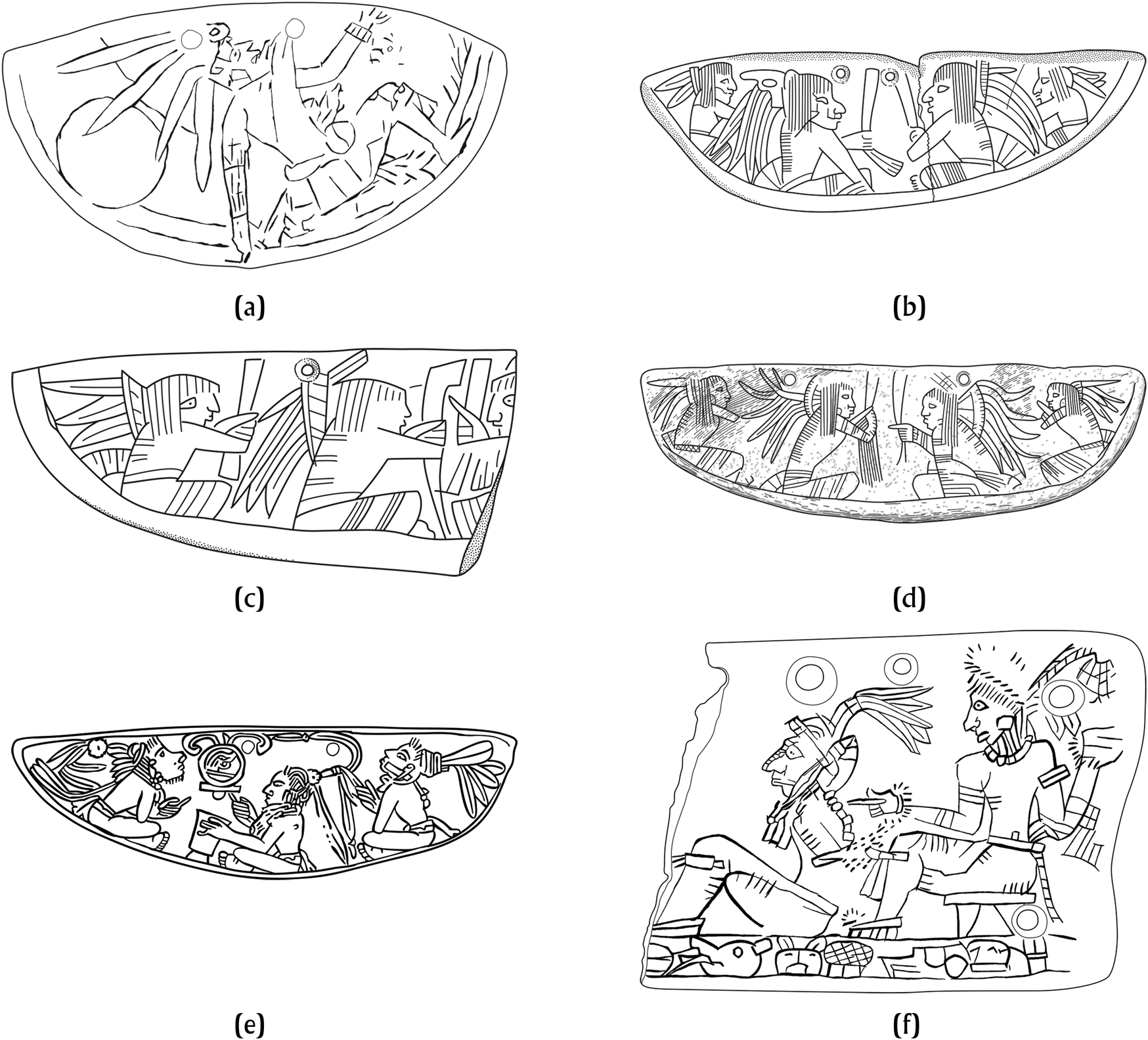
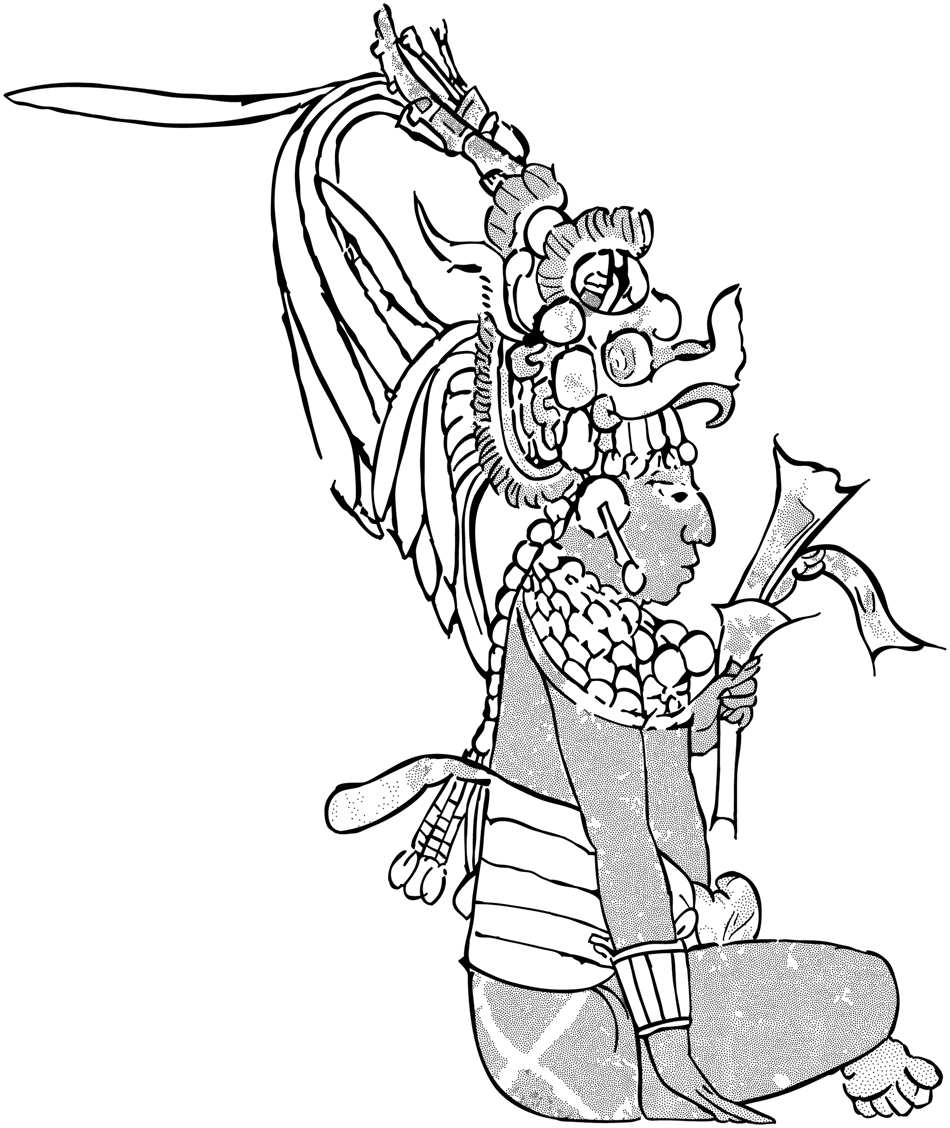
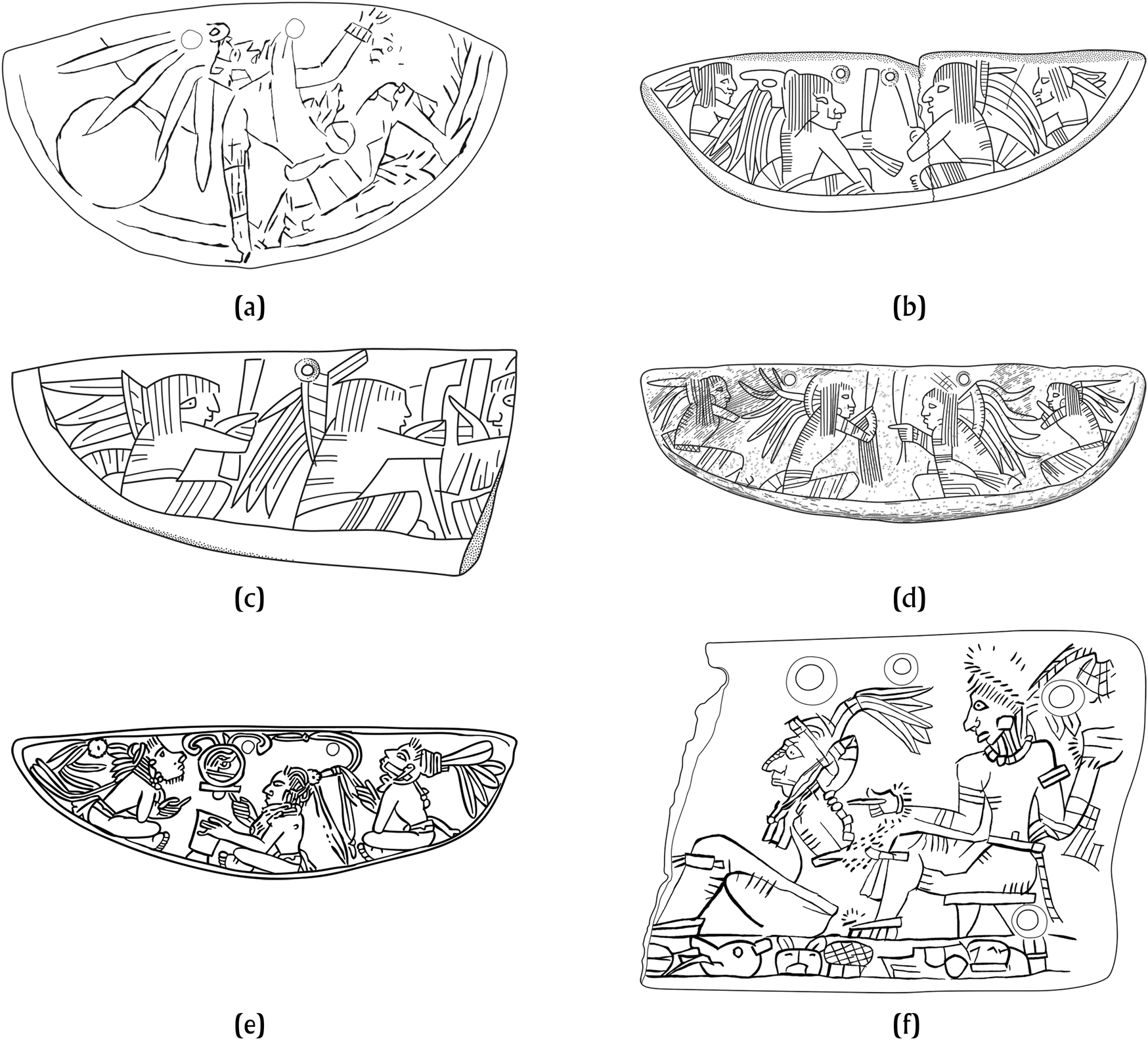
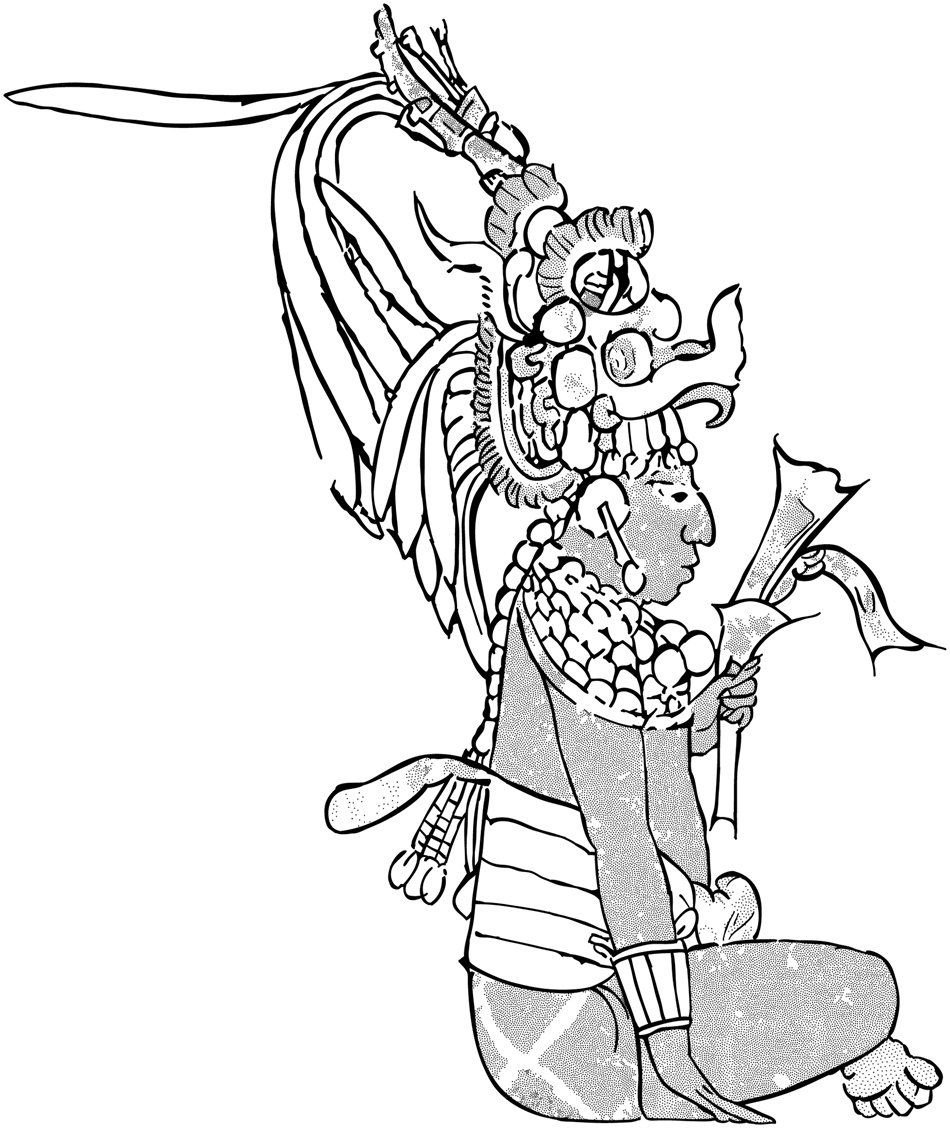
The mostly semielliptical shell gorgets of the Terminal Classic are incised with imagery of a type not formerly favored for shell pendants. These objects may never have been made in large numbers: including the present work, only seven have been published to date (Figures 2a–2f). Of these, one, from a Terminal Classic context at Ceibal (Figure 2a) depicts a lord playing the ceremonial Mesoamerican ballgame. The scenes on the other six gorgets represent (or once represented) conferences between seated, elite men. Two of these, from Terminal Classic strata at Uaxactun (Figures 2b and 2c) depict meetings between two pairs of seated individuals (one of the gorgets is broken in half, but enough remains to reconstruct the scene). A very similar ornament, illustrated by Lumholtz (Reference Lumholtz1902:454), came from an unclear context in the Valley of Mexico (Figure 2d). On the Lumholtz and the two Uaxactun gorgets, the two central figures hold up long, thin objects which could be scepters, bundles of feathers, or fans. There may be a connection here to items apparently made of paper which are sometimes held in Late Classic scenes of courtly life painted on ceramic vessels from the southern lowlands (Figure 3).
Terminal Classic conch-shell gorgets from: (a) Ceibal; (b and c) Uaxactun; (d) the Valley of Mexico; (e) K7498; and (f) El Peru-Waka’. Drawings by Carter.
Detail of a Late Classic polychrome vase showing a seated courtier holding a “scepter” of cloth or paper at a pulque-drinking event. Drawing by Carter after photograph by Justin Kerr (Reference Kerr2023:Kerr No. K5445).
On another, unprovenienced gorget (K7498 in Justin Kerr's [Reference Kerr2023] photographic database; Figure 2e), two seated men face a third; the central figure holds a drinking vessel with a pedestal base. Unlike the six preceding gorgets, the scene on K7498 includes a glyph. This is a date in the 260-day sacred calendar, rendered in a non-Maya script system, a topic explored in more depth below. In this context, it likely names one of the men in the scene.
A related ornament (Figure 2f) was excavated at El Peru-Waka’ in 2003 from a Terminal Classic cache deposit (Lee Reference Lee2003:161–162). Apparently carved from conch shell, this object was once a pectoral ornament like the ones discussed above, but roughly rectangular rather than lunate. The gorget was burned, perhaps as part of its ritual deposition, and approximately the left third of it is missing; the remaining piece is a little over five centimeters long, and the whole would have been about eight or nine centimeters. The surviving part is pierced with five biconical holes—three along the top, near what was originally the middle of the piece; one at the upper right corner; and one at the lower right—in contrast to the gorgets discussed above, which each have one hole to either side of the upper center. The holes on the El Peru-Waka’ ornament would have permitted it to be sewn onto a garment. Not all the drill holes are original, however: one of the upper holes was begun from the front, and was interpreted by the excavator, Lee (Reference Lee2003), as one of an original two holes intended for the object's suspension on a cord. The other holes were initiated from the back, with a smaller drill, and the two at the right end destroyed parts of the imagery on the front. The object is thus a gorget that was repurposed as a plaque (Lee Reference Lee2003:162).
The surviving portion of the scene depicts two individuals: a bound captive sitting on the ground near the original middle of the gorget, and behind him a lord seated on a low throne with tapered legs, who points toward the prisoner with an outstretched hand. Lines around the captive's mouth indicate facial painting or tattooing, and a segmented motif running down his forehead and nose might be more such decoration, or a kind of ornamental nasal prosthetic attested on Late and Terminal Classic monuments and figurines from a region stretching from Palenque to Jaina Island (see Carter Reference Carter, Carter, Houston and Rossi2020:99). Given the precedents both of the other gorgets that depict conferences, and of Late and Terminal Classic scenes of court life in other media, there was probably a third person to the left of the captive (David Freidel, personal communication to Lee [Reference Lee2003:162]). If so, then the scene on the ornament would have shown the prisoner being presented to this third individual.
Below the tableau is a band of incised, glyph-like signs, which might be pseudoglyphs (Stanley Guenter, personal communication to Lee [Reference Lee2003:162]) or signs in a real writing system. The Maya script underwent significant changes in the Terminal Classic period as scribes introduced new signs, jettisoned old ones, and experimented with new formats and reading orders, making some ninth-century texts difficult for epigraphers to interpret (Houston Reference Houston, Baines, Bennet and Houston2008:240–248). But true pseudoglyphs are also not uncommon on high-status Terminal Classic works of art, including portable objects (e.g., Matsumoto Reference Matsumoto2017; Sears et al. Reference Sears, Grube, Garay, Woodfill and Rivas2021; Źrałka et al. Reference Źrałka, Helmke, Hermes, Koszkul, Ting, Bishop and Bojkowska2020:471–472) and even, potentially, some monuments (Martin and Grube Reference Martin and Grube2008:115). What is certain is that neither of the shell gorgets considered here with writing (or “writing”) bears a legible inscription in Classic Maya hieroglyphs.
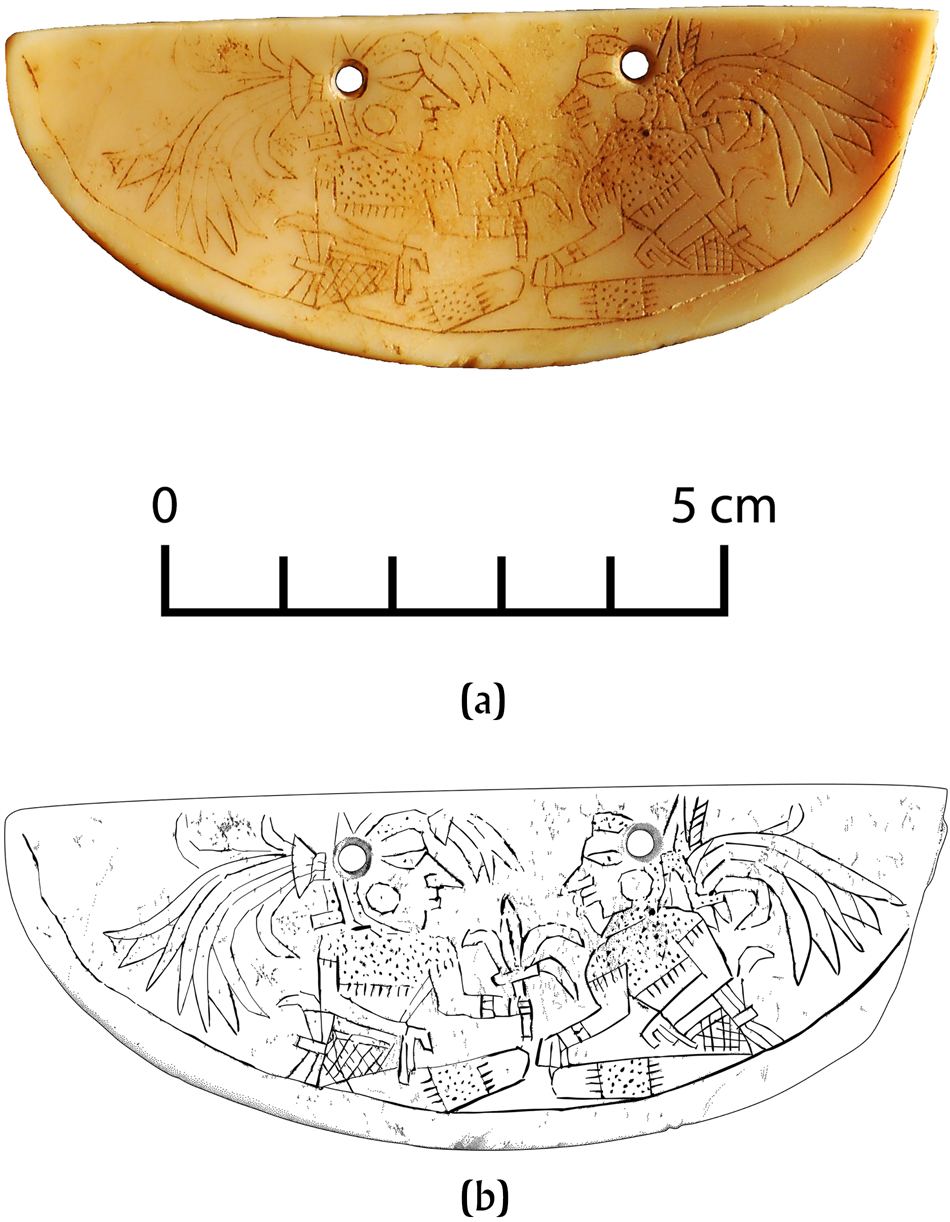
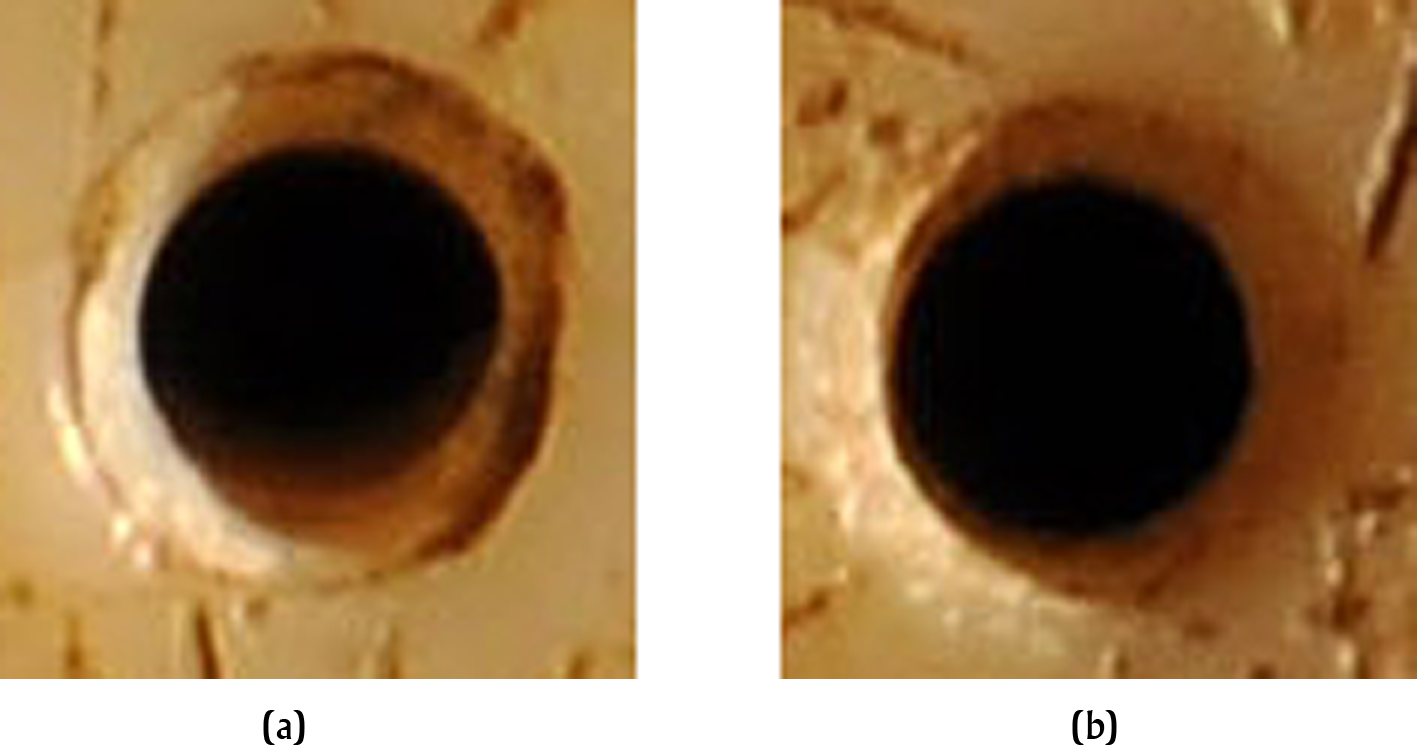
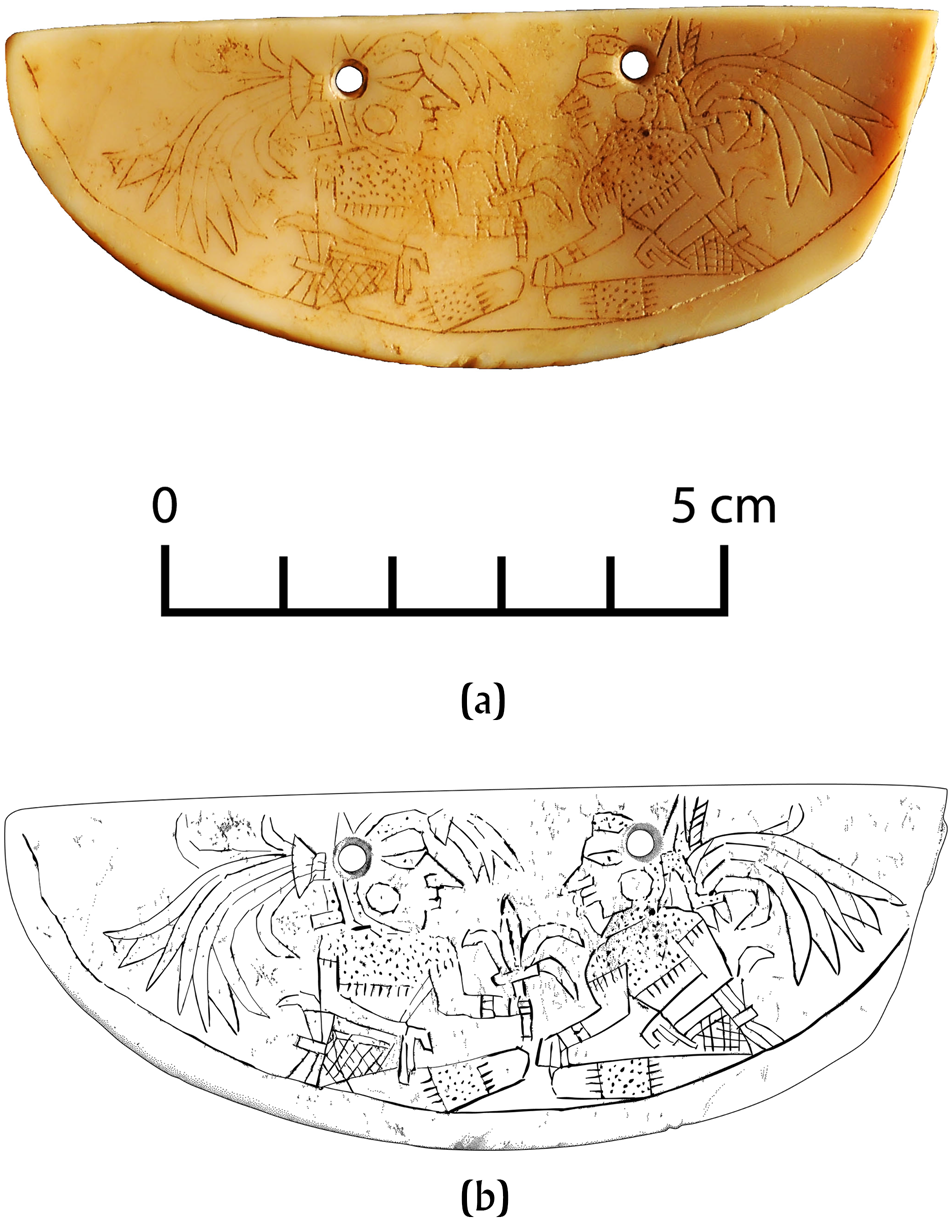
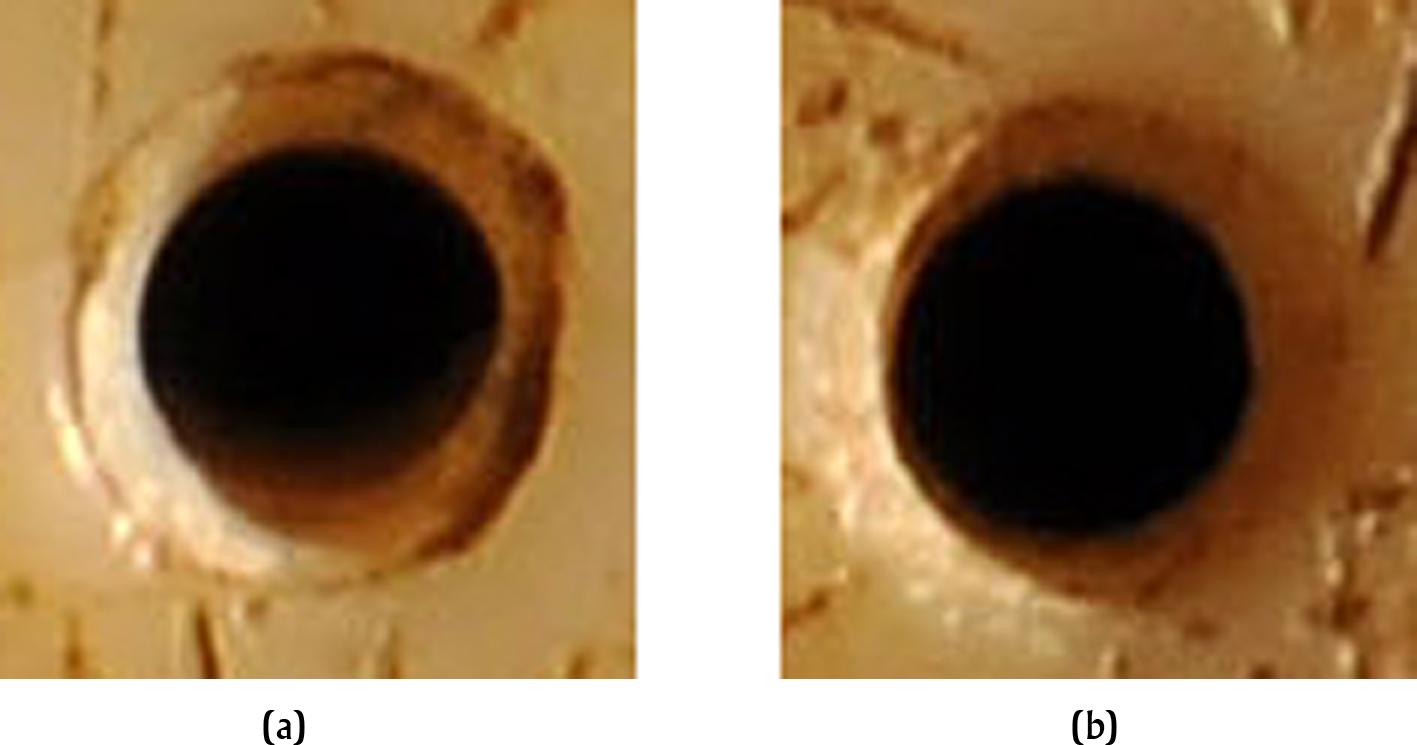
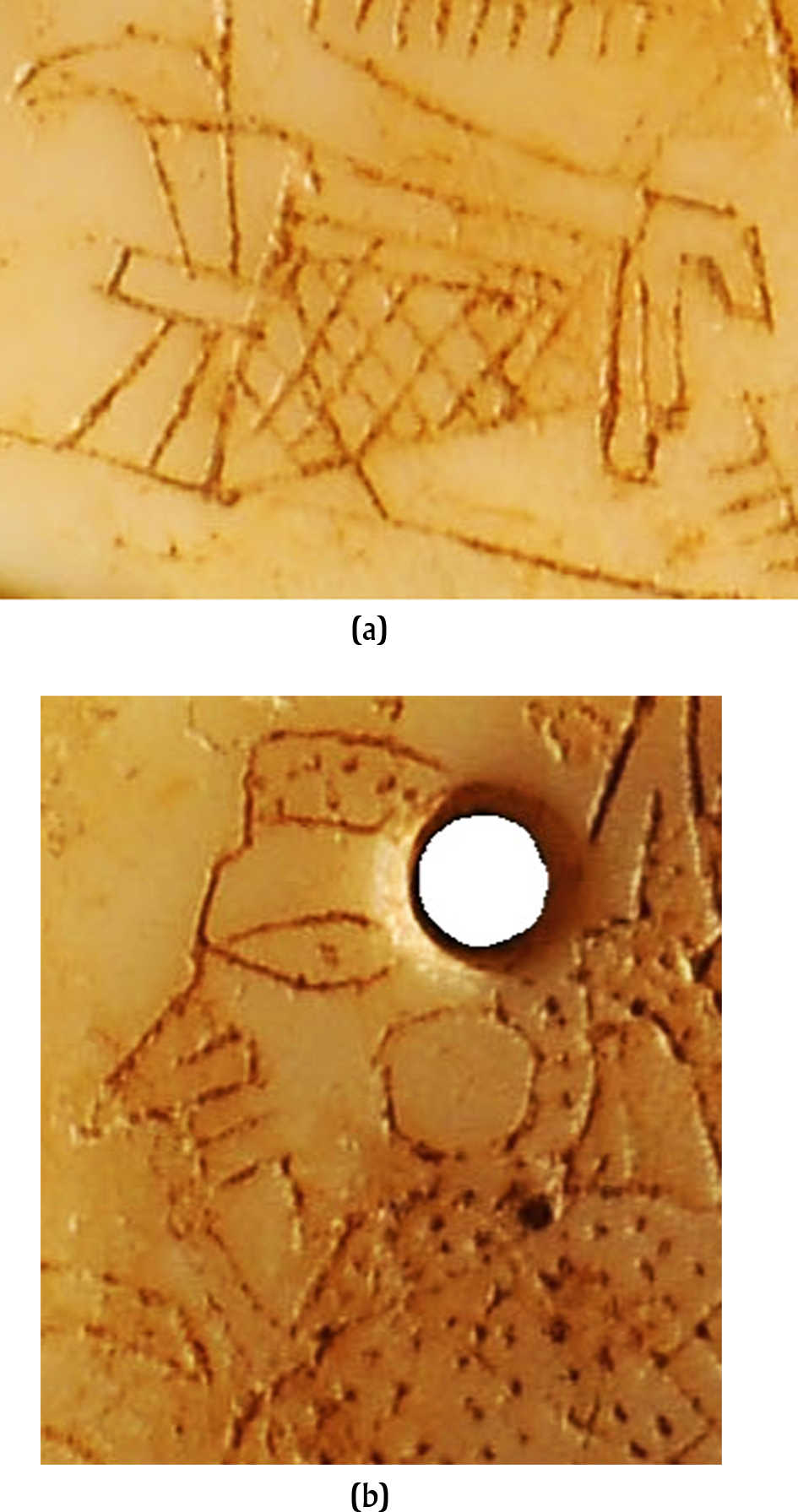
A final semielliptical gorget, not previously published, was presented to the Haffenreffer Museum of Anthropology at Brown University (accession number 2012-25-2) by an anonymous donor in 1959 or 1960. The Haffenreffer gorget (Figures 4a and 4b) is made from a single piece of slightly concave conch shell, 8.3 cm wide from end to end (Thierry Gentis, personal communications 2022; Robert Preucel, personal communications 2022). The concave surface of the gorget is incised with a scene of two men seated facing one another, with the left-hand figure proffering a bundle of feathers or holding a feathered fan or scepter. Two holes are drilled through the ornament, approximately 0.5 centimeters from its flat upper edge and about 1.5 centimeters to either side of its vertical center line. These would have accommodated a string permitting the gorget to be hung around the neck with the rounded edge downwards. The holes were probably drilled after the scene was engraved, since the incised lines end smoothly at the drill holes with no evident scratches trailing down onto their sloping surfaces (Figures 5a and 5b). The right point of the gorget was broken off after the ornament was carved: the broken surface is not polished and the line defining the ground of the scene ends abruptly at the break instead of continuing up in parallel with it.
Terminal Classic conch-shell gorget in the Haffenreffer Museum of Anthropology (accession number 2012-25-2). Photograph and drawing by Carter.
Drill holes in the Haffenreffer gorget: (a) left and (b) right. Photographs by Carter.
Both figures on the Haffenreffer ornament wear nearly identical clothing: a cap or hood covering the head and neck, connected to a short, fringed mantle covering the shoulders and upper chest; a short garment, probably a loincloth, tied behind the waist; bands with fringes around the mid-thighs; simple, beaded bracelets on one wrist; and large, plain, circular ear ornaments. The caps, mantles, and thigh bands are all marked with stipple pecked into the shell, likely depicting the spotted hide of a jaguar or ocelot. The wrapped loincloths, but not their knots, are crosshatched to indicate either the weave or the dark color of the fabric. Both men wear long panaches of feathers projecting from the backs of their headgear. Their outfits differ only in that the figure at left adds a second, smaller cluster of feathers at the brow, while the man at right has some additional, small elements in his headdress.
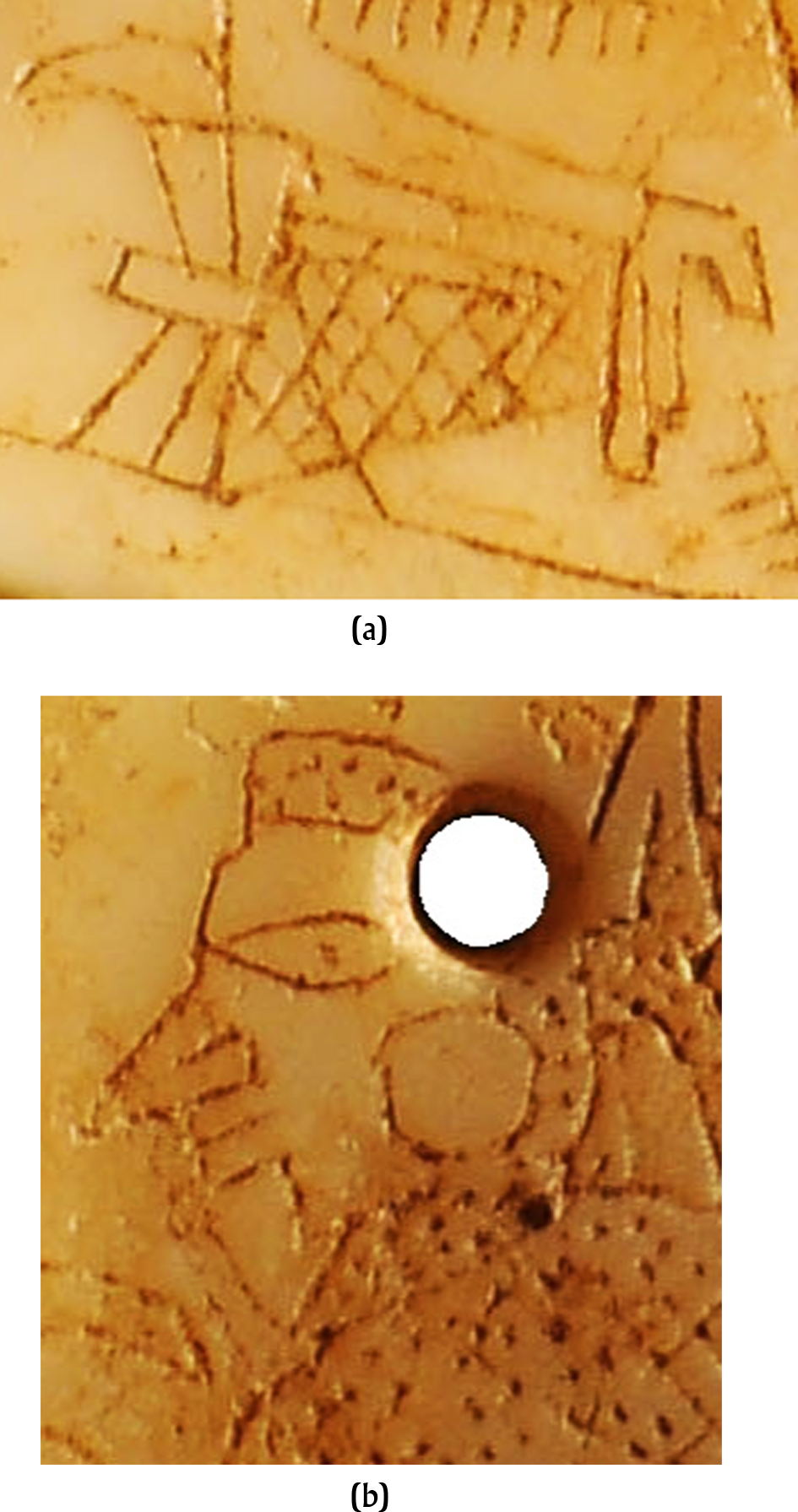
An evident difficulty with curved lines, along with certain details of the carving, suggest an artist of limited skill or experience working in this medium or with this theme. The left figure's loincloth was added after the line defining his lower back and buttocks, since that line is visible through the cross-hatching (Figure 6a). Further faint, shallowly incised lines indicate a false start at rendering the right figure's face and shoulders. An initial attempt portrayed the lips, jawline, and right shoulder about 0.2 centimeters lower than in the final version, with a much larger and softer chin (Figure 6b). This profile was abandoned before the lines had been very deeply cut. A new profile with a sharper, recessed jaw was incised more deeply, reducing the size of the lower face relative to the nose. The shoulder was raised to meet the new jawline with the addition of a line and the extension of the stipple on the mantle.
Details of the Haffenreffer gorget. (a) Loincloth and lower body of the left figure. (b) Face and shoulders of the right figure. Photographs by Carter.
Stylistic comparisons
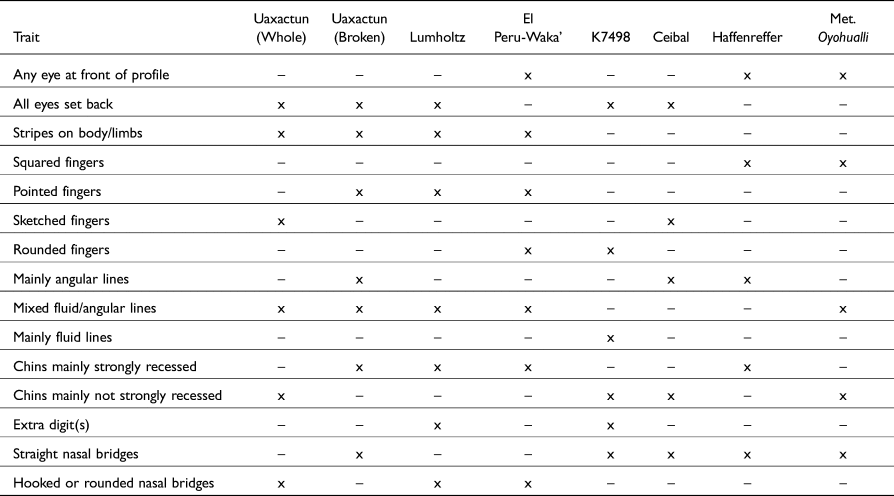
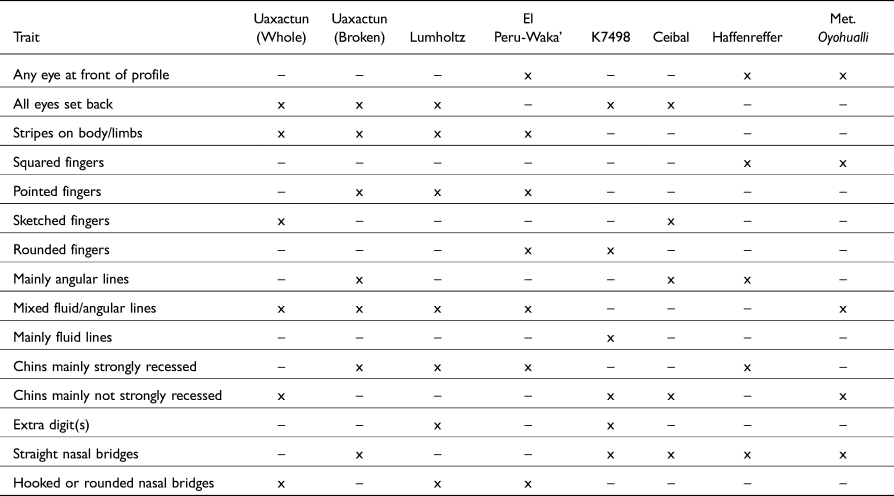
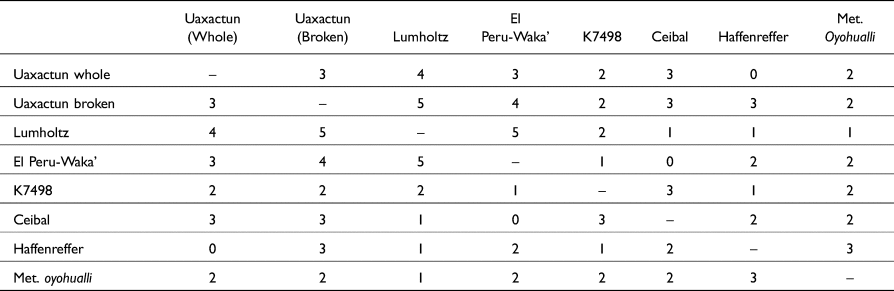
To varying extent, the carving styles of all seven gorgets described above diverge from the conventions of Late Classic Maya art. Divergent stylistic traits include angular, sketchy lines, more pronounced on some gorgets than others. Facial features include eyes that touch the front of the profile; straight nasal bridges in place of the hooked noses more typical of portraits on earlier Classic Maya carved shells; and chins that are strongly recessed, meeting the lower lip in a sharp corner. Fingers are sketched out with disconnected lines on one gorget, while on others they are squared at the ends or taper to a point. Individuals on two of the gorgets have extra fingers or toes, which may simply be errors in carving rather than representing real physical differences; on three of them, the body or limbs are decorated with transverse lines. However, no one gorget exhibits all these traits (Table 1).
Stylistic traits of semielliptical conch-shell gorgets and the Metropolitan Museum (Met.) oyohualli.
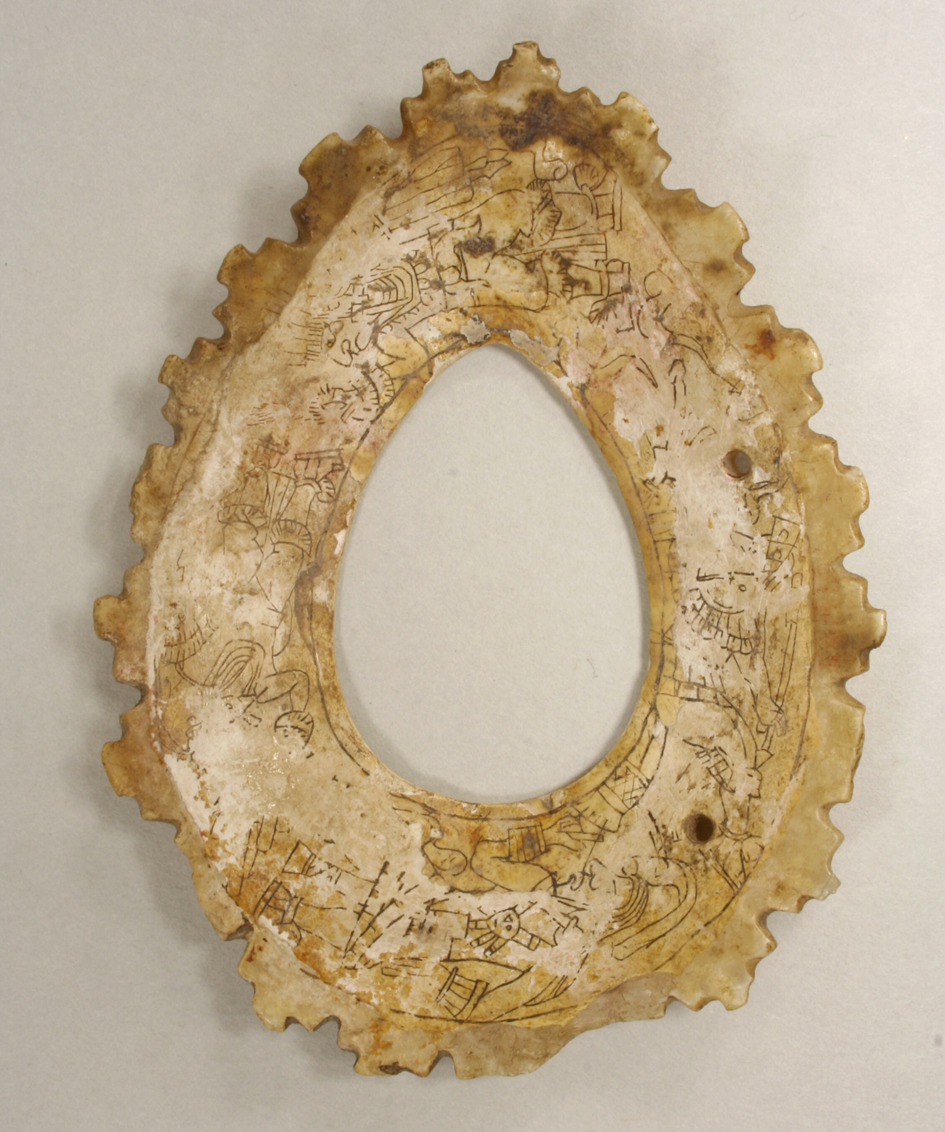
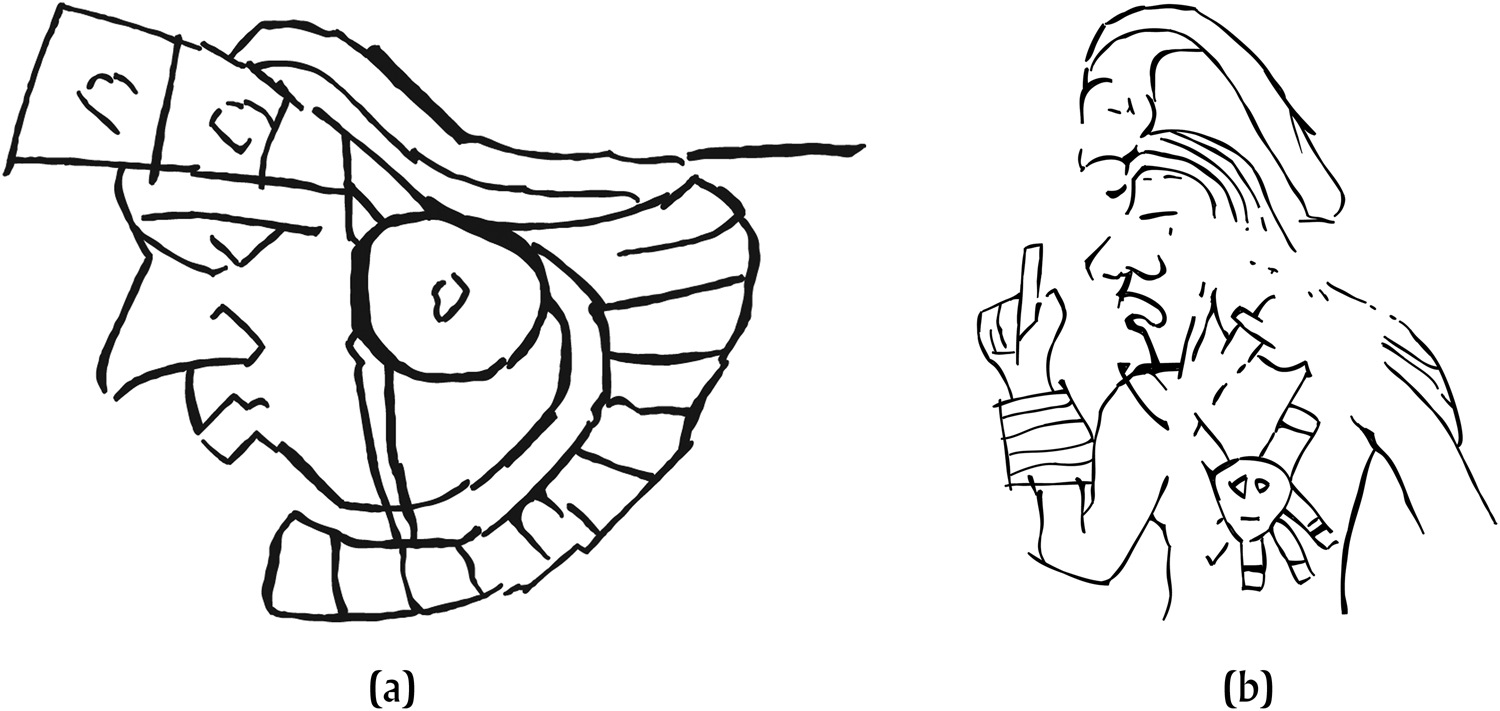
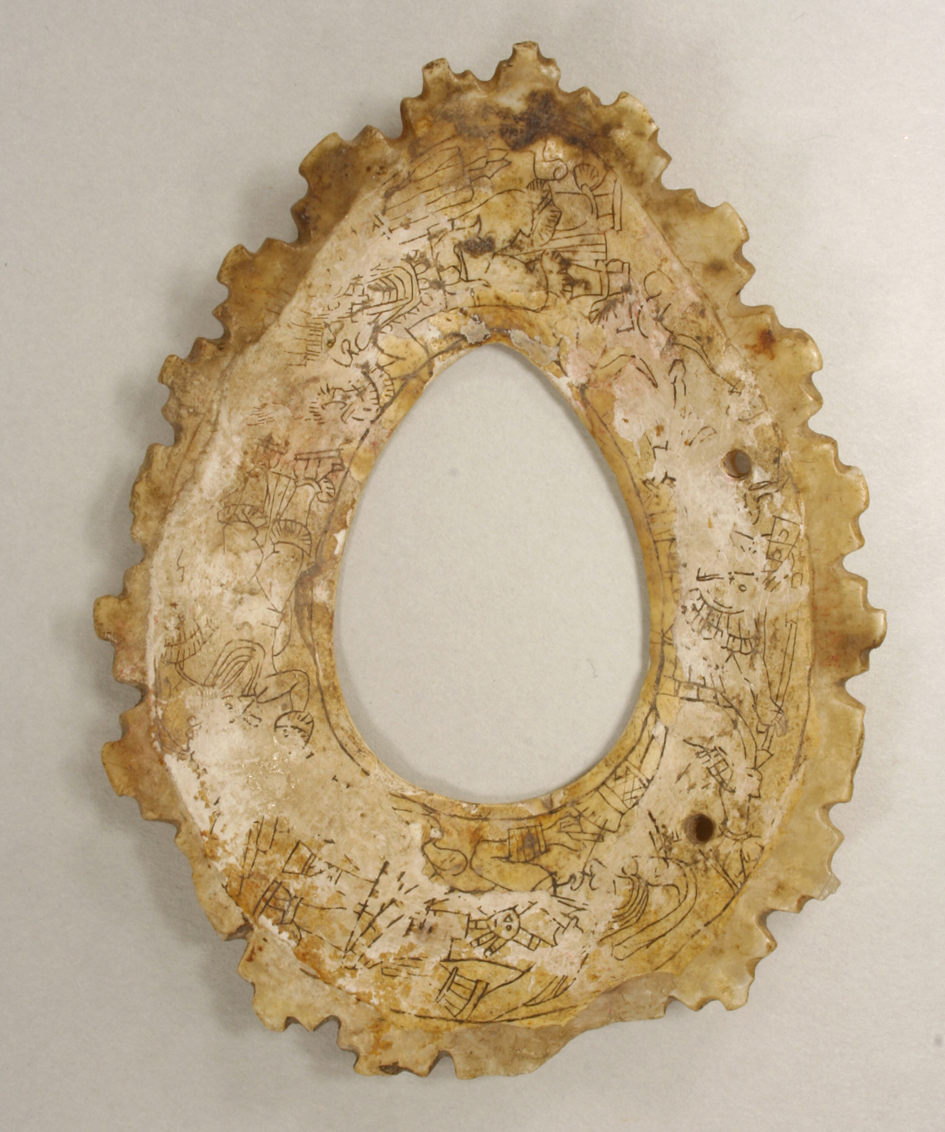
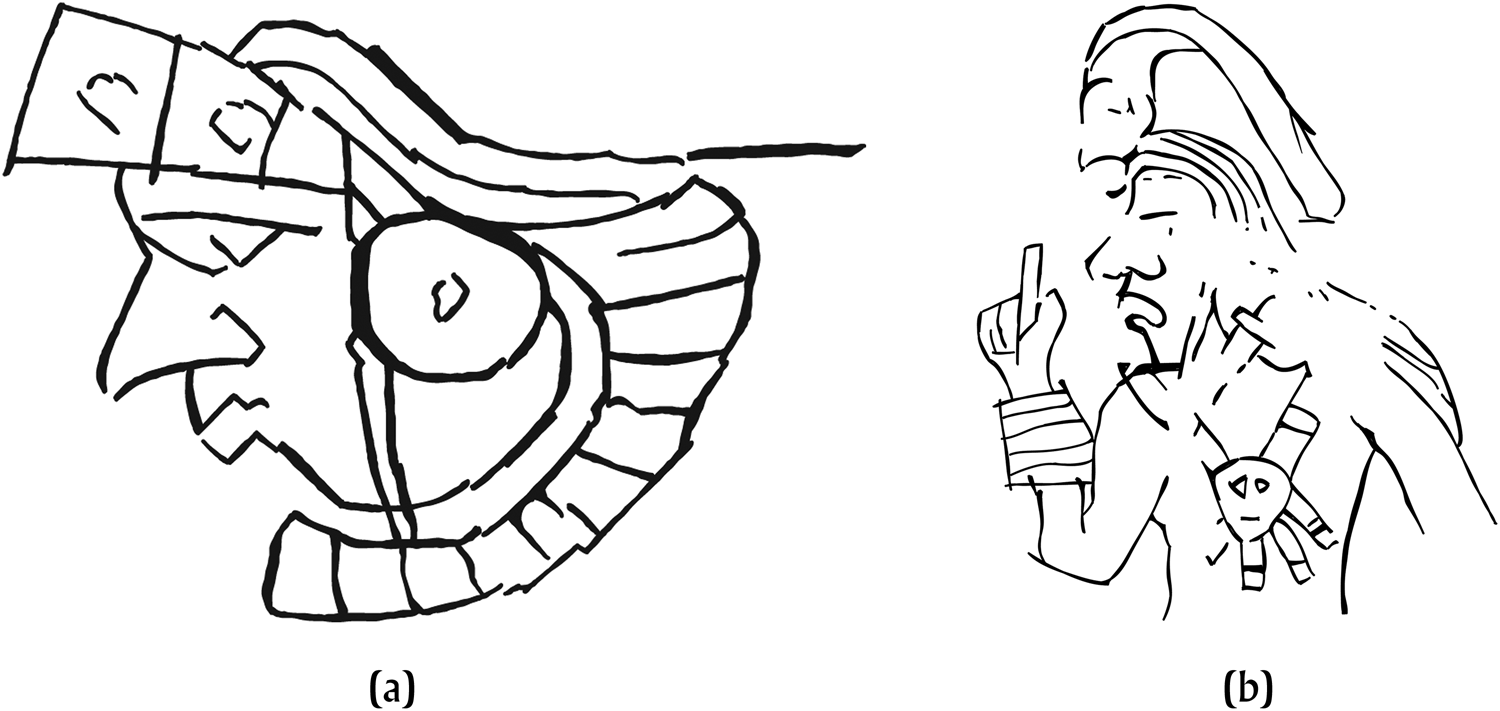
Some of the same stylistic traits appear in the incised imagery on a central Mexican, oval-shaped pectoral ornament, or oyohualli, carved from marine limpet shell, in the collection of the Metropolitan Museum of Art in New York and attributed to the area of Tula, Hidalgo (Figure 7; accession number 1979.206.456; see Ekholm Reference Ekholm and del Río1961). The Metropolitan oyohualli depicts three male warriors holding atlameh and darts, and a fourth elite man speaking. One of the figures has the left end of his eye touching the line that defines his forehead, like individuals on the Haffenreffer and the El Peru-Waka’ gorgets; the same man has a recessed chin meeting the lower lip at a sharp angle (Figure 8a), although other portraits on the oyohualli do not. Nasal bridges are straight, and fingertips are squared (Figure 8b). The shapes and positions of the eyes, the straight nasal bridges, the projecting lower lips, and the recessed chin are highly similar to those on the Haffenreffer gorget, even though the Metropolitan Museum pectoral is more skillfully carved.
Oyohualli in the Metropolitan Museum of Art (accession number 1979.206.456). The Michael C. Rockefeller Memorial Collection, Bequest of Nelson A. Rockefeller, 1979. Photograph courtesy of the Metropolitan Museum of Art.
Details of the Metropolitan Museum oyohualli consistent with the Terminal Classic conch-shell gorgets. (a) Figure with forward-placed eye, straight nasal bridge, and recessed chin. (b) Figure with straight nasal bridge and squared fingertips. Drawings by Carter.
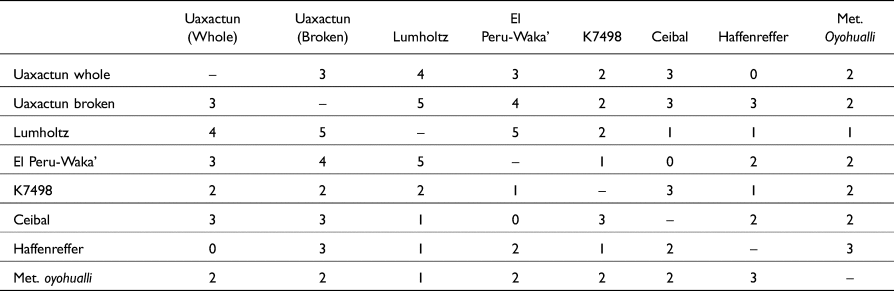
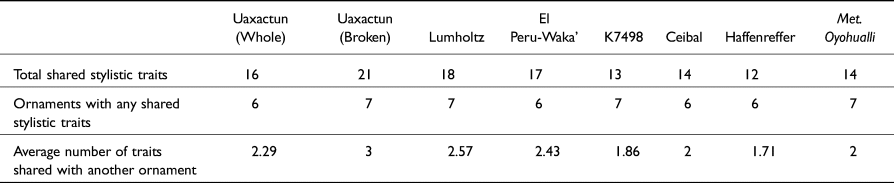
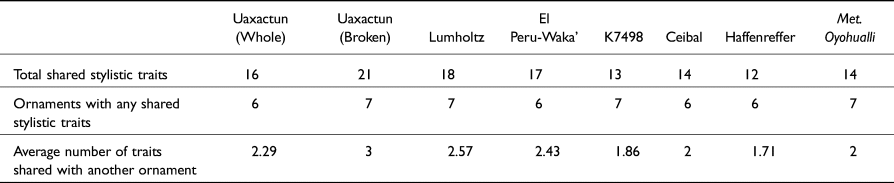
Tables 2 and 3 quantify the stylistic traits shared across these artifacts. The Lumholtz gorget and the two examples from Uaxactun are the most like one another and give the impression of having been copied one from another or from some other original. Within that group, however, there are differences which indicate they were not produced by a single hand. The complete Uaxactun gorget and the Haffenreffer ornament have no stylistic traits from Table 1 in common; neither do the Ceibal and El Peru-Waka’ gorgets. As considered here, stylistic traits are distinct from thematic content. Even though it shares the conference theme with the Lumholtz and Uaxactun pendants, the Haffenreffer gorget is stylistically the most divergent: of the traits assessed here, it shares the fewest with the other six gorgets, and it has the lowest average number of traits shared with another ornament. In terms of the stylistic characteristics of its incised imagery, as opposed to its themes, costumes, or form, the Metropolitan Museum oyohualli fits comfortably with the seven gorgets; in fact, it has as many stylistic traits in common with the other ornaments in Table 1 as the Ceibal gorget, and more than K7498 or the Haffenreffer pendant.
Quantitative comparison of stylistic traits shared across gorgets and the Metropolitan Museum (Met.) oyohualli.
Total stylistic traits shared by gorgets and the Metropolitan Museum (Met.) oyohualli.
On the other hand, other Toltec shell artifacts incised with anthropomorphic figures are stylistically unlike the semielliptical gorgets. A good example is a fragmentary oyohualli excavated in 2011 from an elite residential context on the periphery of Tula (Castillo Bernal et al. Reference Castillo Bernal, Adrián and Maldonado2019). This piece is incised with figures including the death god Mictlantecuhtli and two armed warriors with Feathered Serpent imagery, all rendered in a fluid style that has none of the divergent traits present on the six lunate pendants.
The semielliptical gorgets are also formally, thematically, and stylistically unlike the better-known corpus of shell pendants produced in the Huasteca and analyzed by Beyer (Reference Beyer1933) and more recently by Dávila Cabrera (Reference Dávila Cabrera, Faust and Richter2015). While also carved from conch shell, the Huastec ornaments retain the natural form of the body whorl, with a trapezoidal or triangular shape. Their surfaces were usually inlaid, and in several examples negative space is cut all the way through the shell. The scenes are of ritual or captive-taking, with a coiled, ophidian Earth Monster almost always present in the narrow lower part of the ornament (Dávila Cabrera Reference Dávila Cabrera, Faust and Richter2015:Table 6.1). In their iconography and the style and proportions of their figures, they resemble the Early Postclassic murals of Tamohi/Tamuín (Gendrop Reference Gendrop1970; Zaragoza Ocaña Reference Zaragoza Ocaña2003; see Gutiérrez Solana Reference Gutiérrez Solana1977), themselves related to but distinct from the Mixteca-Puebla or International style (Nicholson Reference Nicholson and Wallace1960; Vaillant Reference Vaillant and Hay1940:299, Reference Vaillant1941:84). Several of the Huastec pectorals exhibit a distinctive way of representing the human eye (the ojo huasteco) with a projection at the back upper corner (Dávila Cabrera Reference Dávila Cabrera, Faust and Richter2015:138), which is absent from the semielliptical pendants. The differences between these two categories of object are perhaps unsurprising since the lunate gorgets date to the Terminal Classic period and the Huastec pendants to the Postclassic, likely after a.d. 1200 (Dávila Cabrera Reference Dávila Cabrera, Faust and Richter2015:146).
In summary, the semielliptical gorgets are stylistically different from earlier Classic Maya conventions, but neither do they fit closely with other regional traditions of carved and incised shell ornaments. Their closest resemblance to a shell pendant from a non-Maya culture may be to the Metropolitan Museum oyohualli, but it would be inaccurate to say that the gorgets themselves are Toltec or central Mexican in style. Rather, they present a style of their own, specific to the Terminal Classic period.
Thematic content
The six lunate gorgets with conference scenes—that is, all of them but the one from Ceibal—parallel themes of diplomacy, exchange, and meetings among members of the elite that are widely attested in Mesoamerican art, especially in the Maya region and in the Mixtec screenfold manuscripts. But they reflect a narrative shift that such scenes underwent in the Terminal Classic period, both on shell ornaments and in other media.
In the Maya world, scenes of meetings among members of the elite hailing from different kingdoms are relatively rare in the Early Classic period, and probably the majority of these few are connected to the Teotihuacano entrada of the late fourth century and the new order it created (e.g., Estrada-Belli et al. Reference Estrada-Belli, Tokovinine, Foley, Hurst, Ware, Stuart and Grube2009; Hurst Reference Hurst2009:Figure 48; Kováč et al. Reference Kováč, Beliaev, Špoták, Safronov, Helmke, Kettunen and Źrałka2019; Stuart Reference Stuart, Carrasco, Jones and Sessions2000; Tokovinine Reference Tokovinine2013:55). In the Late Classic, as new kingdoms proliferated and the ranks of the aristocracy grew, conferences and the giving of gifts or tribute began to be depicted more often. Ceramics were the most common medium for such scenes, at least among surviving artifacts, and many of these vessels may themselves have been presented to honored visitors or hosts to commemorate important meetings (Reents-Budet Reference Reents-Budet1994:164–233, Reference Reents-Budet1998; Tokovinine Reference Tokovinine2016). The conventions of Maya art represented courtly roles and gradations of status using elevation and posture: kings sit at their ease on thrones or high platforms; others sit, stand, or kneel on lower platforms, behind the king, or on the floor in front of him (Houston and Stuart Reference Houston, Stuart, Inomata and Houston2001:63). Usually, this visual language tells us that conference scenes on Late Classic pottery show meetings with emissaries or subordinates, not between kings. A few monuments from the Usumacinta region, such as Piedras Negras Lintels 2 and 3, do represent visits by rulers, but these use the same visual language to distinguish clearly between the higher status of the host and the junior status of his vassal kings (O'Neil Reference O'Neil2010:325; Stuart et al. Reference Stuart, Houston and Robertson1999). They were created in part to memorialize and solidify relationships of hierarchy.
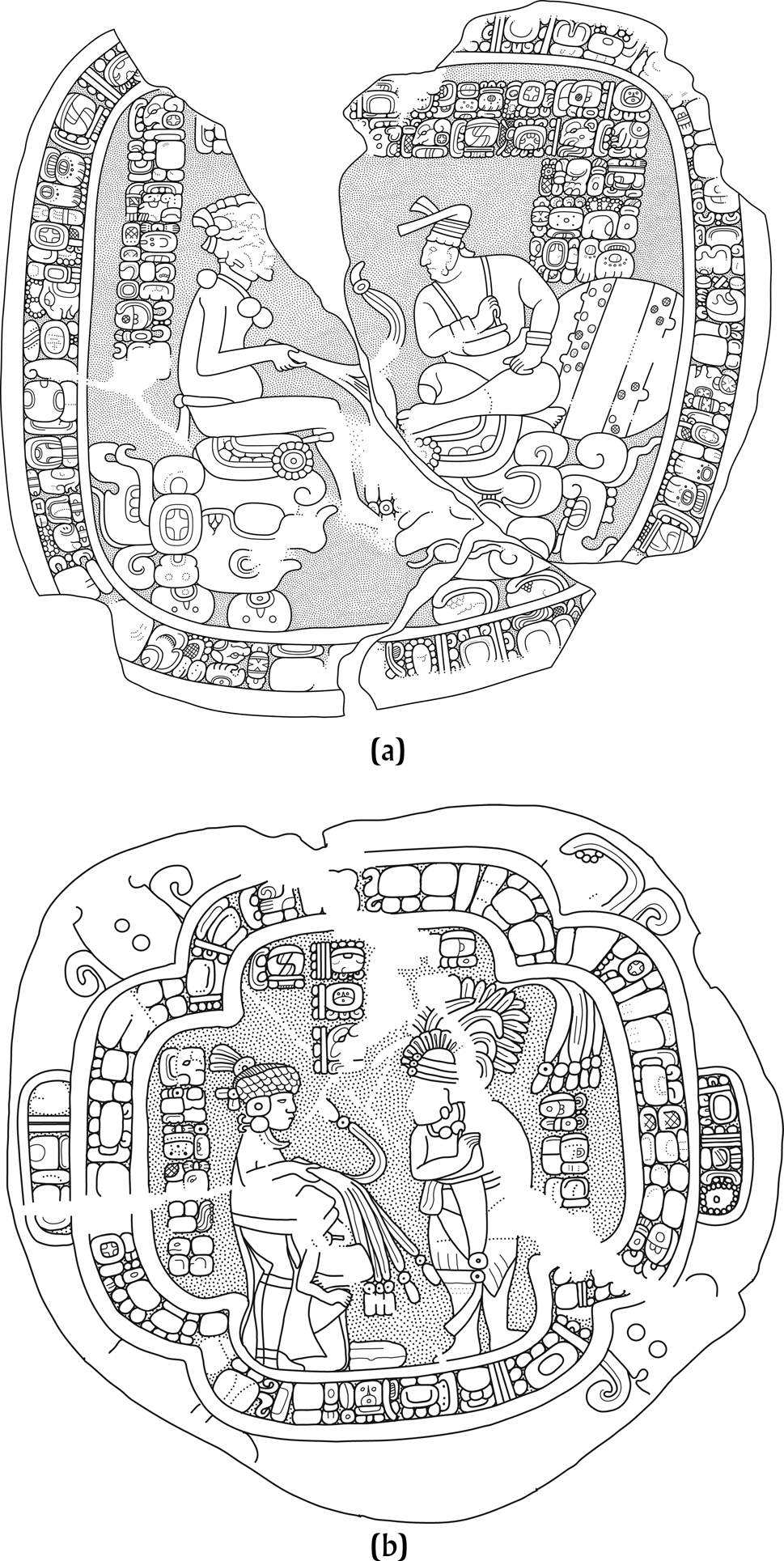
A few sculptures from the end of the Classic period depict scenes of courtly life or even conferences between apparently coequal kings. Perhaps the best examples are Altars 12 and 13 from Caracol (a.d. 820), which commemorate a conference between the rulers of Caracol and Ucanal (Figures 9a and 9b). Both men are depicted at the same height, elevation, and scale to convey their equally kingly status, neither of them occupying the center of the scene—a feature in common with most of the gorgets discussed here. Meanwhile, the Ucanal king's presentation of quetzal plumes and a prisoner to his counterpart recalls the possible bundle of feathers held by one of the men on the Haffenreffer gorget and the inferred prisoner presentation on the El Peru-Waka pendant. To the north, scenes of elite cooperation are important in the Terminal Classic art of Chichen Itza and nearby sites, and that theme is likewise prominent in the monumental art of Tula (e.g., Kristan-Graham Reference Kristan-Graham1989:345–346; Bíró and Pérez de Heredia Reference Bíró and de Heredia2018).
Terminal Classic altars from Caracol depicting conferences between rulers. (a) Altar 12. (b) Altar 13. Drawings by Carter.
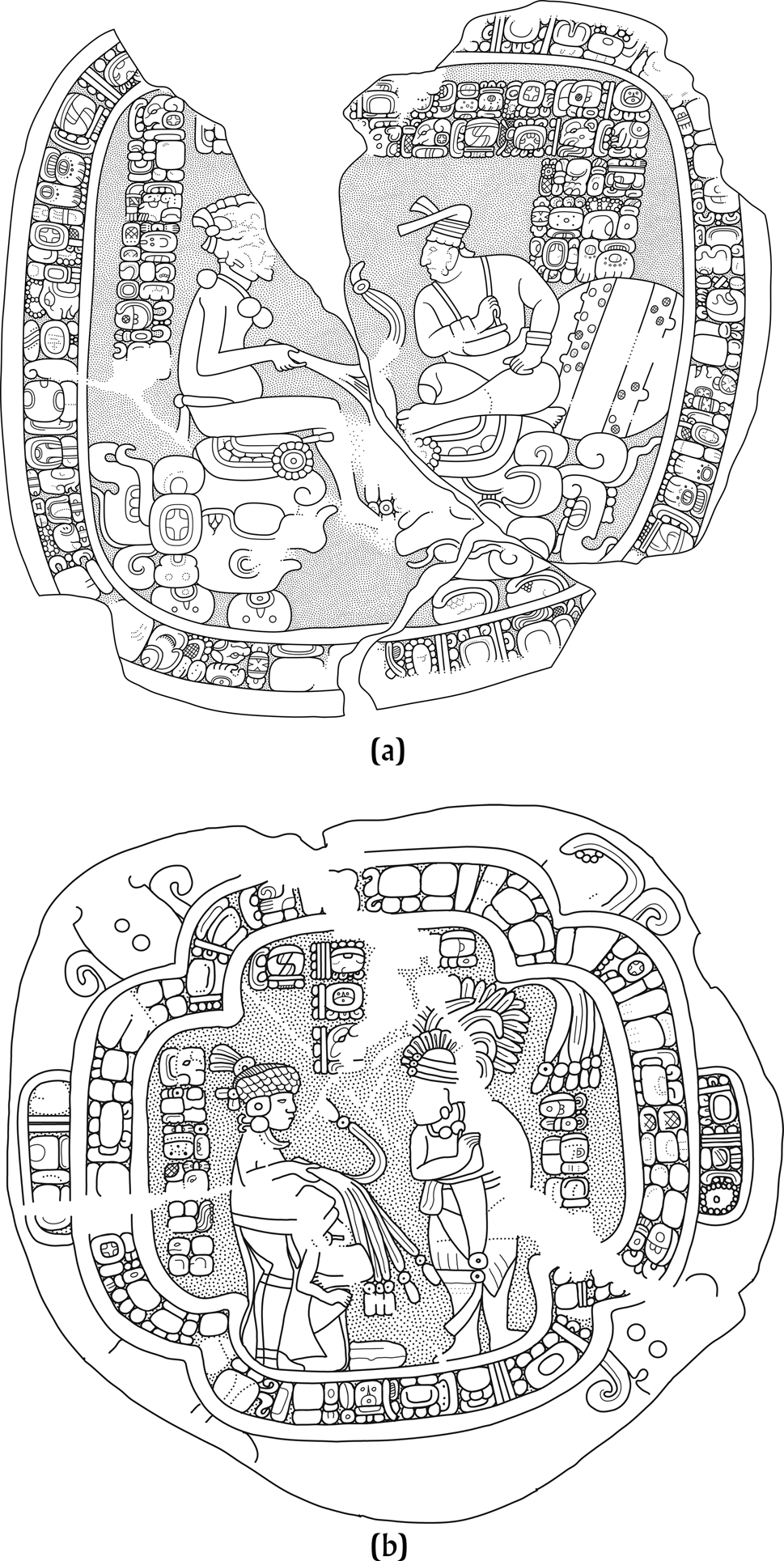
Likewise, with the possible exception of K7498, the conference scenes on the Terminal Classic gorgets suggest the relative social equality of the two sides in the meetings, since they are not strongly distinguished by their scale, costumes, or postures. The prisoner on the El Peru-Waka’ gorget, of course, is not part of either side in the conjectured meeting scene but has been reduced to the status of a valuable object to be gifted or exchanged. Status differences within each side are evident when there are more than two participants, since the figures seated behind the main participants are rendered at a smaller scale and, in two cases (Figures 2b and 2d) have their arms crossed in a gesture of respect (see Villagutierre Soto-Mayor (Reference Villagutierre Soto-Mayor, Wood and Comparato1983[1701]:121) instead of holding scepter-like objects.
The throne on the El Peru-Waka’ ornament indicates that its occupant is of royal status, and probably all the figures on these conch-shell gorgets represent members of the elite, whether royal or sub-royal. Their costumes, however, are notable for their simplicity and for the absence of traditional Late Classic Maya markers of exalted rank: there are no sak huun headbands of rulership, no Principal Bird Deity headdresses, and, on four of the six gorgets with conference scenes (those from Uaxactun, the Lumholtz gorget, and K7498), clothing of any kind is minimal. This lack of ostentatious personal adornment is typical of a trend in Maya depictions of elites at the end of the Classic period, both on monuments and on portable objects (e.g., Graham Reference Graham and Patrick Culbert1973; Halperin Reference Halperin2017; Just Reference Just2007).
Where adornment is present, it departs from Late Classic lowland Maya conventions on six of the seven gorgets. Ear ornaments are not represented on the two Uaxactun gorgets. On the Lumholtz and Haffenreffer objects, the men wear large, circular plaques in their ears. The same sort of ornament appears to be sketched out roughly on the Ceibal pendant as well. The ruler on the El Peru-Waka’ gorget wears a tubular earspool, as do two of the men on K7498, and the third appears to have a floral pendant hanging from his ear. These depictions contrast with the prevalence of composite earflare assemblages in the art and archaeological record of the Late Classic (Carter Reference Carter, Carter, Houston and Rossi2020:91–95).
As for headgear, most of the gorgets depict bunches of feathers attached directly to the hair or to a fan-like element, in both cases worn at the back of the head. The feline-skin hoods on the Haffenreffer gorget do not have a close analogue in the Late Classic Maya corpus. Meanwhile, the headdress worn by the lord on the El Peru-Waka’ pendant closely resembles the furred or feathered hats worn by some martial elites at Chichen Itza in the later art of that site, as well as by the lord depicted on Ucanal Stela 29 (likely a.d. 879; Halperin and Martin Reference Halperin and Martin2020:826–830). Absent from all the gorgets, however, are the transverse nasal ornaments favored at Chichen Itza and in related monumental art at southern lowland centers.
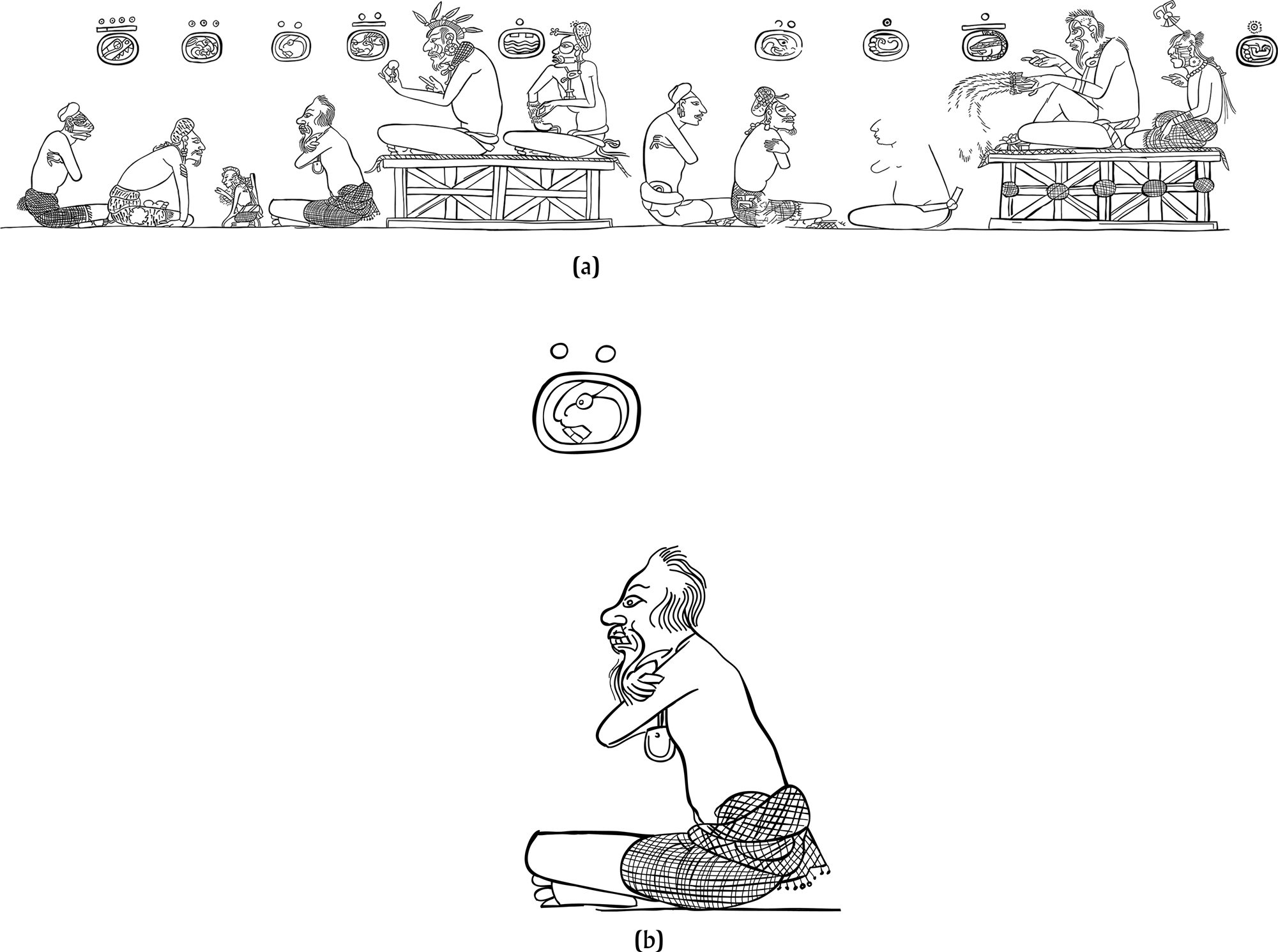
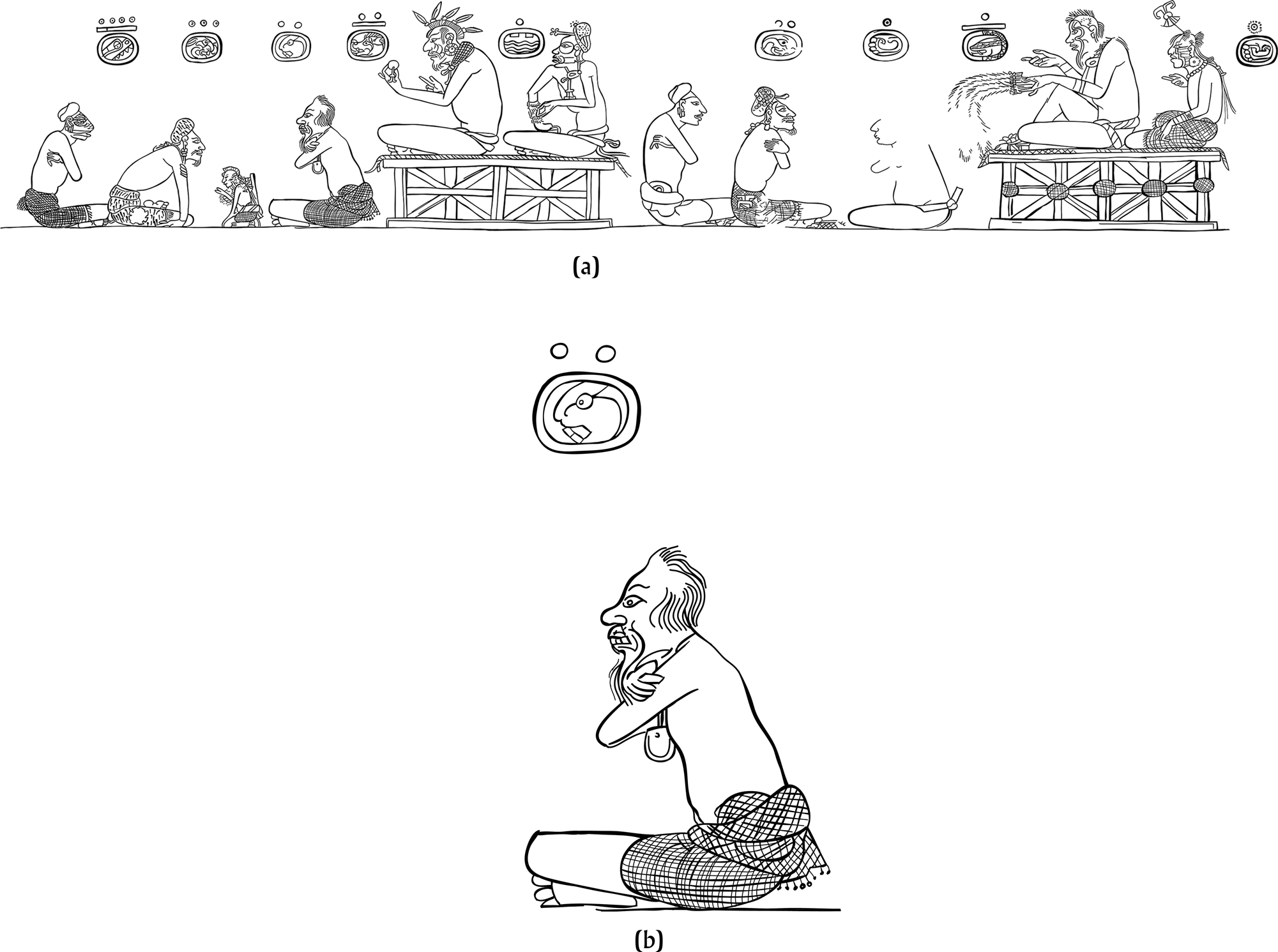
Two final stylistic and thematic comparisons should be made between the conch-shell gorgets and other artifacts from the Terminal Classic or Early Postclassic. One of these is an unprovenienced alabaster vase (K0319; Figure 10) incised with two conference scenes. These are set in palatial spaces and involve the giving of gifts or tribute among elite men, some seated on scaffold platforms and others, presumably visitors and/or social inferiors, on the ground before them (Kerr Reference Kerr1989:11). The proportions of the figures and the style of the lines are consistent with the canons of courtly polychrome vase painting in the Maya Late Classic period, as is the theme of gift presentation between persons of unequal rank. But there are significant differences in dress and personal adornment. Several of the men's faces are heavily painted or tattooed, while three of the four men on the platforms have partially shaven or depilated scalps. These features are usually absent from Late Classic Maya depictions of rulers and nobles, and when tattooed or painted designs do appear on men's faces, it is mainly at sites in the Maya west and along the coast of Yucatan (Houston et al. Reference Houston, Stuart and Taube2006:19–21; Lukach and Dobereiner Reference Lukach, Dobereiner, Carter, Houston and Rossi2020:46). Each participant in the conference scenes is named with a non-Maya date with a circular cartouche around the day-sign. One of the men—a subordinate on the host's side of one of the scenes—wears a lunate pectoral ornament like the ones considered here, shown in profile with one of the suspension holes and the groundline along the bottom of the pendant clearly visible (Figure 10b).
(a) Conference scenes incised on a Terminal Classic alabaster vase of unknown provenience. (b) Detail of one scene showing a semielliptical gorget. Drawings by Carter after photograph by Justin Kerr (Reference Kerr2023:Kerr No. K0319).
The second work is an eleventh-century, stuccoed stone bench (designated K2) at Xochicalco, Morelos. A painted scene on the front of the bench depicts an assembly of people with incense bags and handled ollas seated on either side of a talud-tablero platform (Figure 11; Nielsen et al. Reference Nielsen, León and Helmke2021). Like the figures on vase K0319 and one of the individuals on gorget K7498, the people on Bench K2 are each named with a calendrical date in a rounded cartouche. Nielsen and colleagues (Reference Nielsen, León and Helmke2021:250) point out that such platforms are common in the Maya region, where they were used for a variety of activities including courtly assemblies and ceremonies, and that they have been found as well at El Tajin, but that they are rare in central Mexico outside of Xochicalco. Some of the men in the painting wear turban-like headdresses, potentially a later version of a kind of turban attested at Teotihuacan (Nielsen et al. Reference Nielsen, León and Helmke2021:257). Unlike the alabaster vase, the proportions, lines, and style of the painting on the Xochicalco bench are not notably reminiscent of Classic Maya art, likely exemplifying local conventions instead.
Painted scene from Xochicalco Bench K2. Drawing by Christophe Helmke and Jesper Nielsen, used by permission.

Circular day-signs in the Terminal Classic Maya lowlands
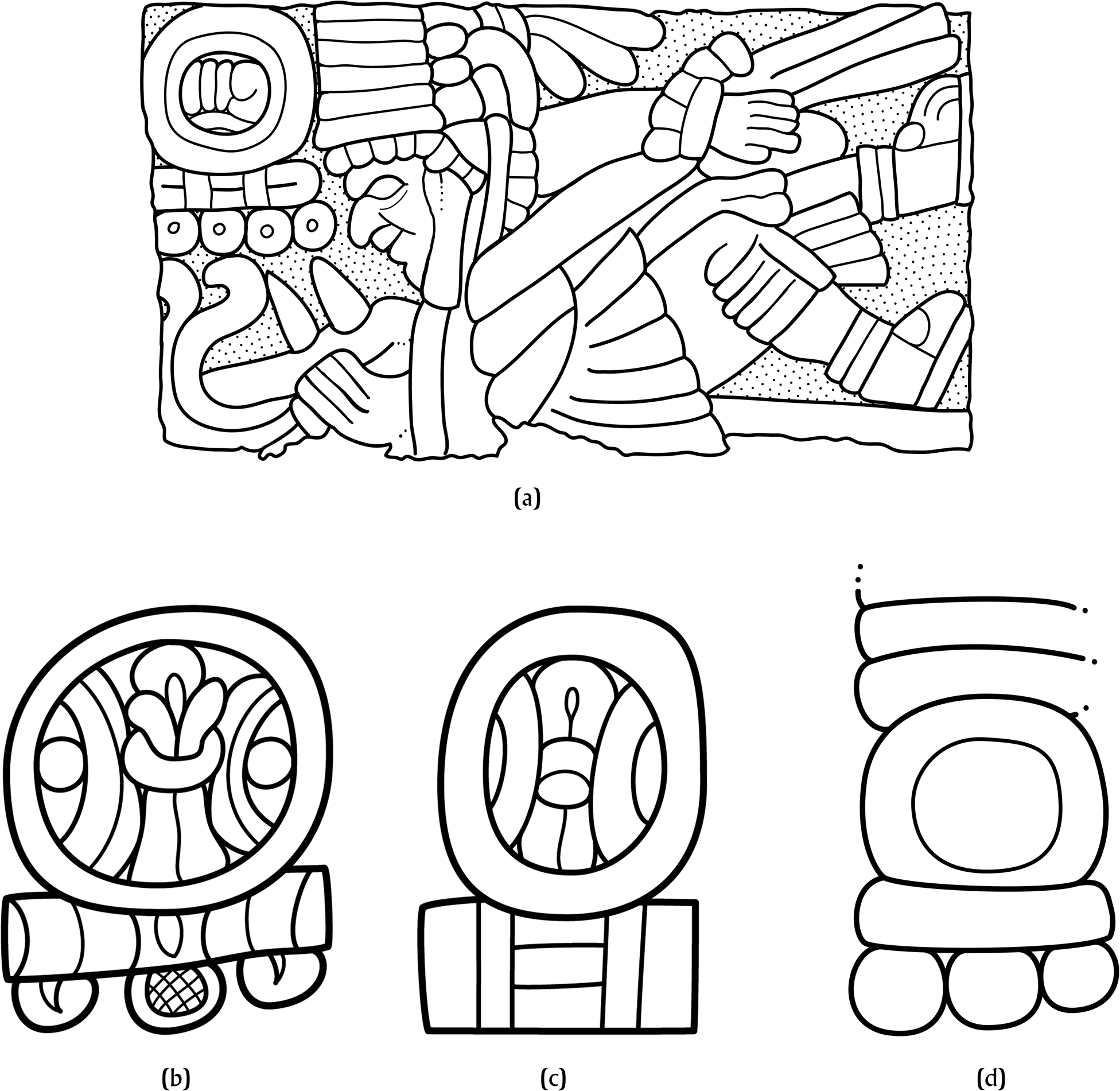
The unprovenienced gorget K7498 bears a date in a non-Maya version of the 260-day sacred calendar. In the Maya region, some Terminal Classic inscriptions include non-Classic Maya hieroglyphs, especially dates used as personal names. Such signs fall into two distinguishable categories with ties to different parts of Mesoamerica and different regional and temporal distributions within the Maya zone. One style employs square or rectangular cartouches around the day-signs and derives from the Mixtequilla region of coastal Veracruz (Werness Reference Werness2007; Wyllie Reference Wyllie2002:84, Reference Wyllie, Arnold and Pool2008:220–230). In the Maya region, these Mixtequilla-style dates appear in grammatical Classic Mayan inscriptions on monuments and portable objects from the central and southern lowlands in the mid- to late ninth century. The other style uses circular cartouches and is closest to dates written at Tula and Xochicalco, in central Mexico (Carter and Lukach Reference Carter, Lukach, Glover, Woodfill and Garrison2024).
Tula-Xochicalco-style dates are part of what Urcid (Reference Urcid2007) has called the Central Mexican Scribal Tradition, which may well derive from Teotihuacano conventions (Helmke et al. Reference Helmke, Nielsen, Leni and Campos2013:92–93). They are distinct, however, from some other ways of writing dates within that larger tradition, even as they display more variability (including diachronic change) than the Mixtequilla style. At Xochicalco, a few monuments bear dates with rounded-square cartouches, sometimes with volutes projecting to either side, and with the numeral sometimes enclosed together with the day-sign; some of these were cached in antiquity or show signs of reuse, and so may be somewhat older than Bench K2, which uses round cartouches (Nagao Reference Nagao2014:79, 129–130, n303; Nielsen et al. Reference Nielsen, León and Helmke2021:256). Monuments at Tula exhibit day-signs with rounded cartouches (Figure 12a), rounded-square cartouches, rounded brackets instead of cartouches, and without cartouches or brackets (Jiménez García Reference Jiménez García1998:Figures 77, 120, 121, 124, 158, 159).
Dates with circular cartouches. (a) Detail of a carved platform adjacent to Pyramid C, Tula. (b) Date from a wall panel in the Lower Temple of the Jaguars, Chichen Itza. (c) Date on the west column from the North Temple of the Great Ballcourt, Chichen Itza. (d) Date on column 1N from the Temple of the Columns, Chichen Itza. Drawings by Carter.
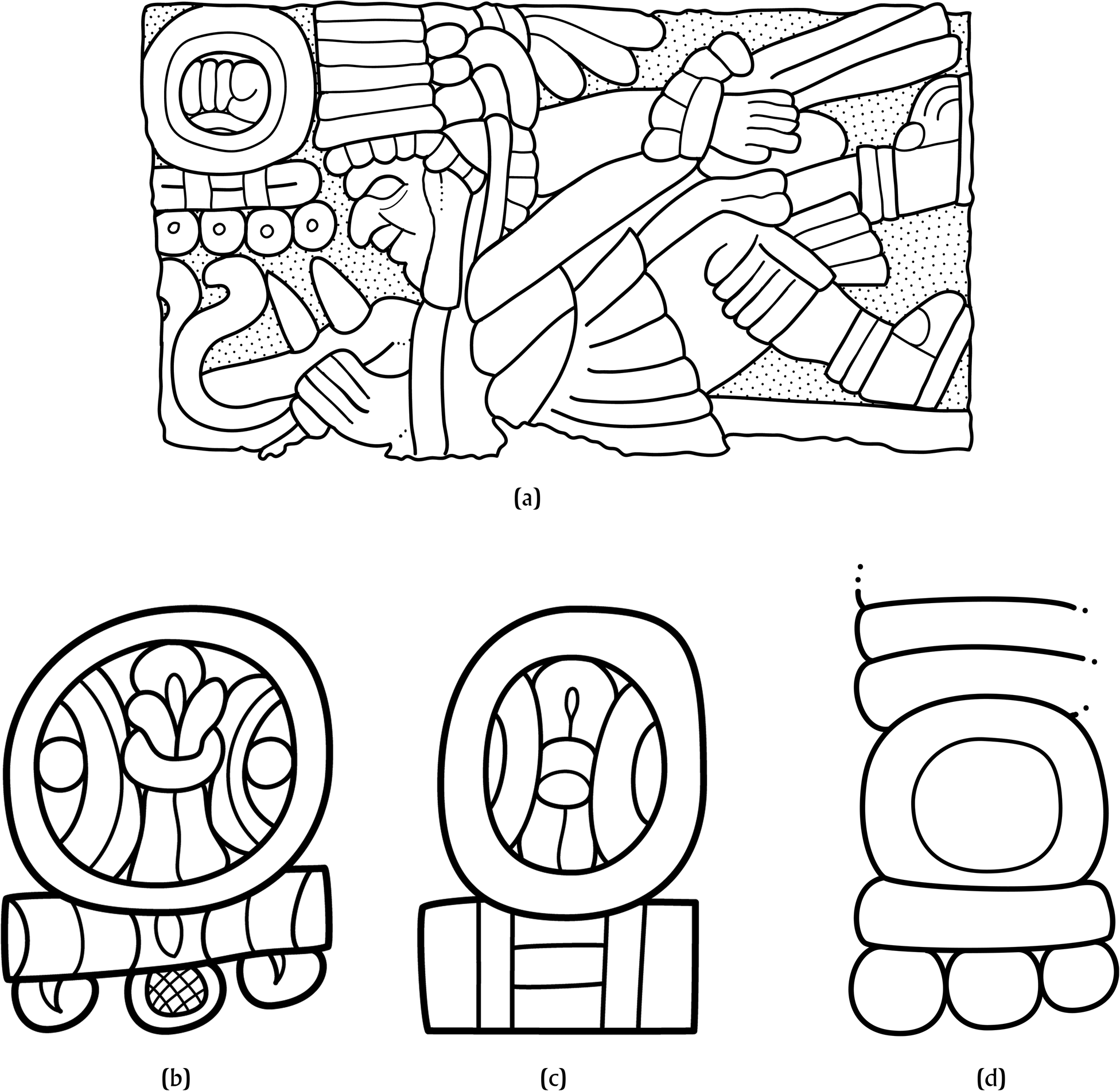
In the Maya region, Tula-Xochicalco-style dates may have a round instead of a square cartouche with numerals placed above or below. Like Mixtequilla-style dates, they function as calendrical names. In contrast to them, however, they are never incorporated into longer, grammatical texts. To our knowledge, dates with circular cartouches have not been identified in the southern Maya lowlands, but they are attested at Chichen Itza, on a wall panel from the Lower Temple of the Jaguars (Figure 12b), the west column from the North Temple of the Great Ballcourt (Figure 12c), and Column 1N from the Temple of the Sculpted Columns (Figure 12d). Other central Mexican-style dates at the same site, however, lack any cartouches; examples come from the Lower Temple of the Jaguars, the Mercado, the Northwest Colonnade, and the Temple of the Warriors (Love and Rubenstein Reference Love and Rubenstein2022:31, 261, 285, 387). The mix of dates with circular cartouches and no cartouches recalls scribal practice at Tula.
Long-distance interaction
The gorgets discussed here can be understood as part of a trend, attested across multiple media at the end of the Classic period, towards depicting amicable conferences between elites of more or less equal status. Nothing about the scenes indicates that they represent supernatural characters, settings, or activities: their iconographic messages are consistently about political and perhaps economic interaction among human leaders. Their find-spots in central Mexico and the Maya lowlands, the circular day-sign on K7498, and the stylistic elements shared with the Metropolitan pectoral naturally raise the possibility that some of the interactions they depict included both Maya and non-Maya people. Against that possibility, however, we note that the people on either side of each interaction are not distinguished from one another by costume or ornamentation, as was the case for Early Classic Maya representations of Teotihuacano-Maya interaction.
Conceivably, these ornaments could have been bestowed during meetings of the kind they portray. It is an open question whether they were produced to commemorate specific, historical events, or whether they were crafted ahead of time and gifted or re-gifted as the occasion might call for. The calendrical name on K7498 would seem to imply the former, as would the prisoner, and perhaps the glyph-like signs on the El Peru-Waka’ gorget. On the other hand, the men on the Haffenreffer, Uaxactun, and Lumholtz gorgets are not distinguished as individuals by their costumes or in any other way, consistent with the possibility that some of the gorgets represent generic scenes.
Archaeological and epigraphic evidence from El Peru-Waka’, Uaxactun, and Ceibal indicates that their Terminal Classic elites participated in networks of long-distance travel and exchange which also included people from outside the southern Maya lowlands. At El Peru-Waka’, kingship may have ended in the early part of the ninth century amid demographic decline and partial abandonment, but post-royal elites continued to wield sociopolitical power and to venerate the memory of the old dynasty including through the manipulation of old monuments (Eppich Reference Eppich, Navarro-Farr and Rich2014; Lee and Piehl Reference Lee, Piehl, Navarro-Farr and Rich2014; Navarro-Farr and Arroyave Prera Reference Navarro-Farr, Prera, Navarro-Farr and Rich2014). It was presumably members of this stratum who acquired and cached the fragmentary gorget found in 2003; they also obtained Altar fine paste ceramics (Eppich Reference Eppich, Navarro-Farr and Rich2014; Meléndez Reference Meléndez, Navarro-Farr and Rich2014), produced in the Usumacinta River region (Bishop and Rands Reference Bishop, Rands and Sabloff1982).
Kingship persisted longer at Uaxactun and Ceibal. After an apparent dynastic rupture at Ceibal, a new king arrived in a.d. 829 with textually attested support from a ruler of Ucanal. At the latter site, an abundance of Pabellon molded-carved ceramics points to close economic ties with the Maya west (Halperin et al. Reference Halperin, Lopez, Salas and LeMoine2020:486–488). Terminal Classic monuments at both centers incorporate Mixtequilla-style calendrical names, as well as costumes and motifs with ties to Chichen Itza and nearby sites, while one ruler of Ucanal likely hailed from the Chontal Mayan-speaking region of the Gulf Coast (Carter Reference Carter2014:196–197, 214–215; Halperin and Martin Reference Halperin and Martin2020). At Uaxactun, Stela 13 (a.d. 830) names a ruler, Olom, who did not use the traditional local emblem glyph. This Olom may be the same person named on Ahk'utu’ molded-carved vessels recovered from the Belize River area, including at Ucanal and Caracol (Carter Reference Carter2014:172–173; 202–203; Helmke and Reents-Budet Reference Helmke, Reents-Budet, Morris, Jones, Awe and Helmke2008; see also Ting and Helmke Reference Ting and Helmke2013), which combine Classic Maya iconography, artistic style, and hieroglyphs with elements like transverse septum ornaments that are rare in Late Classic southern lowland art but feature prominently at Chichen Itza in the Terminal Classic.
In central Mexico, well-known Epiclassic works of art at Cacaxtla, Tula, and Xochicalco likewise combine Maya and local elements, in different ways and to varying degrees at each site (e.g., Brittenham Reference Brittenham2015; Jordan Reference Jordan2016; McVicker and Palka Reference McVicker and Palka2001; Nagao Reference Nagao2014; Smith and Hirth Reference Smith, Hirth and Hirth2000; Turner Reference Turner and Beekman2019). Mural paintings at Cacaxtla blend Classic Maya iconography and visual style with glyphs in a central Mexican scribal system in which day-signs are normally written without cartouches. An exception is the date 9 Reptile Eye in the north portico mural at Structure A, which does have a rounded-square cartouche with volutes.
The monumental art of Xochicalco, notably the friezes on the Pyramid of the Feathered Serpent, similarly mixes Maya-style portraiture with central Mexican forms, themes, and glyphs. Yet finished artifacts from the Maya region are so far rare in the archaeology of the site. Artisans at Xochicalco did obtain raw materials from the Maya area including Maya blue pigment, produced by cooking indigo with palygorskite clay from sources in the northern Yucatan Peninsula, as well as jade from the Motagua River Valley (Arnold et al. Reference Arnold, Bohor, Neff, Feinman, Williams, Dussubieux and Bishop2012; Nagao Reference Nagao2014:115; Taube et al. Reference Taube, Hruby and Romero2005). A ceramic plaque depicting a seated lord in profile is rendered in Late Classic Maya style, like the figures on the Pyramid of the Feathered Serpent, but the accompanying calendrical name 9 Reptile Eye (with a rounded-square cartouche) indicates that it was a local production and not an import (González Crespo et al. Reference González Crespo, Tarazona, de la Vega Nova, Guala and Aguilar1995:236; Nagao Reference Nagao2014:256). A few greenstone plaques depicting faces in frontal view may be Maya in origin, but the majority of similar ornaments were carved at Xochicalco itself (Nagao Reference Nagao2014:257–259).
At Tula, ritual caches have been excavated that contained ceramic vessels from the Maya area, including Tohil plumbate and Silho fine orange. Among the latter is a polychrome painted vase, now at the Museo Arqueológico de Tula “Jorge R. Acosta,” which bears Feathered Serpent imagery and a portrait of a warrior wearing Tlaloc goggles and the kind of pillbox helmet common in martial imagery at Tula and Chichen Itza (Paredes Gudiño and Healan Reference Paredes Gudiño and Healan2021:112). Better-known is a carved shell “picture plaque” first published by Charnay (Reference Charnay1885:74) with a seated ruler on one side and a partial inscription in Maya hieroglyphs on the other; the different orientation of the scene and the glyphs suggests that the ornament was recarved and repurposed at least once (McVicker and Palka Reference McVicker and Palka2001:181). Similar plaques, executed in jade rather than shell, have been recovered from Nebaj (Smith and Kidder Reference Smith and Kidder1951), Uxmal (Ruz Lhuillier Reference Ruz Lhuillier1955:62–63), the Great Cenote at Chichen Itza (Proskouriakoff Reference Proskouriakoff1974:178–185), and from Mesoamerican sites stretching from highland Chiapas to, perhaps, as far west as Michoacan (e.g., Caso Reference Caso and Willey1965; Digby Reference Digby1972; McVicker and Palka Reference McVicker and Palka2001:184; Reents-Budet Reference Reents-Budet1994). Neither jade nor shell picture plaques of this kind have been found in the Classic Maya heartland of northern Peten, however, a fact which McVicker and Palka (Reference McVicker and Palka2001:193) explain by suggesting that they were gifts presented by Maya rulers to allies from the west.
Conclusion
The seven conch-shell gorgets presented here constitute a distinct class of artifacts, specific to the Terminal Classic period, distinct from earlier Classic shell pectoral ornaments, and united as a category—notwithstanding some variation—by their shared form, stylistic traits, and themes. The scenes on the gorgets depict elite men engaging in high-status social activities: playing the ritual ballgame, holding conference, or exchanging gifts. In contrast to most Late Classic scenes of courtly assembly, the two sides represented on five of these ornaments appear to be of equal status. In that respect, they represent an example in one medium of an artistic theme that became important in the Terminal Classic period in the context of intensified contact between the Maya region and areas to the west.
The distribution of the provenienced gorgets and the single non-Maya date on one unprovenienced plaque support the hypothesis that Terminal Classic Maya elites maintained power in part through long-distance political relationships, including with polities in central Mexico. The circular day-sign on K7498 and the stylistic similarities between the gorgets and the Metropolitan Museum oyohualli hint that Tula and/or Xochicalco may have been involved in the production or circulation of some of these objects, and thus in bilateral relations with Terminal Classic Maya kingdoms. Nevertheless, evidence is currently insufficient to argue for a specific origin or for interactions between particular Maya or central Mexican polities on the basis of these pendants.
While the present article does not propose any major changes to our understanding of the complex interactions between different polities and cultural regions in the Terminal Classic period, it does highlight one class of objects with the potential to be used to better understand those networks. Our hope is that with further research, in both the Maya region and central Mexico, more such gorgets will be found and added to the corpus. With additional data, we may approach a better understanding of the settings in which they were produced and the social functions they served.
Acknowledgments
We are grateful for the advice and assistance of David Freidel, Thierry Gentis, Christophe Helmke, Stephen Houston, Jesper Nielsen, Olivia Navarro-Farr, Robert Preucel, F. Kent Reilly III, and three anonymous reviewers.
Competing interests
The authors declare no competing interests.


 Open access

