

Introduction
The Trans-Himalayan region, which runs parallel to the main Himalayan Range and south of the Tibetan Plateau, has not been explored extensively because of its rough terrain. Early work reported human burials from Leh in Jammu and Kashmir (Reference FranckeFrancke 1914) but the most significant evidence comes from Malari in Uttarakhand (Bhatt & Nautiyal 1987–88, Bhatt et al. 2009) where a cave burial culture dated c. 200–100 BC has been identified. In contrast to this situation, across the Himalayas in Mustang, western Nepal, a large number of multi-storey caves used both for burial and habitation between c. 1200 BC and AD 1500 have been excavated (Tiwari 1984–1985; Reference Alt, Burger, Simons, Schön, Grupe, Hummel, Grosskopf, Vach, Téllez, Fischer, Möller-Wiering, Shrestha, Pichler and Von Den Driesch.Alt et al. 2003). Similarly in western or Upper Tibet a large number of residential structures and mortuary sites of various types have been reported (Reference HuoHuo 2000; Reference BellezzaBellezza 2001; Aldenderfer & Moyes 2005: 31; Tong 2001). The burial culture in western Tibet has been dated between 500 and 100 BC based on the three radiocarbon dates available from a mortuary site at Piyang-Dungkar, located close to the important residential site of Dindun (Reference Aldenderfer, Heller and OrofinoAldenderfer 2007).
Back in India, the archaeology of the Kinnaur district of Himachal Pradesh boasts only two accounts which provide any information on human burial (Reference SankrityayanSankrityayan 2012 [1948]: 103–19; Reference SinghSingh 1999: 249–58); these burials have been dated speculatively to c. 2500–200 BC (Reference SinghSingh 1999). Neither of these sites, nor the human remains, have been subject to any archaeological or further scientific investigation.
In order to address this situation, the present authors conducted investigations from 2011–2013 to study the high Himalayan region of Kinnaur. This paper reports the human skeletal remains and associated material culture from the burial sites of Lippa and Kanam in Kinnaur, highlighting their archaeological significance and a new chronology based on radiocarbon and OSL dating.
Lippa and Kanam: cist burial sites
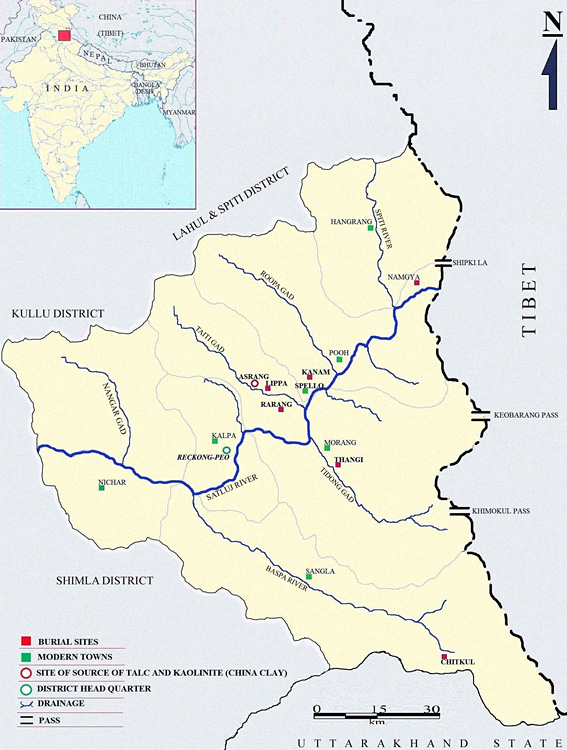
Map of Kinnaur showing the cist burial sites (drawing by Nagendra Rawat).
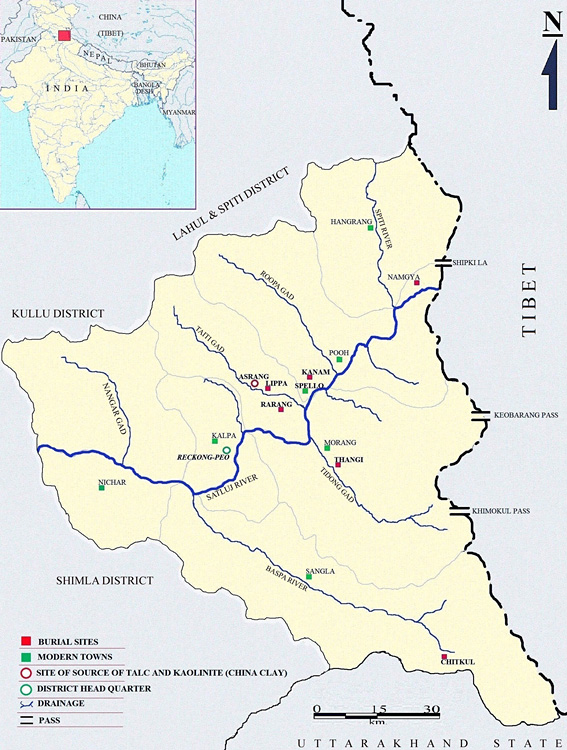
Exploration in the Kinnaur district from 2011–2013 identified a number of sites in the Morang division including Rarang, Thangi and Namgya (Figure 1). Two sites of particular interest are Lippa (31° 39' 51"N, 78° 23' 57" E) and Kanam (31° 40' 69" N, 78° 27' 68" E).
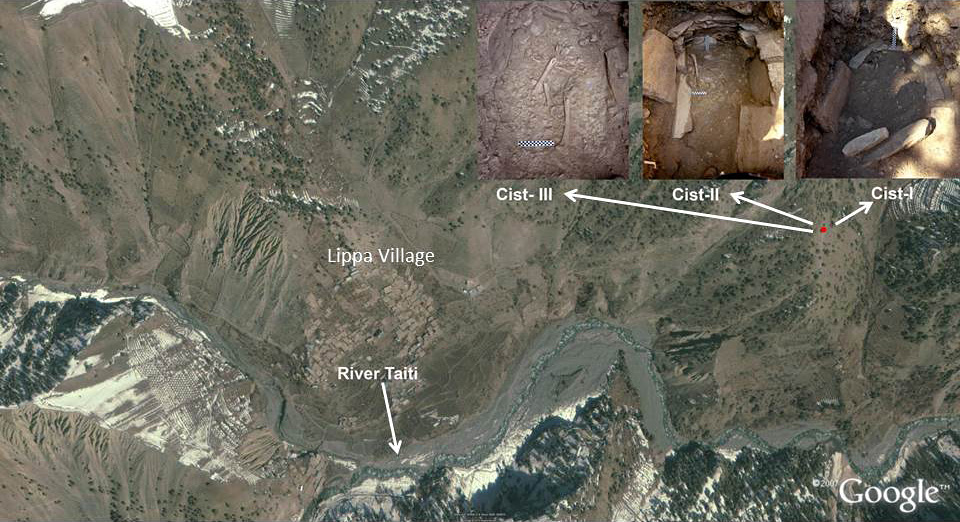
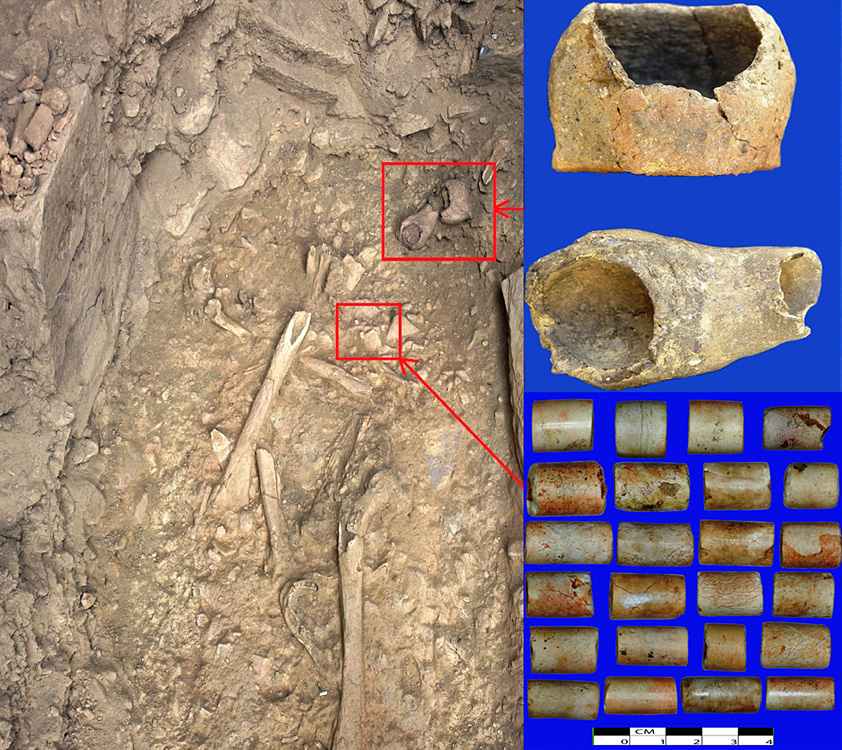
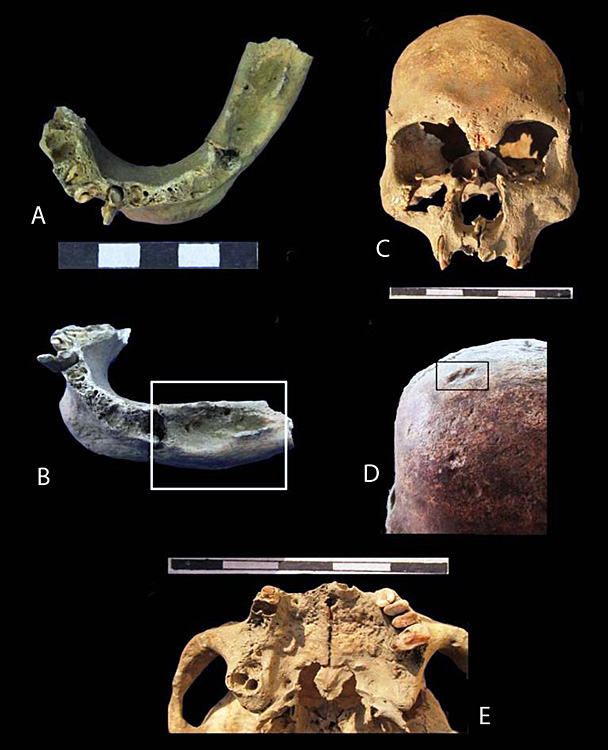
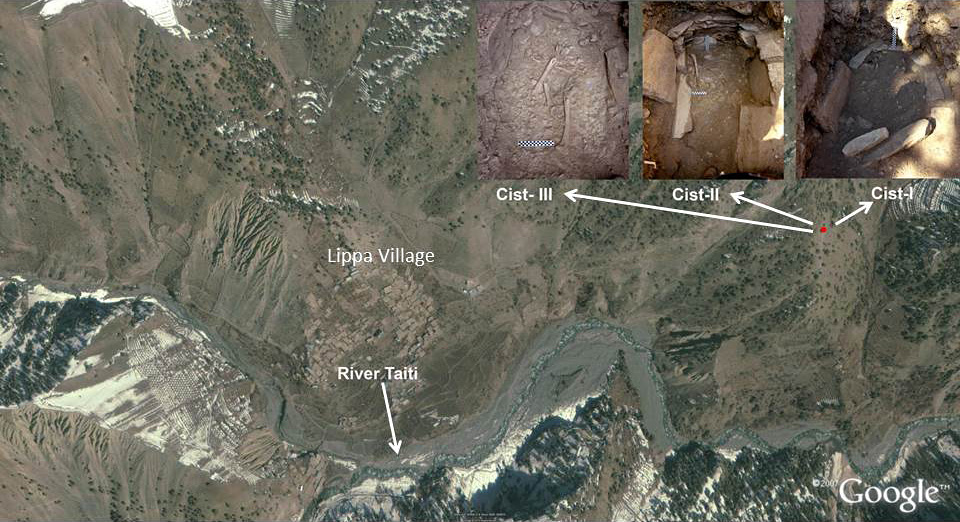
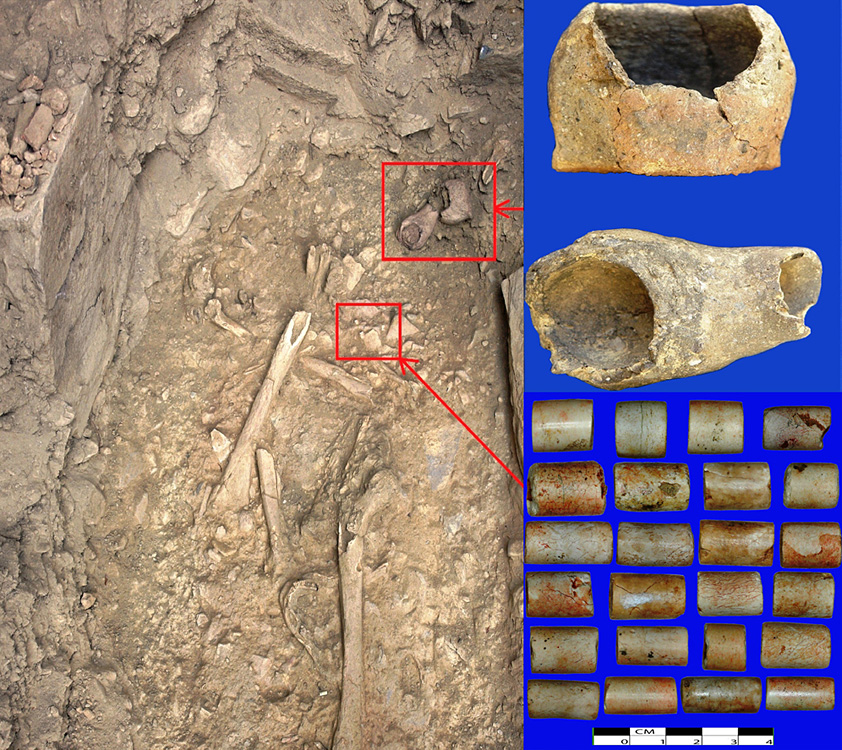
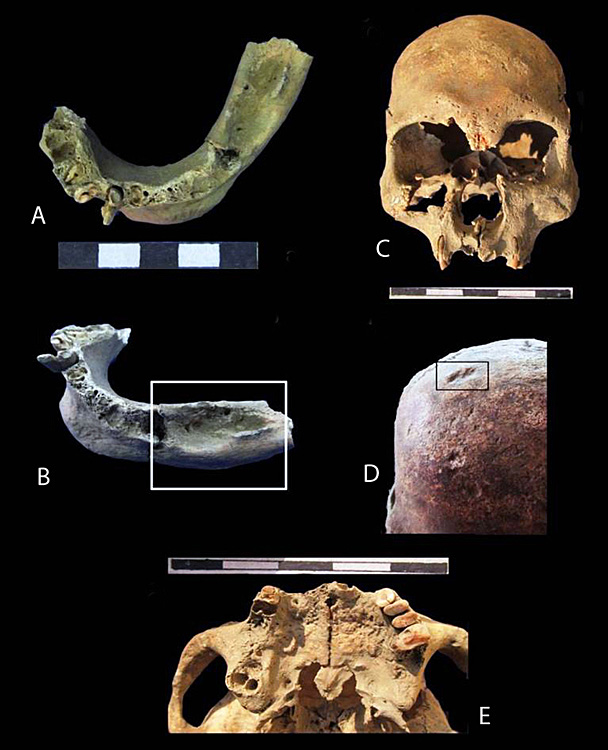
At Lippa, three cist burials (I–III) were distributed across an area of 14m² along the slope of a hill (Figure 2). Cists I and II contained human bone but no grave goods. Cist III contained human bone, charcoal and two small refractory clay crucibles and glazed steatite beads (Figure 3). The bones attest four individuals: a male aged around 35 years, two young males and a female aged around 26 years (Figure 4). It appears that the practice of secondary burial was adopted by the inhabitants of Lippa.
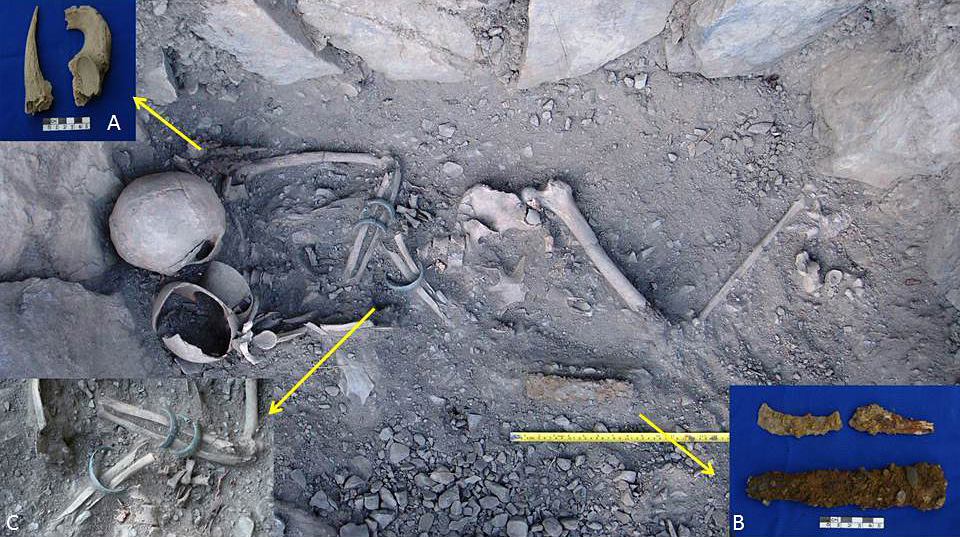
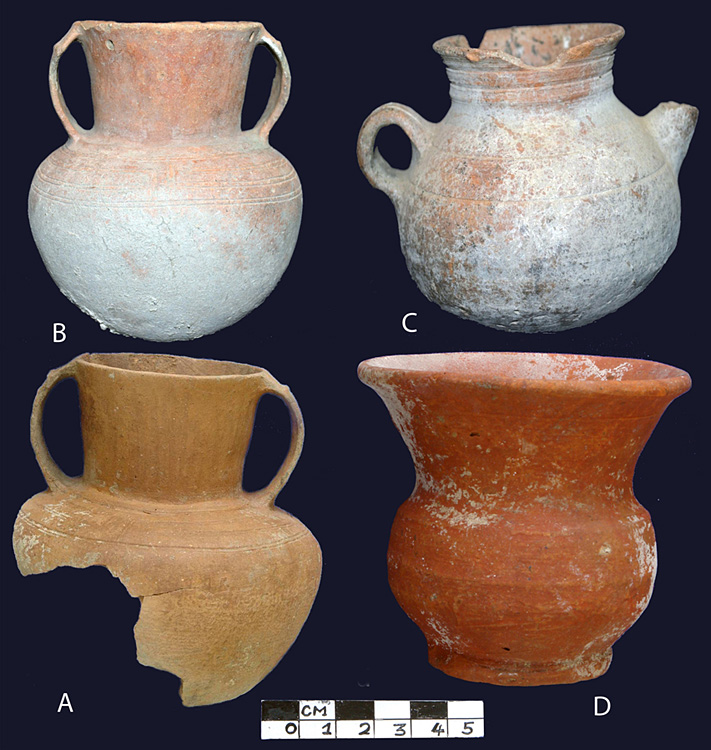
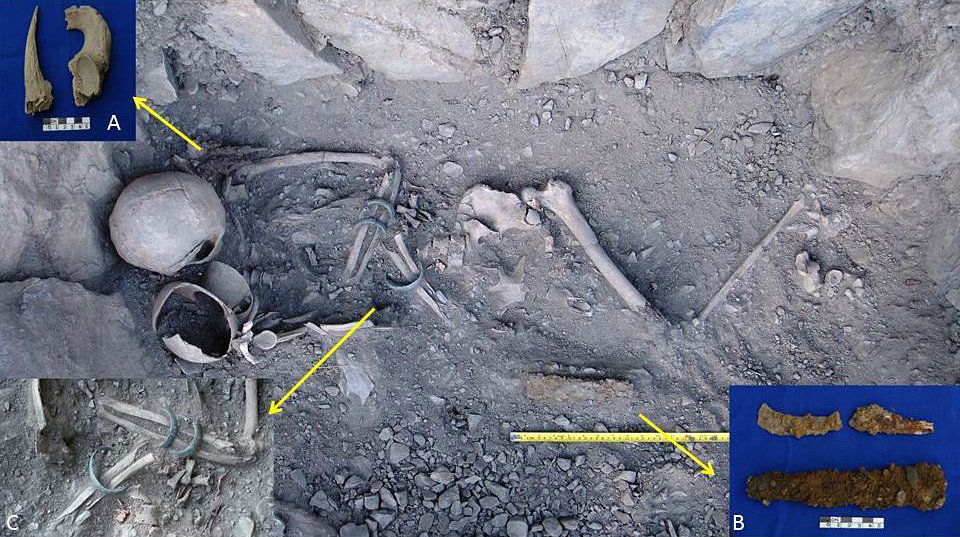
At Kanam, pottery sherds, bone and charcoal fragments were found within an unconsolidated gravel deposit. The most notable discovery was a complete human skeleton in a cist. The deceased was laid south-west to north-east with copper bangles on both wrists. Other grave goods include iron tools, the horns of a ruminant (Figure 5) and a typical red ware pottery vase (Figure 6). This individual is a male of c. 50+ years. Palaeopathological investigation indicates osteoarthritis, osteochondritis, maxillary sinusitis and a healed cranial wound, as well as ante-mortem tooth loss and caries.
Location of cist burials (I–III; as shown in inset) on the mountain ridge towards the north-east of the village of Lippa. © Google.
Crucible and glazed steatite beads and their position in situ in cist burial III at Lippa (photo by J.S. Rawat).
Skeletal remains from Lippa and Kanam showing pathological features: A) Lippa I: mandible (5cm scale); B) Lippa 1: close up of ante-mortem tooth loss; C) Kanam: norma frontalis (10cm scale); D) Kanam: completely healed cranial fracture; E) Kanam: maxilla with severe attrition (10cm scale) (photos by Veena Mushrif Tripathy).
Human skeleton from Kanam cist burial with: A) copper bangles on both forearms; B) horns of ruminant; and C) iron tools with heavy encrustation (photo by Mukesh Bahuguna).
Pottery types from Kanam: A & B) high-necked globular vase with handles on both sides; C) spouted globular vase; D) long-necked, wide-mouthed globular vase (photos by J.S. Rawat).

The development of pyrotechnology
The most important finds from Lippa cist III are two small, highly tempered, moderately vitrified crucibles and steatite beads (see Figure 3). The more complete crucible is oval-shaped and thin-walled and the other is a round, thick-walled, shallow-spouted crucible. The steatite beads vary in colour from white to yellowish, with one showing a light green surface hue.
XRD and SEM-EDS analyses of one bead show it to be made of synthetic enstatite which is produced by heating raw soapstone to a high temperature. The kaolinite and soapstone used to make the crucible and steatite beads could have been sourced from the nearby village of Asrang as this raw material has been reported from here (Geological Survey of India 1989: 52, 2012: 21). Law (2008: 207), however, has found the Asrang soapstone to be of poor quality and hence suggests that it would not have been used for making high-quality glazed beads at Lippa (Law pers. comm. 2013). A study is in progress to establish the actual provenance of these materials.
Dating
The calibrated 14C dates from Lippa and Kanam and a single OSL date from Kanam are given in Tables 1 & 2. The radiocarbon dates have been calibrated using the IntCal09 software (Reimer et al. 2009). Based on the 14C date of 2490±70 BP (BS-3327; 540±70 cal BC) of charcoal from an unconsolidated gravel deposit at Kanam and the OSL date of 2.3±0.2 ka of the pottery, the burial at Kanam may be dated between the sixth and fifth centuries BC. From Lippa the early date of 3140±150 BP (BS-3431; 1420±170 cal BC) may be attributed to the fact of carbon being present in a low amount in the sample, therefore its reliability is questionable until we get more dates. However, at the present stage of our work, based on the Kanam dates it may be said that the burial culture in Kinnaur trans-Himalaya developed around the sixth century BC. Though more dates are required to establish a firm chronology of the burial culture and the development of pyrotechnology, it is important to highlight that these are the first OSL and 14C dates of the burial culture from Kinnaur.


Discussion
Based on the scientific dates from Lippa and Kanam (Tables 1 & 2), we are able to push back the evidence for activity in the Kinnaur area to the sixth century BC and to demonstrate the integration of the area within the wider Trans-Himalayan burial culture of Uttarakhand, Mustang in Nepal, and western Tibet. The evidence of crucibles and steatite beads from Lippa suggest that: 1) the inhabitants developed pyrotechnology using locally available resources not only for metallurgy but also for non-metallurgical application of steatite bead-making; and 2) the crucibles deposited as grave goods in the Lippa cist burial may indicate the identity of the individual as a metalsmith.
The ceramic types found at Kanam and other sites in Kinnaur are very similar to the pottery found at Malari in Uttarakhand (Bhatt et al. 2008–2009: 1–16), Mustang (Reference MishraMishra 1994) and western Tibet (Reference LiLi 2011; Reference TongTong 2011; Bellezza 2013), which date to between 1000 BC and AD 200. This suggests that a common ceramic tradition developed across a large tract of the Trans-Himalayan region and the Upper Tibetan Plateau, though practising different burial traditions. To develop these preliminary findings about burial architecture, funerary practices and pyrotechnologies, detailed excavation will be conducted at Lippa in 2014.
Acknowledgements
The authors would like to extend their thanks to Dr Bhagat Pawar, Sudhir Nautiyal, J.S. Rawat, Mukesh Bahuguna and Kavita Bisht of the Department of History and Archaeology and Museum, HNB Garhwal University, Srinagar, Uttarakhand, India, as well as Puniya Negi and Rajesh Sehgal of Himachal State Museum for participating in the exploration. We also thank Dr S.C. Singh, Dr Manoj K Nautiyal, Mohan Naithani and Nagendra Rawat of the Department for their help in preparing this paper. The authors would like to thank the Director, Birbal Sahni Institute of Palaeobotany for facilities and permission for radiocarbon dating, and to Dr Navin Juyal, GeoScience Division, Physical Research Laboratory, Ahmedabad for measuring the OSL date. The authors also thank the Institute Instrumentation Centre, Indian Institute of Technology, Roorkee, Uttarakhand for the XRD and SEM-EDS analysis of the steatite bead.