

2.1 Introduction
Dhaka, home to an urban population of 20.7 million (BBS, 2023), is amongst the world’s most densely populated places on the planet. Despite being infamous for its traffic congestion and river pollution, this 400-year-old city was once fondly referred to as the ‘Venice of the East’, with its vibrant rivers and canals defining the city’s trade, transport, and sociocultural identity. From the seventeenth-century capital of the Mughal Empire, celebrated for its high-quality yet cheap muslin and silk exports, Dhaka has transformed into a global manufacturing hub for leading fashion brands, driving the country’s rapid economic growth in the twenty-first century. With ‘Made in Bangladesh’ labels increasingly making their way into European high streets and wardrobes, the colourful discharge from thousands of factories silently taints Dhaka’s rivers and waterbodies. Millions of litres of untreated municipal wastewater and solid wastes are further added to this daily cocktail, making the rivers the backdoor drains that have little connection with the city’s middle- and upper-class residents. The riverfronts that were once sought-after residential areas are now occupied by the most impoverished citizens.
What we see in Dhaka today reflects a modern iteration of the historical ‘Great Stinks’ that afflicted rapidly industrialising European cities in the nineteenth century. London, for instance, faced a sanitation crisis where faecal waste from three million residents was routinely dumped into the River Thames, leading to frequent cholera outbreaks (Halliday, Reference Halliday2001). The tipping point came during the scorching heatwave of the summer of 1858, when an intolerable stench pervaded the Victorian city. This prompted the construction of London’s state-of-the-art sewage system over the subsequent decade. Today, high-income countries in Europe and North America treat 70 per cent of their wastewater before discharge, compared to only 8 per cent and 28 per cent in low- and lower-middle-income countries in Asia, respectively (Kookana et al., Reference Kookana, Drechsel, Jamwal and Vanderzalm2020, WWDR, 2017, UNEP, 2016).
Improvement in ambient water quality by halving the proportion of untreated wastewater by 2030 is one of the targets under the Sustainable Development Goals (SDG 6.3). However, monitoring global and national progress towards SDG 6.3 is hindered by substantial data gaps, mainly due to the absence of systematic water quality monitoring systems in most developing countries (UNEP, 2021). The existing water quality monitoring system for Greater Dhaka has insufficient coverage, frequency, and parameters to allow a system-wide understanding of pollution dynamics and effectiveness of interventions. High organic pollution from sewage and solid wastes can interact with chemicals in industrial effluent, amplifying overall toxicity for living organisms. During the monsoon season, runoff from densely populated urban areas and agricultural lands significantly contributes to the pollution load. The heightened river flows and floods transport pollutants downstream and into the floodplains of rural areas. In this chapter, we closely examine these pollution dynamics through monthly data on organic, inorganic, heavy metal, and pathogen contamination across the six rivers surrounding Dhaka.
It is difficult to evaluate and attribute the risks of river pollution to human health and well-being due to the multiple exposure pathways, the long latency periods, and the undefined spatial scales of observable impacts. Beyond direct health effects such as gastroenteritis and skin diseases from contact or immersion in polluted water (Turbow et al., Reference Turbow, Osgood and Jiang2003, Prüss, Reference Prüss1998) and consumption of heavy metals accumulated in fish and crops (Khan et al., Reference Khan, Cao, Zheng, Huang and Zhu2008, Wang et al., Reference Wang, Sato, Xing and Tao2005), there are broader impacts on well-being stemming from poor visual amenities, unpleasant odours, limited recreational opportunities, and stigmatisation of communities (Damery et al., Reference Damery, Walker, Petts and Smith2008). This led us to study the ‘river water diaries’ of Dhaka to understand who interacts with the rivers, for what purpose, and when. Shifting the focus from observable outcomes, this approach allowed a nuanced understanding of the social, economic, and cultural significance of the rivers in people’s lives across space and seasons.
We situate these risks and inequalities within the historical development trajectory of Dhaka from the Mughal era to the British colonial period and discuss how post-independence political and economic priorities shaped the discourse of environmental regulations. With Bangladesh’s economic ascent, transitioning from a ‘least developed country’ to a ‘lower-middle-income country’ in 2015 and set to achieve a ‘middle-income country’ status by 2026, there is an increased political will to free the rivers from pollution. However, this Herculean task is complicated by the complex network of stakeholders within the government, civil society, and the global textile industry, with various forms of state interventions and market-led governance operating within a messy regulatory space. In this chapter, we portray Dhaka’s fashionable rivers to paint the complexities of water–society dynamics that challenge sustainable actions to mitigate risks. The daily experiences of pollution risks by marginalised populations in a megacity reveal one of the many faces of the global water crisis.
2.2 Connected by Rivers, Disconnected from Rivers
In March 2018, on a hot and humid morning, we gathered by the banks of the Buriganga River, awaiting to board a boat for a river tour through the waterways of Dhaka. With a team of about 50 national and international academics and water sector practitioners, the trip was intended to get a first-hand experience of the unfortunate state of pollution of Dhaka’s mighty rivers. Despite being labelled as ‘ecologically dead’, the bustling ambience of the Buriganga waterfront was a testament of the river’s historical role in sustaining the city’s commerce and communication. Multi-tiered ferries, commonly referred to as ‘launches’, were poised to embark on journeys to the southern delta – a landscape interwoven with rivers and creeks that culminate into the expansive Bay of Bengal (Figure 2.1). Cargo freighters with construction materials and motorised wooden trawlers with colourful local produce were docked, waiting to be offloaded. Soon porters lined up to transfer the produce to the vans, like a human conveyor adeptly balancing the loaded baskets on their heads and seamlessly switching it with the next person in exchange of an empty one.
Looking into the expansive Buriganga River from our tour boat in March 2018. As the black, polluted waters glistened in the morning sun, the bridge at the far end read, ‘The nation thrives if the rivers survive. We will bring back our Golden Bengal’ (translated from Bangla).

This is the birthplace of Dhaka – the northern banks of the Buriganga River where the Mughals established their provincial capital in the early seventeenth century. Cradled by six rivers like a garland – Buriganga, Dhaleswari, Turag, Tongi Khal, Balu, and Sitalakhya Rivers – Dhaka’s strategic location was of both military and commercial interest. On the one hand, it enabled surveillance of the lower Bengal Delta against enemy attacks, while on the other hand, the network of rivers and canals allowed transportation of goods to the inner empire. Writing about the seventeenth-century Dhaka, English mariner Thomas Bowrey referred to it as a ‘large spacious’ metropolis, with ‘very fine conveniences’ as it stood beside a ‘fine and large river’ navigable for ships of 500–600 tons (Bowrey, Reference Bowrey1905, p. 150). The water of the Buriganga ‘being an arm of the Ganges’ was ‘extraordinarily good’ (Bowrey, Reference Bowrey1905, p. 150), serving drinking water to its one million dwellers. French merchant Tavernier further noted that Dhaka extended only in length, as ‘everyone coveted to have a house by the Ganges-side’ (Tavernier et al., Reference Tavernier, Phillips, Oldenburg and Everard1684).
Today, the Buriganga River, along with the interconnected river system of Greater Dhaka, is amongst the top contenders of the world’s most polluted rivers. This was apparent as we sailed north-westwards along the Buriganga towards the Turag. The black and indigo water, the rotten egg-like stench, and organic and plastic wastes littered along the banks were in sharp contrast to the picturesque waterscape narrated by Bowrey and Tavernier. The silver jewellery of one of our colleagues became tarnished from silver to black, potentially from the hydrogen sulphide in the air. The appalling state of the rivers is the result of the indiscriminate discharge of untreated wastewater from the city’s households and manufacturing industries, mainly textiles and tanneries. The factories are located within major planned and unplanned industrial clusters along the riverbanks (Figure 2.2). The highest pollution burden is imposed by the wet processing textile units, owing to the high usage of water, along with salts, dyes, and bleaches for washing, dyeing, and finishing processes. Apart from the larger textile units within the export processing zones, most small and medium factory units are concentrated in informal, heterogeneous, under-serviced industrial clusters, often interspersed with some residential dwellings. With very few textile units equipped with fully functioning effluent treatment plants, the bulk of the untreated wastewater makes their way into the rivers through bypass drains and internal canals.
Map of Greater Dhaka (comprising four districts) showing the Dhaka North (DNCC), Dhaka South (DSCC), Gazipur (GCC), and Narayanganj (NCC) City Corporations, major rivers, and industrial clusters.

Compared to textiles, tannery wastewater comprises a high concentration of biodegradable organic load and a substantial nitrogen content, given that leather is composed of proteins, keratins, and fats. The tanning process involves the use of large amounts of salts to preserve the leather, resulting in elevated levels of alkalinity and inorganic compounds, including chromium, chlorides, ammonium, sulphides, and sulphates (Sagris and Abbott, Reference Sagris and Abbott2015). Even though the total volume of wastewater generated by the tanneries is considerably lower than that of the textile industry, the demise of the Buriganga River can be attributed to several decades of pollution stemming from the tanneries in the Hazaribagh cluster (Whitehead et al., Reference Whitehead, Bussi, Peters, Hossain, Softley, Shawal, Jin, Rampley, Holdship and Hope2019). With the tannery industry now been relocated to Savar, the Buriganga River is showing gradual signs of recovery at the cost of the Dhaleswari River now being contaminated.
Today, Bangladesh stands as the world’s second-largest exporter in the USD 45 billion ready-made garment industry, trailing only China, and commands an 8 per cent share of the global market (Berg et al., Reference Berg, Chhaparia, Hedrich and Magnus2021). With this sector contributing over 80 per cent of the country’s export revenue and employing 4 million people, it has emerged as the primary driver for Bangladesh’s economic growth since the 1990s. The leather industry, which contributes around 3 per cent to the export revenue, is also of strategic importance as the country is seeking to diversify its manufacturing export base to sustain the growth trajectory (Hong, Reference Hong2018).
Dhaka’s status as a textile exporter, however, can be traced back to the Mughal period. In contrast to the present-day exploitative dynamic, where the global demand for cheap and fast fashion is choking the local river system, textiles and rivers once shared a harmonious relationship. The exquisite muslin fabric, sought after by royalty and traded across the Roman and Ottoman empires during the sixteenth and seventeenth centuries, was handwoven by skilled artisans using the finest cotton grown along the rivers (Islam, Reference Islam2016). The thread was spun in intensely humid conditions, typically in the morning and evening, with young women going to the middle of the river by boat to cut the yarn (Gorvett, Reference Gorvett2021). The flourishing muslin trade in Bengal, however, met its demise at the hands of the British colonial machinery, whether wielded through the East India Company or direct rule by the Crown. This downfall was orchestrated through discriminatory taxes and tariffs against local cotton growers and weavers, favouring machine-produced imports from British cotton mills.
The colonial policies of the nineteenth and early twentieth centuries also shifted the focus of development from water to land. The dynamic landscape of the delta – its shifting rivers, monsoon flooding, and accretion of new lands – was perceived as a hindrance in the functioning of territorialisation, governance, and taxation. A discourse of ‘contained water’ and ‘dry ground’ emerged, gradually eroding the close-knit bond between Dhaka and its rivers. Under British influence, the transformation of medieval Dhaka into a modern city unfolded, marked by the construction of metalled roads, open green spaces, streetlights, and piped water supply (Ahmed, Reference Ahmed1986). The first flood-protection embankment along the Buriganga was also erected. The advent of the railway in the late nineteenth century further marginalised the significance and upkeep of rivers and internal canals as commercial arteries. The colonial legacy persists in shaping the city’s development trajectory, as wetlands, canals, and rivers continue to be encroached upon for real estate development (Baffoe and Roy, Reference Baffoe and Roy2023). For Dhaka’s middle and upper classes today, encounters with rivers are limited to media coverage of pollution issues, highlighting a stark disconnection from the once integral and dynamic relationship between the city and its waterways.
2.3 Monitoring River Health
The existing institutional arrangement for monitoring surface water quality in Greater Dhaka involves monthly measurements of selected physiochemical parameters by the government’s Department of Environment (DoE), though data collection is less frequent in practice (DoE, 2017).Footnote 1 The DoE’s network of 17 sampling points does not cover the rapidly urbanising areas along upper Turag and Balu Rivers, as well as some important industrial zones. Assessment of heavy metals, inorganic parameters, and persistent organic pollutants in water and floodplain sediments is also needed for a comprehensive understanding of pollution dynamics at the system level. This involves understanding the relative contribution of pollution loads from different reaches and old sediment deposits and the biochemical interactions of pollutants that affect overall toxicity and evaluating the effectiveness of ongoing and planned interventions.
A water quality monitoring system, developed by our colleagues at the Bangladesh University of Engineering and Technology (BUET) (REACH Dhaka, 2023), is the first attempt to ensure regular monitoring of river health across Greater Dhaka. Monthly data from 58 sampling points show the seasonal changes in water quality across different stretches (Figure 2.3). Details on data collection and analysis are outlined in Appendix. During low flow conditions, that prevail from December to April, the dissolved oxygen throughout the river system falls below the minimum threshold essential for sustaining aquatic life. The anoxic conditions in the waters and sediments can result in some metals from bound sediments and gases such as methane, ammonia, and hydrogen sulphide being released. Among the most polluted stretches are the 29-km Buriganga River in the south-west and the Tongi Khal, a 15-km canal linking the Turag and Balu Rivers in northern Dhaka.
River health of Greater Dhaka during 2019–2020 based on a Water Quality Index comprising 15 parameters, namely temperature, pH, electrical conductivity, dissolved oxygen, oxidation-reduction potential, turbidity, colour, alkalinity, iron, ammonia nitrogen, nitrate, phosphate, sulphide, sulphate, and chloride.

The Tongi Khal is also known for its religious significance. Since 1967, its banks have been the sacred grounds for the Bishwa Ijtema, the second-largest gathering of Muslims worldwide, following the Hajj pilgrimage. Every January, a 160-acre government land is transformed with tents to host three million devotees over two three-day phases. The Ijtema served as a natural experiment to understand the impacts of human activities on river water quality. An analysis of heavy metals in Tongi Khal before and after the Ijtema showed an overall increase in concentrations between December 2017 and January 2018 (Rampley et al., Reference Rampley, Whitehead, Softley, Hossain, Jin, David, Shawal, Das, Thompson, Huang, Peters, Holdship, Hope and Alabaster2019). This was due to the combined effects of decreased river flow, resuspension of sediments caused by the disturbance of riverbed during Ijtema preparatory work, and subsequent dissolution of metals due to anaerobic condition. The Ijtema event itself introduced a variety of heavy metals into the Tongi Khal. Washing utensils contributed aluminium, chromium, and iron, while the likely consumption of medicines added selenium. Improper disposal of batteries introduced lithium into the water, and fish residues released manganese. A bacterial biosensor was developed to understand the toxicity of these combinations of heavy metals on living organisms (Rampley et al., Reference Rampley, Whitehead, Softley, Hossain, Jin, David, Shawal, Das, Thompson, Huang, Peters, Holdship, Hope and Alabaster2019). Interestingly, despite the overall increase in metal concentrations, the simultaneous dumping of organic waste resulted in lower availability of free ions, which in turn lowered the toxicity in the samples collected during the Ijtema.
The onset of the monsoon in June–July transforms the riverine landscape. The combined effect of upstream flows from the Himalayas and localised rainfall within the basin leads to the rivers rising (Figure 2.4), subsequently flooding the adjacent low-lying regions. The dilution fades away the stench and black mirror-like surface of the rivers, indicating recovery of the river health to some extent. The concentrations of most organic and inorganic pollutions fall below national thresholds, while the dissolved oxygen rises (Hoque et al., Reference Hoque, Peters, Whitehead, Hope and Hossain2021). There is, however, significant local storm runoff from urban and industrial areas into the streams and rivers, which is evident from elevated turbidity levels in rivers throughout the monsoon season. Increase in temperature and dissolved oxygen, coupled with addition of different genera of coliform bacteria from the monsoon runoff, also reduces the relative proportion of faecal coliform (E. coli) to total coliform.
Low-income settlements near the Konabari industrial cluster along the Turag River. Rise in water levels in monsoon dilutes pollutants, though increased proximity and use of river water is likely to increase exposure to toxic chemicals and pathogens.

Interestingly, the best condition is observed in the post-monsoon season as flushing of the floodplains and rivers in monsoon results in lower sediment and cleaner water, with the pollution plume travelling further downstream (Figure 2.3). The extent of monsoon flooding also varies from year to year. The 2020 floods, for example, inundated about 18 per cent of Dhaka district and exposed 3 per cent of its population – twice as much as 2019 floods (Khan et al., Reference Khan, Shawal, Hossain, Tasnim and Whitehead2024). Moreover, in 2020 as factories were temporarily shut due to COVID-19 lockdown, overall river health was substantially better compared to other years. While monsoon flows dilute the pollutants, the floodwaters deposit toxic heavy metals on the agricultural land affecting dry-season crop productivity. This issue is, however, understudied owing to the widespread perception of monsoons being a blessing as they bring in fertile alluvial soils.
2.4 Life on the Banks of Dead Rivers
Despite the pollution, the banks of the rivers, especially those traversing dense urbanised areas, are always busy with people engaged in diverse activities. We first visited the Tongi slum on a foggy winter morning in January 2017. As we walked along the narrow passages, littered with domestic waste, the honking of buses and trucks on the road faded a little, while the stench of the polluted water grew stronger. Upon reaching the riverbank, we found women and girls washing clothes, dishes or cleaning raw fish and vegetables in the pitch-black river water. A hundred meters away were two hanging latrines. A number of boats were also docked along the bank, being home to the ‘bede’ ethnic group who live and travel along the rivers. Across the river, close to a major fish market, we saw men washing bamboo baskets used to carry or store fish.
Later that year, we started to survey about 2,000 households along a 25-km stretch of the Turag River and Tongi Khal with a view to study the lives of marginalised communities living close to the riverbanks (Hoque et al., Reference Hoque, Peters, Whitehead, Hope and Hossain2021). We divided our study area into four zones, covering up to 1 km on both sides of the riverbank (Figure 2.5). Zone-1, on the upper reaches of the Turag River, comprises land privately owned by a few families descending from early settlers, as well as long-term leaseholders, who built and rented out houses to families and individuals working in nearby brick kilns and factories. Zone-2 covers six peri-urban settlements along the lower reaches of the Turag River, while Zone-3 comprises three densely populated slums close to the Tongi industrial cluster along the Tongi Khal. These slums, including the one we visited above, are on government-owned land, with most tenants and homeowners lacking legal ownership, putting them at risk of eviction. Zone-4, the final stretch of the Tongi Khal, is a relatively quieter neighbourhood, with a boat terminal on the southern bank.

While the surveyed households were generally amongst the poorest residents of the city, there were marked differences in socio-economic profiles of the different zones. Poverty was highest in Zone-3, with one in five adult women working in one of the factories nearby, while the men were engaged in small businesses, casual labour, and garment factories. Zone-4 was a relatively well-off area, having the highest proportion of adults working in the service sector. The average household monthly expenditure in Zone-4 was USD 300, which was higher than the other zones with mean expenditures ranging from USD 160 to 200.
Likewise, there were differences in access to water and sanitation facilities across the four zones (Table 2.1). Households in Zone-1 and Zone-2 used motorised tube wells installed by NGOs, either through pipelines drawn inside their dwelling or through shared taps in communal spaces. Those living on the southern bank of the Tongi Khal in Zone-3 had access to piped water from the water utility (Dhaka Water Supply and Sewerage Authority (DWASA)), whether legally or illegally, while people on the northern bank relied on community tube wells. While they had access to an improved source within a few minutes of walking distance, water was often only available at certain times during the day, creating long queues for a limited quantity that is prioritised for drinking and cooking. Two-thirds of the households in Zone-3 reported sharing their water source with at least five other households. In contrast, those in Zone-4 usually had their own tube wells, with a quarter of them sharing it with others in the same compound.
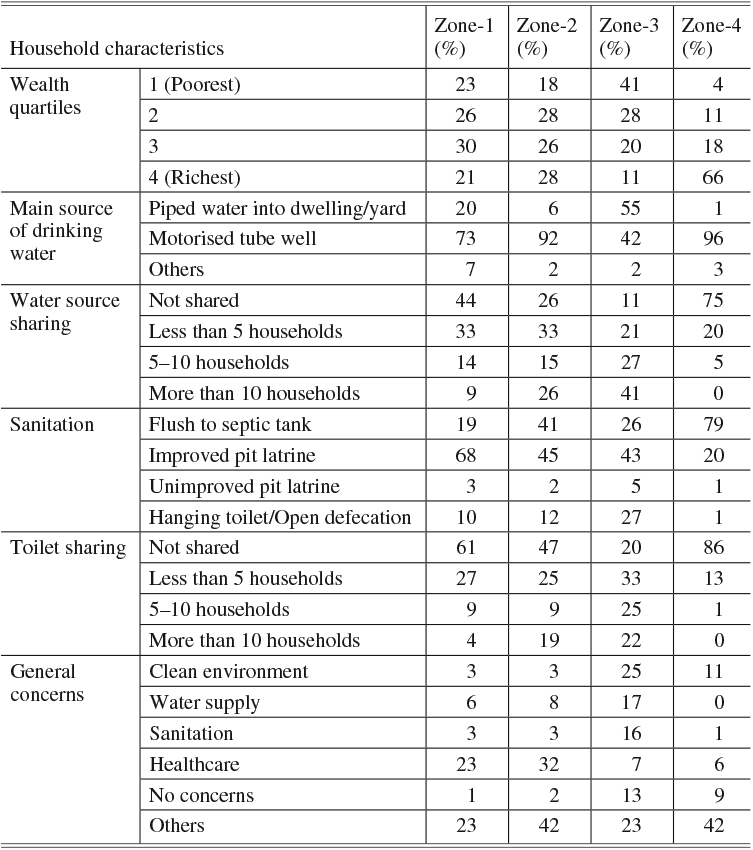
Although none of the households were connected to formal sewerage infrastructure, those in Zone-4 used a flush toilet with a septic tank that was not shared with others. The sanitation conditions were worst in Zone-3, with more than a quarter using hanging latrines or practising open defecation, with the faecal waste discharging into the river. About half of the households in Zone-3 shared their toilets with at least five households, suggesting the lower living standards and increased likelihood of spreading pathogens. Improved pit latrines were more common in Zone-1 and Zone-2, followed by flush toilets with septic tanks.
These differences in poverty and living standards were closely linked to exposure to river pollution. To understand who interacts with the river, under what circumstances and for what purposes, we conducted a direct observation study for two weeks in the dry and wet seasons, respectively. Six observation sites were selected, four in Zone-3 and one in Zone-1 and Zone-4, where enumerators were stationed for three-hour slots throughout the day. Zone-2 was excluded as we did not find any interactions with the river during our scoping visits, as the short river branch flowing through the bottom part of Zone-2 remains dry for part of the year.
Direct contact with river water, through dishwashing, laundry, cleaning fish and vegetables, and personal washing was high in Zone-1 and Tongi slum in Zone-3, particularly among women and girls (Figures 2.6 and 2.7). These sites were close to residential clusters, where overcrowding at community water points and restricted supply only at certain times during the day, led to high usage of river water for domestic activities. Domestic activities were relatively fewer in Zone-4, owing to the better socio-economic status of residents in this area. During the wet season, we observed a slight decrease in domestic activities in Zone-1 and Tongi slum in Zone-3. In Zone-1, construction of new houses along the bank which partially deterred the local residents from accessing one of the observation sites, while in Zone-3, around 60 houses were evicted as part of the government’s drive to control river encroachment.
Boat dwellers and hanging latrines along Tongi slum

Woman collecting plastic bottles from Tongi Khal

Men washing and bathing in the indigo waters

A Ferris wheel for children next to an effluent outlet along Buriganga River.

Intensity of river use activities disaggregated by zone and observation site.

Small-scale productive uses were also observed at some sites in Zone-3. These included washing and dyeing denim, washing fish baskets or plastic sheets, collecting plastic waste, and fishing. Denim washing was mostly carried out by men, under the pillars of the railway bridge on the Tongi Khal. Informal waste pickers could be spotted wading through the river on a boat, collecting plastic bottles for resale while others were seen washing plastic sheets either on the banks or in waist-deep waters. These indigo tainted sheets are waste products from dye packaging, which serve as an income source for these marginalised citizens. Fishing, with or without a boat, was commonly observed across all sites during the wet season. In Zone-1, the abundance of fish along the banks meant that women and children could easily catch these with their bare hands.
Monsoon brought about a steep increase in swimming and bathing activities in Zone-1 and Tongi slum in Zone-3. Recreational swimming was more prevalent among adult men and male children, as cultural norms sometimes refrained women from sharing the same public space with men for recreation. The rise in bathing and swimming, which was also prevalent in other sites, can be attributed to the warmer weather and perceived improvement in water quality. The river was heavily used for boating, mainly for transportation and sometimes for recreation. Boating increased significantly in Zone-3 and Zone-4 during the Ijtema period for transportation of people, food, and construction materials. While temporary sanitation facilities with faecal sludge containment was provided for the Ijtema devotees, urinating into the river was commonly practised, along with the disposal of organic food waste.
Although monsoon flooding typically rejuvenates the Bengal Delta by depositing nutrient-rich alluvial sediment, the scenario is different in Dhaka. Here, the monsoon also brings in toxic pollutants closer to settlements and croplands. The relocation of the tanneries from Hazaribagh to Savar, which we elaborate further in this chapter, has not only transferred pollution from the Buriganga to the Dhaleswari River but has also unleashed new challenges on the downstream communities, particularly impacting Hazratpur village situated 5 km downstream of the Savar tannery estate. Hazratpur, an agrarian community, cultivates rice from December to July, with the low-lying croplands submerged during the subsequent months. The cultivation of vegetables, especially carrots, occurs on higher ground in three-month cycles throughout the year, proving to be a more lucrative output. However, over the past five years, the untreated tannery waste has taken a toll on soil fertility and led to a surge in insect infestation. The pollution load reaches its peak a few weeks after Eid-ul-Adha,Footnote 2 coinciding with flood timings in recent years. Residents of Hazratpur also expressed deep concerns about the declining groundwater level in the village, attributed to the recent installation of five production boreholes by DWASA. This village, once water-secure with access to freshwater through deep tube wells for drinking and irrigation, now grapples with adversities arising from the city’s population growth and industrial activities.
2.5 Regulation by State, Market, and Civil Society
Amongst the various pollution sources, the textile industry often garners the most scrutiny owing to its economic and political significance for Bangladesh, as well as well-known clothing brands. Photos of frothy indigo effluent gushing into the rivers, with boats navigating through floating plastic wastes, appear in international news media echoing the impacts of fast fashion on the poorest populations. Yet, despite compulsory regulations for effluent treatment, along with increasing emphasis on environmental sustainability from global fashion brands, river pollution continues unabated. Understanding this normalisation of pollution and regulatory non-compliance requires critical inquiry into the evolution of state-market dynamics since the country’s independence in 1971 (Peters, Reference Peters2022).
Bangladesh’s early years were marred with economic and political instability. The severe famine of 1974, followed by the assassination of Prime Minister Sheikh Mujibur Rahman in 1975, significantly hindered the country’s efforts towards post-war recovery. In contrast to Mujib’s democratic-socialist ideology, marked by nationalisation of industrial assets and a highly regulated financial sector (Islam, Reference Islam1985), the successive military regimes under General Ziaur Rahman (1977–1981) and General Ershad (1983–1990) adopted a capitalist liberal economic approach. With the promulgation of the New Industrial Policy in 1981, further reformed in 1986 and 1992, the government gradually retreated from its ‘regulatory’ role to facilitate the development of the private sector and expand the country’s export base to non-traditional sectors such as garments and frozen fish. Through a compendium of trade and fiscal reforms, including concessionary duties for imported raw materials and machineries, tax rebates on export income, deregulation of interest rates, reduced emphasis on loan recovery, and a flexible exchange rate with frequent depreciation, the private sector assumed a greater control of driving the country’s economy (Mohammad and Alauddin, Reference Mohammad and Alauddin2005).
Although these macroeconomic reforms were presented as initiatives to promote human and economic development, they essentially served as a tool for Zia’s and Ershad’s military regimes to legitimise and strengthen their unconstitutional power structures by forming alliances with senior bureaucrats and industrialists (Quadir, Reference Quadir2000). During Khaleda Zia’s democratic regime (1992–1997), the private sector’s influence grew even stronger. A significant majority of Parliament members were businessmen and industrialists who funded the party’s extravagant electoral expenses. These policies of market liberalisation were also embraced by international financial institutions such as the World Bank and the International Monetary Fund, which gained unprecedented influence in guiding national policy reforms in aid-dependent countries in the global south (Sobhan, Reference Sobhan1993). These broader economic and political conditions provided a fertile ground for Bangladesh’s textile industry to flourish during the 1980s. At the same time, Bangladesh’s initial exemption from the Multi-Fibre Agreement, which granted quota-free access to the United States market, attracted foreign private investments in manufacturing factories. This, in turn, facilitated significant development of skills and industry knowledge among local entrepreneurs, leading to growth of domestic ventures under the patronage of successive political regimes (Mottaleb and Sonobe, Reference Mottaleb and Sonobe2011).
Given the economic and political significance of the manufacturing sector, the government has traditionally adopted a ‘retreatist’ approach to environmental regulations for industries – one that is ‘strong on paper’ but ‘weak in enforcement’ (Peters, Reference Peters2022). The Environmental Conservation Act (1995), and the subsequent Environment Conservation Rules (1997), require ‘red category’ industries, including fabric dyeing and tanneries, to obtain location and environmental clearance certificates and treat their wastewater to scheduled standards prior to discharge (MoEF, 1997). Revised in 2010, the Act establishes a minimum fine of BDT 50,000 (USD 450) and a maximum fine of BDT 200,000 (USD 1,800) for cases of ‘discharging excessive pollutants’ (MoEFCC, 2010). For repeat offenders, the penalty increases to 1,000,000 BDT (approximately USD 9,200). Yet, publicly disclosed data from 290 cases between 2011 and 2016 show that fines are often imposed arbitrarily, ranging from USD 117 for a garment factory lacking a clearance permit or an effluent treatment plant, to as much as USD 350,000 for instances of partial operation of an effluent treatment plant on the factory premises (Haque, Reference Haque2017).
For many factory owners, the cost savings from not installing or operating effluent treatment plants far outweigh these penalty fines (Haque, Reference Haque2017), with additional data from 2010 to 2019 showing that only half of the fines imposed were actually recovered by DoE (Peters, Reference Peters2022). The limited enforcement actions taken by DoE can be attributed to the significant autonomy enjoyed by large factory owners, who can leverage their political connections to request reductions or waivers of fines, placing DoE officers at risk of facing professional consequences from higher authorities. As a result, cases that are simpler and easier to identify are often pursued, often singling out smaller enterprises that are less likely to mount effective resistance.
Against this backdrop of slack state regulation, private governance by international brands or ‘buyers’ has emerged as an alternative form of environmental regulation. With growing consumer pressure, international brands are increasingly focusing on environmental sustainability practices along their supply chains. Bangladesh now has the highest number of factories with the Leadership in Energy and Environmental Design certification, indicating a trend towards greening investments to boost buyer confidence and assurance of continued participation in the export market (The Daily Star, 2023). Since 2013, the International Finance Corporation led Advisory Partnership for Cleaner Textile has supported hundreds of factories in adopting cleaner production practices that reduce water consumption, wastewater discharge, energy usage, and greenhouse gas emissions (The Daily Star, 2017). Yet participation in such programmes is often limited to the larger first tier suppliers who can recoup the upfront investments through long-term savings in operation costs. For the vast majority of smaller factories, which often operate as subcontractors for larger facilities and fall outside the buyers’ scrutiny, this market-driven regulatory approach proves ineffective in mitigating pollution.
Parallel to these state-market power dynamics, civil society organisations and environmental advocacy groups have emerged as influential actors in negotiating regulatory processes through public interest litigation. A notable example is the Bangladesh Environmental Lawyers Association, which, in 2003, filed a writ petition against relevant government agencies and tannery owners in Hazaribagh, demanding to stop polluting the Buriganga River (BELA v. GoB, 2003). In response, the High Court ordered the industry to relocate to a purpose-built tannery estate along the Dhaleswari River in Savar – a process that ultimately spanned one and a half decades. The centralised effluent treatment plant, a cornerstone of the relocation efforts, however, proved ineffective in mitigating pollution due to a mismatch between its treatment capacity and the actual effluent flow during the peak three-month season (Mirdha, Reference Mirdha2023).
Another landmark verdict was delivered by the High Court in 2019, granting ‘legal personhood’ status to all rivers in Bangladesh and authorising the National Commission for Rivers as the legal guardian (Islam and O’Donnell, Reference Islam and O’Donnell2020). The verdict was a response to a writ petition filed by the Human Rights and Peace for Bangladesh to challenge the legality of earth-filling, encroachment, and construction of structures along the banks of the Turag River. The petition was corroborated by a 2016 report titled ‘Time to Declare Turag Dead’ (Ali, Reference Ali2016) published in The Daily Star – the country’s leading English newspaper.
Over the past one and half decades, multiple projects and plans have been designed and implemented by various government agencies and donor organisations to address these seemingly obvious solutions (Siddique and Rahman, Reference Siddique and Rahman2019). Yet, despite hundreds of millions of dollars of investments, there has not been any noteworthy improvements in river water quality. For instance, the much-hyped Buriganga clean-up project, undertaken by the Bangladesh Inland Water Transport Authority (BIWTA) in 2012, proved to be futile as solid waste recovered from the riverbed and piled on riverbanks ultimately made their way back into the river during monsoon. In response to ongoing river encroachment, BIWTA has spearheaded multiple initiatives to dismantle illegal structures and remove informal settlements, including one in 2019 that evicted the Tongi slum we studied. A network of pillars, erected over the years to demarcate the river boundary, has allegedly been placed in the wrong locations, further legitimising powerful land grabbers. While BIWTA oversees the management of riverbanks, the flow of surface water falls under the jurisdiction of the Bangladesh Water Development Board. An ambitious project designed to augment the dry season flow of the Buriganga by desilting its links with Jamuna River was never completed.
2.6 Conclusion
River health has characterised the political and economic progress of many global cities. The health of rivers is a legacy bestowed on the current population to hand over in better condition to the next generation. Many of Dhaka’s residents may be rightly concerned by both their recent inheritance and future legacy with high levels of river pollution due to the forces of rapid economic and demographic growth in the context of regulatory non-compliance environmental management. Water security inequalities have been exacerbated by river pollution with the most vulnerable least able to escape the social and health risks of living and working in the multiple river arteries of the city.
Observing patterns of daily behaviour across the city reveals who is in harm’s way. Across the four zones we studied there are stark social inequalities between environmental and social risks in Abdullapur (Zone-3) and Mausaid (Zone-4). In the former, people are most concerned with a clean environment and basic drinking water and sanitation services. This reflects ten or more households sharing water supplies or toilets, with a high incidence of open defecation. Remember that Bangladesh is regarded as a regional success story in largely eradicating open defecation. In contrast, people living in Mausaid are more concerned with roads and healthcare reflecting limited toilet sharing and open defecation. The hydrological models clearly show river water pollution is concentrated in Abdullapur, and there is no coincidence that is where the most vulnerable people are found to reside.
By tracing who engages with the river, we can also see different patterns of behaviour and risk (Figure 2.8). During the dry season, it is in the socially deprived areas of the Tongi slum and Konabari where women are found to be at the river undertaking their daily chores. Men are found at the river during the Bishwa Ijtema to join the religious festival and face similar health risks. During the wet season, the assumption that river quality improves with higher flows may contribute to boys and girls swimming in the water in the Tongi slum, though scientific data show the pollution risks remain. Men also engage with the river, beyond the daily boating duties, across all the zones, though most modestly in Mausaid. The few observations of women, girls, men, or boys in the rivers near Mausaid partly both reflects better water and sanitation facilities in the home but also higher development and social indicators. As wealth and welfare increases people choose to live in cleaner river environments and they do not interact with the dirty rivers. This story is the same in Dhaka as it was before in Paris, London, or Washington, D.C.
Observations of river use disaggregated by gender and age.

Government, industry, and donors are aware of the growing water insecurity inequalities and collectively have plans to invest over USD 20 billion in water treatment infrastructure in the coming decades (Byron and Yousuf, Reference Byron and Yousuf2022). This is to be welcomed but with certain caveats. First, the time frames for infrastructure investments are generational demanding early action for the most vulnerable. Second, regulatory non-compliance of environmental pollution is normalised and unlikely to change without unprecedented political or legal reform. Third, the ready-made garment industry looms large as a key, but not unique, actor in improving environmental, social, and economic outcomes.
Social inequalities in Dhaka appear overwhelming in the dense fabric of a city that continuously grows and expands. Addressing the inequalities in Abdullapur, and other areas, needs to be an investment priority. Sharing water and toilets in such dense settlements increases public health risks in addition to reducing human dignity and welfare. Development actors have the means and the money to make significant improvements to bring safe water and sanitation services to these people. This will not immediately address the health of rivers but will make a significant contribution to improving water security in a few years, not a few decades. These areas also have high concentrations of garment workers living in extremely harsh living conditions.
Second, tackling regulatory non-compliance to environmental regulation will be a major challenge, partly because many politicians and factory owners are the same people. Unravelling this political conundrum is unlikely to be quick or easy. While the ready-made garment industry reports billions of dollars of revenue, the margins are thin. Water treatment costs money and workers’ wages are already low and under pressure to increase. Bangladesh performs well globally in the sector due to high-quality and low-cost labour. The economic calculus is challenging; as external regulatory costs are increased by Europe and other global markets, the industry has to manoeuvre agilely, which may lead to selling to less regulated markets in Asia. With an estimated 6,000 factories in Dhaka, the global excellence of the environmental standards of a handful of factories belies the significant damage caused by the majority. If economic history is a guide to the future, Bangladesh will gradually exit the market in decades to come as China and other countries have done.
However, the process of industrial change is highly uncertain and the well intentioned efforts to relocate the tannery industry was not executed well, for a range of reasons, with river health damage relocated from the Buriganga River to the Dhaleshwari River. Public frustration with progress has grown leading to popular support for the legal rights of rivers. It remains unclear if legal precedent can triumph where politics and industry has failed. Global experience of the rights of rivers is emerging and mixed. India is probably the most relevant comparison to Bangladesh with politicians deciding to revoke legal instruments for rights of rivers on the Ganges River in favour of a massive programme of infrastructure investment for water treatment facilities (Mishra and Upadhyay, Reference Mishra and Upadhyay2021).
Beyond the feasibility of legal action improving river health, a proximate victim of action can be the communities living illegally on the riverbanks. Forced removals have occurred on the Tongi slum in Dhaka since the passage of the law. Where these people now live is unclear though their livelihoods have been radically disrupted with limited material change to the health of the river. Since the horrific Rana Plaza disaster a decade ago, global brands working in the industry now take a more direct and proactive role in factory conditions and worker welfare. Understanding and engagement with river health has increased though operates at the factory level, or cluster of factories, rather than the river system. Understandably, there are many other sources of river pollution with the vast quantities of untreated sewage an obvious priority.
Ultimately, the health of Dhaka’s rivers is a government responsibility. Europe and North America massively polluted their urban rivers in their own race for economic improvement. These previously damaged rivers have now recovered where government regulation and enforcement remain strong and consistent. The Government of Bangladesh has the means and the authority to twin-track the longer-term improved health of the rivers and the short-term improved water security in the most polluted locations. The government’s Delta Plan 2100 provides a long-term planning and financial framework for action modelling uncertainties and interactions in monsoon patterns, demographic variability, economic growth, and social welfare (General Economics Division, 2018). Our river observations show the granular and daily reality for people living in extreme hardship today. The moral imperative to act today for the most water insecure people is perfectly compatible with an environmental obligation to progressively improve river health over the next decade.


 Open access