


Introduction
Recent years have been marked by the stunning success of populist parties, politicians and ideas. Populist parties, most of them leaning distinctly to the political right, have been a phenomenon in many Western European countries for several decades. Yet their electoral impact has never been as powerful as in the relatively recent round of national elections across Europe, which also coincided with the Brexit referendum and the election of Donald Trump as United States president. In an attempt to explain this increasing success, scholars have pointed to factors such as economic insecurity and crisis, anti‐immigration sentiments, a general cultural backlash and the decline in traditional parties’ representative function (for overviews, see Inglehart & Norris Reference Inglehart and Norris2017; Ivarsflaten Reference Ivarsflaten2008; Kriesi Reference Kriesi2014; Mudde & Rovira Kaltwasser Reference Mudde and Rovira Kaltwasser2018). Without challenging these explanations, we turn our attention to another, less explored factor (but see Moffitt Reference Moffitt2016): the impact of online communication tools made possible by the proliferation of broadband internet. We explore the idea that the rise of populism can be explained by the diffusion of the online platforms and communication strategies that fast internet has made available. In a nutshell, we argue that one of the reasons why populist politicians and parties are increasingly successful is that broadband internet has provided them with new tools that perfectly suit their communication needs.
Populism can be understood as a communication style that is distinctly anti‐elitist and claims to promote the will of the ‘ordinary’ people (Canovan Reference Canovan1981; Jagers & Walgrave Reference Jagers and Walgrave2007). The anti‐establishment rhetoric of populists finds a perfect ally in broadband internet as a medium that connects political leaders directly to their supporters. What is more, populists often struggle to get their messages across in the mainstream media – especially when these messages rely on unverified content and are socially provocative. Online communication solves this problem, giving populists unfiltered access to their audience (Kriesi Reference Kriesi2014; Moffitt Reference Moffitt2016). This advantage is somewhat unique to populists, as mainstream parties and politicians face fewer restrictions in the first place. For established political players, broadband internet provides just another communication platform. For populists it has been a game changer, providing them with a communication channel that allows them to maintain ideological consistency and circumvent gatekeepers.
We draw on a body of literature that describes how the internet and social media have contributed to political extremism and the polarisation of attitudes. This work has shown that broadband internet can increase partisan hostility (Lelkes et al. Reference Lelkes, Sood and Iyengar2017), influence turnout (Campante et al. Reference Campante, Durante and Sobbrio2018; Falck et al. Reference Falck, Gold and Heblich2014; Larcinese & Miner Reference Larcinese and Miner2017) and increase electoral uncertainty (Sudulich et al. Reference Sudulich, Wall and Baccini2015), while social media have been shown to spur protest activity (Barberá et al. Reference Barberá, Wang, Bonneau, Jost, Nagler, Tucker and González‐Bailón2015). Yet we know surprisingly little about the causal impact of the internet on actual voting, least of all for populist parties.Footnote 1 One of the reasons for this relative lack of evidence is the longstanding problem of voter self‐selection into media exposure (Lazarsfeld et al. Reference Lazarsfeld, Berelson and Gaudet1944). Even if we do observe a correlation between voting behaviour and media use, it is hard to be sure whether what we observe is a causal relationship or a mere artifact of voters seeking to confirm already existing political positions.
To overcome this problem, we follow Sudulich et al. (Reference Sudulich, Wall and Baccini2015) and Lelkes et al. (Reference Lelkes, Sood and Iyengar2017) in combining micro‐level outcome data with an instrumental variable (IV) strategy. Our focus is on two of the major populist parties in Europe, both of which have recently obtained stunning electoral success: the Five Star Movement (Movimento Cinque Stelle, M5S) in Italy and the Alternative for Germany (Alternative für Deutschland, AfD) in Germany. Drawing on survey data collected in the context of the 2013 general election in Italy and five regional elections in Germany in 2016 and 2017, we trace voter choices and patterns of internet use at the individual level. We show that, in both countries, the use of the internet as a source of political information strongly predicts voting for populist parties, but not for other, mainstream, parties.
To address causality, we adopt an IV strategy. We exploit geographical variation in broadband coverage as an instrument for internet use. We demonstrate that, conditional on a number of municipal‐level characteristics that have shaped the roll‐out of broadband internet, this variation in coverage is orthogonal to a large number of possible confounders. By instrumenting internet use with broadband coverage, we show that the correlation discovered in the first step can be interpreted as causal. The increasing availability and use of broadband internet has indeed contributed to the rise of populism in both Germany and Italy, even though the size of this contribution is modest. Our findings add to a growing but limited number of studies that provide real‐world evidence for the causal effect of media on political outcomes. To the best of our knowledge, our study is the first to demonstrate a causal link between one of the most puzzling political phenomena of our time – the steady rise of populist parties – and the spread of broadband internet.
Populism and the spread of broadband internet
Populist parties have been on a slow but steady rise in Europe. Inglehart and Norris (Reference Inglehart and Norris2017) estimate that their share of seats in national and European parliament elections rose from 10 per cent in the 1960s to 25 per cent in 2015. This increase in importance appears to have accelerated in recent years, which saw populist parties consolidating substantial shares of the vote in France, the Netherlands and Austria, while reaching record highs in Germany, Italy and Sweden. Most importantly, Brexit (the decision by British voters to exit the European Union) was promoted by Britain's right‐wing populist United Kingdom Independence Party (UKIP) and driven by nativist and anti‐elitist motives (Iakhnis et al. Reference Iakhnis, Rathbun, Reifler and Scotto2018). In the United States, the last decade or so saw the development of the Tea Party, which shares many of the characteristics of European (right‐wing) populist parties (Skocpol & Williamson Reference Skocpol and Williamson2016), and in 2016, American voters elected Donald Trump as president, whose frequent use of anti‐elitist messages and appeals to America's traditional values resemble the typical communication style of other populist leaders (Inglehart & Norris Reference Inglehart and Norris2017).
The rise of populist parties and politicians in Western democracies has been attributed to the relative demise in status of working‐class men, who feel left behind and turn to populist politicians and parties for support (Gidron & Hall Reference Gidron and Hall2017). Sharpened economic competition and the economic crisis of 2008–2009 have not only exacerbated such feelings of relative deprivation (Colantone & Stanig Reference Colantone and Stanig2018), but have also contributed to constraining the margin of manoeuver for traditional parties, thus reducing their traditional representative function, to the advantage of new, populist actors (Kriesi Reference Kriesi2014). Other scholars contend that the support for populism is better explained as a cultural backlash against postmaterialist values than by economic factors (Inglehart & Norris Reference Inglehart and Norris2017). This culturalist perspective focuses on right‐wing populist parties’ frequent appeals to traditional values and their anti‐immigration stance (Ivarsflaten Reference Ivarsflaten2008).
As a concept, populism remains contested. Among possible definitions, the so‐called ‘ideational approach’ has gained prominence among scholars. According to this approach, populism can be defined as a set of ideas that share an anti‐elitist dimension, where ‘the pure people’ are pitted against ‘the corrupted elites’ (Mudde & Rovira Kaltwasser Reference Mudde and Rovira Kaltwasser2018). A parsimonious definition of populism, therefore, sees it as a communication style of political actors that refer to ‘the people’ and claim to speak in their name (Canovan Reference Canovan1981; Jagers & Walgrave Reference Jagers and Walgrave2007). Indeed, scholars have argued that such a communication style is a defining feature of contemporary populism, arguing that ‘the populist ideology manifests itself in the political communication strategies of populist leaders’ (Kriesi Reference Kriesi2014: 364). Thus, populism can also be conceived as a ‘discursive frame’ (Aslanidis Reference Aslanidis2016) or a ‘communication phenomenon’ (De Vreese et al. Reference De Vreese, Esser, Aalberg, Reinemann and Stanyer2018), in which the media used to communicate is as important as the content of the messages.
It therefore makes sense to ask how the increased availability of broadband internet and the new communication channels this expansion has promoted have affected the success of populists. Since the advent of the internet, scholars have investigated the impact of this new technology on several aspects of politics, including populism (Bimber Reference Bimber1998). Only recently, however, have scholars started to provide causally identified estimates for the impact of broadband internet and social media on political behaviour. These studies have shown that broadband internet can increase partisan hostility (Lelkes et al. Reference Lelkes, Sood and Iyengar2017), boost grassroots protest movements (Campante et al. Reference Campante, Durante and Sobbrio2018), influence turnout (Falck et al. Reference Falck, Gold and Heblich2014; Larcinese & Miner Reference Larcinese and Miner2017), and increase electoral uncertainty (Sudulich et al. Reference Sudulich, Wall and Baccini2015) and protest activity (Barberá et al. Reference Barberá, Wang, Bonneau, Jost, Nagler, Tucker and González‐Bailón2015). Yet, with one recent exception (Falck et al. Reference Falck, Gold and Heblich2014), there is practically no causal evidence of how the diffusion of broadband internet impacts actual voting.
We argue that broadband internet is of particular use for populists, giving them a relative advantage over other parties. We believe that this is due to three qualities common to populists, but not shared by mainstream parties: (1) populists often need to circumvent gatekeepers in the mainstream media, especially in countries where tabloid media outlets are weak or unsupportive; (2) populists seek to maintain an anti‐elitist and people‐centric stance that stresses a direct connection to ‘the people’; and (3) populists often use and rely on borderline truths and forged content that would not receive (sufficient) coverage in most mainstream media. Populist parties and politicians in many countries are seen as mavericks that adopt untenable positions. Journalists working for mainstream media will often be unwilling to cover them favourably, partially because of professional norms that stress impartial, fair and responsible reporting (Aalberg et al. Reference Aalberg, Esser, Reinemann, Stromback and De Vreese2016). Clearly, this argument does not imply that traditional media are always hostile towards populist movements. The media can be both ‘friends and foes’ of populist parties (Mudde Reference Mudde2007: 49). In particular, tabloid media can be supportive of populist movements, as could be observed during the Brexit referendum campaign in the United Kingdom (Deacon et al. Reference Deacon, Wring, Harmer, Downey and Stanyer2016). In extreme cases, as in some Central and Eastern European countries, media and populist parties go hand in glove, resulting in a ‘congruence of stylistic elements between media logic and political populism’ (Esser et al. Reference Esser, Stepinska, Hopmann, Aalberg, Esser, Reinemann, Strömbäck and De Vreese2016: 10).
Yet, even where populists enjoy substantial visibility in the mainstream media, they may still be tempted to use online tools as an additional communication channel. The 2016 American presidential election is a case in point. While Donald Trump benefited from increased mainstream media coverage during the primary election campaign (Reuning & Dietrich Reference Reuning and Dietrich2019), another reason for his success was arguably his hybrid‐media campaign, which relied heavily on social media (Wells et al. Reference Wells2016). Comparative evidence shows that populist parties in many European countries (including France, the United Kingdom, Italy, Spain, Austria and Norway) have invested heavily in online channels of direct communication, no matter what the media system (Esser et al. Reference Esser, Stepinska, Hopmann, Aalberg, Esser, Reinemann, Strömbäck and De Vreese2016).
Second, we argue that the online tools enabled by the expansion of broadband coverage disproportionally favour populists because they allow them to maintain ideological consistency. Besides needing to circumvent mainstream media that act as gatekeepers, populist actors want to avoid the established media. There is general consensus among scholars that a defining feature of populism – regardless of whether left‐wing or right‐wing – is the postulated ‘antagonistic relationship between the corrupt elite and the virtuous people’ (Rooduijn Reference Rooduijn2019: 363). Populists often deride established media outlets as part of the very elite they are attacking, and claim to speak directly ‘to the people and for the people’ (Urbinati Reference Urbinati2019: 8). This is true not only for right‐wing populists (Esser et al. Reference Esser, Stepinska, Hopmann, Aalberg, Esser, Reinemann, Strömbäck and De Vreese2016: 10), but also for left‐wing or ideologically hybrid populist movements (Casero‐Ripollé et al. Reference Casero‐Ripollé, Feenstra and Tormey2016; Engesser et al. Reference Engesser, Ernst, Esser and Büchel2017). Populist rhetoric, in turn, finds a perfect ally in online platforms that allow them to communicate directly with party supporters, cutting out traditional media intermediaries. Content analysis of social‐media messages confirms that elements of both anti‐elitism and people‐centrism tend to be present in the online communication of populist parties in countries such as Austria, Italy, Switzerland and the United Kingdom, even though the media environment in these countries differs starkly (Engesser et al. Reference Engesser, Ernst, Esser and Büchel2017). We therefore second Moffitt (Reference Moffitt2016: 92), who argues that ‘populist actors have benefited from the ability [of new media] to reach “the people” in a low‐cost and efficient manner that sidesteps traditional media channels, while at the same time appearing to be more “direct”, “immediate” and accountable to their “people”’.
A third reason why populists profit particularly strongly from new online platforms has to do with the type of content they frequently tend to share, but which mainstream parties typically shy away from: unverified or outright forged media items. During the 2016 American electoral campaign, many news items circulated online that were later proven to be factually wrong, and the vast majority of these news items favoured the populist candidate Donald Trump (Guess et al. Reference Guess, Nyhan and Reifler2018b). This is relevant because manipulative, false content appears to diffuse ‘farther, faster, deeper, and more broadly than the truth’ (Vosoughi et al. Reference Vosoughi, Roy and Aral2018: 1146).
Similarly, during the campaign for the 2017 national election in Germany, AfD representatives frequently shared news items that were known to be manipulated and taken out of context (Sängerlaub et al. Reference Sängerlaub, Meier and Rühl2018). The internet can be a fertile ground for diffusing conspiracy theories that echo the anti‐elitist stance of populist movements. Indeed, evidence shows that belief in conspiracy theories correlates with support for populist parties in Italy (Mancosu et al. Reference Mancosu, Vassallo and Vezzoni2017) and with extreme left‐wing and right‐wing ideology in the United States, the Netherlands and Sweden (Castanho Silva et al. Reference Castanho Silva, Vegetti and Littvay2017; Marwick & Lewis Reference Marwick and Lewis2017; Krouwel et al. Reference Krouwel, Kutiyski, Van Prooijen, Martinsson and Markstedt2017).
It is important to reiterate that none of the above points fully applies to mainstream parties. Established parties usually maintain good links with the mainstream press and have no need to circumvent them. They do not typically deride mainstream media and thus do not have to keep their distance. And they are usually committed to operating on the basis of facts, so that relying on false information would harm their credibility. For these reasons, we contend that broadband internet has given an advantage to populist parties that established parties cannot fully use.
The five star movement and the alternative for Germany
This paper focuses on two of the major populist parties in Europe: the M5S in Italy and the AfD in Germany. Although the two parties show some differences in terms of ideological orientation and issue positions, during the 2014–2019 legislative period of the European Parliament they belonged to the same parliamentary group (‘Europe of Freedom and Direct Democracy’), which united them with other populist parties like the British UKIP.
The Five Star Movement (M5S)
Founded by the charismatic comedian Beppe Grillo in 2009, the M5S competed at the national level for the first time in the general election of 2013. By gaining around a quarter of the vote for the Chamber of Deputies (25.6 per cent), the party reached astonishing electoral success without precedent in postwar Italian history for a party running for the first time. In the subsequent national election in 2018, the party managed to increase its share of the vote still further, with one Italian voter in three opting for the M5S in the race for the Chamber of Deputies (32.7 per cent). The M5S claims to be ‘outside’ the left‐right spectrum (Bordignon & Ceccarini Reference Bordignon and Ceccarini2013). However, the M5S shares some key features of populism, such as strong anti‐elitist rhetoric – in which the ‘people’ are opposed to corrupted political elites – and emphasis on a direct connection between the leader of the movement and his supporters. The M5S's main means of communicating with its supporters is Beppe Grillo's blog, a popular website that exemplifies the philosophy of the M5S since it enables its leader to cut out mainstream media as a communication intermediary and disseminate unfiltered content (Mosca & Vaccari Reference Mosca, Vaccari, Corbetta and Gualmini2013).
The Alternative for Germany (AfD)
Founded in 2013, the original agenda of the AfD was to oppose German financial support for other European countries and Europe's common monetary regime. The party then quickly drifted to the populist political right, taking up issues such as the ‘fight against political correctness’, and rejecting the acceptance of refugees (Schmitt‐Beck Reference Schmitt‐Beck2017). Like the M5S, the AfD quickly rose to power, entering first the European Parliament and then the regional parliaments of all Germany's 16 states. The AfD entered the Bundestag, the national parliament, for the first time in the 2017 general election, garnering 12.6 per cent of the vote – the third‐best performance of all parties. The party heavily relies on social media websites to interact with members, supporters, the media and the general public. Facebook is of particular importance for the party. As of December 2018, the official fan page of the AfD's federal organisation counted almost 440,000 likes. This was more than twice as many as the largest German parties, the Christian Democrats and the Social Democrats (with around 190,000 likes each), could muster.
Empirical strategy
We test the hypothesis that the rise of populist parties can be partly attributed to the effect of online tools and communication strategies enabled by the proliferation of broadband access. Our empirical strategy consists of two steps. First, we show that internet use consistently predicts voting for both the M5S and the AfD. In a second step, we seek to establish the direction of the causal arrow. Is it internet use that makes people vote for populists, or do those who are ideologically aligned with the populist agenda (and would vote for populist parties anyway) simply seek information online more frequently? To address this challenge, we follow recent contributions in the field and adopt an IV strategy (cp. Falck et al. Reference Falck, Gold and Heblich2014; Sudulich et al. Reference Sudulich, Wall and Baccini2015; Lelkes et al. Reference Lelkes, Sood and Iyengar2017), instrumenting individual internet use with variation in broadband coverage at the level of the municipality.
Survey data: Italy
We rely on the fourth and the fifth wave of the ‘2013 inter‐electoral ITANES panel’ (Belluci & Maraffi Reference Belluci and Maraffi2014), which were conducted by telephone interview, respectively, before and after the general election of 24–25 February 2013. A total of 1,158 respondents took part in the two waves. Respondents come from 783 municipalities throughout Italy.
Our dependent variable is the respondent's vote as recalled in the post‐electoral Wave 5. We recoded the variable either as a dummy (assigning a value of 1 to those who voted for M5S, and 0 to all other respondents), or as a choice variable, in which we assigned different values for all the parties that received more than 4 per cent of the vote. Our independent variable is a question in Wave 4 about the main source of information on the upcoming election. Respondents were asked: ‘Where do you receive most information on the election that will be held in a few months?’ Possible answers included traditional media (television, radio, newspapers), personal contacts and the internet. We recoded the variable as a dummy, assigning a value of 1 to those who used the internet as their main source of information, and 0 to all other responses.
Survey data: Germany
Individual‐level data for Germany come from the German Longitudinal Election Study (GLES) project. We draw on pre‐electoral surveys collected in the context of regional elections held in different German states between March 2016 and May 2017, before the national election in September 2017 (Roßteutscher et al. Reference Roßteutscher, Schmitt‐Beck, Schoen, Weßels, Wolf, Henckel, Bieber and Scherer2017).Footnote 2 The dataset comprises 1,929 observations collected by telephone and online interview. We include data from pre‐electoral GLES surveys conducted since the AfD abandoned its national‐conservative approach for a distinctly right‐wing populist approach, marked by the shift in leadership from Bernd Lucke to Frauke Petry in summer 2015. The data come from five different states and a large number of municipalities (940 zip code districts) distributed across all geographical areas of the country – and thus provide ample variation in broadband coverage.Footnote 3
Our dependent variable is the intention to vote for AfD in the 2017 national elections. In line with the analysis of the ITANES data, we present two versions of the dependent variable: a binary variable, which codes whether an individual intends to vote for the AfD or not; and a choice variable, which records which of the six major parties a person intends to cast their vote for. Our independent variable captures the use of the internet for political purposes. The question reads: ‘During the past week, on how many days have you used the internet to inform yourself about politics and political parties?’ Respondents could answer on an 8‐point scale, ranging from ‘not at all’ to up to ‘7 days’. We rescale this variable to range between 0 (no internet use) to 1 (everyday use) to make it comparable to the Italian data.
In order to improve the precision of our estimates, all our regression models include standard sociodemographic controls (respondents’ gender, age and level of education),Footnote 4 a dummy variable for whether the respondent lives in either a central or peripheral municipality, and a geographical indicator for the different areas of Italy (north‐west, north‐east, centre, south, islands). Models that combine data for different states in Germany also include regional dummies to account for heterogeneity at this level. To keep our estimates comparable across models, we also include municipality‐level controls that ensure the ignorability of our instrument, notably population density, the steepness of the terrain, a municipality's average level of education, average age and unemployment rate. All of these variables are from the early 2000s, before the roll‐out of broadband internet. Acknowledging that control variables can sometimes artificially inflate effect sizes (Lenz & Sahn Reference Lenz and Sahn2018), for all major models we also report ‘naive’ results, including only region‐fixed effects.
Instrumental variable
While the inclusion of these variables strengthens the validity of regression estimates, it does not allow us to address the problem of reverse causality. It is plausible to assume that individuals seek out information about their preferred parties online, which would create a causal arrow running from party preference to internet use, and would bias estimates. To overcome this problem, we instrument internet use with the degree to which a respondent's home municipality is covered by broadband internet by either landline or mobile phones.
The IV strategy aims to isolate the part of the variation in internet use that is explained by variation in availability of broadband internet – and which is accordingly not affected by reverse causality, as illustrated in Figure 1. Importantly, our instrument is a measure of broadband availability instead of a measure of the proportion of people with an actual subscription to broadband internet. This latter measure would be problematic since it would re‐introduce the self‐selection problem ‘through the backdoor’. Rather, our coverage measure indicates the extent to which broadband internet is available in principle.
Logic of the empirical strategy.
Notes: Schematic overview of empirical strategy. Solid lines indicate causal relationships discussed in the text. Dashed lines stand for potential threats to inference resulting from potential interrelationships between individual‐level and municipality‐level characteristics.

Broadband coverage in Italy and Germany
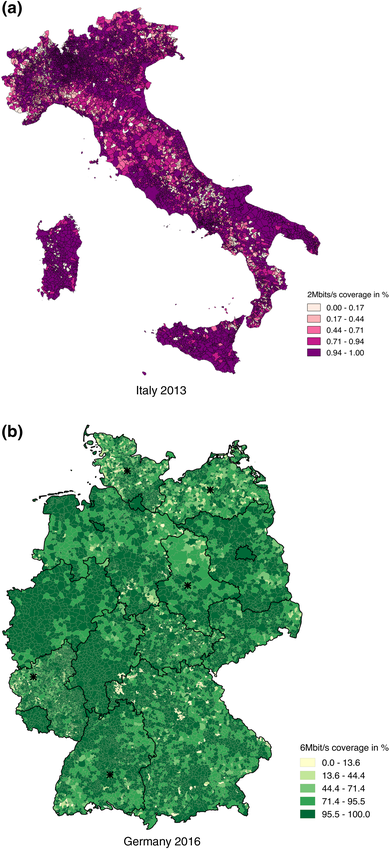
Data on broadband availability was provided by Infratel on behalf of the Ministry for Economic Development for Italy, and by the TÜV Rhineland on behalf of the German Ministry of Transport and Infrastructure for Germany. The figures provided a measure of the proportion of households in a municipality with access to internet speeds of 2 Mbits/second and above in 2013 in Italy, and the proportion of households in a municipality with access to internet speeds of 6 Mbits/second and above in 2016 in Germany, as shown in Figure 2.Footnote 5 We recode the values from 0 (no coverage) to 1 (full coverage).
Broadband coverage in Italy and Germany. [Color figure can be viewed at wileyonlinelibrary.com]
Notes: Broadband coverage at the municipality level in (a) Italy 2013 and (b) Germany 2016. Darker colours indicate higher coverage. German states from which survey data is drawn are marked with an asterisk (∗).

In Online Appendix D, we provide a detailed description of how broadband internet was rolled out in Italy and Germany. Of importance for our causal identification strategy, the development of broadband internet in both countries was based on the pre‐existing telephone network. Varying distances between the central network hubs and individual households created variation in broadband speed, especially in rural and suburban areas. Crucially, these distances had been irrelevant for the original purpose of connecting households to the telephone network, meaning that the resulting variation in broadband speed has little to do with strategic or market decisions taken at the time when the telephone network was constructed (Campante et al. Reference Campante, Durante and Sobbrio2018; Falck et al. Reference Falck, Gold and Heblich2014).
Still, strategic concerns did play a role in determining where internet service providers would roll out broadband connectivity first. Of overriding concern to providers is the degree of urbanisation or population density, which largely determines the expected financial return of investing in broadband technology (Gruber et al. Reference Gruber, Hätönen and Koutroumpis2014). In addition, steep hillsides make construction difficult, which is why rugged areas tend to be more poorly provided with all forms of telecommunication technology. There is also evidence that places with relatively high education levels, a youthful population and a strong economy – likely factors associated with higher demand for broadband internet – were given preference during the roll‐out.Footnote 6 Our empirical models reflect this ‘assignment process’ of broadband coverage by including control variables for these municipality‐level characteristics. We provide evidence that, once these characteristics are taken into account, the population in poorly covered areas is closely comparable to the population in more fully covered areas.
Instrument strength and exclusion restriction
In order for broadband access to be a valid instrument, two criteria have to be met. First, the instrument has to correlate with the potentially endogenous predictor ‘internet use’ in meaningful ways. Previous research shows that, typically, this criterion is fulfilled – that is, internet use is strongly elastic to access to fast internet connections in the United States (Hitt & Tambe Reference Hitt and Tambe2007), and in Europe.Footnote 7 Instrument strength is measured in a first‐stage ordinary least squares (OLS) regression where the endogenous predictor is regressed on the instrument plus the other pre‐treatment covariates used in the analysis. Estimating the first stage using our survey data from Italy and Germany reveals that our instruments are slightly below the critical threshold of an F‐value of 10: the F‐statistic is 8.6 for Italy and 7.8 for Germany (see Table A1 in the Online Appendix)
Since we are dealing with weak instruments, we follow the advice of Angrist and Pischke (Reference Angrist and Pischke2009) to focus on confidence intervals rather than point estimates, and also to report reduced form estimates – that is, the results from a regression of the outcome on the instrument. In an experimental setting, the reduced form estimates the intention‐to‐treat (ITT) effect. In other words, the effect of full internet coverage on the probability of voting for populist parties, regardless of whether people individually make use of broadband internet or not. More importantly, the reduced form is estimated using OLS and hence does not suffer from systematic bias.
Second, for the instrument to be valid, the only channel through which broadband availability influences voting behaviour should be to make it easier for people to use the internet (exclusion restriction). Another way of conceiving of the exclusion restriction is that broadband access should be as good as randomly distributed. We argue that this criterion is fulfilled conditional on pre‐treatment municipality‐level factors that determined where the expansion of broadband coverage would first take place. Apart from population density and terrain steepness, these municipality‐level factors include age structure (captured by the share of the population over 65 years of age), economic strength (measured with the unemployment rate) and education level (indicated by the share of the highly educated).
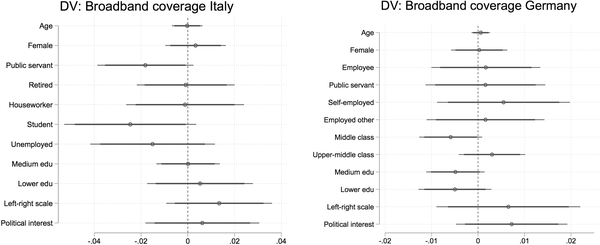
However, we might still be concerned that there could be residual causal pathways caused by some unobserved municipality‐level covariates. In order to further reduce this threat to inference, we therefore include the same set of individual‐level controls in our instrumental variable regressions as in the simple OLS regressions, notably gender, age, education and employment status. The idea is that potential causal pathways from municipal‐level factors to our outcome that do not run through increased internet use should work through individual‐level characteristics. However, regression analysis in Figure 3 shows that these worries are largely unwarranted since no predictors within a large set of control variables is significantly associated with our instrument (i.e., broadband coverage). In other words, after controlling for municipality‐level characteristics, populations in areas with high broadband coverage are indistinguishable from those in areas with low broadband coverage – except for the fact that they use the internet at higher rates.
Conditional independence of the instrument.
Notes: Results of ordinary least squares (OLS) regressions of broadband coverage in Italy and Germany on various individual‐level covariates, simultaneously controlling for municipality‐level covariates and region fixed effects. Markers (dots) are point estimates; the thick/thin horizontal lines are 90/95 per cent confidence intervals.

As an additional test, we conduct a falsification exercise. If the exclusion restriction is met, broadband availability should not predict behaviours that are not linked to internet use, such as the use of newspapers as a source of news. Figure A1 in the Online Appendix shows that newspaper consumption appears to be unrelated to broadband coverage, increasing our confidence in the validity of the instrument.
Results
Correlational analysis
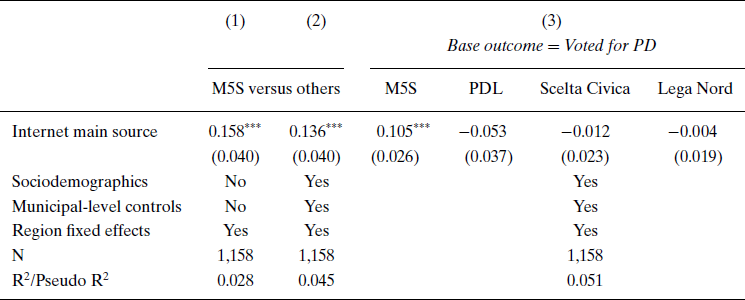
We begin our analysis by testing whether the use of the internet as the main source of news correlates positively with voting for M5S in Italy. In the first model of Table 1, we report naive regression results of populist voting on internet use, including only region‐fixed effects. In models 2 and 3, we also control for the individual‐ and municipality‐level covariates introduced above. Standard errors are clustered at the level of the municipality to account for potential interdependencies among individuals from the same municipality. Models 1 and 2 show that the use of broadband internet significantly and strongly predicts voting for M5S: those who rely on the internet as their main source of political information are 14–16 per cent more likely to vote for M5S than those who rely on other sources of information.Footnote 8
Internet use and party vote in Italy

Notes: Models 1 and 2: Linear probability model (OLS regression). Dependent variable: Vote for M5S as recalled in post‐election Wave 5. Model 3: Marginal effects from multinomial logistic regression, categories ‘other parties’ and ‘did not vote’ omitted for readability purposes. Internet main source: Respondents who chose ‘internet’ as main source of news on the upcoming election. Standard errors (in parentheses) clustered at the municipality level. Full results in Table A2 in the Online Appendix. ***p < 0.01.
Results from a multinomial logistic regression in model 3 confirm these findings. Those who relied on the internet as their primary news source were 11 per cent more likely to vote for M5S than those who voted for the main centre‐left party (Partito Democratico, PD). No significant correlations can be observed with votes for the other parties.Footnote 9
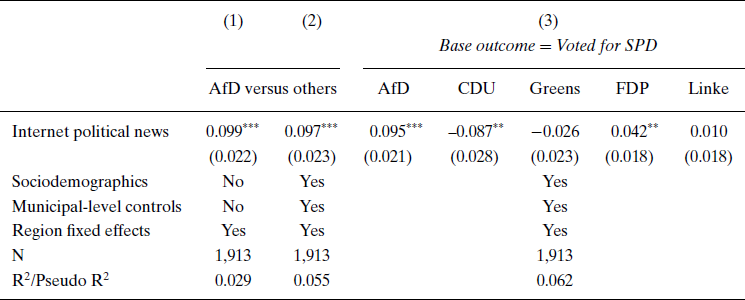
Our findings from Germany, presented in Table 2, mirror those from Italy. Use of the internet for political purposes strongly predicts voting intentions for the AfD. Moving from no internet use for political purposes to everyday use increases the inclination to vote for the AfD by 10 per cent (models 1 and 2) – an effect closely resembling the estimates from Italy. These results hold up when AfD supporters are compared to voters of the other major parties in a multinomial logistic model (model 3). Here we see that internet use strongly predicts voting for the AfD, and marginally for the liberals (Freie Demokratische Partei, FDP). Internet use for political purposes is somewhat negatively associated with voting for the conservative CDU (Christlich Demokratische Union).
Internet use and party vote in Germany

Notes: Models 1 & 2: Linear probability model (OLS regression). Dependent variable: Intends to vote for the AfD in the 2017 general elections. Model 3: Marginal effects from multinomial logit regression. Category ‘other parties’ not included in the table to increase readability. Internet political use: Number of days the internet was used to obtain information on politics and political parties (scaled to 0–1). Standard errors (in parentheses) clustered at the zip code level. Full results in TableA3 in the Online Appendix. **p < 0.05; ***p < 0.01.
Instrumental variable estimates
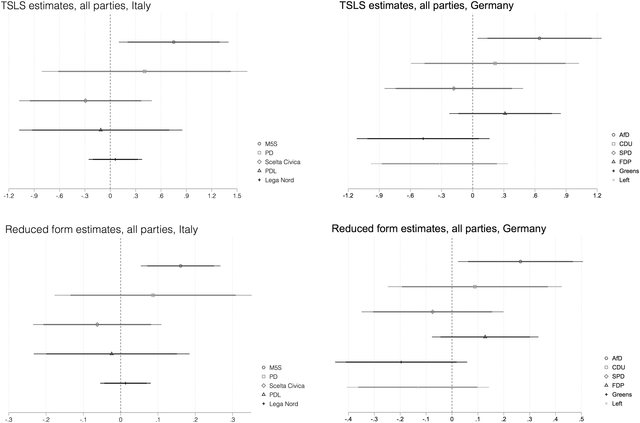
Next, we implement our IV strategy. The results are summed up in Figure 4 (full results can be found in Tables A5–A8 in the Online Appendix). We see that both the reduced form and the second stage from the two‐stage least square (TSLS) regression strongly and positively predict voting for M5S and Afd. The reduced form/ITT suggests that the expansion of broadband coverage from zero to full coverage is associated with a 16.1 per cent increase in the likelihood of voting for the M5S, and a 27 per cent increase in the likelihood of voting for the AfD.
Instrumental variable results.
Notes: Instrumental variable (reduced form and two‐stage least square) results for parties that contested the analysed elections in Italy (left) and Germany (right). Markers (dots) are point estimates; the thick/thin horizontal lines are 90/95 per cent confidence intervals.

The second stage gives us an estimate of the local average treatment effect (LATE) for compliers – that is, an estimate of the treatment effect for those enabled by broadband coverage to use the internet as their main source of news. We estimate that, among this subgroup, the probability of voting for M5S increases by 75 per cent, while the probability of voting for the AfD increases by 64.4 per cent. It is important to underline that we do not estimate the effect of using the internet for the entire population, but only for those who decided to use the internet once broadband was available (compliers). Partially for this reason, the TSLS regression estimates are substantially larger than the reduced‐form estimates.
As may be expected when using a relatively weak instrument, our results are subject to a great deal of uncertainty. Indeed, the 95 per cent confidence intervals range from 9 to 141 per cent for M5S, and from 3.4 to 125.4 per cent for the AfD. We hence cannot be certain that the LATE actually corresponds to the high point estimate. However, the second stage TSLS estimators comfortably include our point estimates from the standard regressions, giving us confidence that these can be interpreted as causal.
The other lines in Figure 4 show the results of the IV analysis for the other parties in Italy and Germany. We see that internet coverage and use increased the vote share for populist parties only. For none of the other parties is the causal effect distinguishable from zero. The advantages of broadband internet, it appears, are indeed unique to populist parties.
Heterogeneous effects
After demonstrating the effect of broadband internet on support for populist parties, we test whether the magnitude of these effects differs across various segments of the electorate. We have argued above that broadband internet is of particular use for populists compared to mainstream political actors because it allows populists to circumvent gatekeepers, maintain an anti‐elitist and people‐centric stance, and rely on forged or borderline‐true content. Thus, if we assume that online messages can influence political behavior – as the studies mentioned above document (for a recent review, see also Tucker et al. Reference Tucker, Guess, Barberá, Vaccari, Siegel, Sanovich, Stukal and Nyhan2018) – populists should be able to persuade and mobilise voters through online media, and they should be able to do so more effectively than mainstream parties. While our analysis confirms that this is the case when we consider the average effect of broadband internet on voting, it does not, however, exclude the possibility that certain categories of voters might be more susceptible to populist communication than others. In other words, our ‘treatment’ (i.e., broadband access) might have heterogeneous effects depending on individual‐level characteristics.
Drawing on the literature, we identified four characteristics of theoretical interest. A first dimension concerns voters’ ideological self‐placement. Internet use might activate pre‐ existing political attitudes and help to turn them into actual political behaviour. Through the internet, potential voters for as of yet fringe populist parties can discover that others share their opinion, especially by engaging in many‐to‐many dialogues that set online communication apart from traditional media (Bimber Reference Bimber1998). At the worst, the internet allows individuals to enter echo chambers where their own opinion appears to dominate (Quattrociocchi et al. Reference Quattrociocchi, Scala and Sunstein2016). Thus, assuming that left‐right placement is a relatively stable trait (Knutsen Reference Knutsen1995), we can expect populist parties’ online communication to have a stronger activating effect among individuals who share the political orientation of the parties in focus. For Germany this means the effect should be stronger among those who place themselves on the political right. In the case of Italy, we can expect the effect of broadband internet on voting for the M5S to be stronger among those who place themselves outside the left‐right scale, given the ‘post‐ideological’ nature of the M5S (Bordignon & Ceccarini Reference Bordignon and Ceccarini2013).
Besides activating pre‐existing political attitudes, populist online messages might succeed in mobilising certain categories of voters who would otherwise not participate in politics or would cast a protest vote. First, we can expect populist messages to be particularly appealing for lower or middle class voters who largely count among the so‐called ‘losers of globalisation’ – a segment of voters who have been particularly susceptible to the appeal of populists (Kriesi Reference Kriesi2014). Second, broadband internet might help populist parties to mobilise previous non‐voters. Post‐election surveys from both Germany and Italy have shown that the AfD and the M5S attracted particularly many previous non‐voters disaffected by traditional party politics (Berbuir et al. Reference Berbuir, Lewandowsky and Siri2015; Russo et al. Reference Russo, Riera and Verthé2017). Thus, we can expect the effect of broadband access to be stronger among those who did not participate in previous rounds of national elections. Finally, populists’ online communication might succeed in mobilising especially young voters, among whom social media use has been shown to be linked to higher political engagement (Holt et al. Reference Holt, Shehata, Strömbäck and Ljungberg2013).
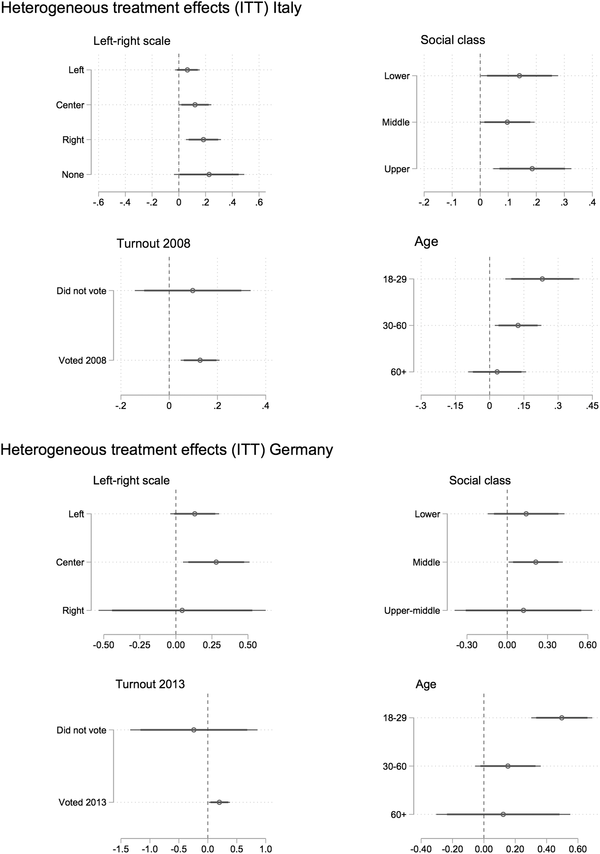
We tested these predictions by interacting our instrument with a set of sociodemographic characteristics at the individual level. In Figure 5 we show the effect of moving from minimal broadband coverage (around 25 per cent of households) to full coverage within each of the identified subgroups. We caution that this analysis is merely exploratory because our chosen characteristics may be correlated with other covariates. What is more, even if there appear to be visible differences between subgroups, these may not in fact be statistically different from each other. For each category we therefore report the results of a Wald test of the null hypothesis that all subgroup effects are equal. Finally, we should caution that we report heterogeneity in the ITT effects – that is, the overall causal effect of the roll‐out of broadband coverage. This is different from the local causal effect of internet use (the LATE). In particular, the ITT may be influenced by differential compliance rates among subgroups. We explore these possibilities in Figure A3 in the Online Appendix, where we show first‐stage and TSLS results alongside the reduced form estimates. Given these caveats, the results presented here should be merely seen as suggestions for further research.
Heterogeneous treatment effects.
Notes: Heterogeneous treatment effects along several dimensions of theoretical interest. The depicted coefficients are marginal effects from reduced form regressions (ITT) where the dependent variable (populist voting) is regressed on the instrument (broadband coverage) interacted with measures for the indicated variables. Social class based on type of employment (Italy) and self‐reported classification (Germany). Markers (dots) are point estimates; the thick/thin horizontal lines are 90/95 per cent confidence intervals.

As far as ideology is concerned, broadband access appears to have the largest overall effect on voting for the M5S among those who do not place themselves on the left‐right scale, in line with predictions. In the case of the AfD, in contrast, we observe the largest effect among those who are at the centre of the political spectrum, while we find no effect among those on the right. This suggests that, while the online communications of the M5S activated support among non‐ideological voters, the AfD succeeded in actually persuading centrist voters to support it. The lack of effect among right‐wing German voters may be explained by the fact that these voters were already committed to supporting the AfD, regardless of whether or not they had access to AfD's online communication. However, both in Italy (p = 0.29) and Germany (p = 0.42), the Wald tests fails to establish statistically significant differences between subgroups.
With respect to the possibility of mobilisation, we observe that broadband access mostly mobilised middle‐class voters in Germany, while the effect did not differ substantially across social classes in Italy, in line with expectations. Contrary to expectations, however, we do not find stronger mobilisation of previous non‐voters: within this section of the electorate, broadband access had no effect on support for populist parties in either Italy or Germany. Rather, the effect is entirely driven by those who participated in previous rounds of national elections. In any case, differences between subgroups are not statistically significant in either Italy (p = 0.45 and p = 0.44, respectively) or Germany (p = 0.88 and p = 0.43, respectively).
Finally, Figure 5 shows that broadband access had the strongest effect among the youngest segment of the electorate in both countries, and a much lower or no effect among middle‐aged and older voters. Here, the Wald tests detect significant levels of heterogeneity in treatment effects for both Italy (p = 0.09) and Germany (p = 0.02). As shown in Figure A3 in the Online Appendix, it is likely that the strong ITT effect among the young is partly due to higher compliance rates in this subgroup. Provided with faster internet, young people increase their online news consumption more strongly than other age groups, meaning that they are exposed to the populist messages circulating online in larger numbers. In sum, these findings suggest that broadband internet might have contributed to increasing support for populist parties in Italy and Germany not by mobilising those who had previously refrained from voting, but by activating either non‐ideologically aligned voters (Italy) or centrist voters (Germany), and by mobilising middle‐class German voters, and especially the young. If we consider that early voting can be habit forming (Dinas Reference Dinas2012), the mobilising effect of broadband internet among young voters has particularly important implications for the long‐term support for populist parties.
Conclusion
We tested whether the dissemination of broadband internet can help to explain the rise of populist parties in Europe. While this was only one factor among many, our answer is affirmative. We show that internet use goes strongly and consistently along with voting for populist parties (but not for mainstream parties) in both Italy and Germany. Exploiting variation in access to broadband internet, we show that this effect is causal. Our analysis of potential channels relating internet use to populist voting indicates that, most plausibly, the expansion of broadband coverage has helped populist parties to reach and mobilise new voters, especially among the young. These findings are in line with the understanding of populism as a communication style that appeals directly to concerns left unaddressed by other parties. Populists, we show, find the perfect tool in broadband internet.
Importantly, we do not claim that broadband internet is the main determinant of support for populism, or that populist messages can persuade voters only through the internet. Echo chambers exist not only in the online world, and recent evidence indicates that they might be even stronger in offline social networks (Guess et al. Reference Guess, Lyons, Nyhan and Reifler2018a: 15; see also Tucker et al. Reference Tucker, Guess, Barberá, Vaccari, Siegel, Sanovich, Stukal and Nyhan2018). We cannot exclude, however, that at least some of those who are exposed to populist messages online will then convey these messages to offline social networks, thus expanding the reach of populist communication beyond online echo chambers. While the role of offline social networks falls beyond the scope of our study, we believe that investigating the spill‐over effects of online populist communication proves a promising avenue for research.
What kind of context may our findings generalise to? We believe that two interrelated scope conditions may be important: a lack of access to the main political arenas (especially the national parliament), and exclusion from mainstream media coverage. As explained above, both conditions were true for the two parties we focus on during the periods under study, and are likely to apply to populist parties elsewhere, especially newly founded ones. This may also give us some indication of where an effect of broadband internet on support for populist parties is not to be expected: where populists are present on the main political stage, and where they receive the support of the mainstream media. The right‐wing populists of the National Rally in France (the former Front National), for example, have long had representatives in the national parliament, as had their populist peers from the Austrian Freedom Party. In the United Kingdom, the populist UKIP and Brexit Party are given substantial favourable coverage by the tabloid press, despite not being represented in Parliament. Under such conditions, populists might not perceive the need to take their mobilising efforts online. However, these are no hard‐and‐fast criteria. As we have argued, populists may profit from online communication for reasons that go beyond simply ‘having a voice’ – namely maintaining ideological consistency and spreading borderline truths or forged content.
As regards the ideological stance of populist movements, we believe that both left‐wing and right‐wing populist parties and politicians should benefit from using online communication channels, as long as these actors share an anti‐elitist and people‐centric rhetoric. In contrast, as confirmed by our empirical findings, mainstream parties should not benefit to the same extent from online media, since they do not share the same type of rhetoric that distinguishes populist movements. Online communication should be particularly vital for right‐wing populists, insofar as they spread strongly anti‐immigrant or plainly xenophobic messages, which would hardly be covered by mainstream media. Ultimately, the extent to which our findings hold in other contexts is an empirical question that needs to be addressed by ongoing research.
Finally, it is worth asking how lasting broadband‐induced support for populists will be. On the one hand, populist parties were the first to recognise the potential of the internet, and have eagerly used it. They could possibly lose this advantage in the future when other parties have managed to catch up. On the other hand, there are good reasons to believe that what we are observing is the result of a structural change. Almost by definition, populist parties address issues that are outside mainstream party politics, often reaching well into the territory of the politically incorrect and drawing on scarcely verified information. The communication style of President Donald Trump is a case in point. Conventional parties and the mainstream media are, for good reason, hesitant to cover this type of content. Broadband internet allows populists to get their message across nonetheless. The internet thus appears to have expanded political communication options in a way that disproportionately benefits populists. In other words, the advantage populists have gained with the spread of broadband internet is likely to persist.
Acknowledgements
We thank Daniel Auer, Diego Gambetta, Katjana Gattermann, Noam Gidron, Anselm Hager, Enrique Hernández, Valentino Larcinese, Marta Paradés Martín, Briitta van Staalduinen and the participants at APSA 2018, EPSA 2018 and research seminars at the University of Copenhagen, the University of Vienna and the Central European University for their helpful feedback. We also thank Jara Kampmann of GESIS Cologne for helping us access the micro‐data for the German part of the study, and our reviewers for their constructive and insightful comments.
Online Appendix
Additional supporting informationmay be found in theOnlineAppendix section at the end of the article.
[Correction added on 13 February 2020 after initial online publication: The supporting information data files have been updated.]



 Open access

