





Introduction
Explaining foreign accents in second language speech has been one of the principal aims of the study of second language acquisition since its inception. The phenomenon of accents signals a shift in learning ability with age, which prohibits, or at least greatly diminishes, the possibility of first language (L1)-like outcomes in the acquisition of a second language (L2) after early childhood. Explanations for this change in language learning ability have been of two general types. On the one hand, accents have been thought to arise from the influence of previously established knowledge in the mind of the bilingual speaker, which, given continued plasticity in the language learning systems in the brain, will compete with L2 and thus change the conditions under which L2 is learned (Caldwell-Harris & MacWhinney, Reference Caldwell-Harris and MacWhinney2023; Flege, Reference Flege and Strange1995; Hernandez et al., Reference Hernandez, Li and MacWhinney2005). On the other hand, changes in L2 learning have been explained in terms of maturation and loss of neural plasticity, with concomitant constraints in learning ability once the initial period of specialization has ended (Granena & Long, Reference Granena and Long2013; Hyltenstam & Abrahamsson, Reference Hyltenstam, Abrahamsson, Doughty and Long2003; Lenneberg, Reference Lenneberg1967; Long, Reference Long1990; Penfield & Roberts, Reference Penfield and Roberts1959).
These approaches have been posited as opposing or mutually exclusive accounts of age effects on L2 acquisition in the field of second language acquisition (SLA; Muñoz & Singleton, Reference Muñoz and Singleton2011). Yet, none of these models have been established with certainty, due to the methodological challenge of separating maturational changes in the brain from factors that are confounded with age of acquisition (AoA). For example, the acquisition of L2 typically also marks the onset of bilingualism, whereby L2 will be affected not only by a different state of neurological maturation but also by the type and amount of language input that is received, as well as by the interaction of several language systems in the mind (Birdsong, Reference Birdsong2018). When explaining foreign accents in L2 speech, it is thus difficult to disentangle the influence of previously learned languages from maturational changes in the speech production system. In the present study, we address this question by investigating speech production in international adoptees.
Maturational constraints on L2 ultimate attainment
AoA effects on L2 learning are commonly thought to be caused by increased maturation in the neural systems underlying the human language ability. Such changes may result from, for example, increased myelination of language-related pathways in the brain (Pulvermüller & Schumann, Reference Pulvermüller and Schumann1994), neuroanatomical changes such as increasing hemispheric lateralization (Lenneberg, Reference Lenneberg1967), or decreased neural plasticity with age (Penfield & Roberts, Reference Penfield and Roberts1959). This in turn will lead to a reduced ability to assimilate novel linguistic materials with age. Such maturational changes have been discussed in terms of critical or sensitive periods for language (DeKeyser, Reference DeKeyser2000; Hyltenstam & Abrahamsson, Reference Hyltenstam, Abrahamsson, Doughty and Long2003; Lenneberg, Reference Lenneberg1967; Long, Reference Long1990; Scovel, Reference Scovel1988; Werker & Hensch, Reference Werker and Hensch2015).
The original notion of a critical period for language, associated with the work of Eric Lenneberg (Reference Lenneberg1967), postulated a period between two years and puberty during which first language learning would be possible. This theory was based on observations of correlations between milestones in language development and anatomical and physiological maturation in the child, which signaled a co-occurrence between qualitative changes in neural organization and a decline in language learning ability with age, which formed the basis of a theory of biological constraints on language learning.
While Lenneberg was primarily concerned with the acquisition of the first language, in SLA the theoretical model by Lenneberg has been associated with the so-called Critical Period Hypothesis (CPH; Krashen, Reference Krashen1973; Scovel, Reference Scovel1969; Snow & Hoefnagel-Höhle, Reference Snow and Hoefnagel-Höhle1978). The CPH states that language acquisition past the critical period will lead to the recruitment of different mechanisms during the acquisition of L2. Such differences could involve reduced or severed access to innate language learning mechanisms (Bley-Vroman, Reference Bley-Vroman1989, but see Reference Bley-Vroman2009), which would lead to the recruitment of different types of supporting memory or representational systems (Paradis, Reference Paradis2009; Ullman, Reference Ullman and Sanz2005), or changes in the cognitive parsing of linguistic materials (Newport, Reference Newport1990). Because of the decreased efficiency of such mechanisms in accommodating the novel language, L2 production is expected to deviate from L1 (Patkowski, Reference Patkowski1990; Scovel, Reference Scovel1988). While a putative “strong” version of the CPH, which predicts a decline in language learning only at puberty, may not give the whole picture (Hyltenstam & Abrahamsson, Reference Hyltenstam, Abrahamsson, Doughty and Long2003), there is evidence that acquisition in different linguistic domains will decrease at different ages (Granena & Long, Reference Granena and Long2013). For example, L1 language syntax may reach an adult level of functioning already around the age of five years, which may affect L2 acquisition in this domain (Krashen, Reference Krashen1973).
Recent models of critical period plasticity suggest that while the brain is inherently plastic experience will introduce neural “brakes” on plasticity—effectuated either by structural constraints or changes in the inhibitory/exhibitory balance in the brain (Takesian & Hensch, Reference Takesian, Hensch, Merzenich, Nahum and Van Vleet2013)—which will settle in a stabilized pattern of processing that will be adaptive for a particular environment (Reh et al., Reference Reh, Dias, Nelson, Kaufer, Werker, Kolb, Levine and Hensch2020; Werker & Hensch, Reference Werker and Hensch2015). Such perceptual attunement begins as early as six months of age for both vowel and lexical tone distinctions and leads to a decline in the discrimination of contrasts not in L1 (for a review, see Werker, Reference Werker2018). Progressive specialization for different aspects of the environment will furthermore lead to shifts in learning ability, where, for example, sensitivity to the sound system of L1 will affect later language learning (Ruben, Reference Ruben1997; Werker & Tees, Reference Werker and Tees2005).
Such changes in language learning susceptibility with age, however, may not be exclusively explained by reference to neurobiological maturation. As we will see in the next section, AoA effects on L2 acquisition can also be explained through changes that are confounded with AoA, in particular through the influence of existing knowledge in L1 during the acquisition of L2.
Transfer and interference in L2 learning
The influence of L1 knowledge on L2 learning has long been observed in the study of second language acquisition. Early proposals suggested that the compound nature of the bilingual speech processing system would lead to transfer, through “interlingual identification,” between the languages in the mind of the bilingual speaker, which would manifest in difficulties with understanding and producing speech sounds, words, and grammatical structures in L2 (Weinreich, Reference Weinreich1953). Such transfer has been regarded as an all-pervasive phenomenon in bilinguals and has been studied in terms of specific linguistic subsystems, such as phonology, lexicon, and morphosyntax (Gass & Selinker, Reference Gass and Selinker1983; Jarvis & Pavlenko, Reference Jarvis and Pavlenko2008; Odlin, Reference Odlin1989).
Developmentally, models of transfer home in on the fact that the initial stages of L2 acquisition will depend on L1 structures already established in the mind of the learner, limiting the possibility of L1-like outcomes in L2. This effect has been described as negative transfer, or interference, between L1 and L2 (Lado, Reference Lado1957). In addition, models also assume a degree of flexibility in the systems underpinning language learning, which is manifested through the way in which the acquisition of novel structures in L2 can influence existing knowledge in L1 (Pavlenko & Jarvis, Reference Pavlenko and Jarvis2002).
Interference is often couched in computational terms through the notions of competition and entrenchment (Caldwell-Harris & MacWhinney, Reference Caldwell-Harris and MacWhinney2023; Hernandez et al., Reference Hernandez, Li and MacWhinney2005; MacWhinney, Reference MacWhinney and Schmid2016). As the infant acquires the L1, cortical maps reflecting input of the different levels of language are established and progressively stabilized, or entrenched, through increasing experience. For example, in speech perception, the acoustic formant patterns of the ambient language will shape the tonotopic organization of the auditory cortex, creating a warped perceptual space suited for L1 phonetic structures (Guenther, 2002; Kuhl et al., 2005). Similarly, L1 articulation will be progressively supported by cortical maps in the motor cortex and inferior frontal gyrus (MacWhinney, Reference MacWhinney and Schmid2016, p. 351).
During L2 acquisition, structures of L2 are thought to compete with existing L1 structures, which will yield different patterns of representation in the two languages over time. In other words, although the neurocognitive mechanisms underpinning L2 learning are thought to be the same as for the infant learning the L1, the possibility of L1-like outcomes in L2 will be limited because L2 acquisition will be blocked by already established L1 structures.
During the initial stages of L2 acquisition, the novel language is thought to be parasitic on L1, that is, speech sounds in L2 will be interpreted through the sound patterns established in L1 (Hernandez et al., Reference Hernandez, Claussenius-Kalman, Ronderos, Castilla-Earls, Sun, Weiss and Young2019). This will lead to massive transfer of previous learning during the earliest stages of L2 acquisition (MacWhinney, Reference MacWhinney, Kroll and De Groot2005). With increasing experience and use of L2, however, processing in this language will become progressively independent of L1. The two languages may nevertheless be joined by the process of “resonance,” whereby mutual connections between units in the two languages will be activated by the same stimulus, creating a pattern of co-dependence between the languages (MacWhinney, Reference MacWhinney, Kroll and De Groot2005). This will lead to differential entrenchment between the languages, where L1 in most cases will play a dominant role. If L1 use is discontinued, however, it is predicted that L1 interference will cease and that structures in L2 will be acquired unimpeded by it. This assumption is of fundamental importance for the study of international adoptees, which will be reviewed momentarily.
The speech learning model of L2 speech production
In the study of speech production, L1 influence on the long-term acquisition of L2 has been formalized in terms of the Speech Learning Model (SLM; Flege, Reference Flege and Strange1995; Flege & Bohn, Reference Flege, Bohn and Wayland2021). The SLM postulates that the mechanisms involved in L1 and L2 learning will remain the same throughout life, but as new languages are learned, phonetic categories stored in long-term memory will align to produce a common, bilingual phonetic space (Flege, Reference Flege and Strange1995, p. 239). Phones of a novel language that are perceived as similar to existing ones will thus be stored together (through interlingual identification, or “equivalence classification”), and phones that are perceived as different will be stored as separate categories. As L1 is progressively established in the mind of the speaker, L2 learning ability will be affected. Specifically, L2 phones that are perceptually located within the space of one single phone in L1 will continuously receive interference and will thus be difficult to learn. When there is an overlap between a single phonetic category in L1 and a single novel L2 category, however, learning will be supported by the existing category. Likewise, novel categories in L2 that do not exist in L1 will not receive interference and will thus be acquired in a more L1-like manner.
Depending on the structural differences between L1 and L2, L1 may thus either aid or hinder the learning of L2. For example, in a study of L1 speaker assessment of foreign accents, the production of the English vowels /ɪ/ and /i/ by L1 speakers of German was found to be accurately identified as the intended phone by L1 English listeners (Flege et al., Reference Flege, Bohn and Jang1997). This suggested that there was positive transfer from the German L1, which also contains a distinction between /ɪ/ and /i/. By contrast, phones produced by L1 speakers of languages that did not contain the contrast (Spanish, Mandarin Chinese, and Korean) were identified less accurately by English L1 listeners (Flege et al., Reference Flege, Bohn and Jang1997). None of the L2 groups, however, had an advantage in the production of the English /ε/ and /æ/ vowels, a contrast that either did not exist or mapped onto a single category in L1.
As both languages of a bilingual are constantly engaged, furthermore, the SLM predicts bidirectional influences from L2 to L1 (Flege, Reference Flege, Cole and Hualde2006). In cases where the L2 category is identical to the L1 counterpart, both sounds will be aligned in a compound category, which may involve changes in L1 as well. If the L2 sound is established as a novel category, furthermore, the L1 category may be “deflected,” in order to maintain sufficient perceptual distance between the categories.
The SLM thus predicts that the establishment of novel L2 categories will become more difficult with increasing AoA, because continued L1 use will lead to more stable initial representations in this language, leading to increased interference with categories in L2 during acquisition. Crucially, however, just as with the entrenchment account, age-related effects on L2 learning will arise only insofar as L1 is in continued and prolonged use (MacWhinney, Reference MacWhinney and Schmid2016, p. 351).
Because bilinguals experience both delayed onset of L2 as well as regular use of two languages, it is usually difficult to disentangle bilingual language use from maturational effects in this group. In order to explain the constraints on L2 acquisition incurred by a later AoA, the challenge is thus not only to identify the temporal extent of the period of sensitivity (Bialystok & Hakuta, Reference Bialystok, Hakuta and Singleton1999) or the long-term outcomes of L2 learning initiated after the period (Abrahamsson & Hyltenstam, Reference Abrahamsson and Hyltenstam2009). Rather, it is necessary to disentangle the functional significance of early cerebral maturation and specialization from the influence of continued L1 use. One way to do this is to study L2 ultimate attainment in international adoptees.
Language development in international adoptees
International adoption typically leads to a language environment shift that involves moving to a setting where a different language is spoken, often with the consequence that many L1 features may no longer be productive. The shift in language environment usually leads to a reversal in language dominance (or dominant language replacement; Hyltenstam et al., Reference Hyltenstam, Bylund, Abrahamsson and Park2009), whereby the L1 is effectively forgotten, to the extent that adoptees can be regarded as monolingual speakers of L2 (Norrman et al., Reference Norrman, Hyltenstam, Bylund, Genesee and Delcenserie2016). In contrast to bilingual L2 acquisition, adoptees thus go through successive stages of monolingual language acquisition.
The reversal in language dominance has been predicted to be beneficial for acquisition of L2, since transfer between L1 and L2 will be minimized (Hernandez et al., Reference Hernandez, Li and MacWhinney2005). In addition, adoptees will also use the L2 exclusively from adoption onwards, which in turn means that they will receive the same amount and type of naturalistic language input as their non-adopted peers. Both of these conditions would be predicted to lead to L1-like L2 attainment in adoptees. Tentative support for this claim comes from some of the first studies to experimentally investigate the forgotten L1 in adoptees (Pallier et al., Reference Pallier, Dehaene, Poline, LeBihan, Argenti, Dupoux and Mehler2003; Ventureyra et al., Reference Ventureyra, Pallier and Yoo2004). Pallier and colleagues examined adults who had been adopted from Korea to France between 3 and 8 years of age, and they found no differences in brain activation patterns (using fMRI) between the adoptees and non-adopted French L1 speakers, when listening to Korean speech. The adoptees were furthermore described as having become completely L1-like in L2 (although this was not explicitly tested, see Hyltenstam et al., Reference Hyltenstam, Bylund, Abrahamsson and Park2009). In fact, Pallier and colleagues argued that L1 loss may be a prerequisite for the high levels of attainment observed in adoptees:
One possible explanation suggests that the effects of age of acquisition before the age of 10, are not due to an irreversible decrease of neural plasticity with age, but are rather due to an increased stabilization of the neural network by the learning of L1. When exposure to L1 ceases, then the network could somehow “reset” and L2 would be acquired fully. (Ventureyra et al., Reference Ventureyra, Pallier and Yoo2004, p. 89)
This is in line with the entrenchment account (outlined above), which provides a tentative explanation for this observation:
Once Korean input was no longer available, L1 resonance quickly diminished with a resulting rapid drop in L1 entrenchment. Freed from the effects of competition and entrenchment, these adopted children were able to learn L2 with little difficulty. (Hernandez et al., Reference Hernandez, Li and MacWhinney2005, p. 224)
The same prediction can be made based on the SLM: if input in L1 ceases, then equivalence classification to L1 categories would not occur, and, following the hypothesis of full access to all features of the novel language (Flege & Bohn, Reference Flege, Bohn and Wayland2021), L2 speech would be acquired unhampered by it (Flege, Reference Flege, Cole and Hualde2006).
However, in the light of contemporary research on maturational constraints, it is unlikely that perceptual narrowing is completely reversible, even at very young ages. Recent studies of adoptees, in fact, reveal a more nuanced picture of language acquisition in international adoptees. Not only have adoptees been found to retain implicit and neural sensitivity to the L1 despite having completely lost any conscious knowledge of the language (Choi et al., Reference Choi, Broersma and Cutler2017; Oh et al., Reference Oh, Au and Jun2009; Pierce et al., Reference Pierce, Klein, Chen, Delcenserie and Genesee2014; Norrman et al., Reference Norrman, Bylund and Thierry2022; Singh et al., Reference Singh, Liederman, Mierzejewski and Barnes2011; Zhou, Broersma, & Cutler, Reference Zhou, Broersma and Cutler2021), several studies also show that adoptees’ perception and production of L2 deviate from that of non-adopted L1 speakers (Delcenserie & Genesee, Reference Delcenserie and Genesee2014; Hyltenstam et al., Reference Hyltenstam, Bylund, Abrahamsson and Park2009; Pierce et al., Reference Pierce, Chen, Delcenserie, Genesee and Klein2015) and in fact tend to score like bilingual L2 speakers rather than L1 speakers in language production and perception tasks (Bylund et al., Reference Bylund, Hyltenstam and Abrahamsson2021; Norrman & Bylund, Reference Norrman and Bylund2016; Bylund et al., Reference Bylund, Abrahamsson, Hyltenstam and Norrman2019).
Hitherto, however, no study has yet investigated L2 speech production in adult international adoptees using phonetic formant analysis. Speech production in international adoptees nevertheless provides a crucial test of the predictions made by the SLM. Specifically, following irreversible specialization for L1 during an early sensitive period, and given evidence of implicit retention of L1 knowledge in adoptees, it is possible that phonological attunement prior to adoption will affect speech production in the ways predicted by the SLM, but without any continuous use of L1. This makes it possible to examine the underlying theoretical assumptions of this model while disentangling the key factors of age and bilingualism that are confounded in bilinguals. This will be the topic of the present investigation.
The present study
Evidence reviewed in the previous sections thus suggests that sensitivity to early experienced speech contrasts may remain for long periods of time in adoptees, but also that the later AoA in this group will lead to differences in how L2 is learned. Investigating long-term outcomes in speech production in adoptees could help to dissociate mechanisms of transfer and interference from maturational changes in the acquisition of L2. In the present study, we investigate the vowel production of adults who were adopted from China to Sweden within their first years of life. While Chinese has a relatively sparse vowel inventory, with five basic vowels, and some allophonic variation based on phonological context (Duanmu, Reference Duanmu2007), Swedish has a rich vowel inventory, with nine basic vowel categories that are realized as long and short variants, distinguished by both spectral and durational features (Riad, Reference Riad2014). The adoptees were compared to a matched group of Swedish L1 speakers (controls). We investigated the production of the Swedish front and back rounded vowels /y ʉ/, which in Chinese tend to be realized as a single vowel /y/. Because vowel pairs in L2 that map onto a single category in L1 will be difficult for bilingual L2 learners to acquire, according to the SLM, this model also predicts that the loss of L1 in adoptees would allow them to successfully acquire this contrast. From this perspective, it is hypothesized that adoptees will not differ from controls in their production of the distinct Swedish /ʉ/ vowel. If, on the other hand, maturational changes were involved, adoptees would nevertheless differ from controls. This perspective thus hypothesizes that adoptees will show deviating realizations of /ʉ/ compared to controls. Adoptees’ production of the Swedish /y ʉ/ contrast thus provides a critical test of these two theories. We also tested the two vowels /i u/ that make up phonological distinctions in both languages, which, by virtue of being shared between the languages, should not be affected by interference. It is thus predicted by both accounts that adoptees and controls produce the vowels in the same way.
Methods
Participants
Two groups of participants took part in the study: adults who were adopted from China to Sweden as toddlers (N = 18, mean age = 20.3 ± 1.83 years, AoA 16.9 ± 8.8 months, range 5–37 months) and L1 speakers of Swedish (N = 15, mean age = 21.8 ± 2.6 years). In order to control for sex differences, only female participants were included in the study. They were adopted from different regions in ChinaFootnote 1 , and although the variety of Chinese spoken to them at birth is unknown, the regional varieties spoken in these areas do not use the critical Swedish /y-ʉ/ contrast. All participants spoke Swedish with the same regional accent. None of the adoptees could speak or understand Chinese, and none of them had had any significant exposure to Chinese since adoption.Footnote 2 Participants were recruited using advertisements in newspapers and online and through word-of-mouth. The study was approved by the regional ethics board, and all participants signed informed consent forms prior to participation.
Materials
The materials consisted of words containing four Swedish vowel phonemes /i y u ʉ/ in long and short allophones (Riad, Reference Riad2014; Table 1). While the high vowels /i y u/ all exist in Chinese (see Supplemental Figure S1), the contrast between /y/ and /ʉ/ is unique to Swedish and thus requires the formation of novel categories. Compared to the other phonemes, the allophonic variation of /ʉ/ is somewhat broader, with the long variant /ʉː/ characterized as more frontal (/y/-like) and the short variant as clearly central, which is why the phoneme itself is characterized as central (although this definition retains some ambiguity, see Riad, Reference Riad2014, pp. 37–39). The short /ʉ/ allophone, furthermore, is lowered in closed syllables, thus corresponding to a Chinese mid-central vowel, /ə/, which itself is subject to large allophonic variation, (Duanmu, Reference Duanmu2007, p. 37).
Swedish vowel inventory (expressed in IPA characters). The corresponding Chinese phonemes are included as reference

Although allophonic variation in vowel quality is a characteristic of long and short vowels in Swedish, phonological contrast depends on differences in duration. In Mandarin Chinese, vowel duration covaries with lexical tone and syllable structure, but it is not contrastive (Duanmu, Reference Duanmu2007, p. 40). Chinese and Swedish have a similar number of consonants (19 and 18 respectively), but Swedish allows for consonant clusters both in initial and final position of the syllable, which is not allowed in Chinese.
The stimuli in the current experiment consisted of 42 multisyllabic Swedish words, containing either long or short allophones in stressed closed syllables (see Supplemental Table S1 for a list of the words used).
Procedure
Participants were seated in a silent, sound-attenuated room and read words presented one by one on a computer monitor (using PsychoPy; Peirce et al., Reference Peirce, Gray, Simpson, MacAskill, Höchenberger, Sogo, Kastman and Lindeløv2019). Participants were instructed to read each word at a natural speech rate. Words were presented in a random order for each participant, and the rate of presentation was controlled manually by the experiment leader, who was seated in an adjacent room. If the participant was unfamiliar with the word, or otherwise hesitated, they were encouraged to read the word again; in case of multiple readings per item, the first segment without disturbances or hesitations was selected during annotation. Sound was recorded at a 44,100 Hz sample rate, using an Audio Technica AT3035 cardioid condenser microphone.
Analyses
All speech segments were annotated manually, marking the onset and offset of each vowel, syllable, and word. Formant analysis was conducted in Praat (6.2.09, Boersma & Weenink, Reference Boersma and Weenink2001) by extracting a maximum of 5 formants within a 0.025 s moving window (0.01 s steps) using linear predictive coding (burg algorithm). The maximum frequency was set to 5500 Hz. Formants were measured at the sample closest to the midpoint of each vowel.
Formant values for each subject were bark-transformed, and the distance between the adopted group and controls was measured using Mahalanobis distance. In contrast to Euclidean distance, which averages across samples to provide a static point in space, Mahalanobis distance compares each point in the test vector to the distribution of responses in the comparison vector. This provides a measure where the distance is expressed in terms of the number of standard deviations from the control group; it also provides more robust estimation, as it accounts for the variability in this group. Since the articulatory contrasts that were used consisted of differences in lip rounding, which in addition to F1 and F2 also involves F3 (Fant, Reference Fant1992), distance was measured in three-dimensional (F1–F3) formant space. Mahalanobis distance was measured for each subject and word in relation to the distribution of tokens of the same word in the control group.
Statistical tests were conducted by means of linear mixed-effects regression using the “lme4” (Bates et al., Reference Bates, Mächler, Bolker and Walker2015) package in R (R Core Team, 2022). All models included treatment coded (0, 1) categorical variables Group (Swedish, Adopted), Vowel (/i y u ʉ/), and Duration (long, short) as fixed effects, with current age and age of acquisition as covariates. We used the maximal random effects structure motivated by the design that converged (Barr, Reference Barr2013), which included by-participant and by-item random intercepts, and by-participant random slope for Duration. The dependent variable (bark values, Mahalanobis distance, or duration depending on the model) was log-transformed in order to bring it closer to normality. All assumptions of the statistical tests were met.
The Swedish duration distinction was measured as the vowel-syllable ratio of each VC syllable in seconds. Duration was tested statistically using the same model design as for spectral distance, with the categorical factors Group, Vowel, and Duration, current age and age of acquisition as covariates, and random intercept for participant and item, with duration as random slope for participant.
Statistical significance of main effects and interactions in the models was obtained using the “anova” function from the “lmerTest” package in R (estimating degrees of freedom and F-statistics using Satterthwaite’s method). Pairwise comparisons were conducted using two-tailed independent samples t-tests. All p-values were Bonferroni corrected for multiple comparisons.
Results
Formant measurements
First, we compared the difference between the groups for each formant separately (see Table 2 for raw formant values). Adding the factor Group did not increase the fit of the model for the formant F1 (F(1) = 0.482, p = .5) nor did add any interaction involving this factor (ps > .82). For the formant F2, there was a significant three-way interaction between Group, Vowel, and Duration (F(3) = 2.82, p = .038). Planned pairwise comparisons showed that F2 was higher for the adoptees compared to the Swedish controls for long /y/ (t = 7.218, CI = [0.491 0.859], p < 0.001, d = 0.948), long /ʉ/ (t = 4.017, CI = [0.143 0.419], p = .001, d = 0.575), and long /i/ (t = 3.421, CI = [0.234 0.872], p = .006, d = 0.536). There were no differences for long /u/ or any of the short allophones (ps > .513). There were no significant effects involving Group for the formant F3 (ps > .085). Only the short /i/ allophone showed a higher F3 for the adoptees compared to controls (t = 3.696, CI = [0.134 0.441], p = .002, d = 0.538), but no other comparisons were significant (ps > .12). As expected, for all models the factors Vowel and Duration, and their interaction were significant (ps < .001).
Mean formant values (Hz) and standard deviations for all vowels and durations

Mahalanobis distance
In order to account for the overall differences between the groups, Mahalanobis distance was measured (Figure 1). There was a significant interaction between Vowel and Group (F(3) = 3.22, p = .022). No other main effects or interactions yielded significant results (ps > .074). This warranted a closer inspection of the pattern of responses between the groups for the different vowel phonemes. Planned pairwise comparisons showed that adoptees differed from Swedish controls on the /ʉ/ and /y/ phonemes (t = 3.778, CI = [0.615 1.951], p = .001, d = 0.359, and t = 5.067, CI = [1.5 3.405], p < .001, d = 0.456, respectively), but not on the /u/ and /i/ phonemes (ps > .132). Specifically, adoptees differed in their production of long /ʉ/ (t = 3.079, CI = [0.610 2.799], p = .02, d = 0.411), and long /y/ (t = 4.350, CI = [1.665 4.368], p < .001, d = 0.531).
Distance measures. Average Mahalanobis distance for adoptees (dark gray) and controls (light gray). Asterisks show significant differences between the groups. Error bars show standard error.

Duration measurements
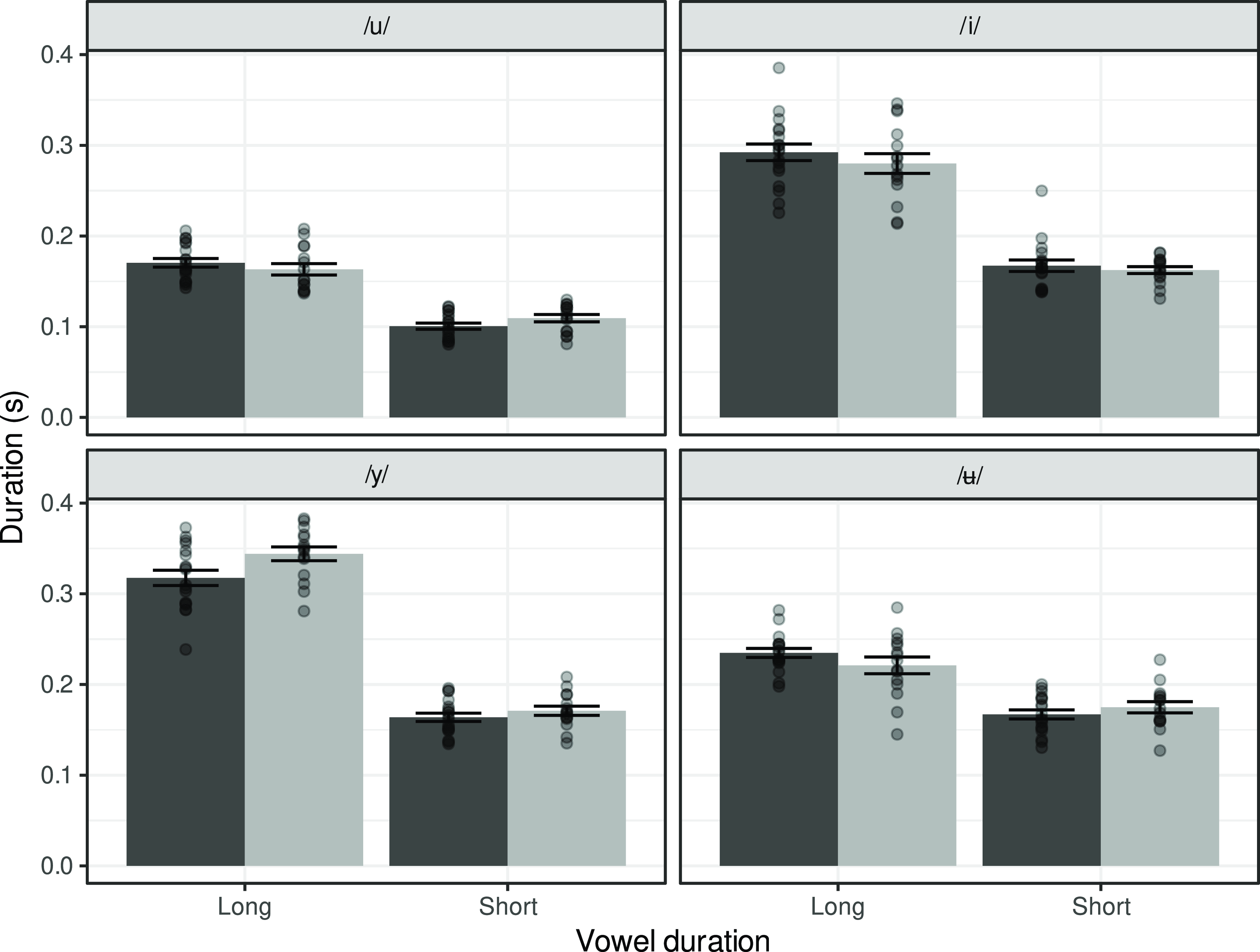
As expected, there was a significant main effect of Duration (F(1) = 27.139, p < 0.001), indicating differences between long and short vowels (see Figure 2). There was also a main effect of Vowel (F(3) = 5.335, p = .003). There was also a two-way interaction between Group and Duration (F(1) = 10.83, p < .001) and a marginally significant three-way interaction between Vowel, Group, and Duration (F(3) = 2.524, p = .056). This indicates that the adoptees did not perform like the L1 comparison group on some of the duration contrasts. Pairwise t-tests, however, did not reveal any differences in the production of duration contrasts (ps > 0.426).
Duration measures. Duration of the vowel in percent of the full VC syllable for long and short vowels for adoptees (dark gray) and Swedish controls (light gray). Error bars indicate the standard error.
Discussion
Adult adoptees who lost contact with their birth language environment as young children and have become functionally monolingual speakers of L2 offer a way to investigate the long-term influence of early language experience. The learning conditions of adoptees—characterized by an early AoA, primarily monolingual input in L2, and a strong communicative impetus to learn the language—are factors that are known to be predictive of L1-like attainment of L2. Due to their overt loss of L1, adoptees are commonly assumed to have an advantage over bilingual L2 speakers, in that L1 will no longer interfere with L2 during acquisition (Flege, Reference Flege, Cole and Hualde2006; Flege & Bohn, Reference Flege, Bohn and Wayland2021; Hernandez et al., Reference Hernandez, Li and MacWhinney2005; Pallier et al., Reference Pallier, Dehaene, Poline, LeBihan, Argenti, Dupoux and Mehler2003). In this study, however, we found that, despite these advantages, adoptees nevertheless differed from non-adopted peers in their production of vowels in L2.
Firstly, we found that the Mahalanobis distance differed between adoptees and controls in the production of the Swedish vowels /y/ and /ʉ/, which make up a phonological contrast that does not exist in the adoptees’ L1. The difference was most noticeable on the long allophones of the vowels, while the short allophones were produced in line with controls. These results are in line with predictions based on the SLM. Because the Swedish high front rounded [yː] and high front/central rounded [ʉː] distinction correspond roughly to the Chinese high front [y], they will map onto that single L1 phoneme, which in turn is predicted by the SLM to lead to deviant production of this vowel distinction. This is indeed what we find. On the other hand, phonemes that are shared between L1 and L2 are predicted to not lead to difficulties since these categories will be transferred to support the acquisition of L2. The larger articulatory distance between the short near-high front rounded [ʏ] and mid-central [ɵ] allophones may thus have been mapped perceptually to the Chinese /y/ and mid-central /ə/ phonemes, respectively, which may have aided acquisition of this contrast in L2. Likewise, neither the /i/ nor /u/ allophones differed from the controls, indicating that the acquisition of these phonemes may have been aided by existing categories in L1 Chinese, which do not differ from those of Swedish.
Secondly, we found that differences pertained primarily to the formant F2, and to some extent to F3, while the production of F1 was similar between the groups. Specifically, F2 was higher in the production of the long /y/, /ʉ/, and /i/ allophones for the adoptees, while there was a marginally significant difference between the groups in F3 for long /i/. These differences are not easily interpreted, but they suggest that the adoptees tend to heighten F2 towards the typical Mandarin Chinese F2 pronunciation of the vowels (see Supplemental Figure S1). The effect may have been the same on F3 for the /i/ vowel, albeit not enough to affect the Mahalanobis distance for this vowel. These observations further support the suggestion that L1 exerts long-term influences on speech production in adoptees.
Finally, all groups were similar in their production of the Swedish quantity distinction, measured as the duration of the vowel in relation to the duration of the whole syllable. Although the statistical model showed interactions involving Group, indicating that the groups differed on at least some of the vowel allophones, none of the pairwise comparisons reached significance. This suggests that despite differences in vowel quality, the adoptees were able to acquire the Swedish quantity distinction on par with controls.
Taken together, these results have important implications for theories of L2 speech production and the notion of a critical period for L2 acquisition.
Implications for transfer and entrenchment models of L2 speech production
The findings presented above are in line with one of the most influential models of L2 speech production, the SLM (Flege, Reference Flege and Strange1995; Flege & Bohn, Reference Flege, Bohn and Wayland2021), wherein L2 is assumed to be acquired using the same mechanisms involved in L1 acquisition, but where existing L1 knowledge will interfere with the establishment of novel linguistic structures in L2, leading to AoA effects in L2 ultimate attainment. This model predicts that adoptees, because of their functional loss of L1, will not be affected by interference and transfer during L2 acquisition, and should thus become L1-like in their L2 speech production. The finding of significant differences between adoptees and Swedish L1 speakers calls for a revision of the assumptions underlying these predictions.
Because our results cannot be explained by patterns of current (or recent) language use, they suggest that specializations from the earliest stages of language learning will have long-term influences on the acquisition of L2 by adoptees, despite their overt functional loss of L1. Such traces of early learning have been documented both behaviorally and by using neuroimaging methods. For example, in a study of Chinese-Canadian adoptees, Pierce et al. (Reference Pierce, Klein, Chen, Delcenserie and Genesee2014) found overlapping cortical activation in response to a Chinese lexical tone contrast in both adoptees and non-adopted L2 speakers who have retained the use of their L1. Adoptees have also been found to be faster in the behavioral re-acquisition of difficult L1 contrasts than non-adopted controls, suggesting behavioral implications of L1 retention in the brain (Choi et al., Reference Choi, Broersma and Cutler2017; Hyltenstam et al., Reference Hyltenstam, Bylund, Abrahamsson and Park2009; Singh et al., Reference Singh, Liederman, Mierzejewski and Barnes2011). Long-term effects of early language learning have also been observed in L2, where both adoptees and early bilinguals—but not L1 monolinguals—show recruitment of areas in the brain associated with cognitive control during a phonological working memory task in L2 (Pierce et al., Reference Pierce, Chen, Delcenserie, Genesee and Klein2015). Adoptees have furthermore been found to perform like bilinguals in a phonological discrimination task (Norrman & Bylund, Reference Norrman and Bylund2016), indicating differential processing in L2 compared to controls, regardless of whether the first language was maintained or not.
Furthermore, while influences from early learning have been predicted based on the notion of entrenchment (e.g. Caldwell-Harris & MacWhinney, Reference Caldwell-Harris and MacWhinney2023; Hernandez et al., Reference Hernandez, Claussenius-Kalman, Ronderos, Castilla-Earls, Sun, Weiss and Young2019; MacWhinney, Reference MacWhinney and Schmid2016), the fact that we find L1 effects despite complete disuse and overt loss of proficiency in this language suggests that mechanisms other than resonance and entrenchment are involved. In other words, stabilized patterns of neural activation due to recurring language production and exposure and the use of these structures to acquire novel linguistic materials cannot explain how brief language experiences limited only to the first years of life can affect speech production in adulthood.
Although retention of L1 could not be directly assessed in the present study, recent evidence from studies of retention or relearning of forgotten L1 contrasts suggests that L1 categories are not restructured following disuse. Rather, studies on both adoptees (Choi et al., Reference Choi, Broersma and Cutler2017; Norrman, Bylund, & Thierry, Reference Norrman, Bylund and Thierry2022; Oh et al., Reference Oh, Au and Jun2009; Pierce et al., Reference Pierce, Klein, Chen, Delcenserie and Genesee2014; Singh et al., Reference Singh, Liederman, Mierzejewski and Barnes2011) and childhood overhearers (Au et al., Reference Au, Oh, Knightly, Jun and Romo2008; Bowers et al., Reference Bowers, Mattys and Gage2009; Tees & Werker, Reference Tees and Werker1984) who have been exposed to an early learned language again in adulthood suggest that even brief encounters with a language during early childhood will lead to enhanced perceptual abilities of language-specific phonological contrasts. Such perceptual abilities may also be reflected in more accurate production of L1 contrasts by adoptees after training (Choi et al., Reference Choi, Broersma and Cutler2017). Early specialization thus seems to remain intact over long periods of time. Although the exact influence of early representations on later learning cannot be resolved by the data presented here, it nevertheless suggests that early representations have a special status during long-term L2 development.
While it has been argued that loss of early representations may be a prerequisite for L1-like attainment in L2 (Pallier, Reference Pallier, Köpke, Schmid, Keijzer and Dostert2007), the present findings suggest that early specialization will shape language production regardless of whether two languages are used in parallel or not. The etiology of this effect thus seems to be different from that proposed by models of transfer and entrenchment. In other words, influence from early experience is not interference: instead of reflecting continuous competition between languages, early specialization has a privileged status in relation to later learned languages, an explanation more akin to theories of critical or sensitive periods on language learning.
Critical periods and irreversibility of early language specialization
The observation of long-term influences of early experience despite behavioral disuse suggests the involvement of privileged learning typical of critical or sensitive period theories for phonetic learning. As we have seen, the notion of a critical period for language is often associated with the idea of a maturational period during which the individual is rendered sensitive to specific aspects of environmental input, with a steep shift in learning ability once this period of maturation has ended. Such maturational effects are often thought to reflect broad neurological changes, such as myelination (Pulvermüller & Schumann, Reference Pulvermüller and Schumann1994) or hemispheric reorganization (Lenneberg, Reference Lenneberg1967). However, evidence from adoptees also challenges assumptions behind this canonical version of this theory. Because this theory seems to argue for a wholesale loss of language learning abilities after puberty, except for features already acquired in childhood, it cannot readily account for the fact that adoptees are still able to learn novel features in L2 that are not in L1.
However, as seen in the introduction, perceptual attunement is a progressive process that begins soon after birth (e.g. Werker, Reference Werker2018). According to this view, critical period development is not seen as an all-or-nothing event with clear temporal boundaries, but rather as a series of minute specializations to environmental demands over time, where each step not only constrains the input that is treated as relevant by the individual but also opens up new opportunities for learning.
The idea of progressive specialization suggests that changes are not only quantitative—reflecting an increase in the frequency of exposure to specific linguistic structures—but that development is characterized by qualitative changes in how information is perceived and processed. Although neural brakes incurred during critical or sensitive period development may be lifted under experimental circumstances (Takesian & Hensch, Reference Takesian, Hensch, Merzenich, Nahum and Van Vleet2013), under typical conditions they are in effect irreversible.
The suggestion of irreversibility provides an important step towards distinguishing different explanations for L2 speech production. Because prolonged and parallel use of two or more languages is required to explain L2 variability by both transfer and entrenchment accounts (Flege, Reference Flege and Birdsong1999; MacWhinney, Reference MacWhinney and Schmid2016; Pavlenko & Jarvis, Reference Pavlenko and Jarvis2002), interference from early specialization without further exposure cannot be easily accommodated by these models. The now extensive literature on language acquisition in adoptees has thus only been selectively included by these models, that is, when showing evidence of complete L1 loss (e.g. MacWhinney, Reference MacWhinney, Schmid and Köpke2019). Contemporary evidence regarding adoptees still needs to be fully incorporated into these models. The notion of progressive specialization, however, elegantly accounts for the flexibility and variability observed in actual second language acquisition, typically accounted for by entrenchment and transfer accounts, while at the same time preserving the notion of biological irreversibility typical of the critical period hypothesis. This view thus provides the most complete account for the adoptees’ L2 vowel production features presented here.
Limitations
One limitation of the present study is the relatively low number of participants in the difficult-to-find group of international adoptees. However, the patterns observed in the data are nevertheless in line with the predictions, and we are confident that adding more participants would only have strengthened statistical inferences and the conclusions drawn.
We observed greater variability in the adopted group (for instance in the distance measures; Figure 1) compared to the controls, which was not explained by any of the background variables collected (i.e. age or age of acquisition). Such variability is nevertheless typical of second language speakers (both bilinguals and adoptees; see e.g. Norrman & Bylund, Reference Norrman and Bylund2016) and may stem from intra-individual variability that affects the individual averages for each vowel category. Trial-by-trial variability was adjusted for the statistical models.
In order to investigate the implied similarity between adoptees and non-adopted bilingual L2-speakers, it would be useful to include a group of matched Chinese-Swedish bilingual controls. Similarities between adoptees and bilingual L2 speakers have previously been shown (e.g. Norrman & Bylund, Reference Norrman and Bylund2016), and future studies should entertain the possibility of including this control group. In this way, it would also be possible to collect production data on the Chinese vowels as a reference, which can as of now only be deduced from previously published data (see Supplemental Figure S1). Future studies could also investigate consonant production in adoptees which was not done in the present study.
Summary and conclusion
In this study, we have for the first time investigated the production of Swedish vowel contrasts by Chinese-Swedish international adoptees. We have argued that early sensitive period development leaves long-term traces in speech production that will influence L2 learning. Although ultimate attainment in L2 will be seemingly native-like or near-native, the process for reaching that level of attainment in adoptees will be different from that of L1 Swedish speakers. This is reflected in differences between adoptees and controls in the production of vowels that are phonologically distinctive in L2 but not in L1. In the absence of continued L1 use, however, these results cannot be explained by mechanisms of transfer or entrenchment and should rather be understood as reflecting the long-term influence of early and irreversible specialization for L1. That the observed patterns follow the predictions of the SLM, furthermore, indicates that similar mechanisms of early critical period specialization may influence speech production even in bilinguals, although it may be concealed—both empirically and in the formulation of theory—by differences in bilingual language use.
Supplementary material
The supplementary material for this article can be found at https://doi.org/10.1017/S0142716424000237
Acknowledgements
This research was funded by the Lars Hierta Memorial Foundation. Thanks to the three anonymous reviewers for valuable feedback on a previous version of this article. Any remaining errors are entirely my own.
Competing interests
The author declares none.


 Open access

