


In March 2002, the UK Department of Health (2002a) recommended that all acute psychiatric wards should provide a ‘self-contained women-only inpatient unit’. However Ford et al (Reference Ford, Durcan and Warner1998) revealed that only 36% of female in-patients in England and Wales had access to such facilities. The Department of Health (2002b) suggests that one way to rectify this would be the provision of local, women-only crisis houses.
Crisis houses in the UK have already been described (Killaspy & Dalton, 2000; Reference Hodgson, Carr and WealleansHodgson et al, 2002). In this study we evaluate the effectiveness of one such project: the Women’s Service crisis house in Croydon, South London.
The Women’s Service is a nurse-led unit run by female staff, based in a residential area of Croydon. This is a Greater London Borough with a population of over 330 000, ranking 49 out of 99 on the Jarman index, but with areas of significant deprivation. Minority ethnic groups comprise 22% of the population in Croydon, and the ethnic population is diverse and includes a large number of refugees. The service provides 24-h crisis care for up to eight women with enduring mental health problems, and is available to any woman aged 17 or over who needs in-patient care. It therefore provides an alternative to the local acute wards which are all mixed gender. A female consultant psychiatrist visits the unit weekly and reviews all new clients, liaising with consultants in the catchment area as appropriate. Each patient has a primary nurse with whom they meet three times a week and each patient attends daily therapeutic groups.
Previous research in the UK has highlighted women’s negative experiences of hospital admission. Cutting & Henderson (Reference Cutting and Henderson2002) suggested that many women service users in Croydon experience a mixed in-patient environment as ‘ counter-therapeutic’. Studies in the United States, including randomised controlled trials (Fenton et al, Reference Fenton, Mosher and Herrell1998, Reference Fenton, Hoch and Herrell2002; Reference Hawthorne, Green and LohrHawthorne et al, 1999), have demonstrated that residential crisis centres can be a cost-effective way of providing acute psychiatric care; however, in the UK they remain a new innovation in mental health services.
We hypothesised that patients admitted to the Croydon Service would show a significant improvement in functioning (as measured by Global Assessment of Functioning (GAF) scores on discharge). Our secondary hypotheses were that symptoms ratings and level of unmet needs would improve, and that patients would use fewer mental health services in the 2 years following their admission to the service.
Method
This study was observational using a repeated-measures design. We obtained data from questionnaires and from PAS (computerised Patient Administration System) records regarding demographic characteristics and records of service use for each patient. All women admitted to the service from the 5 January 1999 to 5 December 2001 were invited to take part in the study. There were no exclusion criteria.
The following measures were administered twice: soon after admission and again on discharge.
-
• Patients completed the Beck Depression Inventory (BDI, Reference Beck, Ward and MendelsonBeck et al, 1962), a self-report rating scale for depressive symptoms.
-
• The admitting clinician completed the GAF (Reference Endicott, Spitzer and FleissEndicott et al, 1976), a measure of individual well-being on a continuous scale between 0 and 90, and the Brief Psychiatric Rating Scale (BPRS; Reference Overall and GorhamOverall & Gorham, 1962), which consists of 24 items rated on a seven-point Likert scale, covering mood and psychotic symptoms.
-
• The in-patient key worker completed the Camberwell Assessment of Need Short Appraisal Schedule (CAN-SAS; Reference Phelan, Slade and ThornicroftPhelan et al, 1995), a measure of unmet needs from the client’s perspective.
Demographic information about each service user, including age at the time of admission, marital status and ethnic group was obtained from PAS, a computerised administration system. The level of service use was measured by recording from PAS the number of admissions (including all local in-patient mental health units and the Women’s Service), the use of accident and emergency departments for psychiatric problems or use of the local ‘ crisis team’, which provides urgent support, including a 24-h telephone service and home visits. This information was recorded for the 2 years before and after the index admission to the Women’s Service. The length of each index admission was also taken from PAS records.
Data were analysed with the Statistical Package for the Social Sciences version 11.0 for Windows. Scores before and after admission were compared using paired t-tests for normally distributed data, or the Wilcoxon’s signed rank test for non-parametric data. Linear regression modelling was used to look for predictors of primary outcome (GAF score on discharge).
Results
There were 296 admissions to the Women’s Service crisis house during the study period of just less than 3 years (8–9 admissions each month). Age at the time of admission was available for 267 women (90%). The mean age was 39.6 years (range 17.8–65.3). Only a broad description of ethnic group was available for 228 admissions (77%). Of these, 190 (83%) were described as White, 24 (11%) as Black, 5 (2%) as Asian, and 9 (4%) as other. Only 13 of those admitted (4%) did not provide any questionnaire data. Scores were not available for 8 patients (3%) on admission and 40 (14%) at discharge.
Impairment and unmet needs
Level of functioning
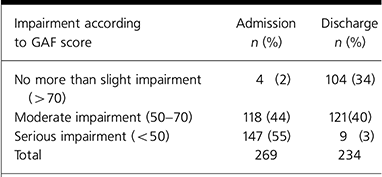
Scores for GAF were available for 269 women (91%) on admission and 234 (79%) on discharge. The median scores were 48 on admission (range 10–70) and 67 on discharge (range 36–90). This represents a significant improvement (Wilcoxon test P<0.001), with a median change in score of 19.7 (Table 1).
Level of impairment in patients at the time of admission and discharge
| Impairment according to GAF score | Admission n (%) | Discharge n (%) |
|---|---|---|
| No more than slight impairment (> 70) | 4 (2) | 104 (34) |
| Moderate impairment (50-70) | 118 (44) | 121(40) |
| Serious impairment (<50) | 147 (55) | 9 (3) |
| Total | 269 | 234 |
Unmet needs
The CANSAS scores were available for 261 women (88%) on admission and 220 (74%) on discharge. The median score was 8 at the time of admission and 4 on discharge (Wilcoxon test, P<0.001); 168 women (81%) had a decrease in their CANSAS score during their stay at the Women’s Service.
Symptoms ratings
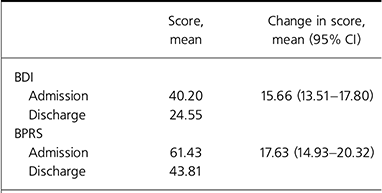
The BDI was completed by 263 patients (89%) on admission and 220 (74%) on discharge. The BPRS scores were available for 262 (89%) on admission and 224 (76%) on discharge. The mean scores are shown in Table 2. Changes in both BDI and BPRS were highly significant (P<0.001, paired t-test).
Change in symptom ratings during admission
| Score, mean | Change in score, mean (95% Cl) | |
|---|---|---|
| BDI | ||
| Admission | 40.20 | 15.66 (13.51-17.80) |
| Discharge | 24.55 | |
| BPRS | ||
| Admission | 61.43 | 17.63 (14.93-20.32) |
| Discharge | 43.81 |
Service use
A record of the length of stay at the Women’s Service was traced for 262 admissions (89%). Patients stayed between 1 and 109 days, with a mean duration of 23 days (s.d.=15.5). Of these 262 admissions, 204 (78%) were completed within the target 30 days.
Records of the Women’s Service use were traced for 269 patients (91%). In the 2 years prior to their index admission to the service, 48% (130) had required some form of in-patient treatment, with 35% (94) admitted to a mainstream ward; 67% (180) had used the accident and emergency department or the crisis team during this period. In total, during the 4-year period investigated, 137 (51%) were admitted at least once to a mainstream acute ward.
There was no reduction in the use of in-patient care following admission to the service, in fact the total number of admissions was higher in the 2 years following the patient’s index admission, although this difference did not reach significance (z=71.715 P=0.086). Admissions to the service represent a greater proportion of in-patient care in the second half of the study period (χ2 test, P=0.003). There was no significant change in the use of the accident and emergency department or the crisis service following admission to the service (Wilcoxon test, P=0.123 and 0.587 respectively.)
Linear regression modelling with GAF scores on discharge as the dependent variable showed that none of the scores on admission predicted functioning on discharge.
Discussion
This study suggests that the Women’s Service crisis house has provided effective care for a large number of women with significant mental health problems, with good improvement in symptoms, level of unmet needs and level of functioning during the admission. These results were achieved over reasonably short periods, with more than three-quarters of stays completed within the target period of 30 days.
As an observational study of a single service, our results can only offer preliminary information that may not be applicable to other populations or services. However, this model of service provision remains an innovative approach in the UK and there are few published data to support its use within the National Health Service.
The study has several methodological limitations. Information regarding diagnosis and treatment were not available and data on ethnicity and marital status were not always recorded. Response rates were lower at follow-up, but overall response rates were very high, ranging from 73% to 91%. Data were collected by staff involved with the project, which may have led to reporting bias. However, the study used well-validated instruments and included self-report measures. Patients attending the service reported high levels of use of mainstream in-patient and crisis services. This suggests that the service is providing an alternative to the local (mixed) acute wards for women with severe mental illness, rather than, as has been suggested, admitting women who were not sufficiently unwell to have been admitted to mainstream psychiatric wards.
Rates of service use did not decrease in the 2 years following admission to the Women’s Service. A previous study by Hodgson et al (Reference Hodgson, Carr and Wealleans2002) showed decreased service use following admission to another crisis house; however, this was at 6-month follow-up and was not sustained at 1 year. The slight increase in admissions in the second 2-year period could be explained by the significant increase in the use of the service, perhaps because of increased awareness of its availability.
Outcome as measured by GAF score on discharge was not predicted either by symptom severity on admission or severity of impairment on admission. This implies that good outcomes could be achieved despite severe illness or disability on admission.
Further work is needed to investigate predictors of outcome, which would help guide clinicians and service providers about which women might benefit from this potentially very valuable service. In the longer term a randomised controlled trial of this type of service in comparison with generic acute wards would answer the important questions about the service’s effectiveness compared with standard care.


 Open access


eLetters
No eLetters have been published for this article.