

INTRODUCTION
Maya lithic studies can provide some insights into intrinsically important and interesting aspects of the changing political and economic systems, such as production, technology, consumption, exchange, and warfare by employing a diachronic approach (e.g., Aoyama Reference Aoyama, Hruby, Braswell and Chinchilla2011; Braswell Reference Braswell, Golden and Borgstede2004; Hirth Reference Hirth2003; Sheets Reference Sheets1977). Although scholars have learned a great deal about the Late Preclassic and Classic Maya lithic artifacts, there is a particularly conspicuous lacuna in empirical studies dealing with lithic production and exchange during the Middle Preclassic period (1000–350 b.c.). This was a critical period during which many characteristics of social complexity became institutionalized in the Maya lowlands. One principal reason for this lacuna is the Maya penchant for building directly on top of earlier structures, with the result that large areas of the Middle Preclassic levels at most lowland Maya sites are often inaccessible to excavators (Sabloff Reference Sabloff1994:113). Consequently, with some notable exceptions (e.g., Aoyama Reference Aoyama1999; Awe and Healy Reference Awe and Healy1994; Brown et al. Reference Brown, Dreiss and Hughes2004; Clark and Lee Reference Clark, Lee, Lowe and Pye2007; McAnany Reference McAnany and McAnany2004; Moholy-Nagy Reference Moholy-Nagy2003; Rice et al. Reference Rice, Michel, Asaro and Stross1985; Sheets Reference Sheets and Sharer1978), relatively few Middle Preclassic obsidian studies have been carried out in and adjacent to the Maya lowlands.
Despite its ubiquity among the ancient Maya, war is difficult to demonstrate archaeologically. Since most Classic Maya cities, including Ceibal, were abandoned gradually with inhabitants usually carrying away a large portion of their weapons and other belongings to their next residences, identifiable ancient Maya weaponry is seldom recovered from primary contexts. We need to conduct diachronic studies of possible weapons not only from primary but also from secondary contexts.
This paper aims to fill that gap and discusses the results of my diachronic analysis of 69,794 chipped stone artifacts collected in and around Ceibal, Guatemala, in order to elucidate the socioeconomic and political aspects of procurement, exchange, production, and use of chipped stone artifacts, including pointed weapons. These lithic artifacts pertain to the Middle Preclassic through the Terminal Classic period (1000 b.c.–a.d. 900) and can serve as sensitive indicators for reconstructing one aspect of the long-term changing patterns in the pre-Columbian Maya economic systems as well as warfare in the region of this study. Specific research questions include: (1) what were the geological sources of obsidian used in the manufacture of prismatic blades and other artifacts over time; (2) what was the relationship between blade technology and the development of sociopolitical complexity; and (3) what were temporal and spatial distribution patterns of possible chipped stone weapons?
REGION OF THIS STUDY
The lowland Maya city of Ceibal is located on a series of hills that lie on the south and west banks of the Pasión River, 12 km east of the town of Sayaxche in the Department of Peten (Willey Reference Willey1990; Willey et al. Reference Willey, Smith, Tourtellot and Graham1975). The main ruins of Ceibal are situated on hills that form a limestone escarpment that rises 100 m above the river to an altitude of about 220 m above sea level, constituting the highest terrain above the course of the river throughout the Peten lowlands. Of all Pasión drainage sites, Ceibal is the largest, both in extent and in the total construction volume of its major public structures. There are three main groups of structures—Groups A, C, and D—on three hilltops in the central part of Ceibal with public structures covering an area of about 1 square kilometer. Intensive and extensive excavations by Harvard University carried out from 1964 through 1968 in the central part of Ceibal and elsewhere at the site provided basic settlement data and ceramic chronology (Sabloff Reference Sabloff1975; Smith Reference Smith1982; Tourtellot Reference Tourtellot1988).
Since 2005, the members of the Ceibal-Petexbatun Archaeological Project have uncovered substantial construction activities in the early stages of human settlement in Ceibal, especially during the Middle Preclassic period (1000–350 b.c.), which the Ceibal Project of Harvard University did not bring to light (Inomata et al. Reference Inomata, Triadan, Aoyama, Castillo and Yonenobu2013, Reference Inomata, MacLellan, Triadan, Burham, Aoyama, Nasu, Munson, Pinzón and Yonenobu2015). During the early Middle Preclassic Real-Xe phase (1000–700 b.c.), the site's first pyramid-platform and public plaza were constructed. In the subsequent late Middle Preclassic Escoba-Mamom phase (700–350 b.c.), Ceibal then became an important center with numerous pyramid-platform constructions and a local population that increased steadily. Ceibal reached its first peak during the Late Preclassic Contutse-Chicanel phase (350–100 b.c.).
An early Ceibal ruler, K'an Mo’ Bahlam (floruit a.d. 415) was mentioned in a retrospective text, but Ceibal was occupied in only a very minor way in the latter part of the Early Classic period (a.d. 450–600). After this, there was strong revival in both the central part and the peripheries of Ceibal during the Late Classic period (a.d. 600–810). However, the Ceibal ruler Yich'aak Bahlam was captured by Ruler 3 of the nearby Dos Pilas-Aguateca dynasty in a.d. 735, and Ceibal was politically subordinate to the Dos Pilas-Aguateca dynasty at least for a time (Martin and Grube Reference Martin and Grube2008:61; Mathews and Willey Reference Mathews, Willey and Culbert1991:50). Ceibal reached its second peak with some of its most spectacular stelae being carved and erected during the Terminal Classic period (a.d. 810–900), a time when many other cities in the southern Maya lowlands were in decline. The process of abandonment as a major city occurred after a.d. 900. Caobal was a minor center of Ceibal, located approximately three km to the west of Group A of Ceibal. Excavations of the Ceibal-Petexbatun Archaeological Project in 2008 and 2009 investigated the earliest public architecture at Caobal (Munson Reference Munson2012).
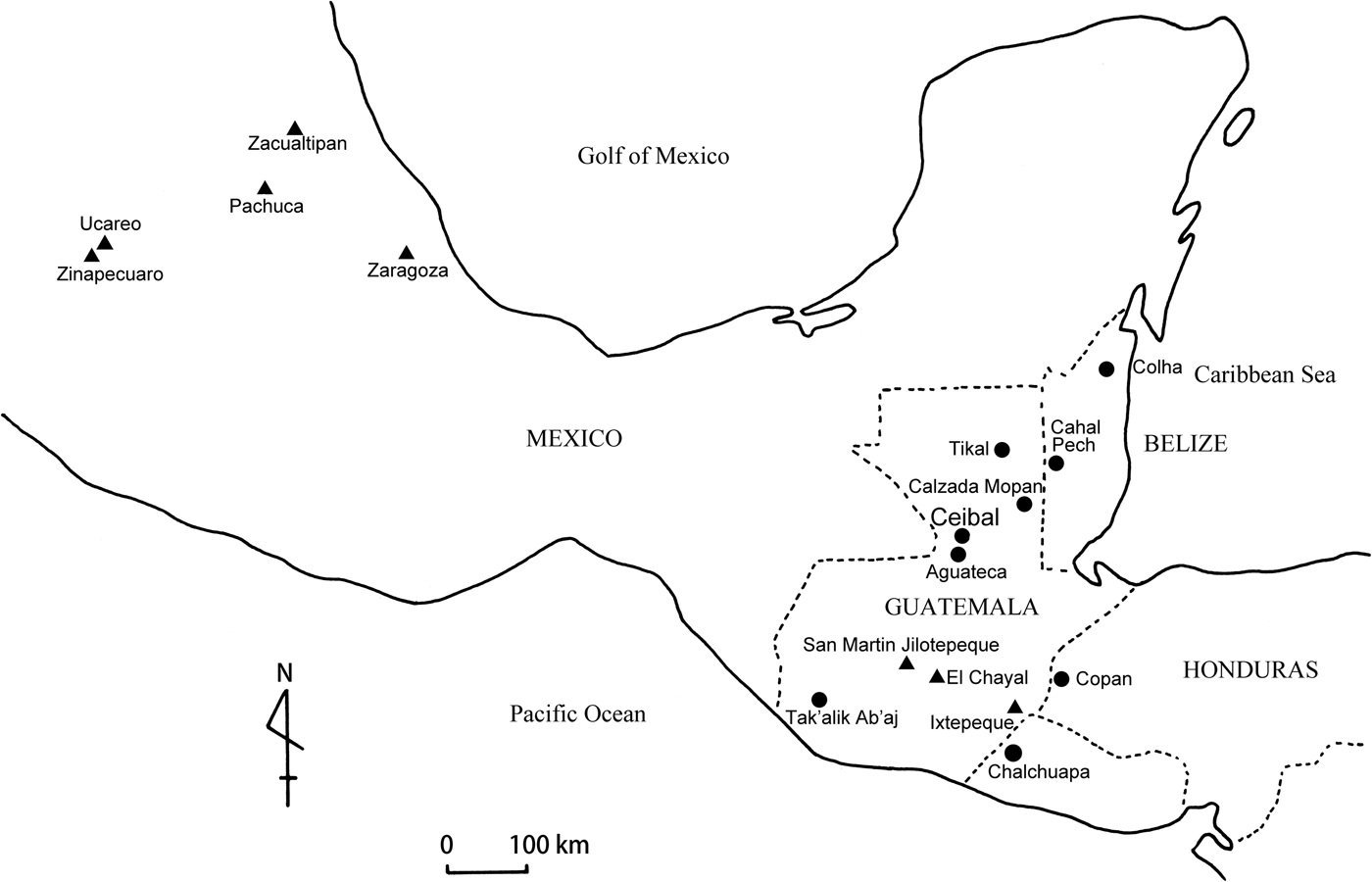
The ancient inhabitants of Ceibal imported obsidian from at least eight geologic sources: San Martín Jilotepeque, El Chayal, and Ixtepeque in highland Guatemala, as well as five Mexican sources (Figure 1). El Chayal obsidian was heavily used during the early Middle Preclassic period, while San Martín Jilotepeque was the principal source in the late Middle Preclassic through Terminal Preclassic periods, and El Chayal once more became the major source in Ceibal during the Classic period (Table 1). Chert material was available locally in Ceibal, as suggested by the large percentage of artifacts containing remnant cortex (64.8 percent), in contrast to the small percentage of imported obsidian artifacts containing remnant cortex (14.6 percent). Chert was obtained locally near the Pasión River. Chert nodules were also available from both the nearby hills occupied by extensive settlement and in the parent bedrock material. The quality of local chert is medium to coarse. Finer quality chert was available nearby for the production of prismatic blades and bifacial artifacts.
Map of Mesoamerica, showing the locations of Ceibal, other archaeological sites, and obsidian sources mentioned in the text. Drawing by the author.
Visual and XRF source assignments of obsidian artifacts from Ceibal, Guatemala.
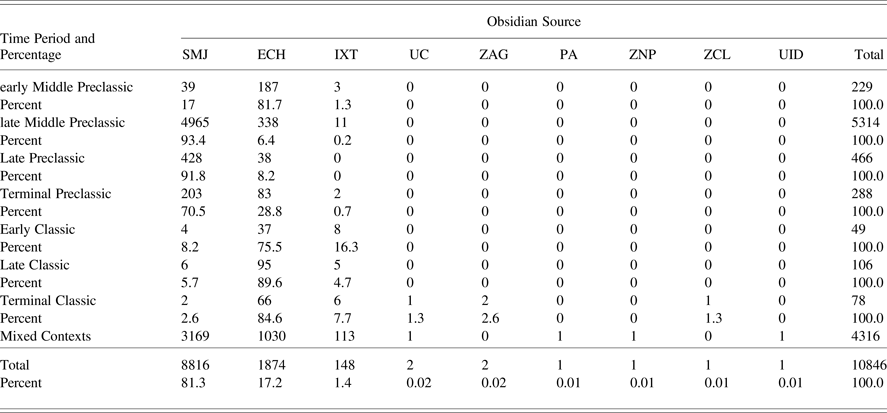
SMJ = San Martín Jilotepeque, ECH = El Chayal, IXT = Ixtepeque, UC = Ucareo, ZRG = Zaragoza, PC = Pachuca, ZNP = Zinapecuaro, ZCL = Zacualtipan, UID = Unidentified source.
METHODOLOGY
I studied 72,490 lithic artifacts recovered from different parts of Ceibal and Caobal between 2005 and 2014. The Ceibal-Petexbatun Archaeological Project has collected significantly more chipped stone artifacts (n = 69,794) than the Ceibal Project of Harvard University (n = 2,394 [Willey Reference Willey1978]), primarily because the excavated soil was screened through a quarter-inch-mesh. Thus, all lithic artifacts were saved during the course of the investigations. Of 72,490 lithic artifacts collected from Ceibal, 69,794 artifacts were from a chipped stone industry, while the remaining 2,696 pieces were polished stone and other kinds of stone artifacts. A total of 58,948 chipped stone artifacts were manufactured from chert, while 10,846 artifacts were made from obsidian (Table 2). In this study, I will focus on diachronic changes of chipped stone artifacts and, therefore, chronological control is of particular importance. To insure temporal control, I eliminated lithic collections that seemed to represent mixed time periods. Consequently, the total chipped stone samples from Ceibal were reduced to 34,050 artifacts (6,530 obsidian artifacts and 27,520 chert artifacts) and these serve as the basis for the diachronic discussions presented below (Tables 2–4). Notably, the Ceibal-Petexbatun Archaeological Project has collected 32,473 chipped stone artifacts from unmixed Preclassic contexts, including 27,560 artifacts from Middle Preclassic contexts. In fact, the Middle Preclassic lithic artifacts from Ceibal make up the largest sample of this critical period in the Maya lowlands to date. Nevertheless, temporally mixed samples were also considered in order to study spatial distribution patterns of rare artifacts, such as exhausted polyhedral cores, bifacial points, and Mexican obsidian artifacts.
Chipped stone artifacts from Ceibal, Guatemala by time period.
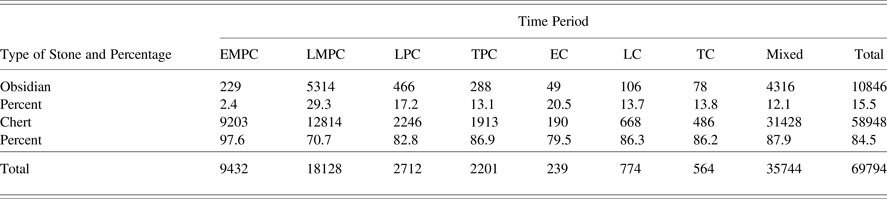
EMPC = early Middle Preclassic, LMPC = late Middle Preclassic, LPC = Late Preclassic, TPC = Terminal Preclassic, EC = Early Classic, LC = Late Classic, TC = Terminal Classic.
Technological analysis of chert artifacts from Ceibal, Guatemala.
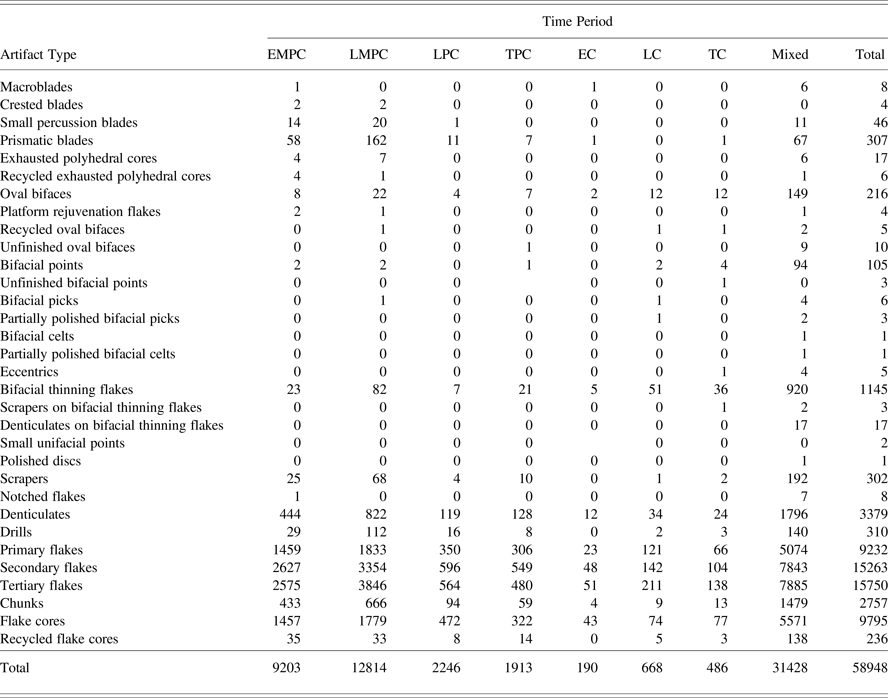
EMPC = early Middle Preclassic, LMPC = late Middle Preclassic, LPC = Late Preclassic, TPC = Terminal Preclassic, EC = Early Classic, LC = Late Classic, TC = Terminal Classic.
Technological analysis of obsidian artifacts from Ceibal.
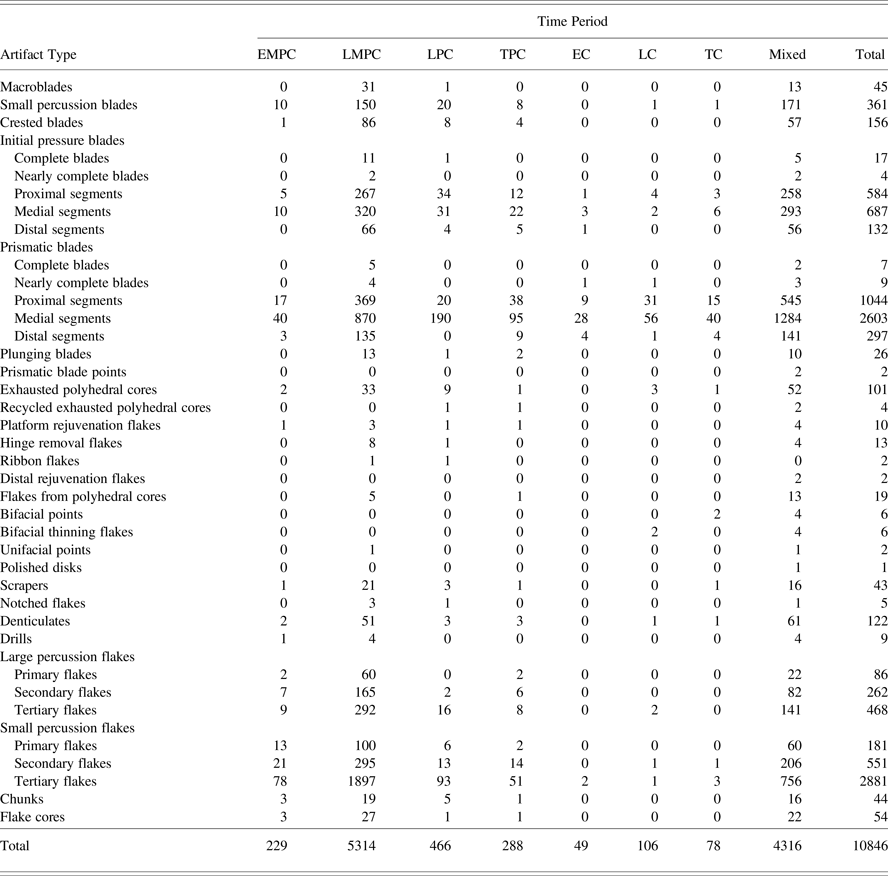
EMPC = early Middle Preclassic, LMPC = late Middle Preclassic, LPC = Late Preclassic, TPC = Terminal Preclassic, EC = Early Classic, LC = Late Classic, TC = Terminal Classic.
As presented in Tables 3 and 4, I classified the chipped stone artifacts according to their raw material combined with technological analysis (Aoyama Reference Aoyama1999, Reference Aoyama2009a, Reference Aoyama, Inomata, Triadan, Ponciano and Aoyama2009b). The pre-Columbian obsidian exchange system in Ceibal was reconstructed by combining technological analysis and source analysis, thus identifying likely sources for the importation of raw material and finished products (Table 5). I identified sources of all obsidian artifacts recorded from Ceibal by combining the portable X-ray fluorescence (pXRF) of a large sample of 5,375 obsidian artifacts and visual examination of the remaining artifacts, which I will discuss in detail in a separate article. Visual analysis on obsidian artifacts was redone by using a comparative reference collection which contains both the obsidian artifacts analyzed by pXRF and geological specimens of the pre-Columbian obsidian sources in Mexico, Guatemala and Honduras. Suffice it to say that there were changes in proportions of San Martín Jilotepeque and El Chayal from the previous publications, particularly regarding the data on Caobal (Aoyama and Munson Reference Aoyama and Munson2012), which I will present below.
Technological types of obsidian artifacts from Ceibal, Guatemala by obsidian sources.
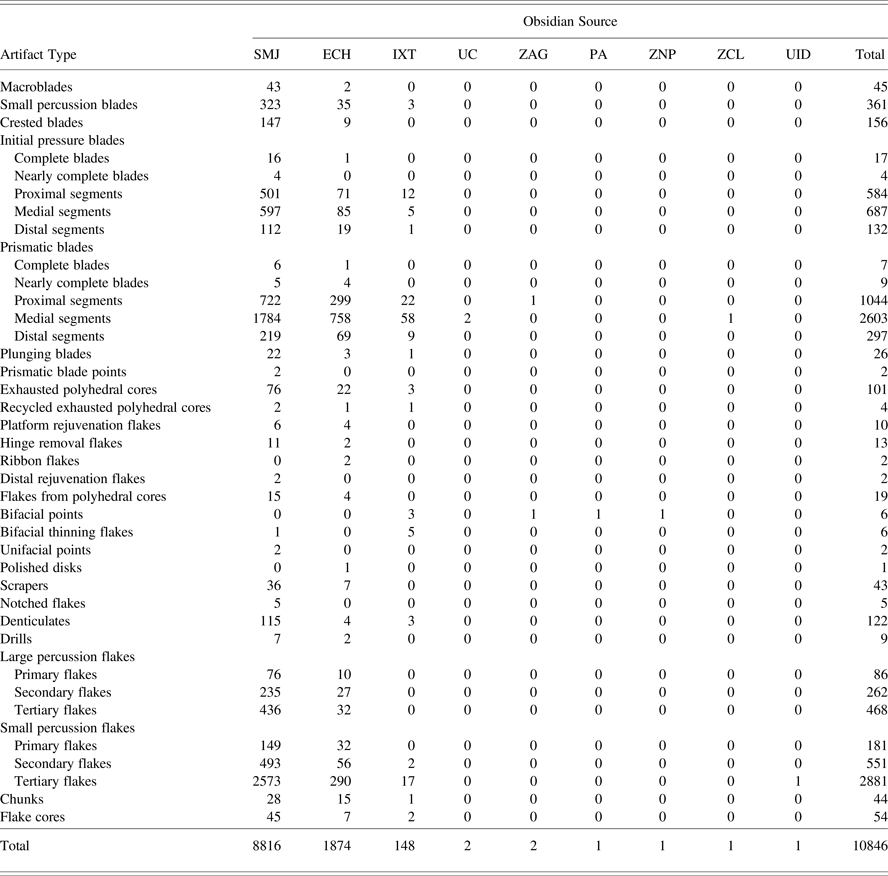
SMJ = San Martín Jilotepeque, ECH = El Chayal, IXT = Ixtepeque, UC = Ucareo, ZRG = Zaragoza, PC = Pachuca, ZNP = Zinapecuaro, ZCL = Zacualtipan, UID = Unidentified source.
Using high-powered microscopy techniques, I have also conducted microwear analysis on 7,737 stone artifacts from Ceibal and other Maya sites (Aoyama Reference Aoyama1995, Reference Aoyama1999, Reference Aoyama2007, Reference Aoyama2009a, Reference Aoyama, Inomata, Triadan, Ponciano and Aoyama2009b). In 1987, I conducted an intensive experimental study of use-wear on obsidian and chert in Honduras in order to establish a framework for the interpretation of Maya stone tool use (Aoyama Reference Aoyama1989, Reference Aoyama1999). The results of 267 replication experiments conducted in a range of worked materials permitted identification of use-wear patterns. The instrument used in the study was a metallurgical microscope (Olympus BX60M) with 50–500x magnification and an incident light attachment. Use-wear patterns were documented with an Olympus photomicrographic system PD-20 attached to a digital camera.
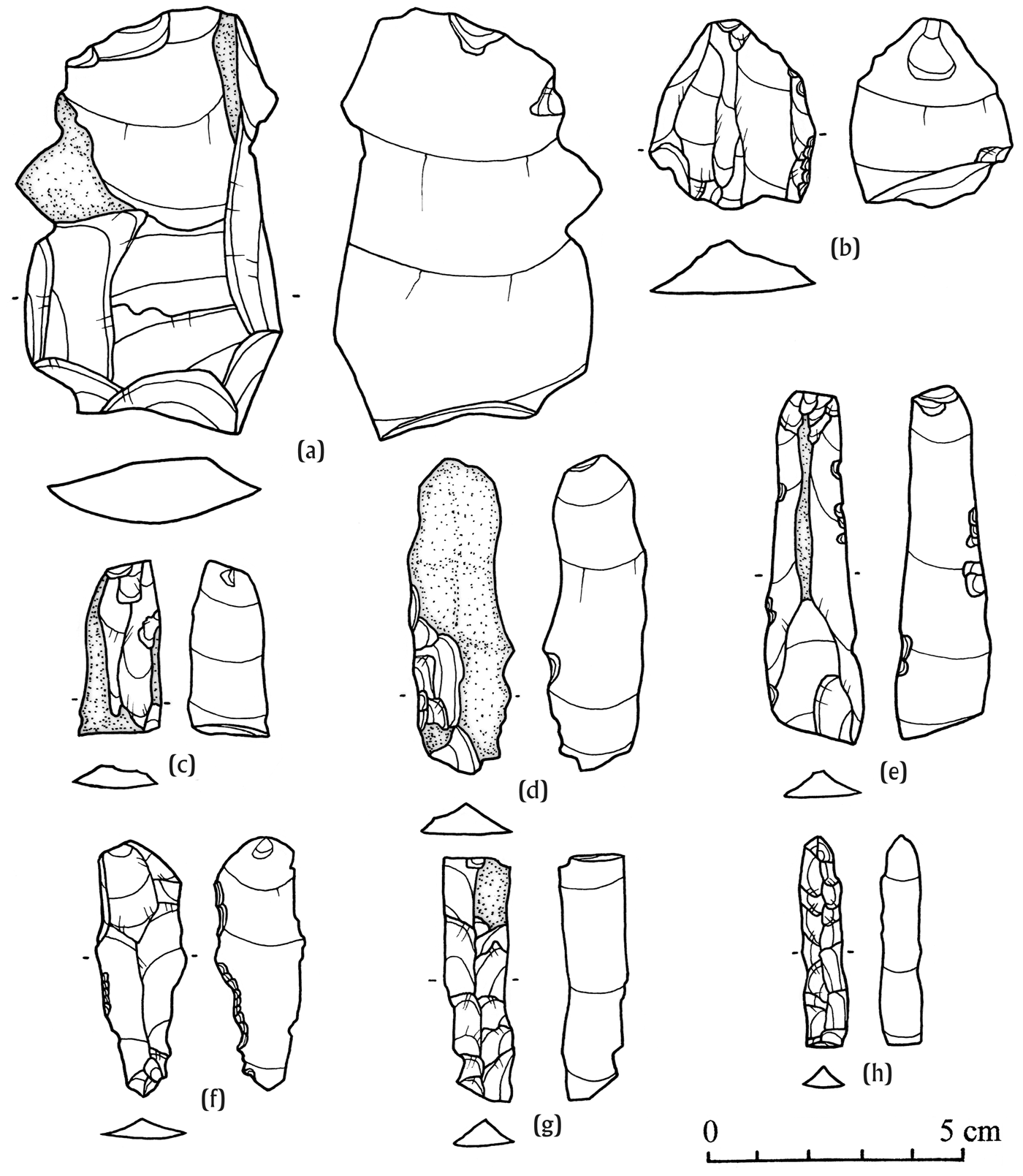
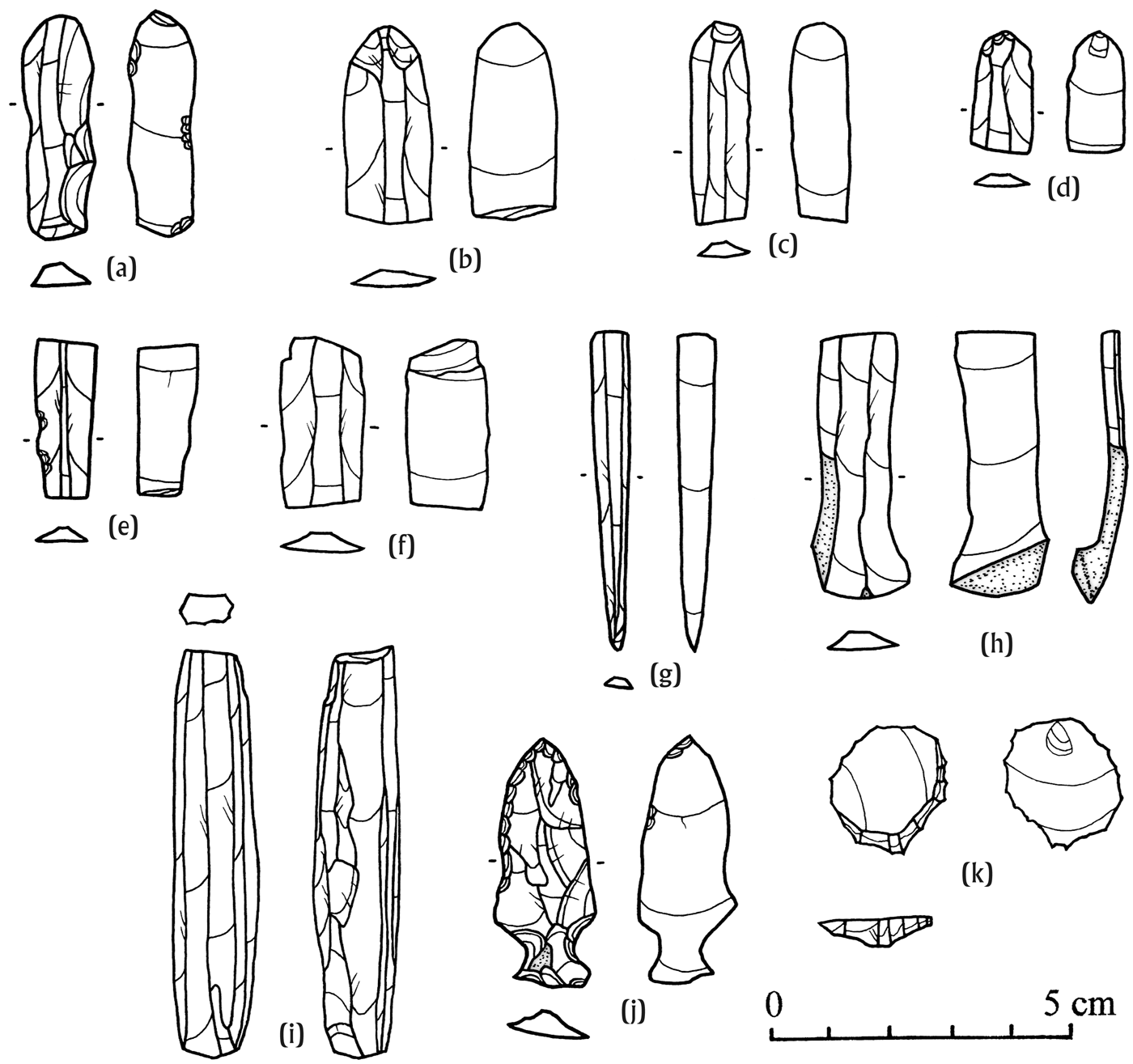
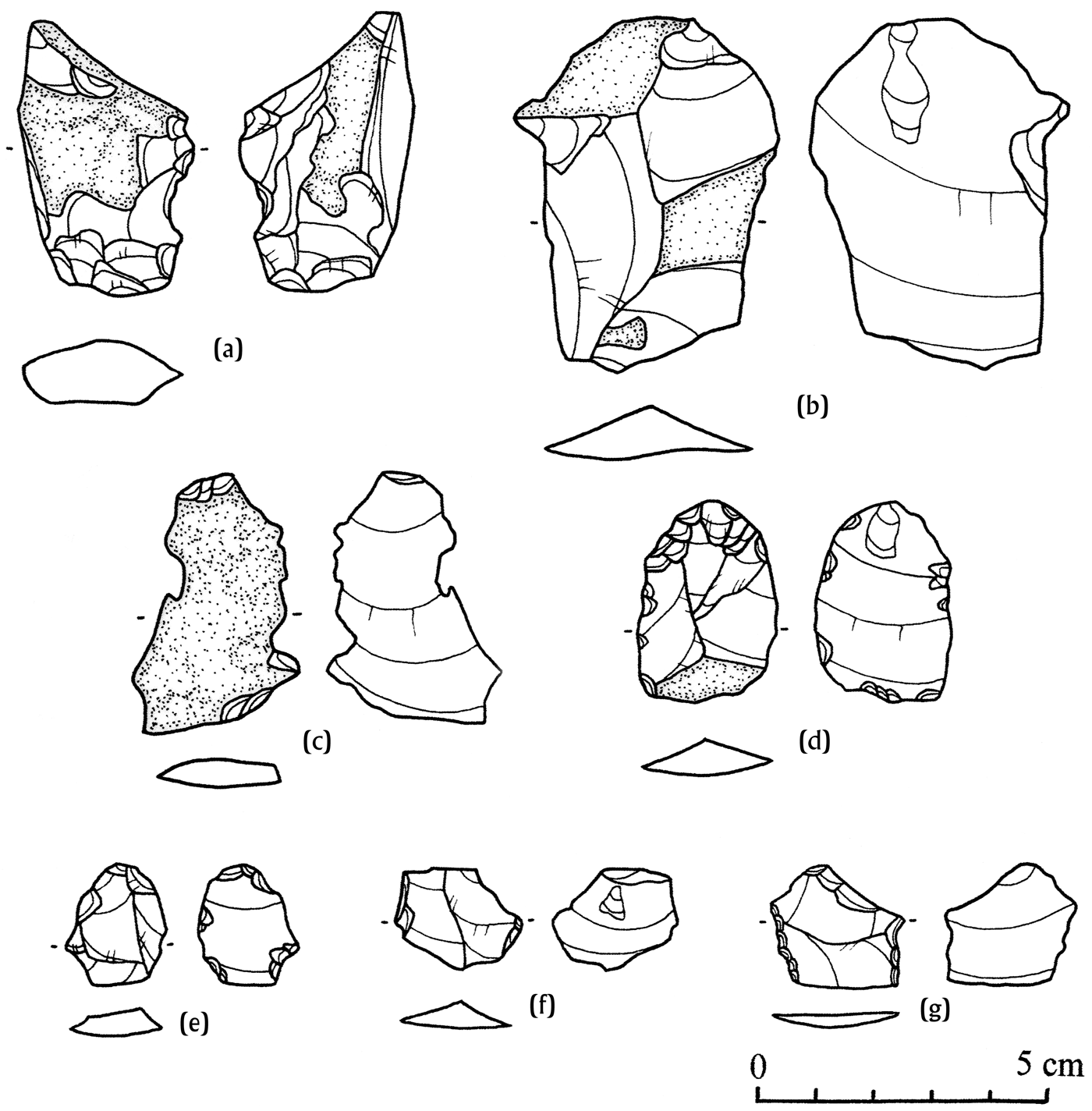
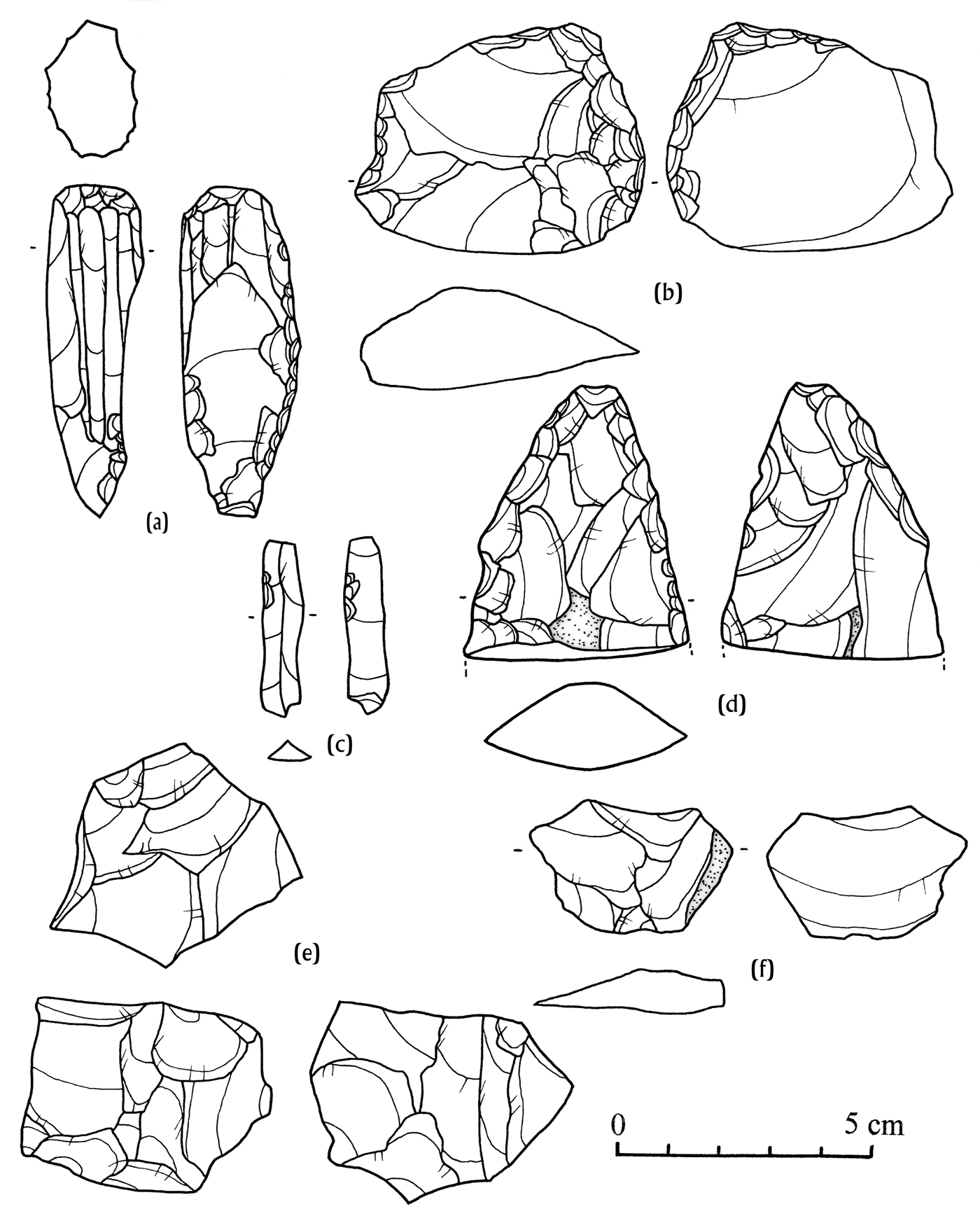
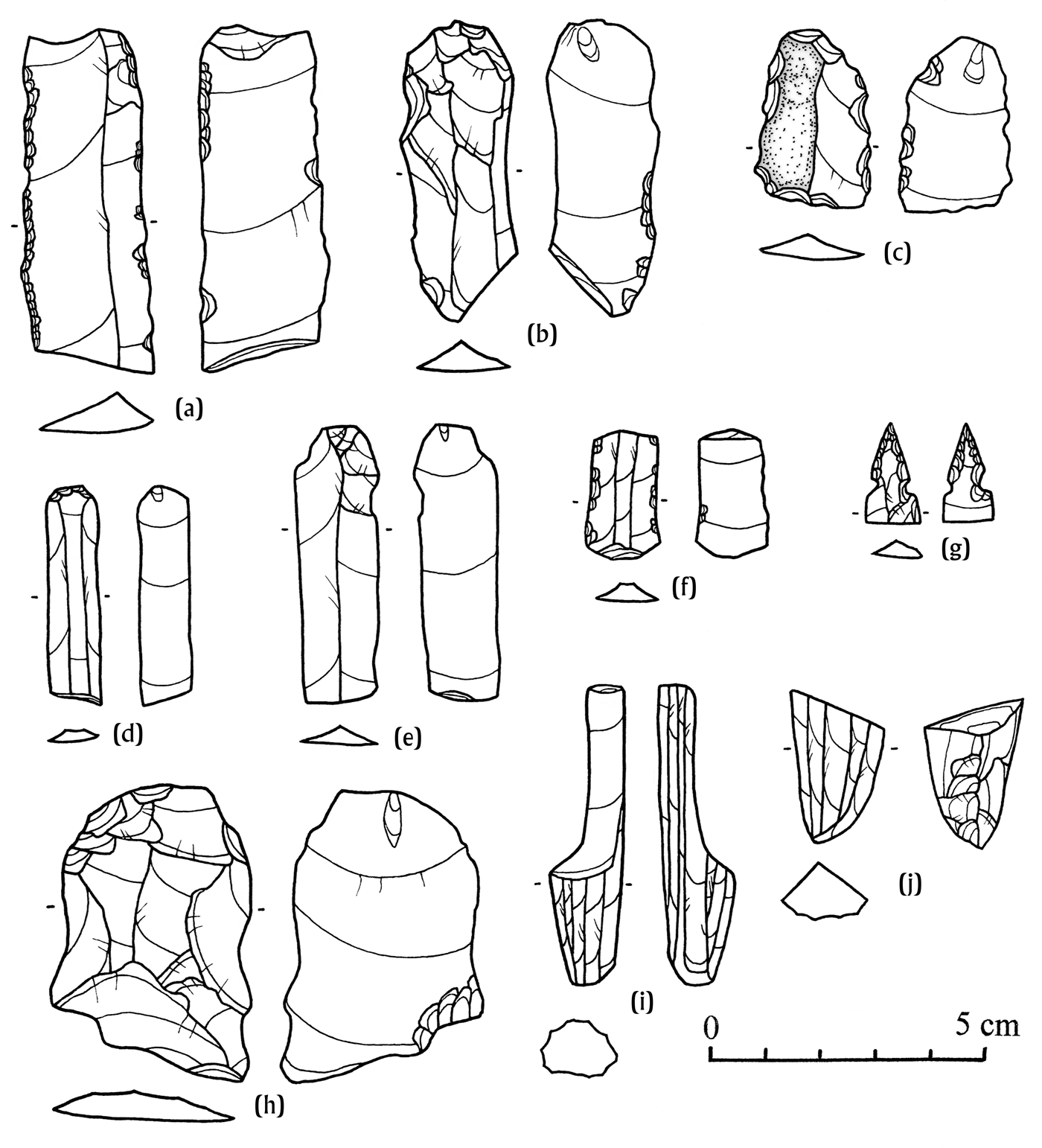
I drew all the lithic illustrations in Japanese technical style (Figures 2–7). Each illustrated sample shows the sequence of flake scar detachment. Flake scars, fissures, and ripple marks demonstrate the relationship of adjacent flake scars. In what follows, I will present data related to the procurement and production of obsidian artifacts, as well as results pertaining to chert chipped stone production, including possible chipped stone weapons during the Preclassic and Classic periods.
Middle Preclassic obsidian artifacts related to the percussion stage of core-blade production from Ceibal: (a–b) macroblades, (c–f) small percussion blades, and (g–h) crested blades. Drawings by the author.
Middle Preclassic obsidian pressure blades and other artifacts from Ceibal: (a) initial pressure blade, (b–d) proximal segments of prismatic blades, (e, f) medial segments of prismatic blade, (g) distal segment of prismatic blade, (h) plunging blade, (i) exhausted polyhedral core, (j) stemmed unifacial point on small percussion blade, and (k) platform rejuvenation flake. Drawings by the author.
Middle Preclassic obsidian percussion flakes and a flake core from Ceibal: (a) flake core, (b, d) secondary flakes, (c) primary flake, (e–f) tertiary flakes, (g) denticulate. Drawings by the author.
Middle Preclassic chert artifacts from Ceibal: (a) exhausted polyhedral core, (b) denticulate, (c) prismatic blade, (d) oval biface, (e) flake core, and (f) secondary flake. Drawings by the author.
The 13 obsidian prismatic blades associated with the Burial 104 of Ceibal from the late Middle Preclassic period. Photograph by the author.

Late Preclassic, Terminal Preclassic and Classic obsidian artifacts from Ceibal. (a) macroblade, (b–c) small percussion blades, (d–e) proximal segments of prismatic blades; (f) medial segment of prismatic blade, (g) side-notched prismatic blade point, (h) tertiary flake, and (i–j) fragments of exhausted polyhedral cores. Drawings by the author.
REAL-XE PHASE, EARLY MIDDLE PRECLASSIC PERIOD (1000–700 b.c.)
Chipped Stone Artifacts from Ceibal
A total of 9,432 chipped stone artifacts, including 229 obsidian artifacts and 9,203 chert artifacts, were recovered from unmixed early Middle Preclassic Real-Xe (1000–700 b.c.) contexts. Obsidian artifacts account for only 2.4 percent of all chipped stone artifacts dating to the early Middle Preclassic period (Table 2). As shown in Table 1, El Chayal was the dominant source of obsidian (81.7 percent), with minor quantities of obsidian from San Martín Jilotepeque (17 percent) and Ixtepeque (1.3 percent). The predominance of El Chayal obsidian in Ceibal during the early Middle Preclassic period is important and indicative of a general trend against a previous model that depicted virtually all Middle Preclassic obsidian as coming from San Martín Jilotepeque (e.g., Nelson Reference Nelson1985). By way of comparison, nearly all the obsidian came from Ixtepeque to Copan, Honduras, from the Early Preclassic through the Early Postclassic period (Aoyama Reference Aoyama2001:348). Maya obsidian procurement during the Middle Preclassic period was more complex than previously thought.
The presence of exhausted polyhedral cores and artifacts related to the percussion stage of core-blade production (Figure 2), such as small percussion blades, a crested blade, and many pressure blades, suggest that large polyhedral cores of El Chayal obsidian were imported to Ceibal and that pressure blades (Figure 3) were manufactured locally during the early Middle Preclassic period (Table 6). Preclassic blade makers in Ceibal created a crested ridge to remove crested blades. In addition, a portion of the El Chayal obsidian was also imported to Ceibal in the form of large flake spalls (unmodified chunks broken from larger nodules of raw material) or small nodules for the production of percussion flakes (Figure 4). This observation is based on the presence of flake cores, the high percentage of cortex found on El Chayal obsidian artifacts (22.5 percent), and a relatively low percentage of pressure blades (i.e., initial pressure and prismatic blades) made from El Chayal obsidian (31 percent).
Technological types of obsidian artifacts from Ceibal by obsidian sources, early Middle Preclassic period.
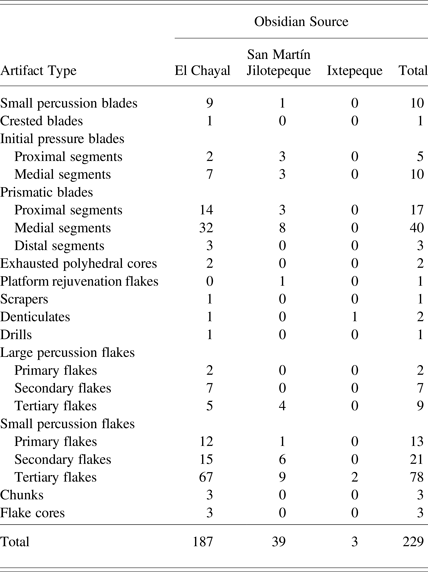
A small percussion blade, initial pressure blades, prismatic blades, and a platform rejuvenation flake made from San Martín Jilotepeque obsidian were found, indicating local production of prismatic blades. Moreover, it is likely that a portion of the San Martín Jilotepeque and Ixtepeque obsidian was also imported to Ceibal in the form of large flake spalls or small nodules, based on the presence of flakes made from Ixtepeque obsidian and the high percentage of cortex found on San Martín Jilotepeque obsidian artifacts (17.9 percent).
Informal percussion flakes (n = 6,661) are the predominant form of chert chipped stone artifact in Ceibal in the early Middle Preclassic period, accounting for 72.4 percent of the total assemblage (Table 2). There are also 1,457 flake cores, indicating local production of flaked stone tools (Figure 5). Retouched flake tools include scrapers, a notched flake, denticulates, and drills. Local production of chert prismatic blades also began during this period, by removing these by pressure from carefully prepared polyhedral cores. Evidence for this includes chert exhausted polyhedral cores, prismatic blades, a macroblade, small percussion blades, and crested blades. In contrast, only the technique—hard hammer percussion—has been recognized for chert macroblades, smaller blades, and bifacial tool fabrication at Colha, Belize during the Middle Preclassic period (Potter Reference Potter, Hester and Shafer1991:24). Eight oval bifaces, two bifacial points, and 23 bifacial thinning flakes were also found in Ceibal, suggesting the local production of both oval bifaces and bifacial points at this time. Moholy-Nagy (Reference Moholy-Nagy2003:Table 2.30) reports six chert prismatic blades at Tikal during the early Middle Preclassic Eb phase, whereas chert exhausted polyhedral cores, prismatic blades, stemmed bifacial points, and oval bifaces date to the late Middle Preclassic period (600–350 b.c.). Therefore, empirical evidence for local production of chert prismatic blades, oval bifaces, and bifacial points in Ceibal predates that of Tikal. The chert bifacial points and a shell ornament representing a decapitated human head (Inomata et al. Reference Inomata, Triadan, Román, Ruiz and Cuerva2010:34), both recovered from the Central Plaza of Ceibal and dated to the early Middle Preclassic period, are the earliest evidence of warfare in Ceibal.
I analyzed microwear on 70 chipped stone artifacts dated to the early Middle Preclassic period in Ceibal. All seven analyzed obsidian artifacts were used, including two medial segments and a distal segment of prismatic blades, two primary flakes, and two secondary flakes, indicating that not only prismatic blades but also primary and secondary flakes were used as tools, while interpretable microwear was observed on 16 out of 63 chipped chert artifacts (25.4 percent). Following Vaughan (Reference Vaughan1985:56–57), each portion of a lithic artifact with interpretable use-wear was counted as an “independent use zone” (IUZ). A total of 33 IUZ were identified on the artifacts dated to the early Middle Preclassic period. Meat or hide processing (63.6 percent) were the most common activities (Figure 8), followed by working unidentified material (21.2 percent) and wood carving (12.1 percent). A chert tertiary flake was used for shell or bone carving. Obsidian prismatic blades were used for cutting meat or hide and unidentified material. Some chert unretouched flakes were “informal tools” used frequently for multiple functions. Activities performed with these chert flakes were for meat or hide processing (70 percent) followed by wood carving (15 percent), shell or bone carving (5 percent), and working unidentified material (10 percent).
Type E2 polish and parallel striations on a chert flake that was used to cut meat or hide from Ceibal during the early Middle Preclassic period. The edge of polish surface is rounded and rough, with numerous pits. Photograph by the author.

Comparison with the Obsidian Artifacts from Other Sites in the Maya Lowlands and Neighboring Regions
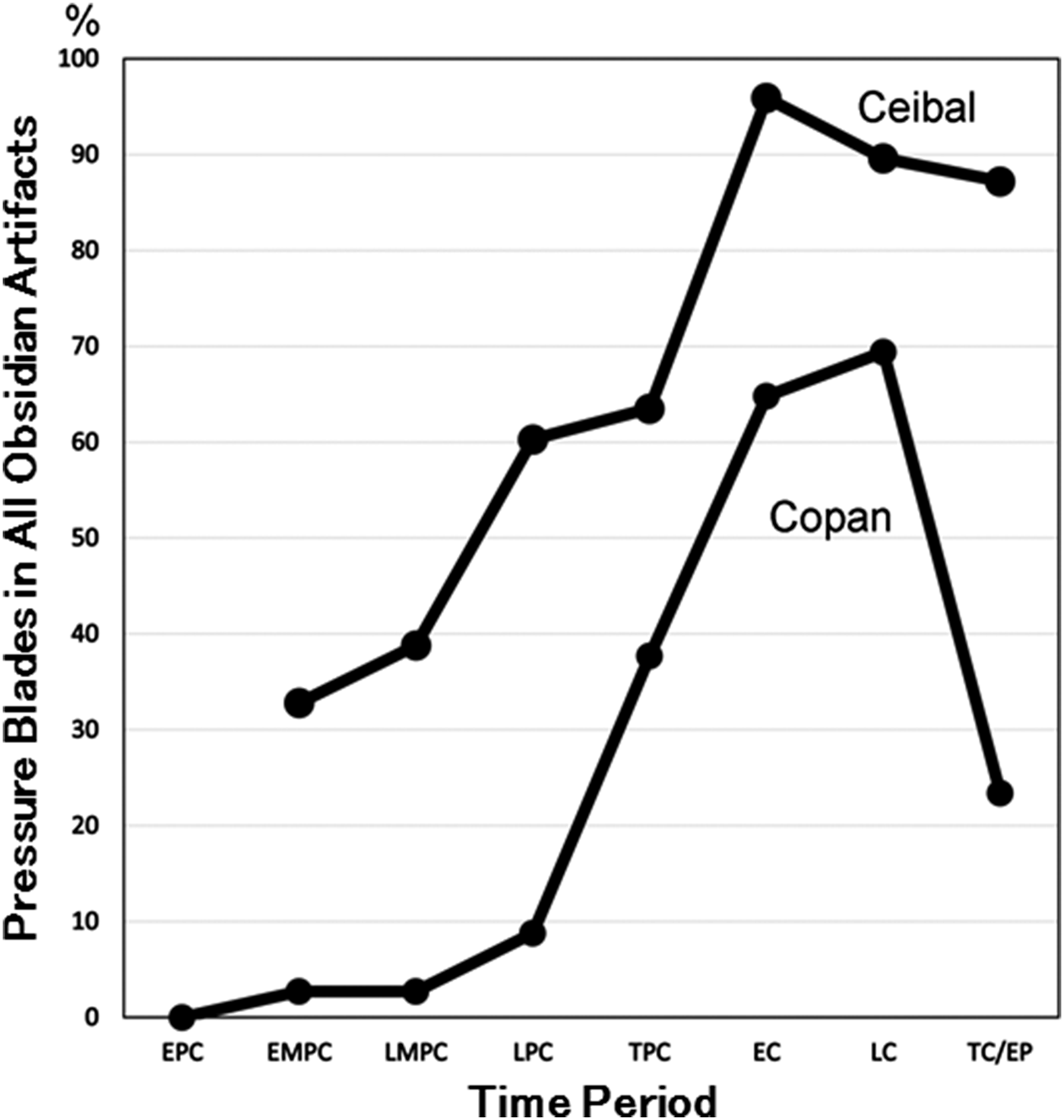
To summarize the diachronic changes in obsidian procurement and production, Figure 9 compares the percentage of pressure blades in obsidian artifacts over time in Ceibal with that of Copan. Comparative samples of chipped stone were available from both sites so that I could make meaningful quantitative comparisons. During the Middle Preclassic Gordon phase (1000–850 b.c.), small quantities of prismatic blades made from Ixtepeque obsidian (n = 19) were imported to Copan as finished products (Aoyama Reference Aoyama1999:Table 2). There is no evidence for local blade production, due to the lack of manufacturing debitage for local production of obsidian blades. On the basis of the extremely low percentage (4.7 percent) of prismatic blades in obsidian artifacts and the high percentage of cortex in the Ixtepeque obsidian artifacts (18.5 percent), it would appear that Ixtepeque obsidian was imported mainly as large flake spalls or small nodules for the production of percussion flakes. While large polyhedral cores of El Chayal and San Martín Jilotepeque obsidian were imported to Ceibal and pressure blades were manufactured locally during the early Middle Preclassic period, it was not until the Late Protoclassic Bijac phase (a.d. 150–400) that the importation of large polyhedral cores of Ixtepeque obsidian into the Copan Valley and the local production of prismatic blades began as a result, rather than the cause, of sociopolitical development in the Copan Valley (Aoyama Reference Aoyama2001:351). The diachronic obsidian data at Copan strongly support Clark's (Reference Clark, Johnson and Morrow1987) contention about the association between blade technology and sociopolitical complexity, in which he suggested that production of these valued objects at sites distant from source areas may have necessitated sponsorship by local chiefs and specialists to organize production.
Diachronic change in the percentage of pressure blades in all obsidian artifacts in Ceibal and Copan. EPC = Early Preclassic, EMPC = early Middle Preclassic, LMPC = late Middle Preclassic, LPC = Late Preclassic, TPC = Terminal Preclassic, EC = Early Classic, LC = Late Classic, TC/EP = Terminal Classic/Early Postclassic.
Awe and Healy (Reference Awe and Healy1994) report 28 obsidian flakes and note the absence of obsidian blades at Cahal Pech, Belize, during the first half of the early Middle Preclassic period (1000–850 b.c.), whereas the introduction of obsidian prismatic blades and blade cores is linked to increased architectural differentiation and social ranking during the late Middle Preclassic period (650–350 b.c.). In contrast, from the inception of its importation to K'axob, Belize, during the early part of the Middle Preclassic period (800–600 b.c.), obsidian arrived as finished prismatic blades (McAnany Reference McAnany and McAnany2004:308). At Tikal, Guatemala, Moholy-Nagy (Reference Moholy-Nagy2003:Tables 3.18, 3.24, 3.29) identified three obsidian prismatic blades and two small flakes that dated to the early Middle Preclassic Eb phase (800–600 b.c.), while a fragment of exhausted polyhedral core, indicative of local blade production, and 17 prismatic blades date to the late Middle Preclassic period (600–350 b.c.). In contrast, Rice and colleagues (Reference Rice, Michel, Asaro and Stross1985:595) suggest the existence of local blade production in the central Peten Lake region, Guatemala, during the early Middle Preclassic Ah Pam phase (750–550 b.c.), based on two exhausted core fragments of San Martín Jilotepeque obsidian.
The obsidian artifacts in Ceibal during the early Middle Preclassic Real-Xe phase represent the earliest evidence of local production of prismatic blades made from both El Chayal and San Martín Jilotepeque obsidian in the Maya lowlands to date. Ceibal society appears to have attained a minimal level of sociopolitical complexity wherein the procurement of large polyhedral cores of obsidian and local production of prismatic blades could be carried out during this period. One of the early leaders of Ceibal may have begun to sponsor the procurement of large polyhedral cores of obsidian and local production of fine blades on behalf of his community as a means of consolidating and legitimizing his own political authority. Blades may have been distributed as a type of political patronage in the form of gifts used to attract subordinates.
Outside the Maya lowlands, the current data shows temporal variability in the adoption of blade technology and concurrent operation of various obsidian exchange networks during the Early and Middle Preclassic periods. Coe and Diehl (Reference Coe and Diehl1980:246–259) report obsidian exhausted polyhedral cores, prismatic blades, flake cores, flakes, and other artifacts at the Gulf Coast Olmec center of San Lorenzo during the San Lorenzo phase (ca. 1400–1000 b.c.), indicating the local production of both pressure blades and percussion flakes. Guadalupe Victoria, Puebla, was the primary source of obsidian for the inhabitants of San Lorenzo during the San Lorenzo phase and they expanded their obsidian procurement network to include several other sources, including Pico de Orizaba and Altotonga, Veracruz, Zaragoza, Puebla, Paredon and Otumba, State of Mexico, Pachuca and Zacualtipan, Hidalgo, El Paraíso, Queretaro, Ucareo, Michoacan as well as El Chayal and Ixtepeque, Guatemala (Cobean et al. Reference Cobean, Coe, Parry, Turekian and Kharkar1971, Reference Cobean, Vogt, Glascock and Stocker1991; Hirth et al. Reference Hirth, Cyphers, Cobean, De León and Glascock2013). In the Chiapas highlands, the inhabitants imported obsidian spalls for the production of percussion flakes from several sources, such as San Martín Jilotepeque, El Chayal, and Tajumulco during the Early Preclassic period, whereas virtually all the obsidian came from San Martín Jilotepeque during the Middle Preclassic period, when the local blade production began. While obsidian spalls continued to be brought into Chiapas communities along with large polyhedral cores, the first evidence of pressure blade manufacture coincides with the emergence of large chiefdoms (Clark and Lee Reference Clark, Lee, Lowe and Pye2007). In contrast, obsidian prismatic blades were imported in finished form to the Pacific coast center of La Blanca during the Conchas phase of the Middle Preclassic period (1000–600 b.c.), while an expedient flake production persisted after the introduction of prismatic blades. El Chayal was the most common source for obsidian, followed by Ixtepeque and San Martín Jilotepeque at the site (Jackson and Love Reference Jackson and Love1991).
ESCOBA-MAMOM PHASE, LATE MIDDLE PRECLASSIC PERIOD (700–350 b.c.)
There was a continuation of platform and temple rebuilding during the late Middle Preclassic Escoba phase in Ceibal (Inomata et al. Reference Inomata, MacLellan, Triadan, Burham, Aoyama, Nasu, Munson, Pinzón and Yonenobu2015:4269). The lithic assemblage from unmixed late Middle Preclassic deposits yielded the largest sample of chipped stone artifacts in Ceibal of any time period of human occupation. A total of 18,128 chipped stone artifacts includes 5,314 obsidian artifacts and 12,814 chert artifacts. Obsidian artifacts constitute 29.3 percent of all chipped stone artifacts in the late Middle Preclassic deposits in Ceibal (Table 2). Thus, a significant increase in the quantity of imported obsidian can be noted at this time. As shown in Table 1, most of the obsidian brought to Ceibal came from San Martín Jilotepeque (93.4 percent), while minor quantities of obsidian were contributed from El Chayal (6.4 percent) and Ixtepeque (0.2 percent).
San Martín Jilotepeque obsidian was imported in the form of large polyhedral cores that were modified into percussion and pressure blades during the late Middle Preclassic period. This opinion is based on the presence of exhausted polyhedral cores and the artifacts related to the percussion stage of core-blade production, such as macroblades, small percussion blades, crested blades, in addition to a wide variety of core rejuvenations flakes and flakes from recycled exhausted polyhedral cores (Table 7). A stemmed unifacial point shaped from a crested blade was found in the Central Plaza. A stemmed unifacial point made on a small percussion blade blank was recovered from secondary context of the late Middle Preclassic period in the East Court (Figure 3j). These two points are the earliest points made from San Martín Jilotepeque obsidian in Ceibal to date. Large flake spalls or small nodules of San Martín Jilotepeque obsidian were also brought to the site to produce percussion flakes. This inference is based on the relatively high percentage of cortex found on San Martín Jilotepeque obsidian artifacts (16.4 percent), a relatively low percentage of pressure blades (38.6 percent), and abundant flake cores.
Technological types of obsidian artifacts from Ceibal by obsidian sources in the late Middle Preclassic period.
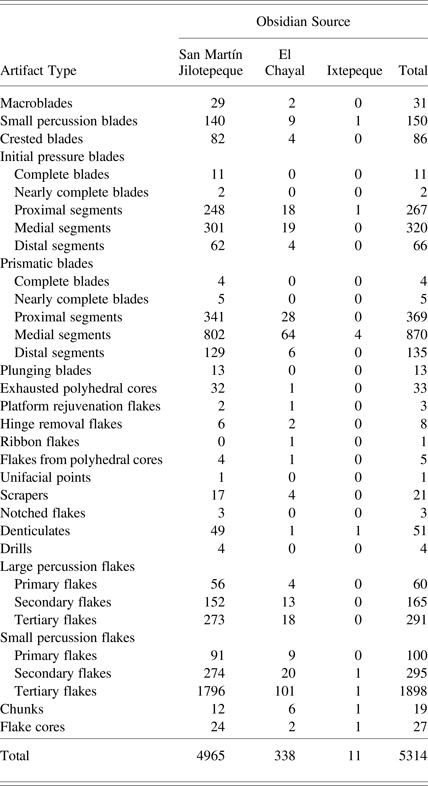
Due to the presence of an exhausted polyhedral core and percussion blades, such as macroblades, small percussion blades and crested blades, as well as core rejuvenations flakes and a flake from recycled exhausted polyhedral core, El Chayal obsidian was imported primarily in the form of large polyhedral cores. In addition, based on the relatively high percentage of cortex found on El Chayal obsidian artifacts from the late Middle Preclassic (20.1 percent) and the presence of primary and secondary flakes and flake cores, large flake spalls or small nodules of El Chayal obsidian were also brought to the site to produce percussion flakes.
The presence of a small percussion blade and pressure blades indicate that some large polyhedral cores of Ixtepeque obsidian may have been imported to Ceibal during the late Middle Preclassic period. In addition, it is likely that Ixtepeque obsidian may also have been imported in the form of large flake spalls or small nodules, based on the presence of a flake core and flakes made from Ixtepeque obsidian, as well as the high percentage of cortex found on Ixtepeque obsidian artifacts (27.3 percent).
At the nearby minor center of Caobal, obsidian artifacts account for only 8.2 percent (n = 68) of all chipped stone artifacts in the late Middle Preclassic deposits, while obsidian artifacts constitute 9.1 percent (n = 260) of the chipped stone assemblage at Jul Group (CB210A) in the periphery area of Ceibal. These percentages are significantly smaller than similar deposits found at the central part of Ceibal (34 percent; n = 5,015), indicating that the inhabitants of the central part of Ceibal had greater access to obsidian imports than peripheral areas. Similarly at Caobal, the majority of obsidian was obtained from San Martín Jilotepeque (69.1 percent), while minor quantities of obsidian were contributed from El Chayal (29.4 percent) and Ixtepeque (1.5 percent).
Due to the lower percentage of cortex found on San Martín Jilotepeque obsidian artifacts from Caobal (6.4 percent) rather than Ceibal (16.5 percent), San Martín Jilotepeque obsidian was imported primarily in the form of more prepared polyhedral cores which were transformed into pressure blades at Caobal, while large polyhedral cores were imported to Ceibal during the late Middle Preclassic period. This inference is also supported by the significantly greater percentage of pressure blades made from San Martín Jilotepeque obsidian from Caobal (87.2 percent) than Ceibal (38.2 percent). Similarly, based on the higher percentage of pressure blades made from El Chayal obsidian from Caobal (65 percent) than Ceibal (39.6 percent), El Chayal obsidian was imported primarily in the form of more prepared polyhedral cores to Caobal. Moreover, no cortex was found on the El Chayal obsidian artifacts from Caobal. Additional obsidian artifacts from the late Middle Preclassic deposits in Ceibal, which are notably absent from Caobal comprise the artifacts related to the percussion stage of core-blade production, including macroblades, macroflakes, small percussion blades, and crested blades. In contrast to the high percentage of cortex found on obsidian artifacts from Ceibal, virtually no obsidian artifacts present cortex at Caobal during the entire pre-Columbian sequence. It is possible that Ceibal elites may have distributed semi-exhausted polyhedral cores of obsidian to the inhabitants of Caobal throughout the Preclassic and Classic periods.
Following the earlier pattern, production of percussion flakes remained the dominant chert chipped stone artifact in the late Middle Preclassic period, accounting for 70.5 percent (n = 9,033) of the total chert lithic assemblage from this period (Table 3). Retouched flake tools in the assemblage included: 68 scrapers, 822 denticulates, and 112 drills. Local production of chert prismatic blades also continued, based on the presence of chert exhausted polyhedral cores, prismatic blades, small percussion blades, and crested blades. A total of 22 oval bifaces, a bifacial pick and 82 bifacial thinning flakes were also found from unmixed late Middle Preclassic contexts, while two bifacial points were recovered, suggesting the local production of bifacial artifacts at this time.
A total of 253 IUZ were identified on 251 chipped stone artifacts (150 obsidian and 101 chert artifacts) recollected from the late Middle Preclassic midden on Floor 5b associated with the Kaaxkuut Structure under the large terrace east of the massive temple-pyramid Structure A-24 (CB200B-1-7-3). Microwear was identifiable on 86.9 percent of obsidian artifacts, while at least 60.5 percent of chert artifacts were used. Comparisons of the results of microwear analysis of obsidian (IUZ = 219) and chert artifacts (IUZ = 34) show clear differences between the two assemblages. The analyzed obsidian lithic artifacts, which mainly consisted of prismatic blades, were used principally for unidentified material (65.3 percent) and wood carving (25.6 percent); and, to a much smaller degree, for meat or hide processing (5 percent) and carving shell or bone (4.1 percent). Overall, the great majority of obsidian prismatic blades from Ceibal were utilitarian tools used for a variety of craft production and domestic tasks. In terms of activities performed with chert artifacts, meat or hide processing (58.8 percent) were the most common activities, followed by working of unidentified material (20.6 percent), shell or bone carving (17.6 percent) and wood carving (2.9 percent). Consequently, several kinds of craft production occurred in this household. I agree with Hirth (Reference Hirth and Hirth2009) who suggests that multicrafting better categorizes the way that domestic craft activity was structured in pre-Columbian Mesoamerica.
It should be noted that some obsidian flakes and initial pressure blades as well as chert flakes and scrapers were used for shell or bone carving. During the Late Classic period, the high-status courtier/scribe of the nearby city of Aguateca engaged in the production, on a part-time basis, of shell and bone objects of high symbolic value and other royal regalia in a courtly setting, while virtually no evidence of shell or bone carving has been found outside of the epicenter of Aguateca (Aoyama Reference Aoyama2009a:129; Emery and Aoyama Reference Emery and Aoyama2007). As Inomata (Reference Inomata2001:324) asserts, such objects made by a skilled elite craftsperson were probably highly valued and the act of craft production itself, including some lithic production (Hruby Reference Hruby, Hruby and Flad2007), was also an ideologically loaded political act, closely related to the elites' power and prestige. The celestial origin of obsidian, based on the Mesoamerican belief that lightning created obsidian (Pastrana and Athie Reference Pastrana, Athie, Levine and Carballo2014), for example, imbues the material with supernatural power. The results of microwear analysis indicate that elites in the central part of Ceibal may have engaged in various kinds of artistic creation and craft production, including shell or bone carving during the late Middle Preclassic period. I argue that craft production by elite men and women was important in exclusionary tactics and elite identity among the Preclassic and Classic Maya.
LATE MIDDLE PRECLASSIC OBSIDIAN BLADE WORKSHOP DUMP IN AN ELITE-DOMESTIC CONTEXT
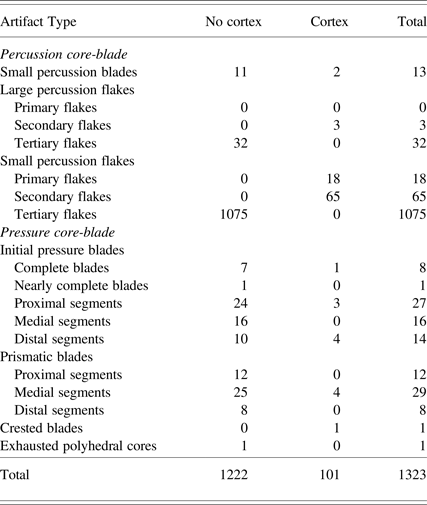
In her extensive excavations in the epicenter of Ceibal as part of the Ceibal-Petexbatun Archaeological Project, Jessica MacLellan uncovered an obsidian blade workshop dump (CB211B-1-6-3). A total of 1,323 obsidian artifacts (421.1 g) date to the late Middle Preclassic Escoba 2 phase (600–450 b.c.) and were associated with Structure Tz'unun in the Karinel Group, a large residential platform, only 160 m west of the Central Plaza of Group A (Figure 10). Although the obsidian deposit (only 0.1 cubic meters) was in a small area directly on the bedrock, obsidian density (13,230 pieces and 4,211 g per cubic meter) is the highest in Ceibal in any period of time during occupation (Figure 11). All obsidian artifacts except a prismatic blade made from El Chayal obsidian were manufactured from San Martín Jilotepeque obsidian. Neither ceramic sherds nor chert artifacts were found with obsidian artifacts. The compactness and pureness of the obsidian deposit suggests that the obsidian knapper may have worked in a nearby production area in a domestic context and dumped obsidian debris from a container into the bedrock. In other words, the deposit represents a discreet event of knapping activity. It strongly resembles the Bustamente site near Chalchuapa, a concentration of Late Preclassic blade workshop debris that had been deposited probably quite close to the actual locus of manufacture (Sheets Reference Sheets1972).
Map of Group A of Ceibal, showing the late Middle Preclassic obsidian blade workshop dump (CB211B-1-6-3) associated with Structure Tz'unun in the Structure 47-base (•) as well as the Late Classic chert biface workshop dump (CB204A-1-5-1) next to the ballcourt Structure A-19 in Group A of Ceibal (▴). Map by the author, modified from Smith Reference Smith1982:Map 1; used with permission of the Peabody Museum, Harvard University.

Obsidian artifacts from the late Middle Preclassic obsidian blade workshop dump (CB211B-1-6-3) associated with Structure Tz'unun in the Structure 47-base, Ceibal. Photograph by the author.

The obsidian debitage consisted predominantly of percussion preforming debris, which was used to transform large polyhedral cores into polyhedral cores, such as large and small percussion flakes (including decortication flakes), a crested blade with remnant cortex, and small percussion blades (Table 8). Irregular blades (initial pressure blades), rejected prismatic blades, and a medial fragment of exhausted polyhedral core were also recovered. However, no macroblades were recovered. The number of prismatic blades was extremely low (n = 49) and the percentage of pressure blades (i.e., initial pressure and prismatic blades) in obsidian artifacts was extremely low (8.7 percent). Moreover, the ratio of distal pressure blade segments to proximal pressure blade segments is 0.5, indicating that half of the distal pressure blade segments are missing. The above data suggest that many percussion and pressure blades were removed from the assemblage because they were the objective and had been successfully manufactured.
Technological analysis of the obsidian blade workshop dump from Ceibal, late Middle Preclassic period.
It is important to ask ourselves how many blades were produced in the late Middle Preclassic domestic workshop in Ceibal. How can the number of missing blades be determined? Although only a medial fragment of exhausted polyhedral core was found, the visual characteristics of the obsidian suggest that the obsidian artifacts derived from several cores. Therefore, a first step was to estimate the number of cores that were missing from the debris. My estimate was based upon the number of initial pressure blades, which were restricted to one ring of blades from a core. Clark's experiments indicate that one can expect from 15 to 18 first-series flakes and blades per core (Clark Reference Clark1997:154). At least 36 initial pressure whole blades (based on eight complete blades, one nearly complete blade, and 27 proximal blade segments) to 66 whole initial pressure blades (based on all blades and blade segments) were estimated to have been part of the Ceibal obsidian refuse. Although not all initial pressure blades were discarded, the 36 to 66 initial pressure blades must have been taken from three to five cores. Based on conservative estimates of 150 to 200 pressure blades per core, for example, three to five cores could have produced 450 to 1,000 whole pressure blades or 1,350 to 3,000 blade segments (estimates based upon breakage of blades in three pieces). This implies that between 1,200 and 2,800 pressure blade segments are missing from the workshop debris. If we apply a consumption estimate of 10 complete blades per family of five per year (see Clark Reference Clark and Isaac1986:36), the yearly needs of 600 to 1,400 consumers would have been met by the blades manufactured in the production episode represented by the late Middle Preclassic deposit. The blade production would have been sufficient to fulfill the needs of the local population of Ceibal.
The Ceibal obsidian deposit is the earliest obsidian blade workshop dump located in the Maya lowlands to date. Importantly, obsidian blade production was carried out in domestic settings. An elite household member may have manufactured obsidian percussion and pressure blades in or near the residential Structure Tz'unun during the late Middle Preclassic Escoba 2 phase. Again, I believe that obsidian blade production by a skilled elite craftsperson was important in exclusionary tactics and elite identity and may have been loaded with ideological meaning.
A TOTAL OF 13 OBSIDIAN BLADES LOADED WITH IDEOLOGICAL MEANING
Caches and burial offerings of obsidian artifacts provide clues regarding the diverse meanings of obsidian and its role in ancient Maya cultural practices. Cache 157 was deposited in the floor of Structure Tz'unun in the Structure 47-base, mentioned above. This late Middle Preclassic Escoba 2 phase cache contained two special artifacts made from San Martín Jilotepeque obsidian and large ceramic sherds (Figure 12). The obsidian artifacts consist in a proximal fragment of an initial pressure blade (6.9 × 1.3 × 0.4 cm, 3.7 g) and a flake core with remnant cortex (7.5 × 6.3 × 2.9 cm, 121.3 g). Hence, both the first ring of the long pressure blade and the flake core could have had some symbolic significance and religious power.
Cache 157 deposited in the floor of Structure Tz'unun in the Structure 47-base, Ceibal, the late Middle Preclassic period: a flake core with remnant cortex (left) and a proximal fragment of an initial pressure blade (right). Photograph by the author.

In 2008, Inomata and his colleagues (Inomata et al. Reference Inomata, Triadan, Román, Pinto, Munson, Tsukamoto, Laporte, Arroyo and Mejía2009) uncovered Burial 104 in the Central Plaza of Ceibal, which dated to the late Middle Preclassic Escoba 3 phase (450–350 b.c.). Apart from a complete vessel, a piece of a greenstone perforated ornament, four bivalve shells, and a worked conch shell plate with remnant red pigment, this distinguished male was buried with 13 obsidian prismatic blades and an exhausted polyhedral core. The worked conch plate is similar to the Classic scribes' ink pots, including those uncovered in the elite residences at Aguateca (Inomata and Stiver Reference Inomata and Stiver1998). The buried elite male may have had an identity related to painting or writing (Inomata et al. Reference Inomata, Triadan, Román, Pinto, Munson, Tsukamoto, Laporte, Arroyo and Mejía2009:595).
So far, the 13 blades recovered from this burial in Ceibal are the earliest offerings of this specific quantity of obsidian blades in Mesoamerica. Five of the blades were complete, two nearly complete, and the others included two proximal, and four distal segments (Figure 6). All blades were made from San Martín Jilotepeque obsidian. Usewear analysis indicates that all blades had been used. The 13 blades were not reduced from a single polyhedral core. However, I was able to refit two cases of proximal and medial blade segments. Although there is a possibility that the original quantity of blades had been 11 or 12, I prefer the interpretation of 13 because the refitted blade segments were used for different tasks. In the first case of refit, the proximal blade segment was used for wood carving and the medial blade segment for cutting unidentified material. In the second example, the proximal blade was used for cutting unidentified material, whereas the medial blade segment was utilized for meat or hide processing. In total, 26 IUZ were identified, such as cutting unidentified material (53.8 percent), wood carving (30.8 percent), shell or bone carving (7.7 percent), and meat or hide processing (7.7 percent), suggesting that this high status individual may have engaged in multiple crafting activities, if he had used the blades. The 13 blades were found in association with a very small exhausted polyhedral core (5.3 × 1.1 × 1 cm, platform dimensions: 0.8 × 0.6 cm, 8.6 g) made of San Martín Jilotepeque obsidian presenting 11 scars of narrow (less than 1 cm wide) prismatic blades without any manufacturing errors, demonstrating sophisticated blade technology during the late Middle Preclassic period in Ceibal. The buried elite male may have manufactured such obsidian blades and 13 is of great significance, as the number thirteen is significant in Maya numerology (Miller and Taube Reference Miller and Taube1993:125).
Elsewhere, a total of 13 notched pressure blades from the Late Classic Cache 4 of Structure L8-5 at Aguateca were considered royal ritual objects and appear to symbolize “13 serpents” (Aoyama Reference Aoyama2006:25). The dramatic performances and temple dedication rituals involved in the deposition of royal lithic artifacts in theatrical spaces at Aguateca must have reinforced the ruler's political and economic power. For the ancient Maya, the Waterlily Serpent symbolized the surface of water and was a supernatural patron of the number 13. Some Classic Maya rulers used the head of the Waterlily Serpent as a crown (Miller and Taube Reference Miller and Taube1993:184). The 13 blades could also have other connotations, including the 13 layers of heaven. Moreover, Chaak, the god of rain and storm, was also patron of the head-variant number 13 used in the 260-day calendar. In any case, the 13 notched pressure blades in Cache 4 of Aguateca and the 13 prismatic blades of the late Middle Preclassic period in Ceibal were loaded with ideological meaning.
Moreover, a Terminal Classic cache of 13 prismatic blade segments was deposited at the Acropolis of El Reinado in the southeast Peten region (Aoyama and Laporte Reference Aoyama and Laporte2009:37), while a Protoclassic (200 b.c.–a.d. 150) cache of 13 whole prismatic blades ranging in length from 27.9 to 29.4 centimeters is reported from Tak'alik Ab'aj in the Guatemala Pacific coastal region (Prater Reference Prater, Gaxiola G. and Clark1989). The most important aspect of the find in Ceibal is that this high status individual managed sacred concepts associated with the number 13 during the fifth century b.c., much earlier than his counterparts at Tak'alik Ab'aj. Moreover, this elite male of Ceibal may have engaged in painting or writing in addition to multiple crafting activities, possibly producing obsidian prismatic blades as well as wood and shell or bone goods.
CONTUTSE-CHICANEL PHASE, LATE PRECLASSIC PERIOD (350–100 b.c.)
Because many obsidian artifacts from later than the Middle Preclassic period came from construction fills mixed with earlier materials in Ceibal, considerably fewer artifacts of the Late and Terminal Preclassic and Classic periods could be assigned to a single ceramic complex. Late Preclassic deposits in Ceibal contained a total of 2,712 lithic artifacts, including 466 made of obsidian and 2,246 made of chert. Following the earlier pattern, San Martín Jilotepeque continues to be the most common source for obsidian (91.8 percent), followed by El Chayal (8.2 percent). Although no Ixtepeque obsidian artifacts were found from primary contexts, the percentage of Ixtepeque obsidian artifacts among obsidian artifacts recovered from secondary contexts of the Late Preclassic period is small (0.3 percent; n = 3). Similarly at Caobal, of the 17 artifacts, the majority of obsidian artifacts are from the San Martín Jilotepeque source (64.7 percent), followed by El Chayal (35.3 percent). Obsidian artifacts account for 17.2 percent of all chipped stone artifacts in the Late Preclassic deposits in Ceibal, while obsidian artifacts account for a small fraction of the total chipped stone artifacts from Late Preclassic levels at Caobal (4.4 percent), indicating that Ceibal elites had greater access to obsidian imports than the inhabitants of Caobal.
Due to the presence of an exhausted polyhedral core, a macroblade and small percussion blades, and given the relatively high percentage (59.6 percent) of pressure blades in obsidian artifacts, as well as core rejuvenations flakes and a flake from recycled exhausted polyhedral core, it would appear that the San Martín Jilotepeque obsidian was imported mainly as large polyhedral cores to Ceibal as in preceding periods (Table 9). In addition, a small portion of the San Martín Jilotepeque obsidian was also imported to the site in the form of large flake spalls or small nodules, based on the presence of many flakes and the relatively high percentage of cortex (9.6 percent) in the San Martín Jilotepeque obsidian artifacts.
Technological types of obsidian artifacts from Ceibal by obsidian sources, Late Preclassic period.
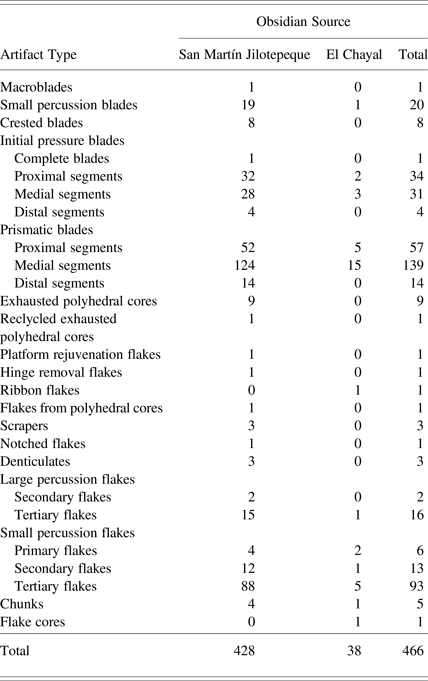
Although the sample of obsidian artifacts made from El Chayal obsidian pertaining to this period is small, it is likely that El Chayal obsidian may have been imported to Ceibal primarily in the form of large polyhedral cores. The evidence for this includes the presence of a small percussion blade, as well as an overall high percentage (65.8 percent) of pressure blades in the El Chayal obsidian artifacts. Due to the relatively high percentage (13.2 percent) of cortex found on El Chayal obsidian artifacts, as well as a flake core and various flakes, large flake spalls or small nodules of El Chayal obsidian were also brought to the site to produce percussion flakes.
Informal percussion flakes (67.2 percent, n = 1,510) were the most common chert chipped stone artifact recovered from the Late Preclassic contexts in Ceibal (Table 3). Other chert artifacts associated with these deposits include: 472 flake cores, eight recycled flake cores, 119 denticulates, and 16 drills. There is also evidence for bifacial technology and local production of chert prismatic blades in Ceibal during the Late Preclassic period, based on the chert oval bifaces, bifacial thinning flakes, a small percussion blade and prismatic blades recovered from primary contexts as well as a bifacial point, exhausted polyhedral cores, prismatic blades, and a platform rejuvenation flake from secondary contexts of this period.
XATE PHASE, TERMINAL PRECLASSIC PERIOD (100 b.c.–a.d. 200)
Chipped stone artifacts recovered from unmixed Terminal Preclassic contexts are represented by 288 obsidian artifacts and 1,913 made from chert. Obsidian artifacts account for 13.1 percent of the total chipped stone assemblage from Terminal Preclassic levels (Table 2). As evident from Table 1, San Martín Jilotepeque was the dominant source of obsidian (70.5 percent), with minor quantities of obsidian from El Chayal (28.8 percent) and Ixtepeque (0.7 percent). Similarly at Caobal (n = 9), the primary source of obsidian was San Martín Jilotepeque (66.7 percent), followed by El Chayal (33.3 percent)
Pressure blades were the most common form of San Martín Jilotepeque obsidian artifacts (57.1 percent) during the Terminal Preclassic period in Ceibal. The presence of small percussion blades, crested blades, and a flake from recycled exhausted polyhedral core suggest that large polyhedral cores of San Martín Jilotepeque obsidian were imported to Ceibal during the Terminal Preclassic period (Table 10). In addition, due to the presence of a flake core and the relatively high percentage of cortex found on San Martín Jilotepeque obsidian artifacts (13.3 percent), a portion of the San Martín Jilotepeque obsidian was also imported to Ceibal in the form of large flake spalls or small nodules.
Technological types of obsidian artifacts from Ceibal by obsidian sources, Terminal Preclassic period.
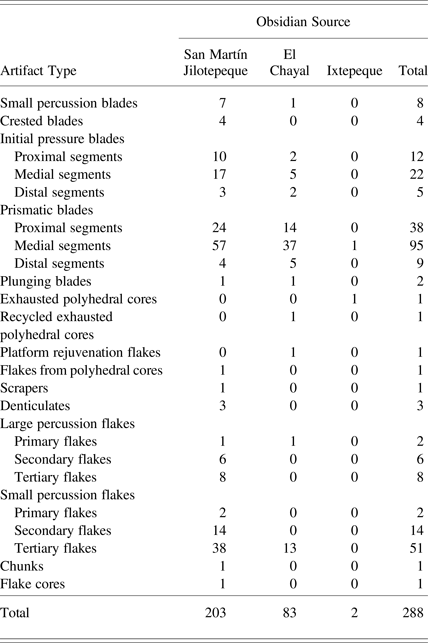
Artifacts made from El Chayal obsidian were dominated by pressure blades (79.5 percent) and the percentage of cortex found on El Chayal obsidian artifacts is relatively low (6 percent). A medial segment of prismatic blade and a fragment of exhausted polyhedral core made from Ixtepeque obsidian were found, indicating local production of prismatic blades.
The assemblage of chert artifacts is dominated by informal percussion flakes in Terminal Preclassic levels (69.8 percent; n = 1,335). In addition, 322 flake cores, 14 recycled flake cores, 59 chunks, 10 scrapers, 128 denticulates, 8 drills, and 7 prismatic blades were fashioned from chert (Table 3). Thus, chert prismatic blades were produced from the early Middle Preclassic to the Terminal Preclassic period in Ceibal, especially during the Middle Preclassic period. There are also three oval bifaces and nine bifacial thinning flakes. Moreover, a bifacial point and an unfinished oval biface were recovered, suggesting the local production of bifacial points and oval bifaces during the Terminal Preclassic period.
EARLY CLASSIC PERIOD (a.d. 200–600)
There was a major decline in construction activity in Ceibal during the Early Classic period (Sabloff Reference Sabloff1975:233). Unmixed Early Classic deposits in Ceibal contained only 239 lithic artifacts including 49 made from obsidian and 190 made from chert, supporting the conclusion of a population reduction in Ceibal during this time. Obsidian artifacts account for 20.5 percent of all chipped stone artifacts recovered from Early Classic deposits (Table 2). However, the percentage of obsidian artifacts (7 percent) in all chipped stone artifacts in the Early Classic deposits at Caobal is smaller than similar deposits found in Ceibal, suggesting that Ceibal maintained greater access to obsidian imports than the inhabitants of Caobal.
Once again, El Chayal became the major source in Ceibal during the Early Classic period (75.5 percent), followed by Ixtepeque (16.3 percent) and San Martín Jilotepeque (8.2 percent). Based on the considerably lower percentage of cortex found on the obsidian artifacts from the Early Classic contexts (2 percent) rather than the Terminal Preclassic period (11.1 percent), obsidian was imported primarily in the form of more prepared polyhedral cores which were transformed into pressure blades in Ceibal. Cortex was found only on a distal segment of prismatic blade made from Ixtepeque obsidian and none of El Chayal and San Martín Jilotepeque obsidian artifacts included cortex. Moreover, the great majority of the El Chayal obsidian artifacts are pressure blades (94.6 percent). Eight additional pressure blades made of Ixtepeque obsidian and four prismatic blades of San Martín Jilotepeque were also recovered (Table 11). Overall, San Martín Jilotepeque obsidian appears in significantly lower quantities in the Classic period contexts than in Preclassic deposits. In contrast, greater quantities of Ixtepeque obsidian were imported to Ceibal throughout the Classic period than in Preclassic times.
Technological types of obsidian artifacts from Ceibal by obsidian sources, Early Classic period.
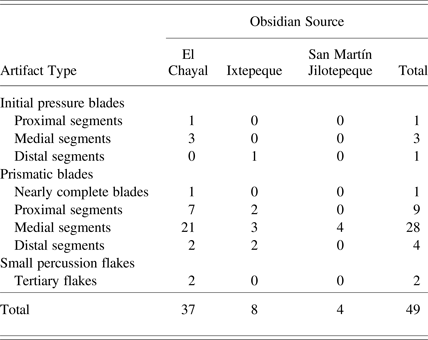
A small medial fragment of bifacial point made of the green obsidian from the Pachuca source, central Mexico, was found in an Early Classic secondary deposit of Structure A-2, a large platform of 55 × 45 m located on the south side of the South Plaza of Group A (CB207A-1-4-7). Its material, form, and workmanship, especially overlapping fine transverse parallel pressure flaking along the edges and faces (Carballo Reference Carballo2007:178), leave no doubt that it was manufactured at Teotihuacan. So far, this is the only green obsidian artifact ever found in Ceibal. It should be noted that the Ceibal Project of Harvard University did not detect any green obsidian (Willey Reference Willey1978:124). At Tikal, green obsidian prismatic blades were present from the early Late Preclassic into the Terminal Classic period, with peak use during the Early Classic period (Moholy-Nagy Reference Moholy-Nagy2003:28). I noted 10 Mexican obsidian artifacts (a green obsidian stemmed bifacial point, eight green obsidian prismatic blades, and a prismatic blade made of Zaragoza obsidian) among a total of 24 obsidian artifacts recovered from the Early Classic contexts at the nearby fortified center of Punta de Chimino in the nearby Petexbatun region (Aoyama Reference Aoyama, Inomata, Triadan, Ponciano and Aoyama2009b:278). The scarcity of green obsidian artifacts in Ceibal would be another line of evidence for the reduction in population during the Early Classic period.
The production of chert percussion flakes remained predominant in Early Classic contexts (64.2 percent). In addition, 43 flakes cores, 4 chunks, 12 denticulates, and 2 oval bifaces were found. No chert bifacial points were recovered from the primary context of the Early Classic period and only two bifacial points were from the secondary context. The rareness of chert bifacial points, combined with the lack of evidence of violent destruction of public structures in Ceibal, suggests that warfare may not have been at the root of several of the causes that led to demographic decline during this period.
LATE CLASSIC PERIOD (a.d. 600–810)
Chipped Stone Artifacts from Ceibal
The Late Classic period is characterized by the restoration of hegemonic power centered in Ceibal during the seventh century (Sabloff Reference Sabloff1975:234). Chipped stone artifacts from unmixed Late Classic contexts totaled 774 and included 106 obsidian artifacts as well as 668 made from chert. Obsidian artifacts account for 13.7 percent of the total lithic assemblage during the Late Classic period.
El Chayal remains the primary source of obsidian (89.6 percent), followed by San Martín Jilotepeque (5.7 percent), and Ixtepeque (4.7 percent). Cortex was found only on a secondary flake of San Martín Jilotepeque obsidian and none of El Chayal and Ixtepeque obsidian artifacts included cortex. El Chayal obsidian artifacts are represented by an extremely high percentage of pressure blades (96.8 percent) and three exhausted polyhedral cores, indicating that polyhedral cores were imported to Ceibal (Table 12). Similarly, based on the considerably lower percentage (0.6 percent; n = 13) of cortex found on El Chayal obsidian artifacts and the greater percentage of pressure blades (86.4 percent; n = 1,800) made from El Chayal obsidian from Late Classic Aguateca, El Chayal obsidian was imported to Aguateca primarily as polyhedral cores for prismatic blade production (Aoyama Reference Aoyama2009a:15).
Technological types of obsidian artifacts from Ceibal by obsidian sources, Late Classic period.

Ixtepeque obsidian artifacts are represented by two prismatic blades, two bifacial thinning flakes, and a tertiary flake, while a medial segment of a prismatic blade, a small percussion blade, and three flakes were made from San Martín Jilotepeque obsidian in Ceibal. The overall pattern of Classic obsidian procurement holds: inhabitants of Ceibal imported greater quantities of El Chayal obsidian and lower quantities of San Martín Jilotepeque obsidian during the Late Classic period than in the late Middle, Late and Terminal Preclassic times. Moreover, a fragment of a bifacial point made of Ixtepeque obsidian and a fragment of a bifacial point made of Zinapecuaro obsidian from western Mexico were found in the central part of Ceibal in secondary deposits of the Late Classic period, slightly mixed with earlier materials. Obsidian artifacts made from Pachuca, Zaragoza, Zinapecuaro, and Ucareo obsidians were present at Tikal during the Early and Late Classic periods (Moholy-Nagy Reference Moholy-Nagy2003:28).
Informal percussion flakes account for 71 percent of the total chert chipped stone assemblage from Late Classic deposits in Ceibal. The chert assemblage includes numerous flake cores, recycled flake cores, denticulates, and chunks (Table 3).
Chert Bifacial Production And Warfare
There is also evidence for local production of oval bifaces and bifacial points in Ceibal, based on the presence of bifacial thinning flakes, bifacial points, an unfinished bifacial point, oval bifaces, a bifacial pick, and a partially polished bifacial pick. In fact, the percentage of bifacial thinning flakes (7.6 percent) among the Late Classic chert artifacts is the highest in Ceibal in any period of time during human occupation. This percentage is much higher than at Caobal (1 percent) during the Late Classic period, but is considerably lower than at the nearby Late Classic center of Aguateca (24.2 percent), where chert bifacial points and oval bifaces were intensively produced (Aoyama Reference Aoyama2009a:43). Some elite scribes/artists at Aguateca were stone knappers who manufactured obsidian prismatic blades and chert bifacial tools on a part-time basis.
The production of chert bifacial artifacts was less intensive in Ceibal than at Aguateca. Bifacial thinning flakes are scarce in most excavated contexts but the central part of Ceibal is an exception (Figure 10). A chert biface workshop dump was uncovered in a 2 × 2 m test pit 17 m east of the ballcourt Structure A-19 in Group A of Ceibal (CB204A-1-5-1). A total of 342 chert artifacts (983.3 g) were in the Floor 3 fill, i.e., a secondary deposit of the Late Classic period, slightly mixed with earlier materials. A medial segment of a prismatic blade and a tertiary flake, both made of El Chayal obsidian, as well as a good amount of ceramic sherds were associated with the chert artifacts. The percentage of obsidian artifacts among all chipped stone artifacts from this fill (0.6 percent; n = 2) is considerably lower than the same percentage for the Late Classic period in Ceibal. Moreover, the fill deposit yielded neither metates nor manos, which would indicate food preparation activities, as opposed to crafting. Although the excavated area was small and the chert deposit was not totally excavated, at least 260 of the 328 chert flakes were identifiable as bifacial thinning flakes. It should be noted that I was extremely conservative in my identifications of these particular artifacts. Indeed, these flakes comprise more than 22 percent of all chert bifacial thinning flakes recovered by the Ceibal-Petexbatun Archaeological Project between 2005 and 2014. Both the quantity of chert bifacial thinning flakes and the percentage (76 percent) of bifacial thinning flakes among all chert artifacts are the highest registered in the present study, suggesting chert bifacial production nearby in Group A of Ceibal. There were a few retouched flake tools, including a scraper, five denticulates, and a drill, as well as eight flake cores, but casual flakes (19.9 percent; n = 68) did not dominate the chert chipped stone artifacts. Moreover, based on numerous bifacial thinning flakes containing remnant cortex (n = 53), as well as the relatively high percentage of primary and secondary flakes among all casual flakes (60.3 percent), both earlier and later stages of bifacial reduction were carried out (Table 13).
Cortex on the chert bifacial workshop dump from Ceibal, Late Classic period.

In sum, both the chert lithic assemblage and the associated artifacts point out that this fill deposit was a mixture of chert bifacial production, other nonsubsistence production debris, and trash. The notable presence of bifacial thinning flakes indicates that a nearby resident in Group A engaged in the production of chert bifacial tools, such as oval bifaces and bifacial points. Such a knapper who lived in the central part of Ceibal may have been an elite member, as some elite scribes/artists at Aguateca were stone knappers, although it is also possible that a servant was engaged in bifacial production.
The Ceibal-Petexbatun Archaeological Project has recovered a total of 111 chert points and 10 obsidian points from primary and secondary contexts (Table 14), while the Ceibal Project of Harvard University uncovered 77 chert bifacial points and 11 obsidian points from all time periods (Willey Reference Willey1978:102, 124). In contrast, the greater number of chert bifacial points (n = 308) pertaining to the Late Classic period were recovered at the rapidly abandoned city of Aguateca (Aoyama Reference Aoyama, Inomata, Triadan, Ponciano and Aoyama2009b:280). This large quantity of bifacial points is indicative of the escalating violence and warfare at Aguateca in the eighth and early ninth century (Aoyama Reference Aoyama2005). Based on the epigraphic data, forces of Ruler 3 of the Dos Pilas-Aguateca dynasty defeated Ceibal in a.d. 735 (Martin and Grube Reference Martin and Grube2008:61). In contrast to the absence of bifacial and unifacial points in the peripheral areas of Ceibal, it should be noted that nearly one half of chert bifacial points (n = 53) in the present Ceibal sample as well as two small unifacial points made of chert (Figure 13b) were recovered from primary and secondary contexts of the Late Classic period in the central part of Ceibal, indicating that they were primarily weapons. The lithic data do suggest the intensification of warfare in Ceibal during Late Classic period.
Late and Terminal Classic chert artifacts from Ceibal: (a) bifacial thinning flake, (b) small unifacial point, (c) oval biface, and (d–e) bifacial points. Drawings by the author.

Pointed chipped stone tools from Ceibal, Guatemala by stone type and context.

TERMINAL CLASSIC PERIOD (a.d. 810–900)
The final expansion of public structures took place during the Terminal Classic period and represents the last phase of construction in Ceibal. Unmixed Terminal Classic deposits contained a total of 564 chipped stones, represented by 78 obsidian and 486 chert artifacts. Thus, obsidian artifacts in Ceibal account for 13.8 percent of the total lithic assemblage in this period, while obsidian artifacts account for a smaller percentage of the total chipped stone artifacts from Terminal Classic levels at Caobal (8.5 percent). El Chayal continues to be the most dominant source for obsidian in Ceibal (84.6 percent). El Chayal obsidian artifacts included 53 prismatic blade fragments and eight initial pressure blades which account for 92.4 percent of the total lithic assemblage (Table 15). El Chayal obsidian was imported in the form of polyhedral cores during the Terminal Classic period, based on the presence of an exhausted polyhedral core, the absence of percussion blades, and the absence of El Chayal obsidian artifacts with cortex.
Technological types of obsidian artifacts from Ceibal by obsidian sources, Terminal Classic period.
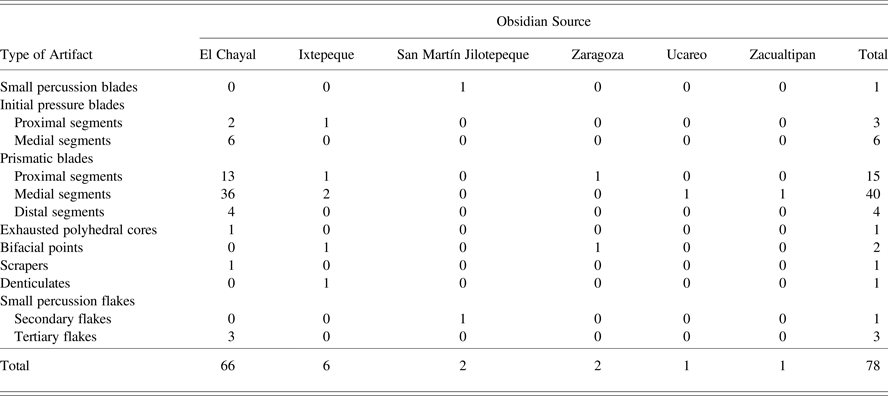
For the first time, obsidian side-notched stemmed points made on prismatic blade appear from secondary context of the Terminal Classic period (Figure 7g). The results of microwear analysis indicate that both obsidian prismatic blade points and chert small points were mainly used as arrowheads (Aoyama Reference Aoyama2005:294). Although the spear or dart points were more important than the bow and arrow in Classic Maya warfare, the bow and arrow was present in Ceibal during the Terminal Classic period. The arrow points were not recovered in the peripheral areas of Ceibal but were found exclusively in the central part of Ceibal, indicating that they were primarily weapons, although some of them may have been also used in hunting. In contrast, obsidian arrow points were found in hilly and mountain terrain in the Zapotitan Valley of El Salvador, many away from any settlement, and thus were clearly used in hunting (Sheets Reference Sheets and Sheets1983:Table 10-1).
A small percussion blade and a small secondary flake made of San Martín Jilotepeque obsidian were also recovered. There is a notable absence of Ixtepeque obsidian artifacts with cortex. An initial pressure blade, three prismatic blades, a bifacial point, and a denticulate made of Ixtepeque obsidian were recovered, indicating local production of prismatic blades and bifacial tools from the same obsidian source. A proximal segment of a prismatic blade and a bifacial point made of Zaragoza obsidian, a medial segment of a prismatic blade made of Ucareo obsidian, as well as a medial segment of a prismatic blade made of Zacualtipan obsidian were also found. Mexican obsidian artifacts account for 5.1 percent of all obsidian artifacts from Ceibal during the Terminal Classic period and no Mexican obsidian artifacts were recovered from Caobal.
The results of my study indicate a high percentage (15.6 percent; n = 10) of Mexican obsidian artifacts (all prismatic blades) among a total of 64 obsidian artifacts recovered from the Terminal Classic contexts at the nearby fortified center of Punta de Chimino in the Petexbatun region (Aoyama Reference Aoyama2006:29). While 81.3 percent of the obsidian was from El Chayal and 3.1 percent from Ixtepeque in the Highlands of Guatemala, 10.9 percent was from Pachuca. 3.1 percent from Ucareo, and 1.6 percent from Zaragoza in the Highlands of Mexico. Moreover, elites of such major centers as Calzada Mopan and Ixtonton in the southeastern and central-western Peten region participated in the long-distance obsidian exchange networks of Terminal Classic Mesoamerica. A total of 36 Mexican obsidian artifacts were recovered from the Terminal Classic contexts of the region, including those from Zaragoza (n = 17), Ucareo (n = 10) and Pachuca (n = 9) sources in the Highlands of Mexico (Aoyama and Laporte Reference Aoyama and Laporte2009:38). In particular, Mexican obsidian artifacts account for 18.5 percent (n = 24) of all obsidian artifacts from Calzada Mopan during the Terminal Classic period. The notable absence of green obsidian artifacts and the scarcity of Mexican obsidian artifacts in Terminal Classic Ceibal indicate that Ceibal elites may not have participated in developing long-distance obsidian exchange networks during the tenth century. This implies that the decline in population in Ceibal may have occurred shortly after a.d. 900.
The chert assemblage is again dominated by informal percussion flakes (63.4 percent; n = 308) and also includes 77 flake cores, 3 recycled flake cores, 13 chunks, 1 prismatic blade, 24 denticulates, and 3 drills. Noteworthy is the abundance of bifacially retouched tools (Figures 13c–13e), such as oval bifaces, bifacial points, a bifacial pick, an eccentric, as well as 37 bifacial thinning flakes from Ceibal in the Terminal Classic. The percentage of bifacial thinning flakes (7.6 percent) among the Terminal Classic chert artifacts in Ceibal is significantly higher than at Caobal (2.4 percent) during the Terminal Classic period. There is no evidence for the production or use of obsidian or chert bifacial points, small unifacial points, or obsidian prismatic blade points at Caobal (Aoyama and Munson Reference Aoyama and Munson2012:40). These artifacts are commonly associated with violence and warfare (Aoyama Reference Aoyama2009a) yet their apparent absence at Caobal point to a lack of such conflict. Negative evidence, however, does not provide justifiable grounds for making conclusive statements. In contrast, the production of obsidian and chert bifacial points increased considerably in the southeastern and central-western Peten region during the Terminal Classic period at such major centers as Ixtonton, Calzada Mopan, El Chal and Machaquila (Aoyama and Laporte Reference Aoyama and Laporte2010:12). The fall of the Ceibal dynasty was marked by the destruction of its royal palace and temple pyramid (Houston and Inomata Reference Houston and Inomata2009:309). Possible chert pointed weapons, include 42 bifacial points recovered from secondary contexts and four bifacial points from primary contexts of the Terminal Classic period, all found in the central part of Ceibal and none from the peripheral areas, coincide with escalating warfare and violence in the region.
SUMMARY AND CONCLUSIONS
The results of the present study suggest that the importation of large polyhedral cores of obsidian and local production of prismatic blades began as the result of sociopolitical development in Ceibal during the early Middle Preclassic Real-Xe phase. Early Middle Preclassic Ceibal society appears to have developed a minimal level of sociopolitical complexity wherein the procurement of large polyhedral cores of obsidian and local production of prismatic blades could be carried out. The obsidian data in Ceibal represent the earliest evidence of local production of prismatic blades made from both El Chayal and San Martín Jilotepeque obsidian in the Maya lowlands to date.
El Chayal obsidian was heavily used during the early Middle Preclassic period, while San Martín Jilotepeque was the principal source in the late Middle Preclassic, Late Preclassic, and Terminal Preclassic periods. El Chayal once more became the major source in Ceibal during the Classic period. The Classic patterns of obsidian procurement were already established during the early Middle Preclassic period. There were long-standing traditions of importing obsidian from the Maya highlands and local procurement of chert for the production of blades and flake tools in Ceibal and Caobal during the entire pre-Columbian sequence. It would appear that obsidian was imported mainly as large polyhedral cores, which were transformed into both percussion and pressure blades in Ceibal, while a small portion of obsidian was also imported to the site in the form of large flake spalls or small nodules during the Preclassic period. In contrast, during the Classic period obsidian was imported mainly in the form of more prepared polyhedral cores, from which stone knappers manufactured pressure blades in Ceibal. Ceibal elites may have distributed semi-exhausted polyhedral cores of obsidian to the inhabitants of Caobal throughout the Preclassic and Classic periods. Chert prismatic blades were produced from the early Middle Preclassic to the Terminal Preclassic period in Ceibal, especially during the Middle Preclassic period. A high status male buried with 13 obsidian prismatic blades at late Middle Preclassic Ceibal demonstrates that this high status individual managed sacred concepts associated with the number 13, as early as the fifth century b.c. Artistic and craft production using chipped stone tools by noble men and women as well as the garnering of ideological, religious, and esoteric knowledge related to exchange, production, use, and deposition of obsidian artifacts were important in exclusionary tactics and elite identity among the ancient Maya. The scarcity of obsidian artifacts from the Mexican highlands suggests that Ceibal elites were not able to actively participate in the long-distance obsidian exchange networks. This is noteworthy because this is a sensitive chronological indicator for the Early Classic and Terminal Classic periods in the nearby Petexbatun region and throughout the southeast and central-western Peten region (Aoyama Reference Aoyama, Inomata, Triadan, Ponciano and Aoyama2009b:278; Aoyama and Laporte Reference Aoyama and Laporte2010).
There is evidence for local production of chert bifacial points and oval bifaces as early as the early Middle Preclassic period. There is increasing evidence of the production and use of chert and obsidian bifacial points, chert small unifacial points, and obsidian prismatic blade points in the central part of Ceibal during the Late and Terminal Classic periods, as there are compelling epigraphic and archaeological evidence for warfare in the Petexbatun and Pasión regions (Inomata Reference Inomata1997; Inomata and Triadan Reference Inomata and Triadan2010; Martin and Grube Reference Martin and Grube2008:61; Mathews and Willey Reference Mathews, Willey and Culbert1991). The artifact changes are almost certainly tied to changes in the practice of warfare in these regions (Aoyama and Graham Reference Aoyama and Graham2015). Lithic data do point toward direct involvement of elite residences in the epicenter of Ceibal in such warfare. Although the spear or dart points were predominant weapons in Classic Maya warfare, the increase in both chert small unifacial points and obsidian prismatic blade points in Ceibal heralds bow-and-arrow technology by the Terminal Classic period.
RESUMEN
El presente artículo presenta los resultados del análisis diacrónico de artefactos líticos recolectados en y alrededor de Ceibal, Guatemala, con el fin de aclarar el aspecto del patrón de cambio a largo plazo en los sistemas económicos de los mayas precolombinos y en la guerra. La importación de núcleos poliédricos grandes de obsidiana de las tierras altas mayas y la producción local de navajas a presión se inició como un resultado del desarrollo sociopolítico en Ceibal durante la fase Real-Xe de la faceta temprana del período preclásico medio. La obsidiana de El Chayal fue intensivamente usada durante la faceta temprana del período preclásico medio, mientras San Martín Jilotepeque fue la fuente principal de obsidiana durante la faceta tardía del período preclásico medio, los períodos preclásico tardío y preclásico terminal. Una vez más El Chayal vuelve a ser la fuente mayor en Ceibal durante el período clásico. Hay abundantes evidencias de producción y uso de puntas bifaciales de pedernal y obsidiana en la parte central de Ceibal durante los períodos clásico tardío y terminal, indicando que las élites en el epicentro de Ceibal se involcuraron en la guerra. Aunque lanzas o dardos fueron las armas predominantes en la guerra de la civilización maya cásica, el incremento tanto de puntas pequeñas de pedernal como de puntas de navaja prismática de obsidiana señala la tecnología de arcos y flechas ya en el período clásico terminal.
ACKNOWLEDGMENTS
Funding for Aoyama's research in Guatemala since 1998 has been provided by the Ministry of Education, Culture, Sports, Science and Technology-Japan (Grants-in-Aid for Scientific Research No. 21101001, No. 21101003, No. 26101001 and No. 26101003), the Japan Society for the Promotion of Science (Grants-in-Aid for Scientific Research No. 11710209, No. 13571033, No. 17401024, No. 21402008 and No. 26300025), Foundation for the Advancement of Mesoamerican Studies (FAMSI), the Mitsubishi Foundation, and the Takanashi Foundation. I greatly appreciate the significant improvements to the manuscript suggested by Payson Sheets, Geoffrey Braswell and Takeshi Inomata. I also thank the members of the Ceibal-Petexbatun Archaeological Project, particularly Daniela Triadan, Otto Román, Víctor Castillo, Flory Pinzón, and Estela Pinto, for their guidance and support during the lithic analysis. Joyce Cunningham kindly helped me to edit the manuscript. My lovely wife, Vilma Aoyama, helped me with the Spanish abstract. Any errors remain entirely my responsibility.


 Open access

