





Introduction
International trade has been proven to overexploit some animal species so heavily that their survival has been threatened, therefore, a worldwide Convention on International Trade in Endangered Species of Flora and Fauna was launched in 1975 (CITES 2023a). Among the species listed are all extant elephant species. The African elephant (Loxodonta africana, Blumenbach 1797)—including Loxodonta cyclotis (Matschie 1900) has been listed since 1977 in Appendix II (= international trade regulated), since 1989 in Appendix I (= international trade banned), with the exception for four well-managed populations in Botswana, Namibia, Zimbabwe and South Africa whose populations were transferred back to Appendix II in the same year. The Asian elephant (Elephas maximus, Linnaeus 1758) has been listed in Appendix I since 1975. Elephants have been hunted for international trade in ivory and their populations have been rapidly decreasing (CITES 2023b, Gobush et al. Reference Gobush, Edwards, Balfour, Wittemyer, Maisels and Taylor2022; Gobush et al. Reference Gobush, Edwards, Maisels, Wittemyer, Balfour and Taylor2021; Williams et al. Reference Williams, Tiwari, Goswami, de Silva, Kumar, Baskaran, Yoganand and Menon2020). In response to recent serious slaughters of African elephants, the worldwide CITES community has been strengthening the existing rules for international trade since 2007 (CITES 2023c). However, the trade in the specimens obtained before the CITES convention applied (so-called preconvention specimens, usually before 1975) is still allowed (CITES 2023d).
In some cases, specimens older than those before the convention are called antiques, which means that the artifacts were made of animals killed some decades ago. Some CITES signatories have rather precise definitions of the time interval from which an antique item must come from, but these intervals vary among individual signatories.
One of these precise intervals is defined in the legislation of the European Union, where the antique specimens are defined as worked specimens, and as such they “were significantly altered from their natural raw state for jewellery, adornment, art, utility, or musical instruments, more than 50 years before the entry into force of this Regulation (338/97) and that have been acquired, to the satisfaction of the management authority of the member state concerned, under such conditions. Such specimens shall be considered as worked only if they are clearly in one of the aforementioned categories and require no further carving, crafting or manufacture to affect their purpose” (Council of the European Union 1997). Since elephant species were listed in the basic EU Regulation 338/97 in 1997, 50 years before points to 1947 as the year that marks an antique (= before 1947) and a modern (= after 1947) born ivory.
Antique expert opinions, radiocarbon dating, or other evidence is recommended to be used to prove the antiquity of artifacts in trade (European Commission 2021), and each method has its own disadvantage. Employing radiocarbon dating yields real evidence; however, the artifact is necessarily damaged by sampling, and its artistic value can be diminished. On the other hand, opinion evidence is nondestructive, but it often does not possess the necessary scientific criteria to test the accuracy of the conclusions, creating possible loopholes for the laundering of modern ivory (Kufnerová et al. Reference Kufnerová, Pachnerová Brabcová, Suchý, Ovšonková, Frouzová, Cajthaml and Světlík2021).
A case study of an ivory statuette is presented. The statuette was declared antique by the seller and traded publicly in the Czech Republic (territory of European Union) without any documents, which was believed to be a legal act. The claim has been debunked first by radiocarbon analysis and later by other evidence found inside the statuette, showing that the term antique was abused to cover a modern ivory.
Materials and methods
The subject of the study was an ivory statuette of a Happy Fisherman (height 26 cm, weight 0.58 kg), discovered in an antique brick and mortar shop in the Czech Republic. The statuette was obtained for research purposes by contract 3/2020 from the Czech Ministry of Environment in April 2020. The information about the subject was provided by the Czech Environmental Inspectorate based on a legal request upon the Czech Act on Access to Environmental Information No. 123/1988 Coll., No. ČIŽP/OOPLC/2021/1642 in June 2021.
The statuette was declared by a professional as antique and, therefore, eligible for a commercial trade without restrictions or special documents according to the law valid in the EU during 2017.
Radiocarbon dating in 2017
In 2017, the state administration requested an age determination of the statuette; sampling and radiocarbon analysis were performed in the Czech Radiocarbon Laboratory at the Nuclear Physics Institute.
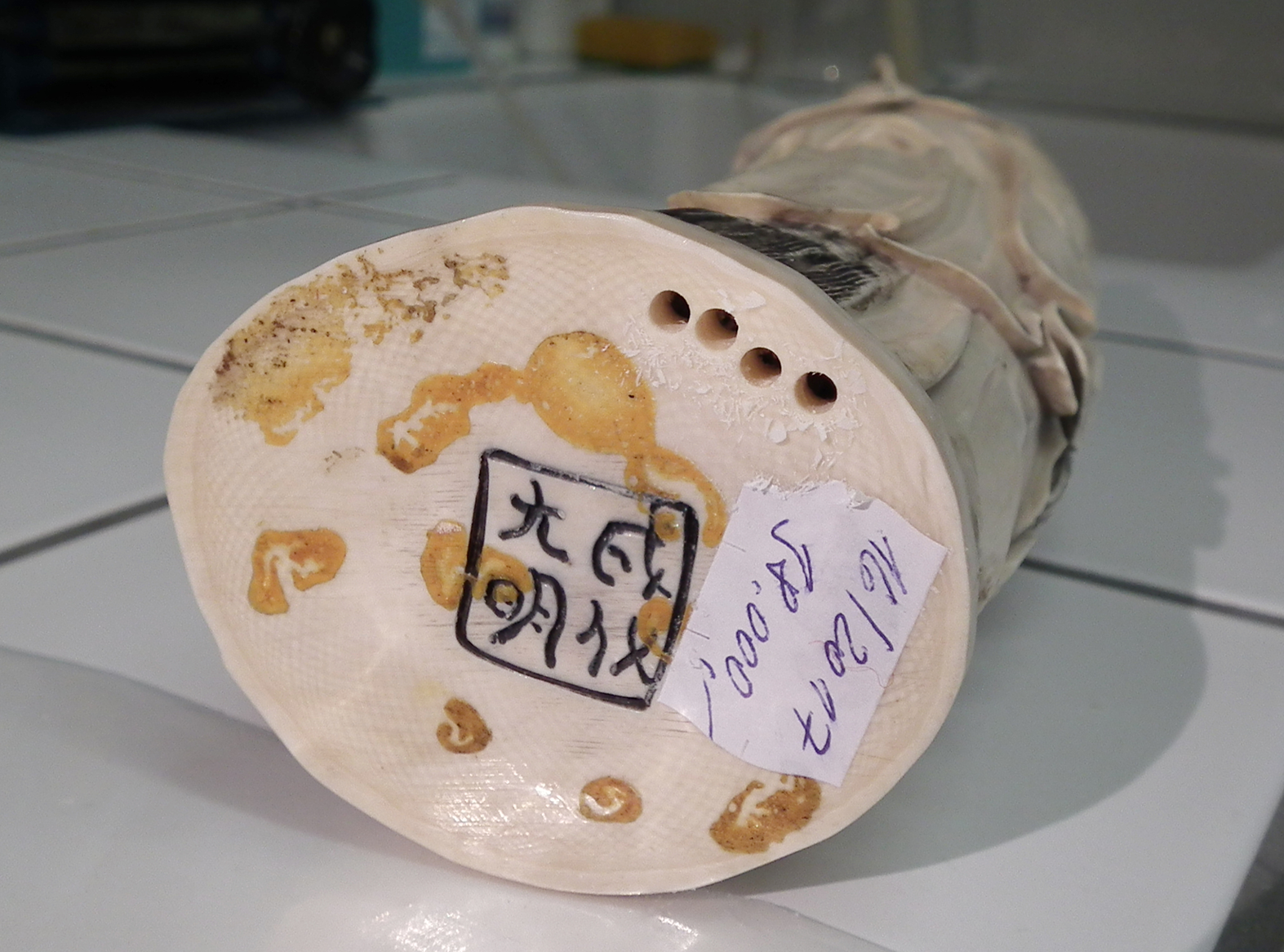
Even though today’s radiocarbon analysis using accelerator mass spectrometry (AMS) has minimal weight requirements (tens of milligrams and less), sampling will inevitably damage the statue. Damage can be largely mitigated by sampling in a hidden place. The Happy Fisherman was sampled by low-speed drilling the underside of the base, in the dentine part of the tusk cross section, close to its outer edge to avoid the artist´s stamp (Figure 1A, sample CRL17_527). Elephant tusks grow continuously as overlapping cones, pushing the older tissue outward and away from the elephant mouth. In the cross section, the central part corresponds to ontogenetically younger ivory than at the edge.
Sampling sites for radiocarbon analysis in 2017 – sample 17_527.

Chemical pre-treatment of the ivory included repeated leaching in acidic and basic environments to extract pure collagen. The gelatin acquired by acid denaturation at 90°C was air-dried and combusted at 900 °C with CuO as an oxidant. The resulting CO2 was purified and reduced to graphite with Zn as a reducing agent (Orsovszki and Rinyu Reference Orsovszki and Rinyu2015). The samples were pressed into aluminium cathodes and measured on AMS MICADAS (Atomki, Hungary) together with five pairs of secondary oxalic acid standard NIST (NBS) HOX II SRM 4990-C and fossil phthalic acid anhydride. The AMS data were processed using software BATS (Wacker et al. Reference Wacker, Christl and Synal2010), and the resulting 14C activities were calibrated with free software OxCal 4.4. (Bronk Ramsey Reference Bronk Ramsey2009). Since the origin of ivory is unknown, three possible radiocarbon data sets for 1950–2019 (Bomb 21 NH3, Bomb 21 SH1-2, and Bomb 21 SH3) covering geographic zones of natural occurrence of African elephants were used (Hua et al. Reference Hua, Turnbull, Santos, Rakowski, Ancapichún, De Pol-Holz, Hammer, Lehnam, Levin, Miller, Palmer and Turney2021).
Radiocarbon dating in 2023
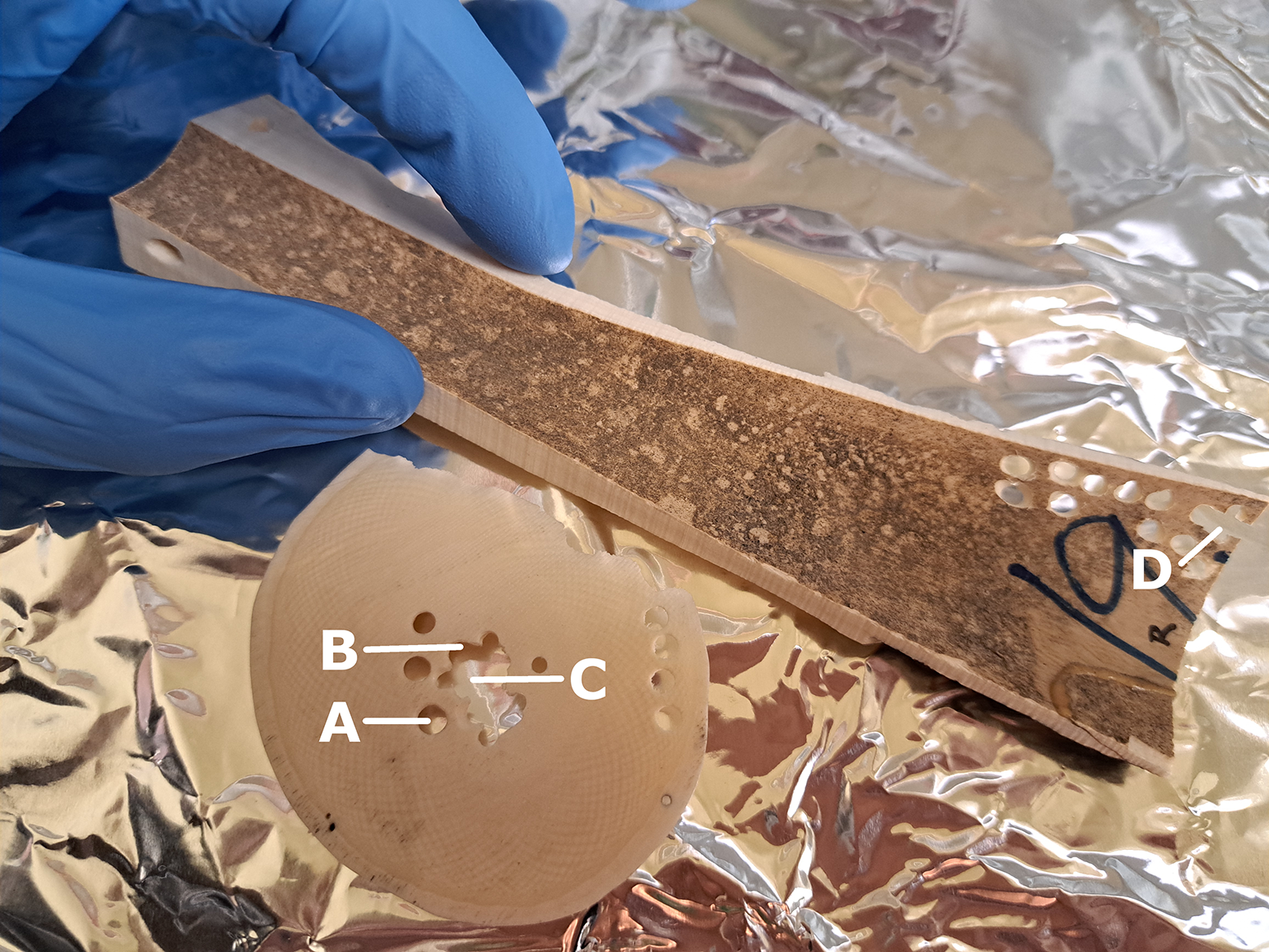
The second Happy Fisherman sampling was conducted in 2023. At this time, there was no longer pressure to mitigate damage to the statuette, so the sampling site could be freely chosen to match the most recent tissue, as close as possible to the time of the elephant´s death. Thus, three samples 23_1363A – C were taken from the central part of one of the cross sections of the base (avoiding the very bottom possibly contaminated by glue and dyes); the sample 23_1363D was sampled at bottom part of the fisherman body (Figure 1B).
Sampling sites for radiocarbon analysis in 2023 – samples 23_1363A – C from the cross section and 23_1363D from the body.

The samples were processed similarly to 2017, except that the gelatin acquired by acid denaturation at 75°C was freeze-dried and the graphites were measured on AMS MILEA at the Nuclear Physics Institute, Czech Republic (Kučera et al. Reference Kučera, Maseiner, Muller, Němec, John, Světlík, Kameník, Dreslerová, Pachnerová Brabcová, Tecl, Bourquin, Herrmann and Fahrni2022).
Discovery inside the statuette
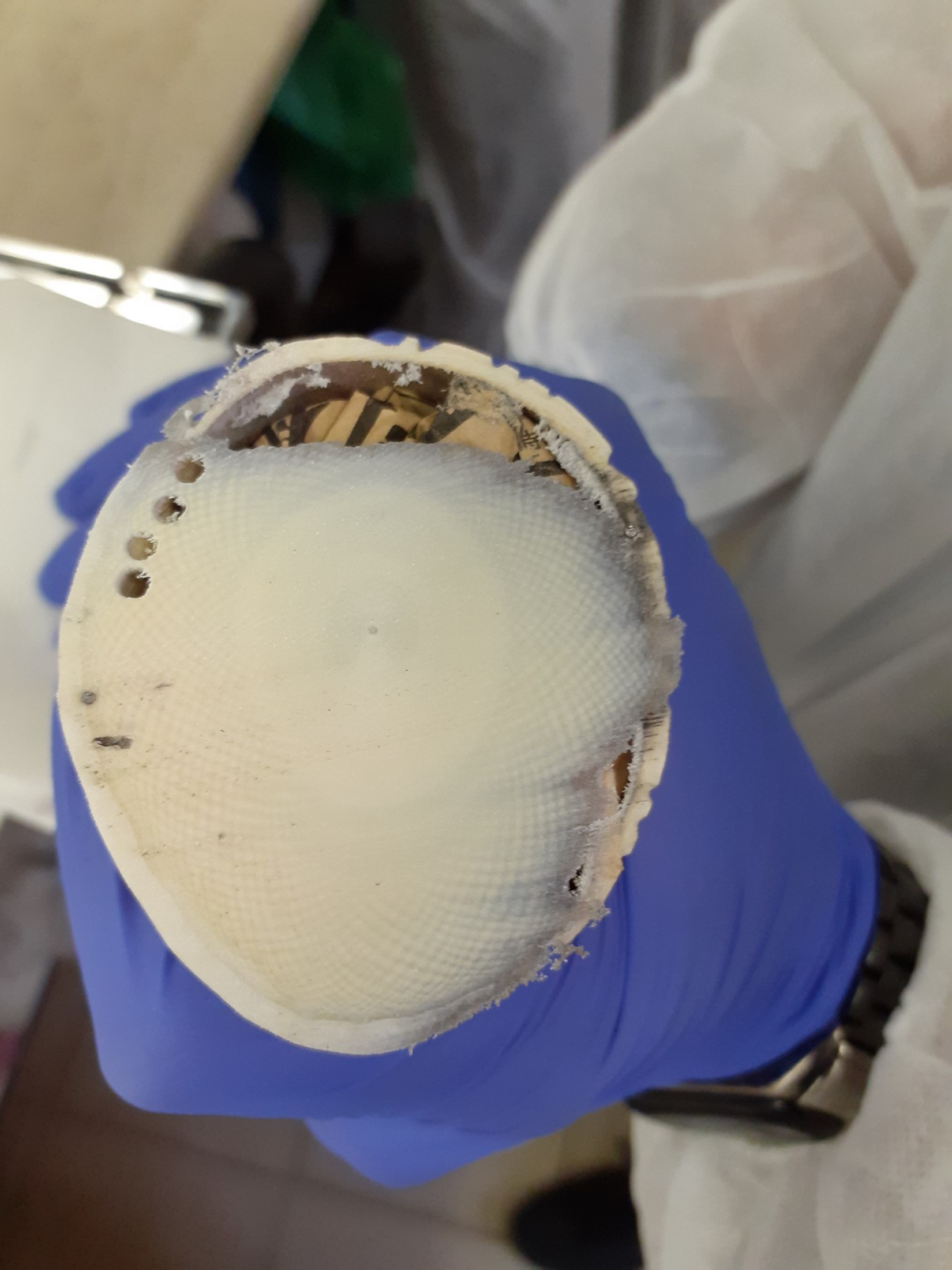
After the statuette was confiscated, it was provided for further research. In October 2021, four thin slices were cut from the bottom of the statuette using the Micro Band Saw MBS 240/E. This intervention revealed a tusk cavity and two heavy objects inside. They were identified as granite stones of 182.3 g total weight, each wrapped in newspapers (Figure 2, supplementary video shared on Figshare - 10.6084/m9.figshare.24212253). Newspapers were examined by the Chinese collection curator in the Naprstek Museum of Asian, African, and American cultures Prague.
While opening the statuette, unexpected inner contents appeared.

Results and discussion
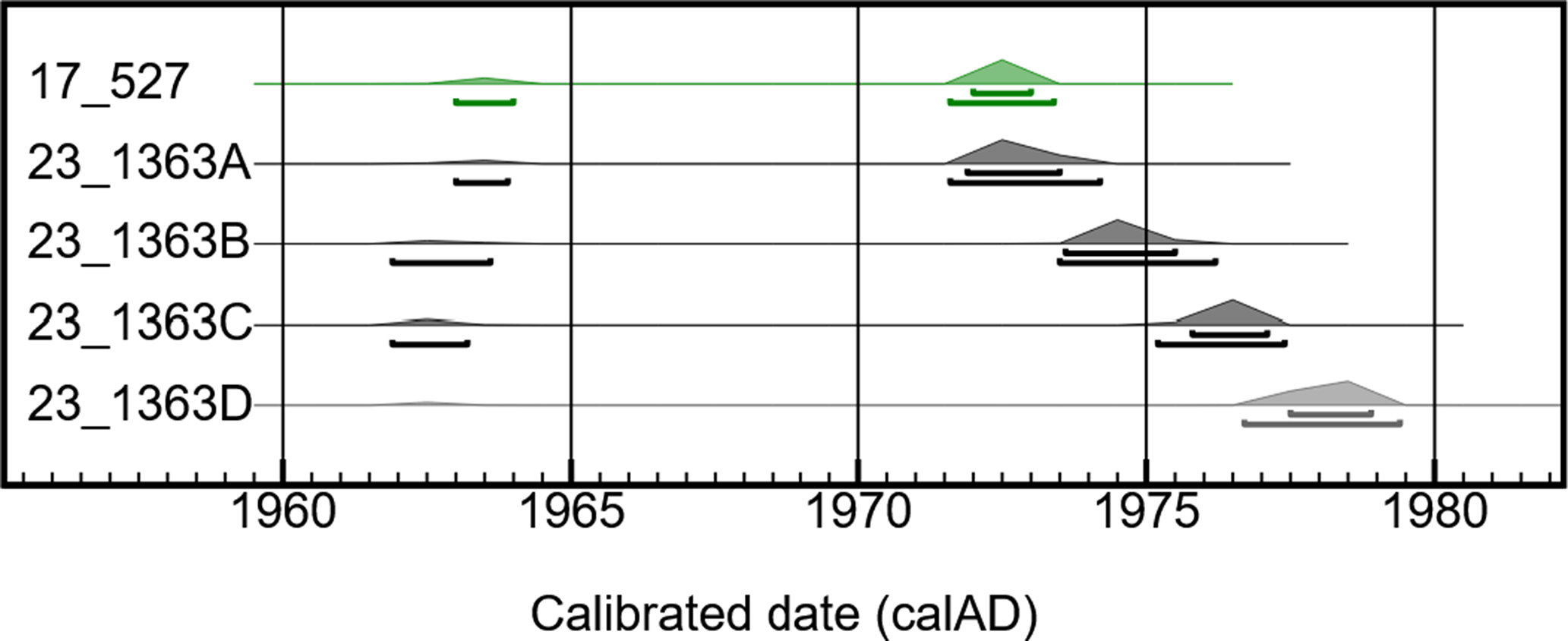
The results of radiocarbon dating are summarized in Table 1 and Figure 3. The ivory yielded high collagen content ranging from 106 to 202 mg/g. All three possible calibration datasets (Bomb 21 NH3, Bomb 21 SH1-2, and Bomb 21 SH3) place the ivory to the second half of 20th century at the probability 68%; reliably far beyond the year 1947 defining the (il)legality of ivory. For the sake of simplification and clarity, only the results obtained with Bomb 21 NH3 dataset are discussed in the following text.
Radiocarbon activities are reported as conventional radiocarbon age (CRA) and as fraction modern (F14C) with the uncertainties corresponding to one standard deviation

Visualization of calibrated ages of all ivory samples. The relatively oldest sample in the base disc from the sampling in 2017 is marked green. The light grey depicts the sample from the body, ivory coming probably from another tusk.

At the 95% probability level, the radiocarbon activities yield two possible true ages, the beginning of the 1960s and turn of 1970s and 1980s. Considering the diameter of the bottom disk compared with fisherman body, it is most likely these two parts come from tusks of two different animals. The samples A, B, C are arranged chronologically as we expect, if the tusk had grown in descending part of the calibration curve. The sample C helps to define the date 1976 that must be close to the elephant´s death. Sample from 2017 (Figure 3, green), from the edge of the base, must be considerably older than the samples A, B, and C, thus probably corresponds to the ascending part of the calibration curve. This sample helps to determine the date closer to the elephant´s birth. Together, the samples and the size of the bottom disk suggest, that the elephant was at least on the threshold of adulthood, born around 1963 and still alive in 1976.
Sample D, coming from the body of the fisherman, was taken from supposedly the youngest part, so its age approaches the time of death. Since the two tusks were together used to make the statuette, it is more likely they come from the same trade or stockpile and the elephants died around the same time. This would exclude the older interval, leaving the death most probably around the year 1978.
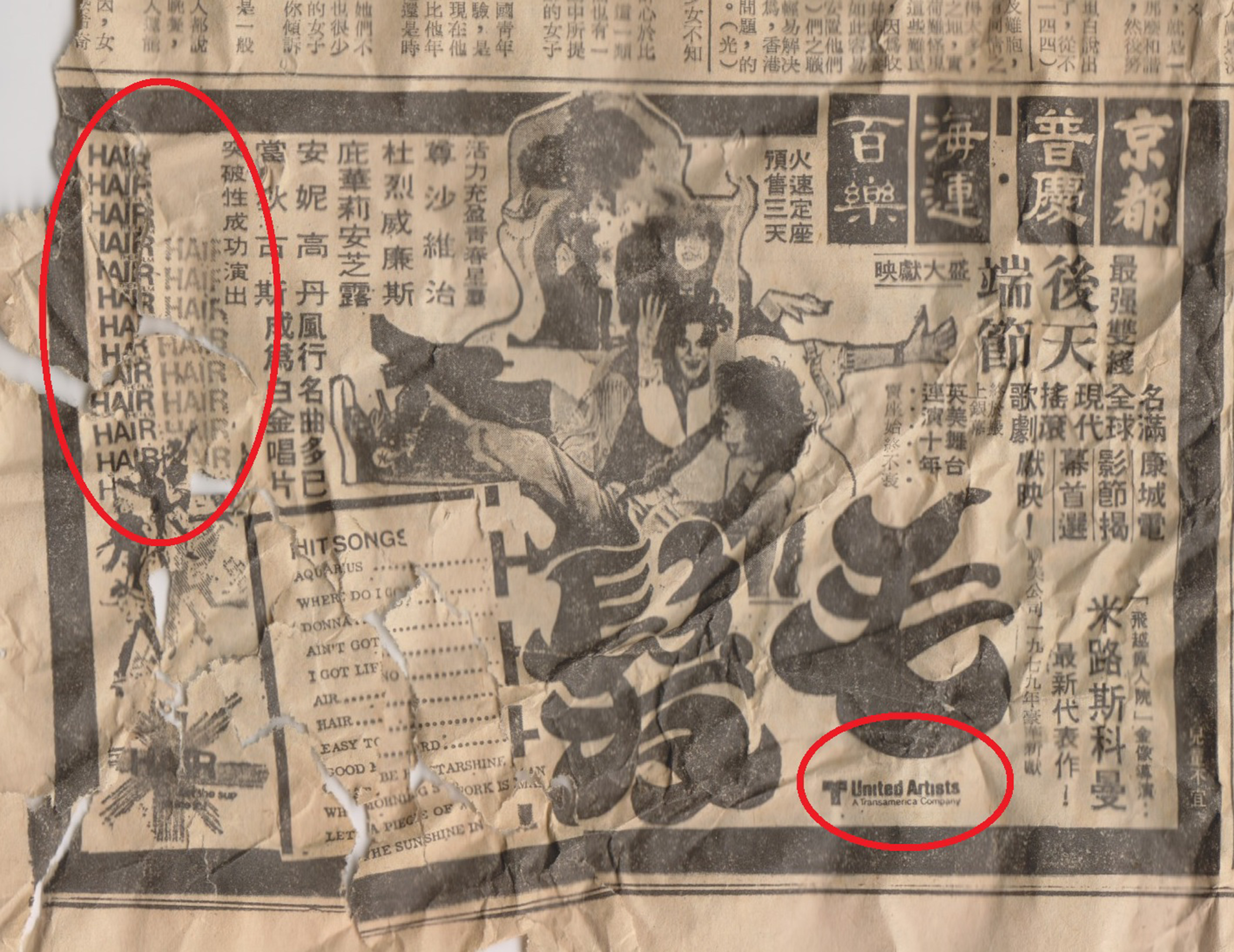
Two pieces of paper found inside the statuette were inspected (Figure 4). One sheet was slightly disturbed by the bandsaw, but it was possible to assemble the page for convenient reading.
One of the two papers found inside the statuette Happy Fisherman. Marked parts are discussed in the text.

The fragments examined represented newspapers, the names of which, however, could not be ascertained. Short stories, horse racing results and advertisements were identified. Newspapers were printed in traditional Chinese characters in vertical columns oriented from top to bottom. The use of traditional Chinese characters implied newspapers printed outside the People’s Republic of China, i.e. in Hong Kong before its handover in 1997.
On one of the fragments examined, advertisements offering financial services, especially money lending were identified. Company names, phone numbers, and addresses were listed, but no date was found. Several advertisements listed a Hong Kong address, so it was deduced that Hong Kong was the place where the newspaper was published.
Several movie advertisements were printed at the bottom of the other page. Above them, there was a graphic line separating them from short stories and horse racing results. Movie advertisements consisted of collages of black-and-white photographs of actors or movie stills, or pen-and-ink drawings. The movie´s title, directors, actors, and brief synopsis were given in Chinese. Two advertisements contained movie titles in English. No exact dates (such as the year and issue) were given on the fragments. For the time definition it was assumed that the movies´ release date in Hong Kong would specify the time when newspaper fragments were used to wrap the stones before placing them in the ivory statuette. Therefore, the movie Play It Again database was searched. The database contains foreign-language movies screened in Hong Kong from 1920 to the present, including titles of the movie in Chinese, the original titles, the release dates in Hong Kong, as well as other materials such as movie posters and advertisements in the Hong Kong press.
Of the five movies listed, four have been identified using “Play it again” database. The first advert under scrutiny, using the original movie poster, draws attention to a movie titled Fu zi wu qing (translated Fathers and Sons Without Feelings) (Play it again 2023; IMDb 2023a). It is USA movie with the English title King of the Gypsies, which was shot in 1978 and released in Hong Kong in 1979. Below the photo from the movie, there is information “today the tickets pre-sales starts.”
The second movie advertisement on the same page is a pen-and-ink cartoon. The title of the movie in Chinese is partially torn off, only three of the four characters can be identified: Feng kuang xun … Above the Chinese title, the English title of the film is partially illegible: “A mad mad mad adventure in Ru…” It was identified as a Soviet-Italian film A Mad Mad Mad Adventure in Russia (original title Neveroyatnye priklyucheniya Italiantsev v Rossii, translated Incredible Adventures of Italians in Russia), which was shot in 1974 and released in Hong Kong in the same year under the title Feng kuang xun bao (translated Crazy Treasure Hunt) (Play it again 2023; IMDb 2023b).
Another movie advertisements contained photograph of a young couple, below which is the title of the film: Yuan zhi lian (translated Kite Love). It is a Japanese film with the English title Take Me Away (the original Japanese title Furimukeba ai), which was shot in 1978 and released in Hong Kong in 1979 (Play it again 2023; IMDb 2023c).
The last identified was a movie Maofa (translated Hair) advertisement with the English text “HAIR HAIR HAIR…” (repeated 22×), followed by “HITSONGS AQUARIUS, WHERE DO I GO, DONNA, AIN´T GOT NO, I GOT LIFE, AIR, HAIR, EASY TO BE HARD, GOOD MORNING STARSHINE, WHAT A PIECE OF WORK IS MAN, LET THE SUNSHINE IN.” There was a picture of several characters in dancing postures, identified as a depiction derived from the poster related to the soundtrack to the movie musical Hair (Forman Reference Forman2023; MacDermot Reference MacDermot2023), specifically as Treat Williams (Berger), Beverly D’Angelo (Sheila), and Annie Golden (Jeannie). To the authors of this article, Hair, including the soundtrack, is very well known. Its director Miloš Forman began his famous career in communist Czechoslovakia before emigrating to the USA. The movie Hair was released on March 14, 1979, followed by the soundtrack and the poster in the same year (Forman Reference Forman2023), thus specifying probable terminus post quem for newspapers publishing. The movie Hair was released in Hong Kong in 1979 (Play it again 2023; IMDb 2023d).
Furthermore, the logo with the English text “T United Artists A Transamerica Company” was recognized. The logo in this form was used between April 23, 1976, and May 27, 1982 (Logopedia 2023), the latter specifying apresumable terminus ante quem.
It can be concluded that the stones wrapped in newspaper fragments were inserted into the ivory statuette in 1979 or later.
The combination of previous findings strongly suggests that the elephants died around the time, where the African elephants were listed in CITES (1977). This contravenes the declaration of the antique expert, who placed the origin of the statuette before 1920.
CITES entered in force in China on April 8, 1981. It remains unknown if the ivory was imported to China prior to or within the period of time between March 14, 1979 (movie Hair released) and April 8, 1981 (CITES in force in China), where no CITES import permits were requested, or if the ivory was imported and the statuette was created after April 8, 1981 (CITES in force in China) and before May 27, 1982 (end use of United Artists logotype), thus in the period where CITES import permit might have been already necessary. It is also possible that the ivory craftsman kept an older newspaper in stock for several years and created the statuette later.
The legislation of the European Union, valid in the Czech Republic in 2017, was very well formulated (see the definition of the worked specimen above) and clearly forbids the trade. However, its poor application enabled the sellers to mix modern ivory pieces among the older ones. The rules for the trade in ivory have become stricter in EU since 2022 and there is a new collection of recommendations to the member states to allow only trade in pre-1947 antiques among museums. Trade in other artifacts is only exceptional and requires issuance of the certificate in an administrative procedure where the circumstances of the origin and acquisition of the ivory are verified.
Conclusions
The radiocarbon dating of the confiscated ivory statuette Happy Fisherman, probably crafted from two different animals, does not match the statement of an antique expert. While the expert declared the statuette an antique, therefore originating from the period before 1947, the radiocarbon dates the ivory after. Sampling from different parts of the fisherman allow us to narrow the results of their true age to 1976 and most probably to 1978, which must be close to the death of the elephants in question.
Information obtained from the unexpectedly found newspapers inside the statuette points to the time of crafting. It is possible that the ivory import and the crafting took place shortly after the elephants died, in 1979 at the earliest.
Many countries permit exemptions from the ban on commercial activities related to antique ivory. We suggest that the expert assessment of ivory age to be always supported either by the radiocarbon analysis or strong evidence proving the origin and true age of the ivory artifacts. Total ban on antique ivory trade, where no loopholes are left, could probably be reconsidered at least on the EU territory, because exemptions-free legal system saves resources needed for proper enforcement and does not provide the space for misinterpretation (intentional or not) of the term “antique”. This attitude, however, will always be questioned by the states, where elephant poaching is low, elephant herds are well managed at rather high costs, number of elephants is growing, elephant-human conflicts arise, and income of the legal ivory trade creates a part of the state income.
Acknowledgments
The work was supported by the Ministry of the Interior of CR, under the programme Strategic Support of the Development of the Security Research in the CR 2019 – 2025, project “Effective use of forensic evidence methods to combat wildlife crime” No. VJ01010026.
The authors would like to thank the Czech Customs, Czech Ministry of Environment and Czech Environmental Inspectorate for their work on the case, cooperation with the research team and provided information related to the case.
The experiments have been partially carried out at the CANAM (Centre of Accelerators and Nuclear Analytical Methods) infrastructure LM 2015056, particularly LAMS (Laboratory of Accelerator Mass Spectrometry).


 Open access

