





1. Introduction
1.1. Social conventions and moral rules
Consider the following dilemma. Richard wakes up late on Monday and cannot decide what to wear to work. After realizing that he does not like any of his pants, he decides to wear his silk pajamas to the office. Is it morally permissible for Richard to do so? And now, consider another problem. Tim, a college freshman, has found a way to counterfeit tickets for a local concert venue. Although he knows that the tickets will not get people into concerts, he sells them to various people at inflated prices. Everyone who bought the tickets comes to the concert only to realize that the tickets are fake. Is it morally permissible for Tim to do so?
These two vignettes, taken from Royzman et al. (Reference Royzman, Landy and Goodwin2014), illustrate a distinction between two types of social transgressions. Both protagonists break social norms (a dress code and a prohibition of fraud), but the norms belong to two distinct categories. Richard transgressed a conventional norm, while Tim transgressed a moral norm. The difference is revealed by a counterfactual test (Turiel, Reference Turiel1983): if in another country wearing pajamas to work were acceptable, most people would judge Richard’s behavior as permissible. If in another country, counterfeiting tickets were permissible, most people would still judge Tim’s behavior as immoral. The best explanation for this asymmetry is harm: counterfeiting tickets causes harm to the buyers that is at least as large as the benefit to the seller, making the act impermissible regardless of local rules (Baron, Reference Baron, Bonnefon and Trémolière2017). Wearing pajamas harms no one.
The moral-conventional distinction, however, is not drawn at the same boundary by everyone. Haidt et al. (Reference Haidt, Koller and Dias1993) presented harmless but offensive actions to adults and children of varying socioeconomic backgrounds in the United States and Brazil. Their scenarios included cleaning a toilet with a national flag, eating a pet dog killed by a car, and other acts that are disgusting or disrespectful but cause no material harm to others. High-SES adults, particularly students at elite universities, treated these actions as matters of personal preference or social convention, consistent with Turiel’s framework. Low-SES adults and children differed: they moralized these actions, judging them as universally wrong even when told that everyone in the community found them acceptable. For these participants, moral judgments were better predicted by affective reactions (particularly disgust) than by appraisals of harm. Critically, within-country SES differences were larger than between-country differences, suggesting that socioeconomic background shapes the moral-conventional boundary more than national culture does. If the boundary between moral and conventional is psychologically variable in this way, then where an individual draws it may carry information about their broader moral orientation and socialization history.
We believe that healthy socialization requires one to differentiate the two types of transgressions, judging moral transgressions as more blameworthy. A person who treats conventional transgressions as equally wrong as moral ones might condemn outgroup members simply for following different customs, potentially promoting xenophobia or discrimination.
In this project, we explored whether the ability to differentiate conventional from moral norms is connected to socially problematic behavior in juveniles. Teenagers often rebel against social hierarchy by contesting social norms to create their own identity (Donovan and Jessor, Reference Donovan and Jessor1985) or to release tension created by social pressure (Agnew, Reference Agnew1992). When a teenager differentiates conventional from moral transgressions, their rebellion will probably be limited to conventional domains: atypical dress or musical taste. When a teenager fails to differentiate the two, contesting social norms may extend to transgressing moral rules.
We report two studies. In Experiment 1, we tested socially problematic juveniles from Youth Educational Centres alongside a control group of students from technical schools. In Experiment 2, we tested whether the same relationship holds in a general secondary school sample using a broader set of scenarios and a continuous measure of socialization.
1.2. Socially problematic juveniles
Past research suggests that juvenile delinquents are morally immature and that their moral cognitive development is arrested at earlier stages (Stams et al., Reference Stams, Brugman, Deković, van Rosmalen, van der Laan and Gibbs2006) and that they may exhibit self-serving distortions of moral rules (Lardén et al., Reference Lardén, Melin, Holst and Långström2006). We hypothesized that a major component of this immaturity is the inability to differentiate social conventions from core moral rules. If so, antisocial and asocial behavior could be attributed, in part, to delinquents failing to place moral rules above social conventions.
Experiment 1 tested this hypothesis in juveniles placed in Polish Youth Educational Centres (YEC). YEC is a closed educational (not corrective) institution for juveniles aged 13–18, placed by a family court decision. Pupils enter YEC because they show asocial behavior and signs of demoralization, but not as punishment for a specific crime (Paluch, Reference Paluch2020). They require correction in closed facilities because of faulty socialization or ignorance of social norms: they are not demoralized enough for jail or juvenile detention, but the probability of them ending up in such facilities is judged too high to leave them without formalized support (Siemionow, Reference Siemionow2020). YEC organizes juveniles’ time through pedagogical staff, with activities aiming to improve emotional development, prevent addiction, and strengthen social bonds (Siemionow, Reference Siemionow2020; Urbanek et al., Reference Urbanek, Kamiński and Chatzipentidis2021).
What is common among YEC juveniles is the absence of proper family socialization and close role models. Many come from orphanages or dysfunctional families. Social norms have often been introduced by formal institutions, which may be less efficient at distinguishing conventions (e.g., do not come late to class) from moral rules (e.g., do not steal), because institutional staff intervene mostly on the basis of observable behavior. Since transgressions of social conventions are more visible, they may be punished more frequently, inflating their perceived importance.
1.3. Cognitive reflection and moral judgments
Cognitive reflection is the willingness to verify and change one’s intuitions through deliberation (Frederick, Reference Frederick2005). Royzman et al. (Reference Royzman, Landy and Goodwin2014) found that people scoring high in cognitive reflection moralize conventional transgressions to a lesser extent than people scoring low, while no difference appeared for moral transgressions. Reflection thus appears to sharpen the boundary between conventions and moral rules. If socially problematic juveniles do differentiate less between the two types of transgressions, one possible mechanism is lower cognitive reflection or the deployment of reflection for motivated reasoning (Epley and Caruso, Reference Epley and Caruso2004) rather than genuine moral evaluation. However, because the evidence linking cognitive reflection to moral judgments is correlational (Baron et al., Reference Baron, Scott, Fincher and Emlen Metz2015), causal inferences are limited. Reflective individuals may arrive at the task with different intuitions rather than overriding the same intuitions that less reflective individuals produce.
2. Experiment 1
We investigated whether socially problematic juveniles from YEC differentiate moral from conventional transgressions differently than a control group of students from technical schools. We also tested whether providing an opportunity for reflection changed moral judgments, using a two-response paradigm (Thompson et al., Reference Thompson, Turner and Pennycook2011) in which participants first answered quickly and then answered again with time to reflect.
Data and materials are available at https://osf.io/vhjpc/?view_only=a0ef62cee7c244ff99e65d4ca819b30f.
2.1. Participants
We tested 75 male YEC pupils from four centers (mean age 16.5, SD = 0.86, range 15–18) and 72 male participants from two technical high schools (mean age 17.2, SD = 0.69, range 16–18). The control group was matched by school profile. We also collected data from 32 female YEC pupils and 7 male YEC pupils under 14, but we set these aside because the sample sizes were too small to detect potential effects of cognitive and moral development.
The sample size was determined by feasibility, given the limited number of YEC facilities, the COVID-19 pandemic, and available resources. Restricting the analysis to males, we had 80% power to detect between-group differences of d = 0.41 and within-subject differences of d = 0.21 (Faul et al., Reference Faul, Erdfelder, Buchner and Lang2009).
2.2. Materials
Participants were presented with four vignettes describing moral and conventional transgressions. Three were adapted from Royzman et al. (Reference Royzman, Landy and Goodwin2014): two moral transgressions (counterfeit tickets, found wallet) and one conventional transgression (pajamas). We replaced the original incest scenario with one involving theft from a priest’s property and lying in confession, but because this item straddles both categories (it includes stealing and lying), we report its results only in the Supplementary Material. Each transgression provides some benefit to the perpetrator.
The question asked was ‘How do you judge the behavior?’ on a 7-point scale (1 = bad, 7 = good). Vignettes were translated and backtranslated, with the final version consulted with YEC staff and piloted for comprehensibility.
2.3. Procedure
Participants were tested in small groups. An experimenter provided verbal instructions about the study’s goals and ethical aspects and then answered questions. Each group completed two phases separated by a 15-minute break. In the first phase, participants filled out a pen-and-paper questionnaire as fast as possible. In the second phase, participants received a new booklet with the same vignettes and were instructed to reflect on the scenarios, judge the protagonists’ actions, and provide brief written justifications.
2.4. Results
We modeled the data using a linear mixed-effects model in jamovi 1.8 (The Jamovi Project, 2021). The dependent variable was the rated moral permissibility of each action. Predictors included group (YEC vs. technical school; between-subjects), transgression type (conventional vs. moral; within-subjects), stage (intuitive vs. reflective), and their interactions.
The critical finding was a group × transgression type interaction, b = 2.08 [1.63, 2.53], t (727) = 9.03, p < .001. Decomposing this interaction, control participants judged moral transgressions as more severe than conventional transgressions, b = −1.33 [−1.65, −1.01], t (727) = −8.10, p < .001, whereas YEC participants judged conventional transgressions as more severe, b = 0.75 [0.43, 1.06], t (727) = 4.63, p < .001. The two-response paradigm produced no main effect and did not interact with any other variables (all ps > .233), indicating that the group difference in differentiation was equally visible in the intuitive and reflective stages.
To quantify the diagnostic value of this difference, we conducted a logistic regression predicting group membership from the moral-conventional differentiation score. This score was calculated as the difference between the permissibility rating of the conventional transgression (pajamas) and the mean permissibility rating of the moral transgressions (tickets and wallet). A positive score indicates that conventional transgressions were judged as more permissible than moral ones. The regression model was significant, R 2 McFadden = .142, OR = 0.64 [0.53, 0.77], Z = −4.70, p < .001. Classification accuracy was 67.8%, with an AUC of .742 (specificity = .57, sensitivity = .78, Figure 1).
Results of Experiment 1. (a) Mean moral permissibility ratings (1–7 scale; 1 = bad, 7 = good) by group and transgression type. Error bars represent 95% confidence intervals. Control students rated moral transgressions as less permissible than convention violations; YEC juveniles showed the reverse pattern. (b) Receiver operating characteristic (ROC) curve for the logistic regression model predicting group membership (YEC vs. control) from the moral-conventional differentiation score. AUC = 0.74. The dot marks the reported operating point (sensitivity = 0.78, specificity = 0.57). The dashed diagonal represents chance classification.

Figure 1. Long description
Panel a is a bar chart. The y-axis is labeled Mean permissibility rating 1 equals bad, 7 equals good, with increments from 1 to 4. The x-axis identifies two groups: Control students and Y E C juveniles. A legend indicates blue bars for Convention violation and red bars for Moral transgression. For Control students, the blue bar is approximately 3.6 and the red bar is approximately 2.2. For Y E C juveniles, the blue bar is approximately 2.8 and the red bar is approximately 3.6. All bars include vertical error bars.
Panel b is an R O C curve. The y-axis is Sensitivity true positive rate from 0.00 to 1.00. The x-axis is 1 minus Specificity false positive rate from 0.00 to 1.00. A dashed diagonal line represents Chance. A solid dark red line represents the model curve with an A U C of 0.74. The curve rises steeply from the origin to a sensitivity of 0.4 at 0.15 specificity, then continues with a shallower slope toward the top-right. A single red dot is positioned above the curve at approximately 0.43 on the x-axis and 0.78 on the y-axis, labeled Sens. equals 0.78, Spec. equals 0.57.
2.5. Discussion
Control juveniles judged moral transgressions as worse than conventional transgressions, while YEC juveniles showed the reverse pattern. Our finding is consistent with evidence that young delinquents achieve only the conventional stage of moral development in Kohlberg’s (Reference Kohlberg1981) framework, internalizing moral rules as external social expectations (Stams et al., Reference Stams, Brugman, Deković, van Rosmalen, van der Laan and Gibbs2006).
The two-response paradigm produced no detectable effect. Although correlational research links cognitive reflection to greater differentiation between moral and conventional transgressions (Royzman et al., Reference Royzman, Landy and Goodwin2014), the present experimental manipulation did not change moral judgments. This is consistent with evidence from Bago and De Neys (Reference Bago and De Neys2018) that most moral responses remain unchanged in the reflective stage, suggesting that reflective individuals arrive with different intuitions rather than overriding common intuitions through reflection.
Experiment 2 extends these findings to a general secondary school sample, with both sexes included and an expanded set of 16 scenarios covering moral transgressions, conventional violations, positive behaviors, and neutral behaviors. If the same directional relationship holds in students who have not been through institutional socialization, this also weighs against the alternative explanation that YEC itself erodes moral-conventional differentiation.
3. Experiment 2
In this preregistered experiment, we tested whether the ability to differentiate moral transgressions from social convention violations predicted socialization outcomes in a general secondary school sample. This is a conceptually different question from Experiment 1. Whereas Experiment 1 asked whether YEC juveniles, who show severe socialization problems, differ from controls in their moral-conventional differentiation, Experiment 2 asked whether degree of differentiation tracks with socialization across the normal range.
Several methodological improvements were made following the in-principle acceptance of the registered report. We dropped the two-response paradigm (which produced no effect in Experiment 1 and is secondary to our main question), expanded the scenario set from 4 to 16 items (including positive and neutral reference categories), added a moral permissibility question alongside the original goodness judgment, and replaced the dichotomous group membership variable with a continuous measure of socialization.
3.1. Deviations from the preregistered protocol
Two aspects of the study deviated from the preregistered plan. First, data were collected in Bydgoszcz rather than Wrocław because recruitment at schools in Wrocław fell through. Second, our preregistered plan specified creating a composite socialization score from the teacher-rated items. For completeness, we report those analyses here. However, our focus lied on the teacher-assigned behavior grade as the primary dependent variable. This choice was made after inspecting the results and is, therefore, post hoc. We consider it defensible for three reasons. First, it is the only global, summative teacher judgment of student conduct in our data, and summative teacher grades are well established as multidimensional composites that integrate academic performance with noncognitive qualities such as effort, compliance, and classroom behavior (Bowers, Reference Bowers2011; Brookhart et al., Reference Brookhart, Guskey, Bowers, McMillan, Smith, Smith, Stevens and Welsh2016). For the Polish behavior grade specifically, this integrative function is explicit: the mark is assigned by the homeroom teacher based on overall conduct across the semester, not tied to any single incident.
Second, the individual teacher-rated items—truancy, homework avoidance, lateness—are too specific and too heavily shaped by determinants unrelated to moral character. Meta-analytic and systematic-review evidence identifies family socioeconomic status, parental involvement, physical and mental health, and school-climate factors as substantial predictors of each of these behaviors independent of student disposition (Gubbels et al., Reference Gubbels, van der Put and Assink2019). A student who skips class or fails to hand in homework may be responding to poverty, illness, caregiving obligations, or disengagement with a specific teacher, none of which are captured by a moral-conventional differentiation score, and all of which add noise to any single item as an outcome. A composite grade in which the teacher weighs these behaviors against the student’s general conduct is less sensitive to such item-level noise. We recognize this is a reinterpretation rather than a preregistered prediction, and we present it with corresponding epistemic caution.
3.2. Hypothesis
Students who perceive moral transgressions as worse than breaches of social conventions will receive higher teacher-assigned behavior grades.
3.3. Participants
We tested 204 students (114 female, 90 male; mean age 16.4, SD = 1.05, range 15–19) from secondary schools in Bydgoszcz, Poland. This sample provides 80% power to detect correlations of r = .17 using one-tailed tests (Faul et al., Reference Faul, Erdfelder, Buchner and Lang2009).
3.4. Procedure
Pen-and-paper tests were administered in classes. Students rated 16 short vignettes describing the behavior of fictional protagonists on two scales: (1) a goodness judgment (‘How do you judge this behavior?’ 1 = bad, 7 = good), consistent with the measure used in Experiment 1, and (2) a moral permissibility judgment (‘Was this behavior morally permissible?’ 1 = no, 7 = yes). Student responses were matched to teacher data using anonymized class numbers.
Homeroom teachers rated each student on 12 behavioral items (1–5 frequency scale), mean grades, school attendance (in %), and the official behavior grade (1–6 scale, from reprehensible to exemplary).
3.5. Materials
Scenarios. The 16 vignettes represented four categories: four moral transgressions (counterfeit tickets, cheating on a university entry exam, taking money from a found wallet, taking goods without paying), four conventional violations (talking loudly in a library, cutting up a national flag, finding a caterpillar in food and discarding it, wearing pajamas to school), four positive behaviors (volunteering at a shelter, tutoring younger students, fundraising for charity, visiting a nursing home), and four neutral behaviors (choosing a sandwich, using a cinema voucher, taking a walk, visiting a museum on a free day). The positive and neutral scenarios served as reference categories. The translated scenarios and answer sheet are available in the Supplementary Material.
Independent variable. As in Experiment 1, the primary independent variable, the moral-conventional differentiation score, was computed as the mean goodness rating of convention violations minus the mean goodness rating of moral transgressions. Higher values indicate stronger healthy differentiation, that is, judging moral transgressions as relatively worse than convention violations. We also computed a parallel score from the moral permissibility scale. As described below, this measure did not predict behavior grades and is treated as an exploratory measure.
Dependent variable. The primary dependent variable was the teacher-assigned behavior grade, scored on the standard Polish 1–6 scale (1 = reprehensible, 6 = exemplary). We refer to this measure as the behavior grade throughout.
Covariates. We included age, sex, GPA (teacher-reported mean grades, as a proxy for general academic functioning), and school attendance (%) as covariates.
3.6. Results
3.6.1. Students’ differentiation of scenario types
Before testing the main hypothesis, we examined whether students differentiated among the four scenario types. We fitted a linear mixed model with scenario type as a within-person predictor and a random intercept per student. Students rated positive behaviors most favorably on the goodness scale (M = 6.85, SD = 0.40), followed by neutral behaviors (M = 6.60, SD = 0.58), conventional violations (M = 3.33, SD = 0.99), and moral transgressions (M = 2.23, SD = 1.03). All pairwise contrasts were significant after Bonferroni correction (ps < .001). The same ordering held for the permissibility scale. Effect sizes for the theoretically central contrast between moral transgressions and conventional violations were large (Funder and Ozer, Reference Funder and Ozer2019).
3.6.2. Main Hypothesis Test
We tested whether the differentiation score predicted teacher-assigned behavior grades. The zero-order correlation was r = .188, p = .004 (one-tailed): students with stronger differentiation received higher behavior grades, consistent with the direction of Experiment 1.
In a multiple regression controlling for age, sex, GPA, and attendance, the differentiation score remained a significant predictor (β = +.15, 95% CI [.04, .26], p = .008, ΔR 2 = .020). The full model explained 44.2% of variance in behavior grades (adjusted R 2 = .428), with GPA (β = .40, p < .001) and attendance (β = .36, p < .001) as the strongest predictors. These findings are consistent with Experiment 1, but the item-level pattern complicates them.
3.6.3. Item-level patterns
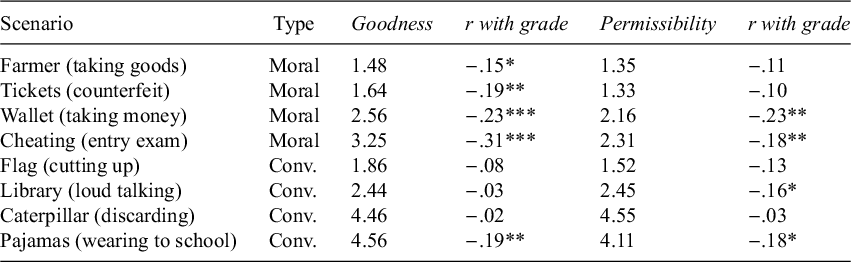
To understand which scenarios carried the effect reported above, we examined item-level means and their zero-order correlations with the behavior grade (Table 1). The item set was not perfectly matched, and the pattern of correlations is informative about how individual items behaved.
Item-level mean ratings by scenario type and rating scale

Table 1. Long description
The table consists of six columns: Scenario, Type, Goodness, r with grade (for Goodness), Permissibility, and r with grade (for Permissibility).
There are eight scenarios divided into two types:
1. Moral Scenarios:
- Farmer (taking goods): Goodness 1.48, r minus .15, Permissibility 1.35, r minus .11.
- Tickets (counterfeit): Goodness 1.64, r minus .19, Permissibility 1.33, r minus .10.
- Wallet (taking money): Goodness 2.56, r minus .23, Permissibility 2.16, r minus .23.
- Cheating (entry exam): Goodness 3.25, r minus .31, Permissibility 2.31, r minus .18.
2. Conventional (Conv.) Scenarios:
- Flag (cutting up): Goodness 1.86, r minus .08, Permissibility 1.52, r minus .13.
- Library (loud talking): Goodness 2.44, r minus .03, Permissibility 2.45, r minus .16.
- Caterpillar (discarding): Goodness 4.46, r minus .02, Permissibility 4.55, r minus .03.
- Pajamas (wearing to school): Goodness 4.56, r minus .19, Permissibility 4.11, r minus .18.
Note: Goodness and Permissibility are rated on a scale of 1 to 7, where 1 is bad or not permissible and 7 is good or permissible. Items are sorted by goodness rating within their respective types.
Note: Goodness: 1 = bad, 7 = good. Permissibility: 1 = not permissible, 7 = permissible. Conv. = conventional violation. Items sorted by goodness rating within type.
Goodness scale. All four moral items correlated with the behavior grade in the expected direction (rs = −.15 to −.31), with cheating showing the strongest correlation despite receiving a relatively lenient mean rating. Among convention items, the pattern was more heterogeneous, and two items behaved atypically in opposite ways.
The flag-cutting item deserves particular attention. Students rated it 1.86 on the goodness scale and 1.52 on the permissibility scale, harsher than two of the four moral transgression items (wallet: 2.56/2.16; cheating: 3.25/2.31). This pattern closely parallels Haidt et al.’s (Reference Haidt, Koller and Dias1993) findings. Their study included a similar scenario (cleaning a toilet with a national flag), and most participants outside of elite universities moralized it, judging it universally wrong despite the absence of material harm. Haidt et al. argued that such moralization is driven by affect (disgust or indignation about disrespect) rather than by harm appraisal. Our students appear to respond to flag desecration in the same way: condemn it as if it were a moral transgression. This means that our classification of flag-cutting as a conventional violation, while correct on Turiel’s (Reference Turiel1983) theoretical grounds (the act causes no direct harm), does not match how most students experience it.
Pajamas show the mirror-image surprise. Its mean goodness rating (4.56) places it with caterpillar as a mildly judged convention, but its correlation with the behavior grade (r = −.19, p = .007) matches the moral items rather than the other conventions. The most parsimonious reading is that the pajamas item directly indexes compliance with school dress codes, which is part of what teachers weigh when assigning the behavior grade. It does not index a general moral-conventional stance. Together, flag and pajamas cover a large share of the variance that the conventional arm of the differentiation score contributes to the main result: one item moralized despite being harmless, the other directly coupled to the outcome measure through the mechanism of school discipline rather than moral judgment.
Permissibility scale. Here, the expected ordering broke down more broadly. Flag-cutting received a lower (worse) permissibility rating (1.52) than the mean moral transgression rating (1.79). Library noise was rated as less permissible than cheating. For two of the four convention items, students judged them as less morally permissible than acts that cause direct harm to others. This violation of the expected ordering indicates that the permissibility question did not function as a universalizability probe. Haidt et al. (Reference Haidt, Koller and Dias1993) showed that the standard universalizability question (‘Would this be wrong even if everyone thought it was acceptable?’) produces interpretable results across SES and age groups, including children and low-SES populations in Brazil. Our permissibility question (‘Was this behavior morally permissible?’) was not the standard item, and the term ‘permissible’ may have been read as asking about general social acceptability or legal regulations rather than about whether the behavior is intrinsically harmful regardless of local rules.
3.6.4. Supplementary analyses
Moral Permissibility Measure. The permissibility-scale version of the differentiation score did not correlate with behavior grades (r = .009, p = .449 one-tailed). In the regression model, the permissibility-based predictor was nonsignificant (β = +.08, p = .173). As the item-level analysis shows, students did not interpret the permissibility question as a moral universalizability probe. We treat this measure as a failed attempt and do not interpret it further.
Factor-Scored Teacher Ratings. Our preregistered plan called for creating composite socialization scores from the 12 teacher-rated behavioral items. Confirmatory factor analysis supported a two-factor solution distinguishing antisocial behavior (NEG: lateness, truancy, homework avoidance, vulgarity, negative emotion expression) from prosocial behavior (POS: engagement, helpfulness, leadership, extracurricular participation, relationships, student governance), with an added residual covariance between two extracurricular items. The factors were scored so that higher numbers correspond to better socialization (more POS, less NEG behavior reported by teachers). The two factors were nearly orthogonal (r = .098), suggesting that antisocial and prosocial behaviors operate as independent dimensions.
The differentiation score did not significantly predict either factor-scored outcome. For NEG, β = +.09, 95% CI [−.04, .22], p = .158. For POS, β = +.02, 95% CI [−.12, .16], p = .756. All signs were in the predicted direction, suggesting the effects may exist but are weaker than our study was powered to detect.
3.6.5. Discussion
The moral-conventional differentiation score predicted teacher-assigned behavior grades, replicating the direction of Experiment 1: students who judged moral transgressions as relatively worse than convention violations received higher behavior grades. The effect was small (ΔR 2 = .020) but statistically significant.
The moral permissibility measure failed to predict any socialization outcome. The item-level analysis (Table 1) points to the most parsimonious explanation: students did not consistently interpret ‘morally permissible’ as a probe of universalizability. The standard universalizability question from the moral-conventional distinction literature (‘Would this behavior be wrong even if everyone thought it was acceptable?’) was not included because teachers advising on the study’s design judged it too confusing for students. In hindsight, this omission was costly. Haidt et al. (Reference Haidt, Koller and Dias1993) used the standard item with children from low-SES backgrounds in Brazil and obtained interpretable results, and the Turiel tradition has used it with much younger children. Future studies should include it.
The factor-scored teacher ratings (NEG and POS) were not significantly predicted by the differentiation score. The most likely explanation is that the individual items composing these factors capture behaviors with too many determinants unrelated to moral character. Truancy, for example, is often driven by poverty, illness, or family circumstances. The behavior grade, by contrast, is a global teacher assessment of conduct, making it a more direct proxy for the construct of interest.
4. General discussion
Across two studies, we found that the ability to differentiate moral transgressions from social convention violations is associated with socialization outcomes. In Experiment 1, YEC juveniles showed a reversed pattern of moral-conventional differentiation compared to controls. In Experiment 2, the strength of this differentiation in a general school sample predicted teacher-assigned behavior grades, though the effect was small.
The two studies answered related but conceptually distinct questions. Experiment 1 tested whether reversal of the healthy differentiation pattern predicts extreme socialization failure. Experiment 2 tested whether the degree of differentiation predicts the magnitude of positive socialization in a general population. Had the relationship been linear, a one-unit increase should have translated into a proportional improvement in behavior. It did not. Reversal was a strong signal of socialization problems in Experiment 1, but variation within the healthy range was a weak predictor in Experiment 2. A threshold model captures this: a minimum level of moral-conventional differentiation appears necessary for healthy socialization, and further increases add little.
Most students in the general school sample differentiated in the expected direction (one-sample t-tests: ps < .001, ds > 0.5), and most received high behavior grades (71% ‘very good’ or ‘exemplary’). With most students clustered at the healthy end of both distributions, the scope for detecting a linear relationship was limited. The significant but small effect we did observe was driven by the tail of students with weaker differentiation and lower behavior grades.
An alternative explanation for the Experiment 1 findings deserves consideration. YEC juveniles may have arrived with normal moral-conventional differentiation, and the institutional environment may have eroded it by enforcing all rules equally. A longitudinal study tracking differentiation before and during YEC placement would be needed to rule out this possibility.
4.1. Limitations and future directions
The use of the behavior grade as the primary outcome in Experiment 2 was post hoc. Although we consider it the most defensible measure, this result should be replicated with a preregistered analytic plan specifying a global behavior measure as the primary outcome.
Our moral permissibility question did not function as intended. Future studies should use the standard universalizability probe from the Turiel tradition (‘Would this be wrong even if everyone in the country thought it was acceptable?’). This item has been used successfully with children as young as 5 and with low-SES populations (Haidt et al., Reference Haidt, Koller and Dias1993), so concerns about comprehensibility should not prevent its inclusion.
The scenarios were not well matched across the moral and conventional categories. Table 1 shows that some convention violations (flag-cutting, loud talking) were judged almost as harshly as moral transgressions, while others (caterpillar, pajamas) were judged mildly. The cheating item was judged more leniently than expected. Future studies should match scenarios more carefully on dimensions other than the moral-conventional distinction itself.
In Experiment 1, we tested only male participants. Experiment 2 included both sexes, and sex was not a significant predictor of behavior grades, suggesting the relationship is not gender specific. The Experiment 1 finding has not been replicated in females.
5. Conclusion
The ability to differentiate moral transgressions from conventional violations is associated with socialization outcomes in adolescents. When this ability breaks down or reverses, the consequences for behavior are substantial. When it is intact but varies in strength, the relationship with behavior is present but small. Whether restoring the distinction in at-risk youth improves behavior is a question that interventions, not correlations, can answer.
Supplementary material
The supplementary material for this article can be found at http://doi.org/10.1017/jdm.2026.10039.
Data availability statement
The materials and data for Experiments 1 and 2 are available at https://osf.io/vhjpc/overview this is a full access link https://osf.io/vhjpc/?view_only=a0ef62cee7c244ff99e65d4ca819b30f. Experiment 2 was conducted as a registered report.



 Open access

