

The global financial crisis of 2009 appears to have had little effect on the rate of mineral exploration in Western Australia. After four decades of extensive mineral resource exploitation in the Pilbara, the adjacent Murchison region is now under increased pressure of development. While heritage surveys are mandated by law as part of the development approvals process and numerous consultation reports are generated, archaeological research in the Murchison region has been limited. Recent systematic surveys undertaken by Eureka Archaeological Research and Consulting (Eureka), University of Western Australia (UWA) and Wajarri Aboriginal Traditional Owner Representatives within Sinosteel Midwest Corporation Limited's Weld Range Project in the Murchison have highlighted a significant increase in the evidence for past Aboriginal occupation of the region than has been previously recorded. There is currently a unique opportunity to investigate the archaeology of the Weld Range and wider Murchison region as mining interests in the area continue to escalate.
The Murchison mid-west region sits between Australia's Mediterranean south-west and arid north-west areas (Figure 1) in which long term Aboriginal occupation has been demonstrated by Pleistocene dates and for which regional archaeological syntheses have been developed (Reference HallamHallam 1975; Reference BrownBrown 1987; Reference DortchDortch 2002). In the inland Pilbara, immediately north of the Murchison, occupation has been dated to at least 35 000 years BP (i.e. Smith et al. 1997; Reference MorseMorse 2009: 5; Reference Slack, Fillios and FullagerSlack et al. 2009). On the nearby Gascoyne coast occupation has been dated to 32 000 BP at Mandu Mandu Creek rockshelter (Reference Morse, Hall and McNivenMorse 1999) and 35 000 and 34 000 years BP at Jansz and C99 rockshelters respectively (Reference Przywolnik, Veth, Smith and HiscockPrzywolnik 2005). To the south, Pleistocene dates of 38 000 BP have been obtained for occupation layers at Upper Swan (Reference Pearce and BarbettiPearce & Barbetti 1981) and as early as 41 000 BP at Devil's Lair (Reference DortchDortch 1984; Reference Chris, Turney, Bird, Fifield, Roberts, Smith, Dortch, Gr�N, Lawson, Ayliffe, Miller, Dortch and CresswellChris et al. 2001). These dates suggest that occupation dating back to the Pleistocene is also probable for the Murchison, although no Pleistocene dates have as yet been recorded.
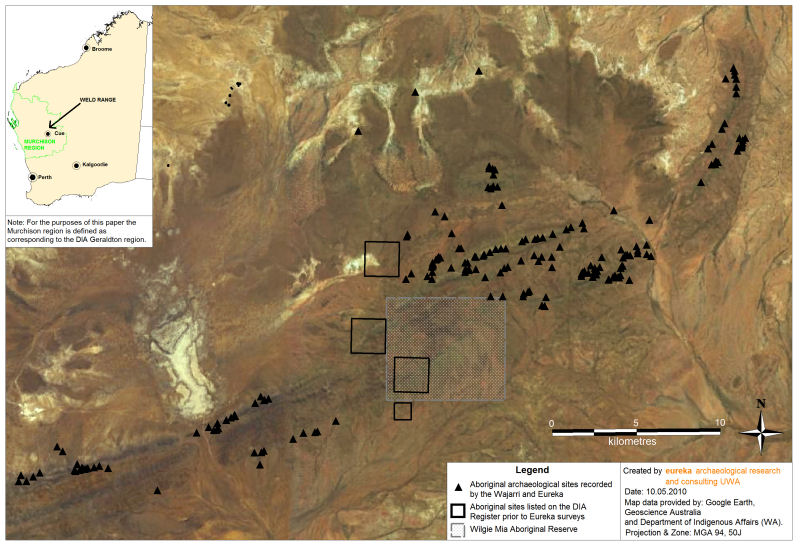
Map of the Weld Range showing the locations of Aboriginal archaeological sites in the Project Area.

Unfortunately, nearly all of the information from archaeological consultancy undertaken in the Murchison over the past few decades remains unpublished and there is little in the way of regional context for work undertaken. In 1983 the Franco-Australian expedition under the auspices of the Western Australian Museum and the University of Bordeaux recovered Holocene human occupation dates during investigations at Walga Rock and Billibilong Springs (Reference Bordes, Dortch, Thibault, Raaynal and BindonBordes et al. 1983). More recent investigations include recording and evaluation of rock art sites and associated archaeological material in the Cue region (Reference WebbWebb 1996; Reference Gunn and WebbGunn & Webb 2000, Reference Gunn and Webb2002, Reference Gunn and Webb2003). In addition to this, there have been a number of investigations of the extensive Wilgie Mia ochre mine located within the Weld Range (Reference DavidsonDavidson 1952; Reference ClarkeClarke 1976; Reference Crawford, Berndt and BerndtCrawford 1980). Red ochre sourced from this quarry was traded over long distances — into the Western Desert and perhaps as far as Western Queensland (Reference WoodwardWoodward 1914). These studies clearly demonstrate a good archaeological record for the Holocene Aboriginal occupation of the Murchison region, and an apparent abundance of rock art sites.
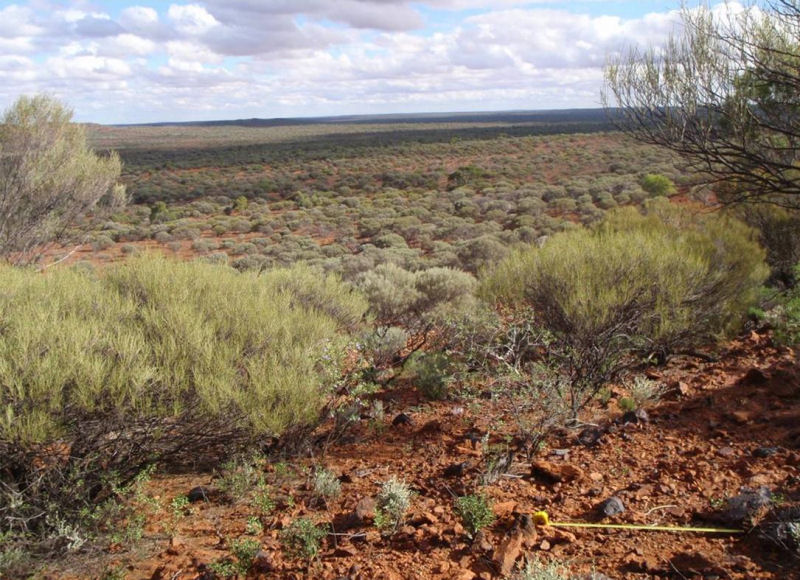
Since 2007 Eureka has been engaged to undertake extensive archaeological survey work in the Weld Range by the Wajarri Traditional Owners of this country as part of Sinosteel Midwest Corporation Limited's Weld Range Iron Ore Project. Located 50km north-east of Cue, the Weld Range is a series of Banded Ironstone Formation hills and ridges. The range extends for some 60km north-east–south-west and is approximately 3km wide. While rainfall in the area is low and water courses are seasonal, permanent and semi-permanent waterholes have been identified throughout the Range. The Wajarri maintain strong links with their country and recognise a wide range of traditional bush foods and medicinal plants throughout the landscape. Archaeological survey has now been conducted across a range of landscape types including rocky ridges, hill slopes, open flats, gullies and breakaways (Figure 2).
Weld Range Environment, north-west view from the Range across typical Acacia spp. woodland (hand tape extended to 1m for scale).

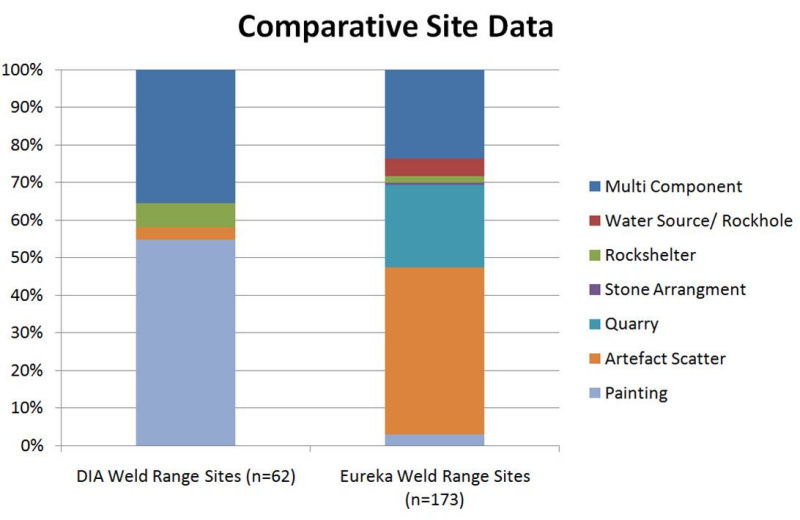
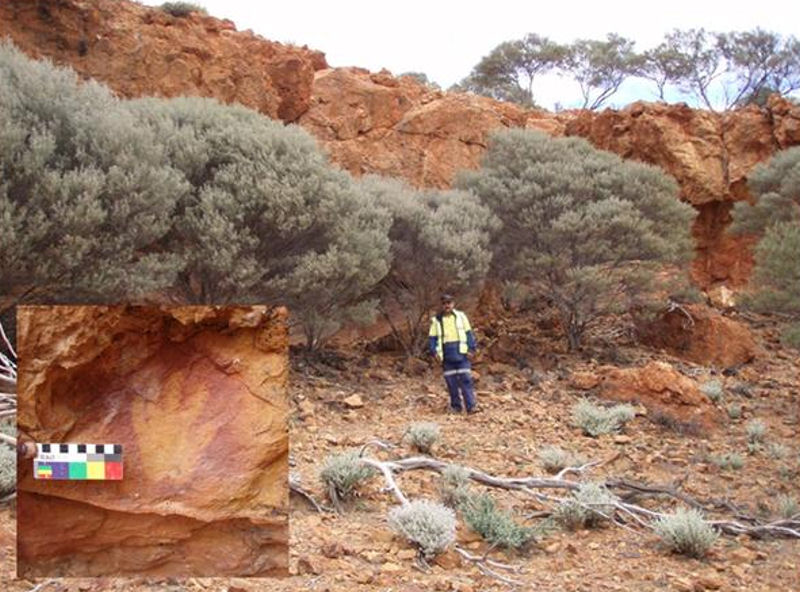
Prior to the survey work described here, the Western Australia Department of Indigenous Affairs (DIA n.d.) Register of Aboriginal Sites listed only 62 sites within 20km of the Weld Range. Fifty-five per cent of these were described as painting sites. Systematic survey work undertaken by Eureka and Wajarri Traditional Owners since November 2007 has now inspected 60km2 and has recorded 173 new sites (Figure 3). The proportions of site type listed on the DIA register of Aboriginal sites prior to the recent Eureka surveys are compared with those recorded as a result of the Eureka surveys in Figure 4. The recent Eureka survey results indicate a much more varied archaeological landscape from that described on the DIA's Site Register for the Weld Range. The sites recorded by Eureka are dominated by artefact scatters (45 per cent) and quarries (38 per cent), contrasting markedly with the predominance of painting sites on the Weld Range site inventory prior to the survey. In fact, the recent Eureka survey data includes less than five per cent rock art sites (Figure 5).
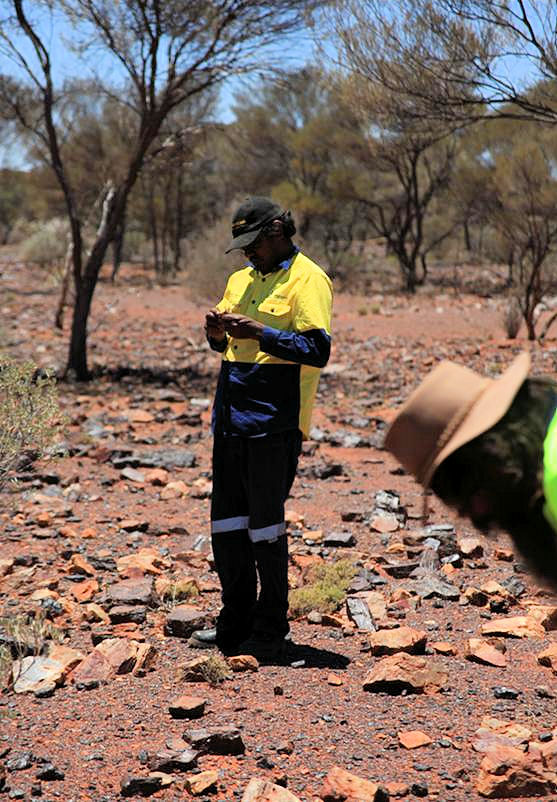
Weld Range Survey, working shot December 2009 (left to right: William Egan, Brendan Hamlett).

Comparison of known archaeological sites in the Weld Range prior to 2007 (labelled DIA Weld Range Sites) and Eureka's Weld Range survey results (labelled Eureka Weld Range Sites).

An example of a Weld Range rock art site. A landscape context shot (Ansell Egan) with inset showing detail of a hand stencil (IFRAO scale is 100mm).

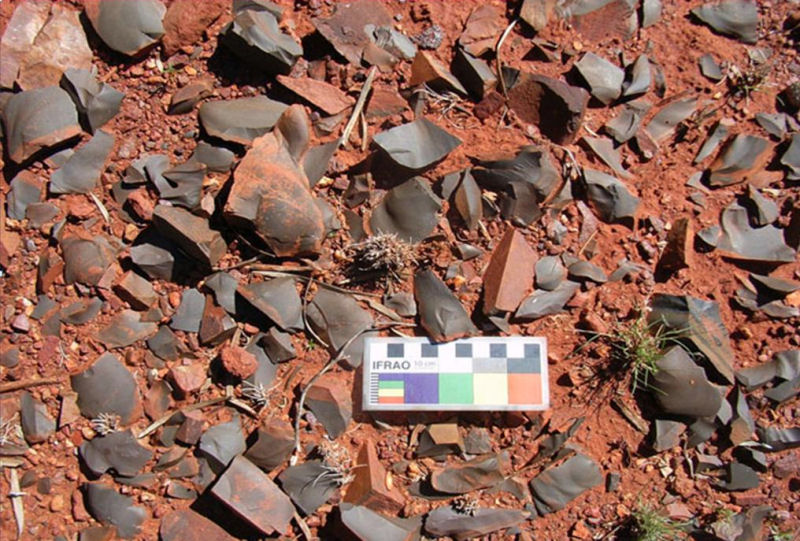
More detailed recording is currently underway at a number of the sites identified since 2007. From this work it is clear that whilst some sites clearly represent palimpsests of occupation events at 'persistent places' (Reference Barton and BevinsBarton et al. 1995) others appear to have been occupied only once and comprise fine-grained evidence such as the material remains of individual knapping events. The high proportion of artefact scatters and quarry sites (Figure 6) indicates intensive exploitation of material resources and habitats within the Range during the Holocene. It also highlights the probable importance of the Weld Range in regional context as a source of raw material for the manufacture of stone tools in addition to the known importance of ochre sources, most notably Wilgie Mia. It should be noted that no survey has been undertaken by Eureka within the Wilgie Mia Aboriginal Reserve and that this area is subject to government protection under the Western Australia State Aboriginal Affairs Planning Act 1972 and a National Heritage listing nomination (Figure 1).
Chert artefacts on the ground surface at a quarry site (IFRAO scale is 100mm).

We conclude from this work that, like the adjacent Pilbara region, the Murchison presents an exceptional archaeological resource including a rich diversity and high density of sites with strong archaeological integrity. The Weld Range survey results highlight the importance of mining activity in initiating and funding basic documentation of heritage sites in archaeologically little known but resource rich parts of Western Australia. It is important that opportunities to document these sites and further investigate the archaeology of the Weld Range and wider Murchison region are not disregarded in the race to develop mineral projects.
Acknowledgements
We would like to thank the Wajarri Traditional Owners of the Weld Range, in particular Mr Colin Hamlett, for his knowledge, support and inspiration to make more of the consultancy work. Thanks to Wadjarri Consulting Services Pty Ltd and Sinosteel Midwest Corporation Ltd for support and approval to publish. Dr Kate Morse read and made useful comments on drafts of this paper for which we are very grateful. Thanks to our other fellow Eurekans: Annie Carson, Jim Stedman, Daniel Harris, Wendy Reynen, Jess Reynolds, Sam Thomas, Ariella Rea-Cunningham, Sean Winter and Sarah Burke.