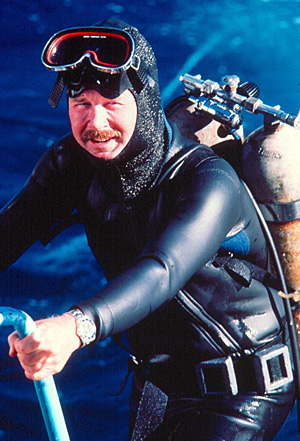


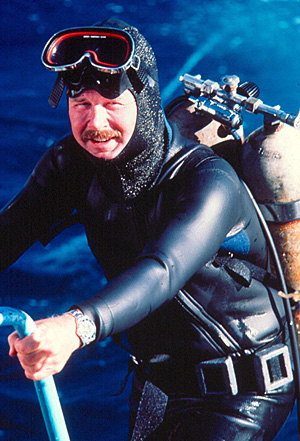
George Bass during an INA and Texas A&M University excavation of an early eleventh-century shipwreck at Serçe Limani, Turkey, 1977 (photograph: Jonathan Blair).
A life of scholarship takes place in a historical context and itself creates a discourse that continues or breaks with the established practice in a discipline (Díaz-Andreu 2007). George Fletcher Bass is the subject of a recent study by the present author conducted by means of a series of interviews pursuing five different themes, including treasure hunting, identity issues and public archaeology. The brief sketch given here draws on these interviews and other resources and reflects on how Bass aided the transition of underwater archaeology from a recreation to a discipline.
Underwater archaeology is intertwined with the development of diving, particularly after the end of the Second World War. New technologies, such as scuba, enabled archaeologists to consider the possibility of studying underwater sites. At first, underwater archaeology was considered to be a leisure or artefact-hunting activity, in which the true discipline was the diving. But from his first acquaintance, the pioneering American historical archaeologist George Bass took a firm theoretical stand in favour of a properly constructed archaeological discipline. He had studied archaeology at Johns Hopkins University and took his doctorate in Classical archaeology at the University of Pennsylvania. Bass combined his archaeological mission with great concern for the difficulties of the underwater environment and for diving safety, increased by his early witness of a diving accident. In 1960 he conducted the first excavation to be carried out completely on the seabed, at Cape Gelydonia (Reference BassBass 1967). In 1966 he published Archaeology under water, a manual that reviewed the techniques for searching and excavating at underwater sites, emphasising, through its techniques and procedures, that underwater archaeology was a part of the discipline of archaeology.
From the 1970s, underwater archaeology became recognised as an academic discipline as much as a professional pastime. With a view to developing integrated approaches, Bass created the independent Institute of Nautical Archaeology (INA) with the objective of focusing energy on fieldwork. In the same decade, specialised journals began to appear, such as the INA Quarterly, a magazine from the INA, and the International Journal of Nautical Archaeology, published by the Nautical Archaeology Society (NAS). As well as combining academic and professional factors, Bass was aware that his archaeology (like all others) was conducted in a social context. The INA was first based on Cyprus, but after war broke out on the island after just one year, George Bass and his colleagues Michael Katzev and Dick Steffy were unable to continue their progress until someone suggested taking the INA to an American University. The INA soon affiliated with Texas A&M University. The university offered him the chance of establishing an independent graduate program of nautical archaeology, although, like other branches of archaeology in the US (Reference FunariFunari 2006: 23), this was subsequently absorbed by the Anthropology Department.
In spite of the professionalisation of the discipline, unregulated explorations of the seabed continued or increased, and during the 1980s questions were raised about the relationship between underwater archaeology and treasure hunting. Relevant debates can be found in the 'Perspectives' section of the Journal of Field Archaeology (Reference BassBass 1981; Reference BassBass & Ruppe 1982; Bass et al. 1983; Reference BassBass & Trembour 1984; Reference BassBass & Hope-Simpson 1985). These discussions emphasised the scientific nature of underwater archaeology, as opposed to the commercial and destructive practice of treasure hunting. This concern is still current, as can be seen in publications such as Arqueologia Até Debaixo D'água [Archaeology...even if under water] (Reference RambelliRambelli 2002) and Underwater archaeology: the NAS guide to principles and practice (Reference BowensBowens 2009).
Bass can be considered as a pioneer of method, and a promoter of a new discipline, as well as a highly successful underwater excavator and researcher. His pioneering work not only allowed archaeologists to work on different site types, but also greatly contributed to the recognition of the practice of underwater archaeology as a scholarly discipline.
Acknowledgements
I owe thanks to my supervisors, Pedro Paulo Abreu Funari and Gilson Rambelli, and also to Margarita Díaz-Andreu, Richard Hingley and George Fletcher Bass. I am also grateful for the support of the São Paulo Science Foundation (FAPESP), the Brazilian National Science Foundantion (CNPq) and the State University of Campinas, Brazil. I take full responsibility for the ideas presented here.