Artemisia Gentileschi (1593–1653) was an exceptionally skilled painter. She might have had a knack for painting, which she allegedly inherited from her parents. But her talent alone did not make her into one of the most skilled Baroque painters – it took several years of training, first under her father’s supervision and then at the Tuscan Academy of the Arts of Drawing, where she was the first woman ever to enroll and where she learned from the best painters of her time. Consider her capacity to paint at the culmination of her career, as is manifested in Self-Portrait as the Allegory of Painting (1638–1639, this book’s cover). In what sense does this capacity count as a skill?
Ordinary use of ‘skill’ is often very liberal and applies indiscriminately to knacks, talents, instincts, habits, know-how, and general-purpose faculties. Philosophers’ current use of ‘skill’ is equally liberal. Epistemologists often classify epistemic competences as kinds of skills and ordinarily compare competencies such as general perception to archery and to fencing;Footnote 1 some even deem knowledge to be a skill.Footnote 2 Philosophers of mind routinely count natural faculties such as memory, imagination, general-purpose reasoning, and attention among skills.Footnote 3
These disparate uses of ‘skill’ are no doubt motivated by the relevant theoretical goals. But they have the pitfall of classifying vastly different kinds of capacities under the same heading; by doing so, they obscure significant differences. Here, I will not attempt an analysis of the ordinary or the prevalent philosophical uses of ‘skill.’ My goal is to offer a regimentation of skill talk across domains – from action theory to cognitive sciences, from biology and evolutionary psychology to education studies – in order to find criteria for singling out a property, indeed a natural kind, that can do interesting theoretical work (§1.1). As I will argue, the resulting regimented notion of skill has a long historical pedigree in that it traces back to Aristotle’s notion of technē and to Ryle’s notion of know-how (§1.2). Section 1.3 defends the methodological value of this regimentation. The regimentation offered will set up my argument for the special interest of this notion of skill in a theory of action and intelligence (Chapters 2–5), as well as for the intellectualistic picture developed in the second part of this book (Chapters 6–13).
1.1 Regimenting Skill
1.1.1 Some Metaphysics
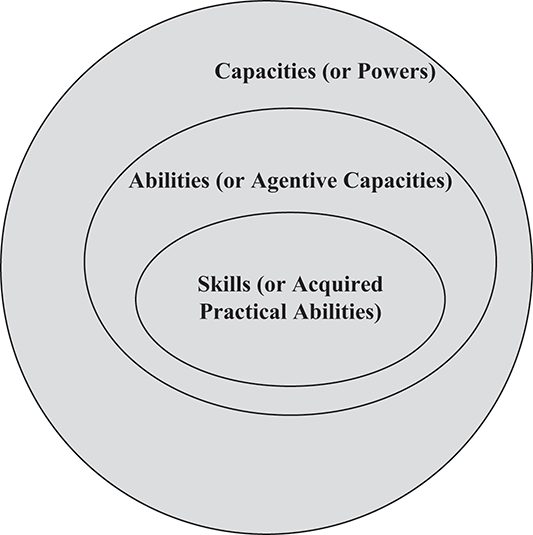
We have capacities for all sorts of events – from getting to sleep to reproducing, from getting injured to acting generously, from imitating to creating new things. Some of these capacities we share with nonagents – both the Earth and the dancer have the capacity to spin. Although not every capacity is agentive, some capacities are. Only agentive capacities are abilities (Figure 1.1).Footnote 4 Abilities are particular kinds of agentive capacities – that is, capacities to act, or active capacities.Footnote 5
A taxonomy of capacities.
Abilities are often identified with modal properties of sorts. Possibilism thinks of an ability to ϕ in terms of success at ϕ-ing at some possible world;Footnote 6 conditional analyses think of it in terms of one’s success at ϕ-ing in every possible world when one intends or tries to ϕ or executes a practically relevant action.Footnote 7 Success views understand abilities in terms of success at sufficiently many possibilities that satisfy certain constraints.Footnote 8
Each of these modal conditions on abilities face problems, but the most outstanding challenges arise for their sufficiency rather than for their necessity. For example, conditional analyses and success views face the problem from phobic or comatose agents, who lack, respectively, the ability to hold a snake or to walk but would succeed at these tasks whenever they intended or tried to do so.Footnote 9 Primitivism – the view that abilities might not be understandable in terms of the usual (existential, universal, or proportional) quantifiers over possibilities but might amount to primitive forms of quantification – might overcome these issues but at a cost of mysteriousness.Footnote 10
These problems with modal analyses of abilities suggest that, while a certain modal profile – that is, a certain pattern of success across possible worlds – is necessary for possessing an ability, it might not be sufficient. Another way of stating this point is that abilities might not be purely modal properties. Their not being purely modal is nonetheless compatible with possession of abilities eliciting a certain modal profile, at least in normal conditions. The “normal conditions” qualification is important to take into account finks and masks.Footnote 11 Abilities can be subject to finks:Footnote 12 For example, one’s ability to speak French might never be exercised if a sorcerer resolves to make sure that one never succeeds at speaking French.Footnote 13 Abilities can be subject to masks too:Footnote 14 For example, one’s ability to speak French might freeze if one ingests a disabling drug.
Consequently, I will take general abilities to be intrinsic properties of an agent which elicit a modal profile in the following sense: if one has a general ability to ϕ in a situation s then, in most of the situations s’ that are at least as normal as s and in which one tries to ϕ, one succeeds in doing so (see Beddor and Pavese [2020: sect. 5.3]); this modal condition takes care of finks and masks; satisfying it is necessary for possessing the relevant ability but might not be sufficient. I reserve talk of “dispositions” for purely modal properties – that is, properties for which a certain modal profile is both necessary and sufficient.Footnote 15
If abilities are not purely modal properties, classifying skills as abilities does not commit one to a purely modal account of skills;Footnote 16 nor does it prejudge whether skills require representations and cognitive states,Footnote 17 since, on this understanding of abilities, skills can be abilities and be grounded in representations and cognitive states.
Skills are general abilities rather than specific abilities – where a specific ability to ϕ is an ability to ϕ in view of particular circumstances for acting.Footnote 18 That is, one might have a skill without contingently being able to exercise it, as when a soccer player is injured. And I allow that one might have the specific ability to ϕ, while lacking the skill to ϕ, when the circumstances are especially favorable – for example, a small child might have the specific ability to sink a basket if they are adequately helped (by being lifted). Since general abilities elicit a certain modal profile, the claim that skills are general abilities implies that an explanatory theory of skill ought to deliver an explanation of that modal profile (§6.4.2, Chapter 9, and Chapter 12).
Since only agentive capacities are abilities, skills being abilities means that only agents can have skills; since abilities are active capacities, it also means that skills are capacities to act. Mere happenings such as being run over by a car or accidentally falling from a cliff are not the sort of things that one can be skilled at. The same is true for entirely passive behaviors; succumbing to others’ will and being blamed are not skills that one can have.
Say that a capacity to ϕ canonically manifests in ϕ-ings. A skill to ϕ canonically manifests in actions of ϕ-ings. Their agentive and active nature demarcates skills from capacities that do not canonically manifest in actions. For example, physiological capacities such as the capacities to digest or to sweat are not skills, since their canonical manifestations – digestions and sweatings – are not actions; nor are subagential capacities skills – for example, the capacity to process relevant complex acoustic and/or visual inputs, the capacity to deal simultaneously with multiple layers of linguistic structure, the capacity to store information in working memory, and so on.
Marr (Reference Marr1982) famously distinguished between different levels of explanation of mental phenomena: the neural or implementation level, the computational (or algorithmic) level, and the functional level. Following Newell (Reference Newell1982: 94), I add a fourth level – the ‘knowledge level’ or, as I will call it, the ‘agentive level.’ This is the level of action-explanations – where it makes sense to talk of the agent intending, having goals, having knowledge and beliefs, and taking means to ends on the basis of their knowledge and of their abilities. Abilities and skills belong to the agentive level of explanation. On the other hand, it makes sense to talk of “capacities” also at the functional, computational, and neural level: as when cognitive scientists talk of perception as taking inputs into outputs (functional), of the capacity of the perceptual system to form a two-and-a-half-dimensional sketch (computational), and of the plasticity of the primary visual cortex or its capacity to undergo changes (neural). Thus we have four different levels of explanation:Footnote 19
Agentive level
Functional level
Computational level
Neural level
While a skill is a general ability, not every general ability is a skill. An example:Footnote 20 Susie believes that she can annoy John by smoking cigarettes, whereas what actually annoys him is her having something on her lips. She annoys John whenever she tries and this is very modally robust – since whenever she tries, she smokes and thus has something on her lips. Susie’s smoking is a property of hers that robustly annoys John, in virtue of which Susie has the ability to annoy John. However, her annoying John is neither intentional nor skilled.
Thus, a skill to ϕ is not just an ability to ϕ: It is the ability to ϕ intentionally – or, as I will call it, a practical ability.Footnote 21 That is to say that a skill’s canonical manifestations are intentional actions. As an objection, consider a basketball player with lightning-fast reflexes: whenever the ball is passed to them, they automatically catch it, without conscious reflection. Their action is skillful. Is it intentional? The devil is in the detail. According to a natural way of filling out the case, our basketball player is in control of their actions. After all, presumably they can flexibly adjust their movements based on their goals and perceptual feedback. This provides reason to deem their action intentional. But suppose we stipulate that their action is not under their control. For example, suppose that they will instinctively catch the ball even when doing so will thwart their aims. This might still be a manifestation of a skill in the epistemic sense of offering evidence that the skill is there (e.g., by indicating their speed), just as people handling glass with care is evidence that the glass is fragile. Thus, while skills canonically manifest in intentional actions, skills can also be manifested non-canonically in any action that provides evidence for the presence of the skill. So, the distinction between canonical and non-canonical evidential manifestations of a skill can account for the residual temptation to think that there is some sense in which even their unintentional actions are skillful.Footnote 22
The actions that we are skilled at can also be thought of as tasks. A task is an action considered from the perspective of one who has to perform it – that is, it is an action to be performed. Since they are typed by their tasks, skills are task-specific abilities: a skill is a skill to ϕ for some task type ϕ. Skills can be clustered into domains – as when we talk of musical skills or mathematical skills.Footnote 23
Since theorizing about skills has to happen in some language, a note about the grammar of skill talk is in order. Just like ‘ability’ or ‘talent,’ in English, ‘skill’ can be used both as a mass noun to refer to the general property of having a skill and as a count noun to refer to particular skills, typed by their task. I will similarly oscillate between these two uses, depending on whether I aim to discuss particular skills or the general property. Given that skills are particular kinds of capacities, they are the sort of things that can be exercised (as capacities can). Thus, I will use “skilled” (or “skillful”) in “skilled behavior” (or “skillful behavior”) as equivalent to a behavior “exercising” a skill to a sufficiently high degree. This qualification is necessary because “skilled” (or “skillful”) is, like “tall,” a gradable adjective; it satisfies typical linguistic tests for gradability – it can enter into comparative morphology (“more than”) and can be modified by intensifiers such as “very.”Footnote 24
Now, a gradable adjective a is satisfied by some behavior b in a context c only if b possesses a to a degree that exceeds c’s standard. Thus, being tall requires not just having a height but also having it to a degree above the contextual standards; accordingly, though every basketball player possesses some height, only some might count as tall. Similarly, being skilled requires not just having a skill but also having it to a degree above the contextual standards. In the same way, some behavior might exercise a skill to some degree without counting as skilled in a context. So, for example, while every soccer player possesses soccer skills, the skilled ones possess them to a particularly high degree.
Philosophical discussion on skills has by and large prioritized embodied skills (e.g., sport skills) to the expense of intellectual skills (e.g., math). By contrast, intellectual and theoretical skills will be as central to my discussion as embodied skills. While in some sense every skill is embodied, since it is embodied in the brain, the distinction between embodied and intellectual skill maps onto the distinction in action theory between types of actions that constitutively require the use of extremities for being instantiated (bodily actions) and types of actions that do not constitutively require the use of extremities for being instantiated (mental actions).Footnote 25 For humans, bodily actions are those that constitutively require the use of controllable muscles – that is, striated or skeletal muscles – and of motor nerves, whereas mental actions do not.
The distinction between “embodied skills” and “intellectual skills” can be understood accordingly.Footnote 26 As we have seen, a skill to ϕ has intentional actions of ϕ-ings as its canonical manifestations. For example, doing math is a canonical manifestation of the skill to do math and swimming is a canonical manifestation of the skill to swim. Let a skill be embodied if its canonical manifestation constitutively requires the use of extremities – muscles or motor nerves; let a skill be intellectual if its canonical manifestations do not constitutively require the use of extremities. While doing math can be done by using extremities (as when one solves problems on a blackboard), it does not constitutively require the use of extremities as one can solve math problems in one’s head – so doing math is an intellectual skill. Swimming, on the other hand, requires the use of muscles, so it is an embodied skill. (For further refinements of this definition, see §3.2.)
1.1.2 Skills versus Talents and Instincts
Skills are acquired (Table 1.1). Cognitive scientists and biologists even define skills as necessarily involving learning.Footnote 27
| Domain-specificity | Acquired | Amenability to improvement and innovation | Active learnability | Individual-specific | Two-way power | |
|---|---|---|---|---|---|---|
| Skill | Yes | Yes | Yes | Yes | Yes | Yes |
| (Mere)habit | Yes | Yes | Some | Not necessarily | Yes | No |
| (Mere) instinct | Yes (many are) | No | No | No | No | No |
| (Mere) knack/talent | Yes | No | No | No | Yes | No |
| General-purpose faculties | No | No | Some | No | No | No |
| Virtues | Yes, many of them | Yes | Unclear | Somewhat | Yes | No |
Among the innate and domain-specific capacities, instead, there are ‘natural’ talents as well as instincts. I will discuss talents in Chapter 5. For now, let natural talents be innate capacities that can vary greatly across individuals of the same species, that are not widespread in a population, and that can be inherited only by one’s offspring.Footnote 28 Instincts, instead, are shared by all members of a species of a given generation (Table 1.1).Footnote 29
It is a thorny question how to understand the innate-acquired distinction. A classic way of drawing it is due to Fodor’s (Reference Fodor and Fodor1981) views of concepts, according to which a concept is acquired just in case it is the result of a learning process – by which he understood any rational revision process, such as hypothesis testing and Bayesian update – whereas a concept is innate just in case it is not the result of rational processes but merely of brute causal mechanisms. Experience might play a role in triggering an innate concept but its role is merely causal.
The problem with extending this suggestion to a more general distinction between innate and acquired abilities is that mere habits themselves are acquired. And yet, they need not be the result of rational revision, since they are acquirable through mere causal processes of rote repetition, drilling, and inculcation (§1.1.3). Following Fodor’s conception of innate/acquired would make mere habits come out as innate, which is the wrong result.
Here is a juncture at which some tools from the philosophy of biology might help. The notion of instincts is central to this field since at least Lorenz (Reference Lorenz and Schiller1957). Lorenz observed that, for example, female mallards raised to reproductive age in the exclusive company of pintail ducks show no sexual affinity for the pintail drakes. But upon seeing a male mallard for the first time, the female immediately engages in the sexual courtship behavior particular to its species, even if it had no opportunity to learn it. If courtship behavior is not acquired from environmental cues, where does it come from? Lorenz’s idea was that certain seemingly adaptive species-specific behavior that develops in isolation from environmental cues is the product of natural selection and so is innate. To experimentally test for innateness, he promoted the use of isolation-rearing experiments. If an organism undergoing isolation develops the trait ‘normally,’ the trait is said to be innate.
Lorenz’s account has attracted no sparsity of criticism.Footnote 30 But critics mostly attacked the idea that any traits can develop completely independently of environmental factors, on the ground that development actually involves complex causal interactions among genes and between genes and environments. An outstanding objection was that even Lorenz’s deprived organisms developed in some (minimal) environment. Hence, as critics contend, Lorenz’s explanation for the origin of the mallard’s behavior is insufficient; the behavior did not develop in the mallard by genes alone.
Nonetheless, something close to Lorenz’s insight had seemed right to many. Innate traits are much more environmentally stable – they develop normally in a range of environments, including impoverished ones.Footnote 31 Along these lines, philosophers of biology distinguish innate traits from acquired traits in terms of the resilience of its development across a variety of different environments.Footnote 32 This suggestion has been more rigorously theorized through the concept of canalization.Footnote 33 Think of development as a branching out of various developmental pathways – each leading to the production of a distinct end state. Once development starts in the egg, a combination of genetic and environmental factors force the developing egg down one or another pathway. For the development of some traits, once a pathway is chosen, it is entrenched or bound to produce a particular end state. When a trait is so entrenched, it is canalized: it has “the capacity to produce a particular definite end-result in spite of a certain variability both in the initial situation from which development starts and in the conditions met with during its course” (Waddington [Reference Waddington1940: 99]). The more canalized, the more innate the trait.
We can import this distinction to characterize the difference between innate and acquired capacities, and relatedly that between skills and instincts. While an instinct tends to develop in pretty much every healthy member of the species across a variety of different environments, skills are only acquired by individuals that during their lifetime find themselves in appropriate natural and social environments. The acquisition of a skill depends on the natural resources made available by the environment – for example, sailing skills develop in populations in proximity to water basins. The differing availability of materials makes for widely different tool-use skills – for example, Incas’ tool skills were shaped by the availability of stone, copper, and bronze, but not of iron.Footnote 34 Skills’ acquisition is also highly affected by interactions with other practitioners of the skill. While many skills can be learned individually too – provided that the environment fuels the necessary resources – the social environment can contribute dramatically to acquisition of a skill, as evidenced by the role verbal feedback plays in facilitating the acquisition and transmissibility of skills (on the role of social learning for skill, see §1.1.9, §12.2.4 and §13.3).
Instincts and other innate capacities are less dependent on both the natural and the social environment.Footnote 35 For example, for a chick’s capacity to peck to develop, it might require the development of certain capacities (such as motor and recognitional capacities), which might also require experiences of a certain sort; and yet this capacity is developed in a variety of more or less congenial circumstances and quite independently even of the presence of other chicks, or even of parents’ instructions.Footnote 36 This is true for human instincts too – for example, our blinking mechanisms in response to threats are developed by infants from the very first days and in a variety of different environments.
Instincts’ independence of the environment can be seen in another respect. Instinctual behavior is less flexible in that it is paradigmatically more resistant to improvement and to innovation. As just one example of its fixity, consider zebra finches. Several studies on these birds have attempted to recreate the generational enrichment in the birdsongs of this species, so as to see if starting from a generation of socially isolated birds, the song exhibited by subsequent generations of zebra finches differs substantially from the wild type of song that zebra finches exhibit in their natural habitat.Footnote 37 But instead of the subsequent generations culturally enriching on the song of the previous generation, it turns out that quite the reverse happens: across generations, the learners gradually regress to the wild type of song, suggesting that cultural enrichment does not stick long term.
The Canalization Theory of Innateness predicts instincts’ resistance to improvement and innovation: since instincts are more canalized, there are more constraints on their development. Their lower flexibility is a result of a high level of canalization. By contrast, the fact that skills are acquired makes them more flexible and in particular more amenable to improvement and, at the expert level, to innovation during an individual lifetime and even cross-generationally. For example, humans learn how to make artifacts from others after they have improved them; they transmit these improvements to the next generation, until quite sophisticated artifacts evolve through effects of cumulation. This generational improvement gradually diversifies the range of tools and artifacts available;Footnote 38 sometimes improvements are even less gradual, such as the potters’ wheel,Footnote 39 Cristofori’s piano incorporation of hammers and action,Footnote 40 or the electrification of musical instruments.Footnote 41
Skills are distinctively flexible and this also involves their amenability to improvement. At the expert level, their flexibility involves the amenability to novel solutions and, in this sense, to innovation (§3.4; Chapters 8, 10, and 11). Saying that skills are amenable to improvement or innovation is not to say, of course, that as a matter of fact every skill is always improved or innovated upon, just that they can be: since they are not as entrenched as instincts and other innate capacities, their development leaves room for modifications, agentive interventions, or “guided variations” (§13.6). The modal force of “can be improved/innovated upon” is that of nomological possibility – skills are improvable or innovatable provided that actual psychophysical laws are kept fixed. Improvability and innovatability are relative to an agent’s overall psychology and physical condition, and relative is, then, also the property of being a skill: An agent’s A capacity for a task ϕ might not be improvable nor innovatable by an agent A, whereas another agent B’s capacity for ϕ might be improvable and/or innovatable by them. In this case, the capacity for ϕ is a skill for B but not a skill for A.
The relation between instincts and skills raises many interesting questions. Sometimes, “instinct” is used to refer to intuition, or to the capacity for intuitive judgments in some domain. This is not how I am thinking of instincts: While a capacity for intuitive judgments in some domain can be acquired – as, for example, experts’ intuition in chess – instincts are innate. These are innate capacities manifest in behavior that is less than agentively controlled – as human blinking mechanisms or motor babbling illustrate.Footnote 42
Instincts can develop into skills. For example, a variety of studies suggest that infants (as early as three months old) have a predisposition for rhythmic movement in response to music and other metrically regular sounds.Footnote 43 These studies suggest that babies have a musical instinct that might facilitate the acquisition of musical skills. Hence, the question arises: When individuals actually acquire some skill (e.g., a musical skill) thanks to their innate scaffolding (e.g., their musical instinct), do their instincts become those very same skills? Or, rather, are skills built on top of such an instinctual scaffolding?
Throughout, I will prefer the latter way of describing the relation between innate capacities and skills. On the picture according to which an instinct literally becomes a particular skill, it is hard to make sense of how the same instinct can provide the innate scaffolding to a variety of different skills: For example, our instinct to breathe seems to provide the innate scaffolding for meditation skills, dive skills, singer skills, sport skills, and so on. Furthermore, it seems that we acquire, for example, yoga breathing skills; these do not replace the underlying breathing instinct, which can continue to manifest in breathing behavior in which the agent exerts no control. For these two reasons, throughout I will work on the assumption that instincts are not replaced by skills and habits – rather, when they are acquired, skills are built on top of instincts.
Having laid out these differences between skills and instincts, I am of course not suggesting that the boundaries are always clearly defined. Consider mindreading. Plenty of studies on autism and on infants’ mindreading suggest that there is a substantial genetic contribution to mindreading.Footnote 44 In this sense, mindreading seems inherited very much like other general-purpose faculties are. On the other hand, mindreading and folk psychology exhibit at least some degree of cultural variation – in this respect, at least resembling skills more. Or consider locomotion – the ability to move from one place to another. Every healthy human eventually develops it, in a variety of different environments. On the other hand, walking postures appear to be culturally sensitive, at least to some extent.Footnote 45 Thus, while locomotion might be an instinct for humans, particular forms that locomotion can take such as walking might be acquired.
Thus, the boundaries between instincts and skills are not always clearly set. Such is the fate for many helpful distinctions. Even so, there remains a distinction between clear cases of skills – tool-use skills, musical skills, complex motor skills, math skills, chess skills, dancing skills, foraging skills, cooking skills, and so on – that score high with respect to learnability and flexibility and clear cases of instincts – such as crying to be fed, blinking mechanisms, reproductive instincts, birds’ pecking behavior, spiders spinning a web, and so on – that score low, or lower, in both respects. My discussion by and large targets stereotypical skills.
1.1.3 Skills versus Habits
Skills are not the only kinds of capacities that are acquired. Habits are acquired too. Their acquisition in many cases requires practice (Table 1.1). Moreover, habitual behavior can often be intentional: we develop habits in order to reach our goals,Footnote 46 and manifestations of these habits are often directed toward the achievement of those goals.Footnote 47 It seems wrong to deny that the relevant habitual behavior is intentional.
Thus, both skills and habits are acquired abilities and both can manifest in intentional behavior. However, not every habit is a skill – for example, I might acquire the habit of smoking but I have not thereby acquired a skill. Perhaps skills are special sorts of habits?Footnote 48Against this suggestion, habitual behavior differs in a variety of important ways from skillful behavior: primarily in the kind of control they exhibit as well as in their manner of elicitation and of acquisition.
In cognitive sciences, habitual behavior is often operationally defined as behavior that is insensitive to changes in the goals of the agent.Footnote 49 This operational definition is motivated by a variety of examples in which characteristically habitual behavior comes apart from the goal of the agent. For example, if the steering wheel is on the opposite side of the car, it is a common experience to find yourself habitually reaching toward the door when trying to shift gears or pull the handbrake. Or consider the habitual nature of typing, which is similarly unveiled if one tries to type on a foreign keyboard, in which certain symbols might be mapped onto different keys;Footnote 50 or yet again slips, as when, right after moving to a new place, you find yourself driving to the old one.Footnote 51
These examples suggest that habitual behavior is not necessarily sensitive to changes in the goals of agents. The behavior might still manifest control in the sense of being ‘guided’ – for example, it can adjust to the unfolding of the circumstances to further the goal of the agent, while the goal of the agent is fixed; nonetheless, it fails to manifest control in another important sense – that is, that of being sensitive to changes in the agent’s goals.
This diminished control that we have over our mere habits manifests also in the manner of their elicitation. Consider the neurological deficit known as ideo-motor apraxia, which will constitute a recurrent case study throughout the book. Apraxia is a rather common clinical disorder that affects complex and skilled movements. It results from stroke, traumatic brain injury, or degenerative dementias, including Alzheimer’s disease and corticobasal ganglionic degeneration. It is common after dominant left-hemisphere stroke and can be observed in both limbs.Footnote 52 It is only observable when dealing with complex tasks: individuals with apraxia show relative integrity when it comes to performing prehensile actions to objects on the basis of their structure (e.g., size, shape, and weight), as compared to complex actions related to the use of those objects and tools. For example, when attempting to reach out and grasp a cup, an individual with apraxia will perform nearly normally. What is distinctive to apraxia is that it makes a difference if the task is environmentally cued or if the agent is asked to initiate the task in the absence of an environmental trigger. An individual with apraxia might not be able to perform tasks such as making the sign of the cross when asked to do so on demand (no trigger condition) but might perform the sign with no problem when entering a church (trigger condition). Or they may not be able to pick up the phone when asked to do so or when they deliberate to do so (tool condition/on demand) but might be able to perform the action automatically when the phone rings (tool/trigger condition).
Ideo-motor apraxia is interesting because individuals with this condition have plausibly lost a skill – for example, the skill to do a cross sign entering a church. They have lost it since they cannot perform the task on demand; nor can they improve or innovate on that capacity. Thus, they have lost the sort of control over the task that is distinctive of skills. Nonetheless, they have retained the mere habit, as can be shown by the fact that they are capable of automatic responses that are elicited by the environment – as the cross-signing case shows – and that can conflict with the agent’s current goals and intentions.Footnote 53
Mere habits and skills differ along a third dimension – in their manner of acquisition. While the former might be acquired by rote repetition, drilling, habituation, and passive conditioning, acquiring the latter always involves a more active kind of acquisition that requires thinking about what one is doing and looking for mistakes in how one does it.Footnote 54 This difference vis-à-vis training has not been observed only by philosophers. A prominent school in psychology takes deliberate practice to be key to the acquisition of skills at the expert level, where deliberate practice is defined as practice aimed “to improve specific aspects of an individual’s performance through repetition and successive refinement” (Ericsson and Lehmann [Reference Ericsson and Lehmann1996: 278–279]).
Ericsson’s requirement of deliberate practice is meant to apply to very high-level performers; as such, it is a bit too demanding for skilled action in general. Especially at the beginning and intermediate level, we seem to be able to acquire a variety of skills without engaging in the sort of deliberate practice that characterizes a high level of expertise – consider, for example, how children typically acquire first-language reading skills. Nonetheless, the idea that the acquisition is active for skill, in that it cannot just be a matter of passively rote repetition or of passive conditioning, is important. Skills are actively learned in the sense that their acquisition is an exercise of agency.
Skills can, of course, be acquired through reinforcement learning. However, it is a philosophers’ myth that reinforcement learning is passive. A rich literature in psychology distinguishes between two main kinds of reinforcement learning: “model-based” and “model-free” reinforcement.Footnote 55 In both cases, a certain behavior is selected by the agent due to its being awarded over an alternative behavior. So, in both cases, the agent acts when learning by reinforcement in the sense that they select a certain behavior over another, depending on the reward. The difference between the two models is whether or not the selection of the behavior is sensitive to a change in the goal that results from the reward. If, through reinforcement, behavior selected adjusts to the changed value of the goal, the selection is considered derived from the representation of the action’s new goal, or model-based. If the reinforced behavior is insensitive to a similar revaluation, then the reinforcement is model-free.Footnote 56
For example, in training subjects to press different buttons to gain access to small quantities of two different snack foods, one of which they are given to eat at the end of the session,Footnote 57 the subject’s selection of behavior might be sensitive to a devaluing of the snack food with which the agent was rewarded in the previous round; if they subsequently reduce their performance of the action associated with the devalued snack food compared with that of an action associated with a non-devalued snack food, the selection of the behavior is model-based, since it is sensitive to a decrease of value of that outcome. In contrast, if the selection of the behavior is not sensitive to devaluation, and the agent continues to select either one of the snack foods regardless of which one they have been previously rewarded, then the training is deemed model-free (Table 1.2).
| Kinds | Active | Sensitive to changes in goals |
|---|---|---|
| Model-free reinforcement | Yes | No |
| Model-based reinforcement | Yes | Yes |
Model-based reinforcement learning is apt to model the acquisition of skills, for it models the continued sensitivity of the learned behavior to the agent’s goals. While in both kinds of reinforcement learning – both model-free and model-based – the agent exercises their agency, in the model-based variety, the agent retains more control over the selection of their behavior. Far from being passive, learning a skill by reinforcement is an exercise of agency, if anything is.Footnote 58
1.1.4 Agentive Control and Two-Way Powers
As we have seen, skills’ canonical manifestations are ones over which the agent exerts control.Footnote 59 There are two components to the control that is distinctive of skills: the capacity to adjust the execution of the action as the performance unfolds, given a fixed goal of the agent (or guidance), and the capacity to also adjust one’s behavior to changes in the agent’s goals (or agentive control).
If one possesses agentive control toward a certain task, then one has, minimally, the capacity to refrain from executing the task, and to discontinue it, while having the capacity to initiate it and to keep executing it, even given that all conditions for its exercise are in place. Beginners differ from experts in their agentive control – indeed, the more expertise, the more control, where by “expertise” I mean the ability to perform consistently above the mean level of the relevant practice.Footnote 60 While expert banjo players can extemporize as they play a song, adding in or removing parts as necessary, and intentionally making mistakes during the performance, a beginner cannot do that: as they learn a song, they can do it exactly one way, and one cannot change what notes or techniques to use during a performance. Nonetheless, the beginner exhibits some level of agentive control, as they can opt out of starting to play or stop doing so as they are playing. As one develops higher agentive control, one also acquires the capacity to make errors voluntarily during the performance. The capacity to make voluntary mistakes is really distinctive of high-level expertise. The expert gymnast may teach a back walkover by voluntarily showing common incorrect positions of the shoulders in relation to their hands that novices tend to take.Footnote 61 The more expert they are, the more control they have over the mistakes they can make. While this higher control is one of the hallmarks of expertise, some degree of agentive control characterizes all levels of skills.
The distinction between agentive control and mere guidance is related to a more traditional distinction, which goes back to Aristotle, between “two-way powers” and “one-way powers.” A two-way power is a power for a task ϕ that can be exercised by ϕ-ing (its canonical manifestations) but that can also be exercised by not ϕ-ing – by refraining to ϕ or by doing the contrary of ϕ instead (its non-canonical manifestations).Footnote 62 What determines which way a two-way power is exercised is the desire of the agent. According to Aristotle, whereas skills are two-way powers, virtues are only one-way powers (§1.2). For example, the housebuilder can be skilled at their job while refraining in some cases to exercise their skill: their refusal of a commission does not undermine their status as a skilled housebuilder. Or, while playing chess, one might recognize that castling is the best way to avoid being checkmated but choose to make some other move instead, if one desires to lose. This behavior does not call into question one’s skill as a chess player. On the other hand, a person cannot refrain from acting generously when required while still counting as generous. That is, when it comes to virtue, someone’s failing to act generously undermines one’s status as a generous person (Horst [2022: 512–514]).Footnote 63
As Aristotle thought of it, a two-way power is not simply the combination of two powers – that is, the power to ϕ, on one hand, and the power to refrain from ϕ-ing or to do the contrary of ϕ, on the other; rather, it is a power that is susceptible to both canonical manifestations (ϕ-ings) and non-canonical manifestations (not-ϕ-ings); nor is a two-way power the power to choose, since one might exercise a two-way power even though the determining factor of the exercise – the relevant desire is internally determined by one’s previous mental history.Footnote 64
Exercising agentive control at the expert level is very much like exercising a two-way power in Aristotle’s sense – it also involves the capacity to refrain, to discontinue if one so desires, and to make mistakes voluntarily. At the other end of the spectrum, complete lack of agentive control can be seen clearly in merely habitual behavior – as evidenced by apraxia, mere habits can be entirely elicited by environmental conditions even in the absence of, and in some cases against, one’s intentions.Footnote 65
Finally, consider a variant of Frankfurt’s (1969: 835) cases, where Black would force Jones to select the best possible move in a chess game, if Jones were to choose a suboptimal move instead. Intuitively, in such circumstances, Jones could not have selected a suboptimal move since Black would prevent it. If so, when Jones does select autonomously the best chess move, does Jones count as having agentive control over their expert performance, if as I have suggested exerting agentive control at the expert level requires the capacity to act contrary to what the skill requires? The answer is “Yes,” provided one understands the capacity to act contrary to what the skill demands as suggested in §1.1.1 – that is, as requiring success in situations that are at least as normal as the actual; since situations in which Black intervenes in forcing Jones to select the best possible move would be substantially less normal than the actual situation where Jones does select it autonomously, and since Jones can select the alternative move when Black does not intervene or is not around, Jones can count as having the capacity to act contrary to what the skill demands (see Beddor and Pavese [2020: sect. 5.3] for this treatment of Frankfurt’s cases).
Thus, an expert action can be agentively controlled in the sense of involving the capacity to do otherwise in the relevant sense even when internally determined, and even if only potentially externally determined, as in Frankfurt’s (1969) cases.
1.1.5 Habitual Behavior, and Habitual Actions
Thus, mere habits and skills come apart in important ways – in the way they are acquired and exercised. And all the ways in which they come apart have to do, directly or indirectly, with the distinctive sort of control that skills versus habits elicit – they are a byproduct of the fact that skills but not habits remain sensitive to changes in the agent’s goals. As we improve our skills, we retain control over our skills in a way that does not necessarily happen with our habits.
Nonetheless, it would be a mistake to sharply distinguish skills from habits. It will be a theme of Part ii of this book that skills do involve habits. For example, complex skills such as playing tennis can only build over motor habits, such as acquired patterns of hand–eye coordination and motor reflexes. In order to develop these sorts of habits, the acquisition of skills also involves brute causal processes of habituation.
In order to model how a skilled action can involve habits, I will propose that an action can exhibit some level of agentive control when some parts of it are agentively controlled, even though not all of its parts are agentively controlled (§11.3–§11.5). For example, in a fast-paced game like tennis, balls often come in very quickly. Quick reflex responses can be trained, but one might think that they often engage too quickly for an agent to choose whether to engage them. However, the fact that some part of a skilled action might not be agentively controlled does not mean that the action as a whole is not (at least to some extent), since also in such cases the skilled agent can opt out or make mistakes voluntarily in some parts of the performance. So, while some parts of a skilled action are not agentively controlled – and when that is the case, we will say that they are “automatic” or “merely habitual” – the skilled action as a whole can still be.
Moreover, even actions that are generally considered habitual can exhibit levels of agentive control. In the typical examples of habitual behavior – for example, going to work on autopilot – the agent preserves the capacity to refrain from going to work or to stop going to work, and they can overcome new obstacles along the way. In order to capture the intentionality of these examples, these habitual actions are not entirely habitual – they are not out of mere habits, since they remain by and large sensitive to changes in the agent’s goals. So these behaviors do not satisfy the operational definition of habits that we started with. Accordingly, these habitual behaviors are better understood to exercise skills as well, though falling short of satisfying the standards for counting as skilled (as per the distinction we drew in §1.1.1). By contrast, merely habitual behavior (e.g., the ideo-apraxia sign crossing) is less than agentively controlled and is at best guided. Sections 11.2–11.5 outline a theory of skilled action that captures agentive control in action as well as the role of habits in it by developing a theory of actions as mereologically structured.
So there is no denying that the role of habits in skills is important. Nonetheless, skills cannot be fully exhausted by habits, since these fall short of the sort of control that is distinctive of skills. Thus, when skills entirely become mere habits, they cease to be skills and become something else.
1.1.6 Skills versus General-Purpose Faculties
General-purpose faculties include general language, memory, general perception, attention, reasoning, imagination, and mindreading.
Skills differ from general-purpose faculties in that they are both task-specific and domain-specific. A capacity is task-specific if it is a capacity to ϕ, for some task type ϕ. It is domain-specific if it tends to be exercised only during certain kinds of tasks. Domain-specificity is not just a matter of manifesting in specifiable tasks, since just like skills, general-purpose faculties can also manifest in specifiable tasks – for example, tasks of imaginings or of reasoning. What makes them general-purpose is that their deployment is needed in pretty much every skilled action – every skilled action will require attention (monitoring mechanisms), imagining (e.g., for mental practice; §3.6), reasoning (Chapter 10), remembering (Chapters 11–12), and mindreading (Chapter 13). This is not true for skills in general – the skill of playing the piano only gets deployed in playing the piano and in some neighborhood tasks.
One might object that reckoning their generality is only a reason to classify general-purpose faculties as general skills rather than as something other than skills. My reasons against this alternative taxonomy is that it fails to capture other respects under which skills and general-purpose faculties differ: Like instincts (§1.1.2), general-purpose faculties are more canalized – they will manifest to some degree in every healthy member of our species under normal conditions of development. For example, the fundamentals of perception – such as the perceptual systems for detecting object motion, depth, and human faces – are plausibly innate, as they have been present since infancy (Fodor [Reference Fodor1983]; Carey [Reference Carey2009]). Likewise, in a variety of different environmental and social conditions, humans have the capacity to produce meaningful sounds or gestures, to form representations of increasing complexity, to process relevant acoustic and/or visual inputs, to store information in working memory, and so on. Like instincts, moreover, short of acquiring habits and skills, the earliest manifestations of general-purpose faculties are subagentive and/or not controlled behavior – for example, cooing and babbling or the capacity to see faces and hear voices in infants really are reflex-like.
For these reasons, instead of assimilating them to general skills, I propose we assimilate general-purpose faculties to instincts and in particular to bundles of innate capacities – for example, bundles of perceptual capacities – which, short of acquiring habits and skills, fail to manifest in controlled behavior but are recruited to acquire a variety of habits and skills.
Indeed, the application of general-purpose faculties to task domains can give rise to skills: the philosophers’ ability to come up with counterexamples to philosophical views manifests in acts that can be intentional (e.g., of imaginings aimed at finding the relevant counterexamples), and is highly compartmentalized, just like skills are.Footnote 66 The same is true for specific cases of reasoning – for example, reasoning in mathematics. And just as we can acquire yoga breathing skills on top of breathing instincts, we might even be able to build, for example, some perceptual skills, such as chicken-sexing or bird-watching skills, on top of our bundles of perceptual capacities, which remain available for the acquisition of yet other skills. The lesson is not that innate general-purpose capacities are themselves skills; rather, it is that we use these bundles of innate capacities to acquire skills and habits, by applying them to particular task domains. Thus when we talk of ‘perceptual skills’ or ‘reasoning skills,’ we refer to the many different habits and skills acquired by such application.
An interesting example of an acquired capacity arising from bundles of innate perceptual capacities is speech perception, which requires learning to hear language-specific types of ethologically significant sounds.Footnote 67 While speech perception is plausibly acquired and clearly domain-specific, nonetheless in other respects speech perception is more like a habit, in that it is rather insensitive to changes in the agent’s goals: for example, one cannot help hearing sentences as one does, even if one stops wanting to. Similar considerations apply to attentional capacities, such as those developed by radiologists or videogame players – these capacities are not always sensitive to changes in the agent’s goals, so much so that, for example, a radiologist might find themselves attending to parts of X-rays that they would not like to attend to any longer.Footnote 68 For these reasons, while these perceptual and attentional capacities are acquired, they are better understood as habits that enter into skills – for example, those of skilled interlocutors in the case of speech perception or those of videogame players for attentional abilities – rather than themselves as skills.Footnote 69
1.1.7 Skill and Know-How
Artemisia Gentileschi could not be as skilled at painting without knowing how to paint. On the other hand, many mediocre painters know how to paint but not sufficiently well to count as skilled. While knowing how to paint does not entail skillfulness, knowing how to paint sufficiently well does. So, having a skill might be a matter of knowing how, even though, in order to count as skilled, one must know how sufficiently well.
In §2.7, I will argue that to have the skill to ϕ, in the sense regimented in this chapter, just is for one to know how to ϕ. That is, know-how ascriptions track well, albeit not perfectly, the notion of skill regimented here. This said, §2.7 is the only section where I will look explicitly at ascriptions of know-how. Extant discussions of know-how have prioritized discussions about how know-how is ascribed, focusing almost exclusively on English ascriptions.Footnote 70 This disproportionate attention to ascriptions of know-how has had the effect of sidetracking the discussion quite a bit, making it about the semantics of ordinary ascriptions in English rather than some interesting psychological property that ordinary ascriptions might only partially track.Footnote 71 Since my focus in this book is on an interesting psychological property, I plan to spend very little time on a discussion of the semantics of ascriptions of know-how (in any language).
1.1.8 A Faculty for Skills?
If there was a general faculty for skills, it would be general intelligence. Nonetheless, I am reluctant to sign up to the idea that there is a general faculty for skills. Claims about the psychological existence of faculties must come with arguments about their functional unity or their neurological seat. For example, people arguing that there is such a thing as a faculty of language argue for its functional unity and its dissociability from other faculties, as well as for there being a dedicated neurological seat.Footnote 72 However, while there are a vast array of capacities that enter into general intelligence, it is less clear that these cognitive endowments have a functional unity; moreover, the evidence for a dedicated neurological seat for intelligence is controversial.Footnote 73 Indeed, in order to model this lack of functional unity, §4.5 and Chapter 5 will characterize general and domain-specific intelligence in terms of bundles of capacities.
While it is not uncommon for philosophers to identify skillful and intelligent behavior,Footnote 74 I will claim that there must be intelligent behavior that is not skillful – indeed, any view that identifies agentively intelligent behavior with skillful behavior falls prey to a distinctive kind of regress (§4.3); and that, while intelligence and skillfulness are importantly related, their relations might be more subtle than often supposed (§4.5).
1.1.9 Basic Skills and Sociality
Skills are domain-specific learned practical abilities. Not just any domain-specific learned practical ability is a skill, since, for example, virtues are also plausibly learned and domain-specific practical abilities, but as we have seen, it is unclear they are agentively controlled as skills are (§1.1.4). Skills are learned abilities for agentively controlled behavior, which are distinctively flexible in that they are amenable to improvement and innovation.
As another case of abilities that are only partly skill-like, consider basic actions – actions that can be performed intentionally without performing any other action intentionally in the process of performing them.Footnote 75 If there are such things as basic actions, the abilities to perform them would be skill-like in some respects, since they enable agentive control. In other respects, they differ from skills in that they are not as flexible nor amenable to improvement or innovation (more on basic skills in §2.5).
Skills can be taxonomized into social and nonsocial. Social skills are those that require social learning for their acquisition – that is, imitation, testimony, horizontal (among peers), and vertical (parent/offspring) teaching. Examples are public languages: speaking a particular public language is a skill that cannot be acquired without interacting with other minds and speakers of a language, as the case of feral children shows.Footnote 76 I will not assume that every skill is social in this sense – we might imagine, for example, a Robinson Crusoe type being able to acquire tool skills even in isolation from other humans.
While the distinction between social skills and nonsocial skills is important, there is also a vital sense in which all skills are social: in social species – by which I mean species whose members are capable of learning from others – every skill is acquirable through social learning. (What if an individual learns some behavior that only they can acquire, since it requires some scaffolding of innate capacities that nobody else possesses? The sociality of skills has to be qualified: In social species, skills are acquirable through social learning by individuals that share the same scaffolding of capacities.)
Do skills have to be socially learnable? Consider an individual who learns to perform some task but for whom social learning is not an option – perhaps they belong to a constitutively asocial species, so they are simply constitutionally incapable of learning from others. The ability that they acquire might be skill-like in some respects – it might elicit agentive control, being actively learned, and be amenable to at least individual innovation. In the light of cases such as these, I will not be assuming that skills ought to be socially learnable. Nonetheless, since humans are social animals, and so are many nonhuman animals that possess skills, non-even-in-principle-socially transmittable skills will be a rather limiting case.
In ordinary parlance, ‘skill’ is often used to refer to the capacity to do certain things well. However, one might have a skill to ϕ to some degree without yet having the capacity to ϕ well. So, I will only assume that higher levels of skill come with the capacity to do well. It is also ordinary to talk of skill to refer to capacities of particular value, perhaps relative to a culture. But while paradigmatic examples of skills such as soccer, crafts, and professions correspond to valued areas of learned expertise, I will not assume that every skill does. For one thing, there are at least three levels of skills that fall short of expertise – for example, novice, beginner, and intermediate. Moreover, some skills are too simple to correspond to what are usually taken to be areas of expertise. For example, one might be skilled at making additions but addition is not plausibly an area of expertise, while arithmetic is. Likewise, hitting a tennis ball is a skill but alone it falls short of constituting an area of expertise, whereas playing tennis does. The same holds for many simple motor and coordination skills that we acquire early in development and that soon turn into motor habits.
Nonetheless, it seems plausible that clusters of skills in the same domain might correspond to areas of at least possible expertise. This qualification is due to the fact that what counts as an area of expertise no doubt depends on a variety of contingent cultural as well as environmental factors; it might depend, for example, on what a culture happens to value and also on the stage of cultural development one is at – since certain simpler skills might have counted as areas of expertise at some earlier point and no longer at a later point. Since I am thinking of skills as abilities with a certain psychological profile, I include among skills all abilities with this profile, regardless of whether, for contingent reasons, they happen to count as areas of expertise or to be especially valued.
1.2 The Historical Pedigree
1.2.1 Aristotle on Technē
The technical notion of skills that I have singled out in §1.1 comes with a long pedigree. Indeed, it arguably traces back to Aristotle’s conception of technē.Footnote 77
Aristotle did not count general-purpose faculties or even general intelligence (dianoia) among the technai. Clear examples of technai for Aristotle include crafts, such as the art of building, carpentry, weaving, tool use, playing the flute, rhetoric, gymnastics, and sailing (cf. Met. E.2 1026b6–10; EN I.1 1094a8–95ff., inter alia), but also the practice of medicine and the art of war (APo. II.11 94a36–b8).
Although these examples of technē are crafts, sports, and professions, it would be wrong to think that Aristotle identifies technai with such areas of expertise. Aristotle thought of technē in much more general terms as an acquired power (dunameis) – in particular, as a “two-way rational power,” one with a distinctive control, learnability profile, and flexibility.
In this respect, a key text for Aristotle’s discussion of technē is Met. Θ.2.Footnote 78 Technai are defined as powers in accordance with logos – rational powers – and in particular as powers of contraries (enantiōn). In this passage, the claim that technical knowledge is an account (logos), and consists in knowledge of the form (eidos) of its product (Met. Ζ.7 1032a32–b6), is meant to support the view that powers in accordance with logos are two-way powers (§1.1.4). Indeed, Aristotle distinguishes technai from other powers – such as virtues, which are, instead, one-way powers: “in a skill, someone who makes errors voluntarily is more choiceworthy; but with prudence, as with the virtues, the reverse is true” (EN VI.5 1140b23–24).
Technai are acquired powers. In Met. A.1, Aristotle tells us that technē comes about in humans by means of prior experience (empeiria) and that technē is generated from many memories of the similar (ennoemata) that collectively make an empeiria. Nonetheless, technē and mere empeiria are not the same thing. Indeed, this contrast is in some respects reminiscent of the contrast between skills and mere habits (§1.1.3–§1.1.4). Just like habits cannot exhaust skills, similarly, empeiria is not sufficient for technē. Aristotle contrasts the master workers (architektones), who have technē, with the manual workers (cheirotechnai), who only have empeiria (Met. A.1, 981a24–30). Just as habits differ from skills in the control that they elicit, similar is the case for empeiria and technē. Here Aristotle says that the cheirotechnai act correctly from habit (ethos) and equates the behavior that empeiria elicits to that of a fire that cannot but burn (Met. A.1, 981a30–b5). Like habits, empeiria is merely a one-way power.Footnote 79 As such, the concept of skills regimented in §1.1 tracks more clearly Aristotle’s notion of technē than that of empeiria.
For Aristotle, technē is distinctively flexible, as people who have it must adapt to the relevant circumstances: “Those who act must always consider the circumstances relating to the occasion [ta pros ton kairon skopein], as is the case in medicine too and in navigation” (EN 2.2 1104a8–10). Moreover, the possessor of a technē can bring about the best possible product under available conditions: “A good general uses the available army in the most militarily effective way, and a good shoemaker makes the finest shoe out of the leather provided to him; in the same way also for all the other kinds of artisans” (EN 1.10 1101a3–6; cf. Rh. 1.1 1355b12–14, GA 2.6 743a25). Their technē enables the doctor to treat a variety of cases by diagnosing the underlying illnesses and procuring the needed treatment (Met. A.1 981a1–12). Technē is flexible and innovatable. Aristotle states that technē concerns what can be otherwise or for the most part (EN 6.4 1140a1–2, 10–13, 20–23, 6.5 1140a35–b4), whereas other sorts of epistēmē concern what is necessarily and universally the case (e.g., EN VI.1 1139a6–8). Because it concerns what can be otherwise – the realm of contingency – technē can be innovated upon, whereas the domain of what cannot be otherwise does not leave room for intervention.Footnote 80 In the case of artifact kinds, their very existence depends on agency, since it depends on who creates them. Thus, for example, houses only came into being once we started creating them. The possessor of a technē can introduce new types of products – houses built out of new materials, or new medicines for new illnesses – thereby innovating on their technē.
The importance of social learning for technē, and in contrast with mere empeiria, was also emphasized by Aristotle. In Met. A.1, after clarifying that technē is more honorable than experience, Aristotle adds: “In general, being able to teach is a sign of whether a man knows or not, and because of this we consider technē to be more truly knowledge (epistēmē) than experience is; for artisans can teach, but men of mere experience cannot” (981b7–9; cf. EN X.9 1180b32–34). Aristotle thought that technē ought to be teachable and he offered it as one of the main reasons to think that it is a kind of epistēmē. That teaching is of what is known (epistēmē) is a recurring theme in the corpus (e.g., EN VI.3 1139b19–35; EE VII.10 1243b15–39).
Not only is technē teachable. Aristotle endorsed a stronger claim – that is, the possessor of a technē must be able to teach it. In EN (X.x 1181a11–1866), we are told that both doctors and painters can teach their art and practice it (see also EE 1.8 1218b17–22; Met. E.2 1027a20–22, Top. 6.4 141a29–30). Aristotle’s stronger claim that individuals with technē must be in a position to teach it is due to his radical intellectualism – to his view that technē does not just involve knowledge but also knowledge of the form (eidos) of its product, where a form is what something is (to ti ēn einai) – a sort of knowledge that is articulable in general explanations.Footnote 81 I will return to comparing Aristotle’s intellectualism to other forms of intellectualism in §6.3 and §12.1. For the time being, we do not need to endorse this aspect of Aristotle’s conception of technē: teaching a skill is itself a skill, one that not all skilled agents must possess. As Fodor (Reference Fodor1968: 633) puts it: “the best practitioner need not be the best teacher.” Nonetheless, the point remains that, like skills, technē can be taught (by somebody – though not necessarily the skilled agent themselves).
1.2.2 Ryle on Skill
Having reached a regimentation of the notion of skill at the center of my inquiry, the question arises as to whether Ryle, who is commonly taken to have initiated the contemporary reflection on skills, was concerned with the same sort of capacity.
Ryle recognized paradigmatic examples of professions and sports, such as climbing, fencing, boxing, acting, and philosophizing, among skills. At times, Ryle might lean toward a broader conception of skills that also includes general-purpose faculties. For example, Ryle (Reference Ryle1945: 7) talks of reasoning as a skill (also Ryle [Reference Ryle1972: 118–119]). Ryle (Reference Ryle and Meyer1993: 77) would also include perceptual capacities among skills: “estimating distances by sight, seeing through camouflage, identifying aircraft by sight and sound” are given as examples of perceptual skills.Footnote 82
However, in these examples, Ryle should be read as discussing the applications of general-purpose faculties to particular task domains – for example, reasoning about mathematical or philosophical topics, or of perception applied to particular perceptual tasks. For example, he talks of “learning” to recognize ordinary objects, and he claims that this is a matter of “learning perceptual recipes” (Ryle [Reference Ryle1949: 209, Reference Ryle1953: 353]). While some innate perceptual capacities are presumably required to learn such recipes, he clearly thought that some perceptual capacities are acquired. On the other hand, it is unclear whether he thought of these as skills rather than as mere habits, since in these passages he did not explicitly take a stance on whether these capacities would be sensitive to changes in one’s goals.
In other places, Ryle had a very clear distinction between mere habits and skills in mind. Ryle (Reference Ryle1949: 42–43) distinguishes habits from skills in that, although they are both acquired dispositions, the former are acquired through ‘drill,’ or ‘conditioning,’ or ‘mindless repetition,’ whereas the latter are acquired by active practice, which involves “the stipulation by criticism and by example of a pupil’s own judgment,” in which the pupil “learns how to do a thing thinking what he is doing” (also Ryle [Reference Ryle1974: e.g., 341–342]). Ryle also recognized that the elicitation condition of habits differs from that of skills. Ryle (Reference Ryle1949: 42) tells us that “when we describe someone as doing something by pure or blind habit we mean that he does it automatically and without having to mind what he is doing.” Skills are not like other acquired capacities in that they are marked by critical performance in trying to get things right. For example, the young rock-climber learns by “applying off his own bat a recently learned operation-pattern to a new object or situation,” by “innovating according to a formerly set precedent” (Ryle [Reference Ryle1972: 115]; also Ryle [Reference Ryle and Meyer1993: 60]).
According to Ryle, not every capacity is a skill, for not every capacity is amenable to improvement and innovation. Ryle (Reference Ryle and Meyer1993: 60) contrasts skills from “mere competences” such as “buttoning up buttons, sloping arms, spelling, counting and reckoning” (cf. Ryle [Reference Ryle and Meyer1964: 180]; also Kremer [Reference Kremer, Fridland and Pavese2020: 105]). These competences leave “no room for any improvement.” Like mere habits, they are acquired through drill and are stereotyped. Skills, in contrast, require “craftsmanship,” which is “more than mere competence.” Ryle (Reference Ryle1976: 73–74) tells us that skills proper – both embodied ones such as fielding and intellectual ones such as philosophizing – are in a sense always innovating, for the particulars of performances are ever-changing:
the fielder did not and could not make complete preparations for just this particular catch, coming towards him just where he now happens to be, with just this speed and trajectory and at just this height above ground … He has indeed learned from earlier practice to make catches; but he could not, in logic, have been trained to make just this catch.
So even Ryle’s focus was on skills as distinct from habits, innate general-purpose capacities, and other sorts of capacities; he understood skills as flexible capacities, where this involved the amenability to improvement and innovation. Ryle also embraced the claim that skill’s canonical manifestations are intentional, as when he (1949: 5) compares the skill of the clown who tumbles on purpose with the klutz, who only does it unintentionally.
As Kremer (Reference Kremer, Fridland and Pavese2020: 103–104) puts it, Ryle thought that all skills are learned. Indeed, he rejected the idea that there is innate logical know-how since that would entail that we can learn things “without ever having mastered them, that is, that we know without having learned, and hence are experts, though totally inexperienced” (Ryle 1960: 119). And Ryle thought that skills can be taught, though different skills require different disciplines (Ryle [1967: 475]; also Ryle [Reference Ryle1972, Reference Ryle1974]). As such, Ryle is to be considered to be an empiricist about skills.Footnote 83
In conclusion, Ryle thought of skills as acquired capacities for controlled and distinctively flexible behavior and endorsed the distinctions between skills, mere habits, general-purpose faculties, and other sorts of innate and acquired capacities. Thus, in demarcating skills in the way I have suggested, I have not changed the subject of Ryle’s discussion.
1.3 A Note about Methodology
This chapter started with a question: What sort of capacity was Gentileschi’s skill at painting? The answer is that skills such as Gentileschi’s are domain-specific, actively learned capacities that are exercised in agentively controlled and distinctively flexible behavior, where their distinctive flexibility involves amenability to improvement and innovation.
I have arrived at this conception of skills by regimenting talks of skills across different brands of science and philosophy. Cognitive scientists and action theorists talk of skills as abilities under agentive control, understood as not just adjusting to the changing of the external circumstances but also involving sensitivity to changes in the agent’s goals; biologists emphasize the learnability of skills versus instincts and talents, education scholars highlight their social learnability, and evolutionary psychologists focus on the flexibility and amenability of skills to individual and cultural improvement and innovation.
Regimentations of this sort might be accused of changing the ordinary meaning of the word ‘skill.’ My response to this objection echoes classical defenses of regimentation in scientific discourse. Regimentation is a customary operation in scientific practice, whereby certain criteria for pinpointing a natural kind are replaced, as we increasingly learn more about the relevant natural kind by supposedly better criteria for pinpointing the natural kind. Consider Putnam’s (Reference Putnam and Putnam1975: 311) example of “acid.” This term started to be used with rather loose criteria in eighteenth-century chemistry – being soluble in water, sour taste (in water solution), turning litmus paper red – but today we have a theoretical definition of ‘acid’ in terms of the notion ‘proton-donor.’ This more discriminating criterion is not meant to change the meaning of ‘acid’ – rather, it has been proposed on the presupposition that there is a natural kind for which old criteria were too imperfect indicators.
The regimentation offered here is proposed in the same spirit. Ordinary use of ‘skills’ does not discriminate consistently between instincts, knacks, habits, and general faculties. By providing more discriminating criteria for picking up skills, my goal is to have pinpointed a natural kind – one that is interesting to investigate for the purpose of understanding other theoretical interesting notions such as that of intelligence, talent, and agentive control. The fact that the property I am attempting to single out has been theorized by philosophers such as Aristotle and Ryle is evidence that we are dealing with a theoretically interesting kind. The ordinary notion of skill, instead, might track this kind only partially, and so when theorizing about skills it is best to replace it by a regimented notion.
Finally, note that I am not suggesting that the proposed regimented notion needs to be the only interesting notion of skill. Just as the concept of metal is an interesting and more inclusive chemical notion than that of gold, similarly there might be a notion that picks up a wider range of agentive capacities and that might prove helpful for some theoretical purposes. This said, there would be little point in regimenting talk of skills if the proposed regimentation failed to pick out something of theoretical interest. Showing that the notion of skill regimented in this chapter is of theoretical interest is the bet of this book going forward.