





In the spring of 2010, the anime Night Raid 1931 (Senkō no naito reido) premiered on TV Tokyo.Footnote 1 The narrative follows a team of Japanese agents operating under a tokumu kikan (special service organs), “Sakura,” in 1931 China, navigating conspiracies involving Japanese military factions, the Chinese government, local mafia, and international powers. Historically, Shanghai was a major intelligence hub, where Japanese military intelligence services and special service organs operated in competition with Soviet, British, and Chinese networks (Samuels Reference Samuels2019: xvi–xvii). However, it is noteworthy that the protagonists are not ordinary agents—they possess telepathy, precognition, teleportation, and other supernatural abilities.
Although the story spans multiple cities, such as Fengtian, Dalian, and Harbin, Shanghai occupies a primary place in the series’ visual and narrative system. It is here that Night Raid 1931 presents its multi-layered temporality and aestheticized political memory, thus forming its reimagination of modern East Asia. However, the city depicted in this anime is imbued with an atmosphere that is both historically specific and otherworldly. It is neither the Shanghai of historical records nor the Shanghai of contemporary reality. It is a mato (lit. “magic city”), a phantasmic urban space reconstructed through the lens of Japanese anime.
The term mato itself carries a century-long genealogy. Japanese writer Muramatsu Shōfū coined it in his 1924 novel to describe the complex landscape of Shanghai—a cosmopolitan city where modernity and danger intertwined (Muramatsu Reference Muramatsu1924). For decades afterward, the term largely disappeared from public discourse. It wasn’t until the mid-1990s, with Shanghai’s economic boom following the Reform and Opening policies, that Japan once again turned its attention to this term (Xu Reference Xu and Muramatsu2018: 2). In May 1995, the NHK documentary “Mato Shanghai: 100,000 Japanese” reintroduced mato to contemporary audiences. The popular entertainment industry quickly adopted the term in anime productions, recognizing its ability to capture Shanghai’s unique blend of past and present, reality and fantasy.
The spatial arrangement in Night Raid 1931 also involves a unique handling of historical time. Night Raid 1931’s temporal setting is not arbitrary. The year 1931 marks a crucial turning point: this year witnessed the Mukden Incident, which initiated Japan’s occupation of Manchuria and triggered a series of events leading to full-scale war in Asia (Young Reference Young1998: 40; Matsusaka Reference Matsusaka2001: 409). It also stood at the eve of the 1932 Shanghai Incident, or the January 28 Incident, which placed the city under de facto Japanese governance (Jordan Reference Jordan2001: 4, 43). Following the occupation, Shanghai rapidly lost the balance that had sustained its earlier cosmopolitan condition, and with it, its mato characteristics (Liu Reference Liu2010: 252). By situating the story at this historical pivot point, the anime engages a historically significant moment while simultaneously suspending it as an aesthetic possibility.
This then leads to two interrelated questions: Why is 1931 Shanghai being reimagined as mato in contemporary Japanese anime? And how does it reposition Japan’s cultural standing in Asia while grappling with the burden of history?
Building on these questions, this paper uses Night Raid 1931 as a case study to analyze how Japanese popular culture reimagines the image of Shanghai through spatial and temporal displacement. I argue that the mato Shanghai depicted in this anime has transcended the portrayal of a specific historical city and has become an aesthetic apparatus and narrative strategy for managing Japan’s complex relationship with its Asian imperial past. The mato is what Michel Foucault (Reference Foucault1986) calls a “heterotopia”: a real space that exists within society but deviates from the normal order. This anime incorporates supernatural elements into the historical narrative, creating a hauntological space, where the past is neither fully present nor entirely absent, but returns as a specter (Derrida Reference Derrida1994). Through its heterotopic spatial logic and hauntological recreation of 1931 Shanghai, Night Raid 1931 constructs a symbolic mode of cultural imagination based on lost possibilities. In this way, the anime makes imperial history emotionally legible while simultaneously avoiding political reckoning, allowing colonial memory to circulate in popular culture in the forms of atmosphere, style, and narrative possibilities rather than historical responsibility.
Spatial displacement: the heterotopia of Mato
Michel Foucault (Reference Foucault1986) conceptualizes heterotopia as materially existing sites within social reality that are governed by principles that differentiate them spatially from their surroundings. Foucault identifies several key features of heterotopia, three of which are particularly relevant here: the principle of juxtaposition, which integrates multiple incompatible spaces within a single real location; the mirror function, whereby a space both reflects and displaces the subject’s position within the social order; and the existence of systems of opening and closing that regulate access, thus generating different modes of perception and participation (Foucault Reference Foucault1986: 24–6). Taken together, these principles frame heterotopia as a mechanism capable of displaying contradiction and redistributing visibility. According to later reinterpretations, the understanding of heterotopia here is not as an inherently oppositional or liberatory space but rather as a relational spatial effect produced through performance and practices of access (Hetherington Reference Hetherington1997: 8–9). As Soja (Reference Soja1996: 162–3) observes, Foucault’s heterotopia concept, despite its theoretical ambiguities, provides a productive framework for analyzing spaces that are “both real and imagined.” For Night Raid 1931, this means that Shanghai is both a historical referent (the real treaty port in 1931) and a fictional construction (the stylized mato in the anime). The Shanghai constructed, therefore, becomes a multi-layered spatial apparatus in which incompatible modernities, historical responsibility, and cognitive privilege are arranged unevenly.
From a historical perspective, Shanghai has always exhibited the coexistence of multiple, often contradictory spatial orders, and Night Raid 1931 condenses these spatial orders to an extreme degree. Across its 14 episodes, the anime series intensifies and accelerates long-standing spatial contradictions, making the tension between modernity and decay particularly evident. At the beginning of the second episode, the series introduces Shanghai through a sequence of towering buildings and the dazzling night view of the Bund—an image highly consistent with the city’s typical visual representation. The Shili Yangchang (literally, “ten-mile-long foreign zone”) centered on the Bund represents the modern concession zone, where diverse Western architectural styles exemplify a cosmopolitan character (Lee Reference Lee2001: 9–11). Episode 3 further showcases modern lifestyles through the consumption at “sida” (the four major department stores), and through well-dressed elites who attend the symphony.
However, in the shadow of this modernity, the old town, or xiancheng, has always been depicted as chaotic, opaque, and dangerous in history and in the anime (Liu Reference Liu2010: 10–11). As early as in Episode 0, the narrative introduces this darker spatial context through a series of kidnappings of women on ships traveling from Japan to Shanghai, echoing the prevalence of kidnapping cases recorded in the city’s history during this period (Wakeman Jr. Reference Wakeman1995: 113; Lee Reference Lee2001: 4; Liu Reference Liu2010: 9). Episode 6.5 further deepens this portrayal as the protagonists search for a cult concealed within an opium den, which counted for over 15,000 in the city in the early twentieth century (Wakeman Jr. Reference Wakeman1995: 35). The narrative then revolves around a Chinese girl working there, who was sold into prostitution due to her family’s poverty. Her story solidifies the anime’s depiction of the old town as a space where economic deprivation, physical exploitation, and social abandonment intertwine, turning the urban space into a site of slow, structural violence. Opium dens, human trafficking, and sex work are presented not as exceptional cases, but rather as common occurrences that embed inequality into the spatial structure of the city (Figure 1).
In Episode 6.5, the leading female character Yukina observes the underground opium den through the eyes of a Chinese girl via psychic connection. The background shows opium addicts lying in various states of intoxication. The small tables are arranged with opium pipes and kerosene lamps used to light them.
Source: Night Raid 1931, Episode 6.5, 9:26.

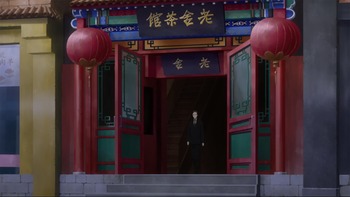
The Laoshe Teahouse appeared in Episode 6. The upper and lower plaques read “Laoshe Teahouse” and “Laoshe,” respectively.
Source: Night Raid 1931, Episode 6, 12:04.

At the level of spatial juxtaposition, these contradictions are presented through visual collision. Neoclassical buildings and modernist facades, as symbols of foreign rule, stand in sharp contrast to the intricate alleys and small shops of the old town (Lee Reference Lee2001: 37). Such a spatial arrangement exemplifies a defining principle of heterotopia: the capacity to place “in a single real place several spaces… that are in themselves incompatible” (Foucault Reference Foucault1986: 25). The anime follows this logic, re-presenting the incompatibility of Shanghai as a visible organization. The juxtaposition of signs in heterotopic spaces produces a “monstrous” bricolage that disrupts established cultural orders (Hetherington Reference Hetherington1997: 9). The collision of neoclassical architectural facades and traditional alleys thus becomes a semiotic disruption, forcibly combining signs that do not originally belong together.
Peter Johnson (Reference Johnson2006: 79), drawing on Foucault, describes this spatial contradiction as “relational marking”: an emplacement “defined by the relations of proximity between points or elements.” The Bund and the old town are not just independent spatial entities; rather, their respective meanings are entirely dependent on their proximity to and difference from each other. The Bund’s modernity can only be interpreted through its adjacency to the dilapidated state of the old town; conversely, the old town’s abjection is intensified by its geographical proximity to the Bund. In this sense, what the mato Shanghai presents is not simple spatial diversity but rather the spatial impossibility: spaces that are usually mutually exclusive. This, in turn, enables a site that “contradict[s] all the other sites” within a given culture (Foucault Reference Foucault1986: 24).
This spatial impossibility is not merely thematic but is technically produced by the medium itself. Thomas LaMarre (Reference Lamarre2009) argues that anime’s visual specificity lies in its compositing of multiple flat layers—background, middle ground, foreground, and character planes—stacked on the animation stand and moved laterally over one another. The resulting image is not constructed through a single unified perspective but through the relational tension between discrete visual planes. LaMarre terms the gap between these planes the “animetic interval”: the space where the force of the moving image is generated and redistributed (LaMarre Reference Lamarre2009: 7).Footnote 2 Different from cinematic animation, which resolves its layers into unified depth, the animated image allows the sliding of planes to remain palpable, distributing visual force laterally across the surface. The image thus produces a “distributive field” in which “movement into depth is replaced by density of information” (Lamarre Reference Lamarre2009: 133). Spatial elements are held in lateral coexistence rather than perspectival hierarchy; they occupy the same frame without being subordinated to a single organizing viewpoint.
This compositional logic provides the material-aesthetic condition for the heterotopic Shanghai analyzed above. The incompatible spaces analyzed above—concession modernity, old-town decay, and the supernatural underworld—are not resolved into a coherent spatial totality but sustained as co-present layers within the animated image. Because the anime composition already operates through the coexistence of discrete planes rather than their unification, the viewer encounters spatial impossibility not as a rupture in visual logic but as an extension of the medium’s ordinary mode of organizing space. Flat compositing thus structurally enacts the heterotopic principle of juxtaposition analyzed above. It is through this material-aesthetic infrastructure that the city can further function as a reflective surface for viewing historical subjectivity from a displaced position.
Beyond the physical juxtaposition of different sites, Foucault’s theoretical elaboration on mirrors reveals how Night Raid 1931 reflects the history of Japan through mato Shanghai. He describes the mirror as a quintessential heterotopia, a site in which the subject’s position is simultaneously present and absent, as the projected image can only be perceived through “this virtual point which is over there” (Foucault Reference Foucault1986: 24). What is important here is not the reflection as representation, but the displacement and the self-recognition that emerge by seeing oneself in the mirror. As Boyer suggests, this structure allows the subject to “reconstitute” itself through a mediated gaze. The mirror thus functions as a spatial technology of indirect self-perception.
Shanghai in Night Raid 1931 is constructed precisely as a heterotopic mirror that reflects the image and history of Japan in its own modernity. The year 1931 marks the beginning of Japan’s aggressive imperial expansion, as well as the start of a doomed defeat. By relocating this historical turning point to a fantastical Shanghai, the anime allows Japanese viewers to see themselves “there where they are not” (Foucault Reference Foucault1986: 24). They are able to detach from their present position and understand imperial subjectivity in an indirect manner. The mato, as a mirror, establishes a reflective mode of engagement mediated through spatial and temporal displacement. What emerges is the “double logic,” where contradictory dualities maintain the normality of everyday historical consciousness while simultaneously negating the illusions that structure it (Boyer Reference Boyer, Dehaene and De Cauter2008: 54–5). Shanghai as mato thus becomes a spatial tool that reorganizes historical visibility, allowing the modernity of the imperial period to manifest itself in the form of atmosphere, affect, and lost possibility. This reconfiguration then lays the foundation for subsequent narrative investments in memory, affect, and nostalgia, which will be examined in the next section.
The heterotopic power of mato Shanghai is further reinforced by Foucault’s fifth principle of heterotopia: a regulated system of opening and closing, which is capable of both isolating a site and making it conditionally accessible (Foucault Reference Foucault1986: 26). Access to Shanghai has historically been uneven at the spatial level. The city did not treat all subjects equally; access was determined by colonial jurisdiction, nationality, and legal status. In the anime, the protagonists, as Japanese citizens, can move freely across concession boundaries and operate in spaces that remain restricted or unstable for other inhabitants of the city.
This historical access mechanism, based on historical context, is further reinforced by the supernatural framework. In addition to privileged access to the colonial city, the protagonists, through their supernatural abilities, are the only ones who can enter and navigate the fictional mato layer of Shanghai. These abilities constitute a kind of liminality (Turner Reference Turner1969), positioning the protagonists as mediators between secular and supernatural worlds. As Buljan and Cusack (Reference Buljan and Cusack2015: 149) note, this structural function is common in many anime narratives involving supernatural powers, where these powers allow characters to access dimensions inaccessible to ordinary inhabitants. Supernatural perception and the mato layer of Shanghai form an interdependent relationship, each providing the conditions of possibility for the other. Therefore, this anime constructs a layered city in which legal and perceptual access reinforce one another, providing unequal mobility with historical justification and narrative necessity.
This restricted entry system reinforces the heterotopic logic of the anime. The supernatural elements highlight the impossibility of unmediated entry, emphasizing the boundaries that separate surface city from its hidden structures and historical reality from speculative reconstruction. In this way, Night Raid 1931 positions mato Shanghai as a space whose meaning emerges from the tension between accessibility and inaccessibility, laying the groundwork for its subsequent function as a reflective surface for processing memory, affect, and nostalgia.
Temporal displacement: suspended history and nostalgic return
Although set in 1931, the anime does not treat this year as a specific period for causal explanation or political reckoning. Instead, historical time is reorganized through temporal displacement, presenting a Shanghai that appears historically situated yet temporally detached from linear progression. This reorganization is achieved through what Foucault (Reference Foucault1986) describes as heterochrony: the suspension, layering, and discontinuity of time within heterotopic space. In Night Raid 1931, reference elements from different periods coexist with historical events, supernatural abilities integrate the future and the past into the present. Time does not progress toward a conclusion; it cycles, accumulates, and returns.
The temporal suspension is largely constructed through the supernatural abilities of the protagonists: Aoi’s ability to freeze time momentarily isolates moments from temporal flow; Yukina’s telepathy transcends temporal boundaries, enabling her to access the past through memories; and Kazura’s teleportation similarly disturbs temporal sequence through instantaneous spatial displacement. Collectively, these abilities break down chronological order and create a layered temporality in which past, present, and future coexist in an unstable relation.
The narrative weaves real events with fabricated plots, presenting both reality and fiction within a single narrative frame. Episode 8 centers on the Lytton Commission’s 1932 investigation in China, but twists this historical event by having the commissioners kidnapped by the villain using his supernatural abilities. Similarly, in Episode 3, the four major department stores—iconic landmarks of Shanghai—become the target of a bombing that never occurred in history. Such fabrication turns documented diplomatic events into scenes full of fantastical elements, and layers invented events onto real historical sites.
What is more inspiring is the temporal misalignment in the anime, which completely breaks the boundaries of chronological order. Episode 6, for instance, presents the “Lao She Teahouse” as a secret meeting place for Asian independence activists (Figure 2). However, this teahouse could not have existed in 1931 Shanghai—not only because it was never built but also because there is a time contradiction in the name itself. The play Teahouse by Chinese writer Lao She was not written until 1956, 25 years later than the anime’s setting. Therefore, this teahouse brings the cultural symbols of the future into the past, and this temporal impossibility cannot be explained as a simple production error. On the contrary, it shows how time works within mato: elements from different eras are mixed freely, completely regardless of the chronological order. This temporal instability aligns with what Jacques Derrida (Reference Derrida1994: 63) theorizes as hauntology: when “time is out of joint,” the past becomes neither fully present nor fully absent, but returns instead as a specter that can be rearranged.
In addition to the narrative effect, this temporal suspension also has specific cultural-political functions, especially reflected in the nostalgic structure built by the visual and narrative strategy of the anime. The nostalgia here is realized through two intertwined modes: one is restorative nostalgia, which seeks to reconstruct an imagined past into a coherent home; the other is reflective nostalgia, which is immersed in contradictions, loss, and cognition of the past that cannot be reproduced (Boym Reference Boym2001: 41, 49). Night Raid 1931 activates these two modes at the same time, thus forming a layered nostalgic structure, which is central to the interaction between history and the series.
At the visual level, the anime constructs the image of Shanghai through highly stylized aesthetic techniques. The frame of the landscape is shrouded in tan and dark gold filters; iconic architectural landmarks are presented with elaborate compositions; female characters wear qipao with form-fitting cuts, higher slits, and vivid colors—these details reflect contemporary aesthetic standards rather than historical dress norms. These elements function less as historical evidence than as aesthetic atmosphere, creating a sense of pastness through the reimagination of historical facts. This sense of nostalgia is achieved by appropriating “the ‘past’ through stylistic connotation, conveying ‘pastness’ by the glossy qualities of the image” (Jameson Reference Jameson1991: 19). Therefore, the visual language of this anime presents a version of “old Shanghai” that feels immediately legible while fundamentally contemporary in its aesthetic logic.
This aesthetic technique supports a restorative nostalgic impulse. The object of nostalgia here is not simply Shanghai as a lost city but also a particular vision of Japan’s historical position within Asia. For Japanese audiences, the mato Shanghai is a heterotopic mirror reflecting the Japanese imperial past. Visually, the narrow alleys are populated by Japanese military and spies; narratively, the story emphasizes the Japanese secret service agency within Chinese urban space. Together, they create an image of Japan, a modern force that once moved freely across Asia, claiming legitimacy for its regional expansion and occupation. By integrating this imperial existence within the aestheticized atmosphere of historical Shanghai, the anime symbolically reconstructs a past in which Japanese dominance appears less political and less violent. This nostalgic reimagination, therefore, actively reshapes a coherent memory about the Japanese empire.
Yet this restorative impulse is constantly disturbed by a parallel reflective nostalgia. While serving the Japanese state, the protagonists repeatedly express ethical doubts about Japan’s actions and discomfort with the consequences of invasion. However, it is noteworthy that this narrative emphasis on inner conflict does not develop into structural political critique; instead, it stays in the consciousness of the lost historical possibilities and tends to mourn the futures that never came (Boym Reference Boym2001: 8). In this sense, the nostalgic aesthetics of this anime is presented on two levels. It beautifies and depoliticizes imperial history, transforming invasion and occupation into an exotic experience while maintaining a melancholic attachment to the lost glories and unfulfilled ambitions. This tension constitutes the unique emotional tone of Night Raid 1931’s engagement with the past without developing into political reckoning.
However, this spectral temporality does carry a political consequence. By detaching 1931 from linear historical progression, the anime transforms ethical and political reality into an aesthetic object that can be consumed. This process exemplifies the characteristic of postmodern cultural production pointed out by Fredric Jameson (Reference Jameson1991: 24–5): the aestheticization of history while stripping away its political connotation. Supernatural elements play a key role in this process by turning history into entertainment. They enable the anime to revisit the period while dodging the weight of historical guilt and the ongoing domestic debates in Japan over World War II. In this way, entertainment becomes a protective frame for “safe” historical engagement. By minimizing the risk of political contestation, this strategic depoliticization also promotes the anime’s domestic reception and transnational circulation.
Such nostalgia mode constructs what Iwabuchi (Reference Iwabuchi2002: 174) identifies as a characteristic operation of Japanese media discourse: the positioning of Asia as the temporal site of Japan’s own past through nostalgic representation. As Iwabuchi further emphasizes, however, this operation depends on the suppression of a crucial historical fact—namely, that the very “vigor” evoked through nostalgia was inseparable from Japanese imperial and economic domination over other parts of Asia (Iwabuchi Reference Iwabuchi2002: 181). Applied to Night Raid 1931, this mechanism operates through a historical and temporal repositioning. The anime turns its spotlight onto 1931, the moment when the identity of Japan was still being imagined as “modern and Asian” (Tanaka Reference Tanaka1995: 2). This imagination was historically conditioned. During the Meiji period, admiration for Shanghai’s modernity remained prominent, yet by the Taishō and early Shōwa years, this attitude had gradually shifted toward a sense of having surpassed China as Asia’s most advanced nation (Fogel Reference Fogel1996; Liu Reference Liu2010). By 1931, such a perception of regional superiority reached its peak, just one step away from the outbreak of a full-scale war.
The anime transforms this historical positioning into narrative form. The protagonists perceive dimensions of reality that others cannot access, foresee futures that others cannot imagine, and move across space with exceptional ease; their abilities embody a form of Japanese privilege rooted in the narrative structure itself. What is foregrounded is not blatant political dominance over the Chinese, but a much more subtle asymmetry of agency and ontological cognition: the capacity to know, to move, and to intervene is granted to Japanese protagonists, thus strengthening their privileged position in the story world.
This configuration produces what might be called, following Iwabuchi (Reference Iwabuchi2002), a form of “trans/national recentering”—a mode that allows Japan to reaffirm its regional centrality through transnational cultural circulation rather than political domination, which in turn stages a return of Japan to Asian history at the level of cultural imagination. This kind of recentering does not seek to overwrite Asian histories but to reposition Japan within them as a mediating and interpretive presence. In Night Raid 1931, trans/national recentering is realized through the redistribution of narrative authority. By granting its Japanese protagonists the capacity to interpret Shanghai through the concept of mato, the anime situates Japan as a naturalized subject within Asian modernity. The city is no longer just a historical site but more like a semiotic field that can be interpreted, navigated, and understood from the perspective of Japan. Through this narrative arrangement, Japan’s regional presence is recentralized and compatible with transnational consumption, so that the symbolic central position can be circulated without relying on explicit assertions of power.
Conclusion
This study has explored the renewed appearance of 1931 Shanghai in Japanese anime and the cultural work performed by this return. Based on the analysis above, we can now address the two questions raised in the introduction regarding the motivation and mechanism behind the reimagining of mato Shanghai in Japanese anime.
The reimagining of 1931 Shanghai in Japanese anime is achieved through the strategic manipulation of time and space. Historical events are not treated as linear and factual but are suspended and transformed. By interweaving historical references with supernatural elements and stylized visuals, Night Raid 1931 constructs a Shanghai that is both familiar and fantastical, a space where past, present, and future coexist in a state of tension. This temporal and spatial displacement allows for the reconstruction of history not as a fixed narrative, but as a fluid and imaginative terrain with various interpretations and possibilities. The use of mato creates a space where Japan’s past presence in Asia can be reexamined in a way that allows for emotional engagement and cultural resonance.
This approach enables Japan to engage with its imperial past in a way that has not yet been resolved at the level of political responsibility. Night Raid 1931 generates a sense of proximity, positioning Japan as a participant in a shared Asian modernity through cultural and affective forms. In this sense, the series exemplifies a broader cultural shift in which Japan’s position within Asia is rearticulated through popular entertainment. The imaginative return to 1931 Shanghai thus consolidates a trans/national recentering, allowing Japan to reclaim its symbolic centrality within Asian history.
The enduring appeal of mato Shanghai highlights its value as a cultural resource. Through mato, those unresolved historical issues can continue to be discussed in popular media. Rather than demanding a historical closure, this mode of representation maintains an attachment to the past by keeping it imaginatively open and emotionally relatable. It is in this way that Night Raid 1931 demonstrates how anime can function as a medium of historical imagination: it stabilizes trans/national recentering while also foregrounding the tensions and ambiguities that persist in the cultural memory of East Asia.
Financial support
This research is funded by Shanghai International Studies University (41005093).
Competing interests
The author declares no conflict of interest.
Author Biography
Zihui Lu is a lecturer and postdoctoral researcher at the School of Japanese Studies, Shanghai University of International Studies. She received her PhD in Japanese Studies from the National University of Singapore, focusing on the manga, anime, and video game-adapted 2.5-dimensional theater. Zihui’s current research interests involve popular theater in Japan and China, Japanese popular culture, and media and technology in performance.


 Open access

