









1. Introduction
A positive integer is called $y$ -smooth if each of its prime factors does not exceed $y$
 . We denote the number of $y$
 -smooth integers not exceeding $x$
 by $\Psi (x,\,y)$
 . We assume throughout $x \ge y \ge 2$
 . Let $\rho \colon [0,\,\infty ) \to (0,\,\infty )$
 be the Dickman function, defined as $\rho (t)=1$
 for $t \in [0,\,1]$
 and via the delay differential equation $t \rho '(t) =-\rho (t-1)$
 for $t>1$
 . Dickman [Reference Dickman7] showed that

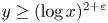
holds when $y \ge x^{\varepsilon }$ . For this reason, it is useful to introduce

De Bruijn [Reference de Bruijn3, Eqs. (1.3), (4.6)] showed that

when $x \to \infty$ and $(\log x)/2 >\log y > (\log x)^{5/8}$
 . Here and later $\gamma$
 is the Euler–Mascheroni constant. As we see, there is no arithmetic information in the leading behaviour of the error term $\Psi (x,\,y) - x \rho (u)$
 , and in particular it does not oscillate. Moreover, the error term is large: the saving (1.2) gives over the main term is merely $\asymp \log (u+1)/\log y$
 [Reference de Bruijn3, p. 56].
This begs the question, what is the correct main term for $\Psi (x,\,y)$ that leads to a small and arithmetically rich error term? De Bruijn [Reference de Bruijn3, Eq. (2.9)] introduced a refinement of $\rho$
 , often denoted $\lambda _y$
 :
:

if $y^u \notin \mathbb {Z}$ ; otherwise $\lambda _y(u)=\lambda _y(u+)$
 (one has $\lambda _y(u)= \lambda _y(u-)+O(1/x)$
 if $y^u \in \mathbb {Z}$
 [Reference de Bruijn3, p. 54]). The count $\Psi (x,\,y)$
 should be compared to

We refer the reader to de Bruijn's original paper for the motivation for this definition. In particular, $\Lambda$ satisfies the following continuous variant of Buchstab's identity:

for $y \le z$ , to be compared with $\Psi (x,\,y)=\Psi (x,\,z)-\sum _{y < p \le z}\Psi (x/p,\,p)$
 . De Bruijn proved [Reference de Bruijn3, Eq. (1.4)]

holds for $\log y > \sqrt {\log x}$ . Saias [Reference Saias17, Lem. 4] improved the range to $y \ge (\log x)^{1+\varepsilon }$
 . De Bruijn and Saias also provided asymptotic series expansion for $\lambda _y(u)$
 in (roughly) powers of $\log (u+1)/\log y$
 . Hildebrand and Tenenbaum [Reference Hildebrand and Tenenbaum14, Lem. 3.1] showed that for $y \ge (\log x)^{1+\varepsilon }$
 ,
,

for $y \ge (\log x)^{1+\varepsilon }$ . Implicit in the proof of proposition 4.1 of La Bretèche and Tenenbaum [Reference de la Bretèche and Tenenbaum5] is the estimate

for $y \ge (\log x)^{1+\varepsilon }$ where $\zeta$
 is the Riemann zeta function and $\xi \colon [1,\,\infty ) \to [0,\,\infty )$
 is defined via

We include as an appendix a proof in English of (1.5). The function $K$ originates in de Bruijn's work [Reference de Bruijn3, Eq. (2.8)]. Evidently, $K(0)=1$
 and $\lim _{t \to -1^+} K(t)= \infty$
 . Moreover, $K$
 is strictly decreasing in $(-1,\,0]$
 [Reference Gorodetsky9].
Suppose $\pi (x)=\mathrm {Li}(x)(1+O(\exp (-(\log x)^{a})))$ for some $a \in (0,\,1)$
 . Saias [Reference Saias17, Thm.], improving on De Bruijn [Reference de Bruijn3], proved that

holds in the range $\log y \ge (\log \log x)^{{1}/{a}+\varepsilon }$ . By the Vinogradov–Korobov zero-free region, we may take $a=3/5$
 . Saias writes without proof [Reference Saias17, p. 81] that under the Riemann hypothesis (RH) his methods give

in the range $y \ge (\log x)^{2+\varepsilon }$ , which recovers a conditional result of Hildebrand [Reference Hildebrand11].
1.1 $G$

Define the entire function $I(s)=\int _{0}^{s} \tfrac {e^v-1}{v}\,{\rm d}v$ . As shown in [Reference Hildebrand and Tenenbaum14, Lem. 2.6], the Laplace transform of $\rho$
 is
is

for all $s \in \mathbb {C}$ . In [Reference Gorodetsky9] we studied in detail the ratio

where

is the partial zeta function and

The function $G(s,\,y)$ is defined for $\Re s>0$
 such that $\zeta (s) \neq 0$
 . Informally, $G$
 carries information about the ratio $\Psi (x,\,y)/\Lambda (x,\,y)$
 , since $s\mapsto \zeta (s,\,y)/s$
 is the Mellin transform of $x\mapsto \Psi (x,\,y)$
 while $s\mapsto F(s,\,y)/s$
 is the Mellin transform of $x\mapsto \Lambda (x,\,y)$
 [Reference de Bruijn3, p. 54]. As in [Reference Gorodetsky9], it is essential to write $G$
 as $G_1 G_2$
 where
where

We assume $\log \zeta (s)$ is chosen to be real when $s>1$
 .
.
1.2 Main results
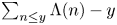
Let $\psi (y)=\sum _{n \le y}\Lambda (n)$ and
and

Theorem 1.1 Assume RH. Fix $\varepsilon \in (0,\,1)$ . Suppose that $x \ge C_{\varepsilon}$
 and $x^{1-\varepsilon } \ge y \ge (\log x)^{2+\varepsilon }$
 . Then

The following theorem gives an asymptotic formula for $\Psi (x,\,y)$ for $y$
 smaller than $(\log x)^{2}$
 .
.
Theorem 1.2 Assume RH. Fix $\varepsilon \in (0,\,1/3)$ . Suppose that $x \ge C_{\varepsilon}$
 and $(\log x)^{3} \ge y \ge (\log x)^{4/3+\varepsilon }$
 . Then

If $y \le (\log x)^{2-\varepsilon }$ then the error term can be improved to $O_{\varepsilon } ((\log x)^3/(y^2 \log y))$
 .
.
Theorems 1.1 and 1.2, proved in § 4, show that

holds when $y/((\log x)^{3/2}(\log \log x)^{-1/2}) \to \infty$ . This range is shown to be optimal in Theorem 2.14 of [Reference Gorodetsky9]. The same theorem also supplies an alternative proof of theorem 1.2 when $y \le (\log x)^{2-\varepsilon }$
 (the proof can be adapted to cover $(\log x)^{2-\varepsilon } \le y \le (\log x)^3$
 as well).
Hildebrand showed that RH is equivalent to $\Psi (x,\,y) \asymp _{\varepsilon } x\rho (u)$ for $y \ge (\log x)^{2+\varepsilon }$
 [Reference Hildebrand11]. He conjectured that $\Psi (x,\,y)$
 is not of size $\asymp x\rho (u)$
 when $y \le (\log x)^{2-\varepsilon }$
 [Reference Hildebrand12]. This was recently confirmed by the author [Reference Gorodetsky9]. This also follows (under RH) from theorem 1.2, since $\Lambda (x,\,y) \asymp _{\varepsilon } x\rho (u)$
 for $y \ge (\log x)^{1+\varepsilon }$
 while (under RH) $G(\beta,\,y) \to \infty$
 when $y \le (\log x)^{2-\varepsilon }$
 and $x \to \infty$
 (this follows from the estimates for $G$
 in [Reference Gorodetsky9], see § 2).
Theorems 1.1 and 1.2 and their proofs have their origin in our work in the polynomial setting [Reference Gorodetsky10], where $\Psi (x,\,y)$ corresponds to the number of $m$
 -smooth polynomials of degree $n$
 over a finite field, while $\Lambda (x,\,y)$
 is analogous to the number of $m$
 -smooth permutations of $S_n$
 (multiplied by $q^n/n!$
 ). In that setting, the analogue of $G_1(s,\,y)$
 is identically $1$
 (the relevant zeta function has no zeros) which makes the analysis unconditional.
1.3 Applications: sign changes and biases
From theorem 1.1 we deduce in § 2.2 the following
Corollary 1.3 Assume RH. Fix $\varepsilon \in (0,\,1)$ . Suppose that $x\ge C_{\varepsilon}$
 and $x^{1-\varepsilon } \ge y \ge (\log x)^{2+\varepsilon }$
 . Then
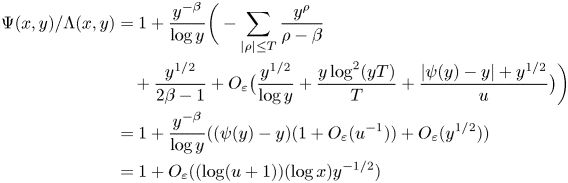
holds for $T \ge 4$ , where the sum is over zeros of $\zeta$
 .
.
Corollary 1.3 implies that large positive (resp. negative) values of $\psi (y)-y$ lead to large positive (resp. negative) values of $\Psi (x,\,y) -\Lambda (x,\,y)$
 and vice versa. Large and small values of $\psi (y)-y$
 were exhibited by Littlewood [Reference Montgomery and Vaughan15, Thm. 15.11]. Note that corollary 1.3 sharpens (1.7) if $y \le x^{1-\varepsilon }$
 .Footnote 1
Let $\pi (x)$ be the count of primes up to $x$
 and $\mathrm {Li}(x)$
 be the logarithmic integral. It is known that $\pi (x)-\mathrm {Li}(x)$
 is biased towards positive values in the following sense. Assuming RH and the Linear Independence hypothesis (LI) for zeros of $\zeta$
 , Rubinstein and Sarnak [Reference Rubinstein and Sarnak16] showed that the set

has logarithmic density $\approx 0.999997$ . This is an Archimedean analogue of the classical Chebyshev's bias on primes in arithmetic progressions. We use corollary 1.3 to exhibit a similar bias for smooth integers. Let us fix the value of $\beta =1-\xi (u)/\log y$
 to be
to be

where $\beta _0 \in (1/2,\,1)$ . This amounts to restricting $x$
 to be a function $x=x(y)$
 of $y$
 defined by

In particular, $y=(\log x)^{1/(1-\beta _0)+o(1)}$ . Then corollary 1.3 shows
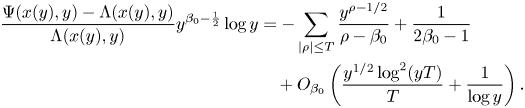
Applying the formalism of Akbary et al. [Reference Akbary, Ng and Shahabi1] to the right-hand side of (1.14) we deduce immediately
Corollary 1.4 Assume RH. Assume LI for $\zeta$ . Fix $\beta _0 \in (1/2,\,1)$
 and let $x$
 be a function of $y$
 defined as in (1.13). Then the set

has logarithmic density greater than $1/2$ , and the left-hand side of (1.14) has a limiting distribution in logarithmic sense.
In the same way that Chebyshev's bias for primes relates to the contribution of prime squares, this is also the case for smooth integers. Writing $G$ as $G_1 G_2$
 as in § 1.1, $G_2$
 captures the contribution of proper powers of primes. When $\beta _0 \in (1/2,\,1)$
 , the only significant term in $G_2(\beta _0,\,y)$
 is $k=2$
 , which corresponds to squares of primes. The squares lead to the term $y^{1/2}/(2\beta _0-1)$
 in (1.14) which creates the bias.
Remark 1.5 Consider the arithmetic function $\alpha _y(n)$ defined implicitly via

This function is supported on $y$ -smooth numbers and coincides with the indicator of $y$
 -smooth numbers on squarefree integers. Working with the summatory function of $\alpha _y$
 instead of $\Psi (x,\,y)$
 , the bias discussed above disappears. This is because, modifying the proof of theorem 1.1, one finds that

holds in $x^{1-\varepsilon } \ge y \ge (\log x)^{2+\varepsilon }$ , meaning the bias-causing factor $G_2(\beta,\,y)$
 does not arise. This is analogous to how the indicator function of primes is biased, while $\Lambda (n)/\log n$
 is not.
Remark 1.6 It is interesting to see if one can formulate and prove variants of corollaries 1.3 and 1.4 in the range $y \le (\log x)^{1-\varepsilon }$ . In this range, an accurate main term for $\Psi (x,\,y)$
 was established in [Reference de la Bretèche and Tenenbaum6].
1.4 Strategy behind theorems 1.1 and 1.2
We write $\Psi (x,\,y)$ as a Perron integral, at least for non-integer $x$
 :
:

where $\sigma$ can be any positive real. For non-integer $x$
 we also have

whenever $\sigma >\varepsilon$ and $y \ge C_{\varepsilon}$
 . Indeed, the Laplace inversion formula expresses $\Lambda (x,\,y)$
 as
as
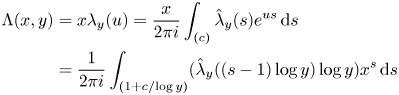
for any $c$ such that
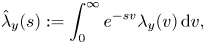
converges absolutely for $\Re s \ge c$ . In particular, we may take $c>-(\log y)/(1+\varepsilon )$
 if we assume $y\ge C_{\varepsilon}$
 , as Saias showed, see corollary A.2. As shown by de Bruijn [Reference de Bruijn3, Eq. (2.6)] (cf. [Reference Saias17, Lem. 6]),

By definition of $F$ , (1.9), we can rewrite (1.16) as (1.15). As Saias does, we choose to work with $\sigma =\beta$
 , which is essentially a saddle point for $F(s,\,y)x^s$
 . If $x \ge y \ge (\log x)^{1+\varepsilon }$
 and $x \ge C_{\varepsilon}$
 then lemma 2.1 implies

Saias proved (1.6) by showing that $\zeta (s,\,y)$ and $F(s,\,y)$
 are close and so if we subtract

then we can bound the integral by using pointwise bounds for the integrand. Instead of subtracting $\Lambda (x,\,y)$ , we subtract $\Lambda (x,\,y)$
 times $G(\beta,\,y)$
 , which leads to

We want to bound the integral in (1.18). The proof of theorem 1.1 considers separately the range

and its complement. When $u$ satisfies (1.19), then in (1.18) one needs only small values of $\Re s$
 to estimate the integral ($|\Re s| \le 1/\log y$
 ) with arbitrary power saving in $y$
 . This is an unconditional observation established in proposition 3.1. However, for smaller $u$
 , one needs $|\Re s|$
 going up to a power of $y$
 if one desires power saving in $y$
 , which makes the proof more involved.
In our proofs, RH is only invoked at the very end to estimate $G_1$ and its derivatives. For instance, in the range where (1.19) and $y \ge (\log x)^{2+\varepsilon }$
 hold, we prove in (4.12) the unconditional estimate
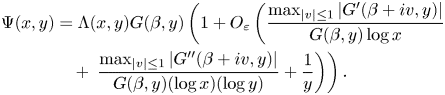
See (4.16) for a similar estimate for $u \le (\log y)(\log \log y)^3$ . In particular, our proofs are easily modified to recover (1.6).
Conventions
The letters $C,\,c$ denote absolute positive constants that may change between different occurrences. We denote by $C_{\varepsilon },\,c_{\varepsilon }$
 positive constants depending only on $\varepsilon$
 , which may also change between different occurrences. The notation $A \ll B$
 means $|A| \le C B$
 for some absolute constant $C$
 , and $A\ll _{\varepsilon } B$
 means $|A| \le C_{\varepsilon } B$
 . We write $A \asymp B$
 to mean $C_1 B \le A \le C_2 B$
 for some absolute positive constants $C_i$
 , and $A \asymp _{\varepsilon } B$
 means $C_i$
 may depend on $\varepsilon$
 . The letter $\rho$
 will always indicate a non-trivial zero of $\zeta$
 . When we differentiate a bivariate function, we always do so with respect to the first variable. We set

2. Preliminaries
2.1 Standard lemmas
Recall $\beta$ was defined in (1.10).
Lemma 2.1 [Reference Hildebrand and Tenenbaum13, Lem. 1] For $u \ge 3$ we have $\xi (u) = \log u + \log \log u + O( (\log \log u) / \log u)$
 . In particular,

Lemma 2.2 [Reference de Bruijn2]
For $u \ge 1$ we have $\rho (u) \asymp e^{-u\xi +I(\xi )} u^{-1/2} = x^{\beta -1} e^{I(\xi )}u^{-1/2}$
 .
.
In the next lemmas we write $s \in \mathbb {C}$ as $s=\sigma + it$
 .
.
Lemma 2.3 [Reference Montgomery and Vaughan15, Cor. 10.5] For $|\sigma | \le A$ and $|t| \ge 1$
 , $|\zeta (s)| \asymp _A (|t|+4)^{1/2-\sigma }|\zeta (1-s)|$
 .
.
Lemma 2.4 [Reference Montgomery and Vaughan15, Cor. 1.17] Fix $\varepsilon >0$ . For $\sigma \in [\varepsilon,\,2]$
 and $|t| \ge 1$
 we have

Lemma 2.5 [Reference Titchmarsh19, Thm. 7.2(A)]
We have, for $\sigma \in [1/2,\,2]$ and $T \ge 2$
 ,
,

Lemma 2.6 [Reference Hildebrand and Tenenbaum14, Lem. 2.7] The following bounds hold for $s=-\xi (u)+it$ :
:
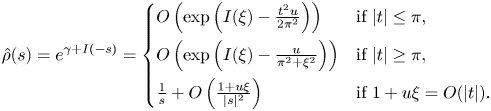
The third case of lemma 2.6 is usually stated in the range $1+u\xi \le |t|$ , but the same proof works for $1+u\xi = O(|t|)$
 . Since $1+u\xi =e^{\xi }$
 , the third case can also be written as

for $s=\sigma +it$ , assuming $\sigma <0$
 and $e^{-\sigma } =O(|t|)$
 . The following lemma is a variant of [Reference Hildebrand and Tenenbaum13, Lem. 8], proved in the same way.
Lemma 2.7 [Reference Hildebrand and Tenenbaum13]
Fix $\varepsilon >0$ . Suppose $x \ge y \ge (\log x)^{1+\varepsilon }$
 and $x \ge C_{\varepsilon}$
 . For $|t| \le 1/\log y$
 ,
,

For $1/\log y \le |t| \le \exp ((\log y)^{3/2-\varepsilon })$ ,
,

2.2 More on $G$

Lemma 2.8 [Reference Gorodetsky9]
Fix $0 \le i \le 4$ . Let $y \ge 4$
 . Let $s \in \mathbb {C}$
 with $\Re s \in [0,\,1]$
 and the property that

Then for $T \ge 3+|\Im s|$ we have
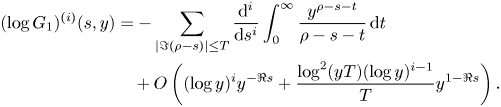
Corollary 2.9 Fix $0 \le i \le 4$ . Let $y \ge 4$
 . Let $s \in \mathbb {C}$
 with $\Re s \in [0,\,1]$
 . If $|\Im s| \le 1$
 we have $(\log G_1)^{(i)}(s,\,y) \ll L(y)^{-c} y^{1-\Re s}$
 unconditionally. Under RH, if $T \ge 4$
 and $|\Im s| \le 1$
 then
then

Under RH, if $T \ge 4$ , $\Re s \in [3/4,\,1]$
 and $|\Im s| \le y^{9/10}$
 then
then

Proof. If $|\Im s| \le 1$ then (2.5) holds. It is easily seen that, for any zero $\rho$
 of $\zeta$
 ,
,

if (2.5) holds. We apply lemma 2.8 with $T=L(y)^c$ and use the Vinogradov–Korobov zero-free region and (2.9) to simplify. Now assume RH, i.e. $|y^{\rho }|=y^{1/2}$
 . We demonstrate (2.7), and (2.8) is proved along similar lines. We apply lemma 2.8 with $T\ge 4$
 and simplify it using (2.9). We bound the resulting error using the facts $\min _{t \ge 0}|\rho -s-t| \asymp |\rho -s|$
 and $\sum _{\rho } 1/|\rho -s|^2 \ll 1$
 for $|s|\le 2$
 , since there are $\ll \log T$
 zeros of $\zeta$
 between height $T$
 and $T+1$
 [Reference Montgomery and Vaughan15, Thm. 10.13]. This gives the first equality in (2.7). The second equality in (2.7) follows by taking $T=y$
 , recalling the classical estimate
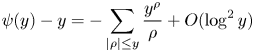
given in [Reference Montgomery and Vaughan15, Thm. 12.5] (it also follows from lemma 2.8 with $(i,\,s,\,T)=(1,\,0,\,y)$ ), and the bound $\sum _{\rho } 1/(|\rho -s||\rho |) \ll 1$
 . The last inequality in (2.7) is von Koch's bound $\psi (y)-y=O(y^{1/2}\log ^2 y)$
 [Reference von Koch20].
We turn to $G_2$ . By the non-negativity of the coefficients of $\log G_2$
 , for $i \ge 0$
 and $\Re s>0$
 we have

Lemma 2.10 [Reference Gorodetsky9]
Fix $\varepsilon >0$ and $0 \le i \le 4$
 . For $y \ge 2$
 and $1 \ge s \ge \varepsilon$
 ,
,
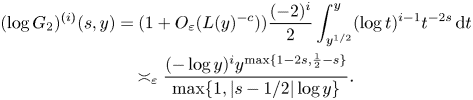
Corollary 2.9 and lemma 2.10, applied with $i=0$ , imply the following
Lemma 2.11 Assume RH. Fix $\varepsilon >0$ . If $1 \ge s \ge 1/2+\varepsilon$
 and $T \ge 4$
 then
then

Corollary 1.3 follows from theorem 1.1 by simplifying $G(\beta,\,y)$ using lemma 2.11 and (2.1).
3. Truncation estimates for $\Psi$ and $\Lambda$


The purpose of this section is to prove the following two propositions.
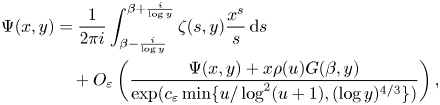
Proposition 3.1 Medium $u$

Suppose $x \ge y \ge 2$ satisfy

Fix $\varepsilon >0$ . Suppose $y \ge (\log x)^{1+\varepsilon }$
 and $x \ge C_{\varepsilon}$
 . Then

Proposition 3.2 Small $u$

Suppose $x \ge y \ge 2$ satisfy

Suppose $x \ge C$ and let $T \in [(\log x)^5,\,x\rho (u)]$
 . Then

3.1 Preparation
Lemma 3.3 Fix $\varepsilon \in (0,\,1)$ . For $\sigma \in [\varepsilon,\,1]$
 and $x \ge T \ge 2$
 we have

The integral should be understood in principal value sense. Lemma 3.3 makes more precise a computation done in p. 96 of Saias’ paper [Reference Saias17] (cf. [Reference Tenenbaum18, p. 537]), which is not stated for general $T$ and $\sigma$
 but contains the same ideas.
Proof. By [Reference Titchmarsh19, Thm. 4.11], for every $r>0$ we have

as long as $s \neq 1$ , $\Re s \ge \varepsilon$
 and $|\Im s|\le 2r$
 . Suppose $s=\sigma +it$
 with $|t| \ge 1$
 . We apply this estimate with $r=|t|$
 , obtaining

We now plug (3.4) in the left-hand side of (3.3). The contribution of the error term to the integral is acceptable:

The contribution of $n^{-s} \mathbf {1}_{n\le |t|}$ in (3.4) to the left-hand side of (3.3) is

Since

by the truncated Perron's formula [Reference Hildebrand and Tenenbaum14, p. 435], and

by Perron's formula, it follows that the integral in (3.5) is bounded by

and so the total contribution of the $n$ -sum in (3.4) to the left-hand side of (3.3) is

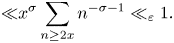
It remains to estimate (3.6), which we do according to the size of $n$ . The contribution of $n \ge 2x$
 is
is
The contribution of $n \in (x/2,\,2x)$ can be bounded by considering separately the $n$
 closest to $x$
 , and partitioning the rest of the $n$
 s according to the value of $k\ge 0$
 for which $|\log (x/n)| \in [2^{-k},\,2^{1-k})$
 :
:

The contribution of $n \le T/2$ is
is

Finally, the contribution of $T/2< n\le x/2$ is
is

acceptable as well.
Corollary 3.4 Fix $\varepsilon \in (0,\,1)$ . Suppose $x \ge y \ge C_{\varepsilon}$
 . For $\sigma \in [\varepsilon,\,1]$
 and $x \ge T \ge \max \{2,\,y^{1-\sigma }/\log y\}$
 we have

Corollary 3.4 rests on lemma 3.3, and makes more precise Proposition 2 of Saias [Reference Saias17].
Proof. Our starting point is the identity (1.15). (If $x \in \mathbb {Z}$ it still holds with an error term of $O(1)$
 , since the integral converges to the average $(\Lambda (x+,\,y)+\Lambda (x-,\,y))/2 = \Lambda (x,\,y)+O(1)$
 .) From that identity it follows that our task is equivalent to upper bounding

Recall $F(s,\,y) = \hat {\rho }((s-1)\log y)\zeta (s)(s-1)\log y$ . By (2.3) with $(s-1)\log y$
 instead of $s$
 we find

if $y^{1-\sigma } = O(|t| \log y)$ , which holds by our assumptions on $T$
 . By the triangle inequality,
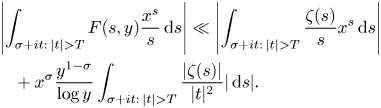
The first integral in the right-hand side of (3.7) is estimated in lemma 3.3. To bound the second integral we apply the second moment estimate for $\zeta$ given in lemma 2.5. We first suppose that $\sigma \ge 1/2$
 . Using Cauchy–Schwarz, the second integral in the right-hand side of (3.7) is at most

Multiplying this by the prefactor $x^{\sigma }y^{1-\sigma }/\log y$ , we see that this is acceptable. If $\varepsilon \le \sigma \le 1/2$
 we use lemma 2.3. We obtain that the second integral in the right-hand side of (3.7) is at most

concluding the proof.
Let $\alpha =\alpha (x,\,y)$ be the saddle point associated with $y$
 -smooth numbers up to $x$
 [Reference Hildebrand and Tenenbaum13], that is, the minimizer of the convex function $s\mapsto x^s \zeta (s,\,y)$
 ($s>0$
 ).
).
Lemma 3.5 For $\sigma \in (0,\,1]$ , $x\ge y \ge C$
 and $T \ge 2$
 we have

Our proof makes more precise a similar estimate appearing in Saias [Reference Saias17, p. 98], which does not allow general $y$ and $T$
 but contains the main ideas.
Proof. The truncated Perron's formula [Reference Hildebrand and Tenenbaum14, p. 435] bounds the error in (3.10) by
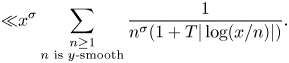
The contribution of the terms with $|\log (x/n)|\ge 1$ is
is
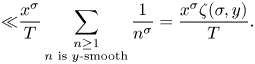
We now study the terms with $|\log (x/n)|<1$ . These contribute
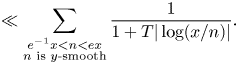
The subset of terms with $|\log (x/n)| \le 1/T$ contributes to (3.11)

The contribution of the rest of the terms to (3.11), namely, those terms with $1/T<|\log (x/n)| <1$ , can be dyadically dissected to terms with $|\log (x/n)| \in [2^{-k},\,2^{1-k})$
 for each integer $k\ge 1$
 such that $2^k<2\,T$
 holds. Their total contribution is

where $\log _2$ is the base-2 logarithm. (We interpret $\Psi (a,\,y)$
 for negative $a$
 as equal to $0$
 .) Note that the sum in (3.13) dominates the right-hand side of (3.12). We shall make use of Hildebrand's inequality $\Psi (a+b,\,y)-\Psi (a,\,y) \le \Psi (b,\,y)$
 , valid for $y \ge C$
 and $a,\,b \ge y$
 . It implies

for $y\ge C$ and all $a,\,b$
 . We apply (3.14) with $a=x-Cx/2^k$
 and $b=2Cx/2^k$
 to find that (3.13) is bounded by

where in the second inequality we replaced $\Psi (Cx,\,y)$ with $\Psi (x,\,y)$
 using [Reference Hildebrand and Tenenbaum13, Thm. 3]. To conclude, we recall Theorem 2.4 of [Reference de la Bretèche and Tenenbaum5] says $\Psi (x/d,\,y) \ll \Psi (x,\,y)/d^{\alpha }$
 holds for $x \ge y \ge 2$
 and $1 \le d \le x$
 . We apply this inequality with $d=2^k$
 and obtain

as needed.
3.2 Proof of proposition 3.1
We first truncate the Perron integral for $\Psi (x,\,y)$ . We apply lemma 3.5 with $\sigma = \beta$
 and $T=\exp ((\log y)^{4/3})$
 . The assumption $y \ge (\log x)^{1+\varepsilon }$
 implies $\beta \gg _{\varepsilon } 1$
 and $\Psi (x,\,y) \ge x^{c_{\varepsilon }}$
 . Since $\alpha =\beta +O(1/\log y)$
 [Reference Hildebrand and Tenenbaum13, Lem. 2] it follows that $\alpha \gg _{\varepsilon } 1$
 and so

We use lemma 2.7 to bound the contribution of $1/\log y \le |\Im s| \le T$ :
:
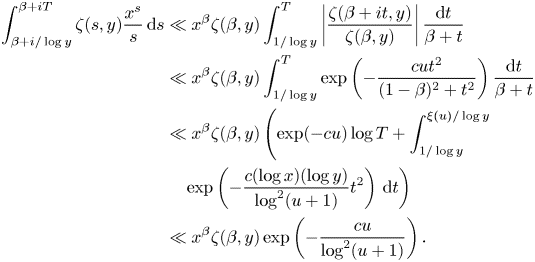
We estimate $x^{\beta } \zeta (\beta,\,y)$ :
:

using (1.9) and lemma 2.2. Finally, note that both $T$ and $\exp (u/\log ^2(u+1))$
 grow faster than any power of $\log x$
 . We turn to $\Lambda (x,\,y)$
 . We apply corollary 3.4 with $\sigma =\beta$
 and
and

We obtain

We now treat the range $1/\log y\le | \Im s| \le T$ . By the definition of $F$
 ,
,

First suppose $t \ge \pi /\log y$ . By the second case of lemma 2.6, this range contributes
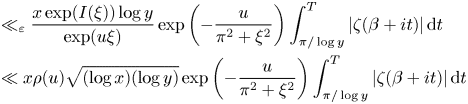
using lemma 2.2 in the second inequality. Recall the second moment estimate for $\zeta$ given in lemma 2.5. It shows that right-hand side of (3.20) is bounded by

where we used the functional equation if $\beta < 1/2$ (lemma 2.3). The contribution of $1/\log y \le t \le \pi /\log y$
 to the right-hand side of (3.19) is treated using the first part of lemma 2.6, and we find that it is at most

using lemma 2.2 in the second inequality. In conclusion,

where
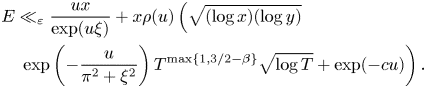
By our choice of $T$ and assumptions on $u$
 and $y$
 , this can be absorbed in the error term of (3.2).
3.3 Proof of proposition 3.2
We first truncate the Perron integral for $\Psi (x,\,y)$ . We apply lemma 3.5 with $\sigma =\beta$
 and our $T$
 , finding

In the considered range, $\Psi (x,\,y) \asymp x \rho (u)$ . In particular, the error term $O(1)$
 is acceptable since our $T$
 is $\ll x\rho (u) \ll \Psi (x,\,y)$
 and so $1 \ll \Psi (x,\,y) /T^{4/5}$
 . Additionally, $\beta \sim 1$
 as $x \to \infty$
 by lemma 2.1 and $\alpha =\beta +O(1/\log y)$
 [Reference Hildebrand and Tenenbaum13, Lem. 2], so $\alpha \sim 1$
 . This implies that $(\log T)/T^{\alpha } \ll 1/T^{4/5}$
 and the error term $O(\Psi (x,\,y)(\log T)/T^{\alpha })$
 is also acceptable. The estimate (3.18) treats the last error term and finishes the estimation. We turn to $\Lambda (x,\,y)$
 . We apply corollary 3.4 with our $T$
 , obtaining

In our range $x\rho (u) \asymp x^{1+o(1)}$ , so the term $\log x$
 is acceptable. We have $\exp (-u\xi ) u\log (u+1) \ll \rho (u)$
 by lemma 2.2, so the second term in the error term of (3.23) is also acceptable.
4. Proofs of theorems 1.1 and 1.2
Proposition 4.1 Medium $u$

Suppose $x \ge y \ge 2$ satisfy

Fix $\varepsilon >0$ and suppose $y \ge (\log x)^{1+\varepsilon }$
 and $x \ge C_{\varepsilon}$
 . Let
. Let

Then $\Psi (x,\,y) = \Lambda (x,\,y) G(\beta,\,y) ( 1 + E)$ for
for

Proof. Our strategy is to establish $\Psi (x,\,y) = \Lambda (x,\,y) G(\beta,\,y) (1 + E_1 + E_2) + E_3$ for
for
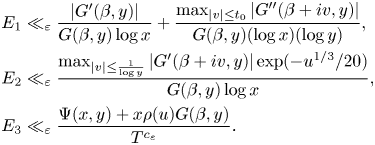
The theorem will then follow by rearranging, once we recall that $x\rho (u) \asymp _{\varepsilon } \Lambda (x,\,y)$ . From proposition 3.1,

which explains $E_3$ . Let $t_0$
 be as in the statement of the proposition. We upper bound the contribution of $t_0 \le |\Im s| \le 1/\log y$
 to the integral in the right-hand side of (4.2). We have

The triangle inequality shows, by definition of $F$ , that
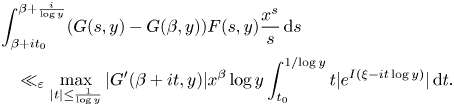
Since $-e^{-v^2/2}$ is the antiderivative of $e^{-v^2/2}v$
 , the first part of lemma 2.6 shows

Hence, $t_0 \le |\Im s| \le 1/\log y$ contributes in total

where we used lemma 2.2 to simplify. Once we divide this by $\Lambda (x,\,y)G(\beta,\,y) \asymp _{\varepsilon } x\rho (u)G(\beta,\,y)$ we obtain the error term $E_2$
 . It remains to study the contribution of $|\Im s|\le t_0$
 to the integral in the right-hand side of (4.2), which will yield $E_1$
 . We Taylor-expand the integrand at $s=\beta$
 . We write $s=\beta +it$
 , $|t|\le t_0$
 . We first simplify the integrand using the definition of $F$
 :
:

We Taylor-expand $\log K(s-1)$ and $G(s,\,y)-G(\beta,\,y)$
 :
:

We expand $I(\xi -it \log y)-I(\xi )+it \log x$ :
:

where we used $I'(\xi (u))=u$ and $I^{(3)}(\xi (u)+it) \ll e^{\xi (u)}/(1+\xi (u)) \asymp u$
 . This implies

for $|t| \le t_0$ . By two basic properties of moments of the Gaussian,
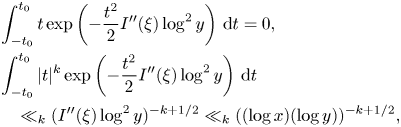
we find
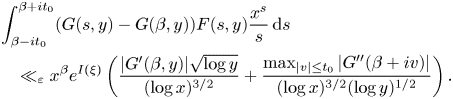
By lemma 2.2, we can replace $x^{\beta } e^{I(\xi )}$ with $x\rho (u)\sqrt {u}$
 , to obtain
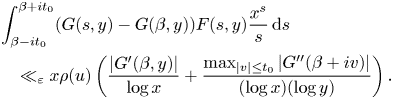
Dividing by $G(\beta,\,y)\Lambda (x,\,y) \asymp _{\varepsilon } G(\beta,\,y) x\rho (u)$ gives the error term $E_1$
 .
.
Proposition 4.2 Small $u$

Suppose $x \ge y \ge C$ satisfy

Let

Then $\Psi (x,\,y) = \Lambda (x,\,y) G(\beta,\,y) ( 1 + E)$ for
for
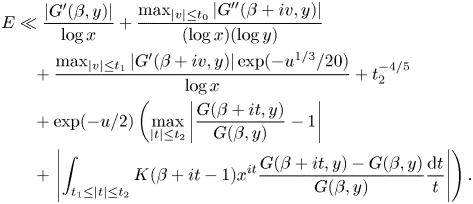
Proof. Our strategy is to establish $\Psi (x,\,y) = \Lambda (x,\,y) G( \beta,\,y) (1 + E_1 + E_2 + E_3 + E_4) + E_5$ for
for
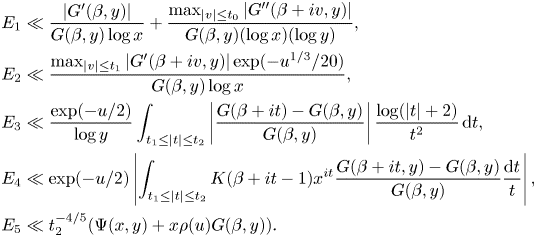
The proposition will then follow by rearranging and the fact that $G(\beta,\,y) \asymp 1$ in the considered range, unconditionally, as follows from corollary 2.9 and lemma 2.10. From proposition 3.2 with $T=t_2$
 ,
,
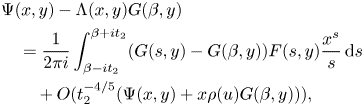
which explains $E_5$ . For $|\Im s| \le t_0$
 , we Taylor-expand $I(\xi -it\log y)$
 as in the medium $u$
 range and obtain the contribution of $E_1$
 (see (4.7)) We treat the contribution of $|\Im s| \in [t_0,\,t_1]$
 . We replace $G(s,\,y)-G( \beta,\,y)$
 with
with

The first two parts of lemma 2.6 show
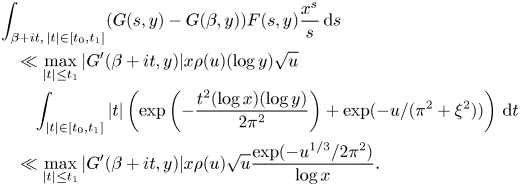
This explains $E_2$ . It remains to consider $t_2 \ge |\Im s| \ge t_1$
 . We use the third part of lemma 2.6 to replace $\hat {\rho }((s-1)\log y)$
 , appearing in $F(s,\,y)$
 , with its approximation:
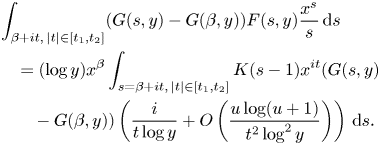
Recall $x^{ \beta } \ll x\rho (u) \sqrt {u} \exp (-I(\xi (u)))$ by lemma 2.2, and that $I(\xi (u)) \sim u$
 since a change of variables shows $I(r)= \mathrm {Li}(e^r)+O(\log r)\sim e^r/r$
 . The contribution of the error term in the right-hand side of (4.11) is

If $|t|\le 2$ we use $|\zeta ( \beta +it)( \beta +it-1)| \ll 1$
 while if $|t| \ge 2$
 we use lemma 2.4, to obtain an error term of size $E_3$
 . The main term of (4.11) gives $E_4$
 .
.
4.1 Proof of theorem 1.1: medium $u$

Here we prove theorem 1.1 in the range (1.19). We obtain from proposition 4.1 that unconditionally

for

Because we assume $y \ge (\log x)^{2+\varepsilon }$ , we have $\beta \ge 1/2+ c_{\varepsilon }$
 . Under RH, $\log G(\beta,\,y) = O_{\varepsilon }(1)$
 by lemma 2.11. To bound the quantities appearing in $E$
 , we write $G(\beta +it,\,y)$
 as $G_1(\beta +it,\,y)$
 times $G_2(\beta +it,\,y)$
 . Lemma 2.10 and equation (2.11) tell us that

for $i=0,\,1,\,2$ and $t \in \mathbb {R}$
 . Corollary 2.9 says that under RH

for all $i=0,\,1,\,2$ and $|t|\le 1$
 . Putting these two together, one obtains (1.11).
4.2 Proof of theorem 1.1: small $u$

Here we prove theorem 1.1 for $u$ in the range (4.8). In this range, $\beta =1+o(1)$
 and $\Psi (x,\,y)=x^{1+o(1)}$
 . Moreover, $\log G(\beta,\,y) = O(1)$
 unconditionally by corollary 2.9 and lemma 2.10. The hardest range of the proof will be $u\asymp 1$
 . Before proceeding with the actual proof, note that from proposition 4.2 and the triangle inequality, it follows that

holds unconditionally for $t_2 \in [(\log x)^5,\, y^{4/5}]$ and the range $x \ge y \ge C$
 , $u \le (\log y)(\log \log y)^3$
 .
.
We obtain from proposition 4.2 with $t_2=y^{4/5}$ that
that

for $E_i$ bounded in (4.10). We write $G(\beta +it,\,y)$
 as $G_1(\beta +it,\,y)$
 times $G_2(\beta +it,\,y)$
 . By lemma 2.10 and (2.11),

for $i=0,\,1,\,2$ and $t \in \mathbb {R}$
 where we simplified $y^{-\beta }$
 using (2.1). From now on we assume RH. Corollary 2.9 implies

for $i=0,\,1,\,2$ when $|t|\le 1$
 . As in the medium $u$
 case, one can bound $E_1$
 by an acceptable quantity using our estimates for $(\log G_1)^{(i)}$
 and $(\log G_2)^{(i)}$
 . Recall

where $t_1 = u\log (u+1)/\log y$ . If $t_1 \le 1$
 we bound $E_2$
 in the same way we bounded $E_1$
 . Otherwise we use (2.8), which implies that

holds for $i=0,\,1,\,2$ and $|t|\le y^{9/10}$
 . This shows that, if $t_1>1$
 , i.e. $u\log (u+1)\ge \log y$
 ,
,

This is an acceptable contribution when $u\log (u+1)> \log y$ . We now study $E_3$
 and $E_4$
 . Due to $G(\beta +it,\,y)/G(\beta,\,y)$
 being very close to $1$
 in our considered range by (4.17) and (4.19), we may replace

by

and incur a negligible error, in both $E_3$ and $E_4$
 . So to show $E_3$
 is acceptable we need to prove

This is shown using the bound

which is a consequence of (2.8) and (4.17). To handle $E_4$ it remains to prove
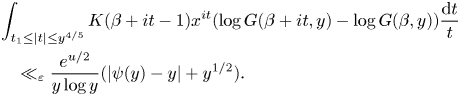
Here we cannot use the triangle inequality and put absolute value inside the integral. Indeed, if we use the pointwise bound (4.21), along with our bounds for $\zeta$ (lemmas 2.4 and 2.5), we get a bound which falls short by a factor of $(\log y)^3$
 . We shall overcome this by several integrations by parts as we now describe.
To deal with the contribution of $\log G(\beta,\,y)$ to (4.22) we use (4.21) with $t=0$
 along with the bound

which follows by integration by parts, where we replace $x^{it}$ by its antiderivative $x^{it}/\log x$
 .
.
Note that due to integration by parts, derivatives of $\zeta$ arise. This means that in addition to lemmas 2.4 and 2.5 we need the bounds $\zeta ^{(k)}(s) \ll _k (1+(|t|+4)^{1-\sigma })\log ^{k+1}(|t|+4)$
 and $\int _{1}^{T} |\zeta ^{(k)}(\sigma +it)|^2 \,{\rm d}t \ll _k T$
 for $\sigma \in [2/3,\,1]$
 and $T,\, |t| \ge 1$
 . These bounds follow from lemmas 2.4 and 2.5 through Cauchy's integral formula.
To deal with the contribution of $\log G(\beta +it,\,y)$ to (4.22) we write it $\log G_1( \beta +it,\,y)+\log G_2( \beta +it,\,y)$
 and obtain two integrals which we bound separately.
4.2.1 Treatment of $\log G_1$

Recall we assume $y \le x^{1-\varepsilon }$ . We want to show

We integrate by parts, replacing $x^{it}$ by its antiderivative, reducing matters to showing

We divide and multiply the integrand by $y^{it}$ , so the left-hand side of (4.23) is now

where $H(t):= y^{it}(G'_1/G_1)(\beta +it,\,y)$ . From lemma 2.8,

and, for $k=1,\,2,\,3$ ,
,

We integrate by parts 3 times, replacing $(x/y)^{it}$ by its antiderivative. We are guaranteed to get enough saving since $\log (x/y) \gg _{\varepsilon } \log x$
 .
.
4.2.2 Treatment of $\log G_2$

The function $\log G_2(\beta +it,\,y)$ is given as a sum over proper primes powers. As the cubes and higher powers contribute at most $\ll y^{-2/3+o(1)}$
 to it by the prime number theorem (see [Reference Gorodetsky9]), we can replace $\log G_2(\beta +it,\,y)$
 with the prime sum $\sum _{y^{1/2}< p \le y} p^{-2(\beta +it)}/2$
 , so we are left to show

For a given $p$ , the pointwise bound $(x/p^2)^{it} \ll 1$
 leads to the above integral being bounded by $\ll \log y$
 . This is good enough for the primes $p \in [y^{1/2}\log y,\, y]$
 , since

For the primes $p \in (y^{1/2},\,y^{1/2}\log y)$ we integrate by parts, replacing $(x/p^2)^{it}$
 by its antiderivatives.
4.3 Proof of theorem 1.2
Suppose $(\log x)^{3} \ge y \ge (\log x)^{4/3+\varepsilon }$ . It follows from proposition 4.1 that $\Psi (x,\,y) = \Lambda (x,\,y) G(\beta,\,y) ( 1 + E)$
 holds unconditionally for

where $t_0$ is given in the proposition. It remains to bound the quantities appearing in $E$
 . From now on we assume RH. Let $A:= (\log x) / y^{1/2}$
 . We will prove the stronger bound
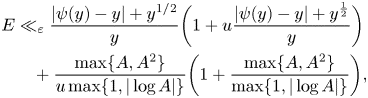
which implies the theorem using $\psi (y)-y \ll y^{1/2} \log ^2 y$ . Recall we can always simplify $y^{-\beta }$
 using (2.1) as $\asymp _{\varepsilon } (\log x)/y$
 . In particular, $y^{1/2-\beta } \asymp _{\varepsilon } A$
 . Recall $G=G_1 G_2$
 . Lemma 2.10 and equation (2.11) tell us that

for $i=0,\,1,\,2$ and $t \in \mathbb {R}$
 . Corollary 2.9 says that under RH

for $i=0,\,1,\,2$ and $|t|\le 1$
 . Applying (4.28) and (4.29) with $i=1$
 shows
shows

which treats the first quantity in (4.26). We now consider the third term in (4.26). Observe

From (4.28) and (4.29) we have

say, and, by (2.11) and (4.29),

so that (4.30) leads to

It remains to bound the second term in (4.26). Observe

By (2.11) we can bound the fraction in the right-hand side of (4.33) by $O_{\varepsilon }(1)$ :
:

The derivatives of $\log G$ in the right-hand side of (4.33) are handled by (4.28) and (4.29), giving
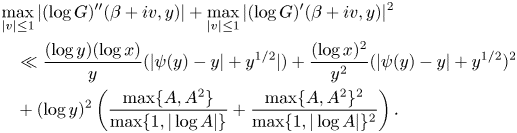
Dividing this by $(\log x) (\log y)$ gives a bound for the second term in (4.26).
Acknowledgements
We are grateful to Sacha Mangerel for asking us about the integer analogue of [Reference Gorodetsky10]. We thank the referee for useful suggestions and comments that improved the manuscript. This project has received funding from the European Research Council (ERC) under the European Union's Horizon 2020 research and innovation programme (grant agreement No 851318).
Appendix A. Review of $\Lambda (x,\,y)$

Appendix A.1 $\lambda _y$ and its Laplace transform

Saias [Reference Saias17, Lem. 4(iii)] proved that $\lambda _y(v) \ll \rho (v)v^3 + e^{2v}y^{-v}$ holds for $y \ge 2$
 , $v \ge 1$
 . The following is a weaker version of his result which suffices for us.
Lemma A.1 Saias
If $u \ge \max \{C,\,y+1\}$ we have $\lambda _y(u) \ll (C/y)^{u}$
 .
.
Proof. The condition $u \ge \max \{C,\,y+1\}$ ensures $e^{\xi (u-1)} \ge y$
 :
:

Integrating the definition of $\lambda _y$ by parts gives

By (A.1) and the definition of $\rho$ we have
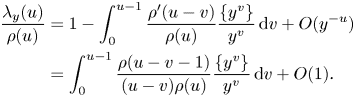
One has $\rho (u-v)\ll \rho (u)e^{v \xi (u)}$ uniformly for $0 \le v \le u$
 [Reference Hildebrand and Tenenbaum14, Cor. 2.4]. Hence the integral on the right-hand side of (A.2) is

which is $\ll u^2 \log (u+1)$ by lemma 2.1. Hence

using lemma 2.2. We have $I(\xi (u)) \ll u$ . As $u^{3/2}\log (u+1)$
 may be absorbed in $C^u$
 , we are done.
By lemma A.1, the contribution of $v \ge \max \{C,\,y+1\}$ to (1.17) is

This establishes
Corollary A.2 Fix $\varepsilon >0$ . If $y \ge C_{\varepsilon}$
 then $\hat {\lambda }_y$
 converges absolutely for $\Re s > -(\log y)/(1+\varepsilon )$
 .
.
Appendix A.2 Asymptotics of $\Lambda$

We define $r \colon [1,\,\infty ) \to \mathbb {R}$ by $r(t):=-\rho '(t)/\rho (t)=\rho (t-1)/(t \rho (t))$
 .
.
Lemma A.3 [Reference Fouvry and Tenenbaum8, Eq. (6.3)] For $0 \le v \le u-1$ and $u \ge 1$
 we have

Lemma A.4 [Reference de la Bretèche and Tenenbaum4, Lem. 3.7] For $u \ge 1$ we have $r(u) = \xi (u)+O(1/u)$
 .
.
Proposition A.5 Fix $\varepsilon >0$ . Suppose $x\ge C_{\varepsilon}$
 . For $x \ge y \ge (\log x)^{1+\varepsilon }$
 ,
,

Equation (1.5) follows from proposition A.5 using lemma A.4. Proposition A.5, in slightly weaker form, is implicit in [Reference de la Bretèche and Tenenbaum5, pp. 176–177], and the proof given below follows these pages.
Proof. For $u=1$ the claim is trivial since $\Lambda (x,\,x)=\lfloor x\rfloor$
 [Reference de Bruijn3, Eq. (3.2)], so we assume $u>1$
 . Recall the integral representation $\zeta (s)=s/(s-1) -s \int _{1}^{\infty }\{t\}\,{\rm d}t/t^{1+s}$
 for $\Re s >0$
 [Reference Montgomery and Vaughan15, Eq. (1.24)]. We apply it with $s=1-r(u)/\log y$
 and perform the change of variable $t=y^v$
 to obtain

From (A.3) and (A.1) we deduce

It remains to show that the right-hand side of (A.4) is

It is convenient to set

where the inequality is due to lemmas A.4 and 2.1 and our assumptions on $x$ and $y$
 . By lemma A.3, the contribution of $0 \le v \le u-1$
 to the right-hand side of (A.4) is

Using $e^{(u-1)a}\gg \max \{(u-1)a,\, (u-1)^2 a^2\}$ and (A.5) we find that the last quantity is $\ll _{\varepsilon } x\rho (u)/((\log x)(\log y))$
 which is acceptable. For $v > u-1$
 , $\rho '(u-v)=0$
 and that part of the integral (times $x$
 ) is estimated as

If $u \ge 2$ this is $\ll _{\varepsilon } x\rho (u) /((\log x)(\log y))$
 , otherwise this is $\ll x\rho (u)(y/x)/\log x$
 . Both cases give an acceptable contribution.


 Open access

