





Introduction
Burial mounds—or kurgans—are a distinctive marker of prehistoric Eurasia. This funerary tradition, found over a vast area encompassing southern and central Europe, southwest Asia, and the Eurasian steppes, represents a peculiar mode of landscape “monumentalization”—the artificial transformation of the environment for display purposes (Reinhold Reference Reinhold, Horejes and Heske2012, Reference Reinhold, Laneri, Palumbi and Müller Celka2019)—that ties in with broader aspects of the social organization, economy, and world views of past societies (Borgna and Muller Celka Reference Borgna and Muller Celka2012; Bourgeois Reference Bourgeois2013; Gosden et al. Reference Gosden, Hommel, Nimura, Romankiewicz, Fernández-Götz, Lock and Büchsenschütz2019). In the Caucasus, kurgans have been excavated since at least the 1890s (e.g. Veselovsky Reference Veselovsky1897) and catalyzed much of archaeological research in Bronze Age culture history and periodization during Soviet times (e.g. Andreeva Reference Andreeva1977; Iessen Reference Iessen1950). In this region, kurgans appeared from at least the fifth millennium BCE as part of a broader trend attested in the Pontic Steppe and Volga regions (Korenevsky Reference Korenevsky2012; Rassamakin Reference Rassamakin and Borgna2012). However, it was from the early fourth millennium BCE onwards that they became a locus for the monumental expression of social ideology (Belinkskij et al. Reference Belinskij, Hansen, Reinhold, Rova and Tonussi2017; Reinhold Reference Reinhold, Laneri, Palumbi and Müller Celka2019), emerging as a distinctive marker of communities until the first millennium BCE as they adapted to the needs of different social groups in both the North and the South Caucasus (see Laneri et al. Reference Laneri, Müller Celka, Palumbi, Laneri, Palumbi and Müller Celka2019). Historically, radiocarbon dates have helped establish the absolute chronology of kurgans in relation to the different stages of the Bronze Age. These earlier works have primarily operated at the scale of cultural sequences and their synchronization—notable examples are the debate over the chronological position of the Maikop kurgans in the North (e.g. Korenevsky Reference Korenevsky1993; Munchaev Reference Munchaev, Kh and Markovin1994; for a complete overview see Ivanova Reference Ivanova2007) and the Early/Middle Bronze Age attribution of the Trialeti kurgans in the South (Gogadze Reference Gogadze1972; Kuftin Reference Kuftin1941)—or sub-divisions within the same archaeological horizon—such as the chrono-cultural “components” of the Maikop-Novosbodnaya phenomenon (Korenevsky Reference Korenevsky2004; Rezepkin Reference Rezepkin2000). While former research has, importantly, defined a chrono-cultural grid, high-resolution radiocarbon dating and Bayesian chronological modeling now allow for a more refined reconstruction of specific burial histories beyond fixed archaeological cultures (intended as material packages associated with a specific social group within a fixed temporal span). Under ideal preservation conditions, kurgans can be a remarkable source of organic materials that can be linked not just to generalized and very approximate archaeological cultures, but to specific actions of funerary ritual and remembrance practices via high-resolution radiocarbon dating and Bayesian chronological modeling. This study provides one such example from the South Caucasus.
In the South Caucasus, kurgans appeared in the early fourth millennium BCE as a marker of élite individuals associated with the Late Chalcolithic Leylatepe culture (ca. 4000–3500 BCE, Lyonnet et al. Reference Lyonnet, Akhundov, Almamedov, Jalilov, Courcier, Bouquet, Huseynov, Loute, Makharadze and Reynard2008; Museibli Reference Museibli2014), in parallel with the contemporary hierarchical trends signaled by wealthy burial assemblages attested in the Maikop kurgans of the North Caucasus (Korenevsky Reference Korenevsky2012). From the mid-fourth millennium BCE, collective kurgans in the South Caucasus are found in association with the so-called Kura-Araxes (KA) culture. The latter represents an expansive archaeological culture marked by a recurring “package” of ceramics, hearths, and architectural and funerary traditions that defines the local Early Bronze Age ca. 3500–2500 BCE (Palumbi Reference Palumbi2016; Sagona Reference Sagona2018). While KA kurgans are present throughout the South Caucasus, their concentration is especially noticeable in the middle Kura region of today’s Azerbaijan (Poulmarc’h et al. Reference Poulmarc’h, Pecqueur and Jalilov2014, 237). In this area, the intentional concentration of funerary mounds may have connected with seasonal movements compatible with a transhumant or nomadic lifestyle, suggesting a close relationship between the funerary landscape and the subsistence strategies of these early communities (Pappalardo and Laneri Reference Pappalardo, Laneri, Laneri and Steadman2023, 363–365). The high visibility and diachronic physical (and intentional) modification of kurgans may also speak to their function as gathering places for the kindred groups involved in funerary rituals, thus contributing to reinforcing a sense of ancestry, communal identity, and territoriality (Pappalardo and Laneri Reference Pappalardo, Laneri, Laneri and Steadman2023, 365–366). Unlike earlier Leylatepe contexts, KA kurgans clearly emphasized horizontal kinship relationships, reflecting egalitarian social values that permeated contexts of practice both in life and death (Smith Reference Smith2015, Reference Smith, Laneri, Palumbi and Müller Celka2019). Current evidence of KA funerary practices suggests that collective depositions resulted from multiple burial events, highlighting, structured by, and structuring/reinforcing such kinship ties. This practice—attested in both kurgan and non-kurgan funerary contexts—denotes a particular mode of engagement with the dead, who are perceived as active and continuing members of the community, through periodical reopening of burials and tending to human remains (Aghikyan Reference Aghikyan2021; Badalyan et al. Reference Badalyan, Smith, Linsday, Khatchadourian and Avetisyan2008; Erdal et al. Reference Erdal, Jalilov, Koruyucu, D’Amico, Erdal, Laneri, Palumbi and Müller Celka2019; Poulmarc’h et al. Reference Poulmarc’h, Pecqueur and Jalilov2014). Recurring evidence from kurgan sites in the middle Kura basin also testifies to the symbolic value of a termination ritual—an important and deliberate break in this social world connecting the living and the dead—consisting of the intentional firing of the funerary chamber after what was determined as the last burial (Akhundov Reference Akhundov1999; Huseynov Reference Huseynov, Laneri, Palumbi and Müller Celka2019; Jalilov Reference Jalilov2018; Laneri et al. Reference Laneri, Jalilov, Erdal, Valentini, Poulmarc’h, Guarducci, Crescioli, Berthon, D’Amico, Pappalardo, Russo and Huseynova2020; Poulmarc’h et al. Reference Poulmarc’h, Pecqueur and Jalilov2014). These elements identify KA kurgans as a rich diachronic archive for better understanding the social and ritual behavior of communities moving within the region between the Kura River and the mountains of the Lesser Caucasus.
Because in the KA culture ancestors continued to participate in communal life, we may reasonably assume that the manipulation of kurgan structures aligned with events of importance across the KA world: termination rituals in particular. Thus far, high-resolution radiocarbon dating on kurgan contexts has been limited in the South Caucasus, one exception being the case of the much later kurgan 3 at Ananauri (Boaretto et al. Reference Boaretto, Lev, Regev, Makharadze, Kalandadze and Murvanidze2016). To date, the temporal relationship within and among collective kurgans in the KA culture remains poorly understood. In this article we report on the results of a wiggle-match sequence of 10 new 14C dates that we recently obtained from a sample of Juniperus sp. associated with Kurgan 8 at Uzun Rama (Ganja, Azerbaijan). The site was the subject of archaeological investigations by the Ganja Regional Kurgan Archaeological Project (GarKAP) in 2018 and 2019 (Laneri et al. Reference Laneri, Müller Celka, Palumbi, Laneri, Palumbi and Müller Celka2019, Reference Laneri, Jalilov, Erdal, Valentini, Poulmarc’h, Guarducci, Crescioli, Berthon, D’Amico, Pappalardo, Russo and Huseynova2020). Kurgan 8, in particular, yielded evidence of use during the early phase of the Kura-Araxes culture, KA I, ca. 3500–2900 BCE (Badalyan Reference Badalyan2014) and the later “Early Kurgan” period associated with the so-called Martkopi assemblages, ca. 2500–2000 BCE (Dzhaparidze Reference Dzhaparidze, Frangipane, Hauptmann, Liverani, Matthiae and Mellink1993; Sagona Reference Sagona, Burney and Sagona2004) assigned to the final Early Bronze or initial Middle Bronze Age depending on nomenclature and periodization proposals (see also Badalyan and Perello Reference Badalyan and Perello2024 on this issue). Burial activity also includes an intrusive inhumation dating to the Late Bronze Age, ca. 1500–1150 BCE (Manning et al. Reference Manning, Smith, Khatchadourian, Badalyan, Lindsay, Greene and Marshall2018; Smith et al. Reference Smith, Badalyan and Avetisyan2009). Our sample (AZ-2022-01a) belongs to a wooden structure that was built purposely to stage the ritual fire that sealed the funerary chamber of Kurgan 8 once it exhausted its function, inscribing its changed status. The results of the wiggle-match are presented here and combined in a Bayesian model with six 14C dates previously obtained by the GarKAP project.
Archaeological background
Şadılı-Uzun Rama (literally “empty land”) is a limestone plateau located in the Goranboy district of Azerbaijan, stretching for almost 3 km along the north shore of the Kurekçay creek, a tributary of the Kura River, near the modern villages of Şadılı and Gharadaghli (Figure 1). The Azerbaijani National Academy of Science began the archaeological investigation of the site in 2012 (Jalilov Reference Jalilov2010, Reference Jalilov2011, Reference Jalilov2012, Reference Jalilov, Işıklıand and Can2015, Reference Jalilov2018), and the Azerbaijani-Italian Ganja Region Kurgan Archaeological Project (GaRKAP) joined its efforts in 2018 (Laneri et al. Reference Laneri, Müller Celka, Palumbi, Laneri, Palumbi and Müller Celka2019, Reference Laneri, Jalilov, Erdal, Valentini, Poulmarc’h, Guarducci, Crescioli, Berthon, D’Amico, Pappalardo, Russo and Huseynova2020). A systematic survey of the area has enabled the identification and mapping of more than 205 burial mounds. The kurgans excavated between 2012 and 2019 are located on the northeastern part of the plateau and date to two main archaeological phases. The first phase is associated with the Kura-Araxes I-II (as per Palumbi Reference Palumbi2008) or Kura-Araxes I cultural phase (as per Badalyan Reference Badalyan2014; for details on how these periodization systems compare, see Passerini Reference Passerini2022) and is attested in Kurgan 1, Kurgan 5, Kurgan 6, and Kurgan 8, ca. 3600/3500–2900 BCE (Laneri et al. Reference Laneri, Müller Celka, Palumbi, Laneri, Palumbi and Müller Celka2019, Reference Laneri, Jalilov, Erdal, Valentini, Poulmarc’h, Guarducci, Crescioli, Berthon, D’Amico, Pappalardo, Russo and Huseynova2020), with a documented case of reuse of the mound in a “Post Kura-Araxes” or “Early Kurgan” phase of the final Early Bronze Age/Middle Bronze Age, ca. 2500–2000 BCE, (Sagona Reference Sagona2018). The second phase is associated with the Late Bronze/Early Iron Age, ca. 14th–10th century BCE (see Manning et al. Reference Manning, Smith, Khatchadourian, Badalyan, Lindsay, Greene and Marshall2018) represented by Kurgan 2, Kurgan 3, Kurgan 4, and Kurgan 7 (Laneri et al. Reference Laneri, Müller Celka, Palumbi, Laneri, Palumbi and Müller Celka2019, Reference Laneri, Jalilov, Erdal, Valentini, Poulmarc’h, Guarducci, Crescioli, Berthon, D’Amico, Pappalardo, Russo and Huseynova2020). Despite the protracted funerary activity on the plateau and with the exception of a concentration of sherds dating to the Chalcolithic on a flat spot to the southwest of Kurgan 8, it should be noted that no permanent settlements have been found in this area (Laneri et al. Reference Laneri, Müller Celka, Palumbi, Laneri, Palumbi and Müller Celka2019, 145). This observation aligns with the documented spread of only temporary “light” architecture at the turn from the Chalcolithic to the Kura-Araxes I, suggesting the presence of short-lived occupations that may indicate, at this stage, a prevalently mobile character of these early Kura-Araxes communities as formerly suggested (Avetisyan Reference Avetisyan2022; Palumbi Reference Palumbi2008; Rothman Reference Rothman, Smith and Rubinson2003). In this context, kurgans might therefore constitute the main “fixed” (more) permanent reference within a mobile social world.
Map of the Şadılı-Uzun Rama plateau highlighting the distribution of: the kurgans identified by the survey (green circles); the kurgans, excavated between 2012 and 2019, dating to the Early Bronze Age (red triangles) and the Late Bronze-Iron Age I (black triangles).

Figure 1 Long description
A map of the Sadili-Uzun Rama plateau showing the distribution of kurgans. The map highlights the locations of kurgans identified by a survey with green circles, kurgans from the Early Bronze Age with red triangles, and kurgans from the Late Bronze-Iron Age I with black triangles. Key locations labeled include Qaradağlı, Kurekcay, and Sadili. The map also includes an inset showing the broader region around the Caspian Sea. The legend indicates the different types of kurgans marked on the map.
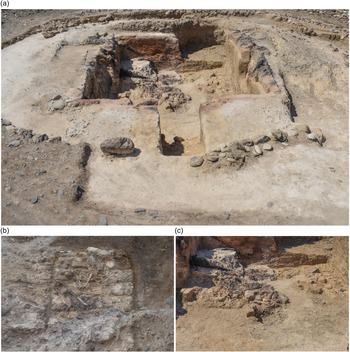
Kurgan 8 was excavated by GaRKAP between 2018 and 2019 (Laneri et al. Reference Laneri, Müller Celka, Palumbi, Laneri, Palumbi and Müller Celka2019, Reference Laneri, Jalilov, Erdal, Valentini, Poulmarc’h, Guarducci, Crescioli, Berthon, D’Amico, Pappalardo, Russo and Huseynova2020). A 12-m diameter tumulus of pebbles and limestone covered a large funerary chamber (ca. 5 m wide and 7 m long) dug into the natural soil in an east-west orientation, preceded by a narrow dromos entrance, and encircled by a row of large stones (Figure 2a). The chamber was lined with rectangular mud bricks covered in white plaster, forming 30–35 cm thick walls, a technique that is well attested in earlier Chalcolithic kurgans in Azerbaijan (Lyonnet et al. Reference Lyonnet, Akhundov, Almamedov, Jalilov, Courcier, Bouquet, Huseynov, Loute, Makharadze and Reynard2008; Museibli Reference Museibli2014). In fact, it has been suggested that the South Caucasian tradition of constructing mud brick burial chambers may reflect a Mesopotamian trait and, possibly, the intent to reproduce an idealized house for the dead (Pappalardo and Laneri Reference Pappalardo, Laneri, Laneri and Steadman2023; Sagona Reference Sagona2018, 153). Funerary depositions were placed inside the chamber through the rectangular entrance corridor with sloping floor, excavated on the eastern side of the chamber according to a funerary pattern that characterizes contemporary barrows from Northwest Azerbaijan (Huseynov Reference Huseynov, Laneri, Palumbi and Müller Celka2019; Pappalardo and Laneri Reference Pappalardo, Laneri, Laneri and Steadman2023). Wooden beams, probably from a type of juniper tree, were placed at an interval of 10 to 20 cm to support the heavy roofing, possibly filled with wattle and daub, although the fire did not leave evidence of it. The floor of the burial chamber was most likely constructed with fine gravel and white lime from the plateau, though it was not possible to detect a coherent floor in the dromos. In the middle of the funerary chamber, a small pit lined with heavy burned pebbles was filled with ash from a fire or, perhaps, from a wooden column burned by a vigorous flame.
Kurgan 8, Uzun Rama. General view of the funerary chamber from the east (a); a primary deposition (“Individual 2”) on the imprints of a sledge/stretcher viewed from the west (b); wooden structure and funerary depositions piled up on the western side of the chamber opposite the dromos entrance viewed from the east (c).

Evidence collected from Kurgan 8 allowed for the reconstruction of a complex sequence of events related to the funerary function of the site (Laneri et al. Reference Laneri, Jalilov, Erdal, Valentini, Poulmarc’h, Guarducci, Crescioli, Berthon, D’Amico, Pappalardo, Russo and Huseynova2020). At least two different phases of deposition could be identified inside the main chamber, and one, exceptionally, inside the dromos. Human remains were amassed on the western side, opposite to the entrance of the funerary chamber, where the disarticulated bones of adults and subadults (infants, children to adolescents) were mixed with pebbles and mudbrick pieces, indicating that these remains may have undergone a further intervention after the collapse of the southern wall and part of the roofing. Eight individuals were found in primary deposition. Two of these were laid on wooden sledge-stretchers or boxes that were possibly involved in a ritual that required dragging the deceased before taking them inside the chamber through the dromos, as suggested by clear imprints on the ground (Figure 2b and c). The deceased were accompanied by a limited set of funerary equipment comprising tableware vessels, bone spindle whorls, necklaces of limestone beads, flint arrowheads, and selected animal remains (i.e., horns and bucrania) (Figure 3). The ceramic assemblage primarily comprises medium grit-tempered Monochrome Burnished Ware (Palumbi Reference Palumbi2008) with occasional traces of chaff in two morphological shapes that probably reflect the intention to set meals for the deceased: deep bowls with simple profile and an omphalos base, and handled jarlets with globular body, pronounced shoulders, and outflaring necks featuring, in a few cases, geometric decorations incised or relieved with the motif of knobs and ribs (Laneri et al. Reference Laneri, Jalilov, Erdal, Valentini, Poulmarc’h, Guarducci, Crescioli, Berthon, D’Amico, Pappalardo, Russo and Huseynova2020, 119–120). According to Badalyan (Reference Badalyan, Giemsch and Hansen2021, 224), the ceramic assemblage from Uzun Rama shares characteristics with the so-called “Didube-Kiketi” ceramic group that defines the first KA phase of homogeneity. This assemblage characterizes the Kura-Araxes I horizon of the South Caucasus and East Anatolia that, despite minor regional variations, diffused with astonishing consistency as a result of the transfer of people, technical skills, ideas, and practices (Sagona Reference Sagona2018, 214–215). The finds from Şadılı-Uzun Rama also aptly reflect the prevalent homogeneity of funerary goods from KA tombs ascribed to a lack of vertical differentiation within contemporary society.
Assemblage of jarlets and deep bowls of monochrome burnished ware (a) and objects (b) from the burial chamber of Kurgan 8.

While the complete analysis of the human remains is in progress, the low number of depositions compared with other known contemporary kurgans (hosting from 30 up to more than 100 individuals, see Erdal et al. Reference Erdal, Jalilov, Koruyucu, D’Amico, Erdal, Laneri, Palumbi and Müller Celka2019; Lyonnet Reference Lyonnet2014) could be attributed to the premature collapse of the structure. Following this event, the dromos was exceptionally used as a second funerary chamber. In fact, a thick deposit of commingled and very poorly preserved human remains, mixed with animal bones and ceramics, may have resulted from successive depositions that pushed the previous ones along the sloping floor of the entrance corridor. At the end of their funerary use, both the funerary chamber and the dromos were set on fire as part of a termination ritual. According to the pattern of the burnt traces, the fire inside the chamber was initiated in the southwestern corner, where the wooden boards of a rectangular structure were found on top of a layer of limestone and rubble that covered two primary depositions (Laneri et al. Reference Laneri, Jalilov, Erdal, Valentini, Poulmarc’h, Guarducci, Crescioli, Berthon, D’Amico, Pappalardo, Russo and Huseynova2020). An analogous structure has been identified inside the funerary chamber of Kurgan 1 at Şadılı-Uzun Rama (Erdal et al. Reference Erdal, Jalilov, Koruyucu, D’Amico, Erdal, Laneri, Palumbi and Müller Celka2019; Jalilov Reference Jalilov, Işıklıand and Can2015, Reference Jalilov2018), and comparable fire patterns, with heavier traces of burning on the western side of the chamber, come from the contemporary sites of Tatarli, Dashuz, Gabala, Khanlar and Borsunlu in Northwest Azerbaijan (Huseynov Reference Huseynov, Laneri, Palumbi and Müller Celka2019). This wooden structure—interpreted as either a “pyre” or possibly a structural element that kept part of the roof open in order to initiate and fuel the fire—together with the consistent pattern of fire traces, hint at the symbolic importance of a shared and anticipated eventual final ritual that was planned from the kurgan’s initial laying and use. After the fire, the resulting destruction layer in the area of the chamber and the dromos was sealed through the construction of a monumental tumulus. A single deposition of an adult individual may be associated with this phase, isolated beneath the final tumulus, along with an accompanying vessel.
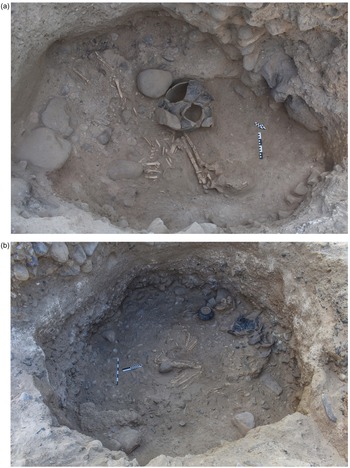
To the ritual activity connected with the following phase of abandonment belongs, in all probability, a small pit that was excavated on its surface, right outside the burial chamber, and containing a small, handled jar with incised decoration, according to a practice documented elsewhere on the plateau (Jalilov Reference Jalilov2018). A continuous awareness of the kurgan’s function, and maybe its connection to a perceived ancestral memory, may be glimpsed in the subsequent use of the monumental tumulus. As revealed during the 2018 season (Laneri et al. Reference Laneri, Müller Celka, Palumbi, Laneri, Palumbi and Müller Celka2019), the tumulus was reused at the end of the third millennium (final Early Bronze Age/Middle Bronze Age, ca. 2500–2000 BCE) to incorporate two intrusive pit graves, Grave I-I and Grave I-II, excavated, respectively, along the northern and western walls of the burial chamber (Laneri et al. Reference Laneri, Müller Celka, Palumbi, Laneri, Palumbi and Müller Celka2019, Reference Laneri, Jalilov, Erdal, Valentini, Poulmarc’h, Guarducci, Crescioli, Berthon, D’Amico, Pappalardo, Russo and Huseynova2020). Grave I-I (Figure 4a) contained the incomplete skeleton, probably due to later robbing, of one individual, together with a few funerary goods that included a stone necklace with a bronze clasp and a black burnished handled jar (Laneri et al. Reference Laneri, Müller Celka, Palumbi, Laneri, Palumbi and Müller Celka2019). A deposit of animal bones belonging to a sheep, a lamb and a snake occupied the southeastern section of the tomb (Laneri et al. Reference Laneri, Jalilov, Erdal, Valentini, Poulmarc’h, Guarducci, Crescioli, Berthon, D’Amico, Pappalardo, Russo and Huseynova2020, 117). Even the larger pit of Grave I-II was excavated to host just a single deposition (Figure 4b). A preserved beam found near the grave suggests that it had a wooden roof that was most probably removed by looters, who disturbed the buried individual. A deposit of animal offerings, ceramic vessels and a bronze dagger was located along the northern section of the earthen pit. The assemblage of large jars from the two graves is of the Black Burnished Ware (BBW) type that distinguishes the immediate “Early Kurgan” period associated with the so-called Martkopi and Bedeni cultural groups, ca. 2500–2000 BCE (see Sagona Reference Sagona, Marro and auptmann2000, Reference Sagona, Burney and Sagona2004), with manufacture characteristics (i.e., globular body, short necks, slightly everted and thickened rims, flat bases, and wide handles along the shoulders) typical of the region (Laneri et al. Reference Laneri, Jalilov, Erdal, Valentini, Poulmarc’h, Guarducci, Crescioli, Berthon, D’Amico, Pappalardo, Russo and Huseynova2020, 122–123). The intrusive tombs testify to a shift from a collective to an individual ethos in the final stage of the kurgan’s life, emphasized by the deposition of valuable metals alongside the deceased. Following the deposition of the two graves, only marginally damaging the previous structure, the whole complex was covered by a larger, slightly more elongated, and highly visible burial mound (Laneri et al. Reference Laneri, Jalilov, Erdal, Valentini, Poulmarc’h, Guarducci, Crescioli, Berthon, D’Amico, Pappalardo, Russo and Huseynova2020, 120).
Intrusive grave (Gr I-I) with disturbed skeletal remains and accompanying objects viewed from the northeast (a) and Intrusive grave (Gr I-II) with a single primary burial and deposit of animal offerings, ceramic vessels and a bronze dagger (viewed from the east) (b).

Materials and methods
Original radiocarbon dataset
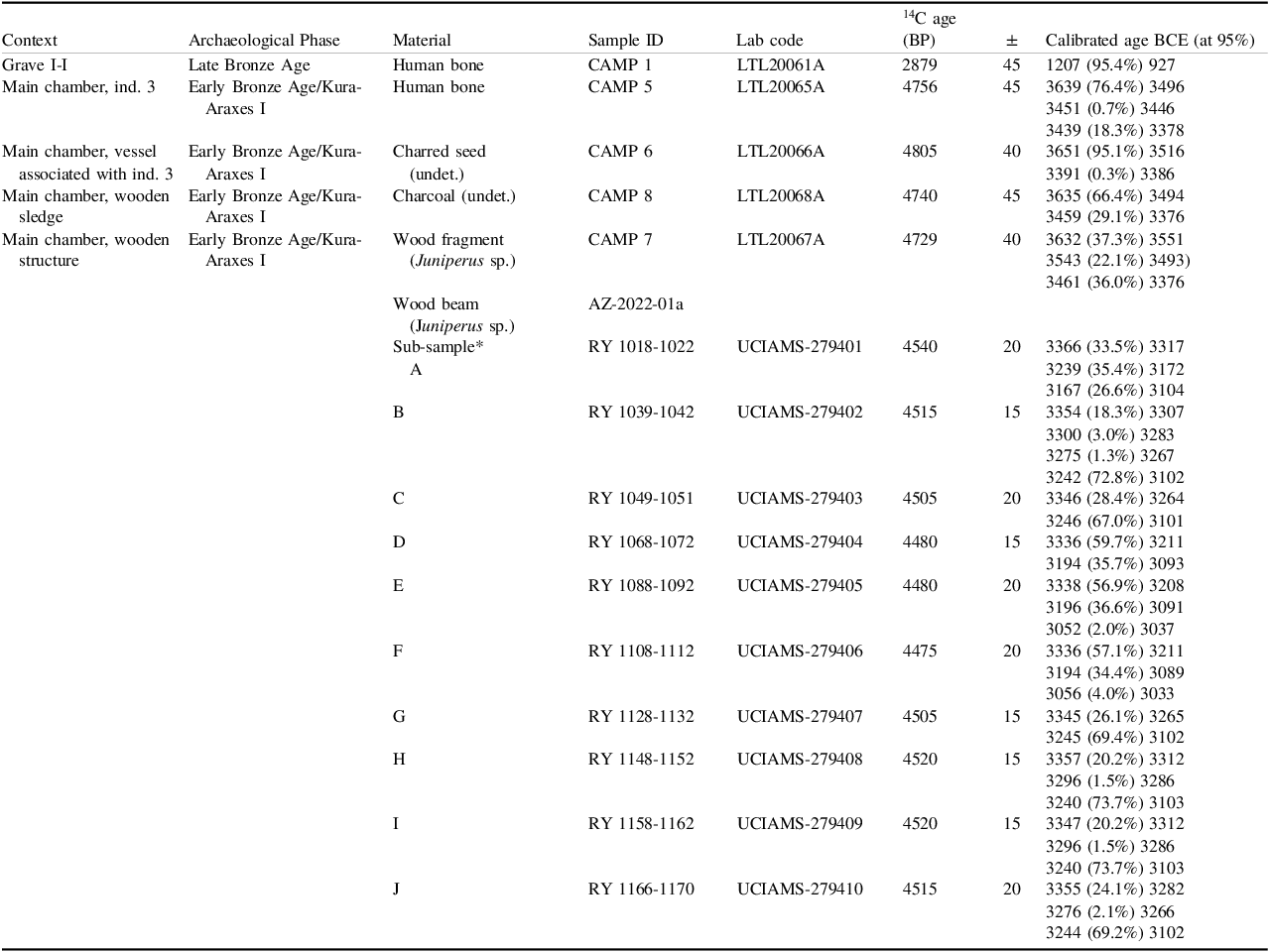
The radiocarbon evidence produced by the GarKAP project includes six 14C dates obtained from samples collected manually in the field between 2018 and 2019 (Table 1). Of these, four 14C dates are associated with the main funerary chamber (i.e. Kura-Araxes use), one is associated with Grave I-I (post-Kura-Araxes use), and one is associated with an inhumation possibly linked with medieval or modern visitation of the site (stratum K6). Dates from the first burial phase were obtained from: a sample of semi burned (undetermined) wood from a wooden sledge used to accommodate the inhumations (LTL20068A); a sample of charcoal (Juniperus sp.) from the wooden structure associated with the ritual burning (LTL20067A); a sample from undetermined seeds deposited with the burial assemblage associated with the second group of inhumations (LTL20066A); an undetermined human bone sampled from the second group of inhumations (LTLT200665A). The date associated with Grave I-I was sampled from an unspecified human bone (LTL20061A). All the samples were 14C-dated at the CEDAD Laboratory of the University of Salento. Botanical samples were pretreated according to the routine acid-alkali-acid (AAA) chemical protocol (Calcagnile et al. Reference Calcagnile, Quarta, D’Elia, Rizzo, Gottdang, Klein and Mous2004; D’Elia et al. Reference D’Elia, Calcagnile, Quarta, Sanapo, Laudisa, Toma and Rizzo2004). Bone samples were pretreated for collagen extraction following the Longin (Reference Longin1971) method. Following chemical pretreatment, the samples were combusted to CO2 in vacuum-sealed quartz tubes at 900ºC and reduced to graphite by using H2 as the reducing agent at 600ºC on Fe powder as catalyst. Graphite samples were then pressed into aluminum target and measured for 14C content with a 3 MV HVEE Tandetron accelerator (Mod. 4130 HC).
List of 14C dates from Kurgan 8, Uzun Rama

* RY= relative years in tree-ring sequence
Wiggle-match
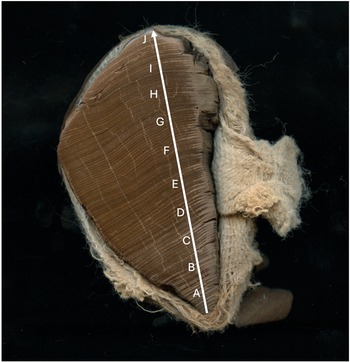
This study expanded on the 14C dating of Kurgan 8 by producing a tree-ring defined 14C wiggle-match sequence (e.g. Galimberti et al. Reference Galimberti, Bronk Ramsey and Manning2004) from a sample of Juniperus sp. acquired in 2022. Our aim was to refine a more precise age estimate for the ritualized closure of the kurgan and its temporal relationship with the earlier and later burial uses—in particular we sought to better define calendar resolution in this fourth millennium BCE period where wiggles in the 14C calibration curve often render individual 14C measurements ambiguous. The sample (AZ-2022-01a, Figure 5), associated with the wooden pyre, was assessed at the Cornell Tree Ring Laboratory. Tree-ring investigation identified a total of likely ca. 175–176 annual rings. The sample exhibited some regions with micro-rings or very indistinct tree-rings (as common in Juniperus sp. from arid to semi-arid areas). Given no other population of samples of the same species from the area for comparison and dendrochronological crossdating, it is therefore unclear whether or not a few of these observed tree-rings are false rings (although the latewood appeared distinctly formed and hence we assume individual annual rings and not false rings in most cases—but one ring in the outermost portion may be an exception, and hence we say ca. 175–176 rings, but there is a further small unquantifiable error associated). The sample was then dissected with a steel blade under a binocular microscope to obtain 10 additional samples of 3–5 rings for 14C dating (Table 1). The sub-samples were extracted at regular intervals of ca. 10–20 rings (calendar years), targeting segments that were not affected by the presence of micro-rings or indistinct rings rendering it feasible to extract samples of 3–5 tree-rings. We preferred groups of 3-5 rings for sub-sampling due to the extreme narrowness of single rings and to avoid introducing noise by interpolating single-year increments to a smoothed calibration curve (for IntCal20 does not include annually resolved measurements for this period). The new samples were processed and dated by AMS at the W.M. Keck Carbon Cycle AMS Facility at the University of California Irvine. Prior to combustion, the samples were treated with acid-alkali-acid (1N HCl and 1N NaOH, 75ºC), bleached to alpha-cellulose (1:1 1M NaCLO2, 1N HCl, 75ºC), treated with 6N NaOH (room temperature) to produce alpha cellulose, washed with 1N HCl and ultra-pure MQ water, and vacuum dried. Measurements were carried out with a 500kV compact AMS unit (NEC 0.5MV 1.5SDH-2).
Sample AZ-2022-01a (Juniperus sp.) with indication of the approximate location of tree-ring groups that were sub-sampled for wiggle-match (from A to J, see Table 1).

Bayesian chronological modeling
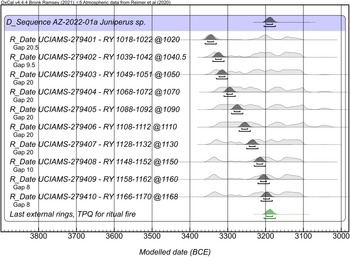
Bayesian chronological modeling, wiggle-matching, and calendar age calibration were performed using OxCal (Bronk Ramsey Reference Bronk Ramsey2009; Bronk Ramsey et al. Reference Bronk Ramsey, van der Plicht and Weninger2001) v.4.4.4 of 2021 (as noted in Figures) and the IntCal20 calibration dataset (Reimer et al. Reference Reimer2020). We derived prior information from the sequence of funerary actions reported in Laneri et al. (Reference Laneri, Jalilov, Erdal, Valentini, Poulmarc’h, Guarducci, Crescioli, Berthon, D’Amico, Pappalardo, Russo and Huseynova2020), taking into account that not all the associated events are directly represented in our 14C dataset (Figure 6). We modeled the wiggle-match sequence derived from sample AZ-2022-01a, aimed at determining the age of the outermost preserved tree-ring, by employing the D_Sequence and Gap and Date functions (Figure 7; Table S1). The Terminus Post Quem (TPQ, “date after which”) for the construction of the wooden structure was further incorporated as a cross-reference into a separate model that employed the burial stratigraphy (Figures 6 and 8, Table S2). In the latter, we grouped the 14C dates associated with the first burial phase as a uniform bounded Phase placed at the beginning of the Sequence (a Date query estimates the date for the Phase between its start and End Boundaries). The beginning of the second burial phase (i.e. accumulation of burials in the chamber and dromos) is represented by a hypothetical Boundary (“Start of second burial phase”, Figures 6 and 8), while the phase itself is not directly dated. This is followed by the cross-referencing of the Date estimate derived from the wiggle-match, which defines a TPQ for the ritual fire, the closure of the kurgan, and, thus, the end of the second (undated) burial phase within the main chamber. We employed the Difference function to interrogate the model about the time lapsed between the end of the first burial phase, which is derived from a directly dated Phase, and the wiggle-match Date estimate offering a TPQ for the end of the second Phase (and also compare this with an Interval query). Since the second burial phase is not directly dated, this function provides a hypothetical duration associated with this activity, assuming that the kurgan was used continuously until its final closure. The last Phase of the funerary Sequence includes a single 14C date from Gr I-I, representing an intrusive burial event after the kurgan chamber was sealed.
Visual summary of the prior information incorporated in the chronological model in Figure 8 and associated radiocarbon samples. Stratigraphic relationships are shown from earliest (bottom) to latest deposits (top).

Wiggle-match sequence obtained from sample AZ-2022-01a. Radiocarbon dates are ordered according to the tree-ring sequence and known intervals using the D_Sequence functions in OxCal 4.4.4. We employed the Date function to estimate the age of the last extant rings (in green), which are not directly dated (see Table S1).

Figure 7 Long description
Panel A: A line graph showing radiocarbon dates and modeled dates for a Juniperus sp. sample from Kurgan 8 at Uzun Rama. The horizontal axis represents the modeled date in BCE, ranging from 3800 to 3000. The vertical axis represents the radiocarbon dates with labels such as R_Date UCIAMS-279401 to R_Date UCIAMS-279410. Each data point is marked with a black bar and a gray distribution curve, indicating the range of possible dates. The green bar at the bottom represents the last external rings, TPQ for ritual fire. The data points show a general trend of decreasing modeled dates from top to bottom.
Bayesian chronological model of Kurgan 8 at Uzun Rama. Radiocarbon dates are grouped and ordered according to the associated burial phase (see text for details). The model cross-references the TPQ derived from the wiggle-match obtained from sample AZ-2022-01a (in green, see Figure 7).

Results and discussion
The new radiocarbon analyses provided additional insights into the history of Kurgan 8, partially challenging expectations based on the existing GarKAP 14C dataset. The unmodeled UCIAMS series (sample AZ-2022-01a) calibrates between ca. 3370 and 3100 BCE, postdating the events dated by the samples associated with the first burial phase (roughly clustered within a range of 3650–3400 BCE, Table 1). This raises questions about the LTLT20067A measurement formerly obtained from the wooden structure, which predates the UCIAMS series. Since sample AZ-2022-01a probably constituted a branch, it is possible that LTLT20067A refers to an earlier sequence from the same tree that is not represented in our sample (of the possible Juniperus sp. trees/shrubs in this region of Azerbaijan, e.g. Gurbanov and Rzaeva (Reference Gurbanov and Rzaeva2019), long-lived examples can be expected based on comparanda from other areas, but we lack suitable dendrochronological comparisons for this sample; nonetheless, juniper trees in Eurasia regularly exhibit considerable longevity (e.g. Esper et al. Reference Esper, Frankj, Wilson, Büntgen and Treydte2007) and ages of several hundred years are plausible in a semi-arid/arid context and as evidenced by AZ-2022-01a). However, probably more plausible is a second explanation: that LTLT20067A derived from displaced material belonging to the earlier use of the kurgan chamber and was erroneously attributed to the wooden pyre. Statistical similarity between this date and the remaining measurements associated with the first funerary phase appear to support this second scenario (this is the scenario we opted for in the preferred model). A third possible explanation is the failure to eliminate contamination from humic or other contaminating mobile materials before AMS dating, since the CEDAD laboratory was not asked to pretreat the sample for a cellulose extraction.
The model compiled for the funerary sequence is accepted at Amodel = 138 and Aoverall = 142.8. The results estimate the Start of the first funerary phase within 3654–3569 BCE (68.3% highest posterior density, hpd) or 3756–3523 BCE (95.4% hpd), and its End within 3599–3489 BCE (68.3% hpd) or 3624–3359 BCE (95.4% hpd) with a Date estimate for this Phase of 3624–3529 BCE (68.3% hpd) and 3675–3410 BCE (95.4% hpd). As for the results of the wiggle-match, the Date estimate for the outermost extant tree-ring places the TPQ for the construction of the wooden structure within 3198–3182 BCE (68.3% hpd) or 3204–3174 BCE (95.4% hpd). Assuming that the construction of the structure occurred close to the felling of the branch (and given from the ring pattern and shape of the sample that the outermost extant tree-ring is relatively close to the original exterior of the tree/shrub), this TPQ should be reasonably close to the dating of the ritual event associated with the burning of the pyre, including the re-deposition of human remains present in the chamber within the kurgan’s dromos. This estimate also provides a TPQ for the end of the second burial phase within the kurgan chamber. Since not all the inhumations from inside the chamber have been 14C-dated, there remains doubt about whether the first tumulus was in use continuously until its ritual closure, or whether burial episodes were separated by periods of inactivity. To approximately estimate the period of time between the end of the first burial phase and the end of the second burial phase we considered two measures. An Interval query between the Boundary for the start of the second burial phase and the wiggle-match date on AZ-2022-01a indicates 0–123 years (68.3% hpd) and 0–322 years (95.4% hpd). This is likely a minimum estimate (given the start Boundary is only informed by the end of the previous phase and the end of the second phase, with no data from within the second phase). A Difference query between the end of the first burial phase and the wiggle-match estimate on AZ-2022-01a in contrast likely indicates a maximum estimate since there is no reason to assume the second burial phase was directly contiguous from the end of the first phase; this query yields a period of 299–410 (68.3% hpd) or 170–438 years (95.4% hpd) between the end of the first burial phase and the (TPQ estimate) closure of the second burial phase. The dating of the remaining inhumations associated with the second tumulus is currently unknown. The archaeological assemblage associated with Gr I-I attests to visitation of the monumental area by Early Kurgan communities. Following the accepted chronological range for the Early Kurgan period (2500–2000 BCE), this would indicate that at least five hundred years separated the closure of Kurgan 8 from later revisitations, highlighting its importance as lieu de mémoire (Nora and Kritzman Reference Nora and Kritzman1984). However, date LTL20061A, the only one associated with Gr I-I, places it within the late second millennium BCE, suggesting activity falling well into the Late Bronze Age/Early Iron Age. There is, therefore, a discrepancy between the age of the human remains and the date suggested by the ceramic assemblage. Most likely, this discrepancy is the result of later disturbances linked with looting or other re-use activities in antiquity, as the absence of several of the deceased’s remains suggests.
In addition to securely dating the closure of Kurgan 8 at Uzun Rama, the new data substantially contribute toward our knowledge regarding broader regional dynamics in the development of the Kura-Araxes horizon both within and beyond the Kura basin. To date, Kurgan 8 at Uzun Rama constitutes the earliest dated KA location in the Kura basin, adding to a very limited dataset of KA sites dating to ca. 3500 BCE (e.g. Jrvezh/Avan, Badalyan Reference Badalyan2014) in the South Caucasus. As Laneri et al. (Reference Laneri, Jalilov, Erdal, Valentini, Poulmarc’h, Guarducci, Crescioli, Berthon, D’Amico, Pappalardo, Russo and Huseynova2020) discussed, the ritual fire that sealed Kurgan 8, dated to after 3204–3174 BCE (95.4% hpd) according to our wiggle-match, relates directly to the transformation of this structure into a permanent landmark (an act of “monumentalization”). The same scenario (i.e. a tumulus closed by fire at the end of a funerary phase) is attested at Mentesh Tepe, a multiperiod site located along the Kura basin where KA and post-KA kurgan structures are present (see Lyonnet and Guliyev Reference Lyonnet, Guliyev, Helwing, Aliyev, Lyonnet, Guliyev, Hansen and Mirtskhulava2017). According to available radiocarbon data, at Mentesh Tepe the construction of kurgan 4, associated with KA funerary activity, probably dates to between the early 36th and the late 33rd centuries BCE, and the structure was possibly in use until the 28th century BCE (though estimates for kurgan 4 are, at this stage, imprecise, see Figure S1 and Table S3). A potential gap separates the dated use of kurgan 4 from the post-kurgan activity (identified as Martkopi, ca. 2600–2200 BCE) associated with the later kurgan 54, though its estimate is poorly defined at this stage (see Figure S1). An interesting, and possibly related situation is attested at Namgala, also located along the Kura River within today’s territory of Tbilisi, Georgia, where an EBA kurgan was recently excavated by a team of the Georgian National Museum (see Passerini et al. Reference Passerini, Manning, Abramishvili, Aghikyan, Avetistyan, Badalyan, Hovsepyan, Hovsepyan, Kakhiani and Mindiashvili2025). Altogether, data from these kurgans might point towards a consistent and conscious pattern of revisitation and burial deposition along the Kura in correspondence with the sealing of long-lived kurgan structures. According to the results of a recent reassessment of KA chronology, the closure of these locations possibly coincided with a spatial reorganization of settlements across the KA world (Passerini et al. Reference Passerini, Manning, Abramishvili, Aghikyan, Avetistyan, Badalyan, Hovsepyan, Hovsepyan, Kakhiani and Mindiashvili2025). If ancestors did, in fact, continue to play active roles in living communities, our findings at Kurgan 8 may indicate a major transformative event in KA history.
Conclusions
Collective kurgans are a critical feature of the archaeological landscape of the South Caucasus and broader Eurasia in later prehistory. As long-lived structures, kurgans represent a remarkable archive of humans’ diverse relationships with life and death across space and time, offering insights into the socio-cultural values of the communities that inhabited the South Caucasian highlands during the EBA. Undifferentiated approaches to the dating of these structures (often based on isolated 14C measurements and focused on chrono-cultural phases rather than single actions) risk oversimplifying (and generalizing) the multi-temporality of these archives, particularly in the absence of obvious stratigraphic sequences. In this study, we harnessed the dating potential of a wood-charcoal wiggle-match to obtain highly informative constraints for the active use of Kurgan 8 at Uzun Rama. While some of the burial contexts within the structure remain undated, our wiggle-match contributed to refining a precise TPQ for the ritual closure of the main chamber, dating likely shortly after 3204–3174 BCE (95.4% hpd). This TPQ immediately intervenes in the otherwise ambiguous (due to calibration noise) dating of EBA contexts during the second half of the fourth millennium BCE. When combined with existing (though, to date, approximate) radiocarbon data from other EBA kurgans located in the Kura basin, our results suggest that the “monumentalization” of Kurgan 8 (Laneri et al. Reference Laneri, Jalilov, Erdal, Valentini, Poulmarc’h, Guarducci, Crescioli, Berthon, D’Amico, Pappalardo, Russo and Huseynova2020) might have been part of a broader reconfiguration of funerary locations across the Kura-Araxes landscape around this time. Though abundant, wood-charcoal from similar contexts has been under-exploited in the archaeology of the South Caucasus thus far. Moving forward, implementing adequate recovery and documentation strategies will help enhance the potential of these materials for resolving chronological questions well beyond the history of single mounds.
Supplementary material
To view supplementary material for this article, please visit https://doi.org/10.1017/RDC.2026.10191
Acknowledgments
This study was completed within the scope of the first author’s doctoral project at Cornell University, which was supported by an NSF Arch-DDRI grant (award #BCS-2106251). We would like to thank Adam T. Smith (Cornell University) for supplying additional funds to obtain the 10 radiocarbon dates from sample AZ-2022-01a. We also thank Brita Lorentzen (University of Georgia) for identifying the sample at the species level. AP thanks John Southon for support and training at the W.M. Keck Carbon Cycle AMS Facility at UCI.
Financial support
Open Access Funding was provided by Freie Universität Berlin.





 Open access

