


In Pleasant Notes upon Don Quixot (1654), printed twelve years after a Parliamentary ordinance outlawed the public performance of plays, Edmund Gayton mourns the loss of “our late stage” and celebrates the endurance of printed playbooks, which
[s]tand firme, and are read with as much satisfaction as when presented on the stage, they were with applause and honour. Indeed, their names now may be very wel chang’d & call’d the works not playes of Iohnson, Beaumont and Fletcher, Cartwright, and the rest, which are survivers of the stage.Footnote 1
The closure of the theatres finally settled an old aesthetic controversy. Four decades prior, Ben Jonson was mocked for naming his play collection Works (1616); by 1640, his presumption was still a target for derision: “Pray tell me Ben, where doth the mistery lurke, / What others call a play you call a work.”Footnote 2 In 1654, Gayton affirms the “works” label and its claims for the drama’s enduring value, not only for Jonson but also for Francis Beaumont and John Fletcher, and William Cartwright (all of whom had been recently published in posthumous dramatic collections), as well as “the rest,” a locution that consolidates a wide range of unnamed dramatists into a coherent group. Gayton does not say that the “works” label for plays was always valid. Rather, he locates English drama’s transformation in the present moment, that plays’ “names now may be … chang’d” into works. The catalyst of this transformation is the theatrical prohibition itself, which spurred theatrical nostalgia, print publication, and play-reading, all crucial factors in English drama’s cultural ascendancy. From the perspective of 1654, the recalled theatre is not morally dubious, but is associated with “applause and honour,” able to both entertain and edify. Gayton pronounces the theatre dead, but the dramatic work has escaped alive, “standing firm” in print and supplying similar satisfactions to the reader as it once did to the playgoer. Playbooks are what remain of an idealized theatrical culture, now extinct: the treasured “survivors” of the “late stage.”
On 2 September 1642, English Parliament banned public performance with an ordinance stating that “[p]ublic Stage-plays … being Spectacles of Pleasure, too commonly expressing lascivious Mirth and Levity,” do not agree “with the Seasons of Humiliation” and ordering that “[p]ublic Stage Plays shall cease, and be forborn.”Footnote 3 This order was issued shortly after the outbreak of the first English Civil War, which had started two weeks earlier, on 24 August 1642. Criticism traditionally regarded the theatrical ordinance as the culmination of a long-standing anti-theatrical grudge borne by the Puritans who dominated Parliament in the mid seventeenth century. Later critics described the ordinance as a pragmatic attempt to establish public safety in a volatile moment by discouraging large gatherings of people.Footnote 4 Even more recently, these revisionist accounts have themselves been revised. N. W. Bawcutt notes that, although characterizing the theatrical prohibition as a “Puritan ban” on theatre oversimplifies things, ideology did motivate the 1642 closures.Footnote 5 The architect of the ordinance was Francis Rous, a committed Calvinist who characterized playhouses as “Churches of Satan” and advocated the replacement of “lascivious” stage plays with fasting.Footnote 6
No matter Parliament’s intention, however, the ordinance of 1642 immediately and lastingly devastated the English theatre industry. Initially framed as a temporary measure, active “while these sad causes and set Times of Humiliation do continue,” public performance was banned in England for eighteen years, throughout the English Civil Wars (1642–51) and Interregnum (1649–60), until both English theatre and the monarchy were restored in 1660. It is true that the public stage was never fully silenced; illegal performances continued in London and in the provinces across this period. Yet illegal performance, undertaken in reduced theatrical circumstances and subject to punishing raids, could not compare with the economically and creatively vibrant theatrical tradition prior to 1642. The theatrical prohibition effectively eliminated acting and playwriting as viable professions. Gayton’s remarks exemplify how the closure of the theatres was described as a form of cultural death in the mid seventeenth century. For eighteen years, the dramatic text was the only legitimate way to consume professional plays, that is, plays produced for the commercial theatres and staged by professional actors starting around 1567, when the first purpose-built theatre was constructed. English playbooks printed after 1642 simultaneously gestured to the death of theatre and enabled the drama to survive.
Theatre Closure and the Paradoxical Rise of English Renaissance Drama in the Civil Wars offers a posthumous history of early modern professional drama during the eighteen-year theatrical prohibition. Despite the pervasive metaphor about the death of theatre, English drama did not disappear during the Interregnum. Nor did the prohibition cause people to simply forget about the professional theatrical tradition of the late sixteenth and early seventeenth centuries. Indeed, the opposite occurred. Far from being a dramatic dead zone, the era of the theatre ban was a time of intense dramatic production, innovation, and reflection – on the stage, on the page, and in the cultural imagination. Newly rare and illicit, theatrical activity was increasingly prized among theatre practitioners and aficionados; actors and spectators risked imprisonment and steep fines to stage and attend clandestine performances. The decline of theatrical infrastructure and threat of raids led to the advent of a new theatrical form, the “droll”: short playlets extracted from professional plays that could be staged cheaply and quickly. In the book market, English drama thrived. There was a surge in first editions of professional plays, reversing the publication trends of the previous four decades. The period witnessed the invention of several new English dramatic forms in print – the first serialized play collection, the first dramatic anthology, the first comprehensive bibliography of English plays in print – and the proliferation of dramatic commentary in paratexts. Yet even as it appeared in novel forms, English professional drama was associated with a quickly receding cultural past. That 1642 was seen to mark the death of English theatre provided contemporaries with critical distance and a sense of historical otherness that enabled them to take stock of their own theatrical past. This led to pre-1642 drama – what we now call “Renaissance” or “early modern” drama – being viewed as a distinct genre and critical field.
“Old Plays” from “The Last Age”
The year 1642 was regarded as a historical breach. Critics have noted that “the last age” was a phrase consistently used after 1660 to describe the political and cultural life of the pre-1642 period.Footnote 7 In Historia Histrionica (1699), James Wright’s nostalgic dialogue on theatre history, the speaker Lovewit wishes that “they had Printed in the last Age (so I call the times before the Rebellion) the Actors names over the Parts they Acted, as they have done since the Restauration. And thus one might have guest at the Action of the men, by the Parts which we now read in the Old plays.”Footnote 8 The “last age” is here defined politically (the moment “before the Rebellion”) but also in terms of dramatic culture, as a theatrical moment not adequately materialized by print culture: Wright wishes that playbooks printed before 1642 included cast lists (as Restoration playbooks tended to do), to give insights into the performances of long-gone actors. That playbooks printed “before the Rebellion” usually omitted lists of actors’ names alongside their parts represents a lost opportunity, a missing historical artefact that cannot be retrieved. Most importantly, Wright’s dialogue reveals a conception of a dramatic category linked to a particular period: “old plays” from the “last age.” We see similar references across the post-1660 period: as their titles hint, John Dryden’s Essay on the Dramatic Poetry of the Last Age (1672), appended to his Conquest of Grenada, and Thomas Rymer’s Tragedies of the Last Age (1678) each present the drama of Shakespeare, Fletcher, Jonson, and their dramatic contemporaries as a distinct category of plays from a bygone era. Dryden elsewhere refers to pre-1642 dramatists as an antediluvian breed sundered by a historical cataclysm: “the Gyant Race, before the Flood.”Footnote 9 When the public theatre resumed in 1660, the pre-1642 plays divided between Thomas Killigrew’s King’s Company and William Davenant’s Duke’s Company were called “Principal Old Stock Plays.”Footnote 10 The designation of “old plays” was not only a critical term deployed by drama critics like Dryden and Rymer, or a means for theatre managers to organize their offerings. The wider public also conceived of pre-1642 plays as a distinct category, as we see from John Evelyn’s diary entry of 1661 in reference to Hamlet: “Now the old plays begin to disgust this refined age.”Footnote 11
References to “old plays” from the “last age” as a way to conceptualize pre-1642 drama were pervasive after 1660. Yet the notion (if not the specific language) of the pre-1642 period as the “last age” was also apparent during the 1640s and 1650s. The perception of historical distance is plastic; once a critical rupture is perceived, even temporally recent moments can seem distant.Footnote 12 Critics observe how the violent political, social, and cultural upheaval of the English Reformation produced a sense of historical discontinuity and contrast that came to be seen as the divide between the medieval and early modern periods. Tim Harris observes that historical periods “reflect patterns that have become discernible only from the vantage of hindsight.”Footnote 13 It is suggested by the etymology of “period,” meaning “to terminate”: crucial to periodization is the sense of a clearly demarcated end.Footnote 14 The first decades of the 1500s came to be regarded by contemporaries as a physical and institutional break with the past; the moment immediately prior came to be seen as “something distant and sharply different” as James Simpson explains.Footnote 15 As commentators both then and now have noted, the early 1640s effected changes comparable to the Reformation. Thanks to the palpable destruction wreaked by the English Revolution, individuals in the 1640s and 1650s had a sense of living through a moment of abrupt historical change, and of the fundamental alterity of the preceding period, which was chronologically close but culturally distant. Contemporaries conceived of a difference between their present and the past conceived as such, as a moment existing on the other side of a historical watershed.
While references to the “last age” are limited between 1642 and 1660, the period offers many references to “old plays.” A report of an illegal performance of Beaumont and Fletcher’s A King and No King in 1647 states that the players were “playing the old play.”Footnote 16 The Puritan John Rowe describes a disastrous provincial performance of Mucedorus in 1653 by stating, “This Play was an old Play, and had been Acted by some of Santon-Har-court men many years since.”Footnote 17 The first edition of the pre-1642 professional play titled The Queen (1653) is called an “Excellent old play” on its title page. Even though A King and No King, Mucedorus, and The Queen were in active circulation on stage and in print in the Interregnum, they were classified as “old plays” because the moment in which they were created was seen to be over. The sense of a dramatic watershed helped create the impression of broader historical watershed: that is, part of the formulation of the “last age” as a general term for pre-1642 England was the fact that it was the cultural home to “old plays.”
The closure of the theatres prematurely aged English professional drama as a class of texts, rendering the drama newly venerable and consolidating the wide variety of plays from the previous seven decades into a select grouping. “Old plays from the last age” turned out to be an enduring dramatic category – at least, the plays embraced by that label continue to be thought of as a coherent group, now called “Renaissance” or “early modern” drama, or plays from “Shakespeare’s time.”Footnote 18 In this book, the label “pre-1642 drama” is mostly used for clarity, but “early modern” and “Renaissance” are also used; while these specific labels are anachronistic insofar as they were not used in the 1640s and 1650s, they are useful as current critical terms that correspond to a category of drama emerging in the mid seventeenth century. No matter what we call it, the dramatic category and field of study bound by the theatre closures in 1642 has remained remarkably consistent since the 1640s. As Ellen MacKay notes, “the terminus of the English stage’s ‘golden age’ is uncommonly absolute – no date serves the turn of dramatic periodization better than 1642.”Footnote 19 Martin Wiggins argues that the year 1642 “sliced” dramatic culture like a “guillotine,” connecting the stark finality of the theatre closures with the execution of King Charles I, seven years later.Footnote 20 As we shall see, contemporaries made the same connection between theatrical and political life in the 1640s and 1650s. Conceiving of a distinct dramatic category defined by 1642 as a terminal boundary is a legacy of mid seventeenth-century discourse.
If the pre-1642 period is the “last age,” what about the period from 1642 to 60? Partly because 1642 has served as a reliable period boundary for so long, drama scholars often ignore the subsequent eighteen years, regarding this period as a cultural vacuum.Footnote 21 Susan Wiseman observes that, for drama scholars, discussion of the theatrical ordinance of 1642 often replaces study of the next eighteen years.Footnote 22 In fact, dramatic publication and performance continued throughout the period, and dramatic criticism flourished like never before. In the 1640s and 1650s, we see the first sustained body of inquiry of the English theatrical and dramatic “past” conceived as the past. The notion that the pre-1642 period represented a distinct cultural moment – the “last age” – with a discrete collection of plays (“old plays”) paved the way for a coherent system of critical study and disciplinary analysis.
Crucial to this development was the pervasive sense of cultural loss: a sense of decline spurs an urge to preserve the past. The historiographical impulse gains particular urgency in moments of perceived widespread destruction: “ruins may make historians,” as Margaret Aston pithily puts it.Footnote 23 This monograph draws on theories about the relationships between loss, death, desire, and historiography.Footnote 24 Censorship inevitably calls more attention to that which is suppressed; people are powerfully motivated to seek out that which is denied to them.Footnote 25 Susan Stewart notes that “nostalgia cannot be sustained without loss,” suggesting how absence prompts idealization.Footnote 26 Jonathan Kramnick notes nostalgia’s role in any emerging sense of periodization, arguing that “the present understands itself in terms of a past from which it has broken and toward which it casts a longing glance.”Footnote 27 Adriana Cavarero argues that biography only becomes complete at the moment of death,Footnote 28 recognizing that some measure of closure is necessary before one can generate historical narratives. Mark Salber Phillips notes that a perception of “critical distance” is necessary for the practice of historiography,Footnote 29 while Lucy Munro notes the importance of historical “otherness” and contrast to establish cultural archaism.Footnote 30 The pervasive impression of the death of theatre after 1642 spurred dramatic and theatrical historiography. The allied processes of recollection (in incipient forms of theatre history and dramatic criticism) and collection (the frenetic publication of full-length plays and creation of dramatic compendia) were material substitutes for the lost theatrical past. As theatrical traditions, practitioners, and buildings were swept away, they entered the realm of the idealized historical imagination.
Theatre Closure posits a conceptual overlap between the play as a “corpse” (or “body,” “relic,” or “remnant”) and the emergence of a corpus of “old” or “dead” plays.Footnote 31 Memorial dramatic editions printed before 1642 gathered the “remnants” of stage plays into published collections, and provide an important analogue for printed drama after the closure of the theatres. In the First Shakespeare Folio of 1623, Ben Jonson elegized the “Memory of My Beloved the Author,” the late Shakespeare, and characterized his textual corpus as “what he hath left us.” Just as the death of the individual dramatist established the conditions of his canonization and the collection of his corpus, so too was the literary elevation and corporatization of English professional drama a posthumous phenomenon. After 1642, an entire theatrical tradition was memorialized, with printed drama regarded as its priceless bequest. In his commendatory poem to Beaumont and Fletcher’s first folio (1647), Roger L’Estrange suggests how the closure disrupted the topos of literary immortality that is a conventional feature of memorial volumes: “Beaumont and Fletcher: Return’d? Methinks it should not be / No, not in’s works: plays are as dead as he.”Footnote 32 Beaumont and Fletcher are dead, but so too is the stage. Without the vitality of embodied performance, the playbook is simply a corpse. But the Beaumont and Fletcher folio of 1647 is offered as a handsome volume that largely completes the Beaumont and Fletcher authorial corpus (Figure I.1). From the corpse of English professional theatre, the corpus of English Renaissance drama sprouted and bloomed.

Theatre Closure and Theatrical Decline
The closure of the theatres immediately compromised the livelihoods of theatre professionals. In The Actors Remonstrance or Complaint, for the Silencing of Their Profession, and Banishment from Their Severall Play Houses (1643), the anonymous author complains of the economic fallout following the theatrical ordinance. Having lost the “Profession which had before maintained us in comely and convenient Equipage,” actors are now “left to live upon our shifts, or the expence of our former gettings, to the great impoverishment and utter undoing of ourselves, wives, children, and dependents.”Footnote 33 The economic damage extended beyond actors and their families, to playwrights, doorkeepers, and musicians, to the “tiremen” and others who worked behind the scenes on costumes, wigs, and props,Footnote 34 to the “tobacco-men” and others who sold items and services to spectators. The author fears that the industry will never recover, noting that “such a terrible distresse and dissolution hath befallen us, and all those that had dependance on the stage that it hath quite unmade our hopes of future recoverie.”Footnote 35 Such pessimism, however, is belied by the intended function of the petition, which requests permission to resume playing. Had the request of 1643 been quickly granted, parts of the theatre industry could probably have picked up more or less where it left off.
Worries about permanent theatre closure or the industry’s inability to recover would have seemed hyperbolic in 1643. The 1642 closure was initially understood as a temporary response to an immediate crisis, akin to the familiar plague closures. Across its seven-decade history, the English theatre industry frequently endured months-long closures that sometimes extended into years. As recently as 1636–7, the playhouses had remained shuttered for eighteen months. After a plague outbreak closed the London playhouses in 1641, The Stage Players Complaint (1641) expresses the same sort of worries that would be uttered two years later in The Actors Remonstrance. The stage player reminisces about happier days “when my heeles have capoured over the stage,” and concludes that “(alas) we must looke for no more of these times I feare.”Footnote 36 In 1641, this fear proved to be unfounded, as the theatres eventually reopened. To be sure, extended plague closures were extremely disruptive to theatre companies: some folded altogether, and personnel and practices were shuffled. Yet, prior to 1642, even if individual companies perished, the theatre industry as a whole had always rebounded. In the mid-1640s, no one could have anticipated how long the playhouses would remain closed. The Actors Remonstrance’s ostensibly exaggerated fear that English theatre was “condemned to a perpetuall, at least a very long temporary silence” turned out to be true.
Already compromised in 1643, the theatre industry sank still further in the years that followed, due both to deliberate governmental attacks on theatre and the inevitable decline that attended an industry with no reliable producers or consumers. Although playing “virtually ceased” during the first English Civil War (1642–6),Footnote 37 illegal performance seems to have become a frequent occurrence in London in 1647 and 1648, as evidenced partly by the fact that Parliament felt compelled to renew the ordinance against playing four times, on 16 July 1647, 11 August 1647, 22 October 1647, and 9 February 1648. The last renewal, “An Ordinance for the utter suppression and abolishing of all Stage-Plays and Interludes,” made plain its intention to shutter the theatres permanently on the grounds of immorality, warning that stage plays attract “the high provocation of Gods wrath and displeasure” and are not to be “tolerated amongst Professors of the Christian Religion.”Footnote 38 While the original order of 1642 represented a “rapid response to a dangerous situation,” rather than the culmination of Parliament’s campaign against theatre, as Susan Wiseman notes, the evidence suggests that “the edict of 1642 turned into a campaign as the wars went on.”Footnote 39 In 1652, Richard Brome characterized the prohibition as an “epidemical ruin of the scene,” capturing the long-standing affinity between the plague closures and mid-century ones (indeed, the plague was also understood by some as evidence of God’s wrath for England’s immorality), but also revealing that the damage to the scene was not temporary, but ruinous.Footnote 40
The raids of illicit performances highlight the incredible risks people took to satisfy their desire for theatrical entertainment and to practice their chosen profession. The Sheriffs of London or the Parliamentary army ambushed performances, seizing costumes and profits from ticket sales, fining and jailing players and spectators, and, in some cases, pressing them into the army.Footnote 41 The extent to which the newsbooks dwell upon the seizure of costumes suggests how vexing this particular loss was for the players.Footnote 42 The threat that raids posed to actors’ livelihoods led to the emergence of drolls, which could be staged quickly, lessening the chance that performances would be raided and costumes confiscated. As Francis Kirkman relates, drolls were “the fittest for the actors to represent,” “there being little cost in cloaths, which often were in great danger to be seized by the then souldiers, who as the poet says, Enter the Red Coat, Exit Hat and Cloak.”Footnote 43
A large raid on theatrical activity occurred on 1 January 1649, the same day that the House of Commons ordered the establishment of a special court to try King Charles I for treason (he was executed publicly twenty-nine days later). The authorities carried out a coordinated crackdown on Drury Lane, Salisbury Court, and the Fortune (forewarned, the Red Bull players escaped). The newsbook The Kingdom’s Weekly Intelligencer for 2–9 January 1649 reported that after the players at Salisbury Court were arrested near the end of their performance, “they were carried to White-Hall with their Players cloathes on their backs. In the way they [i.e. the soldiers] oftentimes tooke the Crown from his head who acted the King, and in sport would oftentimes put it on again.”Footnote 44 The player king’s uncrowning by Parliamentary soldiers foreshadowed England’s real-life drama – within a month, King Charles would face his executioner on the scaffold. Given the pervasive rhetoric surrounding the “murder” of the English theatre, the regicide by the same government who shuttered the theatres made the royalist association between plays and the English monarchy almost inevitable.
The “death” of theatre was also literalized by the visible collapse of the theatre industry. The second Globe Theatre appears to have been demolished in 1644 or 1645; tenements were in its place by 1655.Footnote 45 On 16 July 1645 the Commons ordered that “[t]he Boarded Masque House at Whitehall, the Masque house at St James, and the Courts of Guard, be forthwith pulled down, and sold away.” Apparently, the timber was not immediately disposed of, but lay in piles for two years at Scotland Yard, prompting one commentator to speculate ominously that “timber of the late erected playhouse in White Hall” “lye in the posture of a very large Bonfire ready to welcome the King and his Nobles.”Footnote 46 The renewed theatrical ordinance of February 1648 ordered that the remaining playhouses be “pulled down” (a contemporary expression that can mean both “dismantled on the interior” and “levelled to the ground”). On 24 March 1649 Parliamentary soldiers pulled down Salisbury Court, the Phoenix (also known as the Cockpit), and the Fortune Theatre. The February 1648 ordinance’s classification of all actors as “rogues” abolished their previous legitimacy derived from Royal Patents, adding still more barriers to the acting profession.Footnote 47 Although as late as 1647, theatre professionals could hope for a resumption of theatre, the changes in the late 1640s banished any hope of meaningful return. Political and cultural changes were irrevocable: the king was dead, the monarchy abolished, and the English theatres would not return as they once were.
Walking around London in the early 1650s, one would witness evidence of theatre’s irreparable decline. A decade after the theatres closed, the English dramatist Richard Flecknoe wrote, “A whimzey written from beyond the seas, about the end of the year, [16]52, to a Friend lately returned into England,” printed in Flecknoe’s Miscellania (1653). The “Whimzey” is an imaginary walking tour of England, written from abroad: the royalist Flecknoe exiled himself to the Continent and South America during late 1640s and early 1650s to escape England’s civil strife. Flecknoe takes note of changes to the cultural and political landscape wrought since the war and revolution, and wistfully describes happier days. Flecknoe imagines arriving at the vacant Blackfriars Theatre. He bewails the desertion of the formerly bustling indoor commercial theatre: “Passing on to Blackfriars and seeing never a play bill on the gate, no coaches on the place, nor doorkeeper at the playhouse door with a box like a churchwarden desiring you to remember the poor players.”Footnote 48 The once-vibrant area is drained of activity and atmosphere: no more playbills advertising plays, no clattering of horses’ hooves as they whisk spectators to and from performances, no more wheedling from the doorkeeper, whose box no longer jangles with coins. Confronting the desolate Blackfriars, Flecknoe offers an “epilogue to all the plays were ever acted there,” repurposing the dramatic form that concludes individual plays and applying it to an entire theatrical tradition:
Flecknoe invokes Blackfriars’ medieval history as a priory, shuttered in the Dissolution by zealous Protestant reformers. Reincarnated as a theatre, Blackfriars has once again been rendered silent by the reformers’ Puritan descendants. The players are impoverished and rendered obsolete much like the friars were a century before. Through his comparison between the Dissolution (a symbol of widespread devastation) and the closure of the theatres, Flecknoe insists on the magnitude of the latter. Gazing at the vacant Blackfriars in his mind’s eye, Flecknoe blames the Puritans for their opposition “gainst the stage.” Flecknoe’s biased characterization of the Puritans does not necessarily reflect reality – recent scholarship has challenged the familiar association between Puritanism and anti-theatrical attitudes.Footnote 50 But no matter the actual attitudes or activities of Puritans, Royalists like Flecknoe who dominated dramatic discourse in the 1640s and 1650s perpetuated the stereotype of theatre-hating Puritans, as well as the trope of Royalists being sympathetic to English professional drama. It is no coincidence that some of our field’s most persistent critical clichés date to the moment of the theatre ban, for it is in this period that the critical field of English Renaissance drama was born. Flecknoe’s prejudice represents one of the founding myths of early modern drama studies.
Flecknoe nostalgically recalls the theatrical abundance of the playhouse that formerly showcased “so many” plays of Shakespeare, Jonson, Beaumont, and Fletcher, contrasting it with the current moment of theatrical scarcity that deprives spectators of pleasure and reduces players to penury. Playgoing is an evanescent pleasure lost to posterity, but the activity is not yet fully consigned to yesteryear. After ascribing it to “our Fathers days,” Flecknoe qualifies that “we have seen so many” plays, the inclusive “we” incorporating Flecknoe into a dwindling group of early modern spectators. In 1652, playgoing is still a living memory, but one receding into the past. Flecknoe is part of a dying breed; future generations would have no first-hand experience of pre-1642 theatre. This generational shift was already becoming apparent in the early 1650s. Martin Butler notes that, in the copious prefatory material to William Cartwright’s posthumous dramatic collection printed in 1651, several authors of commendatory poems “can be shown to have been too young to have known the theatres before they closed in 1642, and they speak of ‘reading’ rather than ‘seeing’ the plays.”Footnote 51 After 1642, early modern theatre could be accessed through successive levels of historical memory: memories of direct experience, reports from those who had direct experience of the theatre, and, as time went on, increasingly from second- and third-hand accounts and textual records. The closure of theatres, then, essentially established the modern conditions of early modern theatre history, not accessed first-hand but rather mediated by texts and reports. Though Flecknoe’s walking tour is imaginary, a material encounter with Blackfriars was still possible in 1652. Yet Blackfriars was demolished in August 1655 to make room for tenements, disappearing along with the performances it had staged. Tiffany Stern argues that by the Restoration, “the long-demolished” Blackfriars playhouse was “a locus for all-purpose nostalgia,” one that folded together longing for the politics and culture of pre-war England.Footnote 52 Yet, as the “Whimzey” indicates, Blackfriars nostalgia was present in the 1650s, even before the building came down.
More dramatic losses were endured in the 1650s. The popular dramatist Richard Brome fell on hard times after the theatres closed. In the prefatory matter to his Jovial Crew (1652), Brome described himself as “poor and proud”:Footnote 53 a year prior he had applied for quarterly pension payments for washing, “beverage,” and gown money; by September 1652 he was dead.Footnote 54 More theatrical venues and their denizens were destroyed. The Hope Theatre, a dual-purpose venue “for stage-plays on Mondays, Wednesdays, Fridays, and Saturdays, and for the baiting of Bears on Tuesdays and Thursdays,” was demolished in 1656. Handwritten marginalia in a copy of John Stow’s Annals (1631) notes the unceremonious end of a lively, long-standing entertainment venue, which “was built in the year 1610, and now pulled down to make tenements.”Footnote 55 The report adds the gruesome detail that, after the demolition, seven of the Hope’s bears “were then shot to death on Saturday the 9 day of February, 1655 [i.e. 1656], by a company of soldiers” under the command of Thomas Pride, the Parliamentarian commander who had instigated Pride’s Purge and participated in the regicide.Footnote 56
As Pride’s involvement suggests, the suppression of the theatres was just one facet of a broad agenda of political and cultural reform. The Long Parliament was elected in autumn of 1640 after eleven years of King Charles I’s Personal Rule (1629–40). Parliament quickly set out to reverse what it regarded as the popish excesses, cultural licentiousness, and political oppression of King Charles I, William Laud, Archbishop of Canterbury, and the louche Royalists who backed them.Footnote 57 Parliament reoriented the ecclesiastical calendar around the Sabbath and religious fasts. They condemned Christmas, Easter, and Whitsuntide as superstitions and in June 1647 attempted to ban the holy days outright. Sunday markets and summer fairs were outlawed or severely curtailed; commerce, sports, and travel on the Sabbath were outlawed, as were maypoles and Morris dances.Footnote 58 Reforms wrought changes to the city’s edifices, in addition to theatrical demolition. In 1642, Parliament halted the much-needed restoration work on St Paul’s Cathedral, which Charles I had initiated in the 1630s.Footnote 59 St Paul’s nave was used as an army barracks during the Civil Wars, and at one point stabled 800 horses. Parliament dissolved cathedral chapters; the unauthorized iconoclastic destruction of altars, altar-rails, images, and stained glass in 1641–2 gave way to state-sanctioned acts of religious vandalism after 1643.Footnote 60
At the same time, the brutal English Civil Wars were exacting a shocking death toll. Out of England’s estimated pre-war population of five million people, the total dead from direct and indirect causes during the three wars amounted to 3.7 per cent of the population; the estimated population losses were 6 per cent in Scotland, and perhaps as high as 40 per cent in Ireland.Footnote 61 Cultural reforms caused their own carnage. On 3 June 1649, following an injunction banning all commercial activity on the Sabbath, soldiers under the command of Thomas Pride opened fire on watermen who flouted the prohibition, killing and wounding several watermen and bystanders, including a small child walking along the Thames with her father who was killed by a stray bullet.Footnote 62 The long-standing tradition of “swan upping” – where young swans were counted and assigned to the monarch and trade guilds – ended abruptly when Parliamentary soldiers killed the king’s swans; according to legend, the swans only returned to the Thames with the Restoration of the monarchy.Footnote 63 The River Thames itself reeked of death. The water poet John Taylor, appointed London’s water bailiff during the wars, recalled how “Dead hogs, dogs, cats and well flayed carrion horses / Their noisome corpses soiled the water courses.”Footnote 64 War and reform led to economic depression, death, disease, ruined edifices, and smashed images. For civilians not killed by war or disease, poverty and starvation were constant threats. The ranks of the ill and injured, widows, orphans, and abandoned children swelled. Local church chapters struggled to cope with indigent parishioners; children were found dead in the street, others were left freezing, starving, and clothed in rags.
Much of this widespread devastation is registered in Flecknoe’s “Whimzey.” Wandering through London, Flecknoe muses, “I shall admire at the wondrous change I find there, with the marks of Reformation almost upon every sign-post.” In the aftermath of Pride’s firing on the watermen in 1649, Flecknoe notes their muted bellows: “the Watermen bawle nothing nigh so loud now, as they were wont to do.”Footnote 65 Passing by the dilapidated St Paul’s Cathedral, Flecknoe imagines that he shall find it “cruelly sick of the Stone, voiding every day some, and quite Apoplectique with all its faculties and organs suspended”; his anatomical puns on kidney stones and failing organs gesture to the cathedral’s ruined masonry and its inactivity as a house of worship.Footnote 66
Flecknoe recalls the sensual pleasures that could once be had at Bartholomew Fair. He populates the real-life summer fair in Smithfield (now defunct) with characters from Ben Jonson’s eponymous play: “O Smithfield, thou that in Times of yore, / With thy Ballets didst make all England roar, / Whilst Goodwife Ursuly look’d so bigg / At the roasting of a Bartholomew Pig / And so many Enormities everywhere / Were observed by Justice Overdoe there.”Footnote 67 Flecknoe rehearses Jonson’s notion of the Puritans as iconoclastic, anti-sensual, anti-theatrical, hypocritical zealots.Footnote 68 In Jonson’s Bartholomew Fair, the Puritans Justice Overdo and Zeal-of-the-Land Busy are ultimately humiliated, while the pig-woman and bawd Ursula, and other peddlers of down-market pleasures, triumph. By Flecknoe’s time, real-life events had overturned the outcome of Jonson’s play, and brought Smithfield’s revelry to an abrupt and unexpected end: “Full little (I muse) didst thou thinke then / Thy mirth should be spoiled by the Banbury man.”Footnote 69 In Flecknoe’s telling, thanks to the Puritans (traditionally associated with the Oxfordshire town of Banbury), the heady excesses of the Bartholomew Fair are mere memories, firmly consigned to the “times of yore.” In Flecknoe’s “Whimzey,” the nostalgic recollection of theatre is part of a broader process of cultural remembrance. The vacant Blackfriars Theatre is embedded within a landscape of widespread loss and ruin, of forbidden summer fairs and ruined cathedrals. Flecknoe’s polychronic consideration of cultural reform equates the causes and effects of the English Reformation with those of the Revolution. Written by a self-exiled Royalist envisioning the destruction of traditions and monuments, Flecknoe’s reverie contains both geographical and temporal nostalgia, encompassing nostalgia’s original meaning of homesickness, and its later connotation of yearning for an absent, idealized past.
Eventually, however, Flecknoe’s nostalgic historical attention narrowed to the theatre alone. His A Short Discourse on the English Stage (1664) is the first recognized work of English theatre history. But if theatre history proper is not yet fully formed, the theatre historiographical impulse is clearly visible in Flecknoe’s “Whimzey” from 1652. In both the “Whimzey” and A Short Discourse, theatrical silence prompts remembrance of the glorious days of theatre. The latter begins with the reflection that “our Stage ha’s stood at a stand this many years”; in the former, a contemplation of the vacant Blackfriars prompts a reflection on staged performances of Jonson, Shakespeare, and Beaumont and Fletcher. Theatre history literally starts with the theatrical prohibition.Footnote 70
Theatre Closure and the Paradoxical Rise of English Renaissance Drama in the Civil Wars
By the late 1650s, someone strolling around in Southwark or Drury Lane would find vestiges of the ruined English professional theatre: vacant or demolished playhouses, illicit or raided performances. But one would get a different impression of English drama in the mid seventeenth century if one strolled into St Paul’s Churchyard, the centre of the English book trade. To be sure, walking in the shadow of the dilapidated St Paul’s Cathedral, the publications one would find for sale in the nearby bookstalls would bear witness to a troubled cultural and political moment. Playbooks’ title pages continued to reproduce theatrical attributions; title page claims that a text was “lately played” would be belied by the stark reality of contemporary theatrical conditions. For younger readers who had no experience of legal public performance at all, such attributions to pre-1642 performance took on a cultural life and meaning of their own, beyond the level of the individual performances (now long silent), playing companies (now disbanded), and venues (now pulled down). The page was still tenaciously tied to the stage, even if, for many, performance had shifted from the actual to the imagined. Other paratexts gestured explicitly to specific losses: the first edition of James Shirley’s The Court Secret (published as part of Shirley’s Six New Plays, 1653) (Figure I.2), declares the tragicomedy was “Never Acted, But prepared for the Scene at BLACK-FRIERS.” Slated for performance in September 1642, The Court Secret’s theatrical premiere was thwarted by the 2 September 1642 theatrical ordinance. The title page of Beaumont and Fletcher’s The Wild Goose Chase (1652) declares that the play was printed for the “private Benefit of John Lowin and Joseph Taylor,” the unemployed veteran co-leaders of the King’s Servants, who were cast out of work by the prohibition. Philip Massinger’s Three New Plays (1655) (Figure I.3), invokes the recent political and theatrical turmoil when it characterizes texts performed by his “Late Majesties Servants,” “late” referring both to the dead Charles I and the disbanded King’s Servants.


Figure I.3 Title page from Philip Massinger, Three New Plays (Humphrey Moseley, 1655).
And yet, alongside these poignant reminders of abortive theatrical efforts, unemployed theatre professionals, and political upheaval, London bookstalls in the mid seventeenth century would also reveal English drama’s resilience. Despite, or rather, because of the decline of commercial theatre, English professional drama thrived in print. The closure of the theatres worked “to the stationers’ gains,” Richard Brome noted in 1647, as dramatic production and consumption migrated to print.Footnote 71 The predominance of printed drama after 1642 was neither immediate nor inevitable, however. Publication of drama sharply declined between 1642 and 1645: while fifty-nine playbooks were printed in the two-year span between 1640 and 1642, only one single-text playbook, William Davenant’s The Unfortunate Lovers (1643), appeared between 1643 and 1645. The playbook market began to recover after 1645, thanks largely to the concerted efforts of Interregnum stationers, who transformed the absence of theatre into a commercial and cultural opportunity. For the first time, stationers dominated dramatic production, and they seized upon the practical opportunities and rhetorical possibilities of drama’s near-exclusive existence in print. Creating and responding to audience demand whetted by live theatre’s absence, stationers acquired and published large numbers of previously unprinted scripts shed by the ailing theatre companies, producing dramatic abundance in a time of theatrical dearth. As a result, the 1650s was the third-most productive decade for printed drama since the 1570s. Many of these playbooks featured paratexts that emphasized the authority and value of the dramatic medium of print.
Leading the way was Humphrey Moseley (c. 1603–61), the most important and prolific publisher of English drama in the Interregnum. The wealth of Moseley’s dramatic publication output would be displayed at his bookshop in Paul’s Churchyard, the Prince’s Arms. With his partner Humphrey Robinson, Moseley published the most significant dramatic publication of the Interregnum, Francis Beaumont and John Fletcher’s collected works in folio, Comedies and Tragedies (1647), which included thirty-five previously unprinted plays and thirty-seven commendatory poems by prominent poets, dramatists, and public figures. Moseley also published the afore-referenced Massinger’s Three New Plays (1655) as part of an innovative series of small, single-author dramatic collections printed in octavo, launched with James Shirley’s Six New Plays (1653, co-published with Robinson) and Richard Brome’s Five New Plays (1653). Evidently successful, Moseley extended the New Plays series with Massinger’s Three New Plays (1655), Two New Plays by Lodowick Carlell (1657), and Two New Plays by Thomas Middleton (1657). The stationer Andrew Crooke imitated Moseley, publishing his own edition of Richard Brome’s Five New Plays (featuring five different plays) in 1659. These plays were “new” only in terms of their publication history – many were composed and staged decades earlier – but such publications revealed the continued vitality of English drama in print.
The New Plays editions were new not only in terms of content, but also in terms of format: they represent the first serialized collection of English drama. Each of the New Plays editions was bibliographically uniform: printed in octavo, with a formulaic title (“New Plays” preceded by the particular number of plays), featuring commendatory poems and an engraved portrait of the author. Paulina Kewes notes Moseley’s innovation, arguing that each individual New Plays author “emerges as a central unifying presence which binds together and confers value upon a corpus of disparate and hitherto dispersed texts.”Footnote 72 The binding of dispersed texts under a single author was not new, however; this was also the logic behind the collected works of Jonson, Shakespeare, Beaumont and Fletcher, and Cartwright. Moseley’s real innovation was to collect the collections.
To paraphrase Kewes, Moseley’s New Plays serial collection binds together disparate and dispersed collections from multiple dramatists into a single generic corpus. The central, unifying presence in New Plays is indicated by its title: novelty and genre. On the title pages of these editions, “PLAYS” is given top-billing, printed above and in larger type than the individual dramatist’s name or theatrical company, and larger than their claims of “newness.” The emphasis on genre speaks to the fact that the New Plays authors were generally not from the upper-ranks of the English dramatic corpus, nor do the modest octavo editions attempt to “monumentalize their texts, nor do they insist on the laureate status of their authors.”Footnote 73 Instead of dubiously asserting dramatic value, Moseley ingeniously added value to each lesser dramatist by bundling their individual authorial corpora together and marketing them as part of a larger, multi-author dramatic corpus. Each individual collection of the New Plays asserts the value of its respective dramatist, not to elevate him specifically but to confer value upon a particular class of texts: “plays.” If individual collections effect the canonization of their particular authors, we might say that series collections effect the canonization of “plays,” a term that (recalling Gayton’s distinction) evokes theatrical entertainment as opposed to the more obviously literary “work” or “dramatic poem.”
Browsing the inventory at Moseley’s bookshop, one would find another new printed dramatic form: the first printed commonplace book composed exclusively of English dramatic extracts and, therefore, “the first English drama anthology,”Footnote 74 John Cotgrave’s English Treasury of Wit and Language (1655). The English Treasury belongs to a hybrid genre, positioned between the commonplace book and dramatic anthology.Footnote 75 Plays are digested into didactic and lyrical chestnuts as well as longer extracts that seem to offer little practical application yet evoke the source play’s narrative. The English Treasury’s exclusive reliance on English drama powerfully asserts the genre’s value as a source of moral wisdom and rhetorical exempla. Historically, the commonplace tradition suggests that early modern readers regarded plays not as “unified artistic wholes, but as sources to be dismantled, changed, and mined for wit, wisdom and song.”Footnote 76 This form of reading is “far removed from the tacit assumptions of our modern critical practice which … privileges the larger narrative over the excerpt, the coherent whole over the fragmented piece.”Footnote 77 In his preface, however, Cotgrave betrays misgivings about his method of reading, apologizing for the losses that attend his extractions: “if [extracts] seem to lose ought of their native vigour or beauty in the transplanting, I would hope it is reasonably recompensed in the more usefulnesse of the method they are now in.”Footnote 78 His apology reveals an appreciation of coherent narrative wholes, a form of reading that lends itself to the anthology. Jeremy Lopez observes The English Treasury’s “structural and rhetorical attempt to represent the whole through the part,” and argues that the edition “seems to assume that its reader had a good sense of the whole dramatic corpus that lies just behind the excerpts.”Footnote 79 Cotgrave explains that his extracts are “collected out of the most and best of our English dramatic poems,” thus offering a quantitative and qualitative (“most and best”) corpus of English drama.Footnote 80 As a commonplacer, Cotgrave nominates the “English dramatic poem” as a worthy supplier of sententiae. As an anthologist, Cotgrave offers an historical and aesthetic precis of English drama as a genre.
From Moseley’s Prince’s Arms in St Paul’s Churchyard, one could wend one’s way to Thread-Needle Street to find Ben Jonson’s Head, a bookshop that Robert Pollard was operating by 1655. This was the first known instance of a playwright’s likeness being used as a shop sign, and Jonson’s Head speaks of his high level of celebrity: to be legible as a sign, a portrait has to be immediately recognizable. At first glance, a playwright’s visage used as a bookshop sign seems to speak to Interregnum dramatic culture’s reorientation around print culture and individual authors. Jeffrey Masten observes, “[I]t seems that the idea of a playwright’s head as a sign arrives on the scene only after the closing of the theaters,” noting the possibility that “a playwright’s head is not thinkable under the sign of the working theater.”Footnote 81 And yet, counterintuitively, Pollard never actually published any of Jonson’s plays. In fact, Jonson was notably absent from the increase in playbook publication after the theatres closed: the Jonson folio publications of 1640 and 1641 marked the last time Jonson’s plays would be printed for two decades. Jonson’s authorial persona was divorced from his actual texts: this suggests how dramatic culture by the Interregnum had a life independent from actual theatrical or textual production or consumption. Well-known dramatists and plays permeated part of the cultural tradition as free-standing cultural icons.
At Ben Jonson’s Head, one would find yet another innovation in printed drama: the first comprehensive catalogues of English printed plays. Edward Archer’s “An Exact and perfect CATALOGUE of all the PLAIES that were ever printed,” an alphabetical list of 651 play titles in print appended to the first edition of Thomas Middleton, William Rowley, and Thomas Heywood’s comedy The Old Law (1656, first performed 1618) (Figure I.4),Footnote 82 sold at Jonson’s Head. Archer’s catalogue expanded on Richard Rogers and William Ley’s “An exact and perfect Catologue of all Playes that are Printed” (1656), an alphabetical list of 502 printed plays that had been produced a few months earlier, attached to Thomas Goffe’s pastoral drama The Careless Shepherdess (1656).Footnote 83 These two comprehensive catalogues represent the first efforts to gather and make legible the entire corpus of English plays in print; they are the first enumerative bibliographies of English drama.

The two comprehensive catalogues of 1656 have much in common with the shorter commercial book list advertisements that stationers included in their editions starting in the 1650s, which Adam Hooks argues “transformed printed drama into a distinct generic field.”Footnote 84 Yet the comprehensive catalogues offer a different picture of genre from the commercial book lists, which focus on professional drama and on newer or best-selling titles.Footnote 85 In their quest for comprehensiveness, Rogers and Ley’s and Archer’s catalogues feature texts that rarely appear in other book lists, placing old titles, such as the anonymous Interlude of Youth (written c. 1513, first printed 1530), for which demand must have been low, alongside newer titles like Goffe’s The Courageous Turk (1656). In the comprehensive catalogues, play titles are listed alphabetically, not the best way to advertise the newest or most popular titles. Although the comprehensive catalogues of 1656 fail as commercial texts, they excel as informational ones. The catalogues’ inclusivity and non-hierarchical alphabetical arrangement by play title reveals that their main purpose is not to sell or rank plays. Instead, they aim to inform, functioning as encyclopaedias of English printed drama. The comprehensive catalogues include pre- and post-professional amateur plays (Damon and Pithias [1571] and Robert Cox’s Acteon and Diana [1656]), university drama (Gammer Gurton’s Needle [1575]), pre- and post-1642 closet drama (The Tragedy of Mariam [1616] and Cosmo Manuche’s The Just General [1652]), the royalist The Famous Tragedy of King Charles I, Basely Butchered (1649), and the republican Marcus Tullius Cicero (1651). The catalogues offer a wide array of texts, with diverse theatrical, linguistic, and political backgrounds, gathered under the single heading of “English plays,” united through their shared characteristic of existing in print. English drama is positioned as a voluminous, flexible category that embraces a vast corpus of printed plays from the last century and a half.
The inclusion of each comprehensive catalogue is advertised on the title pages of the respective playbooks to which they are appended, The Careless Shepherdess and The Old Law, which announce that the play text appears “with an Alphabetical catalogue of all such Plays that ever were Printed” and “with an exact and perfect catalogue of all the plays, with the Authors Names” (Figure I.5).Footnote 86 A title page is meant to attract buyers; as a rule, commercial book list advertisements are not themselves advertised on title pages. The comprehensive catalogues’ claims of exactness and perfection also distinguish them from other book list advertisements: these adjectives praise the list itself, not its individual entries. Other “exact and perfect” catalogues were available in the seventeenth century; for instance, one could buy “AN exact and perfect List of their Majesties Royal Fleet, now actually at Sea” (1688):Footnote 87 exactness and perfection are meant to make the list itself, rather than the items, appealing for purchase. Exactness, perfection, completeness, and alphabetical organization are selling points for reference works designed to amass, record, organize, and convey large amounts of information: stationers envisioned that people would be interested in these catalogues as references of printed drama. As Derrick R. Spires has recently noted, the twentieth-century bibliographer Dorothy Porter taught us that bibliographical lists, catalogues, and organizational principles “are all arguments about what matters, how they matter, and ways of knowing.”Footnote 88 That Interregnum stationers bothered to compile the titles of English playbooks in alphabetized printed catalogues, with an expectation that consumers would be interested in these kinds of texts, suggests English drama’s value, as something worthy of knowing.
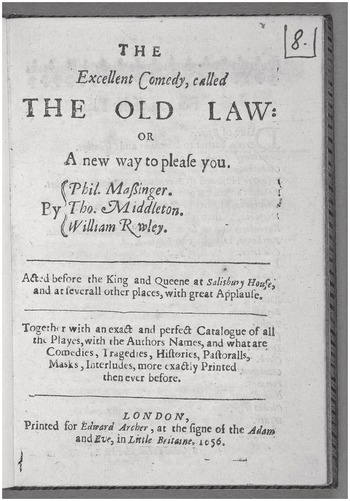
Figure I.5 Title page from Middleton, William Rowley, and Thomas Heywood, The Old Law (Edward Archer, 1656).
In the comprehensive catalogues of 1656, only printed plays are listed, rather than plays performed but not printed. Obviously, the choice to include only printed plays in a catalogue has a commercial dimension: print is an enabling condition of selling plays. Nevertheless, the catalogues resist the commodification of plays. Omitting (commercially enticing) collected editions, the comprehensive catalogues instead list individual plays-in-collection, like Antony and Cleopatra, Macbeth, and Measure for Measure, although in 1656 these plays were only available in print in Shakespeare’s First or Second Folios. One could not, properly speaking, possess a “playbook” called Measure for Measure in 1656. One could, however, know that the play text belonged to a corpus of English drama in print. The contents of “exact and perfect” catalogues represent not so much a bookseller’s entire inventory of commodified playbooks to buy, but rather an authoritative corpus of all English plays in print. Because they excluded performed yet unprinted plays, the catalogues are not a guide to the entire history of English drama.Footnote 89 Rather, they reflect a fundamental reorientation of English drama’s identity around print, partly as a result of the prolonged theatre closures. In an era without the opportunity for theatrical performance, print superseded performance as the crucial element of a play’s cultural currency: the catalogues record a conception of dramatic identity that is no longer chiefly performance-specific. As the theatrical prohibition progressed, plays increasingly relied on possessing some kind of textual iteration to meaningfully “exist” for producers and consumers alike; this text-centric definition of drama endures in modern critics’ reliance on textual remnants to study early modern plays.
The three new printed dramatic forms that first appeared in the 1650s – the New Plays series, the first all-drama printed commonplace book and dramatic anthology, and the first comprehensive catalogues of printed drama – speak to the intense productivity and innovation in printed drama after the theatres closed. All follow the same structural logic of the compendia, namely to unite parts of drama to present a broader view of English drama as a whole. These three compendia are sites where the genre, texts, and critical field of Renaissance drama begin to be visible: each consolidates individual texts into a coherent dramatic category (“plays,” “English dramatic poem,” printed drama), and materialize an aspect of the English dramatic corpus (full-length play, dramatic extract, title).
Each compendium responds to the moment’s pressures and opportunities. With no active theatre industry creating new professional plays, resourceful stationers found fresh ways of repackaging old material, in the novel format of the all-drama commonplace book, or an innovative drama series of older texts that audaciously called itself New Plays. The English Treasury’s appearance is explicitly tied to English drama’s recent decline: Cotgrave explains that his publication is meant to defend the “dramatic poem” at a time when it has been “lately too much slighted.”Footnote 90 The title’s metaphor of the “treasury,” meanwhile, spotlights the volume’s conservatory function in a moment of dramatic loss. From the outset, book catalogues were designed partly to preserve the cultural past. In The Catalogue of English Printed Books (1595), the first printed catalogue of English books, Andrew Maunsell characterized himself as a “remembrancer,” declaring that his catalogue was designed to “draw to your memories Books that you coulde not remember.”Footnote 91 In this context, remembrance has a commercial dimension (one can only purchase plays one is aware of) but is also a crucial step in preserving England’s cultural and intellectual inheritance. Displaying the same impulse, the first instances of bibliographical cataloguing were prompted by the widespread destruction of texts during the Dissolution. Trevor Ross explains that “[t]he very act of recording … presumed the need for such a register. Were it not for the catalogues, it seemed, all of these long-dead authors would have been left to oblivion.”Footnote 92 Analogously, the theatre closures provoked a desire to exhaustively compile and preserve an earlier generation of artistic output that was quickly receding into the mists of memory. Indeed, the theatrical prohibition not only motivated, but also enabled the conditions for the “exact and perfect” catalogues’ creation. Although the catalogues include material written after 1642, rhetorically, the complete lists gesture to a mood of dramatic conclusion. A definitive, ostensibly fixed list of something is only possible once one can be sure there are no new examples.
2 September 1642 has been called the best-known date in English theatre history.Footnote 93 Dramatic criticism, however, has mostly neglected the next eighteen years, called the “obscurest chapter in the history of English literature” and perceived as a “gap” between the two “national” dramatic traditions of the Renaissance and Restoration.Footnote 94 Earlier studies that attend to English theatre and drama during the Civil Wars and Interregnum tend to frame dramatic activities chiefly in terms of the era’s major political and military conflicts. They either advance the persistent identification between Royalist politics and English drama on the one hand and Puritanism and anti-theatricalism on the other, or challenge this familiar binary to instead demonstrate the complex and varied co-option of individual plays from across the political spectrum, from Royalist to Republican. Theatre Closure and the Paradoxical Rise of English Renaissance Drama in the Civil Wars builds on the politically inflected scholarship of Interregnum dramatic and literary culture by Dale Randall, Nancy Klein Maguire, Susan Wiseman, Janet Clare, Rachel Willie, Emma Depledge, Lois Potter, Nigel Smith, and Steven Zwicker, as well as early twentieth-century work by T. S. Graves, Leslie Hotson, and Hyder Rollins.Footnote 95 But the book also modulates notions about Interregnum dramatic culture as encapsulated by Zwicker’s statement that after 1649 there was “no distinction between politics and aesthetics,” and that “all of this era’s work of the literary imagination is embedded in polemic and contest.”Footnote 96 To be sure, in this moment of acute civil strife, English theatre and drama – both individual plays and those institutions more generally – were produced and interpreted with politics in mind. But dramatic producers and consumers in this period also made a concerted effort to transform English drama into a realm apart from politics, presenting plays in ways that sometimes seem to wilfully neglect contemporary crises, and revel in a more bellelettrist appreciation of drama. Ironically, those who were perhaps the most committed to this strategy were Royalists themselves, who saw themselves as guardians of English high culture, as opposed to philistine Puritans. Attempts to cast theatre and drama apolitically, then, could themselves be politically motivated. In this way, Theatre Closure and the Paradoxical Rise of English Renaissance Drama in the Civil Wars differs from earlier studies that unpack the politics of the individual plays composed, staged, printed, or alluded to in the Interregnum, and focuses instead on the political dimensions accorded in this moment to theatre and drama more generally, as concepts. Given that Royalist commentators sometimes deliberately strove to downplay the drama’s political aspects, the latter can be difficult to discern, but the phenomenon indeed represents one of the critical “paradoxes” at the heart of this study. The Interregnum’s self-consciously depoliticized dramatic discourse paved the way for more straightforwardly aesthetic criticism in later centuries.
While previous studies have illuminated this obscure period of literary history, this book is the first to argue that this period is not only worthy of consideration, but central to understanding the critical practice of early modern drama. The major strands of the field – theatre history, dramatic criticism, bibliography – began in the middle decades of the seventeenth century partly in response to the theatrical prohibition. Strikingly, many approaches to and key documents of English drama and theatre history are said to emerge in the mid seventeenth century. David Scott Kastan credits Humphrey Moseley with “inventing” English literature in the 1640s.Footnote 97 Peter Holland, Ellen MacKay, and Richard Schoch argue that theatre history starts with Flecknoe’s A Short Discourse (1664).Footnote 98 Adam Hooks claims that dramatic enumerative bibliography begins with Francis Kirkman’s 1661 comprehensive catalogue.Footnote 99 As noted above, Jeremy Lopez calls Cotgrave’s English Treasury the first dramatic anthology,Footnote 100 while Michael Gavin argues that English literary criticism was born in the 1650s.Footnote 101 Several of these branches of dramatic criticism, anthologization, bibliography, and theatre history flourished most fully after the Restoration. But their earliest instances actually occurred during the 1640s and 1650s, and were driven by changes effected by the theatrical prohibition. Flecknoe’s “Whimzey” of 1652 anticipates many of the strategies, sentiments, and examples of A Short Discourse; one can trace a direct line from Kirkman’s Restoration dramatic bibliographies to the comprehensive catalogues of 1656.
This book demonstrates the prolonged theatrical prohibition’s influence on dramatic commentary. The closure of the playhouses contributed to the first sustained body of literary, specifically dramatic, criticism, as dispersed dramatic coteries reproduced their communities in the printed pages of dramatic paratexts, which swelled in this period. The collapse of theatre brought new attention to and appreciation of the entire field of English plays. Kastan’s author-centric model of literature’s origins overlooks Moseley’s prioritization of “plays” above individual authors. This book instead offers a “post-authorship” account of dramatic canonization and corpus-formation, demonstrating how after the theatres closed in 1642, the set of plays produced up to that year were seen to cohere as a distinct group, what we now call “early modern” or “Renaissance” drama. During and thanks to the theatrical prohibition, pre-1642 drama was for the first time viewed as a distinct genre and critical field.
Scholars of disciplinary periods, fields of cultural production, and canon formation help me theorize the Interregnum as a moment when the related but distinct terms “field,” “period,” and “corpus” of English Renaissance drama were created, and its canonization occurred. Pierre Bourdieu’s sociology of canon formation describes the material, commercial, and social forces that create value, arguing that “the producer of the value of the work of art is not the artist but the field of [cultural] production.”Footnote 102 Bourdieu’s displacement of the artist as the primary agent of his or her own canonization and emphasis instead on the canonizing powers of a “field of production” that includes publishers, critics, and adapters helps me clarify how the era of the theatrical prohibition – when dramatic commentary and innovative forms of adaptation joined dramatic publication practices already entrenched by 1642 – must be understood as a key moment of field creation and canonization. In terms of individual plays, the Interregnum was chiefly a period of dramatic corporatization – that is, the establishment of an inclusive dramatic corpus (evidenced, for instance, in the comprehensive printed dramatic catalogues of 1656) – rather than of canonization. Canonization is important in the Interregnum, however, insofar as canonization was occurring across the entire genre of English drama: that is, pre-1642 plays as a group acquired a higher cultural standing. The common canonization of pre-1642 drama as a whole might seem to contradict the process of exclusion on which canonization relies. Exclusion is still at work even here, however, not in terms of individual plays, but rather in terms of the kinds of genres accorded literary status. The genre of English drama was elevated above other kinds of printed ephemera: whereas plays and pamphlets were treated similarly in the late sixteenth and early seventeenth centuries, by the mid seventeenth century, plays acquired a status apart and above that of printed ephemera. Certainly, the mid seventeenth century in many ways continued processes visible in the earlier part of the seventeenth century, but the Interregnum accelerated these processes, and cemented plays’ status, due partly to the powerful effect of theatrical nostalgia and its attendant effects on the perception of plays’ cultural value.
These views were expressed in dramatic paratexts and other works that represent the first sustained body of inquiry of the English theatrical and dramatic “past.” As early as the mid-1640s, the year 1642 was taken as the kind of fissure producing historical contrast which theorists of periodization note is crucial for period formation. When a conception of this discrete “period” of dramatic style (“the last age”) was subjected to critical study or disciplinary analysis, the result was an emerging sense of a “field.”Footnote 103 Usually, critics locate the first systematic dramatic studies in the Restoration, but Theatre Closure demonstrates their earlier origins in the era of the theatrical prohibition. Frank Kermode’s notion that canon formation relies on the “continuity of attention and interpretation,” bestowed by prominent institutions, transforming mere “opinion” into cultural “knowledge,”Footnote 104 likewise points to the middle decades of the seventeenth century as central to English drama’s canonization. Although the academic institutions on which Kermode dwells had yet to embrace the field of English dramatic study, the increasingly prominent printed paratextual discourse in the Interregnum made conventional and pervasive the activity of dramatic criticism itself.
***
Theatre Closure and the Paradoxical Rise of English Renaissance Drama in the Civil Wars explores how the decline of theatre between 1642 and 1660 lastingly transformed the production, consumption, and conception of English professional drama on the stage, in print, and in the public consciousness. Theatre Closure reconciles theatre history and book history, two approaches usually treated in isolation, to posit the reciprocal influence of drama’s two media – the absent (or illegal) stage and the printed page.Footnote 105 Chapter 1 (“Dead Theatre, Printed Relics”) argues that a pervasive sense of English theatre’s demise during the 1640s and 1650s drove the cultural ascendancy of English plays. Kermode defines literary classics as “old books that people still read.”Footnote 106 The theatre ban transformed English plays into textual objects from another era – that is, it made them seem both older and more bookish – facilitating their widespread acceptance as literature. While individual authors like Shakespeare and Jonson were canonized by the 1630s, this chapter demonstrates that English drama as a whole acquired a comparable literary status only after the theatres closed. An important precursor for this process was the marketing of stage flops as literature: unfavoured plays were deemed to exceed the capacities of vulgar theatrical audiences, and therefore, must be sophisticated. Because failed stage plays were less likely to be revived onstage, they needed to be preserved in print or else sink into oblivion. In the early years after the theatres closed, dramatic discourse followed the older rhetorical example of downplaying printed plays’ theatrical origins to assert their cultural value. As the theatre ban dragged on, however, thanks to theatrical nostalgia, a play’s theatrical origins contributed to, rather than detracted from, its “literary” respectability. Plays were described as printed “relics” of the dead theatre, a metaphor that anticipated and acquired weight from the execution and martyrdom of Charles I in 1649. In short, the genre of English drama was canonized posthumously.
At Ben Jonson’s Head, the stationer Robert Pollard advertised his inventory with Jonson’s recognizable and esteemed likeness, and published a wide range of dramatic and non-dramatic material, but no Jonson plays. A similar separation between authorial persona and printed texts is visible in the Interregnum circulation of Shakespeare. Chapter 2 (“Old Shakespeare”) considers the decline of Shakespearean play publication during the 1640s and 1650s, even as the authorial figure of Shakespeare was celebrated as a standard of dramatic value. While dramatic publishing flourished in the middle decades of the seventeenth century, only two new editions of Shakespeare plays (Othello and King Lear), one new edition of a poem (Lucrece), and one new title page for a reissued edition (The Merchant of Venice) appeared. I ascribe this relative Shakespearean shortfall to stationers capitalizing on the availability of and demand for “new” (i.e. previously unprinted) professional plays in a moment without an active theatre. This emphasis on dramatic novelty neglected Shakespeare’s oft-printed plays, but ensured the survival of many other plays in the early modern English dramatic corpus. This chapter also considers the limited Shakespearean publications in the Interregnum, texts that bear witness to “old” Shakespeare’s established yet imprecise respectability, a quality that led to a range of textual appropriations.
The third chapter (“Canonizing Beaumont and Fletcher”) considers the reception and production of the most popular dramatists on the illegal stage and on the printed page during the Civil Wars and Interregnum: Beaumont and Fletcher. Surveying the considerable body of dramatic paratexts from and commentary on illegal performances of their plays, this chapter offers reasons for Beaumont and Fletcher’s particular popularity. Reading against the grain of politicized criticism that has characterized (and inhibited) approaches to Beaumont and Fletcher for the last four centuries, I offer an alternative reading of A King and No King that argues that this paradoxical play is simultaneously political and not political: audiences were drawn to the play’s aesthetic qualities, but for reasons that often reflected their political investments. While A King and No King’s provocative title undoubtedly speaks to the crises in monarchical succession and identity of the 1640s and 1650s – Charles II’s status as a king was in question after execution of his father Charles I, while many saw Lord Protector Oliver Cromwell as a king in everything but name – the deliberately puzzling quality of the title also speaks to the play’s preoccupation with crises of personal identity, familial relations, and verbal and ontological paradoxes, which are often displaced in criticism in favour of more overtly politicized readings. But while A King and No King’s paradoxes need not be read in the context of Interregnum politics, in practice, Beaumont and Fletcher’s topsy-turvy sensibilities spoke to the vertiginous moment of the mid seventeenth century as well as to Royalists’ bellelettrist sensibilities.
The last two chapters consider how the theatrical prohibition lastingly transformed dramatic attitudes and practices. The restoration of the theatres in 1660 is typically conceived as a “fresh start” in English theatrical culture. Chapter 4 (“Chronic Conditions”) demonstrates that the 1660s marked not simply a change but also a continuation of many of the conditions of the 1640s and 1650s. It focuses on the theatrical professionals who continued to be marginalized from the industry, and the consequent effects on theatre, print publication, and dramatic discourse. The effects of the theatrical prohibition continued to shape dramatic activities and discourse even after the theatres reopened. Chapter 4 is paired with Chapter 5 (“Morbid Symptoms”), which challenges critical commonplaces that locate the origins of dramatic criticism and theatre historiography in the Restoration, and traces these instead to the Interregnum. This chapter articulates the role of the theatrical prohibition in the emergence of different strands of early modern dramatic studies: theatre history, dramatic criticism, and bibliography. Theatre history begins after 1642 because that is when theatre became history. “Exact and perfect” lists of playbooks were interesting in their own right, as encyclopedic repositories of information. Comprehensive enumerative bibliography was a means to shore up the ruins of the dramatic past; as Angus Vine notes, “encyclopedism is the name of the antiquarian game.”Footnote 107 Prefatory dramatic criticism recreated in print the conversations that had otherwise taken place in person at the playhouse, among people now dispersed due to war and economic collapse. Due to the restrictions on theatre, English drama was repackaged and reconceived in ways that still inform our engagements with early modern drama. Together, these final two chapters argue that both the “fresh start” theory of Restoration theatre and the “new” Restoration dramatic studies must actually be understood in terms of the continuation of the Interregnum’s dramatic attitudes and practices after 1660.
“Literary history is a morgue where one seeks out the friend one most loved,” claims the nineteenth-century German literary critic Heinrich Heine, suggesting that the primary concern of literary history is to engage with the literary past from which one is irremediably estranged.Footnote 108 Heine’s formulation helps us understand what happened to English professional drama during the theatrical prohibition. The decisive conclusion of professional theatre in 1642 made both possible and necessary a coherent conception of the lost genre. The perception that early modern professional drama died after 1642 prompted efforts to elegize and anatomize the genre. In fact, the drama neither died nor disappeared between 1642 and 1660; the attempt to silence plays was only partially successful and, ultimately, temporary. Yet during the theatre’s prolonged pause, contemporaries lived with the fear that it might never return. For two long decades, the fear of drama’s irrecoverable loss prompted efforts of recovery that lastingly shaped the category of English Renaissance drama as a genre and critical field.


