

1. Introduction
The concept of a minimal pair has been applied in different ways throughout the history of phonology. It has been essential within many theoretical frameworks to build a set of distinctive features in an L-specific way, in a universal way, and in a practical way, assisting fieldworkers as they document phonemic inventories to map out a lexicon in an unfamiliar language (Chomsky & Halle Reference Chomsky and Halle1968, Trubetzkoy Reference Trubetzkoy1969, Jakobson et al. Reference Jakobson, Fant and Halle1972, Bloomfield Reference Bloomfield1984, Clements Reference Clements1985, Sagey Reference Sagey1986, Sapir Reference Sapir2004; see also Sandler et al. Reference Sandler, Aronoff, Meir and Padden2011, Brentari et al. Reference Brentari, Fenlon and Cormier2018, Mertz et al. Reference Mertz, Geraci, Brentari, Jardine and deLacyin press, and Makaroğlu et al. Reference Makaroğlu, Bekar and Arik2014 for the use of minimal pairs in establishing phonological inventories in sign languages). Of course, other measures, such as phonetic similarity, frequency, productivity and near-minimal pairs are also important tools in these endeavors. Minimal pairs have also been important in psycholinguistic experiments in a number of ways, from establishing categorical perception (Harnad Reference Harnad1987, Bertoncini et al. Reference Bertoncini, Bijeljac-Babic, Jusczyk, Kennedy and Mehler1988, Jusczyk & Bertoncini Reference Jusczyk and Bertoncini1988, Floccia & Bertoncini Reference Floccia and Bertoncini1993; see also Emmorey et al. Reference Emmorey, McCullough and Brentari2003, Baker et al. Reference Baker, Idsardi, Golinkoff and Petitto2005 for sign languages) to determining the shape of words in lexical decision tasks (Pallier et al. Reference Pallier, Colomé and Sebastián-Gallés2001, Clopper & Walker Reference Clopper and Walker2017; see also Carreiras et al. Reference Carreiras, Gutiérrez-Sigut, Baquero and Corina2008 for sign languages).
Consider a near minimal pair in ASL: THINK and CONSIDER (Figure 1), which are related within a semantic field. The selected fingers of the handshape and the place of articulation are the same, but the orientation and movement are different. This type of near minimal pair differs from those, such as APPLE, CANDY, and ONION, which are not morphologically related (Figure 2).
Morphologically related contrast in ASL within a semantic field: (a) THINK vs. (b) CONSIDER (reprinted with permission from ASL SignBank, Hochgesang et al. Reference Hochgesang, Crasborn and Lillo-Martin2026).

(a) APPLE/ONION is a minimal pair for place of articulation features; (b) APPLE/CANDY is a minimal pair for joint configuration features of handshape (reprinted with permission from ASL SignBank, Hochgesang et al. Reference Hochgesang, Crasborn and Lillo-Martin2026).

We know that semantic and iconic relatedness as well as arbitrary factors have an impact on the shape of the lexicon. Systematic (arbitrary) cues in spoken languages, including vowel height, duration, stress, voicing, phonotactics, and so on, have been found to correlate to syntactic, as well as semantic information (Kelly Reference Kelly1992, Monaghan et al. Reference Monaghan, Christiansen and Chater2007, Reilly et al. Reference Reilly, Westbury, Kean and Peelle2012, Blasi et al. Reference Blasi, Wichmann, Hammarström, Stadler and Christiansen2016). For example, in English disyllabic words, stress is one way to distinguish verbs from nouns ( record vs. record , permit vs. permit ). Systematic (arbitrary) cues occur in sign languages as well, in sign families, groups of signs with a formational similarity and a corresponding meaning similarity (Frishberg & Gough Reference Frishberg and Gough2000). For example, the ASL signs for a group of cities (PHILADELPHIA, DETROIT, CHICAGO, INDIANAPOLIS) form such a family, each articulated with the movement of a ‘7’ shape (see Thompson et al. Reference Thompson, Perlman, Lupyan, Sehyr and Emmorey2020, Martinez del Rio et al. Reference Martinez Del Rio, Ferrara, Kim, Hakgüder and Brentari2022).
Iconicity is both fundamental and pervasive in human communication (Perniss et al. Reference Perniss, Thompson and Vigliocco2010, Vigliocco et al. Reference Vigliocco, Perniss and Vinson2014, Akita & Dingemanse Reference Akita and Dingemanse2019) across languages and modalities, where meaning and phonological form are linked (Blasi et al. Reference Blasi, Wichmann, Hammarström, Stadler and Christiansen2016, Dautriche et al. Reference Dautriche, Mahowald, Gibson, Christophe and Piantadosi2017a, Reference Dautriche, Mahowald, Gibson and Piantadosib, Perlman et al. Reference Perlman, Little, Thompson and Thompson2018). For example, the Italian vowel /o/ is used in the affix for large objects (Hinton et al. Reference Hinton, Nichols and Ohala1995): librone, abbraccione, bacione; and /i/ is used in the affix for small objects: librino, messaggino, bacino. These vowels establish iconic relations that correspond to the relative sizes of the oral cavity for the two vowels (i.e. /o/ uses a large oral cavity, /i/ uses a small oral cavity). In sign languages, lexically the forehead is used in ASL for a group related to mental activity (Wilbur Reference Wilbur1987): THINK, KNOW, HYPOTHESIS, and CONSIDER. Also, iconicity contributes to a morphosyntactic distinction across several sign languages: Handling Handshapes, which use hand-as-hand iconicity, are associated with agentive (transitive) subjects, and Object Handshapes, which use hand-as-object iconicity, are associated with non-agentive (intransitive) subjects (Brentari et al. Reference Brentari, Coppola, Cho and Senghas2017). Iconic prototypes have also been shown to be important in two young sign languages, Kenyan Sign Language (Morgan Reference Morgan2017) and Al-Sayyid Bedouin Sign Language (Israel & Sandler Reference Israel, Sandler, Channon and van der Hulst2011, Sandler et al. Reference Sandler, Aronoff, Meir and Padden2011). We take as given that all of these pressures are important in building a language’s inventory. By looking closely at Protactile Language (PT), an emerging language in which minimal pairs have only been in evidence very recently, we gain insights into when and how these pressures first exert themselves. In this article, we describe the origins of PT and its phonological categories since the beginning of the PT movement in 2007 (see Edwards Reference Edwards2024 for background on the PT movement). Our analysis covers data collected over a twelve-year period, between 2010 and 2022.
We report on the results of two studies, using an interdisciplinary methodology to achieve a more complete picture of the emergence of minimal pairs. In Study 1 an experimental task is employed repeatedly over three time periods (2015, 2018, and 2021) to address how the use of phonological units has changed, and these results are compared with naturalistic data collected in 2010, which include forms similar to those elicited in 2015, 2018, and 2021. We show, in general, how PT articulators and phonological units were conventionalized, particularly one such unit, which is crucial for the analysis of minimal pairs in Study 2, the Proprioceptive Object (PO). This unit functions as one kind of Place of Articulation (POA) within ‘contact space’ (explained in the section ‘Proprioceptive constructions’, below).
In Study 2, we show how new PT words have been innovated and minimal pairs created, using the scaf- folding provided by the established coherence of the phonological system. Previously ignored parts of the interlocutor’s body were drawn on to establish landmarks, which help identify increasingly fine-grained distinctions between places of articulation (POAs). We show that these distinctions enable the rapid growth of core lexical items in PT by enabling the creation of entire semantic classes at once, where category-internal relations are represented via diagrammatic iconicity. We provide several examples of minimal pairs that we have observed in PT in the last two years and track the relationship between iconicity and formal contrast.
1.1. Background: language emergence and its relevance for historical change
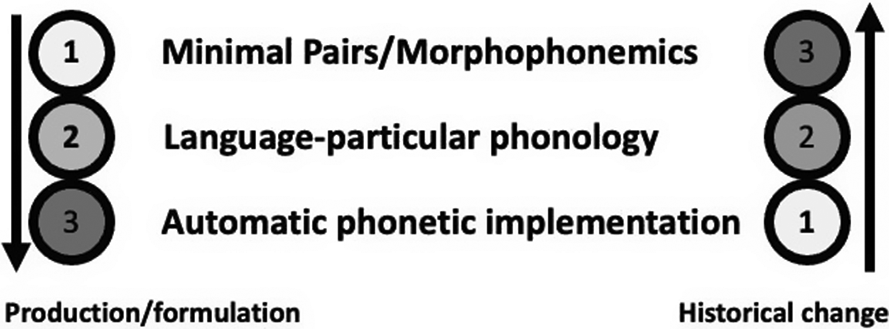
Regarding the emergence of phonology, we see a strong similarity between work on the seeds of phonological change in established languages and the way that minimal pairs are emerging in PT. In a traditional generative phonology model, the formulation and production of a single utterance is understood in terms of a metaphorical timeline that is ‘top-down’ in nature: morphophonemic representation and associated processes occur ‘early’ and automatic phonetic processes and phrasal phonology occur ‘late’. This top-down temporal metaphor (Figure 3, left) started during the period of Chomsky and Halle (Reference Chomsky and Halle1968), continued through the period of lexical phonology (Kiparsky Reference Kiparsky and Yang1982), and exists even now as Optimality Theory addresses opaque operations (McCarthy Reference McCarthy2001). However, in work on historical change the timeline is not top-down, but bottom-up (Figure 3, right). Automatic processes are last in the series of steps pertaining to formulation, but first as they pertain to historical change.
A schema showing the different uses of time in phonology: (left) the morphophonemic, phonological, phonetic path in formulating an utterance in generative phonology, and (right) the phonetic, phonological, morphophonemic path in historical change and language emergence.

Yu and colleagues (Yu Reference Yu2013, Kavitskaya & Yu Reference Kavitskaya and Alan2023) have been studying the seeds of phonological change in spoken languages. They focus on the range of factors in the middle ground (a circled ‘2’ in Figure 3) and how these factors shape automatic processes, whereby properties change status and ultimately become part of the morphophonemics. The case of language emergence we report on here contributes unique perspectives to the field of feature emergence and change, as automatic properties are shaped by social and interactional constraints concerning how form and meaning can be produced. In emerging languages we can observe how those patterns and relations take shape in historical time.
Close scrutiny over a relatively short time frame, taking social and interactional processes into account, can offer a window into how phonological change takes hold in a given community—a kind of micro-history (Yu Reference Yu2013, Kavitskaya & Yu Reference Kavitskaya and Alan2023, and references therein). These scholars recognize that a time frame of sixty years may be enough to track the seeds of historical change—a period which might have been considered a part of synchronic linguistics, given the long time frame with which historical linguistics typically deals. A spoken language example in this area comes from spoken Seoul Korean (Kirby Reference Kirby and Alan2013). A change has been observed concerning two kinds of voiceless stop consonants: simple plain /p/ vs. an aspirated /ph/. Studies of Korean stops during the 1960s found this distinction to be marked primarily by differences in voice onset time (VOT), but speech samples from the 2000s have shown that pitch/frequency is now the primary feature used to mark this distinction.
VOT was contrastive in the 1960s and it has been demoted to phonetic status. Pitch was phonetic and it has been promoted to phonological (morphophonemic) status; and this change occurred during a sixty-year slice of time. For ASL, sixty years is the length of time between the production of the National Association of the Deaf’s set of landmark films documenting ASL (see Supalla & Clark Reference Supalla and Clark2015) and the publication of William Stokoe, Dorothy Casterline, and Carl Croneberg’s groundbreaking dictionary (Stokoe et al. Reference Stokoe, Casterline and Croneberg1965). During this sixty-year period many innovations in ASL have also taken place (Supalla Reference Supalla, Kikusawa and Reid2013, Supalla & Clarke Reference Supalla and Clark2015, Sampson & Mayberry Reference Sampson and Mayberry2022).
It is this insight about microhistory that allows us to turn to language emergence as a window on historical change because young communities have been studied at close range and rapid change is occurring in a period of about sixty years (plus or minus ten years). In describing an undocumented language for the first time, scholars often use the presence of minimal pairs as an initial diagnostic to build the phonemic inventory. We would argue, however, that as in historical change, minimal pairs are the last in a series of steps, some of which may no longer be easily recoverable in a given language. The effects of other aspects of a phonological system can be informative and important in tracking the process of emergence in its earliest stages.
Sign languages have offered numerous ways to observe what is happening in the middle portion of Figure 3. Within this time frame, Sandler et al. (Reference Sandler, Aronoff, Meir and Padden2011) have argued that conventionalization of ‘family-lects’ has occurred in Al-Sayyid Bedouin Sign Language (ABSL) users, whereby multi-generational families of signers begin to converge on single phonological forms for the names of common objects, and a system of verb agreement has developed in Israeli Sign Language (Padden et al. Reference Padden, Meir, Aronoff, Sandler and Brentari2010) and Nicaraguan Sign Language (Senghas Reference Senghas1995).
In addition to language-internal processes, continued use and conventionalization of any language depends on socio-historical and interactional dynamics and characterizations of ways of speaking or signing (including deeming something a ‘language’ or ‘variety’). These dynamics are shaped by the moral and political projects of speakers and linguists, and often play out in complex and subtle ways in interaction (Lucas & Valli Reference Lucas and Valli1991, Gal Reference Gal2006, Johnstone Reference Johnstone2016, King Reference King2020). These factors are present any time a social group or a language is delimited, characterized, or analyzed, and can have significant effects on our understandings of how languages emerge, diverge, converge, and otherwise change (Weinreich et al. Reference Weinreich, Labov, Herzog, Lehmann and Malkiel1968, Auer et al. Reference Auer, Peersman, Pickl, Rutten and Vosters2015). PT is no exception. How and whether PT continues to emerge will depend on the types and frequency of interactions among PT speakers, how speakers identify and frame social relations, and how all of this effects metalinguistic appraisals of what counts as PT. So far, pressures on emergence and standardization have been exerted mainly in training contexts (e.g. granda & Nuccio Reference granda and Nuccio2018, protactilelanguageinterpreting.org/), and in responses to those trainings (e.g. Johnson Reference Johnson2020). However, trainings have often taken place in locations where participants or students remain for some length of time—anywhere from a few days to a few months—before returning home. Little is known about how the practices that are acquired in training change, and are changed by, the home contexts of learners. This is an important area for future research, as it will have a significant impact on the continued emergence (or not) of the language and therefore on our understanding of the conditions required to support language emergence.
DeafBlind thinkers have, thus far, been framing PT as part of a larger, intentional break with ASL and visual practices more broadly. The aim is not to preserve ASL despite vision loss, but rather, to cash in on the affordances of the proprioceptive/tactile modality in ways that make communication precise and efficient, while also maintaining iconic relations that link language to the world in which it is used. Granda and Nuccio (Reference granda and Nuccio2018:13) write:
As Deaf children, we were drawn to visual imagery in ASL stories—transported into the vivid details of the worlds created for us. As DeafBlind adults, we still carry those values within us, but ASL doesn’t evoke those same feelings for us anymore. When you are perceiving a visual language through touch, the precision, beauty, and emotion are stripped away; the imagery is lost…. If you try to access an ASL story through an interpreter … you just feel a hand moving around in air space … . In air space we are told what is happening for other people, but nothing happens for us.
This suggests that PT speakers are prioritizing intuitive and effective communication as opposed to prioritizing the preservation of ASL structures. This is a historically contingent fact that cannot be taken for granted across DeafBlind communities.
1.2. Previous work and background on protactile language (PT)
PT has emerged in groups of DeafBlind people in the U.S., most of whom were born sighted, acquired ASL as children, and became blind slowly over many years. As that process unfolded, visual communication, including the use of ASL, became increasingly untenable. Prior to the PT movement, this problem was addressed by relying on sighted interpreters. With the inception of the PT movement, a politically and culturally framed demotion of visual communication and ASL began, and there was an explicit push toward experimentation and innovation aimed at maximizing the potential of tactile channels for purposes of communication (McMillen Reference McMillen2015, granda & Nuccio Reference granda and Nuccio2018, Clark Reference Clark2024, Edwards Reference Edwards2024). As a result, new grammatical systems are beginning to emerge, which are optimized as never before, to the tactile modality (Edwards & Brentari Reference Edwards and Brentari2020).
In our prior research, we have shown that in roughly ten years, a new phonological system has become conventional in protactile DeafBlind communities. This process has involved assigning specific grammatical roles to the four hands (and arms) of Speaker 1 (‘conveyer’) and Speaker 2 (‘receiver’) in Proprioceptive Constructions (PCs), which are comparable to ‘classifier constructions’ in visual signed languages (Edwards & Brentari Reference Edwards and Brentari2020). In producing a PC, Speaker 1 and Speaker 2 work together to define the global Space of Articulation (similar to a place of articulation, referred to above).
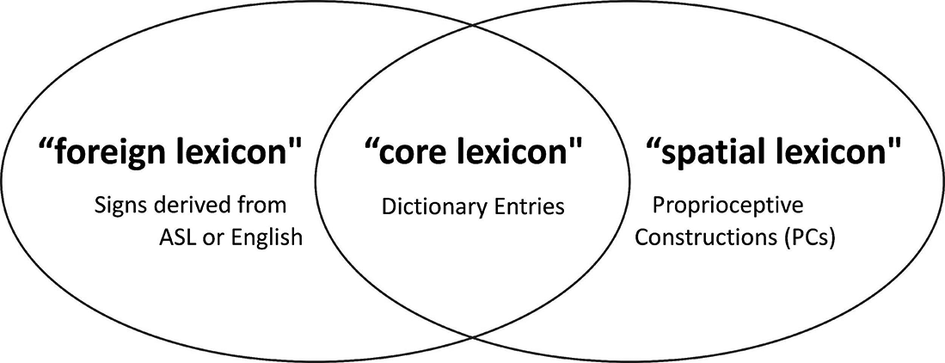
Applying a framework that has been used to analyze many spoken (Itō & Mester Reference Itō, Mester, Beckman, Dickey and Urbanczyk1995a, Reference Itō, Mester and Goldsmithb) and signed languages (Brentari & Padden Reference Brentari, Padden and Brentari2001), we divide the PT lexicon into three parts. The core lexicon (Figure 4, center) is comprised of words whose features are meaningless sub-lexical units with a highly conventionalized form-meaning association. These are the words one would expect to find listed in a dictionary.
Components of the PT lexicon (cf. Brentari & Padden Reference Brentari, Padden and Brentari2001).

A second component, the foreign lexicon (Figure 4, left), contains items borrowed from foreign sources. In ASL this would include the manual alphabet and words derived from that system. The third component, the spatial lexicon (Figure 4, right), is composed of iconic words in spoken languages (Itō & Mester Reference Itō, Mester, Beckman, Dickey and Urbanczyk1995a, Reference Itō, Mester and Goldsmithb), and spatial verbs and classifier constructions in signed languages (Supalla Reference Supalla1982).
Prior work on PT focused on the tools used to express PCs in the spatial lexicon. In the current paper we analyze the emergence of new patterns in PTs core lexicon, and PTs first minimal pairs. In order to understand these findings, we must provide additional background on proprioceptive constructions, which preceded and gave rise to the core lexicon in PT (further details can be found in Edwards & Brentari Reference Edwards and Brentari2020). The units that grew out of the innovation of PCs form the basis of the structures analyzed here.
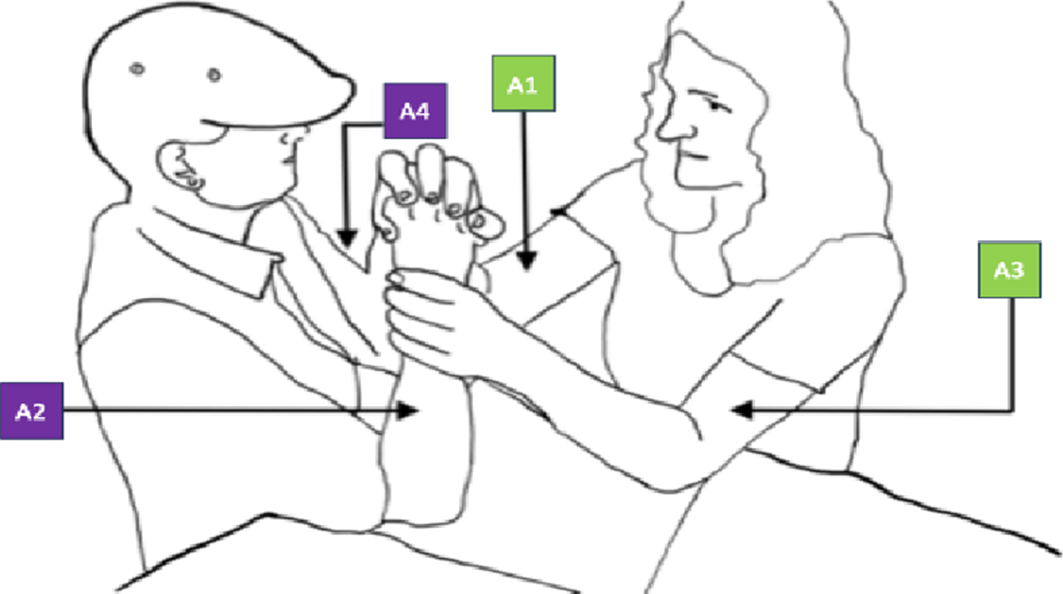
Proprioceptive Constructions (PCs). Most of the early innovations in PT arose in PCs, which are part of the spatial lexicon. In contrast to visual languages, where sign production involves the two articulators of the signer, PT has four potential articulators: the hands and arms of Speaker 1 (Figure 5, right) and the hands and arms of Speaker 2 (Figure 5, left). Recall that Speaker 1 is the principal ‘conveyer’ of information. Speaker 2 contributes to the articulation of the message, but in terms of information is the principal ‘receiver’. We label the dominant hands of Speaker 1 (A1), Speaker 2 (A2) and the nondominant hands of Speaker 1 (A3) and Speaker 2 (A4). In visual signed languages, the dominant hand (H1) and the nondominant hand (H2) are assigned complementary roles; H1 is more active than H2 (Battison Reference Battison1978). In PT, four anatomical structures are available for producing each expression. In our analysis, we assign each structure to a role based on its level of activity. A1 is the most active and is assigned to the dominant hand of Speaker 1. A2 is the next most active role and is assigned to the dominant hand of Speaker 2. A3 is assigned to the non-dominant hand of Speaker 1. A4 has the least active role, and is assigned to the non-dominant hand of Speaker 2, being called on sporadically to produce certain components of expressions, and otherwise being available for producing tactile backchanneling and tracking the movements of Speaker 1’s dominant hand (A1).
The four articulators used to produce Proprioceptive Constructions (PCs).

The incorporation of the receiver’s body (A2 and A4) as part of the articulatory apparatus yields a new kind of articulatory space, which is, to our knowledge, unattested in the world’s languages.Footnote 1 Granda and Nuccio (Reference granda and Nuccio2018) call this ‘contact space’, which they distinguish sharply from ‘air space’, used in visual languages such as ASL. In air space, locations are perceived relative to each other against a visual backdrop, while in contact space, locations on Speaker 2 are activated and perceived against the backdrop of Speaker 2’s own body. For example, in Figure 6 Speaker 1 (right) is describing a lollipop to Speaker 2 (left). The cylindrical stick of the lollipop is represented by the arm of Speaker 2, as is the spherical candy portion. Their spatial relationship to one another is clear since they are perceived by Speaker 2, via proprioception, in the movements and positionings of their own body. Incorporating Speaker 2s body into the articulatory system unlocks great potential in the tactile modality. However, it also generates a problem for the language: how can the articulators of Speaker 1 and Speaker 2 be coordinated in an efficient and effective manner?
Proprioceptive construction: (a) Initiate 1, (b) Initiate 2, (c) Proprioceptive object (PO), (d) Prompt to continue (PTC), (e) Movement-contact type (MC).

Figure 6. Long description
The sequence consists of five panels, each featuring a person on the left wearing a cap and a person on the right. Blue shading indicates active limbs or objects of focus.
Panel a. Initiate 1. The person on the right reaches out with their right arm, shaded blue and labeled A 3, to touch the left arm of the person on the left, labeled A 4. A bounding box highlights the hand contact. Labels A 1 and A 2 point to the upper arms of the right and left individuals respectively.
Panel b. Initiate 2. The person on the right uses their blue-shaded arm A 3 to lift the left leg of the person on the left. A vertical bounding box contains the lifted leg and the supporting hands.
Panel c. Proprioceptive object P O. The person on the left holds their own blue-shaded left arm A 2 upright. The person on the right, with arm A 3, supports the elbow of the person on the left. A bounding box surrounds the upright forearm.
Panel d. Prompt to continue P T C. The person on the left holds their blue-shaded left hand A 2 upward. The person on the right uses their blue-shaded arm A 3 to grasp the wrist of the person on the left. A bounding box focuses on the wrist grip.
Panel e. Movement-contact type M C. Similar to panel d, but the person on the right's arm A 1 is now shaded blue as they pull the other person's arm downward. A bounding box contains a downward-pointing arrow indicating the direction of movement.
Early in its development, PT phonology resolved this problem by establishing conventional ways of signaling how and when Speaker 1 wants Speaker 2 to contribute to co-articulation of PCs. Edwards and Brentari (Reference Edwards and Brentari2020) show that, for data collected in 2015, the conventionalization of such mechanisms involved assigning specific linguistic tasks to four articulators (A1–A4 in Figure 5) in much the same way that the two hands in visual signed languages (H1 and H2) are assigned consistent and distinct tasks (Battison Reference Battison1978). In the following sections, we compare analyses of the 2015 data to comparable analyses of data collected in 2010, 2018, and 2021, in order to find out how the functional roles of the articulators have changed over time, and how those changes have created the conditions required for a core lexicon to take shape in PT.
Each PC includes at least one unit from each of the following categories, labeled according to their role in the larger construction: ‘Initiate’ (I),‘proprioceptive object’ (PO), ‘prompt to continue’ (PTC), and ‘movement-contact type’ (MC). These units, which are defined in Figure 6, combine in the order given, to form a unified construction via rapid interchange between Speaker 1 and Speaker 2.
Initiate: In the temporal unfolding of the PC, the first unit to occur is ‘Initiate’. As its name suggests, its function is to initiate a four-handed construction. For example, in Figure 6a, Attested values for Initiate include: TOUCH, GRASP, MOVE, HOLD, TRACE, PROMPT-TAP, and PROMPT-PO.
Proprioceptive object: Once the PC has been initiated, a meaningful and phonologically constrained space, on which, or within which, further information can be conveyed must be established. We call that space, which is actively produced by Speaker 2, the ‘proprioceptive object’ (PO). In Figure 6b, Speaker 1 produces a second Initiate, telling Speaker 2 to select the PO-SPHERE. In Figure 6c, Speaker 2 produces the PO-SPHERE using A2. Attested values for POs include: PLANE, CYLINDER, SPHERE, INDIVIDUATED OBJECTS, and CONTAINER.
Prompt to continue: The third task in producing a PC is to maintain the active contact space generated by the PO. It tells Speaker 2, ‘Leave this hand here. There is more to come’; or in the case of PUSH, ‘Relax this hand, we are done with it’. Therefore, we call this category of forms ‘prompt to continue’ (PTC). In Figure 6d, after Speaker 2 has produced the requested PO (using A2), Speaker 1 grips the PO (using A3) and holds onto it for the remainder of the PC. This gripping action is an example of a PTC unit. Attested values for PTCs include: GRIP, PENETRATE, PRESS, HOLD, and PUSH.
Movement-contact type: The fourth unit of a PC draws attention to, and characterizes, certain aspects of the PO, or a language-external referent, by producing tactile and proprioceptive cues that contain information about size, shape, location, or movement of an entity. These cues are called ‘movement-contact types’ (MCs). For example, in Figure 6e, Speaker 1 (left) uses A1 (her right hand) to GRIP and SLIDE the forearm of A2 from the wrist to the elbow. Figure 6e shows the end of a GRIP-SLIDE describing a long, cylindrical object. Attested values for MCs include: TRACE, GRIP, SLIDE, PENETRATION, TAP, PRESS, SCRATCH, MOVE, and PUSH.
In what follows, we report on findings for two studies across a twelve-year period. Recorded ethnographic data on PT speakers in 2010 (the earliest data we have on PT) led to an experimental study which was repeated in 2015, 2018, and 2021. Study 1 tracks the diachronic changes measured across data collected in 2015, 2018, and 2021. We then return to the naturalistic data from 2010 to verify our findings by analyzing forms in the same set of speakers, comparable to the data collected in the experimental study. Study 2 analyzes new naturalistic data collected in 2022 documenting further elaborations of the PC sub-system since 2021, as new formal and iconic devices are added to create core lexical items, and, as we will show, minimal pairs.Footnote 2
2. Study 1: conventionalization of phonological units
Study 1 is a diachronic analysis of data collected at four points across five individuals in the role of Speaker 1, who are participating in PT dyads (see below). The Speaker 1 member of the dyad of protactile participants was asked to describe a series of tactile stimuli. We videorecorded, analyzed, and transcribed their productions. This analysis reveals diachronic changes in the form-meaning mappings between articulators and their functional role in the production and reception of four-handed expressions in PT. The conventionalization of these structures laid the foundation for a core lexicon to emerge. The units we describe above in Section 1 are ubiquitous across the entire lexicon (spatial, core, and foreign), and they take on a range of functions. They did not start out as discourse markers but rather as efficient strategies of incorporating contact space, co-presence, and co-constructed words and clauses, which then were conventionalized and grammaticalized as phonological units.
2.1. Methods
2.1.1. Participants: 2010–2021
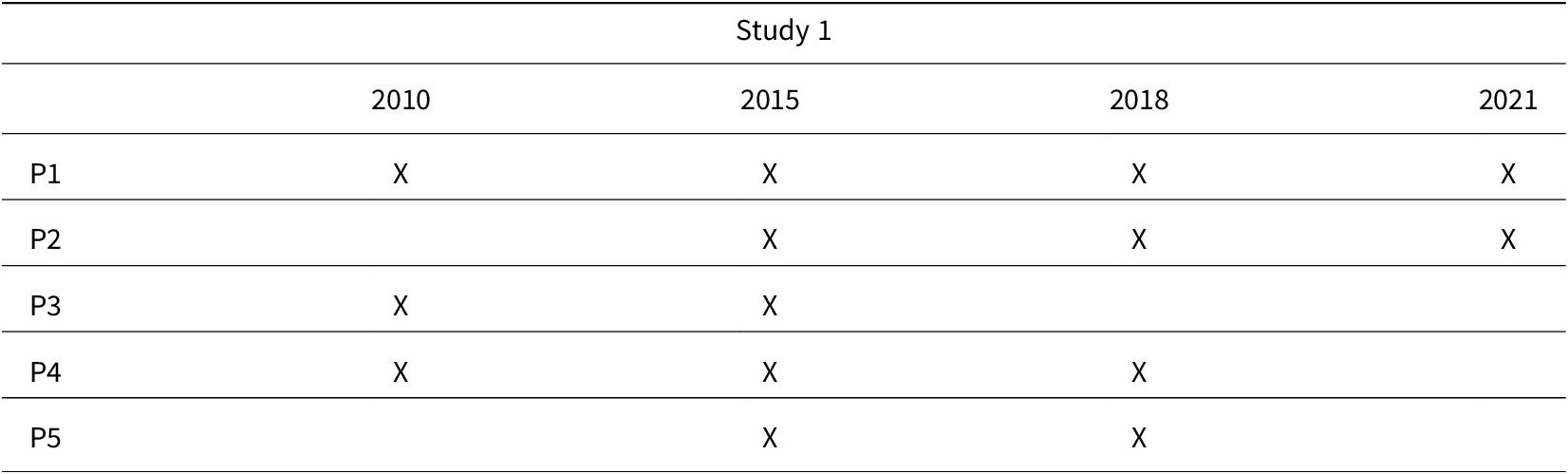
Recruitment took place in two phases. First, relevant community leaders worked with researchers to circulate information about the study. DeafBlind educators working with us selected a subset of those who responded, based on their evaluation of high protactile proficiency. All participants were DeafBlind. We tracked diachronic patterns for five participants (three males, two females, ages 29–64; henceforth P1–P5) across four time points: 2010, 2015, 2018, and 2021. Table 1 shows the data collection events in which each individual participated: P1 2010, 2015, 2018, 2021; P2 2015, 2018, 2021; P3 2010, 2015; P4 2010, 2015, 2018; and P5 2015, 2018. The 2015 participants all had at least one year of exposure to PT. The 2018 participants had at least three years of exposure, and the 2021 participants had at least five years of exposure. All but one participant acquired a visual language prior to age 7 via visual perception (those who became blind in adolescence or adulthood). One participant who was born blind had access to a visual language via tactile reception since birth.
Diachronic participation in Study 1: participants 1–5 (P1–P5), 2010, 2015, 2018, and 2021.

Table 1. Long description
The table is titled Study 1 and consists of five columns and six rows. The columns are labeled from left to right as Participant, 2010, 2015, 2018, and 2021. Participation is marked with an X.
* P 1 participated in all four years: 2010, 2015, 2018, and 2021.
* P 2 participated in 2015, 2018, and 2021.
* P 3 participated in 2010 and 2015.
* P 4 participated in 2010, 2015, and 2018.
* P 5 participated in 2015 and 2018.
2.1.2. Stimuli
The data for 2015, 2018, and 2021 were generated by employing a description task designed to elicit PCs. This was accomplished by presenting a series of tactile stimuli to the participants. These objects were chosen because they offer opportunities for participants to convey information about motion and location events in PT using real objects that can be explored tactually. The first two were presented as singular objects. The rest were presented in singular and plural conditions, as well as multiple conditions, which included a set of three objects, where two were the same, and one was different, along some dimension. In the case of the toy car stimulus, differences included size, shape, material, and whether or not the car was self-propelled (i.e. when you press it down, into a surface, and pull back, does it spring forward? Or does it stay in place?). The lollipop stimulus involved differences in size and type of wrapper. In the case of the pen stimulus, the difference was whether the pen had a cap or was a ball point pen, where the ball point pops out when you press on the end of the pen with your thumb. In addition, some participants described the relative locations of each object on the table.
2.1.3. Procedures
Dyads of PT speakers stood near a small, round table, which was tall enough to comfortably reach stimuli. Tactile landmarks were placed on the ground to signal locations where the cameras could pick up linguistic productions. The stimuli were presented in psuedo-random order. The objects were placed on the table and Speaker 1 was instructed by an experimenter to: ‘describe what you feel’. Speaker 2 was told that Speaker 1 would be describing something they felt. After the description, Speaker 2 was offered an opportunity to feel the stimulus. After a certain number of stimuli, Speaker 1 and Speaker 2 changed roles. However, sometimes, after feeling the stimulus, Speaker 2 chose to repeat a description with added changes or feedback. One of the co-authors and one member of the research staff were present throughout the task to operate the video cameras and place stimuli on the table, but they were only in tactile contact with the participants while placing stimuli. Cameras were placed above the participants (either attached to the ceiling or on tripods) in order to capture contact and motion between Speaker 1 and Speaker 2.
Data collection in 2010 took place as part of a year-long period of sustained ethnographic fieldwork conducted by the first author. First, meetings were held with relevant community leaders, in order to identify a context that would be appropriate for linguistic and interactional research. In those meetings, the community gave permission to videorecord a series of protactile workshops. Eleven DeafBlind speakers and two instructors/organizers met twice weekly for two and a half hours, for a total of ten weeks, in order to experiment with protactile communication in a range of activities. The workshops, held in a private room within a DeafBlind organization in Seattle, Washington, generated 120 hours of interactional data, which were subsequently labeled and organized.
For the purposes of the current study, we focused on three participants who also participated in 2015–2021—P1, P3, and P4, as shown in Table 1. We searched for contexts that were maximally similar to the elicitation contexts created for the 2015–2021 data collection sessions. This included activities where objects, such as a tea strainer, a movable toy snake, or a phone charger, were being described by one DeafBlind participant to another; when objects were referred to as part of demonstrations/instructional activities, where one DeafBlind participant explains how to do something, such as use a crochet hook; and direction-giving activities, all of which were organized by the DeafBlind instructors. While these contexts were not elicitation contexts, and the objects introduced in the workshops were not framed as stimuli, we think these contexts offer an opportunity for comparison with the more targeted elicitations we conducted later.
Transcription. Descriptions of the stimuli, along with the naturalistic data, were videotaped, labeled, and annotated using ELAN (Crasborn & Sloetjes Reference Crasborn and Sloetjes2008). The four anatomical structures—A1 (dominant hand of Speaker 1), A2 (dominant hand of Speaker 2), A3 (non-dominant hand of Speaker 1), and A4 (non-dominant hand of Speaker 2)—were annotated with respect to their linguistic function in proprioceptive constructions—Initiate, PO, PTC, and MC. Edwards and Brentari (Reference Edwards and Brentari2020) demonstrated that one of the earliest stages in the conventionalization of PT phonology is the consistent alignment of particular articulators with particular linguistic functions: A1 is primarily responsible for producing MCs; A2 is primarily responsible for POs; A3 is primarily responsible for producing PTCs; and A4 is rarely involved in linguistic production.
2.2. Results
A total of 3,494 data points were analyzed in Study 1: 293 in 2010, 1,109 in 2015, 764 in 2018, and 1,328 in 2021. The results across time points for each of the PC units and their primary articulator are provided in Figure 7, which shows the proportion of A1 used in Initiate and MC units (A1/Initiate and A1/MC); the proportion of A2 used for PO (A2/PO); and the proportion of A3 used for PTC (A3/PTCs).
Conventionalization (measured by proportion) of form-function pairings across 2010, 2015, 2018, and 2021 for the units of Proprioceptive Constructions.

Figure 7. Long description
The graph plots the percentage of conventionalization on the Y-axis from 0 to 1 against four years on the X-axis: 2010 (N=293), 2015 (N=1109), 2018 (N=764), and 2021 (N=1328). A light gray shaded area covers the 2010 data point.
Four data series are tracked:
* A 1 forward slash Initiate (dark blue squares): Starts lowest at approximately 0.37 in 2010, rises steadily to 0.63 in 2018, and dips slightly to 0.59 in 2021.
* A 2 forward slash P O (orange diamonds): Starts at 0.8 in 2010, drops to 0.69 in 2015, then climbs sharply to reach 1.0 in 2018 and remains at 1.0 in 2021.
* A 3 forward slash P t C (green circles): Starts at 0.74 in 2010, rises to 0.83 in 2015, peaks at 0.85 in 2018, and ends at 0.8 in 2021.
* A 1 forward slash M C (light blue triangles): Starts at 0.78 in 2010, rises to 0.86 in 2015, and plateaus around 0.83 through 2018 and 2021.
Mann-Whitney U tests of ranked comparisons were done for each pair of time points for each of the form-function pairings shown in Figure 7. There was a statistically significant difference for A1/Initiate pairs and A2/PO pairs between time points 2015 and 2018. (A1/ Initiate: U = 6, z = –1.84, p = 0.03; A2/PO: U = 0, z = 2.64, p = 0.004). There was also a significant difference for A2/PO between 2015 and 2021 (U = 0, z = 2.64, p = 0.004). There was a nearly significant difference between 2015 and 2021 for A1/Initiate (U = 5.5, z = –164, p = 0.055). There were no other statistically significant results. As can be seen in Figure 7, the A1/Initiate pairing appears to be less reliably used for Initiates; however, Initiates are of several subtypes distributed across A1 and A3, as shown in Figure 8; the shaded portion of the graph pertains to Study 2, which will be discussed in that section. The two sub-types used already in 2010 (A1/Touch and A3/Grasp) have remained in use at levels of conventionalization between approximately 40% and 80% as forms that initiate new discourses as well as new clauses. The larger innovation to the system is seen with the addition of two new sub-types of Initiates in 2015 (I-Prompt PO and I-Prompt Tap), which become highly conventionalized by 2018.
Sub-types of Initiate units and their distribution across 2010, 2015, 2018, and 2021.

Figure 8. Long description
The Y axis represents the percentage of conventionalization from 0.00 to 1.00. The X axis lists the years 2010, 2015, 2018, and 2021. A shaded gray area covers the 2010 data point region.
Data trends for the four sub-types are as follows.
* A 1 forward slash I-Touch (dark blue circles): Starts at 0.80 in 2010, rises slightly to 0.87 in 2015, drops to 0.59 in 2018, and rises to 0.83 in 2021.
* A 1 forward slash I-Prompt-P O (orange triangles): Starts at 0.00 in 2010, rises sharply to 0.89 in 2015, continues to 0.97 in 2018, and reaches 1.00 in 2021.
* A 3 forward slash I-Grasp (green diamonds): Starts at 0.63 in 2010 and shows a steady decline to 0.54 in 2015, 0.41 in 2018, with a slight recovery to 0.49 in 2021.
* A 3 forward slash I-Prompt-Tap (light blue squares): Starts at 0.00 in 2010, rises sharply to 0.76 in 2015, and continues a linear increase to 0.83 in 2018 and 0.96 in 2021.
The results obtained from the naturalistic 2010 data (N = 293), as shown in Figure 7 (gray portion), confirm our findings that the boost in conventionalization occurred between 2015 and 2018. There were no significant differences between 2010 and 2015 on any of the form-meaning pairings in Figure 7. As expected, there was a significant difference in the use of I-Prompt-PO and I-Prompt-Tap sub-types of Initiate units (Figure 8), which did not exist in 2010 (Mann-Whitney U Test of Ranked Comparisons: U = 0, p = 0.05).
2.3. Discussion of diachronic changes in PT
As we see in Figure 7, the period with the most notable changes in conventionalization was between 2015 and 2018, and during that time period A2/PO achieved the highest level of conventionalization. One important point that is clarified by this analysis is that A2 has only one role in PCs, which is to act as a PO, and this was in place by 2018. As the association of A2 as PO has become more solid, A2 is being broken down into smaller contrastive locations via the incorporation of new joints in the hand as well as on the chest, as landmarks, which we turn to below. These more specific landmarks lay the groundwork for core lexical items and minimal pairs.
A1 has several roles in a PC, which are becoming more conventional over time. A1 has been consistently used for MCs throughout all three time periods, and it is also used in Initiate units. Although at first glance the A1/Initiate pairing might seem much less conventionalized than A1/MCs and A2/POs, we find that if Initiates are broken into subcategories (Figure 8), the story becomes much clearer, and the conventionalization of I-Prompt PO (orange line) and I-Prompt-Tap (light blue line), which are Initiates used exclusively for PCs, is complete in 2021 at 100%.
We have also made an ethnographic observation about A4. A4 has been, from the start, a ‘listening hand’, which is always positioned to track the movement and finger positions of A1. While this relationship between A4 and A1 was there from the earliest data we have collected, in 2010 and 2015 it was used as needed. Less dependence on vision for a given individual corresponded with an increase in continuous contact between A1 and A4. In the 2018 and 2021 data, however, we find that contact between A1 and A4 is ubiquitous, regardless of Speaker 2’s visual status. It has become a linguistic rule to never break contact between A1 and A4 and this is now taking on the important function of creating continuity of movement. While A1 produces MCs on the body of the addressee, the transitional movements of A1 as it approached those locations would not be accessible without obligatory contact between A1 and A4. This is illustrated in Figure 9a: a dyad is shown describing a lollipop stimulus in 2015 and A1 and A4 are disconnected as A1 is in transition between locations in contact space. In Figure 9b, a different dyad is shown describing the same stimulus in 2018, and A1 and A4 are coupled during a similar transition movement.
Diachronic change in relationship between A1 and A4. In Figure 9(a), left, A1 and A4 are not in contact. This occurred frequently in 2015. However, by 2018, contact between A1 and A4 was rarely broken. Instead, they remained in contact in the configuration shown in Figure 9(b), right.

3. Study 2: landmarks and minimal pairs
In a quickly growing body of research analyzing patterns in language use and interaction among DeafBlind people, we have learned that PT is unique in its systematic incorporation of the body of the addressee into the articulation of core lexical items. In DeafBlind communities elsewhere, other types of communication are used, including a signed language, such as ASL or Auslan (Willoughby et al. Reference Willoughby, Shimako, Meredith, Howard, Jan-Ola and Jef2018). In those cases, the configuration of articulators that is conventional for signed languages remains roughly the same, with places of articulation that include landmarks on the face, body, nondominant hand and arm of the signer (see Stokoe et al. Reference Stokoe, Casterline and Croneberg1965, Brentari Reference Brentari1998, and references therein, for signed languages; and Willoughby et al. Reference Willoughby, Shimako, Meredith, Howard, Jan-Ola and Jef2018 for a review of their use in DeafBlind communication). Contrasts grounded in a signed language remain tied to a system of visual landmarks. In such contexts DeafBlind people perceive signs by placing their hands on the hands of the signer and tracking their movements in ‘air space’. This also means that the addressee is lacking access to the face of the signer, where many minimally contrastive landmarks are located (see Figures 1 and 2; also Siple Reference Siple1978). DeafBlind participants respond to this by adjusting as needed in the flow of interaction to disambiguate where confusion might arise (e.g. Petronio & Dively Reference Petronio and Dively2006).
As we have described in previous work, PT uses contact space as much as possible, and as seen in Study 1, in PT the A2/PO pairing, which is a part of contact space, has been highly conventionalized since 2018. This conventionalization of A2/PO has laid the foundation for a new attentiveness to the proprioprioceptive and tactile affordances of A2, and to Speaker 2’s body more generally, to arise. We investigate the way these affordances have been put to use to form minimal pairs in Study 2.
3.1. Methods: participants and procedures
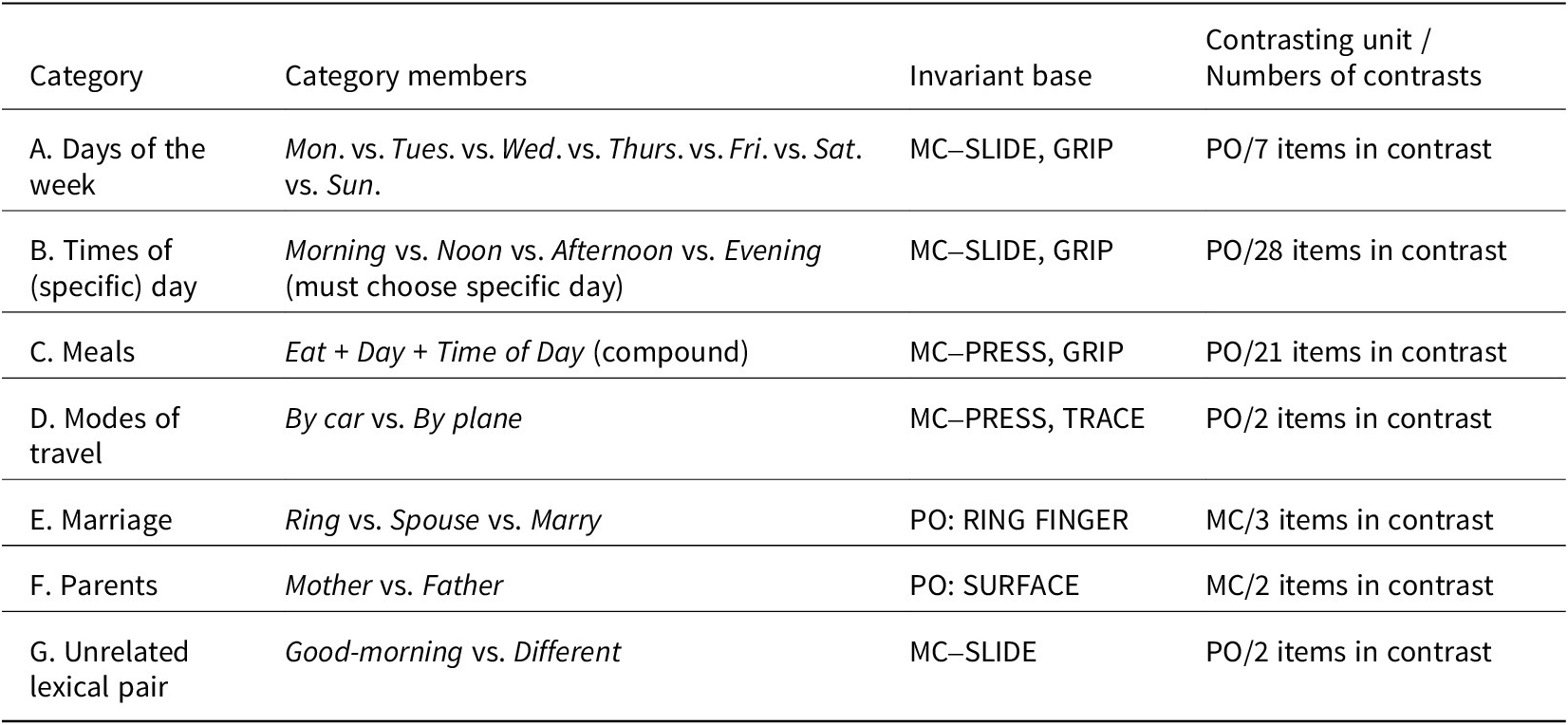
The data for Study 2 were collected over two sessions in 2022. In the first session, Participant 1 introduced Participant 2 (participants as shown in Figure 6) to new vocabulary that he had not yet learned. Both had at least eight years of experience with PT, but they lived in different places at the time, and therefore did not share all of the same emerging vocabulary. We videorecorded this session without any intervention on the authors’ part, and analyzed sets of lexical items to determine how contrasts were made (Table 2). The second session, which took place during a separate trip several months later, was an in-depth follow-up with Participant 1 involving grammaticality judgments to establish precise landmarks and distinctions among closely related forms.
Networks of semantically related minimal pairs in new PT vocabulary.

Table 2. Long description
The table is organized into four columns: Category, Category members, Invariant base, and Contrasting unit / Numbers of contrasts.
* Category A: Days of the week. Members include Mon. versus Tues. versus Wed. versus Thurs. versus Fri. versus Sat. versus Sun. The invariant base is M C dash SLIDE, GRIP. The contrasting unit is P O with 7 items in contrast.
* Category B: Times of (specific) day. Members include Morning versus Noon versus Afternoon versus Evening. The invariant base is M C dash SLIDE, GRIP. The contrasting unit is P O with 28 items in contrast.
* Category C: Meals. Members are a compound of Eat plus Day plus Time of Day. The invariant base is M C dash PRESS, GRIP. The contrasting unit is P O with 21 items in contrast.
* Category D: Modes of travel. Members include By car versus By plane. The invariant base is M C dash PRESS, TRACE. The contrasting unit is P O with 2 items in contrast.
* Category E: Marriage. Members include Ring versus Spouse versus Marry. The invariant base is P O: RING FINGER. The contrasting unit is M C with 3 items in contrast.
* Category F: Parents. Members include Mother versus Father. The invariant base is P O: SURFACE. The contrasting unit is M C with 2 items in contrast.
* Category G: Unrelated lexical pair. Members include Good-morning versus Different. The invariant base is M C dash SLIDE. The contrasting unit is P O with 2 items in contrast.
3.2. Results
3.2.1 Semantically related networks of minimal pairs
In the first session we observed several semantically related networks of minimal pairs, which had previously been undocumented. In the process of documenting these structures, we realized that the contrasts were occurring between landmarks that are not a part of ASL— that is, they are not visual landmarks; instead, they are landmarks that have emerged as new POAs in PT as DeafBlind speakers cashed in on proprioceptive and tactile affordances.
We have identified several sets of words that are related and must be distinguished from one another. These include many words associated with time. Some of them incorporate number, such as the number of months (one month, two months, three months), number of weeks (one week, two weeks), and clock time (one o’clock, two o’clock). There is also a set of terms for the days of the week. In this case, the two knuckles on the radial and ulnar surfaces of the wrist, plus the five fingers of the listener’s dominant hand, offer a natural sequence of seven items, which can readily be used to represent the seven days of the week. In addition, the phalanges of the fingers (proximal and distal), along with the tips of the fingers, provide affordances for a three-way split between morning, afternoon, and evening. See Table 2 for a list of semantically related minimal pairs observed in the first session.
In the second session, we sought to confirm or revise those analyses by asking Participant 1 to describe the meanings of the lexical items we listed and describe their relationship to neighboring terms (if any). This led to some corrections. For example, in Table 2 travel -by -air and travel -by -land are distinguished by moving across the skin on A2 or the tips of the arm hair on A2. Otherwise, they are identical. We initially thought they were distinguished by contact vs. no contact with the arm as it moved. Once we had clarified, we documented the new landmarks being innovated in the system.
3.2.2. New places of articulation (POAs) to use as landmarks in PT
We have observed a number of new structures and locations on Speaker 2’s body that have been incorporated into the phonology of PT, which have never been a part of ASL’s system. What we are seeing in PT is a radical departure from the visual system via new landmarks, which make use of previously ignored parts of the interlocutors’ bodies. Here we describe in detail one subsystem for time words that has been developed in this way. They are core lexical items for periods of the day, days of the week, and associated words with incorporation of number. We describe the set of forms used for the days of the week and times of the day in the following paragraphs as just one in-depth example of the changes that are occurring.
The knuckles on A2 are being used to create words that are minimally contrastive. In PT the hand as a proprioceptive, tactile object, is much more than a rectangle with six surfaces. There are prominent knuckles, phalanges, rises and crevasses that can be employed in the phonology (Figure 10)—in particular, the knuckles and the phalanges between them on A2/PO. In Figure 10, the person on the right is using the bones of the listener’s dominant hand (A2) to create contrasts. The drawing next to the main figure provides a close-up representation of the bones and joints in A2 that are available to the speaker. This includes the radial and ulnar surfaces of the wrist (the bones on either side of the wrist, labeled ‘RADIAL’ and ‘ULNAR’ in the drawing); the metacarpal-phalangeal (‘MCP’) knuckle (where the finger meets the hand); the proximal interphalangeal (‘PIP’) knuckle (in the middle of the finger); and the distal interphalangeal (‘DIP’) knuckle (joint nearest to the fingertip). Just as the eyes, nose, and mouth provide visual landmarks for distinguishing signs in signed languages, these bones in the hand provide landmarks for distinguishing among core lexical items in PT.
A dyad seated in a conventional PT configuration, facing one another. Speaker 1 (right) is producing the core lexical item THURSDAY via an MC, using A1 to produce a slide and make contact with the listener’s A2 (ring finger). To the right of the dyad is a drawing of the bones in A2, as described in the text.

Figure 10. Long description
The left panel is a grayscale photo of two people seated and facing each other. Speaker 1 on the right uses their hand to make contact with the ring finger of the listener on the left. A white rectangular inset box highlights this specific hand contact, labeled A 2. A curved blue arrow points from this inset to the right panel.
The right panel is a color-coded anatomical drawing of the bones in a human hand, also labeled A 2. Starting from the base at the wrist, the carpal bones are shaded dark blue. Moving distally toward the fingers, the labels include.
* U L N A R and R A D I A L sides of the wrist.
* M C P joints where the light blue metacarpals meet the red proximal phalanges.
* P I P joints connecting the red proximal phalanges to the yellow middle phalanges.
* D I P joints connecting the yellow middle phalanges to the orange distal phalanges at the fingertips.
In Figure 11, Speaker 1 (left) produces the PT word THURSDAY by tracing a line down the back of Speaker 2’s (right) index finger. (A close-up is included in the box to the right of Figure 11). This item forms a set with MONDAY, TUESDAY, WEDNESDAY, and FRIDAY, which are expressed via a trace on the back of the finger on the pinky, ring, and middle finger, and the thumb, respectively.
The PT word THURSDAY. To the right of dyad producing the word is a close-up of the contact between the two hands, as described in the text.

In order to say THURSDAY-MORNING Speaker 1 produces a ‘grip’ on the section of the targeted finger between the MCP knuckle and the PIP knuckle (Figure 11). This form contrasts with all of the other forms of ‘morning’ in the set, which are produced by gripping this same location on the other fingers. Likewise, AFTERNOON is produced in the space between the PIP joint and DIP joint. MORNING forms a minimal pair with the AFTERNOON on the same finger. EVENING forms a minimal pair with both AFTERNOON and MORNING by using the space between the DIP and the fingertip. While previous work on emerging languages has focused on what unites members of semantic classes through iconicity, the emergence of contrasts like these within semantic classes gives us some unique insight into how the core lexicon begins to form, and the conditions and pressures that enable and catalyze that process.
We see that iconically PT is drawing on different affordances than those tapped by ASL. The periods of the day and days of the week are grounded in the iconic sequence afforded by seven prominent landmarks on the hand and wrist, and by the phalanges of the fingers on Speaker 2’s body.
3.3. Discussion of new minimal pairs in PT
In Study 2 we see that strong formal and iconic motivations for language innovation exist side by side and can be temporally displaced from one another. The conventionalization of A2/PO between 2015–2018 paves the way for the Proprioceptive Object to be the focus of renewed attention on the affordances it provides to the process of innovation and creation of minimal pairs observed in 2022. We argue that formal conventionalization between 2015 and 2018 was a necessary condition for the iconicity of the hand to ultimately be used in the detailed way that it was in 2022.
A widely held view about the relationship between phonology and iconicity in visual sign languages is that arbitrariness becomes stronger over time and iconicity diminishes (see Frishberg Reference Frishberg1975 for ASL; Radutzky Reference Radutzky1989 and Geraci et al. Reference Geraci, Battaglia, Cardinaletti, Cecchetto, Donati, Giudice and Mereghetti2011 for Italian Sign Language). In the historical change of sign languages several patterns have been observed that follow this generalization. For example, signs once produced at the heart and associated with feelings in early ASL move to the center of the chest (Long Reference Long1918). The ASL signs FEEL, SWEETHEART, BE-TOUCHED-BY, RESTRAIN, and FEELINGS (originally produced at the heart, now more centrally on the chest) have all undergone this process. However, there is growing consensus that iconicity in signed languages is not lost in historical change or language emergence, but rather, is re-organized by lexical, grammatical, and cognitive processes (Dudis Reference Dudis2004, Eccarius & Brentari Reference Eccarius and Brentari2010, Perniss et al. Reference Perniss, Thompson and Vigliocco2010, Padden et al. Reference Padden, Meir, Hwang, Lepic, Seegers and Sampson2013, Brentari et al. Reference Brentari, Coppola, Cho and Senghas2017, Hudson Kam & Tkachman Reference Kam, Carla and Tkachman2020, Oomen Reference Oomen2021, Pyers & Senghas Reference Pyers and Senghas2020, Hodge & Ferrera Reference Hodge and Ferrara2022).
Since 2007, Paul Dudis has been establishing principled distinctions between types of iconicity occurring in spontaneous use of American Sign Language. In a recent iteration (Dudis Reference Dudis2024), his typology distinguishes between at least twelve basic types of ‘depictive spaces’ organized by abstract parameters, including dimensionality, viewpoint, and dynamicity, each of which has several sub-types and can be further augmented via two additional parameters: scale and scope. While ‘plain signing’ does not require a category in Dudis’ model of depiction (since it is outside of the bounds of the phenomenon), one could view American Sign Language as a depictive language, where plain signing occurs when the values for dimensionality, viewpoint, and dynamicity are all 0. For the purposes of this article, what we learn from this work is, first, that iconicity itself is a highly structured phenomenon in an established language like ASL. Second, it follows from this that iconic relations undergirding depictive spaces should not be expected to wane over historical time as a given language emerges and changes. Rather, as Dudis and others have pointed out, those relations often remain available to speakers and can be foregrounded and backgrounded across usage-events (Caselli & Pyers Reference Caselli and Pyers2017, Occhino Reference Occhino2017).
4. General discussion and conclusions
We have highlighted in this paper how looking closely at the micro-history of a developing language can be useful in teasing apart when and how formal and iconic mechanisms play a role in expanding the lexicon, and ultimately create minimal pairs. We provide new evidence for how iconicity is important in language creation, building on processes of formal conventionalization, and we closely track how diachronic changes towards increased formal systematicity in the PT phonological system (Study 1) have paved the way for growth and innovation in the language (Study 2).
First, we see that there is a rapid move towards conventionalization between the years of 2015 and 2018, particularly in the pairing of A2/Proprioceptive Object (PO). With this phonological unit and its purpose firmly established in the system, we then see an increase in the number of landmarks used on Speaker 2’s dominant hand as a PO and on parts of the body that have been already designated for language use. The hand is no longer functioning as it did in ASL, where the hand has six surfaces (Brentari Reference Brentari1998); we see that the bones and phalanges of the fingers have been recruited to define newly innovated landmarks (or POAs). These new landmarks have been used to create minimal pairs that are semantically related lexical items in a field of meaning.
It has been observed that iconicity is useful for language creation (e.g. Hou Reference Hou2018, Pyers & Senghas Reference Pyers and Senghas2020). The series of studies presented here demonstrate two new observations about the relationship between formal structure and iconicity in emerging languages. First, iconicity can act as a catalyzing force after certain formal changes in the system have taken place. The 2015–2018 period in PT development when the A2/PO pairing became highly conventionalized was a necessary step in order for language users to concentrate on the potential of that unit to be used for minimal pairs. The conventionalization of the A2/PO pairing allowed speakers to notice additional places, landmarks, and subtle movements on A2 that were previously under-utilized or not utilized at all. We would argue the use of the knuckles and phalanges as POAs could not have emerged without a highly conventionalized proprioceptive Object (PO).
We also argue that the phonological system and the pragmatic need for contrasts between se- mantically related entities serve to support the kind of conceptual and articulatory density that kickstarts arbitrary mechanisms for generating contrast. We see that the fingers and wrist of Speaker 2 have affordances for generating a set of terms which map diagramatically onto a conceptual representation of calendric time, and sequences of knuckles in the wrist and fingers are employed to create phonological contrasts. Notice that there is no one-to-one resemblance between ‘Thursday’ as a concept and the PT word for ‘THURSDAY’. Rather, there is a diagrammatic correspondence between calendric time as an abstract relational concept and a set of related linguistic expressions, which emerged together. Establishing a set of terms in this way is useful for language creation, learning, and transmission, but it means that any specific day of the week will necessarily resemble all others, since each day occupies one position in the overall pattern. Introducing this relatively large number of words which resemble one another, and are used in the same contexts and therefore are difficult to disambiguate, increases pressure on the linguistic system to introduce arbitrary markers that can be used to distinguish them. Finding the earliest minimal pairs in PT within semantic classes suggests that while iconicity is a powerful catalyst for language emergence, it generates ‘problems’ that are best addressed via precisely the kinds of arbitrary mechanisms that language is so good at providing. Almeida-Silva et al. (2023) have documented several minimal pairs in the emerging Brazilian sign language Cena, and we look forward to more research on their origin and proliferation.
Iconic patterns have also been identified in spoken languages, thanks to new evidence made possible by large corpora. Dingemanse et al. (Reference Dingemanse, Blasi, Lupyan, Christiansen and Monaghan2015) point out that in addition to systematic arbitrary language-internal patterns, systematic iconic patterns are found as well (p. 604). For example, in spoken languages, arbitrary patterns in stress, duration, voicing, and phonotactics mark a given word as a member of a word-class, and those patterns cohere in language-specific ways. They also point to some iconic cross-linguistic associations found in spoken languages, including reduplication in words that include the concepts of repetition or distribution, vowel quality in words that describe size or intensity, vowel lengthening in words that describe length or duration, and consonant voicing in words that convey information regarding weight or mass (p. 606).
Our findings suggest that in new languages the development of minimal pairs requires both established formal coherence in the system and a boost in the number of contrasts available. In addition, we find that minimal pairs do not emerge first in un-related semantic domains (e.g. pin/bin). Rather, they occur under pragmatic pressures in a common semantic field such as days of the week. While previous work on emerging languages has applied the strict definition of a minimal pair (unrelated lexical forms in ASL: ONION vs. APPLE) we see that members within semantic classes contribute to the first phonological contrasts observed in PT, and the emergence of a new core lexicon.
Acknowledgements
Thank you to the DeafBlind PT speakers who participated in this research and to the Social Sciences Division at the University of Chicago for providing cutting edge laboratory facilities, without which, this research would have been far more difficult to conduct. Thank you to two anonymous reviewers and to the editors of Phonological Data and Analysis for insights that greatly improved the article.
Data availability statement
Requests to access the datasets should be directed to Terra Edwards, terraedwards@uchicago.edu. The datasets presented in this article are not readily available in order to protect the confidentiality of the participants to the greatest degree possible.
Conflict of interest statement
The authors declare no conflicts of interest.
Funding disclosure statement
The National Science Foundation (BCS-2336362) and the Gianinno Faculty Fund (Department of Comparative Human Development, University of Chicago) supported the synchronic studies reported in this article. Different stages of the diachronic study were supported by the National Science Foundation (BCS-1651100, BCS-1651100), the Wenner-Gren Foundation for Anthropological Research (Grant #s: 8110 and 9146).
Ethics statement
The studies involving human participants were reviewed and approved by IRB, University of Chicago (Protocol ID IRB24-0806). The participants provided their written informed consent to participate in this study. Written informed consent was obtained from the individual(s) for the publication of any potentially identifiable images or data included in this article.







 Open access

