




The political history of the Holmul River basin in the sixth and early seventh centuries a.d. has been something of a mystery. With a lack of information, the temptation is to ascribe the region to a periphery of the grand accounts of its neighbors such as Tikal (Martin Reference Martin and Sabloff2003) and Caracol (Chase and Chase Reference Chase and Chase2017). However, new archeological and epigraphic data reveal that the region was a vital node in the emergent Kaanu'l geopolitical network (Figure 1). It is also becoming apparent that the groundwork for the subsequent rise of Naranjo as a major power was also laid during this period. Building on previous comprehensive overviews of the regional history (Grube Reference Grube2004a; Grube and Martin Reference Grube and Martin2004; Martin and Grube Reference Martin and Grube2008[2000]), the present discussion offers a more nuanced picture of the political situation on the eve of Kaanu'l's ascendancy and of the subsequent incorporation of Holmul and Naranjo domains into the larger hegemony. The discoveries highlight new legitimating strategies adopted by the local rulers in response to geopolitical change. The new research adds to a growing body of scholarship on ancient Maya hegemonic networks and addresses the bigger question of whether and how these networks could be placed in a broader comparative framework of New and Old World political systems.
Map of the Maya Lowlands covering the possible extent of the Kaanu'l hegemonic network. Drawing by Estrada-Belli.

Before Kaanu'l
The transformation of the political landscape in the region of Naranjo and Holmul in the second half of the sixth century a.d. to one that was dominated by the Kaanu'l royal house for the following 200 years was preceded by a period of stagnation or crisis of which little is known from textual sources—and even less from archaeological data. Part of this gap is due to the deliberate destruction and omission of records by the subsequent political regimes (Martin Reference Martin2000, Reference Martin and Sabloff2003). Uncertainty about the criteria for the Early-to-Late Classic transition (a.d. 500–550) and the material correlates of the last phase of the Early Classic period contributes to the confusion. For example, archaeological contexts at Tikal may not be attributed specifically to a.d. 450–550 based on ceramic assemblages alone (Coggins Reference Coggins, Hammond and Willey1979; Culbert et al. Reference Culbert, Kosakowsky and Moholy-Nagy2019; Moholy-Nagy Reference Moholy-Nagy2003).
The collapse of Teotihuacan around a.d. 550 (Beramendi-Orosco et al. Reference Beramendi-Orosco, Gonzalez-Hernandez, Urrutia-Fucugauchi, Manzanilla, Soler-Arechalde, Goguitchaishvili and Jarboe2009) was the most significant event of that era, because it had a knockout effect on its clients, allies, and trade partners across Mesoamerica. The last self-reported interactions between Maya royals and Teotihuacan occurred in the a.d. 510s and were confined to the Usumacinta region (Anaya Hernández et al. Reference Hernández, Armando and Mathews2002; Tokovinine Reference Tokovinine and Díaz2020:265–266; Zender Reference Zender2007).
There is no textual record of Holmul and Naranjo for the last quarter of the fifth century and the first quarter of the sixth century. The earliest dates at Holmul appear on Stela 6 (a.d. 376–386) and on Mural 7 (a.d. 379), both in the area of La Sufricaya (Figure 2) occupied by a royal court with links to Tikal and Teotihuacan (Estrada-Belli et al. Reference Estrada-Belli, Tokovinine, Foley, Hurst, Ware, Stuart and Grube2009; Grube Reference Grube, Laporte, Arroyo, Escobedo A and Mejía2003, 2004; Tokovinine and Estrada-Belli Reference Tokovinine, Estrada-Belli, Marken and Fitzsimmons2015). The last datable monument at La Sufricaya is Stela 5 (a.d. 422), although Stela 1 may have corresponded to the period ending in a.d. 435 (Tokovinine and Estrada-Belli Reference Tokovinine, Estrada-Belli, Marken and Fitzsimmons2015).
Holmul site plan. Drawing by Estrada-Belli.

In the case of Naranjo (Figure 3), Stela 45, dedicated by Naatz Chan Ahk, dates to the mid-fifth century a.d. (Tokovinine and Fialko Reference Tokovinine and Fialko2007). Stela 41 commemorates the period ending of 9.2.0.0.0 in a.d. 475 (Grube Reference Grube2004a:196–197; Martin and Grube Reference Martin and Grube2008[2000]:70–71). The undated Stela 15 is commissioned by Naatz Chan Ahk's son and provides his placement as the thirty-second or thirty-third since the dynastic founder (Lopes Reference Lopes2005). Tikal inscriptions imply that Naatz Chan Ahk's sister was married to K'an Chitam of Tikal (Tokovinine and Fialko Reference Tokovinine and Fialko2007; see Figure 19). There are no recovered monuments associated with another Naranjo ruler, Tajal Chahk, or with “Hearth” Chan Ahk (see below). This situation contrasts to a near-continuous record at Caracol that begins with the accession of Yajawte’ K'inich I in a.d. 484 (Martin and Grube Reference Martin and Grube2008[2000]:86–87).
Naranjo site plan. Drawing by Tokovinine.

The royal house of Xultun was another major power in the northeastern Peten at the beginning of the sixth century. Xultun Stela 20 (Von Euw Reference Von Euw1978:69–71) celebrates the period ending of 9.0.0.0.0 in a.d. 435, but the name of the ruler is no longer legible. Chak Tok Ich'aak II of Tikal (who acceded in a.d. 486) and K'ahk’ Ujol K'inich of Caracol (who acceded before a.d. 484) were both married to Xultun princesses. The Tikal–Xultun connection is reported on Tikal Stela 17, commissioned by Wak Chan K'awiil (Martin Reference Martin and Sabloff2003:43), whose maternal grandfather was the king of Xultun Upakal K'inich (Beliaev et al. Reference Beliaev, de León, Tokovinine, Luin, Vepretskii, Aragón, Galeev and Canan2013:85–89; Figure 4a; see also Figure 19). The Tikal ruler is mentioned in the inscription on Xultun Stela 6 (Von Euw Reference Von Euw1978:27–28) in a.d. 501, but the context of the reference is unclear (Rossi et al. Reference Rossi, Stuart, Saturno, Arroyo, Méndez Salinas and Paiz2015). The Caracol–Xultun marriage alliance is reported on Caracol Stelae 13 and 16 (Figure 4b; see Martin and Grube Reference Martin and Grube2008[2000]:87). Caracol's own place in the geopolitical network was once reported on Stela 15 (Beetz and Satterthwaite Reference Beetz and Satterthwaite1981: Figure 14b), but its poor preservation means that little is known apart from Caracol's subordinate role, at least one attack against the city, and some relationship to Tikal and to Dzibanche (Martin and Grube Reference Martin and Grube2008[2000]:87).
The political landscape before the rise of Kaanu'l: (a) detail of Tikal Stela 17; (b) detail of Caracol Stela 16; (c) detail of Naranjo Stela 45; (d) detail of the stucco panel, Los Arboles Group, Xultun; (e) detail of unprovenianced vessel (K8763); (f) detail of Naranjo Stela 43; (g) detail of Naranjo Stela 43; (h) detail of Naranjo Stela 44. Drawings by Tokovinine.

There is tentative evidence that the relations between Naranjo and Xultun in the fifth century were antagonistic despite the fact that both dynasties sent brides to Tikal. The remaining section of Naranjo Stela 45 features an emerging deity that holds a shield framed by spear points and emblazoned with a boloon-miin-k'ahk’-och-ch'een war-related expression (Tokovinine and Fialko Reference Tokovinine and Fialko2007). Another fragment of the same monument contains a toponymic reference that may be read as Wak Sa’ chan [ch'een] (Figure 4c). The same place name (Figure 4d) appears on the stucco panels adorning the basal platform of the Los Árboles Acropolis at Xultun (Saturno et al. Reference Saturno, Hurst, Rossi, Rivera Castillo and Saturno2012). Although the context seems to point at a mythical location, there are other examples of connections between mythical or deep-time and actual landscapes in the region (Tokovinine Reference Tokovinine and Díaz2020:258–263). Therefore, Naranjo Stela 45 may refer to an act of war against Xultun or against an important place in its vicinity.
There is no strong archaeological and textual evidence pointing to a specific area of Naranjo as the main residence of its rulers at the end of the fifth century. The Triadic Acropolis B-5 (Figure 3) has most indicators of Early Classic construction activity and at least one looted fifth-century burial (Fialko Reference Fialko2004a:183–184; Reference Fialko, Laporte, Arroyo, Escobedo and Mejilla2004b). In the case of Holmul during the Early Classic K'ak 3 ceramic phase (a.d. 378–550), La Sufricaya (Figure 2) likely served as a seat of the local ruling dynasty, but it had been abandoned and ritually terminated by the end of that period (Estrada-Belli et al. Reference Estrada-Belli, Tokovinine, Foley, Hurst, Ware, Stuart and Grube2009). Recent investigations of residential groups in the vicinity of the palace (Tokovinine and Canan Reference Tokovinine, Canan and Estrada-Belli2019; Tokovinine, Canan et al. Reference Tokovinine, Canan, Enríquez and Estrada-Belli2018) indicate that their occupation continued after the palace abandonment, but no further expansion of this area of the site happened during the following Chak 1 ceramic phase (a.d. 550–680). All of the monuments at La Sufricaya (Grube Reference Grube, Laporte, Arroyo, Escobedo A and Mejía2003; Tokovinine and Estrada-Belli Reference Tokovinine, Estrada-Belli, Marken and Fitzsimmons2015) ended up broken and scattered in the vicinity of the former palace. The base of Stela 5 was found set in the floor of a residential courtyard, but the associated offering of crania of two young adults dates to the eighth century a.d. (Quinn et al. Reference Quinn, Friedrich, Estrada-Belli, Tokovinine and Godfrey2019).
Although the monuments at Naranjo and Caracol discussed above suggest that warfare was part of the process that accompanied the formation of the network of Tikal, Xultun, Caracol, and Naranjo, these references are not specific enough to understand the actual trajectory of the regional system. The Tikal–Naranjo marriage arrangement comes about the same time as the tentative evidence of a Naranjo–Xultun rivalry. The Tikal–Xultun and Caracol–Xultun marriage alliances in the next generation of rulers may be interpreted as a consolidation of the same network or as a shift of the network away from Naranjo. The only well-preserved textual reference to mass casualties comes from a retrospective account on Naranjo Altar 1 that describes the “piling of heads and pooling of blood” of the residents of Kok Ka’, a location otherwise known from an account of its repeated defeat in May and August of a.d. 626 in the text on a stucco frieze on Structure B16 at Caracol (Grube Reference Grube, Chase and Chase1994:103–104). However, it is unclear whether the narrative on Altar 1 refers to an act of warfare or a natural disaster (Houston Reference Houston2006). The chronology of the narrative is uncertain. One reconstruction places the Kok Ka’ destruction in a.d. 544, but that means a prior building dedication by Ajnumsaaj Chan K'inich in a.d. 525 (Houston Reference Houston2006), although all references to Ajnumsaaj's age imply that he was born in the 530s (Grube and Martin Reference Grube and Martin2004:24). An alternative chronology of Altar 1 shifts all the events forward in time by one Calendar Round of 52 years (Grube Reference Grube2004a:197). It resolves the issue with the building dedication date, but then it places the destruction of Kok Ka’ in a.d. 596, after the likely completion date for Altar 1 itself.
Inscriptions at Naranjo and Holmul do not mention a confrontation with the Kaanu'l dynasty. Our best indication that the process of incorporation was not peaceful comes from Xultun Stela 21 (Von Euw Reference Von Euw1978:74–76), which depicts a captured “Buuk’ lord” from the site of Los Alacranes (Garrison and Stuart Reference Garrison, Stuart, Laporte, Arroyo, Escobedo and Mejilla2004; Grube Reference Grube2004b). Given that the rulers of Los Alacranes were vassals of Dzibanche kings (Grube Reference Grube and Sprajc2008:193–196), the capture may correspond to the beginning of the Kaanu'l expansion into the area of Xultun. The date on Xultun Stela 21 is eroded, but the Tzolkin has a coefficient of 10, and the narrative subsequently refers to a katun mid-station (tahn-lam), narrowing the options to the Long Count of 9.5.10.0.0, a.d. 544.
The fate of La Sufricaya monuments also implies a political and ritual rupture. It is significant that these monuments were not broken and cached, or broken and placed in a shrine. Breaking and caching may be interpreted as a nonhostile act of ritual renewal (O'Neil Reference O'Neil, Boldrick, Brubaker and Clay2013; Tokovinine and Fialko Reference Tokovinine and Fialko2007). However, stelae at La Sufricaya were broken into multiple pieces, which were then dragged into different locations on the periphery of the palace compound and just left there. No identifiable ritual activity centered on the fragments for over a century after their deposition. Evidence of violence in the region comes from the lacustrine sediment record near the site of Witzna’ (Figure 1), 13 km to the north of Holmul (Wahl et al. Reference Wahl, Anderson, Estrada-Belli and Tokovinine2019). There, a layer of charcoal roughly dated to the mid-sixth century (Wahl et al. Reference Wahl, Anderson, Estrada-Belli and Tokovinine2019: Fig. 5) may correspond to an attack at the site about the same time when the rulers at Holmul and Naranjo declared their allegiance to the Kaanu'l overlords.
Signs of change
The first visible sign of the changing political order at Naranjo (Figure 3) is a new version of the C-9 Triadic Acropolis (Structure C-9 Sub 3). The central temple of the complex is still very much an Early Classic building in terms of its style, and all of the ceramic material recovered from its fill belongs to the Naranjo equivalent of the Early Classic K'ak 3 (Tzakol 3) phase at Holmul (Tokovinine, Fialko et al. Reference Tokovinine, Fialko, Ramirez, Martin, Vepretskii, Arroyo, Méndez Salinas and Ajú Álvarez2018). The many broken fragments of Stela 45 were found in the fill beneath the central stairway of the temple (Tokovinine and Fialko Reference Tokovinine and Fialko2007). Subsequent alterations buried the structure, and it remains relatively intact with at least two stelae still standing embedded in its stairways (Figure 5a). The central Stela 48, fronted by two plain altars, is carved with an image of a standing ruler and a hieroglyphic caption that ties the monument to the period ending of 9.6.0.0.0 (a.d. 554), which was probably when the whole complex was dedicated (Tokovinine, Fialko et al. Reference Tokovinine and Fialko2018).
Ajnumsaaj's first monument at Naranjo: (a) location of Stela 48; (b) Stela 48. Drawings by Tokovinine.

Like the building behind it, Stela 48 (Figure 5b) closely replicates Early Classic monuments at Naranjo, such as Stela 41 and their likely prototypes, the so-called staff stelae at Tikal (Houston and Stuart Reference Houston and Stuart1996:299–300; Martin and Grube Reference Martin and Grube2008[2000]:37). It shows the new ruler of Naranjo Ajnumsaaj Chan K'inich (abbreviated to Ajnumsaaj in nearly all occurrences of the name) as a youthful Sun God with a fire-drilling staff. In the accompanying inscription (Figure 5b, Block A9), Ajnumsaaj carries the sak chuwen title of the local royal family. However, he is also called yax bolon tz'akbuul ajaw in Block A8 of the inscription. As Stuart (Reference Stuart, Golden, Houston and Skidmore2012:125) points out, Colonial Yucatec dictionaries translate bolon tz'akab as “something eternal” so that bolon tz'akbuul ajaw refers to a collective of royal ancestors—a dynasty. Therefore, yax bolon tz'akbuul ajaw means “new eternal king(s)” or “new dynasty.” Nevertheless, Ajnumsaaj does not reset the dynastic count at Naranjo, so the title should be interpreted as a reference to renewal/rejuvenation rather than replacement. The same dramatic appellative is included in Ajnumsaaj's name on Stela 38 (Graham Reference Graham1978:97) and in a less transparent syntactic context on Altar 1 (Graham Reference Graham1978:103–104). The implication is that of a rift if not a crisis that preceded Ajnumsaaj's accession under Kaanu'l patronage.
It has long been argued that, given that Ajnumsaaj was no older than 12 at the time of his accession to kingship, his accession was hardly business as usual. An apparent use of the Naranjo emblem glyph title by Wak Chan K'awiil of Tikal himself in the inscription on an unprovenianced sixth-century vessel (Figure 4e) implies that he also claimed Naranjo's throne as someone closer to the ruling line than Ajnumsaaj (Martin Reference Martin2005:7–8).
Although Ajnumsaaj's monuments do state that his father was a legitimate ruler of Naranjo (see below), a key new piece of evidence implies that Ajnumsaaj did not in fact originate from Naranjo. The inscription on a polychrome vessel discovered in Building D in Group I at Holmul (HOL.T.93.76; see García Vázquez Reference García Vázquez and Estrada-Belli2019:61–72) identifies the object as a possession of Ajnumsaaj, whose name includes the “twenty-year lord” title (Figure 13a, Blocks G and H) narrowing the production of the vessel to a.d. 546–554, about the same time as Naranjo Stela 48. The novelty of the vessel's Saxche Orange form and decoration is underscored by the absence of its counterparts in the construction fill of the Structure C-9 phase associated with Stela 48 (Tokovinine, Fialko et al. Reference Tokovinine, Fialko, Ramirez, Martin, Vepretskii, Arroyo, Méndez Salinas and Ajú Álvarez2018).
Ajnumsaaj's name on the vessel includes typical Naranjo royal titles in Blocks K–N of the inscription, but it also features an otherwise unique title of “the person from Tuun Kab” in Block J. This so-called title of origin (Stuart and Houston Reference Stuart and Houston1994:19) likely points to Ajnumsaaj's place of birth. The other instance of the same title occurs in the narrative on the stucco frieze of Structure B16 at Caracol (Grube Reference Grube, Chase and Chase1994:102–103). A passage in the text mentions an attack by Caracol against its Naranjo adversaries that took place at the abovementioned location of Kok Ka’ in a.d. 626 (Grube Reference Grube, Chase and Chase1994:Figure 9.11). The same event is described on Caracol Stela 22:G10–H12 (Grube Reference Grube, Chase and Chase1994:87–89), where defeated Naranjo lords are referred to by their Sak Chuwen and Huk Tzuk titles. Another mention of the victory on Caracol Stela 3:C17–D17 states that “those of Sa'aal fell” (Grube Reference Grube, Chase and Chase1994:103). These usual epithets of Naranjo kings are replaced by “those of Tuun Kab” in the text on Structure B16 (Figure 6c). Ajnumsaaj passed away around a.d. 615 (Martin and Grube Reference Martin and Grube2008[2000]:72), so “those of Tuun Kab” could be a reference to his immediate successors, with an implication that Caracol adversaries were fully aware of the legitimacy issues. Naranjo monuments never refer to Tuun Kab, but it does seem to be a location near Naranjo: the toponym occurs on a Zacatel Cream sherd from a Late Classic residential group at La Sufricaya (Figure 6d; see Tokovinine and Canan Reference Tokovinine, Canan and Estrada-Belli2019:95–97).
Politics and rhetoric of Ajnumsaaj's monuments: (a) detail of Naranjo Stela 25; (b) Naranjo Stela 47; (c) detail of stucco frieze, Structure B16, Caracol; (d) Holmul vessel fragment (SUF.L.29.1); (e) graffito with a ballplayer, Guacamayo building, Structure B-15, Naranjo. Drawings by Tokovinine.

It is worth emphasizing that none of Ajnumsaaj's monuments states that he or his father originated from Sa'aal or Maxam, the two toponyms associated with the core of the archaeological site of Naranjo. Therefore, Ajnumsaaj's narratives should not be interpreted as attempts to falsify his origins—which was apparently a known fact among his royal peers—but rather as efforts aimed at boosting the credentials of the Tuun Kab branch of the Sa'aal royal house.
From a.d. 554, it takes more than two decades for Ajnumsaaj to start commissioning monuments that present a narrative detailing his rise to power and his position in a larger political landscape. The first of these narratives is on Stela 43. The top of this monument was recently recovered and documented (Stuart et al. Reference Stuart, Quezada, Tokovinine and Aquino2022). The portrait of Ajnumsaaj on the monument is tagged as “three twenty-year lord,” his age bracket on the monuments dedicated in a.d. 593. The inscription refers to an earlier period ending of 9.5.0.0.0 in a.d. 534 by Ajnumsaaj's father “Hearth” Chan Ahk, who is given the titles of Sak Chuwen and “Sa'aal lord,” the first known occurrence of the emblem glyph of Naranjo (Figure 4g). The stela also contains the portraits of Ajnumsaaj and his father surrounded by patron deities and deified ancestors. The visual roster apparently includes Chak Tok Ich'aak II of Tikal depicted as a Teotihuacan Storm God (Figure 4f). Chak Tok Ich'aak II's Teotihuacan connection is also emphasized on a roughly contemporaneous Stela 17 at Tikal, where he is called “Western K'awiil” (Figure 4a; see Estrada-Belli et al. Reference Estrada-Belli, Tokovinine, Foley, Hurst, Ware, Stuart and Grube2009 on the significance of the title).
The next update of Ajnumsaaj's master narrative is attested on Stela 38 and associated Altar 1 commemorating the period ending of 9.8.0.0.0 in a.d. 593 (Graham Reference Graham1978:97, 103–104). The inscription on the altar begins with a deep-time accession of the divine dynastic founder and adds a couple of similarly ancient events before reporting the dedication of a temple in a.d. 525 or 577 and the devastation of Kok Ka’ in a.d. 544 or 596 while attributing the agency in either event to Ajnumsaaj (see above). The narrative then details the period endings of a.d. 554, 573, and 593, and bestows Ajnumsaaj with a rare title of “3×11 pik lord” as a possible indication that he also lived through three 8,660-day cycle completion events (MacLeod Reference MacLeod2008). The text concludes with a statement that Ajnumsaaj would still be around to celebrate the completion of ten 400-year periods in a.d. 830. As on the earlier Stela 48, Ajnumsaaj carries the title of the “new king(s) eternal,” Sak Chuwen, and “Wak Kab Nal person.” The latter title also appears in the deep-time section of the narrative and is the first known occurrence of this key epithet of Naranjo rulers. Three years later, the text on Stela 44 would affirm that “Hearth” Chan Ahk was also a “Wak Kab Nal person” (Figure 4h). Finally, Ajnumsaaj's titles on Altar 1 include “Juun Ajaw god,” thereby claiming affinity to one of the Hero Twins. The text and image on Stela 38 highlight the period ending of a.d. 593 and reveal that Ajnumsaaj impersonated the divine founder of the dynasty at the ceremony, which explains the deep-time introduction in the narrative on the altar. The text provides Ajnumsaaj with the now-familiar “new king(s) eternal” appellative, the “three k'atun lord” age statement that is clearly distinguished in the same narrative from the “three stone-binding person” reference to the period endings he supervised. The royal titles also include Sak Chuwen and the Naranjo emblem glyph of “Sa'aal lord.”
A loyal vassal and a teammate
The circumstances of Ajnumsaaj's accession to kingship in a.d. 546 come into focus on Stela 25, which commemorates 70 years of his reign in a.d. 615 (Graham Reference Graham1978:69–70). The narrative begins with an otherwise unknown 4,000–year anniversary of an unspecified nonlocal event celebrated in a.d. 157, apparently likened to Ajnumsaaj's accession ceremony in a.d. 546 (Figure 6a). The text continues with stating that the ceremony happened under the direction of “Kaanu'l lord Tuun K'ab Hix.” It is a clear indicator that Ajnumsaaj acceded to kingship as a vassal of the Kaanu'l royal house.
A somewhat earlier statement on Stela 47 (Figure 6b), probably celebrating 40 or 60 years of Ajnumsaaj's reign, apparently represents the same accession event but shows the king dressed in ballgame gear emblazoned with Underworld-linked shells, crossed bones, disembodied eyes, and a pectoral with the ak'ab “darkness” emblem. That, in combination with body marks, strongly suggests that Ajnumsaaj is depicted as a ball-playing Juun Ajaw hero twin, much in line with his connection to this deity on Altar 1 (Martin et al. Reference Martin, Fialko, Tokovinine, Ramirez, Arroyo, Méndez Salinas and Ajú Álvarez2016). The accompanying text reports that on the day of his accession, Ajnumsaaj “dressed for ball game,” joyaj ti pitz (Figure 6b, Blocks A1–A2). The inscription continues with an otherwise unique statement that Ajnumsaaj had been “commanded” (ukabaaj) by “Tuun K'ab Hix, Ajsaakil (K'ahk’ Ti’ Ch'ich’), … Chan, Uk'ay Kaan, four successive divine Kaanu'l lords” (chan tz'akbu[ul] k'uh[ul] kaan[u'l] ajaw[taak]) and “accompanied them as a ball player” (yitaaj pitzaj). The sequence broadly corresponds to what is known of the Kaanu'l overlords whose reigns overlapped with that of Ajnumsaaj, although it also implies that some contemporaneous Kaanu'l rulers (Rulers 15, 18, and Yax Yopaat) either did not personally interact with or were not recognized as overlords by Ajnumsaaj (Martin Reference Martin2017, Reference Martin2020:246; Martin and Beliaev Reference Martin and Beliaev2017). The narrative clearly contrasts the “divine” epithet of the Kaanu'l dynasty with its absence for Ajnumsaaj. It also implies that Ajnumsaaj's subordinate status was confirmed by every new Kaanu'l paramount ruler.
Although no archaeological data link the construction or modification of Naranjo ballcourts (Figure 3) to Ajnumsaaj, there is further evidence supporting the significance of the ballgame during his reign. A large graffito scene on the doorjamb of Guacamaya, the central building of Ajnumsaaj's palace compound underneath later versions of Structure B-15 of the Central Acropolis (Tokovinine and Fialko Reference Tokovinine and Fialko2018), shows a ball player who is strikingly similar to the portrait on Stela 47 (Figure 6e). Therefore, Ajnumsaaj's personal engagement with the ballgame was salient enough to be represented as graffiti on the walls of his palace.
A new order at Holmul
Although there is no comparable monumental record at Holmul, recent discoveries allow for a partial reconstruction of its history. The dedicatory inscription on the late-sixth-century dynastic shrine in Building A of Group II at Holmul (Estrada-Belli and Tokovinine Reference Estrada-Belli and Tokovinine2016) includes a list of five rulers who “succeeded Wiinte’ Naah lord” (Figure 7a). The likeliest candidate for the latter would be the Teotihuacan-connected builder of the La Sufricaya palace in a.d. 379. Three out of five Wiinte’ Naah Lord's successors are from the second half of the sixth century. Two names would be way too few for a time span of more than 150 years. The implication is that not every ruler who resided in the palace at La Sufricaya made it into the final version of the local dynastic history or that the dynastic count began anew with a different “Wiinte’ Naah lord” who lived around a.d. 500. The royal names on smashed La Sufricaya monuments are highly damaged, but one partially discernible sequence of hieroglyphs in the headdress on Stela 1 (Tokovinine and Estrada-Belli Reference Tokovinine, Estrada-Belli, Marken and Fitzsimmons2015: Figure 7.7a) and the inscription on Stela 6 (Grube Reference Grube, Laporte, Arroyo, Escobedo A and Mejía2003:Figure 4) does not appear on the Building A roster. These omissions point to a disruption on par with what was going on at Naranjo.
Holmul after La Sufricaya: (a) dedicatory text of the dynastic shrine above the palace, Building A, Group II, Holmul; (b) mural in the palace, Building A, Group II, Holmul. Drawings by Tokovinine.

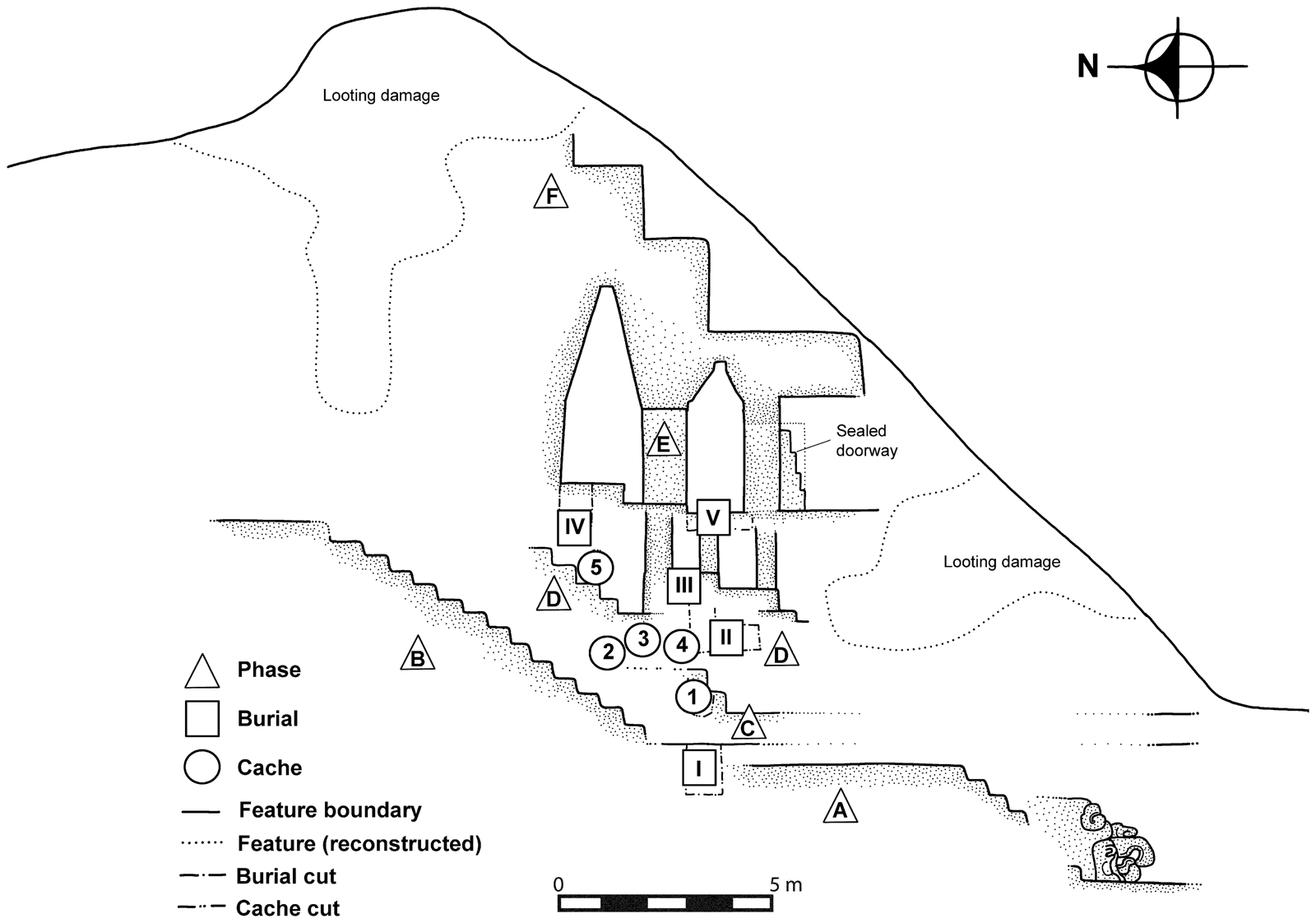
The dynastic shrine of Building A in Group II (“Phase B” on Figure 8) rests on top of a buried palatial structure that likely served as a residence of the local ruler after the move from La Sufricaya (“Phase A” on Figure 8). Only one room (Room 2) in the southeastern section of the structure has been fully excavated (Castillo Reference Castillo and Estrada-Belli2015; Estrada-Belli Reference Estrada-Belli and Estrada-Belli2014). At some point in the occupation history, one of the two doorways the northern wall of the room was blocked, and a bench was added along the full length of its eastern wall, implying a shift to or an expansion of the residential function. The trapezoid niche in the center of the bench conforms to the typical representations of teem thrones in Maya art (Houston Reference Houston2008). The high status of the room occupants is evidenced in at least two hieroglyphic inscriptions painted in the space between the two northern wall doorways (Figure 7b). A lidded cache vessel placed on the central axis of the building (“Cache 1” on Figure 8; see Díaz García Reference Díaz García and Estrada-Belli2012) was decorated with a common emblem of Classic Maya royalty—a combination of the Hux Yoop Huun royal crown deity (Stuart Reference Stuart, Golden, Houston and Skidmore2012) and a tz'ak “succession” knot—also pointing to the regal status of the building's residents (Figure 9). All four walls of the room and the front side of the bench were covered in graffiti, some of it of exceptional quality (Castillo Reference Castillo and Estrada-Belli2015). A carbonized wooden beam fragment from the vault of the room could be C14-dated to 559–647 cal a.d. 2σ, with a high probability of falling within the 575–620 cal a.d. 1βσ range (Beta 388277 14C age: 1470 ± 30 BP; see Estrada-Belli Reference Estrada-Belli and Estrada-Belli2015:10, Figure 1.7a).
Construction phases, caches, and burials of Building A, Group II, Holmul. Drawing by Tokovinine.

Vessel (HOL.L.20.19.2.1) from the palace dedicatory cache, Building A, Group II, Holmul. 3D rendering and drawing by Tokovinine.

Textual and visual narratives in Room 2 evoke complex cultural identities, long-distance contacts, and violence. The painted inscriptions are only partially readable (Figure 7b). The visible Calendar Round date of 7 Kib 14 Ch'een in Blocks pF1–pG1 of the larger inscription may correspond to a.d. 558. The context of the date seems to be war because of the took’-pakal—“flint-shield,” “weapons,” “armies”—expression in Block pE2. Neither the victim nor the agent of the aggression is recognizable. Block pJ5 could plausibly correspond to the local family title of Chak Tok Wayaab. Block pR1 of a smaller text may contain the Tikal emblem glyph, but only about one-third of the grapheme is preserved, making this identification highly tentative. The theme of warfare is present among the graffiti on the room walls. A large drawing on the western wall shows a seated captive with arms tied behind his back who is facing a standing figure holding a banner and an incense bag (Figure 10a). Cross-hatching on the bag and the figure indicate black paint. A partially preserved emblem on the banner looks like a reproduction or an imitation of a central Mexican writing tradition (Taube Reference Taube2000). The beard and the headdress of the captive also do not conform to the sixth-century depictions of Maya nobles from the Southern Lowlands. It is worth noting that a.d. 558 falls in the middle of the conflict detailed on Caracol Altar 21 that included an initial attack by Tikal in a.d. 556 and its defeat by Dzibanche in a.d. 562 (Martin Reference Martin2005).
Visual and textual narratives on graffiti at Holmul: (a) detail of the western wall, palace structure, Building A, Group II, Holmul; (b) detail of the eastern wall, dynastic shrine, Building A, Group II, Holmul; (c) detail of the northern wall, Building D, Group I, Holmul. Drawings by Tokovinine.

The occupation of the palace ended with placing a vaulted burial chamber below what used to be its central room (Estrada-Belli Reference Estrada-Belli and Estrada-Belli2015). The building was then filled and incorporated into the foundation of the abovementioned dynastic funerary shrine (“Phase B” on Figure 8) with an elaborate frieze and a lengthy dedicatory inscription (Estrada-Belli and Tokovinine Reference Estrada-Belli and Tokovinine2016). The tomb (HOL.L.20.21; “Burial I” on Figure 8) is among the richest at Holmul, with 28 vessels revealing a mix of Early and Late Classic types, including Nitan Composite and Saxche Orange (Figure 11; see Callaghan and Neivens de Estrada Reference Callaghan and de Estrada2016:132, 136–137, 173–175; Díaz García Reference Díaz García and Estrada-Belli2012). A much more modest internment (HOL.L.20.15; “Burial II” on Figure 8) with a similar Saxche Orange bowl was discovered under the first steps of the shrine's main access stairway (Díaz García Reference Díaz García and Estrada-Belli2012) and could be chronologically closer to the construction of the palace itself. A third burial (“Burial III” on Figure 8) was found under the floor of the main room of the shrine. The calibrated radiocarbon date for that burial (HOL.T.78.42) produced a range of 443–598 cal a.d. 2σ (Beta 388278, 14C age: 14 1540 ± 30 BP, Oxcal 4.4; see Ramsey Reference Ramsey2009; Reimer et al. Reference Reimer, Austin, Bard, Bayliss, Blackwell, Ramsey, Butzin, Cheng, Lawrence Edwards and Friedrich2020).
Select vessels from Burial HOL.L.20.21 in Building A, Group II, Holmul: (a) HOL.L.20.21.2.26; (b) HOL.L.20.21.2.1; (c) HOL.L.20.21.2.2; (d) HOL.L.20.21.2.20; (e) HOL.L.20.21.2.24. 3D renderings by Tokovinine.

The Holmul ruler Tzahb Chan Yopaat Macha’ is the central figure of the scene of the frieze and is listed in the dedicatory text as a penultimate ruler and father of the reigning monarch K'inich Tajal Tuun/Chahk (Estrada-Belli and Tokovinine Reference Estrada-Belli and Tokovinine2016). Therefore, Tzahb Chan Yopaat Macha’ is the best candidate for the occupant of the main burial, HOL.L.20.21. The dedicatory inscription (Figure 7a) lists his age bracket at death as 20–40 (Blocks L’–M’), whereas his son is reported to be 20 years old at the time (Block X). The son's section of the text (Figure 7a, Blocks X–S’; see also Figure 19) provides three crucial pieces of information: (1) he was a vassal of a “Kaanu'l lord” or “Kaanu'l lord[s]” (Block A’); (2) he was a son of a Naranjo Princess (Blocks G’–J’); and (3) his maternal grandfather was Ajnumsaaj in his third 20-year period of life at the time of the dedication of the building (Blocks B’–F’).
The reported age of Ajnumsaaj serves as an important chronological anchor. As mentioned above, he acceded to kingship at an age of no older than 12 in a.d. 546. It would take at least a year or two for him to father a daughter and at least 13 or 14 more years for his daughter to give birth to his grandson. Given that the reported age of his grandson is 20, that effectively brackets the production of the inscription to a.d. 580–594, with the later part of this time span more likely than the earlier. That also agrees with the upper end of the 443–598 cal a.d. 2σ range of the intrusive burial under the floor of a room in the completed shrine. Therefore, it appears that by a.d. 590, the royal houses of Naranjo and Holmul were tied by obligations of loyalty to Kaanu'l overlords and were also connected to each other through family ties.
The back of the inner room of the dynastic shrine is covered by a complex palimpsest of graffiti (Figure 10b) featuring images of deities and textual references to “god-taking (uk'am-k'uh). Single and paired images of helmeted ball players or ritual combat participants (see Taube and Zender Reference Taube, Zender, Koontz and Orr2009) are the most common theme, suggesting repeated ritual acts. The ballcourt is indeed located to the south of the shrine (Figure 2). This north–south arrangement and a connection between ballgame and ancestral worship was discussed elsewhere (Houston Reference Houston2014), but the additional significance here is that the emphasis in the ballgame at Holmul matches the trend at Naranjo.
Although Tzahb Chan Yopaat Macha’ was likely an important political agent, his age at time of death indicates that he was born in the 550s and, therefore, had not acceded to kingship until the 570s. It is unlikely that he was the protagonist of the painted narratives in the palace connected to the a.d. 558 date. Consequently, his predecessor Juun K'am K'uh (Figure 7a, Blocks Q–T) should be credited with a pivot to Kaanu'l and with arranging the marriage of his son and Ajnumsaaj's daughter. Recent investigations at Holmul tie Juun K'am K'uh to Building D in Group I. A new construction phase of this temple (“Phase D” on Figure 12) was in place by a.d. 540 based on a range of AMS radiocarbon dates from charcoal (Beta 541139, 14C 1540+30 BP, calibrated: AD 433-598[intcal20] cal. C.E. 2σ) and copal resin (Beta 546612, 14C: 1560+30 BP, calibrated: AD 426-575 [intcal20] cal. C.E. 2σ and Beta 541138 14C: 1620+30 BP, calibrated: AD 406-543 [intacal20]cal. C.E. 2σ) in a cache in the fill under the structure. Two burials were subsequently added to the back room of the building. A cist (“Burial III” on Figure 12; HOL.T.93.67) in the western end of the room contained an internment with modest funerary offerings (García Vázquez Reference García Vázquez and Estrada-Belli2019:61–65). AMS dates for a charcoal piece (Beta 512130, 14C: 1520+30 BP) and a bone fragment from the burial (Beta 512132 14C: 1530+30 BP) produced the respective ranges of AD 530-608 [intcal20]cal. C.E. 2σ and AD 527-603 [intcal20] cal. C.E. 2σ. A Saxche Orange bowl sherd from the fill of the cist was inscribed with part of the extended name and titles of Ajnumsaaj of Naranjo (Figure 13d; compare to the same title in Block K in Figure 13a).
Construction phases, caches, and burials of Building D, Group I, Holmul. Drawing by Tokovinine.
Vessels from Burial HOL.T.93.76, Building D, Group I, Holmul: (a) HOL.T.93.76.2.1; (b) HOL.T.93.76.2.2; (c) HOL.T.93.76.2.3; (d) vessel fragment from Burial HOL.T.93.67. Drawings and 3D renderings by Tokovinine.

The second burial (“Burial II” on Figure 12; HOL.T.93.76) was placed in a cist under the floor along the central axis of the same room. Its occupant was accompanied by an Early Classic Balanza Black bowl and two Late Classic Saxche Orange vessels (Figure 13; García Vázquez Reference García Vázquez and Estrada-Belli2019:66–76). One of them was a cylinder vessel (Figure 13a) with images of the Hummingbird patron god of Naranjo (Tokovinine and Fialko Reference Tokovinine and Fialko2018) and a dedicatory text attributing its ownership to Ajnumsaaj, who is given the title of a “twenty-year lord” (Blocks G–H), implying that the vase had to be produced after he became king in a.d. 546 but before he got older than 20, around a.d. 554, making it the earliest known vessel made by Ajnumsaaj's royal workshop. Together with the sherd in the nearby burial, the vessel indicates that Ajnumsaaj's drinking cups were given to his Holmul counterpart early in Ajnumsaaj's reign, perhaps in relation to a marriage negotiation that had to be taking place about the same time. Although this is by no means the only example of gifts from Ajnumsaaj and later Naranjo rulers to their peers and clients (Tokovinine Reference Tokovinine2016), this is the first case of gifts marking a dynastic union. It is also important that no matching gifts from Holmul are attested at Naranjo, nor is there evidence of a bride from Holmul until the late eighth century a.d. Therefore, the relationship between Ajnumsaaj and Holmul counterparts was seemingly asymmetrical—one where Holmul rulers did not or could not reciprocate in kind. The choice of the vessel decoration is also potentially significant in this context, because by virtue of depicting the Naranjo patron deity, the vessel functioned not merely as an extension of Ajnumsaaj's self but also as a devotional object, a sign of an imposition of Naranjo's religious practices at Holmul.
The structure built on top of the tomb of Juun K'am K'uh (“Phase E” on Figure 12) was the focal point of royal activity in the following decades, during K'inich Tajal Tuun/Chahk's reign. Subsequently, it saw another round of royal burials, perhaps corresponding to K'inich Tajal Tuun/Chahk and his household. The principal tomb (“Burial IV” on Figure 12; HOL.T.93.27) was discovered in a cist on a central axis underneath a bench throne in the back room of the structure (García Vázquez Reference García Vázquez and Estrada-Belli2017:169–186). The funerary assemblage of the tomb (Figure 14) differs sharply from previous burials: it consists of a monochrome gauged plate, one Palmar Orange polychrome bowl, and two rather unusual monochrome gauged/incised cylinder vessels (Aguila Orange and Infierno Black) bearing striking resemblance to contemporary funeral offerings at Dzibanche (Nalda Reference Nalda2008). The second burial (“Burial V” on Figure 12; HOL.T.93.53) was found under the floor in the front room and contained a Naranjo-style Saxche Orange plate and a Zacatel Cream bowl (Figure 15; see García Vázquez Reference García Vázquez and Estrada-Belli2018:36–39). Additional whole vessels, including Saxche and Palmar polychromes (Figure 16), and hundreds of vessel fragments and other artifacts were deposited on top of the bench in the first room and on the floor in the second room, likely as a result of multiple ritual reentries (García Vázquez Reference García Vázquez and Estrada-Belli2017:153–168).
Vessels from Burial HOL.T.93.27, Building D, Group I, Holmul: (a) HOL.T.93.27.2.4; (b) HOL.T.93.27.2.2; (c) HOL.T.93.27.2.1; (d) HOL.T.93.27.2.3. 3D renderings by Tokovinine.

Vessels from Burial HOL.T.93.54, Building D, Group I, Holmul: (a) HOL.T.93.54.2.2; (b) HOL.T.93.54.2.1. 3D renderings by Tokovinine.

Vessels from Offering HOL.T.93.6, Building D, Group I, Holmul: (a) HOL.T.93.6.2.3; (b) HOL.T.93.6.2.2; (c) HOL.T.93.6.2.1; (d) HOL.T.93.6.2.4. 3D renderings by Tokovinine.

One of the items discovered in the offerings on the floor was a jade necklace pendant in the shape of a cormorant beak ending in a Maize God head with a Hux Yop Huun headdress (Figure 17b; see also Estrada-Belli Reference Estrada-Belli and Estrada-Belli2017:16–17; García Vázquez Reference García Vázquez and Estrada-Belli2017:161). In the scene on Naranjo Stela 48 (Figure 5b), Ajnumsaaj is depicted wearing a necklace with at least three pieces. Each piece looks like a cormorant beak with a Maize God and a Hux Yop Huun headdress (see a close-up on Figure 17c). They are nearly identical to the jade adornment discovered at Holmul. Moreover, a cormorant head pendant appears in the necklace of a corner figure on the Building A frieze (Figure 17a). The remaining portion of the caption in the headdress of that figure evokes the mythical toponym of Wak Chan Nal, associated with the Maize God variant credited with the foundation of Kaanu'l (Figure 17d; see Tokovinine Reference Tokovinine2013:116–117). It is possible that Naranjo and Holmul rulers impersonated this version of the maize deity because of their new political and perhaps even kinship affiliation to Kaanu'l as it occurred in the more transparent case of Kaanu'l vassals at La Corona (Martin Reference Martin2020:165–166; Stuart Reference Stuart2015; Tokovinine Reference Tokovinine2013:118–119). Cormorant–maize deities are known elsewhere: for example, the mythical founder of the Palenque dynasty is “Reed Maize” and “Cormorant-Hawk” (Figure 17e; see Stuart Reference Stuart2005).
Maize deities and their pendants: (a) detail of the Building A frieze showing the Wak Chan Nal deity with a cormorant necklace pendant; (b) Yuknoom Uti’ Chan's necklace pendant, Offering HOL.T.93.6, Building D, Group I, Holmul; (c) detail of Stela 48, Naranjo; (d) Juun Ixiim Wak Chan Nal/Winkil deity, detail of the vase, Cuychen Cave; (e) Akanal Ixiim Muwaan Mat deity, detail of the Temple of the Sun Tablet, Palenque. Drawings by Tokovinine.

Visual references aside, an inscription on the Holmul pendant (Figure 17b) identifies it as a personal possession of a Dzibanche ruler. The text may be read as yuuh yuknoom uti’ chan k'uh[ul] kaan[u'l] ajaw: “[it is] the necklace of Yuknoom Uti’ Chan, divine Kaanu'l lord.” The only confirmed date from the reign of this Kaanu'l sovereign is a.d. 619—he supervised the accession of a Caracol king—and the maximum extent of his tenure is a.d. 611–622 (Martin and Grube Reference Martin and Grube2008[2000]:106). The caveat of this identification is that Ruler 18 of the Kaanu'l dynastic list on Codex-style vessels, whose reign could correspond to a.d. 582–592, was also Yuknoom Uti’ Chan (Martin Reference Martin1997:861, Reference Martin2017). Such highly personal and ritually significant (the flesh and the essence of rulership) gifts among Maya rulers are exceedingly rare. There is only one comparable example of a potentially Kaanu'l-owned pendant from a belt set that was evidently given away sometime during the Early Classic period (Fields and Tokovinine Reference Fields, Tokovinine, Pillsbury, Doutriaux, Ishihara and Tokovinine2012). Therefore, the discovery of Yuknoom Uti’ Chan's necklace pendant points to a strong bond between Holmul rulers and Dzibanche–Kaanu'l overlords and a more direct flow of gifts between the two royal houses after the death of Ajnumsaaj at Naranjo, who passed shortly after a.d. 615 (Martin and Grube Reference Martin and Grube2008[2000]:72).
The timing of the inscription on the pendant does not necessarily correspond to that of the burials and other offerings because it could have been kept as an heirloom. Further clues are provided by the graffiti on the walls of the room where the pendant was found. One scene features a short inscription with a Calendar Round of 10 Ajaw 13 Yaxk'in corresponding to the Long Count of 9.9.2.4.0, or a.d. 615 (Figure 10c). Unfortunately, the section of the inscription that once contained the verb is too eroded. Nevertheless, the date a.d. 615 is sufficiently close to Yuknoom Uti’ Chan's reign. The graffiti in the room differ drastically from the imagery in the Building A palace in that the scenes are dominated by large representations of war staffs or banners decorated with shields and spear points (Figure 10c). This explicitly martial symbolism of ancestral veneration at Holmul implies conflict and military engagements even though there is no corresponding epigraphic record. The full chronological extent of commemorative activities that resulted in the deposition of whole vessels and sherds in the room of the structure is suggested by a Zacatel Cream bowl (HOL.T.93.06.02.01) decorated with a Tzolkin day of 8 Ajaw (Figure 16c). If it evokes a named 20-year period, then its production corresponds to 9.13.0.0.0, or a.d. 692. It could also refer to a five-year period completion of 9.9.15.0.0 on the same Tzolkin day in a.d. 628. Similar vessels in the royal Burial A9-2 at the site of Xunantunich to the southeast of Holmul were dated to a.d. 672 and 692 (Awe et al. Reference Awe, Helmke, Slocum and Tilden2019).
Discussion and concluding remarks
The evidence presented here suggests that the pre-Kaanu'l political landscape of eastern Peten was dominated by a network of marriage alliances involving the dynasties of Tikal, Xultun, Naranjo, and Caracol. Naranjo and Holmul kingdoms were incorporated into the Kaanu'l network shortly before a.d. 550. The transition was preceded by turmoil at either site, which is marked by missing monumental records and signs of political transition and violence at Holmul / La Sufricaya. The first secure date after this series of events is Ajnuumsaj's accession in a.d. 546 as a child king under the supervision of Tuun K'ab Hix. The new textual evidence reveals that Ajnumsaaj originated from a nonlocal branch of the Sa'aal royal family, further underlying the disruptive nature of the political transition. The recently discovered frieze at Chochkitam further to the north and closer to Xultun (Figure 18) includes a statement of explicit subordination to Kaanu'l's K'ahk’ Ti’ Ch'ich’ in a.d. 568 (Figure 18; see Estrada-Belli and Tokovinine Reference Estrada-Belli and Tokovinine2022). It is likely that future research will reveal that the Kaanu'l hegemonic network incorporated every polity in eastern Peten. Moreover, once established around a.d. 550, the system remained relatively stable for 70+ years and was dominated by several successive overlords known from texts and material remains found at Dzibanche (see Estrada-Belli et al. 2024 and Velásquez 2024).
Detail of the Chochkitam stucco frieze. Drawing by Tokovinine.

As postulated by Martin (Reference Martin2020), the emergence and relative tenacity of the Kaanu'l hegemonic network offers a curious contradiction to Classic Maya concepts of sovereign power tightly linked to covenants between local dynasties, ancestors, and deities. One Kaanu'l strategy in dealing with this contradiction at Holmul and Naranjo seems to be in drawing a line between k'uhul (“holy/divine”) Dzibanche rulers and their vassals, who either did not use the emblem glyph title at all (e.g. Sak Chuwen, Chak Tok Wayaab) or used it without the k'uhul epithet. In the case of Naranjo, the upgrade to “divine Sa'aal lord” happened only during the reign of the mid-seventh-century Naranjo king K'ahk’ “Skull” Chan Chahk and postdated the first major crisis of the Kaanu'l system (Martin and Grube Reference Martin and Grube2008[2000]:73). This pattern is attested at other sites incorporated into the Kaanu'l hegemony, including La Corona and Los Alacranes (see the discussion in Estrada-Belli and Tokovinine Reference Estrada-Belli and Tokovinine2016). Therefore, subordinate royal families apparently did not have the same level of access to the divine as their regional overlords.
An even more fascinating strategy is suggested by the emphasis on participation in ballgame rituals. Here, references at Holmul and Naranjo are part of a larger trend clearly linked to Kaanu'l. Monuments at La Corona (Zender Reference Zender2004), Zapote Bobal (Tunesi Reference Tunesi2007), and Tonina (Stuart Reference Stuart2013) contain similar retrospective accounts, although the expression “accompanying as a ball player” (yitaaj pitzaj) on Naranjo Stela 47 stands out for contrasting a quasi-egalitarian team membership to hierarchical subordination (ukabaaj). One possible way of interpreting it is that the Maya ballgame and ballcourts are inherently liminal places and experiences—consequently, the connection to the cult of the ancestors and other supernatural underworld denizens. A liminal experience implies a suspension of usual roles. In this case, several sovereign rulers temporarily become members of a single team, a liminal communitas (see Turner and Turner Reference Turner and Turner1978) leading to a different political identity. Ballgame rhetoric advances a novel suprasovereign political community that suspends the prior landscape of Maya dynasties and the underlying human–divine covenants instead of downgrading some of them as with the k'uhul strategy.
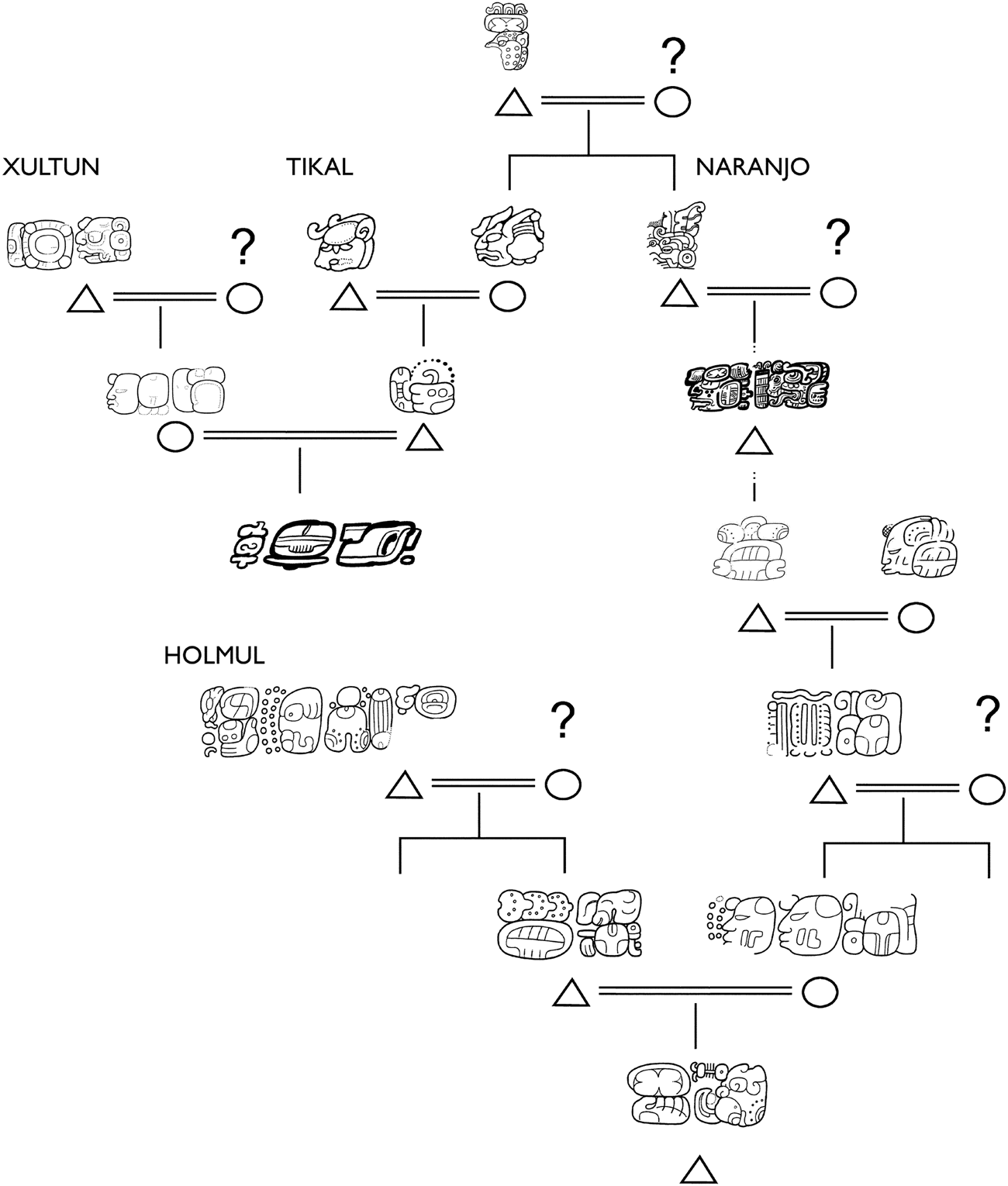
At the same time, data from Holmul and Naranjo reveal that the more traditional networks of marriage alliances and gifts also continued in the new political landscape (see Figure 19 for a summary of all marriage alliances discussed in this study). Juun K'am K'uh of Holmul received gifts from Ajnumsaaj and arranged for the marriage of Ajnumsaaj's daughter and Juun K'am K'uh's son. It seems very likely that Juun K'am K'uh was also Tuun K'ab Hix's vassal. However, the evidence at Holmul shows how Ajnumsaaj built his own network of allies and/or clients through prestigious gifts and marriage ties. Holmul rulers, at times, were able to interact directly with the Kaanu'l overlords, and those relationships were equally sealed with gifts.
Genealogical links between Maya rulers discussed in the article. Drawing by Tokovinine.
It is highly significant that there is no evidence of reciprocal gifts from Naranjo to Dzibanche or from Holmul to Naranjo or Dzibanche. Consequently, the gifts marked asymmetrical relationships of patronage and subordination. One can only speculate what kinds of goods or services were expected by the dominant side of the relationship. For example, recent data from the Naranjo local hegemonic network suggest growing importance of taxation in ground maize (LeCount et al. Reference LeCount, Blitz and Tidwell2022). The Holmul region did have large areas of intensive agriculture according to lidar surveys (Canuto et al. Reference Canuto, Estrada-Belli, Garrison, Houston, Acuña, Kováč, Marken, Nondédéo, Auld-Thomas, Castanet, Chatelain, Chiriboga, Drápela, Lieskovský, Tokovinine, Velasquez, Fernández-Díaz and Shrestha2018), and those could have served as a significant taxation base for Naranjo and Dzibanche.
It is unclear how Kaanu'l overlords dealt with the emergence of regional power networks such as the one created by Ajnumsaaj. A direct involvement with Naranjo's clients (as evidenced in Yuknoom Ti’ Chan's gifted personal jewel) in the absence of matching offerings from Naranjo after a.d. 615 suggests an intervention from Dzibanche into local politics. Violence was always an option, as subsequent attacks on Naranjo by the Kaanu'l and Caracol lords show.
New data also reveal the importance of patron deities in the emergent hegemonic network or networks. Naranjo and Holmul rulers don specific necklace pendants potentially indicating that they assumed the identity of the Kaanu'l variant of the Maize God. At the same time, Ajnumsaaj presented his Holmul counterpart with gifts bearing the image of the Naranjo patron deity, thereby extending the ritual landscape of his own city. The movement of special possessions, such as Ajnumsaaj's drinking vessel and Yuknoom Uti’ Chan's pendant, reveal that the network of political agents coexisted with a network of other-than-human entities that equally contributed to the negotiation of power and authority in the Kaanu'l hegemony.
Finally, references to Kaanu'l lords at Naranjo and Holmul attest to the complexity of the Kaanu'l political system. Recent discussions of the Kaanu'l royal house (Martin Reference Martin2017, Reference Martin2020; Estrada-Belli and Tokovinine Reference Estrada-Belli and Tokovinine2022) suggest that multiple Kaanu'l lords operated simultaneously, but only one of them held the title of kaloomte’ as a paramount ruler. Consequently, Tuun K'ab Hix played a major role in Kaanu'l affairs as seen from Naranjo but never occupied the top tier of the internal Kaanu'l hierarchy. Following the same logic, Naranjo inscriptions omit Yax Yopaat of Dzibanche, because he presumably played no role in the region of Naranjo. This reliance on de facto corulers tasked with different areas of the hegemony seems to be one of the contributing factors of Kaanu'l expansion.
Acknowledgments
Research at Holmul and La Sufricaya was authorized by Guatemala’s Ministry of Culture and Sports and supported by grants from the Pacunam, Hitz, Maya Archaeology Initiative, Alphawood Foundation, National Science Foundation (#2023648), and Society for American Archaeology (SAA H. and T. King Grant #202006). Guatemala’s Ministry of Culture and Sports authorized and funded research and conservation efforts at Naranjo, which were also supported by the General Directorate of Cultural and Natural Heritage of Guatemala, Foundation for the Advancement of Mesoamerican Studies, World Monuments Fund, the Gilbert and Ildiko Butler Foundation, and the United States Department of State Ambassadors Fund for Cultural Preservation. Additional institutional support came from Tulane University, the University of Alabama, the Department of Conservation and Rescue of Archaeological and Pre-Hispanic Sites of the Institute of Anthropology and History (DECORSIAP, INAH), and the Corpus of Maya Hieroglyphic Inscriptions of Harvard University. We would also like to thank Consejo Nacional de Areas Protegidas de Guatemala for allowing access to the Maya Biosphere Reserve and to Sociedad Civil Arbol Verde for their support of fieldwork at Holmul. Several colleagues commented on different iterations of the manuscript or collaborated on prior research summarized here. We are particularly grateful to Simon Martin, Dmitri Beliaev, Sergey Vepretskii, Stephen Houston, Nikolai Grube, David Stuart, and the anonymous reviewers. We remain responsible for all errors and omissions in the final version of this article.


 Open access

