

Approximate location of Bronze and Iron Age sites and Deh Hosein.

Introduction
The earliest appearance of tin bronze in Western Asia has been reported from Mesopotamia (Tepe Gawra, Kish, Ur, and Tell Judeidah) and southwestern Iran (Susa) and Luristan in west central Iran (Kalleh Nissar) in the late fourth and the beginning of the third millennium BCE, whereas the extensive use of tin and tin bronze can be dated around the mid-third millennium over a large area extending from the Persian Gulf to the Aegean (Pernicka et al. 1984, Stech & Pigott 1986, Reference WeeksWeeks 1999, Fleming et al. 2005). Since Mesopotamia, the Khuzestan plain and Luristan all lack metallic resources, ancient metallurgists depended on their adjacent mineral-rich neighbouring regions including the Iranian plateau for the supply of raw materials (Figure 1). The fact that metals and other materials had to be imported from the east or the south is repeatedly mentioned in the cuneiform texts from Mesopotamia. Despite the wealth of base and precious metal resources on the Iranian plateau, no tin deposits have been reported from this region, which could explain the huge bronze production in the Bronze and Iron Ages.
The ancient mine at Deh Hosein
We investigated the newly discovered ancient copper-tin mine at Deh Hosein (Momenzadeh et al. 2005) and several bronze artefacts of typical Luristan style (Reference OverlaetOverlaet 2004) and dating most probably to the Iranian Iron Age from about 1300/1250 to 650 BC. The results were compared with analyses of other bronze artefacts previously published in order to find a possible relationship. The ancient mine at Deh Hosein (Figure 2) is located c. 45 km southwest of Arak city in the eastern part of the central Zagros Mountains which form the north-eastern border of Luristan. The ancient workings appear as numerous big ellipsoidal open depressions in two rows along the mineralized horizons, distributed over an area of 4.5 x 6 km². The old workings are up to 70 by 50m in size and up to 15m deep and are aligned over some 500m (Figure 3).
Location and simplified geological map of the ancient mining area at Deh Hosein.

Part of ancient workings at Deh Hosein.

A hammer stone from ancient excavations.

Several hammer stones of silicified phyllite and granite, pottery sherds and grinding stones have been found in the open-cast mines and adjacent ancient settlements (Figure 4). The pottery sherds can be dated to the early first millennium BCE. Pieces of charcoal found in one of the excavations yielded a radiocarbon date of 3380 ± 55, which on calibration (2s) results in an age range of 1775-1522 BCE. Since the sample derives from an intermediate layer of the mine, the earliest mining activity can be even older.
The mineralisation at Deh Hosein occurs in the form of quartz and quartz-sulfide veins and veinlets as well as disseminated and impregnated in meta-sandstone, phyllite, schist and spotted slate intersected by quartzitic veins. Field survey and ore microscopy have revealed over 30 ore minerals including: arsenopyrite, native copper, copper sulfide minerals, galena, pyrite and cassiterite (Nezafati et al. 2005). In addition, heavy mineral prospection in the streams of the ancient mining area by Zaryaban Exploration revealed nuggets of cassiterite.
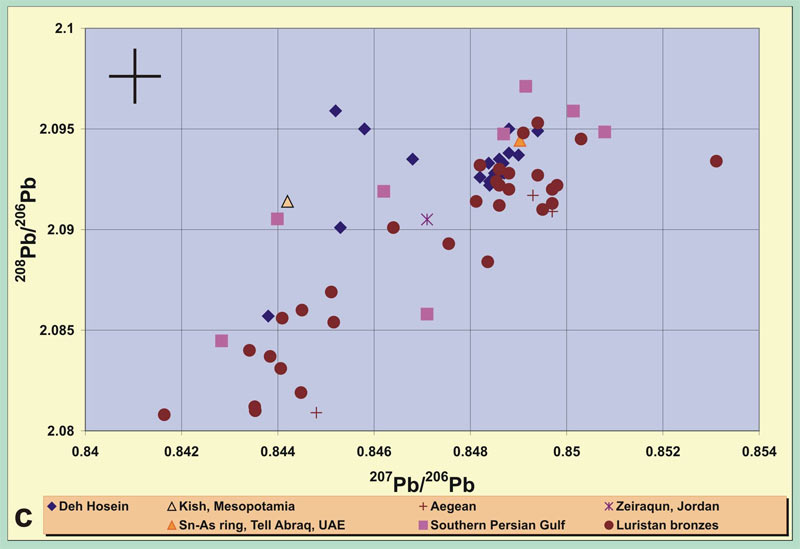
Three isotope plot of lead in ore samples from Deh Hosein in comparison with bronze artefacts from Luristan, Mesopotamia, UAE, and the Aegean. The error bars show the 2σ uncertainty. Note that the scale of the diagram is greatly expanded. A similarly good match is also observed in plots including 204Pb.

Analytical results
Examination of 17 ore samples from Deh Hosein by neutron activation analysis and 29 bronze artefacts from Luristan by energy-dispersive X-ray fluorescence analysis revealed that the metal content of the ore is as much as 6.7%, 10%, 23.9%, 3.7%, 0.75%, and 13.3 ppm for Sn, Cu, As, Pb, Zn, and Au, respectively, whereas the Luristan bronzes show variable concentrations of As, Pb, Zn and Fe in addition to high concentrations of tin (0.48-15.4%). The ore composition of Deh Hosein is matched by several bronze artefacts from Luristan analysed in this study as well as in previous investigations (Fleming et al. 2005).
Even more noteworthy is the observation that the lead isotope ratios of 18 ore samples from Deh Hosein plot within a narrow range from 18.415 to 18.547 for 206Pb/204Pb, 0.8438 to 0.8494 for 207Pb/206Pb and 2.0901 to 2.0959 for 208Pb/206Pb (Figure 5) and that these results are in very good agreement with 25 samples of metal artefacts from Luristan and other bronze artefacts dated to the third millennium BCE from the southern Persian Gulf (Reference WeeksWeeks 1999), the Aegean (Begemann et al. 1992), as well as from third millennium BCE sites in Luristan and Mesopotamia (Begemann & Schmitt-Strecker in preparation).
Conclusions
Thus we have found several indications that Deh Hosein may have been a major supplier of tin for ancient civilisations of Iran and Mesopotamia and perhaps even further west beginning in the third millennium BCE: In summary:
-
i. The lead isotope compatibility of ores from Deh Hosein with many bronze artefacts from Bronze and Iron Age sites distributed from the southern Persian Gulf to the Aegean is good.
-
ii. This is combined with a good match for trace element patterns of ores and artefacts.
-
iii. Copper and tin occur within one mineralisation.
-
iv. Ancient textual references mention tin and bronze supply from regions east of Mesopotamia.
-
v. The dating of surface finds of pottery and charcoal finally supports our findings. At present Deh Hosein is the only tin occurrence close to Luristan and Mesopotamia. However, it is possible that further ancient tin mines may be discovered in the northern part of the Sanandaj-Sirjan zone, located in a similar geological environment.
Acknowledgments
We acknowledge financial support from the German Academic Exchange Service (DAAD) and from the Zaryaban Exploration Co. We thank Bernd Höppner for analytical help, Thomas Stöllner for providing the radiocarbon date and Friedrich Begemann for helpful discussions and permission to use unpublished data.