


1. Introduction
The early phases of chemical and process engineering design are essential for determining the technical and practical viability of emerging solution concepts. During this stage, multiple designs are typically generated and assessed to identify those with the greatest potential for implementation. Traditional evaluation approaches predominantly rely on expert judgement, often involving panels composed of individuals from various engineering domains. While such human-based assessments provide valuable practical insight, they can be time-consuming, resource-intensive, and their outcomes may vary due to subjectivity, personal bias, disciplinary perspectives, and limited access to knowledge beyond the expertise of individual evaluators (Reference Blessing and ChakrabartiBlessing & Chakrabarti, 2009; Reference Edwards, Tehranchi, Miller and AhmedEdwards et al., 2025; Reference UllmanUllman, 2003). These challenges become more evident when decisions must address multiple evaluation criteria such as usefulness, feasibility, and sustainability.
Recent developments in artificial intelligence (AI), particularly the emergence of generative language models such as Generative Pre-trained Transformers (GPT) developed by OpenAI (2025), have introduced new opportunities to support early design activities. Generative AI has recently been explored as a complement to expert evaluation, offering structured reasoning and the ability to integrate external knowledge. However, questions remain about the reliability, stability and human alignment of AI-based assessments. In response to this challenge, this study introduces a multi-agent generative AI framework that functions as a virtual expert panel for evaluating early-stage solution concepts. Although subjectivity and cognitive biases are inherent to human-centred assessments, this study does not aim to eliminate or quantify such effects directly. Instead, it focuses on evaluation consistency, the influence of retrieval-augmented knowledge and alignment with human expert judgement. To guide the investigation, the study formulates the following research questions:
-
• RQ1: How consistent are the evaluations produced by the multi-agent configuration across domain-specific evaluators?
-
• RQ2: How does retrieval-augmented knowledge influence the evaluation behaviour and overall panel outcomes of the AI-based configuration?
-
• RQ3: How closely do the AI-only and hybrid configurations align with human expert judgement in early-stage concept evaluation?
2. Related work
2.1. Concept evaluation in early-phase process design
Evaluating solution concepts in the early stages of process design plays a critical role in determining which options are technically feasible, practically implementable, and aligned with defined design objectives (Reference Blessing and ChakrabartiBlessing & Chakrabarti, 2009; Reference Mesbah, Arous, Yang and BozzonMesbah et al., 2023). The evaluation is typically carried out to identify the most promising concepts for further development, often under conditions of limited data, time constraints, and conflicting design requirements. To overcome these challenges, several frameworks have been proposed to support systematic evaluation in conceptual design. Common approaches include scoring matrices, decision tables, and weighted evaluation models (Reference Chen, Zhong, Liu, Ma and SiChen et al., 2022; Reference Dym, Little and OrwinDym et al., 2013; Reference Pahl, Beitz, Feldhusen and GrotePahl et al., 2007), which enable evaluators to assess solution concepts based on predefined criteria such as novelty, feasibility, usefulness, and sustainability (Reference Baffo, Leonardi, Bossone, Camarda, D’Alberti and TravaglioniBaffo et al., 2023; Reference Dean, Hender, Rodgers and SantanenDean et al., 2006). Although such methods improve structure and transparency, they still depend heavily on expert judgement. As a result, evaluations may vary due to subjective judgement, inconsistent application of criteria and disciplinary differences among evaluators (Reference Blessing and ChakrabartiBlessing & Chakrabarti, 2009; Reference Edwards, Tehranchi, Miller and AhmedEdwards et al., 2025; Reference UllmanUllman, 2003). These persistent challenges highlight the need for approaches that reduce inconsistency while still respecting the inherent subjectivity of design evaluations. Rather than eliminating human subjective insight, digital and AI-assisted methods aim to support more stable, knowledge-informed reasoning during early-stage assessment.
2.2. Generative AI in design concept assessment
Recent advances in generative AI have created new opportunities to support early-stage concept assessment. Several studies have begun examining the ability of large language models (LLMs) to approximate or complement human evaluative judgement. Reference Xu, Kotecha and McAdamsXu et al. (2024) and Reference Livotov and NugrohoMas’udah et al. (2024) measured inter-rater agreement between ChatGPT and expert panels and reported moderate consistency but notable variability in contextual reasoning. Reference Edwards, Tehranchi, Miller and AhmedEdwards et al. (2025) examined the use of vision-language models (VLMs) as AI judges in design and found that the best-performing model achieved expert-level agreement for certain metrics, such as uniqueness and drawing quality, but did not consistently reach human-expert equivalence across all evaluation criteria. Moreover, hybrid approaches that combine AI-generated insights with expert validation (Reference Livotov, Hartmann, Cavallucci, Brad, Livotov and HoussinMas’udah et al., 2026, Reference Mas’udah, Livotov and Hartmann2025; Reference Mesbah, Arous, Yang and BozzonMesbah et al., 2023; Reference Sauer and BurggräfSauer & Burggräf, 2025) have shown potential for improving assessment quality but still face challenges related to consistency, transparency and robustness. Existing applications typically rely on single-agent models, which limits the diversity of perspectives and contextual grounding available during evaluation. In this context, recent developments in multi-agent generative AI and retrieval-augmented reasoning offer promising opportunities to strengthen early-stage evaluation.
2.3. Multi-agent AI and RAG for evaluation
Multi-agent generative AI has emerged as a promising approach for improving reasoning quality by distributing tasks among specialised agents. Frameworks such as AutoGen (Reference Wu, Bansal and ZhangWu et al., 2023) and multi-agent judge architectures (Reference Guo, Chen, Wang, Chang, Pei, Chawla, Wiest and ZhangGuo et al., 2024; Reference Qian, Zhang, Zhou, Ding, Socolinsky and ZhangQian et al., 2025; Reference Rasheed, Waseem, Systä and AbrahamssonRasheed et al., 2024) demonstrate improved robustness and reduced bias compared with single-model assessments. However, despite these advances, multi-agent systems have not yet been applied to structured concept evaluation in engineering design, where assessments must account for criterion-specific and domain-specific requirements.
In parallel, retrieval-augmented generation (RAG), an approach in which an AI model retrieves relevant external domain knowledge and integrates it into its reasoning process, further enhances the factual grounding and contextual relevance of generated outputs (Reference Lewis, Perez, Piktus, Petroni, Karpukhin, Goyal, Küttler, Lewis, Yih, Rocktäschel, Riedel and KielaLewis et al., 2021). In engineering design, previous studies have applied RAG to enhance problem formulation, idea generation, and solution optimisation (Reference Livotov, Hartmann, Cavallucci, Brad, Livotov and HoussinMas’udah et al., 2026, Reference Mas’udah, Livotov and Hartmann2025). Although these studies demonstrate that external domain knowledge can improve the quality and relevance of generative outputs, RAG has not been used for structured concept evaluation, where evidence-based justification and domain alignment are essential. Current research therefore lacks a framework that integrates multi-agent reasoning with retrieval-augmented knowledge for early-stage engineering concept evaluation. Addressing this gap requires empirical analysis of evaluation consistency, the influence of retrieved evidence and the extent to which AI-based assessments align with human expert judgement.
3. Methodology
3.1. Research design
This study employs a multi-agent generative evaluation framework developed using GPT-5.1, the most recent OpenAI model available at the time of experimentation (November 2025). Figure 1 illustrates the overall workflow of the proposed framework which consists of two main stages.
Multi-agent generative AI framework for solution concept evaluation

Figure 1 Long description
A multi-agent evaluation framework for solution concept evaluation. The framework consists of two main phases: Phase 1: Initial evaluation and Phase 2: Collaborative reasoning round. Input solution concepts are evaluated independently by three agents: Agent A (Process engineering), Agent B (Mechanical engineering), and Agent C (Environmental engineering). Each agent rates the solution concepts on usefulness, feasibility, and sustainability, with justification for each criterion. In Phase 2, the agents engage in inter-agent knowledge exchange to finalize the evaluation of the solution concepts.
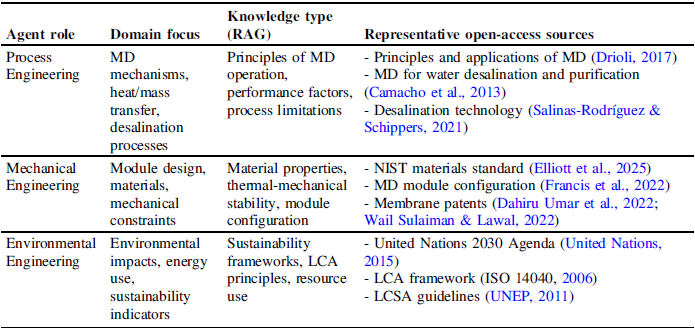
The first stage of the framework focuses on the independent evaluation of solution concepts generated for the case study (Section 3.2). Three role-specialised agents are instantiated from the GPT-5.1 model, representing process engineering (Agent A), mechanical engineering (Agent B), and environmental engineering (Agent C). Each agent receives the same concept description and independently evaluates the concept based on three criteria: usefulness, technical feasibility, and environmental sustainability. The evaluation criteria follow established early-stage design assessment frameworks and are aligned with the assessment structure applied in earlier work on AI-assisted concept optimisation (Reference Livotov, Hartmann, Cavallucci, Brad, Livotov and HoussinMas’udah et al., 2026, Reference Mas’udah, Livotov and Hartmann2025), where usefulness and feasibility are considered fundamental dimensions of early-stage concept assessment (Reference Blessing and ChakrabartiBlessing & Chakrabarti, 2009; Reference Dean, Hender, Rodgers and SantanenDean et al., 2006; Reference UllmanUllman, 2003), while sustainability has become essential in modern process and environmental engineering evaluation frameworks (Reference KlüppelKlüppel, 2005; United Nations, 2015). Collectively, these criteria provide a balanced representation of functional benefit, implementability, and environmental responsibility. A standardised five-point scale (1, 2, 3, 4, 5) was applied to evaluate each concept’s usefulness, technical feasibility and environmental sustainability, with 1 representing the lowest and 5 the highest score. This rating structure follows the assessment scheme used in (Reference Livotov, Huber, Hentschel, Cavallucci, Brad, Livotov and HoussinLivotov et al., 2026; Reference Livotov and Mas’udahLivotov & Mas’udah, 2025). Their ordinal structure enables evaluators to express the degree to which a concept is perceived as useful, feasible, or sustainable, providing a systematic and transparent basis for early-stage design decision-making. Although the scoring framework is identical across agents, each agent applies domain-specific reasoning determined by its assigned role. In the retrieval-augmented condition, the agents have access to an external domain knowledge source during evaluation, as summarised in Table 1. To ensure transparency and reproducibility, the RAG knowledge base consists exclusively of openly accessible engineering documents that are directly relevant to the membrane distillation (MD) case study presented in Section 3.2. These resources were selected to align with the domain responsibilities of the three agents. In the non-RAG condition, the agents rely solely on the knowledge embedded within the GPT-5.1 model.
In the second stage of the framework, the agents participate in a collaborative reasoning round. The individual evaluations produced in the first stage are exchanged among the agents, enabling them to review, compare, and refine their reasoning. This inter-agent knowledge exchange supports the identification of agreement, divergence, and cross-criterion conflict, resulting in a consolidated final evaluation that reflects integrated multi-perspective reasoning rather than a single-agent judgement.
To enable systematic comparison, four experimental settings were examined:
-
a) Multi-agent AI with RAG
The multi-agent system evaluates all concepts with access to external domain knowledge.
-
b) Multi-agent AI without RAG
The same multi-agent system operates using only its internal model knowledge.
-
c) Human expert panel
Three human experts, corresponding to the same disciplinary roles as the AI agents (process, mechanical, and environmental engineering), independently assess the concepts and subsequently discuss their evaluations to produce a consolidated panel outcome. This alignment ensures that comparisons between AI and human evaluations are conducted within an equivalent disciplinary structure.
-
d) Hybrid AI-human evaluation
Human experts review and refine the outputs produced by the AI with RAG setting, which provides the most complete and evidence-supported AI reasoning for human interpretation.
To assess the reproducibility and stability of the model outputs, each AI-based evaluation was executed three times under identical prompting and configuration settings, enabling analysis of run-to-run variation. This research design provides a structured foundation for analysing the influence of role specialisation, retrieval-augmented knowledge, collaborative reasoning, and human expertise on early-stage concept evaluation. The four experimental settings allow systematic comparison of evaluation accuracy, consistency, and reasoning quality across AI-based, hybrid, and human expert assessments.
Summary of retrieval-augmented knowledge sources per agent role

3.2. Case study
To validate the proposed framework, Liquid Gap Membrane Distillation (LGMD) is employed as the reference system for this case study due to its strong coupling between thermal gradients, membrane characteristics, and geometric layout, features that make it suitable as a testbed for early-stage optimisation assessment. LGMD is a thermally driven desalination process in which a heated saline feed flows along a hydrophobic membrane, while a cooler stream behind a condensation surface maintains the temperature gradient. A thin liquid-filled gap between the membrane and condensation plate facilitates vapour condensation and supports compact operation. This configuration, typically operating at 50 - 100°C, offers high salt rejection and compatibility with low-grade heat sources, as demonstrated in (Reference Livotov, Hartmann, Cavallucci, Brad, Livotov and HoussinMas’udah et al., 2026).
Despite these advantages, LGMD performance is constrained by several interconnected issues. First, conductive heat transfer across the liquid gap lowers thermal efficiency and reduces the effective temperature gradient. Second, temperature polarisation at the membrane interfaces further constrains vapour transport by diminishing the driving force. Third, the system is prone to membrane wetting and fouling, particularly when processing high-salinity or organic-rich feed streams. These challenges collectively affect permeate flux, energy consumption, and long-term operational stability.
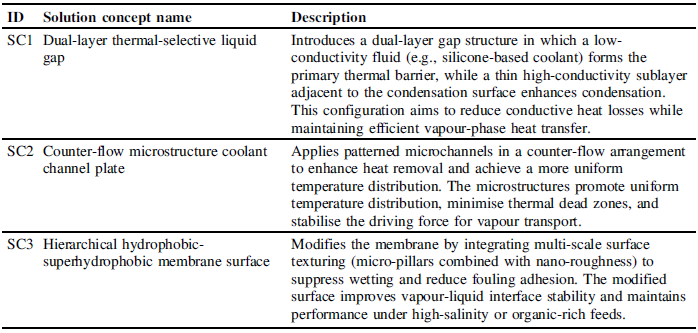
To address these limitations, three solution concepts as presented in Table 2 have been developed in (Reference Livotov, Hartmann, Cavallucci, Brad, Livotov and HoussinMas’udah et al., 2026). These concepts target thermal inefficiencies, flow maldistribution, and membrane performance constraints through modifications in gap design, coolant circulation, and membrane structuring. These solutions serve as the basis for evaluation under the four experimental settings described in Section 3.1.
Solution concepts for improving LGMD performance

3.3. Evaluation
To assess the performance of the proposed multi-agent evaluation framework, the analysis focuses on measurable indicators aligned with the three research questions.
-
• Consistency of evaluation (RQ1)
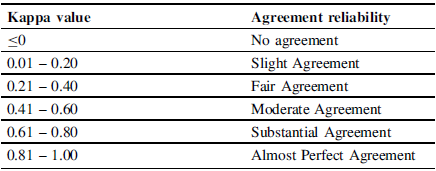
To examine the internal consistency of the evaluations produced by the three domain-specific agents, inter-rater agreement was calculated for each configuration. Weighted Cohen’s kappa was used to assess pairwise agreement between the evaluators, as it accounts for ordinal ratings on a Likert scale (Reference CohenCohen, 1960). Fleiss’ kappa (Reference FleissFleiss, 1971) was applied to examine overall agreement across the three evaluators.
Interpretation of kappa values (Reference Landis and KochLandis & Koch, 1977)

-
• Effect of retrieval-augmented knowledge (RQ2)
To examine the effect of retrieval-augmented knowledge, the AI without RAG and AI with RAG configurations were compared in terms of their panel consensus scores and the variability of these scores across solution concepts and experimental runs. Panel consensus scores refer to the final ratings agreed upon after the collaborative reasoning stage (Phase 2). Differences in mean scores indicate whether RAG influences overall evaluation patterns, while changes in standard deviation reflect its effect on evaluation stability.
-
• Comparative performance of AI, human, and hybrid panels (RQ3)
To examine how closely AI-based assessments align with human expert judgement, two quantitative indicators were employed. Spearman rank correlation (Reference SpearmanSpearman, 1904) was applied to assess the similarity in ranking patterns across the three solution concepts, while the mean absolute error (MAE) was used to quantify numerical deviations between each configuration and the human panel (Reference Chai and DraxlerChai & Draxler, 2014). Both metrics were calculated using the panel consensus scores for each configuration.
4. Results and discussion
4.1. Consistency of evaluation (RQ1)
Table 4 presents the inter-rater agreement results for usefulness evaluations across the four experimental configurations. The AI with RAG configuration exhibits negative pairwise and overall kappa values, reflecting low statistically meaningful consistency among the evaluators. The AI without RAG and Hybrid configurations show near-constant ratings, leading to undefined pairwise agreement coefficients due to insufficient rating variability, while the overall kappa values remain negative. In contrast, the Human configuration demonstrates slight agreement, suggesting greater diversity in expert judgement and more differentiated but less consistent usefulness assessments. Overall, the findings indicate that AI-based evaluators showed highly uniform usefulness ratings, leading to apparent uniformity but limited measurable inter-rater agreement.
Inter-rater agreement for usefulness evaluations

Turning to feasibility evaluation, Table 5 shows the inter-rater agreement results across configurations. Compared with usefulness, feasibility assessments exhibit higher and more stable agreement levels, indicating greater consistency among domain-specific evaluators. The AI with RAG and AI without RAG configurations demonstrate slight to fair agreement, reflecting moderate alignment in technical feasibility judgements. The Human configuration achieves moderate agreement at both pairwise and overall levels, suggesting more coherent and aligned feasibility assessments among experts. The Hybrid configuration shows fair agreement, indicating improved consistency relative to purely AI-based evaluations but lower alignment than the human panel. Overall, these results indicate that feasibility evaluations involve more differentiated and domain-sensitive reasoning, leading to more meaningful inter-rater consistency than usefulness assessments.
Inter-rater agreement for feasibility evaluations

Extending the analysis to sustainability, Table 6 reveals a further reduction in agreement levels. The AI with RAG configuration exhibits near-constant ratings, resulting in undefined pairwise agreement and negative overall kappa values, which indicate limited measurable consistency. The AI without RAG configuration demonstrates slight agreement, suggesting modest alignment among evaluators in sustainability assessments. In contrast, the Human and Hybrid configurations exhibit negative pairwise and overall kappa values, indicating agreement below chance level and substantial variability in domain-specific judgements. Overall, the results suggest that sustainability evaluations are characterised by greater divergence among evaluators, reflecting the complexity and multidimensional nature of sustainability considerations in early-stage design.
Inter-rater agreement for sustainability evaluations

4.2. Influence of retrieval-augmented knowledge (RQ2)
Table 7 compares the panel consensus scores for usefulness between AI configurations with and without retrieval-augmented knowledge. The AI without RAG configuration produces identical mean scores across all solution concepts, indicating highly uniform and stable evaluations. This suggests that, in the absence of external knowledge support, the panel tends to converge on similar usefulness judgements across different solution concepts. In contrast, the AI with RAG configuration achieves a slightly higher mean score with low variability, reflecting a modest improvement in perceived usefulness while maintaining stable evaluation behaviour. Overall, these results indicate that retrieval-augmented knowledge marginally increases the mean usefulness ratings without introducing substantial instability.
Panel consensus comparison between AI configurations for usefulness evaluation

Following the analysis of usefulness, Table 8 examines the effect of retrieval-augmented knowledge on feasibility evaluations. The AI without RAG configuration achieves a slightly higher overall mean score but exhibits greater variability across solution concepts, indicating less stable feasibility assessments. This suggests that, in the absence of retrieved knowledge, feasibility judgements are more sensitive to contextual differences. By contrast, the AI with RAG configuration demonstrates a marginally lower mean score accompanied by reduced variability, reflecting more consistent evaluation behaviour. The lower standard deviation indicates that retrieval-augmented knowledge contributes to greater stability in feasibility assessments, even though it does not substantially increase perceived feasibility. Overall, these findings suggest that RAG appears to contribute to more stable feasibility evaluations.
Panel consensus comparison between AI configurations for feasibility evaluation

Building on the analysis of usefulness and feasibility, Table 9 examines the influence of retrieval-augmented knowledge on sustainability evaluations. The AI without RAG configuration achieves a slightly higher overall mean score with moderate stability, indicating relatively consistent sustainability assessments across solution concepts. The AI with RAG configuration produces a comparable mean score and slightly lower variability, reflecting similarly stable evaluation behaviour. The small difference in mean values suggests that retrieval-augmented knowledge does not substantially alter the perceived sustainability of the solution concepts. However, the marginal reduction in variability indicates that RAG contributes to more uniform sustainability judgements. Overall, these findings imply that the primary impact of RAG in sustainability evaluation lies in enhancing consistency rather than substantially altering overall panel ratings.
Panel consensus comparison between AI configurations for sustainability evaluation

4.3. Comparative performance of AI, human, and hybrid panels (RQ3)
This section compares how closely the AI-based configurations match human expert judgement using Spearman rank correlation and mean absolute error (MAE). Table 10 summarises the results across the three solution concepts. The AI without RAG configuration shows moderate positive alignment with a slightly higher MAE, suggesting partial similarity in the overall evaluation patterns and assigned scores. In contrast, the AI with RAG setting shows a negative correlation and the largest MAE, indicating that access to retrieved information does not necessarily lead to human-like ranking behaviour in this experiment. Interestingly, the hybrid configuration demonstrates the closest alignment with the human panel in this experimental setting, achieving both the highest correlation and the lowest MAE. This suggests that combining human input with AI support produces evaluations that more closely reflect human judgement in this experimental setting. Overall, the results for RQ3 show that while AI can assist in early-stage evaluation, the hybrid approach provides the closest approximation to human assessment patterns.
Agreement and deviation between AI, hybrid and human evaluations

Taken together, the results indicate that the proposed framework is intended to structure early-stage evaluation rather than replace expert judgement. It is particularly relevant in exploratory screening contexts, where multiple alternatives must be assessed systematically under time constraints. The framework contributes by organising multi-perspective evaluation and making underlying reasoning more transparent. However, its effectiveness depends on the relevance and coverage of retrieved knowledge, and it does not substitute for experiential insight or organisational considerations that shape real-world decisions. Variability among experts should therefore not be interpreted solely as a weakness. In early design phases, differences in judgement may reflect uncertainty, emerging risks or tacit knowledge. In this sense, the hybrid configuration can support more reflective and robust early-stage decision-making.
4.4. Limitations and future work
This study has several limitations that should be acknowledged. The experiment involved a small number of solution concepts and relied on a specific set of knowledge sources, which limits statistical robustness and may not represent broader engineering contexts. In particular, the rank correlation analysis was based on three solution concepts, which restricts the statistical generalisability of the alignment results. Although demonstrated within a process engineering case, the framework is conceptually transferable to other domains requiring structured multi-criteria evaluation. The impact of the RAG configuration depended on the relevance of retrieved documents and may vary when sources are incomplete or misaligned with the problem context. Furthermore, the evaluation employed a simplified consensus mechanism and focused on usefulness, technical feasibility and environmental sustainability, without incorporating additional factors, such as organisational, economic or strategic considerations that frequently shape real-world decision-making. While GPT-5.1 was used in this study, the framework is model-agnostic and can be implemented with other LLMs, subject to comparable reasoning capabilities. Future work should expand broader concept sets, domain-specific knowledge bases and richer human-AI collaboration formats.
5. Conclusion
This study examined a multi-agent framework for early-stage concept evaluation, focusing on evaluation consistency, the influence of retrieval-augmented knowledge and alignment with human expert judgement. The findings show that AI-based panels tend to produce uniform evaluation patterns across solution concepts, though statistical agreement levels vary depending on the evaluation criterion. The inclusion of retrieval-augmented knowledge alters evaluation patterns but does not lead to closer correspondence with human rating behaviour. Across all configurations, the hybrid setting achieved the closest alignment with human judgement, indicating that combining AI-supported assessment with expert interpretation provides the most stable outcomes. Overall, the findings indicate that while AI can support early design evaluation, human involvement remains essential. The proposed framework offers a practical basis for structured, knowledge-supported assessment, and future studies may further enhance its effectiveness through broader test cases and more comprehensive knowledge integration.
Acknowledgement
The authors are grateful to the German Academic Exchange Service (DAAD) for funding this research.









 Open access

