

1. Introduction
This paper addresses a well-worn topic: originalism, the theory that judges should interpret the U.S. Constitution in a manner consistent with the intent of its framers.Footnote 1 The published papers on the subject range from philosophicalFootnote 2 to practical.Footnote 3 This paper leans toward the practical—specifically, evidence of real-world effects or implications of originalism. The primary effect often advanced by originalists is the tendency of the approach to constrain the discretion of judges.Footnote 4 The inputs to an originalist analysis—constitutional text and history—consist of objective facts that a judge must confront in theorizing about the Constitution’s meaning. Those objective facts can serve to falsify some of the theories that a judge might propose, and in this sense originalism puts a check, or perhaps more appropriately a leash, on judges. However, another effect of originalism, which is all too obvious in modern court opinions, is the creation of official histories.Footnote 5 The articulation of such histories by the U.S. Supreme Court inserts an organ of the government into a space of open, atomistic debate, potentially distorting the search for truth in history. It also takes judges outside of the business of deciding those issues—and only those issues—necessary to resolve a dispute, and involves them in the more controversial activity of settling historical truth. This is an activity that should be frowned upon in an open society.
The harm from official histories issued by the Supreme Court may seem at first to be remote. However, in matters of historic importance, this harm can be immediate and serious. The most harmful official history is provided by Taney’s opinion in Dred Scott v. Sandford, which set out a racist positive originalist theory of the Constitution.Footnote 6 The opinion provided estoppel and reliance arguments that Southern slaveholders and their government agents embraced in full, leading ultimately to secession and the Civil War. Most Supreme Court official histories are not nearly so harmful, but they still have the capacity, through distorting historical truth, to generate and support potentially harmful theories—and the constant drip of official histories is itself corrosive to welfare.
Another question I examine is how originalism should be considered as a process for determining what the law is, or what the law should be. The first question concerns positive originalism and the second normative originalism. I conflate the two because the difference is unimportant for my analysis, and it seems difficult to maintain anyway. A positive originalist interpretation that is indefensible on any reasonably attractive normative basis, and incapable of being generalized into a normatively attractive version, would be uninteresting. The question I consider is whether originalism should be considered a methodology of analyzing the law or a perspective on the law. Since it is possible for some analytical processes to be a mixture of both, the more refined question is whether originalism is closer to a perspective than to a methodology, or vice versa. I conclude that originalism is closer to a perspective.
Here is why. A methodology takes a passive approach to data and applies an analytical process, or family of such processes, to reach a conclusion on some question of interest. The process or family of processes is consistently applied; only the inputs—data and primitive assumptions—change. The methodologist accepts the data as given and attempts to take as much of the data as possible into account. The methodologist can, both in theory and application, reach any particular conclusion: There is no set of conclusions that are walled off or considered excluded a priori. A perspective, by contrast, consults and interrogates the data—typically an experiential base—and draws conclusions predicated on elements observed in that experiential base. The perspectivist operates actively on the data or experiential base, taking the elements from that base that support the conclusion the perspectivist regards as proper under the perspective, and interpreting those elements in a manner that supports the preferred conclusion. The perspectivist is not open to reaching any conclusion whatsoever, because there are certain conclusions that are regarded as inappropriate from the viewpoint of the perspective. An example of a perspective in the law is critical race theory.
A perspective can often identify flaws in the design of government that might otherwise be overlooked by the general public. For this reason, perspectives often provide a social benefit beyond the informational value of simply hearing a perspectivist account. However, there may be competing accounts within the same perspective, and there are, necessarily, competing perspectives. A methodology is often necessary for choosing among competing perspectives. For this reason, a perspective is never a sufficient basis for judicially or morally resolving a question of interest.
Originalism is much closer to a perspective than a methodology, at least as it appears to be applied in modern court opinions. The originalist actively searches in and interrogates an experiential base—constitutional text and history—for elements consistent with their thesis. Text and historical events that can be interpreted in more than one way are inevitably interpreted to support the originalist’s thesis. Like perspectivists generally, originalists generally do not consult the experiential database in the spirit of free inquiry, and their methods are often ad hoc. Unlike perspectivists generally, originalists in their quest to settle historical truth can inflict harm.
Many decisions offer up duels between competing historical narratives supporting competing originalist arguments. Since the competing theses draw on different elements of the experiential base, and interpret common elements differently, it is difficult and often impossible for the neutral observer in many cases to tell which side is correct. A methodology is needed to choose between the competing originalist arguments, but originalism itself does not supply a methodology.
None of this is to suggest that originalism is not a valuable approach to the interpretation of constitutions. Originalism is a necessary perspective in legal analysis, and arguably the only perspectivist approach that merits the label necessary. It is first among equals in legal perspectives. But it is not a methodology, at least not as currently practiced. And it should not be viewed generally as a sufficient basis for interpreting the law.
Overall, originalism, in the form of official histories in Supreme Court majority opinions, is a policy with theoretical benefits—mostly due to the supposed constraining of judicial discretion; and some concrete costs—like a drug with some evidence of efficacy but significant adverse side effects. The literature has focused on the efficacy question. This paper focuses on the costs: the adverse side effects (which include the distortion and retardation of historical truth, with the potential for harm) and the pressing of judges beyond their writ and domain of expertise. A more limited originalist enterprise—such as confining originalism to dissenting opinions or to falsification efforts generally—may be in order.
Despite the voluminous literature, the criticisms of originalism offered here have not yet been set out in the published work. This is because most of the published work discusses the meaning of originalism and its application by courts, while this paper discusses the effects of originalism. In any event, the large number of published papers on the topic should not be viewed as a prohibitive deterrent to criticism by non-specialists. Originalism claims to offer the best method of interpreting the Constitution. That is a claim that affects us all. To the extent that the effects of a given interpretation of a constitutional provision shed light on the likely intentions behind that provision, the views of economists should be taken as seriously as those of historians and constitutional theorists.Footnote 7 Moreover, the arguments in the literature appear to be relatively straightforward, and do not compel the non-specialist to approach them with the same timidity as one might approach a more recondite field of knowledge.
2. The Case for Originalism
I should start with a very strong argument for originalism, expressed by the late Robert B. Seidman in an academic seminar many years ago. Seidman said that originalism is unquestionably an important perspective on a constitution and then offered the example of South Africa.Footnote 8 No one would contend, he noted, that the history of apartheid, and the interest on the part of the new government in uprooting apartheid, should be regarded as irrelevant or nonessential in interpreting the South African Constitution.Footnote 9
Although persuasive, this argument does not fully close the case, because the question of why originalism might be desirable remains. In the case of South Africa, originalism likely has the constraining effect predicted by its advocates.Footnote 10 Originalism checks judges from adopting frameworks that have nothing to do with the history of apartheid. It also has a forcing effect: Originalism forces judges to take the history of apartheid into account in interpreting the constitution. Whether this dual restraining and forcing effect is socially desirable is the ultimate question. As a general matter, it would seem to be a dubious argument: Intelligent judges should be permitted to apply whatever framework seems best in their eyes. The case for restraining and forcing, then, is based on the understanding that the constitution restrains the state in a manner that resolves or avoids the recurrence of problems that have been endemic to the political culture of that nation, and perhaps to all nations. The constitutional restraints are socially desirable, for otherwise the same problems will arise again, to society’s long-term detriment.
Of course, as time passes the original basis, or set of original bases, for a constitution change and diminish. Many of the historical vestiges of apartheid remain, yet the economy and government have changed: Many Black people now hold important positions in government and business in South Africa. The notion that the deck is stacked, as it were, to allow whites to continue to oppress Blacks is no longer so easy to accept. Oppression often now takes on a general hue, with Blacks oppressing other Blacks through the instrument of government or using offices of government to enrich themselves at the expense of the public.Footnote 11 Over time, oppression becomes more of a story of ‘man’s inhumanity to man’, rather than a story of racial conflict. Of course, apartheid itself was always a story of man’s inhumanity to man, but race made oppression more obvious, durable, specific in effect, and predictable. Race makes oppression easy to carry out, easy to accept as apparently natural, but at the same time it stores up an explosive potential.Footnote 12
After enough time has passed, future generations may look at the South African Constitution and discount the importance of the history of apartheid in its interpretation. The provisions that were framed in response to racial oppression may be viewed as a response to general oppression, or perhaps not even that. Perhaps many will advocate for a color-blind view of the South African Constitution.Footnote 13 But as long as the vestiges of apartheid remain, there will always be a sound argument for understanding the South African Constitution as a framework for uprooting a racially oppressive system.
Obviously, the same comments apply to the U.S. Constitution. The thirteenth, fourteenth, and fifteenth amendments were framed to uproot a system of racial oppression.Footnote 14 They were not entirely successful, as the history of Jim Crow laws and lynching continued to unfold well into the 1960s.Footnote 15 Racial discrimination in employment markets continues today.Footnote 16 And yet, most of the current Supreme Court Justices believe that the U.S. Constitution should be read in a color-blind manner. This is so, even though almost all of the current justices believe originalism should be either the predominant, or at least an important, approach to the Constitution.
My point is not to criticize the Supreme Court. It is only to say that originalism is surely an important perspective from which to interpret a constitution. Of course, it is a perspective to which the Court has not remained entirely faithful. Indeed, in the most recent affirmative action cases, the majority of justices view the equal protection clause of the fourteenth amendment as prohibiting efforts on the part of private colleges to take steps to ameliorate racial inequality.Footnote 17
3. Problems with Originalism
There have been so many critiques of originalism that it would be tedious to survey them here.Footnote 18 Let us start with the point that it has succeeded as a perspective. The majority of Supreme Court justices today either regard themselves as originalists or feel some need to invoke originalist arguments.
There are conceptual problems that arise immediately in connection to the meaning of the term ‘originalism’. For example, does it refer to the original intent of the Framers, or to the original meaning? How far should one search under layers of meaning in determining intent? These issues have been aired out in the literature.Footnote 19 However, one simple example hints at some of the difficulties at this definitional stage. Take the case of the provision in the Constitution specifying that to be eligible to be President, one must have attained the age of thirty-five years.Footnote 20 This would appear to be the most obvious provision of the Constitution, requiring no serious debate over its meaning or the Framers’ intent. But consider the reason why the Framers chose thirty-five as the minimum age. The clearest explanation is in Federalist 64: to ensure that the person offering themself as a candidate has had time to acquire a reputation in business and political circles.Footnote 21 In other words, Federalist 64 does not suggest that the Framers thought that thirty-five was a marker of some special stage of wisdom or emotional maturity; no, thirty-five was minimally sufficient for members of the relevant public to know enough about the candidate to be able to assess their character, judgment, and proclivities on the basis of public information. This would have made sense in 1787, a time when many people had obtained quite a lot of experience in the real world by the age of thirty-five. Washington had commanded troops by the age of twenty-two. Hamilton had run the accounts for a trading business in the West Indies while in his teens and served in military command posts before becoming chief of staff to General Washington at twenty. Most thirty-five-year-olds today who would consider running for President have not acquired anywhere near the amount of experience these men had acquired by age twenty-five. If one were to take the genuine intention of the thirty-five-year age requirement in 1787 and translate it according to today’s common experiences, the age requirement should be raised to forty-five or fifty. That would be inconsistent with the public meaning of the age requirement in the Constitution, but it would be consistent with its original intention.Footnote 22 Problems of this nature should plague originalism to the end, but I will set them aside for the most part, to focus on the effects.
Many originalist decisions present conflicting accounts of history in the majority and dissenting opinions. Consider, as just one recent example, Oil States Energy Services v. Greene’s Energy Group, an opinion on the constitutionality of the inter partes review (IPR) process adopted under the America Invents Act of 2011.Footnote 23 Under the IPR system, a party can challenge an existing patent before the Patent Trial and Appeal Board (PTAB), a unit within the patent office, itself a department within the executive branch, and have the patent invalidated. The majority opinion by Justice Thomas looked back into English history and argued that it was not unusual for an already-issued patent to be reexamined and canceled by government officials, not judges, in England in the period near the time of the adoption of the U.S. Constitution. This led Justice Thomas to conclude that patents are “public franchises,” and that it was perfectly fine under the Constitution to have a system where existing patents are reviewed and invalidated at the behest of private parties before the PTAB.Footnote 24 Justice Gorsuch, looking at the same English history, concludes that such post-issuance cancellations by government functionaries were rare events and certainly not a routine or notorious practice in the English system. This bolstered his view that patents are private property, and that a system in which already-issued patents are called back and canceled by officials within the executive branch was inconsistent with the original design under the Constitution. On the basis of the opinions alone, it is impossible for the reader to know which side is correct.Footnote 25 Indeed, it may not be possible, given the difficulty of determining what really happened in the distant past, to discover which side is more accurate on history in Oil States.
What does the public gain from such debates over the interpretation of history? In the example of Oil States, the fundamental problem is that the question of history boils down to an empirical proposition that probably cannot be answered through existing historical resources. Historical resources often do not tell us how much something happened relative to other occurrences, and whether the frequency was such that people familiar with government would have regarded the occurrence as ordinary and part of the process. The question in Oil States is whether post-issuance cancellations of patents occurred at such a frequency in England over the 1700s that the Framers would have regarded such phenomena as an expectable part of the patent system. To be more precise, given a base number of issued patents, what is the relative frequency with which such patents were cancelled by government officials? Justices can take different positions on the answer to this question, and present their evidence, but in the end the answer is often unknowable. I will refer to this again, later, as the ‘empirical frequency problem’. It is a relatively unremarked although fundamental difficulty in originalism.
3.1 Official History Problem
Originalism has some undesirable incentive effects. The justices are not historians. They are not primarily interested in perusing through historical records to gain a better understanding of events that occurred, and do not have the time to undertake such activity with the same care as professional historians. In many cases, each of the justices has a position on an issue and has an interest in using history to support that position.Footnote 26
Probably the first problem with this arrangement is that one side is going to win and the opposing side is going to lose. The majority opinion that emerges contains an account of history that has received the approval of the U.S. Supreme Court. Often there will be a dissenting opinion with a different account or interpretation of history, but in the end, that is a rejected version.
As the originalism project continues, the Court comes closer to producing, through majority opinions, a record of official history. The international record of official histories is troubling.Footnote 27 In many countries, they are associated with propaganda.Footnote 28 They support views of the nation that the government wants the citizens to believe. The manufactured national image is designed to enable the government to impress upon the minds of citizens, especially the youth, an obedience and willingness to accept as morally correct the goals of the national government. Russia, for example, has an official history promoted by Vladimir Putin. This history applauds Russian military aggression and downplays the cruelties of Stalin. Memorial, a Russian human rights organization dedicated to recording the history of political repression, has been labeled “a ‘foreign agent’ by the Russian government.”Footnote 29 All of this is designed to condition Russians to accept Putin’s military adventures as desirable.
3.1.1 Judicial Interference with the Search for Truth
The creation of official histories should strike at least some members of the Court as troubling and in tension with the theory undergirding the First Amendment. Official accounts of history are likely to discourage, disincentivize, or crowd out discordant non-official accounts. Real historians who offer accounts of history that differ from those adopted by Court majorities may have their inconsistencies with the official position pointed out to them. Alternatively, real historians may decide to write history to support their side of an issue likely to come before the Court—and being on the winning side may seem desirable. The existence of a process that generates official accounts may preempt and distort independent, private accounts.Footnote 30 For example, in one of its famous cases, West Virginia State Board of Education v. Barnette, the Court said: “If there is any fixed star in our constitutional constellation, it is that no official, high or petty, can prescribe what shall be orthodox in politics, nationalism, religion, or other matters of opinion.”Footnote 31 And yet does not a majority opinion finding in favor of a particular version or interpretation of history tend to do precisely that?Footnote 32 Even if the official history does not preempt the market in independent histories, it may bias individual assessments by throwing a politically-oriented cloak of some particular color on a specific version of history. If this occurs, the result is a stifling or deformation of the atomistic and robust public debate that the First Amendment fosters.
I have so far focused on the incentives associated with official history, but there is a more fundamental problem of how society should go about determining historical truth. First, the determination of truth, or really the falsification of invalid claims, is socially valuable, because the members of a society should not be guided by false compasses. On determining truth, Mill offered the following proposition:
Complete liberty of contradicting and disproving our opinion, is the very condition which justifies us in assuming its truth for purposes of action; and on no other terms can a being with human faculties have any rational assurance of being right.Footnote 33
It follows from this that it would be undesirable for the government to prohibit the statement of interpretations or opinions which contradict the official history, because doing so obstructs the falsification of historical claims. It follows by extension that it is also undesirable for the government to provide a stamp of approval on a particular contested version of history—that is, to issue a ‘fiat history’. While the Court providing a fiat history does not completely obstruct the general “liberty of contradicting,” it does block some pathways to contradiction (e.g., in the opinions of inferior courts) and provide the advantage of the government’s imprimatur to a particular story or interpretation. And, as already noted, it may cause a political division where rejectionists swarm around and cling to the opposing position, which also tends to hinder the search for truth.
Two caveats seem appropriate. First, some official histories must be stated of necessity. There are some instances, such as military events, where private histories may be socially undesirable because they require the revelation of information that might imperil existing individuals or current operations. To take just one example: In the Second World War, British intelligence services were reluctant to give access to secrets even to their selected official historians, and demanded control over what the historians could publish about their methods, because of the risk that revelation would diminish their ability to use the same methods against future enemies.Footnote 34 Although official military history is generally less desirable than an open system, the official history is better than no history at all.Footnote 35 The second caveat applies where a government department issues a scientific report on a matter. Take the case where the government’s report does not block or preclude private reports or opposing reports from within the same government. The government is simply trying to provide a valid statement on a matter, such as whether vitamin D helps people avoid catching Covid-19. This is different from the issuance by the Court of an official history. The differences between a fiat history from the Court and a scientific report from the government are two: First, the research report, unlike the Court’s fiat history, does not block any avenues of contestation. The Court’s fiat history, however, blocks all inferior courts from contradicting it, and contradictory statements by inferior courts may be the most efficient and reliable path toward contesting the Court’s version of history. Second, the research report has the power to influence based solely on its persuasiveness. The Court’s interpretation of history, however, has a power to influence based almost entirely on its approval by the government. Given the hierarchical position of the Supreme Court, the Court’s fiat history is for practical purposes the operative history concerning all matters of the federal government.
3.1.2 Historical Truth and the Role of Judges
One could push the argument in a slightly different direction to say that articulation of official histories in court majority opinions is inconsistent with norms of judicial modesty implicit in Article III of the Constitution. The argument goes as follows: Courts are authorized to decide disputes—cases and controversies—between opposing litigants. They are not authorized to announce general opinions on matters of public interest, such as the ‘true history’ or ‘correct understanding’ of public events. It follows that courts, including the Supreme Court, should limit themselves to a resolution of ‘relative truth’, or more appropriately ‘relative falsity’, as between the litigating parties.Footnote 36 The judges should confine their opinions to no more than what is required as a resolution of competing stories—perhaps no more than a rejection or falsification of one. The statement of a true version of history goes beyond what is necessary for this task.
This argument deserves to be unwrapped a bit further: Why is it socially undesirable for courts to issue opinions on the ‘true history’ of public events? After all, federal judges, unlike elected officials, are not at the beck and call of political benefactors. They have lifetime appointments and are sufficiently removed from interest-group pressure to be able to offer independent judgments on matters of importance to the public. Federal judges, unlike professional historians, are confronted with, and to some degree forced to hear, both sides of a dispute where historical accounts may be relevant. For this reason, federal judges may be inclined to issue more accurate, or more truthful, versions of history than would many professional historians. Still, the reason for dissuading judges from this business is the same as the reason for keeping public officials out of it generally: that it tends to distort the search for truth. That judges are involved does not weaken, and may strengthen, the case against official histories. Judges are less likely to be discounted as political operatives, but this bolsters the case for keeping them out of the activity of writing official histories. If official histories are to be written, it is better that they be written by transparently political actors, for then they can be taken at their worth by knowledgeable citizens.
This issue is related to that of advisory opinions, which are unconstitutional violations of the separation of powers.Footnote 37 The ‘ban’ on advisory opinions can be defended on straightforward instrumentalist grounds. With respect to both the general public and to public officials, advisory opinions are likely to generate estoppel and reliance arguments against the government, leveled against executive, legislative, and judicial departments, as citizens attempt to argue that their actions were approved in advance by the courts, or that they had relied and made investments on the basis of the judge’s advisory statements. With respect to public officials, advisory opinions are likely to generate accountability issues in the executive branch, as officers attempt to shift blame to the judiciary for their decisions.Footnote 38 For these reasons, advisory opinions are likely to do more harm than good.Footnote 39 Official histories are obviously not the same as advisory opinions on the law, but on matters of great public importance, they can also create estoppel and reliance arguments among the citizenry, and blame shifting on the part of public officials. In the relatively rare circumstances where this occurs, official histories issued by the Court are no less problematic than advisory opinions.
To be sure, these arguments do not apply to the determination of precedent, or prevailing law, by a court. While it is true that the determination of precedent seems similar to the determination of an official history, it is a narrow and special type of history. It is a private history for the courts, without which the common law process could not function. Similarly, the finding of facts by a court may seem similar to the determination of an official history, but it is nothing more than a resolution of competing factual accounts for the narrow purpose of deciding who loses in a dispute.
3.1.3 Antitrust Example
To some degree, the official history problem has been revealed with surprising clarity in antitrust law. British and American common law both contend with the problem of agreements not to compete, or contracts in restraint of trade. In Mitchel v. Reynolds, decided in 1711, the court established a test known as the ‘rule of reason’, under which agreements in restraint of trade would be enforced, provided they were reasonable and limited in duration and geographic boundaries.Footnote 40 Many decisions in the English and American courts applied this common law rule of reason to anticompetitive agreements before the Sherman Antitrust Act was enacted in the U.S. in 1890.Footnote 41 However, under the Sherman Act, the Supreme Court early on adopted a per se illegality rule, based on a literal reading of Section 1, which prohibits “[e]very contract, combination in the form of trust or otherwise, or conspiracy, in restraint of trade.”Footnote 42 Defendants pressed the Court on the apparent inconsistency between the common law test and the Sherman Act rule, arguing that since a literal prohibition on contracts in restraint of trade would be impossible to enforce, the Court should read the Sherman Act in a manner consistent with the common law test.Footnote 43 The Court’s resolution of this conflict came in Addyston Pipe in an opinion by then-Judge Taft (who would later become President of the United States and after that the Chief Justice).Footnote 44 Taft articulated a new official history of the common law on restraints of trade. He held that the common law cases were limited to five categories of transactions, one being the case of a master passing on a trade to an apprentice, and that they almost never dealt with naked agreements to fix prices or wages. Under this official history, Taft concluded, there was no conflict between the Court’s nearly literal reading of Sherman Act Section 1 and the common law on trade restraints; they were virtually congruent. This official history of the common law is contradicted by the actual common law cases.Footnote 45 However, this same official history has never been rejected or even reexamined by the Supreme Court, and it has influenced modern case law and scholarship on antitrust.Footnote 46 Relatively few scholars have considered it valuable to examine the common law trade restraint cases and their implications for the interpretation of Section 1 of the Sherman Act.
Taft’s official history of the Sherman Act has a strained relationship with originalism. It is, arguably, an exercise in originalism for a judge to read the common law in a manner that supports a series of decisions already taken by the Supreme Court. However, if the Court had decided to take a truly originalist perspective on the interpretation of Sherman Act Section 1, it would have, in response to Taft’s opinion, inquired into what the common law had to say about contracts in restraint of trade, without any inclination toward a particular answer. There was a substantial body of case law on the subject, stretching back more than two hundred years before the Sherman Act. A court with even a slight attachment to originalism would have considered this large body of law as relevant in interpreting an ambiguous provision in a modern statute. After all, as many litigants noted, and the Court eventually conceded, a literal prohibition on contracts in restraint of trade is equivalent to a prohibition of all contracts, since all contracts by their nature limit the options of the contracting parties and thereby restrain trade.Footnote 47 Since a literal reading of Section 1 would lead to an absurd result, the provision was ambiguous as framed by Congress. Someone had to figure out what Congress meant. The sensible resolution, obviously, is to assume that Congress, writing on a background of more than one hundred years of common law on covenants not to compete, incorporated that law into the statute, unless Congress in clear terms rejected the common law. Under this approach to interpretation, Sherman Act Section 1 was not absurd as framed by Congress. It still remains open to an originalist court to take up this matter. The Court eventually modified its interpretation of Sherman Act Section 1 to read it as prohibiting only unreasonable restraints of trade, which is, in very general terms, the common law test of Mitchel v. Reynolds.Footnote 48 But the Court never made an effort to dive back into the common law cases to get some understanding of what ‘unreasonable’ meant under the common law, and whether the early Sherman Act decisions were consistent with that meaning.
3.2 Dangerous and Less Dangerous Official Histories
The official history problem is less serious in some Court opinions than in others. For example, it is not such a worrisome issue when history is used to make an originalist argument in a dissent. In that case, appearing in a dissent, there is little risk that the historical account will become an official history, and such an account may be necessary to correct an erroneous implication about history suggested by the majority opinion. Also, where the history involves objective facts that are either not in dispute or easily verified, there is little risk coming from the assertion of a historical account in an opinion, whether majority or dissenting. The troubling implications arise when the historical accounts appear in majority opinions and involve contested factual accounts or matters of interpretation.Footnote 49 One example is the empirical frequency problem referred to earlier: How frequently did some event occur, within a relevant sample of events, and what did its occurrence imply for public expectations? Did government functionaries in England rarely cancel already-issued patents in the 1700s, or did it happen with sufficient frequency during that period that it could be regarded a notorious feature of the English patent system?
The safest case, where the originalist historical account appears to be mostly objective fact and also presented in a dissent, is exemplified by the Curtis dissent in Dred Scott v. Sandford.Footnote 50 Addressing the question of whether African Americans descended from slaves could be citizens, Justice Curtis said:
To determine whether any free persons, descended from Africans held in slavery, were citizens of the United States under the Confederation, and consequently at the time of the adoption of the Constitution of the United States, it is only necessary to know whether any such persons were citizens of either of the States under the Confederation, at the time of the adoption of the Constitution.
Of this there can be no doubt. At the time of the ratification of the Articles of Confederation, all free native-born inhabitants of the States of New Hampshire, Massachusetts, New York, New Jersey, and North Carolina, though descended from African slaves, were not only citizens of those States, but such of them as had the other necessary qualifications possessed the franchise of electors, on equal terms with other citizens.Footnote 51
Referring to Massachusetts in particular, Curtis elaborates.
An argument from speculative premises, however well chosen, that the then state of opinion in the Commonwealth of Massachusetts was not consistent with the natural rights of people of color who were born on that soil, and that they were not, by the Constitution of 1780 of that State, admitted to the condition of citizens, would be received with surprise by the people of that State, who know their own political history. It is true, beyond all controversy, that persons of color, descended from African slaves, were by that Constitution made citizens of the State; and such of them as have had the necessary qualifications, have held and exercised the elective franchise, as citizens, from that time to the present.Footnote 52
Curtis then pivots to the question of whether the Constitution changed the status of Black American citizens. He suggests that it would have been implausible that states that had not conditioned the right to vote on race would, secretly, vote in ratification conventions for a constitution that, secretly, deprived Black citizens, themselves among the people choosing delegates to the convention, and even perhaps among the delegates, of their citizenship.
Did the Constitution of the United States deprive them or their descendants of citizenship?
That Constitution was ordained and established by the people of the United States, through the action, in each State, of those persons who were qualified by its laws to act thereon, in behalf of themselves and all other citizens of that State. In some of the States, as we have seen, colored persons were among those qualified by law to act on this subject. These colored persons were not only included in the body of “the people of the United States,” by whom the Constitution was ordained and established, but in at least five of the States they had the power to act, and doubtless did act, by their suffrages, upon the question of its adoption. It would be strange, if we were to find in that instrument anything which deprived of their citizenship any part of the people of the United States who were among those by whom it was established.Footnote 53
In response to these points, Taney, writing for the Court, added several pages to his opinion, setting out an explicitly racist originalist theory of the Constitution.Footnote 54 He presents a litany of legal rules in various states, many enacted in the period after the Revolution and before the Constitution, that indicate “the state of public opinion in relation to that unfortunate race.”Footnote 55 He is especially interested in anti-miscegenation laws, suggesting that their existence implies that Black Americans could not have been citizens.Footnote 56 He touches on the problem of security: Blacks cannot be citizens because if they were, then:
It would give to [them] … the right to enter every other State whenever they pleased, singly or in companies, without pass or passport, and without obstruction, to sojourn there as long as they pleased, to go where they pleased at every hour of the day or night without molestation … and it would give them the full liberty of speech in public and in private upon all subjects upon which its own citizens might speak; to hold public meetings upon political affairs, and to keep and carry arms wherever they went.Footnote 57
He points to the Framers. They were “great men—high in literary acquirements—high in their sense of honor,” and if they really meant that all men are created equal, then the “the conduct of the distinguished men who framed the Declaration of Independence would have been utterly and flagrantly inconsistent with the principles they asserted.”Footnote 58 Although unstated, “the conduct” Taney adverts to is presumably that of brutalizing African men and raping African women.Footnote 59 The arguments are suggestive of his thesis but, in the end, there is almost nothing in the evidence he offers indicating an unambiguous exclusion of Black Americans from citizenship in any of the state rules or expressions of public opinion before the ratification of the Constitution. Some of the inferences Taney devises from the laws he offers as evidence of the racist intent of the Framers border on farcical. He refers to the militia law of 1792, passed by the second Congress, which “directs that every ‘free able-bodied white male citizen’ shall be enrolled in the militia.”Footnote 60 As Curtis notes, if this law implies that Blacks were not citizens, then it also implies that the non-able-bodied were not citizens too.Footnote 61
Breyer describes Taney’s opinion as “lurid.”Footnote 62 However, its luridness is effective, compelling the reader to pay attention, as it paints a dystopian vision of a nation where Blacks marry whites, travel whithersoever they desire, and speak openly in the public square, on their own account, on issues of local or national importance. Taney wrote forcefully, and consequently there is no opinion in the federal records that so poorly fails to grasp where the nation was heading in the long run. From today’s perspective, it invites derision and deservedly sullies Taney’s reputation.
Perhaps because of the weakness of Taney’s arguments, and because Curtis exploded virtually all of them in his dissent, there was considerable resistance to Taney’s racist history becoming the official account of the social and political status of Black Americans under the Constitution.Footnote 63 The opinion was rejected as morally unacceptable by much of the country, apart from the slave states, and superseded by later events. Still, the danger of originalist history is evident in Taney’s opinion. If the opinion had met more acceptance—if citizens had not been free to openly disagree with government organs, and history had played out differently—the opinion might have had a lasting impact on the status of Black Americans. But its immediate acceptance in the slave states led to a dangerous polarization of the country.
Dred Scott suggests that the problem of official histories is difficult to resolve, if there is any resolution possible. It would seem strange to require court majorities to avoid the use of originalist historical accounts. Sometimes one faction on a court perceives a need to respond to the arguments of another faction; perhaps Taney would not have set out his racist historical theory if Curtis had not set out his originalist account of Black citizenship. However, it might be desirable for courts to develop a norm that originalist historical accounts should be avoided in majority opinions—unless those accounts involve only uncontestable facts. Otherwise, the danger and the spectacle of Supreme Court official histories will continue. At least if the histories are confined to dissenting opinions, there is little risk that an erroneous historical account or interpretation will shape future opinions in the Supreme Court, lower courts, government policy, and the viewpoints of academics. A dissent must engage in a fair fight with competing theories, while a majority decision has an immediate advantage in the competition for acceptance and acquiescence. This immediate advantage bestows on originalist historical accounts—incorporated in majority opinions—the capacity to harm.
The foregoing suggests a four-part scheme consisting of: (1) majority and interpretive, (2) dissenting and interpretive, (3) majority and factual, and (4) dissenting and factual (see Table 1). The danger of originalist historical accounts is greatest in the first category (1) and lessens as one moves to the last category (4). Concurring opinions should be regarded as nearly as dangerous as majority opinions, since there is always the risk that a concurring opinion will overtake the majority as the most persuasive argument in favor of the Court’s decision. The Curtis dissent is a category (4) opinion. The Taney majority opinion is in category (1) because it is largely interpretive and extrapolative. It is an official history designed to persuade its audience that slavery is both morally ideal and a core part of the nation’s foundation. Taney’s opinion generated estoppel and reliance arguments that Southern politicians and slaveholders exploited to the fullest. They argued that in Dred Scott the federal government had accepted the rightness of the slave system, that a rejection of the system reflected a rejection of the Constitution in its true original meaning, and that the South had been right to rely and make investments on the basis of this ‘true constitution’.Footnote 64 It appears to have been successful in this sense, and contributed as a cause of the Civil War.Footnote 65 Even more directly, it laid the moral groundwork for the Ku Klux Klan, a terrorist organization responsible for scores of murders. The Klan’s philosophy appears to have been drawn directly from the pages of Taney’s opinion. Its primary mission, in its own words, is to defend “pure Americanism” as it was originally intended.Footnote 66
Official History Opinion Types
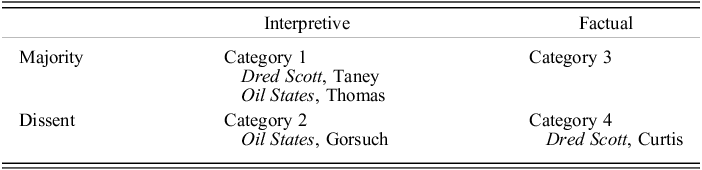
One might object to my argument based on the foregoing four-part scheme on the ground that interpretation, extrapolation, and inference are desirable and often necessary features of judicial reasoning—or indeed of evaluative reasoning in general.Footnote 67 However, one can distinguish forward-looking inferential reasoning about the implications and effects of a decision from backward-looking inferential reasoning for the purpose of defending a perspective on historical truth.Footnote 68 Forward-looking inferences help us evaluate the merit or social desirability of a legal rule by examining its likely effects. Bentham would have to be regarded as perhaps the major expositor of this viewpoint in the law.Footnote 69 Backward-looking inferential reasoning for the purpose of supporting a position, by contrast, preempts evaluative inquiry and forces submission to a certain point of view. Taney’s opinion in Dred Scott is an example of this backward-looking teleogical inferential reasoning. It is an effort to construct and defend an uncontestable truth, clothed in “lurid” language, both to appeal to the prejudices of some readers and to inculcate prejudicial thinking in other readers. Taney’s argument can be condemned not only for the virulent perspective at its base, but also for its effort to frame that perspective as a fundamental tenet of the constitutional order and to appeal manipulatively to superstitions and passions.
More generally, judicial reasoning involves (1) the formation and articulation of rules, (2) the determination of matters of ‘ultimate truth’ (guilt or innocence verdict),Footnote 70 and (3) the resolution of matters that involve both reasoning processes (rule making and ultimate truth determination). Forward-looking inferential reasoning is a natural and intuitive approach to the construction of rules. Backward-looking inferential reasoning is a natural, although less intuitive, approach to the determination of ultimate truth. Arthur Conan Doyle’s works on the fictional consulting detective Sherlock Holmes are meditations on the use of evidence to determine ultimate truth. In the first novel, Holmes explains that he uses a process of backward-looking inferences to solve his cases, and admonishes the reader never to theorize as to the conclusion ahead of the facts in such a process.Footnote 71 Backward-looking teleological inferential reasoning, as in Taney’s opinion in Dred Scott, violates Holmes’ (Doyle’s) injunction by subordinating the inferential process to the judicial examiner’s a priori belief in ultimate truth.
Obviously, not all official histories will carry the same degree of danger as Taney’s opinion. The official history of the patent system in Oil States is not likely to cause a civil war. However, like the official history in the Addyston Pipe antitrust case—which, recall, has distorted antitrust jurisprudence and scholarship, removing from consideration a significant body of common law that may have helped antitrust courts reach sounder applications of the Sherman Act—the Oil States official history, with its implication that patents are a species of “public property,” may have undesirable effects, diminishing the utility of the patent system for the foreseeable future. Specifically, Oil States, by giving more power in the patent system to the executive branch rather than the courts, increases the likelihood that lobbyists will adversely influence the system, to the detriment of innovation.Footnote 72 The official history portion of Oil States may appear to be nothing more than a dash of salt in the wound created by the decision, but it does additional wounding by conjuring the impression that executive branch cancellation of patents, at the behest of private parties, is perfectly normal and the way things have always been done in the most advanced economies. If the Oil States history is repeated in future opinions, along with its related theory of patents as public franchises, patent lawyers eventually may be conditioned to accept a politicized patent system as longstanding practice.
One might object that only a fool would get their history from a Supreme Court majority opinion.Footnote 73 However, the incentives built into the legal system make this sort of ‘foolishness’ both predictable and rationally-based. One group of rational believers and defenders of any fiat history from the Court will consist of those whose interests are aligned with that history and the legal position that it supports. An originalist historical story supporting their position deeply entrenches their sense of justice in their cause. To them, their position is no longer a mere legal claim, but a claim about the fundamental or essential nature of the state. More broadly, the problem with the Court stating history in a majority opinion is that in a field such as law, lower courts accept the Court’s fiat history as valid. Lower courts, lawyers, and scholars, over time, repeat the Court’s historical claims as truth. As the Court’s version of history gets repeated over and over, it becomes accepted by lawyers as truth—or at least as a set of claims that a lawyer must pretend to accept as truth. With such a large faction of rational defenders of the Court’s fiat history, it becomes difficult for any effort, in the courts or the legislatures, to overturn or reverse the legal position aligned with the Court’s fiat history.
There are, as a byproduct of Table 1, some suggestions on methods that should be used by originalists. To the extent possible, they should rely on uncontestable historical facts. They should minimize extrapolative arguments and inferential hops. That is, inferential hops should be few and short. They should avoid reliance on a specific non-peer-reviewed historical account, a mistake of the Court majority in Oil States.Footnote 74 Historical accounts published in non-peer-reviewed law journals may have been written with an intention to influence a court to adopt a certain view of history. This is not to say that all non-peer-reviewed law journal articles are unreliable as a source of history, or that all peer-reviewed articles are necessarily reliable as sources of history. Unquestionably, the issue of reliability is more complicated than a simple determination of whether an article has been reviewed by peers. However, the non-peer-reviewed law journals—that is, the student-edited journals—are likely to address issues that may arise in litigation and to offer clear answers to those questions; answers that are unlikely to have been seriously examined by more experienced scholars before publication by the student editors. This process multiplies the risk that a single manipulative historical account will influence an originalist court; or conversely, that an originalist judge committed to a particular position can find an historical account in a law review that supports it.
To be clear, this is not an argument against originalism; it is an argument that originalism imposes a hidden tax on society. Like any tax, we should weigh the costs against the benefits: Perhaps the tax should be reduced by half or applied only to certain activities. Similarly, now that the Court is mostly originalist, society should consider how to limit the costs of originalist history in majority opinions.
4. Methodologies versus Perspectives
In this part, I will address the differences between methodologies and perspectives in legal analysis and ask how we should view originalist accounts with respect to these two categories. Some might refer to this as a matter of epistemology.
4.1 Defining Concepts
First, let us try to define these concepts. A ‘methodology’ is a family of analytical processes that one applies to determine the effect or the ethical soundness of an intervention or policy. One feature of a methodology is that it does not lend itself immediately to a particular answer. The answer one reaches through applying a methodology depends almost entirely on the initial facts or premises that one enters into the methodological process. Change the premises or the facts, change the answer. There is not a set of answers, under a methodology, that are ruled out a priori.
Economics, for example, is a methodology. It requires that one take into account that demand curves generally slope down, supply curves generally slope up, and that most actors behave rationally in response to incentives. However, aside from the necessity of some basic analytical processes, it does not guarantee any particular answer out of an analytical exercise. An economist, or someone applying economic analysis, could reach any conclusion on a question such as whether the income tax, or the minimum wage, should be increased.
Similarly, philosophy is a methodology. The literature distinguishes between deontologists and consequentialists, but neither of these approaches guarantees a particular answer on any question. This is obviously true for consequentialists. There is a facile view that consequentialists have a ‘right’ answer in every case: whatever produces the best consequences.Footnote 75 But any serious application of consequentialism requires a measure to evaluate consequences: utility, wealth, life-years saved, injuries avoided, and so on.Footnote 76 After a measure is chosen, the consequentialist must compare two states on the basis of the measure, which is not always easy. If wealth is the chosen measure, one must decide what to do when choosing between states involves wealth increases for some and wealth losses for others. A Paretian would choose state A over state B only if some people are better off in A and no one is worse off. A Kaldor-Hicks standard would choose state A over state B if the winners could fully compensate the losers and still prefer state A. For deontologists, the questions are what principle they give priority to, and to what extent do the deontologists permit utilitarian ‘principles’ to invade their methods.Footnote 77 Consider, for example, the famous Trolley Problem: The trolley is barreling toward four people, and the driver can hit a switch to send it in the direction of three people.Footnote 78 A consequentialist would often choose to hit the switch because that is less costly to society—although, again, this depends on the measure one chooses in order to compare outcomes. A deontologist might choose not to hit the switch, because of the wrong involved in actively intervening to kill others.
A ‘perspective’, in contrast to a methodology, approaches a question from a particular point of view, and discusses or analyzes the question from the experiential base associated with the particular viewpoint. The experiential base often relies on facts, or interpretations of facts, that cannot be questioned, at least not by someone who does not share the same experiential base or interpretive viewpoint.Footnote 79 Often the experiential base is not fully knowable by any one person. The perspective contributes an element of truth that could easily go unnoticed in its absence. The response or answer offered by the perspective is typically constrained by the experiential base. To be sure, a perspective, or perspectivist argument, is not the same thing as advocacy. Advocacy indicates an activity or specific action, while a perspective is an outlook or specific point of view. A perspectivist scholar need not engage in advocacy. Advocacy suggests a narrow interest in advancing a cause. The perspectivist, by contrast, often identifies and calls attention to a fact or a social problem that the general society has overlooked. The solutions to the social problem identified by the perspectivist, should he or she choose to suggest solutions, may improve the general welfare as much or more than the welfare of those sharing the viewpoint. The perspectivist need not press for a specific resolution; it is enough to identify an important fact or problem that has eluded the rest of society.
Critical race theory, for example, is a perspective. It offers an analysis of the law that draws on an experiential base—typically, the experiences of a Black or non-white person, usually in America—to arrive at a critique, or possibly an approval, of a particular body of law or feature of government.Footnote 80 Non-Blacks cannot question the experiential base of Blacks, or their interpretation of that base.Footnote 81 The experiential base of the critical race theorist is vast, consisting of the entire history of Black or non-white people. Often, the critical race theorist identifies important facts or social problems that have gone unnoticed by the general society, sometimes in the face of considerable skepticism.Footnote 82 However, there are answers or policies that would surely not be open to the critical race theorist—such as, ‘discriminate against Blacks’—no matter how the underlying facts or premises are changed.Footnote 83 In the same sense, feminist legal theory is a perspective.
Of course, the existence of a perspective implies the existence of the complementary perspective. A critical race theory perspective implies the existence of an anticritical race theory perspective, a perspective that presumably would reach the opposite conclusion to that of the critical race theorist. There is also the possibility of conflict within a perspective. The experiential base is vast, and perhaps unknowable to any individual. One perspectivist may consult the experiential base and reach a very different conclusion from that of another perspectivist consulting the same experiential base. The two perspectivists may see different parts or elements of the experiential base or see the same element of the base and interpret it differently. For example, consider the question of issuing vouchers to public school children to enable them to afford to attend private schools if that is their preference. One critical race theory perspective on school vouchers is that they are socially undesirable, because they would result in poor children (mostly Black) remaining in the public schools after others more advantaged flee, and consequently receiving educational services inferior to the level currently provided.Footnote 84 An alternative critical race theory perspective holds that it is the substandard level of educational services in the public schools now that harms Black children most, and that vouchers would improve their welfare by allowing them to escape the public system.Footnote 85
Just as consequentialism can invade the processes of the deontologist, methodologies can invade the processes of the perspectivist.Footnote 86 A critical race theorist could use methods from economics to address a question; for example, such as whether the minimum wage is socially beneficial or helpful to Black Americans.Footnote 87 The result would be some hybrid of the methodological and perspectivist approaches. It would apply the methodology but only in the service of reaching conclusions acceptable to the perspective. Would the new hybrid approach itself constitute a methodology or a perspective? Probably the crucial feature defining a perspective is that it walls off some conclusions, and even consideration or analysis of some data—specifically those conclusions or those data that are unacceptable or of no use to the perspective. To return to the minimum wage example, suppose the application of economic analysis, along with data, resulted in the conclusion that the minimum wage is beneficial to whites and harmful to Blacks.Footnote 88 Under the critical race theory perspective, the only part of the analysis that matters is that pertaining to Blacks. Under an anticritical race theory perspective, the only part of the analysis that matters is presumably that pertaining to whites.
4.2 Some Counter Considerations
My assertion that methodologies can blend into perspectives can be reversed, to say instead that perspectives can blend into and alter methodologies. One could argue that a methodology such as economics can be infected by a perspective. The economist, I have suggested, takes the data given and applies the toolbox of the methodology to the data. However, perhaps this is incorrect. Perhaps the economist chooses the data or chooses the question he or she puts to the data, and through these efforts injects a perspectivist approach into an economic analysis. The ultimate conclusion of this line of reasoning is that there is no difference between a perspective and a methodology.
This line of inquiry submerges us into the shallow end of a deeper vein of argumentation—specifically, whether the empiricist notion of data being ‘given’ is entirely specious. While I reject this strong form inferentialist position, I can adopt some elements of it and still maintain my thesis.Footnote 89
Since it is a practical question that I am examining—what is originalism?—I will treat it on practical terms. Return to the example of the economist who chooses the questions to ask of the data. If such an analyst chose to consult the data in a manner that generated only the answers that suited their preferences, they would face two dangers. First, the methodological tools of economics are general in nature and not designed to lend themselves to the support of a particular viewpoint. The same may be said of the tools of any analytical process that merits the label ‘methodology’. Because of this, the perspective-wedded methodologist may find themself contradicted by their own analysis and need to struggle with it to get the answers they desire.Footnote 90 Second, because the tools are general, their work is necessarily exposed to reexamination by others not wedded to the same preferences. The work of the hypothesized analyst would invite the dissemination of new analyses reaching different conclusions and exposing the shortcomings of that work. For the perspectivist, the situation is different. The methods of the perspectivist are often tied to the perspective, in several senses. First, the perspectivist necessarily approaches and selects data to support the conclusions desired under the perspective. Second, the perspectivist often chooses methodological tools for the purpose of supporting the conclusions desired under the perspective. Third, any set of analytical tools used to undermine the conclusions of the perspectivist can be refuted as being used primarily to oppose the perspectivist.Footnote 91 The approaches to data and to analytical tools are necessarily subordinate to the perspective.
Suppose, as a test of my argument, I surrender my position and posit that all methodologies are disguised perspectives. Then even this proposition must be considered the conclusion of a perspective. The conclusions of the argument surrendered would be an alternative perspective. In this position of skepticism, some analytical process would be needed for choosing one perspective over another—and choosing one perspective over another would appear to be necessary for the advancement of science and culture.
Hence, while there is some fluidity in the boundaries of methodologies and perspectives, the two remain distinct as ideals. The methodologist, in ideal form, is constrained by data and by analytical tools; the perspectivist, by contrast and in the same ideal light, subordinates data and analytical tools. These ideals are in a sort of opposition, although in their real-world representations they often and necessarily—because of both the idealism and the imperfection of human nature—blend in and invade each other’s territories.
4.3 What is Originalism?
What is originalism, a perspective or a methodology? It is mostly a perspective.Footnote 92 The originalist works from an experiential base, the historical record as they perceive it, and their conclusion is fully determined by their perception (or the perception they desire the reader to have) of the experiential base. The perception is almost always narrowly teleological in nature, formed to support the position that the originalist analyst seeks to reach. Because of its teleological nature, it is in full a perspective, although typically not associated with any biologically fixed or socially constructed group, as in the case of feminist legal theory or critical race theory. Where it is associated in a given moment with a political party, it has a group association, but that group association is not necessarily stable.Footnote 93 Moreover, the experiential base in the originalist setting is vast—in the case of the U.S. Supreme Court, all of American and British legal and political history—and to some degree unknowable to any individual.
One might offer, as a counterargument to this assessment, that originalists often reach different conclusions in the same case, as in Dred Scott. However, the mere fact that two originalist applications can reach opposing conclusions in the same legal controversy does not convert originalism into a methodology. The methodologist applies the same analytical process and reaches different conclusions as the underlying facts or assumptions change. The originalist deliberately consults the elements of the experiential base that support their outlook and interprets the historical record to the same effect. In Dred Scott, Taney and Curtis consult different elements of the experiential base and interpret common elements of the historical record differently.
The methodologist more or less passively accepts the data given to them and applies the same analytical process, as well as they can. The perspectivist, by contrast, actively interrogates the experiential base, which is vast, for the elements that support their perspective. A perspectivist with an opposing viewpoint will interrogate the experiential base to find the elements that support the opposing perspective. Where the two find the same elements, they will interpret them in opposing manners. Take for the example, the critical race theory perspective on the minimum wage.Footnote 94 Some perspectivists might focus on the beneficial effect to low-income workers and conclude from a race theory perspective that the minimum wage is socially beneficial. A different perspectivist might focus on the disemployment effect, which typically hurts Blacks more than whites, and conclude that the minimum wage is harmful.
This difference between passivity and activism in the construction of a sample may seem inconsistent with the general theory of originalism. Originalism is considered desirable as an approach to interpreting the Constitution because it constrains judges. An originalist judge must consult historical facts and cannot simply decide on the basis of their intellectual biases or preferences, or their commitment to some theory of welfare. That definitely has a constraining effect, as having to confront data has on any purely theoretical approach. Objective data allow for the falsification of theories, and falsification excludes some theories from credibility or plausibility. However, the constraints imposed by originalism leave quite a lot of room for judges to reach the conclusions of their preferences. That is largely a result of the sampling activism inherent in originalist analysis.
There is another theory that can be offered in support of originalism, beyond its tendency to constrain judges from relying solely on their own theories of welfare. This theory is that the Constitution already reflects a great deal of synthesized experience and judgment on optimal systems of government. No other government that has ever existed has a body of analysis underlying its creation that comes close to The Federalist Papers. Unless a judge can be sure that they have designed a superior system of government, they should be extremely careful about departing from what the Constitution provides. But this theory of originalism has almost nothing to do with the problem of activism in interrogating the experiential base of an originalist analysis. Sure, it is probably desirable that originalism constrains judges, because otherwise they might replace an optimal system with a suboptimal system. A judge may be fully aware of this risk, and yet sampling activism will still lead them to interpret the historical record in a manner that supports the conclusions of their preferences.Footnote 95
4.4 Positive versus Normative Originalism
The question of whether originalism is a perspective or a methodology might seem unimportant or irrelevant in comparison to the question of whether it is successful in the positive or normative sense. The positive version of originalism holds that the intent of the Framers explains what the law is.Footnote 96 The normative version holds that the intent of the Framers tells us what the law should be. If originalism is successful in either sense, one might argue that it should not matter whether it is a perspective or a methodology. There are several objections to this argument.
First, the distinction between positive and normative originalism is difficult to maintain. The originalist literature appears uniformly to attribute normatively attractive intentions and objectives to the Framers.Footnote 97 Taney seems alone in providing a normatively unattractive positive-originalist theory that the Framers intended the Constitution to require racism in the operation of government. Taney’s racist theory was ably refuted by Curtis, but it cannot be regarded as thoroughly spurious. In addition, there may be some provisions of the Constitution that reflect normatively undesirable intentions, such as the Second Amendment.Footnote 98 Yet, no originalist has found it worthwhile or interesting to explain any provision of the Constitution on the basis of some normatively unattractive principle in modern lights (for example, using Taney’s racist theory). Hence, there is, in observed applications, virtually no distinction between positive and normative originalism.
There is a deeper problem with the concept of normative originalism. A normative theory tells us how the world should be and explains why. But normative originalism merely says that the world should be as the Framers say it should be, without explaining why. If the Constitution provides an objective in connection with some provision, as does the Patent Clause, explaining that its purpose is “[t]o promote the Progress of Science and useful Arts,” then the document answers the ‘why’ question for everyone.Footnote 99 However, if the Constitution provides no objective for a particular provision, as is true of most of its provisions, then it falls to the originalist theorist to find an objective. Once they find an objective—such as “equality”Footnote 100 or the absence of “castes”Footnote 101 —then the discovered objective takes precedence and the actual intentions of the Framers, whatever they were, would seem to be irrelevant. Once this occurs, the originalist’s theory becomes a theory based on the discovered objective, which is almost always normatively attractive in modern lights. Why not apply Occam’s razor to cut out the ghostly middleman and go directly to the normatively attractive objective?
Originalism may seem on firmer ground, even as a perspective, when used as a positive theory of constitutional interpretation. Most positive theories, especially those based on methodologies, have normative implications, but it is not necessary. The positive originalist would say that originalism explains the law as it is, and therefore provides the best predictive base, whether there are normatively attractive principles behind the originalist interpretation or not. The trouble with this argument is that it seems to be false. Originalism does not appear to be successful as a positive theory of the law. It often appears to provide equal support to both majority and dissenting opinions.Footnote 102 Whichever side wins today, in the sense of getting the most votes on the court, is going to be originalist.
4.5 Discounting Perspectives: Keeping Perspectives in Perspective
I have so far avoided making a value judgment on perspectives. Part of the value judgment I am going to offer is implicit in what I have said so far. Perspectives are valuable, but they should be kept in perspective. There are several reasons to discount perspectives.
First, as I noted earlier, perspectivist theories conflict with other perspectives, and sometimes with theories from within the same perspective. These conflicts open the question of how one should choose when there is a conflict between perspectives. How and when should the recommendations of one perspective be chosen over those of another? Suppose a critical race theory perspective comes to a conclusion that is in opposition to that from a feminist perspective? There must be some method of choosing between perspectives, or among conflicting recommendations made from within the same perspective. In other words, a methodology to choose between perspectives is needed.
This problem of conflict in originalism is illustrated in Oil States, where Justices Thomas and Gorsuch offered competing perspectives on the history of English patent law. The difference turned on an unknowable element of the experiential base: How frequently did government functionaries cancel already-issued patents in the 1700s in England, and was the empirical frequency sufficient that such cancellations could be deemed a notorious feature of the English patent system? There is no way to competently choose between the opposing originalist perspectives based on the evidence presented by each justice. However, some methodology could be employed to choose between them. Given the explicitly utilitarian aims of the patent system, the methodology itself would naturally be utilitarian. There is no need here to go into the analysis—and Gorsuch, to his credit, does offer utilitarian arguments in addition to his originalist case.Footnote 103
Second, and closely related to the first point, why give preference to any particular perspective, especially with respect to a legal document such as the Constitution, which is designed to remain in force indefinitely? The perspectives that claim some degree of importance today may be supplanted, or at least partially displaced or modified, by other perspectives in the future. Of course, in this respect originalism deserves to be distinguished from critical race theory or feminist legal theory. Biologically or socially constructed perspective groups may be modified or displaced, in terms of political power, due to demographic change, while originalism is a superficially neutral perspective that is not connected to demography. A biologically or socially constructed perspective may, however, identify a flaw in the design of government that might otherwise go unnoticed by the general society for a long time.Footnote 104 A critical race theory perspective on the Federal Bureau of Investigation, for example, would have identified the potential for abuse of dissenters and political outsiders at the hands of the agency (for example, the treatment of Martin Luther King) long before the recent series of events leading political conservatives to demand reform of the agency. However, the flaw in the design of the FBI is the potential for abuse, a flaw that has nothing to do with the perspective of the group (i.e., Black dissenters, white conservatives, etc.) that happens to fall victim to it at any time.
Similarly, in operation, originalism is more than just a perspective because it also has a constraining function on judges, although the constraining effect is weak.Footnote 105 However, the question remains: Even with respect to originalism, why give preference to a perspective, viewed narrowly on its own terms, setting aside its potential beneficial externalities? Simply being consistent with the historical record cannot be a persuasive basis for supporting an originalist approach to the Constitution, unless it offers something more than mere fidelity to the past. Being consistent with the past has never been a sound justification to support any law and never will be.Footnote 106
I am driven to the conclusion that a perspective is almost never a sufficient basis for any decision on the Constitution, or perhaps any decision on the law. The perspective must be combined with a methodology in order to justify giving it preference over other perspectives, or to find the perspective appealing as an approach to legal analysis. The same goes for originalism. As a perspective, it must be combined with a methodology that can justify privileging a particular originalist argument over other originalist or non-originalist arguments.
Return to the case of South Africa, and specifically Seidman’s incontrovertible thesis that it would be strange to interpret the South African Constitution without consideration of the history of apartheid. This suggests to me that originalism is a necessary component of any effort to interpret a constitution. The pull of originalism fades as time passes, but it remains an important and necessary perspective. Of all the perspectives one could adopt in interpreting a constitution, originalism appears to be the only one that merits the adjective ‘necessary’. However, originalism is not a sufficient basis for rendering a sound conclusion on how the Constitution should be interpreted.
5. Conclusion
Originalism should be understood as a policy that has costs and benefits. Its chief cost is its tendency to generate official histories that are sometimes erroneous in important respects. Official histories tend to preempt real or honest histories, have a speech constraining effect, attract factionalist and manipulative authors, and generate socially harmful reliance theories. Originalism’s chief benefit is that it provides a useful and perhaps necessary starting point for analysis and tends to constrain the range of theories judges consider, although the constraining effect is weak. It may seem to bias decision-making toward conservatism, but the constraints are, again, probably too weak to matter much in this regard.
More attention should be given to the spectacle of official histories authored by nine lawyers. Surely, English historians must be amused by the run of U.S. Supreme Court official histories of their country.
But none of this should be taken as an argument for setting the dial at zero. The originalist perspective is probably necessary in reaching a sound interpretation of a constitution, but it is not sufficient. It is nothing more than a perspective. For the originalist perspective to offer a justification for some contested interpretation, it must be combined with a methodology for choosing one perspective over another.
Acknowledgments
For helpful improvements I thank an anonymous referee of this journal, and for comments on earlier drafts David Lyons, Gary Lawson, Jack Beermann, David Seipp, and Robert Tsai.
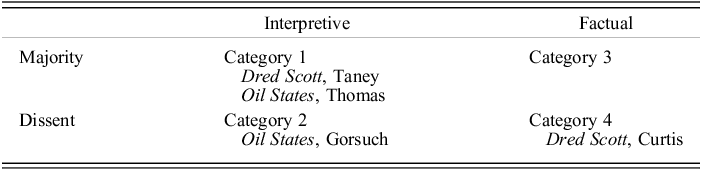

 Open access

