

Introduction
Public debates over public policy are shaped not only by which issues are discussed but also by whose voices are heard. In democratic societies, interest groups play a crucial role in shaping policy agendas, providing expertise, and articulating societal demand (Baumgartner et al. Reference Baumgartner, Berry, Hojnacki, Leech and Kimball2009). Yet, access to the arenas where public debates unfold (particularly the media) is not equally distributed (Binderkrantz et al. Reference Binderkrantz, Christiansen and Pedersen2015; Norris Reference Norris2000). A growing body of research shows that media visibility and policy influence tend to favor well-resourced, professionalized actors, especially economic groups such as corporations and business associations, while citizen groups, NGOs, and other less institutionalized voices remain marginalized (Binderkrantz et al. Reference Binderkrantz, Christiansen and Pedersen2015; Vesa and Binderkrantz Reference Vesa and Binderkrantz2023). These imbalances shape public discourse and influence which perspectives inform policy debates.
Existing research has largely explained media access by focusing on the internal characteristics of interest groups, such as financial resources, insider status, and perceived newsworthiness (Binderkrantz et al. Reference Binderkrantz, Chaqués-Bonafont and Halpin2017). Media outlets tend to privilege well-established actors that actively engage in policymaking and can produce timely, authoritative content (De Bruycker and Beyers Reference De Bruycker and Beyers2015; Dür and Mateo Reference Dür and Mateo2016). Yet, group-level attributes alone cannot explain patterns of media visibility. Media coverage is also shaped by broader institutional contexts, particularly national media systems (Binderkrantz et al. Reference Binderkrantz, Chaqués-Bonafont and Halpin2017; Vesa and Binderkrantz Reference Vesa and Binderkrantz2023). However, we know comparatively little about how media systems structure the visibility of organized interests in public debates. This paper addresses this gap by examining how media-system logics shape the representation of interest groups in public debates over artificial intelligence (AI) governance.
Media visibility can be understood as the result of two complementary mechanisms: supply and demand. On the supply side, interest groups actively seek media attention through press releases, events, and public-relations strategies designed to attract journalistic coverage. On the demand side, journalists select which actors to quote and which voices to amplify based on professional norms and news values such as prominence, expertise, conflict, and timeliness (Harcup and O’Neill Reference Harcup and O’Neill2017). While both mechanisms shape media access, this study focuses primarily on the demand side. We argue that institutional media environments condition journalistic sourcing practices, influencing which interest groups are considered credible or newsworthy sources in policy debates. Differences in journalistic professionalism, political parallelism, and market competition therefore shape how journalists filter the supply of potential sources and determine which actors gain visibility (Brüggemann et al. Reference Brüggemann, Engesser, Büchel, Humprecht and Castro2014; Hallin and Mancini Reference Hallin and Mancini2004; Humprecht et al. Reference Humprecht, Herrero, Blassnig, Brüggemann and Engesser2022).
The choice of artificial intelligence as an empirical focus is theoretically strategic rather than merely topical. AI governance constitutes a most-likely case for corporate dominance: it is embedded in a highly concentrated industry characterized by extreme capital intensity, technical opacity, and strong economies of scale. The knowledge required for regulation is largely privately held by multinational technology firms, creating structural information asymmetries between corporate and non-corporate actors. Moreover, AI debates are frequently framed in terms of competitiveness, innovation, and geopolitics, further privileging business actors. At the same time, AI is not deeply rooted in traditional left-right cleavages, making it a demanding test for media-systems theory. If institutional differences in political parallelism, journalistic professionalism, and market structure matter, they should shape interest-group visibility even in a technocratic and weakly partisan domain structurally tilted toward corporate power. AI therefore provides a stress test of how media systems shape pluralism under conditions of concentrated economic advantage.
Drawing on a novel dataset of news articles collected via the Factiva platform from January 2018 to December 2024, this study analyzes the extent, diversity, and tone of interest-group representation in leading national newspapers across four countries: Italy, Spain, the United Kingdom, and the United States. These countries exemplify contrasting media systems, allowing us to explore how institutional differences shape interest-group visibility. The analysis focuses on digital editions of prominent newspapers representing a range of ideological orientations. We extract named entities (a process known as NER, Named Entity Recognition), classify them into different types of interest groups, assess their frequency and sentiment, and examine variation across countries and outlets using computational text analysis techniques.
The paper contributes to the literature on interest-group representation and media systems by showing how institutional media environments shape pluralism in policy debates even when structural economic power strongly favors corporate actors. In liberal media systems such as the United States and the United Kingdom, market competition and professional norms tend to generate a relatively pluralistic media space. By contrast, in polarized-pluralist systems such as Spain and Italy, stronger ties between media outlets and political actors can produce more selective patterns of coverage. Finally, the present study has practical relevance beyond the academic community. For advocates and lobbyists, understanding which types of organizations gain coverage and why can inform communication strategies and coalition building. For regulators and policymakers, mapping the imbalance of voices may help to design more inclusive consultation processes and to anticipate how public opinion might be shaped by media narratives. For civil society, recognizing whose perspectives are amplified – or marginalized – can support efforts to broaden participation in debates over AI governance.
The paper is structured as follows. Section Access and bias in interest-group representation: the case of artificial intelligence introduces the puzzle of unequal media visibility among interest groups in AI governance and sets out the comparative focus on four countries. Section The role of institutional context in shaping media attention reviews the literature on media systems and interest-group representation, culminating in four hypotheses that link actor type, systemic context, outlet variation, and tone. Section Data and methods details the research design, describing the data extraction and coding procedures, and the diversity and sentiment metrics. Section Media coverage of interest groups regarding the AI political debate reports the empirical findings in three steps: (a) the dominance of corporate actors, (b) cross-national differences in actor and tone diversity, and (c) outlet-level patterns that nuance systemic effects. Section Concluding remarks concludes, highlighting limitations and avenues for future research on the evolving hybrid media environment and its impact on policy debates around emerging technologies.
Access and bias in interest-group representation: the case of artificial intelligence
A growing body of scholarship underscores the structural biases that shape which interest groups gain media access and how often they appear in public discourse (Vesa and Binderkrantz Reference Vesa and Binderkrantz2023). Media attention is not evenly distributed; it is disproportionately concentrated among a small number of well-established, resource-rich organizations (Binderkrantz et al. Reference Binderkrantz, Christiansen and Pedersen2015; Binderkrantz et al. Reference Binderkrantz, Halpin and Pedersen2020; Thrall Reference Thrall2006). These actors are typically high-status groups with the professional capacity to engage in sustained lobbying and consistent access to policymakers.
This bias in visibility stems from the differential “newsworthiness” of interest groups. Newsworthiness tends to favor organizations that maintain a regular presence in political debates, interact frequently with decision-makers, and provide timely, credible, and specialized information (Binderkrantz et al. Reference Binderkrantz, Chaqués-Bonafont and Halpin2017; Binderkrantz et al. Reference Binderkrantz, Christiansen and Pedersen2015; Dür and Mateo Reference Dür and Mateo2016). Economic interest groups (particularly business associations and trade unions) are generally better positioned in this regard. Their capacity to overcome collective-action problems, secure stable funding, and employ professional staff allows them to become central actors in both policy advocacy and media narratives (Baumgartner and Chaqués-Bonafont Reference Baumgartner and Chaqués-Bonafont2015; De Bruycker and Beyers Reference De Bruycker and Beyers2015; Klüver Reference Klüver2013).
Economic groups often secure insider status through formal consultation mechanisms (such as advisory boards, committees, and working groups) where they provide expertise to policymakers. Such institutionalized access reinforces their media visibility, as journalists tend to rely on these well-connected actors as authoritative sources. In contrast, citizen groups face more significant hurdles in securing consistent media attention. Their presence in the media is typically episodic, relying on the deployment of attention-grabbing tactics such as protests, petitions, or symbolic acts that align with journalistic criteria for newsworthiness (Binderkrantz et al. Reference Binderkrantz, Chaqués-Bonafont and Halpin2017; Danielian and Page Reference Danielian and Page1994; Oehmer Reference Oehmer2017). These groups may also gain visibility when supported by influential allies (e.g. celebrities or politicians) or when advocating for broadly supported causes like environmental protection or gender-based violence. Nonetheless, few possess the resources or institutional access needed to regularly influence media narratives.
Yet insider status does not automatically translate into favorable or even neutral coverage. Journalists frequently privilege conflictual or dramatic frames in order to attract audiences, and negative attention (such as scandals, protests, or public criticism) can be more newsworthy than routine policy participation. As Harcup and O’Neill (Reference Harcup and O’Neill2017) note, factors such as “power elites,” “bad news,” and “conflict” are central news values in journalistic selection. Consequently, actors lacking institutional access may still gain visibility by challenging powerful organizations or highlighting controversial aspects of emerging technologies. Civil-society groups, for example, may appear in the news by criticizing the societal risks of artificial intelligence or mobilizing against the influence of large technology firms. However, even when conflict drives media attention, the debate often remains centered on the activities and decisions of major technology companies, reinforcing their prominence as central actors in the policy discussion.
In the domain of artificial intelligence, economic interest groups (especially companies but also business associations) hold a particularly advantageous position in both policymaking and media engagement. However, the expectation of dominance in this policy area extends beyond the general advantages typically enjoyed by business actors. AI governance is structurally centered on a small number of multinational technology firms that control the core infrastructure on which AI systems depend, including cloud computing capacity, specialized hardware, proprietary large language models, and vast datasets. This concentration generates not only financial asymmetries but also structural dependency: policymakers and journalists alike rely on these firms for access to technical expertise and real-time information about system capabilities and risks.
Their influence stems from several reinforcing factors: their perceived role in driving innovation and economic growth, their deep technical expertise, and their privileged access to policymakers. Much of the frontier knowledge about AI systems is produced within corporate research laboratories rather than universities or public research institutes, giving technology firms considerable epistemic authority in public debates. Policymakers and journalists frequently rely on these actors to interpret technological developments and assess regulatory implications.
For these reasons, technology firms and their sectoral associations are expected to overshadow not only non-economic actors but also other economic sectors in media coverage of AI governance. Beyond insider access, these companies also engage in outside lobbying designed to shape public opinion, framing AI issues in favorable terms through strategic communications and public-relations campaigns (Hakobyan Reference Hakobyan2024). Their institutional presence is further reflected in regulatory arenas: business actors accounted for roughly one-third of participants in European Commission consultations on the AI White Paper and AI Liability Directive, whereas civil-society groups and trade unions were less prominent. Taken together, the technical expertise, financial capacity, and institutional embeddedness of technology firms make them particularly newsworthy actors and increase the likelihood that they dominate media coverage of AI governance. Hence, we expect:
H1: Technology firms and their sectoral associations receive higher levels of media coverage in AI policy debates than other types of actors.
The role of institutional context in shaping media attention
Existing literature emphasizes the characteristics of interest groups themselves (such as their participation in political debates or their capacity to provide relevant information) as key determinants of media attention. However, these factors only provide part of the explanation. The institutional context in which interest groups operate plays a fundamental role in shaping how, why, and which organized interests are covered in the news. Specifically, media systems (rooted in historical, cultural, and political-institutional configurations) condition the relationship between interest groups and public visibility.
Hallin and Mancini (Reference Hallin and Mancini2004) seminal framework on media systems identifies four key dimensions to differentiate national media landscapes: the structure of the media market, the level of journalistic professionalism, the degree of political parallelism, and the role of the state. While this framework remains influential, it has been updated to account for profound transformations in the media environment, such as digitalization, audience fragmentation, and the rise of social media. For instance, Brüggemann et al. (Reference Brüggemann, Engesser, Büchel, Humprecht and Castro2014) refined Hallin and Mancini’s typology by incorporating these new dynamics, and more recently, Humprecht et al. (Reference Humprecht, Herrero, Blassnig, Brüggemann and Engesser2022) extended this work by developing a comparative model that accounts for algorithmic gatekeeping, platform influence, and political polarization across digital and traditional media. The paper builds on these typologies to explain variations in media coverage across and within countries.
In the polarized-pluralist model (represented by countries such as Spain and Italy) media systems are characterized by high political parallelism, relatively low levels of journalistic professionalism, and significant state involvement (Hallin and Mancini Reference Hallin and Mancini2004). These features have been reinforced, rather than mitigated, by the digital transformation (Brüggemann et al. Reference Brüggemann, Engesser, Büchel, Humprecht and Castro2014; Humprecht et al. Reference Humprecht, Herrero, Blassnig, Brüggemann and Engesser2022). Digital platforms have amplified ideological polarization and deepened the ties between media outlets and political actors. While traditional media continue to reflect partisan alignments, newer online platforms allow for more fragmented and ideologically targeted communication. In Italy, media ownership remains highly concentrated and centralized, often dominated by politically connected figures. In contrast, Spain exhibits greater regional and digital-media diversity, although concentration in national television markets persists.
In liberal media systems, such as those in the United States and the United Kingdom, commercialization plays a dominant role. Media outlets’ decisions are primarily driven by market forces, with a significant focus on attracting audiences and generating revenue. Journalistic norms and practices emphasize objectivity, neutrality, and the separation of news reporting from political affiliations (Hallin and Mancini Reference Hallin and Mancini2004). There is moderate political parallelism, meaning media outlets are not entirely ideologically neutral, and minimal state intervention in media operations (Brüggemann et al. Reference Brüggemann, Engesser, Büchel, Humprecht and Castro2014; Humprecht et al. Reference Humprecht, Herrero, Blassnig, Brüggemann and Engesser2022). Despite important differences in public broadcasting and audience polarization, both the United States and the United Kingdom retain key characteristics of the liberal media model – high journalistic professionalism, strong market competition, and relatively limited state intervention – distinguishing them from the polarized-pluralist systems of Southern Europe.
The liberal category, however, warrants further nuance. Recent research on audience polarization shows that the United States lacks a large centrist outlet and exhibits higher levels of partisan segmentation than European democracies. Ownership structures may also interact with AI coverage specifically: the Washington Post, owned by Amazon founder Jeff Bezos, occupies a distinctive position in this debate. It is worth noting, however, that the Post displays one of the most negative tonal profiles toward economic actors in our sample: a pattern that, if confirmed by further qualitative analysis, would suggest that ownership does not mechanically translate into favorable framing. By contrast, the United Kingdom’s public-service broadcasting tradition provides a moderating influence through institutions such as the BBC, reducing polarization despite commercialization. While both countries share market-driven media and relatively high journalistic professionalism, these differences caution against assuming perfect equivalence. We therefore treat the liberal category as a heuristic analytical grouping and test for country-specific effects alongside the broader liberal versus polarized-pluralist distinction in the empirical analysis.
The variation across media systems has important implications for how interest groups are represented in the public sphere. In liberal systems, higher levels of journalistic professionalism and weaker political parallelism suggest that interest groups are more likely to receive media attention based on issue relevance, credibility, and newsworthiness. In contrast, in polarized-pluralist systems, media coverage of interest groups is more selective and ideologically filtered (Danielian and Page Reference Danielian and Page1994). Outlets are more likely to privilege groups that align with their own political perspectives or that are closely connected to powerful political actors. In such environments, interest-group visibility is not merely a function of resources or access to information but is also mediated by the partisan logic of the media system itself.
Empirical analysis provides support for this argument. Binderkrantz et al. (Reference Binderkrantz, Chaqués-Bonafont and Halpin2017) highlight how interest groups’ access to the media varies across countries and is shaped by both group type and institutional context. They show that across Denmark, Spain, and the UK, economic interest groups consistently receive the most media attention; however, the media environment in the UK is more open to non-economic voices. Aizenberg and Hanegraaff (Reference Aizenberg and Hanegraaff2020) longitudinal comparison between British and Dutch media also shows that non-economic interest groups (such as public-interest groups or advocacy organizations) play a more central role in the UK, reinforcing the idea that British media tends to be more pluralistic or responsive to a wider range of societal voices. In the US context, research on sourcing practices confirms a similar pattern: despite high commercialization, quality newspapers routinely incorporate counter-voices and expert sources beyond government officials, although coverage remains structured around elite actors (Cook Reference Cook1998; Dimitrova and Strömbäck Reference Dimitrova and Strömbäck2009). Similarly, Grömping (Reference Grömping2019) emphasizes the role of institutional factors (such as the openness of the political system or legal protections for the press) in shaping how easily interest groups can draw attention to specific issues. These structural conditions can either facilitate or hinder the ability of civil-society organizations to gain media coverage. Overall, these studies emphasize that although economic interest groups dominate media access across the board, country-specific political and media institutions shape the visibility of other group types, particularly citizen groups.
At first glance, this expectation might appear to conflict with the previous hypothesis. If news values favor economic actors, why should liberal media systems produce more diverse coverage? The key lies in the professional norms that structure journalistic practice in these systems. Journalistic professionalism involves not only reliance on authoritative sources, but also a commitment to balance, counter-voice sourcing, and the representation of competing perspectives (Binderkrantz et al. Reference Binderkrantz, Chaqués-Bonafont and Halpin2017; Hallin and Mancini Reference Hallin and Mancini2004). As a result, while corporate actors remain central sources across all media systems, journalists in liberal contexts are more likely to include additional actors in order to present contrasting viewpoints. Both hypotheses are therefore complementary rather than contradictory: corporate actors dominate coverage overall, but professional norms in liberal systems increase the likelihood that other voices appear alongside them. Hence, we expect:
H2: Interest-group media coverage on AI news is more diverse in liberal media systems (the US and UK) than in polarized-pluralist systems (Italy and Spain).
In addition to shaping which groups gain visibility overall, media systems may also influence the consistency of such coverage across media outlets within the same country. In polarized-pluralist media systems, high levels of political parallelism mean that newspapers often maintain close ideological or political alignments, which can shape editorial priorities and sourcing practices (Hallin and Mancini Reference Hallin and Mancini2004). As a result, different outlets may emphasize distinct sets of actors and perspectives depending on their ideological orientation. Citizen groups and advocacy organizations are particularly likely to be affected by these dynamics, as their claims often intersect with broader ideological debates about regulation, social justice, or market governance. In contrast, in liberal media systems, stronger professional norms and a greater emphasis on journalistic neutrality tend to produce more comparable sourcing patterns across outlets, even when newspapers differ in editorial stance. Empirical research has shown that exposure to interest groups can vary substantially depending on the media outlet audiences consume, reinforcing ideological segmentation in the public sphere (Binderkrantz et al. Reference Binderkrantz, Chaqués-Bonafont and Halpin2017). Illustratively, in Spain progressive outlets such as El País tend to give greater visibility to citizen groups advocating social or environmental causes, whereas more conservative newspapers like El Mundo often emphasize business actors or market-oriented perspectives. These patterns suggest that outlet-level variation in interest-group visibility should be more pronounced in polarized-pluralist systems than in liberal media systems.
This argument assumes that outlets actively shape coverage through editorial selection rather than passively reflecting the supply of available sources. Media organizations are not neutral conduits; they select, emphasize, and frame actors in accordance with their own editorial identity and market positioning (Baumgartner and Chaqués-Bonafont Reference Baumgartner and Chaqués-Bonafont2015). Where that identity maps onto clear ideological templates (as with traditional left-right partisan issues) differential sourcing is expected. However, when a policy domain does not neatly align with established cleavages, even ideologically distinct outlets may converge on similar sourcing patterns.
H3: Interest-group media coverage varies more strongly across media outlets in polarized-pluralist media systems (Italy and Spain) than in liberal media systems (the United States and the United Kingdom).
Beyond shaping which groups gain visibility, media systems may also condition how those groups are portrayed. Political parallelism implies not only differential source selection, but also differential evaluative framing: outlets aligned with particular political perspectives are more likely to portray actors in terms consistent with their editorial stance (Baumgartner and Chaqués-Bonafont Reference Baumgartner and Chaqués-Bonafont2015; Binderkrantz et al. Reference Binderkrantz, Chaqués-Bonafont and Halpin2017). In polarized-pluralist systems, where journalistic norms exert weaker restraint on partisan expression, this evaluative dimension is expected to be more pronounced. Journalists in these contexts are more likely to frame actors approvingly or critically depending on the outlet’s ideological orientation, producing sharper tonal contrasts across actor types. In liberal systems, by contrast, professional norms of balance and neutrality tend to compress tonal differences, yielding more uniform – and typically more moderate – sentiment across actors and outlets. Moreover, as De Bruycker (Reference De Bruycker2019) has shown, media attention can function as both a blessing and a curse for advocacy, depending on whether the framing is favorable or hostile. This suggests that the tone of coverage is not merely a by-product of visibility, but an analytically distinct dimension through which media systems condition the representation of organized interests. We therefore expect that polarized-pluralist systems will exhibit wider tonal variation across actor types than liberal systems, and we incorporate tone as an integral component of the empirical analysis alongside measures of presence and diversity.
H4: The tone of interest-group coverage varies more strongly across actor types in polarized-pluralist media systems (Italy and Spain) than in liberal media systems (the United States and the United Kingdom).
In sum, media systems shape the structure of opportunities for interest-group visibility. Political parallelism, the level of journalistic professionalism, market logic, and the nature of state intervention condition which interest groups gain visibility, how they are represented, and how they are amplified in the media. These institutional features not only affect the pluralism of the media landscape but also influence the contours of public debate and the capacity of interest groups to shape political agendas.
Data and methods
We conducted an extensive data extraction using the Factiva platform, targeting articles published between January 1, 2018, and December 31, 2024. The time scope covers the period from the establishment of the High-Level Expert Group on Artificial Intelligence through the proposal, debate, approval, and entry into force of the regulation. The sample consists of digital articles from two leading quality newspapers in each of four countries ( $N = 8$
). Outlets were selected according to three criteria: (1) elite status, (2) digital reach, and (3) ideological pluralism. First, we selected newspapers widely recognized as national agenda-setting outlets or “newspapers of record,” which exert substantial influence on political discourse (McCombs and Shaw Reference McCombs and Shaw1972). Second, according to the Reuters Institute Digital News Report (Reuters Institute for the Study of Journalism 2024), the selected outlets rank among the most trusted and widely read digital news brands in their respective markets. Third, to capture ideological diversity, we selected pairs reflecting the major political divide in each national press system: The Guardian (center-left) and The Times (center-right) in the United Kingdom; El País (center-left) and El Mundo (center-right) in Spain; La Repubblica (progressive) and Corriere della Sera (moderate/liberal) in Italy; and The New York Times and The Washington Post, selected as the two dominant national prestige papers with global influence from the United States. We excluded tabloids and free-sheets to maintain genre comparability, ensuring that all analyzed texts belong to the tradition of quality journalism characterized by in-depth analysis and editorial rigor. Articles were selected based on the inclusion of the keyword “artificial intelligence” in their respective languages.
$N = 8$
). Outlets were selected according to three criteria: (1) elite status, (2) digital reach, and (3) ideological pluralism. First, we selected newspapers widely recognized as national agenda-setting outlets or “newspapers of record,” which exert substantial influence on political discourse (McCombs and Shaw Reference McCombs and Shaw1972). Second, according to the Reuters Institute Digital News Report (Reuters Institute for the Study of Journalism 2024), the selected outlets rank among the most trusted and widely read digital news brands in their respective markets. Third, to capture ideological diversity, we selected pairs reflecting the major political divide in each national press system: The Guardian (center-left) and The Times (center-right) in the United Kingdom; El País (center-left) and El Mundo (center-right) in Spain; La Repubblica (progressive) and Corriere della Sera (moderate/liberal) in Italy; and The New York Times and The Washington Post, selected as the two dominant national prestige papers with global influence from the United States. We excluded tabloids and free-sheets to maintain genre comparability, ensuring that all analyzed texts belong to the tradition of quality journalism characterized by in-depth analysis and editorial rigor. Articles were selected based on the inclusion of the keyword “artificial intelligence” in their respective languages.
Two further clarifications are warranted. First, the period beginning in 2018 captures the institutionalization of AI governance in Europe and abroad. In June 2018 the European Commission created a High-Level Expert Group on Artificial Intelligence to develop ethics guidelines and policy recommendations, and in the same year the White House issued its first strategic plan on AI research. These initiatives mark the point at which AI regulation shifted from a technical issue to a salient policy domain, generating sustained media attention. Our sampling frame therefore aligns with the onset of formal public debate rather than an arbitrary start date.
Second, the selection of two newspapers per country is guided by both practical and theoretical considerations. We focus on the quality press because these outlets command agenda-setting influence and reach cross-national elites. Each pair represents the major poles of the national ideological spectrum, ensuring variation in editorial perspectives. We do not include tabloids or purely digital outlets in order to maintain comparability across systems and because quality newspapers still exert a disproportionate influence on political discourse. While only two outlets per country cannot capture the full diversity of media ecosystems, this design trades breadth for depth and allows us to model outlet-level variation using richer longitudinal data. In addition to comparing media-system types, we also examine variation across newspapers within each country, allowing us to detect whether patterns differ between the United States and the United Kingdom.
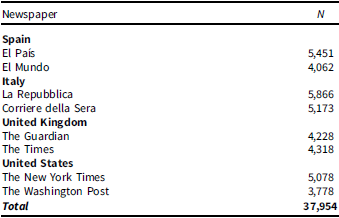
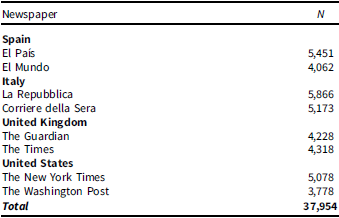
In total, we gathered 37,954 articles, which constitute approximately 0.9 per cent of the articles published during this period. The distribution of articles among the newspapers is as follows, as shown in Table 1:
Number of articles that mention Artificial Intelligence, 2018–2024. Own elaboration
Of them, 36,309 contained at least one entity, corresponding to 95.67 per cent. Entities were extracted from the articles using the LLaMa 3.3 70B-Instruct language model (Meta AI 2024), chosen for its strong multilingual capabilities and competitive performance on text classification and entity recognition tasks. Recent work has shown that large language models can match or surpass trained human annotators across a range of text-annotation tasks relevant to political and social science research (Gilardi et al. Reference Gilardi, Alizadeh and Kubli2023), and recent benchmarking places LLaMa 3.3 70B among the top-performing models across diverse domains on tasks including factual verification and named entity recognition (Chakraborty et al. Reference Chakraborty, Chowdhury, Shuvo, Chatterjee and Roy2025). To reduce classification variability, we used a low temperature setting (0.2) and a structured JSON output format with explicit category definitions (the full prompt is reproduced in the Supplementary Materials).
The model was instructed to identify all organization entities mentioned explicitly or in possessive forms, excluding generic references or pronouns lacking specificity. Extracted entities were first classified using a scheme derived from the EU Transparency Register, including categories such as companies, business associations, academic institutions, NGOs, consumer organizations, trade unions, and public authorities. For analytical purposes, these categories were subsequently aggregated (excluding public authorities) into four broader actor types: economic actors (companies and business associations), academia, NGOs (including consumer organizations), and trade unions. Within the economic category, individual firms account for the vast majority of mentions; business and sectoral associations represent about the 3 per cent of all economic references (see the Supplementary Materials, Section 5). We aggregate both subcategories under the economic label because their structural position in AI governance is functionally equivalent: both represent corporate interests in regulatory debates, albeit through different organizational forms. Additionally, the tone in which each entity was mentioned (positive, neutral, or negative) was also classified. This process yielded a total of 69,026 unique entities.
Our analysis proceeds in three steps. First, we measure the presence of different categories of interest groups by counting entity mentions. Second, we evaluate the diversity of actors using two standard diversity metrics: Shannon entropy and the Gini-Simpson index. Third, we examine the tone of coverage (positive, neutral, or negative) and its diversity to evaluate how different actors are portrayed in the media.
We estimated three hierarchical multilevel models for two different outcome variables. First, we assessed how sentiment -in each news piece ( $i$
)- varies by actor type (
$i$
)- varies by actor type ( $e$
) and system (
$e$
) and system ( $s$
), controlling by newspaper (
$s$
), controlling by newspaper ( $n$
), using a Gaussian mixed-effects model given that the outcome is measured on a continuous scale:
$n$
), using a Gaussian mixed-effects model given that the outcome is measured on a continuous scale: ${\rm{Ton}}{{\rm{e}}_{i,e}} = {\theta _{e,s}} + {\beta _n} + {\epsilon _i}$
Second, we fitted a global negative-binomial model of entity counts, where ${N_{e,s}}$
denotes the number of mentions of each actor type in each system, to test the association between actor types and media systems:
${N_{e,s}}$
denotes the number of mentions of each actor type in each system, to test the association between actor types and media systems: ${N_{i,e}} \sim {\rm{NegBin}}\left( \lambda{_{i,e,}\phi } \right)$ ${\rm{log}}\left( {{\lambda _{i,e}}} \right) = {\theta _{e,s}} + {\gamma _c} + {\beta _n} + {\epsilon _i}$
Third, we estimated separate negative-binomial models within each country ( ${N_{e,n}}$
denotes the number of mentions of each actor type in each newspaper) to compare sourcing profiles within each national market:
${N_{e,n}}$
denotes the number of mentions of each actor type in each newspaper) to compare sourcing profiles within each national market: ${N_{i,e}} \sim {\rm{NegBin}}\left( {{\lambda _{i,e}},\phi } \right)$ ${\rm{log}}\left( {{\lambda _{i,e}}} \right) = {\theta _{e,n}} + {\epsilon _i}$
We use Bayesian inference to estimate the parameters of interest. A Bayesian approach is especially suitable when dealing with non-nested structures in hierarchical multilevel models (Gelman and Hill Reference Gelman and Hill2007). All models used weakly informative priors: The Gaussian model for tone used $N$
(0,1) for fixed effects and Student-t(3,0,2.5) for random-effect standard deviations. The negative-binomial models additionally included a Gamma(0.01,0.01) prior on the shape parameter. All of them were run with four chains of 2,000 warmup and 2,000 sampling iterations each.
$N$
(0,1) for fixed effects and Student-t(3,0,2.5) for random-effect standard deviations. The negative-binomial models additionally included a Gamma(0.01,0.01) prior on the shape parameter. All of them were run with four chains of 2,000 warmup and 2,000 sampling iterations each.
Media coverage of interest groups regarding the AI political debate
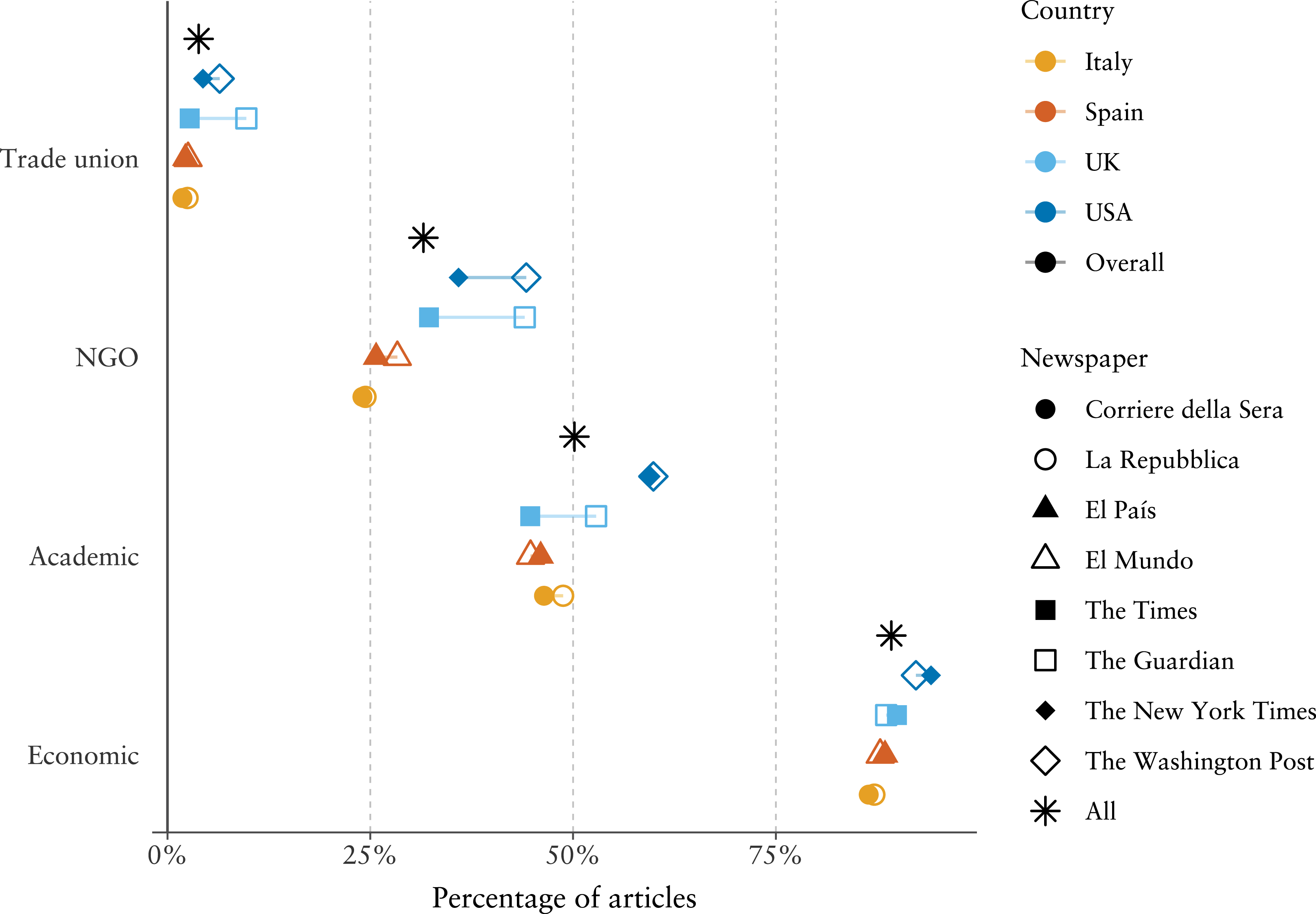
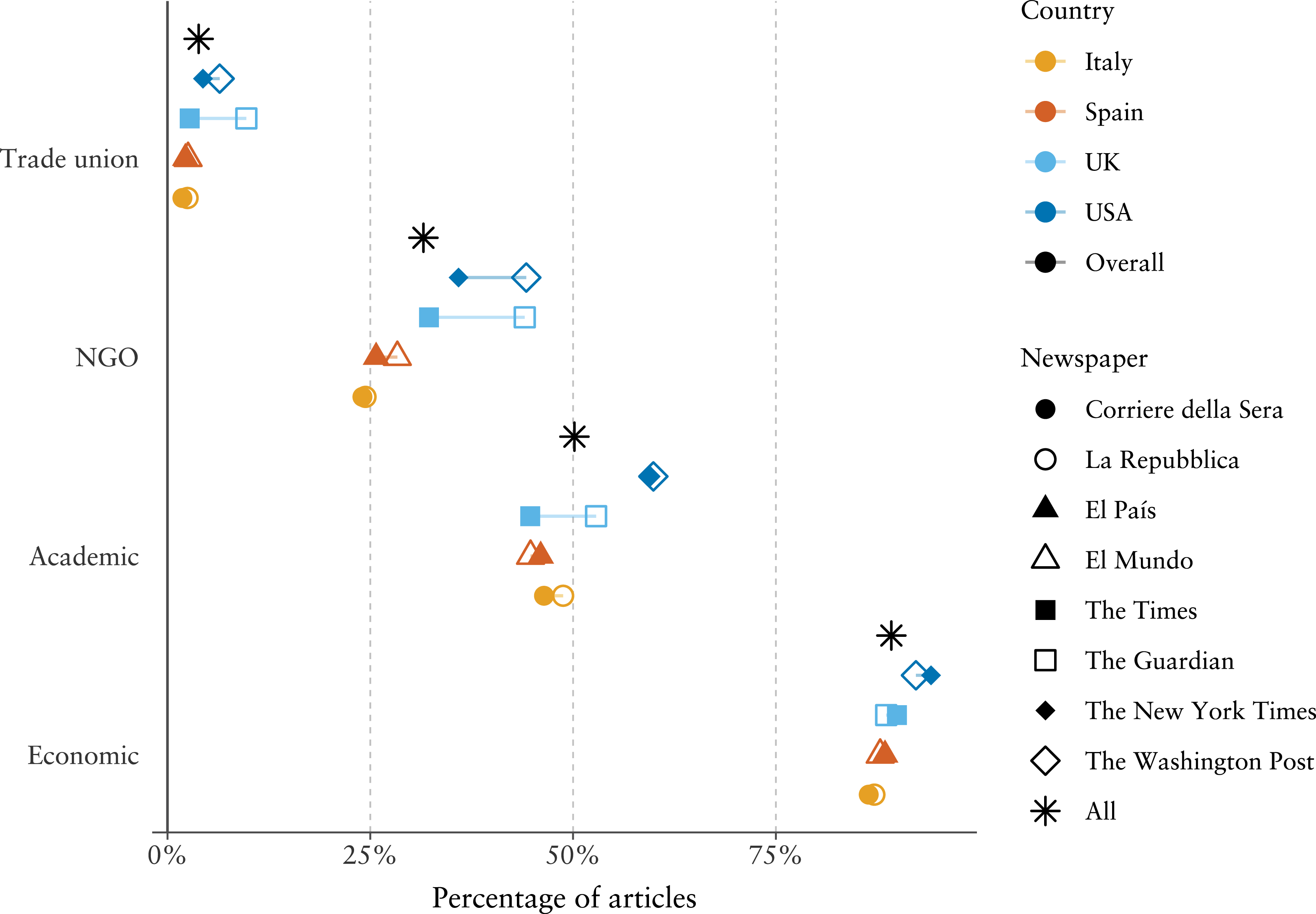
Economic actors occupy a predominant position in AI-related articles. As Figure 1 illustrates, they are mentioned in almost 90 per cent of articles, reflecting their central role in the innovation and implementation of AI. Academic and research institutions are also mentioned in half of the articles, while NGOs are the third group in terms of media coverage, and account for almost one third of the articles. Trade unions are the least represented with less than 4 per cent of media coverage. These results also illustrate that economic actors articulate their lobbying strategies on a bilateral basis, and most of the time in parallel to business associations.
Variation in the relative presence of interest groups overall and between newspapers (by country). Own elaboration.
Media coverage
The descriptive evidence confirms that news coverage about artificial intelligence is organized around a narrow set of economic voices, although the breadth and tone of that coverage vary in ways broadly consistent with media-systems theory. Economic actors account for roughly 85 per cent of all actor mentions in the corpus, and the ratio of firm-centered stories to stories that feature only non-corporate actors ranges from 0.98 in the United States to 1.29 in Spain. Taken together, these patterns provide strong support for H1: business interests dominate media coverage of AI regardless of national context. At the same time, the presence and framing of other actors differ across media systems and across individual outlets.
To test this, we fitted a Bayesian negative-binomial multilevel model on 151,816 article-entity observations. On the log-count scale, all non-economic actor types are substantially less frequent than economic actors, and the gaps widen under polarization. Academic sourcing, although lower than corporate sourcing everywhere, is the only category that narrows the distance in polarized-pluralist systems (interaction $\beta = 0.22$
, 95 per cent CrI [0.19, 0.25]); NGO and trade-union mentions, by contrast, decline further (
$\beta = 0.22$
, 95 per cent CrI [0.19, 0.25]); NGO and trade-union mentions, by contrast, decline further ( ${\beta _{{\rm{NGO}} \times {\rm{Polarized}}}} = - 0.24$
[−0.28, −0.21];
${\beta _{{\rm{NGO}} \times {\rm{Polarized}}}} = - 0.24$
[−0.28, −0.21]; ${\beta _{{\rm{Trade}} - {\rm{union}} \times {\rm{Polarized}}}} = - 0.54$
[−0.62, −0.45]). A complementary descriptive indicator tells the same story: the geometric mean of distinct actor categories per story reaches 7.92 in the United States and 6.00 in the United Kingdom, but drops to 5.10 in Spain and 4.48 in Italy. Together, these results reinforce the idea that journalistic professionalization and weaker political parallelism enhance the likelihood that non-corporate voices make it into the news.
${\beta _{{\rm{Trade}} - {\rm{union}} \times {\rm{Polarized}}}} = - 0.54$
[−0.62, −0.45]). A complementary descriptive indicator tells the same story: the geometric mean of distinct actor categories per story reaches 7.92 in the United States and 6.00 in the United Kingdom, but drops to 5.10 in Spain and 4.48 in Italy. Together, these results reinforce the idea that journalistic professionalization and weaker political parallelism enhance the likelihood that non-corporate voices make it into the news.
Contrasts across outlets within each country speak directly to H3, but in the opposite direction to what was hypothesized. In the polarized-pluralist press, sourcing profiles converge: neither the Spanish nor the Italian newspaper pair shows meaningful differentiation across actor types, with all interaction coefficients close to zero and credible intervals overlapping it (full estimates in the Supplementary Materials, Sections 2.2.1–2.2.4). In the liberal press, by contrast, editorial differentiation is pronounced. The Guardian cites NGOs and trade unions far more frequently than The Times ( ${\beta _{{\rm{NGO}} \times {\rm{Times}}}} = - 0.73$
[−0.82, −0.65];
${\beta _{{\rm{NGO}} \times {\rm{Times}}}} = - 0.73$
[−0.82, −0.65]; ${\beta _{{\rm{Trade}} - {\rm{union}} \times {\rm{Times}}}} = - 1.43$
[−1.62, −1.25]), and The Washington Post out-sources The New York Times on both categories as well (
${\beta _{{\rm{Trade}} - {\rm{union}} \times {\rm{Times}}}} = - 1.43$
[−1.62, −1.25]), and The Washington Post out-sources The New York Times on both categories as well ( ${\beta _{{\rm{NGO}} \times {\rm{WPost}}}} = 0.43$
[0.36, 0.50];
${\beta _{{\rm{NGO}} \times {\rm{WPost}}}} = 0.43$
[0.36, 0.50]; ${\beta _{{\rm{Trade}} - {\rm{union}} \times {\rm{WPost}}}} = 0.42$
[0.26, 0.57]). These patterns suggest that commercial competition within liberal systems drives greater editorial differentiation than ideological alignment does in polarized-pluralist contexts.
${\beta _{{\rm{Trade}} - {\rm{union}} \times {\rm{WPost}}}} = 0.42$
[0.26, 0.57]). These patterns suggest that commercial competition within liberal systems drives greater editorial differentiation than ideological alignment does in polarized-pluralist contexts.
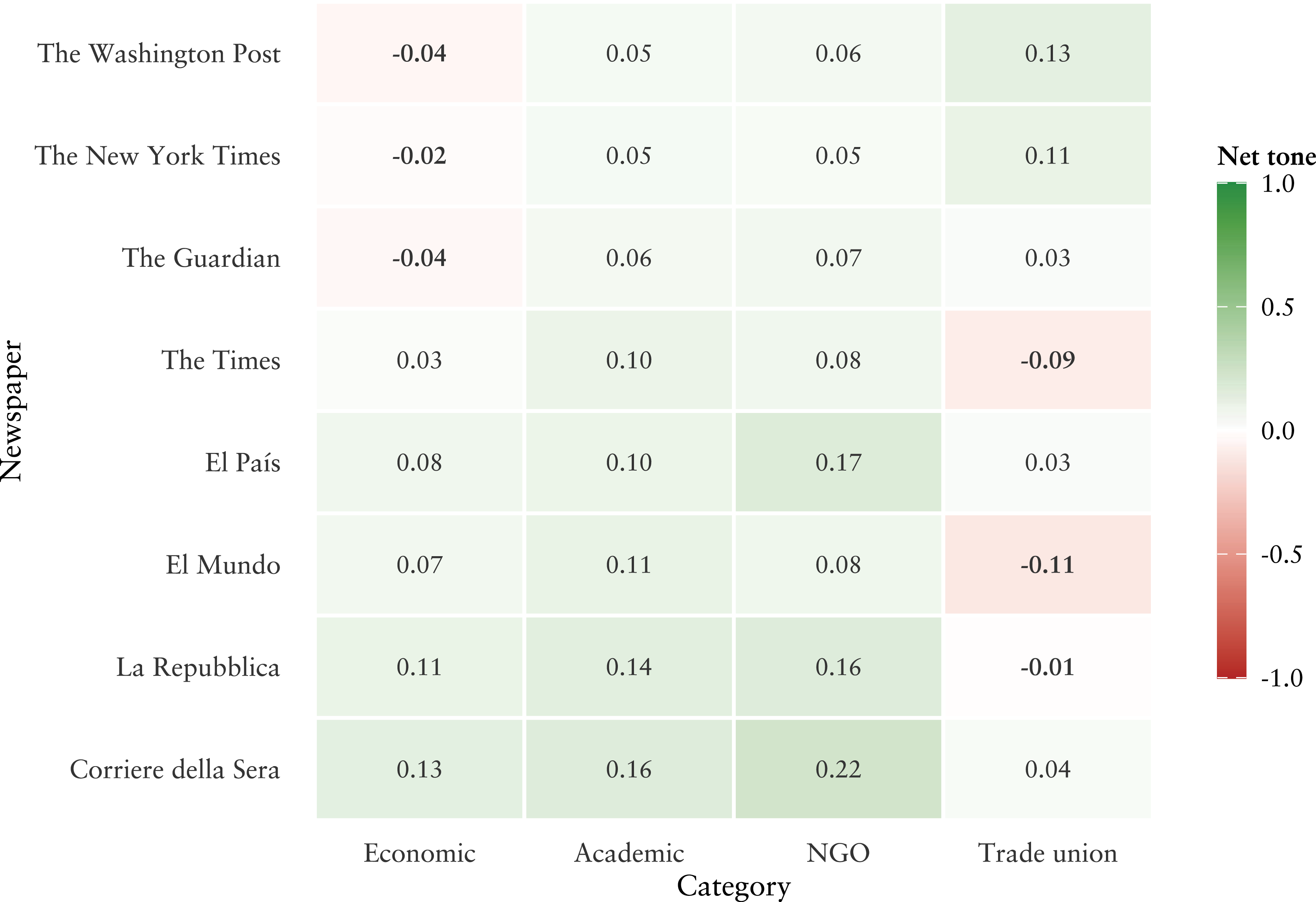
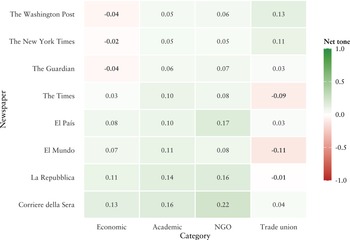
Differences in tone amplify these quantitative imbalances. The heat-map of net sentiment (Figure 2) reveals a distinct hierarchy: economic actors are framed neutrally or mildly positively in every newspaper except The Washington Post, which adopts a slightly negative stance; academic institutions receive uniformly positive treatment; NGOs attract the warmest language, especially in Corriere della Sera, El País and The Times; and trade unions are the only actor type that slips into negative territory, notably in El Mundo and The Times.Footnote 1
Differences on the tone by IGs and newspaper. Own elaboration.
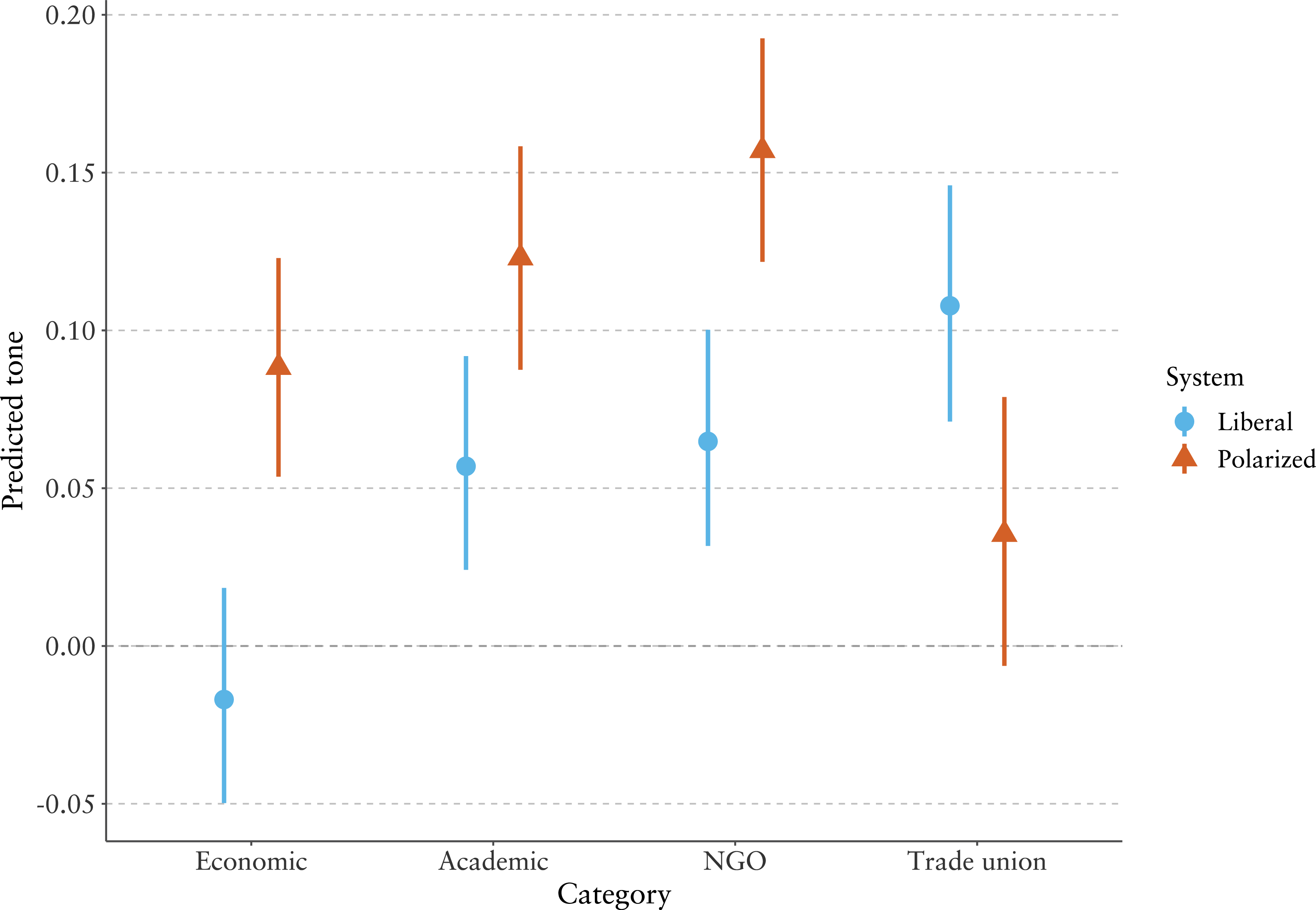
Bayesian multilevel modeling (Figure 3) refines this picture. Taking economic actors in liberal outlets as the reference category, all three non-economic groups receive more positive framing, from +0.07 for academics to +0.12 for trade unions. The polarized-pluralist press treats economic actors more warmly (+0.10 [0.05, 0.15]), but the premium enjoyed by non-economic groups narrows, and for trade unions the interaction reverses sign (−0.18 [−0.21, −0.15]), yielding a net negative tone. Importantly, random variance concentrates at the article level ( ${\sigma ^2} \approx 0.036$
) rather than the newspaper level (
${\sigma ^2} \approx 0.036$
) rather than the newspaper level ( ${\sigma ^2} \approx 0.001$
), indicating that systemic context sets the tonal baseline while individual outlets fine-tune it only marginally. These patterns are consistent with H4: tonal contrasts across actor types are wider in polarized-pluralist systems, where economic actors receive warmer coverage and trade unions shift into negative territory, than in liberal systems, where sentiment differences across actor types are more compressed.
${\sigma ^2} \approx 0.001$
), indicating that systemic context sets the tonal baseline while individual outlets fine-tune it only marginally. These patterns are consistent with H4: tonal contrasts across actor types are wider in polarized-pluralist systems, where economic actors receive warmer coverage and trade unions shift into negative territory, than in liberal systems, where sentiment differences across actor types are more compressed.
Predicted values (and 95 per cent confidence interval) of tone by system. Own elaboration.
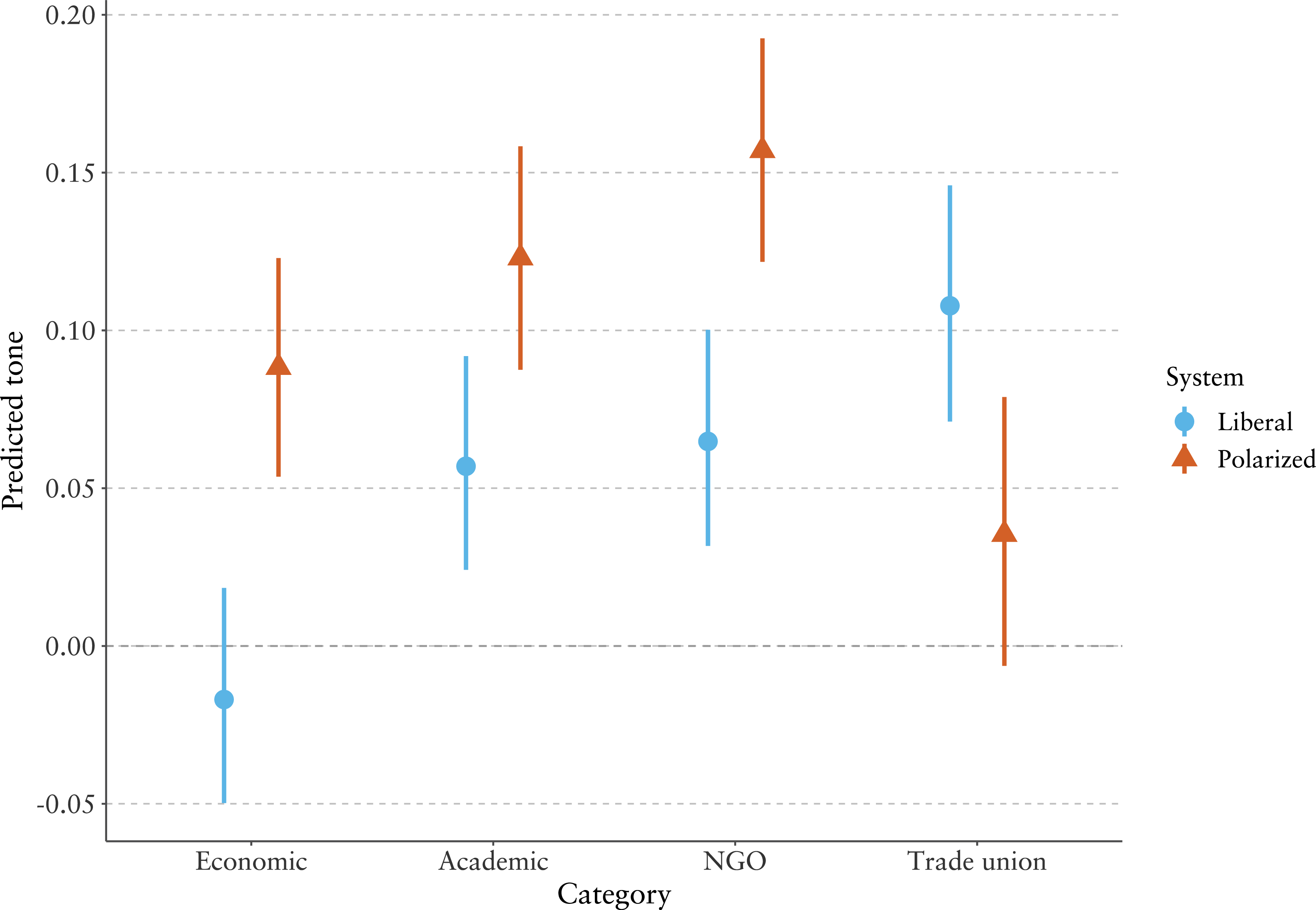
Taken together, these results provide clear evidence for H1 by documenting the structural primacy of business actors. The findings regarding H3 point in the opposite direction to what was hypothesized. We anticipated greater within-country variation in polarized systems driven by ideological leanings, yet the data show the opposite: outlet-level differentiation is statistically significant in liberal systems but muted in polarized-pluralist ones. The only partial exception involves trade unions in Spain and the UK, where progressive and conservative outlets do diverge, a pattern that speaks more to the organizational strength of unions in those countries than to a general feature of AI coverage.
Media diversity
To evaluate the diversity of organizational voices in newspaper coverage of artificial intelligence, we employ two widely used fragmentation indices: Shannon entropy and the Gini-Simpson index. Shannon entropy captures both the number of actor categories present in an article and the evenness of their distribution, whereas the Gini-Simpson index is particularly sensitive to the dominance of any single actor type. In both cases, higher values indicate greater diversity.
Country-level averages, calculated from the 36,309 articles containing at least one organizational entity, reveal a clear hierarchy (Table 2). The United States displays the highest level of actor diversity (Shannon = 0.444; Gini-Simpson = 0.301), followed by the United Kingdom (0.403; 0.289), whereas Spain (0.333; 0.273) and Italy (0.335; 0.261) show considerably lower levels. The identical ordering across the two indices suggests that the results are robust across alternative measures of diversity.
Presence and tone diversity: country-level means sorted by Shannon. Own elaboration

These findings provide support for H2, which predicts greater pluralism in liberal media systems than in polarized-pluralist ones. However, the magnitude of the scores also highlights the limits of this pluralism. Even in the United States (the most diverse case) average entropy reaches less than half of its theoretical maximum, reflecting the structural prominence of corporate actors noted earlier. In Spain and Italy, by contrast, articles not only feature fewer actor categories but also present less balanced distributions among those actors, indicating a narrower range of voices in the AI debate.
Examining the distribution of story-level diversity further clarifies this pattern. In all countries the most common value is close to zero, indicating that many articles mention only a single actor category. When these single-actor stories are excluded, the cross-national differences largely disappear: Shannon entropy for multi-actor articles rises to approximately 0.63–0.65 in all four countries. This suggests that the observed diversity gap stems primarily from differences in how frequently newspapers publish multi-actor stories rather than from differences in how those stories are internally structured.
A similar pattern emerges when diversity is measured in terms of tone. Average tone diversity is again highest in liberal media systems (United Kingdom = 0.303; United States = 0.276) and lowest in polarized-pluralist ones (Italy = 0.235; Spain = 0.211). Yet once single-actor stories are excluded, these differences shrink substantially. In other words, newsroom practices that include multiple actors within a single article simultaneously broaden the range of evaluative perspectives expressed in the coverage.
Taken together, these results confirm H2 while refining its implications. Liberal media systems do indeed feature a broader range of organizational voices in AI coverage. However, this advantage stems primarily from a greater propensity to publish articles that include multiple actors, rather than from systematically more balanced treatment within individual stories.
Interpretation and additional analyzes
To facilitate interpretation for practitioners, note that the log-count coefficients reported above translate into percentage differences in mentions. For example, an estimate of $- 1.72$
for academic institutions in the liberal baseline means that, holding other factors constant, stories are expected to include only about
$- 1.72$
for academic institutions in the liberal baseline means that, holding other factors constant, stories are expected to include only about ${e^{ - 1.72}} \approx 0.18$
as many academic mentions as corporate mentions. A difference of
${e^{ - 1.72}} \approx 0.18$
as many academic mentions as corporate mentions. A difference of $+ 0.22$
for the polarized interaction implies a 25 per cent increase over the baseline. Likewise, Shannon entropy values can be understood as measuring the spread of actor categories within a story: a value of 0 would indicate a single actor type, whereas the highest country-level average of 0.44 in our sample corresponds to moderate diversity, with several actor categories represented but one dominating.
$+ 0.22$
for the polarized interaction implies a 25 per cent increase over the baseline. Likewise, Shannon entropy values can be understood as measuring the spread of actor categories within a story: a value of 0 would indicate a single actor type, whereas the highest country-level average of 0.44 in our sample corresponds to moderate diversity, with several actor categories represented but one dominating.
Our data also reveal that organized interests rarely appear in isolation from corporate actors (see the Supplementary Materials, Section 6). Ninety per cent of articles that mention an NGO and the same share of those that cite an academic institution also reference at least one economic actor; for trade unions the figure rises to 95 per cent. The reverse, however, does not hold: only 32 per cent of articles featuring economic actors also include an NGO, roughly half cite an academic institution, and just 4 per cent mention a trade union. This pronounced asymmetry indicates that non-corporate voices enter the AI debate overwhelmingly in relation to business actors rather than on their own terms, whereas corporate actors frequently appear without any counterpart from civil society, academia, or organized labor.
The sentiment measure captures the tone of journalistic description in the sentence where the entity is mentioned. It therefore reflects how news outlets frame each actor rather than the self-reported tone of quoted speakers. Negative sentiment may arise from journalists’ critical assessment of an organization’s behavior or from reporting on controversies, and positive sentiment may reflect either favorable framing or citation of advocates praising the actor. While disentangling speaker and journalist tone is beyond the scope of this automated analysis, we caution readers against interpreting positive coverage as unequivocal support.
Finally, examining trends over time shows that the relative presence of economic actors remains remarkably stable at around 89–91 per cent between 2018 and 2023, declining only in 2024 to 86 per cent (see the Supplementary Materials, Section 7). NGO and academic mentions fluctuate within narrow bands (roughly 30–34 per cent and 50–54 per cent respectively) without clear directional trends, and trade unions remain marginal throughout (2–7 per cent). This stability persists despite a near-tripling of corpus volume from around 3.5 thousand articles per year in 2018–2022 to over 9 thousand in 2023 and 10 thousand in 2024, suggesting that the structural primacy of corporate actors documented above is not an artifact of a particular period.
Concluding remarks
This study examined how media systems shape the representation of interest groups in AI policy debates across eight newspapers in four countries. By connecting our empirical findings with the theoretical frameworks of comparative media systems and interest-group politics, we offer three primary contributions to the literature. First, we extend the empirical scope of interest-group research (Binderkrantz et al. Reference Binderkrantz, Chaqués-Bonafont and Halpin2017; Vesa and Binderkrantz Reference Vesa and Binderkrantz2023) to an emerging, technically concentrated policy domain, demonstrating that the mechanisms identified for traditional regulatory arenas are not only present but intensified where epistemic and economic asymmetries favor corporate actors. Second, by disaggregating diversity into between-article (multi-source reporting) and within-article (actor balance) components, we identify an editorial mechanism (the propensity to include multiple actor types in a single story) as the key locus of cross-national variation. Third, by showing that outlet-level differentiation operates through market competition rather than political parallelism in this policy domain, we invite a reconsideration of when and how Hallin and Mancini (Reference Hallin and Mancini2004)’s framework travels to debates that do not conform to established ideological templates.
The first contribution builds on the confirmation of the structural primacy of economic actors in AI coverage (H1). Companies and business associations appear in the overwhelming majority of articles across all countries, far exceeding the presence of academic institutions, NGOs, or trade unions. This pattern is consistent with prior work documenting the systematic advantage of resource-rich, professionalized organizations in securing media attention (Binderkrantz et al. Reference Binderkrantz, Christiansen and Pedersen2015; Binderkrantz et al. Reference Binderkrantz, Halpin and Pedersen2020; Thrall Reference Thrall2006). What the AI case adds is that the mechanisms identified in studies of traditional regulatory arenas (insider status, informational advantage, and journalistic reliance on authoritative sources; Binderkrantz et al. (Reference Binderkrantz, Chaqués-Bonafont and Halpin2017); De Bruycker and Beyers (Reference De Bruycker and Beyers2015)) operate with particular intensity where technical opacity generates strong epistemic asymmetries between corporate and non-corporate actors. The AI case thus illustrates how the newsworthiness criteria theorized by Harcup and O’Neill (Reference Harcup and O’Neill2017) (prominence, expertise, power-elite status) cumulate when a policy domain is structurally concentrated in a small number of multinational firms.
The second contribution derives from our finding that liberal media systems display greater diversity of actors and perspectives than polarized-pluralist ones (H2). Both actor diversity and tone diversity are higher in the United States and the United Kingdom than in Spain and Italy, aligning with Hallin and Mancini (Reference Hallin and Mancini2004)’s argument that stronger journalistic professionalism and weaker political parallelism foster a more pluralistic public sphere and corroborating earlier comparative evidence that British media are more receptive to non-economic voices than their Southern European counterparts (Aizenberg and Hanegraaff Reference Aizenberg and Hanegraaff2020; Binderkrantz et al. Reference Binderkrantz, Chaqués-Bonafont and Halpin2017). Our analysis refines this literature in two ways. On the one hand, the magnitude of the diversity scores reveals that pluralism remains bounded even in liberal systems: corporate actors dominate coverage everywhere, confirming Vesa and Binderkrantz (Reference Vesa and Binderkrantz2023)’s contention that institutional openness modulates, but does not override, the structural advantages of well-resourced groups. On the other hand, the diversity gap between systems originates not in within-article balance but in the propensity of newsrooms to publish multi-source stories – an editorial mechanism largely invisible in previous research, which has typically focused on the aggregate presence of actor types rather than on the compositional structure of individual news items.
The third contribution follows from the outlet-level analysis, which yields results that contradict H3 and challenge a common assumption in the media-systems literature. Rather than observing greater divergence across outlets in polarized-pluralist systems, we find that newspapers in Spain and Italy rely on remarkably similar sourcing patterns, whereas liberal media environments exhibit more pronounced editorial differentiation. This pattern runs counter to the expectation, derived from Hallin and Mancini (Reference Hallin and Mancini2004) and subsequent refinements (Brüggemann et al. Reference Brüggemann, Engesser, Büchel, Humprecht and Castro2014; Humprecht et al. Reference Humprecht, Herrero, Blassnig, Brüggemann and Engesser2022), that political parallelism should generate systematic sourcing divergence across ideologically opposed outlets. Two interpretations, both with theoretical implications, are possible. First, because AI governance does not map neatly onto traditional left–right cleavages, ideologically distinct outlets may lack the partisan template that typically drives differential sourcing on welfare, immigration, or labor-market policy (Baumgartner and Chaqués-Bonafont Reference Baumgartner and Chaqués-Bonafont2015). Second, editorial differentiation in liberal systems appears to be driven less by ideology than by market positioning, consistent with Cook (Reference Cook1998)’s account of how competitive pressures lead commercial outlets to cultivate distinctive sourcing profiles to signal editorial identity. These findings suggest that the theoretical link between political parallelism and outlet-level pluralism, while well established for conventional partisan issues, may not extend automatically to emerging policy domains.
The analysis of tone reinforces these patterns and supports H4. Academic institutions and NGOs tend to receive more positive coverage than corporate actors, while trade unions are more frequently associated with negative evaluations in polarized-pluralist systems. This is consistent with De Bruycker (Reference De Bruycker2019)’s argument that media visibility is analytically distinct from tonal treatment: attention can be a blessing or a curse depending on how actors are framed. Our findings add that the valence dimension is itself shaped by media-system logics, with wider tonal contrasts in polarized-pluralist contexts, where journalistic norms exert weaker restraint on evaluative framing. Importantly, most of the variation in sentiment occurs at the article level rather than the outlet level, suggesting that systemic characteristics set the tonal baseline while individual newspapers fine-tune it only marginally. This refines the media-systems literature by locating the effects of political parallelism not primarily in outlet-level editorial lines, but in shared national journalistic conventions that shape how actors are evaluated across the press as a whole.
An alternative interpretation of these patterns is that the cross-national diversity gap reflects differences in the political salience of AI (higher in the US and UK, where major technology firms are headquartered) rather than media-system characteristics per se. Three features of the data weigh against this reading: the volume of AI coverage is broadly comparable across the four countries (Table 1); the diversity gap disappears in multi-actor stories, where Shannon entropy converges at 0.63–0.65 regardless of country (Section Media diversity), pointing to an editorial mechanism rather than issue salience; and the United States combines the closest proximity to major AI firms with the highest diversity scores, suggesting that professional norms operate even where corporate presence is strongest. Nonetheless, future research comparing interest-group visibility across policy domains within the same countries would help adjudicate between the two explanations.
Several limitations should also be noted. Our focus on quality newspapers captures only part of the contemporary information environment, a concern particularly relevant in the hybrid media system theorized by Humprecht et al. (Reference Humprecht, Herrero, Blassnig, Brüggemann and Engesser2022); other arenas (television, online platforms, social media) may display different patterns. Media visibility, moreover, does not necessarily translate into policy power (Dür and Mateo Reference Dür and Mateo2016; Klüver Reference Klüver2013), and our design lacks a census of all AI-active organizations in each country, so the 85 per cent corporate share indicates media concentration rather than representational bias relative to the underlying organizational population. Finally, our design captures demand-side selection (which actors journalists choose to cite) but cannot determine whether the observed patterns also reflect supply-side targeting by interest groups (Oehmer Reference Oehmer2017). It is plausible that NGOs concentrate their media strategies on sympathetic outlets, which would partially account for the Guardian–Times divergence; disentangling these mechanisms requires data on groups’ communication activities, which we leave to future research.
Despite these limitations, the findings highlight the continuing importance of media systems in structuring public debates about emerging technologies. A broader implication for democratic deliberation follows from our results: media pluralism in emerging policy domains depends less on within-article balance than on whether editorial routines favor multi-source reporting. As artificial intelligence becomes increasingly central to economic and political life, understanding whose voices are amplified in the media, and whose are muted, remains crucial for assessing the inclusiveness and balance of democratic deliberation (Norris Reference Norris2000).
Supplementary material
The supplementary material for this article can be found at https://doi.org/10.1017/S0143814X26101159
Data availability statement
Replication materials are available in the Journal of Public Policy Dataverse at https://doi.org/10.7910/DVN/1YFQ96.
Acknowledgements
Earlier versions of this paper were presented at the ECPR General Conference (Dublin, 2024), the XII Workshop on Empirical Political Science (Barcelona, 2025), the Comparative Agendas Project Annual Conference (Konstanz, 2025), the EPSA Annual Conference (Madrid, 2025), and the 7th International Conference on Public Policy (Chiang Mai, 2025). We thank participants and discussants at these venues for their constructive comments. We are also grateful to the editors and the anonymous reviewers of the Journal of Public Policy for their detailed and constructive feedback, which substantially improved the manuscript.
Funding statement
This research was supported by the Spanish Ministry of Science and Innovation through grants PID2021-123463NB-I00, PRE2022-101688 and RYC-2019-028369-I.



 Open access

