


Introduction
In the previous chapter we investigated the role of input in the language learning process and the importance of giving language learners large amounts of ‘accessible’ language input. In this chapter, we focus on the importance of creating opportunities in the language classroom for productive language use, that is, ‘output’, whether spoken or written. We investigate why output, alongside input, is considered essential for the language learning process and what sort of output is most likely to lead to successful language acquisition. In the classroom context, creating opportunities for output is an ongoing challenge for the teacher given that, for many students, opportunities to use language outside of the classroom may be limited.
In this chapter, we are concerned with the second of Reference NationNation’s (2007) four strands. Opportunities for students to engage in meaning-focused output should, according to Reference NationNation (2007), make up approximately one quarter of the classroom focus. We will discuss further the type of output that Nation recommends.
Reference NationNation (2007) argues that a well-balanced language course should consist of four roughly equal strands:

The Importance of Output
In Chapter 3, we encountered the Input hypothesis (Reference KrashenKrashen, 1985) and Krashen’s claim that exposing learners to language input (i.e. language that they can read/see or hear) was all that was needed for successful language learning. This belief in the absolute sufficiency of language input was challenged by research from immersion classrooms where students had been exposed to years of language input. Researchers like Merrill Reference Swain, Gass and MaddenSwain (1985) found that, even after years of schooling with English as the medium of instruction, learners of English were not able to correctly use some common grammatical structures. Although fluent and able to comprehend and communicate well, their language was characterised by many grammatical and spelling errors. They simply had not noticed many features of English, such as the use of pronouns, the use of ‘s’ with verbs in the third person singular (e.g. he speaks), articles, and so on.
Learners do not only need comprehensible input for language learning, they also need to produce comprehensible output (Reference Swain, Gass and MaddenSwain, 1985).
According to this hypothesis, output does more than just help learners to become more fluent as they use language; it actually contributes to the language learning process.
Swain realised that a key characteristic of these immersion classrooms was that the students had not had many opportunities to produce the second language. This led Swain and other researchers to rethink the role that language output might contribute to language learning (Reference Gass and SelinkerGass & Selinker, 2001). The result was the Comprehensible Output Hypothesis (Reference Swain, Gass and MaddenSwain, 1985). In this chapter we will use both the terms ‘output’ and ‘production’ interchangeably. Each of these terms can refer, of course, to the oral and/or written use of language.
A key idea behind the Comprehensible Output Hypothesis is that production forces language learners to process language differently from the way they process it when they are just listening to, or reading, language input. In focusing on language input learners can often ‘get away’ with just paying attention to vocabulary, that is, all they may need to do is to understand what they hear or read. However, when they want to produce language, they also have to pay attention to grammar so as to communicate effectively. For example, when they are listening to language input, they may know from hearing adverbs like ‘yesterday’ or ‘last week’ that the speaker is referring to past time and so they don’t need to pay attention to the tense of the verb. When they produce the language though, they may notice that they don’t know how to use the verb in the way they need to, in order to indicate that something happened in the past. As Reference NationNation (2009) points out, when you produce language you have to think like a writer, rather than just a reader! You have to pay attention to aspects of the language you haven’t necessarily needed to previously. Production forces you ‘to move from semantic to syntactic processing’ (Reference Swain, Gass and MaddenSwain, 1985, p. 249), from processing meaning to processing grammar.
This role for production, or for practising something that you have learnt about and understood, is not limited to language learning (Reference Gass and SelinkerGass & Selinker, 2001). We can all think of examples where having to use knowledge productively, or put it into practice, consolidates that knowledge and leads to better learning. I might read and follow instructions for how to put up my new tent successfully. Having to actually do it, or explain the process to a friend so that they too can successfully erect the tent, will further extend and consolidate my learning (and help me see where any gaps might be).
The Benefits of Language Output
Reference Swain, Gass and MaddenSwain (1985, Reference Swain and Hinkel2005) claims that there are several ways in which giving students opportunities to produce language output might lead to language learning. Below we look at an example of a dialogue from one language classroom, and use it to demonstrate the different ways in which Swain claims that production may facilitate language acquisition.
The background to this example, from Shona’s Year 11 Japanese classroom, is that the students are working together to solve a murder mystery. They have been told that their Deputy Principal has been murdered and they have been given a list of suspects, all of whom are employed at the school. The students have written descriptions of the suspects in Japanese and their task is to establish the identity of these key suspects. If they are stuck, they are allowed to go and ask the teacher for clues. This is what the student in Example 4.1 has done, asking in Japanese: uhh, yougisha C no hinto wo oengai shimasu (can I have a hint for Suspect C?). The clue that the teacher gives him, in Japanese, is that Suspect C works in Student Services (Ah, yougisha C was Student Services de hataraite imasu). The student wants more information, however, and asks a question, but he asks it in English and the teacher insists it needs to be in Japanese! As you read the dialogue, see if you can find instances where the student thinks like a writer and pays attention to aspects of language that are new for him (note that we indicate in bold anything that the student says in Japanese).
Example 4.1

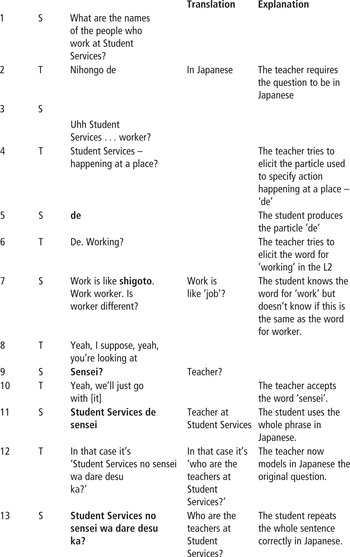
In having an opportunity to produce language output, a learner may notice the gap between what they want to say and what they can say (Reference GassGass, 1997; Reference Swain, Cook and SeidhoferSwain, 1995). The opportunity or need to produce language helps the learner notice problems they have in using language. In other words, it serves as a consciousness-raising function. In Example 4.1 this happens at Turn 3.

Noticing a problem or a gap
may lead a learner to reflect on language (Reference Swain, Cook and SeidhoferSwain, 1995). Reflecting on language may take place in different ways. It may involve thinking about, questioning, or talking about the language to use. We see this for our student in Turn 7, where he is still working on the problem of how to say ‘worker’ in Japanese.

Having to produce language output can give learners opportunities to test out hypotheses, or understanding, about the language they are learning. Here they may try out new language they are not sure of, working at the ‘cutting edge’, so to speak, of their language ability. When they do this they may, at the same time, get valuable feedback about how successful their attempt to communicate was (Reference Swain, Cook and SeidhoferSwain, 1995) and this feedback may facilitate learning. For our learner, we see this at Turns 9 and 10.

In this short dialogue from Shona’s classroom, we have seen how the student encounters a difficulty in saying what he wants to say in Japanese. However, in the end, in Turn 13, the student finally does, with help from the teacher, correctly produce the sentence that he was initially unable to formulate for himself: ‘Student Services no sensei wa dare desu ka?’ We could argue that this sentence represents ‘pushed output’ for this student, and that the opportunities he had to try out and reflect on language during this dialogue may have facilitated important learning. In the next section, we will investigate in greater depth the notion of pushed output.
To summarise, then, opportunities to produce language output can be beneficial for language learning in a number of ways. They can highlight for the learner where there are gaps in their language knowledge; they can help him or her notice language and pay attention to it. In Chapter 3 we discussed how noticing language is important for learning to occur (Reference Schmidt and RobinsonSchmidt, 2001), a notion we will return to again in Chapter 5. In the example we give from Shona’s classroom, the student had an opportunity to consciously reflect on language while talking with the teacher. These opportunities might also occur as learners interact and collaborate to complete a task or activity. For example, in writing a story summarising a picture sequence, they may discuss what to say: thinking, questioning, and talking about the language to use. Reflecting on language is something that learners may also do on their own as they work independently at producing language. Opportunities to produce language may allow for testing out new forms of language that learners have learnt, and allow them to get feedback about these. Often this feedback may come from a listener or a reader, but sometimes learners are also able to correct themselves, as a result of hearing or reading what they have said or written. When students interact together to produce language output, there is another important benefit, this time for the listener rather than the speaker. The speaker’s output can be input for the listener, and there is always the potential that they can learn from this input (we looked in some detail at the ways in which input can drive language learning in the previous chapter). A final benefit for language output is that it allows the learner to develop a personal voice or a way of using the language to communicate that is unique to them (Reference SkehanSkehan, 1998).
Pushed Output
In Chapter 3, we discovered that input needs to be challenging for the language learner, it needs to encourage them to work to comprehend what they hear or read. In a similar way, researchers claim (e.g. Reference Swain and HinkelSwain, 2005; Reference NationNation, 2009) that output needs to push learners to produce language that is slightly beyond, or, as we have already mentioned, at the cutting edge of their linguistic ability. This is important so that learners continue to make progress in their learning and don’t remain stuck at a certain level of proficiency. According to Reference Bygate, Samuda, Mackey and PolioBygate and Samuda (2009), communicative opportunities must be structured so as to prompt language learning to take place. In pushed output, the learner is put under some pressure and encouraged to use language at a more challenging level.
Reference Swain, Gass and MaddenSwain (1985) claims that language learning is promoted when learners have to produce language that is slightly beyond their level of ability. Swain calls this ‘pushed output’. It takes effort.
We have already seen one example of pushed output from a Japanese classroom in the previous section. Another example comes from a Year 9 French classroom (first year of secondary education with students approximately 13 years old, in their first year of learning French). The students are working at a sequence of lessons on the topic of dating. James, the teacher, wants his students to learn how to talk about something they plan to do. They already know the verb they would use for this: the verb aller, to ‘be going to’. James elicits from the students the verbs that could be used with aller, and together they form a list that he writes on the blackboard, as in Example 4.2.
Example 4.2

James then asks his students to write a sentence about what they are going to do on the date they are planning, thus pushing them to use this structure to express personal meaning in a complete sentence. For most, if not all, students in this class, using this verb ‘aller’ to express a future intention could be considered an example of ‘pushed output’. This is because although they are familiar with this verb, they are now using it in a new way for a new grammatical function. They are therefore having to extend their use of this grammatical feature/word (Reference NationNation, 2009) and move from word level to sentence level production (Reference TothToth, 2006).
Pushed output can also help language learners gain greater control over language that may only be partially acquired or learnt (Reference De BotDe Bot, 1996). In the dialogue we looked at in Example 4.1, we could argue that it is now more likely that the student will be able to ask independently, in the future, the question that they worked hard to formulate in correct Japanese with the teacher’s help (‘Student Services no sensei wa dare desu ka?’).
Another way of encouraging students to push their output and gain greater control over language is to have them work at activities
where there is a degree of time pressure. James has his beginner level learners of French play ‘Spike’s game’, which involves time pressure, at the end of most lessons. Spike refers to a big, ‘spiky’, plastic ball which the students throw from one to another. The student holding Spike asks a question in French and throws Spike to another student. This student has to first answer the question and then throw Spike to another classmate, asking another question that they will then answer in turn. Examples of the types of questions that James’s students were asking each other as they played Spike’s game were:

Spike’s game put students under some time pressure in that they were unwilling to hold on to Spike for too long. However, James describes below a variation of Spike’s game – ‘Spike’s questions’ – which puts students under even greater time pressure. For this game, he hands out an egg timer or a ‘bomb’ timer, which will ‘explode’ after a certain time. The aim of this game is to ask and answer questions quickly so that you are not left holding the bomb or timer when time is up.

There are a number of other ways in which learners may be encouraged to ‘push’ their output. We list some of these below, along with examples of ways in which we saw them being implemented in the classes we observed.
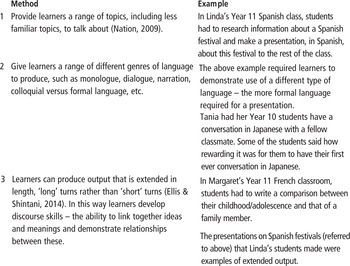
We point out that the teachers whose practice we profile in this and other chapters of this book were very experienced, and that it can take considerable expertise to establish the types of classrooms we describe.
A final example of pushed output comes from another Japanese classroom, this time a Year 10 classroom, where students are in their first year of learning Japanese. This time, the teacher, Tania, speaks of how amazed she was by one of her student’s willingness to try out language that she had learnt. Tania describes how she was teaching her students about sports and she had given them the phrase in Japanese for ‘I think it’s a sport’, even though she thought that this was quite a hard language structure for them to use at their level of language learning. Tania describes how she and the student had the following exchange in Japanese:

Tania goes on to explain further the reason for her surprise:

This last example stands out because so far in this chapter we have been looking at ways in which the teacher can set up and facilitate opportunities for pushed output. However, in this last example, it is the student who initiates this for herself, very much to the surprise and delight of her teacher.
This section on pushed output has focused on how we can get students communicating in ways that challenge them in their use of language resources; in this next section we will return to Nation’s idea, referred to earlier, that output needs to be meaning-focused (Reference NationNation, 2007).
Communicating with Language Output
The main goal of output is usually to convey a message to someone else. This will often involve finding out something that wasn’t already known. Output where there is a genuine need for the message that is conveyed, and where those involved in the exchange are discovering something they didn’t already know, is ‘communicative’. It meets Nation’s criterion of being meaning-focused. Examples of communicative output are: greeting someone, inviting someone to a party, expressing emotions, and so on. Back in an earlier section, we looked at an example of communicative output where a student, trying to solve a murder mystery, was asking questions to find out who the suspect was. Communicative output can lead to opportunities for learning, as we identified in that example.
A very powerful reason for including opportunities for the genuine communication of information is that they are highly motivating for learners. In this way learners are not just learning the language, but also using it authentically for real purposes. They become language users rather than just language learners. In Chapter 1 we introduced the idea of ‘environmental challenge’ and discussed how this can lead to engagement on the part of the learner (Reference ShernoffShernoff, 2013), particularly when it is accompanied by environmental support (Reference Shernoff, Ruzek and SinhaShernoff et al., 2017). Some of the aspects of environmental challenge that have been associated with student engagement are opportunities for solving meaningful problems (Reference Bransford, Brown and CockingBrandsford, Brown, & Cocking, 1999) and activities that are relevant to students’ lives (Reference ShernoffShernoff, 2013). Opportunities to engage in real communication of information may fulfil these criteria and promote student engagement (see Chapter 2). We do have evidence from some of the classrooms we visited that students are highly motivated to use language when they are communicating to find out something that they don’t already know.
For example:
In Margaret’s Year 11 classroom, students interviewed each other to find out about what they were like when they were 6 years old. Several students mentioned, as a highlight of the lesson, the fact that they got to learn things about each other that they did not already know.
In a Year 10 Japanese lesson students had the opportunity to ask each other about the sports they played. One student wrote as feedback about the lesson:
In a Year 9 Spanish classroom, students had to write about their television viewing preferences and share these with each other. In a questionnaire completed at the end of the lesson, one student commented that they liked ‘finding out what people liked watching’.
In a Year 13 English class, one student commented that her teacher was different from other teachers because she was interested in learning about them and their opinions:


This emphasis on meaningful communication contrasts with mechanical drills where learners are only practising language and where there is an emphasis on accuracy rather than on the meaning being expressed. (There is a place for practice in the language classroom, but there is a good way to plan for and implement this, as we will see in Chapter 6.) Learners are likely to be demotivated if the task or activity they are working at is seen as little more than an excuse for attending to grammar and vocabulary (Reference Bygate, Samuda, Mackey and PolioBygate & Samuda, 2009). For this reason, activities where learners are required to pay attention to the meaning of what they are saying, but where the teachers themselves are very focused on eliciting particular language structures, are problematic. The learners may infer, from the lack of attention to meaning, that what they say is not nearly as important as how they say it – for example how accurate it is! For the learner, producing language in this way, that is, trying to focus on meaning and, at the same time, endeavouring to be accurate, can be cognitively very demanding (Reference TothToth, 2006).
Supporting the Learner
In Chapter 1, we discussed the notions of ‘environmental challenge’ and ‘environmental support’ (Reference ShernoffShernoff, 2013). In this chapter, one obvious example of environmental challenge that we have considered in some depth is ‘pushed output’.
But we also need to realise that output does not necessarily need to be ‘pushed’ to be challenging for learners. For a learner, particularly a beginner learner or a learner of lower proficiency,
it can be very nerve-racking to have to speak or write in the target language. This desire to avoid speaking
can be even greater for the adolescent. In Chapter 1 we discussed how adolescents often experience anxiety
when speaking in front of others (Reference Sumter, Bokhorst and WestembergSumter et al., 2009). Teachers with a high level of proficiency in the language they are teaching, and who are some distance time-wise from their experience of learning a language, can easily forget how difficult it is for their students to speak in another language. Jessica highlights this point:

At the same time, research in general education demonstrates that teachers who have high expectations tend to have students who achieve more (Reference Rubie-Davies, Peterson, Sibley and RosenthalRubie-Davies et al., 2015). In the
following extract Tania, a teacher of beginner learners of Japanese in Year 10, admits that her low expectations of her students had held them back in terms of their ability to use Japanese in the language classroom:

James, a teacher of Year 9 students in their first year of learning French, has the expectation that students can and will express themselves orally
during a lesson. He describes the importance of prioritising opportunities for oral output:

As we saw in Chapter 1, along with environmental challenge students need to have environmental support. One aspect of environmental support
that research has highlighted as being important for learner achievement is the use of class activities
that match students’ background and interests
(Reference Shernoff, Ruzek and SinhaShernoff et al. 2017) (see Chapter 2). Reference KangKang (2005) suggests that teachers need to find topics in which their learners are interested and about which they have some background knowledge and experience. He suggests varying topics and accommodating different preferences amongst students.
Along with topic, Reference KangKang (2005) found that conversation partners and the conversational context were also factors that would predict whether a learner was prepared to talk in the language they were using. In Chapter 1 we discussed how, for adolescents, relationships with peers
are exceedingly important. As part of our research for this book, we asked students what they liked about lessons that we had observed. In three different classrooms, they said they liked:
conversations with friends;
interacting/working with friends/classmates; and
working in groups.
The language teacher, in planning for language output, needs to set up opportunities for peer interaction. Classroom
relationships, a feature of environmental support that is considered important for student learning, also need to be supportive (Reference Shernoff, Ruzek and SinhaShernoff et al., 2017). James refers to this below, as part of establishing a safe environment, where students feel it is all right to make mistakes. James talks about encouraging his students of French to take risks and describes his aims:

Some other helpful examples of how learners may be supported to produce output come from Reference NationNation’s (2009) discussion of how to create opportunities for meaning-focused output.
These are summarised as:
1 FAMILIARITY: learners need to write and talk about things that are largely familiar to them. Only a small proportion of language should be unfamiliar (this is to be held in tension with the idea that talking about unfamiliar topics may help ‘push’ learners in their output).
2 STRATEGIES: learners should use communication strategies, dictionaries, or previous input to help them when they lack the language that they need to communicate successfully.
3 OPPORTUNITIES: learners need many opportunities to produce language. In a study describing a focus on one aspect of the Spanish language (the anti-causative clitic se), Reference TothToth (2006) describes a range of types of output tasks that were completed as part of this one unit: comparing and contrasting pictures, summarising short texts, putting the steps of a recipe in sequence, and narrating personal stories.
In this chapter there has been quite an emphasis on how to encourage students to produce spoken language output, however, it is important to remember that language production also involves written language output. We will focus on written output in the next section, and also continue with the theme of supporting the learner, seeing how teachers set up the type of support that learners need for writing tasks.
Supporting Students to Write as Well as Speak
We mentioned earlier that when a learner produces language, they have to think like a writer and pay attention to features of language that they might not have had to previously (Reference NationNation, 2009). Both writing and speaking are important because, while both can benefit language learning in the ways that we have described earlier, they provide different and complementary benefits for language learning. Typically, oral language tends to foster the development of fluency but also requires the learner to master pronunciation, stress, and intonation patterns so that they can communicate intelligibly. On the other hand, written language tends to allow for a greater attention to specific features of language and a greater focus on accuracy because, in contrast to speaking, writing typically allows time and this means that learners can plan, select, revise, and edit their language (Reference HarmerHarmer, 2015).
It is interesting to note that being good at one of these skills does not necessarily mean that one is good at the other. James comments below about his beginner students of French (aged approximately 13 years):

Another teacher, Jessica, makes a similar observation. She also suggests that being good at either writing or speaking does not mean that one is necessarily good at the corresponding skill. However, she does point out that, for some of her students, writing was a skill that they developed first and one which helped them establish the foundation upon which they could later build to produce the language orally. In the following extract, Jessica is describing how she had her beginner learners of French make a poster where they described themselves. She put all these posters together into a book, which became a reference that the whole class could refer to:

We will now explore how James used a writing activity with his beginner learners of French. The aim was that they would, over a series of several lessons in the computer lab, write a love story using an online platform (see Chapter 7 for more information about the use of digital technologies). Their first task was to choose and describe the characters in their love story. There are a couple of observations to make about this lesson. Firstly, James chose a topic that was likely to draw on the interests of his students (Reference NationNation, 2009). Secondly, he had ‘scaffolded’ his students into this task, in that previous lessons had focused on the language needed for planning and describing (romantic) dates. This meant that the students already had activated some of the ideas and language that they would need for this writing task. Finally, James’s implementation of this lesson was interesting in that he could have chosen amongst a number of options in the way that he set this task up. For example, he could have:
put the students into groups to write one story together, working on the premise that by working together it was likely that they would produce a piece of writing that would be better than anything they could write on their own (Reference NationNation, 2009).
made the task a guided composition exercise where he chose the pictures and helped the students with useful language.
What James actually did was to make students responsible for making up their own stories, requiring them to work independently but being available for help if they wanted it. In this way he gave them a lot of autonomy, albeit with a structure to guide them.
Figure 4.1 shows the introduction to one of the stories that James’s students produced. The translation of the French is written below the figures. This is an imaginative story about New Zealand’s Prime Minister. It is not without error, the student has forgotten that the adjective ‘important’ should be modified – importante – to describe a feminine noun, but nonetheless it communicates the introduction to an interesting story in an entertaining way.
The story of BacindaFootnote 1

In Margaret’s class (referred to earlier), the students were in their third year of learning French (approximately 15 years of age) and preparing to sit an external exam for which they had to submit a portfolio of written work. The piece of writing which they were working towards was an essay in French in which they would compare their childhood with the childhood of a family relative. An interim homework task was that they would, in French:
Write a paragraph about what you did and liked when you were 6 years old, and about your friend and what they did and liked when they were 6.
Margaret prepared students for this homework task over a period of two lessons. In the first lesson:
1 Students were given questions to ask their teacher, Margaret, about herself as a child of 6.
2 As they asked these questions and listened to Margaret’s answers the students made notes.
3 The students subsequently took part in a game where they had to see who could remember the most facts about their teacher’s life at age 6.
4 Finally, they listened to the teacher reading a short paragraph about her life at the age of 6 and identified factual errors based on the information she had given them earlier.
In the second lesson:
5 The students were given a sheet of questions. The types of questions were:
6 They had to write answers to these questions that were true for them and memorise these answers.
7 They then, in pairs, had to ask and answer these questions of each other.
8 At the end of the lesson the teacher asked the students to share aloud interesting facts they had learnt about each other.

The important point to make about this lesson sequence is that Margaret planned very carefully a series of steps which scaffolded the students to be able to write a short paragraph. This paragraph was, in actual fact, preparation for the bigger writing task (the essay to go in their writing portfolio) which they would continue to work towards during other lessons. In the ways in which Margaret prepared her students for this written task, we see examples of Reference NationNation’s (2009) strategies (listed in the previous section) in practice. Firstly, Margaret had her students listen to language input which contained key vocabulary and language structures relevant to the topic, so that they became familiar with the language they needed. This language input activated the language that students needed for the topic. She also had her students listen to a model of the type of discourse they were to produce in written form; this was a paragraph about her life as a 6-year-old. Secondly, in the second lesson, the students had resources to draw on as they formulated answers to the questions they were given; dictionaries and Margaret herself, who helped many students work out how to say what they wanted to in French. Finally, Margaret gave students many opportunities to orally produce this language. Here the students were able to draw on written notes as a guide as they asked each other questions and so used this language in pairs. It was only after this careful preparation that students were asked to write a paragraph about the topic of their childhood.
In the next section we will continue to focus on the importance of scaffolding learners toward successful language production.
Scaffolding Learners to Communicative Success
In this section, we take a closer look at scaffolding through a conversation between Jessica and a Year 9 student, as seen in Example 4.3. The student, in her first year of learning French, has something that she would like to say but doesn’t know how to say it. She is encouraged by Jessica to try to do this and with her help she finally manages to communicate her message, which is that her uncle has told her that in Switzerland French speakers say ‘yes’ in two ways, oui and ouais (which we translate as ‘yes’ and ‘yeah’). We understand this from her acceptance of her teacher’s interpretation of what she has been trying to say, in Turn 25. This dialogue is a good example of pushed output. It is also communicative, in other words, the learner wants to convey novel information to her conversation partner (in this instance, the teacher). This is important because if Jessica, the teacher, had already known what the student was trying to say, this dialogue may not have taken place. We should also acknowledge that for the student, the idea that she was trying to communicate was quite complicated, not related to ‘here and now’ but requiring communication about someone and about language use in another place. (Anything that the student says in French is in bold.)
Example 4.3

In an earlier section of this chapter, we looked at another dialogue (Example 4.1) between a teacher and learner and we considered the mental processes and general learning skills that the learner appeared to use as he spoke and expressed himself in Japanese. Note that we could only make hypotheses about these, based on what we observed, because, of course, we were unable to be sure what the learner was actually thinking or how they were processing language. However, because we were focused on how language learning and knowledge appeared to be processed in the brain, we were viewing learning from a cognitive perspective. We referred to Swain’s Output Hypothesis and looked at how opportunities for output might lead to language learning.
Sociocultural theory sees learning occurring in rather than as a result of interaction. Interaction can provide learners with opportunities to collaboratively produce new linguistic forms. Initially they will typically need scaffolding or help to produce these forms, but gradually they will learn to produce them independently. When this happens, it is said that learning has taken place.
We could, on the other hand, view dialogues like Examples 4.1 and 4.3 from another perspective: from a sociocultural rather than a cognitive viewpoint. Interestingly, Reference Swain and LantolfSwain (2000) herself later reinterpreted her understanding of the role of output in second language learning in terms of sociocultural theory. Sociocultural theory views learning as a social process and claims that language is acquired through interaction. It argues that learning is facilitated when an expert, or a more proficient user of the language, helps a learner use language that is more advanced than they may be able to use on their own. Swain therefore, argued for a switch from using the term ‘output’ to ‘collaborative dialogue’.
We can therefore look at the dialogue in Example 4.3 through a sociocultural lens. In doing so we are interested in instances where Jessica, the expert, scaffolds and works collaboratively with the student to help her use language that is more complex than she is able to use independently. A good example of where Jessica worked with the student to co-construct what it was she wanted to say is in Turns 5 to 8, and later in Turn 18.

Sociocultural theorists argue that, when learners receive scaffolded help to produce language, as in this example, they will become able to use this language with less assistance, and ultimately, be able to use it independently (see Figure 4.2). However, whether one views second language learning from a sociocultural perspective, or from a cognitive perspective, one believes that this type of interaction is facilitative of language learning. Common to both theoretical traditions is the idea that learning is facilitated as a learner interacts with a more proficient speaker (this can be the teacher or another learner) and receives support.
Scaffolding

In returning to a cognitive lens to look again at Example 4.3, we can see how, as the teacher interacts with the student, she
negotiates meaning in this dialogue (Reference Long, Ritchie and BhatiaLong, 1996) to try and establish, when she is not sure, what it is that the student wants to say. We will look at two ways that she does this in the examples below.

In the next exchange, we have the second example of negotiation of meaning.

Negotiating meaning in this way is an important way of ensuring that the message is successfully communicated. The checks and clarifications that ensue provide the crucial opportunity to hear language repeated, broken up, slowed down, and key words emphasised. This helps the learner to notice different features of language (the Output Hypothesis claims that this is one way that output can promote language learning).
An important aspect to note with this example is that both Jessica and her student were prepared to struggle to get meaning across instead of dropping the topic, which can often happen with language and topics that cause communicative difficulties. For both conversation participants, this was quite brave and the fact that they remained focused on communicating the information that the student wanted to share demonstrated determination and patience. At the end of the lesson Jessica mentioned to the researcher how good she thought it was that this learner had persevered to express her message in French.
We can note two more important points that contribute to the success of this exchange. Both interlocutors, the teacher and the student, are required to pay close attention to what is said, to relate their utterances to the other’s utterances and to the topic (Reference Nakahama, Tyler and Van LierNakahama, Tyler, & Van Lier, 2001). For example, in Turn 23, as we have seen, the student realises that the teacher has misinterpreted her meaning and quickly responds, ‘non, non, non’, etc. This response demonstrates how invested she is in making sure that her message is communicated accurately.
The other thing to point out, which is crucial here, is just how sensitive the teacher is to the student, making sure that she has the confidence to continue the conversation. She first encourages her to ‘try’ (‘essaie, essaie, essaie’) and then gives her lots of reinforcement. For example, she says ‘oui’ (yes), sixteen times to encourage the learner or to indicate that she understands. She also uses expressions such as ‘super, c’est bien’ (‘great’, ‘that’s good’). It is easy, as we have noted, to imagine that the student might have given up without this persistent encouragement. This feedback on performance on the part of the teacher is an aspect of ‘environmental support’ which Reference Shernoff, Ruzek and SinhaShernoff et al. (2017) recognise as contributing to learner engagement and success.


 Open access