1 Introduction
Over the past decade, immigration has become a defining issue in electoral politics across Western countries. Rising immigration rates have contributed to the elections of far-right, nativist leaders like Donald Trump in the US and Giorgia Meloni in Italy. These leaders have prioritized migration control, often pursuing strict deportation policies, expanded detention systems, and heightened border security measures. At the same time, foreign aid, which was once positioned as a complementary tool for addressing the root causes of migration, has sharply declined – often at the behest of those same leaders.
This dual trajectory of intensified border enforcement and shrinking aid budgets raises urgent questions about the future of migration management. On the one hand, harsh deterrence measures are unlikely to sustainably slow international migration flows. People will continue to move despite walls, detention centers, and deportations, because such policies do little to address the poverty, violence, and instability that drive them to leave their homes in the first place (Castles, Reference Castles2004). On the other hand, while foreign aid has often been invoked as a tool to target these root causes, its effectiveness in shaping migration remains deeply contested.
Indeed, despite decades of policy experimentation, there remain more questions than answers about whether, and under what circumstances, aid reduces migration. Empirical findings are fragmented and at times contradictory. While some studies find that aid deters migration (e.g., Lanati & Thiele, Reference Lanati and Thiele2018; Simon et al., Reference Simon, Schwartz and Hudson2024), others identify little or no effect (e.g., Clemens & Postel, Reference Clemens and Postel2018; Clist & Restelli, Reference Clist and Restelli2021). Still others suggest aid increases outmigration in the short term by easing the financial costs of mobility (e.g., De Haas, Reference De Haas2007). For policymakers, this ambiguity offers little guidance in a moment when anti-immigrant politics are on the rise and harsh deterrence measures dominate policy agendas.
The current reduction in aid from traditional donors offers us an opportunity to reflect on aid effectiveness as it relates to immigration. To do so, this Element introduces a new framework for understanding the different objectives, mechanisms, and outcomes of foreign aid in relation to the international movement of people. Our framework serves as both a tool for organizing and reviewing existing scholarship and a foundation for generating policy-relevant research questions. More importantly, it highlights what has and has not worked in past attempts to use aid as a migration management instrument, while suggesting what should be done differently when aid inevitably returns to the forefront of policy debates. Before introducing the framework and its contours, brief backgrounds on international migration, foreign aid, and the intersections between them are in order.
1.1 The Rise of Political Nativism
Immigration has become one of the most divisive issues in domestic politics across Western countries, fueling the success of populist and nationalist leaders in recent years. From Donald Trump’s “Build the Wall” campaign in the US, to the rise of far-right parties in Europe, politicians have increasingly won elections by promising stricter immigration enforcement and by portraying migrants as threats to national identity, public safety, or welfare systems (see Kapelner, Reference Kapelner2024). Yet even before this recent nationalist movement, few issues were more politically intractable than immigration, reflecting deep-seated anxieties about race and cultural identity, fears about the erosion of national sovereignty, and concerns about labor market competition and social welfare burdens (Dennison & Geddes, Reference Dennison and Geddes2019; Newton, Reference Newton2008).
Immigration policy tends to be cyclical, as restrictive policies are often followed by permissive ones, and vice versa. In the US, for example, the restrictiveness of the first Trump administration was followed by relatively open policies during the Biden administration, which have been followed by an even harsher crackdown during the second Trump term. Yet even as policies have often oscillated, voter support for tough immigration policies has increased across several Western democracies (Van Hauwaert & Vegetti, Reference Van Hauwaert and Vegetti2025).
This political climate has had two major consequences. First, it has entrenched deterrence-oriented migration policies, such that deportation, detention, and militarized border control became the default responses to political pressure. Second, it created incentives for governments to search for alternative tools that could be framed as tackling migration at the source. Foreign aid emerged in this context as a way for governments to signal that they were managing migration without bearing the social and ethical costs of ever-stricter border enforcement.
1.2 Background on Aid–Migration Nexus
Building on these dynamics, donor governments increasingly deployed aid with explicit migration objectives, in alignment with an idea that has been advanced in academic research for decades.Footnote 1 Aid disbursements were often framed in terms of reducing migrant outflows and securing the cooperation of migrant-sending states. For example, in the 2010s, the US government provided approximately $1 billion to Central American countries to slow migrant outflows (Gerschutz-Bell, Reference Gerschutz-Bell2022), while the EU directed approximately €3 billion to slow emigration from African nations (Clemens & Postel, Reference Clemens and Postel2018).Footnote 2
As we will see, the effectiveness of these programs has varied. Yet there is significant reason to believe that aid can impact the movement of people. It can do so directly through programs and projects that are explicitly designed to decrease or increase the international flow of migrants. Programs to decrease migration often focus on creating jobs in border communities, building border management capacity, or compelling governments to erect barriers to emigration. For example, European donors have provided aid to the Jordanian, Lebanese, and Turkish governments in exchange for commitments to house Syrian refugees that would probably flow into Europe otherwise (Tsourapas, Reference Tsourapas2019). In contrast, some donor governments provide aid to train or recruit workers abroad to fill labor gaps at home. For example, Australia’s Pacific Labour Scheme (PLS) provides funds to several Pacific nations to help them recruit and train individuals to work in Australia.Footnote 3
Aid also has indirect impacts on migration when it stimulates the push and pull factors that encourage or discourage people to emigrate. For example, in instances where aid generates economic growth or improves political institutions in recipient countries, those countries’ residents should become more satisfied with their opportunities and rights at home, reducing their interest in moving abroad. By the same token, if aid inadvertently reduces the accountability of leaders to citizens (see Morrison, Reference Morrison2009), people will be inclined to seek better representation in foreign nations.
Aid provision can also affect pull factors in the countries that migrants wish to move to. For example, if aid creates a fiscal burden on donor countries or diverts resources that could otherwise be used to address domestic needs, then human welfare in these countries will worsen and they will become less desirable destinations. Indeed, economic downturns are generally accompanied by declines in immigration, as fewer labor market opportunities are available to new residents (Villarreal, Reference Villarreal2014; Winter, Reference Winter2020).
1.3 Broader Debates on Foreign Aid
Any discussion of the aid–migration nexus must also be situated within broader debates over the purpose and effectiveness of foreign aid itself. Since its inception in the post-World War II era, foreign aid has been alternately championed as a catalyst for development and stability (see Sachs, Reference Sachs2014) and criticized as wasteful, ineffective, or even harmful (see Easterly, Reference Easterly2006; Moyo, Reference Moyo2009). Research finds that well-targeted aid reduces poverty (Alvi & Senbeta, Reference Alvi and Senbeta2012), promotes good governance (Jones & Tarp, Reference Jones and Tarp2016), and fosters resilience in fragile states (Savun & Tirone, Reference Savun and Tirone2011, Reference 84Savun and Tirone2017). Yet other work counters that aid generates dependency (Ouattara, Reference Ouattara2007), entrenches corrupt elites (Morrisson, 2015), and distorts local economies (Economides et al., Reference Economides, Kalyvitis and Philippopoulos2008), producing few sustainable benefits (Easterly, Reference Easterly2003).
This fragmented and mixed evidence creates further confusion as to whether and how aid can impact migration outcomes. What remains clear is that aid produces inconsistent results. Additionally, conservative and nationalist forces have often framed the totality of foreign aid as charity that should be used at home rather than abroad – a sentiment that is often shared by voters (Heinrich et al., Reference Heinrich, Kobayashi and Bryant2016). This has contributed to considerable reductions in foreign aid funding and programming around the world.
1.4 Clarifying the Aid–Migration Nexus with a Conceptual Framework
Given the elevation of strict migration controls that are unlikely to foster long-term results, inconsistent aid effectiveness, and a pause in much of the world’s aid provision, this is an opportune time to reflect systematically on the relationship between foreign aid and migration. Doing so can provide conceptual clarity to scholars, while offering policymakers guidance on building a new foreign aid regime that avoids mistakes of the past.
Foreign aid affects individuals’ migration decisions and behaviors in different ways, depending on the type, purpose, and delivery of aid, as well as the context and the characteristics of potential migrants. The empirical literature hints at this complexity, as studies suggest that the relationship between aid and migration is conditional on aid project type (Lanati & Thiele, Reference Lanati and Thiele2018), the region to which it is directed (Andreas et al., Reference Andreas, Gröger, Heidland and Wellner2023), and the consistency of its delivery (Gamso et al., Reference Gamso, Yuldashev and Lu2021). Yet we have lacked a clear and coherent framework that can help us to identify the main factors and mechanisms involved, evaluate the effectiveness of aid for this purpose, and generate evidence-based recommendations and best practices for designing and implementing coherent and complementary aid and migration policies.
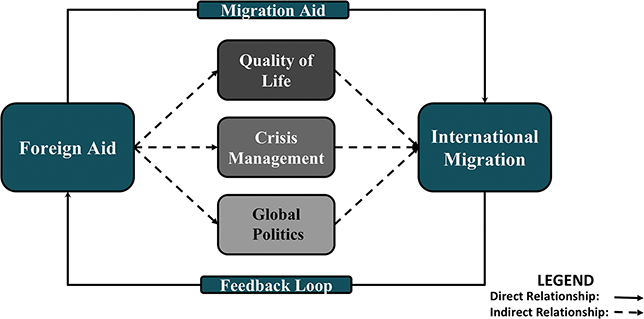
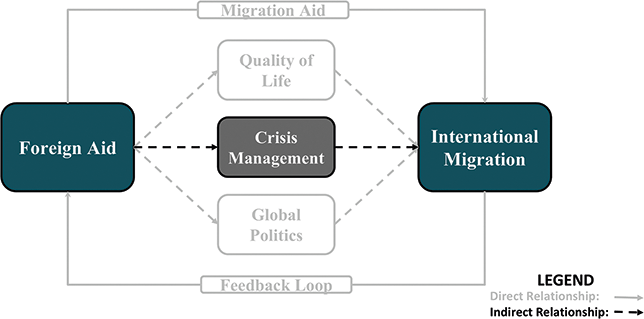
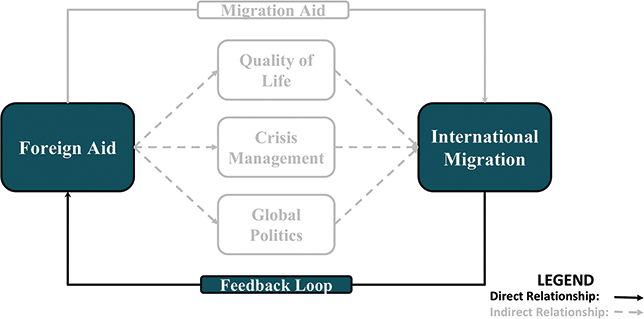
This Element fills the void. Our framework lays out one direct pathway and three indirect pathways by which aid may affect international migration, as well as a feedback loop. This framework is visualized in Figure 1, briefly discussed in the subsequent paragraphs, and detailed in the sections that follow. Crucially, these pathways should not be thought of as proposed hypotheses, but rather as conceptual lenses to guide structured empirical assessments and policy analyses of the aid–migration nexus.
A conceptual framework for explaining the relationships between foreign aid and international migration.
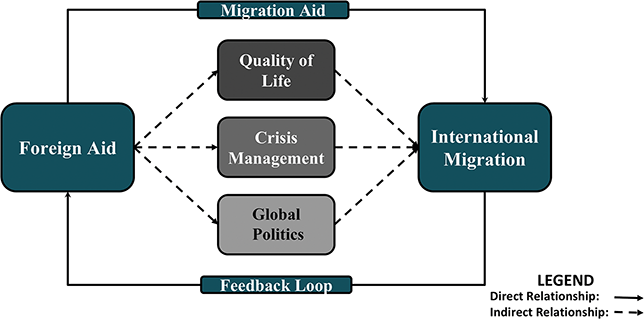
On the far left and right of the illustration are foreign aid and international migration. Each is a complex and multifaceted topic in its own right. Approaching aid in a systematic fashion requires one to reflect on the strategic objectives of donors (Alesina & Dollar, Reference Alesina and Dollar2000), politics in donor countries (Milner & Tingley, Reference Milner and Tingley2010), and the consistency of aid delivery (Hudson & Mosley, Reference Hudson and Mosley2008), among other things. Understanding international migration requires us to consider what leads individuals to seek new lives abroad (Carling, Reference Carling2024), what types of individuals are more and less likely to migrate (Feliciano, Reference Feliciano2005), how individuals decide where to move (Crawley & Hagen-Zanker, Reference Crawley and Hagen-Zanker2019), and what they do when they arrive (Abramitzky et al., Reference Abramitzky, Boustan and Eriksson2020).
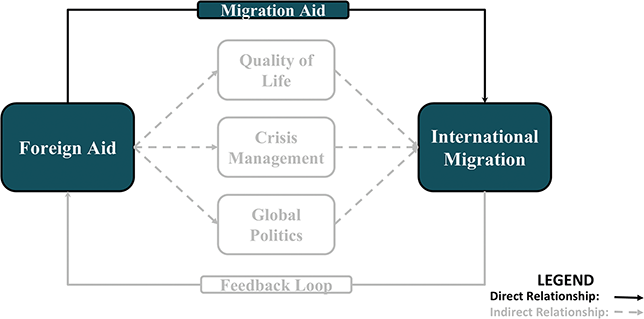
While much more could be said about aid and international migration as stand-alone topics, our purpose is to explore the relationships between them. Our framework does so with attention to several underlying mechanisms, or pathways, by which they are connected. We differentiate direct from indirect pathways. The direct mechanism, which we call the migration aid pathway and connect with a solid line in Figure 1, refers to aid projects specifically designed to encourage or discourage people from leaving their countries of residence. Projects along these lines may attempt to create jobs in areas of migrant sending countries that are prone to emigration, compensate leaders for blocking migrant outflows, or offer controlled paths for immigrants to enter a donor country to fill labor gaps. These sorts of direct aid projects are the focus of Section 3.
Indirect pathways, which are denoted in the figure with dashed lines, offer mediating outcomes that aid projects are designed to affect, which, in turn, impact international migration flows. Our framework offers three such pathways: (1) quality of life (QoL), (2) crisis management, and (3) global politics.
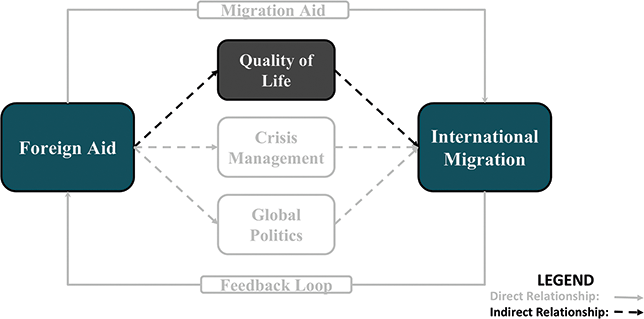
The first indirect pathway, which centers on QoL, begins with the notion that aid can create economic growth (Headey, Reference Headey2008), improve political institutions (Jones & Tarp, Reference Jones and Tarp2016), support clean air and water initiatives (Barkat et al., Reference Barkat, Alsamara and Mimouni2024), and generate other positive impacts on individual and societal well-being in recipient countries. To the extent that aid is effective in achieving QoL improvements, the opportunity costs of an uncertain move to a foreign nation become greater, and so people should be more inclined to stay where they are. Yet a rival explanation offers that improvements in QoL have the opposite effect, providing resources to individuals that they can use to emigrate. Section 4 explores these contrasting narratives further, assessing if and how various dimensions of life quality affect international migration flows, whether positively or negatively.
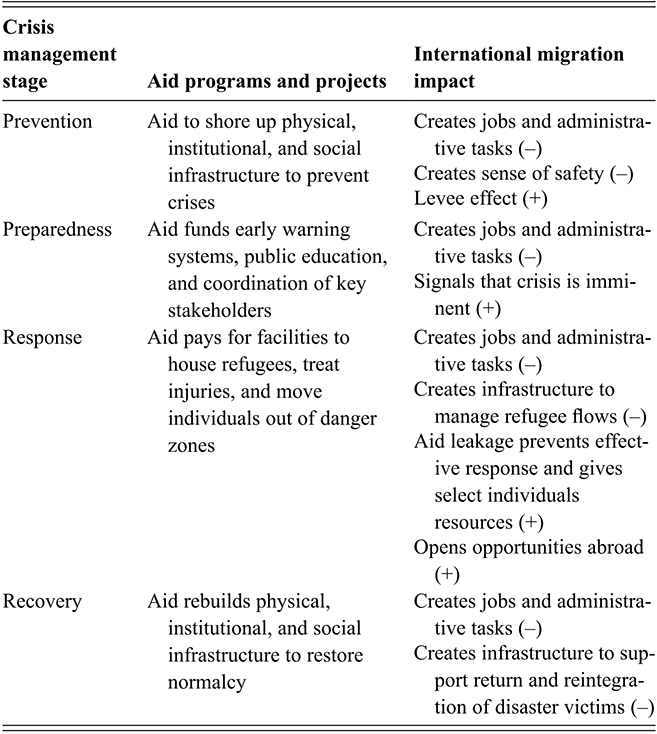
The second indirect pathway focuses on crisis management. People are often inclined to flee locations that are experiencing crises, such as catastrophic natural disasters (Boustan et al., Reference Boustan, Kahn and Rhode2012), severe economic downturns (Bazillier et al., Reference Bazillier, Magris and Mirza2017), or extreme political violence (Boutton & Carter, Reference Boutton and Carter2014; Garriga & Phillips, Reference Garriga and Phillips2014; Schmeidl, Reference Schmeidl1997). In some cases, aid inflows help to stabilize affected regions in a manner that reduces outflows of people. Yet in other instances aid makes the situation worse, as is widely argued to have occurred in Haiti after the 2010 earthquake (e.g., Katz, Reference Katz2013). Much of that aid was captured by political leaders, thereby doing little to assist disaster relief and even undermining relief efforts by shielding policymakers from the demands of the public (Buss, Reference Buss2015). In this situation, and in others like it, aid is unlikely to reduce emigration and may instead have the opposite effect. Section 5 explores crisis management aid in greater depth, breaking down its components and their impacts on cross-border flows.
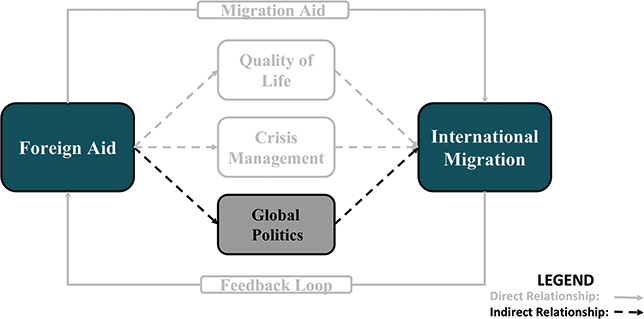
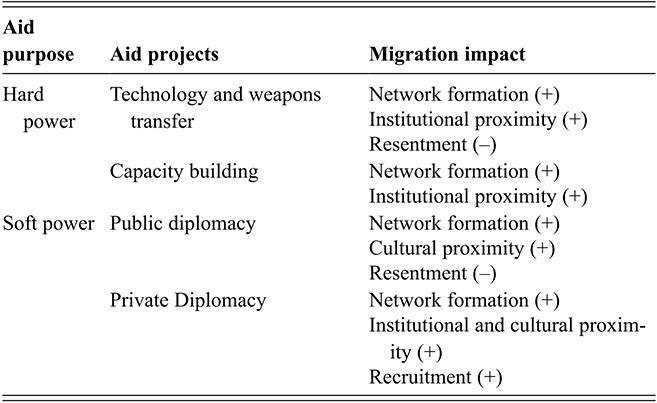
The third indirect pathway focuses on global politics. Donors frequently provide aid in hopes of advancing their geopolitical power, with hard power aid supporting the military capacities of recipient countries and soft power aid acting as a diplomatic tool (Blackwill & Harris, Reference Blackwill and Harris2016). Such aid can shrink institutional and cultural distance between donor and recipient nations, which eases migration between them (Berthélemy et al., Reference Berthélemy, Beuran and Maurel2009; Lanati & Venturini, Reference Lanati and Venturini2021). On the other hand, geopolitical aid could foster resentment in donor or recipient countries that leads to heightened migration barriers or discourages the movement of people. Section 6 develops this pathway further.
The framework also offers a feedback loop. This refers to the manners by which international migration, whether prompted by aid or otherwise, affects foreign aid provision. Positive feedback may proceed through lobbying by members of a diaspora, as when Somalians residing in Norway successfully lobbied Norwegian officials to initiate the Special Financing Facility to channel aid to Somalia (Tellander & Horst, Reference Tellander and Horst2019). A negative feedback loop occurs when migrant inflows create a backlash that leads to the empowerment of nationalist political actors who cut aid donations. Crucially, this facet of the framework, which is the focus of Section 7, shows that the relationship between aid and migration is not unidirectional.
1.4.1 Cross-Cutting Considerations
Three important cross-cutting considerations must be emphasized. These points do not alter the basic logic of the framework, but they underscore the complexity of applying it to real-world cases.
First, while the framework treats international migration in aggregate terms, migrants are not a homogenous group. Aid interventions, migration opportunities, and barriers to mobility are experienced differently across lines of gender, sexuality, race, and class. Perspectives from feminist or gender studies (see Jenkins, Reference Jenkins2025), queer theory (see Hall & Jagose, Reference Hall and Jagose2013), and critical race theory (see Crenshaw et al., Reference Crenshaw, Gotanda, Peller and Thomas1995) remind us that the same aid intervention may have heterogeneous and even contradictory effects on different populations. For instance, QoL improvements may enhance educational or employment opportunities for women in patriarchal societies, thereby reshaping the gender profile of migrant flows. Crisis management aid may reinforce social hierarchies of whose displacement is recognized as deserving of assistance. Likewise, geopolitical aid is often entangled with colonial legacies (Chiba & Heinrich, Reference Chiba and Heinrich2019), which may reproduce structural inequalities that shape the prospects of racialized migrants. Acknowledging these perspectives helps clarify that the pathways identified here operate unevenly across social groups.
Second, although the framework identifies four mutually exclusive pathways at the conceptual level, in practice, these pathways often intersect. Aid projects are rarely confined to a single logic and their consequences for migration often reflect overlapping objectives. For example, humanitarian assistance designed to respond to crisis displacement may be paired with development programming that seeks to improve livelihoods, thereby combining the crisis management and QoL pathways. Similarly, peacebuilding efforts may be embedded within broader geopolitical strategies, illustrating the convergence of crisis and geostrategic logics. The emerging literature on the “Triple Nexus,” which refers to the integration of humanitarian, development, and peace agendas, illustrates both the potential and the pitfalls of such intersectional programming (see Czerska-Shaw & Dunin-Wąsowicz, Reference Czerska-Shaw and Dunin-Wąsowicz2025; Lee & Marchand, Reference Lee and Marchand2025; Rettberg & Dupont, Reference Rettberg and Dupont2025). These examples demonstrate that any empirical application of the framework must grapple with the ways in which pathways combine, overlap, and sometimes contradict one another.
Last, but not least, our conceptual framework embraces methodological pluralism and equally weighs contributions from various epistemic communities, as real-world events are continuously constructed, co-constructed, and reconstructed by physical, social, and ideational forces at micro-, meso-, and macroscales. Thus, we do not claim to have reduced the foreign aid or the migration literature to their bare positivist bones. To the contrary, we embrace complexity, for example, by incorporating feedback loops as discussed in Section 7. In addition, where appropriate, we note additional factors that drive foreign aid allocation or influence migration outcomes that fall outside the scope of our conceptual framework.
1.5 Significance of the Element
Foreign aid is, perhaps, the most widely investigated topic in the field of development studies, with scholars having investigated the motives and interests of donors and recipients, as well as the impacts of aid on various facets of recipients’ economies and societies.Footnote 4 It has also ignited vigorous public debate, with advocates supporting additional aid provision and detractors calling for aid funding to be reallocated to donor countries’ domestic priorities (see Prather, Reference Prather2024) – this latter call has been answered most dramatically in the US through the closure of the United States Agency for International Development (USAID) (Moynihan & Zuppke, Reference Moynihan and Zuppke2025). International migration is a similarly contentious topic in the academicFootnote 5 and policy spheres, with many across the political spectrum calling for restrictions on migrant inflows (Alonso & Claro da Fonseca, Reference Alonso and Claro da Fonseca2012), even as others tout the positive impacts of migration and advocate for fewer barriers to international movement (e.g., Krueger, Reference Krueger2024). Yet when policymakers, scholars, and students have engaged in dialogue on how these two complex concepts affect each other, the lack of conceptual clarity has impeded understanding, knowledge development, and the establishment of useful policy insights.
This Element offers a clarifying framework that should be of value to scholars working on aid, migration, and the intersection of the two, and to policymakers across the political spectrum. It will help researchers to situate their own analyses, whether those be theory building, hypothesis testing, or normative assessments. At the same time, the Element can help policymakers to design and implement aid and migration policies that are coherent, evidence-based, and responsive to the needs and interests of key stakeholders.
1.6 Layout of the Element
Before turning to the framework itself, Section 2 provides essential background on immigration policy and management, highlighting both security-oriented and development-based strategies. The subsequent sections investigate the framework in greater depth. Section 3 focuses on the direct migration aid pathway, Section 4 focuses on the QoL pathway, Section 5 explores the crisis management pathway, Section 6 investigates the global politics pathway, and Section 7 centers on the feedback loop. Section 8 closes the Element by tying together the components of the framework and considering the implications for research and policy.
2 Immigration Policy and Management
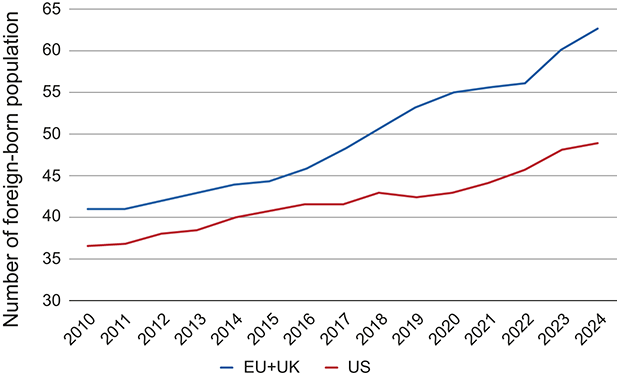
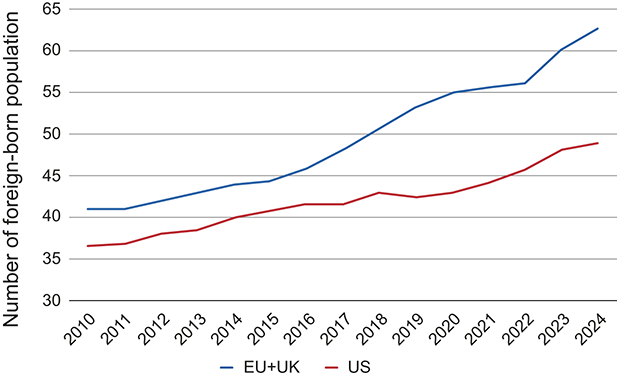
Over the last fifteen years, immigration to Western countries has reached record levels. As of 2024, the foreign-born population in the EU and UK increased to sixty million and in the US to nearly fifty million (Figure 2). Within this context, immigration has become one of the most salient issues in Western political and policy landscapes. Debates over borders, security, and the rights of immigrants have heightened the visibility of migration as a public concern, while simultaneously shaping the tools that governments deploy to manage migrant flows – including foreign aid.
Foreign-born populations in the EU, UK, and US.
This section situates the aid–migration nexus within the broader landscape of immigration policy, laying the groundwork for the framework that we present in subsequent sections. It provides an overview of two broad approaches that governments have used to manage international migration: restrictive measures, which seek to control or deter migration through border enforcement, deportations, and related instruments, and development-oriented strategies, which aim to reduce the structural push factors driving migration using economic transfers.
By examining these approaches, which have often been deployed in tandem, this section highlights the tensions, complementarities, and practical limitations that arise when governments attempt to influence migration flows. The section also underscores how recent shifts invite us to reconsider the role of aid in addressing the root causes of migration.
2.1 Restrictive Approaches
Restrictive migration policy approaches emphasize deterrence, with the goal of reducing migrant arrivals through tighter border enforcement, increased deportations, and the externalization of migration controls to third countries. They are often framed as immediate responses to the threat of migration and linked with public concerns about national sovereignty, increased unemployment, and the loss of control and identity among previously dominant societal groups (Cantat et al., Reference Cantat, Pécoud and Thiollet2025).
Border enforcement is perhaps the most emblematic restrictive measure. Along the US-Mexico border, for example, successive US administrations have invested in walls, surveillance technologies, and expanded patrol capacities in an effort to deter irregular crossings and signal the prioritization of security (Andreas, Reference Andreas2022). In Europe, maritime operations in the Mediterranean, ranging from European Border and Coast Guard Agency (Frontex) patrols to coordinated naval missions, aim to intercept boats before they reach European shores (see Kalkman, Reference Kalkman2021). Deportations and detention policies complement these measures, signaling to domestic audiences that unauthorized migration will be met with firm consequences (Wong, Reference Wong2015).
Restrictive strategies increasingly rely on externalization – that is, outsourcing border control to third countries. This includes deals in which destination countries provide funding, equipment, or training to governments in migrant-sending or transit states, with the expectation that they will prevent departures or host displaced populations. Examples range from European support to Mediterranean and North African governments, such as maritime security assistance to Libya, to broader agreements like the EU-Turkey deal, under which Turkey committed to hosting millions of Syrian refugees in exchange for aid transfers (Liguori, Reference Liguori2019).
Restrictive policies are costly, often requiring sustained financial and political investment. Yet evidence of their effectiveness is mixed, with studies suggesting several reasons that they fail to sustainably reduce migration. First, restrictive measures have to go through the policy-legal-implementation funnel in order to have an impact on migration outcomes. By the time these policies are enacted, legislation is passed, regulations are issued, and enforcement is carried out, gaps have diluted their effects (see Czaika and De Haas, Reference Czaika and De Haas2013). Second, restrictive measures do not address the underlying factors leading people to emigrate (e.g., Wong, Reference Wong2015; Castles, Reference Castles2004). With root factors still pushing them to move, migrants react to restrictive policies by following dangerous alternative routes and relying on smugglers, instead of staying in their countries of residence (Fontana, Reference Fontana2022). Third, restrictive strategies raise significant human rights concerns, as they expose migrants to violence, detention in poor conditions, and prolonged uncertainty (see Pécoud & de Guchteneire, Reference Pécoud and de Guchteneire2006). This can make restrictive approaches untenable, as public discomfort with human rights violations leads to policy reversal.
Ultimately, while restrictive approaches remain politically attractive, their capacity to address the underlying drivers of migration is limited. This speaks to the need for alternative or complementary strategies.
2.2 Development-Oriented Approaches
In contrast to deterrence-oriented policies, development-based strategies aim to address the underlying causes of migration by improving the conditions that drive people to leave their home countries. The core assumption is that migration flows are shaped by structural factors, such as poverty, unemployment, political instability, and weak governance, and that reducing these pressures will lessen the incentives for people to migrate. Governments and international organizations have sought to pursue this approach through foreign aid, trade, and foreign investment.
Foreign aid has been the most prominent tool in this category. US administrations have repeatedly directed aid toward Central America with the stated purpose of reducing migration. These programs have intended to promote economic opportunity, strengthen governance, and curb violence in the region (Gerschutz-Bell, Reference Gerschutz-Bell2022). Similarly, the EU has deployed aid through programs such as its Trust Fund for Africa (EUTF), channeling billions of euros to projects framed around job creation, border management, and stability in African states (Clemens and Postel, Reference Clemens and Postel2018). Beyond aid, trade and investment initiatives have been promoted as ways to generate employment and improve livelihoods in migrant-sending countries, thereby reducing the economic pressures that fuel emigration. For example, advocates of the North American Free Trade Agreement (NAFTA) argued that the agreement would create jobs in Mexico, promoting development and curbing irregular migration northward (Skonieczny, Reference Skonieczny2001).
Despite its intuitive appeal, the evidence on development-oriented strategies is mixed. As noted in Section 1, some studies of foreign aid offer evidence for a reducing effect, while others find that aid amplifies international migration or has no discernible effect at all. Likewise, while NAFTA expanded trade and investment flows, it also disrupted small-scale agriculture and contributed to new patterns of labor displacement, intensifying migration pressures in the short run (Hartman, Reference Hartman2010). This migration hump effect underscores the complexity of linking development gains to immediate reductions in emigration.Footnote 6 Moreover, the instrumentalization of aid, whereby aid is deployed primarily to serve donor interests in migration control rather than to advance development goals on their own terms, should raise normative concerns, particularly when aid is diverted away from pressing humanitarian priorities to projects narrowly designed to stem migration flows.
Development-oriented approaches therefore occupy an ambivalent space in migration management. They promise longer-term, more humane alternatives to deterrence, but they lack immediate payoff and are empirically uncertain as well as ethically contestable.
2.3 Tensions and Emerging Trends
In practice, governments often blend restrictive and developmental approaches to migration management, yet they operate under conflicting logics: Restrictive strategies define migration as a problem to be contained, with success measured by fewer arrivals and greater deterrence, while developmental strategies treat migration as the outcome of deeper structural drivers and focus on long-term improvements in those areas. When deployed together, these logics may clash. For example, when governments ramp up deportations while simultaneously funding job-creation programs abroad, migrants and recipient-country partners may interpret the latter as insincere, leading to the erosion of trust in aid.
Additionally, restrictive and developmental strategies pull in different directions politically. Border security and deportations provide visible signals to domestic audiences that governments are acting, while developmental approaches are slower, less tangible, and harder to sell, especially to economically struggling voters who see foreign aid as charity (Heinrich et al., Reference Heinrich, Kobayashi and Bryant2016). The result is that development initiatives are often subordinated to security imperatives, with aid redirected toward short-term containment measures, such as funding coast guards, detention centers, or migration enforcement capacity, rather than addressing the underlying drivers of migration.
These tensions are evident in policies such as the EU-Turkey deal, which promised both humanitarian support for refugees in Turkey and stronger border enforcement to reduce irregular crossings into Europe. The deal exemplifies the abovementioned contradictions, offering resources to support migrants closer to their region of origin while simultaneously restricting pathways for onward movement and reinforcing securitized approaches. Likewise, the halting of most US development aid, much of which had been channeled to Central America’s Northern Triangle for the purposes of migration management, even as the US electorate has soured on immigration and the government has leaned heavily into restrictive policies and rhetoric, speaks to the difficulty of selling development as a means to reducing immigration.
2.4 Rethinking Development-Based Migration Policy
The recent shuttering of USAID (Walker et al., Reference Walker, Khurana and Zhang2025), along with less dramatic reductions in foreign aid from other donor countries (Kent, Reference Kent2025), creates a moment of both challenge and opportunity. By many accounts, aid reductions are already having deleterious effects on health and well-being in poor countries (e.g., Houreld & Haroun, Reference 75Houreld and Haroun2025; Stover et al., Reference Stover, Sonneveldt and Tam2025), yet policymakers and scholars now have a chance to rethink aid – which even supporters must admit has been riddled with problems. This rethinking extends to the aid–migration nexus, which has rarely been assessed in systematic terms.
Against this backdrop, the sections to come delve into our framework for understanding the connections between aid and migration. Our hope is that this framework will guide more careful, responsible, and effective approaches to research and policy when a new foreign aid regime emerges.
3 The Migration Aid Pathway
The previous section situated migration policy within two broad traditions: restrictive enforcement measures and development-oriented strategies aimed at addressing root causes. Building on that foundation, this section turns to the first linkage in our framework, examining the direct use of foreign aid as a tool to influence migration flows. Unlike development programs that indirectly affect mobility, migration aid is explicitly designed with migration outcomes in mind. Donor governments may deploy it to deter movement, whether by funding job creation in sending countries, strengthening border controls, or compensating states for restricting outflows. Alternatively, they may do so to encourage movement by, for instance, supporting training and recruitment schemes that channel workers into donors’ labor markets.
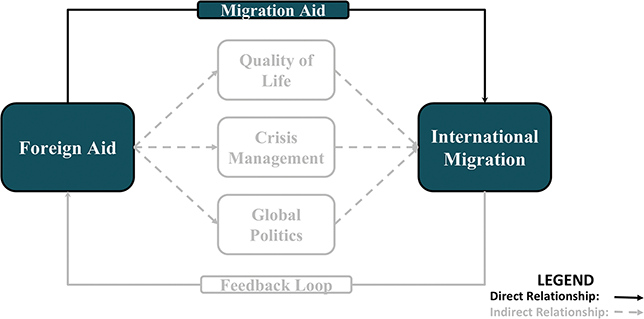
This section examines the logic, forms, and implications of such direct interventions – visualized in Figure 3. In doing so, we differentiate aid for border security from aid for migration management, break down the sorts of aid initiatives that fall into these categories, and reflect on the enablers and impediments to aid effectiveness in these contexts. The section closes with implications for policy and research.
The migration aid pathway.
Before beginning the analysis, it is important to contextualize the magnitude of direct migration aid. Norman and Micinski (Reference Micinski2023) write that $12 billion was spent on aid for the purposes of slowing migration in 2017 – out of $146.6 billion in total aid. This aid was mostly intended to address the underlying causes of migration, such as poverty and poor public service provision (these mostly fall within our QoL pathway, to be discussed in Section 4). Yet, it also included around $150 million in funding for building migration management capacity in recipient countries, including for border control, labor recruitment, and reintegration. While migration aid thus constituted only a small share of Official Development Assistance (ODA) in 2017, it can increase in certain regions or during periods of heightened movement. For example, according to a 2023 Oxfam report, approximately two-thirds of the €1 billion in migration-related aid that the EU provided to Niger, Libya, and Tunisia, starting in June of 2021, was directed toward migration control (Weisner & Pope, Reference Weisner and Pope2023). More generally, ODA spent on migration control and management by European countries typically accounts for 5–14 percent of their total ODA budgetsFootnote 7 and the EU’s Neighbourhood, Development and International Cooperation Instrument spent 10–15 percent of its budget on migration-related aid projects in 2022–2023.Footnote 8 Thus, migration aid is a growing segment of foreign aid.
Over the next several pages, we explore two types of migration aid: aid for border security and aid for migration management.
3.1 Foreign Aid for Border Security
Aid for border security encompasses efforts by donors to help recipient countries manage their national borders. Two subtypes of aid fall into this category. The first is aid for building border management capacity, which seeks to enhance a recipient state’s ability to secure its borders, prevent illegal activity, and manage the cross-border movement of people in a more structured and sustainable manner. The second is aid for border closure. This is typically quid pro quo in nature, where donor countries provide financial or technical assistance and, in exchange, recipient states restrict the departure of migrants. This form of aid is usually reactive, occurring during migration surges, and it is highly sensitive to political dynamics in both donor and recipient countries.
3.1.1 Aid for Building Border Management Capacity
Foreign assistance for building border management capacity typically focuses on strengthening a recipient-country’s ability to monitor and control its borders. It takes the form of technical assistance, infrastructure development, and training for border patrol and security forces. The goal is to create a more secure border environment that slows irregular migration, human trafficking, drug smuggling, and other security threats, while also facilitating legal and orderly movement.
US assistance to Mexico under the Mérida Initiative exemplified this approach.Footnote 9 The Mérida Initiative was a security cooperation program aimed at combating organized crime and improving border security. Through the Initiative, the US funded advanced surveillance technology and equipment, such as helicopters and biometric systems, as well as training programs for Mexican border security and law enforcement agencies (Seelke, Reference Seelke2023). The EU has provided similar sorts of assistance, including financing and training programs to Balkan states through FrontexFootnote 10 and to Moroccan authorities through the EUTF.Footnote 11
Such programs have the potential to offer a sustained impact on border security and migration, but their effectiveness depends on several factors. First, political will and cooperation between the donor and recipient governments are essential. If both parties are committed to the initiative and have aligned security interests, then aid is more likely to be implemented successfully. Second, financial support alone is rarely sufficient. Technical expertise and infrastructure investments, such as advanced surveillance systems, biometric identification tools, and improved transportation networks, are crucial for building a comprehensive border security framework. Third, institutions in aid-recipient countries matter. Corruption constitutes a significant challenge, as local authorities may misuse funds or allow illegal activities such as human trafficking or drug smuggling to persist in exchange for bribes. Likewise, political instability or conflict can disrupt implementation, particularly in fragile states where the government lacks control over certain regions. Additionally, poor institutional capacity can hamper aid effectiveness. For instance, even if advanced technology and equipment are provided, the recipient country may not have sufficient skilled personnel or logistical support to operate and maintain these systems effectively.
In practice, aid for border management capacity has often struggled to achieve its intended outcomes. Despite the scale of investment under the Mérida Initiative (approximately $1.8 billion), assessments have revealed major weaknesses in accountability and implementation. A Government Accountability Office (GAO) report found that the strategic documents guiding the Initiative failed to include measurable targets or comprehensive timelines for delivery of equipment and training (Abu-Hamdeh, Reference Abu-Hamdeh2011). Consequent procurement, administrative, and coordination challenges led to delays of key equipment like helicopters and scanners (Bow, Reference Bow, Bow and Santa-Cruz2012). Misalignment between the US and Mexico further undermined the initiative (see Gallaher, Reference Gallaher2016), culminating in a breakdown of the program in 2018 (Vorobyeva & Berg, Reference Vorobyeva and Berg2021). Ultimately, the Initiative failed to measurably reduce irregular migration (Jacobson et al., Reference Jacobson, Sarukhán, Carlsen, Benítez Manaut and Olmos Rodríguez2021; Seelke, Reference Seelke2023), while its results in terms of advancing other objectives were decidedly mixed (see Bow, Reference Bow, Bow and Santa-Cruz2012). Crucially, heightened border security and improvements in detection capacity at official crossings did little to address travel through irregular routes managed by smugglers, which probably grew in response to stricter border management (see Capps et al., Reference Capps, Meissner, Ruiz Soto, Bolter and Pierce2019).
A similar pattern has emerged in Europe’s near abroad, where the EU provides financing and training through Frontex and other bilateral initiatives. While these programs did improve tactical border control in some areas, they left deeper governance challenges unresolved. Corruption remained pervasive and smuggling groups adapted their operations. Heightened enforcement along certain corridors merely shifted migration flows to new routes through Croatia (Vanessa & Pupavac, 2024). This was compounded by credible human rights accusations toward Frontex, leading to more migrant precarity (see Bobić & Šantić, Reference Bobić and Šantić2020; Guild, Reference Guild2024).
Taken together, these cases highlight the recurring limitations of migration-focused capacity-building aid. Donors can provide advanced technology, training, and financial resources, but without deep institutional reform, accountability, and sustained political alignment, these inputs rarely translate into durable improvements in border governance. At best, they create temporary or localized enforcement capacity. At worst, they fuel corruption, push migrants into more dangerous routes, and undermine human rights.
3.1.2 Aid in Exchange for Border Closure
Providing foreign aid in exchange for the closure of national borders to out-migration has emerged in recent years as an even more direct form of migration aid. The most widely publicized example is the EU’s 2016 agreement with Turkey – later extended to other governments in the Middle East and North Africa (MENA) – in which the Turkish government agreed that it would attempt to stop irregular migration through the Aegean Sea and that irregular migrants apprehended en route to Greece would be sent to Turkey in exchange for €3 billion in aid (later increased by an additional €3 billion), which were to be spent on improving the conditions of Syrian refugees in Turkey (Kirişci, Reference Kirişci2021). The US has formed similar arrangements with its neighbors in Central America, explicitly linking aid flows to migration reduction – including via threats to cut aid if Central American governments failed to lessen the number of migrants heading toward the US border (McDonnell, Reference McDonnell2019).
Some evidence supports the effectiveness of these agreements. For example, in the years following the establishment of a 2016 aid-for-migration control arrangement between Italy, the EU, and Libya’s UN-backed government, departures from Libya to Italy fell approximately 95 percent (Varvelli & Villa, Reference Varvelli and Villa2019). Likewise, while over 800,000 mostly Syrian asylum seekers arrived in Greece in 2015, the number dropped to around 200,000 in 2016, the year that the EU and Turkey established their agreement, and to approximately 36,000 in 2017 (Terry, Reference Terry2021).Footnote 12
Yet, even as these agreements quickly slowed migration, their viability as longer-term strategies is questionable. The first challenge is that the arrangements themselves may not prove sustainable, whether due to domestic political changes (Leeds & Savun, Reference Leeds and Savun2007), geopolitical factors (Borzyskowski & Vabulas, Reference Borzyskowski and Vabulas2019), or pressure from domestic or foreign audiences (Helfer, Reference Helfer2005). Indeed, such agreements have already come under strain: Turkey temporarily opened its border to Greece in 2020 on the basis that it was overcapacity in terms of hosting Syrian refugees and that the EU was not doing enough to share or alleviate the burden (Jovanovski, Reference Jovanovski2020).
Further challenges may come from key stakeholders. The human rights community has emerged as a major source of pressure. These agreements arguably violate the rights of individuals to seek asylum and freedom of movement, as enshrined in Articles 13 and 14 of the Universal Declaration of Human Rights.Footnote 13 Additionally, there have been reports that aid-recipient states are abusing the rights of the migrants and refugees that they host. A 2020 report from Amnesty International alleged that refugees and migrants in Libya were subjected to forced labor, sexual violence, torture, and murder, among other things (Amnesty International, 2020). Likewise, a 2023 Human Rights Watch report alleged that migrants from sub-Saharan Africa had suffered significant abuses from Tunisian authorities (Human Rights Watch, 2023). These criticisms could spur backlash against Western governments that have prioritized human rights in the past (Kreutz, Reference Kreutz2015).
Domestic political pressures could also challenge the persistence of these arrangements. Foreign aid is often unpopular with donor countries’ citizens, who wish for their representatives to prioritize domestic matters over what they perceive to be charity to foreign nations (Lee, Reference Lee2019). Frustrations may mount as donors are forced to expand the array of countries that they provide aid to in an effort to quell several migratory routes at once. This may be compounded as governments threaten to open their borders to unleash emigrants if aid is not provided (Freier et al., Reference Freier, Micinski and Tsourapas2021; Micinski, Reference Micinski2023; Tsourapas, Reference Tsourapas2019).
Citizens in aid-recipient countries may also push their governments to abandon these agreements, particularly if they see the needs of political leaders and migrants as being privileged above their own. Aid inflows may reduce leaders’ representativeness, as they adopt the migration policies preferred by donors rather than those of their own citizens (Panebianco, Reference Panebianco2022). Indeed, citizens in these countries often oppose hosting refugees or other migrants (Ghosn et al., Reference Ghosn, Braithwaite and Chu2018), suggesting that their preferences are misaligned with public policies. This may ultimately lead governments to abandon such programs for fear of alienating their core constituents. If states reopen their borders, the number of emigrants could be quite large. Countries like Turkey and Libya house millions of refugees and migrants, who often live in poor conditions with few opportunities for upward mobility. These are just the sorts of settings that people are eager to leave.
All of this suggests that quid pro quo arrangements such as these are not sustainable ways of managing migration, even as governments find them attractive in the near term.
3.2 Foreign Aid for Migration Management
The second category of direct migration aid centers on migration management initiatives in developing countries. These efforts encompass aid for migration services, managing transit migrants, relieving migratory pressure, and return migration services. For example, the US government’s Collaborative Migration Management Strategy, launched in 2021, focuses on stabilizing populations in Central America by expanding lawful migration pathways while promoting regional cooperation on migration management (Seelke & Meyer, Reference Seelke and Meyer2023). Similarly, the EUTF has invested in migration management and facilitated migrant return and reintegration (Bisong, Reference Bisong, Rayp, Ruyssen and Marchand2020).
Such aid can enable better migration governance, reducing irregular migration flows while facilitating safe and orderly movement. Moreover, to the extent that this sort of aid addresses underlying migration pressures, it should have a more sustained impact on emigration than the programs described in Section 3.1. However, migration management aid can come with its own challenges and must be deployed with care to be effective and avoid unintended negative side effects.
The remainder of this section discusses the four abovementioned subcategories of migration management aid. In most cases, these sorts of aid projects are designed to be migration-deterring, but some are intended to be migration-enabling.
3.2.1 Aid for Managing Migrants in Transit
Transit nations, such as Turkey, Jordan, Mexico, and Tunisia, often face large influxes of migrants and refugees, creating significant pressures on their infrastructure and resources. To assist these nations, donors provide funding to enhance migrant processing systems and provide essential services like food, shelter, healthcare, and legal assistance. This should leave transit countries better equipped to manage migrant flows and to ensure the humane treatment of vulnerable populations.
An example of this aid strategy occurred in the context of the abovementioned EU-Turkey deal, where the EU provided over €6 billion to Turkey to help manage the Syrian refugee crisis. While this aid was arguably given in a quid pro quo manner (Gamso & Yuldashev, Reference Gamso, Yuldashev and Ben Ali2021b), the EU’s stated intention was for Turkey to use the funds to provide services to Syrian refugees in order to improve their living conditions. The EU has also funded programs along these lines through the EUTF in Burkina Faso,Footnote 14 Mali,Footnote 15 and Niger.Footnote 16
While foreign aid can potentially enhance transit countries’ capacities to handle migration, public resistance (Cagaptay, Reference Cagaptay2019) and logistical issues (Lenner & Turner, Reference Lenner and Turner2019), as well as corruption (Andersen et al., Reference Andersen, Johannesen and Rijkers2022) and mismanagement (Maipose, Reference Maipose, Hope and Chikulo2000), often pose obstacles. There is also the risk of long-term dependency on foreign aid if transit nations struggle to build self-sustaining systems.
3.2.2 Aid for Relieving Migratory Pressure
The next subcategory is aid for relieving migratory pressures, typically through initiatives aimed at creating jobs, providing social services, or improving living conditions for individuals who might otherwise migrate. These programs do not focus on broad, long-term development, but rather on immediate interventions for specific groups, such as border communities, ethnic minorities, or populations affected by conflict or economic instability. The goal is to enable would-be migrants with the means to succeed at home, thereby reducing the appeal of migration.
The EUTF directs resources to various programs along these lines. For example, from 2017 to 2020, it contributed €7 million to support the creation of micro and small enterprises and vocational training programs in the border areas of Burkina Faso, targeting youth and women in particular.Footnote 17 Likewise, it targeted Mali with €13.5 million from 2016 to 2020 to support food security and employment in the Kayes, Sikasso, and Koulikoro regions through the cashew nut sector,Footnote 18 and provided €20 million to support youth employment in the horticulture, agribusiness, and handicrafts sectors of the Koulikoro, Kayes, and Gao regions of Bamako.Footnote 19 USAID had, until recently, similar programs in Central America that explicitly sought to promote job creation in high out-migration areas or among the demographic groups that are likely to emigrate, such as young people. These included Creando mi Futuro Aquí in Honduras, Prosperity in El Salvador, and the Creating Economic Opportunities Project in Guatemala. Crucially, each of these programs was designed and implemented with the explicit intention of slowing out-migration from these regions.
Programs such as these are more likely to work when they are designed in partnership with local governments or NGOs that have a deep understanding of the target populations. Longer-term impacts are also more likely when aid supports entrepreneurship training or business development that can continue to create jobs as aid inflows slow. Conversely, corruption or mismanagement can lead to resources being siphoned off or allocated inefficiently, reducing the impact of the programs. Likewise, if the scale of the intervention is insufficient to address the broader structural issues driving migration, such as systemic violence, widespread poverty, or poor governance, then it may have only a marginal effect on reducing migratory pressures. And if individuals view the aid as temporary or insufficient to meet their needs, they may still seek better opportunities abroad regardless of the local programs in place (Simon et al., Reference Simon, Schwartz and Hudson2024).
3.2.3 Aid for Migration Services
Aid for migration services, which is migration enabling, refers to initiatives that help channel legal, cultural, and employment-related information to prepare migrants for life abroad. Donors support programs such as these, which are typically administered by government agencies or NGOs, in order to recruit laborers to fill market voids. These programs often include predeparture training, where migrants are educated about the legal frameworks, cultural norms, and employment conditions they may face in destination countries. They may also cover topics such as workers’ rights, financial literacy, and personal safety, which are essential for reducing the risks of exploitation and abuse.
Examples include Australia’s PLS, mentioned in Section 1, which funds programs in Pacific nations such as Fiji, Kiribati, and Papua New Guinea that recruit and train workers to join the Australian labor market,Footnote 20 and South Korea’s Employment Permit Systems, which recruits and trains workers from several countries in the region, including Bangladesh, Pakistan, and Sri Lanka, for temporary work in South Korea.Footnote 21
While aid programs along these lines can improve legal migration pathways and reduce exploitation, they also face several challenges that can hinder their effectiveness and integrity. One major issue is the potential for exploitation and abuse, as migrants may encounter unsafe working conditions, wage theft, or restricted freedoms – even despite being informed of their rights. Relatedly, these programs often reflect the economic and political agendas of donor countries, which prioritize filling labor shortages over safeguarding migrant welfare. This can lead to programs that focus heavily on recruitment but provide insufficient support or protection. Furthermore, the training offered in these programs may not always prepare migrants for the complexities of life abroad, leaving them with false expectations about cultural integration and employment conditions. Finally, these programs may not prove sustainable if funding or political will falters, raising questions about their long-term impacts.
3.2.4 Aid for Returning Migrant Services
Aid for returning migrant services is the final subcategory of migration management aid. This supports a range of services that support migrants as they navigate the social, economic, and psychological challenges of reintegration into their home countries after returning from abroad. Services often include vocational training, financial support, entrepreneurship programs, counseling, and assistance in finding employment. The goal is to ensure that returning migrants can reestablish themselves, contribute to their local economies, and avoid the need for remigration due to economic hardship or social exclusion.
For example, the Overseas Pakistanis Foundation, with support from the German government, offers comprehensive reintegration programs for workers returning to Pakistan.Footnote 22 The EU has supported programs along these lines in other countries as well, including Morocco, Algeria, Tunisia, Libya, and Egypt,Footnote 23 and at the regional level through the EU-International Organization for Migration Joint Initiative for Migrant Protection and Reintegration, which offers services like psychological counseling, skills development, and support for entrepreneurship to returning migrants across Africa and the Sahel.Footnote 24
Several factors contribute to, or impede, the effectiveness of these programs. First, a multitiered approach that attends to both immediate reintegration needs and long-term economic opportunities is more effective than simpler, unidimensional approaches. Second, programs should be designed with local contexts in mind and in coordination with local stakeholders, including migrants themselves. Other relevant conditioning factors include efforts to minimize the stigma and discrimination that can make it difficult for returning migrants to reintegrate socially, robust local public service provision, and safeguards against corruption.
3.3 Key Themes, Policy Implications, and Future Research
Several key themes emerge from this section. The first distinguishes aid to manage borders from aid to support the livelihoods of vulnerable populations. While either approach may be effective, the latter is more likely to lead to sustained decreases in emigration, since it addresses the underlying factors that lead people to move abroad. The second theme is that migration aid can be preventive, as when it is deployed to create the conditions for individuals to live full lives in their countries of origin or residence, or reactive, as when aid is provided in the face of migration surges brought about by large-scale crises (e.g., the civil war in Syria). The third theme is about program design. Various factors may enable or impede the effectiveness of migration aid, including corruption and the incorporation of local knowledge, and so aid program designs that incorporate these factors are essential.
As policymakers draw insights from these themes, they should keep in mind that the approaches to migration aid highlighted in this section are not mutually exclusive and can instead be parts of a holistic policy framework. Policymakers that wish to curtail immigration should deploy migration aid to promote employment, public safety, and service provision in order to prevent migrant surges, but so too must they realize that some surges will not be prevented. With this in mind, policymakers should also provide aid for border security capacity in preparation for inevitable upticks in migration. From there, aid to foster and facilitate return migration can be deployed as a means of recovery.
When developing projects, policymakers should adopt a dynamic approach that integrates design and implementation while incorporating feedback loops for continuous learning. This process begins by embedding local knowledge into the design phase, ensuring that projects address the key drivers of migration in a given context. During implementation, adaptive management allows for adjustments based on real-time data and emerging challenges. A feedback loop ensures that lessons learned from ongoing projects inform future design. This iterative approach increases the likelihood that migration aid evolves and improves, adapting to changing conditions for greater long-term impact.
It is also important that we continue developing our knowledge and understanding of migration aid. This section has provided a migration aid typology. The next step is to conduct empirical research to assess the effectiveness of distinct aid approaches. To do so, scholars will need to develop key tools at the macro and micro levels. At the macro level, the need is for precise data on migration aid flows across countries that specifically categorizes aid projects according to the typology. This data can be used in large-N studies to observe if, and to what extent, migration aid of each type affects international migration. At the micro level, focused monitoring and evaluation studies are necessary to assess the effectiveness of individual migration aid programs.
4 The Quality of Life (QoL) Pathway
As discussed in Section 3, migration aid that directly and explicitly seeks to prevent the movement of people across national borders has become more common in recent years, with aid provided in exchange for border closures gaining particular traction (e.g., Freier et al., Reference Freier, Micinski and Tsourapas2021; Micinski, Reference Micinski2023; Tsourapas, Reference Tsourapas2019). Yet the more common approach to aid-based migration management, which we explore in this section, has envisioned aid as a means of addressing the QoL-deficits that lead individuals to migrate abroad (see Figure 4), such as poverty and joblessness, political repression, corruption, and social unrest.Footnote 25 In theory, as aid improves QoL in recipient countries, residents should be more satisfied where they are and less inclined to undertake a difficult journey abroad.
The QoL pathway.
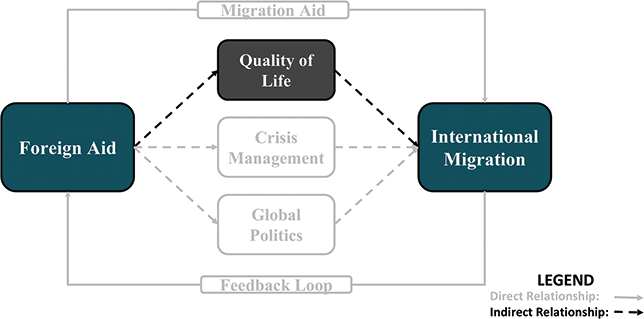
There is a clear and appealing intuitiveness to the idea that foreign aid can improve lives and deter international migration in the process, but this simple idea obscures complexities. What constitutes an improvement in QoL and is foreign aid well-suited for providing such improvements? Even if aid does improve QoL, how confident should we be that these improvements will deter movement? This section explores these questions by identifying QoL-related push factors and the aid projects that align with them, and then assessing the effects of these projects through a detailed review of the empirical literature. In doing so, it clarifies which QoL-aid strategies are likely to deter international migration, and which may enable it. The section closes with key themes, policy implications, and avenues for future research.
4.1 QoL, International Migration, and Aid Programs
Within the context of human development, QoL is a comprehensive concept that describes levels of individual and community well-being. Models that conceptualize QoL (e.g., Maslow, Reference Maslow1987; Sen, Reference Sen, Chenery and Srinivasan1988) suggest five key components: physical safety, economic security, access to public services, reciprocal social relationships, and fundamental civic rights. This section considers each dimension of QoL, its connection to international migration, and aid-based efforts to improve it.
4.1.1 Physical Safety
Physical safety refers to the condition of being free from threats or harm, whether from violence, crime, natural disasters, or environmental hazards. This is, perhaps, the most critical component of overall QoL. Without it, individuals and families are unable to thrive, build meaningful relationships, or achieve economic and social success (Maslow, Reference Maslow1987). Insecurity not only affects immediate safety but also mental health (Pearson et al., Reference Pearson, Clevenger and Horton2021), economic opportunities (Diprose, Reference Diprose2007), and social cohesion (Bjornstrom & Ralston, Reference Bjornstrom and Ralston2013).
The connection between physical safety and migration is well established (see FitzGerald & Arar, Reference FitzGerald and Arar2018). Exposure to persistent insecurity, whether from armed conflict (Bohra-Mishra & Massey, Reference Bohra-Mishra and Massey2011; Lozano-Gracia et al., Reference Lozano-Gracia, Piras, Ibáñez and Hewings2009), generalized violence (Cutrona et al., 2023; Roth & Harnett, Reference Roth and Hartnett2018), or even domestic abuse (Bowstead, Reference Bowstead2015), is a powerful driver of mobility. People flee when their lives or those of their families are at risk, even if doing so entails significant costs and dangers (Poole, Reference Poole2022). This applies not only to displacement in conflict zones but also to contexts marked by chronic criminal violence or weak state authority, where insecurity erodes the prospects for economic survival and social connectivity (Garni, Reference Garni2010). In such cases, migration becomes both a survival strategy and a means of restoring stability and safety. Conversely, improvements in security conditions tend to reduce pressure to move, as individuals feel more confident investing in their futures locally, even prompting return migration in some cases (Zakirova & Buzurukov, Reference Zakirova and Buzurukov2021).
Donors have invested heavily in aid programs intended to improve security conditions in fragile or violence-affected states (Findley, Reference Findley2018). These initiatives range from support for police and judicial reform (Bayley, Reference Bayley2006; Van Der Spuy, Reference Van Der Spuy2000) to programs to reduce gang and community violence (Higginson et al., Reference Higginson, Benier and Shenderovich2015) to efforts aimed at resolving ongoing civil conflicts (Böhnke & Zürcher, Reference Böhnke and Zürcher2013). US assistance in Central America’s Northern Triangle, for instance, has included community-based violence prevention programs and funding for more accountable policing (Shifter, Reference Shifter2012). Similarly, European donors have linked development assistance to stabilization programs in parts of the Sahel (Bøås, Reference Bøås2020).
4.1.2 Economic Security
Economic security, which provides individuals and families with the means and confidence to prosper, is another key component of QoL. Stable employment and sufficient income are central to this QoL dimension. Employment opportunities that drive economic survival and fuel personal growth are especially important for fostering happiness and life satisfaction and for cultivating vibrant communities of talented and creative individuals (Florida, Reference Florida2003).
The link between economic security and migration is direct. A lack of jobs, low wages, or unstable livelihoods are among the most consistent factors prompting outward migration, particularly from low- and middle-income countries (see Ochoa-Moreno et al., Reference Ochoa-Moreno, Quito, de la Cruz del Río-Rama and Torres-Díaz2025). Migrants often view moving abroad as a strategy to secure income, send remittances, and stabilize household consumption (Itzigsohn, Reference Itzigsohn1995; Semyonov & Gorodzeisky, Reference Semyonov and Gorodzeisky2008). At the same time, migration pressures are shaped not only by poverty itself but by inequality and limited upward mobility. Where opportunities are scarce or concentrated with certain groups, individuals may seek alternatives abroad, even if they are not among the very poorest (Clemens & Mendola, Reference Clemens and Mendola2024; Scott, Reference Scott and Ratuva2019). In fact, the poorest lack the means, information, or access to move in many cases (Clemens, Reference Clemens2011).Footnote 26 On the other hand, improvements in employment prospects and income security can reduce incentives to leave, although there is nuance here, as income growth may stimulate migration up to a certain point (Telli, Reference Telli2014; Winter, Reference Winter2020).Footnote 27
Aid programs aimed at strengthening economic security occupy a central place in donor strategies. These include initiatives to promote job creation through entrepreneurship and small business support (Bah et al., Reference Bah, Brada and Yigit2011), agricultural development projects to improve rural livelihoods (Kaya et al., Reference Kaya, Kaya and Gunter2013), and infrastructure programs designed to expand market access and stimulate local economies (Sahoo & Bishnoi, Reference Sahoo and Bishnoi2016). For example, the US has invested in education and agricultural modernization programs in Central America (Rice, Reference Rice1999; Valverde, Reference Valverde1999), while the EU has tied portions of its development cooperation to programs that encourage youth employment and foster small enterprise development (Heck & Habersky, Reference Heck and Habersky2025; Simon et al., Reference Simon, Schwartz and Hudson2024).
4.1.3 Access to Services
The third component of QoL is access to services such as healthcare, education, and clean water. These services, which might also include access to key infrastructure and social protection, are essential for meeting physiological needs, which is a foundational element of QoL (Maslow, Reference Maslow1987). Services can be provided by the private or public sector, but having some degree of public service provision is essential for ensuring effective, society-wide access (see, for example, Basu et al., Reference Basu, Andrews, Kishore, Panjabi and Stuckler2012).
Deficits in service provision are linked to migration pressures. People may see emigration as the only path to securing better opportunities for themselves and their families, where health systems are weak (Castelli, Reference Castelli2018) and schools are inadequate (Abbas & Sagsan, Reference Abbas and Sagsan2020). Surveys of prospective migrants often cite dissatisfaction with public services as a motivating factor (e.g., Crawley & Hagen-Zanker, Reference Crawley and Hagen-Zanker2019). Interestingly, and contrary to the migration hump theory noted in Section 4.1.2, it appears to be the relatively poor that emigrate in response to weak public service provision (Gamso et al., Reference Gamso, Yuldashev and Lu2021), as these are the most service-reliant individuals (Sumarto et al., Reference Sumarto, Suryahadi, Bazzi, Barrientos and Hulme2008).
Foreign aid programs have long sought to increase access to basic services. Donors fund initiatives to strengthen public health systems (Bendavid & Bhattacharya, Reference Bendavid and Bhattacharya2014), expand educational access (Dreher et al., Reference Dreher, Nunnenkamp and Thiele2008; Nandwa & Asiedu, Reference Nandwa and Asiedu2007), and extend infrastructure (Bertheau & Linder, Reference Bertheau and Linder2022; Botting et al., Reference Botting, Porbeni and Joffres2010). For example, USAID health programs have, until recently, targeted maternal health and HIV/AIDS treatments across multiple regions (Bhutta & Rulisa, Reference Bhutta and Rulisa2025), while the EU has financed projects aimed at improving education and social protection for vulnerable populations (Holden, Reference Holden2008).
4.1.4 Social Relationships and Networks
Social networks and relationships within communities are a fourth component of QoL (Putnam, Reference Putnam1994). Strong social networks provide emotional support, foster trust, and create a sense of belonging, which are important factors in individual happiness and stability (Acock & Hurlbert, Reference Acock and Hurlbert1993). Likewise, communities with robust social capital are more resilient, as they can leverage networks to improve economic and social well-being (Woolcock, Reference Woolcock1998).
Migration decisions are deeply embedded in social networks (Munshi, Reference Munshi2020). Research has shown that migration is often a collective strategy, facilitated and sustained by transnational social ties. Existing family or community members abroad can lower the costs and risks of moving by providing information, financial assistance, and practical support upon arrival (Palloni et al., Reference Palloni, Massey, Ceballos, Espinosa and Spittel2001). At the same time, strong networks at home can deter emigration, as people feel bonded to their local communities (Zhao & Yao, Reference Zhao and Yao2017).
Aid programs have sought to strengthen community ties and social capital through investments in youth engagement programs (Ignatowski, Reference Ignatowski2007), minority rights (Sundstrom, Reference Sundstrom2006), and civic society (Henderson, Reference Henderson2002). For example, the World Bank has supported community-driven development programs that empower local groups to set priorities for infrastructure, services, and governance.Footnote 28 Likewise, USAID has funded initiatives to build trust and cohesion in conflict-affected areas by supporting dialogue across divided communities (Thompson, Reference Thompson1997).
4.1.5 Rights and Freedoms
Finally, basic rights and freedoms are integral to well-being (Sen, Reference Sen, Chenery and Srinivasan1988). These include political freedom, legal protections, and the right to participate in societal decisions, as well as freedom from human rights abuses and political repression. Within this context, enhancing governance, promoting the rule of law, and protecting human rights improve QoL by ensuring that individuals live in safe and just societies.
The relationship between rights and migration is well documented. Political instability and repression frequently drive people to emigrate (Campos & Lien, Reference Campos and Lien1995; Dutta & Roy, Reference 71Dutta and Roy2011; Sun, Reference Sun2025), whether to escape direct threats or to seek environments where they can exercise basic freedoms. Authoritarian governance and systemic corruption can similarly heighten the desire to leave (Hiskey et al., Reference Hiskey, Montalvo and Orcés2014) – although nondemocratic countries may have relatively closed borders that prevent migrant outflows (Miller & Peters, Reference Miller and Peters2020). Conversely, where rights are respected and institutions function fairly, individuals are more inclined to invest in their futures at home, reducing pressure to emigrate (see Rowlands, Reference Rowlands1999).
Aid programs aimed at strengthening rights and freedoms have often focused on governance reform, institution-building, and civil society empowerment (see Jones & Tarp, Reference Jones and Tarp2016). Donor efforts have included judicial reform (Pásara, Reference Pásara2013), training officials in transparency and accountability (Dávid-Barrett & Fazekas, Reference Dávid-Barrett and Fazekas2020), funding civil society organizations (Edwards and Hulme, Reference Edwards and Hulme1996), and providing technical assistance for electoral processes (Uberti & Jackson, Reference Uberti and Jackson2019). For example, UNDP rule of law programs in fragile states reflect attempts to enhance governance and safeguard civic rights.Footnote 29
4.1.6 Synthesis
Physical safety, economic security, access to services, social relationships, and rights and freedoms each represent distinct but interconnected components of well-being, and deficits in any one of them can become a catalyst for emigration. Aid has targeted all of these domains, including programs that improve security, expand job opportunities, strengthen public services, build social capital, and enhance governance. See Table 1 for a summary of the evidence.
| QoL dimension | Connection to migration | Representative aid interventions |
|---|---|---|
| Physical safety | Insecurity from conflict, violence, or disasters drives migration; improvements in safety reduce pressure to leave and may encourage return migration | Security-sector reform; community violence prevention; conflict resolution; US programs in Central America’s Northern Triangle; EU stabilization programs in the Sahel |
| Economic security | Lack of jobs, low wages, and inequality are migration drivers; improvements in livelihoods reduce emigration, though rising incomes can also stimulate migration (migration hump) | Job creation through entrepreneurship and SME support; agricultural development; infrastructure and market access; US agricultural modernization in Central America; EU youth employment initiatives |
| Access to services | Poor health, education, and infrastructure drive migration, especially for households that depend on public services; improvements can reduce service-based migration drivers | Health system strengthening; education access; infrastructure expansion; USAID maternal health and HIV/AIDS programs; EU investments in education and social protection |
| Social relationships & networks | Migration is embedded in collective strategies: Strong networks at home can anchor individuals, while transnational ties lower costs of migration | Youth engagement; minority rights; civil society strengthening; World Bank community-driven development; USAID trust-building in conflict zones |
| Rights & freedoms | Political repression, corruption, and lack of rights drive emigration; stronger rights and accountable institutions reduce migration pressures | Governance reform; judicial reform; transparency and accountability training; civil society funding; electoral support; UNDP rule of law programs |
4.2 Effectiveness of QoL Aid
Understanding the impact of QoL-aid on migration requires tracing a multistep pathway: Aid affects QoL and then changes in QoL influence migration decisions. We have already discussed the QoL factors that influence migration, as well as the aid targeted to address those factors. Next, we consider whether this aid is effective – both in terms of improving QoL and reducing international migration.
4.2.1 Aid for Physical Safety
Aid programs aimed at reducing violence and insecurity, such as community policing, gang prevention, and peacebuilding initiatives, have proven effective at times, although the empirical literature has produced mixed findings (see Dreher et al., Reference Dreher, Lang and Reinsberg2024). On the positive side, Amaya-Panche (Reference Amaya-Panche2025) finds that EU aid to Colombia led to a decrease in civilian victimization via its positive impacts on civilian agency and the visibility of violence. Likewise, Savun and Tirone (Reference 84Savun and Tirone2017) find that aid in support of good governance and civil society reduces terrorism. Aid for policing reform in South Africa also produced some positive outcomes, even as its effectiveness was often undermined by underlying bureaucratic conditions (Van Der Spuy, Reference Van Der Spuy2000). In contrast, Uvin (Reference Uvin1998) argues that foreign aid reinforced the conditions in Rwanda that led to the 1994 genocide, while De Juan (Reference De Juan2020) finds that aid to post-conflict Nepal contributed to upticks in ethnic conflict. A systematic review from Zürcher (Reference Zürcher2017) indicates that aid to conflict zones is more likely to exacerbate conflict than to dampen it. This review further finds that the relationship between aid and conflict in these settings depends on the degree of stability and security, as well as the capacity of armed groups to interfere with aid delivery.
These findings speak to the role of contextual factors in moderating aid effectiveness. Where aid is sustained and embedded in broader governance reforms, improvements in safety appear more durable and, consequently, more likely to reduce emigration. However, the opposite occurs where institutions are weak, fostering little benefit and even exacerbating the conflict it is meant to address. The likelihood in these latter contexts is ongoing or heightened migrant outflows.
4.2.2 Aid for Economic Security
Foreign aid has long been deployed with the goal of strengthening economic security in recipient countries, whether through stimulating economic growth, fostering development, or directly supporting job creation. The evidence on these effects is mixed but informative. On one hand, a substantial body of research suggests that well-targeted aid can contribute to macroeconomic growth and development. Arndt et al. (Reference Arndt, Jones and Tarp2015), for example, show that aid has a positive effect on long-run growth and contributes to poverty reduction. Mahembe and Odhaimbo (Reference Mahembe and Odhiambo2021) also find a poverty-reducing effect, particularly for democratic countries. Scholars have also identified relationships between foreign aid and job creation, with An et al. (Reference An, Guo and Jiang2025), for example, observing a two percent increase in local employment in African countries that receive aid from China. Likewise, Harris (Reference Harris2021) finds that aid supports human capital accumulation, with positive labor market implications. Aid can also contribute to labor rights (Lim et al., Reference Lim, Mosley and Prakash2015), water access (Pickbourn, Reference Pickbourn, Caraher and Ndikumana2022), and food security (Balcilar et al., Reference Balcilar, Olasehinde-Williams and Tokar2025), speaking to wider development implications.
Yet, the findings are not uniformly positive. Herzer and Nunnenkamp (Reference Herzer and Nunnenkamp2012) find that aid worsens income inequality, while Page and Shimeles (Reference Page and Shimeles2015) find that aid has contributed to a trend of economic growth without job creation in Africa.Footnote 30 Rajan and Subramanian (Reference Rajan and Subramanian2008) identify no robust evidence that aid spurs growth, regardless of the institutional environment or the composition of aid. Some studies have reconciled mixed findings by highlighting conditional effects, whereby aid effectiveness depends on the strength of political institutions (Adedokun, Reference Adedokun2017) or on the composition of aid itself (Akramov, Reference Akramov2012).
When linked to migration outcomes, the impacts of aid for economic security follow a similarly conditional pattern. Studies of aggregate aid have identified a positive relationship to emigration, such that cross-border migration rises as aid inflows increase (e.g., Berthélemy et al., Reference Berthélemy, Beuran and Maurel2009). The logic underlying this finding is that aid offers poor people resources that they can use to emigrate, even as it may improve livelihoods in middle-income countries enough to deter outflows (see De Haas, Reference De Haas2007). To the extent that this migration hump pattern holds, it suggests that income dynamics in the aid-recipient country condition the effects of aid on migration. Likewise, the composition of aid likely plays a moderating role, with rural development aid, for example, producing modest reductions in emigration by creating or sustaining jobs in agriculture (Gamso & Yuldashev, Reference Yuldashev2018b). These findings collectively indicate that aid for economic development is effective at reducing emigration, conditioned on how and where it is allocated.
4.2.3 Aid for Services
Foreign aid has played a significant role in improving access to health, education, and social protection, though its effectiveness varies across sectors and contexts. In health, large-scale aid programs have reduced child mortality and strengthened disease control efforts (Bendavid & Bhattacharya, Reference Bendavid and Bhattacharya2014; Odokonyero et al., Reference Odokonyero, Marty, Muhumuza, Ijjo and Moses2018). Education aid has also supported access to basic schooling, as well as human capital development more broadly (Harris, Reference Harris2021; Riddell & Niño-Zarazúa, Reference Riddell and Niño-Zarazúa2016). Yet, while aid targeted toward service provision has produced positive outcomes, aid in the aggregate appears to have the opposite effect (Wolf, Reference Wolf2007), perhaps reflecting the disconnect that aid, as a form of nontax revenue, can produce between policymakers and constituents (see Knack, Reference Knack2001). It is also the case that aid can effectively supplant government spending, as policymakers divert funds for social services elsewhere (see Pack & Pack, Reference Pack and Pack1993). This may undermine the service boosting effects of aid, while also leaving countries vulnerable to aid cuts.
This has important implications for international migration. Research suggests that the impact of aid on public services is one of the main channels through which it slows the movement of people (Lanati and Thiele, Reference Lanati and Thiele2018). Evidence further suggests that aid targeted to improve political institutions in recipient countries corresponds to a reduction in emigration (Gamso & Yuldashev, Reference Yuldashev2018a), perhaps because this aid supports public service provision. Service specific aid has also been shown to deter migration, with Lanati and Thiele (Reference Lanati and Thiele2021) finding that upticks in health aid correspond to reductions in the emigration of medical professionals. Crucially, just as increases in aid-supported public services reduce migrant outflows, rapid aid cuts have been associated with heightened emigration, particularly of the most vulnerable (Gamso et al., Reference Gamso, Yuldashev and Lu2021).
4.2.4 Aid for Social Relationships and Networks
Aid designed to strengthen social capital and community ties can build trust, empower local groups, and foster cooperation (see Danquah & Ouattara, Reference Danquah and Ouattara2023). At the same time, aid’s effectiveness in building social relationships depends heavily on its design and conditionality. While participatory and transparent programs can reinforce networks and trust, less accountable forms of aid undermine them. For instance, Adera (Reference Adera2023) finds that Chinese aid, which is typically delivered with relatively few conditions (Gehring et al., Reference Gehring, Kaplan and Wong2022), has eroded social capital by fueling corruption and weakening institutional trust (Isaksson & Kotsadam, Reference Isaksson and Kotsadam2020).
Strengthened networks and local trust may reduce emigration by providing a stronger sense of belonging and improving resilience in times of stress, lowering the perceived need to move abroad. Participatory development projects that enhance voice and accountability while fostering strong community ties may also encourage citizens to invest in their home communities rather than pursue mobility (see Zhao & Yao, Reference Zhao and Yao2017). Conversely, in cases where aid unintentionally fosters inequality, patronage, or corruption, trust in institutions will weaken, driving people to seek alternatives abroad (see Poprawe, Reference Poprawe2015). Thus, the effect of aid on migration is contingent on its impacts on social networks. Some donors have been more effective than others when it comes to fostering the sort of social cohesion that can deter emigration. Additionally, if pro-cohesion aid creates networks that eventually cross national borders, then those networks may facilitate greater migration in the future, even as they deter it in the short term.
4.2.5 Aid for Rights and Freedoms
Aid targeted at rights, governance, and institutional reform has often proven more effective than other aid streams (Dreher et al., Reference Dreher, Lang and Reinsberg2024). Programs related to the rule of law, government accountability, and civil society have been shown to strengthen political institutions and human rights (Carnegie & Marinov, Reference Carnegie and Marinov2017; Jones & Tarp, Reference Jones and Tarp2016). That said, studies have also identified negative relationships between aid in the aggregate and human rights, particularly when leaders in recipient countries capture aid and redirect it toward repressive efforts (Darden, Reference Darden2020). Aid capture is especially common in autocratic countries (Andersen et al., Reference Andersen, Johannesen and Rijkers2022) and in those with existing human rights problems (Douch et al., Reference Douch, Edwards, Landman and Mallick2022), creating a paradoxical dilemma where aid improves rights and freedoms primarily in countries that already have them.
It seems, then, that aid for good governance is fairly effective at producing its intended outcomes, while aid in more general terms is conditionally effective. This pattern follows in the aid–migration literature, which has found that aid for good governance is accompanied by a decrease in migrant outflows (Gamso & Yuldashev, Reference Yuldashev2018a). This aligns with earlier findings that citizens who trust that their political voice matters and that legal protections function fairly are less likely to pursue migration, whereas those facing disillusionment, repression, and instability are more inclined to seek freedoms abroad (Hiskey et al., Reference Hiskey, Montalvo and Orcés2014; Sun, Reference Sun2025).
4.2.6 Conditioning Factors and Synthesis
Across QoL dimensions, the effects of aid on migration are highly conditional, shaped by the broader institutional context in which aid is delivered. Where institutions are strong, aid can reinforce development trajectories, expand services, and build trust, thereby reducing migration pressures. Where institutions are weak, aid is more prone to capture, diversion, or substitution effects that may undermine its intended objectives. Equally important are donor characteristics and the type of aid provided. Targeted aid, such as sector-specific programs in health, education, or governance, is more effective than general budget support or aggregate aid flows, which can more easily be absorbed into patronage networks or used for short-term political goals. Donor practices also condition outcomes: Participatory and transparent programs are more likely to generate legitimacy and social trust, while top-down or conditionality-light aid may erode them. Finally, the stability of aid flows matters, as volatility and sudden cuts can destabilize service delivery and intensify outflows. See Table 2 for an overview of these findings.
| QoL dimension | Evidence on aid effectiveness | Migration implications | Conditional factors |
|---|---|---|---|
| Physical safety | Mixed: some successes in reducing violence (EU aid in Colombia, aid for civil society reducing terrorism), but in some cases aid worsened conflict (Rwanda, Nepal); reviews suggest aid to conflict zones often exacerbates conflict | Safety gains reduce emigration; conflict-exacerbating aid increases it | Effectiveness depends on institutional stability, ability to prevent aid capture, and embedding within governance reforms |
| Economic security | Mixed: evidence of poverty reduction, job creation, and human capital support; but also inequality, growth without jobs, or null effects | Aid reduces outflows when it creates jobs and raises living standards; but can also finance emigration from low- and middle-income countries | Effectiveness varies with institutional quality, regime type, and aid composition |
| Access to services | Strong evidence for health and education aid improving outcomes; but risks of aid dependence, fiscal substitution, and aggregate aid undermining service quality | Improved service provision reduces emigration, but cuts to service-related aid increase outflows among the most vulnerable | Conditional on whether aid supplements vs. supplants government spending; stability of aid flows; alignment with institutional reforms |
| Social relationships & networks | Aid can build trust and cooperation when participatory/accountable; can erode trust and fuel corruption if poorly designed | Strengthened networks and trust reduce emigration; however, transnational networks may facilitate future migration | Design and conditionality of aid; donor practices |
| Rights & freedoms | Governance aid is effective in improving rights; aggregate aid undermines rights when captured by authoritarian leaders | Stronger institutions and freedoms reduce emigration; repression and disillusionment increase it | Regime type and aid capture risks; existing human rights environment; alignment with civil society |
4.3 Key Themes and Policy Implications
Several key themes emerge from this analysis. First, QoL is multifaceted, encompassing economic security, physical safety, access to public services, social capital, and civic rights – each of which plays distinct roles in shaping well-being. Second, the effects of QoL factors on emigration are not uniform. Quality of Life factors have distinct influences on people’s decisions, and not all factors have a direct impact. Third, the impact of QoL-oriented aid on migration varies.
The most obvious implication for policymakers is that some sorts of aid are more likely to affect international migration than others, as a byproduct of their impacts on QoL. However, significant questions remain and more work must be done to enhance our understanding. The next step is to conduct a comprehensive empirical analysis. To facilitate that, researchers must develop clearer measures of the individual QoL dimensions – going beyond those that we currently have, which vary in terms of their quality and specificity. These can be used to model the individual relationships between aid, QoL metrics, and international migration for a fine-tuned interpretation of each facet of the QoL typology. These measures can also be combined into a holistic index, which can be leveraged to assess the relationship between aid, QoL in cumulative terms, and migration flows.
Qualitative research can provide complementary insights by uncovering how aid programs are experienced on the ground, how recipients perceive changes in opportunity and security, and how these perceptions translate into decisions about staying or leaving. Interviews, ethnographic fieldwork, and project-level case studies can illuminate microlevel mechanisms, including shifts in trust, aspiration, or household strategy. Such evidence will deepen our understanding of how aid affects migration, while also helping to explain why similar aid interventions may yield divergent outcomes across places and populations.
5 The Crisis Management Pathway
In the wake of a catastrophic natural disaster or a bout of intense civil conflict, foreign aid often flows in large amounts to the affected country or countries (Becerra et al., Reference Becerra, Cavallo and Noy2014; Swenson & Kniess, Reference Swenson and Kniess2021). The ODA for humanitarian response, which is typically related to disaster relief and recovery, was 12 percent ($26 billion) of total ODA in 2023 (OECD, 2024), while 11 percent ($5 billion) of ODA went to peace and conflict resolution-related activities in 2021 (OECD, 2023). Crises typically invoke tremendous international sympathy as well as concern about stability within the country and beyond its borders, leading donors to take action (Olsen et al., Reference Olsen, Carstensen and Høyen2003). One common concern is the outflow of large numbers of migrants and refugees (Robinson et al., Reference Robinson, Roy and Baumgartner2024).
Even as scholars have conducted numerous studies on crisis response aid (e.g., Becerra et al., Reference Becerra, Cavallo and Noy2014, Reference Becerra, Cavallo and Noy2015; Cheng & Minhas, Reference Cheng and Minhas2021; Drury et al., Reference Drury, Olson and Van Belle2005; Mogge et al., Reference Mogge, McDonald and Knoth2023) and crisis-induced migration (e.g., Beine & Parsons, Reference Beine and Parsons2015; Comfort, Reference Comfort2023; Drabo & Mbaye, Reference Drabo and Mbaye2015; Mitchell & Pizzi, Reference Mitchell and Pizzi2021), little work has connected these variables to determine whether relationships exist between them.Footnote 31 This section addresses this void by exploring the mechanisms by which aid provided in the context of large-scale crises affects the international movement of people (see Figure 5). We break crisis management into four phases: prevention, preparedness, response, and recovery. We then discuss how aid at each of those phases impacts migration flows. We close by reflecting on the core themes that emerge from our analysis and offering implications for policy and research.
The crisis management pathway.
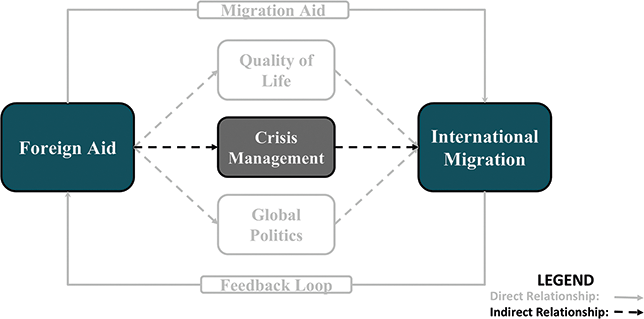
Before delving into the analysis, it is important to differentiate natural disasters from those caused by human activity. Natural disasters are events caused by natural processes of the Earth, such as hurricanes, earthquakes, floods, or volcanic eruptions. These events occur due to environmental forces and are often unpredictable, though their risks can sometimes be mitigated. Human-caused disasters, also known as anthropogenic disasters, result directly from human activities, such as industrial accidents, pollution, deforestation, or wars. At times, natural disasters are exacerbated by human activities. For example, human-caused climate change is leading to the intensification of natural weather events (Coronese et al., Reference Coronese, Lamperti, Keller, Chiaromonte and Roventini2019). Our analysis is applied to both natural and human-caused crises in this section.
It is also important to note that crises can have long-term effects on peace, prosperity, and stability. In this section, our primary interest is sudden-onset, high-intensity, large-scale disasters or crises, not on the changes in QoL that may follow (which we discussed in Section 4). For example, an outbreak of civil war may take the form of a short period of high-intensity conflict, which is followed by a longer period of low-intensity and scattered fighting that worsens public safety or economic stability for people living in the area. This section’s focus is on the initial period of highly intense conflict, which we can think of as the crisis, as opposed to the subsequent period of lower intensity fighting.
5.1 Crisis Management
A crisis is a sudden, catastrophic event that causes significant disruption, damage, or destruction to communities, infrastructure, the environment, and human lives. Crisis management, which refers to the organization and coordination of resources, responsibilities, and procedures to effectively respond to and mitigate the impacts of such crises, can be divided into four stages: prevention, preparedness, response, and recovery (FitzGerald et al., Reference FitzGerald, Tarrant, Fredriksen and Aitken2016). These stages are detailed in the subsections that follow.
5.1.1 Prevention
We begin with prevention, which requires the implementation of proactive, long-term strategies to reduce risks and vulnerabilities. These strategies include adopting international best practices, such as building codes and the construction of disaster-resistant infrastructure, diversifying economic resources to reduce dependence on vulnerable industries that are prone to damage during natural disasters, and establishing mechanisms for conflict mediation and peacebuilding to prevent civil conflicts from emerging or escalating. The goal of prevention is to stop a crisis from occurring by putting proper safeguards into place (see Tozier de La Poterie & Baudoin, Reference Tozier de La Poterie and Baudoin2015).
5.1.2 Preparedness
While prevention efforts should lower the probability of a disaster, they will not be effective in all cases. Thus, the next stage of crisis management is preparedness, which seeks to minimize the loss of life and property when crises occur. Preparedness measures include building early warning systems that enable timely evacuations, public education campaigns that teach communities how to respond when a crisis event strikes, and the coordination of various actors, such as governments, militaries, and nonprofit organizations, to prepare organized responses (Sutton & Tierney, Reference Sutton and Tierney2006).
5.1.3 Response
Once the crisis begins, the response phase launches with an immediate focus on providing relief for victims and communities. Responses include evacuation efforts, medical assistance, and search and rescue operations, as well as food, water, sanitation, shelter, and camp management (Feng & Cui, Reference Feng and Cui2021). Crucially, preparedness and response are connected, as the response will be more effective and efficient when responders are well prepared (Erbeyoğlu & Bilge, Reference Erbeyoğlu and Bilge2020). For example, well-coordinated relief efforts by international, public, private, and nonprofit organizations can help to ensure that resources are properly distributed to those in need during the response.
5.1.4 Recovery
The final stage of crisis management focuses on recovery efforts. These include rebuilding physical infrastructure, such as homes, roads, schools, and hospitals, as well as supporting human and social infrastructure through agricultural recovery, job training for those whose livelihoods were disrupted by the event, and reconciliation processes to build bridges between conflicting parties. The goal is a return to normalcy for crisis-stricken communities (Yuldashev, Reference Yuldashev2018).
5.1.5 Feedback Loop
The lessons learned from responding to and recovering from a crisis should feed back into subsequent prevention and preparedness work. Post-crisis recovery assessment researchers, committees, conferences, and public educational campaigns can facilitate social and institutional learning that prevents complacency when a crisis is not imminent (Comfort, Reference Comfort2023).
5.1.6 Migration at Each Stage
As discussed in the crisis migration literature (Martin et al., Reference Martin, Weerasinghe and Taylor2013, Reference Martin, Weerasinghe and Taylor2014; McAdam, Reference McAdam2013), each stage of crisis management corresponds to distinct migration dynamics. During the prevention and preparedness phases, migration tends to be limited and often anticipatory (see Franck & Turner, Reference Franck and Turner2025). For example, households may relocate preemptively or engage in temporary labor migration to diversify risk. In the response phase, migration is typically acute and involuntary, as populations flee disaster-affected areas (Drabo & Mbaye, Reference Drabo and Mbaye2015; Trinh et al., Reference Trinh, Feeny and Posso2021). The recovery phase may see return migration where reconstruction is effective and institutional trust is present or prolonged displacement and onward migration where recovery and trust falter (Ong et al., Reference Ong, Jamero, Esteban, Honda and Onuki2016; Reinhardt, Reference Reinhardt2015).
5.2 Crisis Management Aid
Low-income countries tend to have weak government capacity and few resources for crisis management (Jones et al., Reference Jones, Oven, Manyena and Aryal2014), making foreign aid a key source of revenue and expertise. Aid can contribute to crisis management at each of its stages, although giving tends to be highest in the response stage when the public’s attention is at its highest point. Weaver and Krishnan (Reference Weaver and Krishnan2016) report that $106.7 billion in foreign aid was dedicated to crisis relief in the period from 1991 to 2010, with around 66 percent going to emergency response, 22 percent to recovery, and 12 percent to preparedness.Footnote 32
5.2.1 Prevention Aid
When aid is deployed at the prevention stage, it aims to lower the vulnerability of people, their built and natural environments, and their livelihoods (Ward & Shively, Reference Ward and Shively2017). Donors can provide funds and expertise to help developing countries adopt best practices for fostering resilience, such as constructing earthquake-resistant buildings and designing infrastructure with effective flood drainage systems. Likewise, by strengthening public safety nets and diversifying economic resources, prevention aid aims to mitigate the effects of climate-related events like floods and droughts as well as anthropogenic disasters such as industrial accidents (Rajan, Reference Rajan2002).
Mitchell and van Aalst (Reference Mitchell and van Aalst2008) report that prevention aid fosters long-term stability and reduces the potential for population displacement caused by natural disasters. Other studies find that prevention aid can stop a civil conflict from occurring or keep it from escalating (Anderson, Reference Anderson1996), even when other conflict-inciting factors are present (Savun & Tirone, Reference Savun and Tirone2012).
5.2.2 Preparedness Aid
Preparedness aid invests in building resilient communities that can better withstand shocks when a crisis occurs (Islam & Walkerden, Reference Islam and Walkerden2015). It enables developing countries to create comprehensive plans for swift evacuations, casualty minimization, and protection of property. Specific projects may include early warning systems, public education programs, and emergency response training. Investments can also support technology infrastructure, such as communication systems, to facilitate faster crisis response and recovery, as well as training first responders and developing of military, government, and nonprofit coordination strategies to promote quick and organized responses.
This sort of aid has the potential to help countries lessen the impacts of crises. However, this is not assured. For example, preparation aid may inadvertently disincentivize recipient states from putting their own preparative measures into place. Poorer nations with weak political institutions are particularly prone to this crowding out effect (Raschky & Schwindt, Reference Raschky and Schwindt2016).
5.2.3 Response Aid
When a crisis occurs, foreign aid is critical in providing immediate humanitarian relief by helping affected populations with evacuation, search and rescue operations, and urgent medical care. Aid agencies can also provide essential resources such as food, water, sanitation, and shelter to displaced people, ensuring their basic needs are met. When managed well, donors coordinate with governments and NGOs to efficiently distribute aid, preventing chaos and supporting an orderly relief process. This is often managed by the UN Office of Coordination for Humanitarian Affairs in low-income, aid-dependent countries (Yuldashev, Reference Yuldashev2018).
Yet, response aid effectiveness is conditional, reducing the duration of disasters in some cases (De Ree & Nillesen, Reference De Ree and Nillesen2009) but extending it in others (Narang, Reference Narang2015). In particular, aid from donors that display high levels of context, coherence, capability, and consistency performs better than aid from donors that lack these characteristics (Brattberg & Rhinard, Reference Brattberg and Rhinard2013). This aligns with research showing that crisis responses are more likely to produce their intended outcomes when community consensus, stakeholder coordination, and preparedness are high (Drabek, Reference Drabek2005).
5.2.4 Recovery Aid
Recovery aid focuses on helping communities rebuild in the aftermath of a crisis to restore normalcy and prevent permanent population displacement (Paul et al., Reference Paul, Galasso and Baker2024). Aid at this stage supports the reconstruction of homes, schools, hospitals, roads, and other vital infrastructure. It also assists with the restoration of livelihoods by providing the seeds, tools, and resources necessary for agricultural and economic recovery, thereby rehabilitating industries disrupted by the crisis. In the case of certain human-made crises, these efforts may also focus on conflict resolution and reconciliation.
As is the case for aid at other crisis management stages, the effects of recovery aid are mixed (Kligerman et al., Reference Kligerman, Walmer and Bereknyei Merrell2017) and can be affected by conditioning factors (e.g., Girod, Reference Girod2012). For example, Ahmad et al. (Reference Ahmad, Shen, Boota, Liu and Ma2025) find that corruption and poor political institutions prevent post-disaster aid from reaching those who need it most. Likewise, Amhad and Ma (Reference Ahmad and Ma2020) find that some aid types are targeted better than others, with direct cash payments reaching intended recipients more readily than agricultural aid in post-flood Pakistan. When and where recovery aid is effective, it generates stability (Daly et al., Reference Daly, Mahdi and McCaughey2020) and social cohesion (Fearon et al., Reference Fearon, Humphreys and Weinstein2009). Yet such aid can also be insufficient for restoring precrisis conditions (Daly et al., Reference Daly, Mahdi and McCaughey2020) and it can even set the stage for subsequent incidents (Narang, Reference Narang2014).
5.3 Crisis Aid and Migration
We next consider how aid at each stage of crisis management affects migration flows from disaster-affected countries. We synthesize these effects in Table 3 and discuss them in the subsections that follow.
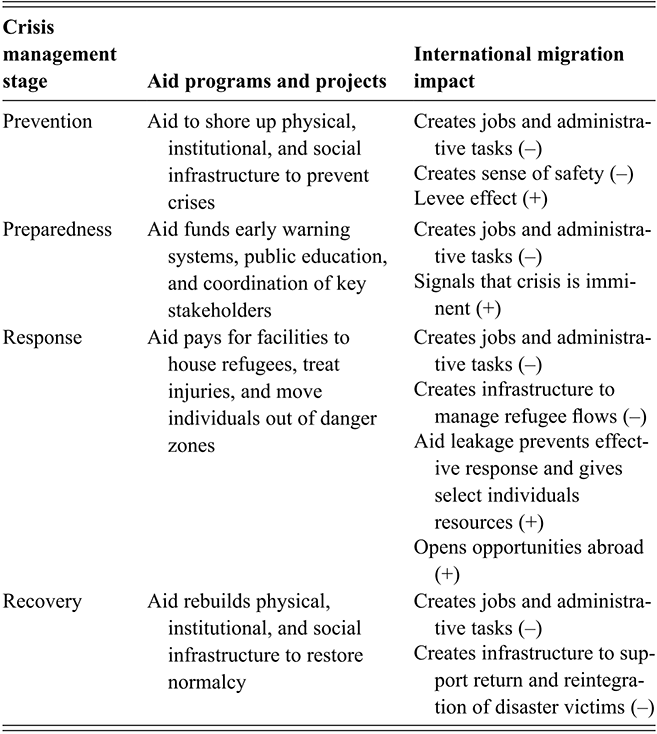
Table 3 Long description
The table presents three columns: Crisis Management Stage, Aid Programs and Projects, and International Migration Impact. It outlines how different types of aid interventions at each stage of crisis management influence migration, with effects marked as negative (reducing migration) or positive (increasing migration). Prevention stage aid focuses on strengthening physical, institutional, and social infrastructure to prevent crises. Migration impacts include the creation of jobs and administrative tasks (negative effect on migration), the creation of a sense of safety (negative), and a levee effect (positive), meaning that improved protection may encourage settlement in risk-prone areas, potentially increasing migration later. Preparedness stage aid supports early warning systems, public education, and coordination among key stakeholders. This creates jobs and administrative tasks (negative effect on migration), but also signals that a crisis may be imminent (positive), which can encourage people to migrate preemptively. Response stage aid funds facilities to shelter refugees, provide medical treatment, and evacuate individuals from danger zones. Migration impacts include job creation and administrative tasks (negative), and the development of infrastructure to manage refugee flows (negative). However, aid leakage, in which aid resources are diverted, can give some individuals the means to migrate (positive). Additionally, response efforts may open opportunities abroad (positive), increasing migration. Recovery stage aid is used to rebuild physical, institutional, and social infrastructure to restore normal conditions. This creates jobs and administrative tasks (negative), and develops infrastructure that supports return and reintegration of affected populations (negative), both of which reduce incentives to migrate. Overall, the table shows that aid can both reduce and increase international migration depending on the stage of crisis management and the specific mechanisms involved.
5.3.1 Prevention Aid and Migration
Prevention aid can be used by recipient states to build key infrastructure, ranging from sea walls for tsunamis to robust institutional safeguards against the proliferation of armed nonstate actors. This sort of aid should stop some individuals from emigrating by creating jobs for them to build or administer infrastructure projects (see Rentschler et al., Reference Rentschler, Avner and Hallegatte2025). Likewise, the adoption of prevention measures should send a signal to the population that a crisis is less likely to occur, stopping those with anxieties about local danger from moving to safer locations (Fornalé et al., Reference Fornalé, Armiero and Odasso2023). In these regards, prevention aid should be migration-deterring. Most importantly, effective prevention that stops a crisis from occurring altogether will preempt whatever emigration would stem from it.
That said, there is some danger that crisis prevention – and the aid that supports it – could be counterproductive in the long term, particularly if it stops smaller incidents but potentially creates the conditions for larger ones. This is known as the levee effect (e.g., Ferdous et al., Reference Ferdous, Wesselink, Brandimarte, Di Baldassarre and Rahman2019), where levees that are built to protect communities from frequent, small floods create a false sense of security, leading to increased development in flood-prone areas. Over time, water that would naturally spread out across floodplains is confined, which increases the pressure on levees. If they break, the water released can be much more destructive than if it had been allowed to follow its natural course in smaller, more frequent floods. When an extreme flood does occur, the resulting impact on migrant outflows could be quite large.
5.3.2 Preparedness Aid and Migration
Just like prevention aid projects, preparedness initiatives should employ individuals (see Folb et al., Reference Folb, Detlefsen, Quinn, Barron and Trauth2010), potentially creating jobs where there were shortages before and preventing those in search of work from looking elsewhere. And, of course, well-managed crises should bring softer impacts with fewer resulting refugees. Yet projects like these may also send the signal to local populations that a crisis is imminent (Watanabe & Fujimi, Reference Watanabe and Fujimi2025), thereby prompting some to preemptively move to a safer location. Thus, even as this sort of aid should be migrant deterring, it could accelerate emigration to a limited degree.
5.3.3 Response Aid and Migration
Response aid will, once again, create jobs for individuals in recipient countries, while also offering housing options for displaced people (typically) within national borders (Ganapati & Ganapati, Reference Ganapati and Ganapati2008). This should stop some individuals from moving abroad in reaction to the crisis. However, the context of a major crisis event is likely to be chaotic, providing opportunities for corruption and consequent aid leakage (Zafar et al., Reference Zafar, Rahman and Ammara2023). This may prevent the migration-deterring benefits of aid from being realized. It may also put aid in the hands of individuals who will use it to move themselves and those close to them to a safer place outside of the nation’s borders. Additionally, international aid agencies themselves may be a cause of out-migration, as they hire local people (often with significant education and skills) for staff positions that take them abroad (Lemay-Hébert et al., Reference Lemay-Hébert, Marcelin, Pillage and Cela2020). Even beyond those hired into the international development sector, the presence of aid agencies can make individuals in crisis-affected countries aware of opportunities abroad, which some will choose to pursue.
5.3.4 Recovery Aid and Migration
Finally, there is aid for the recovery stage, which may fund the reconstruction of physical infrastructure after a natural disaster or support conflict resolution initiatives in the aftermath of civil war. These sorts of aid projects will require staff, thereby creating jobs. More importantly, they should facilitate permanent resettlement for those in a state of flux that might otherwise decide to move to a new destination (Joshi & Nishimura, Reference Joshi and Nishimura2016). In this regard, recovery aid should be migration-deterring and perhaps even supportive of return migration (Muir et al., Reference Muir, Cope, Angeningsih and Jackson2020). There is a caveat, however, that when recovery aid funds reconstruction in an inappropriate or insensitive manner, it may not have the intended effects of promoting resettlement. This is exemplified by thousands of houses hastily built with funds from foreign aid donors in post-tsunami Indonesia, which sat largely uninhabited because they were built in an area likely to face additional extreme weather events and because the layouts were misaligned with local gender customs (Kitzbichler, Reference Kitzbichler2011; McCaughey et al., Reference McCaughey, Daly, Mundir, Mahdi and Patt2018).
5.4 Key Themes and Policy Implications
Two key themes emerge from our analysis, each with important policy implications. First, while large-scale crises attract significant aid inflows at the response and recovery stages, our analysis showcases the need for a multiphase crisis management approach in which more aid is provided in the prevention and preparation stages. Unfortunately, this is often hard to accomplish given human complacency, the short-term incentive structures of politicians, and political instability and institutional weakness in many developing countries (Birkland & Warnement, Reference Birkland, Warnement, Kapucu and Liou2014). Nevertheless, focusing aid projects on risk reduction and prevention activities in this more comprehensive manner is likely to reduce the negative impacts of catastrophic events as well as the international migrant flows that accompany them. Crucially, aid at these stages should be carefully applied to prevent the levee effect or a signal of impending disaster.
Second, aid projects for crisis management must be designed to adequately align with local conditions, including local norms and values. If projects are not designed appropriately, then they are unlikely to have the intended effects, as we saw in post-tsunami Indonesia. In some cases, they may even exacerbate crisis vulnerability, as illustrated with the levee effect concept.
5.5 Future Research
Going forward, researchers should conduct three sets of empirical analyses to further assess the ways that crisis management mediates the aid–migration nexus. First, scholars should disaggregate foreign aid to distinguish crisis-specific aid from other aid that is routinely leveraged in crisis settings. Do these distinct aid types have similar impacts on the migration decisions of disaster victims and disaster-affected communities? In addition, researchers can disaggregate crisis aid itself according to the four stages of crisis management to clarify how each relates to the international movement of people.
Next, researchers should analyze distinct types of crises and disasters. They can begin by differentiating anthropogenic from natural disasters, and then consider different sorts of crises in each category. Does aid provided in the context of civil wars lead to migration through the same pathways as aid for earthquakes? Do earthquake and hurricane aid follow the same patterns? Teasing these dynamics out should be a priority going forward.
Finally, migration can be disaggregated. For example, urban populations may respond to crises and crisis aid differently than rural populations. By the same token, people close to a foreign border may be more likely to migrate internationally than those at a greater distance. Higher-income individuals may also be more likely to migrate than those with lower incomes, since they have the resources to do so. Researchers should consider various other differentiations as well, including gender, race, and sexual orientation.
6 The Global Politics Pathway
While Sections 4 and 5 focused on the idea that aid can mitigate push factors that would otherwise encourage or force the movement of people, such as poor economic prospects and natural disasters, this section considers how foreign aid affects migration via its impacts on international political relations (see Figure 6). The political nature of aid, which is often disbursed by donor states with the intention of advancing their geostrategic interests (Essex, Reference Essex2013), is central to this analysis. This takes on particular importance in the global political context of the early twenty-first century, as the return of great power politics has led to a renewed emphasis on geoeconomics (see Wigell et al., Reference Wigell, Scholvin and Aaltola2019).
The global politics pathway.
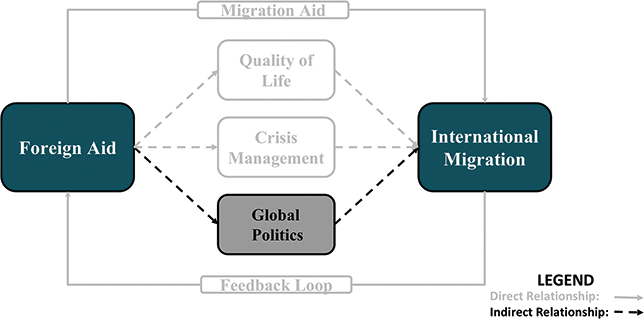
Figure 6 Long description
The conceptual framework illustrates the relationships between foreign aid and international migration. Two large boxes on the left and right represent Foreign Aid and International Migration, respectively. Between them are several intermediary pathways. At the top, a direct pathway labeled Migration Aid connects foreign aid directly to international migration. Between foreign aid and international migration, three indirect pathways appear in the center: Quality of Life, Crisis Management, and Global Politics. Dashed arrows indicate indirect relationships linking foreign aid to these intermediary factors and from them to international migration. The Global Politics pathway is visually emphasized relative to the others. At the bottom, a feedback loop connects international migration back to foreign aid, illustrating that migration outcomes can influence future aid decisions. A legend distinguishes direct relationships (solid arrows) from indirect relationships (dashed arrows).
6.1 The Geopolitical Interests of States
International relations theory tells us that states prioritize their power and security. This often involves controlling key resources, securing vital territories or trade routes, and shaping international alliances and political systems to protect and promote their strategic priorities (see Flint, Reference Flint2021). States project their geopolitical power by means of hard and soft power tools. Hard power refers to the use of coercion and force through military and economic strength. States may project hard power by maintaining global and regional military presences, imposing economic sanctions, and controlling key resources like oil and gas (Lemke, Reference Lemke and Flemes2010). Soft power is the ability to attract and co-opt through culture, diplomacy, and political influence. It relies on shaping global norms and values through cultural exports and diplomatic efforts rather than direct force (Nye, Jr., Reference Nye1990).
6.2 Geopolitical Aid
States often deploy economic tools in service of their geopolitical objectives and goals (Blackwill & Harris, Reference Blackwill and Harris2016), including foreign aid (Gamso, Reference Gamso, Aggarwal and Ming2025). Geopolitical aid is provided with the specific aim of advancing the donor country’s strategic interests and expanding its influence. While we are not aware of any official statistics or empirical analyses that have quantified the Element and proportion of geopolitically focused aid, there is a sizeable empirical literature connecting foreign aid to donors’ hard and soft power projections (Heidland et al., Reference Heidland, Michael, Schularick and Thiele2025).
Hard power aid seeks to bolster the coercive capabilities of a recipient country to boost its defense and deterrence outcomes in alignment with the donor’s security interests. One major component of hard power aid is the transfer of technology and weapons to create security dependence while strengthening the recipient’s military. These transfers often include fighter jets, missile defense systems, and surveillance technology, alongside the technical knowledge required to operate and maintain these assets. For instance, Western countries have provided Ukraine with billions of dollars in military aid since Russia’s 2022 invasion.Footnote 33 While this aid supports Ukraine’s defense, it also advances the geopolitical interests of donor states that wish to keep Ukraine under their control while containing Russia.
A second component of hard power aid is capacity building, which focuses on developing the recipient country’s military infrastructure and institutional capabilities. This includes training military personnel, enhancing intelligence systems, and improving operational strategies. To this end, donor countries often send military advisors to the recipient nation or conduct joint exercises with its military. For example, the US has sent hundreds of military advisors to Taiwan in the 2020s to provide training and to support structural reforms (Feng, Reference Feng2023). This aid strengthens Taiwan’s defensive capabilities, but so too does it serve US geopolitical interests by impeding China’s ability to carry out a military campaign that would expand its presence in the Pacific.Footnote 34
Soft power aid focuses on building long-term influence through cultural, educational, and political channels. Soft power aid can support public or private diplomacy. Public diplomacy programs, which seek to improve public perception of the donor country, often take the form of scholarships, cultural exchange opportunities, or language training. For instance, China’s Confucius Institutes at universities around the world enhance its soft power by promoting Chinese language and culture (Li, Reference Li2025). More generally, donors regularly provide aid in hopes of building public support (Blair et al., Reference Blair, Marty and Roessler2022), spreading their social and political norms (Scott & Carter, Reference Scott and Carter2019; Zhang & Huang, Reference Zhang and Huang2023), and even advancing certain religious beliefs (Cooper, Reference Cooper2015).
Private diplomacy aid similarly seeks to improve perceptions of the donor nation, but it is aimed at elites, as opposed to the public. Such aid may take the form of scholarships, training programs, or exchanges for members of the recipient state’s government, military, or business leaders. It could also include direct support for policymakers, powerful families, or political factions, or for institutions or sectors that are aligned with elite interests. These programs foster personal relationships between donor and recipient country elites, potentially aligning recipients’ interests with donors’ geopolitical goals.
6.3 Pathways from Geopolitical Aid to Migration
In this section, we propose the impacts that each type of geopolitical aid has on international migration. This is summarized in Table 4 and detailed in the pages that follow. Crucially, while the independent variable of interest remains foreign aid, its effects on migration often operate indirectly through political and perceptual channels. Geopolitical aid can shape migration both by creating linkages that facilitate movement (through institutional alignment, elite networks, or cultural familiarity) and by provoking reactions that constrain it (through public or elite backlash). These intervening mechanisms, which are rooted in public attitudes, elite calculations, and domestic political responses, mediate the aid–migration relationship, rather than constituting distinct causal forces.
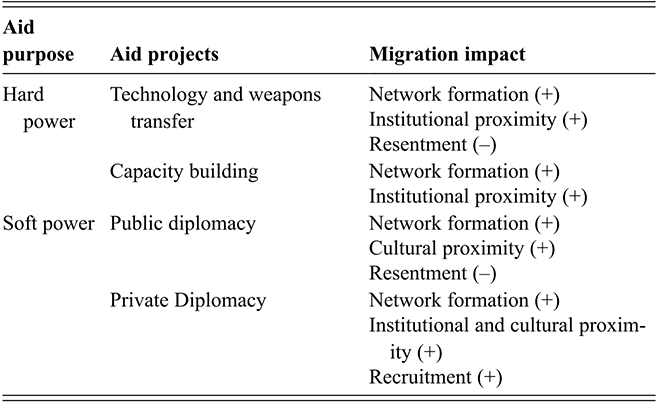
Table 4 Long description
The table has three columns: Aid Purpose, Aid Projects, and Migration Impact. It distinguishes between hard power and soft power forms of aid and outlines how specific projects influence migration. Two types of hard power projects are listed. First, technology and weapons transfer is associated with increased migration through network formation (positive) and institutional proximity (positive), but may also generate resentment (negative), which can reduce migration. Second, capacity building similarly promotes network formation (positive) and institutional proximity (positive), both of which facilitate migration. Two types of soft power projects are also listed. First, public diplomacy fosters network formation (positive) and cultural proximity (positive), both of which increase migration, but may also produce resentment (negative), which can reduce migration. Second, private diplomacy encourages network formation (positive), institutional and cultural proximity (positive), and recruitment (positive), all of which increase migration. Overall, the table shows that both hard and soft power aid can promote migration by strengthening networks and various forms of proximity, while in some cases generating resentment that may reduce migration.
We begin with hard power aid that transfers technology and weapons or helps to build the recipient’s military capacity. This aid can foster relationships between individuals from donor and recipient countries, as military leaders and personnel collaborate professionally and socialize with one another. These networks could, in turn, facilitate migration between nations (Bagchi, Reference Bagchi2001; Munshi, Reference Munshi2020). Additionally, these sorts of aid projects can reduce institutional distance between countries, as militaries and military adjacent industries align their structures and practices with one another. Heightened institutional proximity should encourage employment-based movement between nations (Belot & Hatton, Reference Belot and Hatton2012), particularly as the skills and experiences of individuals in recipient countries more closely match those demanded by the military bureaucracies of donor nations. In this way, military and security assistance can be seen as integrative mechanisms: forms of aid that bind states together through shared practices, norms, and personnel flows, lowering the social and institutional costs of migration.
Soft power aid can also promote migration. Aid for public diplomacy supports the formation of relationships, as aid workers meet and develop bonds with local people (see Eyben, Reference Eyben2006). These networks can ease the process of migration, as individuals have friends and associates that they can reach out to or rely on as they move from the recipient to the donor country – or vice versa (Boyd, Reference Boyd1989). Likewise, familiarity and warm sentiments toward the donor’s culture and language can encourage and ease bilateral migration (Lanati & Venturini, Reference Lanati and Venturini2021). Private diplomacy can have similar effects, forming networks and fostering closer cultural understandings between elites in donor and recipient nations (see Kassenova, Reference Kassenova2022). Private diplomacy may also lead to labor migration, as it forges institutional proximity (Neumayer, Reference Neumayer2008) while also facilitating talent recruitment at the elite level (see Czaika, Reference Czaika2018). Together, these forms of aid create personal, institutional, and cultural bridges that normalize movement between donor and recipient nations.
However, geopolitical aid can also trigger disintegrative feedback effects that dampen migration by fostering alienation or backlash. On the donor side, resentment may arise when large segments of the population perceive strategic aid to be a misuse of taxpayer money (Prather, Reference Prather2024). While all foreign aid is open to such critiques, assistance deployed for the purposes of building military alliances or funding cultural exchanges for diplomatic gains can be particularly contentious, as citizens question the value of investing significant resources in foreign militaries or in overseas cultural projects against the backdrop of domestic needs (Liu & Shao, Reference Liu and Shao2022). This corresponds to a form of mass-level backlash, where citizens, perceiving overreach abroad, turn inward (see Ketzer, Reference Ketzer2013). This sentiment can become more pronounced if the media or political figures emphasize the disparity between local hardships and the government’s international ambitions. Domestic discontent with international relations often generates a preference for isolationism (Bonifai et al., Reference Bonifai, Rudra, Bulding and Moya2022), including restrictive immigration policies (Kim, Reference Kim2024). A reduction in the number of migrants welcomed or accepted to the donor country is likely to follow, as policymakers align with a disgruntled and isolationist public (Ko & Choi, Reference Ko and Choi2022). This represents a mass backlash channel, in which public opinion pressures elites to enact foreign policy retrenchment, including migration restriction (see Hainmueller & Hopkins, Reference Hainmueller and Hopkins2014).
For example, after the 2003 invasion of Iraq, the US deployed billions of dollars in strategic aid to stabilize the country and shape its trajectory. This included military aid aimed at ensuring security and influencing political outcomes, as well as substantial reconstruction funds to rebuild infrastructure, support civil society, and promote democratic institutions.Footnote 35 Over time, the prolonged military engagement and its significant financial and human costs sparked backlash within the US (Jacobson, Reference Jacobson2010; Karol & Miguel, Reference Karol and Miguel2007). Critics argued that the immense resources devoted to Iraq should be redirected toward domestic priorities, especially following the 2008 financial crisis (e.g., Stiglitz & Bilmes, Reference Stiglitz and Bilmes2008). Domestic backlash coincided with and contributed to heightened security concerns and xenophobia toward Middle Eastern immigrants in the US, complicating immigration policies (Love, Reference Love2017) and leading to stricter visa requirements and enhanced security screenings for individuals from Iraq and neighboring countries (Epatko, Reference Epatko2011). These factors combined to produce a more scrutinized and cautious approach to the inflow of migrants from the region (Wasem, Reference Wasem2020). This sequence illustrates both mass- and elite-level backlash: popular discontent constrained policymakers, while strategic fatigue prompted foreign policy retrenchment and tighter migration control.
A similar dynamic has followed Russia’s 2022 invasion of Ukraine. In the aftermath of the invasion, the US and EU began sending large amounts of military aid to Ukraine,Footnote 36 while simultaneously opening their borders to Ukrainian refugees (Faiola et al., Reference Faiola, Noack and Adam2022; Jordan et al., Reference Jordan, Kanno-Youngs and Shear2022). Yet over time public backlash emerged against the policy of supporting Ukraine (Telhami, Reference Telhami2023), with some politicians and media personalities arguing that their respective countries should stay out of the conflict (Dutkiewicz & Stecula, Reference Dutkiewicz and Stecula2022; Pengelly & Borger, Reference Pengelly and Borger2023) and others going so far as to blame Russia’s invasion on Western support for Ukraine (Blake, Reference Blake2022). These sentiments have been accompanied by a pushback against the policies welcoming Ukrainian refugees in Europe (Koc, Reference Koc2024) and immigrants and refugees more generally in the US (Santhanam, Reference Santhanam2024). Here too, the cycle of strategic engagement and domestic fatigue created disintegrative effects, weakening support for both aid and migration.
Foreign aid can also foster negative attitudes in recipient countries toward donors (Blair et al., Reference Blair, Marty and Roessler2022). This can reflect the distributional impacts of aid, as those who are adversely impacted by aid inflows turn against the donor (Tokdemir, Reference Tokdemir2017). It can also reflect feelings that aid is being used to subvert or control the recipient’s politics, economy, or society (Carnegie & Dolan, Reference Carnegie and Dolan2021). This sentiment was evident in Pakistan, where US counterterrorism and stabilization aid was often seen by locals as a way for the US to exert undue influence (Haqqani, Reference Haqqani2013). Such resentments could offset whatever migration-stimulating effects aid produces, while generating hostility toward migrants from the donor country. Indeed, anti-American sentiment has been pervasive in Pakistan, likely stemming at least in part from anger against perceived US interference in the country’s politics and society (Pew Research Center, 2012). These dynamics capture how aid can activate disintegrative mechanisms abroad, eroding trust and inflaming nationalism in ways that diminish migration.
In addition, hard power aid can stimulate emigration when it is provided to authoritarian leaders that use it to consolidate power – driving political, religious, and ethnic minorities out. For example, US provision of military and counterterrorism aid in Central Asia after 9/11 was used by the region’s authoritarian leaders to target their domestic political opponents (Cooley & Heathershaw, Reference Cooley and Heathershaw2017), leading opposition figures and ethnic minorities to seek exit. Similarly, military aid provided to the Mubarak regime in Egypt was used in a manner that pushed out the regime’s opponents (Brownlee Reference Brownlee2012).
In sum, geopolitical aid operates through both integrative and disintegrative mechanisms. Integrative channels, such as elite linkages, institutional alignment, and cultural familiarity, tend to increase bilateral migration, while disintegrative channels rooted in mass or elite backlash can suppress it. The balance between these forces likely depends on domestic political conditions, perceptions of fairness or overreach, and the broader geopolitical context.
6.4 Future Research and Policy Implications
Our analysis has weaved together several strands of literature to connect the dots between geopolitical aid and international migration. Future research should test these relationships empirically. If connections are found to exist, then researchers should scrutinize the underlying mechanisms that we have offered to assess their validity. Scholars that specialize in qualitative research are especially well-suited to this latter effort.
For policymakers, the challenge will be balancing strategic objectives with migration management when deploying geopolitical aid. Our analysis suggests that aid provided for this purpose will primarily have a migration-enabling effect, meaning that policymakers need to carefully consider when and how to use aid in contexts where increased migration might generate domestic backlash or strain immigration systems. In cases where governments are seeking to decrease immigration rates, alternative geoeconomic tools such as trade agreements or investment partnerships might achieve similar strategic outcomes without stimulating international movement.
7 The Feedback Loop
Whereas prior sections described the pathways by which foreign aid affects the movement of people, this section considers the inverse: How immigration affects the provision of foreign aid. In the context of our conceptual framework, this constitutes a feedback loop: Changes in immigration lead to changes in aid provision, which in turn affect international migration rates through the pathways discussed in prior sections. See Figure 7.
The feedback loop.
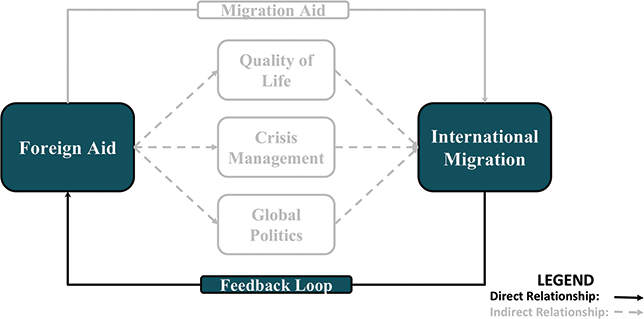
The pages that follow explore this feedback loop further. We begin by discussing the influence of diaspora communities on foreign giving. We then consider an alternative pathway, by which the presence of immigrants prompts nationalist backlash that leads to aid reduction. The section closes with key themes, policy implications, and avenues for future research.
7.1 Diasporas and Foreign Aid
Diasporas contribute to their host societies by providing diverse skills, filling critical labor market gaps, and fostering cultural richness. In many advanced economies, they play key roles in technology, healthcare, academia, and entrepreneurship, driving innovation and economic growth (see Saxenian, Reference Saxenian2006). Moreover, the unique perspectives they offer enrich the social fabric of host nations, enhancing vibrancy and global appeal (Horst & Olsen, Reference Horst and Olsen2021).
Simultaneously, they maintain strong ties with their countries of origin, channeling various forms of investment and knowledge back home (Kleist, Reference Kleist2008; Wickramasekara, Reference Wickramasekara and Triandafyllidou2022). Remittances and the transference of skills through return migration have received particular attention (e.g., Galstyan & Ambrosini, Reference Galstyan and Ambrosini2023; Khan & Merritt, Reference Khan and Merritt2020; Poirine & Dropsy, Reference Poirine and Dropsy2019), but diaspora communities can also support home country development through their influence over foreign aid (Brinkerhoff, Reference Brinkerhoff, Picard, Groelsema and Buss2008).
There are at least two ways in which diaspora communities affect aid. The first is by providing private aid directly. Many members of the diaspora engage in philanthropic efforts, funding education, healthcare, and disaster recovery initiatives in their home countries. For example, Afsal and Reshmi (Reference Afsal and Reshmi2023) explore philanthropic giving from members of India’s diaspora community in the Persian Gulf region.Footnote 37
Beyond direct financial contributions, diasporas often advocate for their home countries within the political systems of their host nations (Bermeo & Leblang, Reference Bermeo and Leblang2015), lobbying for increased ODA, military assistance, or other support. For example, as noted in Section 1, the Somali diaspora in Norway has been credited with Norway’s establishment of a donor trust fund to Somalia (Tellander & Horst, Reference Tellander and Horst2019). Likewise, lobbying efforts by the Armenian diaspora in the US have led Armenia to receive more aid and Azerbaijan to receive less (Zarifian, Reference Zarifian2014).
While the examples here showcase diasporas that have bolstered giving to their home countries, this may not be reflective of a wider trend. Aid stemming from the efforts of diaspora communities could have a substitution effect, whereby donors decrease other support to the diaspora’s home country because they perceive that needs are already being met through diaspora-induced aid. It is also important to note that not all diaspora communities attempt to lobby or are successful in the efforts that they do undertake (Prasad & Savatic, Reference Prasad and Savaic2023) – not least of all because not all migrants can vote in host countries.
7.2 Positive and Negative Feedback Loops
Diaspora communities, by advocating for or directly contributing to aid efforts, can affect the flow of resources from their countries of residence to their countries of origin. This aid may be used to bolster human development, disaster management, and the geopolitical objectives of donors. As we have discussed in prior sections, aid directed toward these areas can impact international migration. Thus, migration affects aid flows and these aid flows then influence further migration, forming an ongoing cycle. This feedback loop highlights the interconnectedness of migration and foreign aid, where each has the potential to shape and reinforce the other over time.Footnote 38
Feedback loops can be positive or negative and this one is no different. A positive feedback loop drives a system further in the same direction, as occurs when migration leads to increases in foreign aid and that aid then encourages further migration. For example, diaspora-driven development aid improves educational outcomes, builds roads and bridges, and raises household income that can meaningfully increase residents’ capacities for international mobility, as they become more informed, gain access to new locations of opportunity, and obtain the material means to travel. Network dynamics will lead many of those that do emigrate to settle in the donor countries where their diaspora communities are located. The consequent expansion of the diaspora further reinforces the cycle.
Alternatively, the feedback loop could be negative, such that international migration is stabilized or reduced as a result of diaspora aid. For example, aid that promotes political development by dampening corruption and enhancing political representativeness should discourage migrant outflows as people feel more satisfied where they are. Likewise, diaspora aid in the aftermath of a major crisis could fund reconstruction that allows people to return to their homes. Such negative feedback loops create a self-correcting effect on international migration (Jolivet, Reference IJolivet2015).
In some cases, diaspora aid may initially increase migration, in keeping with a positive feedback loop, before stabilizing it over time in the fashion of a negative feedback loop. For example, public diplomacy aid provided to improve relations between the diaspora group’s home and host countries could lead to increases in bilateral migration as recipients become more acculturated to the donor’s language and culture, constituting a positive feedback loop. Yet a backlash could ensue over time, as recipients sour on what they believe are efforts to infringe on national sovereignty and identity. As backlash sets in, migration between donor and recipient countries may decline, amounting to a negative feedback loop. Such double feedback loops can vary across time and space, which helps to explain the rise and fall of migration patterns for particular groups (De Haas, Reference De Haas2010).
7.2.1 Political Feedbacks and Aid Retrenchment
While the efforts of diaspora communities can expand aid flows, immigration can also generate political reactions that push aid in the opposite direction. As discussed in earlier sections, mass migration has fueled support for nationalist and populist movements that favor foreign policy retrenchment (Alesina & Tabellini, Reference Alesina and Tabellini2024), including reductions in foreign aid (Hackensch et al., Reference Hackenesch, Högl, Öhler and Burni2022; Kiratli, Reference Kiratli2021; Suzuki, Reference Suzuki2023). These dynamics constitute a second type of feedback loop driven by mass-level backlash.
In donor countries, large or rapid increases in immigration can heighten public anxieties about cultural change, economic competition, or security (see Wright & Esses, Reference Wright and Esses2019). Right-wing and populist parties have frequently capitalized on such sentiments by framing foreign aid as a misuse of national resources, arguing that funds should instead be spent on domestic priorities (Hackenesch et al., Reference Hackenesch, Högl, Öhler and Burni2022; Moynihan & Zuppke, Reference Moynihan and Zuppke2025). This logic transforms migration pressures into political momentum for cutting aid budgets or redirecting aid away from humanitarian or development goals toward border security and migration deterrence.
For example, Donald Trump, who found electoral success in part due to anti-immigration attitudes in the US (Reny et al., Reference Reny, Collingwood and Valenzuela2019), effectively closed USAID in 2025 (Moynihan & Zuppke, Reference Moynihan and Zuppke2025). In Europe, far-right parties such as the Alternative für Deutschland in Germany, the Alliance for the Future of Austria in Austria, the Swiss People’s Party in Switzerland, and the Party for Freedom in the Netherlands have similarly advocated aid reductions (Bayram et al., Reference Bayram, Schneider, Faust and Thomas2024; Suzuki, Reference Suzuki2023). Likewise, proponents of the Brexit campaign in the UK argued that EU aid obligations undermined national control (Bayram et al., Reference Bayram, Schneider, Faust and Thomas2024). Across these cases, migration has indirectly influenced foreign aid through electoral backlash and elite realignment.
7.3 Key Themes, Policy Implications, and Future Research
Through direct financial contributions and by lobbying for ODA and other forms of support, diasporas can significantly affect the foreign aid landscape. At the same time, international migration can generate countervailing political pressures within donor countries, as rising immigration sometimes fuels populist or isolationist movements that call for reductions in aid. The result is that migration can influence aid in two competing ways: through expansive feedback that increases aid via diaspora mobilization and through restrictive feedback that decreases aid via backlash politics. Which feedback dominates will depend on contextual factors, such as partisan alignment, media framing of migration, and broader public attitudes toward globalization.
By coordinating with diaspora communities, policymakers can shape these feedback loops to align with broader social and economic objectives. For instance, host country governments can collaborate with diaspora groups to send aid that encourages migration when labor shortages or demographic challenges are present. Conversely, in contexts where slowing immigration is preferable – such as during migration surges that strain resources – policymakers can work with diaspora communities to direct aid toward initiatives that are likely to slow migration from recipient countries.
Future research should explore the migration–aid–migration cycle further to determine when and how feedback loops occur. In doing so, scholars should conduct longitudinal studies to better understand their dynamic nature – that is, how they may shift from positive (negative) to negative (positive) over time. Future research should also examine how diaspora-driven and backlash-driven feedback loops intersect with donor country dynamics, identifying the political and economic conditions under which each mechanism prevails.
8 Conclusion
Against the backdrop of rising economic nationalism and a retreating international development regime, this Element has offered a conceptual framework for understanding the relationship between foreign aid and international migration. In doing so, it has provided what we believe to be a comprehensive set of pathways by which aid and migration are linked to one another. The clarity we offer should help to structure a literature that has, up to this point, been characterized primarily by empirical studies producing fragmented results from which it is difficult to derive substantive or policy-relevant findings. We hope our analysis will support more analytically grounded research and enable policymakers to adopt holistic and theoretically informed approaches to aid policy and migration management when foreign aid inevitably returns to the forefront of international policy debates.
Crucially, our work bridges divides by bringing together concepts and frameworks from development studies, disaster management, and international relations. Foreign aid is inherently political, even as it supports economic development and comes to the rescue in times of crisis. This means that understanding the aid–migration nexus will require contributions from scholars in a host of areas, while conducting aid-oriented migration policies will draw in representatives of various agencies and priority areas.
This concluding section undertakes four tasks. First, we reiterate the model, reflecting on its boundaries and potential extensions. Next, we discuss key themes and policy implications. Third, we consider the next steps for researchers to build on our analysis. We close with a call for action, urging scholars and policymakers to draw on the framework and push it forward with refinements and improvements.
8.1 Framework Boundaries and Extensions
This Element has introduced and detailed a conceptual framework for understanding the complex and multifaceted relationship between foreign aid and international migration. It proposes one direct pathway (migration aid) and three indirect pathways (QoL, crisis management, and global politics) by which aid impacts migration, as well as a feedback loop pathway by which migration affects aid. We believe that this analysis offers a holistic assessment of the aid–migration nexus and that the pathways are comprehensively exhaustive.
That having been said, there are at least two important issues that fall outside the scope of our analysis. First, the number of cross-border migrants that are (or could be) compelled to move or deterred from doing so by foreign aid is small as a share of the total global movement of people. They are primarily moving from low- and middle-income countries in response to push or pull factors that could be stimulated by aid. While this may be a large group of people in numerical terms, it is just a sliver of the many individuals that move between and within countries. Second, our focus on foreign aid means that the multitude of other factors that contribute to the international movement of people is largely outside the scope of this Element. Even if we limit the discussion to cross-border economic transfers, the roles of trade, foreign investment, and remittances are not considered.
We believe that the framework could be applied to the internal movement of people within countries, as funds from foreign aid donors and national governments probably affect urbanization rates, movement across subnational borders, and other facets of within-country migration. While the model might need to be tweaked in some regards, its foundational principles and core pathways are generally applicable (see Cattaneo et al., Reference Cattaneo, Christiaensen, Rutkowski and Cullen2022). Likewise, the same sort of exercise that we have undertaken could be carried out to systematically assess the trade–migration or remittances–migration nexuses.
A larger challenge is the changing policy landscape. The liberal international order that underpinned the expansions of aid and migration has been eroding. In many Western donor countries, nationalist governments have curtailed development budgets and tightened migration controls, exemplified most starkly by the suspension of USAID in 2025. At the same time, emerging and nontraditional donors such as China, India, Brazil, and several Gulf states have expanded their development engagement. These new actors operate according to different logics of conditionality and political alignment, reflecting how the goals, norms, and institutional architectures of aid are evolving in a postliberal era of global politics. We hope that the analysis provided in this Element will help policymakers in this new aid era to avoid some of the mistakes that characterized the previous one.
8.2 Key Themes and Policy Implications
Several key themes and policy implications emerge from our analysis, corresponding both to individual components of the framework and to the framework as a whole. Component-specific takeaways have been highlighted in the preceding sections, so we focus here on three overarching themes that stand out.
First, while policymakers have tended to focus on the potential for aid to reduce international migration through its impacts on QoL, our analysis reveals several additional pathways. Moreover, within each pathway, there are multiple potential relationships between aid and migration, with some positive and others negative. This speaks to the complex nature of the aid–migration nexus, but it also offers a host of avenues by which policymakers can leverage aid to manage migration flows.
Second, aid for migration management may be deployed proactively to prevent migration surges or reactively when surges are already underway. Proactive strategies seek to improve livelihoods, stability, and resilience in aid-recipient countries, supporting development outcomes while alleviating push factors that would otherwise encourage migrant outflows. In contrast, reactive strategies seek to constrain the movement of people or to mitigate the impacts of crises already underway. Such efforts, while at times politically expedient, do little to address the root causes of migration.
Third, policy design can enhance or weaken aid effectiveness, with implications for international migration. Aid projects that are designed and implemented in coordination with local stakeholders are far more likely to achieve meaningful results than those that are not. Learning and adjusting in light of earlier aid efforts is also crucial to improving aid policy design over time.
8.2.1 Normative Implications and Emerging Actors
Using foreign aid as a tool for migration management raises important normative questions about the purpose and ethics of aid itself. Development assistance has traditionally been justified on humanitarian grounds, intended to promote welfare, stability, and self-reliance in recipient countries. Yet when aid is explicitly linked to migration control, the line between humanitarianism and self-interest can blur. Critics argue that instrumentalizing aid to deter migration risks subordinating the needs of vulnerable populations to the political priorities of donor states, potentially compromising the integrity of development policy and hindering movement (e.g., Christensen & Simon, Reference Christensen and Simon2024). At the same time, some contend that managing migration through aid can be ethically justified if it prevents dangerous, irregular journeys and contributes to stability in sending regions (e.g., Gamso & Yuldashev, Reference Gamso and Yuldashev2021a). These debates underscore that aid policy cannot be assessed solely on utilitarian grounds, as questions of fairness, accountability, and consent remain central to the legitimacy of aid–migration strategies.
A further consideration is the role of nonstate actors, whose growing influence complicates traditional notions of donor–recipient relationships. NGOs, faith-based organizations, and private philanthropies often operate across borders and may pursue objectives that differ from those of state donors (Adelman, Reference Adelman2009; Youde, Reference Youde2019). For example, philanthropic organizations often prioritize human rights protections and rights over migration deterrence (Illingworth, Reference Illingworth, Beck, Hahn and Lepenies2020). The expansion of digital technologies has also allowed diaspora groups, foundations, and even corporations to engage in transnational giving and advocacy at an unprecedented scale. These nonstate actors can amplify or counterbalance state-led aid strategies, introducing pluralism and fragmentation into the global aid–migration landscape (Desai & Kharas, Reference Desai and Kharas2018).
Finally, the rise of new sovereign donors has begun to reshape the global aid architecture in ways that challenge long-standing Western norms (Chin & Quadir, Reference Chin and Quadir2012). Their growing role introduces new dynamics into the aid–migration nexus. For example, development projects financed through China’s Belt and Road Initiative may generate localized employment that reduces outward migration, while Gulf-funded programs can reinforce labor migration corridors that sustain remittance flows. As Western states cut back on giving and move toward securitized migration policies, these nontraditional donors will increasingly fill the gap – albeit guided by distinct motives and models of cooperation. The result is a more multipolar and contested aid regime, in which the relationship between aid and migration will be shaped as much by emerging powers and private actors as by established donors.
8.3 Avenues for Future Research
The framework developed in this Element provides a basis for theorizing how different types of aid operate through distinct causal pathways to shape migration outcomes. Advancing this framework will require studies that unpack the mechanisms within and across categories, specify the conditions under which different effects occur, and examine how feedback loops evolve over time. Greater theoretical precision will allow researchers to move beyond general claims that aid affects (or does not affect) migration toward a more systematic understanding of when, how, and for whom such effects arise.
Empirical research should begin by quantifying aid flows across the categories identified here: migration, QoL, crisis, and geostrategic. Understanding the proportions of aid allocated to each type and how these proportions vary across regions and over time will provide critical data for further analyses. The next step is to begin testing of the proposed relationships. At the macro level, large-scale analyses using tools such as Structural Equation Modeling or Complex Adaptive Systems can help model the framework as a whole, allowing researchers to examine the collective influence of various aid types on migration patterns. At the meso level, researchers could develop indices that classify aid projects into our broader categories, which can then be used to evaluate the impacts of specific aid types on migration trends.
At the micro and meso levels, qualitative methods can play equally important roles. Comparative case studies, fieldwork, and elite interviews can illuminate how aid projects are designed, perceived, and implemented in ways that shape migration incentives. For example, process tracing can uncover how a specific aid intervention in agriculture or education changes migration aspirations over time, while ethnographic work can reveal how recipient communities interpret and respond to donor priorities. Similarly, discourse and content analyses of donor communications, NGO reports, or media coverage can shed light on how aid and migration are framed in public and policy debates.
Empirical researchers may also wish to conduct region-specific studies – either to understand regions on their own terms or for comparative purposes. For example, aid may have different sorts of effects on emigration from the MENA region than from South and Central America, owing to distinct political, economic, and cultural conditions. Paired or nested case studies could help reveal the mechanisms underlying these regional differences, identifying how institutional capacity, political culture, or donor–recipient relations mediate the effects of aid on migration. Conditioning variables could also be studied in a large-N context by considering whether different aid types amplify or mitigate one another’s effects on migration, or how institutions in donor or recipient countries moderate relationships between aid and migration.
Additionally, future studies should consider how evolving aid architectures influence these dynamics. The growing roles of nontraditional donors, private foundations, and multilateral initiatives may not fundamentally change the mechanisms linking aid and migration, but they do alter the context in which those mechanisms operate. Qualitative research can be especially valuable in tracing how these new actors negotiate legitimacy, pursue partnerships, and shape perceptions of aid effectiveness in local contexts. Exploring how emerging configurations intersect with established pathways can help ensure that conceptual models of the aid–migration nexus remain relevant in a rapidly changing global system.
Beyond empirical inquiries, further refinements to the conceptual framework could be developed. These may include more detailed explanations for the mechanisms corresponding to each pathway or theorizing further about the factors that determine whether feedback loops are negative or positive. These efforts can offer still more conceptual clarity to the field, while unlocking additional empirical questions in the process.
8.4 Final Thoughts
In this Element, we have provided structure to a fragmented literature by creating a conceptual framework for understanding the intricate relationship between foreign aid and international migration. Our framework offers much-needed theoretical clarity and serves as a practical tool for both researchers and policymakers. For scholars, it provides a roadmap for conducting empirical analyses that can test, refine, and expand the relationships we have outlined. For policymakers, it offers a structured approach to designing aid interventions that are effective, yet sensitive to the complex and contextual dynamics of migration.
Our framework is a starting point, not a definitive conclusion. The aid–migration nexus is inherently dynamic, influenced by shifting geopolitical landscapes, the evolving climate crisis, and the changing aspirations of individuals and communities worldwide. The global aid architecture itself is also in flux: Traditional donors face fiscal pressures and domestic political constraints that have narrowed their commitments, even as new and nonstate actors are expanding their roles. These shifts make it all the more vital to understand the mechanisms linking aid and migration, as well as how those mechanisms adapt as the system evolves.
We urge researchers, policymakers, and stakeholders to take up this framework, challenge it, refine it, and expand upon it to design aid strategies that are adaptive, forward-thinking, and attuned to the realities of migration drivers. Together, we can create a more integrated understanding of the aid–migration nexus that informs better policy, fosters global stability, and improves the lives of millions.
Acknolwedgments
The authors acknowledge the use of OpenAI’s ChatGPT for brainstorming ideas and generating preliminary text. All analyses, interpretations, and final content are the authors’ own, informed by their extensive research on the topic over the past decade.
Peter Ho
Zhejiang University
Peter Ho is Distinguished Professor at Zhejiang University and high-level National Expert of China. He has held or holds the position of, amongst others, Research Professor at the London School of Economics and Political Science and the School of Oriental and African Studies, Full Professor at Leiden University and Director of the Modern East Asia Research Centre, Full Professor at Groningen University and Director of the Centre for Development Studies. Ho is well-cited and published in leading journals of development, planning and area studies. He published numerous books, including with Cambridge University Press, Oxford University Press, and Wiley-Blackwell. Ho achieved the William Kapp Prize, China Rural Development Award, and European Research Council Consolidator Grant. He chairs the International Conference on Agriculture and Rural Development (www.icardc.org) and sits on the boards of Land Use Policy, Conservation and Society, China Rural Economics, Journal of Peasant Studies, and other journals.
Servaas Storm
Delft University of Technology
Servaas Storm is a Dutch economist who has published widely on issues of macroeconomics, development, income distribution & economic growth, finance, and climate change. He is a Senior Lecturer at Delft University of Technology. He obtained a PhD in Economics (in 1992) from Erasmus University Rotterdam and worked as consultant for the ILO and UNCTAD. His latest book, co-authored with C.W.M. Naastepad, is Macroeconomics Beyond the NAIRU (Harvard University Press, 2012) and was awarded with the 2013 Myrdal Prize of the European Association for Evolutionary Political Economy. Servaas Storm is one of the editors of Development and Change (2006-now) and a member of the Institute for New Economic Thinking’s Working Group on the Political Economy of Distribution.
Advisory Board
Arun Agrawal, University of Michigan
Jun Borras, International Institute of Social Studies
Daniel Bromley, University of Wisconsin-Madison
Jane Carruthers, University of South Africa
You-tien Hsing, University of California, Berkeley
Tamara Jacka, Australian National University
About the Series
The Cambridge Elements on Global Development Studies publishes ground-breaking, novel works that move beyond existing theories and methodologies of development in order to consider social change in real times and real spaces.