





Introduction
Climate change can affect agriculture in several aspects (Cline, Reference Cline2008). An increase in intensity and frequency of many extreme climate events, a decrease in rainfall and frequent heat waves can be identified such as characteristics of climate change (Houghton, Reference Houghton2005; Gourdji et al., Reference Gourdji, Sibley and Lobell2013). In fact, the global climate scenario will be distinguished by a rise in greenhouse gases amount, a rise in temperature and changes in the precipitation diagrams (Marín et al., Reference Marín, Armengol, Carbonell-Bejerano, Escalona, Gramaje, Hernández-Montes and De Herralde2021). With excessive increase temperatures, warming leads to reduce crop yields because plants increase the speed of their development, producing less in the process (Hedhly et al., Reference Hedhly, Hormaza and Herrero2009; Chen et al., Reference Chen, van Groenigen, Yang, Hungate, Yang, Tian and Zhang2020). On the one hand, although the increase of atmospheric carbon dioxide (CO2) concentration can enhance photosynthesis, as a carbon source and reduce transpiration rates (Burkart et al., Reference Burkart, Manderscheid, Wittich, Löpmeier and Weigel2011; Deryng et al., Reference Deryng, Elliott, Folberth, Müller, Pugh, Boote and Rosenzweig2016), on the other, the higher temperatures also affect the ability of plants to use and obtain moisture (Viciedo et al., Reference Viciedo, de Mello Prado, Martinez, Habermann, Branco, de Cássia Piccolo and Tenesaca2021). In fact, high temperatures lead to a decline in stomatal conductance (gs) characteristic of upsurging water stress (Trahan and Schubert, Reference Trahan and Schubert2016).
The water availability for the grapevine is influenced by the combination of water deficit and high summer temperatures, especially from the point of view of berry ripening; the resulting wines show imbalances due to high alcohol content and low polyphenolic complexity (Santos et al., Reference Santos, Fraga, Malheiro, Moutinho-Pereira, Dinis, Correia and Schultz2020; Savoi et al., Reference Savoi, Herrera, Carlin, Lotti, Bucchetti, Peterlunger, Castellarin and Mattivi2020). Hence, the water status evaluation, in grapevine, acquires enormous importance especially in warm producing terroir, where appropriate vineyard soil management may represent a sustainable approach to achieve a balanced grape quality (Buesa et al., Reference Buesa, Miras-Ávalos, De Paz, Visconti, Sanz, Yeves and Intrigliolo2021; Cataldo et al., Reference Cataldo, Salvi and Mattii2021a).
The benefits of the contribution made by compost, used as soil improvers, in herbaceous crops, fruit growing and viticulture are widely described in the literature (Martínez-Blanco et al., Reference Martínez-Blanco, Lazcano, Christensen, Muñoz, Rieradevall, Møller and Boldrin2013). A good organic matter content ensures better cultivation conditions in many ways, for example, the effects are on workability, water retention, density, porosity, permeability and slow release of nutrients (Johnston, Reference Johnston1986). Due to the application of natural products to the soil or plant, farmers and winegrowers should be able to mitigate the harmful impact of climate change by a suitable adaptation strategy (Rosenzweig et al., Reference Rosenzweig, Curry, Richie, Jones, Chou, Goldberg and Iglesias1994; Paudel and Hatch, Reference Paudel and Hatch2012). It is in this context that the use of zeolite in soil management assumes greater importance (Ramesh and Reddy, Reference Ramesh and Reddy2011). Zeolite [Greek words ζέω, ‘boil’ and λίθος, ‘stone’, ‘boiling stones’ (Polat et al., Reference Polat, Karaca, Demir and Onus2004)], are interesting and versatile minerals that are vital for several ranges of industries due to their particular and unique chemical and structural properties (Van Speybroeck et al., Reference Van Speybroeck, Hemelsoet, Joos, Waroquier, Bell and Catlow2015). They are aluminosilicate solids, natural or synthetic origin, bearing a negatively charged framework of micropores into which molecules may be adsorbed for environmental decontamination and to catalyse chemical reactions (Bacakova et al., Reference Bacakova, Vandrovcova, Kopova and Jirka2018).
Due to their ability to perform cation exchange, zeolite applications were found in various industries, such as in the pharmaceutical industry, petrochemical industry (Rhodes, Reference Rhodes2010; Bish and Ming, Reference Bish and Ming2018). Zeolites have many properties, some of these are of interest for agricultural purposes: high CEC, high water holding capacity in the free channels, and high adsorption capacity (Hedström, Reference Hedström2001). In agriculture, some of the important applications are water treatment (Margeta et al., Reference Margeta, Logar, Šiljeg and Farkaš2013), gas adsorption (Mofarahi and Gholipour, Reference Mofarahi and Gholipour2014), aquaculture (Nomura et al., Reference Nomura, Fukahori, Fukada and Fujiwara2017), animal husbandry (Ilić et al., Reference Ilić, Petrović, Pešev, Stojković and Ristanović2011), absorption of heavy metals (Tahervand and Jalali, Reference Tahervand and Jalali2017) and also for odour control (Halim et al., Reference Halim, Aziz, Johari and Ariffin2010). Zeolites can also absorb up to 55% water, later this water is used by the plants for their metabolic activities (Pisarovic et al., Reference Pisarovic, Filipan and Tisma2003). In grapevine, foliar applications of chabasite-rich zeolitites were able to control simultaneously grey mould, sour rot and grapevine moth and improve the composition of grapes and wines (Calzarano et al., Reference Calzarano, Valentini, Arfelli, Seghetti, Manetta, Metruccio and Di Marco2019, Reference Calzarano, Seghetti, Pagnani and Di Marco2020).
However, until now the advantages of applying zeolite in vineyards to the soil have not been studied. This research is an outcome for the need to find sustainable products that can support the performance of new plantations as a result of climate change, without the help of irrigation. The present investigation examines the effects of a new product called Zeowine (made by the synergy of compost and zeolite) compared with only compost on Sanforte new plantations vines, in local Mediterranean conditions, especially this study evaluates its effects on ecophysiological parameters, yield, sugar and anthocyanin content.
Materials and methods
Study region, climatic conditions, experimental design and settings
This study was carried out in the viticultural Chianti area, in the San Miniato county (PI) (coordinates Lat. 43°40′55.1″N and Long. 10°53′13.8″E), Tuscany, Italy, located at an elevation of 190 m a.s.l. facing North-East exposure, at the Cosimo Maria Masini estate. The San Miniato climate is Mediterranean, semi-arid, with a mean annual precipitation of 800 mm and a mean annual temperature of 14.5°C. According to Italian legislation, a decree of the President of the Republic n. 412 of 26 August 1993 (Table 1) the climatic classification of the municipality of San Miniato is D, 1513 degree days (GG).
Climatic zones of the Italian territory according to the degree days (GG)

An automated weather station (Ecotech, Germany) located at 80 metres from the vineyard, was used to record total rainfall (mm) and maximum, mean and minimum air temperature (°C). Trials were conducted during 2019, 2020 and 2021 growing seasons in the newly planted experimental vineyard. Soil horizons present a clay loam texture with the following average characteristics: 20.2% silt, 27.9% clay and 51.8% sand; organic matter 1.79% (USDA classification); pH (H2O) 7.7. The newly planted vineyard of the red cv. Sanforte (Vitis vinifera L.), grafted on 1103 P rootstock, was planted during 2018, with a spacing of 2.3 m between rows × 0.8 m between plants (~5434 vines/ha) and located in an area with a 5.5% slope. Vines were planted without irrigation aid; at the time of plantation 90 kg/ha of biodynamic compost was applied. The experimental plot was arranged with a complete randomized block design, consisting of six blocks (four rows each) and one factor (soil treatment). Two soil treatments were applied: C commercial compost (20 tons per hectare) and Z Zeowine (30 tons per hectare). Zeowine is a product that is derived from the composting of waste from the wine supply chain (stalks, grape pulp, pomace, etc.) with the addition of 30% zeolite during the initial phase of the process. The treatments were applied in February 2019 by using a manure spreader to guarantee its uniform application over the entire soil surface and integrated into the soil at a depth of 30 cm. As following the main characteristics of the applied compost and zeolite (clinoptilolite type) used for the preparation of Zeowine are reported (Doni et al., Reference Doni, Gispert, Peruzzi, Macci, Mattii, Manzi and Masciandaro2021):
• Clinoptilolite: 68.30% SiO2, 2.80% K2O, 0.75% Na2O, 12.30% Al2O3, 1.30% Fe2O3, 0.15% TiO2, 3.90% CaO, 0.90% MgO, 12.50% loss on ingnition, 5.10 Si/Al, 130 CEC cmolc/kg.
• Compost: <0.5 E.C. (dS/m), 8.32 pH, 28.00% Total Organic Carbon, 4.00% Total Nitrogen, 7 C/N, 3.90% Humic Acids, 2.20% Fulvic Acids.
From the two central rows of each block, two homogeneous vines (total 12 vines per soil treatment) were randomly tagged for leaf gas exchange, water potential and grape composition assessments. Ecophysiological measurements were carried out during the three vegetative seasons (2019–2020–2021), while grape sampling was conducted in the 2020 season (third year of planting of the vineyard) and 2021 (fourth year of planting of the vineyard) as 2019 was without production.
Stomatal conductance and leaf temperature, net photosynthesis and water use efficiency, midday stem water potential, leaf chlorophyll fluorescence and content
During three seasons, from flowering to maturity, between 10 and 12 a.m., leaf temperature and leaf gas exchange (stomatal conductance (gs), transpiration rate (E) and net photosynthesis (Pn)) was measured using Ciras 3, a portable infrared gas analyser (PP Systems, Amesbury, MA, USA), on 12 healthy and fully developed leaves per treatment, in the median portion of a primary shoot (12 replicates, one each tagged vine). Measurements were taken once a day on the following dates: flowering (9 July 2019, 2 July 2020, 28 June 2021), fruit set (17 July 2019, 13 July 2020, 5 July 2021), pre veraison (22 July 2019, 21 July 2020, 12 July 2021), veraison (6 August 2019, 1 August 2020, 29 July 2021), mid maturation (19 August 2019, 17 August 2020, 18 August 2021), full maturation (26 August 2019, 3 September 2020, 31 August 2021). The photosynthesis/transpiration ratio, extrinsic water use efficiency (eWUE), was calculated. Setting the leaf chamber flow under the same conditions as Cataldo et al. (Reference Cataldo, Salvi, Paoli, Fucile and Mattii2021b) measurements were performed: saturating photosynthetic photon flux of 1300 μmol/m2s, ambient CO2 concentration ~400 ppm and ambient temperature.
Using a pressure chamber (model 600, PMS Instrument Co., Albany, OR, USA), midday-stem water potential (Ψstem, MPa) of dark-adapted leaves (over a 60-min period) was determined on 10 fully expanded leaves per treatment (Ritchie and Hinckley, Reference Ritchie and Hinckley1975). Measurements were conducted between 12 noon and 1:00 p.m., from flowering to the ripening phase, in the median portion of a primary shoot (10 replicates, one each tagged vine). Measurements were taken once a day on the following dates: flowering (9 July 2019, 2 July 2020, 28 June 2021), fruit set (17 July 2019, 13 July 2020, 5 July 2021), pre veraison (22 July 2019, 21 July 2020, 12 July 2021), veraison (6 August 2019, 1 August 2020, 29 July 2021), mid maturation (19 August 2019, 17 August 2020, 18 August 2021), full maturation (26 August 2019, 3 September 2020, 31 August 2021).
In the hottest and driest period, from pre-veraison to the ripening, using Handy-PEA® tool (Hansatech Instruments, UK), Chlorophyll a fluorescence transient of dark-adapted leaves was recorded with a saturating flash of actinic light at 3000 μmolm/m2s for 1 s. Briefly, the maximum quantum yield of photosystem II (PSII) was calculated as the ratio F v/F m = (F m − F 0)/F m where F v represents the variable fluorescence and F m represents the maximal fluorescence of dark-adapted (over a 30-min period) leaves (Maxwell and Johnson, Reference Maxwell and Johnson2000).
Measurements were taken once a day on the following dates on 12 healthy and fully developed leaves per treatment, in the median portion of a primary shoot (12 replicates, one each tagged vine): pre veraison (22 July 2019, 21 July 2020, 12 July 2021), veraison (6 August 2019, 3 August 2020, 29 July 2021), mid maturation (19 August 2019, 14 August 2020, 18 August 2021), full maturation (26 August 2019, 3 September 2020, 31 August 2021).
A 502 SPAD device (Konica Minolta Inc., Japan) was used to measure chlorophyll content in leaves. Measurements were taken once a day on the following dates on 12 healthy and fully developed leaves per treatment, in the median portion of a primary shoot (12 replicates, one each tagged vine): pre veraison (22 July 2019, 21 July 2020, 12 July 2021), veraison (6 August 2019, 3 August 2020, 29 July 2021), mid maturation (19 August 2019, 14 August 2020, 18 August 2021), full maturation (26 August 2019, 3 September 2020, 31 August 2021).
Berry composition
During 2020–2021 seasons, from veraison to harvest (3 August 2020, 17 August 2020, 3 September 2020, 8 September 2020 and 29 July 2021, 18 August 2021, 31 August 2021, 10 September 2021), a 100-berry sample was collected mixing berries from the tagged vines of each block of both Zeowine and Compost vines (12 samples of 100-berry in total per treatment) to perform technological analyses and determine the optimal maturity level to harvest (ripening curves). Each sample was weighed with a digital scale (model ES2201, Artiglass, Due Carrare, PD, Italy) and immediately juiced. Sugar content (°Brix) was measured using a refractometer (PCE-Oe Inst., Lucca, Italy); pH was measured using a portable pH meter (PCE-Oe Inst., Lucca, Italy) and must g/L tartaric acid (titratable acidity) was determined on a 10 mL for each 100-berry sample by manual glass burette using 0.1 M NaOH to an endpoint of pH 7.0. Moreover, a duplicate 100-berry sample was picked mixing berries from the tagged vines of each block of both Zeowine and Compost vines (12 samples of 100-berry in total per treatment), was processed for phenolic maturity parameters, such as extractable and total polyphenols and anthocyanins (mg/l) (Ribéreau-Gayon et al., Reference Ribéreau-Gayon, Glories, Maujean and Dubourdieu2021) with the Yves-Glories method (Glories, Reference Glories1984a, Reference Glories1984b). Briefly, the samples were read with the spectrophotometer (Hitachi U-2000, Chiyoda, Japan) at 520 nm for anthocyanins and 280 nm for polyphenols. In addition, as described by the method, the following solutions were used: aqueous solution of HCl at pH 1, an aqueous solution of tartaric acid at pH 3.2, solution of ethanol hydrochloride EtOHCl, 2% solution of HCl and an aqueous solution of SO2.
Statistical analysis
Data from each season 2019, 2020 and 2021 were separately analysed by means of one-way ANOVA with soil treatments as the main factor (P ⩽ 0.05). In addition, mean values were separated by Fisher's least significant difference (LSD). P value adjustment was performed with the Holm method (P ⩽ 0.05). All statistical analyses were performed using R and RStudio (Boston, MA, USA) (Allaire, Reference Allaire2012).
Results
Vineyard microclimate
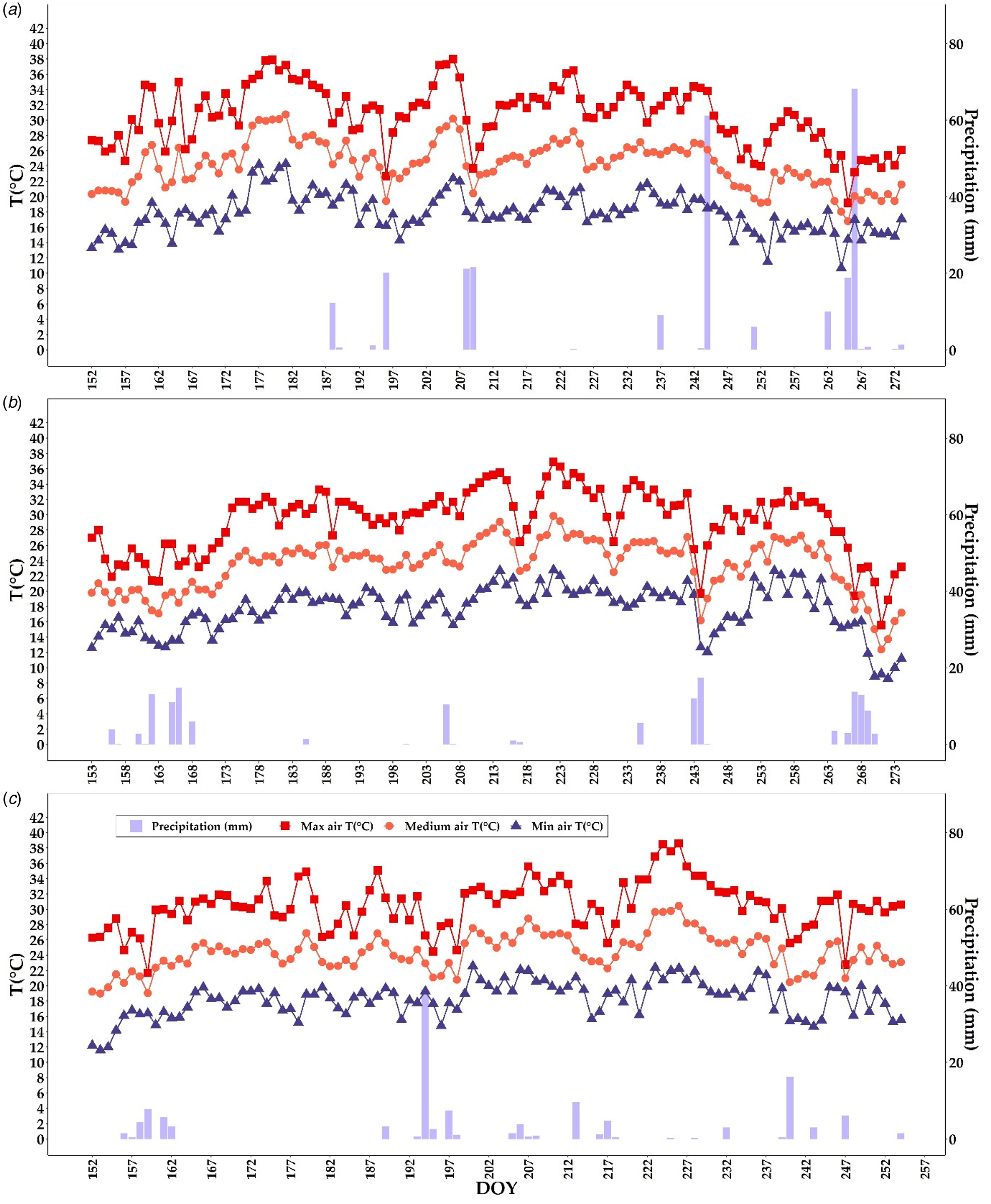
Climate resulted as typical of the Mediterranean region, although some differences in rainfall pattern were detected in the three different years of research (Fig. 1). The 2019 year (657.8 mm rain/growing season) was characterized by an even distribution of rain especially during spring and autumn with a dry period in June and August. The 2020 year (454.6 mm rain/growing season) was characterized by an even distribution of rain especially autumn whit a dry period in April and July. Whereas the 2021 year (458.2 mm rain/growing season) was characterized by an even distribution of rain especially spring with a dry period in June and July. Maximum temperatures exceeded 35°C on the following days (Fig. 2): from 25 to 30 June 2019 (176–181 DOY), from 1 to 3 July 2019 (182–184 DOY), from 23 to 26 July 2019 (204–207 DOY), 11 and 12 August 2019 (223–224 DOY), from 30 July to 1 August 2020 (212–214 DOY), from 8 to 10 August 2020 (221–223 DOY) and 12 August 2020 (225 DOY), 7 July 2021 (188 DOY), 26 July 2021 (207 DOY) and from 11 to 15 August 2021 (223–227 DOY).
Colour online. Vineyard Microclimate. Monthly total rainfall (mm) and mean, maximum, minimum temperature (°C) of 2019, 2020 and 2021. The data refer to the following months: April 2019–December 2019 (91–335 DOY), January 2020–December 2020 (1–336 DOY) and January 2021–September 2021 (1–244 DOY).

Colour online. Vineyard Microclimate. Daily total rainfall (mm) and mean, maximum, minimum temperature (°C) of 2019 (a), 2020 (b) and 2021 (c). All data refer to the hottest central months of each year (from June to September). The days are expressed in Day of the Year (DOY) as follows: June 2019 (152–181), July 2019 (182–212), August 2019 (213–243), September 2019 (244–273) and June 2020 (153–182), July 2020 (183–213), August 2020 (214–244), September 2020 (245–274) and June 2021 (152–181), July 2021 (182–212), August 2021 (213–243), September 2021 (244–255).
Stomatal conductance and leaf temperature, net photosynthesis and water use efficiency, midday stem water potential, leaf chlorophyll fluorescence and content
As reported in Figs 3(A)–(F), no significant differences were noted in chlorophyll content (maximum quantum yield of PSII) in leaves of Vitis vinifera between treatments (Zeowine and Compost), while chlorophyll a fluorescence reported differences especially in the warmer period (6–19 August 2019, 3 August 2020, 12 July 2021 and 18 August 2021).
Colour online. Maximum quantum yield of PSII (F v/F m) ((A), 2019; (C), 2020; (E), 2021) and chlorophyll content (SPAD Units) ((B), 2019; (D), 2020; (F), 2021) in Vitis vinifera with two different soil management: Zeowine (Z, green column) and Compost (C, brown column). The days are expressed in Day of the Year (DOY): 22 July 2019 (203), 21 July 2020 (195), 12 July 2021 (193); 6 August 2019 (218), 3 August 2020 (216), 29 July 2021 (210); 19 August 2019 (231), 14 August 2020 (230), 18 August 2021 (230). Different letters within the same parameter indicate significant differences. Data (mean ± s.e., n = 12) were subjected to one-way ANOVA (LSD test, P ⩽ 0.05).

On the hottest days, significant differences in physiological parameters (Pn and WUE) between Z and C during the three study seasons (2019, 2020 and 2021) were found; Zeowine showed higher rates of photosynthesis v. C treatment (Table 2).
Physiological parameters
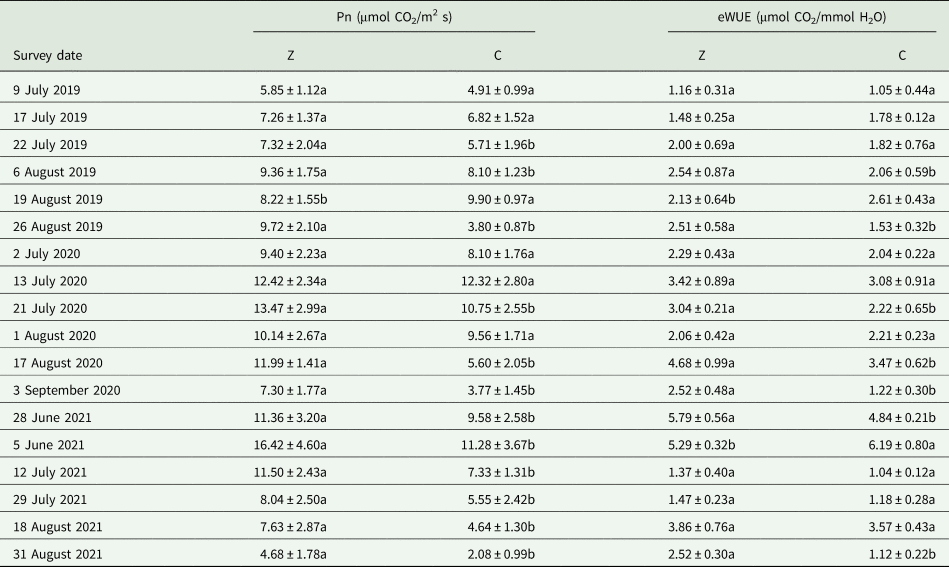
Net photosynthesis (Pn), water use efficiency (eWUE) of Vitis vinifera treated with two different soil management methods: Zeowine (Z) and Compost (C). Different letters within the same parameter indicate significant differences. Data (mean ± s.e., n = 12) were subjected to one-way ANOVA (LSD test, P⩽0.05)
Treatment C showed in all seasons, values of leaf temperature higher than treatment Z. On the hottest days, the Z treatment tended to record values of superior stomatal conductance (Fig. 4).
Colour online. Stomatal conductance (gs, mmol m-2s-1), ((A), 2019; (C), 2020; (E) 2021) and leaf temperature (°C) ((B), 2019; (D), 2020; (F), 2021) in Vitis vinifera with two different soil management: Zeowine (Z, green line) and Compost (C, brown line). The days are expressed in Day of the Year (DOY): 9–17–22 July 2019 (190–198–203), 6–19–26 August 2019 (218–231–238) and 2–13–21 July 2020 (184–195–203), 1–17 August 2020 (214–230), 3 September 2020 (247) and 28 June 2021 (179), 5–12–29 July 2021 (186–193–200), 18–31 August 2021 (230–243). Different letters within the same parameter indicate significant differences. Data (mean ± s.e., n = 12) were subjected to one-way ANOVA (LSD test, P ⩽ 0.05).

Significant differences in stem water potential between soil treatments were found (Fig. 5). Leaf water potential values reflect seasonal trends; peaks of increased water stress were recorded in July 2019, August 2020 and July/August 2021 after the driest and hottest months (June 2019, July 2020 and July 2021).
Colour online. Physiological parameters. Stem water potential (ψ, MPa), ((A), 2019; (B), 2020; (C), 2021) in Vitis vinifera with two different soil management: Zeowine (Z, green line) and Compost (C, brown line). The days are expressed in Day of the Year (DOY): 9–17–22 July 2019 (190–198–203), 6–19–26 August 2019 (218–231–238) and 2–13–21 July 2020 (184–195–203), 1–17 August 2020 (214–230), 3 September 2020 (247) and 28 June 2021 (179), 5–12–29 July 2021 (186–193–200), 18–31 August 2021 (230–243). Different letters within the same parameter indicate significant differences. Data (mean ± s.e., n = 12) were subjected to one-way ANOVA (LSD test, P ⩽ 0.05).

Berry composition
Table 3 shows the composition of Sanforte berries under two different soil management approaches in 2020 year (first year of production of the vineyard) and in 2021 year (second year of production of the vineyard) in terms of technological maturity. During the 2020 season, significant differences at full veraison, mid-maturation and harvest were noted in sugar content and during the 2021 season, significant differences at mid-maturation, full-maturation and harvest were noted in sugar content: Z had the highest values than C treatment. In the 2020 harvest, the C treatment detected higher acidity values, while in the 2021 harvest no difference was noted in acidity values.
Technological maturity

Sugar content (°Brix), titratable acidity (TA), pH and berry weight of Sanforte berries treated with two different soil managements: Zeowine (Z) and Compost (C). Data (mean ± s.e., n = 12) were subjected to one-way ANOVA. Different letters within the same parameter and row indicate significant differences (LSD test, P ⩽ 0.05)
As shown in Table 4, the greatest differences in phenolic maturity were found in the composition of extractable and total anthocyanins. As for the 2020 season, at full maturation and harvest, Z berries showed significantly higher extractable and total anthocyanin content compared to C berries. The lowest values in total anthocyanins were recorded for the C treatment at the three different stages. No differences in total polyphenols at harvest were found. At full maturation, no differences in extractable polyphenols were found, while at harvest C berries showed significantly higher extractable polyphenol content compared to the Z treatments.
Phenolic maturity

Total anthocyanin (Tot. Anth.), extractable anthocyanin (Extr. Anth.), total polyphenol (Tot. Polyp.) and extractable polyphenol (Extr. Polyp.) content of Sanforte berries treated with two different soil managements: Zeowine (Z) and Compost. Data (mean ± s.e., n = 12) were subjected to one-way ANOVA. Different letters within the same parameter and row indicate significant differences (LSD test, P ⩽ 0.05)
As for the 2021 season, at mid-, full-maturation and harvest Z berries showed significantly higher extractable and total anthocyanin content compared to C berries. At harvest, Z berries showed significantly higher extractable and total polyphenol content compared to the C treatments.
In both seasons, significant differences were found for the production parameters at harvest (Table 5). Treatment Z, in general, had a higher weight of the bunches and yield per plant compared to the C treatment.
Production parameters

Cluster weight (kg), yield/vine (kg) and a number of cluster/vine of Sanforte cv. With two different soil management: zeowine (Z) and compost. Different letters within the same parameter indicate significant differences. Data (mean ± s.e., n = 12) were subjected to one-way ANOVA (LSD test, P ⩽ 0.05)
Discussion
To focus on climate change, the main objectives of soil management are to maintain an environment that favours the development of the vegetative apparatus, the accumulation of organic matter, the absorption of water and the use of nutrients; management that causes drop-in soil skills to reduce these aspects (Smith and Powlson, Reference Smith and Powlson2007). However, proper soil management can be expected to restore ecosystem functions that have been degraded (Komatsuzaki and Ohta, Reference Komatsuzaki and Ohta2007).
This study highlights the importance of soil management in the Mediterranean area through the application of a new zeolitic-based product against the problems of climate change. Chlorophyll a fluorescence (F v/F m, an indicator of photo-oxidative stress; Baroli et al., Reference Baroli, Gutman, Ledford, Shin, Chin, Havaux and Niyogi2004; Lichtenthaler et al., Reference Lichtenthaler, Buschmann and Knapp2005) reported differences especially on the hottest days (6–19 August 2019, 3 August 2020 and 18 August 2021). The photo-oxidative shock inhibited photosystem II (PSII) efficiency, as suggested by the reduction of F v/F m ratios (Pietrini et al., Reference Pietrini, Chaudhuri, Thapliyal and Massacci2005). We hypothesize, that in the C treatment, the extreme temperature-induced photo-oxidative stress as could be derived from increased expression of reactive oxygen species (ROS) scavengers and an increased pool size of the xanthophyll cycle pigments (Jaghdani et al., Reference Jaghdani, Jahns and Tränkner2021). Consequently, in C treatment, a robust inhibitory effect on photosynthetic capacity and net CO2 assimilation (Pn) was reported during that period, as a typical impact of PSII deficiency (Pintó-Marijuan and Munné-Bosch, Reference Pintó-Marijuan and Munné-Bosch2014). Gaseous exchanges were affected in zeolite-treated vines; Zeowine showed higher rates of photosynthesis v. C treatment (De Smedt et al., Reference De Smedt, Steppe and Spanoghe2017). The photosynthesis trend during the seasons of both treatments reflected that temperature directly influenced the photosynthesis rate by stimulating the activity of photosynthetic enzymes and the electron transport chain (ETC) (Slot and Winter, Reference Slot and Winter2017). At low temperatures, the Pn rate increased proportionally with the temperature until it reached an optimum (Long, Reference Long1983). The higher-summer temperatures reduced C photosynthesis (i.e. during 2020, on August 3th maximum temperatures above 30°C led to the following photosynthesis values: C treatment 3.77 μmol CO2/m2s and Z treatment 7.30 μmol CO2/m2s). In addition, an increase in the air temperature for the C treatment indirectly led to increased leaf temperature, which could stimulate water loss by transpiration and elevate vapour pressure deficit (VPD) (Yang et al., Reference Yang, Sinclair, Zhu, Messina, Cooper and Hammer2012). Probably the effect on leaf temperature was mediated by water availability, as it was observed from stem water potential data. As with barley and corn seedlings (Krutilina et al., Reference Krutilina, Polyanskaya, Goncharova and Letchamo2000), the application of zeolite to the vineyard soil was found to increase photosynthetic activity.
In contrast to what was observed by Steiman et al. (Reference Steiman, Bittenbender and Idol2007) the WUE of zeolite treated plants was usually higher to compost vines, suggesting that zeolites did increase water consumption with increasing CO2 fixation (Chaves et al., Reference Chaves, Osorio and Pereira2004). Due to zeolitic ability to retain water (Sepaskhah and Barzegar, Reference Sepaskhah and Barzegar2010), plants treated with clinoptilolite (Zeowine) showed significantly lower leaf temperatures in both seasons than zeolite-free composting plants. The following reductions were recorded during 2019: −1.25% on June 21st, −2.14% on July 9th, −8.14% on July 17th, −5.81% on July 22nd, −7.90% on July 31st, −7.11% on August 19th. The following reductions were recorded during 2020: −1.11% on May 22nd, −3.79% on June 9th, −3.49% on June 22nd, −1.58% on July 2nd, −2.77% on July 13rd, −2.85% on August 3rd. Instead, the following reductions were recorded during 2021: −7.00% on June 28th, −2.51% on 5th July, −3.69% on 12 July, −5.17% on 29 July, −1.47% on 18th August and −4.66% on 31st August. Probably the lower transpiration rates of compost-treated plants may explain the higher leaf-air temperature that was observed (De Smedt et al., Reference De Smedt, Someus and Spanoghe2015).
In all seasons the Sanforte cultivar recorded valuable stomatic conductance values, reflecting its anisohydric-conservative behaviour (drought-tolerance) under stress conditions, keeping stomas always open (Rogiers et al., Reference Rogiers, Greer, Hatfield, Hutton, Clarke, Hutchinson and Somers2012), despite the fall in water potential for compost treatment.
In our study the synergy of compost and zeolite positively affected water stress; due to the zeolitic skill of adsorption and release water (Polat et al., Reference Polat, Karaca, Demir and Onus2004), the Zeowine application showed less negative water potential values during the most syccitous period in all years (2019, 2020 and 2021). In fact, several studies on species other than the grapevine also reported that water deficit stress was mitigated by soil applications of zeolite such as in Aloe vera L. (Hazrati et al., Reference Hazrati, Tahmasebi-Sarvestani, Mokhtassi-Bidgoli, Modarres-Sanavy, Mohammadi and Nicola2017), in Trigonella foenum-graecum (Baghbani-Arani et al., Reference Baghbani-Arani, Modarres-Sanavy, Mashhadi-Akbar-Boojar and Mokhtassi-Bidgoli2017), in Oryza sativa L. (Zheng et al., Reference Zheng, Chen, Wu, Yu, Chen, Chen and Xia2018), in Hordeum vulgare L. (Ahmed et al., Reference Ahmed, Al-Ghouti, Hussain and Mahmoud2017) and in Cucumis sativus L. (Mohabbati et al., Reference Mohabbati, Mood, Shahidi and Siuki2018). Zeolite increased the water-holding capacity of the soil and improved soil quality in the root zone (AL-Busaidi et al., Reference AL-Busaidi, Yamamoto, Tanigawa and Rahman2011).
During the 2020 season, significant differences at full veraison, mid-maturation and harvest were noted in sugar content, while during the 2021 season, significant differences at mid-, full-maturation and harvest were noted in sugar content: Z had the highest values than C treatment. At the time of harvest, Zeowine increased the sugar content of 5.50% in 2020 and 2.00% in 2021. We hypothesize that the higher sugar content of Zeowine-treated plants was due to their higher rate of photosynthesis (Medrano et al., Reference Medrano, Escalona, Cifre, Bota and Flexas2003). A close link between photosynthesis (Rubisco activity) and vine carbohydrate metabolism was found and it was observed that the photosynthesis rate (Pn) was directly related to the rate of the sugar metabolic process (Mao et al., Reference Mao, Li, Mi, Ma, Dawuda, Zuo, Zhang, Jiang and Chen2018). Moreover, we hypothesize that this correlation was due to the young age of the plants; in fact, as there were few stored carbohydrates, berry sugar accumulation was more sensitive to photosynthesis. Vines subjected to zeolite foliar applications (chabasite rich-zeolitite) in addition to significantly reducing grey mould and sour rot infections, increased sugar and alcohol content. In addition, these effects have been linked to the reduction of the leaf temperature, in this case, due to zeolite ability to reflect infrared radiation (Calzarano et al., Reference Calzarano, Seghetti, Pagnani and Di Marco2020). However, it cannot be excluded the zeolite capacity to absorb carbon dioxide, determining its increase near the stomata and net photosynthesis increase (De Smedt et al., Reference De Smedt, Steppe and Spanoghe2017). This aspect deserves more and deeper investigation.
A 23% (2020) and 31% (2021) increase in the weight of the harvest berry for zeowine treatment was also observed; the ability of zeolite to improve the radical water microclimate led to more hydrated and larger berries (Baeza et al., Reference Baeza, Sánchez-de-Miguel, Centeno, Junquera, Linares and Lissarrague2007).
Regarding phenolic maturity, the greatest differences were found in the composition of extractable and total anthocyanins. At full maturation and harvest, Z berries showed significantly higher extractable and total anthocyanin content compared to C berries (2020). The lowest values in total anthocyanins were recorded for the C treatment at the three different stages during the seasons. At mid-, full-maturation and harvest Z berries showed significantly higher extractable and total anthocyanin content compared to C berries (2021). The higher Brix degree of Z treatment may explain the increased accumulation of anthocyanins in the berries (sugar/anthocyanin relationship) (Hernández-Hierro et al., Reference Hernández-Hierro, Quijada-Morín, Martínez-Lapuente, Guadalupe, Ayestarán, Rivas-Gonzalo and Escribano-Bailón2014). In fact, it was demonstrated that differences in the anthocyanin extractability were highly influenced by the ripeness degree and also, by the soluble solids contents (Hernández-Hierro et al., Reference Hernández-Hierro, Quijada-Morín, Rivas-Gonzalo and Escribano-Bailón2012). During the 2020 season, no differences in total polyphenols at harvest were found. At full maturation, no differences in extractable polyphenols were found, while at harvest C berries showed significantly higher extractable polyphenol content compared to the Z application. During the 2021 season, significant differences in polyphenols at harvest were found; Z berries showed significantly higher extractable and total polyphenol content compared to the C application. Increases in total anthocyanins, but also in total polyphenols and colour intensity, were recorded in wine obtained from vines treated with zeolite leaf applications (Calzarano et al., Reference Calzarano, Valentini, Arfelli, Seghetti, Manetta, Metruccio and Di Marco2019). Again, the leaf temperature reduction effect may have been decisive, for these results, because linked to higher biosynthesis of phenolic compounds (Conde et al., Reference Conde, Pimentel, Neves, Dinis, Bernardo, Correia, Gerós and Moutinho-Pereira2016; Movahed et al., Reference Movahed, Pastore, Cellini, Allegro, Valentini, Zenoni, Cavallini, D'Incà, Tornielli and Filippetti2016). Considering the promising results obtained by zeolite leaf applications, and in this study, by zeolite soil applications, their synergic use may be desirable, with a view to environmentally friendly crop management.
Significant differences were found for the production parameters at harvest. Treatment Z had generally increased the weight of bunches, yield by vine (2020, 2021) and their number (2020). In fact, an increased concentration of CO2 (CO2 adsorption/desorption zeolite skill; Liu et al., Reference Liu, He, Qian, Fei, Zhang, Chen and Shi2017) provides a higher crop production (Kimball, Reference Kimball1986).
Conclusions
Based on the findings of this experiment, it could be concluded that the deleterious effects of global warming, in a new grapevine plant, can be reduced with Zeowine soil improver. The zeolite skill to hold water and exchange nutrients, gave the vines the strength to improve their performance and carry out better production than the compost treatment. The features of zeolite combined with compost could be one of the best solutions to make a stand against drought problems. Therefore, it is in this scenario that the application of Zeowine in the vineyard to the soil can be a valid tool to mitigate the effects of climate change. However, further investigations are needed, given the few studies carried out on the application of zeolites in vineyards.
Acknowledgements
The authors gratefully acknowledge the technical assistance of Filippo Rossi (GMR, Strumenti). The study was carried out within the framework of the LIFE EU project LIFE ZEOWINE LIFE17 ENV/IT/000427 ‘ZEOlite and WINEry waste as an innovative product for wine production’.
Financial support
This research received no specific grant from any funding agency, commercial or not-for-profit sectors.
Conflict of interest
The authors declare there are no conflicts of interest.
Ethical standards
Not applicable.


 Open access

