

1. Introduction
Climate change mitigation and adaptation are key prerequisites for sustainable development (IPCC, Reference Masson-Delmotte, Zhai, Pirani, Connors, Péan, Berger, Caud, Chen, Goldfarb, Gomis, Huang, Leitzell, Lonnoy, Matthews, Maycock, Waterfield, Yelekçi, Yu and Zhou2021, Reference Pörtner, Roberts, Tignor, Poloczanska, Mintenbeck, Alegría, Craig, Langsdorf, Löschke, Möller, Okem and Rama2022a, Reference Skea, Shukla, Reisinger, Slade, Pathak, Khourdajie, van Diemen, Abdulla, Akimoto, Babiker, Bai, Bashmakov, Bataille, Berndes, Blanco, Blok, Bustamante, Byers, Cabeza, Calvin, Carraro, Clarke, Cowie, Creutzig, Dadi, Dasgupta, de Coninck, Denton, Dhakal, Dubash, Geden, Grubb, Guivarch, Gupta, Hahmann, Halsnaes, Jaramillo, Jiang, Jotzo, Jung, Ribeiro, Khennas, Kılkış, Kreibiehl, Krey, Kriegler, Lamb, Lecocq, Lwasa, Mahmoud, Mbow, McCollum, Minx, Mitchell, Mrabet, Mulugetta, Nabuurs, Nemet, Newman, Niamir, Nilsson, Nugroho, Okereke, Pachauri, Patt, Pichs-Madruga, Pereira, Rajamani, Riahi, Roy, Saheb, Schaeffer, Seto, Some, Steg, Toth, Ürge-Vorsatz, van Vuuren, Verdolini, Vyas, Wei, Williams and Winkler2022b). Consequently, both scholars and practitioners advocate their mainstreaming across all policy levels and sectors. Such policy mainstreaming (hereinafter referred to as climate mainstreaming) is crucial for public and private action to become more sustainable. This point has been stressed again in the context of the recent climate conference, COP 26,Footnote i and the latest reporting from the Intergovernmental Panel on Climate Change (IPCC) (IPCC, Reference Pörtner, Roberts, Tignor, Poloczanska, Mintenbeck, Alegría, Craig, Langsdorf, Löschke, Möller, Okem and Rama2022a, Reference Skea, Shukla, Reisinger, Slade, Pathak, Khourdajie, van Diemen, Abdulla, Akimoto, Babiker, Bai, Bashmakov, Bataille, Berndes, Blanco, Blok, Bustamante, Byers, Cabeza, Calvin, Carraro, Clarke, Cowie, Creutzig, Dadi, Dasgupta, de Coninck, Denton, Dhakal, Dubash, Geden, Grubb, Guivarch, Gupta, Hahmann, Halsnaes, Jaramillo, Jiang, Jotzo, Jung, Ribeiro, Khennas, Kılkış, Kreibiehl, Krey, Kriegler, Lamb, Lecocq, Lwasa, Mahmoud, Mbow, McCollum, Minx, Mitchell, Mrabet, Mulugetta, Nabuurs, Nemet, Newman, Niamir, Nilsson, Nugroho, Okereke, Pachauri, Patt, Pichs-Madruga, Pereira, Rajamani, Riahi, Roy, Saheb, Schaeffer, Seto, Some, Steg, Toth, Ürge-Vorsatz, van Vuuren, Verdolini, Vyas, Wei, Williams and Winkler2022b).
The aim of climate mainstreaming is the systematic inclusion of climate change objectives in sector policy and practice at all levels, to moderate harm and help societies and the planet to thrive. In practice, it means that policies, programmes and projects that otherwise would not have taken climate change objectives into consideration explicitly include them when making development choices (IPCC, Reference Pörtner, Roberts, Tignor, Poloczanska, Mintenbeck, Alegría, Craig, Langsdorf, Löschke, Möller, Okem and Rama2022a, Reference Skea, Shukla, Reisinger, Slade, Pathak, Khourdajie, van Diemen, Abdulla, Akimoto, Babiker, Bai, Bashmakov, Bataille, Berndes, Blanco, Blok, Bustamante, Byers, Cabeza, Calvin, Carraro, Clarke, Cowie, Creutzig, Dadi, Dasgupta, de Coninck, Denton, Dhakal, Dubash, Geden, Grubb, Guivarch, Gupta, Hahmann, Halsnaes, Jaramillo, Jiang, Jotzo, Jung, Ribeiro, Khennas, Kılkış, Kreibiehl, Krey, Kriegler, Lamb, Lecocq, Lwasa, Mahmoud, Mbow, McCollum, Minx, Mitchell, Mrabet, Mulugetta, Nabuurs, Nemet, Newman, Niamir, Nilsson, Nugroho, Okereke, Pachauri, Patt, Pichs-Madruga, Pereira, Rajamani, Riahi, Roy, Saheb, Schaeffer, Seto, Some, Steg, Toth, Ürge-Vorsatz, van Vuuren, Verdolini, Vyas, Wei, Williams and Winkler2022b; Runhaar et al., Reference Runhaar, Wilk, Persson, Uittenbroek and Wamsler2018). It is thus about addressing climate change in sectoral local, national and regional planning and decision-making processes, rather than as stand-alone measures or a separate sector (ibid.).
The climate mainstreaming approach is supported across different international policy frameworks, including the Glasgow Climate Pact, the Paris Agreement on Climate Change, Agenda 2030, the Sendai Framework for Disaster Risk Reduction 2015–2030 and the Sustainable Development Goals (UN, 2015; UNFCCC, 2015, 2021; UNISDR, 2005, 2015). The aspiration is to support synergy creation and innovation across professional fields, which is expected to result in more effective and resource-efficient measures (Adelle & Russel, Reference Adelle and Russel2013; Kok & De Coninck, Reference Kok and de Coninck2007; Runhaar et al., Reference Runhaar, Mees, Wardekker, van der Sluijs and Driessen2012; Wamsler, Reference Wamsler2014). Accordingly, the recent IPCC report (IPCC Reference Pörtner, Roberts, Tignor, Poloczanska, Mintenbeck, Alegría, Craig, Langsdorf, Löschke, Möller, Okem and Rama2022a) states that mainstreaming is frequently proposed when seeking a coherent approach to adaptation and mitigation. It notes with high confidence that sustained actions are strengthened by mainstreaming climate considerations into, for instance, institutional budget and policy planning cycles, statutory planning and monitoring and evaluation frameworks, along with local efforts (ibid.).
At the same time, there is little evidence that current knowledge on effective mainstreaming has translated into policy outcomes and radical, transformational change (IPCC, Reference Pörtner, Roberts, Tignor, Poloczanska, Mintenbeck, Alegría, Craig, Langsdorf, Löschke, Möller, Okem and Rama2022a, Reference Skea, Shukla, Reisinger, Slade, Pathak, Khourdajie, van Diemen, Abdulla, Akimoto, Babiker, Bai, Bashmakov, Bataille, Berndes, Blanco, Blok, Bustamante, Byers, Cabeza, Calvin, Carraro, Clarke, Cowie, Creutzig, Dadi, Dasgupta, de Coninck, Denton, Dhakal, Dubash, Geden, Grubb, Guivarch, Gupta, Hahmann, Halsnaes, Jaramillo, Jiang, Jotzo, Jung, Ribeiro, Khennas, Kılkış, Kreibiehl, Krey, Kriegler, Lamb, Lecocq, Lwasa, Mahmoud, Mbow, McCollum, Minx, Mitchell, Mrabet, Mulugetta, Nabuurs, Nemet, Newman, Niamir, Nilsson, Nugroho, Okereke, Pachauri, Patt, Pichs-Madruga, Pereira, Rajamani, Riahi, Roy, Saheb, Schaeffer, Seto, Some, Steg, Toth, Ürge-Vorsatz, van Vuuren, Verdolini, Vyas, Wei, Williams and Winkler2022b; Reckien et al., Reference Reckien, Salvia, Pietrapertosa, Simoes, Olazabal, De Gregorio Hurtado, Geneletti, Krkoska Lorencova, D'Alonzo, Krook-Riekkola, Fokaides, Ioannou, Foley, Orru, Orru, Wejs, Flacke, Church, Feliu and Heidrich2019). Accordingly, a worldwide review of adaptation mainstreaming efforts identified that although most cases include policy outputs, they generally do not lead to policy outcomes (Runhaar et al., Reference Runhaar, Wilk, Persson, Uittenbroek and Wamsler2018). This ‘implementation gap’ has led to calls for improved mainstreaming to support more sustainable and equitable development (IPCC, Reference Pörtner, Roberts, Tignor, Poloczanska, Mintenbeck, Alegría, Craig, Langsdorf, Löschke, Möller, Okem and Rama2022a, Reference Skea, Shukla, Reisinger, Slade, Pathak, Khourdajie, van Diemen, Abdulla, Akimoto, Babiker, Bai, Bashmakov, Bataille, Berndes, Blanco, Blok, Bustamante, Byers, Cabeza, Calvin, Carraro, Clarke, Cowie, Creutzig, Dadi, Dasgupta, de Coninck, Denton, Dhakal, Dubash, Geden, Grubb, Guivarch, Gupta, Hahmann, Halsnaes, Jaramillo, Jiang, Jotzo, Jung, Ribeiro, Khennas, Kılkış, Kreibiehl, Krey, Kriegler, Lamb, Lecocq, Lwasa, Mahmoud, Mbow, McCollum, Minx, Mitchell, Mrabet, Mulugetta, Nabuurs, Nemet, Newman, Niamir, Nilsson, Nugroho, Okereke, Pachauri, Patt, Pichs-Madruga, Pereira, Rajamani, Riahi, Roy, Saheb, Schaeffer, Seto, Some, Steg, Toth, Ürge-Vorsatz, van Vuuren, Verdolini, Vyas, Wei, Williams and Winkler2022b; Reckien et al., Reference Reckien, Salvia, Pietrapertosa, Simoes, Olazabal, De Gregorio Hurtado, Geneletti, Krkoska Lorencova, D'Alonzo, Krook-Riekkola, Fokaides, Ioannou, Foley, Orru, Orru, Wejs, Flacke, Church, Feliu and Heidrich2019; Runhaar et al., Reference Runhaar, Wilk, Persson, Uittenbroek and Wamsler2018; UNFCCC, 2021).
One reason why current approaches are limited is that they tend to focus on wider socio-economic structures, governance dynamics and technology change (IPCC, Reference Pörtner, Roberts, Tignor, Poloczanska, Mintenbeck, Alegría, Craig, Langsdorf, Löschke, Möller, Okem and Rama2022a, Reference Skea, Shukla, Reisinger, Slade, Pathak, Khourdajie, van Diemen, Abdulla, Akimoto, Babiker, Bai, Bashmakov, Bataille, Berndes, Blanco, Blok, Bustamante, Byers, Cabeza, Calvin, Carraro, Clarke, Cowie, Creutzig, Dadi, Dasgupta, de Coninck, Denton, Dhakal, Dubash, Geden, Grubb, Guivarch, Gupta, Hahmann, Halsnaes, Jaramillo, Jiang, Jotzo, Jung, Ribeiro, Khennas, Kılkış, Kreibiehl, Krey, Kriegler, Lamb, Lecocq, Lwasa, Mahmoud, Mbow, McCollum, Minx, Mitchell, Mrabet, Mulugetta, Nabuurs, Nemet, Newman, Niamir, Nilsson, Nugroho, Okereke, Pachauri, Patt, Pichs-Madruga, Pereira, Rajamani, Riahi, Roy, Saheb, Schaeffer, Seto, Some, Steg, Toth, Ürge-Vorsatz, van Vuuren, Verdolini, Vyas, Wei, Williams and Winkler2022b; O'Brien, Reference O'Brien2018; Rockström et al., Reference Rockström, Gaffney, Rogelj, Meinshausen, Nakicenovic and Schellnhuber2017; Runhaar et al., Reference Runhaar, Wilk, Persson, Uittenbroek and Wamsler2018), whilst the role of people's internal dimensions has been vastly neglected (Ives et al., Reference Ives, Freeth and Fischer2020; O'Brien, Reference O'Brien2018; Wamsler et al., Reference Wamsler, Osberg, Osika, Hendersson and Mundaca2021). So-called internal, interior, inner or personal dimensions or spheres are sometimes also referred to as inner worlds, inner being, interiority or mindsets. They refer to individual and collective values, beliefs, worldviews, paradigms and associated internal (i.e. cognitive/emotional and relational) qualities and capacities (Wamsler et al., Reference Wamsler, Osberg, Osika, Hendersson and Mundaca2021). The current lack of integration in knowledge and practice has resulted in a situation where policy paralysis has significantly contributed to undesirable behaviour and institutions moving in directions that are unsustainable (Clayton & Manning, Reference Clayton and Manning2018; Gifford, Reference Gifford2011; IPCC, Reference Pörtner, Roberts, Tignor, Poloczanska, Mintenbeck, Alegría, Craig, Langsdorf, Löschke, Möller, Okem and Rama2022a, Reference Skea, Shukla, Reisinger, Slade, Pathak, Khourdajie, van Diemen, Abdulla, Akimoto, Babiker, Bai, Bashmakov, Bataille, Berndes, Blanco, Blok, Bustamante, Byers, Cabeza, Calvin, Carraro, Clarke, Cowie, Creutzig, Dadi, Dasgupta, de Coninck, Denton, Dhakal, Dubash, Geden, Grubb, Guivarch, Gupta, Hahmann, Halsnaes, Jaramillo, Jiang, Jotzo, Jung, Ribeiro, Khennas, Kılkış, Kreibiehl, Krey, Kriegler, Lamb, Lecocq, Lwasa, Mahmoud, Mbow, McCollum, Minx, Mitchell, Mrabet, Mulugetta, Nabuurs, Nemet, Newman, Niamir, Nilsson, Nugroho, Okereke, Pachauri, Patt, Pichs-Madruga, Pereira, Rajamani, Riahi, Roy, Saheb, Schaeffer, Seto, Some, Steg, Toth, Ürge-Vorsatz, van Vuuren, Verdolini, Vyas, Wei, Williams and Winkler2022b).
Practitioners and scholars are thus increasingly calling for new approaches to support a more profound cultural shift and transformation towards sustainability, where people's internal dimensions or mindsets are seen as potential ‘deep leverage points’ for transformation (Adger et al., Reference Adger, Barnett, Brown, Marshall and O'Brien2013; Grusovnik, Reference Grusovnik2012; Kagan, Reference Kagan2010; Kassel et al., Reference Kassel, Rimanoczy and Mitchell2016; Meadows, Reference Meadows1999; O'Brien, Reference O'Brien2018; Waddock, Reference Waddock2016; Wamsler et al., Reference Wamsler, Schäpke, Fraude, Stasiak, Bruhn, Lawrence, Schroeder and Mundaca2020a, Reference Wamsler, Osberg, Osika, Hendersson and Mundaca2021; Woiwode et al., Reference Woiwode, Schäpke, Bina, Veciana, Kunze, Parodi, Schweizer-Ries and Wamsler2021). Hence, the 2022 IPCC Assessment Reports on climate change mitigation and adaptation highlight the importance of addressing internal dimensions and the development of a more integrative approach to enable sustainable actions (IPCC, Reference Pörtner, Roberts, Tignor, Poloczanska, Mintenbeck, Alegría, Craig, Langsdorf, Löschke, Möller, Okem and Rama2022a, Reference Skea, Shukla, Reisinger, Slade, Pathak, Khourdajie, van Diemen, Abdulla, Akimoto, Babiker, Bai, Bashmakov, Bataille, Berndes, Blanco, Blok, Bustamante, Byers, Cabeza, Calvin, Carraro, Clarke, Cowie, Creutzig, Dadi, Dasgupta, de Coninck, Denton, Dhakal, Dubash, Geden, Grubb, Guivarch, Gupta, Hahmann, Halsnaes, Jaramillo, Jiang, Jotzo, Jung, Ribeiro, Khennas, Kılkış, Kreibiehl, Krey, Kriegler, Lamb, Lecocq, Lwasa, Mahmoud, Mbow, McCollum, Minx, Mitchell, Mrabet, Mulugetta, Nabuurs, Nemet, Newman, Niamir, Nilsson, Nugroho, Okereke, Pachauri, Patt, Pichs-Madruga, Pereira, Rajamani, Riahi, Roy, Saheb, Schaeffer, Seto, Some, Steg, Toth, Ürge-Vorsatz, van Vuuren, Verdolini, Vyas, Wei, Williams and Winkler2022b). Such an integrative approach requires unleashing people's internal potential and capacity to care, commit to, and effect change for a more sustainable life across individual, collective organisational and system levels.
In response to such insights, disciplinary and interdisciplinary advances have translated into the emergence of new, conscious full-spectrum heuristics and theories.Footnote ii Socio-environmental and climate actions are here understood as challenges that require addressing practical, political and internal spheres of transformation (O'Brien, Reference O'Brien2018; O'Brien & Sygna, Reference O'Brien and Sygna2013; Sharma, Reference Sharma2017). Despite this recent progress, knowledge has yet to be applied to the field of climate mainstreaming, and remains segregated and fragmented across disciplines and communities, thus hampering the integration of internal and external transformation (Gowdy, Reference Gowdy2008; Parodi & Tamm, Reference Parodi and Tamm2018; Wamsler et al., Reference Wamsler, Osberg, Osika, Hendersson and Mundaca2021).
Against this background, this study explores how the implementation of climate mainstreaming can meaningfully move beyond its current focus on isolated, highly tangible successes, which constitute essentially weak leverage points,Footnote iii and instead connect all spheres of transformation. The aim is to investigate new theoretical terrain, by analysing the links between conscious full-spectrum and mainstreaming theories to identify possibilities and potentials to address the gaps in current approaches and practice. Drawing upon this comparative analysis, we discuss how people's internal qualities and capacities can be made an integral part of climate mainstreaming. In particular, how they can be sourced to create new patterns that effectively address climate change and associated social crises and inequalities.
First, we outline the methodology (Section 2), then we present the two theories' key features, gaps and synergies, and the differences between them (Section 3). We identify the nexus between internal dimensions, climate change mitigation and adaptation and incomplete approaches to their mainstreaming, and discuss the implications for new knowledge and theory development. The resultant integrative framework provides a heuristic that links the mainstreaming of climate considerations and internal dimensions across all spheres of transformation, generating new approaches and questions that support emergent solutions and progress. We conclude with some policy recommendations and future research needs (Section 4).
2. Methodology
We conducted a comparative analysis of the interlinkages between conscious full-spectrum and climate mainstreaming theories. The conscious full-spectrum and climate mainstreaming approaches described by Sharma (Reference Sharma2017) and Wamsler (Reference Wamsler2014) were selected because they: (1) aim to support sustainability transformation; (2) have emerged out of empirical workFootnote iv; (3) have been widely adopted in both theoryFootnote v and practiceFootnote vi in different contexts; and (4) are acknowledged in the climate and sustainability policy and advocacy work of key organisations such as the United Nations (UN),Footnote vii the European Environment AgencyFootnote viii and the IPCCFootnote ix (e.g. IPCC Assessment Reports).
Our comparative analysis focused mainly on the core literature on the theoretical foundations and applications of these two theories, which we identified with the help of six key informants. The latter included researchers and practitioners who had either developed the theories, or applied them in their professional work. The objective was to assess the core literature on the theories, not to systematically review all related research studies. The selection of literature was thus guided by the study's research aims, the criteria regarding the selection of the theories (see above) and by the authors' and informants' notions of what constitutes the related core literature.Footnote x
The theories and their applications were also assessed through observation and participation in four workshops, during which mainstreaming, conscious full-spectrum frameworks and similar approaches were applied to the context of climate change. These workshops were run in 2018 (Hamburg, Germany), 2019 (Lund, Sweden and Oslo, Norway)Footnote xi and 2021 (online, international).Footnote xii Key informants and workshop participants included scholars and practitioners working in sustainable development and transformation.
The comparative analysis of the identified theories was carried out using a modified version of grounded theory, which was tailored to assessing literature (Corbin & Strauss, Reference Corbin and Strauss2008; Mayring, Reference Mayring, Flick, von Kardorff and Steinke2004; Wolfswinkel et al., Reference Wolfswinkel, Furtmueller and Wilderom2013). Through a process of open coding, the data (the theoretical frameworks and related descriptions) were disassembled in order to identify the main features and gaps that emerged from each approach (Corbin & Strauss, Reference Corbin and Strauss2008). Related results are described in Sections 3.1 and 3.2. Subsequently, axial and selective codings were employed to reassemble the data and identify patterns regarding synergies and overlaps, along with differences and overall shortcomings. The latter are described in Sections 3.3 and 3.4. This process formed the basis for generating potential new solutions and theory development (Maxwell, Reference Maxwell2012), and we discuss the latter in Section 4.
3. Results
3.1 Key features of and gaps in the climate mainstreaming framework
In this section, we describe the identified key features of and gaps in the climate mainstreaming framework. They relate to: (1) its aims; (2) development (reason and process); (3) components and their interrelations; (4) underlying assumptions, principles and heuristics; and (5) their linkages to transformation, that is, the levels at which change needs to take place to achieve transformation towards sustainability. See also Supplementary Material A for additional information and descriptions regarding these aspects.
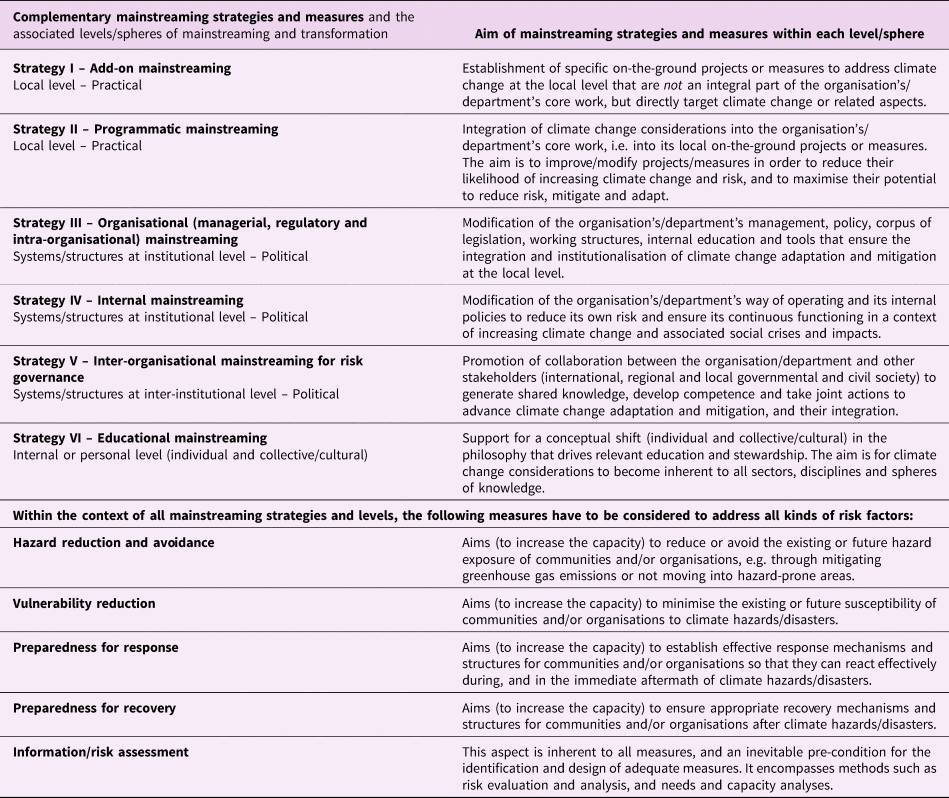
Climate mainstreaming can be understood as a theory of change that is based on many years of experience in different cross-cutting domains. The latter include HIV/AIDS, gender, environment, climate change mitigation, climate change adaptation and disaster risk reduction (see Supplementary Material A). It provides a heuristic, and represents a roadmap for systematically integrating climate change considerations across all sectors and levels. Specifically, it highlights that sustainable transformation can only be achieved if: (1) all levels of mainstreaming are addressed and interlinked; (2) short-term responses and longer-term approaches to increasing climate resilience are combined; and (3) top-down and bottom-up approaches are linked. The levels of mainstreaming, and the associated strategies and measures are illustrated in Figure 1, and defined in Table 1.
Climate mainstreaming framework and associated mainstreaming levels and strategies. Adapted from Wamsler (Reference Wamsler2014, Reference Wamsler2015). See also Table 1 and Supplementary Material A.

Mainstreaming strategies as part of the climate mainstreaming framework

Adapted from Wamsler (Reference Wamsler2014, Reference Wamsler2015). See also Figure 1 and Supplementary Material A.
Note: The terms institution and organisation are used interchangeably in this framework/article.
In simple terms, the different levels of mainstreaming demonstrate that sustainable practices at the local level (strategies I and II) must be accompanied by change at systems (strategies III–V) and cultural levels (strategy VI). Here, the term ‘local’ refers to where climate change-related challenges manifest, and where climate actions result in visible outcomes and change. It relates to the question of tangible change. To achieve change, the goal is to institutionalise climate change mitigation and adaptation (starting from a specific organisation/institution) at institutional and inter-institutional levels, to the point that its integration at the local level becomes standard procedure. This needs, in turn, to be supported by the creation of mechanisms and structures for education and learning, to bring about cultural change within institutions and society at large (strategy VI). The latter relates to individual and collective capacities, values, beliefs, assumptions and paradigms.
Whilst these strategies represent different entry points, mainstreaming and associated transformation requires the implementation of activities at all levels and, hence, the implementation of all strategies, as they support each other (Table 1). Whilst such activities can be assessed by tracking progress and accountability, they need to be accompanied by monitoring and evaluating sustainability outcomes at the local level, which is more challenging (Runhaar et al., Reference Runhaar, Wilk, Persson, Uittenbroek and Wamsler2018). Apart from the strategies, the mainstreaming framework also defines the combination of (socio-economic, physical and environmental) measures that are needed, at each level, to address climate risk comprehensively and ensure that both short-term responses and longer-term approaches are considered (Table 1).
The mainstreaming framework is generic in the sense that it can be applied to both overall adaptation or mitigation, or specific aspects of these (e.g. environmental/nature-based solutions), as well as to other cross-cutting topics. A set of guiding principles and operational tools exists to help organisations translate the framework into practice, and identify gaps and the measures needed to address them. These tools are mainly based on systems thinking and social learning theories, along with methods for risk and project management, monitoring and evaluation (see Wamsler & Raggers, Reference Wamsler and Raggers2018 and Supplementary Material A).
Whilst mainstreaming theory addresses all levels of transformation (see Section 3.2), at the same time there is a lack of systematic and comprehensive consideration of internal dimensions, together with the associated links or ‘bridges’ between different levels (Ensor et al., Reference Ensor, Wennstrom, Bhatterai, Nightingale, Eriksen and Sillmann2019; Woiwode et al., Reference Woiwode, Schäpke, Bina, Veciana, Kunze, Parodi, Schweizer-Ries and Wamsler2021). Such considerations are, however, crucial to get sufficient traction for equitable and transformative change. Without explicit considerations of individual and collective beliefs, values and paradigms, mainstreaming climate considerations into existing development logics and structures can, in practice, perpetuate an anti-political machine, obscuring and depoliticising rather than addressing these internal root causes of the problem (Scoville-Simonds et al., Reference Scoville-Simonds, Jamali and Hufty2020). ‘Mainstreaming [thus] risks not only reproducing development-as-usual, but in fact reinforcing technocratic patterns of control’ (Scoville-Simonds et al., Reference Scoville-Simonds, Jamali and Hufty2020, p. 1).
3.2 Key features of and gaps in the conscious full-spectrum framework
In this section, we describe the identified key features of and gaps in the conscious full-spectrum response frameworkFootnote xiii that relate to its: (1) aims; (2) development (reason and process); (3) components and their interrelations; (4) underlying assumptions, principles and heuristics; and (5) their linkages to transformation, that is, the defined levels at which change needs to take place to achieve transformation towards sustainability. See also Supplementary Material B for additional information and descriptions regarding these aspects.
The conscious full-spectrum framework is a theory of change that aims to connect personal and societal transformation. The goal is to generate lasting results by sourcing internal human capacities and values for strategic action (within oneself and others), and increasing integrity through blending internal and external dimensions in policymaking, planning and implementation. Its development was based on more than 20 years of work for the UN, particularly UNDP and other organisations, and it has been applied to many projects in fields such as HIV/AIDS, disaster recovery and food security (Sharma, Reference Sharma2017). Later, O'Brien and Sygna (Reference O'Brien and Sygna2013) adapted and situated the framework in the context of climate change, articulating the heuristic as three spheres of transformation, consisting of the so-called personal, practical and political (IPCC, Reference Field, Barros, Dokken, Mach, Mastrandrea, Bilir, Chatterjee, Ebi, Estrada, Genova, Girma, Kissel, Levy, MacCracken, Mastrandrea and White2014, p. 1122; O'Brien, Reference O'Brien2018).
The conscious full-spectrum framework is linked to transformation theory and other heuristics that highlight the role of human agency in transformation, and the potential of individuals and groups to become agents of change (Hedlund-de Witt, Reference Hedlund-de Witt2012; O'Brien & Sygna, Reference O'Brien and Sygna2013; O'Brien & Wolf, Reference O'Brien and Wolf2010; Senge, Reference Senge1990). The latter relates to people's underlying values, motivations, beliefs, worldviews and other drivers associated with an activity (and their systemic expressions), and the power to influence or change them (Siegel, Reference Siegel2007). The conscious full-spectrum framework is, therefore, unlike theories of change that seek to encourage sustainable behaviours by ‘nudging’, but do not address deeper causes (O'Brien, Reference O'Brien2018; Rowson, Reference Rowson2011).
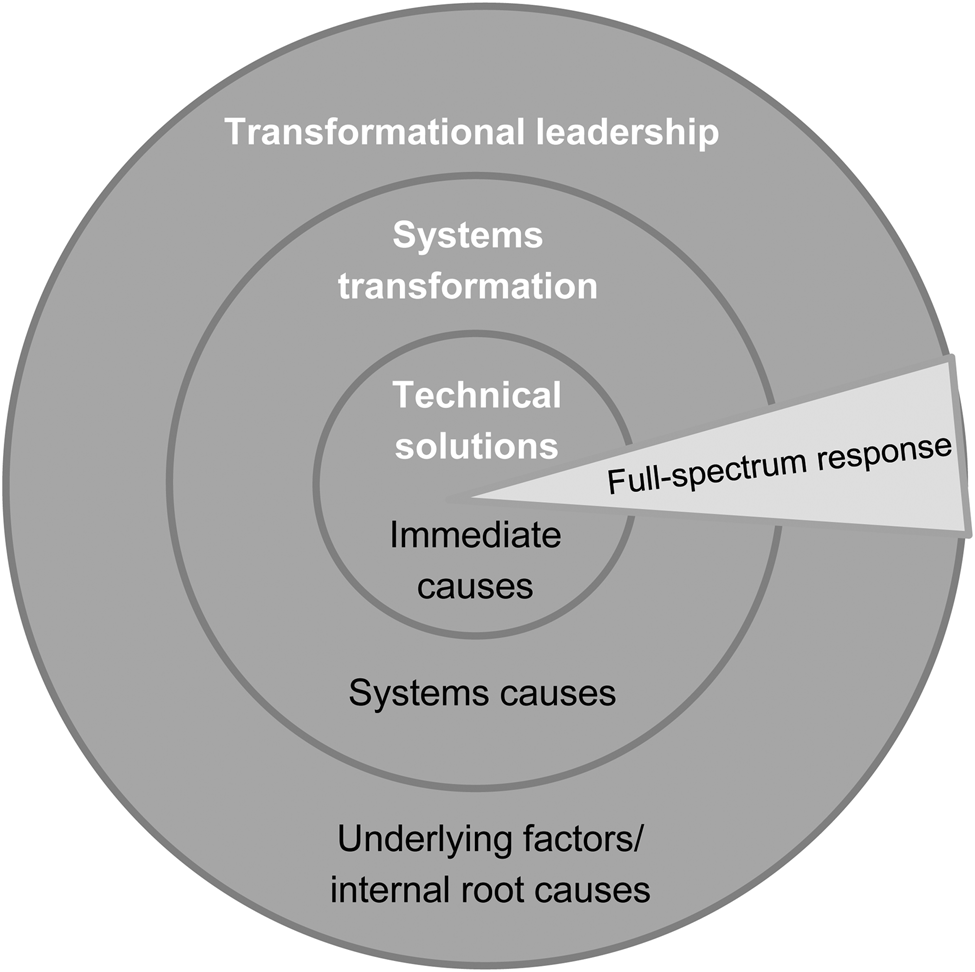
The conscious full-spectrum framework, illustrated in Figure 2 and Table 2, involves three essential strategies or spheres that need to be addressed simultaneously. The innermost circle, or practical sphere of transformation, corresponds to the local level, where problems (e.g. sustainability challenges) manifest, and where actions result in visible outcomes or change (cf. Section 3.1, strategies I and II). Sharma (Reference Sharma2017) calls such actions ‘technical’ solutions, where technical can be seen more broadly as a synonym for ‘practical’ (O'Brien, Reference O'Brien2018). It represents both technical solutions and behaviours with respect to climate change (O'Brien & Sygna, Reference O'Brien and Sygna2013). The middle circle or ‘political’ sphere represents the broader social, political, economic, environmental and cultural systems in which local sustainability problems and actions are embedded (cf. Section 3.1, strategies III–V). These systems can be seen as the rules of the game, and represent enabling or disabling conditions such as policies, governance structures, norms and associated power relations (O'Brien & Sygna, Reference O'Brien and Sygna2013). They therefore constrain or support the implementation of local solutions.
Conscious full-spectrum response framework. Adapted from Sharma (Reference Sharma2017) and Sharma (Reference Sharma2007). The triangular ‘cut’ indicates that outcomes of sustainability occur across all three levels/spheres and that all levels/spheres must be addressed simultaneously to support transformation (i.e. responses should not be partial but have to ‘cut through’ all spheres to support transformation).

Different-level strategies as part of the conscious full-spectrum response framework

Adapted from Sharma (Reference Sharma2017) and O'Brien and Sygna (Reference O'Brien and Sygna2013).
Dominant systems and norms have been established by societies over time, and reflect past and present mindsets – values, beliefs, worldviews – and associated social paradigms (which is also the case for climate mainstreaming [see Section 3.1]). This links to the outermost circle. The latter corresponds to the ‘internal’ or ‘personal’ sphere of transformation, notably internal capacities and agency, here expressed as transformational leadership or stewardship (cf. Section 3.1, strategy VI). Such internal dimensions shape the ways systems and local solutions are viewed, as they influence the framing of issues, and the questions that are asked – or not (O'Brien & Sygna, Reference O'Brien and Sygna2013). Changes related to this internal sphere link to our consciousness, that is, the ways of seeing, understanding and thus interacting with the world. Underlying theories come from the so-called consciousness community of scholars and practitioners, and associated fields such as social and environmental psychology, social neuroscience, personal or adult development and leadership (e.g. Covey, Reference Covey2004; Fielding et al., Reference Fielding, Hornsey and Swim2014; Kegan & Lahey, Reference Kegan and Lahey2001; Torbert Reference Torbert2004).
The framework highlights that sustainable results require an effective response to immediate sustainability problems. However, at the same time, there is a need to leverage the full potential of people to ensure that humanity and the planet thrive. It is founded on universal values, and the capacity to apply this personal stance to enhance effective responses in for example, policymaking, organisational development, project planning and implementation.
The framework can be understood as a process ontology (O'Brien, Reference O'Brien2018) that is linked to a three-step pedagogy. The latter involves operational methods, tools and exercises that are aimed at: (1) sourcing interior capacities; (2) designing to make a difference; and (3) practising/implementing new processes. The framework can also, therefore, be seen as a practice of change. Methods, tools and exercises draw upon knowledge from fields that encompass systems thinking, personal development, social neuroscience, applied psychology and leadership, as well as associated principle-centred frameworks and concepts such as emotional intelligence, mindfulness-based stress reduction, non-violent communication and different project planning tools (e.g. Covey, Reference Covey2004; Goleman et al., Reference Goleman, Boyatzis and McKee2002; Henderson & Knoll, Reference Henderson and Knoll2002; Kabat-Zinn, Reference Kabat-Zinn2005; Kegan & Lahey, Reference Kegan and Lahey2001; Senge, Reference Senge1990, Reference Senge1999; Tann & Luyet, Reference Tann and Luyet2005).Footnote xiv
The framework is anchored in the deep work of the internal sphere, and pulls that through the political and practical spheres, thereby providing the scaffolding for a transformative change process. At the same time, it does not sufficiently define, nor provide a theoretical model for identifying and developing the internal qualities or capacities that are required to support sustainability. In addition, it is somewhat removed from political and social science theory regarding climate mainstreaming, climate change attitudes and behaviours that may hamper its implementation in these fields. There is an implicit assumption that certain internal qualities or capacities are accessible to all, and invariably lead to greater sustainability across all levels. Such inner transformation–sustainability linkages are, however, complex and require further consideration to allow their systematic support and mainstreaming in climate work (Wamsler et al., Reference Wamsler, Osberg, Osika, Hendersson and Mundaca2021; Woiwode et al., Reference Woiwode, Schäpke, Bina, Veciana, Kunze, Parodi, Schweizer-Ries and Wamsler2021).
3.3 Synergies and overlaps
Our comparative analysis identified many synergies and overlaps between mainstreaming and full-spectrum frameworks. They include:
(1) the questions they contend with.
(2) The defined levels at which change needs to take place to achieve sustainable transformation.
(3) An emphasis on the importance of addressing and interlinking all levels of mainstreaming/transformation simultaneously.
(4) A focus on enhancing effective response and addressing the root causes or factors that underlie the targeted challenges.
(5) The importance given to responding to such challenges, whilst simultaneously fostering wider well-being/flourishing/resilience.
(6) The fact that their underlying principles can be applied to all kinds of cross-cutting topics.
Whilst the two frameworks use different wording, both present process-ontologies, and the questions they contend with are ‘how’ questions. In addition, there are clear similarities in the defined levels (spheres) where change needs to take place. In both cases, the innermost circle (Figures 1 and 2) corresponds to local practices and behaviours, the sphere where outcomes become visible on the ground. In the context of climate mainstreaming, the many local flagship projects are typical examples. These initiatives show that impacts are limited if they do not go hand-in-hand with changes within the other levels/circles. The second circle or level refers, in both cases, to changes in the wider system, including, for instance, implementing organisations and other players. The latter includes sectoral organisations and civil society, and the structures that regulate their actions and interactions. These are, in turn, linked to the deeper root causes found in the values and paradigms that are adopted by actors, both professionals and citizens. Both frameworks indicate that training and education programmes and measures should pay particular attention to these root causes.
Another similarity is that both frameworks highlight the importance of addressing and interlinking all levels of mainstreaming/transformation simultaneously. Although most of the literature on transformation acknowledges that there are multiple spheres, it seldom recognises important interdependencies and interactions between them. In contrast, both frameworks highlight that all spheres offer multiple entry points for interventions, but that action should extend to all other spheres for sustainable change. Typical leadership approaches might, for instance, begin by targeting the outermost circle (this is also the initial strategy found in the methods, tools and exercises that are part of the conscious full-spectrum approach), whilst traditional mitigation and adaptation projects, and associated mainstreaming, are more likely to start from the innermost or middle circles, for example, through the development of local solutions and/or institutional strategies at city level, before reaching out to simultaneously address all other spheres.
Despite potential different starting points, both frameworks focus on enhancing effective response and addressing the root causes or factors that underlie the targeted sustainability challenges. Climate mainstreaming is motivated by the need to challenge common ideas, attitudes or activities and change dominant paradigms at multiple levels of governance. It seeks to increase sustainability and resilience by expanding the focus from preventing or resisting climate hazards, to a broader systems framework in which we learn to live and cope with an ever-changing, and sometimes risky, environment (Wamsler et al., Reference Wamsler, Pauleit, Zölch, Schetke, Mascarenhas, Kabisch, Korn, Stadler and Bonn2017). It thus aims to address the root causes of risk, including power structures and failed approaches to sustainable development (Wamsler & Raggers, Reference Wamsler and Raggers2018). Similarly, as described in Section 3.2 the full-spectrum framework relies on the assumption that root causes can be addressed by sourcing human internal capacities to manifest change.
Another similarity between the frameworks is the dual objective of responding to specific needs or challenges, whilst simultaneously engaging in long-term activities that aim to help society and the planet to thrive. In the context of the mainstreaming framework, this is seen in the measures needed to comprehensively address climate risk at all levels, and linking them to educational mainstreaming. Two of the mainstreaming framework's measures relate to responding to hazards and disasters (hazard/disaster response and recovery), whilst the other two focus on increasing resilience and well-being by reducing climate change, vulnerabilities and exposure (Table 1). In the conscious full-spectrum framework, the two-fold objective is mainly related to its focus on internal capacities to effect behavioural and systems change. As Sharma (Reference Sharma2017, p. 216) stated, ‘The mindset and strategies of survival are different from the mindset and strategies for thriving’. Meeting basic needs and addressing immediate problems must, thus, go hand-in-hand with cultivating societies where we nurture human beings to manifest their full potential. This dual objective requires consideration at all levels of mainstreaming and transformation.
The final common trait is the importance given to the inclusion of different stakeholders, their roles, interactions between them and the agency given to ordinary people, that is, to all people. The latter is an explicit aim of the conscious full-spectrum approach.Footnote xv In the context of the mainstreaming framework, it is expressed in the aim to achieve distributed governance (strategy V) and associated guidance that seeks to ensure equitable stakeholder involvement (see also Supplementary Material A). At the same time, the latter has not yet given adequate consideration to the internal (cognitive/emotional and relational) dimensions that support agency.
In sum, both frameworks are based on a similar logic and heuristic for achieving sustainable change, with a focus on renewing existing perspectives, mechanisms and structures. Their application, in this context, is not aimed at adding new, separate mechanisms and structures. Instead, it is about mainstreaming a new perspective, that is, ‘doing the same things differently’ (Sharma, Reference Sharma2017, p. 141). Consequently, whilst the two frameworks focus on different mainstreaming topics (climate change and internal qualities/capacities, or interiority, respectively) to leverage human potential and agency towards change and scaling up, the underlying principles can be applied to all kinds of sectors and cross-cutting topics, which is another explicit feature of both frameworks. The latter is an important finding, as it provides mutual support for the frameworks' underlying logic and heuristic, and opens up the potential for mutual learning from, and integration of, aspects that are lacking or differ.
3.4 Differences and gaps
Our analysis found that, despite certain synergies and overlaps, there are also differences and gaps between the mainstreaming and full-spectrum frameworks. They include:
(1) the thematic focus (the mainstreaming topic).
(2) The starting point (individual versus organisational perspective) and associated target groups.
(3) The extent to which internal capacities are considered across all levels/spheres; this, in turn, reflects the framework's thematic foci, starting points and perspectives.
(4) The latter difference is also reflected in the associated tools (e.g. for sourcing internal capacities and agency) and associated processes for achieving transformation.
(5) The conscious full-spectrum framework is particular in that it provides a pedagogy and practical tools for addressing current gaps in climate mainstreaming (regarding internal capacities/spheres and relationality).
(6) Each approach is based on an implicit assumption that certain internal qualities/capacities lead to sustainability outcomes at different scales, and that these are trainable through a combination of tools that have in parts been adapted to the context of sustainability. An explicit heuristic and integration is, however, missing, opening up scope for further developments and integration.
The first difference we identified is the thematic focus. The full-spectrum approach focuses on agency, through sourcing internal capacities and their mainstreaming across all levels/spheres. The mainstreaming framework focuses on climate change and the mainstreaming of related considerations across all spheres. Consequently, the starting point, and also the perspectives, differ.
Whilst the full-spectrum approach was developed to be applied from the perspective of individuals (independent of any professional affiliation or orientation), the mainstreaming framework was developed to be used from the perspective of an implementing organisation that operates in a place where climate change or climate risk are a current or future sustainability challenge (which is the case for most organisations worldwide). The aim is to assist such organisations in the process of climate mainstreaming, and in particular staff who are responsible for leading this intersectoral and transdisciplinary process.
The third point is that interior dimensions are not addressed to the same extent. This relates to the areas of greatest leverage that each model is guided by. The conscious full-spectrum framework is guided by the notion that the greatest leverage is found in the personal or internal sphere. Consequently, all spheres are examined from this viewpoint, that is, how internal capacities and potential can be sourced to achieve change within all other levels of change and be integrated into essential project design elements, such as learning programmes, communication, policy formulation and organisational development. In contrast, the mainstreaming framework is guided by the notion that the greatest leverage is in scaling or linking up processes within a system. Therefore, whilst internal dimensions are included in the framework in all spheres, it is given less priority. Consequently, whilst the outermost circle is also explicitly related to the internal sphere, in this case, this is without any directionality. Here, the outermost circle is associated with the educational mainstreaming strategy (see strategy VI, Table 1). The aim is to support a conceptual shift (individual and collective/cultural) in the underlying paradigms (that drive sector-specific education and stewardship) that would encourage climate change adaptation and mitigation to become an inherent part of all spheres. This shift should be understood in a broad rather than technical sense, as it is based on a comprehensive understanding of risk. Climate change, hazard exposure and vulnerabilities are here understood as being interlinked with other sustainability challenges (e.g. poverty) that are rooted in multiple societal issues of power, separation and exclusion, such as consumerism, materialism, colonialism, racism and/or elitism (Wamsler & Raggers, Reference Wamsler and Raggers2018). From the perspective of an implementing organisation, the internal sphere can be addressed, for instance, by working with educational bodies to offer training or other joint measures that can be targeted at any of the three spheres. The middle circle of the mainstreaming framework also addresses internal capacities, in the context of managerial mainstreaming (Table 1). For example, the implementing organisation's staff can be offered training that supports the integration and institutionalisation of climate change adaptation and mitigation at the local, project level.Footnote xvi However, this does not explicitly include the need for staff to develop their ability to source internal qualities/capacities and values and draw upon them when designing and implementing projects that can shift behaviours, systems and paradigms (even if they are local). Finally, the innermost circle of the mainstreaming framework also considers personal capacities, for instance in relation to local needs and analysis tools described in Wamsler (Reference Wamsler2014). However, these are often only looked at in relation to implementing and governing climate change adaptation and mitigation measures, rather than the broader sense of supporting human potential and thriving that is found in the full-spectrum approach.
The different considerations of internal dimensions are reflected in the methods and tools used. Unlike the mainstreaming framework, the full-spectrum approach is linked to a process-based pedagogy that aims to source internal capacities that support agency and transformation by mainstreaming their consideration across all sectors and spheres (see also Supplementary Material B). The mainstreaming framework also includes process-based tools for considering personal capacities. However, whilst it focuses on integrating climate change considerations across all spheres, including the internal sphere, it has historically developed out of a more technical and systems perspective. Consequently, most guiding principles and tools are of a more managerial nature. Meanwhile, the lack of consideration of cognitive, emotional and relational aspects and tools that can address underlying mindsets/paradigms has been increasingly highlighted as a key barrier to sustainable mainstreaming and transformation (Wamsler et al., Reference Wamsler, Wickenberg, Hanson, Alkan Olsson, Stålhammar, Björn, Falck, Gerell, Oskarsson, Simonsson, Torffvit and Zelmerlow2020b, Reference Wamsler, Osberg, Osika, Hendersson and Mundaca2021).
Our analyses show that the conscious full-spectrum framework provides a pedagogy and practical tools for addressing such gaps in climate mainstreaming and, more broadly, sustainability science, practice and education, which are currently vastly removed from relational perspectives and approaches (Walsh et al., Reference Walsh, Böhme and Wamsler2020). The framework and the associated pedagogy are based on an implicit assumption that certain internal qualities/capacities lead to engagement and sustainability outcomes across all scales (from the individual to the global) and are trainable through a combination of methods and tools that have, in part, been adapted to the context of sustainability. However, these assumptions and the underlying mechanisms remain implicit. This hampers their potential use as a blueprint that can be applied more broadly to the issue of climate change in general, and climate mainstreaming in particular (see Sections 3.1–3.3).
Advancing current knowledge requires the better-identification, definition and validation of the specific internal qualities and capacities needed to foster agency and achieve systems change for sustainability. This would also allow methods and tools to be adopted, contextualised and adapted to mainstreaming topics (which encompasses most sustainability challenges). The latter point is not explicitly addressed in the context of the full-spectrum approach. In practice, its effective application to the field of climate change mitigation and adaptation (or any other cross-cutting topic) thus requires the simultaneous consideration of knowledge and approaches provided by mainstreaming theory.
4. Discussion and conclusions: from climate mainstreaming to sustainable and just transformation
Climate change mitigation and adaptation are key prerequisites for sustainable development and require systematic mainstreaming across all sector work. However, current knowledge on what makes climate mainstreaming effective has, so far, not translated into far-reaching policy outcomes and transformational change. This implementation gap reflects the limitations of current approaches, which tend to focus on isolated, highly tangible, but essentially weak leverage points, and do not link all spheres of transformation. This situation relates to the fact that mitigation and adaptation originated in the biophysical discourse, which frames climate change as a technical problem (Leichenko & O'Brien, Reference Leichenko and O'Brien2020). Today, other climate change discourses (e.g. critical social and integrative) frame it as a human crisis that is intrinsically linked to other societal crises (e.g. health, food or poverty) and their associated root causes, such as consumerism, racism and elitism (Leichenko & O'Brien, Reference Leichenko and O'Brien2020; Wamsler et al., Reference Wamsler, Osberg, Osika, Hendersson and Mundaca2021). This requires parting ways with mindsets that commodify both the planet and its people (Sharma, Reference Sharma2017). Climate change can thus be understood as a complex human crisis that is intrinsically linked to the destructive disconnection between humans and their world. Consequently, transformation requires an internal (mindset/consciousness) shift, involving long-lasting changes in the way that people experience and relate to themselves, others, nature and future generations (Wamsler et al., Reference Wamsler, Osberg, Osika, Hendersson and Mundaca2021). It requires unleashing human potential and expanding our capacity to care, commit to, and effect change to support sustainability across personal, collective and system levels (Sharma, Reference Sharma2017). In other words, we need new approaches that foster internal capacities and qualities if we are to strategically align initiatives that address climate change across all levels and address the root causes of climate change and other sustainability crises.
Our study shows that such approaches require the mutual mainstreaming and consideration of both climate change and internal dimensions. Our results demonstrate, on the one hand, how climate mainstreaming theory considers internal dimensions and, on the other hand, how the conscious full-spectrum theory is linked to climate mainstreaming. The identified nexus between internal dimensions and climate change, and incomplete mainstreaming approaches underlines the challenge of applying the full-spectrum approach to sectors where climate mainstreaming is not yet established. In practice, climate-specific mainstreaming must thus go hand-in-hand with the sourcing of internal dimensions and capacities across all levels and strategies, and vice versa.
Based on the identified overlaps, synergies, differences and gaps, and recent advances in the field, we propose an integrative framework for conscious full-spectrum mainstreaming, which provides a roadmap for related endeavours (Figure 3). This framework breaks new ground by linking the mainstreaming of climate objectives and internal dimensions across all spheres of transformation. In other words, it brings human interiority to climate change work, by engaging both the political and the personal. Compared to current climate mainstreaming approaches, its underlying process ontology assumes that all individuals are potential agents of change. As the process relies on nourishing the internal qualities and capacities that are needed and embedded in all spheres of transformation and mainstreaming, it becomes impossible to speak of individuals without also speaking of the collective and systems, and vice versa.
Transformative climate mainstreaming framework. The framework supports conscious full-spectrum mainstreaming through the mutual mainstreaming of internal dimensions and climate considerations for equitable, sustainable transformation. It addresses increasing calls for moving from climate mainstreaming to more integrative and transformative climate action (IPCC, Reference Pörtner, Roberts, Tignor, Poloczanska, Mintenbeck, Alegría, Craig, Langsdorf, Löschke, Möller, Okem and Rama2022a, Reference Skea, Shukla, Reisinger, Slade, Pathak, Khourdajie, van Diemen, Abdulla, Akimoto, Babiker, Bai, Bashmakov, Bataille, Berndes, Blanco, Blok, Bustamante, Byers, Cabeza, Calvin, Carraro, Clarke, Cowie, Creutzig, Dadi, Dasgupta, de Coninck, Denton, Dhakal, Dubash, Geden, Grubb, Guivarch, Gupta, Hahmann, Halsnaes, Jaramillo, Jiang, Jotzo, Jung, Ribeiro, Khennas, Kılkış, Kreibiehl, Krey, Kriegler, Lamb, Lecocq, Lwasa, Mahmoud, Mbow, McCollum, Minx, Mitchell, Mrabet, Mulugetta, Nabuurs, Nemet, Newman, Niamir, Nilsson, Nugroho, Okereke, Pachauri, Patt, Pichs-Madruga, Pereira, Rajamani, Riahi, Roy, Saheb, Schaeffer, Seto, Some, Steg, Toth, Ürge-Vorsatz, van Vuuren, Verdolini, Vyas, Wei, Williams and Winkler2022b) by linking inner and outer transformation across individual, cultural, behavioural and systems change. See Section 3 and Supplementary Materials A and B for related strategies/methods and Supplementary Material C for an overview and definitions of transformative qualities/capacities.

The proposed integrative framework can improve climate mainstreaming endeavours as it provides a theoretical basis and roadmap for linking and integrating key principles, strategies and operational tools from both approaches (Figure 3). In particular, it makes it possible:
(1) To mutually mainstream climate change and internal dimensions into sector policy and practice across all spheres of transformation (e.g. through illustrating their linkages and providing operational questions that support the combination of associated tools).
(2) To systematically consider and nurture human internal dimensions and potential in the context of climate work, and assess related approaches beyond targeted training programmes (e.g. through illustrating linkages and how related considerations should be integrated into essential design elements and across all levels).Footnote xvii
(3) To apply the three-step methodology of the conscious full-spectrum framework, or similar approaches for personal development, to the context of climate mainstreaming and sustainability mainstreaming more broadly (e.g. through illustrating linkages and how they relate to relationality and transformative qualities/capacities).
Applying the conscious full-spectrum framework and the process, methods and tools of its three-step methodology to the context of climate mainstreaming is an important way forward. It supports self-reflection and enquiry into one's emotions and fears, perspectives, biases, intrinsic capacities and values, and provides guidance on how to embody and apply one's personal stance to systems thinking and essential project design elements, to ultimately enhance effective response and transformation. As illustrated in Figure 3, it thus helps to systematically support the development of cognitive, emotional and relational capacities that influence people's ways of being, thinking/knowing and acting, which delineate our relationships (with ourselves, others, nature) and thus climate work (Walsh et al., Reference Walsh, Böhme and Wamsler2020; Wamsler et al., Reference Wamsler, Osberg, Osika, Hendersson and Mundaca2021). Being refers to the process of nurturing internal potential; thinking or knowing refers to sourcing this potential to design change; and acting refers to practising and implementing new processes that support and integrate internal potential across all levels and spheres to effect change.Footnote xviii This systematisation enables the inclusion of similar approaches, methods and tools for personal development, and the creation of associated enabling infrastructures, in the context of climate mainstreaming endeavours. At the same time, it makes it possible to systematically apply the conscious full-spectrum framework and associated tools to the context of climate mainstreaming. This extends targeted leadership programmes, by linking them to the emerging discourse on so-called transformative qualities/capacities (Wamsler et al., Reference Wamsler, Osberg, Osika, Hendersson and Mundaca2021) or inner development goals (IDG Initiative, 2021), and associated social change theory, which seeks to build a more conscious and sustainable society (Björkman, Reference Björkman2018).Footnote xix Transformational qualities/capacities can broaden one's circle of identity, care and responsibility for sustainability and can be grouped into five clusters: (1) awareness (e.g. self-awareness and self-management); (2) connection (e.g. compassion and empathy); (3) insight (e.g. perspective-taking and integral thinking); (4) purpose (e.g. intrinsic value orientation); and (5) agency (e.g. sense of empowerment, courage), which in turn relate to open-minded, servant, relational, equitable and action-oriented attitudes (Wamsler et al., Reference Wamsler, Osberg, Osika, Hendersson and Mundaca2021).
Our integrative framework and systematisation make it possible to integrate the consideration of such transformative qualities/capacities in the context of sustainability and climate work and to assess related approaches. This is crucial as both governments and private actors across Europe are increasingly implementing interventions aimed at improving the cognitive, emotional and relational capacities of policymakers with the aim of supporting democratic governance and sustainable development (Whitehead et al., Reference Whitehead, Jones, Lilley, Pykett and Howell2017). At the same time, there is a lack of frameworks, critical analyses and empirical evidence regarding whether and, if so, how such interventions impact wider sustainability outcomes. Such knowledge is vital, as most of the current approaches that have been ‘transferred’ to the broader sustainability context have been developed and validated for individual (often therapeutic) purposes only and were thus not intended for use in the collective dimensions of change and sustainability.
The conscious full-spectrum approach is unique in the sense that its tools have already been adapted to the sustainability context. At the same time, more theoretical and empirical research is needed to better understand how, why, when and with what effect changes in mindsets and consciousness occur, and with what sustainability outcomes. In other words, we need to better understand the specific impact of particular qualities/capacities, and the associated tools and enabling infrastructures that could best-support transformative learning and transformation across domains and contexts (Kegan, Reference Kegan1994; Mezirow & Taylor, Reference Mezirow and Taylor2009; Wals & Corcoran, Reference Wals and Corcoran2012; Wamsler et al., Reference Wamsler, Osberg, Osika, Hendersson and Mundaca2021). This point is key in a context of increasing disconnection to self, others and nature, and the associated rise in climate anxiety, along with them-and-us dynamics such as polarisation and conflict (Clayton, Reference Clayton2020; Dunlap et al., Reference Dunlap, McCright and Yarosh2016). The proposed integrative framework supports the mutual integration of the presented internal dimensions and climate change tools, and offers a unique platform for such endeavours.
The integrative framework and the full-consciousness methods, tools and pedagogy can also serve as a blueprint for establishing so-called transformative learning spaces and platforms that seek to drive climate actions. Such spaces have the potential to shift current negotiating and collaborating cultures, and have emerged in the context of the Conference of the Parties, the highest decision-making body of the UN Framework Convention on Climate Change (Wamsler et al., Reference Wamsler, Schäpke, Fraude, Stasiak, Bruhn, Lawrence, Schroeder and Mundaca2020a).
At the same time, the proposed integrative framework shows that the mutual mainstreaming of internal dimensions and climate considerations must go beyond targeted training programmes and the establishment of transformative spaces. It requires the systematic consideration of internal dimensions in sector policy and practice across all levels of mainstreaming. The framework provides guidance for developing related measures. A concrete example could be the integration of transformative qualities/capacities and universal values (such as compassion) as explicit aims/criteria in regional, national or local performance frameworks, rather than economic growth and/or a pure focus on carbon dioxide reductions. Another example could be the revision of educational policies and national teacher training standards to make sustainability education a legal right for all citizens. This should be balanced by improved climate change education designed to develop the internal capacities and agency required to cope with the emotional toll of the issue, and respond appropriately. Consistent with this approach, the mission statements of sectoral organisations working in sustainability-related issues would need to be modified to support the idea that individual and planetary wellbeing are intrinsically related, and central to the organisations' commitments/portfolio. It would further require the revision of project planning processes and tools, such as results-based/logical framework approaches, or changes in environmental campaigning. The aim is to avoid triggering polarisation or climate anxiety, and instead nurture agency and intrinsic, universal values to support transformation. See Supplementary Material C for further examples.
In sum, the integrative framework and the associated strategies and tools of the conscious full-spectrum and mainstreaming approaches provide systematic support for the consideration of internal dimensions and transformative qualities/capacities in climate and social change efforts. This is key to achieving sustainable development goals, and the targets set out in international and national sustainability and climate agreements.
Supplementary Material
The Supplementary Material for this article can be found at https://doi.org/10.1017/sus.2022.11.
Acknowledgements
This article would not have been possible without the important work and support of many wonderful people who have crossed our way. We would like to particularly thank all facilitators and practitioner coaches of the Transformational Leadership for Sustainability (TLFS) programme, which is hosted and coordinated by cCHANGE. Our deepest gratitude goes to Dr. Monica Sharma, Prof. Karen O'Brien, Sudarshan Rodriguez, Linda Sygna and Leonie Goodwin for their compassionate and tireless efforts to support others and make this world a better place. In addition, we would like to thank Anne Pender, Aida López and Jelle Buijs who continuously let us learn from their insights and wisdom.
Author contributions
CW designed the study, conducted the data collection and analyses and wrote the article. GO supported the data analyses and writing process.
Financial support
The research was supported by two projects funded by the Swedish Research Council Formas: (1) Mind4Change (grant number 2019-00390; full title: Agents of Change: Mind, Cognitive Bias and Decision-Making in a Context of Social and Climate Change), and (2) TransVision (grant number 2019-01969; full title: Transition Visions: Coupling Society, Well-being and Energy Systems for Transitioning to a Fossil-free Society).
Conflict of interest
None.
Data
Data and methods are included in the article and in the Supplementary Material.



 Open access

