

For survivors of domestic violence (DV), access to financial resources is critical for immediate safety and long-term stability. Economic abuse tactics, commonly used by abusers to control and isolate survivors, compromise survivors access to financial resources (Sanders, Reference Sanders2015) and often lead to poverty (Postmus et al., Reference Postmus, Plummer, McMahon, Murshid and Kim2012). As housing is commonly the largest household expense for U.S. families, obtaining safe, long-term housing is a critical part of establishing financial stability and a life free from abuse (Botein & Hetling, Reference Botein and Hetling2016). Research on permanent, supportive housing programmes, especially those with trauma-informed services, shows positive impacts on stability and well-being among survivors (Yakubovich et al., Reference Yakubovich, Bartsch, Metheny, Gesink and O’Campo2022).
However, because such programmes are means-tested, residents are low-income and often struggle to make ends meet. For these survivors, other public safety net programmes that provide both cash and in-kind support are critically important. In the U.S., these programmes include cash assistance through Temporary Assistance for Needy Families (TANF), medical insurance through Medicaid, and food vouchers through the Supplemental Nutrition Assistance Program (SNAP). Administrative burden related to learning about programmes and complying with programme rules, and the psychological toll of being a recipient, however, negatively impact experiences and access (Barnes & Reil, Reference Barnes and Riel2022; Heinrich, Reference Heinrich2016), particularly among the most disadvantaged (Chudnovsky & Peters, 2020; Masood & Nisar, Reference Masood and Nisar2021). Recently, public human service agencies in the U.S. have begun to apply trauma-informed care (TIC) principles to better align programmes with survivors’ needs. Initial research indicates positive benefits (Dugan et al., Reference Dugan, Booshehri, Phojanakong, Patel, Brown, Bloom and Chilton2020; Topitzes et al., Reference Topitzes, Bacalso, Plummer-Lee, Jonas-Gordon and Mersky2022), but such initiatives remain limited.
This article furthers knowledge on administrative burden with a focus on DV survivors, whose trauma histories increase the risk of both needing assistance and experiencing challenges in accessing them. The research goal is to examine how administrative burden, as experienced by survivors, aligns or contradicts TIC practices and how other supports can help. The study is grounded in a specific site, the Town Clock Community Development Corporation (Town Clock) located in New Brunswick, New Jersey, U.S., which provides permanent, supportive housing with trauma-informed services. The term ‘domestic violence’, used by Town Clock, is defined to mean abuse experienced as an adult by an intimate partner or family member. We use the term survivor, not victim, to intentionally reflect trauma-informed practices.
Background
Trauma-informed care
TIC is an approach to providing health, social, and educational services that incorporates a holistic understanding of the impact of trauma and integrates this understanding into policies and practices (SAMHSA, 2014). Agencies that follow TIC principles avoid re-traumatising individuals while promoting healing and resilience. Traumatic events, defined as a negative life-altering experience where one’s sense of safety, control, and capacity to cope are disrupted, are common and can deeply impact health and behaviour (Kilpatrick et al., Reference Kilpatrick, Resnick, Milanak, Miller, Keyes and Friedman2013). A traumatic event can be acute, like a car accident or natural disaster, or chronic such as DV or child abuse. Trauma theory states that trauma, particularly when caused by a trusted individual, can impact an individual’s psychological health, and that prolonged exposure to trauma, such as in the case of DV, may impact one’s capacity to self-regulate, build relationships, and maintain self-esteem (Herman, Reference Herman2022).
The movement to integrate an understanding and response to trauma at the agency level began in the mental health field and with the seminal work of Harris and Fallot (Reference Harris and Fallot2001), who advocated for five TIC principles: (1) creating physical and emotional safety within the environment, (2) building trustworthiness and transparency to ensure honest interactions, (3) providing individuals with choices over their care, (4) fostering collaboration and mutuality in the healing process, and (5) focusing on empowerment by building skills and self-efficacy. Later guidance issued by the U.S. Substance Abuse and Mental Health Services Administration (SAMHSA) combined choice and empowerment into one principle and added two others: peer support; and cultural, historical, and gender, addressing the community and socio-political aspects of trauma and recovery (SAMHSA, 2014). Knowledge and practice guidance continues to grow with the development of new approaches including shame-sensitive practices (Dolezal & Gibson, Reference Dolezal and Gibson2022) and a stronger emphasis on macro-environmental aspects of trauma (Birnbaum, Reference Birnbaum2019).
Domestic violence, economic abuse, and poverty
TIC is increasingly embedded into DV services, and research calls for strengthening it further (Anyikwa, Reference Anyikwa2016; Wilson et al., Reference Wilson, Fauci and Goodman2015). DV agencies on their own, however, cannot meet all of the needs of survivors, particularly those lacking financial resources. Experiences of poverty and DV are often interrelated. Financial hardship can increase stress and strain within a household, escalating the frequency and severity of DV (Goodman et al., Reference Goodman, Smyth, Borges and Singer2009). DV can also lead to poverty; abusers use economic abuse to exert control over financial resources, undermining the survivor’s ability to support themself (Postmus et al., Reference Postmus, Plummer, McMahon, Murshid and Kim2012; Sanders, Reference Sanders2015). Economic abuse tactics include controlling access to bank accounts, forbidding the survivor from working or attending school, and generating debt in their name (Adams et al., Reference Adams, Sullivan, Bybee and Greeson2008). These behaviours can limit the resources available to survivors, making it more difficult to leave abusive relationships (Bybee & Sullivan, Reference Bybee and Sullivan2002). Furthermore, economic abuse has long-term detrimental effects on financial stability, education, employment, and mental health, thus putting survivors at risk of experiencing longer-term poverty (Postmus et al., Reference Postmus, Plummer, McMahon, Murshid and Kim2012).
For low-income survivors of DV, cash and voucher benefits available through the public safety net are potential supports that facilitate independence (Baker et al., Reference Baker, Cook and Norris2003). Survivors are overrepresented in public assistance programmes like TANF (Kimerling & Baumrind, Reference Kimerling and Baumrind2004; Spencer et al., Reference Spencer, Lemon, Komro, Livingston and Woods-Jaeger2022). At the same time, programme requirements, particularly those in conditional welfare programmes, may be difficult for survivors to meet or may put them in danger. For example, participating in work requirements may be difficult if a survivor is struggling with depression or must appear in court. While challenges in applying to or receiving public benefits are not unique to survivors, experiencing trauma can exacerbate such barriers.
Administrative burden
These barriers, or the ‘onerous’ experiences of interacting with governmental services and institutions, are defined as administrative burden (Burden at al., Reference Burden, Canon, Mayer and Moynihan2012). Current scholars often conceptualise administrative burden as being composed of three types of costs (Moynihan et al., Reference Moynihan, Herd and Harvey2015). First, learning costs are the effort and time needed to understand rules, requirements, and procedures. Second, compliance costs relate to complex administrative tasks required to receive benefits. Third, psychological costs are associated with stress or stigma. Such burden negatively impacts access to public services, with programmes designed to serve low-income populations often having more costs (Heinrich, Reference Heinrich2016; Herd & Moynihan, Reference Herd and Moynihan2018; Tarshish et al., Reference Tarshish, Gal, Holler, Benish and Dahan2023). Individual characteristics can also impact experiences; those with the least amount of human and financial resources (Chudnovsky & Peeters, 2020) and administrative capital (Masood & Nisar, Reference Masood and Nisar2021) are often least able to navigate burden.
Experiences of administrative burden are shaped by formal and informal policy designs (Halling & Baekgaard, Reference Halling and Baekgaard2024). On one hand, conditional and work-oriented welfare policies, including punitive measures like sanctions, are related to high levels of administrative burden (Heinrich, Reference Heinrich2016). On the other hand, while changes in legislation and design can impact administrative burdens in means-tested programmes (e.g. Fox et al., Reference Fox, Stazyk and Feng2020), other solutions lie at the frontlines of service delivery and address caseworkers as policy implementers (Maynard-Moody & Musheno, Reference Maynard-Moody and Musheno2000). Street-level organisation theory tells us that frontline workers, like welfare caseworkers, exercise significant discretion in their work (Lipsky, Reference Lipsky1980). Ideally, discretion allows caseworkers to tailor services to individuals, but it can also result in inconsistencies and biases in service delivery (Brodkin, Reference Brodkin1997). The actions of frontline workers are shaped by organisational characteristics and resource constraints (Brodkin, Reference Brodkin2012; Watkins-Hayes, Reference Watkins-Hayes2009), and the interplay of both formal and informal policy design further complicates how administrative burden manifests at the frontlines (Baekgaard & Tankink, Reference Baekgaard and Tankink2022).
While work on how to use these insights to ease administrative burden is lacking (Halling & Baekgaard, Reference Halling and Baekgaard2024), evaluations of TIC pilots at public welfare agencies show promising results (Topitzes et al., Reference Topitzes, Bacalso, Plummer-Lee, Jonas-Gordon and Mersky2022). However, recent research that examines public benefit systems from a trauma-informed lens demonstrates a mismatch between TIC and participant experiences – assessments and interactions are often re-traumatising, revealing great psychological costs among participants and poor practices among caseworkers (Roberts et al., Reference Roberts, Stuart, Allan and Gumley2022; Scullion & Curchin, Reference Scullion and Curchin2022). A scoping review of TIC practices within welfare-to-work practices demonstrates a strong theoretical foundation for how TIC could improve policy outcomes in public welfare systems but concludes that empirical evidence remains limited (Corbett et al., Reference Corbett, McGann, Considine and Rejón2026). Moreover, the policy environment of conditionality poses challenges to a full implementation of TIC principles (Scullion et al., Reference Scullion, Young, Martin, Hynes, Pardoe and Curchin2023).
Methods
Study site and research question
The current study brings together previously independent lines of research on TIC and administrative burden. Using a trauma-informed lens, the project asks how survivors’ experiences with public benefits contrast, complement, and interact with TIC practices. The study site is the Town Clock Community Development Corporation, a trauma-informed, housing programme for women who have experienced DV, located in New Brunswick, New Jersey, U.S. The mission of Town Clock is ‘to provide permanent, affordable, safe housing and supportive services for survivors of DV and their children’ (www.townclockcdc.org). Town Clock residents are recipients of subsidised housing benefits, with rent calculated as a portion of income and periodically assessed for continued eligibility. In addition to subsidised rent, residents have access to supportive services, designed to support healing from abusive experiences and assist in obtaining financial stability. In alignment with the philosophy of permanent supportive housing, the programme is not time-limited, providing survivors the time necessary to find stability. Town Clock is integrated into the state’s DV service provider community and the Middlesex County Continuum of Care (CoC), the network that manages housing placements in the county.
Research design
The research project was a qualitative endeavor, and data collection was conducted with a trauma-informed perspective. Conducting research from a trauma-informed lens involves several practices that integrate TIC principles throughout the process (Edelman, Reference Edelman2023; Voith et al., Reference Voith, Hamler, Francis, Lee and Korsch-Williams2020). Recruitment and data collection practices were based on leveling power differences, elevating participant choice, avoiding re-traumatisation, and increasing transparency (Edelman, Reference Edelman2023; Voith et al., Reference Voith, Hamler, Francis, Lee and Korsch-Williams2020). For example, the interview protocol avoided unnecessary questions about abusive experiences; sessions were scheduled only when a programme staff member was present in case of difficulties; and participants were often reminded of the value of their perspectives.
The research was approved by the University Institutional Review Board as a community-engaged project. The relationship between the research team and Town Clock, as a community partner, enhanced the project’s rigor and the team’s ability to gather robust perspectives. In addition to interviews and focus groups, the lead author observed resident meetings and events to deepen the team’s exposure to the programme and dynamics among the residents and staff. The coding process followed a reflexive thematic analysis, a dynamic and iterative approach to qualitative data analysis that emphasises the researcher’s role in interpreting and constructing themes from the data (Braun & Clarke, Reference Braun and Clarke2021; Byrne, Reference Byrne2022). This method values depth and richness in understanding, aiming to produce contextually grounded insights that reflect the complexity of experiences. Reflexive thematic analysis strongly matches the principles of trauma-informed research, particularly in elevating participant voice.
Recruitment and sample
The research team identified participants using purposive sampling. To inform residents of the study, a flyer was posted at the apartment building. The lead author was also invited to a resident meeting to discuss the study. Nine of the eleven residents participated. As shown in Table 1, seven residents volunteered for individual interviews, five of whom completed two interviews and two completed one. Second interviews were designed to gather a deeper understanding of experiences and probe further into developing themes. Though the follow-up interviews constitute the collection of longitudinal data, the focus of the research question was not on examining changes through or over time and thus a qualitative longitudinal analytical approach was not used (Saldaña, Reference Saldaña2003). One of the interviews was conducted both English and Spanish, as preferred by the resident. Interviews lasted between twenty-seven and fifty-five minutes, not including time to discuss the project and obtain informed consent. A final focus group, which lasted seventy-five minutes, was conducted at the end of data collection to discuss preliminary findings. Eight residents attended the focus group, including two who had not been interviewed.
Interviews and focus groups with Town Clock residents

The nine participants ranged in age from early twenties to late sixties and had diverse identities and circumstances. Five of the nine residents lived alone – two had adult children living elsewhere, and three had no children. The four mothers had between one and three children, ranging in age from two years to fifteen years old. One of the mothers was pregnant. The study group included Black, white, Hispanic, and Asian women. Two of the nine women had moved to Town Clock within the past year, and the resident with the longest tenure was there for over six years. To protect confidentiality, residents were asked for a pseudonym, and individual-level demographic characteristics are not provided (Table 2).
Interviews and focus groups with stakeholders

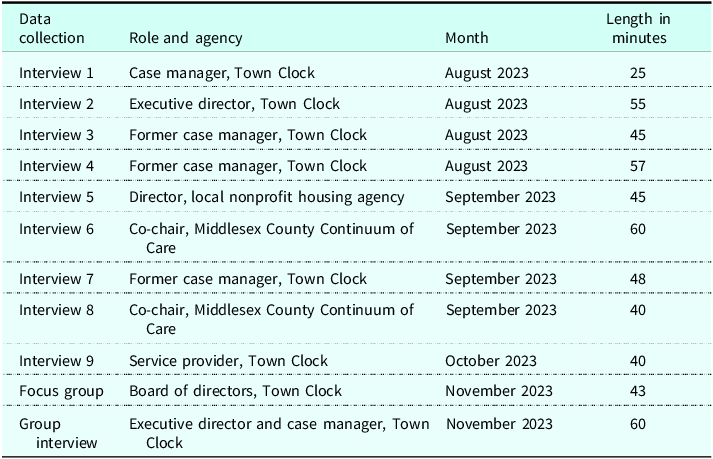
Programme stakeholders were invited to participate in the study via email, except for the executive director of Town Clock and the case manager, who were invited to participate during a meeting with the lead author. The executive director shared contact information for former staff, the affiliated therapist, and county housing experts, all of whom agreed to an interview. Finally, the Town Clock board of directors received an invitation and consent form via an email from the executive director prior to a monthly meeting. Twelve board members attended the virtual meeting, all of whom stayed to participate in the focus group.
Research procedures and analysis
The research team developed two data collection procedures: one for Town Clock residents and one for programme stakeholders. Instruments were semi-structured and allowed for responsive interviewing (Rubin & Rubin, Reference Rubin and Rubin2012). All resident interviews and the final focus group were conducted in person by the lead author in a private, on-site room. Interviews with programme stakeholders, including current and former Town Clock staff members, board members, and local housing experts affiliated with the Middlesex CoC, were conducted over Zoom or in person by the lead author. The board member focus group was virtual and lasted forty-five minutes. Finally, a one-hour in-person group interview with current staff was completed at the end of the data collection period to review preliminary findings, serving as a member checking activity to confirm interpretations of developing themes. Interviews and focus groups, except for the final group interview, were audio-recorded and transcribed verbatim.
The research team analysed transcriptions using reflexive thematic coding (Braun & Clarke, Reference Braun and Clarke2006, Reference Braun and Clarke2021) in NVivo software. A predominately inductive approach was used to centre the participant perspectives. The team followed a six-phase analytical process articulated by Byrne (Reference Byrne2022) as a worked example of Braun and Clarke’s approach. Initial codes were generated independently, and the team met frequently to review initial codes and share differences in interpretations. During this line-by-line coding step, the team noted instances of a priori codes related to administrative burden and TIC principles. The team worked collaboratively on generating and reviewing potential themes. The lead author drafted the final theme definitions and gathered feedback for refinement. Writing the findings was a group activity that relied on analysis notes and coding outputs.
The analysis is strengthened by four strategies commonly utilised to support the rigor of qualitative inquiry (Creswell & Poth, Reference Creswell and Poth2018) and described to enable the reader to judge the validity and contribution of the research (Nowell & Albrecht, Reference Nowell and Albrecht2019). First, the project was based on a prolonged study site engagement to develop a deep understanding of the context, trust with participants, and rich data. Second, triangulation of data, through the combination of interviews and focus groups with different stakeholders, was used to increase robustness. Relatedly, multiple coders participated in the project to confirm interpretations and avoid bias. Third, peer debriefing and member checking were used to check and assess the validity and credibility of the team’s interpretations of the data. Finally, the reliance on reflexive thematic coding as the analytical approach strengthened the team’s intention to check researcher bias.
Findings
Coding of the data resulted in three main themes: (1) public benefits as a resource to meet financial needs; (2) barriers to public safety net benefits are numerous and related to rules and administrative burden; and (3) facilitators to public safety net support are aligned with TIC principles. These themes are presented along with sub-themes and supporting quotations.
Financial needs and public benefits
Town Clock provides residents affordable, long-term housing with supports. Compared to other low-income families without stable housing, residents of Town Clock are better off in making ends meet. Rent is tied to income and can be zero dollars when needed. Numerous residents touched on the importance of the income-based rent costs, with one stating, ‘ I’m just grateful that I’m here… I could have been homeless. You know, being out of work like that. Once you get paid, then they try to calculate what they can charge you for rent and things like that. So that’s a good thing’.
Residents can also make use of a food pantry, and Town Clock staff organise events and gifts around celebrations and holidays.
At the same time, many residents explained financial difficulties. Only one of the residents interviewed, Beatrice, a single woman with no children, shared that she is able to cover her expenses and even save a bit of money each month. Beatrice has been living at Town Clock for almost three years; she was unemployed and receiving public benefits for about a year before finding restaurant work. Now, after two years of working full-time, Beatrice is financially stable and feels lucky. She explained that maintaining stable employment is challenging; challenges she sees other residents facing, particularly those with children.
One of the residents that expressed feeling challenged in making ends meet was Cleo, a single mother who had living at Town Clock for the last six years. One of Cleo’s major priorities is ensuring her daughter, who also was healing from past abuse, has the support she needs to succeed at school and home. However, Cleo stated that this priority, coupled with her lack of transportation and specific job skills, has made it difficult to secure employment that works for her. She relies upon public benefit, like SNAP and Social Security disability, to afford basic necessities. Cleo made it clear that these benefits have left her with little spending or saving flexibility, identifying numerous expenses that she consistently struggles to cover.
Much like Cleo, other residents and programme stakeholders discussed the struggles faced by survivors in making ends meet. Most of the residents were working minimum wage jobs, and some had unpredictable schedules. Blessed, a single woman in her fifties, expressed frustration regarding her reduced hours at a convenience store. For some, meeting daily expenses was made more difficult by credit card or medical bills – debt that often was tied to their past abuse. Strong agreement between residents and stakeholders existed in perceptions of public safety net benefits as a critical resource in meeting basic needs during times of transition and when escaping abuse. One former case manager explained, ‘The food stamps definitely is a help. I think, coming in, all of them … were on food stamps and cash assistance’. Case managers discussed how transitions from, through, and beyond an experience of DV can be jarring and abrupt. For example, one former Town Clock case manager noted,
Let’s keep in mind what else they’re going to need and how different this is, and how can we do a better job of preparing them for that change. What can we do better in that transition that might honestly make everybody’s lives a lot easier in the long run.
Stakeholders and residents alike emphasised this need for both time and resources to adjust or move towards the survivor’s goals.
Barriers to the public safety net
Despite strong agreement that the public safety net is a critical resource, residents and stakeholders frequently discussed barriers to accessing and maintaining benefits. These barriers comprise the second findings theme and fall into two categories: rules related to eligibility and benefit levels, and administrative burden.
Eligibility and benefit levels
One category of barriers noted by both residents and stakeholders related to the rules that determine who is eligible to receive benefits and how much a recipient qualifies to receive. In terms of eligibility rules, citizenship was most frequently discussed as a barrier to accessing benefits. When asked about whether certain individuals struggle disproportionately with access, a current Town Clock staff member discussed refugees: ‘ . . . technically they’re here in America working, paying taxes, but they don’t get access to some of the stuff. So, I would say they kind of fall through the cracks’.
Similarly, Aisha, a single mom of three children, when asked if she is receiving public benefits, shared that her immigration status disqualified her.
For those that had received TANF in the past or were currently receiving it, their monthly benefit amount was considered to be too little to enable women to both make ends meet and plan for the future. A lively discussion during the resident focus group focused on the interplay of low benefit levels and low income.
Participant 1: So, the system is kind of, I don’t know, messed up. You worry about it.
Participant 2: Seriously, that’s the word for it, messed up.
Participant 1: When you’re working, you don’t get any assistance from government. You use your money to pay for, you use it for childcare, transportation and everything. A little bit food. At the end of the day, you don’t get anything for yourself or even for food. But when you’re not working, the government gives you some money for food and some cash, but that is not also enough. So, it’s like should I work? Because it’s like when you’re working, it’s not enough. It’s so much, seriously. Sometimes I don’t know what to do…
Stakeholders pointed out that any shifts in employment status or pay rates could prevent residents from qualifying for benefits.
Administrative burden
In addition to barriers related to eligibility and benefit levels, residents and stakeholders discussed administrative burden. Though study participants did not use the language of costs, coding revealed a strong match with learning, compliance, and psychological costs.
Illustrating the learning costs associated with public benefit receipt, residents and Town Clock staff expressed frustration with understanding the application process. Regarding SNAP, Pilar, a single grandmother living alone at Town Clock explained, ‘At first, it was a little difficult to get, but you know I don’t, don’t understand anything. And needing to understand it, was very difficult’.
A former Town Clock case manager discussed how she felt part of her job as a case manager was to facilitate access to supports and resources, and ultimately empowering residents to apply on their own, without help. She explained, ‘And so, I feel like I can really help educate the clients. It’s very frustrating. Yeah, you want them to, you know, be empowered to, you know, kind of advocate for themselves and take it on, but, you know, if I’m confused about some of this stuff…’
Some of the explanations of barriers also aligned with compliance costs. Residents and stakeholders characterised the public safety net as ‘broken’ and offered specific examples where existing rules and regulations were difficult for survivors to follow. One former Town Clock case manager stated,
I hate the system, because I mean, and I can speak from both perspectives because about ten years ago I was a recipient and I’m now helping other people, so I know the ins and outs, and there are a lot of holes in the system that don’t make any sense.
She explained how difficult it is to access childcare and ended her point with, ‘Like they don’t make it easy for you to really support yourself. It’s a hard climb, like it’s like you’re climbing out of a ditch. It’s very difficult and challenging… It’s like you’re not setting me up to win’.
Angela, a young pregnant mother with two children, also described compliance costs related to meeting work requirements and obtaining childcare through TANF. She shared,
You always have to fill in the form and send it to them to show that you are looking for a job … and also the problem reason why you do not have the job or maybe you stop working. Usually, they say you can apply for childcare, but you have to do some particular number of hours. And … you have to work continuously for maybe a month or two months before you can qualify for the childcare.
Despite these frustrations, residents persisted with paperwork and appointments, and no one discussed voluntarily leaving a programme. One former case manager discussed her efforts to help residents when they were sanctioned for non-compliance and trying to reinstate benefits.
Finally, all participants discussed challenges related to the psychological costs. Residents felt stress and stigma in their relationships with case managers and experiences in public welfare agencies. Strong consensus existed in the focus group session when asked to contrast their experiences at the Town Clock programme and those at the public benefits agency.
Participant 1: Oh, it’s way more personable here. Like (Town Clock staff member) and (Town Clock staff member), they have emotions, they have facial expressions. They just speak better to you. But those people at social services [public welfare agency], uh-uh, no!
Participant 2: They could be very disrespectful!
Programme stakeholders also expressed concern that psychological costs can prevent women from receiving help. One of the local housing experts explained, ‘Women, people of colour, and who maybe don’t speak English, recent immigrants, all experience it more differently… stigma is a killer. It’ll keep people from getting help, every time’.
When asked about potential solutions, a leader of the county CoC housing network explained,
A lot of times there are policies in place to help people, but they’re just not used because “Maybe I don’t think you’re deserving enough. Maybe you came in with a sour puss, and now I don’t like you. So, I’m not really going to tell you about that post.” So, to me, it would be like I’m going to wave the magic wand, and everyone is going to have the right attitude and understand that it is a gift to you to help another human being, and you should be happy to do so, not make them grovel for it… everything you know and learned should be worked for that person’s betterment.
Stakeholders, including Town Clock staff and board members as well as local housing experts, discussed the need for shifts in the way public agency caseworkers and staff interact with recipients. Most interviewees expressed concerns regarding caseworker bias and judgement, particularly as related to lack of training on trauma.
Facilitators to the public safety net
In contrast to the barriers discussed, study participants focused on three factors that facilitated access and mitigated negative experiences with the public safety net. The three factors – strong case management, peer support, and flexibility – were discussed as critical elements of Town Clock but lacking in public agency offices. TIC principles are embedded in all three of these facilitators and were integral in making Town Clock effective in easing safety net administrative burden.
Case management
Town Clock employs a part-time case manager. When asked to describe what case management entails, former and current Town Clock staff as well as community experts used similar language to describe the job. They talked about ‘connecting’ residents to services and resources across multiple agencies. One stakeholder described the position as a ‘systems navigator’, and many discussed the importance of ‘relationship building’ with residents as well as staff across public and non-profit service agencies. One interviewee explained that case management is ‘person-centred’, and elaborated,
We sit with the person and really find out what they want, what do you want? What do you think you need? How do you think we can help you? This is what we can offer. So, doing a person-centred sort of interview, an intake and assessment… Being able to have a conversation and hold information. And then be able to follow up and break it down. And that’s a real skill, you know. It’s learned over time.
Residents similarly discussed how the Town Clock case manager, as well as the staff at their former DV shelter, helped with many issues. Residents described close, trusted relationships; a common phrase used was ‘they understand me’. All described being able to work through challenges and on goal setting, processes that align well with TIC principles of empowerment and choice. Beatrice recalled meetings with the case worker that were focused on goal setting: ‘My main goal is to find a job. So, (the case manager) is helping me with that. We set some goals for six months. And, then she asks “Are you working on that thing? Are you working on this thing?’
Regarding access to the safety net, case management was often utilised to facilitate information or connections to resources. Many residents talked about how they first learned about public benefits, from a case manager. Emily, a young single mother with a toddler, explained,
I didn’t hear about any of that (safety net benefits), not until I got here, not until I got into programmes like this. And I feel like that should be [better known], I mean it’s open and available to everybody. You just have to put in the work and apply, but really not everybody knows about it.
A former case manager shared that she not only helped residents with completing forms but also spent time advocating on behalf of residents. She explained, ‘So, I do a lot of that (connecting to public assistance). I’ve called with them. I have reached out to them individually, getting information and then bringing it back to the ladies here. It’s just very hard, right, to get in contact with them’.
Evident in this description is the challenge that survivors faced in accessing and maintaining benefits on their own, and how the trauma-informed case management at Town Clock, not at the public agencies, helped in overcoming barriers, including learning and compliance costs.
Peer support
A second facilitating factor for residents is peer support. The survivors at Town Clock described how their relationships with other residents helped them emotionally and materially. Angela noted how the environment at Town Clock was conducive to peer support,
I’m kind of in good relationships with everybody. I just don’t see us as just residents. I see us as family. I feel like everybody has gone through their own thing … But we are trying to heal. We kind of need each other. The support.
In addition to emotional support, residents described helping each other out with babysitting, running errands, and sharing information. The lead author observed information sharing at the focus group session during a conversation about finding affordable housing outside of Town Clock. The author’s question prompted an exchange with multiple examples of how residents learn from each other:
Facilitator: I feel like you’re learning from each other, right? Is that something that you usually try to do – sort of share information and help each other out like this?
Participant 1: Yeah, we do! We have spoken about it many times.
Participant 2: I learned from (former resident) about the working thing and I know from Happy and Aisha about…
Participant 3: I mean we do. I see certain people outside walking in and out, and you have a conversation with them and sometimes you just talk, and you learn certain things.
This conversation illustrates the role of peer support, a TIC principle that emphasises collaboration and support among peers who have similar lived experiences, in easing administrative burden.
Flexibility
The third and final facilitator coded in the data was flexibility, specifically in the programming and approach at Town Clock, including residents’ ability to reside there without a time limit. This flexibility served as a facilitator to receiving public benefits, as Town Clock services often complemented what was provided by the safety net, enabling women to pursue benefits without the worry of income gaps or application delays. Residents and stakeholders described how placement at Town Clock empowered the residents to learn to navigate the complexity of the public benefits system. At the core of this approach was trauma-informed principles and allowing residents to grow at their own pace. In reference to the goals of Town Clock, one case manager explained that running a trauma-informed programme meant, ‘Giving them [residents] time to find themselves, giving them time to heal, giving them time to fall apart, and slowly put themselves back together’.
In contrast to the time and flexibility residents have at Town Clock, the public safety net is constructed to be time-limited and has firm deadlines in terms of compliance. Stakeholders, including the board members, considered the ample time available at Town Clock, as well as the food pantry and other opportunities for financial help, as a balance and resource that complements the gaps in public benefit provisions. In this way, the TIC foundation of Town Clock serves as a critical facilitator to making the rigid public safety net work for survivors.
Discussion and conclusion
Our findings demonstrate the applicability of applying both TIC and administrative burden frameworks in understanding the needs and experiences of low-income DV survivors. Our three themes: financial needs and the safety net, barriers to safety net access, and facilitators to access, illustrate the negative impact of administrative burden and the positive effects of TIC in the lives of low-income survivors. Findings indicate that for survivors, even ones who are stably housed, the public safety net provides critical benefits and has the potential to better support survivors. The trauma-informed programming available at Town Clock, including case management, peer supports, and flexible services facilitated access to and maintenance of public safety net benefits. However, even with strong case management through Town Clock, survivors faced barriers to accessing benefits. Barriers, which include eligibility criteria, low benefit levels, and administrative burden, exacerbate the challenges survivors face particularly while recovering from trauma and suggest a poor match between the policies and the realities of survivors. This finding echoes concerns identified by other researchers who have examined public benefits systems from a TIC perspective (Corbett et al., Reference Corbett, McGann, Considine and Rejón2026; Roberts et al., Reference Roberts, Stuart, Allan and Gumley2022; Scullion & Curchin, Reference Scullion and Curchin2022).
Considering experiences of administrative burden more specifically illustrates how burden is characterised by a lack of TIC principles and sheds new light on potential solutions. Findings point first to learning costs, with residents expressing how they did not always understand the processes they encountered when trying to access benefits. Many noted confusion over forms, echoing previous research on learning costs (Yates et al., Reference Yates, Carey, Malbon and Hargrave2022). Stakeholders shared this perspective, commenting that even they struggled to understand. Both residents and Town Clock case workers perceived information to be inaccessible or sometimes guarded. These learning costs reflect gaps in TIC concerning the principles of trustworthiness and transparency as well as collaboration and mutuality.
Compliance costs, as experienced by those in this study, also reflect a lack of TIC principles in public safety net programmes. Again, the principle of trustworthiness and transparency was viewed as particularly lacking, along with the principle of empowerment, voice, and choice. In a TIC environment, decision-making and policy implementation should be made with transparency in order to build trust with recipients. Residents in our study did not feel trusted, nor did they feel empowered to make choices. Noone discussed goal setting or collaboration with staff at the welfare agency. Instead, the regulations and procedures of the conditional safety net were uniformly experienced as chores, unconnected with goals. Women in our study did not view the county welfare staff as supportive, and as such, echoing findings by Bell & Smith (Reference Bell and Smith2022), by adopting a focus on compliance rather than empowerment, frontline workers contributed to compliance costs.
Finally, psychological costs and stigma indicate a lack of all six TIC principles in the overall culture of the safety net and strongly echo TIC evaluations of UK safety net programmes (Roberts et al., Reference Roberts, Stuart, Allan and Gumley2022; Scullion & Curchin, Reference Scullion and Curchin2022). The extent of psychological costs experienced by Town Clock residents illustrate Moynihan and colleagues’ (Reference Moynihan, Herd and Harvey2015) description of how costs arise when individuals perceived that their value is derived solely from their status as a recipient. This feeling of being undervalued contradicts the TIC principle of collaboration and mutuality, which emphasises efforts to level power dynamics between recipients and staff. Moreover, our study participants were concerned with various biases they perceived in the system, reflecting a lack of the principle of cultural, historical, and gender issues. The TIC principle of safety was also a concern for residents, all of whom felt unable to have personal conversions with agency staff.
While our findings offer insights about understanding administrative burden through a trauma-informed lens, they must be interpreted with an understanding of project limitations. As a qualitative project, the goal was to provide evidence to build and refine theories through a deep examination of experiences, relying extensively on participant voice – not to test a theory. Moreover, the case study selection of a permanent supportive housing programme in New Jersey means that findings relate to the experiences of survivors with some distance from their past abuse, residing in stable housing with access to other TIC supports. The experiences of other survivors, particularly in terms of an absence of facilitators as well as a greater need for safety, are likely different.
Future research could further these findings. Replicating the research in other locations and with other groups may add nuance to our themes. Our findings motivate an in-depth study on immigrant survivors, particularly in the current political environment. Research on public benefits staff would add another perspective on the relationships among TIC, administrative burden, and frontline challenges of policy and resource constraints. Research that probes more deeply into each of the six TIC principles to assess comparative relevance is an important next step for the field. From a more programme-evaluation standpoint, future research on TIC programmes could include administrative burden as an outcome to test the impact of TIC on reducing burden and the perceptions of costs. This suggestion relates to that of Corbett and colleagues (Reference Corbett, McGann, Considine and Rejón2026) who call for TIC evaluations that examine participant outcomes. Similarly, research on interventions that decrease administrative burden could include measures of TIC. In other words, by taking steps to reduce administrative burden, are programmes also becoming more aligned with TIC principles, even without an intention to do so?
Though further research is needed to understand the magnitude of the impact that TIC practices could have on easing administrative burden, our findings provide initial evidence for strengthening TIC principles in public human services agencies. In short, survivors view the public safety net as essential to financial stability, but programmes are hindered by a lack of TIC principles, manifested through administrative burden. Findings support providing TIC training and resources to public agency workers to recognise the impact of trauma, implement TIC principles, and engage in case management that imbeds trust, collaboration, and empowerment. Such strategies could complement burden-focused, paperwork reduction, and modernisation efforts. Simultaneously, DV advocates might partner more closely with public agencies to increase collaboration and lessen the burden experienced by survivors.
Acknowledgements
We thank the leadership of the Town Clock Community Development Corporation for their partnership and our interviewees for sharing their time and expertise with us, particularly the residents of Town Clock for their trust and honesty.
Funding statement
This work was supported by the Family Self-Sufficiency and Stability Research Network, Grant Number 90PE0043 from the Office of Planning, Research and Evaluation, Administration for Children and Families, U.S. Department of Health and Human Services. Its contents are solely the responsibility of the authors and do not necessarily represent the official views of the Office of Planning, Research and Evaluation, the Administration for Children and Families, or the U.S. Department of Health and Human Services.


 Open access

