

Introduction
Context and Aim
The cultural policy of the European Union (EU) aims to construct an ‘imagined community’ by defining a common history or common practices, values and norms (Shore Reference Shore2000; Sassatelli Reference Sassatelli2002). The EU has made various attempts in recent decades to make European identity more concrete. Launched in 1985, the European Capital of Culture (ECOC) programme is at the centre of the EU’s cultural actions and is part of its general cultural policy (Sassatelli Reference Sassatelli and Patel2013). The goal of the ECOC is to create an overall cultural picture of Europe, to strengthen a sense of European identity and to promote some degree of political integration (Patel Reference Patel and Patel2013). The ECOC functions as a structured platform for dialogue between the EU and participating cities. Cities engaged in the ECOC process often navigate the intersection of local, national, supranational, and global dynamics. Rather than offering a fixed meaning of Europe, the ECOC highlights the contested and evolving nature of Europeanness as it is negotiated within specific local contexts. Furthermore, this kind of bottom-up interpretation of Europeanness is more likely to generate recognition for the European project (Fage-Butler Reference Fage-Butler2018; Lähdesmäki Reference Lähdesmäki2014). The articulation of so-called ‘European values’ – such as democracy, cultural diversity, solidarity, or shared heritage – is neither fixed nor universally agreed upon, but is shaped by historical contingencies and local interpretations. In the context of the European Capital of Culture, these values are not simply imposed from above but are actively constructed and negotiated through each city’s unique historical and geographical background (Lähdesmäki Reference Lähdesmäki2014; Palonen Reference Palonen2010; Sassatelli Reference Sassatelli and Patel2013).
The idea of Europe has carried distinct and evolving meanings in the post-socialist countries of Central and Eastern Europe (CEE). After decades of Soviet dominance and constrained autonomy, the post-1989/91 period unfolded amid simultaneous reconfigurations of both ‘Europe’ and ‘sovereignty’. Their subsequent engagement with European political and cultural frameworks was therefore not a simple ‘reintegration’ into a fixed order or a straightforward ‘return’ to national sovereignty, but a negotiated process that reshaped statehood, identity, and Europe itself. Some CEE cities carry the material and spiritual heritage of past socialist regimes and aim to strengthen their European belonging through the ECOC and present themselves as ‘European’ through their culture and urban spaces (Turşie Reference Turșie2015). Furthermore, CEE cities increasingly operate within a post-national space – one where identities, governance, and cultural expressions are shaped by transnational networks, EU frameworks, and global flows, rather than being confined to nation-state boundaries. They generate multiple identifications with Europe and create a diverse and at the same time territorially defined image of Europe. This article aims to explore how CEE cities construct Europeanness within the framework of the ECOC programme, with a set of research questions including: How does the ECOC enable cities to reshape their identity and retell their history within a European context? How do former communist cities deal with their past? How do they narrate their past to fit into the European dimension of the ECOC programme? What forms can Europeanness take and how do they differ across Europe? What are the spatial dynamics in interpreting Europeanness among ECOC cities?
The EU’s Identity Politics and ECOC
Culture and the EU’s Identity Politics
Since the establishment of the European Community in 1957, political scientists have been deeply interested in the issue of identity. Concurrent with European political integration, the possibility and desirability of constructing a European identity have been widely discussed. Although the EU is not the only actor that defines European identity, it has been described as embodying the ‘identity hegemony’ producing various normative discourses on what Europe should be (Delanty Reference Delanty1997; Herrmann et al. Reference Herrmann, Risse and Brewer2004). With the EU’s treaty base and multi-level governance framework (Hooghe and Marks Reference Hooghe and Marks2003), the shaping of European identity is seen as a political project. EU institutions provide an institutional and discursive environment that is conducive to the transformation, to a certain extent, of previously exclusive local or national identities, thereby creating a close link between the EU and the European societies (Friedman and Thiel Reference Friedman and Thiel2012). However, as European integration deepens, the debates on European identity in the public realm have become increasingly important and widespread (Zappettini Reference Zappettini2019).
European identity is closely related to culture, yet culture is a paradoxical factor in creating a European identity (Friedman and Thiel Reference Friedman and Thiel2012), not least because it is deeply entangled with collective memories and historical narratives. On the one hand, shared cultural references to Europe’s past can support the construction of a common identity; on the other hand, culture becomes a source of tension when nationally rooted interpretations of history – particularly in the post-socialist ‘return to Europe’ context – feel challenged by European integration. Not only is European identity an internal European issue but it also affects the EU’s normative and geopolitical position in the world. Most scholars engaged in addressing the concept of European identity (Checkel and Katzenstein Reference Checkel and Katzenstein2009) or the European public sphere (Risse Reference Risse2010) believe that culture remains rooted in national traditions, but EU initiatives such as the European Capital of Culture and growing cross-border exchanges have made it increasingly transnational and European. The EU has taken various steps over the past decades to render the concept of European cultural identity more concrete, such as the Lisbon Treaty and the European Agenda for Culture, seeking to foster a common idea of Europe (Lähdesmäki Reference Lähdesmäki2012).
However, European identity is also closely related to culture, and culture has long been a paradoxical factor in the making of a European identity (Friedman and Thiel Reference Friedman and Thiel2012). On the one hand, culture is integral to constructing a common identity; on the other hand, it can become a source of tension when particular national cultures feel threatened by European integration.
ECOC and the European Dimension
Building a common and coherent European identity is at the heart of EU identity politics and can be detected in the ECOC paradigm, as the official purpose of the programme is to highlight the similarities and differences between European cultures and to generate a greater sense of belonging among European citizens (Fage-Butler Reference Fage-Butler2018). The enlargement of the EU in 2004 further changed the structure of the ECOC programme and the EU began a concrete process of cultural Europeanization in new member states, bringing the ECOC initiative to a new milestone. A stronger European dimension became a requirement to increase cultural exchanges between Western and Eastern European cities (Mittag Reference Mittag and Patel2013). The rationale for these developments is that the EU institutions saw the need to reinforce the ECOC’s profile and to cope with the increasing complexity of an enlarged EU (Patel Reference Patel and Patel2013). In 2006, the ‘European dimension’ and ‘city and citizens’ standards were introduced by Decision 1622/2006/EC.
Along with this renewed policy, the ECOC initiative is seen as entering a new phase in which the European dimension and Europeanness become major foci of local implementation and promotional rhetoric (García and Cox, Reference García and Cox2013; Lähdesmäki, Reference Lähdesmäki2014). Importantly, these discussions are often anchored in selective engagements with the past: cities mobilize historical narratives, memories, and heritage to position themselves within a changing Europe – an approach that has been particularly salient in post-socialist contexts where ECOC has served as a cultural vehicle for re-articulating Europeanness after 1989/91. For the last 20 years, EU institutions have worked to promote shared values and goals that help define what it means to be part of Europe. The European dimension permeates the explicit and implicit political goals of the programme, including: promoting European cultural diversity and commonality; strengthening Europe-wide cultural cooperation and increasing mutual understanding among citizens and cross-cultural dialogue; inspiring people to participate in the cultural activities; and ultimately creating a shared sense of belonging and identity with Europe (Lähdesmäki Reference Lähdesmäki2014). The European dimension also ensures that the ECOC is a transnational project and not just a domestic event in a host city. Generally, the European dimension can be achieved by highlighting the richness of cultural diversity in Europe and bringing the common aspects of European cultures to the fore (García and Cox Reference García and Cox2013; Fage-Butler Reference Fage-Butler2018).
Europeanness: A Discursive Construction
Instead of developing a single and homogenized identity policy in an attempt to strengthen Europeans’ sense of belonging, EU institutions were involved in defining Europeanness. Europeanness is a set of values, norms and beliefs that underpin European integration and the European socio-political community (Gierat-Bieroń Reference Gierat-Bieroń, Czerska-Shaw, Galent and Gierat-Bieroń2018). Scholars have studied the identity-building process of the ECOC and outlined the following three interdependent principles of the EU’s discursive construction of Europeanness.
First, EU cultural policy carries significant symbolic weight, with its norms often intentionally vague. This ambiguity allows for a wide range of interpretations and enables different actors to adapt or appropriate European cultural narratives to fit their own local or political contexts (Calligaro and Vlassis Reference Calligaro and Vlassis2017). The EU has engaged in a negotiation of Europeanness while allowing others to assign the exact meaning of the term. EU cultural policy promotes identity not as a fixed ‘being’ but as a fluid ‘becoming’ (Sassatelli Reference Sassatelli2009), aligning with Patel’s (Reference Patel and Patel2013) view of integration by interpellation. Through emotionally charged yet vague terms such as ‘European identity’ and ‘common cultural heritage’ (Lähdesmäki Reference Lähdesmäki2014), the EU governs symbolically, inviting identification while leaving meanings open to interpretation, enabling flexible appropriation across diverse political and cultural contexts.
Second, as a contested concept, Europe can not only be shaped by European institutions but also appropriated according to local conditions. This localized understanding of Europeanness may be more meaningful to the public than a top-down definition, thereby promoting greater identification with European projects (Fage-Butler Reference Fage-Butler2018). The ECOC programme generates and promotes both Europeanness and locality. Sassatelli (Reference Sassatelli, Meinhof and Triandafyllidou2006, Reference Sassatelli2008, Reference Sassatelli2009, Reference Sassatelli and Patel2013) referred to this process as ‘Eurocalization’ or the ‘localization of Europe’, that is, the EU creates a local Europe by localizing the European and Europeanizing the local simultaneously. Calligaro (Reference Calligaro2013) also pointed out that through the ECOC programme, the EU aims to develop a flexible relationship between local cultural actors and the EU structure and to empower cultural actors at the local level to create their own definition of Europeanness.
Finally, the fundamental aim of EU cultural policy is to emphasize the cultural diversity of Europe, while looking for potential common elements that reflect the various European cultures. This simultaneous emphasis on unity and diversity is a key feature of the EU’s identity-building. In other words, Europeanness has many different cultural units and characteristics, but these cultures are also considered to be related to some underlying common elements, such as common cultural roots, history and heritage (Bieber and Bieber Reference Bieber and Bieber2020). The discourse of ‘unity in diversity’ guides the ECOC programme and is widely used in the practice of producing ECOC events (Lähdesmäki Reference Lähdesmäki2012). Cultural aspects are constantly renegotiated, with the pendulum swinging between ‘unity’ (such as the European common cultural heritage) and ‘diversity’ (such as nationality and language) (Clopot and Strani Reference Clopot, Strani, Kockel, Clopot, Tjarve and Craith2019; Shore Reference Shore2006). This is especially important in the context of the EU’s eastern enlargement, as the concept of Europeanness needs to be semantically flexible to accommodate the growing cultural diversity resulting from the increase in EU member states.
Methodology
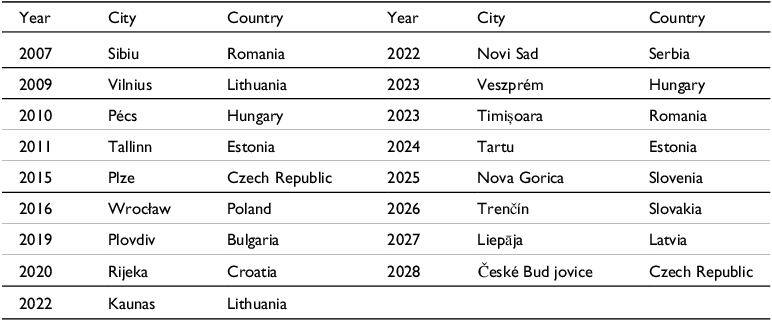
This study includes 17 post-socialist ECOC cities from 2007–2028, primarily in EU member states (see Table 1). Notably, Novi Sad (Serbia), from a candidate country, reflects how the ECOC transcends EU borders, illustrating that Europeanness is constructed through cultural affiliation, not limited to formal membership or geopolitical boundaries. This period was chosen for two main reasons. First, it is related to the evolution of the ECOC. In the early stages, the European dimension was not a priority for the host cities. It was not until 2006 that the EU institutions’ decision 1622/2006/EC revealed the significance of the European dimension (European Parliament and the Council 2006) and made the discourse around shaping Europeanness more obvious. Another consideration is the source of the data. Since 2007, the European Commission has commissioned a British consulting firm – Ecorys – to conduct annual impact assessments on ECOC cities.
The list of CEE cities included in the research

This study employs a qualitative analysis of two primary types of documents produced within the ECOC programme: bid books and final evaluation reports. The bid books represent the planning and conceptualization phase, wherein cities articulate their cultural visions, objectives, and proposed projects. Final reports, in contrast, document the implementation outcomes, reflecting how initial plans materialized and were received by stakeholders. The Ecorys reports, commissioned by the European Commission and produced using a standardized evaluation framework, offer systematically collected data that enable cross-case comparison of ECOC cities’ strategies and impacts. While useful for identifying patterns across editions, the reports reflect institutional priorities and may underrepresent dissenting voices or informal cultural dynamics, thus requiring critical interpretation alongside other sources. Using the bid books as an analytical text, it is possible to explore how the candidate cities have added their own interpretations of the shaping of Europeanness. This also means that to be selected, those applicants may enhance their arguments or choose the rhetoric preferred by EU institutions. However, the interpretation of what it means to be European may not be consistent with what the city does in actuality.
As for the analytical approach adopted, this study applies post-structuralist discourse analysis (Hansen Reference Hansen2006; Laclau and Mouffe Reference Laclau and Mouffe1985) to capture how the ECOC cities construct and promote their Europeanness. The specific historical and situational context of discourse influences how identities are interpreted and constructed (Torfing Reference Torfing, Howarth and Torfing2005). This research aims not to seek to ultimately determine the meaning of Europe but to demonstrate empirically the diversity of Europeanness from various discourse contexts. The identification of key discourses – particularly those related to European unity and cultural diversity – was conducted through a systematic coding process. Using a coding framework grounded in theories of cultural identity and Europeanization, texts were analysed iteratively to detect recurrent themes, narrative frames, and rhetorical strategies. Discourses of unity were identified in bids that invoked a shared European past. Common history and heritage and restoration of pre-war European identity were evident in cities seeking to reconnect with a cosmopolitan legacy. Shared values, challenges and citizens reflected efforts to rearticulate European unity through democratic ideals, youth participation, and responses to contemporary crises. Diversity was coded where cities positioned themselves as cultural melting pots, invoking multilingualism and coexistence. The theme of meeting point and gateway emerged in bids emphasizing spatial in-betweenness and cultural crossroads. Post-national and cross-border characteristics were identified in cities which highlighted transnational networks and borderless identities.
The Discourses of Unity
Common History and Heritage
Within the European dimension, the discourse of ‘unity’ emerged repeatedly as ECOC candidate cities positioned their local histories as constitutive elements of a broader European historical narrative. From a poststructuralist standpoint, these narratives did not simply recount past events but performed discursive acts that produced particular ‘truths’ about European identity, thereby shaping boundaries of inclusion and exclusion within Europeanness. Cities crafted temporal and spatial linkages that strategically aligned their cultural heritage and urban fabric with a shared European identity, thus negotiating their belonging within Europe.
Temporally, the 2007 ECOC Sibiu mobilized a selective genealogy, framing its origins through ties to Luxembourg, the other city holding the 2007 title. Sibiu’s narrative traced its founding back to the twelfth-century Mosel-Rhine region, now Luxembourg territory (Shanos Reference Shanos2015). This selective historical construction inscribed Sibiu into a discourse of Europe’s ‘oldest history’, performing legitimacy by appropriating a grand European meta-narrative while excluding competing local histories. Similarly, Vilnius 2009 invoked its past entanglements with the Grand Duchy of Lithuania, the Kingdom of Poland, and Tsarist Russia, weaving a temporal discourse that positioned the city within European power dynamics but selectively emphasized connections that resonated with contemporary European belonging (Crisafulli Reference Crisafulli2011; Ecorys 2010). Such narratives exposed European identity as fractured and contingent, shaped by ideological selection and exclusion.
Pécs 2010 (2005) layered its identity across multiple historical-cultural epochs – from Christian Rome, the Middle Ages, Classicism, middle-class culture, to modern art – creating a multi-stranded narrative that resisted singular, monolithic European stories and reinforced its place in a complex cultural continuum (Lähdesmäki Reference Lähdesmäki2012). Other cities performed Europeanness through claims of pioneering historical roles: the 2021 ECOC Timişoara emphasized its position as the first city in the Austro-Hungarian Empire and continental Europe to install electric street lighting, ethically positioning itself as an innovator and restorer of European values (Timişoara 2021 (2016)). Through this framework, Timişoara rearticulated a turbulent European past of crises into a forward-looking narrative of renewal and cultural experimentation, demonstrating how historical discourse functions as a tool of ethical self-fashioning within Europeanness.
Spatially, ECOC cities engaged in discursive constructions of Europe as a multifaceted, interconnected cultural space, where diverse urban architectures were strategically linked to broader European spatial imaginaries. Pécs 2010 framed its built environment as situated at the crossroads of five overlapping cultural regions – the Germanic Central Europe, the Balkans, the Austro-Hungarian legacy, the Mediterranean, and East-Central European socialism – producing a spatial narrative that challenged fixed national borders and emphasized Europe’s layered cultural hybridity (Lähdesmäki Reference Lähdesmäki2012). Similarly, Tallinn 2011 presented its old town as a microcosm of European cultural integration, highlighting architectural influences from Germany, Denmark, Russia, Sweden and Finland. The city’s emphasis on transnational artistic collaborations functioned as a discursive strategy to remap Europe as a fluid network of cultural exchange and shared heritage (Tallinn 2011 (n.d.)). This spatial discourse constructed a heterogeneous yet unified European urban identity, contesting essentialist spatial narratives.
Looking forward, the 2026 ECOC Trenčín planned to foreground marginalized European architectural heritage, including modernist and brutalist styles, blending Slovak local architecture with wider European innovations (Trenčín 2026 (2021)). This act of spatial re-signification disrupted dominant Eurocentric aesthetic discourses, highlighting alternative spatial identities within Europe’s architectural narrative. Lastly, the 2028 ECOC České Budějovice envisioned reconnecting cities across Austrian, Czech, and German borders via historical and pilgrimage routes. By retelling shared narratives through art and linking itself with other ECOCs such as Braga 2027 and Nova Gorica/Gorizia 2025, it constructed a translocal European identity that transcended state boundaries, privileging shared cultural footprints as the basis for belonging (České Budějovice 2028 (Reference Budějovice2023)).
Restoration of Pre-war European Identity
While not universally applicable to all post-socialist cities, many in Central and Eastern Europe have approached the ECOC initiative as an opportunity to reframe their identity in relation to a perceived pre-socialist European heritage. This section examines how some cities have selectively reclaimed elements of their pre-World War II past, negotiating their Soviet-era legacy while aligning themselves with contemporary narratives of European modernity and cultural continuity. ECOC candidate cities from the former Soviet bloc constructed discourses that framed communism as a disruptive and negative rupture within their histories, using this positioning to rearticulate their European belonging. Sibiu’s 2007 ECOC bid narrated the communist period as a break in Romania’s trajectory, with the bid itself symbolizing the country’s ‘return’ to Europe (Horner Reference Horner, Carl and Stevenson2009). This discourse reproduced a teleological progression from a problematic past to a desirable European future, selectively emphasizing rupture and renewal. Vilnius’ 2009 bid treated the Soviet era as a historical anomaly that fractured its national identity but could be overcome by reclaiming a pre-Soviet ‘original’ history, thus legitimizing current European claims (Crisafulli Reference Crisafulli2011). This act of selective historicizing privileges certain pasts while marginalizing others, producing an ‘authentic’ European identity.
Timişoara’s 2021 narrative described communism as an ‘unwanted past’ characterized by distrust and civic disengagement. The city framed its ECOC project as a ‘cultural journey’ to overcome this passivity and foster renewed participation (Timişoara 2021 (2016: 3)). This discourse positions the city as a site for ethical renewal, where history is mobilized as a resource for crafting a revitalized European identity. Similarly, the 2028 ECOC České Budějovice emphasized a ‘shared past’ that includes but ultimately downplays the totalitarian chapter in Czech history, situating authoritarianism as a temporary deviation within a continuous European narrative (České Budějovice 2028 (Reference Budějovice2023)). This normalization produces a resilient European identity that transcends recent disruptions.
CEE cities often invoked pre-World War II Europeanness as a core element of their identities, challenging the East–West binary by representing Europeanness as multidimensional and interconnected. The 2015 ECOC Plzeň explicitly employed the metaphor of ‘revival’ to describe its post-socialist transformation, using terms such as ‘rediscover’, ‘cleanse’ and ‘revive’ to signify the shedding of the socialist past and the rebuilding of an open, European identity (Plzeň 2015 (2010: 14); Hong and Kim Reference Hong and Kim2019). Its slogan ‘openness’ functioned performatively to enact this transformation. Wrocław’s 2016 bid used the concept of ‘Metamorphoses of Culture’ to metaphorically represent its historical upheavals, especially the post-World War II population replacement. This discourse reconciled ruptures by presenting the city’s identity as a continuous transformation aligned with European reintegration (Ecorys 2017; Wrocław 2016 (2011)).
For Kaunas in 2022, Europeanness was framed as ‘reconnecting’ with the West, drawing on a nostalgic image of the city’s open-minded pre-war identity in 1938. The discourse centred on notions of ‘return’ and ‘steps’ toward reclaiming authentic European values, constructing a cyclical temporality where past ideals guide present identity (Kaunas 2022 (2017: 23)). Conversely, the communist past was often constructed as a barrier to full European inclusion. Plovdiv’s 2019 bid explicitly articulated a sense of disconnection from a European ‘West’ imagined as democratic, dynamic, and cultural, thereby marking itself as excluded from this dominant discourse (Plovdiv 2019 (2014: 5)). The ECOC status was deployed as a discursive strategy to claim a place within a more inclusive and broadened European cultural space (Clopot and Strani Reference Clopot, Strani, Kockel, Clopot, Tjarve and Craith2019).
Shared Values, Challenges and Citizens
In their ECOC bids, CEE cities constructed Europeanness not as a fixed identity, but as a fluid and contested discursive field. These bids foregrounded a dual narrative in which Europe was simultaneously imagined as a space of openness, multiculturalism, and democratic values, and as one fractured by xenophobia, exclusion, and institutional distrust. Timișoara’s 2021 ECOC bid reflected the dual identity often negotiated by post-socialist cities – claiming both a shared European heritage and a distinct set of regional challenges. While invoking common European values, the city positioned itself as a ‘laboratory’ for a more inclusive and participatory future. This framing implicitly acknowledged persistent divides – such as East–West disparities – while proposing culture as a means to bridge them (Timişoara 2021 (2016)). The 2020 ECOC, Rijeka, both invoked and problematized European values, positioning them as an ‘old ambition’ intertwined with diversity, openness, and freedom, while simultaneously questioning their stability. Rijeka’s discourse constructed European identity as a site of negotiation – not merely through the promotion of democratic ideals but through active engagement with contemporary challenges, thus producing meaning through responsibility (Rijeka 2020 (2015)). Similarly, the 2027 ECOC, Liepāja, framed itself as an ‘Agora of Values/Democracy in Action’, producing a discursive space where the Europe of desire is both imagined and contested via curated forums on democracy, green, and digital transformations (Liepāja 2027 (2022)). The 2015 ECOC, Plzeň, articulated a generational discourse by positioning youth as ‘confidence bearers’, metaphorically linking Europeanness with democratic temporality and responsibility (Plzeň 2015 (2010: 15)). Yet, this narrative was destabilized by the city’s recognition of social closure and anxiety within Czech society, which fractured the European imaginary. Through ECOC, Plzeň aimed to deconstruct these internal divisions, rearticulating itself closer to Europe and reaffirming its role as a cultural centre – a performative act to reconfigure collective identity amid instability (Hong and Kim Reference Hong and Kim2019).
Some cities use the ECOC platform to draw attention to contemporary European challenges and to present culture as a means of addressing these tensions. Amidst the ongoing discursive constructions surrounding unemployment, immigration, nationalism, and other sociopolitical tensions within Europe, the 2021 ECOC, Novi Sad, positioned itself as a site for the negotiation and performance of European democratic values – tolerance, intercultural dialogue, and volunteerism – through cultural enactment (Novi Sad 2021 (2016)). The 2024 ECOC bid from Tartu problematized contemporary European values by naming populism and xenophobia as antagonistic forces disrupting the hegemonic narrative of an open, democratic Europe. This framing situated digitalization and mental health as emergent discursive nodes around which urban and rural life were structured in the twenty-first century (Tartu 2024 (2019)). Nova Gorica’s 2025 ECOC discourse articulated EU institutional distrust, Brexit, and populism as fractures in the European imaginary, while simultaneously invoking a call to re-legitimate these institutions (Nova Gorica 2025 (2020)).
Trenčín’s 2026 ECOC discourse unfolded climate change as a multifaceted signifier intersecting ecological, human, cultural rights, and migratory subjectivities, positioning cultural events as vectors for raising critical awareness (Trenčín 2026 (2021)). The Central and Eastern European ECOCs interpellated a ‘common future’ through European citizenship, privileging cross-generational dialogue where youth were positioned as both symbolic and actual agents of Europe’s democratic project. Plzeň 2015 metaphorically invoked youth as ‘bearers of self-confidence’, inscribing them within a democratic temporality of freedom and responsibility (Plzeň 2015 (2010: 15)). Kaunas 2022 problematized spatial and demographic flows – brain drain, internal migration – while deploying ECOC as a discursive mechanism to forge transnational solidarities and reimagine youth futures (Kaunas 2022 (2017)). Lastly, České Budějovice 2028’s use of the collective ‘we’ enacted a discursive strategy to foster youth participation and collective identity through cultural engagement (České Budějovice 2028 (Reference Budějovice2023)).
The Discourses of Diversity
Cultural Melting Pot
The metaphor of a ‘melting pot’ – despite its contested history and implications of assimilation – remains a common trope in illustrating the complex relationship between diversity and unity within European cultural identity. ECOC bids frequently mobilized discourses of cultural hybridity and multiplicity to perform Europeanness, constructing identity not as a fixed essence but as an ongoing negotiation of difference. Through these narratives, cities enacted themselves as sites where diverse linguistic, ethnic, and religious traditions intersected, creating contingent and hybrid cultural subjectivities. Rijeka 2020, for instance, articulated a self-image rooted in polyvocality, positioning itself as a cultural melting pot shaped by Roman, Slavic, German, Hellenic and Hungarian linguistic influences. This multiplicity was not merely additive; it was presented as dialogic and productive – giving rise to new values through continuous interweaving of cultural voices (Rijeka 2020 (2015)). Timişoara 2021 reinforced this narrative through ‘Words of Light’, an event that celebrated linguistic plurality and foregrounded intercultural dialogue as a constitutive European value (Timişoara 2021 (2016)). The 2010 ECOC, Pécs, showcased its diverse religious heritage – Turkish mosques, synagogues, and Catholic churches – as symbols of cultural plurality, invoking the historically loaded socialist-era concept of ‘peaceful coexistence’ to emphasize coexistence amid difference (Pécs 2010 (2005)).
Plzeň 2015 invoked its multicultural past – Czech, German, and Jewish, Catholic, Protestant, and Jewish traditions – to articulate a disrupted but recoverable coexistence. The bid narrated diversity as a foundational yet contested memory, disturbed by ‘two totalitarian regimes’, thus anchoring multiculturalism within a tensioned historical temporality (Plzeň 2015 (2010: 120)). Rijeka similarly staged its Europeanness through symbolic convergence: East and West (Orthodoxy and Catholicism), and overlapping architectural languages – Italian, Croatian, Austrian, and Hungarian – produced a material semiotics of cultural hybridity (Rijeka 2020 (2015)). Timişoara projected itself as a historically multicultural city, where Catholics, Orthodox, Christians, and Muslims coexisted, thus mobilising pluralism as a performative tradition (Timişoara 2021 (2016)).
Ethnic minorities and migration were also operationalized discursively to signify inclusivity and transnational belonging. Pécs 2010 used immigrant culture as a marker of its European orientation, implying that cultural diversity produced through migration aligns with continental values (Ecorys 2011). Wrocław 2016 reconstructed its multicultural image through a post-World War II re-population narrative. Migrant heritage was discursively framed as enriching and transformative, as the city positioned itself ‘where different cultural perspectives continue to merge’, thereby constructing a performative site of fluid identities (Wrocław 2016 (2011: 21); Latusek and Ratajczak Reference Latusek and Ratajczak2014).
Plovdiv 2019’s slogan ‘Together’ invoked coexistence not as a static state but as an ongoing negotiation of difference. The bid acknowledged ethnic tensions and lack of dialogue, positioning the city as a laboratory of integration. The ‘Fuse’ theme did not erase divisions but sought to re-signify them through cultural programming aimed at reconciliation, inclusion, and social cohesion (Clopot and Strani Reference Clopot, Strani, Kockel, Clopot, Tjarve and Craith2019; Plovdiv 2019 (2014)). Timişoara 2021 again asserted multiplicity with the slogan ‘Light up your city’, foregrounding over 30 cultural and ethnic communities to construct the city as a nexus of cosmopolitanism and ecumenism (Timişoara 2021 (2016)). In these discourses, cultural diversity functioned as a performative claim to Europeanness. Cities did not merely describe pluralism – they enacted it, producing identities through the contingent interplay of difference, memory, and aspiration.
Meeting Point and Gateway
Within the ECOC framework, post-socialist cities constructed discursive identities by positioning themselves as liminal spaces – bridges, gateways, or ports – between cultural, geopolitical, and historical binaries. These metaphors functioned not as neutral descriptions but as performative utterances that articulated Europeanness through spatial in-betweenness and symbolic hybridity. Through such discourse, these cities negotiated their place within a Europe that often located them on its margins. Sibiu 2007 opened its application by claiming a historical role as a meeting point of East and West and a site of European civilization, thereby inscribing itself into a grand civilizational narrative (Horner Reference Horner, Carl and Stevenson2009; Shanos Reference Shanos2015). Rather than simply referencing geography, this framing performed a spatial reorientation of Romania – shifting it from perceived periphery to symbolic centre in the context of EU enlargement. Tallinn 2011 similarly mobilized its multi-ethnic architectural heritage to frame itself as a transhistorical point of encounter, performing belonging through a discourse of layered multicultural authorship (Lähdesmäki Reference Lähdesmäki2010).
Wrocław 2016, through reference to historic trade routes such as Via Regia and the Amber Route, invoked movement and exchange as markers of European integration, embedding the city into continental flows (Ecorys 2017). Plovdiv 2019 activated its location on the Maritsa River and proximity to pan-European transport corridors to assert itself as a regional hub within European connectivity (Ecorys 2020). These spatial imaginaries did not merely reflect position but produced symbolic capital for these cities within the European project. Veszprém 2023 used the metaphor of a ‘ferryboat’ on Lake Balaton to enact a fluid, mobile Europeanness – where identities travel across cultural waters without fixed destination. This rhetorical move blurred national demarcations and reframed borders as traversable rather than rigid (Veszprém 2023 (n.d.: 38)). The metaphor of the ferry did not describe place but constituted a relational identity through motion and mediation.
Such figurations – bridge, gateway, port – emerged as recurring tropes. Pécs 2010 positioned itself as the ‘gateway to the Balkans’, aligning multiculturalism with geopolitical repair after the Yugoslav wars (Ecorys 2011). Rijeka 2020 deployed the ‘port of diversity’ to rearticulate local identity around openness and fluidity, invoking the port not just as infrastructure but as a metaphor for European unity-in-diversity (Rijeka 2020 (2015)). Plzeň 2015 offered itself as a ‘bridge’ between old and new Europe, staging mobility and reconciliation as forms of symbolic capital (Plzeň 2015 (2010)). Novi Sad 2021 activated the material and symbolic resonance of bridges – built, destroyed, rebuilt – to articulate both local trauma and a national aspiration for EU membership. The metaphor of the ‘new bridge’ became a temporal narrative of rupture and renewal, situating the city within a broader discourse of post-war reconstruction and European integration (Novi Sad 2021 (2016); Turşie and Perrin 2020). These post-socialist cities constructed Europeanness not as a given, but as a discursive position – produced through metaphors of movement, fluidity, and liminality. Their performative deployment of space generated claims of inclusion while subtly challenging dominant spatial orders within the European imaginary.
Post-national and Cross-border Characteristics
One of the goals of the ECOC programme is to challenge the traditional concept of the nation-state, promoting the European Cultural Zone as an alternative model centred on regionalism. The 2010 ECOC, Pécs, enacted a discursive strategy aimed at re-territorializing cultural identity within a post-national framework by invoking the Southern Cultural Area – encompassing Bosnia and Herzegovina, Croatia, Hungary, Montenegro, Romania, Serbia and Slovenia. This regional construct reactivated pre-existing but disrupted cultural linkages, fractured by the violent disintegration of Yugoslavia. Rather than merely restoring past ties, Pécs reframed cultural cooperation as a tool for wider political and symbolic integration beyond the nation-state. Through this positioning, Pécs sought insertion into transnational networks, producing a discourse of European belonging that resisted national boundaries (Ecorys 2011; Lähdesmäki Reference Lähdesmäki2010). This post-national logic also surfaced in other ECOC discourses. Wrocław 2016 articulated a self-critical stance, identifying Polish culture’s national character as an obstacle to European integration. Its bid reconfigured cultural identity by weakening the centrality of the national, thus enabling a discursive shift toward a more European, post-national subjectivity (Wrocław 2016 (2011)). Similarly, Rijeka 2020 deployed a rhetoric of disidentification, contrasting itself against Croatian national narratives. Croatia was linked with ‘insecurity, hardship and war’, while Rijeka positioned itself as an ‘oasis of normality’ (Rijeka 2020 (2015: 2)). This contrast constructed Rijeka’s Europeanness not through national inclusion but through symbolic autonomy – constituting a European self through spatial and ideological distance from the nation-state.
Novi Sad 2021 performed a similar identity manoeuvre through regional affiliation. As part of the Danube Network of around 80 municipalities, the city articulated a sense of belonging not based on linguistic unity (given the region’s 20 spoken languages), but on shared historical and cultural flows. Its bid produced regional identity as a discursive counterpoint to national homogeneity, advocating a collective Danubian subjectivity as a basis for European integration (Novi Sad 2021 (2016)). In Veszprém 2023, the Balaton region emerged as a symbolic geography for post-national identity construction. The bid proposed a cultural region defined not by state boundaries, but by intersecting local, regional and European elements. Its programme positioned Lake Balaton as a connective space, producing Europeanness through overlapping scales of belonging that sidestep national delineations (Veszprém 2023 (n.d.: 23)). Nova Gorica/Gorizia 2025 represented a particularly explicit articulation of post-national discourse. As twin cities straddling the Slovenian-Italian border, their ECOC bid invoked the metaphor of a ‘third space’, transcending binary identities tied to the nation-state. The slogan ‘GO! Europe’ and the claim that ‘culture, like water, doesn’t care much about points and lines on a map’ performed a deliberate erosion of territorial logic, positioning the cities within a vision of borderless European belonging (Nova Gorica 2025 (2020)). Collectively, these ECOC bids did not simply express a desire to ‘be European’, but enacted discursive reconfigurations of identity – dislocating the national as the primary referent and performing Europeanness through spatial, historical, and symbolic decentring. Through this, post-national identity emerged not as a fixed condition but as an ongoing negotiation within the cultural field.
Conclusion
The fundamental objective of the EU’s cultural policy is to simultaneously emphasize cultural diversity and find some common elements to unify various European cultures. This discourse has been applied by the ECOC cities to demonstrate their European dimension and the desire to generate European cultural identity from the bottom up (Lähdesmäki Reference Lähdesmäki2012). Following the EU’s eastward enlargement, the ECOC programme is a particularly fascinating case to study the spatial and regional dynamics shaping Europeanness. Drawing partly on bid books and other sources, this study empirically explores how post-socialist cities attempt to construct a European identity and express their spatial dynamics through the ECOC initiative. It is a real challenge for CEE cities, with young democracies with a totalitarian past, to overcome feelings of inferiority and to highlight their European dimension and their contribution to the richness and diversity of European culture. They aim to position themselves as a central bridge between Eastern and Western Europe, though their integration with broader European political and institutional frameworks is still in progress.
As Lähdesmäki (Reference Lähdesmäki2012) observed, European cultural identity is often attempted through appeals to connections with European history and a common European heritage. While highlighting a city’s architecture and heritage can easily draw attention to the unity of European culture, this approach is often ideological, shifting the cultural conflicts and social issues of today’s Europe to the commonality of heritage and the past. This article also examines how CEE cities invoke historical narratives to articulate their sense of Europeanness, framing their efforts as processes of both restoring lost identities and transforming themselves to fit contemporary European contexts. Pre-war history is described as the moment when they were fully European, when European values were integrated into their identity. ‘Restoration’ is associated with the pre-war period and shows that cities are now seeking to regain a European identity interrupted by totalitarian regimes. The concept of ‘transformation’ in these cities reflects not only a desire to move beyond their communist and totalitarian pasts but also reveals the complexities and tensions involved in redefining identity within European frameworks. However, due to the demographic turnover experienced after World War II, some CEE cities cannot rely solely on their historical Europeanness but also need to create it with new residents. Furthermore, some Eastern European countries continue to face structural and institutional challenges in areas such as governance, economic development, and EU integration, which can contribute to an imbalance in influence and resources compared with many Western European states. In addition, most CEE cities emphasize that Europe is a place of openness, freedom and cultural diversity, a source of learning and inspiration, but also full of conflicts and doubts. They highlight the role of citizens – particularly the younger generation – in shaping Europe’s future direction and advancing its core values.
Reflecting European cultural diversity through reference to history and heritage is one of the most common practices in EU cultural policy. However, Lähdesmäki (Reference Lähdesmäki2010) has critically pointed out that when multiculturalism is presented as a creative and unproblematic symbol in promotional materials, conflicts and confrontations related to cultural diversity are transformed into peaceful dialogue, thereby obscuring a history of domination and repression associated with confrontation or conflict. She cited the 2010 ECOC, Pécs, as an example. While the city was promoted as religiously diverse, past conflicts were also hidden, especially the fate of the city’s Jews. The concepts of meeting point and gateway reflect the blending and coexistence of local culture with different ethnic groups and cultures in post-socialist cities. The CEE cities associate themselves with ideas such as multicultural exchange, openness and cosmopolitanism to demonstrate their Europeanness. Meeting points also represent the fluidity of urban identity, which creates preconditions for encounters from different cultures. As places become more open to difference and change, this will contribute to the formation of a multicultural society. Overall, the Europeanness that emphasizes fluidity, openness and multicultural characteristics help these cities construct a localized Europe within urban space. In addition, CEE cities also consider themselves geographically at the crossroads of European people, roads and cultures, as gateways and bridges between the East and the West, such as Plzeň, Plovdiv and Wrocław. They position themselves fully within an interconnected Europe of the future, challenging the notion that Europe is synonymous with the West and highlighting a more pluralistic understanding of European identity. In particular, cities located in border areas give new meaning to their geographical location to reposition in a more favourable European context (Turşie Reference Turșie2019).
Finally, some post-socialist cities seek to reduce their ties to their own country because of conflicts on national territory or the growth of nationalism or authoritarianism. They try to highlight the post-national character of their Europeanness and not limit their European identity to the urban landscape. Rather, these characteristics belong to a wider transnational region historically and geographically. Emphasizing their differences with the country, they must construct the space of European identity into a dynamic area for creating European meaning, position themselves within it and contribute independently to the construction of a European identity. The CEE cities demonstrate their Europeanness and embrace cultural diversity. They see themselves as a convergence of different peoples and cultures. At the same time, some cities present themselves as actors within a post-national European space, often highlighting values such as openness, solidarity and transnational cooperation – sometimes in contrast to national governments. This will help to change their non-European image and demonstrate their uniqueness relative to nation-states in the process of constructing their European identity.
Yi-De Liu is Professor at the Institute of European Cultures and Tourism and Vice President for International Affairs at National Taiwan Normal University, Taiwan. He received a PhD in European Studies from the University of Portsmouth, UK. His main research focuses on EU cultural policy from a transnational perspective.

 Open access

