





Introduction
Drawing from classic studies (Butler & Stokes, Reference Butler and Stokes1971; Campbell et al., Reference Campbell, Converse, Miller and Stokes1960; Key & Cummings, Reference Key and Cummings1966), an important part of today’s political science literature sets out to understand why people support political parties (Alter & Zürn, Reference Alter and Zürn2020; Klüver & Spoon, Reference Klüver and Spoon2016; Marcos-Marne et al., Reference Marcos-Marne, Plaza-Colodro and Freyburg2020; Voogd & Dassonneville, Reference Voogd and Dassonneville2020). This has become a much more intricate task with the expansion of universal suffrage, the unfreezing of Lipset & Rokkan’s (Reference Lipset and Rokkan1967) socio-political cleavages (Mair, Reference Mair1984, Reference Mair1993), the rise of ‘non-partisan parties’ (Ignazi, Reference Ignazi1996) or ‘parties without partisans’ (Dalton & Wattenberg, Reference Dalton and Wattenberg2002), the transition from so-called allegiant to more assertive citizens (Dalton & Welzel, Reference Dalton and Welzel2014), and the changing patterns of political participation (Theocharis & van Deth, Reference Theocharis and van Deth2017).
Recent scholarship on contemporary party support increasingly focuses on analysing the factors driving support for populist radical right (PRR) actors (Arzheimer, Reference Arzheimer and Rydgren2018; de Jonge et al., Reference de Jonge, Georgiadou, Halikiopoulou, Kaltwasser and Tanscheit2025; Harteveld et al., Reference Harteveld, Mendoza and Rooduijn2022; Rooduijn et al., Reference Rooduijn, Burgoon, Elsas and Werfhorst2017; Steenvoorden & Harteveld, Reference Steenvoorden and Harteveld2018; Zanotti & Roberts, Reference Zanotti and Roberts2021).Footnote 1 This follows the observation that PRR actors have become an undeniable force across the political landscape (Rovira Kaltwasser et al., Reference Rovira Kaltwasser, Van Hauwaert, Heinisch, Off, Dolezal and Zanotti2024). In line with much of the traditional electoral behaviour literature, numerous studies underline the pertinence of what we can describe as past reflections. They attribute a key role to the past when they set out to explain PRR support, ranging from socialisation (Ivarsflaten & Stubager, Reference Ivarsflaten, Stubager and Rydgren2013) and partisanship (Meléndez & Kaltwasser, Reference Meléndez and Kaltwasser2021) to government evaluation (Akkerman et al., Reference Akkerman, Zaslove and Spruyt2017; Voogd & Dassonneville, Reference Voogd and Dassonneville2020) and perceived corruption (Busby et al., Reference Busby, Gubler and Hawkins2019; Pirro, Reference Pirro2014), as well as relative deprivation (Burgoon et al., Reference Burgoon, Baute and van Noort2023; Versteegen, Reference Versteegen2024) and emotions like anxiety and anger (Harteveld et al., Reference Harteveld, Mendoza and Rooduijn2022; Mayer & Nguyen, Reference Mayer and Nguyen2021).
What remains underdeveloped in studies about PRR support is the role of nostalgia, and authoritarian nostalgia more specifically. Oddly enough, the connections between PRR actors and authoritarian regimes are often mentioned but rarely examined empirically. This is puzzling considering that PRR actors are enjoying electoral success in many post-authoritarian countries – whether emerging from right-wing dictatorships (e.g. Argentina, Brazil, Chile, Portugal, Spain, South Korea, and Turkey) or left-wing ones (e.g. Belarus, Nicaragua, many Central and East European countries, Peru, Russia, and Vietnam), yet we have little empirical knowledge about whether this success is linked to authoritarian nostalgia. Even in countries without a clear authoritarian past, we notice that political actors refer to ‘a better past’ that is more authoritarian in nature (e.g. Trump in the USA). Here, equally, we know little about the role of authoritarian nostalgia in bolstering party support.
An important question, then, is whether nostalgia for a factual or mythical authoritarian past organises and activates individuals, or whether it deters them from supporting PRR actors. This is where our study sets out to make its contribution. We are primarily interested in how individuals reflect upon a country’s authoritarian past and whether this might relate to their political behaviour. On the one hand, we could hypothesise that authoritarian nostalgia makes individuals more prone to support PRR actors simply because these parties are, by definition, authoritarian and look at the past favourably. In this case, agenda congruence (Jones & Baumgartner, Reference Jones and Baumgartner2004) would explain why authoritarian nostalgia can constitute a winning strategy for PRR actors. On the other hand, we could hypothesise that the memory of a right-wing authoritarian past creates an anti-dictator bias that penalises the electoral performance of PRR actors (Dinas & Northmore-Ball, Reference Dinas and Northmore-Ball2020). We provide key insight into this debate by focusing on Spain and Portugal as emblematic cases.
Our main findings are three-fold. We find that levels of authoritarian nostalgia are considerably higher amongst PRR supporters than any other party supporters. While there is limited evidence of the explanatory value of general collective nostalgia, we find evidence that authoritarian nostalgia relates to PRR support. Additionally, we find that authoritarian nostalgia relates to traditional right-wing support, albeit to a lesser extent compared to PRR support. Overall, we demonstrate how nostalgia for the authoritarian past is a powerful feeling that strengthens support for PRR actors. Examining the electoral performance of PRR actors opens a largely unexplored avenue of research. It is also time to question the common assumption that aligning with an authoritarian past is electorally disadvantageous for PRR actors. If, as our findings suggest, they are instead rewarded for this alignment, it has significant implications for the strategies and positions of traditional parties – and perhaps even for the future of democracy.
The political use of nostalgia
Before examining authoritarian nostalgia in detail, we first consider nostalgia’s broader political and electoral relevance. Nostalgia can be described as a feeling that the present is worse than the past (Davis, Reference Davis1979) or as a sentimental yearning for the past (Muro, Reference Muro2005). Nostalgia typically arises from feelings of loss and societal change (Duyvendak, Reference Duyvendak2011). Feelings of nostalgia are commonly triggered in response to increased anxiety and fear fuelled by processes of rapid personal or societal change. The past informs group members about who they are, where they come from, and where they are going (Stefaniak et al., Reference Stefaniak, Wohl, Sedikides, Smeekes and Wildschut2021). Nostalgia is, therefore, a psychological coping strategy that deals with moments of deep uncertainty and radical discontinuity, and it is a rather common feeling (Hepper et al., Reference Hepper, Wildschut, Sedikides, Ritchie, Yung, Hansen, Abakoumkin, Arikan, Cisek, Demassosso, Gebauer, Gerber, González, Kusumi, Misra, Rusu, Ryan, Stephan, Vingerhoets and Zhou2014; Versteegen, Reference Versteegen2024). For this reason, its role is particularly salient during transformation processes (Swidler, Reference Swidler1986) that call for new interpretation schemes to understand and navigate a rapidly changing reality (Kitschelt, Reference Kitschelt1995; Mair, Reference Mair2013). Examples of such profound macro-changes are the transformation from industrial to post-industrial society, economic, political, and cultural globalisation, as well as crises such as wars, pandemics, and deep economic downturns. The mythologised past serves as an antidote to an unsettling present, acting as an anchor amidst uncertainty (Wohl et al., Reference Wohl, Stefaniak and Smeekes2020).
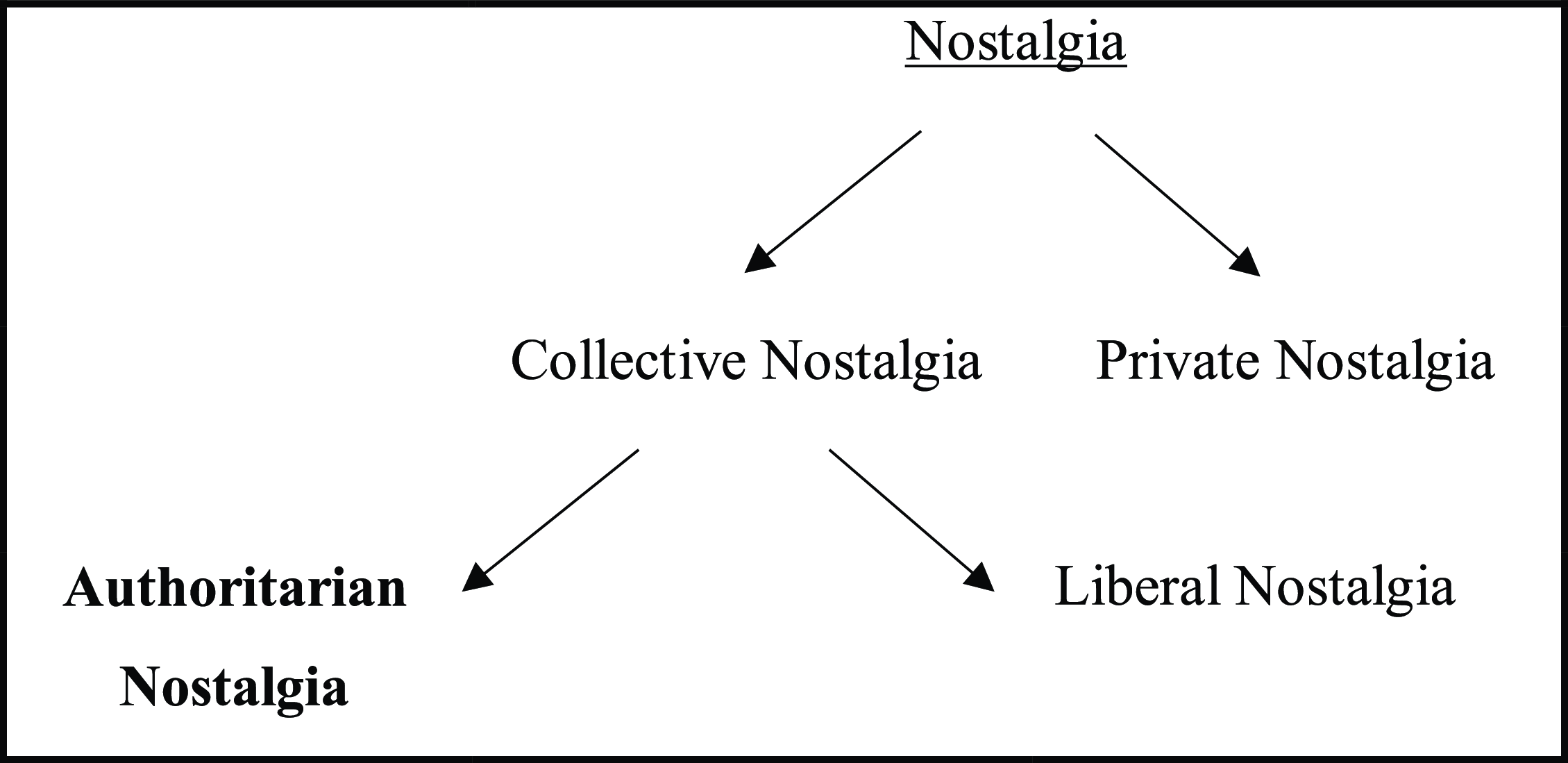
Nostalgia has two dimensions: a private, individual one, and a collective one (see Figure 1). Personal nostalgia refers to people’s past, such as family, friends, music, school, movies, and so on. Collective nostalgia refers to the shared (glorious) past of a group to which people connect their identity or a generalised feeling that the group was better in the past (Van Prooijen et al., Reference Van Prooijen, Rosema, Chemke-Dreyfus, Trikaliti and Hormigo2022). While personal nostalgia primarily evokes effects on an individual level, collective nostalgia is primarily related to group-level consequences. Crucially, personal nostalgia is unrelated to group identity (Wildschut et al., Reference Wildschut, Bruder, Robertson, van Tilburg and Sedikides2014) and, therefore, unable to explain party support. This is the main reason why we only consider the collective dimension of nostalgia throughout our study.
A conceptual map of different types of nostalgia.

Like its individual-level counterpart, collective nostalgia entails longing for a time in the past of one’s social group that is seen as particularly illustrious. This means that it can be exploited politically to justify the present (Stefaniak et al., Reference Stefaniak, Wohl, Sedikides, Smeekes and Wildschut2021). In political discourse, the term nostalgia is often employed in reference to a golden age, as a return to a previous, more preferable period in a country’s history (Smith, Reference Smith2009). A central mechanism of nostalgia is the juxtaposition and unfavourable comparison between an idealised past and the decaying present (Elgenius & Rydgren, Reference Elgenius and Rydgren2022), and this is often rooted in nationalism. For example, nationalist political actors can use a narrative of ‘rebirth’ (Kešić et al., Reference Kešić, Frenkel, Speelman and Duyvendak2022), using the past as a positive example against the current ‘moral decay’, to fight against the loss of ‘genuine social relationships’ and save the nation. Ethnic homogeneity, cohesion, social order, and state sovereignty are often central elements of a nationalist nostalgic discourse, and the past for which nostalgia is expressed can vary greatly according to the context. Radical left actors, for example, can articulate different types of nationalist discourses, each with its own flavour of nostalgia for a better past: social patriotism, counterhegemonic patriotism, national cosmopolitanism, and post-national cosmopolitanism (Custodi, Reference Custodi2023). Golden ages can be located several hundred years in the past and refer to different experiences and times of national building, and they can be interpreted in various ways according to the ideology of the actor crafting them.
Similar to nationalist actors, populists are prone to exploit nostalgia (Van Prooijen et al., Reference Van Prooijen, Rosema, Chemke-Dreyfus, Trikaliti and Hormigo2022). Populists frequently emphasise that the elites hijacked the people’s will long ago, and they promise to return power to the people (Elçi, Reference Elçi2022). A key dimension of the populist response to societal transformations and its politico-cultural mythologisation of the past is related to nostalgia (Couperus et al., Reference Couperus, Rensmann and Tortola2023). Populists constitute a new ideology of home – a vision of the lost heartland (Taggart, Reference Taggart2004) – which represents nostalgia for a reconstructed past and, in turn, provides a sense of security against the perceived loss of identity. Golden ages are crucial for populists because they provide sources of political legitimacy for the present, along with the rhetoric of authority and authenticity against troublesome changes, crises or decline (Elgenius & Rydgren, Reference Elgenius and Rydgren2019). For example, it has been found that exposure to populist speech increases both personal and collective nostalgia (Van Prooijen et al., Reference Van Prooijen, Rosema, Chemke-Dreyfus, Trikaliti and Hormigo2022) and that perceptions of declining status are a consistent predictor of populist support (Ferwerda et al., Reference Ferwerda, Gest and Reny2024).
Concerning PRR actors, we know that they combine nostalgia with nationalist and authoritarian claims (Bonikowski & Stuhler, Reference Bonikowski and Stuhler2022). Indeed, nostalgia is considered to be a key ingredient of the ethnic nationalism and populism that defines the rhetoric of the PRR (De Vries & Hoffmann, Reference De Vries and Hoffmann2018). The political programmes of PRR actors often aim to radically alter the political and societal status quo in a way that seeks to ‘restore’ old social, ethnocultural, and political certainties (Ignazi, Reference Ignazi2003; Mudde, Reference Mudde2004). Right-wing populism has been described as a ‘backward-looking reactionary ideology, reflecting a deep sense of nostalgia for the good old days’ (Betz & Johnson, Reference Betz and Johnson2004, p. 324). Recent examples of politicians who instrumentalize the past to rehabilitate nostalgic ethnonationalism against liberal democracy and cosmopolitan social change include Donald Trump and his attempt to ‘Make America Great Again’ (Bonikowski & Stuhler, Reference Bonikowski and Stuhler2022), Erdogan and his use of Ottoman nostalgia (Karakaya, Reference Karakaya2020), Narendra Modi and the reference to ‘Hindu Revival’, and Victor Orbán ‘Day of National Cohesion’ to commemorate Hungary’s glorious past (Pető, Reference Pető2017).
Collective nostalgia is particularly functional in attracting citizens with high levels of societal pessimism (Steenvoorden & Harteveld, Reference Steenvoorden and Harteveld2018). A recent study finds that PRR supporters are not attracted by this rhetoric because of personal nostalgia, but because they long for ‘the way society used to be’ or ‘the way people were’, a phenomenon known as temporal relative deprivation (Versteegen, Reference Versteegen2024) that matches the description of collective nostalgia offered above. Moreover, recent studies confirm that a sense of ‘nostalgic deprivation’ – a subjective manifestation of socioeconomic risk – is a major motivator behind support for PRR actors in Europe and the USA (Gest et al., Reference Gest, Reny and Mayer2018; Steenvoorden & Harteveld, Reference Steenvoorden and Harteveld2018).
Collective nostalgia, based on mechanisms of temporal relative deprivation or nostalgic deprivation, proposes a future based on the idealised picture of a whitewashed, mythical past. Specifically, it stimulates anger and resentment against those who allegedly caused the current social reality, namely those who were seeking a greater say in politics and society – e.g., minorities, women, and environmentalists (Alter & Zürn, Reference Alter and Zürn2020). The ‘good old days’ mean different things to different people, but for PRR supporters, they can be identified in a glorious past – based on historical revisionism – characterised by cultural and ethnic homogeneity, national sovereignty, and social cohesion. For all these reasons, the idea of the past idealised by PRR actors often echoes an authoritarian past in which society stood on traditional values that have been lost.
Introducing authoritarian nostalgia
Nostalgia relates to a mythical past through which it seeks to shape a brighter future: it may be a generic golden age, an imperial or colonial past, but also a specific war or conflict (Lubbers & Smeekes, Reference Lubbers and Smeekes2022). Our focus is not only on generic nostalgia for the ‘good old days’, but – more specifically – nostalgia for an authoritarian past (see Figure 1).
Before discussing the role of authoritarian nostalgia, it is necessary to outline the connection between the authoritarian past and present-day PRR actors. On the one hand, they can be authoritarian successors (Loxton & Mainwaring, Reference Loxton and Mainwaring2018), i.e., actors that directly emerge from the old authoritarian elite and act in continuity with the past authoritarian regime. On the other hand, they can be new actors that have no direct historical links to the past authoritarian regime. Some parties, like the Rassemblement National in France or the Sweden Democrats, lack direct ties to the past authoritarian regimes but are linked to extremist ideas and have sought to increase their democratic credentials by distancing themselves from these associations. Finally, while some parties have roots in the past authoritarian regime, such as Brothers of Italy, others, like Alternative for Germany, adopt authoritarian nostalgia at a later stage.
Regardless of their links to an authoritarian past, some scholars argue that contemporary PRR actors embodying those values tend to be more stigmatised (Eatwell, Reference Eatwell, Merkl and Weinberg2003; Rydgren, Reference Rydgren2005). Authoritarian regimes inevitably leave behind long-lasting legacies (Simpser et al., Reference Simpser, Slater and Wittenberg2018) that frequently influence the social acceptability and electoral performance of contemporary parties aligned with aspects of that past regime (Couperus et al., Reference Couperus, Rensmann and Tortola2023; Pop-Eleches & Tucker, Reference Pop-Eleches and Tucker2020). Indeed, a recent strand of literature shows that a democratic transition usually produces an anti-dictator bias because repressive regimes are assessed negatively after the transition to democracy (Dinas & Northmore-Ball, Reference Dinas and Northmore-Ball2020; Neundorf & Pop-Eleches, Reference Pop-Eleches and Tucker2020).
In the West European context, many PRR parties were initially demonised and stigmatised because of their links to the fascist past (Bursztyn et al., Reference Bursztyn, Egorov and Fiorin2020; Harteveld et al., Reference Harteveld, Dahlberg, Kokkonen and Van Der Brug2019), which – in turn – contributed to the limited electoral success of ‘the old master frame’ (Van Hauwaert, Reference Van Hauwaert2019). While contemporary PRR parties are not necessarily a direct re-incarnation of past fascist regimes (De Felice, Reference De Felice1975; Nolte, Reference Nolte1966), they sometimes carry and reinterpret elements typical of historical fascism (Copsey, Reference Copsey2020; Griffin, Reference Griffin1993; Paxton, Reference Paxton2004), such as the rejection of elites, the promotion of nationalism, the adherence to authoritarian tendencies, anti-liberalism, frequent crisis narratives, and even the reference to racially oriented conspiracy theories (e.g. Great Replacement). For this reason, they are still – at times – ostracised, stigmatised, subjected to a cordon sanitaire, and other measures that make them unable to fulfil their electoral potential (Rydgren, Reference Rydgren2005), especially in countries characterised by a stigmatised right-wing authoritarian past (Manucci, Reference Manucci2020).Footnote 2
Yet, the idea that PRR actors are punished because of their association with an authoritarian past seems to be losing strength for two main reasons. First, PRR actors have become politically relevant in the Sartorian sense. Not only have they been able to perform strongly at the polls, but their positions and rhetoric have also become part of the political mainstream (Brown et al., Reference Brown, Mondon and Winter2023) and are frequently adopted by other political actors (Krzyżanowski & Ekström, Reference Krzyżanowski and Ekström2022). Second, PRR actors are no longer necessarily ostracised because of their association with the values and ideas of an authoritarian past. Or, at least, this does not prevent them from obtaining ‘politically relevant’ status and consolidating even in party systems previously free of PRR actors. Germany is an outstanding example: the AfD was the second most-voted party in the 2025 German federal election, while some factions of the party maintained historical revisionism towards the much-stigmatised Nazi past (Weisskircher, Reference Weisskircher2024).
This suggests, contrary to previous assumptions and in line with the most recent research on the topic, that authoritarian nostalgia can enhance support for PRR actors rather than hinder their electoral performance (Couperus et al., Reference Couperus, Rensmann and Tortola2023; Kim-Leffingwell, Reference Kim-Leffingwell2023a). In other words, PRR actors might be rewarded for their authoritarian nostalgia, rather than being punished for it. For example, it is entirely possible that a country does not develop an anti-dictator bias because the memory of the authoritarian past is not particularly negative (Kim-Leffingwell, Reference Kim-Leffingwell2023a; Manucci, Reference Manucci and Oswald2022). Another possible explanation is that the duration of the anti-dictator bias may be temporally limited. Once the temporal distance from the authoritarian past allows it, PRR actors might once again be able to rely on authoritarian nostalgia to attract nostalgic voters instead of being punished for it. We know, for example, that citizens socialised under right-wing autocracies are less likely to support PRR actors, but that, crucially, this effect diminishes as the distance from the time of the democratic transition increases (Frantzeskakis & Sato, Reference Frantzeskakis and Sato2020). Finally, PRR parties might avoid the stigma they face because of the existence of a reputational shield that makes them appear as acceptable and with strong democratic credentials (Ivarsflaten, Reference Ivarsflaten2006; Manucci, Reference Manucci2025).
While the debate presents us with two antagonistic expectations about the relationship between authoritarian nostalgia and PRR support, the corresponding literature remains underdeveloped. Considering the increasing relevance, success, and consolidation of PRR actors across the world, our absence of knowledge is not only puzzling but also problematic. Therefore, in what follows, we examine this relationship in two cases that illustrate the larger phenomenon, namely Spain and Portugal. This will help us gain further and more definitive insights into the ongoing debate.
Case selection: authoritarian legacies and PRR support in Spain and Portugal
Following a most similar systems design (Gerring, Reference Gerring2006), we study Spain and Portugal – two countries with shared authoritarian legacies but varying democratic transitions and distinct PRR trajectories. This design allows us to isolate the role of authoritarian nostalgia while minimising confounding structural differences. Spain and Portugal are not only illustrative cases of a larger phenomenon but critical in testing the assumption that authoritarian nostalgia hinders PRR success. If authoritarian nostalgia correlates with PRR support even in these contexts, the phenomenon may extend to more entrenched or distant legacies elsewhere.
Historically, both countries experienced long-lasting right-wing authoritarian regimes marked by authoritarianism, nationalism, conservativism, and anti-communism, as well as limited pluralism and state repression – thereby fitting Linz’s (Reference Linz2000) definition of authoritarian regimes. They also stood out for their unusual longevity compared to other European right-wing dictatorships, reinforcing their imprint on collective memory. Despite these regime similarities, their respective democratic transitions were radically different. Spain’s transition to democracy in 1975 was elite-led and negotiated, culminating in a so-called ruptura pactada (negotiated break) and a pacto del olvido (pact of forgetting), which constituted a deliberate effort to depoliticise the Francoist past and avoid conflict. Amnesty laws protected former regime elites, and open reckoning with the past was postponed. The democratic parliament’s first law granted amnesty to Franco-era officials, blocking prosecution for war crimes. For decades, selective amnesia helped ensure a peaceful transition to democracy. In contrast, Portugal’s transition between 1975 and 1976 was revolutionary and included nationalisations, purges, and a constitutional ban on fascist parties. As a consequence, the authoritarian past was explicitly rejected, and right-wing forces became heavily stigmatised under democratic rule.
These divergent transitions shaped the political opportunity structure for PRR actors. For decades, the legacy of the authoritarian past was one of the barriers to entry, constituting the basis of so-called Iberian exceptionalism (Alonso & Rovira Kaltwasser, Reference Alonso and Rovira Kaltwasser2015; da Silva & Salgado, Reference da Silva, Salgado, Lobo, da Silva and Zúquete2018). Even during the financial crisis (early- to mid-2010s) and the so-called ‘refugee crisis’ (mid-2010s) – events that catalysed PRR actors across Europe – PRR actors remained electorally marginalised in both countries until the rise of VOX and Chega.Footnote 3 VOX – founded in 2013 as a split from the conservative Partido Popular (PP) – first gained regional representation in Andalucía in 2018. It first entered the national parliament following the April 2019 snap election (10% of the popular vote and 24 seats). A key reason for its breakthrough is the strong nationalist backlash to the 2017 Catalan independence referendum. Perceived as too lenient on regional nationalism, the PP lost many voters to VOX, which seized the moment by championing a hardline defence of national unity and centralisation reminiscent of the Franco era (Rama et al., Reference Rama, Zanotti, Turnbull-Dugarte and Santana2021; Rodríguez-Teruel, Reference Rodríguez-Teruel2021; Turnbull-Dugarte, Reference Turnbull-Dugarte2019). Chega – founded in 2019 as a split from the conservative Partido Social Democrata (PPD/PSD) – first entered parliament following the October 2019 election (1.3% of the popular vote and 1 seat). It gained traction thanks to the charismatic figure of the party leader André Ventura, favourable media coverage, and ’popular‘ (or, rather, populist) positions on welfare issues and privatisations (Heyne & Manucci, Reference Heyne and Manucci2021; Manucci, Reference Manucci2024; Marchi, Reference Marchi, Kondor and Littler2023; Mendes & Dennison, Reference Mendes and Dennison2021). Since then, both parties have grown rapidly and, at the time of writing, they both are the third most-voted for party in their respective country: VOX with 15.1% of the popular vote (33/350 seats) in the 2023 election and Chega with 22.6% of the votes (58/230 seats) in the 2025 snap election. Their electorates share several key features: their voters are relatively young (which might explain their reduced susceptibility to negative authoritarian legacies), predominantly male, rather religious, with average levels of education, high levels of dissatisfaction with the way democracy works, and attracted by strong leaders (Heyne & Manucci, Reference Heyne and Manucci2021; Lobo et al., Reference Lobo, Heyne and Manucci2024; Rama et al., Reference Rama, Zanotti, Turnbull-Dugarte and Santana2021).
Both parties utilise their respective authoritarian legacies, although this is mediated by the different democratic transitions the countries experienced. VOX adopts a rhetoric rooted in Spain’s far-right traditions and Francoist legacy (Martín et al., Reference Martín, Paradés and Zagórski2022), although technically the authoritarian successor party is the mainstream PP. Chega is less overt in its ties to Salazarism, but not entirely implicit. For example, its 2022 slogan Deus, Pátria, Família e Trabalho (God, Fatherland, Family and Work) closely mirrors Salazar’s slogan Deus, Pátria e Familia. Moreover, Chega’s main ideologues (e.g. Diogo Pacheco de Amorim) have unambiguous ties to post-Salazarist movements. Altogether, both VOX and Chega are rather subtle in their expressions of nostalgia. Rather than blatant and open nostalgia, they often use coded language and dog whistles. The goal is to maintain their democratic credentials while signalling they embody a nostalgic vision of the authoritarian past, thereby creating a calculated ambivalence (Biscaia & Salgado, Reference Biscaia, Salgado, Palau-Sampio, López García and Iannelli2022; Manucci, Reference Manucci2024).
While most studies of authoritarian nostalgia focus on the supply side, its impact on political behaviour remains underexplored. Spain and Portugal are ideal cases to examine this, as PRR actors were long stigmatised but have recently risen to prominence. Since we know that political attitudes change slowly, the surge of VOX and Chega cannot be explained by economic or cultural change alone (Valentim, Reference Valentim2024). It is likely that both PRR actors and their authoritarian nostalgia have become less stigmatised over time (Manucci, Reference Manucci2025). As third-wave democracies, Spain and Portugal still have large segments of the electorate with direct or intergenerational memory of the authoritarian regimes. If authoritarian nostalgia can shape PRR support in such contexts, it is certainly plausible that similar dynamics exist in countries with more distant or diffuse authoritarian legacies and a more established radical right presence.
Research strategy
We rely on original survey data collected by IPSOS in Spain and Portugal between November and December 2023. The individual country samples (N = 1,500) are nationally representative and selected according to quotas (age, education, gender, and region).Footnote 4 The selection of Spain and Portugal as our cases provides us with two illustrations of European countries with a similar authoritarian past that, after the democratic transition, has been highly stigmatised, thus restricting the opportunity for PRR parties to obtain significant electoral results (Alonso & Rovira Kaltwasser, Reference Alonso and Rovira Kaltwasser2015; Mendes & Dennison, Reference Mendes and Dennison2021).
Dependent variable
Our main dependent variable refers to the support for PRR parties. In line with previous studies operationalising that support (Akkerman et al., Reference Akkerman, Zaslove and Spruyt2017; Van Hauwaert & Van Kessel, Reference Van Hauwaert and Van Kessel2018), we rely on the typical prospective vote question inquiring about which party respondents would vote for if elections were held tomorrow.Footnote 5 Figure 2 provides an overview of the anticipated party support amongst the respondents in our samples. It excludes respondents who answered, ‘would vote blank/invalid’, ‘would not vote’ and ‘don’t know’, but includes the ‘other’ response category.
Projected party support in Spain and Portugal. Note: Populist radical right parties have darker bars.

Drawing from this prospective vote question, we construct two separate dependent variables: a dichotomous and a nominal one. First, we operationalise PRR party support as a dichotomous variable, distinguishing between PRR support and non-support (the latter includes non-PRR party supporters and those who do not support any political party).Footnote 6 Second, we use the original nominal variable, but recode as missing those respondents who would cast a blank or invalid vote, those who would not vote, and the ‘don’t know’ responses.Footnote 7
Independent and control variables
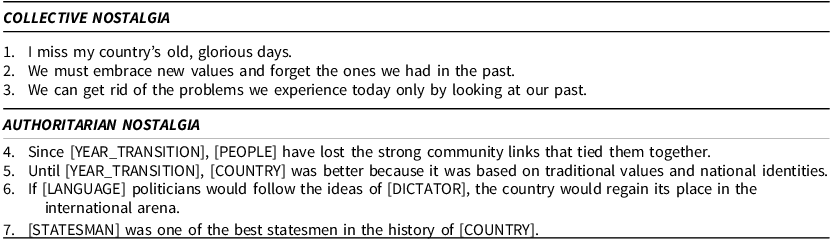
Our analysis explores the impact of nostalgia on PRR support. Since authoritarian nostalgia is a specific sub-category of collective nostalgia (see Figure 1), we rely on separate sets of items to measure both concepts independently with the purpose of more accurately capturing the diverse aspects (dimensions) of nostalgia while overcoming some of the operational limitations of past studies. We include the items we use in Table 1.
Items measuring collective and authoritarian nostalgia

Note: We include the original Spanish and Portuguese question wordings in Section B of the Supplementary Materials.
The top panel of Table 1 lists the three items we use to measure general collective nostalgia. They are all Likert-scale statements with five answer categories, ranging from ‘strongly disagree’ to 5 ‘strongly agree’. These, by and large, draw from existing research (De Vries & Hoffmann, Reference De Vries and Hoffmann2018; Van Prooijen et al., Reference Van Prooijen, Rosema, Chemke-Dreyfus, Trikaliti and Hormigo2022; Versteegen, Reference Versteegen2024) and allow us to measure the extent to which the respondents consider the present to be worse than the past (without priming them into thinking about a specific past or why the present might be worse than the past).
The bottom panel of Table 1 includes four innovative items that we propose to measure authoritarian nostalgia. All items are 5-point Likert statements, equally ranging from 1 ‘strongly disagree’ to 5 ‘strongly agree’. Most studies that set out to capture authoritarian nostalgia rely on (distant) proxies, such as an assessment of authoritarian aspects of democracy (Chang et al., Reference Chang, Chu and Park2007) or a quality-of-life evaluation compared to the past (Prusik & Lewicka, Reference Prusik and Lewicka2016). At the same time, asking questions that are too direct might make respondents wary of their answers because social desirability bias might make it harder for people to openly admit that they are nostalgic for the authoritarian past (based on a widespread anti-dictator bias). Furthermore, most studies rely on single items (Kang, Reference Kang2016), thereby assuming authoritarian nostalgia is a singular sentiment that captures either a positive or a negative sentiment rather than a more holistic latent one that can – in theory – have multiple encompassing dimensions (Howe & Krosnick, Reference Howe and Krosnick2017), or include a set of items that tap into the distinct aspects of authoritarian nostalgia (Kim-Leffingwell, Reference Kim-Leffingwell2023a).
We account for this by proposing to measure authoritarian nostalgia with items that are both explicit enough to make sure that we measure the appropriate concept, but also indirect enough to allow the respondents to give honest answers despite the possible presence of social desirability bias. Items 4 and 5 link the end of the authoritarian experience to the beginning of a decline in community links, traditional values, and national identities. These are elements often associated with authoritarian nostalgia (Smeekes et al., Reference Smeekes, Wildschut and Sedikides2021), and they allow us to avoid asking a direct question such as ‘I get nostalgic about the authoritarian regime’ (Kim-Leffingwell, Reference Kim-Leffingwell2023b). Item 6 proposes the ideas of the past dictator as a remedy for a better future. Item 7 explicitly assesses the authoritarian leader and his role in making the authoritarian regime desirable.
We draw from these four items to explore the dimensionality of authoritarian nostalgia (Cronbach’s alpha is 0.87 in Spain and 0.84 in Portugal). First, we perform an exploratory factor analysis, finding clear evidence of a single dimension in each country (EV is 2.78 in Spain and 2.44 in Portugal). Then, we rely on a polychoric factor analysis to estimate a single latent variable as an indicator for authoritarian nostalgia.Footnote 8
We additionally adjust all our analyses for variables that are potentially related to either PRR support or nostalgia. Specifically, we include indicators for authoritarian attitudes (3 separate items)Footnote 9 , social dominance (4-item scale), populist attitudes (8-item scale), xenophobia (5-item scale), economic positions (5 separate items), social conservatism (4-item scale), political trust (5-item scale), democratic support, democratic satisfaction, the perception of the party either as a danger to democracy or a reflection of the authoritarian past (2 items), internal efficacy (3-item scale), external efficacy (3-item scale), the evaluation of the country’s transition to democracy (6 separate items), and political interest and various socio-demographics (age, education, gender, region, employment status, household income, religiosity, and generations living in household).Footnote 10
Results: PRR support and nostalgia
Before we get into the relationship between nostalgia and PRR support, we first provide a descriptive analysis that allows us to gauge the average levels of nostalgia amongst the different party supporters in Spain and Portugal. Figure 3 illustrates this for the three separate indicators of collective nostalgia.
Average levels of collective nostalgia across party supporters. Note: The dotted vertical lines represent the average level of the separate collective nostalgia items within each country. We also include 95% confidence intervals around the averages.

Two observations stand out. On average, PRR supporters in both Spain and Portugal miss their country’s ‘old, glorious days’ more than their non-PRR counterparts (top panel). Moreover, there appears to be little to no discernible difference between PRR and non-PRR party supporters when it comes to the two other collective nostalgia indicators. Interestingly, a set of item-specific t-tests indicates there are – on average – no differences in collective nostalgia between Spanish and Portuguese partisans (p > 0.05).
Figure 4 plots the authoritarian nostalgia index for both countries.Footnote 11 We notice that the average level of authoritarian nostalgia is higher across the Portuguese political landscape than it is in Spain, and this difference is significant (p < 0.05). This is unlike the observations related to collective nostalgia (see Figure 3), and it suggests that Portuguese people are more nostalgic than their Spanish counterparts concerning the authoritarian past specifically.
Average levels of authoritarian nostalgia across party supporters. Note: The dotted vertical line represents the average level of authoritarian nostalgia within each country. We also include 95% confidence intervals around the averages.

The fact that the level of authoritarian nostalgia is higher in Portugal than in Spain is initially puzzling, given that the Portuguese revolutionary democratic transition stigmatised the past regime more than the transition that took place in Spain, based on a ‘pact of forgetting’. However, Franco’s regime was more violent than Salazar’s and only took power after years of civil war. This might explain why the nostalgia for the authoritarian past is lower in Spain than in Portugal.
Figure 4 shows that VOX and Chega supporters stand out in terms of their authoritarian nostalgia (this is also true for all four comprising items). They tend to look much more favourably on their country’s authoritarian past and hold more positive opinions of it. This aligns with some contemporary research linking the success of PRR parties to authoritarian nostalgia (Kim-Leffingwell, Reference Kim-Leffingwell2023a; Manucci, Reference Manucci2020; Steenvoorden & Harteveld, Reference Steenvoorden and Harteveld2018) and goes against the findings of recent studies identifying the presence of an anti-dictator bias (Dinas & Northmore-Ball, Reference Dinas and Northmore-Ball2020; Neundorf & Pop-Eleches, Reference Neundorf and Pop-Eleches2020).
As for the other party supporters, their levels of authoritarian nostalgia tend to be relatively indistinguishable from one another, with one notable exception: The PP in Spain. Traditional right-wing supporters in Spain also have above-average levels of authoritarian nostalgia (this is also true for all four comprising items), which remain nonetheless considerably below the authoritarian nostalgia levels of VOX supporters. This can be readily explained by the fact that the conservative party in Spain has its immediate roots in the Franco regime and is technically an authoritarian successor party (Loxton & Mainwaring, Reference Loxton and Mainwaring2018). Many of its loyal (and older) supporters have a favourable view of Franco’s regime (Bale & Rovira Kaltwasser, Reference Bale and Rovira Kaltwasser2021; Rama et al., Reference Rama, Zanotti, Turnbull-Dugarte and Santana2021).
We do not observe the same clear-cut distinction between the Portuguese mainstream right (PPD/PSD), Chega, and ‘the rest’. Even though PPD/PSD supporters have above-average levels of authoritarian nostalgia, their levels are not decisively different from the authoritarian nostalgia levels of supporters of some smaller parties, such as the liberal IL or the environmentalist PAN (this is also true for all four comprising items). Finally, the supporters of left-wing parties (most notably Spanish Socialist Workers’ Party (PSOE) and Socialist Party (PS) in Spain and Portugal, respectively) display lower levels of authoritarian nostalgia in comparison to the supporters of right-wing parties.
Explaining PRR support: the role of nostalgia
Figure 4 does not reveal anything yet about the potential effect nostalgia can have on party support. So, in a subsequent step, we design a set of models to examine the extent to which collective and authoritarian nostalgia contribute to party support. We do so by taking a two-folded approach.Footnote 12 First, we use a logistic regression to model our dichotomous dependent variable for PRR support. Then, we use a multinomial logistic regression to model the nominal dependent variable for party support to gain further insights into this support.
Figure 5 presents the average marginal effects of the collective nostalgia items and our authoritarian nostalgia index on PRR support in both Spain and Portugal.Footnote 13 This shows that, by and large, we find supporting evidence of our previous observations from Figures 3 and 4. Across both countries, PRR supporters are more likely to miss their country’s ‘old, glorious days’. We find no conclusive evidence that other indicators of collective nostalgia matter for PRR support, which aligns with the levels of collective nostalgia being quite similar between party supporters.
Average marginal effects of nostalgia on populist radical right party support. Note: Point estimates with 95% confidence intervals. For reasons of clarity, we did not include control variables in the visualisation. We refer to Section F in the Supplementary Materials for the full models with control variables.

We also find that the higher an individual’s nostalgia for the authoritarian past, the more likely they are to support VOX and Chega in Spain and Portugal, respectively. This is a novel finding that is at least different from the accepted wisdom that PRR actors need to distance themselves from the authoritarian past to be considered credible, legitimate, and relevant political actors that can have electoral success. We show that authoritarian nostalgia is a key identifier of VOX and Chega supporters, as well as their support.
The explanation of this may be twofold. At least today, it is not (or no longer) an obstacle for support or a reason for citizens to punish these parties, as some scholars posited in the past (van der Brug et al., Reference van der Brug, Fennema and Tillie2000; Van Spanje, Reference Van Spanje2010). While PRR actors might have initially needed to distance themselves from the authoritarian past to gain legitimacy and increase credibility in the eyes of their peers, i.e. traditional parties, we present at least indicative evidence that contemporary parties can gain electoral advantages from not doing so in the eyes of their beholders, i.e. party supporters. Alternatively, it may be that the so-called Iberian brand of past authoritarianism is more easily digestible for its citizens. Even though the Franco and Salazar dictatorships were brutal in their suppression of the opposition, Iberian PRR parties were not directly implicated in the Holocaust, which may present these parties with more leniency in referring to the ‘old glorious days’.
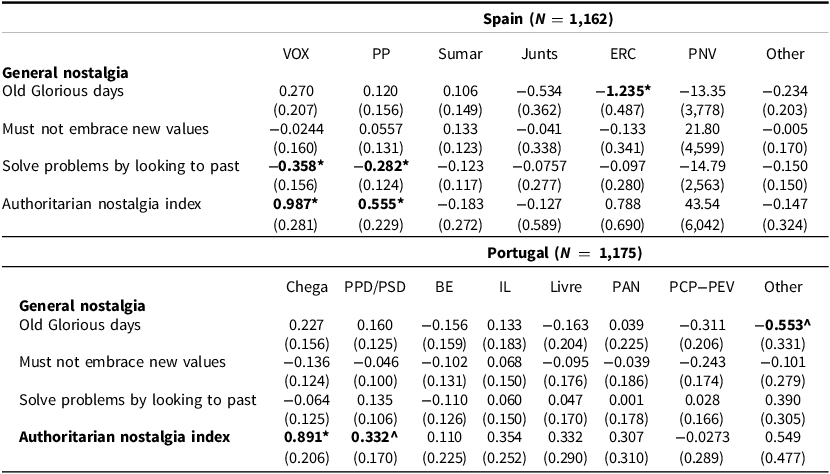
While our initial models relied on a dichotomous dependent variable to distinguish between PRR and non-PRR supporters, we now turn to a nominal dependent variable that captures a broader range of electoral choices. This allows us to offer a more nuanced and accurate picture of the relationship between nostalgia and party support. We illustrate the results from a multinomial logistic regression in Table 2, using as a baseline category party support for social democratic parties PSOE and PS in Spain and Portugal, respectively.
Nostalgia and populist radical right support, nominal dependent variable

Note: Table shows standardised coefficients with standard errors in parentheses; ^ < 0.10, * < 0.05; Full models with control variables are available in Section G of the Supplementary Materials.
We find evidence that authoritarian nostalgia is an important correlate of the support for VOX and Chega. The support for VOX and Chega is – at least partially – the result of a collective memory of this glorified historical period before the democratic transition. It provides PRR supporters with an identity and captures their generalised feelings that things were better in this specific past. While it remains difficult to interpret the size of a coefficient as an indicator of ‘how good (or bad) an explanation a variable is’, it is noticeable that the standardised authoritarian nostalgia coefficient for the PRR actors is amongst the largest in the models, thereby at least providing us with a sense of how important it can be.Footnote 14 Furthermore, we find surprising evidence that respondents who believe we can get rid of the problems we experience today only by looking to our past are less likely to support VOX (and PP).
Beyond our findings related to PRR support, it is worth highlighting two additional observations. First, there is little to no discernible pattern in the relationship between our dependent variable, party support, and some of the collective nostalgia items. So, even though levels of collective nostalgia might be higher – relatively speaking – than many would have expected (even though, in absolute terms, they are average), our indicators of the phenomenon seem to play little to no role in understanding party support. This aligns with our main takeaways from Figure 5.
Second, as in Figure 4, we also notice that authoritarian nostalgia is an important correlate for the support of the traditional right-wing party in Spain, namely the PP, and to a lesser extent in Portugal (PPD/PSD). This effect is present to a lesser extent than for PRR parties, but it is still significant and considerable in Spain and indicative in Portugal. Furthermore, the size of the coefficient (to the extent that we can use this as an indicator) remains considerably smaller than the one corresponding to the PRR category (p < 0.05). More broadly speaking, however, the role of authoritarian nostalgia remains limited – never reaching conventional levels of significance as a predictor for other parties’ support. This provides tentative evidence that authoritarian nostalgia fosters (populist radical) right-wing support, rather than ‘just’ PRR support, especially when mainstream right-wing parties are closer to the past authoritarian regime.
Conclusion
A rich and established literature examines how much past reflections contribute to our political choices. This seems evident, as we draw from our socialisation and civic resources to assess current parties and leaders based on their performance. This reward-or-punish rationale is important to understand elections and, more generally, democratic representation. Yet, considering that many of those assessments are made from the luxury of representative democracy, we often forget to account for the authoritarian past that many contemporary regimes – democratic, or not – carry with them. How can we account for these reflections of a non-democratic past once we examine electoral dynamics and party choice more specifically?
Previous studies point to the relevance of nostalgia in driving political behaviour (Ferwerda et al., Reference Ferwerda, Gest and Reny2024; Steenvoorden & Harteveld, Reference Steenvoorden and Harteveld2018). Most findings highlight the limited value of personal nostalgia and the driving force of collective nostalgia in this regard (Kim-Leffingwell, Reference Kim-Leffingwell2023b; Sedikides & Wildschut, Reference Sedikides and Wildschut2019; Versteegen, Reference Versteegen2024; Wildschut et al., Reference Wildschut, Bruder, Robertson, van Tilburg and Sedikides2014). What remains largely missing from this literature is the political role of collective nostalgia and, more specifically, authoritarian nostalgia. This is the focus of our study. Our results show that levels of authoritarian nostalgia are above average amongst right-wing electorates, and that authoritarian nostalgia has a positive relationship with PRR support. In other words, we find evidence that authoritarian nostalgia resonates with PRR supporters and can serve as a reward mechanism for PRR parties. We also show that authoritarian nostalgia is a driver of support for the traditional right, albeit to a lesser extent.
These results constitute the foundation for a dispositional comparative framework that allows for the in-depth study of authoritarian nostalgia. With the rise of political actors across the globe who glorify a romanticised version of the past, it is more important than ever to understand the effects of authoritarian nostalgia. We rely on Spain and Portugal to examine how nostalgia for a recent right-wing authoritarian regime can shape contemporary political behaviour and benefit right-wing political actors. However, the relevance of our theoretical framework is not contextually bound and extends beyond the Iberian context. Many countries, across diverse world regions, share legacies of authoritarian rule that remain embedded in collective memory and public discourse.
In Europe, countries like Germany and Italy continue to confront the memory of 20th-century totalitarianism amidst the success of radical right actors. In Latin America, countries such as Brazil, Chile, and Argentina show how military regimes are selectively remembered and politically instrumentalised. Similar dynamics unfold in Russia and Turkey, where nostalgia for past authoritarian power is increasingly central to contemporary nationalist-populist rhetoric, or in Japan, where revisionist narratives about imperial history have entered mainstream politics. Moreover, our framework may also help explain support for political actors using nostalgia for left-wing authoritarian regimes – such as in parts of Eastern Europe (e.g. Hungary, Romania) and Southeast Asia (e.g. Vietnam, Laos) – where post-socialist or post-revolutionary identities continue to shape political alignments. By focusing on the attitudinal dispositions rooted in collective memory and regime evaluation, our framework provides a comparative and transferable tool to understand why appeals to authoritarian pasts with different ideological backgrounds can resonate with contemporary electorates. This calls for further empirical application and refinement across contexts with varied legacies, transitional trajectories and levels of democratic consolidation.
As a discipline, we want to empirically analyse nostalgia and party support because they are relevant socio-political phenomena – today more so than ever – with a direct impact on democratic support and stability. However, we are normatively interested in understanding these dynamics to gain insights into democratic functioning, which – in turn – will help us anticipate and engage with political reality more specifically. If we analyse, we can forecast. If we can acquire knowledge about ‘what is’, we can work towards ‘what should be’. If a positive image of the past authoritarian regime is no longer a reason for the electoral failure of political actors using this, but, to the contrary, a reason for their electoral success, the implications are both relevant and potentially unsettling. What is the future of liberal democracy in a context where authoritarian nostalgia is a prevalent feature?
This study paves the way for future research but also faces several limitations that we hope future research can remedy. Much remains to be done concerning the micro-foundations of authoritarian nostalgia. We need to unravel the characteristics of those citizens who feel authoritarian nostalgia, especially in terms of their age. In this regard, it will be particularly important for future studies to examine to what extent actual experiences with the past relate to levels and impact of authoritarian nostalgia, i.e., do we observe generational differences between individuals? Moreover, it will be important to assess to what extent this feeling is manufactured by political actors who choose to weaponise (openly or through dog whistles) the past. Future studies should also consider further disentangling authoritarian nostalgia, as we can theorise economic and cultural dimensions of the concept. It is also important to point out that we cannot establish a causal link in its strictest sense. To do so, we would need panel data or experimental data. Future research should also test our theoretical framework on countries characterised by different types of authoritarian pasts – including both left- and right-wing regimes, military and one-party rule – as well as in contexts where the authoritarian period lies further in the past, in order to assess how temporal distance affects the persistence and political relevance of authoritarian nostalgia and to understand the generalisability of our results.
Supplementary material
The supplementary material for this article can be found at https://doi.org/10.1017/S1475676525100108
Data availability statement
The full replication material is available in the following public repository: https://doi.org/10.7910/DVN/UHTQUH
Acknowledgements
We thank the editorial team for a smooth and professional process, and the anonymous reviewers for their invaluable feedback – offered with care, despite the often-unrewarded nature of such academic service.
Funding statement
Luca Manucci acknowledges funding from the Fundação para a Ciência e a Tecnologia (FCT) under grant agreements 2022.03115.PTDC and 2021.03609.CEECIND.
Competing interests
Authors have no conflict of interest to declare.
Ethics approval statement
The survey questionnaire used in the manuscript received the approval of the ICS ethical committee.





 Open access

