


1. Introduction
Can history help us understand the crisis of democracy today and its authoritarian challenges? One way to do so is through the study of the structures of democracy and dictatorship, respectively, alongside their evolution over time. Indeed, historical eras of authoritarian ‘revanche’ remain key examples with which to inform new research on modern authoritarianism, especially as it relates to institutional formats used by aspiring autocrats and nascent authoritarian regimes. Yet making useful historical comparisons requires us to ground ourselves in rigorous conceptualisations of authoritarian governance, how it exists in the contemporary period, and in what ways we can – and cannot – make analogic comparisons with earlier eras.Footnote 1
Today, the constitutional schemas of modern liberal democracies follow a broad ‘standard model’ which has only become widely adopted since the end of the Cold War.Footnote 2 This structural model of governance has not only been influential among democratic regimes but has also strongly contoured the formal institutions of modern ‘electoral authoritarian’ regimes, which form the large majority of non-democratic states today.Footnote 3 These include key, research-paradigm influencing cases such as Russia, Turkey, Serbia, Venezuela, and Hungary, among many others.Footnote 4 Electoral authoritarian regimes are common, yet can cause considerable analytic difficult due to their formal structures so closely resembling democracies. And it leads us to ask a natural follow-on question: how distinct are these types of authoritarian regime from other forms of non-democratic rule?
A. Connecting authoritarianism, from the present to the interwar
This article argues that lessons on regime-building from a previous age of autocratisation hold surprising analytic purchase for ongoing contemporary discussions, which can in turn inform our understanding of the past itself. Namely, the governance experience of the Interwar Era in Europe, a period stretching from the end of the First World War to the start of the Second.Footnote 5 Indeed, the notable constitutional mimicry undertaken by authoritarian regimes today both parallels and sits distinct from older dynamics present during the Interwar period, during which a variety of innovative authoritarian models of constitutionalized political order emerged.Footnote 6
This period too found authoritarian regimes taking partial cues and institutional inspiration from respective democratic regime models, although with greater structural differences and more reliance on path-dependence from national-level ‘liberal’ or imperial-representative institutions that had developed in the second-half of the 19th century.Footnote 7 Furthermore, these models were in competition with alternative ‘institutional–hierarchical’ regime formats built along then-innovative corporatist lines, which profoundly influenced the set of institutional options relevant to intellectuals, political actors, and thinkers in the era.Footnote 8
This leaves scholars with a question relevant especially to current institutions-focused trends in comparative political science, as well as to comparative legal, constitutional, and even regional studies.Footnote 9 While many authoritarian regimes of the Interwar period succumbed to either authoritarian corporatist institutional reformatting or became simple personalist dictatorships, several retained inherited electoralist institutions (prominently, both parliaments and multiparty elections), most notably the authoritarian regimes of Interwar-Era Poland, Hungary, and several states in the Balkans.
Do these have any analogues to contemporary authoritarian regimes that also retain such institutions? If so, to what degree does pre-WWII authoritarian experimentation at the institutional level match or remain distinct from dominant conceptualisations in our current era? And how well do our contemporary theories of comparative authoritarianism successfully travel to a previous age of post-monarchical institutional change at the regime-level? As the goal of social scientific scholarship is to assess political and social patterns across time and space, determining the similarities and differences between two eras of rising authoritarianism is of clear analytic relevance and helps inform a variety of ongoing, cross-disciplinary research paradigms.Footnote 10
To answer these questions, this article conceptually delineates the Interwar Era’s variant of the ‘electoral authoritarian’ regime-type, relying on a unique categorisation project of all authoritarian regimes in Central and Eastern Europe during this period. It finds that the ‘electoral authoritarian’ regimes of the era were conceptually distinct from those of today, although legible in a ‘family resemblance’ manner. Compared to the modern standard model, Interwar electoralist regimes held a greater emphasis on anti-political dominant parties and the inheritance of 19th-century-style parliamentarism in terms of both institutional patterns and means of political manipulation. Yet they also maintained clear authoritarian features of both regime personalisation and executive unaccountability, as well as growing experimentation with corporatist-style economic and sectoral representation.
This article first discusses the concept of electoral authoritarianism in the modern period and compares it to developments of electorally based authoritarianism in Central and Eastern Europe during the Interwar. In doing so, it identifies the problems with simply applying modern labels to historical practices. It then introduces an updated classification schema of authoritarian systems across the region, followed by a general summation of major regime dynamics across a set of institutional and regime characteristics. It concludes with a brief illustrative case of Poland under Józef Piłsudski and the Colonels’ Government prior to the onset of the Second World War as an example of electoral authoritarianism along the Interwar model, one that slowly moved towards more institutional–hierarchical patterns yet never fully ridding itself of its electoralist inheritance.
This article is thus an exploratory exercise in concept development and temporal bounding, raising further questions about theoretical fit and the relevance of historical models of authoritarianism to contemporary theoretical debates in the 21st century. This is a critical step for ongoing scholarly projects on regime-type, comparative constitutionalism, and democratisation–autocratisation dynamics and provides a cross-disciplinary attempt for the past to inform the present, and vice-versa.
2. Electoral authoritarianism and the ‘standard model’
Since the final decades of the Cold War, constitutional structures across the globe have been heavily influenced by electoralist norms even in authoritarian and autocratising polities.Footnote 11 From the 1980s onward, both stably authoritarian and newly autocratising regimes have largely followed the paper contours of ‘standard model’ liberal–democratic constitutional setups, with directly-elected and institutionally-separated executives and legislatures chosen through broad suffrage in multiparty elections, alongside a de jure constitutionally empowered judiciary. The contemporary ‘standard model’ is widely followed globally, and an important dynamic within modern authoritarian regimes is the capture and use of institutions designed for liberal democracies to further sustain non-democratic rule.Footnote 12
The ‘standard model’ format is unique in that it connects both the apex executive and lawmaking institutions to popular elections, while also supplementing these structures with minoritarian, rights-protecting, and legal oversight mechanisms through constitutional courts, as well as additional institutions such as ombudsmen or legally autonomous economic entities like central banks. Although sometimes assumed to be coterminous with democracy itself, the dominant liberal-democratic ‘standard model’ setup is a late Cold War and post-Cold War development initially centered in Europe and the Anglophone world. The high degree of formal minoritarian protections and autonomous institutions in the current version of the ‘standard model’ are especially new, often emerging only in the late 1970s even in many long-standing electoral democracies.Footnote 13
Importantly, contemporary authoritarian regimes that have emerged either through democratic backsliding (as in post-Soviet Eurasia and some European cases) or reformed their institutions after the Cold War (as in many sub-Saharan African regimes), have largely maintained or even forthrightly adopted the ‘standard model’.Footnote 14 The presence of liberal-democratic institutions has not prevented autocratisation or stable authoritarian rule, and in many cases rather has been a foundation to their political legitimacy as well as a source of their periodic instability.Footnote 15 Presidents and prime ministers in authoritarian and autocratising states retain their authority through unfree and unfair elections, while emphasising democratic and popular credentials as an important element of their self-perception and self-legitimation, if not the actual practice of politics.Footnote 16
Indeed, authoritarian polities using the standard model, often termed ‘electoral authoritarian’ regimes, have distinct political features. They are more unstable at a regime-level than more traditional absolute monarchies or ideological party-states, although less so than military juntas or personalist dictatorships without power-sharing institutions.Footnote 17 They often recourse to regime-loyalist dominant parties, while allowing for de jure multiparty politics that vary significantly in their degrees of political closure and control. In some electoral authoritarian regimes, for example, all opposition parties are broadly controlled and coopted by the regime (such as in Russia or Kazakhstan), whereas in others the party system is more fluid and allows for greater genuine pluralism – if not fully fair competition (such as in Hungary or Turkey).Footnote 18
Most contemporary electoral authoritarian regimes, furthermore, often ensure that electorally connected institutions are relatively quiescent – usually through the political capture of the parliament and the moving of policy-making and information-gaining functions to other institutions, although parliaments are rarely entirely silent over the longer term of a given regime.Footnote 19 Much of the ‘liberal’ component of institutional politics in modern electoral authoritarian regimes, especially open plenary debate and representative pluralism, is thus sharply curtailed or found in less-accountable institutions through internal elite rotation and more overtly hierarchical and subordinate structures controlled by the apex executive.Footnote 20
3. The liberal inheritance in pre-WWII electoralist regimes
Contemporary electoral authoritarian regimes benefit from the considerable institutional evolution of the ‘standard model’ format as it has developed over the last half-century. The growth in electorally-disconnected autonomous institutions as needed to protect rights, when placed in authoritarian systems, in fact provides new institutional levers through which authoritarian leaders can bypass or otherwise mitigate concerns about elected institutions – which always hold the latent threat of going awry in the wake of an unexpected election event.Footnote 21 For example, constitutional courts, which are easily packed with loyalists after or during autocratisation, can act as legitimating constitutional institutions that in fact defend the authoritarian incumbent through juridical processes and can intervene during periods of political discontent.Footnote 22 This is, of course, the opposite of their stated intent in modern democracies.
Similarly, democracies after WWII evolved towards greater control of legislative bodies through parliamentarism and institutionalized coalition and cabinet processes, as well as electoral systems designed to ensure party fragmentation is reduced to a manageable level.Footnote 23 Put simply, modern democracies have developed considerable experience in managing party discipline and instituting robust plenary regulations designed to prevent free-wheeling chaos or overly independent politicking. Even the most fragmented party systems in democracies today are fluent in means and methods for controlling and ordering politics. Having learned these lessons from these more pluralist frameworks, modern authoritarian regimes have used such practices forthrightly to control the ‘standard model’ institutions that they inherited or took on over the last several decades.
This set of learned practices was less set and more diverse in the pre-WWII period. Democratic experiments prior to the current era often had more divided and divisive parliamentary plenaries, leading to cabinet instability and ideological extremism within institutions.Footnote 24 The institutional norms of dominant parties controlling parliamentary plenaries and packing political offices were still taking shape in many polities, parliamentary standing orders were unusually permissive and vulnerable to obstruction, and presidential or premier-presidential regimes were still perfecting ways to ensure compliant legislative bodies in the late 19th and early 20th centuries.Footnote 25 Similarly, strong oversight from courts was largely nonexistent or theoretical – Hans Kelsen’s work on judicial review in the post-Habsburg Austrian context would be critical for later democratic development, but incipient and widely debated at the time.Footnote 26
As a result, in the wake of the First World War more politically fragmented and institutionally plural democracies emerged in Central and Eastern Europe that would ultimately struggle to maintain political order given the lack of this standard set of mechanisms to control and tame political differences in democratic institutional settings. Debates at the time centered squarely on parliament itself as a particular point of tension and political indecisiveness.Footnote 27 One reason for this was the broad assumption of ‘liberal’ norms being coterminous with parliamentary institutions, and that those liberal norms were over time revealed to be centered on fractious factionalism, obstructionism, and unsettled elite compromises.Footnote 28
In essence, the Interwar ‘crisis of parliamentary democracy’ existed before the introduction of new governance technologies that would later denude and mollify these particularly chaotic dangers to democratic governance. The contemporary ‘standard model’ and its association with modern liberalism is devoid of these connections, in notable contradistinction to the Interwar Era. Indeed, critiques of modern democracies often instead note rather the insufficient differences across party groups or the oligarchic, ‘cartel’-like nature of coalition management, rather than concerns about fractious and hostile fragmentation, especially in more developed democracies.Footnote 29
Thus, as Interwar Era electoral democracies succumbed to autocratisation through coups and other forms of regime change, most new authoritarian regimes sought alternative models that deprioritised or entirely abolished electorally-connected institutions, with the exception of plebiscitary or Caesarist presidential offices still formally acclaimed through election by the whole population.Footnote 30 Liberalism as an institutional marker survived primarily in constitutional monarchies, while other states evolved into personalist dictatorships or ‘institutional-hierarchical’ states with strong ideocratic features.
Nevertheless, this distinct pattern was not total. In a few key Interwar cases, most notably Poland and Hungary, a form of electoralist authoritarianism partially survived, although headed by explicitly or de facto unaccountable executives. The following sections review these alternative regime-types and their variety across the swathe of Interwar Era authoritarian regimes, in reference to and dialogue with the existing typological scholarly literature.
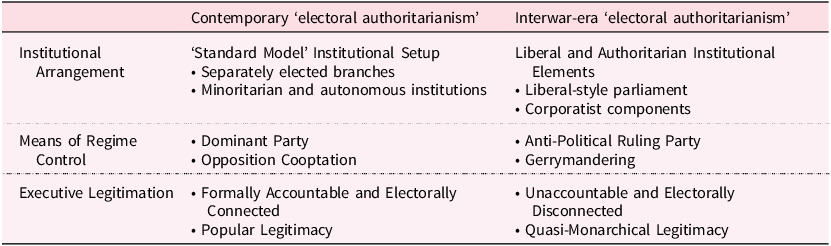
In doing so, through a general analytic narrative across a diverse universe of cases, it argues that in some ways, these electoralist models – as well as the ‘liberal’ constitutional monarchies that maintained a form of parliamentary pluralism – partially fit the contemporary electoral authoritarian model, but with different institutional solutions to the problems of sustaining authoritarian political order. In these cases, primarily through anti-political party vehicles, electorally detached executives, and fitful experimentation with alternative corporatist institutions, as shown above in Table 1.
Comparing electoralist authoritarian regime types across eras

Source: Author.
4. The problem of existing regime conceptualisations in historical perspective
One trouble with attempting to combine the conceptual and typological projects of current scholarship largely focused on the post-World War II period with historical cases from the Interwar experience is precisely the diversity of authoritarianism and the institutional experimentation on offer in the era. Due to the circumstances of the War’s end and the decolonisation wave that took place in the subsequent two decades, most regimes of the latter half-century across the globe can be easily fit into categories of electoral democracies, single-party regimes, personalist dictatorships, monarchies, and military juntas. This forms the influential classification scheme presented by Geddes and coauthors.Footnote 31
While fitting Interwar regimes into this matrix is certainly possible, it is complicated by the plethora of semi-electoral, semi-corporatist, and semi-closed regimes that existed in wide regional variation. This ill-fit is emblematic of a period in which authoritarian theorists held significant sway, and political leaders grappled with the question of how politics ‘should’ look in an age of atomizing mass modernity.Footnote 32 The answer was often not electoral democracy but did not model older forms of closed authoritarian rule either.
Standard descriptions used for post-Cold War regimes fit even less well, given the overwhelming number of electoral regimes with internal authoritarian content today.Footnote 33 The four-part division common in many regime datasets used by social scientists now – liberal democracy, electoral democracy, electoral authoritarianism, and closed authoritarianism – can certainly be deployed, and is useful for providing cut-points to create analysable case sets. Yet, this too misses a great deal of institutional diversity within the Interwar period, and tends towards unwarranted assumptions of certain logics of rule being shared across very disparate political orders.
This mirrors an older concern in the literature on the Interwar period, which tends to describe political regimes in terms of substantive socio-political commitments enmeshed within particular institutional and socioeconomic class patterns rather than formal structure. For example, Gregory Luebbert’s influential categorisation of Interwar regimes as pluralist democracy, social democracy, fascism, and traditional dictatorship or Barrington Moore’s simplified pathways of liberalism, fascism, and communism.Footnote 34 These, and others, all build in institutional orders associated with particular ideological and sociological constellations of power. In this telling, the institutional schemas of these regimes were determined by trajectories of halted or perverted modernisation, or unlucky social class balances of which the political order proper was largely an outcome variable. Yet how exactly one parcels out the fascist from the quasi-fascist and the national–authoritarian to the personal-dictatorial becomes troublesome given such broad strokes.
A somewhat divergent echo of this line of thinking can also be found in an older literature on authoritarianism itself, which sought to first make a totalitarian–authoritarian distinction and then introduce corporatism as a unifying framework for the surviving residual postwar authoritarian states.Footnote 35 Although this research project would be ended abruptly as the Third Wave of Democratization swept away the remaining legacy regimes that survived the Interwar era in Southern Europe and Latin America.Footnote 36
Indeed, the diversity of authoritarian rule in the 1920s and 1930s was quite considerable, stretching from absolute monarchies to military juntas to electoral authoritarian regimes to fascist-adjacent one-party personalism. Descriptors for any given regime vary across historians and political scientists, as well as even contemporary observers.
Austria from 1934 to 1938, for example, has been called separately ‘fascist’, ‘clericofascist’, ‘austrofascist’, ‘corporative authoritarian’, ‘closed authoritarian’, ‘national-authoritarian’, an ‘authoritarian state’, and a ‘national dictatorship’, as well as a variety of proper nouns associated with regime leaders or German-language descriptors such as Ständestaat, Kanzlerdiktatur, Regierungsdiktatur, or simply the Dollfuß-Schuschnigg-Diktatur. Needless to say, all of these adjectival forms may or may not have genuine analytic merit (and surely invite considerable debate within the historiography as well as more politically charged media), but the ensuing conceptual mess of such specific concept markers inevitably makes it difficult to make cross-national regime comparisons.Footnote 37
The more granular categorisation effort used in this article can improve on the conceptual muddling inherent in these older frameworks by focusing especially on those residual authoritarian cases – the capacious ‘traditional dictatorships’ of Luebbert and the over-stretched ‘fascist’ or ‘para-fascist’ coded cases by many that have long caused problems for definition-minded historical scholarship, as well as more closely analysing the utility of the concepts that may be valuably derived from the parsimonious typologies developed in the last 30 years.Footnote 38
This is not to say that ideological labeling, including the morally loaded terms of fascism and communism, are not important – it is merely that these frameworks, which dominate case-specific historiography and are the subject of extensive debates in-country, can be supplemented by an alternative conceptual analysis using theoretical tools from other approaches. This article is derived from this reclassification exercise, focusing rather on the electoralist variations that emerged in the period than the fascist and ‘institutional–hierarchical’ or corporatist cases.
Taking cues from Huntington’s seminal work on the institutionalisation of political order in Cold War-era single-party regimes, I focus on the conceptual promise of ‘electoral authoritarian’ models traveling to this period, described in the prior section as a form of institutionalised and stable form of authoritarianism, which manages to marry some of the formal institutions of modern democratic governance with internal authoritarian content.Footnote 39 This regime descriptor allows for considerable variation in the kind and degree of political institutionalisation present, and above all the particular structural–institutional diversity within this subset, but also leaves well outside the concept more familiar understandings of emergency rule, temporary military regimes, states of exception, and traditional, non-constitutionalised authoritarian polities under the guise of a monarchy or personalist dictatorship.Footnote 40
As per Huntington, an institutionalised regime at the general level is one whose organisational apparatus and political order displays high degrees of adaptability, complexity, autonomy, and coherence.Footnote 41 That is, institutionalisation itself is “. . .the process by which organizations and procedures require value and stability”.Footnote 42 Echoed by Eva Bellin four decades later, this way of understanding institutionalisation emphasises formal rules (in our case, constitutions and institutional state bodies) as well as an ideal-typical delineation between a neo-Weberian state ruled through institutions and one ruled by authoritarian informality that overwhelms nominal institutions.Footnote 43 To frame authoritarian regimes as falling into different categories of institutionalisation is to understand them as having an important element of regularity, proceduralism, and (modest) non-personalised ‘merit’ built into the political superstructure, even if one also allows for informal cliques and patronal networks working within said institutions.Footnote 44
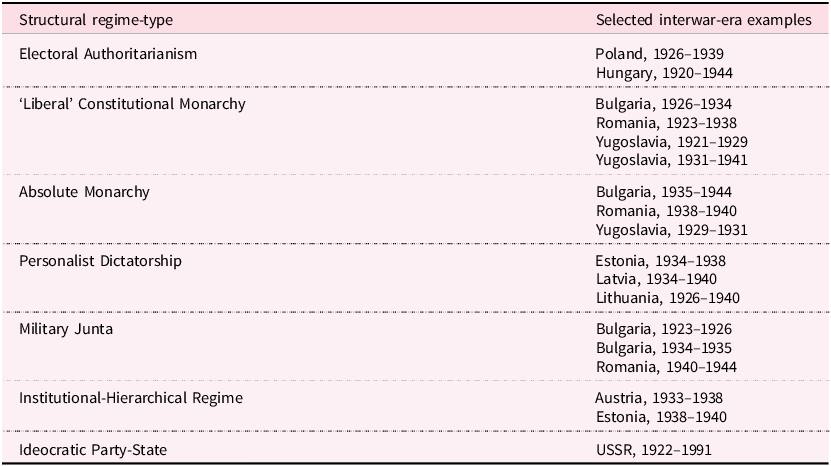
Indeed, even while dismissing the relevance of ‘traditional dictatorships’ of Central and Eastern Europe, Luebbert also admitted them to be highly experimental, a variety of ‘quasi-constitutional dictatorships’ in which authoritarianism was varyingly enmeshed in diverse political processes and institutional patterns that needed a great deal of nuance to describe the hypostasis of simultaneous pluralism and restriction on offer.Footnote 45 To that end, to conceptually distinguish Interwar regimes, we are able to note the wide institutional divisions across regimes often otherwise bracketed together, as noted in Table 2.
Structural regime-types in the interwar era (Central and Eastern Europe)

Source: Author.
We can categorise regime formats of the Interwar Era in several conceptual buckets. First, there are easy cases – absolute monarchies, personalist dictatorships, and outright military juntas. These require no additional conceptualisation and fit standard social science classifications: unconstrained rule by a hereditary monarch with full sovereign power, rule by a single individual lacking institutional constraints and highly reliant on patron-client networks and informal, arbitrary political control, or rule by a committee of military officers.Footnote 46 Meanwhile the ideocratic (or ideological) party-state was a sui generis development out of the Leninist vanguard party ruling the USSR, with the integrated fusion of party institutions in all state and social entities in a totalizing hierarchy from the party cell at school or the workplace all the way to its executive politburo.Footnote 47
Meanwhile, the more unusual electoral authoritarian regime and the liberal constitutional monarchy of the era both share parliamentary institutions with multiparty elections. Here the distinguishing feature being the presence of an unelected monarchical executive in the latter holding the privilege of prime ministerial confidence and an unaccountable personalist executive sitting above controlled electoral politics in the former. Finally, the ‘institutional–hierarchical’ regime refers to regime experimentations in political corporatism mixed with a single unaccountable apex executive, underneath which was a complex subordinate hierarchy of assembly, conciliar, cameral, or vocational-corporate bodies endowed with constitutional political power.Footnote 48 These latter forms are closest in governance architecture to Fascist Italy (as well as the corporatist personalist dictatorships of Iberia), although without the same ideological priors.Footnote 49
5. Schematising the interwar through authoritarian institutional diversity
The Interwar period in Central and Eastern Europe saw the emergence of several new states sewn together from the cloth of the old Austro-Hungarian, Russian, and German Empires, joining a group of continuing states in the Balkans.Footnote 50 With almost no exceptions, the 20-year interbellum between 1919 and 1939 was politically tumultuous for every independent state in the region, with waves of coups and attempted coups clustering in the mid-1920s and mid-1930s especially.
With the exception of Czechoslovakia, no Interwar-era state in the region was spared an interruption to political order due to regime change, coup, or irregular emergency rule, however brief.Footnote 51 As noted above, most scholarly discussions of the political disorder and instability in the region at the time focus on the collapse of democracy and the rise of nationalist, communist, and fascist mass movements that either sparked or followed on these disruptions to regular political order.
Yet, as this article is unconcerned with either autocratisation or democratic breakdown proper, we can bracket major questions of exactly why, how, and under what domestic and international circumstances the Interwar waves of autocratisation took place. Rather, to our concerns here, we are interested in the notable substantive variety of authoritarian regimes – in their constitutional order, structural forms, and institutional capacity – that speckled the region by the 1930s. The following narrative provides a summative descriptive account across the wider region that emphasises where electoralist models of authoritarian politics survived, where they were replaced by institutional–hierarchical or more personalised regimes, and where cross-regime borrowing occurred.
A. Political regimes in the old states of the Balkans
In the Balkans, monarchies predominated. Most held to the traditional structure of liberal constitutional monarchies of the era – a kind of 19th-century version of the modern ‘standard model’ – with a royal head of state interacting with an elected, but gerrymandered and sometimes suffrage constrained, parliament and a prime ministerial executive formally beholden in shifting degrees to parliamentary or royal confidence. By the mid-1920s, most monarchs had aligned themselves with a set of bourgeois or aristocratic political elites – often an oligarchic cadre of system-loyalist parties alongside the army as a source of established order – and engineered plenary majorities to suit royal wishes, while de facto detaching prime ministers from parliamentary confidence and returning them to service at royal preference.Footnote 52 Thus, while some Balkan cases were sufficiently democratic in the 19th and early 20th centuries given the time period (cases vary by the decade), by the Interwar era most were substantively authoritarian.
Calling this combination of liberal constitutional order and authoritarian political order a ‘mimic democracy’, Mattei Dogan cleverly noted that in the case of Romania, a de facto system of revolving royal preference had developed, in which elections were used to post-hoc justify (and sustain in parliament) a newly-favored prime minister. In fact, ‘the party holding power on the day of the elections always attained at least 40 percent of the vote until 1937. But – and this is of essential importance – the same party was never in power for two successive legislative elections. The alteration in power was regularly assured’.Footnote 53 This oligarchic party-pluralist form of mild electoral authoritarianism has been suggested to derive in part from dominant latifundia-style landowning patterns inherited from the 19th century.Footnote 54 Here is our first variation on electoral authoritarian regimes, with the notable element of an unaccountable executive mixing with an exclusive and rotating oligarchic party system reliant on gerrymandering for controlled electoral returns.
Variations on this situation of authoritarian royal privilege in iterated negotiation with a party oligarchy existed in Bulgaria and Yugoslavia as well, although individual case differences abounded. In Bulgaria, a tense dynamic of agrarian populist mobilisation and oligarchic party politics had hindered the development of sustained political order since before the First World War.Footnote 55 This was not a stable pattern, and a short-lived military regime would govern from 1923 to 1926 and again a brief military coup in 1934 would instantiate a separate junta for less than a year, before reverting to a form of royal dictatorship. Yugoslavia, meanwhile, inherited a weakened landholding class of aristocrats with a long legacy of a liberal constitutional order under monarchical privilege that shared power with a peasant-influenced parliamentary assembly.Footnote 56 Early centralisation in Belgrade and a brief royal dictatorship from 1929 to 1931 cemented a perception of ethnic dominance and conflict, although elite coalitions remained fluid and layered.Footnote 57
We can say, however, that for the bulk of the Interwar period, the three Balkan kingdoms largely oscillated between royal dictatorship and a form of electoral authoritarianism that relied on the façade of liberal constitutionalism and took advantage of reserved monarchical powers then still common (if often elsewhere unused) in European monarchies.Footnote 58 Indeed, this interesting variant on electoral authoritarianism – in which a royal head of state had to constantly deal with an (often rambunctious) electoralist parliament and executive government, yet was usually able to put sufficient pressure on elites and the masses to ensure preferred winners at regular elections – is on its own an important conceptual lesson from the Interwar Era and suitable for modern comparisons. And in the Yugoslav case, when royal dictatorship was established, it would be re-constitutionalised with an executive-dominant but formally liberal-constitutional model that lasted until 1941.Footnote 59
This form of authoritarianism, reminiscent of modern authoritarian monarchies in Morocco or Kuwait, is a more pluralist, if constrained, ruling pattern and one common in Western Europe in the early 19th century, reflecting an old oligarchical liberal inheritance.Footnote 60 Adam Bilinski terms this mix of liberal constitutional monarchy with considerable, reserved monarchical powers ‘PA monarchies’, (ie, pluralist-with-alternation) insofar as they could be characterized as both ‘pluralist’ and had the ‘possibility of electoral alternation in legislative control’.Footnote 61 They remained authoritarian in a residualist sense (that is, elections did not fundamentally determine apex political offices), but retained a notable degree of hybridity relative to other contemporary cases.Footnote 62 As in modern monarchical states with such parliamentary inheritances, there would be a continual balance between monarchical authority and attempts to bring back forms of the elitist parliamentary oligarchy. And as elsewhere in the Interwar, the Balkan cases would increasingly experiment with anti-political parties – in these cases, in support of the monarch – as well as rely on considerable gerrymandering in the periods when they allowed multiparty elections.
B. Political regimes in the new states of East-Central Europe
In East-Central Europe, the newly formed states emerging from the postwar wreckage of empire all started with attempts at republican forms of government.Footnote 63 In Poland, Austria, and Czechoslovakia, democratic regimes sought to take hold. In Hungary, a bloody civil war left the first stable Hungarian regime as authoritarian from the get-go.Footnote 64 In two of the former three cases, electoralist governance models survived in electoral authoritarian guise, as it would in the Hungarian case as well. Only Austria fully transitioned to the institutional–hierarchical model of authoritarianism. Czechoslovakia falls out of the analytic case set as it maintained democracy until its annexation by Nazi Germany in 1938–1939.
Hungary takes pride of place as the only case under study that consisted of a single authoritarian spell for the entire prewar period. Inheriting the considerable institutional legacy of the Kingdom of Hungary within the old Habsburg empire, parliamentary institutions and party groups were well-established in both the formal constitutional order as well as the de facto political order.Footnote 65 Formally remaining a kingdom without a king, it retained a type of electoral authoritarianism throughout.
The predecessor Kingdom under the Habsburgs had functionally been a monarchical form of an electoral authoritarian regime since the 1867 Ausgleich, relying on extensive gerrymandering to produce large majorities for a perpetually feuding gentry class.Footnote 66 And with the anti-communist civil war victory, a new electoral authoritarian regime under the tutelary regency of Admiral Miklós Horthy developed.
Horthy’s de facto monarchical office, however, sat above a parliamentary system where gerrymandered, but semi-competitive elections were dominated by the Unity Party, a pro-regime dominant party that competed in a cartel with smaller Christian Democratic, Social Democratic, and agrarian parties.Footnote 67 The Unity Party framed itself as an anti-political party of national unity, safeguarding the nation from ethnic and class divisions.Footnote 68 Interwar Hungary had also inherited an elitist, national–liberal political culture from the Habsburg era that meshed well with the legitimation practices of an electoralist regime that simultaneously prevented uncontrolled political expression through competitive elections.Footnote 69
Interestingly, Hungary did implement an upper parliamentary chamber with membership criteria based on a variety of professional, confessional, and constituency backgrounds in 1925, and the short-lived Gömbös government in the mid-1930s proposed a far more corporative authoritarian constitutionalist framework, although these plans never went anywhere after his death.Footnote 70 Here, we see the liberal (albeit monarchical–authoritarian) parliamentary inheritance maintained a strong presence in the new post-monarchical regime, with longstanding electoral system manipulation practices meshing nicely with a broad-tent, anti-political dominant party that captured the parliamentary space and ensured most politics stayed within the cabinet and the unaccountable executive.
In Austria, the First Republic found no such political peace, with considerable political fragmentation and polarization on the right and left leading to paramilitary political violence.Footnote 71 Under a tense series of democratically elected coalition governments made of fractious right-wing and traditional conservative parties through the 1920s, paramilitary fighting escalated until a short civil war led to a self-coup by Chancellor Engelbert Dollfuß and a brief period of exception in February 1934. Dollfuß, however, was uninterested in either non-institutionalised personalist dictatorship or continued emergency rule.Footnote 72
Crafting an explicitly institutional–hierarchical political order along corporatist lines, he and his successor, Kurt Schuschnigg, presided over an experiment that has provided fodder for generations of scholars to wrangle over its relative ideological and institutional contours.Footnote 73 The Austrian case moved far along the corporative framework, creating a ‘duumvirate’ of executive authority shared by a presidential and constitutionally privileged Chancellery office, as well as a reformulated bicameral legislative Diet whose membership was selected through four advisory bodies ‘representing the state, culture, the economy and the regions’ as well as other corporate bodies.Footnote 74
Importantly, these bodies were assigned asymmetric hierarchical power, with the presidentially appointed Staatsrat (Federal State Council) charged with the authority to review all other advisory opinions and policy consultations from the other chambers, ahead of formal parliamentary legislation.Footnote 75 For our purposes, Austria forms an important example of the institutional–hierarchical model, in which the political order – corporatist, clerical, party-based authoritarianism with a greatly empowered and formalised Chancellery office – was indeed congruent with the constitutional outlines of advisory chambers and sectoral cameralism under one-party authoritarianism, while rejecting the older electoralist parliamentary inheritance of Cisleithenian and First Republic Austria.Footnote 76
Poland occupies a special place in the historiography of Interwar regimes, in part because of the complexity of its electoral politics for both its unstable democratic period as well as the authoritarian regimes that followed it. Revolving cabinets, a function of an over-proportional electoral system and polarised ideological, regional, class, and ethnic cleavages embittered political actors across the spectrum.Footnote 77 A coup by the former Chief of State and Marshal of Poland Józef Piłsudski in May 1926 left the formal constitutional order in place from the democratic Second Republic, leading to an electoral authoritarian regime with Piłsudski holding de facto tutelary executive power as the Minister of Defence.Footnote 78
Unique among other electoral authoritarian regimes in the region, the Piłsudski era was notable for holding free and fair elections in 1928, before a dominant party was instituted in the early 1930s and questions of institutionalising a more forthrightly authoritarian regime began to loom.Footnote 79 A new constitution enshrining a super-presidentialist system was implemented just before his death, which maintained a significantly weakened form of liberal constitutionalism that was in content thoroughly authoritarian under a series of military-dominated governments under the civilian presidency of Ignacy Mościcki.Footnote 80 Growing interest in corporatism and the development of a single-party regime was evident from 1935 onward.
Poland was an Interwar-style electoral authoritarian regime since the 1926 coup, although its institutionalisation varied over time – peaking in 1937 with a newly reformed dominant party and the consolidation of the new constitution. Yet personalism in the leadership was already becoming a problem, and there is considerable uncertainty whether experimentation with corporatist structures in the late 1930s would have gone very far. The final empirical section further below provides a brief case illustration of this dynamic in greater detail.
C. Political regimes in the new Baltic republics
In the Baltics, democracies under a parliament-dominant model with high proportionality suffered from continual political instability, with the wobbling Lithuanian democracy collapsing in 1926 and both Latvia and Estonia breaking down with days of each other in 1934. Similar stories of ideological ferment and elite contention existed across cases, although each state settled on a different sort of authoritarian rule by the late 1930s.Footnote 81
Lithuania’s democratic order was overthrown in 1926, ushering in a short period of contested electoral authoritarian rule under the ultra-nationalist intellectual and prime minister Augustinas Voldemaras and president Antanas Smetona, the latter eventually pushing out Voldemaras and advocating for a strongly presidentialist constitution, only to abolish the constitutional order entirely in 1929 in favor of personal dictatorship.Footnote 82 Although an extra-constitutional parliament was returned in 1936, its members were uniformly regime loyalists and acted more as an acclamatory body of the type found in Nazi Germany, Fascist Italy, or the Soviet Union. Ruling by decree until 1938, Smetona then introduced a new constitution that held the promise of institutionalising the regime but was never followed through before the regime fell.Footnote 83
In Latvia, a self-coup by Kārlis Ulmanis led to the development of a non-institutionalised, personalist authoritarian regime, with no constitution promulgated and efforts at a fascist-style cult of personality and mass movement politics preferred. Ulmanis accrued prime ministerial and presidential titles left over from the democratic era, but parliament and other constitutional organs were shuttered, and a form of personalist dictatorship settled until invasion in 1940. Describing himself as ‘Leader of the People’, Ulmanis instituted a panoply of corporatist institutions which were largely controlled top-down from respective executive ministries, but they were neither constitutionalised nor did they hold any real subordinate autonomy within the authoritarian hierarchy.Footnote 84
Finally, Estonia’s unstable democratic regime was toppled in 1934 by Konstantin Päts. This self-coup, in league with a cross-party cartel of elites, was justified as a prophylactic measure against a rising radical populist movement that took its cues from fascist movements elsewhere in Europe. This regime, however, was preoccupied with developing a constitutional form of stable authoritarian rule. Formally dissolved political institutions were left intact, corporatist organs were introduced and settled into Estonian society, and a new, institutional–hierarchical political order, mixing full state-corporatism and electoral authoritarianism was instituted in 1938.Footnote 85 Defeat and conquest by the Soviet Union would prevent further efforts at working out the new system in practice.
Table 3 develops greater distinctions across these regimes, highlighting the degree of institutionalisation versus personalisation over their respective regime spells, the degree to which they sat more within the electoral authoritarian or institutional–hierarchical models of authoritarian governance, and specific characteristics of the internal domestic politics within, including the strength of the ruling dominant or single party and degree of ‘mimic’ or virtual party politics retained by way of elections or in parliamentary plenary.
Ideal-Typical characteristics of interwar institutionalised authoritarianism

Source: Author.
A final coda can be made with regard to Finland, which by most measures retained its status as an electoral democracy after the end of the Finnish Civil War in 1918. Yet as one academic observer pointed out at the time, its Interwar trajectory was one of considerable repression against both Communists and the fascist-aligned Lapua Movement, especially in the 1920s and early 1930s, suggesting that the Finnish ‘political status was changed from that of a Baltic state of the authoritarian type to that of a member of the Scandinavian family of democracies’.Footnote 87
Complicating this characterisation was the curious personal institution of Gustaf Mannerheim, who held a de facto position as a quasi-monarchical state guarantor and foreign policy arbitrator with titles ranging from Regent to Field Marshall to Chairman of the Finnish Defense Council during the period.Footnote 88 This unusual regime combined in some ways elements of the Interwar style of electoral authoritarianism (especially in regards to foreign affairs and military-security matters) with the somewhat constrained internal political pluralism of an electoral democracy, thus representing a plausibly hybrid case.
6. Poland as an interwar style electoral authoritarian regime
Poland in the Interwar period experienced significant political turbulence as well a single authoritarian spell from 1926 to the end of the regime with the Molotov–Ribbentrop Pact and subsequent partition. The historiography is divided on the subject of the post-1926 regime, with most both confirming it as authoritarian but also often noting its relatively liberal and pluralist domestic political order, compared to neighbouring countries.Footnote 89 Multiparty elections were maintained, electoral interference was mixed (famously free in 1928 and equally coerced in 1930), parties continued to campaign, the parliament continued to sit, and press and speech freedoms were far more expansive than in other regimes.Footnote 90 In this way, we again see the utility in trying to understand Interwar authoritarianism through conceptual lenses of electoral authoritarianism and the liberal inheritance, relative to simpler accounts of traditional dictatorship.
The authoritarian period of the Polish state is usually broken into two distinct regimes – one in which Józef Piłsudski played a de facto ‘strongman’ tutelary role while never sitting at the formal apex of the official regime, and a second era following the promulgation of a new constitution, Piłsudski’s almost immediate subsequent death, and the establishment of a clique of military figures known as the ‘Colonel’s Government’ holding commanding positions in government under the civilian presidency of Ignacy Mościcki.Footnote 91 The latter period of the regime saw movement towards experimentation in corporatism and single-party models, instructively highlighting the strong headwinds among authoritarian regimes of the era pushing away from electoralist models.
The Polish regime can therefore be helpfully conceptualised as an Interwar variant on electoral authoritarianism, in which liberal constitutional institutions – the parliament (Sejm), the judiciary, an elected presidency – survived throughout the period and indeed often were the site of genuinely contested politics. At the same time, it is also clear that the Piłsudski era should be seen as a good example of the personalisation of political order, especially given the mismatch between Piłsudski’s informal power as arbiter and decision-maker, widely reported in the literature, from both electoral politics and the formal head of state or government.Footnote 92
As noted, with the transition to the so-called ‘Colonel’s Government’ era in the wake of Piłsudski’s death, we may also identify a turn towards an increasingly institutionalising regime, if not one that satisfies criteria for the institutional–hierarchical political order, given the generic liberal structure of the formal constitution (even in its ‘superpresidentialist’ revision) and the lack of non-electoral corporatist or advisory bodies beyond certain unimplemented constitutional provisions. Indeed, Poland will remain structurally of the Interwar variant of electoral authoritarianism throughout the period.
What is instructive here is the degree to which the more institutionalised regime following Piłsudski’s death developed a far less active and politically relevant legislature – a change not picked up even during the rigged 1930 elections, but only with the onset of the Colonel’s Government and the 1935 elections, which consolidated the anti-political ruling party to a much greater degree. This suggests an institutional tightening of the screws, the post-constitutional fallout among rival camps within the elite Sanacja coalition, and would then be followed by further consolidation of the ruling, antipolitical party the Nonpartisan Bloc for Cooperation with the Government (Bezpartyjny Blok Współpracy z Rządem - BBWR) into the Camp of National Unity in 1937 (Obóz Zjednoczenia Narodowego - OZON), which began to take on single-party characteristics.Footnote 93
A. Electoral authoritarianism under Piłsudski
The May Coup of 1926 was triggered by a variety of factors, but the proximate cause was the unpopular government of Wincenty Witos, which suffered from constant parliamentary infighting, the fallout from the Locarno Peace Treaty, and an ongoing trade conflict with Germany that continued to undermine the economy, as well as discontented elite opinion. At this point the so-called ‘Sejmocracy’ of the Polish democratic experiment had thoroughly acquired a negative reputation, and Piłsudski found himself in a peak position to force out the ruling government by extralegal means.Footnote 94
The coup ushered in a brief period of emergency rule before the formal constitutional order was quickly re-established. The political order, however, had been bent out of its democratic setting. Supported by the mass movement known as Sanacja (Sanation, or a ‘return to health’), which quickly provided its name to the regime as a general descriptor, placed Kazimierz Bartel into the prime-ministership and Ignacy Mościcki as the new president, a position he would hold until 1939.Footnote 95 An electoral authoritarian regime would then develop after the coup cut the Gordian Knot of Polish democracy, although one imbued initially with a strong legacy of the old liberal parliamentary experience informing most political actors of the day. For even the oppositional ethnonationalist right, ‘having come to maturity in this specific political ambiance [the inheritance of German and Habsburg parliamentarism], they were apprehensive or at least unfamiliar with the concepts of a modern dictatorship based on stimulated and disciplined mass popular activities’.Footnote 96 This would underlie a slower transition away from the Interwar electoralist governance model, which only emerged in the latter half of the 1930s.
Piłsudski would remain on the sidelines in terms of formal office, holding the Defense Minister position throughout as well as two shorter stints as Prime Minister for parts of 1926–1928 and briefly in 1930. His was a tutelary role, a prominent expression of the non-institutionalised element of the Polish regime.Footnote 97 A new anti-political dominant party vehicle was created, the BBWR which was allowed to support a government even after winning only a plurality of Sejm seats in the 1928 elections – yet the non-loyalist parliamentary majority managed to still place the socialist politician Ignacy Daszyński as Speaker of the Sejm for one term. The BBWR itself was known for considerable factionalism within its big-tent framework. Nevertheless, further elections were more heavy-handed, with considerable repression brought against some members of the political opposition for the 1930 election, which the BBWR won comfortably, and was repeated to even greater effect in the 1935 election.Footnote 98
The Sanacja regime was thus an electoral authoritarian regime, one that wavered between harder and softer means of ensuring continued parliamentary power, and one that had a curious tutelary figure distinct from either head of government or head of state making primary political decisions. As Jerzy Holzer notes, ‘as a political camp, Sanacja was little concerned with forcing its followers into well-organized structures; even less did it use its strength as the ruling party to organise and indoctrinate the whole of society along its ideological lines’.Footnote 99 Figure 1 below illustrates the considerable party pluralism even under post-coup electoral authoritarianism and in light of an increasingly rigged electoral system.
Polish authoritarian elections, 1928 and 1930. Source: ‘The elections to the Polish Parliament (Sejm) 1919–1947’ (Chart from Datawrapper).

Meanwhile, the tutelary figure of Piłsudski was less clearly a stand-in for a monarch as in the neighboring Hungarian regime but functioned in a similar way as an ultimately unaccountable apex executive figure. This curiosity points to the need to understand the electoral authoritarian regime of the Interwar Era as a conceptual variation, rather than mirror, of contemporary usage. Furthermore, this lack of congruence between the increasingly authoritarian political order and the formally electoralist – if lopsided in presidential power – constitutional order would become even more stretched upon Piłsudski’s death in May 1935.Footnote 100
B. Institutionalising authoritarianism under the colonels
The death of Józef Piłsudski coincided with a regime attempt at institutionalising rule – a problem recognised by elites in government, in the ruling party, and in the informal clique of military figures that were closest to him.Footnote 101 Prepared over the course of a year and passed a month before Piłsudski’s death, a new constitution – termed the April Constitution – would provide for a super-presidential system in which the presidency held extensive decree powers, a legislative veto, heavy appointment prerogatives, and privileges of dismissing the government and parliament, but that still aligned with nominally liberal constitutional formats.Footnote 102
Interestingly, Poland mostly avoided experimentation with corporatist organs or other cameral state bodies during this drafting, with interest-articulation and societal penetration limited to the reach of the clumsy BBWR ruling party as well as local groups of notables that were connected to the regime – although this was an actively contested point among the ‘colonels’ and BBWR leadership that debated the new constitution.Footnote 103 Certain corporatist features were introduced (discussed below) that were never implemented, nevertheless highlighting the pull of institutional-hierarchical governance models during the period even despite the electoralist format mixed with personalised rule that defined Poland’s Interwar authoritarian regime.
The military cadre around Piłsudski had to figure out what they were going to do with a constitution that had been tailored to the dead general’s preferences.Footnote 104 Mościcki was allowed to continue on as president – now occupying a far more powerful formal institutional office. But rule had been largely devolved to the ‘colonels’ in the ministerial government, which dealt with factional disputes between Edward Rydz-Śmigły and Józef Beck, moderates in close coordination with the presidential office, and hardliner factions led by Walery Sławek.Footnote 105
Rydz-Śmigły would begin to develop a secondary cult of personality as ‘Second Man of the State’, especially after the reformation of the BBWR into the Camp of National Unity (Obóz Zjednoczenia Narodowego - OZON), which began to promote ethnic nationalist mobilisation in sharp contrast to the civic preferences of Piłsudski’s relatively inclusive and anti-political state-patriotism. BBWR after 1935 and especially OZON also moved towards a more hegemonic electoral authoritarian regime model. As Figure 2 shows, this resulted in supermajority wins in 1935 and 1938 in both the Sejm and the Senate (a result of both electoral system gerrymandering as well as an opposition boycott), and all other MPs coming from either coopted ethnic minority party associations or pro-government independents, although internal intra-party factional discord remained notable.Footnote 106 Development into a single-party model under OZON (and thus finally departing the electoral authoritarian model fully) seems a reasonable suspicion given this trajectory had the war not interrupted.
Polish authoritarian elections, 1935 and 1938. Source: ‘The elections to the Polish Parliament (Sejm) 1919–1947’ (Chart from Datawrapper).Footnote 107

Table 4 above provides details of the governance model of the post-1935 Polish regime, noting executive, legislative, party, and nascent corporative organisational features developed under the Colonels. Indeed, it is possible that had the Polish regime continued into the 1940s, Rydz-Śmigły and more radical elements of OZON might have begun a transition in governance architecture, with movement towards a more nationalist and personalist dictatorship, in part to appease ethnic Polish grievances about the relatively inclusive Sanacja regime.Footnote 108 Similarly, the one-party model, with its more ‘institutional-hierarchical’ characteristics, might have increasingly been implemented had the regime survived, with the goal that a ‘system of personal dictatorship was to have been strengthened by the formation of an efficient grassroots Sanacja party, which would then be brought to the top in a one-party system’.Footnote 109 As it was, even OZON remained still factionalised, with vying candidates within the party adding friction to any fully hierarchical party model.
Schema of institutionalising electoral authoritarianism in Poland, 1935–1939

Source: Author.
Other institutional–hierarchical characteristics, such as new experiments in economic corporatism, were largely left on paper when the regime fell to Nazi and Soviet invasion. The vague corporative economic structures mentioned in the April Constitution were never activated, and executive government was riven with dissent that was only resolved through an increasing personalism – one that was often justified given the growing military threat that loomed ever larger in the immediate years before 1939. Yet it remains unclear whether the institutionalised high-point of the regime had been reached, and thus the Polish regime remained broadly as it was, an electoral authoritarian regime that both relied on a capacious dominant party and remained wedded to a form of constitutional order, although it was not fully congruent with the regime reality.
7. Conclusion
Using Central and Eastern Europe’s experience with authoritarian rule in the Interwar Era, this Article briskly explored the relevance of placing contemporary regime-type discussions in the theoretical and conceptual literature in dialogue with the study of the political past of modernity. In so doing, this paper applies the tools of comparative authoritarianism scholarship to bear on Interwar authoritarian cases, locating partial and intriguing variants of electoral authoritarianism in a subset of these cases. It does so in an exploratory, rather than comprehensive, manner, providing a plausibility check essential as the discipline of political science continues its historical and institutional ‘turns’.
While some regimes in Eastern Europe’s interbellum can confidently be labeled traditionally – as personalist dictatorships or simple authoritarian monarchies – others too can be fruitfully explored for conceptual comparative lessons. Modern electoral authoritarianism bears a family resemblance to both the liberal constitutional monarchies of the Balkans, as well as the curious electoralist regimes of Hungary and Poland. In all cases, sustaining multipartism and elected parliaments was paired with unaccountable executives, whether monarch, a monarch-like figure in Horthy, or the informal personalised power of a Piłsudski.
While the application of electoral authoritarianism remains an issue of detailed case context and empirical nuance, as suggested by the Polish case discussed in greater detail, it remains a fruitful avenue of inquiry for both historical political science and contemporary comparative authoritarianism scholarship. Critically, emphasising the distinct place of unaccountable executives, antipolitical regime parties, the liberal parliamentary inheritance, and a tendency to at least partially seek more institutionalised forms through experiments with corporatism, as well as the perpetual allure of more personalised displays of power.
This conceptual contribution thus holds merit as an alternative analytic descriptor for a small but important subset of authoritarian regimes that exist today as well, which has been noted in a few places in the text. While few regimes today are electoral authoritarian in the peculiar way which that governance model formed and crystallised in the 1920s and 1930s, it is likely that comparisons with both certain contemporary dominant-party regimes and other hard-to-classify regime cases – such as contemporary Iran or wartime Russia – may be relevant, if only to explore the limits and possibilities of conceptual recategorisation for future work in this vein of the historical and comparative study of regimes.
Competing interests
The author has no conflicts of interest to declare.


 Open access

