

On April 7, 1919, fashionably dressed women crowded into the Great Hall of the Cooper Union. Women’s reform groups had called a meeting to rally support for state labor bills being blocked by Republicans in Albany: an eight-hour day and a minimum wage for women, and the expansion of the women’s night work ban to cover streetcar and elevator operators. When a vote on resolutions was called, Ella M. Sherwin demanded to be heard. Identifying herself as president of the Women’s Equal Opportunity League, Sherwin insisted that these bills hurt women more than they helped. A man from the Central Federated Union shook his fist at Sherwin and insisted she was a fraud, an opportunist, and a front for manufacturers. The room erupted, and a half-dozen Equal Opportunity League members jumped to their feet shouting angry denials. As the chair pounded her gavel for silence, Sherwin yelled: “We were put out of good jobs!” Then the janitor cut the lights.Footnote 1
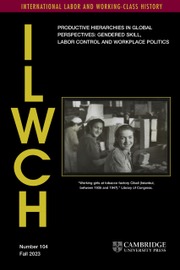
New York City streetcar “conductorettes” in October 1918, masked against influenza. National Archives, 45499323.

This raucous scene captures the essence of a conflict about what working women needed and who was qualified to speak for them, a longstanding debate that crested in New York City during World War I. The most contentious of the issues in dispute was whether women should be permitted to work at night. Night work was the stage on which reformers’ ideas about the good of the majority most tangibly conflicted with a minority arguing for women’s autonomy. Whether and what kind of work women could do at night was a conflict about class, motherhood, and self-determination.
The question of night work was not a new one, but it was particularly fraught in New York. Around the country, women won new jobs when the U.S. entered the Great War—but only in New York did female reformers spearhead the opposition to their employment.Footnote 2 There, local chapters of the National Consumers’ League and the Women’s Trade Union League (WTUL) led the lobbying effort to expand the night work ban, which they insisted would protect women. A month after the contentious Cooper Union meeting, they succeeded. Female transit workers were suddenly barred from working past ten o’clock at night or before six o’clock in the morning, and thousands of women were abruptly fired. Angry, they joined the Women’s Equal Opportunity League (WEOL), founded by female printers in 1918. The New York organization fought expansion of women-only protective laws and ultimately won repeal of the night work ban for printers, elevator operators, and some transit workers.
Reformers demonized WEOL, without proof, as a stooge for employers, but the group was motivated by personal experience. WEOL’s leaders had all lost jobs as a result of the night work law. Their voices are underrepresented in the history of protective labor legislation. Their papers were not preserved. Unlike their political opponents, they did not have the opportunity to become salaried staff of women’s reform organizations. They remained shift workers their entire lives, while continuing to campaign for what they called “industrial equality” for women. Their viewpoint is occasionally mentioned by historians, but a full portrait of their advocacy does not exist. The lives of three WEOL leaders—printer Ella M. Sherwin, transit guard Margaret Hinchey, and streetcar ticket agent Mary A. Murray—illustrate the origins and longevity of working-class support for formal legal equality for women.Footnote 3
Sherwin, Hinchey, and Murray were among thousands who protested the loss of their jobs, and dozens who devoted themselves to political agitation. These three women were particularly notable for the depth and duration of their involvement, and each highlights a different facet of working-class women’s opposition to night work laws. All three were White; Hinchey was an Irish immigrant and the others were native-born. Only Sherwin had a high school diploma. Only Murray had children; she spoke often about why mothers preferred night shifts. All three were devoted union members whose advocacy alienated them from their unions. Together they determined to oppose all women-only protective laws, which they believed cemented women’s position at the bottom of the labor market. They lobbied state and federal governments for decades, contradicting reformers who insisted that women benefited from these laws.
Ella M. Sherwin joined the fight earliest. A Linotype operator from Buffalo, she lost her overnight newspaper job in 1913. As a printer, she represented the elite of the industrial workforce, but rather than insist on printers’ exceptionalism she helped develop the argument that all women were harmed by single-sex laws. Margaret Hinchey was the most experienced activist of the three, a well-known suffragist who could not find work after New York women won the vote. Hired as a guard on the Brooklyn streetcar during the war, she found herself again unemployed when the night work law expanded. Hinchey personifies the significance of new wartime opportunities for women without much formal education, and her bitter falling out with her former colleagues at the WTUL shows the vehemence of the ideological divide over protective labor legislation. Another transit worker, Mary A. Murray, had been a ticket-taker since before the war. A widow with five young children, who sewed their clothes in the ticket booth at midnight, Murray was politicized by losing her job. She directly challenged the ban’s proponents about who constituted a “good mother.” After she succeeded in reclaiming her position, she accused her union of abandoning women workers and organized an all-female bargaining unit.
These three women would become the working-class spokespeople for the federal Equal Rights Amendment (ERA) in the 1920s. Their own experiences losing night shift jobs and fighting to get them back predated the ERA—and presaged a conflict with other advocates for working women that would continue for decades. Historians have focused on the upper- and middle-class women of the National Woman’s Party (NWP), who were the most visible proponents of the amendment. The working-class women who demanded the ERA—not in spite of the prospect that it would nullify single-sex labor laws but because they hoped it would—have received less attention. To appreciate their significance we need to understand who they were, why they got involved, and the scale of the work they led in the years before the ERA was introduced.
Night work laws
Night work bans in the U.S. were gendered in their enactment and their defense. Before the Supreme Court’s Lochner decision voided protective laws for men, some hours restrictions covered men also—but night work laws always targeted women and children.Footnote 4 New York is a case in point: an 1895 law limited bakery employees of all sexes to sixty hours each week, and no more than ten hours per day breathing flour. In 1899, the legislature barred children under 18 and women of any age from work in a factory or laundry after nine o’clock at night, excepting her own home or family business.Footnote 5 Before Lochner reached the U.S. Supreme Court, New York courts twice upheld the bakery law as a reasonable use of state power to protect public health. In Washington, however, the justices ruled 5-4 that the law violated the employee’s right to sell as much of his time as he wished.Footnote 6 The New York courts followed Lochner and voided the night work law in 1907, holding that woman is “no more a ward of the state than … man.”Footnote 7 Nationwide, the slipperiness of women’s difference versus equality was a hallmark of court rulings on labor laws. Decisions striking down gendered protections asserted women were practically equal; decisions upholding the laws insisted they were profoundly different.Footnote 8
After Lochner, the National Consumers’ League designed a strategy to resuscitate protective labor laws that relied on arguments for difference. They succeeded in Muller v. Oregon, where the Supreme Court ruled unanimously that women’s frailty required the intervention of the state, and “legislation designed for her protection may be sustained even when like legislation is not necessary for men, and could not be sustained.”Footnote 9 Before Muller, Alice Kessler-Harris notes, only three states forbade women from working at night. After the court adopted the Consumers’ League argument that night work threatened a woman’s morals, a dozen states passed laws against women working past nine or ten or even six o’clock at night.Footnote 10 New York reinstated its night work law after the Triangle Shirtwaist Factory fire dramatized women’s vulnerability and unequal bargaining power. Outcry from organized labor and reformers following the fire fueled the creation of a Factory Investigating Commission. Two of the Commission’s first recommendations were a nine-hour maximum day and a ban on night work for women who worked in factories. The ban went into effect in July 1913, and women who worked nights—including Ella Sherwin—were fired. Some printers and bookbinders protested that they were not factory workers and the law should not apply to them. Their unions and the Commission urged them to await the outcome of litigation challenging the law.Footnote 11
The National Consumers’ League helped defend the New York law using the strategy that had succeeded in Muller. By 1914 their brief on night work had ballooned to more than four hundred pages. It built on two themes: that night work depleted the quantity and quality of maternal attention, thus good mothers should stay home with their children at night; and that other women—childless women—who went out at night were morally suspect.Footnote 12 New York’s highest court agreed, accepting as fact that working nights was dangerous for women. Not only individual children but the future of national fecundity was at stake. Women’s night work should be banned, the New York court ruled, “for the sake of the children whom a great majority of them will be called on to bear and who will almost inevitably display in their deficiencies the unfortunate inheritance conferred upon them by physically broken down mothers.”Footnote 13 The court acknowledged that some women disagreed, but held that the state should “protect them against even their own indifference, error or recklessness.”Footnote 14
Wages and childcare, not recklessness, however, prompted women to work nights. Night shifts often paid more for less work: a fifty-hour week for more pay than sixty, or a five-night shift instead of six, with a ten percent premium. Mothers of young children were overrepresented on factory night shifts, and they invariably said they chose night work so they could care for their children during the day. Women without children told the Consumers’ League they slept fine in daytime; their biggest complaint was sexual harassment, which they attributed to a dearth of female supervisors at night.Footnote 15
For every fighter, a woman worker
Women’s work opportunities, in New York in particular, expanded in 1917 when two events shifted women’s economic and political status. In April, the U.S. entered the war in Europe. In November, New York women won equal suffrage: the first state in the East where men agreed to share power. By year’s end, federal “work or fight” laws for men, combined with immigration restrictions, meant jobs opened to women that had never been accessible before. Suddenly, women were delivering telegrams, driving streetcars, and operating elevators all over New York City. These were “men’s” jobs, highly visible and encouraged for women as a form of patriotic service. Posters depicting White women in overalls saluted: “For Every Fighter, a Woman Worker.”Footnote 16 In the South, Whites weaponized the “work or fight” laws to force Black women into domestic service, prompting an exodus: more Black women moved North between 1916 and 1920 than in the prior forty years combined.Footnote 17 In the North too, they were relegated to the dirtiest, most menial roles. Urban factories and retail stores largely refused to hire them, citing customer preference and the expense of providing the segregated facilities that White employees demanded.Footnote 18 Operating elevators was a rare exception. The first woman to run an elevator in Rochester was “a member of the race,” the New York Age noted proudly.Footnote 19 By 1918 Black women were also operating elevators in Syracuse, Utica, and in Manhattan, where 17,000 elevators were largely staffed around the clock. In 1919 half of the female elevator operators in the city were African American.Footnote 20
The new elevator operators and streetcar “conductorettes” attracted immediate attention. Newspapers were full of boosterism about their fitness, their performance, their patriotism, and especially their clothing.Footnote 21 Streetcar women on the Manhattan lines wore a military-style knee-length coat, bloomers, and high boots. The Brooklyn Rapid Transit uniform was slightly less masculine, with a skirt under a dark blue coat. Both uniforms included a cap with a metal badge number. Women made the same starting wage as men, and the conductor and guard jobs paid better than factory work. Streetcar women said they liked being outdoors doing something less repetitive than sewing or canning. Women were also hired as carpenters and painters in the repair shops, and the possibility of advancement seemed real.Footnote 22
The Consumers’ League of New York City immediately denounced the “moral hazards” of such work and demanded that the maximum-hour and night work laws should cover those jobs.
It is unthinkable that young women should be employed on streetcars at night. The state labor laws protect girls working in factories and mercantile establishments, but the lawmakers never expected that girls would be put to work as elevator operators, streetcar conductors or messengers. New laws will have to be enacted.Footnote 23
The local Consumers’ League and WTUL lobbied hard to expand the labor laws. Five weeks after that heated April 1919 meeting at the Cooper Union, the legislature amended the night work law to cover transit workers and elevator operators. On the streetcars, the impact was immediate: the Brooklyn and Manhattan streetcar companies promptly fired 500 women and estimated that 1,200 women would be out of work soon.Footnote 24 The Consumers’ League denied responsibility, insisting that the women were fired because soldiers were returning. The private companies that ran the streetcars disagreed. They told the state Women’s Bureau and the press that they wanted to keep their female employees: women handled cash more honestly than men, they said, with lower absenteeism and turnover. However, transit schedules were incompatible with the night work ban. “There is not a single one of [our] runs that begins after six in the morning and before ten at night,” said a lawyer for the transit companies. A Brooklyn Rapid Transit executive said: “I should say 60 percent of our women are supporting children. The new law practically prohibits the use of women.”Footnote 25
Ella Sherwin, Margaret Hinchey, and Mary Murray came together to lead the effort to repeal the law. Over the next several years, they won exemptions for various industries, helped block laws that would further limit women’s hours, and dampened public support for women-only labor laws. They argued that rather than protect women, these laws permanently impeded women’s economic opportunity. Night work restrictions removed a tangible choice about how to live, which all three women found intrusive and paternalistic. Sherwin, Hinchey, and Murray led the cohort of “industrial” advocates for the ERA from World War I through World War II. They were the leaders of the NWP Industrial Council and later the Industrial League for Women’s Equality, chairing those groups into the 1940s. They took up the issue because of the loss of their own jobs, and stayed engaged long after they reclaimed them or found other work. They were authentic, politically effective working-class women who contested what it meant to be a good mother and for a woman to be out at night.
Ella M. Sherwin
The transit women’s firings in 1919 were front page news, but when Ella Sherwin lost her night job in 1913, no one noticed. Printers were a tiny portion of the women affected by the factory night work ban. Eligible for neither evening nor overnight shifts, women found daytime work scarce because the largest newspapers were morning papers whose type was set overnight. Sherwin managed to find a day shift at a “book and job” commercial printer. It paid eight dollars less each week for a day that lasted thirty minutes longer. Sherwin had only recently arrived in New York City. She learned the printing trade after high school in Buffalo; in her twenties she lived with her parents and worked at the small-town Batavia Times. She devoted her leisure time to activism: she was the founding president of the Batavia Socialists and a leader of the local woman suffrage group. In 1910 she and her mother were delegates to the state suffrage convention in Niagara Falls. Around 1912 Sherwin came to New York City for a training course given by the Linotype company, maker of the massive, molten typewriter that had transformed printing. She settled in Brooklyn and lived on and off with a fellow Socialist and member of the Typographical Union, Frank Gibbons. They eventually married, but only her mother referred to her as Mrs. Gibbons; Sherwin used her own name always.
Printers were unquestionably unique in 1913. In no other industry could a woman do the same job as a man for the same wage.Footnote 26 Most wage-earning women worked in the garment industry, where they made between six and nine dollars per week. Women who belonged to the Typographical Union, in contrast, earned union scale: thirty-five dollars per week if they worked the “third shift,” which began at two o’clock in the morning. Just two hundred members of New York City’s Typographical Union local, however, were female.Footnote 27 Protective labor advocates said women like Sherwin were so few as to be irrelevant. In a memo to the Factory Investigation Commission, the Consumers’ League argued:
This statute affects the health, morals and welfare of thousands of women throughout the state. It is enacted in the interest of the greatest good of the greatest number. If it entails a readjustment of the working hours of a few hundred individuals in two occupations, this is a small price to pay for the great benefit to the immeasurably larger body of workers.Footnote 28
While insisting the ban’s impact on printers was insignificant, the Consumers’ League worked doggedly to block them from winning a legislative exemption. With the help of the State Federation of Labor, they derailed the printers’ bill three times. Two different governors—one Republican, one Democrat—vetoed printers’ exemptions that had passed the legislature by large margins.Footnote 29
After the first veto in 1917, Ella Sherwin and other women printers were done relying on their union to defend them. Voters at last, they launched a new organization. “A large body of women who really work (when they can get work) have formed an organization, the Women’s League for Equal Opportunity, for the purpose of combating any further legislation for women only,” they announced in the Brooklyn Daily Eagle.Footnote 30 Three weeks later, Sherwin published an editorial in the Socialist daily paper identifying herself as Chairman and explaining the group’s goals.Footnote 31 Then and thereafter in editorials, letters to the editor, quotes in newspaper articles, and testimony at legislative hearings, Sherwin consistently emphasized the need for labor solidarity among all workers, the danger of allowing women to become underpaid scabs, and the economic harm to women of restricting their hours and not men’s. Quoted in the New York World after the night work law expanded, Sherwin summarized the problem:
Welfare legislation, if persisted in, will protect women to the vanishing point. Whatever its intent, it can have but one outcome. It will drain women out of all highly paid and highly organized trades, because the law will prevent them from doing the same work that men do and the unions will prohibit them from working for a lower wage than the men.Footnote 32
From its beginnings, WEOL campaigned against all single-sex laws. Though founded by union printers, a printers’ exemption was never the group’s sole priority. In its second year in existence, WEOL championed a state equal rights in employment bill, which was introduced in the Senate.Footnote 33 Asked whether she believed in any restriction on women’s labor, Sherwin replied: “If there is employment that is not fit for a woman, it is not fit for a man.”Footnote 34 WEOL sought to represent all working women, both professional and unskilled. At a high-profile legislative hearing in 1919, Sherwin and the other printers presented their own research about transit women who preferred night work. The hearing also featured an elevator operator named Stella Jackson. Explaining that she made twice as much money as department store clerks, Jackson said that if she lost her job due to the night work ban, “it means I will have to go back to house [domestic] work … I have no education. I cannot do stenography or anything like that … I run an elevator and I am proud of it.”Footnote 35 Sherwin and the other printers were probably not surprised when a state official—the former leader of the Typographical Union—mocked Jackson’s lack of education. Even as the printers continued to seek an exemption for their own industry, they did not distance themselves from less educated women in unskilled trades. In doing so, they chose sex solidarity over class privilege.
Upper-class women were a part of WEOL, most notably Nora Stanton Blatch. Blatch was the first American woman to be licensed as a civil engineer, and in 1919 she had recently lost a well-publicized battle for membership in the American Society of Civil Engineers. After testifying in Albany at WEOL’s invitation, she remained involved. Her mother Harriot Stanton Blatch appeared at some WEOL functions; other professional women joined the group as well. Yet for the three decades that it remained active, working-class women set WEOL’s agenda and led the group’s efforts.Footnote 36 Piecing together surviving correspondence, newspaper clippings, and frequent references in the records of WEOL’s opponents, a picture emerges of a small but persistent organization. Ella Sherwin and transit worker Mary A. Murray were the long-serving mainstays of WEOL and its progeny, the Industrial Council and Industrial League of the NWP. WEOL rented office space first at a building near Madison Square; later at Bible House, a printing industry behemoth at Astor Place; and in the 1930s and 1940s at office buildings in midtown. No membership records survive, though newspaper clippings name two dozen women who regularly attended meetings and spoke on behalf of the organization. In 1920, WEOL claimed a reach of 20,000 women—many of whom were transit workers politicized by the loss of their night jobs.Footnote 37
Margaret Hinchey
Margaret Hinchey, who joined Sherwin in the WEOL leadership in 1919, was the most experienced orator and organizer among them. An Irish immigrant, in 1912 Hinchey had helped lead a strike at the laundry where she worked and was immediately recruited by the New York WTUL to join its suffrage campaign. Over the next five years, Hinchey made the case to working-class women and their husbands, fathers, and brothers that women’s votes would benefit them. The New York Times described her as “the Billy Sunday of the suffragists,” invoking the famous evangelist.Footnote 38 Ironically, success cost her the career she loved. After New Yorkers won the vote in 1917, the national suffrage movement refocused on passing and ratifying a federal amendment, which required the votes of legislators, not individual male voters. After campaigning in Montana to elect Jeanette Rankin the first woman in Congress, Hinchey could not find regular organizing work. The working-class women who became paid staff of the WTUL were more literate than she was, able to keep up a flood of correspondence with legislators and donors. Her gifts as a speaker and organizer were unusual, but her trajectory evidences how valuable the new job categories were to ordinary working-class women: Hinchey had returned to working in a laundry before she got a job as a transit guard. Compared to crafts like printing or clerical jobs that required literacy, streetcar work was permeable. Not only did it pay better than sewing or canning, it was vastly preferable to losing your independence as a maid in another woman’s home.Footnote 39
When the legislature expanded the night work ban on May 14, 1919, to cover transit and elevator jobs, Hinchey was fired. She and the other dismissed women understood their firing in explicitly class-based terms. Within days, three hundred Brooklyn Rapid Transit guards, conductors, and ticket agents crowded into a car barn in East New York for an organizing meeting. The transit women had no doubt who was to blame. They jeered a list of job postings proffered by the Y.W.C.A. “If we starve we will never be the maids of these women who have put this bill over on us,” shouted one worker, to huzzahs.Footnote 40 That night they created the B.R.T. chapter of WEOL.
Hinchey’s story illustrates the bitterness of the ideological divide over night work. Hinchey disdained trade unionists like Rose Schneiderman, who had been a capmaker and garment industry organizer until the New York WTUL hired her on salary. To Hinchey, Schneiderman was a sellout, using her comfortable post to misrepresent working women’s needs. In a public letter, Hinchey described herself as a victim of “the uplifters and social workers,” calling them “rich women who want fame, and highly paid organizers who, while carrying union cards in their pockets so as to delude ignorant women, help to pass laws which will throw these same women, they claim to represent, out of work.”Footnote 41 The letter ran on the front page of a newspaper upstate where Hinchey was campaigning for Thaddeus Sweet, the conservative speaker of the Assembly. In October 1919, WEOL members canvassed Sweet’s district for more than a month, helping him rebuff a female challenger backed by the WTUL. Hinchey was familiar to locals from her suffrage work, and her first-person testimony was direct: “I have lost my position, in which I was getting $32 a week, because of the law which prohibits women from working at night.… Now I have to work harder, the same number of hours, no fresh, outside air, and receive only $18 a week.”Footnote 42
The conflict between advocates and opponents of protective labor laws was rife with vituperative language on both sides. Corresponding with the WTUL’s upstate canvasser, Schneiderman said of Hinchey: “I never dreamed that Margaret would ally herself with the other side so thoroughly as she [is] in this case.”Footnote 43 For Hinchey, the rift was particularly bitter; she broke with her mentor Leonora O’Reilly, a pillar of the WTUL who was sensitive to the complex class politics within that organization and the larger world of progressive reform. Hinchey’s farewell to O’Reilly lambasted Schneiderman and the League, concluding:
Dear Lenora, I guess this is the last letter as we are two different opinions I stand for the right of freedoms of the working women to kick themselves when and whare the[y] want work – 8 or 9 hours day or night just the same as men they have no club over then why should we I will always think of you M Hinchy.Footnote 44
While some transit jobs would win exemption from the night work law in 1920, the higher-paying guard and conductor jobs were not restored. Elevator operators, however, won an exemption in 1921, and Hinchey was running an elevator when she lobbied President Calvin Coolidge for the ERA in 1926. An officer of the NWP Industrial Council, she was one of five women in the delegation to address the President. Hinchey emphasized the gap between working-class women and those who claimed to speak for them, with a dig at Schneiderman, the former capmaker.
The people who are working for the ‘welfare’ laws don’t know what they do to working women. They are not railroad workers, cap makers, waitresses and elevated conductors, nor are they scrub women, but they tell us when we lose our good jobs that ‘There is always scrubbing to do, isn’t there?’ We ask for the Equal Rights Amendment to the Constitution to prevent the adoption of restrictive laws applying to women, but not to men, which only cost us our good jobs to give us others more poorly paid.Footnote 45
Mary A. Murray
In contrast to childless activists Sherwin and Hinchey, Mary Murray had five young children. She offered a more conventionally sympathetic face for women workers, and consistently presented the voice of a working mother to legislators. Murray began working nights long before World War I; she went to work as a ticket agent soon after her husband died in 1908. Years later, testifying for the ERA to the Senate Judiciary Committee, she explained why she preferred night work when her children were small.
I was able to be with them during their waking hours, to give them a mother’s care and companionship.… In the evening I saw them safely in bed before I left home, with careful instructions on whom to call in case of sickness or accident. I was able to work free from worry. I got home early enough to get a few hours’ rest, to prepare their breakfasts, to get them off to school and snatch a few hours’ rest.Footnote 46
Murray lost that job in 1919 when the expansion of the night work law covered ticket agents along with the higher-paying, newly available guard and conductor jobs. Murray volunteered to help lead the B.R.T. Equal Opportunity League the night it was formed.Footnote 47
The group immediately demanded a meeting with Governor Al Smith, a Democrat for whom many of the women had cast their very first vote. One week after the legislature passed the night work bill, 250 transit workers gathered at City Hall wearing their uniforms.Footnote 48 An attorney named Amy Wren presented their case:
These women, your Excellency, want laws that apply to men and women and not those that apply only to women. Not one of these women was ever consulted regarding this law. It was advocated by such organizations as the Women’s Trade Union League, the Woman Suffrage Party and the Consumers’ League.Footnote 49
One by one the women described how much they liked their jobs and why they preferred night shifts. Anastasia Maloney, a single mother of three, broke down as she explained that her wages as a guard were keeping her children out of an orphanage, and now that job was gone. Addressing the governor directly, she asked: “You want to have your children home with you, don’t you?” Newspaper reports describe Governor Smith’s discomfort: “Please don’t! We are trying to help you, Mrs. Maloney, so please don’t cry and make it more distressing.”Footnote 50 Distressed though he may have been, the governor was unpersuaded. He reminded the women that he had served on the Factory Investigating Commission which recommended the original night work ban in 1913. That commission heard testimony from doctors who said night work was bad for women, and nothing the transit workers said had changed his mind. Sounding the refrain that women should accept harm to themselves for the good of others, he said: “While a few might suffer from laws such as the one under discussion, the good to the many [make] them desirable steps in the progressing of reform.”Footnote 51 These women represented a different definition of what it meant to be a good mother than the one Al Smith understood. Smith believed children were endangered by their mothers’ night shifts and needed them at home; Mary Murray and Anastasia Maloney believed being a good mother meant earning enough money to keep their children out of an orphanage.
The transit women’s battle with the Governor was front page news, and the story of hard-working women who wanted their jobs back challenged long-standing public support for protective labor laws. Sympathetic Greenwich Village feminists covered the issue in upscale magazines, and stories appeared in mainstream newspapers like the Sun and the New York Times.Footnote 52 The coverage began to shift upper-class women’s opinion. Mary Murray addressed the New York City Federation of Women’s Clubs at the Hotel Astor ballroom in January 1920. After hearing her story, the delegates voted to oppose “discriminatory legislation for women.”Footnote 53 And they were not alone: when the legislature reconvened, it restored women ticket agents to nighttime work. Legislative opinion had shifted so quickly that the amendment was sponsored by the same lawmaker who had introduced the ban the year before.
After regaining her night job, Murray’s political engagement only increased. Dissatisfied with the Amalgamated Association of Street and Electric Railway Employees, Murray proposed the B.R.T. Equal Opportunity League as the bargaining unit for hundreds of ticket agents who had returned to work. When Amalgamated Local 918 prepared to strike in the summer of 1920, Murray asked the ticket agents: “What did the Amalgamated do for you? Nothing. Not one of their representatives ever saw the Governor. Not one of their representatives urged a Senator or Assemblyman to vote for our [exemption] bill.”Footnote 54 The ticket agents voted to recognize the B.R.T. Equal Opportunity League as their unit.Footnote 55 With the strike looming, Murray summarized her members’ position:
We believe in labor unions, but are opposed to traitors. The Amalgamated proved traitors to us women by accepting us as members, taking our money and then breaking the solemn oath given to stand by us. We stood by the union during the previous strike and left the cars as the men did. After the strike was over the Amalgamated refused us recognition, and tried to force us out of the employ of the company so as to get our jobs for the men.Footnote 56
The Amalgamated went out on strike at the end of August 1920, and the women’s local stuck to their jobs, at double pay and with police protection.Footnote 57 After the strike ended, the B.R.T. Equal Opportunity League remained the ticket agents’ bargaining unit and succeeded in winning more of their demands.Footnote 58 Maurine Weiner Greenwald’s research on wartime streetcar systems suggests how limited women’s options were.Footnote 59 In cities where streetcar women sided with the company, the strongest unions made sure they lost their jobs. Where women sided with the union, the companies made sure they lost their jobs—and the unions did little to defend them. Purposefully female organizing within a mixed-sex workplace is rare, and the evolution of the ticket agents’ unit deserves further study.Footnote 60
While continuing to lead the bargaining unit and lobby the legislature, in 1922 Mary Murray joined the National Woman’s Party. The tactically radical wing of the suffrage movement, NWP turned its post-Nineteenth Amendment energy to another federal amendment; this one designed to end sex discrimination in every facet of political and economic life. Murray joined NWP expressly to ensure the group did not compromise on labor legislation in drafting the ERA.Footnote 61 Murray felt heard by NWP leadership and agreed to chair the Industrial Council, a role she held for decades. She lobbied for the ERA into the 1940s, working closely with Ella Sherwin. In 1940 Murray was seventy-two years old and still working as a ticket agent at the Parkside Avenue stop in Brooklyn. She died in 1952, remembered in NWP’s journal as “the foremost opponent of the no-night work law for women.”Footnote 62
Conclusion
Ella Sherwin led WEOL until it merged into the Industrial League for Women’s Equality, the successor to the NWP Industrial Council. She lobbied Congress and wrote letters to the editor on Industrial League letterhead through the 1940s, working alongside Murray and other women who had been involved since 1918, like printer Margaret Kerr-Firth and bookbinder Mollie Maloney. Sherwin continued to support herself as a printer, always anxious about finding enough work. As a union substitute on standby, her schedule was uncertain—but she was able to compete for nighttime shifts. Printers had won exemption from the night work law in 1921, on their fourth attempt. The bill was introduced by Assemblyman Marguerite Smith, then the only woman in the New York legislature, and signed by Governor Nathan Miller, whom WEOL had supported in defeating Al Smith. Marguerite Smith lost her seat that autumn after the WTUL campaigned hard against her.Footnote 63
Margaret Hinchey disappears from the record after meeting with President Coolidge in 1926. It is unclear how long she remained an elevator operator; her 1937 naturalization application lists her occupation as “housework.” Hinchey’s career demonstrates how limited the choices were for independent women without education, especially those who rejected convention. Historian Meredith Tax summarized Hinchey’s fate: “With her particular blend of working-class politics and feminism, she truly could find no home.”Footnote 64
The Women’s Equal Opportunity League was likewise a misfit. Its members were dissidents within their labor unions, dissenters in reform politics, and working-class women in the upper-class milieu of the NWP. To their opponents they were threatening and dangerous from the moment they appeared. The New York WTUL discussed them constantly and worked hard to undermine them with labor leaders, politicians, reform groups, and women’s clubs. The national and local Consumers’ League sought to discredit them; one effort involved a ten-page pamphlet, titled “Equal Opportunity for Women Wage Earners: Facts vs. Fiction,” that attacked WEOL by name and disputed its goals point by point.Footnote 65 WEOL’s detractors asserted that it opposed all protective legislation, including child labor laws. It did not. WEOL was consistently, singularly focused on legal equality between adult women and men. It supported hours and conditions requirements when applied equally. It opposed minimum wage laws for women only, which WEOL believed created a wage ceiling that further handicapped women workers. (It never discussed minimum wages for men, to which the American Federation of Labor was firmly opposed.) WEOL’s opponents—and historians since—looked hard for evidence that the group was funded or directed by the National Association of Manufacturers or the New York state merchants’ association, and found none.Footnote 66
WEOL spoke for a minority of women workers, but on behalf of all women’s economic potential and opportunity for self-support. The leaders of WEOL were more connected to one another, consistent in their ideology, and continuously active for decades than has been previously documented. WEOL was never large enough to pay its leaders or preserve their papers, which helped keep the group historically marginal. Meanwhile, its political opponents became the establishment. Eleanor Roosevelt emerged as the patron of the WTUL in the 1920s, and in 1928 her husband won the governorship. Leaders and allies of the WTUL and the Consumers’ League joined the Roosevelt administration, where they eventually helped expand protection for all workers. It is not surprising that the story of working women in the first half of the twentieth century has been told from their point of view. In addition, Nancy Cott suggests that the defeat of the ERA in 1982 made its origins less compelling to historians.Footnote 67 Missing a fuller picture of WEOL and its activists, the conflict over the ERA came to be seen as a fight between earnest reformers who had vulnerable women’s interests at heart and privileged women whose commitment to equality ignored working-class lives. The sources and duration of these three women’s activism proves that story is too simple.
Acknowledgements
For archives, advice, and encouragement over the long gestation of this article the author thanks Reva B. Siegel, Alice Kessler-Harris, Stephen S. Frug, Lara Vapnek, Meredith Tax z’l, Lynn Dumenil, Marla Stone, Donna Haverty-Stacke, Elisheva Urbas, Coline Jenkins, Eric Jenkins-Sahlin, Benjamin and Gabrielle Tiven, and Hon. Seth M. Marnin.


 Open access

