


Introduction
Over the past 2 decades, the global threat of terrorism has intensified, with devastating attacks occurring in both high-income countries (e.g., USA 2001, Madrid bombings 2004, London bombings 2005) and low- and middle-income countries (LMICs) (e.g., Mumbai attacks 2006 and 2009, Karachi bomb blasts in 2009 and 2013).Reference Barron 1 – 7 Bombing incidents have also occurred in several regions of Pakistan, especially in the provinces of Khyber Pakhtunkhwa and Baluchistan.Reference Akhtar 8
Bomb blasts have been a devastating reality in Pakistan for over 2 decades. Since 2000, the country has witnessed 7883 explosions, with 360 incidents reported in 2024 alone. These attacks have taken a heavy toll, claiming nearly 70,000 lives, including many health care workers (HCW).Reference Masood 9 – 13 Beyond the fatalities, the injuries from these blasts are severe, often requiring urgent and extensive medical care, emphasizing the need for stronger emergency response systems, better trauma care, and policies aimed at reducing the frequency and impact of such attacks.Reference Khan, Khan and Naeem 14 , Reference Mirza, Parhyar and Tirmizi 15
Radiological dispersal devices (RDDs), also known as dirty bombs, are relatively simple and imprecise weapons. They combine conventional explosives such as dynamite with radioactive material. The explosion can scatter radioactive material across a wide area. 16 These man-made disasters have a dual impact: physical injuries from the blast itself and psychological trauma from the fear of radiation exposure.Reference Balicer, Catlett and Barnett 17 Experts believe that while an RDD might not cause widespread physical casualties from a public health perspective,Reference Chin 18 , Reference Runge and Buddemeier 19 the fear and panic it creates within the general population can be significant. Furthermore, radiological disasters pose serious health and safety risks for both the affected population and first responders who provide emergency medical care and mitigation at the incident site.Reference Katz, DFDFSJ, Christensen, Glassman and Gill 20 The US Centers for Disease Control and Prevention (CDC) estimates that 50-80% of victims of an explosive event arrive at medical facilities within the first 90 minutes. 21 In Pakistan, the average ambulance response time is approximately 30 minutes; however, many ambulances are poorly equipped, and drivers often lack the necessary training to manage mass casualty emergencies.Reference Chandran, Ejaz, Karani, Baqir, Razzak and Hyder 22 Most ambulance services in the country operate through private or charity-based organizations, such as Edhi, Chhipa, and Aman Foundation. In recent years, the not-for-profit organization “Aman Foundation” has introduced an ambulance that includes advanced medical services with trained paramedics, aiming to improve prehospital emergency care.Reference Chandran, Ejaz, Karani, Baqir, Razzak and Hyder 22 Later, it partnered with Sindh Integrated Emergency & Health Services (SIEHS-1122), revolutionizing emergency care by introducing Pakistan’s first state-of-the-art, life-saving ambulance service. 23
A prior study conducted in the US indicates that HCWs are less likely to report to work in case of radiological events when compared to other disasters.Reference Brice, Gregg, Sawyer and Cyr 24 In Pakistan, most bomb blast victims are rushed into ambulances and other vehicles by the “Scoop & Run” method, with mostly just one emergency transport provider, the driver onboard without any trained staff.Reference Minhas, Mahmood, Jahanzeb, Ranjeet and Bhatti 25 –Reference Muzzammil, Minhas, Khan, Effendi, Minhas and Jabbar 27 Lack of coordination among different responding organizations in Pakistan exists; this usually leads to the victims being dropped off at the nearest trauma center, irrespective of its capacity, causing significant overcrowding and further overwhelming the health care staff.Reference Zafar, Jawad and Shamim 26 Often, these mass casualty events are followed by large-scale public outbursts and violence, with emotionally charged people entering emergency departments.Reference Zafar, Jawad and Shamim 26 The influx often exceeds the capacity of hospital security systems, making it challenging to maintain order and ensure the delivery of timely medical care. Currently, no standard system of triage, prehospital decontamination, or transfer protocol exists in Pakistan, increasing the risk of HCWs’ exposure to radiation in case of a dirty bomb explosion.Reference Minhas, Mahmood, Jahanzeb, Ranjeet and Bhatti 25 , Reference Zafar, Jawad and Shamim 26 , Reference Mahmood, Aftab and Shafiq 28
Given these challenges, HCWs’ willingness to respond (WTR), an attitudinal dimension distinct from knowledge and skills, has critical implications for health care institutional surge capacity in emergency situations.Reference Mehmood, Barnett and Kang 29 Our study examined the association between WTR and behavioral factors, demographics, and work-related characteristics among emergency department HCWs during a dirty bomb scenario in Pakistan. Findings of the study can help guide effective intervention strategies for enhancing HCWs’ WTR in such disasters. Reference Mehmood, Barnett and Kang 29
Methods
A cross-sectional survey was conducted in August to September 2022 among HCWs in the Emergency Departments of Aga Khan University Hospital (AKUH) and Jinnah Postgraduate Medical Centre (JPMC) in Karachi, Pakistan. This survey evaluated willingness to respond (WTR) to 3 hazardous scenarios: weather-related disasters (published previously),Reference Kang, Barnett and Chhipa 30 a pandemic (published previously)Reference Asad, Afzal and Chhipa 31 and RDDs [dirty bombs]. We aimed to examine how self-efficacy and other behavioral factors, along with demographics and work-related characteristics, are associated with WTR.
The methodology, including participant recruitment, inclusion and exclusion criteria, and data analysis techniques, has been detailed in previous publications.Reference Kang, Barnett and Chhipa 30 , Reference Asad, Afzal and Chhipa 31 This paper specifically presents findings on WTR in dirty bomb situations, utilizing a modified version of the Hospital Infrastructure Response Survey Tool, which incorporates selected items from the General Self-Efficacy Scale.Reference Mehmood, Barnett and Kang 29
In this study, “WTR if asked” refers to HCWs who are off duty but willing to respond if called upon by the hospital, whereas “WTR if required” signifies that all HCWs are on duty and obligated to respond.Reference Kang, Barnett and Chhipa 30 , Reference Asad, Afzal and Chhipa 31
Data Analysis
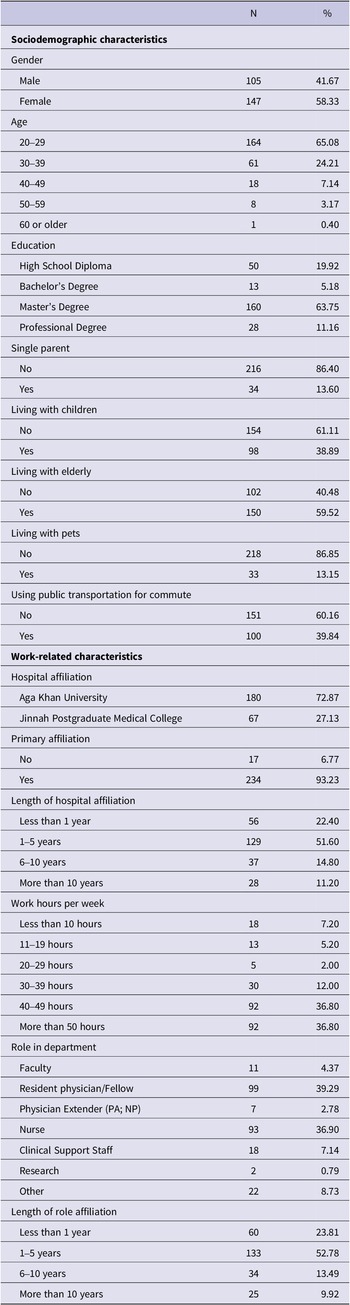
In total, 362 individuals completed the survey, constituting 97.83% of emergency department staff at AKUH and JPMC. Responses from a total of 252 emergency department health workers were analyzed (Table 1), after excluding those who provided only “don’t know” responses or did not respond to any WTR or belief statements in RDD emergencies.
Demographic characteristics of emergency department health workers in Karachi, Pakistan (n = 252)

Ethics Statement
Ethical approval for the study was obtained from the Johns Hopkins Bloomberg School of Public Health Institutional Review Board (IRB00019662), the AKUH Ethics Review Committee (6959) and the JPMC Institutional Review Board (f.2-81/2022-GEN/133/JPMC).
Results
Of the survey respondents, 147 (58.33%) participants were females and 105 (41.67%) were males. More than half of respondents (n = 164, 65.08%) were aged 20 to 29. Most had a master’s degree (n = 160, 63.75%), and approximately one-fifth had a high school diploma (n = 50, 19.92%). Thirty-four (13.60%) participants were living as single parents. More than half of health workers (n = 150, 59.52%) were living with elderly dependents. Ninety-two (36.80%) participants reported working from 40 to 49 hours a week, and the same number of people worked over 50 hours a week on average. Most participants were either resident physicians (n = 99, 39.29%) or nurses (n = 93, 36.90%). The resident group reported no firsthand experience of managing bomb blast event in Karachi.
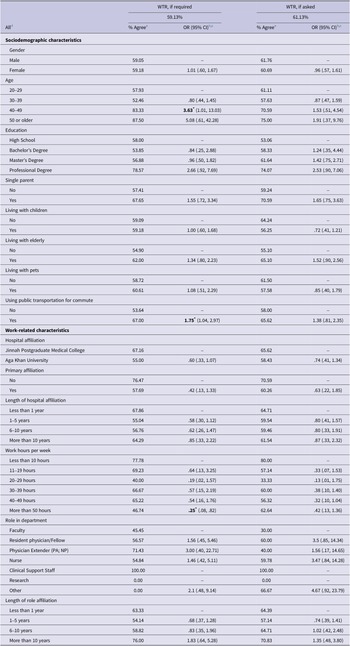
Associations between demographic characteristics and willingness to respond to dirty bomb emergencies are described in Table 2. Health workers’ overall willingness to respond was 59.13% if required and 61.13% if asked. WTR between female and male participants was not significantly different. HCWs aged 40 and 49 were more willing to respond than those aged 20-29 (OR 3.63, 95% CI 1.01–13.03) if required, but not if asked (but not required). WTR to dirty bomb emergencies did not vary by health workers’ education level or family dynamic. Those using public transportation for commute showed higher WTR than those were not if required (OR 1.75, 95% CI 1.04–2.97). Among work-related characteristics, work hours were negatively associated with WTR. Participants who worked more than 50 hours per week were 75% less likely to report to work during dirty bomb emergencies if required, compared with those who worked less than 10 hours (OR .25, 95% CI .08–.82). One’s role in the emergency department and length of affiliation were not significantly associated with WTR.
Associations between participant demographics and willingness to respond to a dirty bomb emergency

a Percent agreeing with WTR statement.
b Odds ratios represent the odds of stating a positive WTR for the respective positive attitude/belief response compared to the negative response.
c *P <.05, **P <.01, ***P <.001.
d Percent pertaining to all survey respondents.
Table 3 shows associations between WTR and attitudes/beliefs about dirty bomb emergency response. Age and role within hospital were found to be independently associated with both WTR if required and WTR if asked in a multivariate analysis and were controlled in the logistic regression analyses. After adjusting for these factors, most attitudes/beliefs were significantly associated with WTR if required. Participants who believed that colleagues would report during dirty bomb emergencies were 23 times more likely to show WTR than those who did not if required (OR 22.82, 95% CI 11.03–47.21) and 12 times more if asked (OR 12.10, 95% CI 6.07–24.12), demonstrating the highest associations among the attitude/belief factors. Health workers who know how important their roles are in the hospital showed 13 greater odds of responding to dirty bomb disasters than their counterparts if required (OR 13.03, 95% CI 6.89–24.65). Psychological preparedness and family preparedness were significantly positively associated with WTR (OR 10.35, 95% CI 5.55–19.31; OR 9.06, 95% CI 4.82–17.04). Emergency-specific self-efficacy beliefs, including perceived ability to perform duty (OR 8.62, 95% CI 4.60–16.14), perceived ability to address patient concerns (OR 8.37, 95% CI 4.51–15.53), and perceived high impact of one’s response (OR 7.05, 95% CI 3.90–12.76) were significantly associated with WTR if required. General self-efficacy was not associated with WTR. Most attitudes/beliefs were significantly associated with WTR if asked, but with lower odds ratios than WTR if required. Health workers aware of role-specific responsibilities (OR 6.95, 95% CI 3.86–12.51) and having skills for those responsibilities (OR 6.42, 95% CI 3.56–11.57) were more likely to report.
Associations between attitudes/beliefs and self-reported willingness to respond to a dirty bomb emergency

a Percent agreeing with WTR statement.
b Odds ratios represent the odds of stating a positive WTR for the respective positive attitude/belief response compared to the negative response.
c All associations with WTR were statistically significant, except for general self-efficacy. Perceived occurrence, perceived severity, perceived need for preevent preparation, and perceived need for postevent support showed significant associations with WTR if asked at P < .01. All other associations were significant at P < .001.
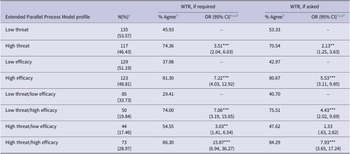
Participants’ EPPM profile and its association with WTR are described in Table 4. 53.57% participants showed low perceived threat, while 46.43% showed high perceived threat toward dirty bomb emergencies. Having higher perceived threat was significantly associated with WTR if required (OR 3.51, 95% CI 2.04–6.03) and if asked but not required (OR 2.13, 95% CI 1.25–3.63). In total, 51.19% of participants had low efficacy, and 48.81% of participants showed high efficacy toward dirty bomb events. Health workers who reported having high efficacy were 7 times more likely to report to work when required (OR 7.22, 95% CI 4.03–12.92) and 6 times more likely to report if asked but not required (OR 5.53, 95% CI 2.02–9.69), compared to those who had low efficacy.
Associations between EPPM categories and self-reported willingness to respond (WTR) to a dirty bomb emergency

a Frequencies and percent of respondents in each respective threat and efficacy category.
b Percent agreeing with WTR statement.
c Odds ratios represent the odds of stating a positive WTR for the respective positive attitude/belief response compared to the negative response.
d *P < .05, **P < .01, ***P < .001.
The analysis of EPPM-based profiles further revealed the role of efficacy and risk beliefs. 28.97% of participants were in the high threat/high efficacy profile, while approximately one-third (33.73%) of participants were in the low threat/low efficacy profile. Health workers in the high threat/high efficacy profile were approximately 16 times more likely to be willing to respond to dirty bomb disasters than those in the low threat/low efficacy profile if required (OR 15.87, 95% CI 6.94–36.27), and those in the low threat/high efficacy profile were 7 times more likely to show WTR (OR 7.06, 95% CI 3.19–15.65). Those in the high threat/low efficacy category were 3 times more likely to show WTR if required (OR 3.03, 95% CI 1.41–6.54), compared with participants in the low threat and efficacy group. Similarly, participants with high perceived threat and high efficacy were 7 times more likely to respond to dirty bomb emergencies if asked (OR 7.93, 95% CI 3.65–17.24), compared with the low threat and low efficacy group. In contrast with WTR if required, those in the high threat/low efficacy profile were not significantly different in exhibiting willingness from the low threat/low efficacy group during dirty bomb emergencies.
Discussion
Bomb blasts have been a persistent security threat and place immense pressure on hospitals and emergency services. Due to the sudden and aggressive nature of these events, they severely disrupt the functioning of the emergency department.Reference Minhas, Mahmood, Jahanzeb, Ranjeet and Bhatti 25 HCWs often must work additional hours under significant stress in disasters, and the emergency department represents a critical nexus for improving response capacity in such situations. This study examined Pakistan-based emergency department HCWs’ perceptions and perspectives toward willingness to respond (WTR) to an RDD (“dirty bomb”) blast scenario. We investigated the association of demographic and attitudinal/belief characteristics with WTR and assessed the impact of Extended Parallel Process Model (EPPM) perceived threat and perceived efficacy categories on WTR. Overall, HCWs’ WTR in response to a dirty bomb emergency was 59.13% if required, and 61.1% if asked but not required. Age and reliance on public transport were positively associated with WTR if required, while longer working hours were negatively associated.
As with previous research on self-efficacy with regard to disaster response, multiple attitudes/beliefs and perceptionsReference Al-Hunaishi, Hoe and Chinna 32 , Reference Öksüz, Avci and Kaplan 33 were found to be significant predictors of willingness to respond. In particular, multiple attitudes/beliefs were found to be strong predictors of WTR to the dirty bomb scenario.
Both WTR if required and WTR if asked but not required were positively associated with perceived likelihood that colleagues would report. Other factors positively associated with WTR, if required, included the perceived importance of one’s role, psychological preparedness, perceived preparedness of one’s family in their absence, and perceived ability to provide timely information. WTR, if asked, was linked to perceived awareness and knowledge of the public health impact, as well as awareness of and perceived skills for role-specific responsibilities. A study conducted in 2 government-run trauma centers in Karachi indicated that there were no simulated drills or disaster management courses for HCWs in the emergency department. Reference Siddiqui, Jawad, Minhas, Ansari, Siddiqui and Mehtab 34 Despite that, our study identified a positive association regarding perceived knowledge of the public health impact, with approximately 75% of participants agreeing with its importance. Readiness and skills to deal with such a situation can be acquired through didactic teaching, simulated training, and real-life experience.Reference Walz 35 Studies have shown that disaster-specific training positively influences HCWs’ response in emergencies and disasters. A study from Saudi Arabia indicated that although a high number of participants had training in disaster management and were supposed to be able and ready, most of them were unwilling to provide care unconditionally in the bomb blast or dirty bomb scenario.Reference Sultan, Løwe Sørensen, Carlström, Mortelmans and Khorram-Manesh 36 Special focus toward addressing their barriers toward responding such as such as lack of self-efficacy and emotional distractions because of uncertainty about the safety issues can help them to respond cohesively. Reference Sultan, Løwe Sørensen, Carlström, Mortelmans and Khorram-Manesh 36
Two other studies from the US and Japan also identified significant differences in WTR depending on whether HCWs were asked versus required to respond.Reference Balicer, Catlett and Barnett 17 , Reference Dallas, Klein, Lehman, Kodama, Harris and Swienton 37 Our previous studies on weather and pandemic scenariosReference Kang, Barnett and Chhipa 30 , Reference Asad, Afzal and Chhipa 31 showed similar variations in WTR if required versus if asked but not required among HCWs, which contrasts with studies conducted in other regions.Reference Sultan, Sørensen, Carlström, Mortelmans and Khorram-Manesh 38 , Reference Engels, Barten and Boumans 39
Among the demographic characteristics, age was one of the important factors influencing WTR. This study found a significant association between age and WTR, with those aged 40-49 years being 3.63 times more likely to be willing to respond to dirty bomb emergencies. Similarly, a study conducted in the US reported a higher WTR among individuals aged 50-59 years,Reference Balicer, Catlett and Barnett 17 highlighting the potential role of age-related factors such as experience, confidence, and risk perception in emergency preparedness. While other researchReference Balicer, Catlett and Barnett 17 reports negative association of WTR with public transport, this study showed positive association between public transport and WTR; this finding requires further contextual exploration of perceived safety, self-efficacy, and availability of alternate transport options.
The overall WTR in a dirty bomb scenario was 59.13% if asked, which aligns with previous studies in the US, showing similar findings.Reference Balicer, Catlett and Barnett 17 Prior research on radiological disaster scenarios indicates that WTR among HCWs ranges from 39% to 76%, and our findings align with the higher end of this range, even with the differences in training of HCWs, lack of drills, and suboptimal coordination of disaster response in Pakistan.Reference Brice, Gregg, Sawyer and Cyr 24 , Reference Dallas, Klein, Lehman, Kodama, Harris and Swienton 37 , Reference Qureshi, Gershon and Sherman 40 –Reference Watson, Barnett and Thompson 42 The anticipated behavior of coworkers emerged as a significant predictor of HCWs’ WTR to dirty bomb scenarios. Turner et al. also found that firefighters and emergency medical services (EMS) personnel were more likely to exhibit WTR if required, if they believed their colleagues would also respond, emphasizing the influence of peer behavior on individual willingness to respond. Reference Turner, Rebmann, Loux and Charney 43
Perception of family preparedness during disasters was identified as a significant predictor of HCWs’ willingness to respond (WTR) in this study.Reference Turner, Rebmann, Loux and Charney 43 Balicer et al. reported that HCWs were 7.73 times more likely to respond in RDD scenarios if they believed their families were prepared to function in their absence.Reference Balicer, Catlett and Barnett 17 Similarly, our findings demonstrated that the odds of reporting to work were nine times higher if HCWs were required to respond and 2.85 times higher if they were asked to respond. These results highlight the critical role of perceived family preparedness in enhancing willingness, potentially by reducing personal and emotional barriers associated with leaving loved ones during emergencies.
We observed a negative association between working hours and willingness to respond (WTR). Specifically, individuals who work more than 50 hours per week tend to show a lower WTR when required. During critical events, HCWs are often required to work extended hours under stressful conditions, potentially putting their safety at risk. In the context of an RDD event, health care professionals may experience significant psychological distress due to the perceived threat and uncertainty associated with such incidents.Reference Balicer, Catlett and Barnett 17
While HCWs’ ability to manage disasters is important, ability itself is not always sufficient. Willingness also serves as an important construct, and studies have reported that HCWs, although trained in disaster management, can be unwilling to provide care.Reference Sultan, Sørensen, Carlström, Mortelmans and Khorram-Manesh 38 This study provides insights into WTR determinants and offers an opportunity to address barriers that could be amended by appropriate interventions such as transportation and addressing psychological distress and personal safety as suggested by previous studies. Reference Qureshi, Gershon and Sherman 40
Limitations
This study was limited to 2 large urban teaching institutions and thus limited to external validity. It can be interpreted that these results are conservative, indicating that the actual willingness to respond in a real-life event may be lower, though it is improbable that it would be higher. The findings and recommendations for enhancing training and organizational support systems are nonetheless still broadly relevant to HCWs in other regions of Pakistan.
Conclusion
This Pakistan-based study provides insights into the factors influencing HCWs’ willingness to respond to a dirty bomb emergency in an LMIC setting. Our findings highlight the importance of psychological preparedness, perceived support from colleagues and family, and organizational support in enhancing WTR. The study also underscores the need for targeted training programs and organizational policies to improve knowledge, skills, and confidence among HCWs.
By addressing the identified factors, such as self-efficacy, perceived risk, and organizational support, health care institutions in resource-challenged settings can significantly improve the preparedness and willingness of their workforce to respond to such emergencies. Future research should explore the long-term impact of these interventions and investigate the role of cultural and societal factors in shaping HCWs’ response behaviors. Additionally, longitudinal studies can provide valuable insights into the evolving dynamics of HCWs’ preparedness over time. The findings of this study suggest the substantial potential for efficacy-centered training to enhance HCWs’ WTR to a radiological disaster scenario in an LMIC environment. In a related practical vein, this study’s findings point to the timely need for applied research into the utility, feasibility, and impact of low-cost, efficient training modalities such as mHealth, to bolster HCWs’ WTR and accordingly enhance health system disaster surge capacity in resource-challenged environments.
Acknowledgments
The author sincerely acknowledges the technical support provided by Saima Mushtaque at Jinnah Postgraduate Medical Centre. The authors would like to express their gratitude to all HCWs who participated in the study.
Author contribution
BA, UC, and NA conceptualized and revised the manuscript, UC drafted it and facilitated data collection, and BAK analyzed and interpreted the data. DB obtained research funding, and SM, DB, AM, JD, and JR contributed substantially to its revision and provided final approval of the manuscript for publication.
Funding statement
This study was funded by the National Institutes of Health Fogarty International Center (Award 1R21TW012210-01).
Competing interests
The author declares no conflict of interest.


 Open access

