

More than two millennia ago, Indigenous inhabitants of what is now Mexico and Central America developed a hieroglyphic script that was the most structurally and functionally versatile writing system native to the Americas. The earliest Maya text with an archaeologically confirmed date comes from the third century bce and attests to a tradition that was already well established (Saturno et al. Reference Saturno, Stuart and Beltrán2006; Stuart et al. Reference Stuart, Hurst, Beltrán and Saturno2022). However, most known inscriptions were produced during the Classic period (ce 250–925), a time of cultural florescence and peak hieroglyphic production. Scribes were well-educated in mathematics, religion and astronomy and documented centuries of ritual, political, astronomical and other events in thousands of texts in diverse materials such as limestone, clay, bark paper, bone and shell (Coe Reference Coe and Hammond1977; Coe & Kerr Reference Coe and Kerr1997; Rossi et al. Reference Rossi, Saturno and Hurst2015). Surviving epigraphic and archaeological evidence suggests that those who created valuable hieroglyphic artefacts, including monumental inscriptions and polychrome ceramics, trained and worked within the royal court, meaning that literacy and hieroglyphic production were closely affiliated with dynastic authority and elite culture (Coe Reference Coe1973; Houston Reference Houston and Houston2012, 200–206; Inomata Reference Inomata2001; compare Landa [1566] Reference Landa and Tozzer1941, 27–9).
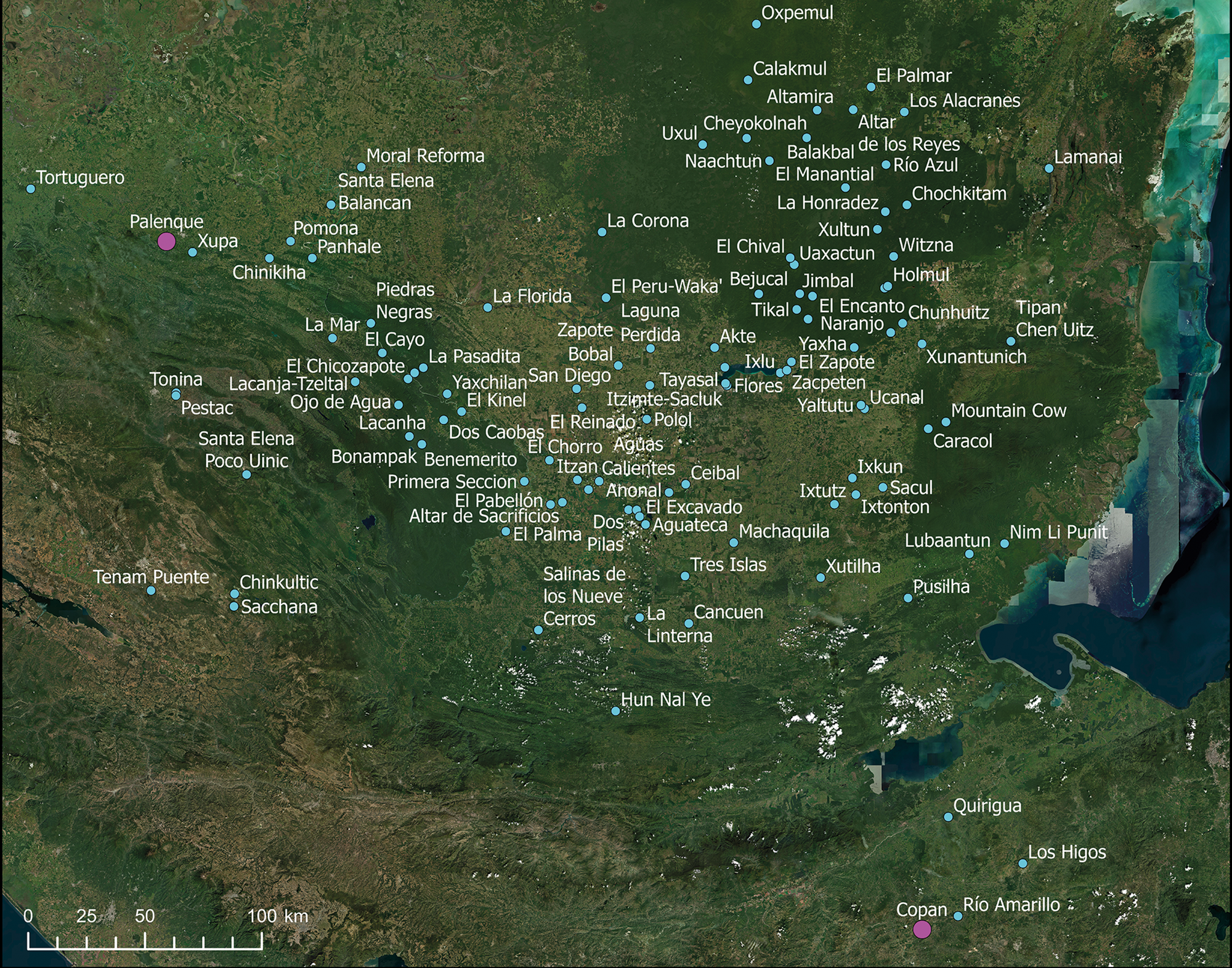
Scribes in all Classic Maya communities participated in interregional exchange, as is most obvious in their use of a common writing system to record a (mostly) common language (see Houston et al. Reference Houston, Robertson and Stuart2000; Reference Houston, Robertson and Stuart2001; Law et al. Reference Law, Robertson, Haertel, Houston, Metz, McNeil and Hull2009). Yet their engagement in that exchange varied wildly, especially with respect to production and reception of new hieroglyphic practices. Some ways of writing remained notably consistent across time and space, attesting to a pan-lowland writing tradition sustained through generations of scribal interaction. But no single Classic Maya polity ever dominated the hieroglyphic tradition, just as the region was never politically unified. This article thus considers the Classic Maya lowlands as an area dotted with polities whose scribes interacted within a regional writing tradition and simultaneously developed distinct, local hieroglyphic cultures (Fig. 1).
Map of Classic Maya sites from which monumental stone inscriptions were analysed for this study. (Compiled by the author in ArcGISPro using data from the Proyecto Arqueológico Busiljá-Chocoljá and Prager et al. (Reference Prager, Gronemeyer, Wagner, Matsumoto and Kiel2014). World Imagery (WGS84) basemap copyright © 2021 Esri, Maxar, Earthstar Geographics, CNES/Airbus DS, USDA FSA, USGS, Getmapping, Aerogrid, IGN, IGP, and the GIS User Community.)

To illustrate this dynamic, I profile traditions of monumental writing at Copan in western Honduras and Palenque in Chiapas, Mexico—two Classic Maya polities outstanding for their diverse hieroglyphic productions but divergent in the cultural basis for and social dynamics of their innovations. Based on palaeographic study of inscriptions on stone monuments and comparison of hieroglyphic features carved in different places and moments in time, I trace key pathways along which scribal knowledge was conveyed from and to Copan and Palenque. I contextualize local scribes’ participation in hieroglyphic knowledge exchange within the centres’ extensive political and economic networks, some of which are documented in those same monumental texts (see Martin Reference Martin2020; Martin & Grube Reference Martin and Grube2008). Comparison with calligraphic production in China during the Song dynasty (ce 960–1279), where sources offer details into individual masters’ training, craft and attitudes towards writing that are inaccessible in the Classic Maya context, suggests that differences between scribal traditions at Copan and Palenque reflected local attitudes and training. Ultimately, I argue that distinct cultures of creativity at Copan and Palenque account for the multi-faceted nature of scribal production and exchange within a regional hieroglyphic tradition that remained largely coherent despite never being centrally administered. The study's approach offers possibilities for teasing out local dynamics of cultural invention, innovation and transmission in the ancient past.
Understanding invention, innovation and cultures of creativity
Hundreds of hieroglyphic inscriptions from across the Maya lowlands attest to vibrant knowledge transmission among scribes throughout the Classic era. Inherent to this process was innovation, which introduced changes in the writing system; some then became longstanding fixtures while others were never reproduced or fell out of use within a generation. As used here, ‘innovation’ does not convey valences of modernization, revolution, or other evolutionary assumptions about change, nor is it a gloss for creativity as ‘the Romantic notion of … a mysterious, ex nihilo, and original creation’ indicative of individual genius (Wilf Reference Wilf2014, 398). Instead, I follow theoretical impulses in communications and anthropology that treat technological innovation as an inherently social process. Whereas invention manifests through sui generis change, innovation entails broader ‘adoption of an invention on a collective scale’, a prerequisite for its dissemination across time or space (Roux Reference Roux and Shennan2010, 217; see Rogers Reference Rogers1995; Weissner Reference Weissner, Barton and Clark1997; e.g. Hegmon & Kulow Reference Hegmon and Kulow2005). In other words, invention yields a singular creation; innovation, in contrast, presupposes its acceptance among peers, even if it is often ‘changed or modified … in the process of its adoption and implementation’ (Rogers Reference Rogers1995, 175; see Fitzhugh & Trusler Reference Fitzhugh, Trusler and Shennan2009, 26). Creativity, in turn, is understood as the capacity to produce something acknowledged in that cultural context as novel or distinct (Wilf Reference Wilf2014, 401–2; Reference Wilf2015; cf. Urban Reference Urban, Tomlinson and Millie2017, 34–38). The following discussion addresses temporal and social dimensions of invention, innovation and creativity, a triad of important loci of distinction between the scribal traditions at Palenque and Copan.
Temporal dimensions of invention and innovation
Networks of exchange require ongoing input to be maintained. Among Classic Maya scribes, two key modes of developing hieroglyphic knowledge were creating novel practices—including new logographic (word) or syllabic signs, for instance—and modifying existing ones. Such changes to ways of writing, generated locally and sometimes shared regionally, constitute the core of any diachronic understanding of Classic Maya scribal tradition. But how were changes in Classic Maya hieroglyphic practice initiated and spread? Where were major centres of innovation, how did they influence others, and what communities adopted, declined, or transmitted practices received from peers? Considering these issues requires confronting hieroglyphic change at both micro- and macro-scales to understand where inventions originated and which communities, local and regional, subsequently accepted them as innovations.
Stylistic attributes and distribution of signatures suggest that Classic Maya scribal workshops included artisans of varying skill, experience, and creative proclivity (Houston Reference Houston and Costin2016; Montgomery Reference Montgomery1995, 600–11; Tate Reference Tate and Fields1994; van Stone Reference Van Stone2005). Yet even for those with early exposure to scribal production, innate ability or predisposition would have been decisive: a trainee's apparent talent could open doors to royal commissions, but such talent's absence probably pushed such opportunities out of reach (cf. e.g. Gerhart Reference Gerhart, Jordan and Weston2003, 193–4). Evidence from psychology and anthropology positions expert practitioners, whether potters, weavers, or scribes, as the most likely inventors because ‘being able to ignore rules comes from a mastery of the rules’ (Shi Reference Shi2018, 875; see Dietler & Herbich Reference Dietler and Herbich1989; Howard Reference Howard2009; Wilf Reference Wilf2014; Reference Wilf2015). Beyond having mastered the production sequence, experts can finely execute the basic tasks it requires and thus perceive and push beyond the limits of what the community of practice has already achieved (Bril et al. Reference Bril, Roux, Dietrich, Roux and Bril2005; Ericsson & Lehmann Reference Ericsson and Lehmann1996; Howard Reference Howard2009). Furthermore, masters’ social standing and networks tend to be robust enough to sustain transmission of their innovations such that they are later visible in the archaeological record (Henrich Reference Henrich2001, 1009–10).
An invention may originate from gradual, compounding changes enacted over time, or from a momentary shift in production. The former instances of continuous invention or progressive, incremental transformation may take place collectively over generations in a process that is often assumed to be largely undirected and collective in nature (Cresswell Reference Cresswell, Latour and Lemonnier1994; Reference Cresswell1996; Roux Reference Roux and Shennan2010). In a writing system, instances of gradual change provide crucial evidence that scribal exchange occurred through sustained, recursive interactions rather than intermittent encounters (see Lacadena Reference Lacadena1995, 220–236). In this article, in contrast, I highlight phenomena that would be better characterised as discontinuous inventions, or substantial, often rapid change through “purposeful generation of innovations” (Wilf Reference Wilf2015, 681; see Cresswell Reference Cresswell, Latour and Lemonnier1994, Reference Cresswell1996; Roux Reference Roux and Shennan2010). All innovation is historically contingent, the product of the technologies, peoples and materials in use at a given moment; discontinuous invention's episodic nature, however, means that it is particularly bound up in local contexts of singular invention and community adoption (Roux Reference Roux and Shennan2010, 224–5). Scribal innovations, whether from creating new signs, substantially modifying existing ones, or presenting them in novel formats, thus offer salient insight into the communities who may have created and disseminated them.
Social dimensions of innovation and creativity
Across the diverse hieroglyphic landscape of the Classic Maya lowlands, several centres of monumental production distinguished themselves by virtue of scribes’ enthusiastic innovation or ready reception of new ideas from outside. The two processes are by nature neither mutually exclusive nor co-dependent, as moments of inventiveness require interpersonal acceptance to be perpetuated to any meaningful extent. If relations of knowledge exchange are too few or too weak, the transmission network is too fragile ‘for the technological feature to have sufficient redundancy to resist historical events’—in other words, for the innovation to spread far and wide enough to enter into the larger tradition (Roux Reference Roux and Shennan2010, 228; see Henrich Reference Henrich2001, 1009–10). Yet creative scribes were not necessarily receptive to ideas from outside, nor to proffering their own knowledge to others. Regardless of a community of hieroglyphic practice's internal inventiveness, transmission of new developments through scribal travel or circulation of texts may have been stymied by closed groups that did not share knowledge with outsiders; others, in turn, may have been more interested in learning new practices from others than in generating their own (Roux Reference Roux and Shennan2010, 228).
I refer to Copan and Palenque's scribal traditions of invention and innovation as ‘cultures of creativity’ because they reflect differing approaches to development and exchange of hieroglyphic practices. What behaviours or outcomes are considered ‘creative’ and which personae are endowed to realize them are cultural judgements (Hallam & Ingold Reference Hallam and Ingold2007; Wilf Reference Wilf2014). According to the Euro-American ideal inherited from nineteenth-century Europe, creativity ‘constitutes a problem—a scarce resource’ located in individuals that cannot be cultivated through training and is repressed by imposing standardized norms (Wilf Reference Wilf, Enfield and Kockelman2017, 199). But inventive, adaptive, generative expressions of creativity are not delimited to specific people, places, or epochs. Improvisation, or what Michael Chibnik (Reference Chibnik1981, 260) refers to as ‘culturally guided routine experimentation’, is inherent to daily life in any society; it ‘enable[s] individuals and groups to cope with problems of everyday life’, even if the results usually do not have a lasting impact on the larger culture (Chibnik Reference Chibnik1981, 259). Thus, what differentiates innovation from the ‘comparatively routine experiments’ is the former's atypicality and more salient role in cultural change (Chibnik Reference Chibnik1981, 259).
Understanding innovation as scalar—spanning degrees of creativity that are present across society even as they are differentially expressed—elevates it to a social phenomenon beyond the ‘individual-level trial-and-error learning or cost-benefit analysis’ of earlier, evolutionary models (Henrich Reference Henrich2001, 992). Prestige or conformity pressure may lead one to adopt non- or even mal-adaptive behaviours or technologies, for example, or to artificially delimit the bounds of acceptable innovation (Henrich Reference Henrich2001, 997). Conversely, creativity can be socialized as a collective endeavour in which ‘[r]eal people … continually create themselves and one another, forging their histories and traditions as they go along’ (Ingold & Hallam Reference Ingold, Hallam, Hallam and Ingold2007, 6), and innovation can be explicitly cultivated as a group production strategy (Wilf Reference Wilf2015). In some contexts, creativity is an outgrowth of or inherent to cultural normativity, whereas in others it is more recognizable at or beyond the margins (Wilf Reference Wilf2014). That tension may even lead the more normative culture to intervene, sometimes coercively, to claim that creativity as its own (Ogundiran Reference Ogundiran2014).
Creativity, then, is a web of values attributed to certain practitioners who deviate from the status quo and who are culturally defined according to their abilities, training (or lack thereof), or persona. Its cultural contingency is apparent in expectations surrounding how creativity is expressed, including its products’ relationship to works from past and future generations. Comparison of scribal cultures at Copan and Palenque illustrates the varying dynamics at play as scribes produced, responded to and selectively deployed hieroglyphic practices. Both communities stand out among Classic Maya polities for innovativeness in monumental inscriptions. But closer examination reveals different cultures underpinning hieroglyphic expression at each site. Scribes at Copan extended their creative impulse to innovation and adoption and participated robustly in hieroglyphic transmission. At Palenque, however, scribes were more reserved in exchanging knowledge with neighbours, and distribution of their original works suggests that they valued singular bursts of creativity over perpetuation of those inventions.
Copan: innovation on the southeastern frontier
Located at the southeastern extreme of the Maya area and home to one of the lowlands' most prolific sculptural programmes, Copan presents perhaps the best single-site case study in the region for understanding multi-generational dynamics of cultural transmission. Geographically removed from the heart of the lowlands in the Central Peten in northern Guatemala and southeastern Mexico, Copan elites appear to have played a relatively minor role in Classic Maya geopolitics (Fig. 2). Their involvement in open political and military conflict was apparently limited to the southeastern zone, with only modest evidence for political engagement farther afield (see Martin Reference Martin2020; Martin & Grube Reference Martin and Grube2008). Yet Copan's robust participation in Classic Maya culture reflected intensive, long-term cultural transmission with counterparts to the north in which local elites seem to have exercised more influence than their limited political involvement would suggest.
Detail of Figure 1 highlighting the locations of Copan and Palenque.
Although the Central Peten provides the earliest monumental evidence for most hieroglyphic features first attested in the Early Classic era (ce 250–600), scribal exchange with the Copan and its subsidiary Río Amarillo was not unidirectional even during this early period. At least 32 hieroglyphic representations made their monumental debuts in the southeast and only later were reproduced by scribes in the Central Peten and elsewhere (Table 1).
Hieroglyphic features initially attested on stone monuments at Copan or Río Amarillo and subsequently recorded on monuments in other regions.

* Contemporaneous with Copan Stela 63.
Notes to Table 1
1. When possible, hieroglyphs are identified using the alphanumeric system introduced by Thompson (Reference Thompson1962) and modified by the Textdatenbank und Wörterbuch des Klassischen Maya (TWKM) project (Prager & Gronemeyer Reference Prager, Gronemeyer, Gülden, van der Moezel and Verhoeven-van Elsbergen2018; https://mayawoerterbuch.de/zeichenkatalog/). Transliterations are in bold, with logographic readings represented in UPPER CASE and syllabic values in lower case. Hyphens (-) separate transliterated glyphs within a sequence. Transcriptions are italicized, and hyphens (-) within the transcription indicate morpheme boundaries.
2. All correlations of Maya dates to the Julian calendar were calculated in the TWKM program ‘Maya Calendar Calculations’ (https://mayawoerterbuch.de/calendar-calculations/) using the Martin and Skidmore (Reference Martin and Skidmore2012) correlation of 584,286 days.
Whether Copan scribes in fact innovated the 32 elements or instead adopted them from another, undocumented source is unknown. But chronological distribution indicates that, for all the scribal insights flowing down from the Central Peten during the Early Classic era, practitioners in the Copan region also utilized ways of writing that their Central Peten peers only later included in their own stone inscriptions.
Throughout its recorded history, Copan scribes were not merely passive receivers of hieroglyphic knowledge. Noteworthy here is the longevity of many innovations. Many practices received from afar, as well as innovations either developed in the southeast or adopted there before they appeared on Central Peten monuments, were retained through multiple generations. Among 28 features attested at Copan or Río Amarillo by the seventh century (Table 1), 23 were reproduced on local monuments at least into the eighth century; the five exceptions were T1030br K'AWIIL ‘[theonym]’ and the relatively uncommon signs T0145st che, T1704st ALAY?, T0704st ICH(ON)? ‘chest’, and T1592st MIH ‘zero’ (Fig. 3a).
Notable hieroglyphic features in inscriptions from Copan: (a) T0704st ICH(ON)?, on Stela 7 (9.9.0.0.0; 10 May 613); (b) T1544bh CH'E’N ‘cave’, on Stela 2 (9.11.0.0.0; 12 October 652); (c) double-dot phonetic reduplicator, on Stela 49 (Early Classic); (d) T1569st HU'N ‘paper; book’, on Stela D (9.15.5.0.0; 23 July 736). (Images: (a–c) photographs by the author; (d) drawing SD-1006 by Linda Schele © David Schele. (Photograph: Ancient Americas at LACMA (ancientamericas.org), modified by the author.)
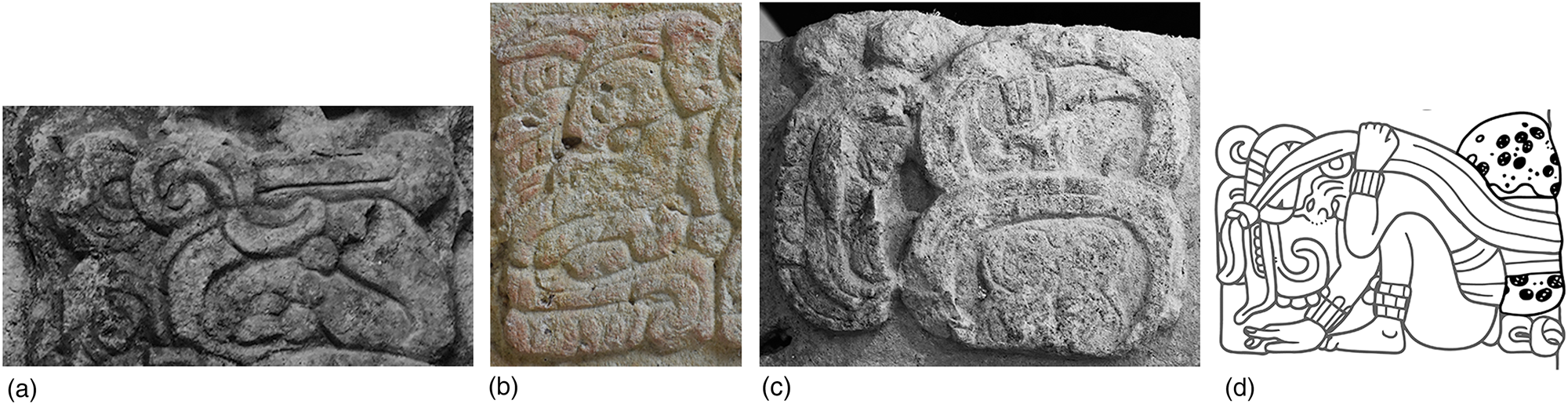
Likewise, among at least a dozen hieroglyphic features that Copan scribes are likely to have adopted from western or Pasión River-area scribes in the sixth and seventh centuries ce (Matsumoto Reference Matsumoto2021, table 8.7), only T1544bh CH'E’N ‘cave’ and the double-dot phonetic reduplicator are not found in the site's eighth-century monumental corpus (Figs 3b–c). Additionally, almost all features that Copan scribes probably learned from western or Pasión-area contacts during the eighth century were reproduced on at least two other southeastern monuments after their debut, a notable exception being the rare logograph T1569st HU'N ‘paper; book’ used only once at Copan (Fig. 3d) (Matsumoto Reference Matsumoto2021, table 8.7). Retention of novel forms learned from others indicates the depth of Copan's engagement in hieroglyphic exchange, through which scribes experimented with new ways of writing and integrated them into their monumental texts over generations.
Trends in hieroglyphic adoption signal the multi-dimensionality of the exchange networks in which Copan's scribes participated. They also foreshadow a shift toward increasing scribal interactions with the western region during the Late Classic period (ce 600–830), departing from the Central Peten's prominence in Copan's Early Classic hieroglyphic development. Tatiana Proskouriakoff (Reference Proskouriakoff1950) was the first to argue that exchange between western and southeastern Classic Maya artists resulted in common iconographic programmes and shared modes of production for free-standing stone monuments (see also Clancy Reference Clancy, Boone and Willey1988; Coggins Reference Coggins, Boone and Willey1988; Miller Reference Miller, Schortman and Urban1983; Rands Reference Rands1968). Palaeographic analysis of Copan's stone inscriptions indicates that Late Classic cultural influence from the western region extended to scribal practices as well, as Berthold Riese (Reference Riese, Boone and Willey1988) previously suggested based on the historical contents of Copan's monuments. Indeed, several western or Pasión River-area scribal communities were among the first to adopt forms initially attested at Copan, even during the Early Classic period (Table 1).
A Late Classic acceleration in this trajectory, however, suggests increased scribal engagement between the three regions. Spatio-temporal distribution points to several dozen hieroglyphic features that Copan scribes may have first learned from western or Pasión contacts (Matsumoto Reference Matsumoto2021, 460–64, table 8.7). Some ways of writing had been circulating in the Maya lowlands for centuries before their first monumental use in the southeastern area. Yet multi-generational lapses preceding their adoption in the Copan area, as well as western or Pasión examples that chronologically intervene between the first known monumental uses in the Central Peten and the southeast, point to the former regions as likely sources of this knowledge for local scribes (Matsumoto Reference Matsumoto2021, 458–64). Nonetheless, Copan's ceramics—a less patently royal and more diverse realm of material culture—differed significantly from ceramic spheres in the Maya lowlands throughout the Classic period (Beaudry Reference Beaudry, Rice and Sharer1987; Urban & Schortman Reference Urban, Schortman, Rice and Sharer1987). Thus, it seems that the polity's cultural reorientation toward the Maya lowlands to the northwest was a particularly elite phenomenon, or at least did not equally impact all spheres of artistic production.
Palenque: creativity at the hieroglyphic forefront
Along the Usumacinta River in the western Maya lowlands, a rich epigraphic corpus details how several powerful dynastic polities jockeyed for power over centuries (Fig. 2). Many of the best-known epigraphic sources from the region originate from Palenque, where kings diligently documented in monumental form narratives of their Baakal dynasty reaching back into primordial time (see Mathews & Schele Reference Mathews, Schele and Robertson1974; Schele Reference Schele and Robertson1976; Reference Schele and Robertson1991). As at Copan, monumental scribes at Palenque were exceptionally enthusiastic experimenters both in accepting writing practices from others and in developing their own. But closer examination reveals a key cultural difference between the two centres, one that concerns the scribes’ legacy more than their creativity: transience. Whereas many hieroglyphic innovations at Copan were transmitted to later generations of scribes, much of Palenque scribes’ creative impetus resulted in short-lived inventions whose use was apparently limited to a single generation or even a single inscription.
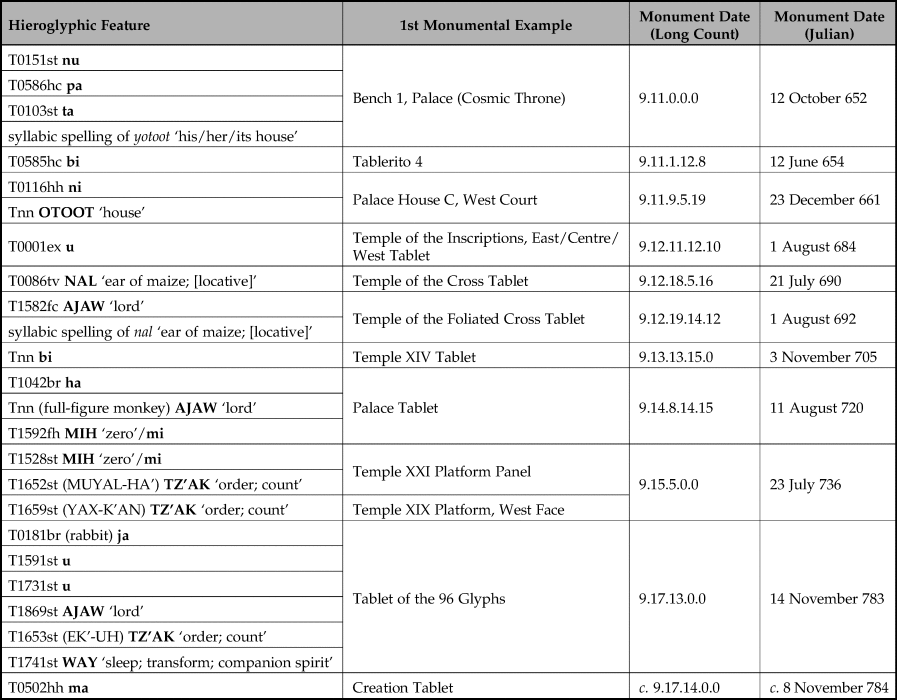
During the Late Classic era, the Baakal kingdom and its court clearly distinguished itself among its Maya peers through its scribes’ hieroglyphic creativity. This stature is reflected in Palenque scribes’ use of several dozen forms that were not deployed among area neighbours and their role as an early adopters of other forms acquired through exchange (Matsumoto Reference Matsumoto2021, 355, table 7.8). These include 25 features first attested on monuments from the Late Classic period that seem to have been created by scribes at Palenque (Table 2).
Hieroglyphic features that are either unique to or first attested in monumental inscriptions at Palenque and may represent local innovations.
Yet Palenque scribes were also at the forefront of hieroglyphic trends coming from other scribal communities, as alluded to in the discussion of Copan's tradition of monumental inscriptions. Among 65 hieroglyphic features that within the western region were first or only adopted by Palenque scribes (Matsumoto Reference Matsumoto2021, tables 7.9 and 8.8), at least 34 were previously attested on monuments elsewhere in the Maya lowlands, often most recently in the southeastern region but in some cases in the Central or Eastern Peten. Thus, they presumably represented knowledge acquired through interaction with outside contacts, probably through exchange of written materials and of artisans themselves.
Palenque scribes’ creative impetus is notable for its chronological spread, too. Palenque's 25 innovations are distributed relatively evenly over a 132-year span of monumental production (Table 2). A plurality of six innovations debuted in just one inscription, the Tablet of the 96 Glyphs (Fig. 4); 11 of the remaining 19, however, were introduced on monuments dedicated by the start of the eighth century (Table 2; see Matsumoto Reference Matsumoto2021, table 8.8).
Right side of the Tablet of the 96 Glyphs from Palenque. (Photograph courtesy of the Instituto Nacional de Antropología e Historia, México (CC BY-NC-ND 4.0).)
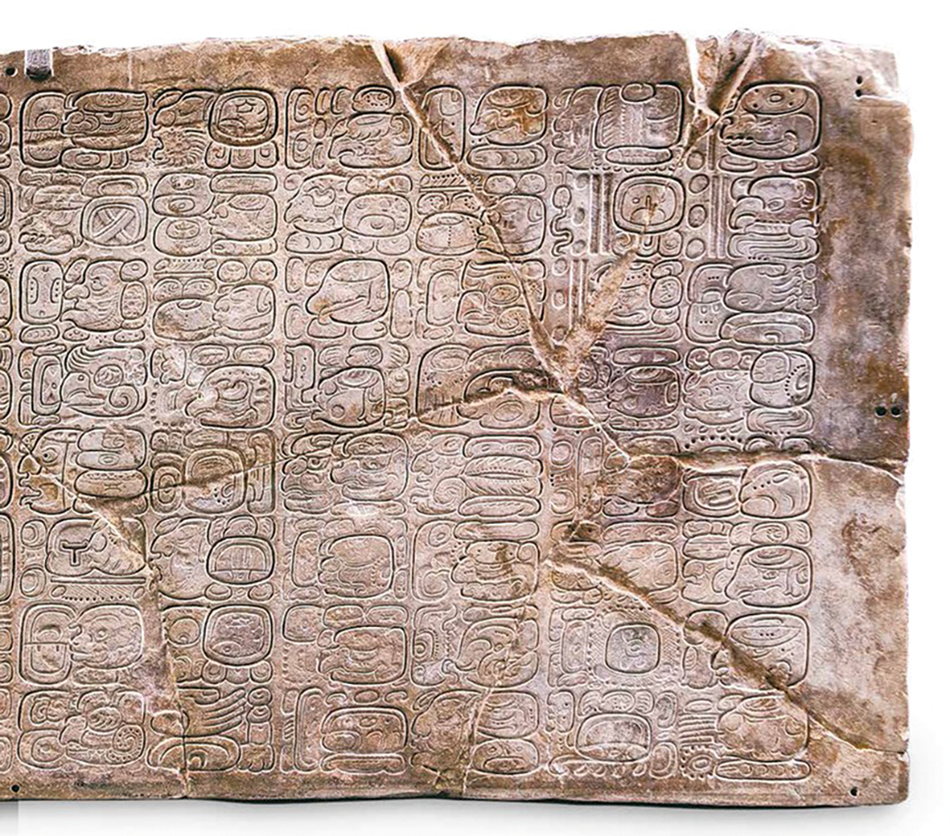
This timeline suggests that local scribes’ culture of hieroglyphic creativity was in place at least by the mid seventh century, perhaps buoyed by the political stability of K'inich Janaab Pakal I's long reign (615–683) (Martin & Grube Reference Martin and Grube2008, 162–8). Thus, Palenque's ‘“golden age” of production and heightened aesthetics’ (van Stone Reference Van Stone2005, 346) under K'inich K'an Joy Kitam II (702–c. 721), K'inich Ahkal Mo’ Nahb (721–c. 742) and K'inich K'uk’ Bahlam II (764–c. 799) was not as much a departure from as an extension of the local scribal tradition (Martin & Grube Reference Martin and Grube2008, 172–5; Stuart & Stuart Reference Stuart and Stuart2008, 220–32). In his study of Palenque's hieroglyphic monuments, Marc van Stone (Reference Van Stone2005) identified over 20 distinct scribal hands that were active during the eighth century. Although the visual coherence of those pieces suggests that that number may be an overestimation, his study underscores the hieroglyphic diversity that characterized Palenque's prolific monumental production at the time. At the same time, the internal graphic uniformity of texts like the lengthy Tablet of the 96 Glyphs indicates that the signs were laid out by a single master hand, even if multiple artisans ultimately collaborated to execute them (Fig. 4; see van Stone Reference Van Stone2005, 363–8).
Nonetheless, local scribes’ readiness for early adoption and invention did not necessarily correlate with regional influence. First, Palenque may have been the first western site where scribes used a series of hieroglyphic features in monumental contexts, but those scribes did not necessarily disseminate them to their neighbours. Of 35 hieroglyphic features that Palenque was the first western site to implement and that probably originated from communities to the east or south, 12 apparently were never adopted on the monuments of its western neighbours. Seventeen of the remaining 23 were not attested on monuments at other western centres for at least another 15 years, and only four appeared in inscriptions elsewhere within 10 years of their first use at Palenque (see Matsumoto Reference Matsumoto2021, 467, table 8.8). It is impossible on current evidence to determine whether all these features were communicated through the western area very gradually via Palenque or reintroduced later by a third party. Long lags in dissemination, nonetheless, may favour the latter scenario. At the very least, we can infer that Palenque's scribal community was open to exchange but either not engaged or not dominant enough for their recently adopted practices to spread readily among its western counterparts.
Second, the innovative boom at Palenque proved limited not only in duration and regional influence, but in longevity. Intergenerational retention, in other words, was apparently less important than display of singular inventions in local monument production. Among the 25 features that Palenque scribes may have been the first to carve in a monumental text (Table 2), 14 are attested only in a single stone inscription at the site. Some, like T0586hc pa and T0116hh ni, were adopted as early as the mid seventh century, over a century before the last monumental inscription was dedicated at the dynastic centre. Yet these innovations—including some that were eventually adopted at other polities—were never firmly established in the local scribal repertoire. Even some that Palenque scribes probably learned from others, such as full-figure number and Initial Series calendric forms (Fig. 5), were each executed on just one of the centre's surviving monuments.
Animated full-figure forms of numbers and Initial Series calendric units on Palenque's Palace Tablet. Gift of Ian Graham, 2004. (© President and Fellows of Harvard College, Peabody Museum of Archaeology and Ethnology, 2004.15.1.1771.3 and 2004.15.1.1771.4.)

Although Palenque's court appears to have ceased production of hieroglyphic monuments in the late eighth century, there seem to have been cultural self-limitations on internal propagation of scribal knowledge well before then. No hieroglyphic monuments are known to have been dedicated at the site after 784. At least 19 stone inscriptions containing several thousand hieroglyphs were inaugurated after 720, however, providing scribes with plenty of opportunity to reproduce seventh- and early eighth-century innovations. In addition, of 65 hieroglyphic features that Palenque scribes adopted before or to the exclusion of their western neighbours (Matsumoto Reference Matsumoto2021, tables 7.9 and 8.8), just two occur in the site's latest known text, a incised Fine Gray ceramic vessel known as the Initial Series vase that dates to 799 (Stuart & Stuart Reference Stuart and Stuart2008, 363–8; Ruz Lhuillier Reference Ruz Lhuillier1951, 39–42): the formerly logographic T0757st as the syllable ba and a syllabic spelling of kab ‘earth’ as ka-ba instead of the commonplace KAB logograph (Fig. 6).
Initial Series vase from Palenque. (Photograph: Ignacio Guevara, courtesy of the Instituto Nacional de Antropología e Historia, México (CC BY-NC-ND 4.0).)

Many Late Classic novelties that Palenque scribes introduced into their repertoire, whether through adoption or invention, were ultimately ephemeral—hinting that fundamental shifts in scribal culture may have paralleled but were not mere symptoms of the late eighth-century cessation of local monumental hieroglyphic production.
Calligraphy and hieroglyphs: a Song dynasty comparison
Hieroglyphic monuments at Copan and Palenque demonstrate palaeographic distinctions within the regional Classic Maya tradition that, I argue, reflected scribes’ differing approaches to invention, innovation, and participation in hieroglyphic knowledge exchange. Yet our understanding of Classic Maya scribal culture is severely constrained by surviving sources. Apparently, monumental stone, ceramic vessels and other durable text artefacts were not preferred surfaces for documenting scribes, their work, or reactions that it elicited. Comparison with other, better-documented writing traditions, however, allows us to draw educated guesses. In particular, calligraphy in Song dynasty China (ce 960–1279) offers a cogent comparison with Classic Maya scribal culture. Although this elite art was practised under imperial supervision in China (Ledderose Reference Ledderose and Lavin1989)—a political framework that was never in place in the Maya world—Classic Maya hieroglyphic training and production appear to have been similarly centralized at a local level within each polity (Inomata Reference Inomata2001). Thanks to a large corpus of surviving works, rich biographies of calligraphic masters and generations of well-documented aesthetic metadiscourse, the Song context facilitates a richer interpretation of how proximity, access and innovation shaped the distinct ways of writing that Classic Maya scribes developed at Palenque and Copan.
Training and transmission
Under the Song dynasty, aesthetic metadiscourse about calligraphy elevated the work of specific masters whose creativity shaped Chinese writing practices—so much so that a sixteenth-century Ming intellectual later identified the primary Song contribution to calligraphic history as yì 意 or ‘intent, will, reason, the cognitive processes that distinguish the individual along with his or her personal idiosyncrasies’ (Sturman Reference Sturman1994, 22; see McNair Reference McNair1994, 221–3). During the late Tang dynasty (ce 618–907), critics began emphasizing the calligrapher's spontaneity of execution over his mental and emotional preparation for writing (Shi Reference Shi2018, 873–4). This shift reflected a broader redefinition of creativity as improvisational rather than intentional, even if such ‘“skillful spontaneity”’ ultimately relied on ‘complete mastery of brush techniques … [and] a repertoire of similar cursive-shaped shapes’ that defined ‘the limit[s] of calligraphic creation’ (Shi Reference Shi2018, 874).
Song calligraphers constantly navigated a tension between maintaining received traditions and inventing new forms in their work, in part by consulting older Chinese texts, including epigraphic sources (Chu Reference Chu1990; Egan Reference Egan1989; Hsu Reference Hsu and Schnapp2013; McNair Reference McNair1994). In their studies, masters frequently reached back at least to the first-century Han dynasty for inspiration (Egan Reference Egan1989; Ledderose Reference Ledderose and Lavin1989; Sturman Reference Sturman1994, 22–53). Antiquarian revival was motivated not only by a desire to look back to earlier times, before the sociopolitical upheaval of the Tang-Song dynastic transition, but also by contests for intellectual and stylistic authority in the present (Harrist Reference Harrist1995; Hsu Reference Hsu and Schnapp2013; McNair Reference McNair1994). Thus, Song calligraphers’ engagement with peers’ work was influenced by interpersonal and factional relations beyond the official sphere of imperial politics (Harrist Reference Harrist1995; Hsu Reference Hsu and Schnapp2013; McCausland Reference McCausland2011, 37–43). But individual background and social connections, too, influenced creative inspiration and resources available to fuel it. Access to books in government libraries was dictated by one's position within the administration, connections and recognition: some aspiring scholars were unable to consult necessary textual resources until they were awarded a government position (McDermott Reference McDermott2006, 128). Consequently, potential sources of historical inspiration were not equally accessible to all calligraphers (Sturman Reference Sturman, Liu, Ching and Smith1999, 220).
Parallel dynamics surely influenced development of hieroglyphic practices across the politically fragmented Classic Maya lowlands as well, even if we cannot definitively reconstruct them now. In the case of Palenque, scribes’ limited involvement in external exchange may have been one component of broader cultural distinctions from other western polities that feature so prominently in dynastic histories. Local inscriptions, for example, emphasize the mythical origins of Palenque's triad of patron deities and its dynastic foundations, and many hieroglyphic monuments diverge from western Maya norms in form and placement (Houston Reference Houston1996; Schele Reference Schele, Robertson and Jeffers1979; Reference Schele and Benson1986; Stuart & Stuart Reference Stuart and Stuart2008, 166–215). Under the successive reigns of K'inich Janaab Pakal's three sons in particular, hieroglyphic and iconographic messaging demonstrated a general ‘preoccupation with the past’, particularly in the aftermath of the kingdom's recurring conflicts with rival Tonina (Stuart & Stuart Reference Stuart and Stuart2008, 188, 220). Like many Song calligraphers, then, scribes at Late Classic Palenque may have been responding to a combination of royal political interests, local artistic developments and personnel-specific hieroglyphic trends. Although their politically peripheral location may not have encouraged scribal exchange with peers across the Maya lowlands, the primary limitation on hieroglyphic transmission appears to have been cultural rather than geographic.
Scribes at Copan, on the other hand, maintained intensive contact with peers across the Maya lowlands even as dynastic politics focused primarily on local affairs and much of the population remained more culturally affiliated with nearby, non-Maya communities (see Boone & Willey Reference Boone and Willey1988; Manahan Reference Manahan, Stanton and Magnoni2008; Neff et al. Reference Neff, Cogswell, Kosakowsky, Belli and Bove1999; Viel Reference Viel1993). The primary scribal development from the Early Classic into the Late Classic was reorientation of transmission—outgoing and incoming—from the Central Peten, the heaviest source of influence on Copan's early monumental programs, to the Pasión River and especially the western areas. The causes of this shift are not immediately apparent. It is possible that the hegemonic conflict between Central Peten heavyweights Tikal and Calakmul impeded scribal communication with that region or made it too perilous politically (see Martin Reference Martin2020, 309–19; Martin & Grube Reference Martin and Grube2008, 25–53, 102–115). Yet the reorientation came even as Copan remained involved in Central and Eastern Peten politics, as evidenced by its inclusion on contemporaneous lists of important kingdoms recorded at Altar de Los Reyes and Tikal; a long-distance visit by an El Palmar entourage down to Copan's early eighth-century king Waxaklajuun Ubaah K'awiil; and Copan's epigraphic and political ties to Pusilha and Nim Li Punit in the Eastern Peten (Barthel Reference Barthel1968; Grube Reference Grube and Šprajc2003; Prager Reference Prager2002; Tsukamoto & Esparza Olguín Reference Tsukamoto, Esparza Olguín, Houston, Skidmore and Golden2015; Wanyerka Reference Wanyerka2003).
In other words, Copan was at geographic and political arm's length from the Classic Maya heartland to the north. But Copan maintained strategic ties with some communities in that region who facilitated access to cultural as well as political resources, similar to some Song-era scholars without an imperial administrative post. The El Palmar ambassador's visit may even have inspired the modest inscribed stairway erected at his home site soon afterward in a gesture to the massive Hieroglyphic Stairway at Copan (Tsukamoto Reference Tsukamoto, Masson, Freidel and Demarest2020; Tsukamoto & Esparza Olguín Reference Tsukamoto, Esparza Olguín, Houston, Skidmore and Golden2015)—and, as comparison with Song calligraphers suggests, to his personal relationship with the Copan king. This exchange exemplifies not only ‘how the periphery could inspire developments at the core’ (Martin Reference Martin2020, 337), but also how political contacts could foster changes in hieroglyphic production.
Tradition, invention and scribal values
Official calligraphic practices in Song China were transmitted through training under court or imperial administration. Instruction emphasized contemplation and ‘repetitive imitation’ of works by calligraphic masters to acquire the ‘somatic awareness or knowledge’—what Pierre Bourdieu (Reference Bourdieu1977) would call ‘habitus’—needed to produce them (Shi Reference Shi2018, 878; cf. Peng Reference Peng2019). All Song masters, regardless of their level of antiquarian interest, built on the centuries-old calligraphic tradition by integrating unique stylistic components into their own work, such as by infusing their lines with looseness and freedom (Ledderose Reference Ledderose1979, 58–68; Sturman Reference Sturman1994, 115–20; Reference Sturman, Liu, Ching and Smith1999). Yet not everyone agreed on the appropriate degree and nature of individual expression. Some distinguished Song practitioners, such as Sū Shì 蘇軾 and Mǐ Fú 米芾, delimited their styles from revolutionary colleagues like Sū Shùn-qīn 蘇舜欽, rejecting what they considered an excessively unbridled, ‘wild’ technique (kuángcǎo 狂草) as a degeneration of China's heralded ancient tradition that reflected lack of discipline or authenticity (Egan Reference Egan1989, 374–6; Sturman Reference Sturman, Liu, Ching and Smith1999, 201–5). Other critics like Ōu yáng Xiū 歐陽修, in turn, decried calligraphic imitations of older, refined styles as ‘self-consciously wrought, hav[ing] none of the spontaneity or vitality of the originals they emulate’ (Egan Reference Egan1989, 376). According to Song aesthetics, true creativity expressed itself through neither straightforward mimicry nor uninhibited self-abandonment, but instead through yì, ‘the artist's perception of things, and his or her feelings’ (Shi Reference Shi2018, 879). Because yì infused a master's work, those who later contemplated the work could ‘grasp the beauty of the forms and the intent behind the calligraphic traces’, even the master's yì itself (Shi Reference Shi2018, 878).
Successful ‘calligraphic performance’ thus combined bodily practice acquired through repetition-based learning with sensory perception of ‘the reality or spirit of [things]’ (Shi Reference Shi2018, 878, 879). Exchange between a calligraphic master and his apprentice was not limited to cerebral knowledge transfer; it was sensorial and embodied, conveying a form of ‘esoteric knowledge’ in whose subsequent use ‘the disciple not only imitates the master, but invokes, mentally and bodily, the deeply embedded master's body image’ (Peng Reference Peng2019, 196, 197). Because style and skill were generally correlated with a Song practitioner's morality, calligraphic expression was an intrinsically socio-political act; likewise, calligraphers’ aesthetic criticisms of their peers or predecessors were infused with evaluations of their character (Egan Reference Egan1989, 396–402; McNair Reference McNair1995; Reference McNair1998, 1–15). How Song calligraphers responded to other's practices reflected judgements on whether that person was worthy of emulation, as well as interpersonal alliances or political inclination (Egan Reference Egan1989; Sturman Reference Sturman, Liu, Ching and Smith1999; e.g. McCausland Reference McCausland2011, 73–8).
Surviving hieroglyphic sources from the Classic Maya lowlands offer almost no information about individual scribal identities and certainly no insights into their moral personhood. But they do record other realms of social interaction, especially politics, that may have influenced whether an innovation took root, independent of any one person or group's creative capacity. Song-dynasty China, where calligraphers’ short- and long-term impact on calligraphic practice was shaped by their reputations as practitioners and as moral beings—as well as factional politics, intellectual lineage and social standing—hints at socio-cultural dynamics that could have affected scribal development in the Classic Maya lowlands. Pedagogically, Song calligraphic culture emphasized purposeful (self-)distinction built upon a foundation of rigorous study and deep familiarity with existing models. Creativity was ‘cultivated via highly regimented practices of socialization’ in which the novice, by ‘following, imitating, and inhabiting the external, convention, and highly regimented forms and behaviours’, ultimately ‘learn[ed] to effectively break from’ them (Wilf Reference Wilf2014, 402; see Shi Reference Shi2018, 874, 880–81). Ultimately, then, transmission of Song calligraphic practices proceeded in a dialogical interplay between copying and responding that was guided by cultural preferences (Urban Reference Urban, Tomlinson and Millie2017). The rigidity of imitation-based training was aesthetically tempered by the idiosyncrasy of sensorial experience, with the result that yì could be expressed quite differently between masters or even within one master's oeuvre (Shi Reference Shi2018, 878).
This scenario is particularly suggestive for interpreting the situation of Palenque. One plausible explanation for the limited diffusion of local hieroglyphic inventions is that a small cohort of especially assertive scribes generated most Late Classic novelties. Alternatively, and perhaps more feasibly, this scribal generation, rather than being unusually inventive themselves, may have implemented a new pedagogy valuing singular creativity over collective continuity (cf. e.g. Chance Reference Chance, Jordan and Weston2003; Jordan Reference Jordan, Jordan and Weston2003). Perhaps reproduction of others’ inventions was disparaged as inauthentic or unoriginal at eighth-century Palenque, as among calligraphic critics in Song China. Or the intended audience of hieroglyphic novelties receded, and with it the incentive to perpetuate them. The small scale and architectural contexts of many of the inscriptions, after all, would have restricted appreciation of their component signs to just a subset of Palenque's literate minority. In either case, the Late Classic shift in Palenque's hieroglyphic tradition may well have been catalysed by a culture of scribal competition that elevated individual distinction above collective continuity. A ready parallel can be found in the Baakal dynasty's tradition of fraternal succession, which was prominently highlighted in monumental inscriptions and often resulted in heirs—at least those who managed to successfully jostle their way to the fore—not acceding to the throne until they were well into middle age (Houston Reference Houston2018, 49; Martin & Grube Reference Martin and Grube2008, 155–72; Stuart Reference Stuart2005, 152–8, 188–9).
Whatever their creative catalyst had been, once that scribal cohort ceased guiding monumental production at Palenque—whether due to retirement, death, or reshuffling of personnel hierarchies—their successors, some of whom may have also been their contemporaries, did not pass on the new hieroglyphic practices. It is, of course, possible that the restraint reflected active rejection of local inventions. But the inventions’ significant quantity and prominent display in elite political and ritual spaces instead suggest a local, eighth-century scribal culture that prized singularity in its originality. The proper legacy of master scribes’ inventions in Palenque's hieroglyphic tradition was for them to remain precisely that, short-lived creations that did not enter the collective repertoire (cf. e.g. Greenfield Reference Greenfield2004, 101–10, 154–60). Moreover, local scribes appear to have been less engaged in sharing practices with or even accepting them from other western centres—maybe an extension of their aesthetic preference for hieroglyphic novelty or from self-consciousness about their tradition's distinctiveness. The trend is, in any case, quite striking when one considers Palenque's robust political activities and ongoing scribal exchange with other communities as distant as Copan.
Conclusions
Classic Maya scribal culture developed in disparate directions and with variable socio-cultural effects, some of which can be approximated by carefully examining specific practices’ chronological and geographic trajectories. All scribal communities participated in the unified, albeit decentralized, tradition of hieroglyphic writing that made their inscriptions mutually legible, even if their participation remained uneven. In this landscape, Palenque and Copan stand out as two centres where hieroglyphic creativity was expressed in monumental composition with especial exuberance. Yet their cases manifest chronological and palaeographic differences which, I argue, were rooted in fundamentally distinct scribal cultures. Palenque scribes seem to have been less interested in reimplementing existing forms than in continually experimenting by inventing or acquiring new ways of writing. In contrast, scribes at Copan regularly incorporated new developments into their repertoire and shared them with others. The two centres’ monumental corpora reflect their scribes’ common commitment to hieroglyphic invention but distinct cultural motivations and social consequences, which collectively set these communities of scribal practice apart in the tradition of Classic Maya hieroglyphic writing.
The case of Copan clearly illustrates that even in the Early Classic era, scribal knowledge was actively circulating along multi-directional trajectories via informed travellers and inscribed, portable objects. Notably, not all this hieroglyphic knowledge was tied to specific graphic forms; it also included broader principles about how to manipulate the script in monumental form, as exemplified most clearly by full-figure forms that appeared at Copan in early eighth-century calendrical passages (Fig. 7).
Animated full-figure forms of numbers and Initial Series calendric units on Copan Stela D. (Drawing: SD-1006 by Linda Schele © David Schele. Photograph: courtesy Ancient Americas at LACMA (ancientamericas.org).)

The practice of carving full-figure calendrical signs could have arisen independently among ambitious monumental scribes and sculptors at different centres, which would explain the multi-century gap separating the full-figure hieroglyphs at Caracol in the Eastern Peten from the first instances at Yaxchilan and Palenque, both in the west. However, close chronological coincidence of their first appearances at Palenque and Copan makes a shared conceptual origin more likely, especially in the context of other epigraphic evidence for contact between the southeastern and western areas. According to a retroactive account on Stela 8, dedicated in 783, a woman bearing a title closely identified with Palenque's dynasty arrived at Copan and partnered with then-king K'ahk’ Yipyaj Chan K'awiil, bearing the son who would eventually take the throne as Yax Pasaj (Marcus Reference Marcus1976, 145; Martin Reference Martin2020, 184 n. 19; Riese Reference Riese, Boone and Willey1988, 81–6). The first Copan monument to represent Initial Series calendric units in full-figure form, Stela D dates to 736, a few decades before the birth of late eighth-century ruler Yax Pasaj—and to the same generation when his mother would have arrived from Palenque. Karl Taube (cited in Fash Reference Fash, Robertson and Fields1991, 153) observes a parallel shift in monumental style under Yax Pasaj, departing from stelae sculpted in the round characteristic of his predecessors to relief panels more typical of Palenque.
Perhaps it was in fact Copan's liminal position on the southeastern frontier of the Maya lowlands, at the interface between Mesoamerican cultural spheres, that motivated increased scribal engagement with elite Classic Maya counterparts. The southeastern lowlands have been long recognized as a locus of cultural tension between the ‘core’ of elite Classic Maya culture and the ‘periphery’ of non-Maya southern Mesoamerica, a phenomenon that left indelible marks on local material culture and inspired significant creative departures from more central Maya traditions (Schortman & Urban Reference Schortman and Urban1994; Urban & Schortman Reference Urban and Schortman1986; Reference Urban, Schortman, Rice and Sharer1987; cf. Ogundiran Reference Ogundiran2014). This unique situation may have defined Copan elites in interactions with their Maya neighbours to the north (Schortman & Urban Reference Schortman, Urban, Bell, Canuto and Sharer2004; Schortman et al. Reference Schortman, Urban and Ausec2001). Yet it may also have been a source of anxiety about balancing their own cultural identity with acceptance as peers in the Classic Maya political sphere. How much hieroglyphic innovation was too much? At what point, in other words, did their inscriptions become so different that they were no longer considered Maya? Copan's frontier status found abundant expression in its innovative, integrative material culture. But these same materials—especially hieroglyphic monuments, as exclusive, public-facing products of elite authority—signalled that local elites, through their participation in the dense networks of Classic Maya exchange, were culturally central despite their geographically peripheral position.
Palenque, in turn, displays a compelling disjunction between political and scribal participation in Classic Maya society, underscoring the multi-dimensionality of local elite culture and its variable forms of material expression. Local inscriptions document the polity's extensive political engagements; palaeographically, however, they reflect comparatively muted exchange. Even the original placement of most hieroglyphic monuments at Palenque, in enclosed spaces like palace courtyards or elevated temples to which access was probably restricted, alludes to home-grown values of representation and reproduction: although elites were quite willing to politic with Classic Maya peers, they prioritised local expressions and audiences in their scribal tradition. A corresponding distinct character is apparent in Palenque ceramics, which ‘diverged markedly from Maya norms’ despite some Early Classic similarities with Peten ceramic spheres (Rands Reference Rands and Marken2007a, 34; see also Reference Rands and Marken2007b). In another testament to the polity's outlier cultural status, Palenque potters were involved in or at least adjacent to the proposed source of the novel Pabellon Molded-Carved wares that emerged in the late Late Classic period and came to define ceramic assemblages across the lowlands, their fine paste, thin walls and moulded embellishments signalling a marked departure from the Maya ceramics of prior centuries (Foias & Bishop Reference Foias and Bishop2013, 350–61; see Rands et al. Reference Rands, Bishop, Sabloff and Willey1982; Stuart & Stuart Reference Stuart and Stuart2008, 232–4).
Given Palenque's ongoing political entanglements, the patently local character of its Late Classic inscriptions seems to signal less a state of ‘cultural isolation’ than a conscious ‘drifting away’ or active distancing from the practices of other lowland Maya communities (Rands Reference Rands and Marken2007a, 34). Palenque's relative removal from trends circulating across the lowlands thus appears to have been internally motivated rather than externally imposed. Moreover, many hieroglyphic features unique to its monuments saw a very limited window of use despite local scribes’ engagement in networks that reached as far as Copan. Palenque's hieroglyphic isolation and innovativeness were, in short, related through correlation, not causation. Perhaps the same ethos that discouraged local scribes from repeating new forms also deterred them from disseminating the forms farther afield. They were undoubtedly capable of extraordinary hieroglyphic ingenuity and, it seems, selectively willing to exchange ideas with other scribal communities. Yet by neither consistently perpetuating hieroglyphic novelties in local texts nor conveying them to others, Palenque scribes transformed few inventions into innovations. They thus nurtured a culture of monumental writing that was pulled in multiple directions by the discontinuity of momentary creations.
Capacity for hieroglyphic invention was widely distributed among scribes across the Classic Maya lowlands but not necessarily valued in the same way. Even communities like Copan, whose monumental scribes actively experimented at home, still engaged in meaningful communication with scribal peers. In other scribal traditions, however, hieroglyphic inventions were only intermittently transmitted intergenerationally or disseminated to other communities, as at Palenque. Local variation in how—not only if—Classic Maya scribal communities participated in the pan-lowland writing tradition alludes to intra-regional distinctions in hieroglyphic culture and its intersections with political identity. These phenomena could be better teased out in the future by examining writing across multiple media, for instance. For now, however, they underscore the need to study technological innovation in regional traditions in tandem with the cultures of creativity of their participating communities.
Acknowledgements
Claudia Brittenham, Susan Eberhard, Paja Faudree, Stephen Houston, Adrienn Kácsor, Simon Martin, Ekaterina Pukhovaia, Andrew Scherer and two anonymous reviewers provided invaluable feedback as this article took shape. Any remaining errors of thought or word are my responsibility alone. This research was generously supported at various intervals by a CLIR-Mellon Fellowship for Dissertation Research in Original Sources, a Doctoral Dissertation Research Improvement Grant from the National Science Foundation (# 1821867), an Interdisciplinary Opportunity Fellowship from the John Carter Brown Library and Brown University's Graduate School and a Junior Fellowship in Pre-Columbian Studies from Dumbarton Oaks.


 Open access

