





Introduction
Immigration policies aim to achieve two primary objectives: regulating the volume of migration and managing its composition. While extensive research exists on the former (Castles Reference Castles2004; Hollifield, Martin and Orrenius Reference Hollifield, Martin and Orrenius2014; Helbling and Leblang Reference Helbling and Leblang2019), the latter remains less understood. Specifically, the effectiveness and long-term consequences of selectively admitting certain migrants over others are largely unknown. A crucial aspect of this issue is the political integration of migrants and their trust and support for democratic institutions. Immigration has the potential to shape the political support and orientation of the demos in the long run, which are critical factors for good governance and social cohesion in democracies.
This study examines the long-term effects of immigration policy on the attitudinal component of migrants’ political integration, with a focus on democratic satisfaction and political trust (Dinesen and Hooghe Reference Dinesen and Hooghe2010; Maxwell Reference Maxwell2010a; Maxwell Reference Maxwell2010b; Dinesen Reference Dinesen2012; Heath, Fisher, Rosenblatt et al. Reference Heath, Fisher, Rosenblatt, Sanders and Sobolewska2013; Maxwell Reference Maxwell2013; Superti and Gidron Reference Superti and Gidron2022). Research on the relationship between migrant selection and different aspects of integration is scarce and highly contested in the literature. Some studies identify a clear link between immigration policy and integration (Cobb-Clark Reference Cobb-Clark2003; Büchel and Frick Reference Büchel and Frick2005; Constant and Zimmermann Reference Constant and Zimmermann2005; Söhn Reference Söhn2013; Cangiano Reference Cangiano2014), while others report minimal effects (Helbling, Simon and Schmid Reference Helbling, Simon and Schmid2020) or no significant relationship (Van Tubergen, Maas and Flap Reference Van Tubergen, Maas and Flap2004; Fleischmann and Dronkers Reference Fleischmann and Dronkers2010).
Theoretically, I argue that distinguishing between external and internal regulations in immigration policy, and their interaction, is crucial. External regulations refer to admission requirements; internal ones relate to rights granted after entry (Ruhs and Anderson Reference Ruhs and Anderson2012; Ruhs Reference Ruhs2013). Following Schmid (Reference Schmid2021), I refer to policies that are harder on the surface (stringent entry) and softer inside (inclusive rights) as watermelon regimes. I hypothesize that watermelon regimes are associated with higher political support in the long term, outperforming free movement and stricter regimes.
The primary empirical test is the political support of non-white Commonwealth migrants in the UK. These migrants experienced different regimes over the past century, making them an ideal case. I focus on free movement (1948–1962) and a watermelon regime with stronger occupational selection but lenient post-entry rights (1963–1973). By comparing political attitudes with two control groups decades later, this study presents a hard test of the theory, given that better-integrated migrants are more likely to remain. Difference-in-differences and interrupted time series (ITS) analyses show that political support was highest among those under the watermelon regime.
This results from the interplay between selection and context mechanisms. While selective criteria attract migrants with high integration potential, outcomes are significantly enhanced by lenient internal regulations. Better economic integration emerged as a crucial factor. The combination of selective admission and inclusive policies improved the economic trajectory of Commonwealth workers, resulting in higher wages decades later.
A second analytical strategy generalizes these findings. Using European public opinion data and indicators across hundreds of origins and 70 destination country-year groups, results show that migrant selectivity enhances democratic satisfaction and trust only when access to rights is high.
This study makes two contributions. First, although certain integration policies and citizenship acquisition show positive effects (Just and Anderson Reference Just and Anderson2012; Hainmueller, Hangartner and Pietrantuono Reference Hainmueller, Hangartner and Pietrantuono2017; Goodman Reference Goodman2023), they come late in the migration journey and affect a highly selected population. I show that entry-level conditions, which apply more broadly, shape early trajectories. These findings align with the growing consensus that lowering integration costs post-arrival is more effective than incentivizing long-term adaptation (Fouka Reference Fouka2023). However, costly admission criteria can lead to optimal outcomes if paired with inclusive post-entry rights.
Second, my findings show that policy effects emerge from migrants’ integration potential and their destination context (Bratsberg, Ferwerda, Finseraas et al. Reference Bratsberg, Ferwerda, Finseraas and Kotsadam2021). This supports culturalist and experiential frameworks, often in conflict (Dinesen Reference Dinesen2012; Superti and Gidron Reference Superti and Gidron2022). Specifically, enhancing migrants’ bargaining power and labor market integration is a key contextual mechanism for greater political support.
Finally, this study has important policy implications. The conclusion examines the costs and benefits of adopting watermelon regimes. This contrasts with current trends that increase openness while restricting rights (Ruhs Reference Ruhs2013), resembling what Goodman and Pepinsky (Reference Goodman and Pepinsky2021) call ‘exclusionary openness’ – a model that became unsustainable after the collapse of the post-war liberal consensus. I argue that the perceived costs of watermelon regimes (public backlash, welfare expenses, and long-term stays) are often exaggerated. These costs appear to be outweighed by benefits, particularly in fostering well-integrated migrant communities over time.
Theory
The ambiguous effects of migrant selectivity
Integration is often defined as the equal participation of migrants alongside natives in key institutions of the host country (Alba and Foner Reference Alba and Foner2015; Helbling, Simon and Schmid Reference Helbling, Simon and Schmid2020). In this context, my focus will be on the attitudinal component of political integration, which pertains to the relationship between migrants and the political system of their destination country. Within the broader integration literature, the political attitudes of immigrants have received relatively less attention (Dinesen and Hooghe Reference Dinesen and Hooghe2010; Maxwell Reference Maxwell2010a, Reference Maxwell2010b, Reference Maxwell2013; Dinesen Reference Dinesen2012). Specifically, I will analyze democratic satisfaction and political trust, two essential attitudinal components of political integration (Superti and Gidron Reference Superti and Gidron2022). Notably, high levels of political trust are associated with increased social cohesion (Li, Pickles and Savage Reference Li, Pickles and Savage2005) and ultimately democratic resilience in a context of increasing ethnic diversity. While political support is a crucial aspect of political integration, the latter encompasses many more dimensions that are not so clearly related to the entry-level conditions hypothesized in this study. For instance, electoral participation is likely to interact with legal voting rights and naturalization policy, and representation among politicians is an aspect that goes beyond attitudes.
Hardening selection criteria is a common policy tool used by governments to attract migrants with a higher potential for integration (Söhn Reference Söhn2013; Bonjour Reference Bonjour2014; Cangiano Reference Cangiano2014; Helbling, Simon and Schmid Reference Helbling, Simon and Schmid2020). In countries with selective migration policies, applicants for entry visas must meet specific requirements, such as language fluency, job experience, and education – factors that are believed to drive long-term integration (Borjas Reference Borjas1988). Several studies have identified a positive association between selective migration policies and improved integration outcomes (Cobb-Clark Reference Cobb-Clark2003; Büchel and Frick Reference Büchel and Frick2005; Constant and Zimmermann Reference Constant and Zimmermann2005; Söhn Reference Söhn2013; Cangiano Reference Cangiano2014).
However, the effectiveness of immigration policies in fostering integration remains heavily contested. In a comprehensive analysis of the relationship between selection and integration, Helbling, Simon and Schmid (Reference Helbling, Simon and Schmid2020) found that policy effects are generally small and limited in scope. This finding aligns with several earlier studies that question the strength of the link between migrant selectivity and integration (Van Tubergen, Maas and Flap Reference Van Tubergen, Maas and Flap2004; Constant and Zimmermann Reference Constant and Zimmermann2005; Fleischmann and Dronkers Reference Fleischmann and Dronkers2010).
So why might immigration policies fail to attract the desired type of migrants? A significant body of scholarship argues that restrictive immigration policies have not succeeded in reducing migration flows or altering the composition of migrant populations (Castles Reference Castles2004; Hollifield, Martin and Orrenius Reference Hollifield, Martin and Orrenius2014). Massey, Durand and Pren (Reference Massey, Durand and Pren2016) argue that strict border enforcement increases the costs of returning to the country of origin, thereby incentivizing long-term settlement in the destination country. Examining the comparative effects of immigration policies on demographic flows across OECD countries, Helbling and Leblang (Reference Helbling and Leblang2019) find that the impact of such policies is highly heterogeneous and conditional on economic pressures and information available through transnational migrant networks.
The watermelon hypothesis
Previous research on the effectiveness of migrant selectivity presents conflicting results. I argue that it is crucial to distinguish between external and internal regulations within immigration policy, as migrants’ long-term integration outcomes are shaped by the interaction of these two components.
External regulations refer to the criteria governing admission, while internal regulations concern the rights granted after entry (Ruhs and Anderson Reference Ruhs and Anderson2012). Although both are integral to immigration policy, they regulate distinct dimensions of the migration process: external regulations determine who may enter, whereas internal regulations shape the rights, security of status, and length of stay of admitted migrants (Helbling, Bjerre, Römer et al. Reference Helbling, Bjerre, Römer and Zobel2017). Common tools for tightening external selectivity include quotas, job offer requirements, labor market tests, occupational experience, language proficiency, salary thresholds, and educational qualifications. In contrast, internal regulations are primarily defined by the difficulty of acquiring permanent settlement, as well as by the scope of economic, political, social, and family rights available to migrants (Ruhs Reference Ruhs2013).
Two mechanisms explain the conditional effects of entry and stay conditions: selection and context.
Selection mechanisms: Stricter entry requirements aim to admit migrants with greater integration potential, based on educational, occupational, linguistic, or economic characteristics. Migrant selectivity is thus expected to yield favorable integration outcomes compared to free movement, where such selection is absent. Moreover, in free movement systems, the low costs of return and circular migration (De Haas, Czaika, Flahaux et al. Reference De Haas, Czaika, Flahaux, Mahendra, Natter, Vezzoli and Villares-Varela2019: 909) may reduce incentives for migrants to invest in the institutions and political system of the host country. Support for selection mechanisms would be consistent with culturalist approaches to migrant political integration, which argue that political attitudes are relatively stable and shaped by origin-country contexts (Superti and Gidron Reference Superti and Gidron2022). The focus on selection mechanisms highlights the importance of arriving during policy regimes rather than living through them. If selection requirements determine later integration levels and trajectories, it is necessary to hypothesize the effects of conditions under which one was admitted rather than the conditions regulating the admission of other migrants. While the conditional long-term effects of admission criteria are a novel proposition tested here, this does not preclude other regulations affecting migrants’ attitudes as they live in certain regimes.
Context mechanisms: Culturalist and selection-based models predict superior integration outcomes regardless of post-entry conditions, as they assume that integration potential is stable and formed in origin countries. By contrast, contextual approaches emphasize that migrant attitudes can evolve in response to the host-country environment (Dinesen Reference Dinesen2012; Bratsberg, Ferwerda, Finseraas et al. Reference Bratsberg, Ferwerda, Finseraas and Kotsadam2021), particularly through exposure to its institutional framework (Dancygier and Saunders Reference Dancygier and Saunders2006; Maxwell Reference Maxwell2013; Superti and Gidron Reference Superti and Gidron2022).
Rather than viewing culturalist and contextual perspectives as mutually exclusive, I argue that internal regulations exacerbate or diminish the integration potential set by admission criteria. Inclusive post-entry rights and accessible pathways to settlement can lower the costs of integration, even before targeted integration or naturalization policies are enacted. This aligns with the view that reducing the costs of integration is more effective than harder policy interventions, incentivizing effort or long-term adaptation (Fouka Reference Fouka2023). The aspirations to easily achieve an equal status to natives can crystallize positive attitudes towards the receiving political system upon arrival, and set positive trajectories in the long run.
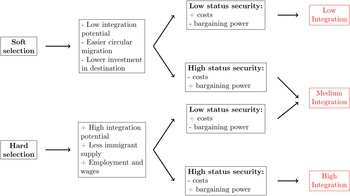
From this perspective, optimal outcomes should arise under watermelon regimes, in which higher integration potential, set by high entry selectivity, is exacerbated by inclusive internal rights. As illustrated in Figure 1, the inverse combination – low entry selectivity paired with restrictive internal rights – should produce the weakest integration outcomes. Guest-worker systems that encourage short-term or circular migration, or kafala-style regimes in non-democratic contexts, exemplify this configuration. Intermediate outcomes are expected in soft-soft and hard-hard regimes, where the effects of either permissive or restrictive entry criteria are offset by contrasting internal policy environments.
Summary of integration effects.

A novel mechanism related to migration experiences is economic integration. Watermelon regimes may enhance labor market incorporation and economic prospects for migrants, which in turn could lead to higher levels of satisfaction and trust in the political system.
There are two reasons why watermelon regimes might increase the economic returns of migrants in the long run, leading to higher political satisfaction and attachment to the institutional environment. First, these regimes may offer a higher starting level of economic advantage compared to softer entry conditions. Stricter immigration laws can reduce labor supply, thereby increasing wages (Cigagna and Sulis Reference Cigagna and Sulis2015). Migrants selected based on higher or specific skills are more costly to replace, and therefore may benefit from higher wage premiums.
Secondly, more lenient internal regulations can enhance the bargaining power and future economic trajectories of highly selected migrants, which may explain why economic integration tends to be higher in watermelon regimes. This can be attributed to two key features of inclusive internal regulations: the portability of work visas, which allows migrants to switch employers, and the right to settle permanently with minimal requirements. When work permits are tied to a single sponsor, the employer holds greater bargaining power to set salaries, limiting the capacity of migrants to improve their wage trajectories (Massey and Malone Reference Massey and Malone2002; Lindsay Lowell and Avato Reference Lindsay Lowell and Avato2014). This feature, combined with extensive social and labor rights, is a plausible driver of better economic trajectories for migrants.
Moreover, temporary migrant workers often have less bargaining power in the labor market compared to permanent workers (Ruhs and Martin Reference Ruhs and Martin2008). Crucially, initial visa status can influence the productivity and wage trajectories of migrants (Lindsay Lowell and Avato Reference Lindsay Lowell and Avato2014), suggesting that rights granted to migrants upon arrival can have long-term effects.
Commonwealth immigrants and political support
Commonwealth policy regimes
This section analyzes the political attitudes of non-white migrants from the Commonwealth of Nations who arrived in the UK between 1948 and 1973. Over this period, immigration policy underwent substantial transformations. An initial phase of unrestricted movement (1948–1962) was succeeded by a more restrictive regime (1962–1973), which combined stringent entry requirements with relatively generous provisions for settlement and family reunification – a configuration equivalent to a ‘watermelon’ regime. Crucially, all Commonwealth migrants were granted full voting rights upon arrival, regardless of the prevailing immigration regime. As such, variation in voting rights cannot account for differences in political integration across cohorts. If anything, the uniform enfranchisement of Commonwealth migrants likely fostered a relatively high baseline of political integration. This, in turn, makes the UK case a stringent test for detecting additional policy effects, as any observed differences must emerge over and above this institutional foundation of formal political inclusion.
Free movement regime (1948–1961): This period was characterized by free movement, during which individuals born in Commonwealth countries enjoyed unrestricted access to the UK. All Commonwealth citizens were de facto recognized as British subjects under the British Nationality Act, as British passports referred to their holders as ‘Citizens of the United Kingdom and Colonies’. This enshrined the right of colonial-born citizens to work and settle in the UK (Spencer Reference Spencer2002). Migration during this period was primarily motivated by economic opportunities, and most arrivals did not have pre-arranged jobs (Hampshire Reference Hampshire2005).
Watermelon regime (1962–1972): The Commonwealth Immigrants Act of 1962 significantly curtailed the right to enter the UK, although settlement and family reunification requirements remained minimal. The combination of stricter entry requirements and relatively lenient internal regulations makes this period equivalent to the watermelon regime described earlier. If the 1962 regime facilitated a long-term integration premium, we should observe significantly better outcomes among migrants arriving after the new law compared to those who arrived during the free movement period.
The unexpected surge in arrivals during the free movement period, coupled with a hostile public, pressured the government to restrict immigration (Hansen Reference Hansen2000: 120). The Commonwealth Immigrants Bill became law on July 1, 1962. This law effectively transformed Commonwealth migrants into de facto labor migrants, as the right of entry became conditional on holding an employment voucher issued by the British government, based on the country’s labor needs. This restriction of eligibility conditions affected migrants of all skill levels in the early years of the new regime. While stricter selectivity criteria are not always intended to attract migrants with higher integration potential, this policy shift specifically targeted economic migration based on occupational demand, consistent with the scope of the watermelon hypothesis.
Although the border was significantly hardened, the rights of Commonwealth migrants were not severely curtailed once in the UK. Family reunification was fully permitted (Hansen Reference Hansen2000: 119), and settlement rights were maintained (Spencer Reference Spencer2002: 133). The political narrative focused on increasing immigration controls while ensuring high levels of integration (Hampshire Reference Hampshire2005). The Act established the Commonwealth Immigrants Advisory Council (the first legal body for the integration of immigrants), and the Race Relations Act (the first UK legislation to address racial discrimination in employment and housing) was passed in 1965.
In 1968, a second Commonwealth Immigrants Act was passed, primarily aimed at restricting the entry of East African immigrants of Asian origin who had settled in newly independent states like Uganda and Kenya. This law was essentially an extension of the 1962 Act and did not alter the fundamental principles of the policy regime. Appendix K shows identical results if we exclude Kenyan and Ugandan migrants from the analysis.
The end point of our analyses will be 1973, when the Immigration Act of 1971 became law and introduced a new framework regulating the entry and stay of Commonwealth migrants (Spencer Reference Spencer2002: 143). The internal regulations of the new regime became harder, with tighter settlement and family reunification rights for immigrants without parents or grandparents born or naturalized in the UK (non-patrials) (Hampshire Reference Hampshire2005). However, settlement and family reunification were still possible, and in fact, access to citizenship was ‘inclusionary and expansive’ (Hansen Reference Hansen2000: 217). This means that while internal rights after 1973 were harder than what one would expect in a watermelon regime, the policy was inclusive enough without constituting a fundamental policy shift.
Data and method
I rely on the Ethnic Minority British Election Study (EMBES),Footnote 1 a major survey of ethnic minorities’ political attitudes and behavior fielded just after the UK general election on May 6, 2010. This remains the largest and most authoritative study of ethnic minority political attitudes ever conducted in Britain. The primary focus was on five minority groups: individuals of Indian, Pakistani, Bangladeshi, Black Caribbean, and Black African backgrounds. The study employed a multi-stage stratified random sampling design, yielding 2,787 interviews representative of these ethnic groups.
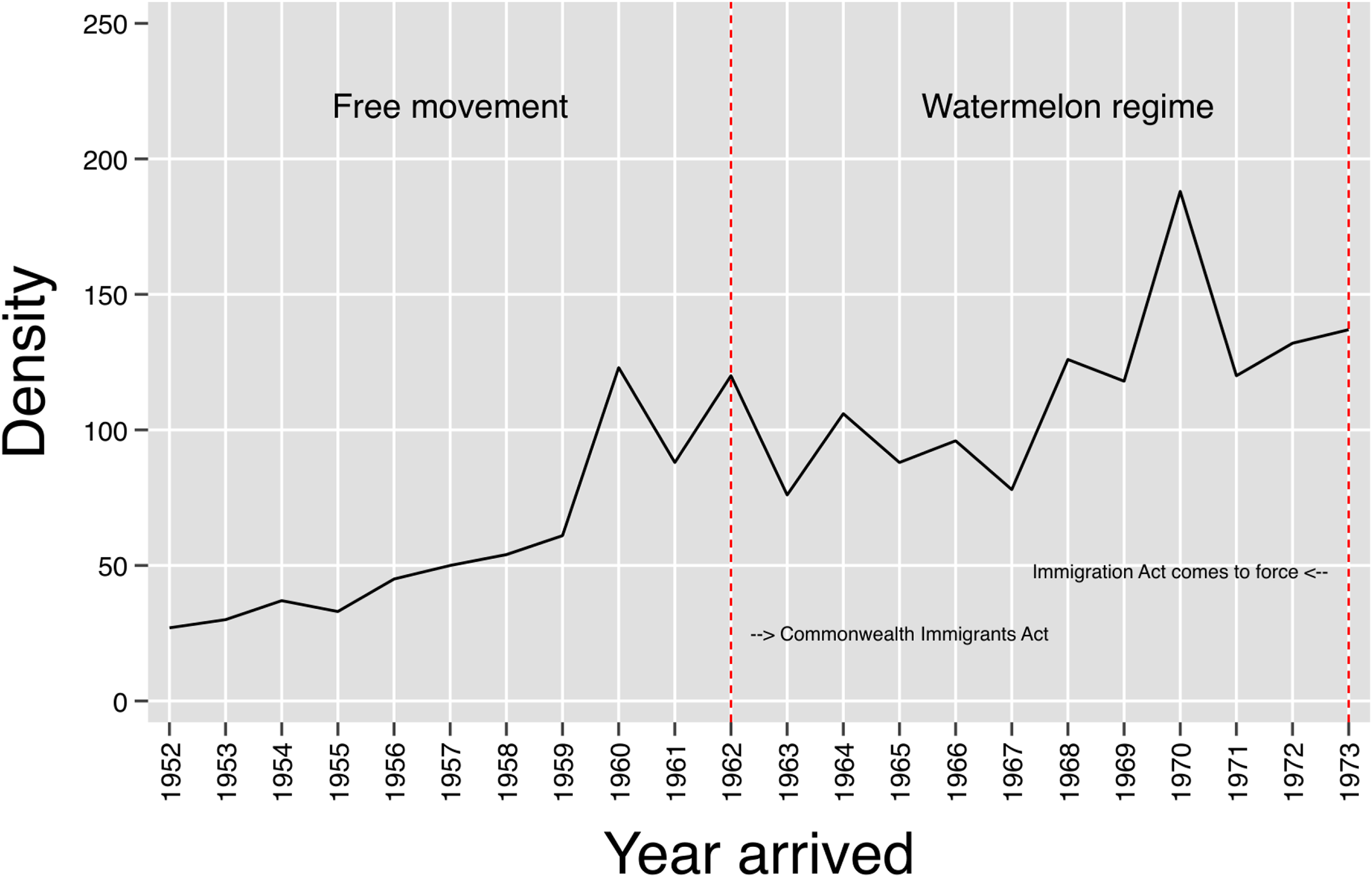
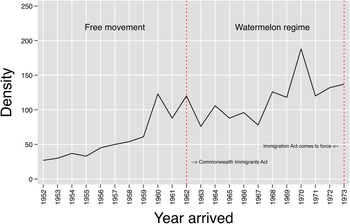
I select foreign-born individuals with information on their country of origin and year of arrival. Figure 2 illustrates a gradual increase in the presence of Commonwealth migrants over time. Interestingly, immigration numbers appear to increase prior to the announcement of subsequent and more restrictive policy regimes in 1962 and 1971. This trend is consistent with historical accounts based on official migration statistics, which document a ‘beat-the-ban’ effect (Spencer Reference Spencer2002), where the political climate led migrants to anticipate changes in the rules.
Commonwealth migrants across policy regimes.
Note: Density of Commonwealth migrants across policy regimes in the Ethnic Minority British Election Study.
Dependent variables: The main dependent variables are satisfaction with democracy and political trust. The former is measured on a 4-point scale, assessing responses (from negative to positive) to the question, ‘On the whole, are you satisfied or dissatisfied with the way that democracy works in this country?’ The latter is an aggregate measure based on two indicators: trust in the Westminster Parliament and trust in politicians (both measured on 0–10 scales, from ‘no trust’ to ‘a great deal of trust’). Democratic satisfaction and political trust serve as reasonable indicators of structural and institutional support for the political system in the destination country. Political interest in the destination country (measured on a 5-point scale from ‘none at all’ to ‘quite a lot’) is not available for our control groups. Despite the limitations of these analyses, Appendix I shows broadly consistent results on political interest.
Independent variables and mechanisms: All models will control for education (where 1 = having obtained a university degree), age, and gender (where 1 = male). Based on the theory outlined earlier, I will examine two types of mechanisms. First, selection mechanisms will test whether different policy regimes changed the composition of the migrant population in terms of education, gender, age at migration, religious denomination (Christian, Hindu, Muslim, Sikh, and Buddhist or other), and area of origin (Asia, Caribbean, Africa, and other). Selection mechanisms will also assess whether migration intentions differed across policy regimes. The EMBES contains several items with sufficient observations across policy regimes that measure reasons for migrating to Britain. These items include economic migration (a dummy variable where the reason given was ‘earn money’), family reunification (‘joining spouse’), political reasons (‘freedom’), and general aspirational reasons (‘better life’).
The second type of mechanism to be tested is context. Specifically, I hypothesize that watermelon regimes increase the bargaining power of economic migrants from the start, facilitating their economic and labor market incorporation in the long run, and subsequently increasing their political satisfaction. While the EMBES is well-suited to measure political attitudes, it lacks data on wages and labor market status. I therefore use several yearly rounds of the UK Annual Population Survey (APS)Footnote 2 from the 2000s (2004–2010), which provide a reasonably long time span after the migration of the cohorts of interest, allowing contemporary macro-economic conditions to remain constant. The sample size in each wave is approximately 320,000 respondents, constituting the largest coverage of any household survey in the UK and enabling the generation of statistics for small respondent groups. The APS uses data combined from two waves of the main Labour Force Survey, collected via local sample boosts. I observe levels of gross weekly earnings, unemployment status, and possession of a permanent contract. I select respondents born outside the UK and of non-white background, who predominantly migrated from the Commonwealth between the 1950s and 1980s (Maxwell Reference Maxwell2012). Appendix A provides descriptive statistics of all variables.
Control groups: Integration can be conceptualized and measured in different ways, depending on the reference category against which migrants are compared: comparable natives, other kinds of migrants, or temporal comparisons between first- and second-generation migrants, among others (Bloemraad, Esses, Kymlicka et al. Reference Bloemraad, Esses, Kymlicka and Zhou2023). Different measures are not necessarily superior, but capture different and complementary aspects of integration.
I will compare migrants’ political attitudes with those of two control groups. The first control group consists of migrants arriving in Western European countries other than the UK. The effect of a new policy regime will be estimated as the change in political attitudes among Commonwealth migrants arriving in the UK, compared to the change in other migrants’ attitudes arriving in other Western European countries in the same year, while controlling for destination country fixed-effects.Footnote 3 To conduct this analysis, I merge the EMBES with the cumulative file of the European Social Survey (ESS),Footnote 4 selecting only foreign-born respondents with information on the precise year of their arrival in the destination country. As immigration flows have shaped the demography of many European countries over the last few decades, the random probability samples of the ESS reflect this phenomenon and offer sizable shares of foreign-born individuals. The ESS is thus widely used in recent social science research focusing on immigrant attitudes and integration (Just and Anderson Reference Just and Anderson2012; Just, Sandovici and Listhaug Reference Just, Sandovici and Listhaug2014; Helbling, Simon and Schmid Reference Helbling, Simon and Schmid2020; Platt, Polavieja and Radl Reference Platt, Polavieja and Radl2022). Given the slightly different operationalization of variables across the EMBES and the ESS, I standardize all variables to range from 0 to 1 before merging.
The second group comprises British-born individuals who turned 17 years old in the year when the migrants they are compared with arrived in Britain. This means that the effect of a new policy regime will be the change in political attitudes among migrants compared to the change in natives’ attitudes who turned 17 at the time (and who are in exactly the same age range, as shown in Appendix J). The rationale behind this control group is that political attitudes are known to form and crystallize during early adulthood, as a result of socialization processes driven by family, school, and the political climate (Neundorf and Smets Reference Neundorf and Smets2015). This allows me to compare migrants and natives who were socialized into the UK’s political system during an identical political, cultural, and economic context. Moreover, this control group allows us to rule out general macro-economic or political climates driving the results. If outcomes are due to general economic conditions or government performance coincident with policy changes, natives should also be affected by the same confounders. I merge the EMBES with the 2010 British Election Study, a survey of 3,512 British respondents fielded at the same time, using identical question wordings.Footnote 5
Modeling strategy: I employ two modeling strategies. First, I transform the data into a frame where migrants, who are the unit of analysis, are nested in years of arrival. I then fit adapted difference-in-differences models, where I interact the treatment (migrant vs. control group) with the period after the policy change. All models include demographic controls, year of arrival fixed-effects, and (in the case of models comparing migrants with migrants) destination country fixed-effects. Since all respondents were interviewed at the same time and free movers and watermelon cohorts lived through identical regimes until the year of interview, we can plausibly identify the effect of arrival time net of other contemporaneous policy effects. Specifically, the models comparing migrants with migrants can be summarized as follows: ${Y_{ict}} = {\beta _1}\left( {{M_{ic}} {X_t}} \right) + {\beta _2}{M_{ic}} + {\beta _n}{{\bf Z}_{itc}} + {\gamma _t} + {\delta _c} + {\epsilon _{ict}}$
Where,
- ${Y_{ict}}$
is the level of political support for a given immigrant
$i$
arriving in the country of destination
$c$
in year
$t$
;
${Y_{ict}}$
is the level of political support for a given immigrant
$i$
arriving in the country of destination
$c$
in year
$t$
; -
${M_{ic}}$
is the treatment variable where 1 = Commonwealth migrant and 0 = control group;
-
${X_t}$
is a dummy variable representing the policy regime (0 = pre-intervention period, and 1 = policy change and after), which is absorbed by year of arrival fixed-effects;
-
${\beta _1}$
is the difference-in-differences estimate and main parameter of interest;
-
${\beta _2}$
is the average effect of being a migrant vs. the control group;
-
${\beta _n}$
is a set of coefficients associated with the vector Z of covariates;
-
${\gamma _t}$
are year of arrival fixed-effects;
-
${\delta _c}$
are country of destination fixed-effects;
-
${\epsilon _{ict}}$
is the error term.


The second analytical strategy employs ITS analyses. ITS allows me to compare the local effect of having arrived just after a given policy change versus the previous immigrant cohort, as well as compare to a control group. The added value of ITS is twofold. First, the assumption of parallel trends between treated and control units in the absence of the treatment is relaxed. The pre-treatment trend becomes a parameter of interest in the model, allowing for the observation of potential anticipation effects, which are natural in the context of policies adopted as a result of a particular political climate. Second, the potential trend after the policy intervention can also be modeled dynamically. This allows us to rule out potential confounders taking place in the time between the treatment and the measurement of the outcome, and enables an examination of whether the effects of the policy weakened or strengthened as new cohorts of migrants arrived during that policy regime. Specifically, the ITS models fitted below can be expressed as: $\eqalign {{Y_{it}} & {= {\beta _0} + {\beta _1}{T_t} + {\beta _2}{X_t} + {\beta _3}{T_t}{X_t} + {\beta _4}{Z_i} + {\beta _5}{T_t}{Z_i}} \cr & {+ {\beta _6}{X_t}{Z_i} + {\beta _7}{T_t}{X_t}{Z_i} + {\beta _8}{C_{it}} + {\beta _9}{D_i} + {\epsilon _{it}}}}$
Where,
-
${Y_{it}}$
is the level of political support for a given immigrant
$i$
arriving in year
$t$
;
-
${T_t}$
is the time elapsed since the start of the series until the relevant policy change (which gets the value 0);
-
${X_t}$
is a dummy variable representing the intervention period (0=pre-intervention period, and 1 = policy change and after);
-
${Z_i}$
is the treatment variable where 1 = Commonwealth migrant and 0 = control group;
-
${\beta _0}$
represents the intercept or starting level of the outcome variable;
-
${\beta _1}$
is the trajectory of the outcome until the introduction of the intervention;
-
${\beta _2}$
represents the intercept at the time of the intervention;
-
${\beta _3}$
represents the slope of the outcome after the intervention;
-
${\beta _4}$
represents the effect of being a migrant vs. the control group;
-
${\beta _5}$
represents the trajectory of the outcome for migrants (vs. the control) until the introduction of the intervention (or pre-treatment trend);
-
${\beta _6}$
the effect of the policy intervention among migrants;
-
${\beta _7}$
the trajectory of the outcome after the policy intervention among migrants;
-
${\beta _8}$
represents the effect of control variables
${C_{it}}$
;
-
${\beta _9}$
represents the fixed-effect of the country of destination
${D_i}$
(for specifications comparing migrants with migrants);
-
${\epsilon _{it}}$
is the error term.


In this type of ITS setup, treatment effects are indicated by a significant ${\beta _6}$
and/or
${\beta _6}$
and/or ${\beta _7}$
(Linden and Adams Reference Linden and Adams2011: 1232).
${\beta _7}$
(Linden and Adams Reference Linden and Adams2011: 1232). ${\beta _6}$
indicates whether there was a change in the level of political support immediately following the immigration policy change for migrants, compared to the relevant control group. If the watermelon hypothesis is correct, I expect positive and significant effects of the 1962 policy intervention on support (vs. free movement).
${\beta _6}$
indicates whether there was a change in the level of political support immediately following the immigration policy change for migrants, compared to the relevant control group. If the watermelon hypothesis is correct, I expect positive and significant effects of the 1962 policy intervention on support (vs. free movement). ${\beta _7}$
will indicate whether policy effects strengthened for migrants (vs. the control) after the change, or whether they decayed over time.
${\beta _7}$
will indicate whether policy effects strengthened for migrants (vs. the control) after the change, or whether they decayed over time.
Difference-in-differences models
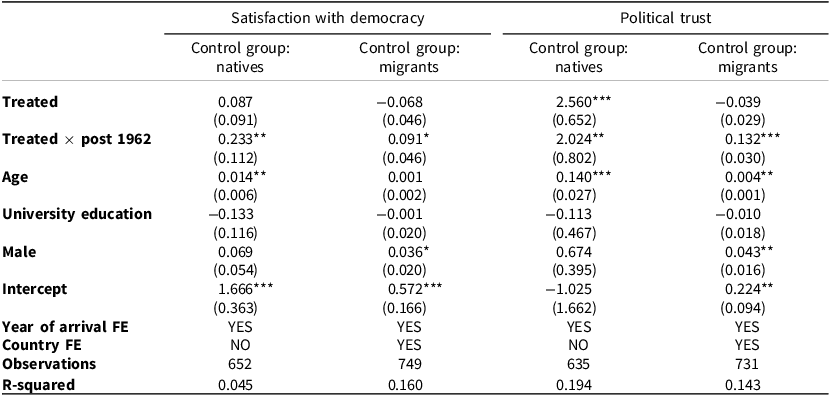
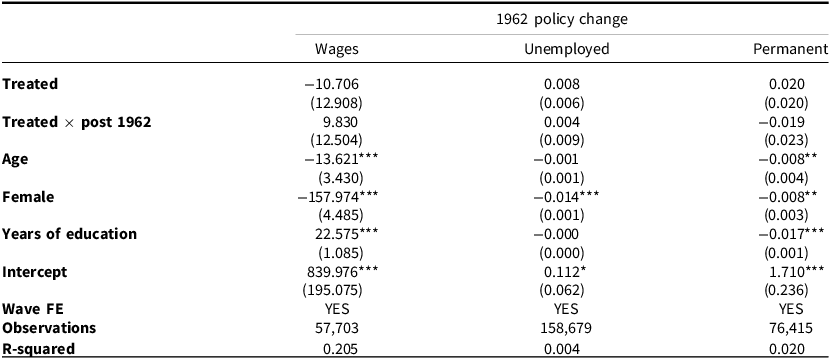
Table 1 reports difference-in-differences models assessing the effects of the 1962 Commonwealth Immigrants Act. The primary parameter of interest is the interaction term between the treatment variable and the post-1962 period following the law’s enactment. The analysis is restricted to observations including the free movement and watermelon periods until the introduction of the subsequent policy regime in 1973. This ensures that the effects are attributable to the watermelon regime and not influenced by more recent migration policies. The demeaned constitutive term of the post-1962 period is omitted because of collinearity with the year of arrival fixed-effects included in all specifications. Appendix D confirms that results remain consistent if year of arrival and country dummies (instead of demeaned variables) are used and all constitutive terms are retained. Appendix E shows that excluding all fixed effects does not significantly affect the results.
Difference-in-differences - 1962 policy change

Significance levels: ***p < $0.01$
, **p <
$0.01$
, **p < $0.05$
, *p <
$0.05$
, *p < $0.1$
.
$0.1$
.
Source: Ethnic Minority British Election Study, British Election Study 2010, European Social Survey.
Note: Linear models showing coefficient estimates and clustered standard errors at the year of arrival. Post policy change dummy absorbed by year fixed-effects. In each model, only observations until the end of the policy regime of interest are included (1972 for the 1962 Commonwealth Immigrants Act, and 1982 for the 1971 Immigration Act).
Table 1 reveals a positive and significant effect of the 1962 Commonwealth Immigrants Act on political support across all model specifications. It is important to note that outcomes are observed in 2010, decades after migration. These represent conservative, long-term effects of the immigration regime. Political trust is positively affected, showing robust and significant results whether compared to British-born citizens (almost half of a standard deviation of the outcome, p < 0.05) or migrants (more than half of a standard deviation, p < 0.01). The impact on satisfaction with democracy is also significant when compared to natives socialized during the same historical period (a third of a standard deviation, p $\lt$
0.05), or migrants arriving in other European countries in the same year (more than a third of a standard deviation, though significant only at the 90per cent level). Appendix M shows identical substantive results if no control groups are specified and overall levels of political support among Commonwealth migrants are used as dependent variables.
$\lt$
0.05), or migrants arriving in other European countries in the same year (more than a third of a standard deviation, though significant only at the 90per cent level). Appendix M shows identical substantive results if no control groups are specified and overall levels of political support among Commonwealth migrants are used as dependent variables.
Parallel trends: The validity of the effects attributed to the watermelon regime reported in Table 1 relies on the assumption that, in the absence of the policy treatment, treated and control units would have followed parallel trends. While this assumption is untestable, Appendix B evaluates its plausibility through several event-study analyses examining the interaction between treated units (vs. each respective control) and pre-treatment periods starting in the early 1950s. The parallel trends assumption appears more defensible if these interaction effects (ie differences between treated and control units) are insignificant or show no trend.
Appendix B shows generally flat and insignificant pre-treatment effects when using migrants as the control group. Notably, the only positive and significant effect on satisfaction with democracy and political trust occurs immediately after the 1962 treatment. When using natives as the control group, pre-treatment effects are negative and flat for political trust, suggesting that migrants arriving during free movement had lower levels of political trust than comparable natives, with a reversal occurring only after the 1962 Commonwealth Immigrants Act. The analysis for satisfaction with democracy and natives as the control group is less satisfactory, with inconsistent signs and significance over the 1950s, and plausible anticipation effects.
Overall, the parallel trends assumption is broadly supported – positive and significant effects are observed only post-treatment across all model specifications, and pre-treatment trends are generally flat. However, anticipation effects in one specification cannot be entirely ruled out. As a robustness check, Appendix C replicates Table 1 by modeling unit-specific trends to control for differential pre-treatment trajectories. The 1962 watermelon policy effect remains strong and significant in models with migrants as the control group, though it is less robust with natives as the reference category.
Robustness checks: To enhance comparability between treated and control groups, Appendix F replicates Table 1 while weighting units based on the probability of treatment. This probability is calculated using age, gender, education, year of arrival/socialization (for models with British natives as the control group), and age at migration (for models with other migrants as the control group). This robustness check confirms that the 1962 watermelon effect remains positive and significant across all outcomes and specifications. Appendix J shows that results are consistent when only including natives in the control group who are in the exact same age range as treated migrants. Appendix N shows that policy regimes did not significantly affect natives’ political support, suggesting that the mechanisms operate through migrant policy conditions and not through natives’ reaction to those conditions. Appendix O shows identical substantive results if a single factor variable summarizing democratic satisfaction and political trust is analyzed as the outcome.
One potential concern with using cross-sectional data for cohort-based longitudinal analysis is survival bias. It is possible that only the most successful long-stayers are observed, as those who did not integrate may have left the country earlier. However, this type of survival bias should not affect the validity of the watermelon effect. Survival bias would likely favor older cohorts rather than the watermelon regime – integration should be higher among older free movers who have stayed longer, following a downward trend across subsequent policy regimes.
Interrupted time series analyses
Across different model specifications and robustness checks, the previous section has demonstrated that Commonwealth migrants arriving after the 1962 Commonwealth Immigrants Act (the watermelon regime) exhibited higher levels of democratic satisfaction and political trust decades after their arrival. However, it is important to note that models using migrants as the control group appear more robust to potential diverging trends between treated and control groups compared to models using natives as the reference category.
Changes in immigration policy do not occur in isolation but are influenced by economic, political, and public opinion factors. The ITS models presented here do not assume policy changes are random but instead account for potential anticipation effects by dynamically modeling pre- and post-intervention trends. These models also adjust for time-varying unobserved confounders between the exposure to the treatment and the measurement of the outcome, such as length of stay and other macro-economic or political trends.
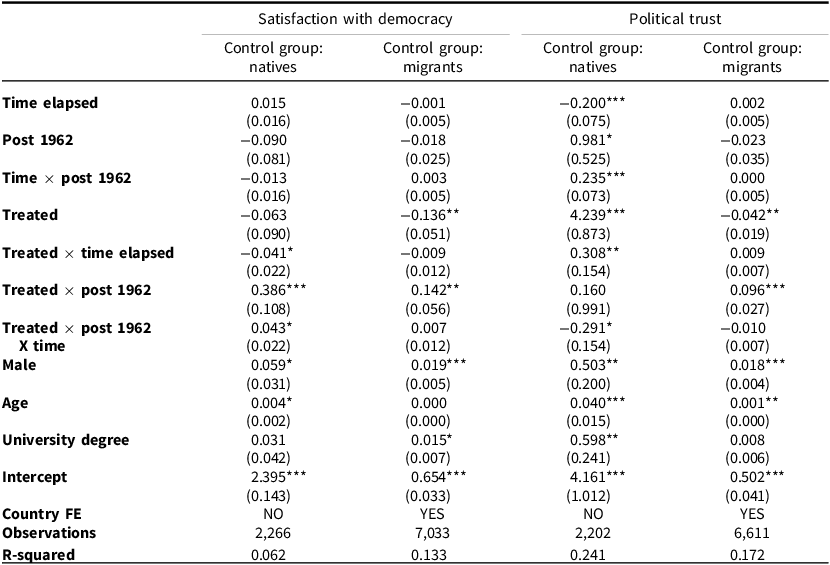
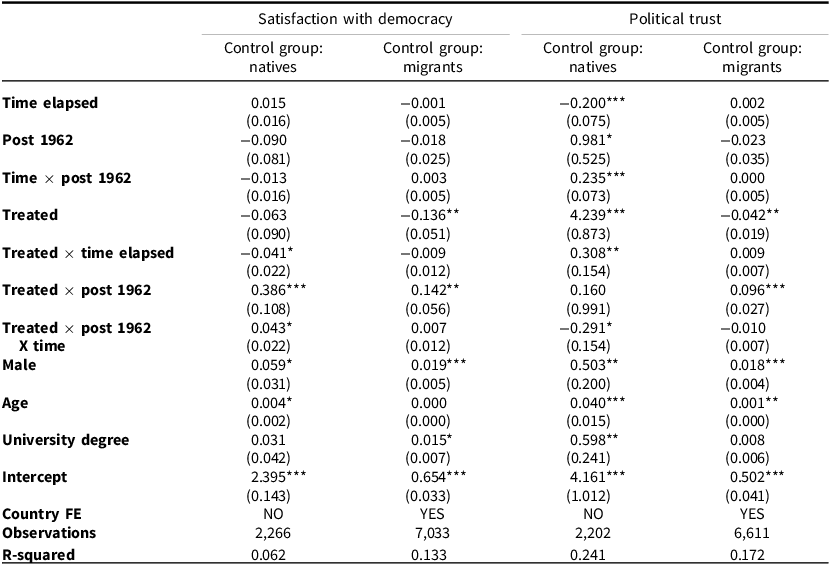
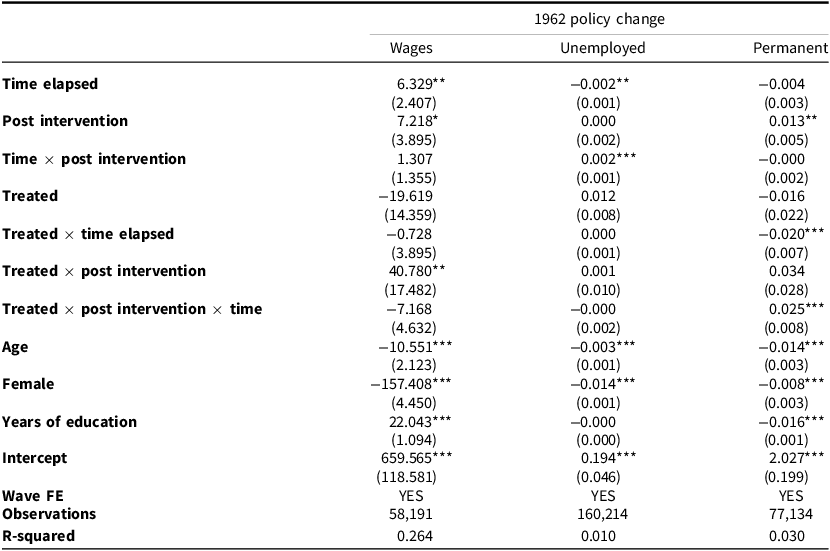
Table 2 highlights the parameters of interest. The interaction between the treated dummy and the post-1962 period indicates changes in political support among migrant cohorts arriving immediately after the policy change compared to the relevant control group. The interaction between the treated group, the post-1962 period, and the time trend assesses whether policy effects intensified or diminished for migrants arriving in subsequent years.
Interrupted time series - 1962 policy change
Significance levels: ***p < $0.01$
, **p <
$0.01$
, **p < $0.05$
, *p <
$0.05$
, *p < $0.1$
.
$0.1$
.
Source: Ethnic Minority British Election Study, British Election Study 2010, European Social Survey.
Note: OLS Models showing coefficient estimates and clustered standard errors at the year of arrival.
Table 2 shows positive and significant effects (p < 0.01 or p < 0.05) of arriving after the 1962 policy change on satisfaction with democracy (regardless of the control group) and political trust (when comparing migrants with migrants). Post-intervention trends are mostly insignificant, indicating that the positive effects of the watermelon regime remained stable across migrant cohorts arriving in subsequent years. A marginally significant positive post-intervention trend (p < 0.1) is observed for democratic satisfaction when comparing with natives, suggesting that the positive effects of the watermelon regime may have strengthened over time for this outcome.
The exception to these generally positive findings is noted in the third column of Table 2. Here, the 1962 policy change fails to achieve statistical significance when predicting political trust compared to natives, and the post-intervention trend is negative and marginally significant (p < 0.1). This may be attributed to a strong and significant pre-treatment trend for migrants compared to natives (as indicated by the treated X time elapsed interaction), potentially obscuring the policy effects in this model.
Robustness checks: Appendix G presents the marginal effects of the policy interventions and post-treatment trends from Table 2. These results confirm the broadly stable and positive effects of the watermelon regime. The comparison between migrants and migrants shows less significant effects toward the end of the watermelon regime, implying that the positive impact on political support is more pronounced among earlier arrivals who stayed longer under that regime. Appendix H replicates the ITS results from Table 2 using Prais-Winsten regressions, which aggregate variables at the year of arrival level and transform the dataset into a single time series to adjust for potential first-order autocorrelation. This approach reaffirms the positive, significant, and stable effects of the watermelon regime on political support (except for the model predicting trust with natives as the control group).
Mechanisms
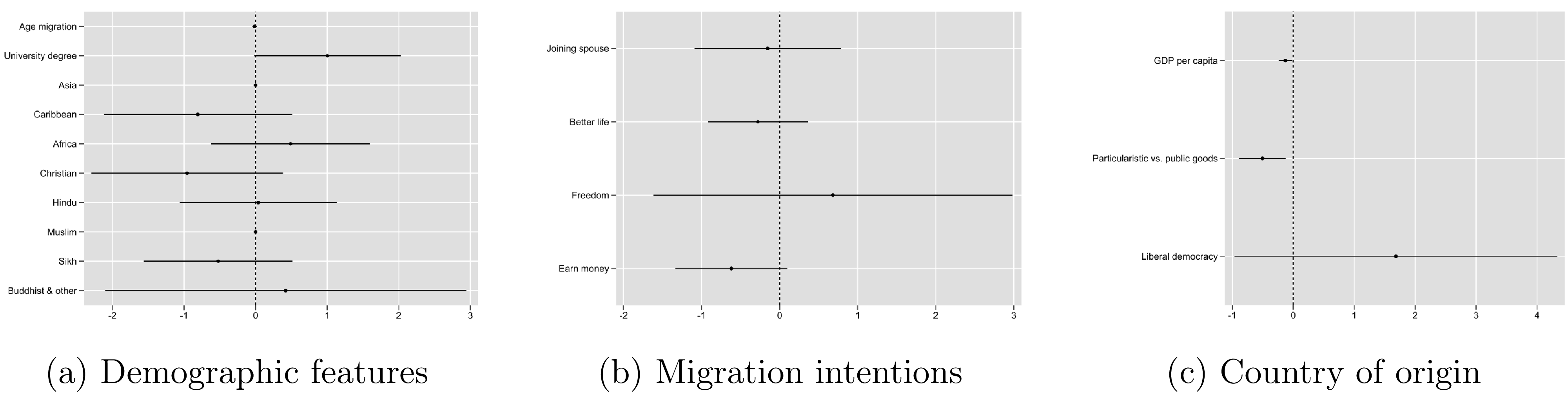
Selection effects: Figures 3a–c analyze whether the composition of the migrant population in the watermelon regime differs substantially from that in the free movement period. The figures report logit coefficients predicting arrivals during the 1962 Commonwealth Immigrants Act versus the previous regime. In terms of demographic features, watermelon and free movement migrants are indistinguishable regarding age at migration, religious denomination, or geographical area of the Commonwealth. However, migrants arriving after 1962 appear more likely to have obtained a university degree, even though this result is borderline significant (p = 0.054).
Selection effects of watermelon regime (1962–1972) vs. free movement (1948–1961).
Note: Logit coefficients predicting arrival during the watermelon regime (1962–1972) vs. free movement (1948–1961).
Source: Ethnic Minority British Election Study and V-Dem.
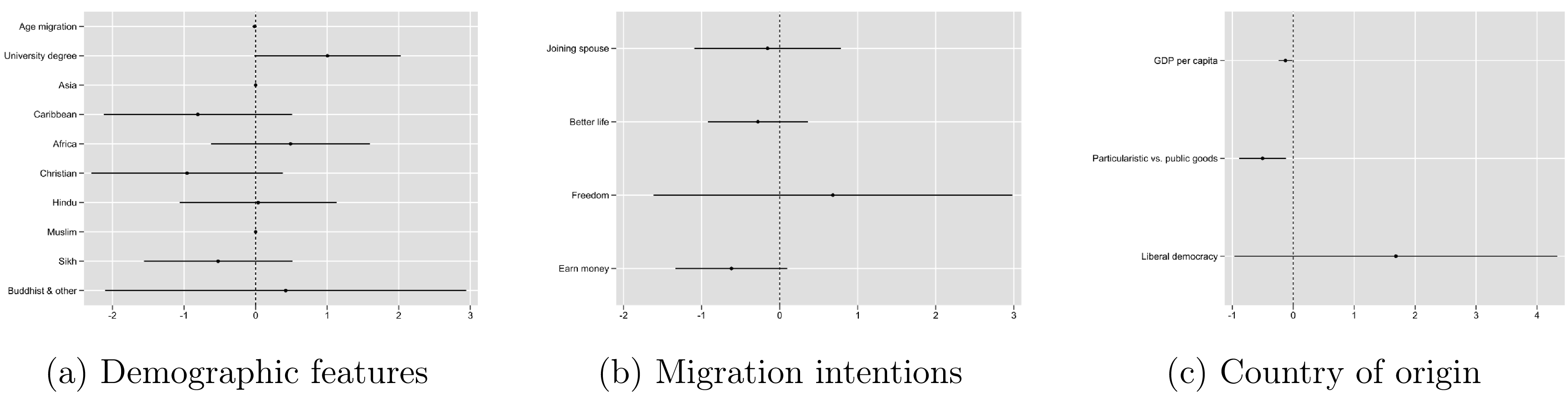
In terms of migration intentions, watermelon migrants are indistinguishable from free movers. The effects of family reunification (‘joining spouse’), economic reasons (‘earn money’), political reasons (‘freedom’), or aspirational reasons (‘better life’) are statistically insignificant when predicting whether one belongs to the post-(vs. pre-) 1962 cohort.
Regarding features of origin countries at the time of migration, Figure 3c shows the effects of three variables from the V-Dem dataset (Pemstein, Marquardt, Tzelgov et al. Reference Pemstein, Marquardt, Tzelgov, Wang, Medzihorsky, Krusell, Miri and von Römer2020): GDP per capita, a continuous measure from particularistic to public goods provision, and a liberal democracy index (ranging from lower to higher democratic values). The results suggest that watermelon migrants were not more likely to come from democracies than free movers. Economic variables have significant effects, but contrary to the hypothesis of selection from places with higher integration potential, migrants arriving during the watermelon period came from economically poorer countries with weaker public good provision. It is important to note that these effects could be confounded by push and not only pull factors. For instance, economic and political conditions in origin countries explaining post-colonial conflicts in Africa and a general shift in migration away from the Caribbean towards South Asia may coincide with, but not causally explain, changes in policy. Even if origin conditions are behind some of these effects, they go against the expectation of selection effects of migrants from stronger economic contexts and integration potential.
Overall, selection effects on standard demographics, migration intentions, and country of origin features appear relatively weak in explaining higher levels of political support among migrants arriving during the watermelon regime compared to free movement. However, the higher integration potential achieved by higher selection criteria could operate through other unobserved features (ie enhanced effort or motivation) and through a better connection with labor market needs from the start, because having a prior job offer is required.
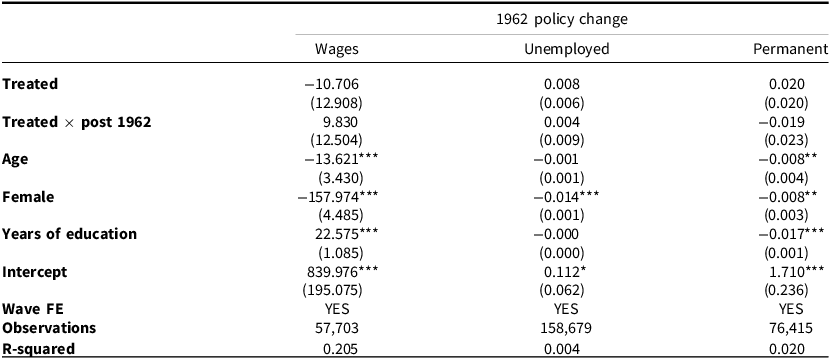
Economic integration: The mixed and relatively weak patterns observed in selection effects suggest that they do not fully explain why migrants arriving during the watermelon regime exhibited significantly higher levels of political integration than free movers. Tables 3 and 4 shift the focus to a hypothesized mechanism related to migrant experience and context: economic integration. Even if migrants were initially selected for higher socioeconomic status, observing their wages, unemployment rates, and labor market security decades after arrival provides insight into whether the destination country maintained or diminished their economic prospects. The analyses follow a similar strategy to previous sections, combining difference-in-differences models with ITS using several waves of the UK APS. Only active individuals who are not retired are included, which means that pensions and other age-related welfare considerations are excluded. The treated group comprises non-white Commonwealth migrants who were older than 16 years old at migration, focusing solely on first-generation migrants entering the labor market. The control groups are restricted to individuals within the same age range as the migrants in each cohort, to compare individuals at identical career stages and account for the effects of age and labor market experience on economic returns.
Difference-in-differences models predicting economic integration
Significance levels: ***p < $0.01$
, **p <
$0.01$
, **p < $0.05$
, *p <
$0.05$
, *p < $0.1$
.
$0.1$
.
Source: UK Annual Population Survey (2004–2010).
Note: Linear models showing coefficient estimates and clustered standard errors at the year of arrival. Post policy change dummy absorbed by year fixed-effects. Only observations until the end of the policy regime of interest are included. Analysis restricted to individuals who are not retired and in the same age bracket as migrants arriving during policy regimes of interest.
Interrupted time series on economic integration

Significance levels: ***p < $0.01$
, **p <
$0.01$
, **p < $0.05$
, *p <
$0.05$
, *p < $0.1$
.
$0.1$
.
Source: UK Annual Population Survey (2004–2010).
Note: OLS Models showing coefficient estimates and clustered standard errors at the year of arrival.
While the watermelon effect does not achieve statistical significance in the difference-in-differences models presented in Table 3, the more flexible ITS specification in Table 4 confirms that watermelon migrants were economically better integrated than free movers at the time of observation. The first model, which examines gross weekly wages, reveals that migrants arriving during the 1960s earned £41 more per week than their free-movement counterparts, equating to an additional £164 per month. Furthermore, the trend in permanent contracts (third model) is positive and highly significant, indicating that subsequent cohorts arriving during the watermelon regime were more likely to secure permanent contracts in the long run.
Economic mechanisms do not exclude the significance of other integration channels. For instance, it could be argued that stricter border controls might have softened natives’ attitudes towards immigration, leading to reduced social discrimination. Appendix L examines this possibility with social discrimination as an outcome. The analysis fails to show that entry-level conditions significantly impact the experience or frequency of social discrimination among migrants in the long run, making economic integration a more plausible and enduring mechanism.
Cross-national analysis
Data and method
This section examines whether the combined effect of migrant selectivity and the extension of rights on political support can be generalized. I utilize the cumulative file of the ESS, which provides valid and reliable measures of political attitudes and identifies the country of origin and year of arrival for sizeable samples of foreign-born respondents from outside the European Union (EU).Footnote 6
Dependent variables: The outcomes analyzed are satisfaction with democracy (on a 0–10 scale), political trust (an aggregate indicator of three 0–10 scales measuring trust in Parliament, politicians, and political parties), and trust in the legal system (an aggregate indicator of two 0–10 scales measuring trust in the legal system and trust in the police). The distinction between forms of trust is made because they load onto two distinct constructs after performing a principal components analysis with Varimax rotation.
Independent variables: The main independent variables of interest are the immigration policies regulating entry requirements and levels of rights at the time of arrival. I rely on the Immigration Policies in Comparison database (IMPIC), which measures regulations targeted at four different types of immigrant populations: labor migration, family reunification, refugees and asylum seekers, and immigrants with shared cultural backgrounds (Helbling, Bjerre, Römer et al. Reference Helbling, Bjerre, Römer and Zobel2017). Because of high correlations across all policy domains and the difficulty of determining through which track migrants entered, I follow previous research (Schmid Reference Schmid2020) and use two aggregate indicators of external and internal regulations, respectively. These indicators are continuous variables ranging from 0 (permissive) to 1 (restrictive). While this strategy could conflate selectivity criteria not intended to attract higher integration potential (ie refugee policies aiming to reduce flows by prioritizing resettled refugees over asylum seekers), this bias would attenuate the effects of selectivity on integration and go against the watermelon hypothesis. This dataset enables the analysis of migration laws in 22 countriesFootnote 7 between 1980 and 2010.
All model specifications include years of education, gender (female vs. not), age, age squared, country social expenditure, unemployment rate, and employment protection legislation. Appendix A provides all descriptive statistics.
Modelling strategy: The data exhibits a nested structure, with individuals clustered in country-year groups. Similar to the case study above, non-EU migrants (thus excluded from internal free movement regulations) are compared with natives who turn 17 in the same migration year (as a proxy for political socialization) and with migrants exposed to different policy regimes arriving in the same year. To avoid deflated standard errors, I specify hierarchical linear models (Hox Reference Hox2010). I present models with country of destination fixed-effects, as well as random-effects without country dummies (in Appendix R). This approach balances the trade-off between fixed- and random-effects. Fixed-effects control for any time-invariant unobserved confounders, while random-effects are more efficient when independent variables exhibit low within-unit variation and when there are few observations per unit (Bell and Jones Reference Bell and Jones2015; Clark and Linzer Reference Clark and Linzer2015). These conditions apply to immigration policy, which changes relatively little within countries, and since the number of immigrants within groups is relatively low (around 50–60 on average, depending on the specification). The consistency of the results across fixed- and random-effects is reassuring and addresses exogeneity and efficiency concerns.
Findings
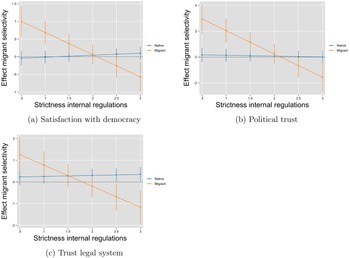
Figures 4a–c illustrate the marginal effects of migrant selectivity conditional on the strictness of internal regulations at the time of arrival, for migrants and natives coming of political age in the same year. The coefficients for these 3-way interactions and the full model specification are provided in Appendix P. Virtually identical results with random-effects (instead of fixed-effects) models are reported in Appendix R.
Marginal effects of migrant selectivity across internal regulations (migrants vs. natives).
Source: ESS, IMPIC, World Bank, OECD.
Note: Marginal effects and 95% confidence intervals based on Model 3 in Appendix P.

The results support the watermelon hypothesis, showing that a unit increase in stricter entry conditions enhances satisfaction with democracy, political trust, and trust in the legal system (higher values on the Y axis), but only when internal regulations are lenient (lower values on the X axis). In cases where migrant selectivity and internal regulations are strict, political support decreases across all outcomes. This strong conditional effect is observed exclusively among migrants. The null effects on natives’ political support suggest that the mechanism operates through migrant conditions and experiences and not through natives’ reactions to immigration policy.
The question now is whether the interactive effect of migrant selectivity and internal rights provides additional insights beyond the independent effects of each regulation. It could be argued that an inclusive internal regime might be sufficient to enhance support, regardless of the level of migrant selectivity at the border.
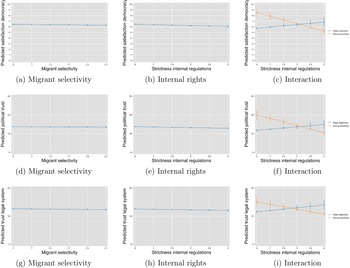
Figures 5a–i illustrate the predicted values of political integration as a function of migrant selectivity alone (first column), internal regulations alone (second column), and their interaction (third column). The results indicate that when modeled individually, external and internal regulations do not significantly alter the predicted values of satisfaction with democracy (first row), political trust (second row), or trust in the legal system (third row). In contrast, the interactive effect markedly influences the outcomes among migrants. In a scenario of high selectivity, moving from very permissive to very stringent internal regulations results in a decrease of 3.5 points in satisfaction with democracy (on a 0–10 scale), 10 points in political trust (on a 0-30 scale), and 5 points in trust in the legal system (on a 0–20 scale).
Predicted values of political integration for migrants.
Note: Predicted values and 95% confidence intervals of democratic satisfaction (first row), political trust (second row), and trust in the legal system (third row).
Source: ESS, IMPIC, World Bank, OECD.

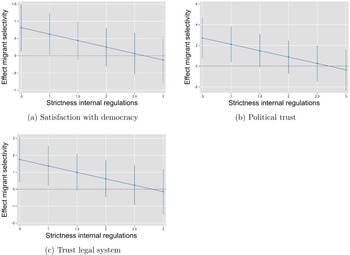
Finally, Figures 6a–c summarize the models where migrants are used as the control group. These models include only foreign-born individuals, with the marginal effects derived from two-way interactions between migrant selectivity and internal regulations (see Appendix Q). The figures depict the marginal effect of a unit increase in the strictness of selection criteria compared to migrants arriving in the same destination country in the same year. Consistent with the watermelon hypothesis and the analyses using natives as the control group, migrant selectivity enhances the three measures of political support only when internal regulations are inclusive. Appendix U replicates the main analyses with contemporaneous values of immigration policy, showing smaller and statistically insignificant results in virtually all model specifications. This means that the selection criteria in place when arriving have stronger and more generalizable effects than living through a particular policy regime.
Marginal effects of migrant selectivity across internal regulations (migrants only).
Source: ESS, IMPIC, World Bank, OECD.
Note: Marginal effects and 95% confidence intervals.

Mechanisms
Selection effects: Appendix S examines potential selection effects, focusing on whether the composition of migrant populations varies according to the policy regime in place at their time of admission. The modeling approach involves specifying a given socio-demographic feature (eg education) as an outcome in Hierarchical Linear Models that include only migrants. The models also incorporate the interaction between migrant selectivity and internal regulations, along with a comprehensive set of controls as independent variables.
Age of migration and length of stay yield significant results. Watermelon regimes tend to attract older migrants and result in shorter stays compared to stricter regimes. Consequently, it cannot be concluded that the positive effects of watermelon regimes are due to younger, more adaptable migrants adjusting more easily to the democratic culture of the destination country. Likewise, it cannot be concluded that the length of stay, typically considered a proxy for higher integration, drives the watermelon effect. If anything, stricter regimes are associated with long-term settlement strategies, given the higher barriers imposed in destination countries and the potential disincentives for return migration (Massey Reference Massey1998).
Similar to the Commonwealth analysis, standard socio-demographics and country of origin features do not drive selection effects. The ESS allows us to include parental education, which is independent of the migration process. The likelihood of having a university-educated parent is similar across watermelon and stricter regimes. Moreover, watermelon regimes are associated with migrants from countries with weaker rather than stronger universal public good provision, countering the expectation that this policy regime attracts migrants from more developed contexts. However, the slopes for country economic variables are generally insignificant. In short, selection effects do not operate through standard features associated with higher integration potential, but are more likely to be connected with unobserved features (ie motivation, personality) or the mechanical effect of admitting only migrants who are embedded in institutional and labor market structures by design.
Economic integration: Appendix T examines labor migration policy effects on three outcomes: income (measured in country-specific deciles), having a permanent contract, and having been unemployed for more than three months. Models with migrants as the control group strongly support the watermelon hypothesis for income and permanency in stricter models with country fixed-effects, and for all three outcomes in random-effects models. Models with natives as the control group, which yield more mixed results, confirm watermelon effects on income in random-effects specifications.
Conclusions
Does migrant selection lead to more support for democratic and political institutions in the country of destination? The case study and large-N analyses presented here suggest that it does, conditional on extensive internal rights upon arrival. Notably, the positive effects of watermelon regimes are evident even decades after migration, which is significant given that longer-staying migrants generally exhibit better integration, regardless of entry conditions. The mechanisms behind the watermelon effect point towards improved long-term economic integration.
The trend of immigration regimes moving towards market models that prioritize temporary economic migration (Boucher and Gest Reference Boucher and Gest2018) and limit rights in favor of selectivity (Ruhs Reference Ruhs2018) contradicts the consolidation of highly integrated cohorts. A potential reason for abandoning the watermelon model is the perceived cost of extending internal rights, as influentially argued by Ruhs (Reference Ruhs2013) in his discussion of the trade-off between flexible admission and rights.
These costs are often linked to fears that generous rights attract unmanageable migrant numbers and raise expenditures (eg minimum wage, work-related benefits, access to education, and healthcare). However, evidence from the Commonwealth case study suggests that the 1960s watermelon regime did not significantly increase numbers. Instead, spikes occurred before stricter policies (ie anticipation effect). Large-N analyses also indicated that watermelon regimes result in shorter stays than stricter ones, challenging the notion that inclusive rights lead to unmanageable outcomes.
Hostility in public opinion and concerns about cohesion are other perceived costs (Ruhs Reference Ruhs2013). Recent research shows that anti-immigrant individuals may accept more migration if entry is selective, while pro-immigration individuals may tolerate fewer migrants if rights are generous (Helbling, Maxwell and Traunmüller Reference Helbling, Maxwell and Traunmüller2024). This suggests that watermelon policies could offer a balanced approach.
The findings suggest that watermelon regime costs may be lower than anticipated. Their selection and economic benefits could improve efficiency, fiscal contributions, and political cohesion. The ‘exclusionary openness’ of admitting migrants while restricting rights, typical of post-war embedded liberalism and current trends, proved unsustainable over time (Goodman and Pepinsky Reference Goodman and Pepinsky2021).
Supplementary material
The supplementary material for this article can be found at https://doi.org/10.1017/S1475676526101340
Data availability statement
The data that support the findings of this study are openly available in the Harvard Dataverse at https://doi.org/10.7910/DVN/T2NKHC.
Funding statement
This research received no external funding.
Competing interests
The author declares no competing interests.


 Open access

