

“London. Four million forlorn hopes!” reads Thomas Hardy’s notebook entry for April 5, 1889.1 Two days later, still contemplating the despair amassed in what was then the world’s most populous city, Hardy wrote of the “woeful fact – that the human race is too extremely developed for its corporeal conditions, the nerves being evolved to an activity abnormal in such an environment.”2 The strain that London’s overdeveloped urban environment was clearly exerting on Hardy’s own nerves opens onto a wider lament on the misery of the “human race,” which must suffer collectively the biological burden of consciousness.3 “Even the higher animals are in excess in this respect,” he writes, expanding the already immense range of his speculations by questioning “whether Nature, or what we call Nature, so far back when she crossed the line from invertebrates to vertebrates, did not exceed her mission.”4 Hardy concludes, “This planet does not supply the materials for happiness to higher existences. Other planets may, though one can hardly see how.”
In these entries, Hardy’s use of the word “excess” relates both to his scientific understanding of the world’s processes and to an embodied sense of disproportion generated by the staggering units of time and space involved in that understanding. A kind of rhetorical excess reflects the magnitude of his outlook as well – a consequence, perhaps, of focusing the sympathetic faculties of his own “too extremely developed” nervous system on phenomena that seem oblivious to, and incommensurable with, daily lived experience. From the aggregated mood of London’s burgeoning population to the moment in deep time when “Nature” first transgressed to the physical possibilities for life on other planets, the sheer scale of these concerns seems to promote an excessive, histrionic mode that may strike us as “unrealistic.”
Hardy’s fiction is consistently marked by existential crisis – a cognitive abyss that opens when the human dramas of literary characters are juxtaposed with the elemental forces of an inhuman universe. Hardy’s efforts to orient the lives of individuals within what Pamela Gossin calls his “personal construction of an astronomical-literary cosmology” engage in a historically specific struggle to comprehend the categorical significance of the human.5 As we have seen, Gillian Beer influentially articulates this as “the problem of finding a scale for the human,” a challenge for late Victorians who, in the wake of evolutionary theory, initiated an ongoing search for “a scale that will be neither unrealistically grandiose, nor debilitatingly reductive, which will accept evanescence and the autonomy of systems not serving the human, but which will still call upon Darwin’s often-repeated assertion: ‘the relation of organism to organism is the most important of all relations.’”6 This chapter shows that, for Hardy, the literary implications of this struggle were not just philosophical or ethical, but deeply formal. Since the mimetic effects of the novel – especially the realist novel – depended on detailed representations of human perspectives, empirically observed, Hardy’s inclusion of the scales of inhuman systems introduced a mode of narrative excess that threatened to disrupt the novel as a system of human relations, to derange its formal conventions, and make it, too, seem “unrealistically grandiose or debilitatingly reductive.”7 However, in this chapter I argue that Hardy’s “excessive” moments serve strategic narrative purposes, that his sensationalized exaggerations of reality can be read as deliberate attempts to represent realities beyond realism.
For Hardy, subjective experience could not be extricated from its situation within geologic time and cosmic distances; at the same time, accommodating this massively distributed reality within a form grounded in everyday life produced a narrative surplus that threatened to overwhelm realist conventions of character, setting, and plot – and to eclipse the significance of individual lives. This chapter demonstrates how Hardy’s novels navigate radical shifts of scale by shifting narrative mode, fluctuating between a predominantly realist style and a heightened mode of excess that tends to be associated with “nonrealistic” genres like sensation fiction, melodrama, and romance. Much of our received understanding of the excessive nature of these “nonrealistic” genres can be traced to late-Victorian disputes over fiction’s aesthetic values and social functions, which privileged the “scientific” qualities of realism as a corrective to the populist fancies of prior forms.8 It is ironic, then, that in Hardy’s novels these shifts away from realism tend to be especially pronounced at moments when the novels are most engaged in representing scientific knowledge.
For Hardy, objects, events, and phenomena need not be “unreal” – that is, supernatural or impossible – to fall outside of realism and into an alternative mode; on the contrary, they can be fully real insofar as they are scientifically observable and empirically knowable, and yet outsized to realist representation. Hardy’s notebook entries offer a brief illustration. As he reflects on the collective unhappiness of London, of the “higher animals,” and of “higher existences” in general, Hardy invokes the inscrutable moment in deep time (approximately 525 million years ago) when the first vertebrate evolved – the biological genesis of consciousness. To narrate this event, Hardy shifts into a romantic mode by depicting the feminized figure of “Nature,” another form of “higher existence,” in the act of erring from her intended plot, “exceeding her mission” by “crossing the line.” To grasp the magnitude of this scientifically observable reality on the scale of human experience, Hardy ascribes mythological agency and intention to systems that can neither be subordinated to nor reconciled with the lives and plots of individual human beings. While this juxtaposition of the empirical and the tropological might otherwise signify a desire to “re-enchant” a rationalized, secular world, for Hardy it also functions as a means of formal accommodation, a method for channeling the bewildering scales of nonhuman systems into the familiar conventions of narrative excess.9
Hardy consistently related the limitations of realist representation to problems of scale and “proportion.” In what follows, I examine how his own anxious and uncertain status as a realist is complicated by his attempts to negotiate between the disparate scales of “world” and “individual” within his novels. I describe how Hardy developed formal and aesthetic techniques for expanding the range of his narratives to take in the sweep of planetary processes, techniques which afforded the distance necessary for his free-indirect narrative style, macroscopic points of view, and migratory narrative designs that rely on what we would today call global positioning. By juxtaposing extreme world perspectives with the lives of individual characters, Hardy fluctuates between the interpersonal entanglements that typify realist novels and phenomena whose scales of space and time seem wholly disproportionate to the domestic sphere. But these scalar problems are also opportunities: by framing scenes of human life within scales that render them “infinitesimal,” Hardy’s novels call for a major expansion of the novel’s range of sympathy.
Throwing Reality Out of Proportion: Tess of the D’Urbervilles
The characters in Hardy’s novels seem painfully aware of the inescapable finality of their fictional worlds, and long for the possibility of different ones. This longing appears, for example, near the beginning of Tess of the D’Urbervilles (1891). After the discovery of noble ancestry initiates a chain of mishaps that incapacitates her profligate father, Tess is forced to take responsibility for delivering the family’s beehives to market. Setting out in the dead of night with her younger brother Abraham and “Prince,” her dusty carthorse, Tess contemplates the sorry events that have brought her to this pass. Abraham, gazing up at the sky, interrupts her thoughts by asking, “Did you say the stars were worlds?”
This conversation opens the novel onto its alternatives, causing Tess, along with the reader, to reflect not just on what but where things might have happened differently.
Rendering the contingencies of Tess’s misfortune at a cosmic scale also reenacts Hardy’s personal lament about his own planet, which “does not supply the materials for happiness to higher existences. Other planets may, though one can hardly see how.” Tess, too, suffers from “nerves being evolved to an activity abnormal in such an environment” – the burdensome inheritance of a different ancestry, one vastly “older than the centuries; older than the D’Urbervilles.”11 Her awareness that she is living on a “blighted star” would therefore seem to instantiate the novel’s failure to escape or overcome the deficiencies of this planet. Yet Tess’s world is not ours, exactly, and it is significant that a fictional character – a literary representation of a human being who, by virtue of self-awareness, might also constitute a form of “higher existence” – should express the forlorn hope that better alternatives might exist somewhere else, in a place beyond the novel.12 One could speculate that Hardy might have spared Tess the misfortune if he had taken his own proposition differently: by writing about favorable conditions for higher existences on other planets, he might even have conceived the form of utopian science fiction that, as we saw in the previous chapter, was taking shape at almost the very moment that Hardy, having allegedly scandalized the public, stopped writing novels.
Instead, Hardy devoted himself to the more fatalistic task of building worlds that resembled his own, a project that culminated in Wessex. While Hardy’s virtual territory opens a sprawling space of narrative possibility, its similarity to the actual time and place it ostensibly represents is intended to enclose and confine these possibilities to the real world. Hardy’s late-career commitment to promoting his novels’ “realism” relied heavily on establishing their fidelity to the paratextual locations in which they are supposed to be set, and Hardy deliberately emphasized geographical features to make Wessex seem believable.13 While Wessex was, of course, a historically real place (an Anglo-Saxon kingdom in southern England that existed from AD 519 until the early tenth century), Hardy’s invocation of this antiquated name proclaims his novels’ separateness from the present, underscores their fictional status, and draws associations with lost and counterfactual times. Alternate reality is amplified in scenes in which characters imagine communicating between worlds. Nor does Hardy’s cartographic realism fully subsume his deliberate and consistent use of narrative devices and structures associated with nonrealistic genres – including melodrama, fantasy, and romance – whose effects are, if anything, made stranger when set in identifiable locations.
While he eventually took pains to define himself as a realist, Hardy chided what he called “scientific realism” earlier in his career. In his essay “The Science of Fiction” (1891), he refuted the notion that close observation and detailed “copying” could provide a complete understanding of human experience. The demand from certain critics to make fiction ever more “scientific,” which, for Hardy, meant an increasingly granular scale of representation, “appears to owe its origin to the just perception that with our widening knowledge of the universe and its forces, and man’s position therein, narrative, to be artistically convincing, must adjust itself to the new alignment.”14 However, Hardy rejected the notion that an increasingly minute and detailed reporting of daily life could be capable of adjusting to such extreme scales. Narrative could not achieve a scientific “copying” of reality, he claimed, because of “the impossibility of reproducing in its entirety the phantasmagoria of experience with infinite and atomic truth, without shadow, relevancy, or subordination.”15 And even if it were hypothetically possible to reach a state of total objectivity, the result would not be recognizable as a work of art.16 The “attempt to set forth the Science of Fiction in calculable pages,” he wrote, “is futility; it is to write a whole library of human philosophy, with instructions how to feel.”17 This argument against “scientific realism” corresponds with his forceful claim, expressed elsewhere, that
[a]rt is a disproportioning – (i.e. distorting, throwing out of proportion) – of realities, to show more clearly the features that matter in those realities which, if merely copied or reported inventorially, might possibly be observed, but which more probably would be overlooked. Hence “realism” is not Art.18
Rather than mimesis, then, Hardy advocated estrangement as an artwork’s definitive, essential function. Art’s role was not to circumscribe the immensities of new scientific perspectives, but rather to locate the enduring value of human experience within their sublime perplexities and scalar displacements. His novels aim to throw reality “out of proportion,” not by introducing unrealistic content, but by incorporating the distorting – but all too realistic – scales involved in “our widening knowledge of the universe and its forces.”
As of 1891, the year in which he published Tess, Hardy was an outspoken opponent of realism who held that for art to express the “still sad music of humanity” (paraphrasing Wordsworth), “a more natural magic” was needed.19 In Hardy’s works, this “natural magic” often takes the form of fantasies, reveries, and wish fulfillments. When Tess and Abraham discuss the possibility that they are living on a “blighted star” among countless “other worlds,” they are imagining alternatives in which their lives are no longer bound to the cruel demands of the novel’s plot. In such scenes, Hardy extends a habit of his narrators, a propensity to dwell on contingency, to his characters. Gillian Beer identifies this as the “optative plot of the commentary, which often takes the form ‘Why did nobody’ or ‘had somebody’”; a technique that causes the reader to step momentarily outside of the onward rush of events and to instead imagine “a succession of ghost plots” in which the “persistently almost-attained happy alternatives are never quite obliterated by the actual terrible events. The reader is pained by the sense of multiple possibilities, only one of which can occur and be thus verified in time, space, and actuality.”20 Beer’s insight can be taken further: it is precisely Hardy’s optative narrative style that “verifies” the inescapable singularity of the plot, because recognizing its alternatives effectively displaces them from “actual” time and space while situating the plot more emphatically within it.
But if they do not take place in the plot’s “actual” space-time, one wonders where else Hardy’s “ghost plots” might occur. The discourse of other worlds that appears so frequently in Hardy’s works implies that there may be whole dimensions where these unrealized narrative possibilities play out, places that are somehow both extraneous from and connected to his novels. Recent methods of literary analysis that theorize the ontological status of fictional worlds often invoke the tradition of “possible world semantics” that stretches from Gottfried Leibnitz’s “best of all possible worlds” to David Lewis’s “modal realism.”21 The mutual grounding of possibility and actuality is reenacted in literary worlds when narrators or characters pause to consider what might have occurred under different circumstances. Andrew Miller calls this narrative mode “the optative disposition,” which “encourages the thought that experiences are themselves bounded or discrete, that time no less than persons comes in its units. It foregrounds, indeed makes melodramatic, the idea of the event.”22 I want to dwell on the terms of this insight, whose stakes are important to my purposes in this chapter. In Miller’s account, counterfactuals or optative possibilities are, against appearances, necessary for regulating the boundaries of the events that actually occur, and for delimiting their temporal scale. “Real” events in fiction gain melodramatic force by being suspended against their metafictional alternatives, whose scales range far beyond the temporalities of the plot. “It is a signal accomplishment of Thomas Hardy’s writing,” Miller claims, that the proliferation of these unrealized temporalities drives the plot forward: “the things that do happen and those that do not are complementary parts of the narrative machinery, paired cogs with interlocking teeth.”23 This technique, I want to suggest, can help us to navigate the apparent impasse between plot and description in Hardy’s work, and in fiction more broadly. On the one hand, diverting attention away from the plot by lingering on other scales seems to block progress and produce narrative inertia; on the other hand, dwelling on other scales to consider counterfactual possibilities reinforces the scalar contingency of the plot, amplifying the novel’s sense of eventedness.
While the activity of contemplating events on cosmic or geologic scales, on temporalities that seem infinitesimally remote from the realities of daily experience, at first seems like a detour that has no direct bearing on the terrestrial progress of characters, for Hardy these scalar digressions serve to raise the stakes, magnifying his novels’ melodramatic effects. To see how this works we can briefly return to the scene of Tess’s night journey. Following her conversation with Abraham about the material possibilities for life on other planets,
Tess fell more deeply into reverie than ever, her back leaning against the hives. The mute procession past her shoulders of trees and hedges became attached to fantastic scenes outside reality, and the occasional heave of the wind became the sigh of some immense sad soul, conterminous with the universe in space, and with history in time.
Then, examining the mesh of events in her own life, she seemed to see the vanity of her father’s pride; the gentlemanly suitor awaiting herself in her mother’s fancy; to see him as a grimacing personage, laughing at her poverty and her shrouded knightly ancestry. Everything grew more and more extravagant, and she no longer knew how time passed. A sudden jerk shook her in her seat, and Tess awoke from the sleep into which she, too, had fallen.
As the starry vastness of the night sky draws Tess out of presence and into reverie, everyday things transform into “fantastic scenes outside reality,” growing “more and more extravagant” until they assume universal proportions. Here the extravagance (literally, “wandering outside”) of cosmic thinking is matched by the extravagance of Tess’s foreboding imagination, in which her father’s deluded “vanity” and her mother’s naively romantic “fancy” mutate into a villainous, mocking suitor – one who will shortly arrive in the person of Alec D’Urberville.24 This premonition primes the novel for the kind of excessive, melodramatic events (rape, and the death of the resulting infant; murder, and the resulting execution) to come. Here, Hardy’s close repetition of the words “fell” and “fallen” carries significant allegorical force, suggesting that Tess must be martyred to expiate the sins of her father and those inherited from her “knightly” forefathers in the murky history of her family’s genetic longue durée. The “sudden jerk” of crashing back to earth, of being pulled down from extravagance by the inescapable gravity of Tess’s planet, becomes a dominant motif. Whereas stargazing seems to shift the novel off course, from bounded time and space into a dream region in which Tess “no longer knew how time passed,” Tess’s reverie is brutally reintegrated with the plot by the “sudden jerk” that announces Prince’s gruesome death. Tess quickly realizes that it is precisely her lapse of conscious attention that has caused a tragicomic joust with the morning mail-cart, that she has inadvertently killed the cherished horse that represents her family’s sole means of subsistence.
“Tis all my doing – all mine!” the girl cried, gazing at the spectacle. “No excuse for me – none. What will mother and father live on now?” … When Abraham realized all, the furrows of fifty years were extemporized on his young face. “Why, I danced and laughed only yesterday!” she went on to herself. “To think that I was such a fool!” “’Tis because we be on a blighted star, and not a sound one, isn’t it, Tess?” murmured Abraham through his tears.
The collision of scales embodied in the horse’s impalement, in other words, resolves Tess’s strange temporal shuttling between real and unrealized events – but only for the briefest instant. The resumption of scalar shifting is registered in the contrast between Abraham’s sudden “extemporization” of “fifty years” and Tess’s awareness that she lived carefree “only yesterday.” Alternatives ground the singular event firmly in the present while casting lines of cause and effect backward and forward in time. The horse’s death will force Tess to seek a new “prince” among her moneyed (and false) relatives, and to fulfill the grim portents she tried to escape in sleep. For Abraham, the cause of all this misfortune seems clear enough. Condemned to a “blighted star,” their fate is inescapable. The early episode encapsulates a recurring pattern of longing and regret that motivates the novel as a whole: the vicissitudes of daily life induce an optative mode of reflection on the much larger, inhuman systems that structure it; but this mode of reflection, rather than simply stalling the plot, produces melodramatic events which lead to further disaster.
Overhearing these characters’ distant longings produces an extreme form of dramatic irony, whereby the reader is positioned as extraterrestrial spectator, looking down on events in Wessex as though from another planet.25 Tess’s dim perception that someone so far removed from her world might be hearing her thoughts attunes us to a form of speculative awareness that is crucial to the way Hardy’s novels operate.26 As Anna Henchman writes, “[i]n Hardy’s scenes of stargazing, the ability to release oneself from one’s subject position is analyzed as both a cognitive and moral activity,” effectively “training” the reader to “travel mentally out into the world, albeit an imaginary one … and into other minds.”27 Henchman’s identification of stargazing as an analogue for disembodied “mental travel” between the worlds of characters and readers elucidates the peculiar activity of inhabiting another’s consciousness – of experiencing “other minds” – but it is important to note that shifting to the cosmic scale also accomplishes the reverse: the unbridgeable physical distance between worlds reinforces the isolation of individual subjectivity. For example, when Tess eventually divulges her unfortunate past to Angel Clare, she precipitates a quite different form of subjective “release” for her new husband:
He was simply regarding the harrowing contingencies of human experience, the unexpectedness of things. Nothing so pure, so sweet, so virginal as Tess had seemed possible all the long while that he had adored her, up to an hour ago; but
The little less, and what worlds away!
… Could it be possible, he continued, that eyes which as they gazed never expressed any divergence from what the tongue was telling, were yet ever seeing another world behind her ostensible one, discordant and contrasting?
Here, the interjected line from Browning’s “By the Fire-Side” (1853) creeps into Angel’s speculations, marking his propensity to retreat, through poetry, into an extreme analytical distance. Like Tess’s stargazing, Angel’s characteristic mode of extravagance becomes a kind of escapism (just as Tess’s drift leads her out of consciousness and into sleep, Angel’s soon leads to sleepwalking, a truly “extravagant” narrative device). To the degree that Angel is here acting like an astronomer, Tess represents another world that cannot be accessed except by observation. Indeed, this is the moment when Angel realizes that he cannot travel into Tess’s mind: from the grounded subject-position of his own world he can only perceive the “ostensible” features of hers, which, he supposes, might even conceal another one.28
The discourse of other worlds exaggerates Clare’s sense of “contingency” – from the chance events that narrowly circumscribe his marriage to the broadest ramifications “of human experience, the unexpectedness of things.” Angel’s far-reaching speculations about the human condition are informed by materialist views he derives from his secular education (an education he closely associates with the “Sixth Standard training” that Tess famously uses to articulate “feelings which might be called those of the age – the ache of modernism” (105)). Clearly, this is a burden far beyond the knowledge that Tess is not so “virginal” as she had once seemed. By retreating into analytical distance, Angel trades the immediacy of his marital troubles for an awareness that the universe is both random and radically alien – that its forces operate on scales that are utterly beyond his control. And while this seems to provoke a move from uncontrollable emotion toward dispassionate, rational thought, it ends up producing an existential crisis so excessive and over-the-top that Angel’s response must be regarded as thoroughly melodramatic.
Possible Worlds: A Pair of Blue Eyes
Hardy’s narratives correspond in significant ways to philosophical theories of possible worlds, and reading them in this context is useful for interpreting the narrative function of the optative mode in novels like Tess. However, Hardy’s own understanding of “other worlds” stems from his long-standing interests in scientific fields, particularly geology and astronomy. Examining the primary sources that influenced Hardy’s conception of other worlds gives a fuller sense of how they informed his fiction, and recent scholarship has traced Hardy’s debt to a body of popular texts that include, notably, Gideon Mantell’s The Wonders of Geology (1838) and Richard Proctor’s Other Worlds than Ours (1870).29 These works discuss the nature of planets and how they change over time, and Hardy borrowed heavily from their lyrical descriptions of “days when this earth was peopled with strange creatures such as now are not found upon its surface.”30 In these texts one discovers passages whose vivid, excursive prose bears a striking similarity to the cosmic perspectives and subject-positions elicited by Hardy’s optative mode. For example:
We turn our thoughts to the epochs when those monsters throve and multiplied, and picture to ourselves the appearance which our earth then presented. Strange forms of vegetation clothe the scene which the mind’s eye dwells upon. The air is heavily laden with moisture to nourish the abundant flora; hideous reptiles crawl over their slimy domain, battling with each other or with the denizens of the forest; huge batlike creatures sweep through the dusky twilight which constituted the primeval day; weird monsters pursue their prey amid the ocean depths: and we forget, as we dwell upon the strange forms which existed in those long past ages, that the scene now presented by the earth is no less wonderful, and that the records of our time may perhaps seem one day as perplexing as we now find those of the geological eras.
Proctor’s final line provides the twist that reverses this deep-time reverie: considering a period when the earth as we now know it will seem utterly alien to future generations estranges the geologic present, and the planet’s current inhabitants are made to seem just as monstrous and weird as those “huge batlike creatures” that belong to the distant past.
Hardy’s most sustained geological description occurs in A Pair of Blue Eyes (1873). As Patricia Ingham has demonstrated, the novel “can be seen at work transmuting material” from its primary source – Mantell’s Retrospect – which “imagines some ‘higher intelligence’” narrating his experiences across geologic time.31
“Countless ages ere man was created,” he might say, “I visited these regions of the earth … and I saw monsters of the reptile tribe, so huge that nothing of the existing races can compare with them. … And after the lapse of many ages I again visited the earth … [a]nd its waters teemed with nautili, ammonates, and other cephalopoda. … And thousands of centuries rolled by … and dry land has again appeared … and I beheld, quietly browsing, herds of deer of enormous size, and groups of elephants, mastodons, and other herbivorous animals of colossal magnitude. … And another epoch passed away … I beheld human beings, clad in the skins of animals, and armed with clubs and spears.”
Mantell’s imagined journey skips over and through the ages, taking in fantastic sights before eventually landing in human prehistory. Hardy’s allusion to this passage in A Pair of Blue Eyes takes place on an “enormous sea-board cliff” which, as he remarked in his preface to the novel, “bears a name that no event has made famous.”32 The fictional event that occurs there, however, has become famous both for its treatment of geological themes and for its intensity as a melodramatic tableau. The scene involves a character named Henry Knight, a geologist who finds himself unexpectedly clinging to the cliff for dear life. From this precarious position he chances to see a fossilized trilobite embedded in the rock:
Separated by millions of years in their lives, Knight and this underling seemed to have met in their death … . [A]t this dreadful juncture his mind found time to take in, by a momentary sweep, the varied scenes that had had their day between this creature’s epoch and his own. There is no place like a cleft landscape for bringing home such imaginings as these.
Time closed up like a fan before him. He saw himself at one extremity of the years, face to face with the beginning and all the intermediate centuries simultaneously … the lifetime scenes of the fossil[s] confronting him were a present and modern condition of things.33
This passage fuses the timescales of geology with the narrative inertia of high melodrama in a scene that, probably apocryphally, has been credited with coining the term “cliffhanger.”
Knight’s perspective on worlds made visible by geologic time thus represents a variation on the “possible worlds” called forth by the optative mode, which, as Miller reminds us, “makes melodramatic the idea of the event.” The scene begins with a chance encounter: “By one of those familiar conjunctions of things wherewith the inanimate world baits the mind of man when he pauses in moments of suspense, opposite Knight’s eye was an imbedded fossil” (213). This odd coincidence diverts the character’s attention from the immediate danger: Knight sees not his own life, but all previous forms of life on earth, pass before his eyes. The narrator’s free-indirect observation concerning the “present and modern conditions of things” involves imagining the simultaneous presence of the entire fossil record, and it is surprising that such a sobering theme is not recollected in a Wordsworthian moment of thoughtful tranquility, but at the peak of a desperate action scene. “Finding time” to “take in” these perspicacious thoughts jars with the immediacy of Knight’s personal struggle for existence, but in suspending the fall Hardy is also drawing out the scene’s suspense.
Again, what appears to be a digression from the plot, an extended description of geologic time, serves to ratchet up the stakes of narrative events. Knight, whose name carries obviously symbolic romantic connotations, seems larger than life in this moment, in part because his predicament is so excessive in relation to the kinds of events that typify everyday life. Knight’s individual extinction serves as a collapsed metonym for that of the human species as a whole, which must take its place alongside even the lowest invertebrates which it will “meet in death” by sharing the fossil record. While it is fair to suggest that Knight’s scene is “unrealistic” – insofar as it relies on an extraordinary, improbable circumstance to dramatize humanity’s relationship to geologic time – this criticism becomes a negative one only if the novel’s aesthetic and moral value depends on its strict adherence to a narrow spectrum of mundane probabilities. Hardy’s decision to include this tableau in A Pair of Blue Eyes introduces a field of knowledge whose immense temporalities are vastly disproportionate to those that regulate its interpersonal dramas, and representing this sudden scalar expansion requires Hardy to shift into a generic mode that can match its sense of excessiveness to the rest of the novel.
The scene’s thematic magnitude, I want to suggest, is negotiated by a shift into melodrama. Peter Brooks influentially defines melodrama as “the mode of excess,” whereby “the ordinary and humble and quotidian” becomes an emblematic, scaled-down version of a “cosmic ethical drama, which by reflection illuminates life here below, makes it exciting, raises its stakes.”34 Brooks makes an implicit case for melodrama’s scalar affordances, for its capacity not only to enlarge the significance of ordinary events to lavish proportions but also to suture the everyday with the universal. “Hence melodrama’s mode must be centrally, radically hyperbolic, the mode of the bigger-than-life, reaching in grandiose reference to a noumenal realm.”35 This formulation helps to account for Knight’s expansion from a realistic character to a hyperbolic symbol; however, this transformation does not mean that A Pair of Blue Eyes must now conform wholesale to a set of expectations that characterize “a melodrama.”36 This is because, for Brooks, melodrama functions not “as a theme or set of themes, nor the life of the genre per se, but rather … as a mode of conception and expression, as a certain fictional system for making sense of experience, as a semantic field of force.”37 Stressing generic “modality” avoids the pitfalls of sorting multivocal and polysemous texts into discrete genres; instead, it allows us to recognize how formal and aesthetic strategies associated with various genres can interact dialogically within a single text. As Richard Nemesvari observes, “Hardy achieves a significant compromise with realist expectations while at the same time retaining elements of the melodramatic mode that refute those expectations in ways that are distinctively his own.”38 This heterogeneous mixture of dramatic elements intensifies Knight’s cliffhanger, whose modal jump into an exaggerated “semantic field of force” punctuates a novel whose events generally adhere to the scalar conventions of realism.
Fluctuating between a realist style of narration and melodramatic tableau in A Pair of Blue Eyes allows the narrative to expand, momentarily, to a larger scale. But how does this effect change our understanding of the text’s overall situation within the field of genre? Here we might look to Linda Williams’s recent theorization of melodrama, which concurs with Brooks in asserting that it should be characterized by the “larger mode (not the singular genre).”39 However, Williams takes issue with predominant descriptions of melodrama which, following Brooks, automatically equate it with what is in “excess” of realism: she writes, “Melodrama has been so derided as an excess to, and of the contrary of, so-called ‘classical realist’ norms that we have failed to see it for what it is; that is, the process by which what is a new, previously unrecognized problem or contradiction within modernity becomes morally legible to its viewers.”40 Williams maintains that this prevailing attitude effectively subordinates the melodramatic mode to a juvenile stage of narrative development, one that must be surmounted by realism’s sobriety and seriousness in order for fiction to become fully modern. Instead, she suggests that the high-stakes symbolism of melodrama can help identify a “previously unrecognized problem or contradiction within modernity,” to clarify its obscurity by making it “morally legible.” Rather than rejecting its outmoded sensationalism, Williams continues, we should hold up melodrama as a distinctively modern form:
If we only look for contemporary melodrama in its most familiar and cliché aspects – pounding music, victims tied to railroad tracks, villains twirling moustaches, rescues that happen in the nick of time – then we mistake its mutable contemporary forms and its protean nature. Melodrama renews itself and makes itself modern by adapting the most recent awareness of social problems and failures of justice to melodramatic ends. Finally, melodrama is in no way inherently opposed to the changing forms of what we recognize as realism.41
As trope, we can regard Knight’s cliffhanger in A Pair of Blue Eyes as both “protean” and “cliché.” Nevertheless, it represents Hardy’s effort to make an emerging “problem or contradiction within modernity” legible to its readers. Except that, in this case, it introduces not “the most recent awareness of social problems” but rather the most recent anxieties surrounding scientific knowledge: the modern “problem” here involves an uncomfortable awareness that “immense lapses of time [that] had known nothing of the dignity of man” have collapsed into the “present and modern condition of things” (214).
If, as Williams suggests, the melodramatic mode affords dynamic possibilities for moral legibility, the scene might also be regarded as an attempt to establish a foundation for interspecies and transtemporal sympathy. Hardy’s ethical commitments on this subject, as Elisha Cohn argues, depend on acknowledging the “consanguinity” of all species, including human, but also in locating these affinities within a narrower relation by limiting “narrative scope to individual human characters encountering individuated animals, a strategy that enables evaluation and responsibility at the expense of ontological continuity.”42 Knight’s encounter with a trilobite fulfills both conditions, though the latter’s status as a relic “separated by millions of years” from the former complicates the status of their relationship as individuals. Given Hardy’s views, which we saw earlier, about the evolutionary misstep of “crossing the line from invertebrates to vertebrates,” it is plausible that Knight might even regard this “underling” with a degree of envy. If the trilobite represents more than an elaborate memento mori, then the scene’s lesson involves the need to radically expand moral legibility itself: to grasp a much wider view of species interconnectedness as an urgent matter of survival.
The Transfer of Excess: Two on a Tower
His parted lips were lips which spoke, not of love, but of millions of miles; those were eyes which habitually gazed, not into the depths of other eyes, but into other worlds.43
None of Hardy’s novels treats scale more directly than Two on a Tower (1881), whose primary action takes place in a tower on a small country estate, but whose narrative reach extends over continents and into the depths of outer space. Two on a Tower is considered Hardy’s most minor novel, both in terms of critical neglect and in Hardy’s own estimation. Having written it in haste for serialization in The Atlantic, Hardy regarded it as an ambitious failure. The novel concerns the relationship of Lady Viviette Constantine, a lonely upper-class woman in her late twenties who has been abandoned by her abusive husband (adventuring in Africa, later presumed dead), and Swithin St. Cleeve, a handsome middle-class youth in his early twenties who fervently desires to make a name for himself as an astronomer. The two are brought together when Viviette discovers that Swithin has appropriated a crumbling, isolated tower on her estate and is using it to record his observations of the stars.
The ancient tower under the night sky becomes a richly symbolic setting for conjuring romantic associations, and as the two strangers become secretly acquainted there, tropes of chivalry and courtly love are transposed into the pursuit of cosmic wonders and the scientific conquest of strange worlds. Given these associations, it comes as no surprise that Hardy subtitled the novel “A Romance” and that he consistently referred to it this way. In a preface written in 1895 (after having received mostly tepid reviews and eager to establish distance from it) Hardy lowered his readers’ expectations further still by labeling Two on a Tower a “slightly-built romance.”44 Yet in the same sentence Hardy claimed that the novel aspired to the highest possible ambition: “to set the emotional history of two infinitesimal lives against the stupendous background of the stellar universe, and to impart to readers the sentiment that of these contrasting magnitudes the smaller might be the greater to them as men.” Critics have noted the apparent contradiction of this statement, “that any fiction appropriately defined as a ‘slightly-built romance’ would be able to sustain such a grandiose thematic burden.”45 Yet this apparent disparity between form and content is entirely appropriate for a novel whose motivation is disproportion itself, a theme reflected in the relative (and problematic) differences in age, experience, class, and marital status between Swithin and Viviette. These disparities, which appear fixed and insurmountable within the context of Victorian social mores, are minimized by the novel’s sustained contemplation of the cosmos, which makes the differences between the central characters seem infinitesimally minor by comparison. Studying astronomy on the tower becomes a narrative strategy for bringing the pair into close spatial proximity, and for leveling them socially: “His vast and romantic endeavors lent him a personal force and charm which she could not but apprehend. In the presence of the immensities that his young mind had, as it were, brought down from above to hers, they became unconsciously equal” (31).
In a letter to Edmund Gosse, Hardy stressed that the astronomical theme was intended to operate this way: “I send this particular book in the belief that you will perceive, if nobody else does, what I have aimed at – to make science, not the mere padding of a romance, but the actual vehicle of romance.”46 The novel’s detailed descriptions of scientific devices – telescopes, observatories, astronomical discoveries – are therefore not “mere padding” or realistic filler; they are devices that reorient the social relations of the characters by reframing them within “universal” scales. However, opening to the cosmic scale produces serious complications, since the same force that minimizes the differences between the protagonists also undermines the domain of actions and events that generate narrative significance, threatening to render the plot inconsequential in the grand scheme of things. We encounter this problem early on, when Swithin, educating Viviette in the basics of astronomy, attempts to relate to her the sheer size of the universe. Viviette has come to the tower to discuss a serious “personal matter,” but after Swithin begins to explain the scope of his concerns she perceives hers to be unimportant by comparison: “Let us finish this subject first; it dwarfs mine,” she says (29).
Thereupon [Swithin] took exception to her use of the word “grand” as descriptive of the actual universe.
The imaginary picture of the sky as a concavity of a dome whose base extends from horizon to horizon of our earth is grand, simply grand, and I wish I had never got beyond looking at it that way. But the actual sky is a horror.
Immediately we encounter allegorical temptation in this passage: the “horror” that resides in the fruits of forbidden knowledge. Swithin patronizingly cautions Viviette against dispelling her ignorance, for once she glimpses the actual scale of the cosmos she will experience a displacement so extreme that it will dwarf not just “personal matters,” but the descriptive economy of language itself. Of course, this warning only serves to whet Viviette’s appetite and Swithin, eager to impress her,
tried to give her yet another idea of the size of the universe; never before was there a more ardent endeavor to bring down the immeasurable to human comprehension! By figures of speech and apt comparisons he took her mind into leading-strings, compelling her to follow him into wildernesses of which she had never in her life even realized the existence.
“There is a size at which dignity begins,” he exclaimed; “further on there is a size at which grandeur begins; further on there is a size at which solemnity begins; further on, a size at which awfulness begins; further on, a size at which ghastliness begins. That size faintly approaches the size of the stellar universe. So am I not right in saying that those minds who exert their imaginative powers to bury themselves in the depths of that universe merely strain their faculties to gain a new horror?”
Here Swithin does not substitute objects whose comparative size could give some indication of the immensities of cosmic bodies, a strategy used in one of Hardy’s major research sources, Proctor’s Other Worlds than Ours, to describe the size of the sun:
Let the reader consider a terrestrial globe three inches in diameter, and search out on that globe the tiny triangular speck which represents Great Britain. Then let him endeavor to picture the town in which he lives as represented by the minutest pin-mark that could possibly be made upon this speck. He will then have formed some conception, though but an inadequate one, of the enormous dimensions of the earth’s globe, compared with the scene in which his daily life is cast. Now, on the same scale, the sun would be represented by a globe about twice the height of an ordinary sitting-room. A room about twenty-six feet in length, and height, and breadth, would be required to contain the representation of the sun’s globe on this scale, while the globe representing the earth could be placed in a moderately large goblet.
Proctor’s explanation relies on comparing familiar objects to strange ones, but the effect is reversible. This becomes most evident in the line that returns the reader to the practically indiscernible “scene in which his daily life is cast,” which, after all, remains Proctor’s frame of reference.
By avoiding an orientation through objects, Swithin’s speech treats the scale of the universe as a problem of discourse, and for discourse. That Swithin cannot relate “the immeasurable” except by “figures of speech” is not an indictment of Viviette’s ignorance specifically; it is a consequence of the way that “human comprehension” informs scalar relationships in general – how they become subjective whenever comparison depends on human cognition. This is also why, despite Swithin’s technical expertise, he verges into the metaphorical domain of “apt comparisons” and “leading-strings” whenever he attempts to bring his astronomical vision into focus at a human level. When Swithin takes issue with Viviette’s use of the word “‘grand’ as descriptive of the actual universe,” he is certainly implying that Viviette’s view of herself in relation to that immensity is too narrow, yet he is also judging her word insufficient as a standard of rhetorical magnitude. Swithin reorients her by supplying a scale of his own, which ascends from “dignity” to “grandeur … solemnity … awfulness … ghastliness … horror.” This scale is thus both linguistic and affective, since it describes the intensified feelings produced by larger and larger phenomena. For Benjamin Morgan, this didactic scene “masks” a “conceptual failure” that runs through the novel as a whole, wherein Hardy’s shifts of scale become “seductive but insufficient attempts to grasp magnitudes of space and time that ‘annihilate’ human life,” and which are “insufficient precisely because they rephrase the vast scale in terms of human judgments … and thus return them to comprehensibility.”47 And yet one might also argue that this mutual failure of comprehension, first on the part of Viviette’s imagination and then on the descriptive range of the English language itself, is never satisfactorily resolved. It is the ultimate failure to “return” these scales to human “comprehensibility” that constitutes the novel’s object lesson.
In this respect, Swithin’s scientific pursuits, which transform deranging magnitudes into raptures of self-satisfaction, comport with Kant’s description of the sublime. As “a feeling of the inadequacy of [the] imagination for presenting the ideas of a whole, wherein the imagination reaches its maximum,” the Kantian sublime is supposed to give way to a kind of pleasure when, “in striving to surpass” these limits, the imagination “sinks back into itself [and] a kind of emotional satisfaction is produced.”48 This pleasure, as we saw earlier, involves harnessing the mind’s own capacity to manipulate scalar relationships between objects. While it would be reasonable to call one thing greater than another, it would be meaningless to judge something “great” without a frame of reference.
It is ultimately one’s self-image, or embodied sense of scale, that is threatened by the sublime phenomenon – and as Swithin’s speech turns from satisfaction to feelings of powerlessness and terror it shifts from a Kantian to a Burkean conceptualization of the sublime. Burke classifies “astonishment” as “the effect of the sublime in its highest degree” (“the inferior effects are admiration, reverence, and respect”), which names the paralyzing “state of the soul, in which all its motions are suspended, with some degree of horror.”49 This clearly resonates with Swithin’s description of “minds who exert their imaginative powers and bury themselves in the depths of [the] universe,” who “strain their faculties to gain a new horror.” Significant to both Burke’s and Swithin’s formulations is the apparent reversal of the sublime experience, from an initially positive one to a potentially “horrific” one that threatens to negate the subject entirely. “In this case,” Burke explains, “the mind is so entirely filled with its object, that it cannot entertain any other, nor by consequence reason on that object which employs it” (53). The profoundly affective quality of the sublime, in other words, produces a form of mental paralysis that “suspends” the motions of a subject.
It is precisely this paralysis that makes Two on a Tower’s cosmic scenes dangerous for the novel. They create formal problems by “astonishing” characters and blocking their narrative progress.50 When Viviette is confronted with a new understanding of the size of the universe, she cries: “Oh, pray don’t; it overpowers me! … It makes me feel that it is not worth while to live. It quite annihilates me!” (29). Swithin attempts to rescue Vivette by steering her back to the “personal matter” she came to discuss, saying, “the universe was not really what you came to see me about. What was it, may I ask, Lady Constantine?” But the astonishing vision makes it impossible for her to proceed with what now seem like trivial concerns.
Swithin’s question here reflects a problem for the novel as a whole, which charges itself with the difficult task of recovering the significance of characters who “feel human insignificance too plainly,” who realize more or less from the outset that “nothing is made for man” (28). The disproportioning effect is not unidirectional, though, because the distance between cosmic bodies and events on earth makes the former seem just as insignificant as the latter. This becomes apparent on the couple’s first meeting, when Viviette encounters Swithin looking through his telescope and asks him,
Astronomy, the subject that seems to open such enormous narrative possibilities, closes them down when treated directly. The novel acknowledges this issue by referencing its own formal limitations: “The mental room taken up by an idea depends as largely on the available space for it as on its essential magnitude” (46). The “available space” of narrative development is curtailed every time a character puts an eye to a telescope because, regardless of the importance ascribed to what that character sees, time is spent looking away from the “scale of terrene life.”
Hardy’s confessed aim for the novel involves more than rescuing its characters from “annihilation,” since it must somehow “impart the sentiment” that “of these contrasting magnitudes the smaller might be the greater to them as men.”51 Again, Two on a Tower attempts to dramatize these displacements at a formal level. By focusing on the domain of the domestic, the personal, and the everyday, it cultivates a mode of realism, but it shifts into the melodramatic mode as it stretches to accommodate phenomena that vastly exceed those parameters. Swithin’s description of an ascending scale of affect becomes an ascending scale of genre, where the size of a phenomenon informs the generic mode its narration requires. This produces a pronounced tension between the realist mode that moves the human story forward in conventional ways and the generic modes that address the story’s nonhuman scales, whose “powers are so enormous, and weird, and fantastical” (57). Labeling Two on a Tower a “romance” (effectively subordinating it to the status of genre fiction) may have signaled Hardy’s admission that, in spite of his efforts, the cosmic ultimately gets the better of the sublunary, but it also implies that it was precisely his incorporation of empirically accurate scientific knowledge, and the vast scales required for narrating it, that made his novel less realistic.
To avoid slipping into the abyss of its overpowering cosmic imagery, Two on a Tower continually raises the stakes of scenes on earth. It does so through what I describe as a transfer of excess, whereby the sublunary is endowed with some of the “enormous, and weird, and fantastical” powers of cosmic bodies. We can see how this works when Swithin describes the terror of a night sky filled with “monsters to which those of the ocean bear no sort of comparison … impersonal monsters, namely, Immensities” (29). Stars and galaxies might seem enormous beyond human comprehension, he continues, but “Until a person has thought out the … inter-spaces, he has hardly learnt that there are things much more terrible than monsters of shape, namely, monsters of magnitude without known shape. Such monsters are the voids and waste places of the sky” (29). The “horrors” of the cosmic void shift Swithin’s language from scientific to supernatural, casting narrative elements in a different light. The central figure of the tower, for example, is transformed from a trope of romance to a staple of the Gothic:
Thus they reached the foot of the column, ten thousand spirits in prison seeming to gasp their griefs from the funereal boughs overhead, and a few twigs scratching the pillar with the drag of impish claws as tenacious as those figuring in St. Anthony’s temptation. “How intensely dark it is just here!” she whispered. “I wonder you can keep in the path. Many ancient Britons lie buried there doubtless.”
As Viviette recalls that the tower in fact stands on a Paleolithic burial mound, this passage transfers shapeless horror from the night sky to the yawning immensities of time. Its weird and fantastical powers give voice to the trees surrounding the tower, where “shade-loving insects had engraved on the mortar patterns of no human style or meaning; but curious and suggestive” (5). The transformation here remains “suggestive,” never fully devolving into fantasy, but it marks a mode of stylistic extravagance that generates heightened narrative expectations. The extraordinary thus becomes reintegrated with the plot, such that “the apocalyptic effect of the scene” – “a lonely column, with a forest groaning under her feet, and palaeolithic dead men feeding its roots” – “was indeed, not inharmonious, and afforded an appropriate background to her intentions” (102). Displacing excessive descriptions from foreground to background represents one way in which the novel makes room for narrative progress; but suspending the overwhelming phenomenon by hanging it over a terrestrial scene does not fully dispel it, since it continues to produce an effect of looming anticipation that bears on the characters’ actions and “intentions.”
The transfer of excess from the cosmic to the terrestrial is repeated in the narrator’s elevated descriptions of the characters themselves. At the end of the novel, when Swithin is finally reunited with Viviette, the narrator offers a sustained description of Viviette’s features, which have changed over the course of the couple’s long separation.52 “[A]nother woman sat before him, and not the original Viviette,” we are told. Her youthful looks and vitality have waned, “and the masses of hair that were once darkness visible had become touched here and there by a faint grey haze, like the Via Lactea in a midnight sky” (259). Here, Hardy takes what is already a baroque simile – graying hair resembling the Milky Way – and exaggerates it by translating it into Latin, a commentary perhaps on Swithin’s inability to turn his mind away from his true desire, astronomy, and its discourse. This self-consciously excessive passage also repeats an allusion to Milton that runs throughout the novel, when Viviette’s “masses of hair that were once darkness visible,” an ostensibly beautiful feature, echoes the famous description of Satan’s hell in Paradise Lost:
Given the poem’s preoccupation with Galileo, telescopes, and the possibility of life on other planets, it seems natural that Two on a Tower should gravitate toward Paradise Lost. Both works dramatize star-crossed lovers who stray beyond their ken when they attempt what William Empson calls “space travel.”53 But the passage is noteworthy not only in terms of its excessive description of Viviette, but in how this description introduces allegory as a formal strategy for staging the novel’s human drama at a cosmic scale. Hardy uses allegory to make Swithin and Viviette socially symbolic: he comes to represent the iconoclastic vanguard of scientific discovery; she, the tradition of Christian morality whose faith is tested by its arrival. But matching human life to the immensity of the cosmos requires the allegory to extend much further. This is why Hardy’s recurring allusions to Milton become so formally important: comparing the protagonists to the proverbial lovers makes the novel, as Sally Shuttleworth puts it, “epic in its reach. Like Paradise Lost, it sweeps across the heavens, placing human sexuality and a desire for knowledge in a framework which is, literally, universal.”54 The universalizing force of allegory elevates Swithin and Viviette to a higher degree of significance, making it possible for their story to resist being annihilated by the immense size of celestial phenomena; but the same force also works against realist techniques that give the characters individual significance as rounded human subjects. Again, the novel refers to this effect explicitly: “To both the situation seemed like a beautiful allegory, not to be examined too closely, lest its defect of correspondence with real life should be apparent” (116). When characters are required to stand for “universal” ideas, what they gain in magnitude they lose in detail. This happens because shifting to the allegorical mode has essentially the same effect as looking through the telescope: it diverts attention away from more immediate events, blocking the narrative progress necessary for character development while summoning distant and excessive figures that cannot be integrated directly (only symbolically) into the plot.
What the novel ultimately strives for is a medial register, where amid its excesses enough of “real life” can still be retained. Between realism and allegory, melodrama emerges as the novel’s generic middle ground, where heightened actions, emotions, and strategies of narrative closure obliquely correspond to the interaction of forces beyond ordinary human life. Again, this comports with Peter Brooks’s influential account of melodrama as “the play of cosmic moral relations and forces,” and it is hard to miss the novel’s surfeit of melodramatic conventions.55 We find pure love and marital scandal, secret histories, sadistic villains, gossip, legal documents riddled with ironic and disastrous conditions, accidents, overheard conversations, misplaced letters, mistaken identity (and people mistaken for ghosts), uncanny coincidences, unplanned parenthood, and somnambulism. Such extravagant, even scandalous elements (especially Viviette’s marriage to the hapless Bishop of Melchester while pregnant with Swithin’s child) might also qualify the novel as “sensation” fiction.56 Many contemporary reviewers thought Hardy had gone too far, while Hardy himself complained that nobody seemed to be taking the astronomical theme seriously enough:
[P]eople seemed to be less struck with these high aims of the author than with their own opinion, first, that the novel was an “improper” one in its morals, and, secondly that it was intended to be a satire on the Established Church of this country. I was made to suffer in consequence of several eminent pens, such warm epithets as “hazardous,” “repulsive,” “little short of revolting,” “a studied and gratuitous insult,” being flung at the precarious volumes.
The most excessively melodramatic event occurs on the novel’s last page, when Viviette is suddenly reunited with Swithin. Shocked by the onrush of too much happiness – the most extreme form of sublime astonishment, perhaps – Viviette’s heart literally breaks: “Sudden joy after despair had touched an overstrained heart too smartly. Vivette was dead” (262). Brooks’s argument, that melodrama effectively polarizes moral questions into diametrically opposed forces, is certainly applicable to Two on a Tower (15). But his identification of the “play of cosmic moral relations and forces” is complicated in this case by the fact that the novel places the cosmic at its center, not just reaching out to it referentially but channeling its grandiosity directly into the quotidian, making the commonplace simultaneously lavish and precarious. The excessive nature of the cosmic phenomena discussed here produces, indeed, necessitates a shift into narrative extravagance that drives Two on a Tower, by the opposite route, toward the melodramatic mode.
Making It Real: Mapping Wessex
When Hardy stopped writing novels, he became increasingly preoccupied with their critical reception. Despite his prior statements against realism, his revisions for the 1912 Wessex Edition of his novels indicate that Hardy fully understood that what he called realist “verisimilitude” had become a standard by which contemporary critics were judging his works, and the novel itself as a high literary art form. The Wessex Edition represents Hardy’s effort to belatedly cement his place within the realist tradition by overhauling his oeuvre, establishing geographical unity as its overarching priority. Incongruities between the novels were reconciled, distances recalculated, and places renamed to correspond with paratextual locations in southwest England.57 These changes, accompanied by the photographs and drawings in Herman Lea’s guidebook Thomas Hardy’s Wessex (1913), added to the body of supplemental material Hardy had introduced in the 1896 edition of the “Wessex Novels,” wherein each volume featured a frontispiece drawing of “relevant Wessex scenes – chosen by Hardy himself in active collaboration with the illustrator,” and a detailed, Hardy-approved map, all of which was meant “to demonstrate and indeed firmly register Hardy’s claim to be both the originator of Wessex and its only legitimate exploiter.”58 The “Wessification” of Hardy’s novels, in short, became an exercise in world-building after the fact. In the General Preface, Hardy assures “keen hunters for the real,” especially “readers interested in landscape, prehistoric antiquities, and especially old English architecture, that the description of these backgrounds has been done from the real – that is to say, has something real for its basis, however illusively treated.”59 The frequency with which Hardy repeats the word “real” is telling; it betrays his concern that, in spite of these changes, his novels might still seem generically extravagant or excessive.
Because his novels are set in a period undergoing massive social transformation, Hardy was also concerned that their local details were becoming quickly and progressively misaligned with the shifting conditions of the present. Hardy wrote that “if these country customs and vocations, obsolete and obsolescent, had been detailed wrongly, nobody would have discovered such errors to the end of Time.”60 Nevertheless, he now considered it his duty to produce an accurate testimony of a disappearing cultural heritage, and he claimed to have “instituted inquiries to correct tricks of memory, and have striven against temptations to exaggerate, in order to preserve for my own satisfaction a fairly true record of a vanishing life.”61 Whereas Hardy had previously defended “disproportioning” as his artistically essential practice, he now viewed “the temptation to exaggerate” as irresponsible, since only his fiction, informed by his direct experiences and research, could serve as the “true record” of a reality threatened with extinction.62 Under these circumstances, Hardy perceived that a new project of realism had become both critically expedient and morally imperative.
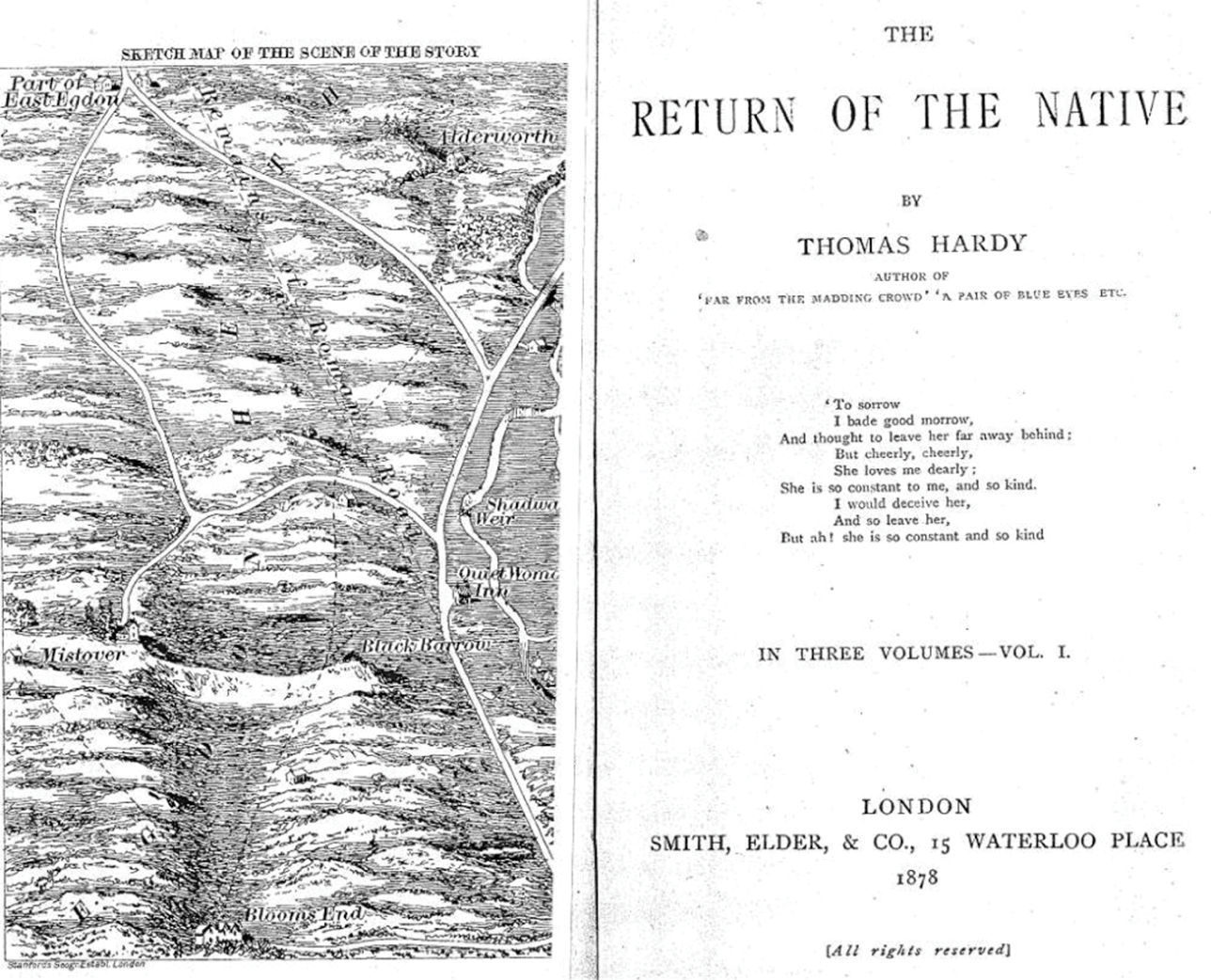
The origins of the Wessex project can be traced back to 1878, when Hardy first pressed his publishers to include “a Sketch of the supposed scene in which the Return of the Native is laid – copied from the one I used in writing the story.” Hardy’s “sketch” was a richly topographical drawing of Egdon Heath, containing the entire action of the novel (Figure 2.1).
Thomas Hardy, frontispiece illustration for The Return of the Native

Hardy explained:
Unity of place is so seldom preserved in novels that a map of the scene of action is as a rule impracticable: but since the present story affords an opportunity of doing so I am of opinion that it would be a desirable novelty, likely to increase a reader’s interest. I may add that a critic once remarked to me that nothing could give such reality to a tale as a map of this sort: & I myself have often felt the same thing.63
By conceiving of the map as a visual confirmation of “unity of place” which would confer “reality to the tale,” and justifying it as a direct response to “a critic,” Hardy was already modeling the response he would make to later objections about his novels’ implausibility. The map that accompanied the Wessex Edition of 1912 represents a massive territorial expansion – one that occurs across, rather than within, individual works. Here the novels’ shared geography encloses them collectively in a kind of time capsule, a geographical archive that preserves them in situ.
If these frontispiece maps were intended, at least in part, to verify the novels’ claims to realism, the world scale of Wessex created complications of its own. The more distant perspective on the whole of Wessex flattens the topographical detail of Hardy’s earlier map, making it two-dimensional, a distancing that also diminishes the relative importance of individual novels and characters. Hardy was aware that extending to such broad geographical horizons could produce nonrealistic effects: either shrinking his characters’ lives to insignificance or, alternately, elevating them to the status of universal subjects. “To be sure,” Hardy wrote, “one might argue that by surveying Europe from a celestial point of vision – as in The Dynasts – that continent becomes virtually a province – a Wessex … even a mere garden.”64 The disproportioning effects of scaling up apply to the novels’ plots as well: Forsyth’s 1912 review of the Wessex Edition praises the “genius” of Hardy’s framing of “humane and universal questions … on the scale of the world,” but lodges a complaint about the novels’ ethical value in the same terms: “How far does art serve culture if it teach[es] that the moral lines which certainly do not converge in this world only continue their tangle in another?”65 Forsyth’s criticism illustrates the incongruity of sustaining realism’s conventional focus on the space and time of daily life while also gesturing toward events on the world scale, highlighting how the disparities between these two points of view produce strong distortions that entangle rather than unbraid the novels’ “moral lines.”
When Swithin and Viviette gaze into the cosmos, or when Angel and Tess imagine other worlds, they are taking up externalized subject-positions (similar to the reader’s) that seem as though they were looking down from another world. Maps help to formalize this externalized point of view.66 From an aerial or global perspective, characters’ lives emerge as mappable plotlines, narrative patterns moving between places, crossing and re-crossing the same paths. Since the events that punctuate Hardy’s novels tend to hinge on the characters being in the right place at the right time for something to happen (or to be prevented from happening), the structure of his plots depends heavily on accurate calculations of speed and distance. Readers familiar with Tess will not be surprised to discover that Hardy drew and consulted detailed maps, and that he gave due consideration to how narrative progress could be spatialized. When Tess contemplates leaving a farm for a day, she must consider that, “Flintcomb-Ash being in the middle of the cretaceous tableland over which no railway had climbed as yet, it would be necessary to walk. And the distance being fifteen miles each way she would have to allow herself a long day for the undertaking by rising early” (301). Tess’s covering thirty miles on foot in a single day is a hardship that the reader encounters, as it were, at ground level, but a reader aided by a map is also encouraged to follow her progress from a much higher vantage, and on a different scale.
The kind of observational distance the maps initiate is manifested in the aesthetic effects of the novel. When Tess starts to work at Flintcomb Ash alongside her friend Marion, the reader is presented this miserable tableau:
[T]he whole field was in colour a desolate drab; it was a complexion without features, as if a face, from chin to brow, should be only an expanse of skin. The sky wore, in another colour, the same likeness; a white vacuity of countenance with the lineaments gone. So these two upper and nether visages confronted each other all day long … without anything standing between them but the two girls crawling over the surface of the former like flies.
The extension of observational distance, in this case, places the reader in an unstable aerial position from which sky and ground are practically indistinguishable – Tess and Marion appear as dots, as flies crawling over the landscape. In certain cases Hardy’s psychogeographical landscapes are so distorted by these kinds of scale effects that they warp the flow of the narrative, as when “strange birds from the North Pole began to arrive silently on the uplands of Flintcomb-Ash.” These birds are, the narrator tells us, “gaunt, spectral creatures with tragical eyes – eyes which had witnessed scenes of cataclysmic horror in inaccessible polar regions of a magnitude such as no human being had ever conceived, in curdling temperatures that no man could endure” (304). Their superhuman suffering is reimagined for us as a classically sublime ordeal, replete with “the crash of icebergs and the slide of snow-hills by the shooting light of the Aurora … by the whirl of colossal storms and terraqueous distortions” (304). These birds may be in Wessex, but their appearance spirits the reader away from an aerial vantage on Tess and Marian and off to distant latitudes. Here, the scales of human perception merge with the nonhuman, through “terraqueous distortions” where water, ice, and land transfuse into chaotic forms beyond linguistic description. And while these distortions of scale again seem to lead away from the plot, the narrator’s hyperstylized excursions only serve to ground Tess more fully within the miserable plot of ground from which she cannot escape.
While in some senses the map of Wessex affords Hardy and his readers an expansive imagined space of narrative possibility, its fixed geography also tends to have the opposite effect, delimiting and sometimes overdetermining the characters’ narrative trajectories. In Hardy’s last novel, Jude the Obscure (1895), the narrative becomes formally engaged with the map to such an extent that the title of each chapter refers merely to the protagonist’s present location (“At Marygreen,” “At Christminster,” etc.). Jude begins to fantasize about Christminster in boyhood because the relatively close proximity of the city to his home village motivates an obsession – a mix of suburban angst and youthful Dick Whittingtonism. From a distance, Jude romanticizes the miniature, calling Christminster “a castle.” As Jude grows, so does his desire for the city, but when he finally closes the distance the scales reverse, and Jude all but disappears into its sprawl of statues and ornaments.
The similarity between the fictional territory of Wessex and the actual county of Dorset and beyond forces the novels to conform to an external geography, and one effect of this formal constraint is that characters whose lives are mapped at a cartographical scale seem to gravitate toward landmarks. Perhaps the most noteworthy example of this effect is Tess’s climactic set piece at Stonehenge. As Tess and Angel Clare flee the scene of Alec D’Urberville’s murder, they travel cross-country in the middle of the night. Passing through a pitch-black, wide-open plain, the pair stumble into a strange and gigantic structure.
Tess’s unwitting pilgrimage to a place of purported heathen sacrifice is richly symbolic; but Stonehenge also makes for a poor hiding place for the fugitive lovers, precisely because of its geography. Under cover of darkness, the pair is safe, but Angel forebodingly recognizes that “This spot is visible for miles by day, although it does not seem so now” (326). This melodramatic tableau becomes the capstone for a novel whose stakes have been raised beyond the pitch of unexaggerated realism. The extreme historical significance of the monument provides a suitable degree of closure for Tess’s narrative excess, a spectacular backdrop for its ending, but including Stonehenge in the events of the novel also elicits the mode of excess that makes the ending climactic. As the ultimate landmark in the region (as it has been for millennia), this spot would be familiar to any reader-as-tourist.67 The suspense and melodrama that attend this scene have to do with harnessing its status as an icon that transcends geographical location – it is, in other words, a mark on the reader’s cognitive map.
In Hardy’s case, then, frontispiece maps help visualize a doubled sense of plot, in which plot conveys both its usual meaning of the progress of narrative action toward closure, and one in which it becomes visible as demarcated space, a circumscribed narrative enclosure. As we have seen, Hardy’s consistent use of the optative mode of unrealized possibility relies heavily on grounding his “ghost plots” within “other worlds.” By expanding beyond the confines of individual novels, Hardy’s map of Wessex adds a new dimension of intertextual possibility, implying that although the line of a character’s plot would end, it could still be traced and thereby contribute to the further reticulation of the territory, affording extinct characters a ghostly retour de personnages.
Hardy’s novels, I have argued, mobilize a wide range of generic alternatives to address the scalar problems of realist representation. Shifting to scales that vastly exceed the lives of individual characters pulls narrative into the mode of melodramatic excess: the longue durées of geologic time intensify suspense; the horizons of the cosmic universe exacerbate longing; the gigantic iconography of Stonehenge produces operatic climax. We have seen how Hardy consistently manipulates scale to achieve his free-indirect narrative style and atmospheric points of view, techniques that can be traced to his claim that “Art is a disproportioning.” Understanding the importance of scalar logic in Hardy’s novels also helps explain why he ultimately turned to maps as devices for unifying his possible worlds. The next chapter will take these concepts further by focusing on how the escalating pace of imperial expansion redefined the horizons of “world scale” and “human scale” at the end of the nineteenth century; on how “scalable” models of colonial expansion brought home a new, terrifying awareness of the planet’s material finitude.

 Open access