

Introduction
AD is the most common form of dementia, and it accounts for an estimated 60–80% of all cases. Its annual incidence rises significantly with age, ranging from 53 new cases per 1,000 persons aged 65–74, to 170 cases per 1,000 persons aged 75–84, and over 230 cases per 1,000 persons aged over 85 (Alzheimer's Association, 2011). AD is characterised by specific biomarkers (e.g., Aβ, tau and cerebral atrophy), and its clinical manifestation includes significant neuropsychological deficits such as memory problems, frequently associated with other cognitive deficits such as aphasia, apraxia and/or agnosia, that significantly interfere with everyday life (McKhann et al., Reference McKhann, Drachman, Folstein, Katzman, Proce and Stadlan1984; Reference McKhann, Knopman, Cherkow, Hyman, Jack and Kawas2011). AD typically affects the patient, their family and their wider social network through its deep impact at physical, psychological and social levels (Cheston & Bender, Reference Cheston and Bender1999; Dourado et al., Reference Dourado, Mograbi, Santos, Sousa, Nogueira and Belfort2014).
Cognitive training in patients affected by AD had been considered unsuccessful for a long time. Twenty years ago, it was claimed that cognitive training appeared to achieve almost negligible, short-term improvements in cognitive functioning, which were not sustained after the end of the training sessions (Rabins, Reference Rabins1996). A consensus statement on interventions for patients with AD corroborated this view, finding limited benefit in psychological approaches (Small et al., Reference Small, Rabins, Barry, Buckholtz, DeKosky and Ferris1997).
However, the perception that cognitive training had limited usefulness in patients with AD has changed in recent years. The rationale for cognitive training in AD is based on evidence regarding the neuropsychology and neuroanatomy of memory impairments in AD and the capacity of the patients with AD to acquire new knowledge (Clare, Wilson, Carter, Hodges, & Adams, Reference Clare, Wilson, Carter, Hodges and Adams2001). Converging evidence clearly indicates that some cognitive subsystems (e.g., procedural memory) remain relatively intact, whilst others (e.g., episodic memory) are dramatically impaired (Brandt & Rich, Reference Brandt, Rich, Baddeley, Wilson and Watts1995; Pause et al., Reference Pause, Zlomuzica, Kinugawa, Mariani, Pietrowsky and Dere2013; Salmon & Bondi, Reference Salmon and Bondi2009). These dissociations are indeed supported also by a developing understanding of the role played by different brain areas in the cognitive processes of memory encoding, storing and retrieval. The brain areas most affected in the early stages of AD are mainly the medial temporal lobe structures, notably the transentorhinal region and the hippocampal complex, which are critical in the consolidation of new episodic memories (Glisky, Reference Glisky and Raz1998; Graham & Hodges, Reference Graham and Hodges1997; Nadel & Moscovitch, Reference Nadel and Moscovitch1997). Therefore, while medial temporal lobe pathology is linked to the failure to rapidly encode new semantic information, other brain structures are involved in the integration of new information with existing knowledge during repeated cognitive training (Glisky, Reference Glisky and Raz1998; Kitchener, Hodges, & McCarthy, Reference Kitchener, Hodges and McCarthy1998). Lastly, recent preliminary evidence has also started to show the positive emotional implications of training in AD (Pezzati et al., Reference Pezzati, Molteni, Bani, Settanta, Di Maggio and Villa2014), thus suggesting the importance of realising effective cognitive training in complex neuropsychiatric conditions (Cavallo et al., Reference Cavallo, Trivelli, Adenzato, Bidoia, Giaretto, Oliva and Picci2013a).
In a recent study, Schecker, Pirnay-Dummer, Schmidtke, Hentrich-Hesse, & Borchardt (Reference Schecker, Pirnay-Dummer, Schmidtke, Hentrich-Hesse and Borchardt2013) involved 42 patients affected by mild AD (all under acetylcholinesterase inhibitor and well adjusted), who were randomised into three groups: a ‘client-centered’ global stimulation group; a cognitive training group focused on working memory abilities; and a control group. Their results showed that client-centered cognitive therapy involved multiple cognitive functions and thus led to a better performance in language processing and functional measures; in addition, cognitive training significantly improved functional measures, while stabilising patients’ performance in the other cognitive areas. In another study, Kanaan et al., Reference Kanaan, McDowd, Colgrove, Burns, Gajewski and Pohl2014 recruited 21 patients affected by mild AD who participated in an intensive computer-based cognitive training (10 days over 2 weeks, with 4 to 5 hours of training a day). They found significant improvement in some neuropsychological measures (Mini-Mental State Examination (MMSE), letter fluency and Trail-Making test), and that these changes were stable at 2- and 4-month follow-ups. More recently, Kim (Reference Kim2015) investigated the effect of cognitive rehabilitation in patients affected by early-stage AD. Interestingly, performance on everyday activities was also taken into account. Forty-three patients were randomised to the cognitive rehabilitation group (receiving structured cognitive intervention) or a control group (receiving an active intervention involving unstructured conversation and health-related videos). Results showed that cognitive rehabilitation was an effective intervention for improving patients’ rating of performance and satisfaction and their quality of life, as compared to the control intervention.
In addition, it has been shown consistently that improvements in the trained cognitive abilities were relatively stable at long-term follow-up (Clare, Wilson, Breen, & Hodges, Reference Clare, Wilson, Breen and Hodges1999; Clare et al., Reference Clare, Wilson, Carter, Gosses, Breen and Hodges2000) and supported the re-learning of activities of daily living (Provencher, Bier, Audet, & Gagnon, Reference Provencher, Bier, Audet and Gagnon2008; Thivierge, Simard, Jean, & Grandmaison, Reference Thivierge, Simard, Jean and Grandmaison2008), although other studies failed to consistently replicate these findings (Farina et al., Reference Farina, Fioravanti, Chiavari, Imbornone, Alberoni and Pomati2002; Grönhoml-Nyman, Rinne, & Laine, Reference Grönhoml-Nyman, Rinne and Laine2010). However, as pointed out by recent systematic reviews (e.g., Bahar-Fuchs, Clare, & Woods, Reference Bahar-Fuchs, Clare and Wood2013; Huntley, Gould, Liu, Smith, & Howard, Reference Huntley, Gould, Liu, Smith and Howard2015), current evidence still does not show in a definite manner the positive impact of cognitive training in AD. Available evidence regarding cognitive training remains limited, due to reduced sample size, lack of long-term follow-ups and primary outcomes measures not always directly related to the aim of the studies.
Our research group recently published a case-study about the efficacy of a new cognitive training called GEO, (Cavallo et al., Reference Cavallo, Cavanna, Harciarek, Johnston, Ostacoli and Angilletta2013b). This study involved an 80 year old female patient diagnosed with early-stage AD, and ten matched healthy subjects. Participants were asked to perform a GEO training task, i.e., a ‘puzzle-like’ task for procedural memory. Both the patient and the healthy controls were subsequently trained using the same task for 2 months, and then their performance was assessed. Although the patient's performance before training was poor compared to healthy controls, after the training these differences disappeared. Our results showed that the patient was not only able to acquire new procedural abilities, but also that her achievements were stable at the 3-month follow-up. However, these interesting but very preliminary results left us with some open questions: First, would it be possible to detect the positive effects of the training not only in a single patient, but also in a large group of patients? Second, even if these results could be demonstrated on a larger scale, would they be stable over time?
To answer these questions, in the present study we used the GEO ‘puzzle-like’ task and followed the procedure described in our previous work (Cavallo et al., Reference Cavallo, Cavanna, Harciarek, Johnston, Ostacoli and Angilletta2013b). We recruited a large group of early-stage AD patients (N = 40) and a large group of healthy controls (N = 40), and we involved all of them in the GEO training. Our twofold aim was to identify the effects of the cognitive training in the overall group of patients as compared to healthy controls, and to investigate whether its effects were stable after 12 months.
Material and Methods
Participants: The present study involved 40 patients with early-stage AD and 40 healthy controls. Patients with early-stage AD were consecutively recruited over two years (from January 2012 until December 2013) in the Assisted Health Residence ‘Ville Roddolo’ (Moncalieri, Italy). Their demographic characteristics were: 13 males and 27 females, age range 66–86, mean 75.50 ± 4.88 years, educational level 8.53 ± 3.00 years, mean duration of illness to time of testing 2.49 ± 0.72 years. Exclusion criteria were: the additional presence of other neurological and/or psychiatric disorders such as traumatic brain injuries, strokes or psychosis, a positive history of alcohol or drug abuse, the presence of any significant general health co-morbidities (e.g., diabetes or hypertension), and the presence of significant sensory impairments and/or extremely severe communication problems that could seriously compromise both the administration of cognitive tests and the interpretation of the relative results and the implementation of the cognitive training. All patients were referred for progressing memory problems, which often resulted in embarrassing (e.g., they tended to forget names of members of the family, or very basic information about their recent past) or dangerous (e.g., they forgot to shut off the gas a few times after cooking, and they tended to forget where the car had been parked) behaviours. Before the beginning of the present study, a comprehensive clinical assessment, including consecutive brain MRI scans, was arranged by Consultant Neurologists, who made a diagnosis of early-stage probable AD, according to standard NINCDS-ADRDA diagnostic criteria (McKhann et al., Reference McKhann, Drachman, Folstein, Katzman, Proce and Stadlan1984). After the diagnosis, they commenced pharmacotherapy with acetylcholinesterase inhibitors.
With regards to the control group, 60 potential participants recruited from the same Assisted Health Residence were carefully screened in order to identify persons with no significant health problems such as cognitive impairment, diabetes, hypertension and neuropsychiatric disorders. At the end of the screening stage, 40 healthy controls (16 males and 24 females, age range 68–84, mean age 76.33 ± 3.83 years, mean years of formal education 8.35 ± 2.79) participated in the study. All of them were living in the Assisted Health Residence ‘Ville Roddolo’ as they were not married, or were widows with no children or other significant family members, and due to their advanced age they preferred sharing an assisted living environment while maintaining regular activities outside the Residence (e.g., playing bowls, to volunteer in the library or in schools, and so on). Through a careful analysis of their clinical records and a detailed clinical interview (based on Green, Reference Green2000), we were able to exclude the presence of past or current substance abuse. In addition, none of the healthy controls were related to the patients involved in the study.
The study was granted approval by the local Research Ethics Committee. Informed written consent was obtained from all participants, and from the patients’ caregivers.
Neuropsychological assessment: All participants underwent a detailed neuropsychological assessment by an experienced neuropsychologist (M.C.), in order to obtain detailed information about their performance across a wide range of cognitive domains. We administered exactly the same tests used in a previous case-study (Cavallo et al., Reference Cavallo, Cavanna, Harciarek, Johnston, Ostacoli and Angilletta2013b). Specifically, the MMSE (Folstein, Folstein, & McHugh, Reference Folstein, Folstein and McHugh1975) and the Short Intelligence Test (Test di Intelligenza Breve, T.I.B., Colombo, Sartori, & Brivio, Reference Colombo, Sartori and Brivio2002) were administered, as a screening measure for cognitive impairment and a measure of premorbid Intelligence Quotient, respectively. Memory was assessed by administering digit span backwards (Wechsler, Reference Wechsler1987), the two-syllable words repetition test (Spinnler & Tognoni, Reference Spinnler and Tognoni1987), and the Rivermead Behavioural Memory Test (RBMT; Wilson, Cockburn, & Baddeley, Reference Wilson, Cockburn and Baddeley1985). Attention was assessed by administering digit span forward (Wechsler, Reference Wechsler1987). Semantic knowledge was assessed by the Graded Naming test (McKenna & Warrington, Reference McKenna and Warrington1983). Language was assessed by the Token test (De Renzi & Vignolo, Reference De Renzi and Vignolo1962). Visuospatial abilities were assessed using three subtests of the Visual Object and Space Perception Battery (VOSP) (Warrington & James, Reference Warrington and James1991): object decision, position discrimination and number location. Executive tasks included both timed and untimed tests. Timed tests encompassed letter (F, A, S) and category (animals) spoken verbal fluency tasks (Novelli et al., Reference Novelli, Papagno, Capitani, Laiacona, Cappa and Vallar1986), as well as the Hayling Sentence Completion test (Burgess & Shallice, Reference Burgess and Shallice1997). As an untimed executive test, participants were administered the Brixton test (Burgess & Shallice, Reference Burgess and Shallice1997).
Neuropsychiatric assessment: Emotional disturbances were investigated by administering the Hospital Anxiety and Depression Scale (HADS; Zigmond & Snaith, Reference Zigmond and Snaith1983), a brief self-assessment scale that provides a valid and reliable measure of severity of anxiety and depression.
Cognitive training (GEO): The exercise used for the cognitive training had been already described in our previous study (Cavallo et al., Reference Cavallo, Cavanna, Harciarek, Johnston, Ostacoli and Angilletta2013b). We presented to the participants (both patients and healthy controls) a simplified model of the world that required subjects to arrange 16 countries in their right place in the shortest possible time, in a ‘puzzle-like’ fashion. The 16 wooden pieces (each representing one country or group of countries) varied in dimensions and colours, and all of them were colorful, light and easy to handle. A fixed order of the pieces was set up in front of the participant every time (see Figure 1 to get a flavour of the equipment used). Participants were invited to start from the easier pieces (e.g., the bigger ones), in order to complete the whole task quickly.
The geographical material used.

This task (puzzle-like task) made up the cognitive training used throughout the study (GEO). Each participant underwent the ‘puzzle-like’ task at the beginning of the study (T0), and the time of completion was recorded. Lower scores (i.e., completion time in seconds) represent better performance. During the course of the training, each participant underwent an individual session of practice with GEO three times a week for 2 months (with each session lasting about 20 minutes), and then their performance was recorded again (T1). At this stage the training stopped, and a 12-month follow-up session was scheduled (T2).
Only four participants were not available at the follow-up (two patients and two healthy controls), as they had moved from the Residence. At follow-up, a complete neuropsychological assessment of all of the participants was repeated, to investigate possible change in their cognitive profiles over time. The assessment sessions for each participant at each testing point (T0, T1 and T2) were video-recorded. Two experienced nurses, not involved in the design of the study and blind to the purposes of it, examined the recorded sessions in order to identify and register the time of completion in seconds. The inter-rater agreement between the two raters was high (Cohen's K = 0.84): the disagreement about few scores was resolved by discussion. To keep track of participants’ awareness about the proposed tasks, at the beginning of each training session participants were asked to answer the following question: ‘Have you ever done this task before?’ Then, the verbal instructions given to the participant were: ‘You can see in front of you a simplified model of the world. You can see a number of pieces that represent countries as well, and your job is to locate these pieces in the right place in the model of the world. Try to do the task as soon as you can, starting with the pieces you consider easier’. At the end of the task, the examiner always said: ‘Well done. Now, I would like you to repeat the same exercise. You did very well. Keep up the good work!’
Descriptive statistical analyses were performed using IBM SPSS Statistics (Statistical Package for the Social Sciences) version 21.0. As the graphical and statistical exploration of the data by means of box plots, histograms, Q–Q plots and normality tests indicated normal distributions, parametric tests were used. First, comparisons of the patients’ scores with healthy controls’ scores on background neuropsychological and neuropsychiatric measures were performed by means of t-tests for independent samples. Second, comparisons of the patients’ scores with healthy controls’ scores on background neuropsychological and neuropsychiatric measures were performed again at the 12-month follow-up, to show possible changes in their neuropsychological profile over time. Lastly, in order to investigate the possible longitudinal effect of the GEO training, a Repeated Measure General Linear Model (RM-GLM) was run by considering participants’ performance on the GEO at the three assessment points (i.e., T0, T1 and T2) as the within-subjects variable, and ‘group’ as the between-subjects factor. A p value < 0.05 was considered statistically significant throughout the analyses.
Results
Baseline neuropsychological assessment: The two groups of participants (patients with AD and healthy controls) underwent a detailed neuropsychological assessment before the beginning of the cognitive training. Patients’ scores were significantly worse than controls’ scores on the following tests: MMSE (t(78) = 26.972, p < 0.001), digit span-forward (t(78) = 3.947, p < 0.001), digit span-backward (t(78) = 4.485, p < 0.001), two-syllable words repetition test (t(78) = 10.077, p < 0.001), RBMT-standardised profile score (t(78) = 35.631, p < 0.001), RBMT-story immediate (t(78) = 35.016, p < 0.001), RBMT-story delayed (t(78) = 24.155, p < 0.001), and Brixton test (t(78) = 3.533, p = 0.01). Regarding all of the other neuropsychological measures administered, patients’ performance did not differ significantly from healthy controls’ performance. Participants’ scores and the statistical comparisons of interest are shown in Table 1.
Demographic Data and Participants’ Baseline Performance on Background Neuropsychological Measures

*p < 0.001; IQ = Intelligence Quotient; GNT = Graded Naming Test; MMSE = Mini-Mental State Examination; NS = not significant; RBMT = Rivermead Behavioural Memory Test; SD = standard deviation; T.I.B. = Test di Intelligenza Breve (short intelligence test); VOSP = Visual Object and Space Perception battery.
Baseline neuropsychiatric assessment: The comparison of patients’ and healthy controls’ scores on the HADS did not show any statistically significant difference (anxiety: patients’ score = 7.50 ± 2.78, healthy controls’ score = 6.97 ± 2.29; t(78) = 0.921, NS; depression: patients’ score = 7.87 ± 2.81, healthy controls’ score = 7.05 ± 2.31; t(78) = 1.434, NS).
GEO task: In order to investigate the possible longitudinal effect of the GEO training, a RM-GLM was run by considering participants’ performance on the GEO at the three assessment points (i.e., T0, T1 and T2) as the within-subjects variable, and ‘group’ as the between-subjects factor.
Mauchly's test indicated that the assumption of sphericity had been violated (Chi-squared = 36.549, p < 0.001), thus degrees of freedom were corrected using Greenhouse–Geisser estimates of sphericity. The results showed that there was a significant main effect of ‘group’: F (1.451, 113.215) = 2,222.22, p < 0.001, and also an interesting significant effect of the interaction between ‘group’ and ‘time’: F (1.451, 113.215) = 674.06, p < 0.001.
Please see Table 2 for details. Figure 2 shows graphically these comparisons of interest.
Results of the GEO Task (in seconds) at the Three Assessment Points (T0, T1, T2). Lower Scores Indicate Better Performance
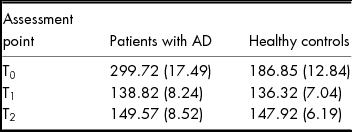
AD = Alzheimer's disease; HC = healthy controls; NS = not significant; T0 = assessment at the beginning of the study; T1 = assessment after the training; T2 = assessment at follow-up.
Neuropsychological follow-up: Four participants (two patients and two controls) were not available at the 12-month follow-up (they moved from Assisted Health Residence earlier). The two groups of participants (patients with AD and healthy controls) underwent a detailed neuropsychological assessment also at the follow-up (12 months after the end of the cognitive training). Patients’ scores were significantly worse than controls’ scores on the following tests: MMSE (t(74) = 35.111, p < 0.001), digit span-forward (t(74) = 5.449, p < 0.001), digit span-backward (t(74) = 5.297, p < 0.001), two-syllable words repetition test (t(74) = 11.216, p < 0.001), RBMT-standardised profile score (t(74) = 37.749, p < 0.001), RBMT-story immediate (t(74) = 26.048, p < 0.001), RBMT-story delayed (t(74) = 19.349, p < 0.001), Verbal fluency-category (t(74) = 3.178, p = 0.02), Hayling test (t(74) = 2.884, p = 0.005), and Brixton test (t(74) = 3.533, p = 0.001). Regarding the other neuropsychological measures administered, patients’ performance did not differ significantly from healthy controls’ performance. Participants’ scores and the statistical comparisons of interest between the two groups are shown in Table 3.
Participants’ Scores on Background Neuropsychological Measures at the 12-Month Follow-Up

*p < 0.001; IQ = Intelligence Quotient; GNT = Graded Naming Test; MMSE = Mini-Mental State Examination; NS = not significant; RBMT = Rivermead Behavioural Memory Test; SD = standard deviation; T.I.B. = Test di Intelligenza Breve (short intelligence test); VOSP = Visual Object and Space Perception battery.
Participants’ performance (in seconds) on the GEO task at the three assessment points (T0, T1, T2).

Neuropsychiatric follow-up: Again, the comparison of patients’ and healthy controls’ scores on the HADS did not show any statistically significant difference (anxiety: patients’ score = 8.07 ± 2.63, healthy controls’ score = 7.55 ± 2.54; t(74) = 0.909, p = 0.143; depression: patients’ score = 8.45 ± 2.18, healthy controls’ score = 7.92 ± 2.22; t(74) = 1.066, p = 0.161).
When the question, ‘Have you ever done this task before?’ was asked to the participants at the beginning of each day of training, patients always replied ‘No’, while all of the healthy controls always answered affirmatively after the first session of training.
Discussion
Cognitive training in AD had been considered of little utility for a long time. Only in recent years, a growing amount of evidence began to challenge this traditional view, suggesting that patients undergoing structured cognitive training can show significant improvements compared to untrained patients (Loewenstein, Acevedo, Czaja, & Duara, Reference Loewenstein, Acevedo, Czaja and Duara2004; Clare & Jones, Reference Clare and Jones2008). However, important issues pertain to the possibility of detecting the effects of training on a group level, and investigating the degree of stability once the training has finished. So far, systematic reviews have failed to show a consistent and significant positive impact of cognitive training in mild to moderate AD.
In the present, case-control study we involved two groups of participants (patients with AD and healthy controls) in structured cognitive training encompassing a ‘puzzle-like’ geographical task. Patients and healthy controls recruited for this study were well-matched in terms of age, gender, pre-morbid IQ and level of formal education. In addition, the comparison of patients’ and controls’ performance on the neuropsychological measures administered showed that only a few measures reflected a significant difference in their performance, corroborating the fact that the patients involved were at the early stages of their condition. More precisely, patients’ performance was significantly worse than controls’ performance on the MMSE, the digit span (forward and backward), the two-syllable words repetition test, the RBMT, and the Brixton test only, whilst the other measures did not show any significant difference between the two groups. Thus, we were confident that the patients were not too cognitively compromised to be involved in this type of cognitive training.
In order to take into account the possibility that cognitive performance was influenced by neuropsychiatric factors, we investigated the presence of possible differences between patients and healthy controls in terms of anxiety and depressive symptoms, as measured by the HADS. Of note, levels of anxiety and depression did not differ significantly between the two groups either at the beginning of the training or at the 12-month follow-up, allowing us to exclude significant differences between the two groups in terms of mood state.
Regarding the exercise used in this study (the GEO ‘puzzle-like’ task), although it is possible to assume that semantic knowledge could be involved (i.e., knowing were South Africa is may help the participant to locate the piece representing South Africa more easily), from a qualitative point of view it is relevant to note that the participants’ initial performance (i.e., T0) was characterised by some errors, whereas during the training they followed the suggestion of starting with the easier pieces (i.e., the bigger ones) in order to avoid making errors. Thus, it can be reasonably assumed that the performance on this task relied more on procedural knowledge (i.e., learning progressively where the pieces should be located correctly to perform the task quickly) than on semantic knowledge.
Interestingly, we found a significant longitudinal effect in patients’ performance, compared to healthy controls. More specifically, the results of the RM-GLM procedure showed a significant main effect of ‘group’, and an additional significant effect of the interaction term ‘group x assessment points’ (i.e., the training influenced each group in a different way during the course of the study). As expected, the initial performance (T0) was significantly different between the two groups, with AD patients performing more poorly, compared to controls. However, at the end of the 2 month training patients’ and healthy controls’ performances were virtually identical. Surprisingly, the same happened at the 12-month follow-up, providing strong evidence of the stability over a long period of time (12 months) of the results achieved immediately after the training. Our pattern of results suggests that the learning of new procedures is still possible in patients with early-stage AD, and above all that these achievements can be maintained for at least 12 months after the end of the training.
It is interesting to note that both patients and healthy controls showed an improvement in their performance over time, even if a greater improvement was observed in AD patients, as compared to controls. A possible explanation may be that a greater improvement can be expected in subjects that have some cognitive impairment at baseline, as they could fruitfully benefit from the training and gain a significant improvement in their performance. Conversely, the potential for improvement is likely to be lower in healthy controls, who are typically already good at baseline. However, future studies should specifically clarify this issue.
A noteworthy finding was that stability in maintaining what patients acquired during training was clear despite the presence of a subtle cognitive decline over time, as shown by the results of the detailed neuropsychological assessment performed at the 12-month follow-up that detected significant differences between the two group in the verbal fluency ‘category’ and in the Hayling test, in addition to the measures already identified at the beginning of the study.
There are various strengths of this study. First, a very detailed neuropsychological assessment was conducted at the beginning and at the end of the study, and the performance on the GEO task of a large group of patients was compared to a large group of well-matched healthy controls: this allowed us to directly compare patients’ performance with the performance of a control group undergoing the same cognitive training. Second, the GEO task administered during the training only required a few minutes to be completed: therefore, the short duration of training sessions (around 20 minutes each) allowed us to implement cognitive training that was not too demanding for participants. Lastly, the follow-up allowed us to investigate the stability of the results achieved during the training after one year: the vast majority of participants were available at follow-up (76/80, i.e., 95%), and we were happy to see that patients maintained very good performance on the GEO task after such a long period of time.
This study also has some limitations: First, we did not include a control group (AD patients not undergoing the cognitive training) to observe patients’ performance on the GEO task in the absence of a specific training, and thus we did not have the possibility to randomise patients between these two groups. Second, we did not investigate the possible generalisation of the capacities acquired during the training to other experimental tasks, in order to see whether these acquired abilities may be effectively applied to cognitive tasks other than the one used during this training. We investigated whether the training had an impact on background neuropsychological measures (data not shown). Based on these statistical comparisons, we did not observe a significant positive impact of cognitive training on background neuropsychological measures, in terms of their improvement. As expected, what we actually observed was a very mild decrease of patients’ performance over time, and stability in the healthy controls’ performance. Speculatively, we could then suggest that a cognitive training like the one we utilised might play a role in contrasting the decay of cognitive performance in patients. However, this definitely remains an important issue for future studies, in which control groups of patients not undergoing the training may help to clarify this situation.
In addition, while the GEO task is challenging but enjoyable, it has no immediate practical utility for patients; a next step would be to implement cognitive training designed with ecological validity in mind. The starting point would be to identify with patients and caregivers everyday actions that are important for them (e.g., remembering to take medications appropriately, or checking the gas tap each time they enter the kitchen room). Then, patients should be trained to repeat over and over this specific action (e.g., take the medication in the correct order each time an alarm clock rings) instead of repeating verbally these instructions to the patient or writing them down for him/her. In doing this, patients will be required to depend more on procedural knowledge (that can be at least partially trained, as shown) than on declarative knowledge (that is significantly impaired in the early stages of this condition already). Our research group is currently working in this direction.
In conclusion, in the present study patients were able to acquire and retain newly acquired procedural abilities for a long period of time. These findings should prompt further investigations in order to identify the degree of learning that patients affected by early-stage AD can achieve, and the degree of stability and generalisability of their newly acquired skills.
Acknowledgements
We would like to thank the participants involved in the study for their time and efforts. The submission of this paper was strongly encouraged by the World Federation of Neurology – Research Group on Aphasia, Dementia and Cognitive Disorders (WFN-RGADCD).
Financial support
While preparing this manuscript, Dr. Marco Cavallo was receiving a European grant (Program: ICT Policy Support Programme, Call: CIP-ICT-PSP-2013-7, Funding scheme: Pilot Type A - CIP-ICT-PSP-PA, Activity: CIP7-Theme 3 - ICT for health, ageing well and inclusion).
Conflict of Interest
None.
Ethical Standards
The authors assert that all procedures contributing to this work comply with the ethical standards of the relevant national and institutional committees on human experimentation and with the Helsinki Declaration of 1975, as revised in 2008.



