

Introduction
Emergency departments (ED) have long been considered as an intervention point for a suicidal crisis. Although EDs are often not the most appropriate setting, they may be the only available service for a suicide crisis; vulnerable populations with lack of access to out of hours community mental health services, mainly adolescents (Farooq et al. Reference Farooq, Clements, Hawton, Geulayov, Casey, Waters, Ness, Patel, Kelly, Townsend, Appleby and Kapur2021; McNicholas, Reference McNicholas2018; Newton et al. Reference Newton, Hamm, Bethell, Rhodes, Bryan, Tjosvold, Ali, Logue and Manion2010) and those experiencing racial/ethnic disparities have relied on the accessibility of emergency services (Zhang et al. Reference Zhang, Carabello, Hill, Bell, Stephenson and Mahajan2020).
Health disparities recorded at the ED level, for ethnic minorities, have been used as a proxy to highlight one of the main reasons of health inequities, racism (Zhang et al. Reference Zhang, Carabello, Hill, Bell, Stephenson and Mahajan2020). In the context of ED self-harm presentations, Black and minority ethnic (BME) communities have higher self-harm rates compared to White populations, however they are less likely to receive a psychiatric assessment compared to the White patients (Cooper et al., Reference Cooper, Murphy, Webb, Hawton, Bergen, Waters and Kapur2010). When focusing on Indigenous populations, Australian evidence on suicidal presentations to EDs from 2009 – 2018 shows that Indigenous communities have 2.8-times higher rate ratios (95% CI 2.62 – 2.93) than non-Indigenous community members and higher odds to have multiple presentations (OR = 1.61: 95% CI 1.38 – 1.87) (Stapelberg et al. Reference Stapelberg, Sveticic, Hughes and Turner2020).
In Ireland, the Traveller Indigenous community has a higher risk of ED presentations for a suicidal crisis, compared to White Irish people, with the highest rate of self-harm observed among Travellers over the age of 50 (Kavalidou et al. Reference Kavalidou, Daly, McTernan and Corcoran2023). Similarly to other Indigenous communities (Kairuz et al. Reference Kairuz, Casanelia, Bennett-Brook, Coombes and Yadav2021) discrimination and racism have negatively impacted on the health disparities between Traveller and non-Traveller people (Hodgins and Fox, Reference Hodgins and Fox2014). The issue of trust from the wider settled community towards young Travellers has further explained their cultural isolation and racialisation (Joyce, Reference Joyce2018). A recent linkage cohort study has further presented that Irish Traveller females residing in England and Wales have double the suicide rate than that of the White compared population (2·26 [1·42 – 3·58) (Knipe et al. Reference Knipe, Moran, Howe, Karlsen, Kapur, Revie and John2024).
Objectives and aim
Little in-depth knowledge exists on the experiences or clinical needs of the Traveller female community when attending EDs with a suicidal crisis. The aim of the current study was, a) to present the risk of self-harm and suicidal ideation hospital presentations, for Traveller females, nationally in Ireland between 2018 – 2022, and b) to explore the emotional, personal and service support needed and received for Traveller women who have thoughts of suicide and attend acute hospitals in Ireland.
Methods
Study design and setting
We used a sequential mixed method design, combining quantitative and qualitative methods. For the quantitative analyses, we conducted a population-based cohort analysis including anonymised and de-identifiable presentation data of suicide-related ideation and self-harm obtained through the database of a national ED service in Ireland (National Clinical Programme for Self-Harm and Suicide-Related Ideation; NCPSHI) (HSE, 2022). For the current study, all available data from 2018 – 2022 were analysed. We used individual interviews and Interpretative Phenomenological Analysis (IPA) to explore the lived and contextual experiences of Traveller women who had sought help for suicidal ideation at the NCPSHI ED services.
Interview recruitment
Recruiting participants for subsequent interviews was achieved through purposive sampling from ten ED services in 2023, with a proportion of 3% or more Traveller women presentations (hospitals are not presented in order to protect participant’s anonymity). For the in-depth semi-structured interviews, when a Traveller woman presented to each ED and was assessed after a suicidal ideation presentation, the clinical nurse specialist (CNS) gave her a leaflet for the study and verbally explained how to contact the researcher of the study to schedule an interview. As per leaflet, the participants were informed that they would be compensated if they would agree to be interviewed. A set of predetermined questions provided a framework for the interviews, allowing flexibility for the interviewer to use accessible language when asking questions in order for the participant to understand and express themselves. Olmos-Vega and colleagues define reflexivity as a continuous, collaborative process that should be embedded within the research team throughout the study (Olmos-Vega et al. Reference Olmos-Vega, Stalmeijer, Varpio and Kahlke2023). It requires critical reflection on personal, interpersonal, methodological, and contextual influences that shape the research. To ensure the integrity of the interviews, researchers employed reflexive practices such as keeping reflective journals and engaging in critical self-questioning to acknowledge and mitigate personal biases. In addition, validation strategies were used, including peer debriefing and maintaining an audit trail to enhance the trustworthiness of the data. Each interview was conducted by a member of the research team. All interviews were recorded for accuracy.
Analysis and outcome measures
Quantitative data
Sociodemographic information such as female gender, 10-year age bands, and ethnic background, for the years 2018 – 2022, were used. The list of ethnic groups recorded follows the Irish national census categories and includes: White Irish; White, any other; White Irish Traveller; Asian or Asian Irish - Chinese; Black or Black Irish - any other background; Black or Black Irish - African; Other, mixed background; Arab; Unknown/Not Specified. All presentations in terms of suicide-related ideation (thoughts of self-harm or thoughts of suicide) and self-harm acts were further used. Given the small number of self-harm ideation presentations, suicidal and self-harm ideation are combined for statistical power.
Assessment information on whether a person was currently attending mental health services when presented to the ED, referral patterns, next of kin involvement in suicide prevention, follow-up calls from clinicians assessing the patients and next care referrals were further utilised in analyses. Ethnic differences on clinical and aftercare characteristics were tested using χ2 tests. Effect sizes (ES) for the level of association in chi-squares are presented (Cramér’s V) with a significant level set at < 0.05. NCPSHI presentation numbers, per National Census populationFootnote 1 , and Poisson regression was used to assess the 5-year age-adjusted relative risk (2018 – 2022), of self-harm and suicide-related ideation by ethnic group, using rate ratios (with 95% confidence intervals), and White Irish females as the reference group. Data analysis was performed with the Statistical Package for Social Sciences SPSS version 27 (SPSS Inc., Chicago, IL, USA), excel and STATA.
Qualitative data
Interview data were analysed using Interpretive Phenomenological Analysis, to create a comprehensive and systematic documentation of the themes and topics discussed in the interviews, linking them together within a thorough category system (Smith et al. Reference Smith, Flowers and Osborn2013; Smith and Nizza, Reference Smith and Nizza2022). The analysis process followed the steps outlined by Smith et al. (Reference Smith and Nizza2022) for IPA analysis. Initially, the researchers thoroughly read and re-read participants’ interview transcripts to immerse themselves in the data. Subsequently, they engaged in initial noting, which entailed reviewing each participant’s interview transcript and making descriptive, linguistic, and conceptual comments. Next, “Experiential Statements” were constructed from which “Personal Experiential Themes” (PETs) were derived. Once PETs were identified for each interview, they were examined collectively, guided by the search for patterns in participants’ experiences. Finally, a comprehensive framework of cross-case “Group Experiential Themes” (GETs) was developed. Based on the objective of this study, only the theme related to the experiences of support, personal and professional, is presented.
Lived experience involvement and diversity
A lived experience Traveller woman working as a family and access worker was recruited as a Patient and Public Involvement (PPI) member and shaped the interview recruitment design, participant’s reimbursement process and dissemination of current findings through an accessible animated video (Supplementary Table 2). Two further Traveller women were recruited for the above co-produced dissemination video. The lead author is a disabled woman from the ethnic minority of the Pontian community of the Black Sea/Pontos.
Results
Quantitative results
Between 2018-2022 there were 37,367 female presentations presenting to the NCPSHI services for both self-harm and suicide-related ideation, of whom 2.7% were from Traveller females (n = 999). Clinical nurse specialists of self-harm (CNS) or/and junior consultants (called NCHD in Ireland) assessed 90% (n = 33,748) of all female presentations; similarly, 89% (n = 693) of all Traveller females went through a clinical assessment. From all females presenting, 14% (n = 5,335) were admitted to a psychiatric inpatient unit, and this was significantly different between ethnic groups, with a higher proportion of Traveller females being admitted, compared to rest of ethnic groups (20% of Traveller females vs 14% of White Irish, (χ2 = 46·33, df (6), p < ·001).
When compared to the White Irish females, the highest rate ratio of a suicidal ideation presentation was observed for the 40 – 49 age group of Traveller females (7.81, 95% CI 6·39 – 9·55), followed by those 50 years of age and older, (5·19, 95% CI 3·87 – 6·97; Table 1). Traveller women over 50 years of age had the highest rate ratio of a self-harm presentation (6·41, 95% CI 5·04 – 8·15; Table 2). Supplementary table presents the 5-year ED presentations per 100,000 (95% CI) for self-harm or suicide-related ideation that were used to calculate rate ratios.
Presentation-based age-specific rate ratios (95% CI) due to suicide-related ideation by ethnicity and female sex 2018–2022

Presentation-based age-specific rate ratios (95% CI) due to self-harm by ethnicity and female sex 2018–2022

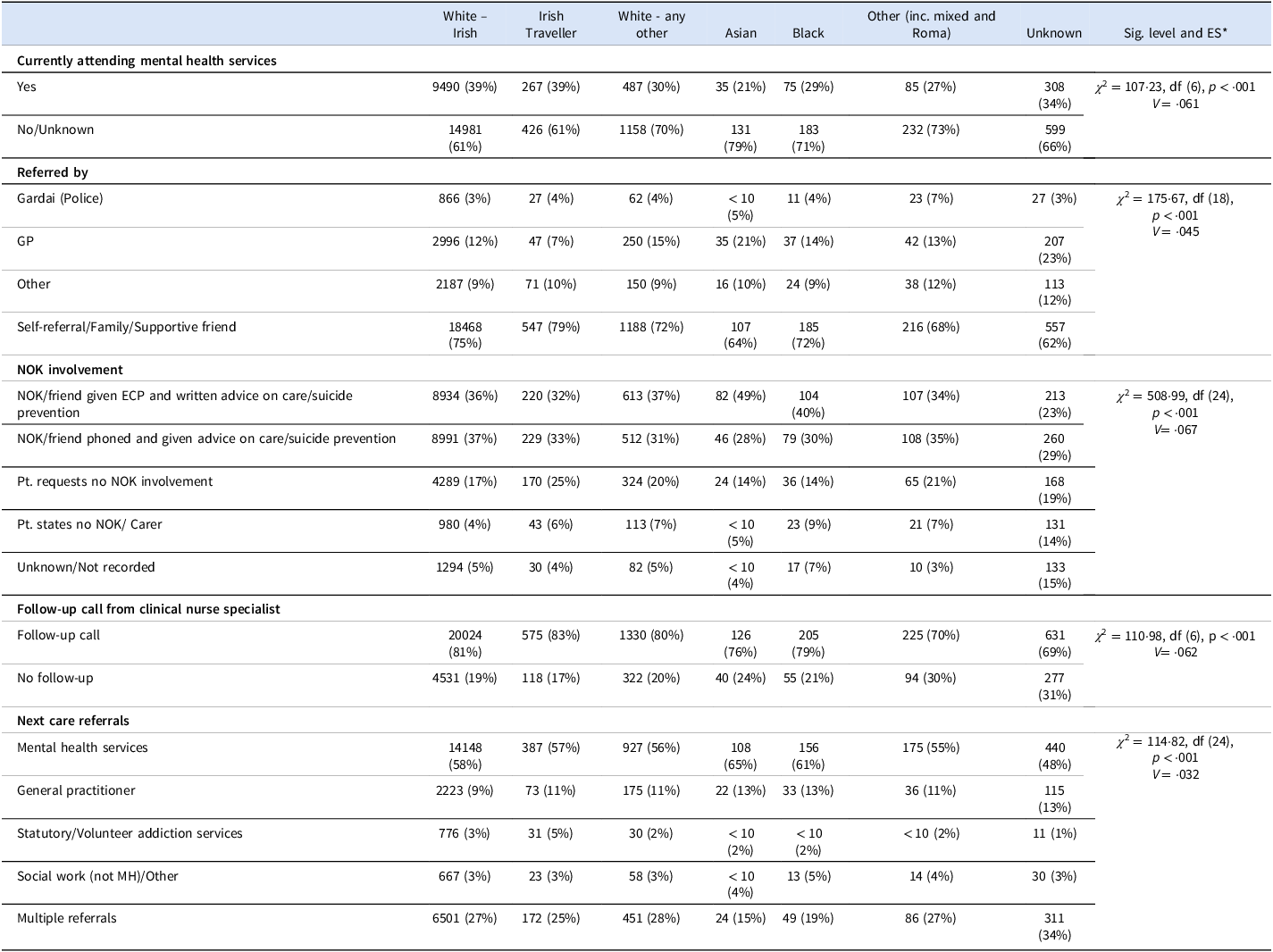
A significant proportion of Traveller women assessed (39%, n = 267) were attending mental health services when presented to the ED, a similar proportion of White Irish women (Table 3). Traveller women were less likely to be referred to the ED by a general practitioner (GP; 7%), compared to other women, but had a higher self-referral presentation (including referred by/with a family or friend; 79%). A significant proportion of female Travellers requested no next of kin involvement regarding suicide prevention advice/call (25%), which was the highest proportion compared to all other women. 83% of Traveller women received a follow-up call from a CNS within 72 hours post assessment (Table 3). The next care referral information indicated that a higher proportion of Traveller women were referred to addiction services, either statutory or volunteer.
Assessment information on the support services and next of kin involvement of women referred to the NCPSHI services between 2018–2022, by ethnicity

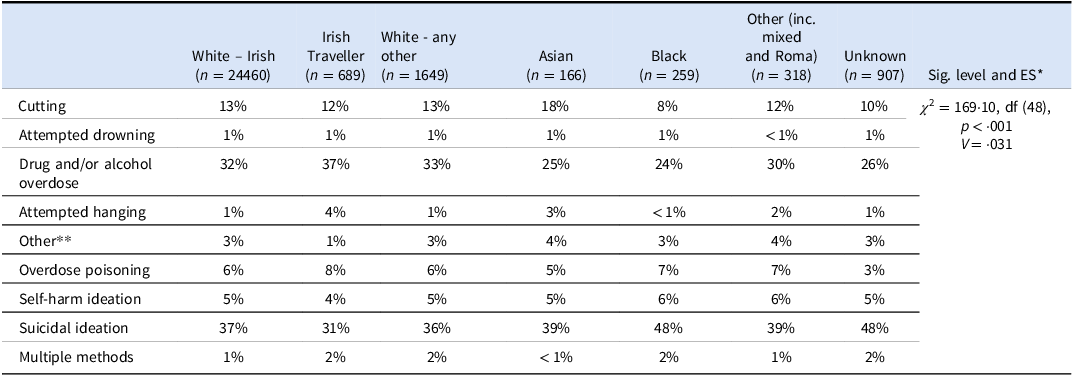
Drug and/or alcohol overdose, attempted hanging and overdose poisoning were significantly more prevalent among the female Traveller community (Table 4), while Traveller women seemed to present less with suicidal ideation (31%), compared to rest of females of all other ethnicities.
Proportion and type of presentation of females assessed between 2018–2022, by ethnicity and unknown

Qualitative results
The response rate of recruiting participants from 10 EDs was 13% (n = 16 leaflets provided in total), during September-November 2023. Two participants from various regions across the Republic of Ireland, sharing similar socioeconomic backgrounds, participated in the interviews. To ensure confidentiality, all identifying details have been either omitted or altered, and pseudonyms have been assigned to safeguard participant anonymity. Quotations delineating and shedding light on the convergence and divergence across participants’ narratives, are presented.
The experiential theme of ‘Power of human connection’ emerged and reflects the enormity and powerfulness of support in the participants experiences of suicidal ideation and human distress. Participants identified support from their partners, partner support as impactful; services support, impact of clinicians and services support; and thirdly Traveller community organisations support.
From participant accounts they described the importance and impact of their partners support. Grace described how listening in a non-judgemental manner from her partner was helpful:
“..like my partner. He listens to me, and doesn’t judge me or anything. He’s very good to me. He sits down and listens to what I go through and stuff like that. But he advises me to do the right thing. So at least I have that support”.
(Grace p 11).
Sophie on the other hand described having no support and in her attempt to make sense of this lack of support identified that her partner experienced addiction difficulties which impacted on his ability to provide support.
“I have no support, I have no one. My husband is an alcoholic”.
(Sophie p.10).
Grace’s trust and connection with her partner highlights the importance of supportive relationships in providing a sense of emotional security and validation, allowing individuals to share their experiences openly and safely which was welcomed by this participant. Grace clearly felt validated and accepted by her partner, who listened to her struggles without judgment. Another aspect of Grace’s account that was important relates to how her partner offers advise and this is experienced as supportive. This combination of emotional support and practical guidance demonstrates the nature of supportive connected relationships in aiding Graces well-being.
Sophie’s account reflects a sense of isolation and loneliness, emphasising their lack of support from their partner leading to feelings of alienation and disconnection from others. The participant’s description of having “no support” and feeling alone implies a loss of agency and autonomy in her own life. Her partners difficulties with addiction further diminish the participant’s sense of control over her life and relationships, contributing to feelings of powerlessness. The participant’s expression of their situation highlights the challenges faced by individuals who lack such support systems.
Regarding the impact of clinicians and services support subtheme, it is evident the importance of connected relationships with clinicians and services. Sophie described in powerful imagery her experience of not feeling supported by clinicians:
“There are social workers there, but they didn’t give any support no times”
(Sophie p 14).
“My social worker, they hide behind cold chair. That I’m suicidal, that I’m cutting myself over me kids. That the social worker is doing this … they’re not doing nothing”.
(Sophie p 15).
Sophie described their social worker as “hiding behind a cold chair” suggesting a perception of emotional distance and lack of engagement from the professional. This highlights the importance of trust and positive interpersonal dynamics in therapeutic relationships and importance of connection with professionals to help alleviate emotional distress. Despite the seriousness of Sophie’s situation, the participant feels that their social worker is not taking effective action to address their needs thereby exacerbating feelings of frustration and hopelessness, particularly when individuals are in crisis and seeking support. Furthermore, Sophie experienced a sense of betrayal or abandonment by the social worker, who they felt was not fulfilling their role in providing support and assistance. This perceived failure of the social worker to intervene may deepen the participant’s sense of isolation and increase their emotional distress. In summary this subtheme illustrates the importance of empathetic engagement, effective intervention, and meaningful connection in supporting individuals who are experiencing suicidal ideation and crisis.
Participants also described a lack of support from services in general. Grace in her account communicated her experience of lack of support from general practice services and mental health services:
“the GP is not the best to be honest, because every time I ring them, they’re always busy and if I want an appointment, they just say that they are busy and that they have an appointment in a week or two. They do not give appointments straight away. So, the GP is not really good”.
(Grace p.12)
“I had a hospital appointment there to see a psychiatrist. Now I ring them, and I asked when was my appointment and they said it was yesterday. Now I could not remember because he didn’t text me, so I didn’t know the appointment was the day before”.
(Grace p 10).
Grace’s experience highlights a sense of temporal disorientation and difficulty in remembering appointments. This could stem from cognitive challenges, such as memory impairment, which can be common in mental health conditions. Furthermore, Grace’s interaction with healthcare providers, particularly the lack of communication about the appointment, highlights the importance of clear and effective communication in healthcare settings. The participant’s reliance on receiving reminders via text suggests a need for proactive communication and support from healthcare services such as primary care and mental health services to ensure that appointments are not missed due to forgetfulness or other challenges. This subtheme highlights the importance of understanding and addressing individual needs and challenges in healthcare settings to ensure equitable access to care and support for all individuals.
The final subtheme Traveller community organisations support related directly to participants accessing support from Traveller community organisations. Both participants very strongly stated that they would not access support form Traveller group organisations in relation to their difficulties with mental health and suicidal ideation as evident below:
“I’m not going to discuss with my traveler community … “I want no traveller”
(Sophie p 17).
‘Interviewer: are you in contact with any organization, for example a traveller community organization?
Grace: no’
(Grace p12)
The participant’s decision to not seek support from their Traveller community suggests a complex interplay between cultural identity and social stigma surrounding mental health. It’s possible that seeking support within their community may be associated with negative perceptions or stigmatisation of mental health issues, leading the participant to seek alternative sources of support. The participant’s reluctance to discuss their mental health issues within their Traveller community may stem from concerns about privacy and confidentiality. The participant’s decision to not seek support from their Traveller community may also reflect perceived barriers to accessing culturally appropriate or effective mental health services within their community. This highlights the need for culturally sensitive and accessible mental health resources that address the unique needs and preferences of diverse communities. It further demonstrates the importance of understanding and respecting individual preferences and cultural contexts in providing mental health support and resources.
Discussion
Our findings indicate that Traveller women between 40 and 49 years of age have 8 times higher risk for a suicidal ideation presentation, and those over 50 years have 6 times higher risk for self-harm, compared to White Irish females. Hospital presented suicidal ideation has been previously linked with a 10 fold increased risk of a suicide death (Ross et al. Reference Ross, Murphy, O’hagan, Maguire and O’reilly2023)(Ross et al. Reference Ross, Murphy, O’hagan, Maguire and O’reilly2023) and given the importance of placing suicidal ideation as an essential intervention point (Jobes and Joiner, Reference Jobes and Joiner2019) our findings pinpoint to the increased risk of potential suicide deaths among female Travellers. As per our findings, previous research has indicated that the Traveller population have a high and persistent hospital presented suicidal ideation compared to settled populations, with the highest risk seen in those 50 years and older [[suicide-related ideation: 7·67 (95% CI 4·60 – 12·78); Kavalidou et al. Reference Kavalidou, Daly, McTernan and Corcoran2023]. In a 2020 survey study among LGBTI + young people of the Roma and Traveller communities in Ireland has further presented that around 63% have had thoughts of suicide, indicating a further vulnerable group within the Traveller community (BeLonG To Youth Services, 2021). While national-level data on suicidal ideation are limited, both qualitative and quantitative studies to date reveal elevated mental health vulnerability in the Traveller population. Of a high concern for clinical services is the social isolation of Traveller females when all layers of interpersonal support are inadequate, be it family or partner support, through to Traveller organisation and public health service support. This may be particularly relevant when some Traveller women such as the two participants here are not utilising Traveller organisations for support and will have little or no support from family members in a collaborative safety plan provided during an ED discharge.
Our further findings that attempted hanging was more prevalent for Traveller females, supports previous studies on the high prevalence of attempted hanging among women in Ireland (White et al. Reference White, Corcoran, Griffin, Arensman and Barrett2024) and the Traveller community (Tanner and Doherty, Reference Tanner and Doherty2022). Based on our results about the contact with mental health services for the Traveller women presenting to EDs, their frequent referrals to addiction services, social service referrals and the follow-up care calls received post ED assessments, place clinicians in a unique self-harm and suicide prevention position that needs to focus on the lack of family, friends and Traveller organisation support (Gorman et al. Reference Gorman, Littlewood, Quinlivan, Monaghan, Smith, Barlow, Webb and Kapur2023) of Traveller females.
To our knowledge this is the first study utilising national ED assessment data of Traveller females with a suicidal crisis, in conjunction with their own input on the experiences when attending an ED with thoughts of suicide. As per Braun and Clarke comment in The Lancet Psychiatry for the importance of small in-depth qualitative studies in high quality medical journals in order to guide good clinical practice (Braun & Clarke, Reference Braun and Clarke2019), our qualitative findings can produce insights that can inform the patient care of marginalised ethnic minorities, such as the Traveller community. Although hospital presenting suicidal crisis, self-harm or suicidal ideation, is the strongest indicator of elevated suicide mortality (Griffin et al. Reference Griffin, Corcoran, Arensman, Kavalidou, Perry and McMahon2023; Ross et al. Reference Ross, Murphy, O’hagan, Maguire and O’reilly2023) no research to date has presented whether people from the Traveller community dying by suicide have been in contact with acute hospitals for a suicidal crisis before their death, and further research is needed.
The current findings should be treated with caution. Firstly, only two Traveller women participated in the qualitative study; however, their data were rich and provided context to the quantitative data. Although the main barriers in recruiting participants at the ED level is the busy ED environment and burden of hospital staff of identifying eligible participants (Price et al. Reference Price, Edwards, Carson-Stevens, Cooper, Davies, Evans, Hibbert, Hughes, Rainer, Siriwardena and Edwards2020), stigma and lack of cultural competency training may have further influenced our low recruitment rate (Heffernan et al. Reference Heffernan, Barrera, Guzman, Golbeck, Jedraszko, Hays, Herzog, D’Aquila, Ison and McColley2023). A greater sample size would provide greater experiential understanding for Irish Traveller women attending hospital in suicidal crisis. It is possible some women are accessing Traveller organisations in addition to being satisfied with the level of care provided through the public health service be it in EDs or through social workers.
Furthermore, racial-based groupings may have been an assumption of physical appearance or the surname of the patient; due to this Traveller or any other non-White-Irish presentations may be under or over reported. The unknown/not recorded ethnic group may have been the result of patients not wanting to state their ethnic background during assessment.
In terms of the quantitative analyses, data analysed are presentation and not individual-based; therefore, there is a possibility that an individual was presented more than once in this cohort. Caution should be held regarding the chi-square analyses, as in many cases the effect sizes indicate a weak association between the ethnicity groupings and clinical variables.
Supplementary material
The supplementary material for this article can be found at https://doi.org/10.1017/ipm.2025.10098.
Data availability
NCPSHI ED data are available through data access agreements (blinded for review). Interview transcripts and individual participant information will not be available at any stage.
Acknowledgements
The authors would like to acknowledge the Traveller women who accepted to be interviewed and the ED CNS who provided the relevant information of this study to the Traveller women assessed. Further acknowledgements to Dr Isabela Troya, Professor Vincent Russell and Ms Rhona Jennings for supporting this project. The views expressed in this paper are those of the authors and do not necessary represent those of the HSE or the funders.
Author contributions
All authors have substantial contributions to conception, design, analysis and interpretation of data, drafting the article or revising it critically for important intellectual content. All authors have approved the final version before submission. The corresponding author (KK) affirms that has access to all the data of the study and had freedom to direct the analysis and reporting without influence form the funders. KK affirms that there was no editorial direction or censorship from the funders.
Financial statement
This work was supported by the Department of Health, Irish Government under the Women’s Health Fund Mental Health Initiatives (13/10/2022). LQ is funded by the National Institute for Health and Care Research (NIHR) Greater Manchester Patient Safety Research Collaboration (Grant Reference Number NIHR204295).
Competing interests
The authors have no conflict of interest to declare.
Ethical Standards
The study was conducted in accordance with the principles of the Declaration of Helsinki. No ethical approval was required for the quantitative analyses due to the anonymity of information reflecting presentations rather than individual data. Ethical approval for the qualitative arm was sought and obtained from all six Hospital Ethics Committees where recruitment took place (REC CA 3046; REC 060/2023; REC 15/06/2023; RRECB0623ITB; REC 27/09/2023; REC ECM 3 (cc) 24/10/2023). Participants were informed about the study’s objectives, voluntariness of participation, and their right to refrain from answering any questions or withdraw via a provided information sheet and endorsed a consent form.




 Open access

