Stationed strategically outside the parking lot, Mrs Zhu’s savoury flatbread stall is one of the first sights to greet a group of tourists at the gates of the guminju 古民居, the ancient-heritage dwellings complex that sits in the heart of a village named Heyang 河阳. As the visitors draw nearer to the ticket booth, it is the umami scent of the meigancai 梅干菜 – dried and preserved mustard leaves – that accompanies the sight of the flatbreads. Their interests piqued and their senses tickled, the visitors make a mental note as they enter the official tourist site to pay Mrs Zhu a visit before they leave Heyang’s ancient dwellings, before they embark on their journeys back to the cities, back to their busy lives and respective homes.
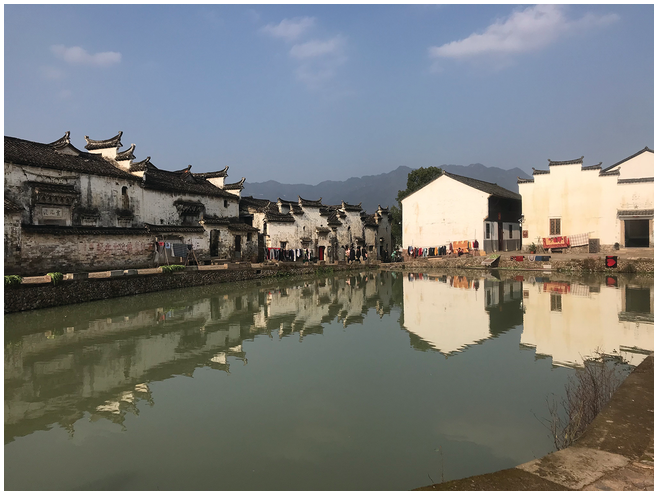
Once having stepped through the ancient gateway, the visitors are greeted by a local tour guide, a former migrant who, once filled with homesickness whilst labouring elsewhere in the country, returned home to Heyang to find work in the village’s main industry of rural tourism. Led by the guide’s enthusiasm and anecdotes, the visitors are sent through a journey underlined by nostalgia – both personal and cultural. Indeed, not a skyscraper in sight, Heyang stands as the ultimate antithesis to the ‘modern city’. It is at once a representation of the romanticized rural idyll as well as a custodian of an agrarian culture and lifestyle that once was and, in some ways, still is. As they venture deeper into the village, the tourists find themselves among centuries-old structures, many of which are still homes to other villagers who have become part of the toured scenery, willingly or not. Now at the heart of the village, the visitors cast their gaze upon a vast pond. On its surface are mirrored reflections of the old and the new. Of the latter, there includes a recently refurbished cultural centre, which retains its Mao-era function as a place for village-wide assemblies and other affairs. Of more historic interest along the pond’s perimeter are the ancient residential buildings that retain their Huizhou-style of architectural design and layout, a widely adopted style for vernacular buildings in the south of the Yangtze River during the Ming (1368–1644) and Qing (1632–1911) dynasties (González Martínez, Reference González Martínez2022, p. 204). One of the most recognizable features of this architectural style is the matouqiang, ‘Horse Head Wall’, a white wall with a stepped profile and ends that slant upward liked a tilted horse head, or a steed in motion. Also known as ‘firewalls’, these walls were built as perimeter walls around residential courtyards to prevent the spreading of fires and to slow the traveling of wind and sound through the otherwise permeable structures made of wood, brick and stone. In contemporary Heyang, the matouqiang is considered one of the ‘must-see’ places along the tourist trail. It is an ideal stop for visitors to ‘check-in’ – to daka 打卡 – as the tiered intricacies of the horse heads provide a certain aesthetic dynamism for photos. The monuments’ reflections in the water are a visual reminder of the depths of their history; yet, ironically, the pond itself was constructed only in 2016 as part of the local state’s initiatives to beautify the village and ‘add value’ to the tourism site (Figure 1.1).

Figure 1.1 Wall of horse heads, the cultural center and the pond.
Also new to the guminju are a group of young entrepreneurs. Born in the mid-late ’90s, they, like the tourists, sought to escape their respective lives, homes and jobs in China’s urban jungles. However, their stays in Heyang were intended to be more permanent. Rather than a brief tour, the entrepreneurs came to this village in search of their versions of the seemingly elusive ‘good life’. While it was a desire to remedy the urban maladies endemic to the ‘post-industrial lifestyle’ that compelled their moves to the countryside, it was generous policies and financial incentives provided by the local state that brought them specifically to Heyang – a village whose future depends upon the preservation of its ‘pastness’ and is fully entangled in a tremendous top-down rural ‘revitalization’ effort. These youth may have been socialized in urban China; however, they are only one generation removed from many who grew up entirely as farmers in the countryside in Mao’s China. For these millennials, the ancient village is a new and unfamiliar place, however, reminiscent of their own grandparents’ courtyards, it is simultaneously a nostalgic and familiar home.
In Heyang, these millennials run small boutiques that sell goods and services such as handmade Han dynasty–style hairpins and costumes for rent. As stipulated in their contracts with the local government, their commodities need to be trendy and appealing to the tastes of the visiting urbanite yet still specifically and ambiguously ‘traditional’, able to embody a certain nostalgia for ‘old Heyang’ as well as incite feelings of homesickness for other rural ‘hometowns’ across the country. These boutiques are tucked away in a residential courtyard protectively encircled by the matouqiang. The conversion of this residential quadrant into a commercial one was also part of a top-down initiative to attract more talent and capital into the village. A bustling multi-household and multi-generational dwelling in its heyday, the courtyard became a multi-purpose space shared between the urban(ized) youth and the local seniors who still own the land use rights of the quadrant but who had agreed (albeit somewhat begrudgingly) to the state’s request to rent out their ground-floor units for the purposes of commercial development (see, e.g., Andreas and Zhan, Reference Han2015; Hayward, 2017 for detailed discussions on rural hukou and land transfers). Whereas the youthful presence of the entrepreneurs became a new addition to the lives of the seniors, the entrepreneurs’ formerly bustling and hectic lifestyles became subsumed within the slow and quiet schedules of the village elders. The days of the new youth adapt to the tempo of the village, taking on a new monotony that is temporarily disrupted by the chipper and curious group of visitors who have now made their way into the courtyard, which is flagged on the tourist trail as the ‘e-commerce courtyard’, dianshangsieheyuan 电商四合院. The tourist group breezes in and out of the quadrant. Some pick up a hairpin or two, however, most leave with their bank accounts untouched as they make their way to one of the final stops on the tour, the famed bashimen 八士门, ‘Eight-Scholar Gate’. Stood before the gate, they are instructed by the tour guide to rub the heads of two stone statues that flank the doorway for good luck before leaving Heyang.
The tour bus is now in sight. Behind the wheel, a bus driver rubs the sleep from his eyes as he is awakened from his nap by the chatter of the now-approaching tour group. He runs the engine while he watches the group re-emerge through the gate that delineates Heyang’s ‘old’ village from the ‘new’, the latter an extension of the village with modern rural houses built in the early 2000s. Sure enough, the tourists remember to stop by Mrs Zhu’s flatbread stall before re-joining the driver on the bus. With the anticipation of posting their memories on their social media feeds, they watch Mrs Zhu in awe through the lens of their mobile phones, recording her every move as she expertly slaps the newly formed flatbreads into the clay oven. Four minutes later, the piping hot flatbreads – locally referred to as shaobing 烧饼 – are pulled out by long tongs and slipped into thin paper sleeves, each printed with the now recognizable logo of ‘Jinyun shaobing’ 缙云烧饼, with the term ‘Jinyun’ referring to the county in which Heyang is situated. Having been featured on national and even international television programmes, this humble street food is considered a wanghongmeishi 网红美食, a dish that has ‘gone viral’ and has been flagged on many a self-proclaimed ‘foodie’s’ bucket-lists. Its virality has brought much attention to the county, and local officials up to the provincial level have revered it as an ‘icon’ of Jinyun’s cultural heritage and nostalgia. A bite of ‘home’, homesickness to go. Before taking a bite, however, smart phones are whipped out once more to not only snap a photo of the delicacy (as they say, the phone eats first) but also to pay. With the convenience of AliPay and WeChat Pay, respectively products of China’s top tech companies Alibaba and Tencent, customers can scan the QR code that hangs beside Mrs Zhu as she quietly kneads the dough for the next order.
Between Mrs Zhu’s traditional clay oven and her digital payment card, the dramatic pond and the historicity of the walls that it reflects and the sharing of space between the entrepreneurial youth and their rural hosts, Heyang has become a site for multiple encounters across the spectrum of the traditional and the modern, the urban and the rural, the old and the new, the culturally valuable and the commercially profitable. It is within these encounters where the developmental dilemmas and potentials that face China’s rural inhabitants in the twenty-first century are salient; it is a complex crossroad of preservation versus development, between historical integrity and marketable commodity and a tenuous dance between villager welfare, state control and commercial interest. Indeed, within China’s broader developmental context in the twenty-first century, Heyang, like countless other villages across the Chinese rural landscape (see, for instance, Chio, Reference Chio2014; Wu, Reference Wu2015), has become the destination for various return flows of people, policies and capital from both the top down as well as the bottom up. A tour through Heyang is at once a journey through the physical and temporal landscapes of China’s ‘cultural heritage’, as well as a journey through a transforming political economy, wherein the rural, in many respects, is being valued increasingly as the ‘next frontier’ for development and investment. At the same time, a visit to Heyang is also a venture into the visitors’, newcomers’, government officials’, and the remaining and returning locals’ affective landscapes of nostalgia, homesickness and even a sense of concern for the countryside. Although it is the sights to see, the ancient tales to hear, the flatbread that may be tasted and the hairpins purchased, it is in this ancient village where the ‘modern citizen’ ultimately goes to search for and take part in the materialization of xiangchou 乡愁.
Homesick Nation is about the mobilization of the Mandarin Chinese term xiangchou 乡愁 as a form of affective governance in the People’s Republic of China (for discussions of ‘affective governance’ more broadly, see, for instance, Ahmed, Reference Ahmed2004; Penz and Sauer, Reference Penz and Sauer2019; Willet, Reference Willet2021). By affective governance, I draw from Elizabeth Perry’s (Reference Perry2002) conception of ‘emotion work’ during the Mao era, wherein popular emotions and lived experiences were mobilized into revolutionary momentum and for the revolution itself. As Sarah Ahmed (Reference Ahmed2004) articulates, ‘emotions do things; (p. 119; original emphasis), and in the case of China, it is imperative to understand how the Party-state is both concerned with gauging popular sentiments and adept in guiding popular sympathies to be in alignment with its goals and objectives (Perry, Reference Perry2002; Sorace, Reference Sorace2019). In her lucid and influential conceptualization of ‘affective economies’, Ahmed (Reference Ahmed2004) reminds us, ‘rather than seeing emotions as psychological dispositions, we need to consider how they work, in concrete and particular ways, to mediate the relationship between the psychic and the social, and between the individual and the collective’ (p. 119). This book also departs from the ways feelings and sentiments mediate state–society relations to look at what feelings are involved in the effective mobilization of xiangchou within the state’s repertoire of governance. Moreover, following Christian Sorace (Reference Sorace2019, Reference Sorace2021), I also frame xiangchou and its mobilization by the CCP as a form of affect, as it ‘suggests fluid, socially mediated atmospheres, rather than discrete, psychological states’ (Reference Sorace2021, p. 30). The central concerns of this book are, therefore, how xiangchou is invoked, mobilized and materialized in contemporary Chinese society to advance the Chinese state’s goals and imperatives for rural revitalization, and it also explores why xiangchou has popular resonance and can be ‘harnessed’ by the state. It asks, why, within this current developmental juncture, wherein ‘urbanization’ remains as the ‘name of the game’ in terms of development in many respects, certain emotions across all facets of the socio-cultural landscape are still attached to and projected upon the Chinese countryside, situating it at the centre of various affective landscapes of xiangchou. Indeed, xiangchou is a ‘potent affective energy’ (Sorace, Reference Sorace2021, p. 30) that both blurs the distinction between not only the public and the private but also the local and the national, creating nodes of intersection between statecraft and the ordinary lives of citizens.
Homesick Nation is also an exploration into the manifestation of xiangchou as a form of yearning, lament and desire across various stratums of contemporary Chinese society to literally, figuratively or symbolically go (back) to the Chinese countryside, real or imagined. Anchored in the village of Heyang 河阳村, situated in Xinjian Township 新建镇, Jinyun County 缙云县, Lishui City 丽水市, Zhejiang Province 浙江省, the main chapters of this book provide an ethnographic account of the materialization of xiangchou as a developmental strategy. Drawing from the traditions of the Extended Case Method (Burawoy, Reference Burawoy2009), Homesick Nation uses the rural tourism industry surrounding the ancient village of Heyang as a case study to explore both the affective qualities of xiangchou as a form of nostalgia, homesickness and topophilia for the countryside, as well as the effective usage of xiangchou as a mobilizing discourse to implement and execute various rural revitalization campaigns and policies in small towns and villages. Within China’s broader developmental context in the Xi Jinping era, countless traditional villages across the mainland Chinese rural landscape have become the destination of various return flows of human, financial and cultural capital. In Heyang, I trace various ‘return flows’ that meet in the village and observe how these flows and their processes ultimately interact with and impact the village and its residents for better and for worse. Anecdotal and empirical evidence provides a journey through Heyang’s modern historical, developmental and socio-cultural landscapes. These return flows are at once motivated by a political imperative to revitalize the countryside, a food security consideration to shore up the nation’s agricultural production capacities, a socio-economic necessity to narrow the urban–rural divide, an ecological urgency to rectify years of environmentally damaging practices in the name of ‘urbanization’ and ‘modernization’ and a genuine desiring for the symbolic and literal home-village. Put differently, these return flows are compelled and depicted by what Karl Marx (Reference Marx1852) explained as the ‘dull compulsions of economic relations’, on the one hand, and what I describe as an ‘affective devotion to cultural attachments’, on the other. Xiangchou – simultaneously effective in its usage and affective in its meaning – sits at the intersection of both.
This introductory chapter provides a brief overview of the developmental context in which this book is situated. Moreover, in order to conceptualize xiangchou as a ‘pair of eyes’ (Yu, Reference Yu2013), it is necessary as well to explore its meaning and its various interpretations and understandings: What is xiangchou? This chapter begins with a historical overview of China’s development from the Mao era to the present-day Xi Jinping era, highlighting the formation and intensification of the urban–rural divide during a condensed and intensive period of urban-biased ‘modernization’. In Section 1.2, I present an inquiry into xiangchou in its various contemporary uses leading up to its adoption as a discursive device. I illustrate how, as a discursive device, xiangchou has contributed to the reframing of the ‘language’ surrounding rurality and the peasantry in Xi-era China.
1.1 Developmental Context: Setting the Stage for the Emergence of Xiangchou
‘Development’ has long been a highly urban-centric project in China’s contemporary history, and an ‘urban bias’ has arguably existed since the inception of the People’s Republic of China, even despite Mao Zedong’s rhetorical and revolutionary focus on the peasantry. In fact, as early as 1949, Mao proclaimed to the entire Party during the second plenary session of the seventh central committee that it was the time to shift the centre of gravity of the Party’s work from the village to the city (Mao, Reference Mao1949). The rural had played its role during the revolution, and according to the newly victorious Chinese Communist Party, it had become a national imperative ‘to do [the] utmost to learn how to administer and build the cities’ (Mao, Reference Mao1949), but with the caveat that ‘under no circumstances should the village be ignored and only the city given attention’ (Mao, Reference Mao1949). However, as Martin Whyte (Reference Whyte2010) observed, ‘Mao Zedong and his colleagues ended up pursuing a vision of socialism that was every bit as biased toward the cities and industrial development and against agriculture and rural residents as the versions promoted by Marx, Lenin, and Stalin before them’ (p. 9). In other words, the socialist government imagined urban and rural societies to serve completely different functions in what was ultimately a developmental strategy that depended upon the extraction of agricultural products from rural areas to feed industrialization (Naughton, Reference Naughton2007, p. 115). Epitomized by the ill-fated Great Leap Forward campaign (1958–1962) and its alarming consequences, this relationship of extraction consequently planted the seeds for the deep urban–rural divide that continued into the twenty-first century.
1.1.1 From the Procurers of Grain to the Provisioners of Labour
During the Mao era, two drastically different administrative systems were used to govern the city and countryside, creating a reality where, among other developmental imbalances and socio-economic inequalities, ‘rural residents were poorer than urban residents, and they had a cheaper and less comprehensive set of social institutions to serve them as well’ (Naughton, Reference Naughton2007, p. 115). Rigid policies, notably the household registration (hukou 户口) system, were installed to control and monitor the flow of people, resources and capital, effectively putting in place a tightly sealed and monitored barrier between the agricultural and the non-agricultural.Footnote 1 Although the reform and opening era loosened these controls and re-allowed internal migration, China still resembled what could be described by Whyte’s (Reference Whyte2010) aptly titled edited volume as ‘one country, two societies’. Furthermore, despite Deng Xiaoping’s relatively successful rural reforms during the early market transition years, the urban bias continued to grow and deepen, manifesting itself in all aspects of the Chinese state’s policies and projects. While the socialist era saw the extraction of resources from the countryside to feed industrialization in the CCP’s aspiration towards a ‘New China’, xinzhongguo 新中国; the millions of migrant labourers and the emergence of such discourses as the sannong 三农 ‘three-rural’ issue – a term formulated by Wen Tiejun in the mid-1980s to describe the plight of peasants, rural society and agriculture during the reform era and later popularized throughout the 2000s and even highlighted as a major concern in the 2006 No. 1 Central Document Footnote 2 – represented another form of extraction from the countryside and exploitation of the peasantry. Whereas the socialist-era’s form of rural exploitation fuelled a vision of self-sufficient industrialization, agriculture and rural labour facilitated the state’s fervent urbanization drive as the country integrated itself into the global market economy (for a more detailed discussion on the transformation of agriculture within capitalism, see, for instance, Wen, Reference Wen2003, Reference Wen2021). With the supposed ideal image of ‘modernity’ represented by the city and China’s future envisioned as urban, the social and political development of the rural, meanwhile, was ‘left behind’ in the construction of a ‘modern China’.
Since the inception of the People’s Republic of China in 1949, the countryside has played an invaluable role in the construction of contemporary China’s urbanity. However, in this process, it was the lives of the rural and the status of rurality that remained undervalued and more or less untended to. China’s urbanization and development have been the result of a complex negotiation between planned economy and market capitalism – indeed, ‘socialism with Chinese characteristics’, or, to borrow from Yasheng Huang (Reference Huang, Otsuka, Rozelle, Brandt and Rawski2008), ‘Capitalism with Chinese Characteristics’ – and it was on the backs of those considered and treated as second-class citizens that China’s first-class cities were built. China’s fervent and rapid development has profited from the mobility of its massive reserve force of labour from the countryside, forming the now infamously beleaguered subjectivity of ‘rural migrant worker’, nongmingong 农民工 (Pun and Lu Huilin, Reference Pun and Huilin2010; Chan and Selden, Reference Chan, Selden, Bieler and Lee2017). They were (in)dispensable – a valuable source of labour and production – but a readily removable body that could be sent right back to their respective rural hometowns when labour was in surplus. Meanwhile, China’s countryside was dwindling.
As cities were emerging, entire villages were literally vanishing. According to Ian Johnson (Reference Johnson2014) of the New York Times, villages were disappearing at the alarming rate of 300 per day between 2000 and 2010. In other words, over a million villages were lost during a decade. To be sure, some villages came to their natural end, as flora and fauna (re)claimed their piece of the earth. However, most were left to hollow and grow grey (Davis, Reference Davis2014, p. 28). The workforce departed, leaving the village to vanish quietly alongside the most vulnerable and elderly – the ‘left behind’ – who slowly returned one by one back to the soil as well. Meanwhile, other villages were prematurely and often brutally razed to make way for new developments. Although certainly alarming and a cause for concern, what is often overlooked by articles in such publications as the New York Times, however, is that the rate of village ‘disappearance’ needs to also consider the systematic restructuring that the central government has implemented over the years to ‘streamline’ rural and regional governance, on the one hand, and to increase the country’s rate of urbanization, on the other.Footnote 3 Through this process, hundreds of thousands of natural villagesFootnote 4 were and continue to be administratively ‘swallowed’ up by a village amalgamation drive that drastically reduced the number of villages from an administrative point of view overnight. Although villages did not ‘disappear’ per se, consequences including cultural loss and a disruption and discontinuation of village(r) identity was a product of this amalgamation. Moreover, while much of this ‘disappearance’ of rural areas is an inherent process of industrialization and urbanization,Footnote 5 it was the often regrettable and irretrievable loss of rural culture and both intangible and tangible cultural heritage that began raising alarms. In fact, in a bid to preserve China’s rural heritage, a comprehensive effort to identify and catalogue ‘traditional villages’ was launched in 2012. It was spearheaded by Feng Jicai 冯骥才, a cultural scholar, artist and a counsellor to the CCP’s State Council. To illustrate the importance of Feng’s mission, the cataloguing effort was jointly carried out by the Ministry of Housing and Urban–Rural Development, the Ministry of Culture, the State Administration of Cultural Heritage and the Ministry of Finance. As a result, 646 villages, including the village of Heyang, were entered into the first iteration of this catalogue through a process of local nomination followed by official inspection, evaluation and approval at increasing levels of state authority. A year later, an entire institution backed by state funding was created within the University of Tianjin under the name of ‘China’s Traditional Village Protection and Development Research Centre’. There have since been five more rounds of formal cataloguing, and as of March 2023, 8,155 villages considered as ‘traditional’ and in need of ‘preserving’ across the country have been listed in the ‘Traditional Chinese Village Catalog’. Suffice it to say, the preservation of China’s villages is an endeavour of national significance.
1.1.2 An Urban Disease
Ironically, it was during the 2000s–2010s when urbanity was quietly plagued by a form of cultural existentialism too. As many rural residents were either uprooted to become migrant labourers or displaced as their hometowns disappeared; it was during this time when the concept of ‘home’ became an elusive concept for city-dwellers as well. Anonymous high rises arose where childhood and cultural sites once stood, illustrating how China’s dramatic urbanization represented a paradoxical and rapid process of construction versus destruction, displacement and replacement and of modern advancement versus cultural loss (Qian, Reference Qian2017). Meanwhile, at the individual level, the simultaneously exciting and aggressive processes of globalization produced what cultural critic Dai Jinhua (Reference Dai1997) described as ‘the most chaotic identity crisis in many decades’, where, surrounded by forests of anonymous skyscrapers, even ‘a “homegrown” Chinese is suddenly stripped of hometown, homeland, and home country and abandoned to the beautiful new world’ (p. 146). In addition to the drastic altering of landscape, a cultural, sociopsychological and even ideological shift was taking place as well. This was best encapsulated by a series of tourist memorabilia easily purchasable at any of China’s main tourist destinations that featured an image of chairman Mao over the phrase, ‘to serve the RMB’ weirenminbifuwu 为人民币服务 – a clever play on words replacing the CCP’s slogan of ‘to serve the people’, weirenminfuwu 为人民服务, with a new meaning of everything in the service of money. Although merely a farce to bemuse shoppers, the underlying reality was not lost on scholars such as Wang Ban (Reference Wang2002), who observed the integrity of social relations and humanism shift into a ‘fluid, bloodless cash nexus, [where] emotionally and ethically charged social relations are reduced to the bare bone of money relations’ (p. 674). Even though both Wang and Dai were writing to depict the socio-cultural and developmental dislocation and dissociation felt at the beginning of China’s reforms, their words remain relevant, and their echoes reverberate quietly between the empty buildings of ghost cities – the products of capital overflow and parasitic and unsustainable urban sprawls.
To illustrate the severity and consequences of such sprawls and unfettered development, I include a quote from scholar and urban-preservation expert Zhang Song, who, during an interview with China Dialogue in 2010, cautioned the following:
The cities in the Yangtze River and Pearl River deltas are expanding outwards, [and] if you include industrial zones, villages and towns, plus all the highways and rail lines, human construction may have already reached an ecological limit.
Indeed, the Party-state may have had a heavy hand in the progression of China’s urban development, but ‘a complete commercialized mode of development’ had taken over (S. Zhang, Reference Zhang2010), greatly compromising the quality of urban spaces and urban life. Such a mode of development is ultimately capital and profit driven; it was ‘urbanization’ dictated by the ongoing accumulation of capital, on the one hand, and its dispersing, on the other. The ‘dispersal’ of capital takes the form of cheap construction that utilizes even cheaper labour, which is at the cost of both the natural environment that is destroyed and the lived environment that is built in the name of ‘development’. Chinese urbanity had become afflicted by an urban disease and rural China was simultaneously hollowing out and producing a precarious class of uprooted migrant labourers caught in between.
Urbanization is a process involving more than just relocation, construction and the physical expansion of cities. It means building new communities and social infrastructures such as the provision of adequate and affordable housing and access to medical care. Yet, in this mad dash to ‘modernize’, numerous localities began anchoring their developmental plans and goals on a profit-driven real estate industry,Footnote 6 which sprawled and spiralled beyond the single-party state’s control. Somewhere along the road, consideration for peoples’ livelihoods, the preservation of culture and the state of the environment became secondary concerns, challenging any notion of sustainability within this model. Therefore, China’s ongoing urbanization became a central focus for the Party-state – at least discursively – which was about to undergo a dramatic transition of leadership in 2013. And indeed, as Xi Jinping claimed the title of China’s new president and the general secretary of the Party, bringing the focus of urbanization ‘back to the people’ was precisely what the new administration needed to achieve.
1.1.3 A Supposed ‘Human-Centric’ Urbanization
Suffice it to say, urbanization has been central to the Chinese state’s growth strategy; however, as the above has illustrated, this highly planned and aggressive expansion of cities has come with tremendous socio-cultural, political-economic and environmental costs; so much that this prompted the current administration to hold its first conference dedicated to urban work in thirty-seven years. With a great sense of urgency, the newly sworn-in Xi administration held its landmark Central Urbanization Work Conference (CUWC) on 18 December 2013. At the time, it was considered by many media outlets, domestic and international, as ‘the most high-level meeting the Chinese leadership has ever convened on urbanization’ for several reasons (Tiezzi, Reference Tiezzi2013). For one, this CUWC took place as a stand-alone meeting alongside the highly anticipated Central Economic Work Conference, and it was attended by all the highest echelons of state power under the intent gaze and scrutiny of China observers around the world. It became a national imperative to re-evaluate the nature of China’s ongoing process of urbanization and, by extension, to address pressing concerns including China’s urban–rural divide, the state of the environment and the integrity of society and culture.
Moreover, the convening of this landmark conference was considered within party discourses as a ‘turning point’ in China’s development. Much attention has been paid to this conference as an inflection point that expanded urbanization quotas and further ramped up the top-down urbanization drive. However, I also want to draw closer attention to certain discursive choices that suggest some concerns over the quality of continued urbanization. As reported by Ma Chi (Reference Ma2015) for one of Beijing’s bilingual mouthpieces, the China Daily, for instance:
China is in a crucial transition period from a rural society to urban society. The process of urbanization led to a range of problems, such as air pollution, congestion, too much garbage and a lack of cultural identity. To cope with these problems and make the development of cities sustainable, a top-level design is urgently needed. That’s why the Central Urban Work Conference was held.
Accordingly, the 2013 CUWC emphasized that China’s ongoing – and, of course, heavily centrally planned – process of urbanization should henceforth focus on being more sustainable and ‘human-centred’. This was also emphasized in the new National-New Type Urbanization Plan (NNUP), a document resulting from the CUWC that was intended to be the blueprint for China’s developmental model for 2014–2020. What was said to qualify this model as being a ‘new-type’ of urbanization was its emphasis on being ‘human-centric’, green and wholly integrative between city and nature and between city and countryside. Or, to put this in party rhetoric, China’s development needed to prioritize ‘clear waters and green mountains’ over the pursuit of ‘mountains of gold and silver’ (Xinhua, Reference Xinhua2013). Meanwhile, development should uphold the tenets of the NNUP by forging ahead with an urbanization that should, in Xi’s now highly quoted and recirculated phrase, ‘let cities merge with nature, let citizens gaze at mountains, see waters, and to jizhu xiangchou 记住乡愁’ (Xi, quoted in Xinhua, Reference Xinhua2013).
1.2 Conceptualising Xiangchou as Affective Governance
While Xi’s references to mountains and bodies of water can be interpreted as calls for a more environmentally conscious model of urbanization, his mention of jizhu xiangchou – to ‘remember xiangchou’ – is arguably more ambiguous both in its original language and in translation. In fact, few, if any, English sources provide a satisfactory translation or even mention of jizhu xiangchou at all. The argument could be made, of course, that this is but a form of rhetoric that does not necessitate such intense scrutiny. However, a search for jizhu xiangchou or simply xiangchou in Mandarin Chinese generates countless results in various mediums – from official news articles published directly by the state’s various propaganda mouthpieces, to academic articles and research papers, to popular blog posts and entire WeChat accounts dedicated to a curation of resources related to ‘xiangchou’ and to short viral videos on social media apps. I discuss media and popular representations of xiangchou and ‘rural imaginations’ more broadly in Chapters 5 and 6. The focus below is on the official and academic discourses surrounding xiangchou.
1.2.1 The Invocation of Xiangchou: Between Hometown and Homeland
Political discourse in the context of the CCP has a powerful ‘trickling-down’ effect, wherein the words of the incumbent president, the ‘paramount leader’ of the Party, the military and the nation-state, can produce direct and lasting consequences, even if they appear to be ‘empty rhetoric’. In fact, whilst Xi’s invocation of xiangchou may have carried a certain degree of ambiguity, a proliferation of research within mainland China has since emerged specifically to (re)define the term in relation to Xi’s words. In 2018, for instance, Wang Xinge et al. published a comprehensive literature review on xiangchou within mainland Chinese scholarship, noting it was only in 2013 when Chinese researchers began to take a more robust interest in the sentiment as a subject for academic and theoretical study. To support this claim, they highlight that there were only 153 academic publications that discussed xiangchou in 2013, however, following its incorporation into ‘official language’ by Xi Jinping, this number grew to 821 articles in 2016 (Wang et al., Reference Wang2018). Critically, the authors attribute this post-2013 surge to the following developmental context:
The interest in xiangchou within our country emerged from the context where there is concern over the problems that have resulted from rapid urbanization and the need to improve the quality of urbanization. Therefore, [xiangchou] is a deeper reflection on urbanization. Under this framework, scholars within China have begun discussions on how to define xiangchou.
Among this group of scholars seeking to define xiangchou is Professor Lu Shaoming of Shanghai Jiaotong University, who uses a triple Venn diagram to describe xiangchou as a concept that sits within the intersections of ‘nostalgic feelings’ (huaijiu ganqing 怀旧感情), ‘homesickness’ (sixiangbing 思乡病) and ‘topophilia’ (liandi qingjie 恋地情结). Taken thus, xiangchou embodies spatial and temporal elements of nostalgia and homesickness, as well as the spatio-cultural attachments, values and processes of individual and collective identity-formation within topophilia. Topophilia, most associated with the writings of humanist geographer Yi-Fu Tuan, is the ‘affective bond between people and place’ (Tuan, Reference Tuan1990, p. 4). Broadly, it encapsulates the experiential elements of being in natural and constructed, ‘carpentered’ and ‘non-carpentered’, environments (Tuan, Reference Tuan1990, p. 75). Topophilia describes the ways in which environments shape perceptions, attitudes, values and world-views (Tuan, Reference Tuan1990, pp. 1–4). For Lu (Reference Lu2016), therefore, the spatial and temporal parameters of xiangchou are more culturally defined than homesickness and nostalgia, and its topophilic qualities are also culturally informed by a certain ‘Chineseness’ that is linked to a cultural conceptualization of ‘home’, which, according to Lu, is rooted in the Confucian understanding of the jiazu 家族, family.Footnote 7 Jia therefore indicates not only lineage and kinship ties, but it can also be interpreted as a vertically and horizontally expansive concept of the ‘home’. In other words, these home-bound attachments within xiangchou function at the individual level as an attachment to the jiaxiang 家乡, the ‘hometown’, as well as at the collective level as a conception of the jiayuan 家园, the ‘homeland’. In fact, Lu even speaks of a ‘small xiangchou’ (xiaoxiangchou 小乡愁) and a ‘big xiangchou’ (daxiangchou 大乡愁). The former, he explains, is the affective bond between the jia (home/family) and the xiang (hometown); and the latter is the affective tapestry weaved out of the bond between the nation (minzu 民族) and the nation-state (guojia 国家).
This element of the “collective homeland” is a main point of departure for other scholars who have contributed to this discursive field as well. For example, a research paper by Chen et al. (Reference Chen2020), which also provides an extensive review on xiangchou-related research within mainland China, argues the following:
Xiangchou in the Chinese cultural context refers to the ‘common homeland’, representing nostalgic emotions based on specific geographical spaces. The xiangchou of the Chinese people is underlined by a deep traditional cultural complex. Therefore, when citing keywords in English [for their publications], scholars within mainland China use the Mandarin pinyinFootnote 8 ‘xiangchou’.
Understood together, the current Chinese academic discourse on xiangchou emphasizes a supposed ‘shared culture’ and ‘shared homeland’, both of which are necessarily nationalistic and culturally relativist in their orientations. Moreover, Chen et al.’s (Reference Chen2020) mentioning of ‘specific geographical spaces’ (tedingdilikongjian 特定地理空间) not only echoes Lu’s emphasis on the home-oriented place-ness within xiangchou, but they also further associate this ‘home’ to the ‘traditional hometown’, which has been historically rooted in the Chinese countryside. This rooting of the xiang 乡 to its rural connotations is made even more explicit when they write, ‘“xiang” represents not only the hometown, but it also represents the countryside’ (Chen et al., Reference Chen2020, p. 1604), and further, ‘embedded in xiangchou is traditional culture and rural culture, and, at the same time, it transmits the DNA of local cultures’ (Chen et al., Reference Chen2020, p. 1604). In other words, the sentiments of yearning and concern embodied within chou are anchored by and oriented towards the xiang, which means not only the hometown and the homeland but also invokes images of the traditional home-village, both real and imagined.
It is worthwhile mentioning that this conceptualization of xiangchou closely resembles modern and contemporary usages of the Japanese concept, furusato. Furusato appears to be not only similar in meaning to xiangchou, but it also shares similar socio-cultural and political functions, which is acknowledged in some mainland Chinese scholarship on xiangchou as well (肖海艳, 2018; 熊远报, 2022; 王新宇, 2023). A brief excursion and detour into contemporary usages and discussions of the Japanese term, therefore, is instructive for this exercise of contextualizing the current xiangchou discourse. Broadly, furusato can be understood as a warm, loving and nostalgic feeling towards the ‘hometown’ or ‘native place’ (Robertson, Reference Robertson1988; Morrison, Reference Morrison2013). Jennifer Robertson (Reference Robertson1991) defines furusato as comprising both a temporal and spatial dimension, wherein the former is represented by the term furu(i), ‘which signifies pastness, historicity, senescence, and quaintness’, as well as ‘the patina of familiarity and naturalness that objects and human relationships acquire with age, use, and interaction’ (p. 14); and the latter ‘is represented by the word sato, which suggests a number of places inhabited by humans: a natal household, a hamlet or village, and the countryside (as opposed to the city)’ as well as ‘a self-governed, autonomous area and, by extension, to local autonomy’ (p. 14). Together, furusato expresses an affective longing for an ‘old home’ that is symbolized by the archetypal Japanese village. As Lindsay Morrison (Reference Morrison2013) details, furusato was already a ubiquitous socio-cultural trope during Meiji-era Japan (1688–1912), which witnessed a significant wave of rural-to-urban migration, an unprecedented phenomenon at the time. During this juncture, however, the notion of ‘going to the city’ was premised primarily on attaining certain material means towards achieving the primary goal of ‘returning home’, which, for most was still in the countryside. Indeed, ‘prior to Japan’s modernization’, writes Morrison (Reference Morrison2013), ‘over ninety percent of Japan’s population called the countryside their home, naturally leading to the concept of furusato being linked with rural areas’ (pp. 6–7). This cyclical pattern of rural to urban migration is encapsulated in the lyrics of the folk song Furusato, translated by Morrison (Reference Morrison2013) as such: “Once I have achieved my goals, I shall return one day” (p. 4). As such, prior to Japan’s industrialization, which was completed by the Taisho period (1912–1926), one’s furusato was therefore the desire for a literal return home.
In contemporary Japan, however, much of this home no longer exists as such; and, for many, there is no longer such a ‘home’ to return to (Robertson, Reference Robertson1988, p. 497). In its more contemporary conceptualizations, the resonance of furusato is ‘not constrained by the necessity of a physically present rural landscape’ (Robertson, Reference Robertson1991, p. 17). In fact, this can be seen in the very ‘multivalent nature’ of the term itself (Robertson, Reference Robertson1988, Reference Robertson1991). Specifically, whereas the term can be written in other ideographic forms, including 故鄉,Footnote 9 it has been more ubiquitously represented since the turn of the 1960s in one of the native Japanese scripts, hiragana, as ふるさと. In hiragana, according to Robertson (Reference Robertson1991), any visual cue for place-ness that can be derived from the term’s ideographic form is erased. Unlike 故鄉, for instance, whose characters carry implied meanings of a more specific rural or ‘non-urban’ situatedness in their forms, ふるさと provides ‘no such extratexual referents but, rather represent the sound furusato itself as a thing’ (Robertson, Reference Robertson1991, p. 15). With furusato as the ‘thing itself’, the concept is therefore able to evoke an affective capacity not towards a particular or specific place but ‘the generalized nature of such a place and the warm, nostalgic feelings aroused by its mention and memory’ (Robertson, Reference Robertson1991, p. 15). This shift towards hiragana in the 1960s was significant for several reasons, including Japan’s ‘miracle 1960s’ of rapid industrialization and economic growth (Robertson, Reference Robertson1991, p. 15), which, among other phenomenon, led to a haunting sense of ‘homelessness’ caused in part by the dramatic loss of the countryside and its rural population and the overwhelming concentration of the country’s population in or within fifty kilometres of the country’s three major cities, Nagoya, Osaka and Tokyo (Robertson, Reference Robertson1991, pp. 24–25). To further illustrate, figures by the World Bank indicate that Japan’s rural population represented only 37 per cent of its total population by the 1960s, dropping further to 10 per cent by 2010. Within furusato is therefore the affective topology of a ‘home’ for the ‘existentially homeless’ (Alexandre, Reference Alexandre2024). This ‘homelessness’ is at once a post-war and post-industrial Japanese experience and a very familiar Heideggerian condition within modernity at large (Robertson, Reference Robertson1988, p. 497). In this sense, the literal ‘old place’, ‘old village’ or even ‘hometown’ that had been left behind by the forces of industrialization and that had vanished through the urbanization of the countryside was replaced by the affective potential that continue to exist within imaginations of the ‘old places’ that are no longer (see Robertson, Reference Robertson1988, p. 515n4). According to Robertson (Reference Robertson1991), moreover, furusato represents ‘everything that suburbs and metropoles are not’, especially for city dwellers, for whom ‘the image of an old village offers an appealing alternative to overcrowded, impersonal living conditions’ (pp. 24–25). Rather than describe an actual place, contemporary conceptions of furusato ultimately encapsulate a feeling rather than a concrete birthplace; furusato points towards an ‘ideal home of the heart – a place accessible to every Japanese’ (Morrison, Reference Morrison2013, p. 3).
It is precisely this appeal to the abstract yet emotionally evocative notion of the ‘ideal home of the heart’ that embeds furusato within the affective tapestries of contemporary Japanese society. In fact, feelings of furusato were also mobilized during post-postwar Japan to animate different landscapes of nostalgia. As Robertson details in her vivid monograph, Native and Newcomer, the Japanese state even adopted the concept of furusato-zukuri, or ‘new furusato’, a place-making ethos that emerged in the 1970s. Critically, furusato-zukuri was and continues to be appropriated by various political parties as part of their campaigns for local regeneration projects. Furusato-zukuri, explains Robertson (Reference Robertson1991), is ‘Nostalgic praxis’, a process and a ‘project that involves remaking the past as the condition for bringing about social transformation – something that is new’ (p. 9). This ‘past’ meant to be remade is based on Japan’s cultural traditions and heritage. In fact, furusato-zukuri became incorporated into an effective administrative policy in postwar Japan that was meant to restore ‘a sense of sociocultural continuity’ by ‘resuscitating “the Japanese spirit” and reforming the state’ during a critical political and ideological inflection point (Robertson, Reference Robertson1991, p. 34). This inflection point was the transition from postwar Japan to post-postwar Japan, the latter of which sought to divorce itself from the guilt and defeat of imperialism and rebuild a Japaneseness anchored to the archetypal ‘old village’ (Robertson, Reference Robertson1991, pp. 34–35). Indeed, advertisements released as part of this administrative campaign featured slogans including, ‘My old village [furusato], my Japan’, a slogan that Robertson (Reference Robertson1991) argues ‘unequivocally identifies native place with the nation and conflates localism and nationalism’ (p. 35) and where ‘the syllables fu-ru-sa-to inserted alongside the ideograph [of generic traditional hometown festivals] effectively assimilate each “old village” featured within the larger and largest community, Furusato Japan’ (p. 36).
Ultimately, this abstraction of place-ness surrounding the idea of the ‘old place’ or ‘non-rural’ as being a symbolic ‘antithesis-to’ also speaks to the way in which xiangchou can and has been variously expressed to evoke an affective capacity towards a place where different feelings and desires become attached. However, just as furusato is shaped by post-postwar Japan’s developmental experience, the contours of xiangchou and its perceived social utility are shaped by China’s march into ‘modernity’ as well. Most importantly, whereas much of this ‘old place’ no longer exists within contemporary Japan, this ‘old place’ still does exist as important political economic entities across significant swathes of mainland China and, indeed, still is the literal home for millions.
1.2.2 Xiangchou as a ‘Structure of Feeling’ throughout ‘Modernity’
With the above in mind, I return our attention briefly back to Lu’s article, which, in addition to defining xiangchou, also traces a century of its expression. Indeed, Lu cross-referenced thousands of literary and academic publications on the topic across three Chinese-language databases between 1912 and 2014 to describe how xiangchou has been a consistent feature of cultural expression throughout modernity, wherein both the objects of xiangchou as well as the subjects or ‘agents’ that experience xiangchou (xiangchou zhuti 乡愁主体) have evolved over time and in tandem with broader, macro-levels of change within the morphing entity known as ‘China’. In his analysis, he highlights the main keywords and themes associated with xiangchou and the primary subjectivities producing such texts. Whilst acknowledging the simultaneous and overlapping existence of multiple xiangchou, he categorized three main ‘eras’ of xiangchou along three temporal and developmental delineations that he demarcates and labels as the Republican Era (1912–1949), Modern China (1949–1999) and Contemporary China (2000–2014).
During the Republican Era, xiangchou, according to Lu, was predominantly an expression of the intelligentsia. In the rubble of the Qing Dynasty, which marked the end of the Imperial Era, the main thematic focus of their xiangchou was a tormented ‘sentiment for the native soil’ (xiangtuqing 乡土情) that had effectively crumbled and was in existential shambles. More specifically, against the backdrop of what Lu summarizes as ‘Western influence’ and ‘internal struggle’, xiangchou was primarily an expression of both the homesickness and the inner political strife of scholars, reformers and activists such as Liang Qichao 梁启超,Footnote 10 many of whom went abroad during this period and were exposed to various ways of thinking and being that would eventually inform their further revolutionary careers and, of course, impact upon the ideological fracturing and tumult that would underscore this period (Lu, Reference Lu2016, p. 6). This was a xiangchou of young reformers and revolutionaries that were (re)constructing visions of self-hood and nationhood by ploughing ahead into the splintering unknown of ‘modernity’.
After the victory of the CCP and the establishment of the PRC, the emphasis of xiangchou shifted towards a form of what Lu calls ‘Patriotic sentiment’ (aiguoqing 爱国情). This patriotic sentiment was expressed primarily by a diasporic community that grew and continued to swell in numbers throughout the decades. That is, especially after the end of the Cultural Revolution, the death of Mao, the dismantling of the commune system and the onset of the reform and opening era, xiangchou travelled outward with a movement of people beyond the boundaries of the ‘PRC’ to reflect a strong, diasporic and (although not explicitly mentioned by Lu) exiled yearning for ‘home’ (Lu, Reference Lu2016, pp. 5–6). One of the most well-known pieces of writing that expresses this form of xiangchou is the poem ‘Xiangchou’ 乡愁 by the late poet Yu Guangzhong 余光中. As a Nationalist, Yu fled the mainland in the wake of the CCP’s victory in 1949. Unable to return, he wrote ‘Xiangchou’ from the Republic of China in 1971 as an ode to his ‘motherland’ and the friends, family and memories he left across the strait. Written in such a socio-political milieu, ‘Xiangchou’ spoke not only about Yu’s personal affectations and experiences as a political exile but his expressions of xiangchou also spoke to a generational yearning for a ‘China’ once ‘whole’. The poem and the xiangchou described within symbolized a pervasive affective landscape of longing that resonated deeply with an entire generation who may have been ‘separated only by a narrow strait’ (Qin, Reference Qin2017, para. 6) but whose distance – cultural, physical and political – from the native ‘home’ grew further apart by the day. Even if they could physically return to the mainland, there was a ‘nostalgia’, ‘homesickness’ and, indeed, a cultural-political affectation felt for an era that they could no longer return to. Xiangchou, at this juncture, was therefore expressed as a lament for a ‘motherland’ and a form of ‘national unity’ possible only in various aborted futures.Footnote 11
Finally, returning our attention to the ‘contemporary moment’, Lu (Reference Lu2016) defines the current iteration of xiangchou as being not only a continuation of the diasporic and exiled longing for the ‘home’ but as a deeply felt lament of China’s internal migrants. In Lu’s words,
Entering the contemporary China of the new millennium (2000–2014), the xiangchou of this era is, on the one hand, the continuation of the patriotic longing by overseas Chinese; and on the other hand, a new phenomenon has sprung out: alongside rapid economic globalisation and urbanisation, a mass of migrant workers and urban emigrants has emerged; the carriers of xiangchou has transitioned to the commonfolk, it has shifted from the intellectual elite to the masses.
That is, against the backdrop of urban-oriented development and its related realities of dis- and re-location, un- and up-rooting, this is a xiangchou, writes Lu, that has ‘returned home’ and that speaks especially to the experiences of China’s massive and diverse floating population (liudongrenkou 流动人口).
Tracing a century of xiangchou, what Lu’s article ultimately illustrates is how xiangchou can and indeed has functioned variously as a ‘structure of feeling’, a term coined by Raymond Williams in 1954 and further elaborated upon in his later work, Marxism and Literature (1977). According to Williams (Reference Williams1977), a ‘structure of feeling’ is ‘a cultural hypothesis’ and an embodiment of ‘social experiences in solution’ that is at ‘the very edge of semantic availability’ (pp. 132–134). As ‘structures’, they are rigid and defined, yet, built by ‘feelings’, they are fluid and muted in their expression, harboured at the level of the individual but collectively cogent and yet to be completely fleshed out in full articulation as ideologies, fixed social institutions or world-views. Ian Buchanan (Reference Buchanan2010) provides further clarity to the concept by describing its meaning and usage as a reference to the ‘different ways of thinking vying to emerge at any one time in history’ (Buchanan, Reference Buchanan2010, p. 455). According to Buchanan (Reference Buchanan2010), Williams developed the term throughout his works as a way to problematize the Gramscian concept of hegemony (Williams 1961, Reference Williams1977), which Buchanan (Reference Buchanan2010) interprets as being used to define a ‘gap between the official discourse of policy and regulations, the popular response to official discourse and its appropriation in literary and other cultural texts’ (p. 455). As a social theory, a ‘structure of feeling’ can be understood as subaltern or counter-discourses that are reactions against certain deficiencies of the lived world, real or perceived, collectively felt.Footnote 12
Understood in this way, xiangchou as a ‘structure of feeling’ in contemporary China is similar to if not the same in function and meaning as furusato (as articulated above but also further elaborated upon by works including Robertson, Reference Robertson1991; Morrison, Reference Morrison2013; Rausch, Reference Rausch2019; Respati, Reference Respati2022; Alexandre, Reference Alexandre2024), as well as contemporary interpretations of ‘nostalgia’, already the subject of an extensive and ever-growing (and ever-relevant) body of work (by no means an exhaustive list, see, for instance Davis, Reference Davis1979; Tannock, Reference Tannock1995; Boym, Reference Boym2001; Clewell, Reference Clewell2013; Routledge, Reference Routledge2016; Becker, Reference Becker2023). In fact, to invoke Svetlana Boym (Reference Boym2001, Reference Boym2011), xiangchou, like nostalgia, is ‘a sentiment of loss and displacement, [and also] a romance with one’s own phantasy’; it is a shapeless sentiment that can be triggered by anything, including – or perhaps, especially – the very passing of time. Such feelings swim in the undercurrents of development, progress and modernity; their idiosyncratic triggers and manifestations dwelling in what Kathleen Stewart (Reference Stewart2007) calls ‘ordinary affects’ – affective dimensions of everyday life – of the private and public spheres. Therefore, in an era underscored by tremendous speeds and scales of mobility – whether by choice, coercion or by necessity – feelings captured in xiangchou have become ever-important in the tapestry of human experience. Expressions of xiangchou can thus function as a ‘safety valve’ in modern society (Davis, Reference Davis1979) or even a rhetorical practice and periodizing emotion that, on the one hand, enables an assertion of continuity within ruptures and, on the other hand, grants what Lu calls the ‘primary agents’ or ‘carriers’ of xiangchou a sense of control within changes and discontinuities (Tannock, Reference Tannock1995). I borrow again from Boym (Reference Boym2001) to argue that xiangchou, understood as a nostalgic ‘structure of feeling’, is akin to the Jekyll to progress’ Hyde (p. 26) – although they seem to look in different directions, they are not antithetical but the mirrored images of each other. As the temporal compression and spatial contortion of ‘progress’, globalization and modernity become more unrelenting, so too, do the siren calls of xiangchou become more compelling.
In effect, xiangchou dwells in various complex relationships and configurations of (un)belonging along the urban–rural spectrum. Echoing Robertson’s (Reference Robertson1991) astute analysis of furusato, this conceptualization of xiangchou, especially from the top down, ‘unequivocally identifies native place with the nation and conflates localism and nationalism’ (p. 35). This is also suggested by Lu (Reference Lu2016), who argues:
Xiangchou has become one of the most effective means to arouse the emotions of the Chinese people, forming the cultural community (wenhua gongtongti 文化共同体) that represents the greatest common denominator of the Chinese nation.
Indeed, xiangchou thus becomes a ‘cultural collective’ and ‘nationally unifying’ concept not only built around the genuine concerns and desires for the Chinese countryside, but, as this book highlights, it also concerns the developmental imperatives that call for its ‘revitalization’. Ultimately, it is in this way that the Chinese state’s invocation and appropriation of xiangchou can be understood. Invoked from the top down and ultimately aligned with the Party-state’s developmental language and agenda, xiangchou is not only a ‘structure of feeling’, but its mobilization and materialization, which is the focus of this book, becomes a form of affective governance. Through this xiangchou discourse, subjective feelings of longing and desire for the ‘home’ are tessellated onto affective landscapes of yearning for a ‘home-town’ that is attached to imaginings of the ‘home-village’. In turn, these imagined ‘home-villages’ become discursively intertwined with a devotion to the homeland. It is in this way that the affective elements of xiangchou – its ‘moments of unformed and unstructured potential’ (Shouse, Reference Shouse2005) – become a politically effective form of affective governance, capable of tapping into existing affective landscapes that are, on the one hand, characterized by ‘homesickness’ in the Heideggerian sense of modern and post-modern unbelonging and alienation and, on the other hand, oriented toward the cultural conceptualization of the hometown, jia-xiang. As Sorace articulates (Reference Sorace2021), the ‘Party does not implant emotions like some evil genius – it engineers the channels of expression along which affective intensities flow, traversing the distinction between public/private’ (p. 30). Xiangchou can describe a distinct feeling and an emotion, but conceptually expanded beyond the personal, it is also both a socio-cultural ‘structure of feeling’ and potent affective energy that flows ‘along discursive meridians drawn by the Communist Party’ (Sorace, Reference Sorace2021, p. 30). It blurs the distinction between not only the public and the private but also the local and the national, creating nodes of intersection between statecraft and the ordinary lives of citizens in villages such as Heyang.
1.3 Outline of the Book
Homesick Nation conceptualizes the term xiangchou as a form of affective governance in contemporary mainland China. It traces the Chinese state’s invocation and mobilization of xiangchou from the central level of governance down to the village level, studying the ‘trickling down’ of discourse from Xi Jinping to village cadre, as well as its materialization into tangible policy from the central government to local society. Using the Extended Case Method, Homesick Nation grounds itself in the village of Heyang, situated in Xinjian Township, Jinyun County, Lishui City, Zhejiang Province. While I focus on the case of a single village, Heyang represents a microcosm of the complex webs of imperatives and challenges within not only efforts to ‘revitalize’ the countryside but also genuine yearnings for the ‘good life’ within post-reform China.
This book is organized into chapters as follows. Chapter 2 introduces the reader to the field site. It provides a historic overview of Heyang village, and it follows with a ‘guided tour’ of the village’s principal tourist area, the ancient heritage dwellings complex, guminju 古民居, a nationally recognized and protected heritage site. It introduces the development of Heyang’s tourism industry from its fledgling grassroots iteration in the mid-1990s to the mid-2010s, where a concerted effort was made by the county government to transform the guminju into a basin of xiangchou. In 2013, the Heyang guminju was lifted to the status of a ‘national treasure’, and it was later ‘upgraded’ to a ‘4A’ grade tourism site in 2020. I open this chapter with a brief detour into the village’s history, stretching as far back as the Five Dynasties era (AD 907–960), the period in which the village was supposedly ‘founded’ by Zhu Qingyuan, a high-ranking gentry who fled the imperial court to avoid being embroiled in war. Revered as the apical ancestor of the Heyang Zhu Clan, the discussion of Zhu then rejoins the twenty-first century, where these historic tales of ‘origins’ are told and sold as part of the ‘xiangchou Heyang’ tourism brand.
Chapter 3 is focused on the county level of analysis, and it studies the Jinyun County’s response to the 19th Party Congress and the Xi administration’s further elaboration upon the Rural Revitalization Strategy. I draw from my fieldwork in the Jinyun county seat in the summer of 2018, where I was able to speak with high-level officials in the county’s Reform and Development Bureau. I describe how the Jinyun County government began concocting a ‘xiangchou plan’ throughout July 2018 and how a very rapid process of policy inception to implementation transpired between August to September. This effort culminated in a five-year developmental strategy known as ‘Jinyun’s Xiangchou Industries to Enrich the People’. Noteworthy was not only the county’s ambitions to coin the term ‘Xiangchou Industries’ but also its desire to make it a national model for revitalization. High-level cadres voiced their desire to create a model that, if acknowledged and appreciated by the central government, could not only put Jinyun on the map but, theoretically, enable other rural regions to become self-sufficient by adopting the ‘Jinyun model’ of rural revitalization and adapting it to their own unique xiangchou. The usage of xiangchou as the means and model for rural revival highlights its salience and the potency of feelings such as ‘homesickness’ embedded within and how the countryside is central to the imagining of the ‘hometown’. In describing my fieldwork in the county seat and my conversations with local officials about the ‘meaning’ of xiangchou – or what it means to ‘have xiangchou’ – this chapter also delves into a meditation on my own ‘return’ to Jinyun as well. I explore the concept of ‘hometown’ and of the self in relation to the hometown as both a person with connections to Heyang and as a researcher. I disclose the complexities and unique facets of my own subject-position as, simultaneously and interchangeably, a ‘researcher’, a ‘foreigner’ and a ‘local’. This chapter also stretches and enriches the concepts of the ‘hometown ethnography’ as a method and the ‘hometown’ as a concept for study through ethnography.
Although Heyang is considered a ‘hometown’, its survival as a ‘living village’ has depended upon its ‘leaving behind’. That is, since the reform and opening era, Heyang’s economy has been largely built upon a culture of migration that has revolved around the industries of duck breeding and shrimp farming. Chapter 4 is an exploration into both the embeddedness of migration and the landscape of xiangchou in Heyang. As a migrant-sending community, Heyang is built upon and even sustained by migrants’ homesickness, and these migration patterns are deeply entangled with the breeding of local shelduck. In fact, the entire county of Jinyun has been nicknamed the ‘hometown of the shelduck’ mayazhixiang 麻鸭之乡. Not a day goes by without the mentioning of ducks in Heyang, and during my fieldwork, ducks were also a point of discussion in every group interview or individual interview, whether prompted or not. It came up most frequently whenever there was mention of migration, income or employment or the whereabouts of neighbours or other family members. This chapter highlights ‘duck tales’ told to me by locals, including my own father, who have personally engaged in the industry at various stages of their lives. Through their personal reflections on the significance of duck breeding, I reconstruct the importance of cyclical migration through different stages of a rapidly transforming China. A focus group interview with four recent ‘returnees’, however, illustrates that by the 2010s, these industries that once sustained the village and its villagers’ livelihood were proving to be unsustainable because of local, national and global processes of change. These four return migrants were formerly shrimp or fish farmers who returned to Heyang, where they became employed as tour guides in the tourist site in the early and mid-2010s. Their stories and perspectives illustrate how households in Heyang reassessed their livelihood strategies and configurations and how the ‘Xiangchou Tourism’ industry presented itself not only as an option to make a living but to do so without needing to out-migrate. Individual narratives and lived experiences also provide moving insight into the complex emotions that underscore their respective returns to the hometown, which range from a sense of comfort and familiarity to a perpetual feeling of precarity due to lingering debts, unstable livelihoods and uncertain futures.
Chapter 5 is a further elaboration upon ‘xiangchou as method’. It explores xiangchou as a materially and culturally embedded concept in the 2010s, which I argue represented an ‘era of crises’ in China. I begin this chapter with the global COVID-19 pandemic, during which the Xinjian Township government issued an emotional plea to its out-migrated households to return or remain at home in the countryside. An analysis of this letter illustrates how the government invoked xiangchou as a force for not only ensuring compliance during the earliest phase of the pandemic but also to mobilize the revitalization of the countryside even thereafter by playing into feelings of homesickness and the inevitable separations from those ‘left behind’. In addition to the acute global health crisis that was the COVID-19 pandemic, I also frame the discussion of longer-term and more embedded ‘crises’ in three broad categories: the ‘big city disease’, the existential crisis of meaninglessness and the three-rural issue. For each, I illustrate how the language of xiangchou emerged as, firstly, a symptom of crises and, later, as a response and potential remedy to these crises. This chapter ends with the case of a Mr Tang, a returnee and entrepreneur who indeed heeded the call for rural return because of his own feelings of ‘homesickness’ and because of attractive investment incentives provided by the local state. Mr Tang became the owner of a factory that falls within the state’s project of producing ‘xiangchou industries’, which employed men and women from nearby villages.
Chapter 6 examines another group of ‘returnees’ in Heyang: young, white-collar entrepreneurs with various backgrounds of urban socialization. They represent a new generation of youth caught in the crosshairs of institutionalized competition and achievement, on the one hand, and mounting youth unemployment and a pervasive experience of ‘involution’, neijuan 内卷, on the other. The return of youth to the countryside – in the form of fanxiangqingnian 返乡青年, or ‘return youth’ – is also a phenomenon that explains another facet to xiangchou as both affect and method: it is a powerful discourse that not only encourages return from the standpoint of individual choice and desire but also helps reshape the overall discourse surrounding the countryside as both a place and a ‘lifestyle’ considered as desirable to return to. Xiangchou becomes a language of ‘escape’ and a materialized reality where one can seemingly ‘escape to’. However, using the stories of several young entrepreneurs who have relocated their lives and enterprises to Heyang, I also illustrate the complexities of this ‘return’ in the forms of the limitations, challenges and dilemmas that these youth have encountered in the village, such as feelings of idleness and boredom. It ponders whether involution is escapable.
Although the fanxiangqingnian phenomenon is certainly not to be confused with the ‘sent-down’ youth of the 1960s–1980s, history does not form in a vacuum. Any mention of ‘educated youth’ and the state’s involvement in their (self)rustication inevitably recalls Mao’s infamous ‘Up to the Mountains and Down to the Countryside Movement’. I therefore include in this chapter a discussion of the fanxiangqingnian (return youth) in the Xi era in relation to the zhishiqingnian 知识青年 (educated youth) of the Mao era. There is historical continuity not only in the state’s envisioned role of the country’s youth as the lynchpins between the urban and the rural but also in how various forms of ‘cultural nostalgia’ have been integral to these top-down processes – from ‘zhiqing nostalgia’ to xiangchou, from Mao to now and from the mass line to the Party line with varying degrees of successes and setbacks.
Homesick Nation concludes in the same way it began: with a tour through Heyang. The final chapter revisits the tour guides discussed in Chapter 4 and explores how the tour guides were instructed by representatives of the state to include the term xiangchou into their scripts. The repetition of xiangchou within the old heritage part of Heyang village illustrates the salience of the term, its cultural resonance and its political influence. However, the tour guides’ personal interpretations of xiangchou also demonstrates the way in which the state’s appropriation of the term had at the same time created new forms of alienation: some Heyang locals feel homesick for a hometown they once knew and seems no longer to be. A clear divide has emerged between the ‘xiangchou’ that drew urban tourists to Heyang, the ‘xiangchou’ that locals hold for the Heyang of their childhood, the xiangchou expressed as a form of concern for the future of their hometown and the xiangchou that the state invoked to implement its policy objectives upon the village.
Lastly, an epilogue provides a reflection on the experience of writing this book and it uses an anecdote surrounding the construction of the pond in Heyang to provide an update on the changes and developments in village life after formal research for this book concluded in 2022.